Bramborák Recipe: Garlicky Czech Potato Pancakes That Stay Gold
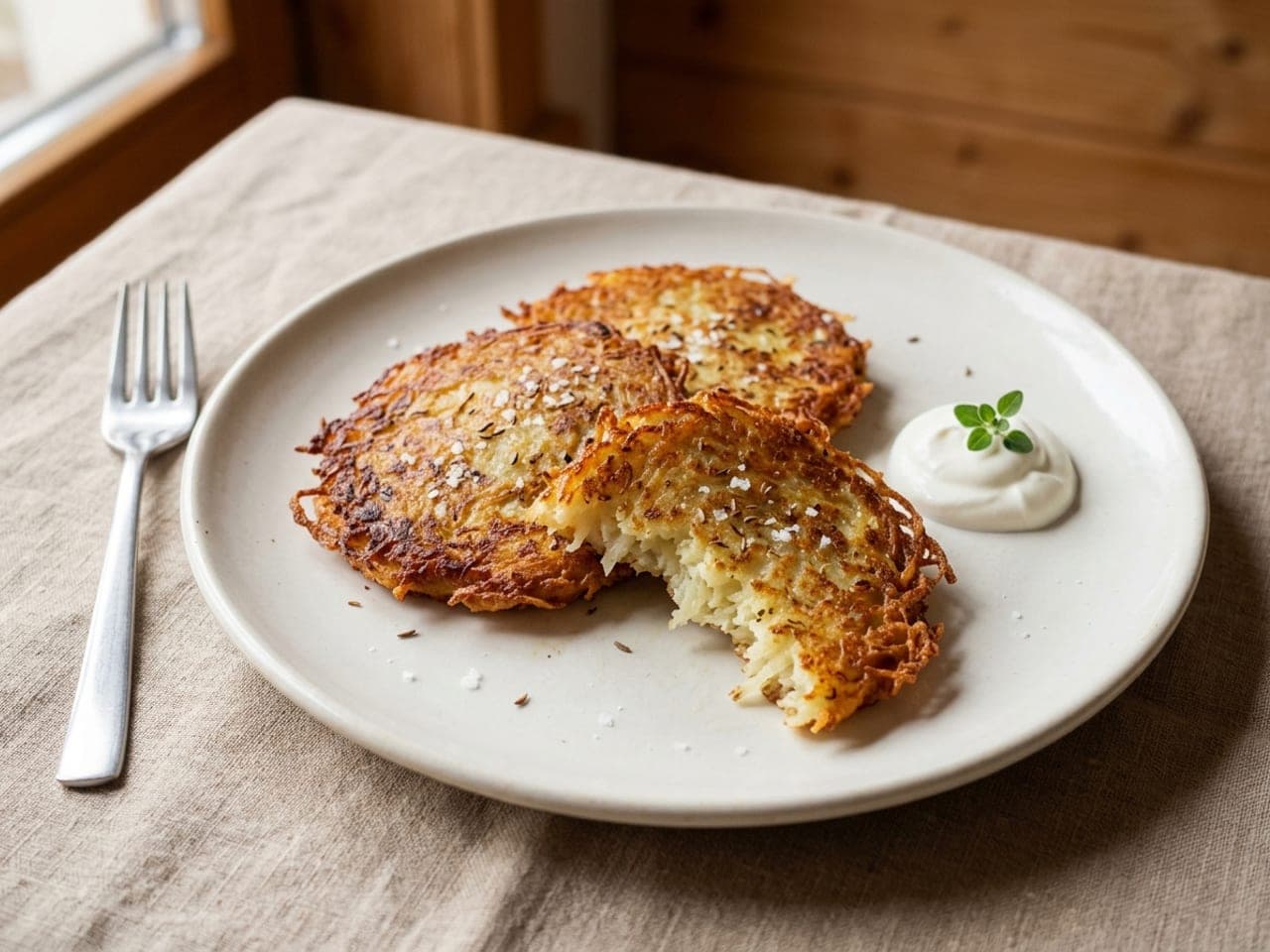
Bramborák (plural bramboráky) is the Czech potato pancake: finely grated raw potato, a little flour and egg, plenty of crushed garlic and dried marjoram, spread thin and fried until the edges turn lacy and gold. This recipe gives the numbers most recipes skip: fat about 1/8 inch (3 to 4 mm) deep at 340 to 350°F (170 to 175°C), pancakes 4 inches (10 cm) across and about 1/4 inch (5 to 6 mm) thick, 2 1/2 to 3 1/2 minutes a side. It also explains honestly why grated potato goes grey: speed, cover and the garlic and marjoram themselves do more than the famous hot milk. And a history: in 1858 a Czech “bramborák” was a man from Brandenburg, and the earliest garlic and marjoram bramboráky we found in print, from 1905, were baked in the oven and described as almost gone. Vegetarian when fried in oil. Contains egg, wheat and milk.
Ingredients
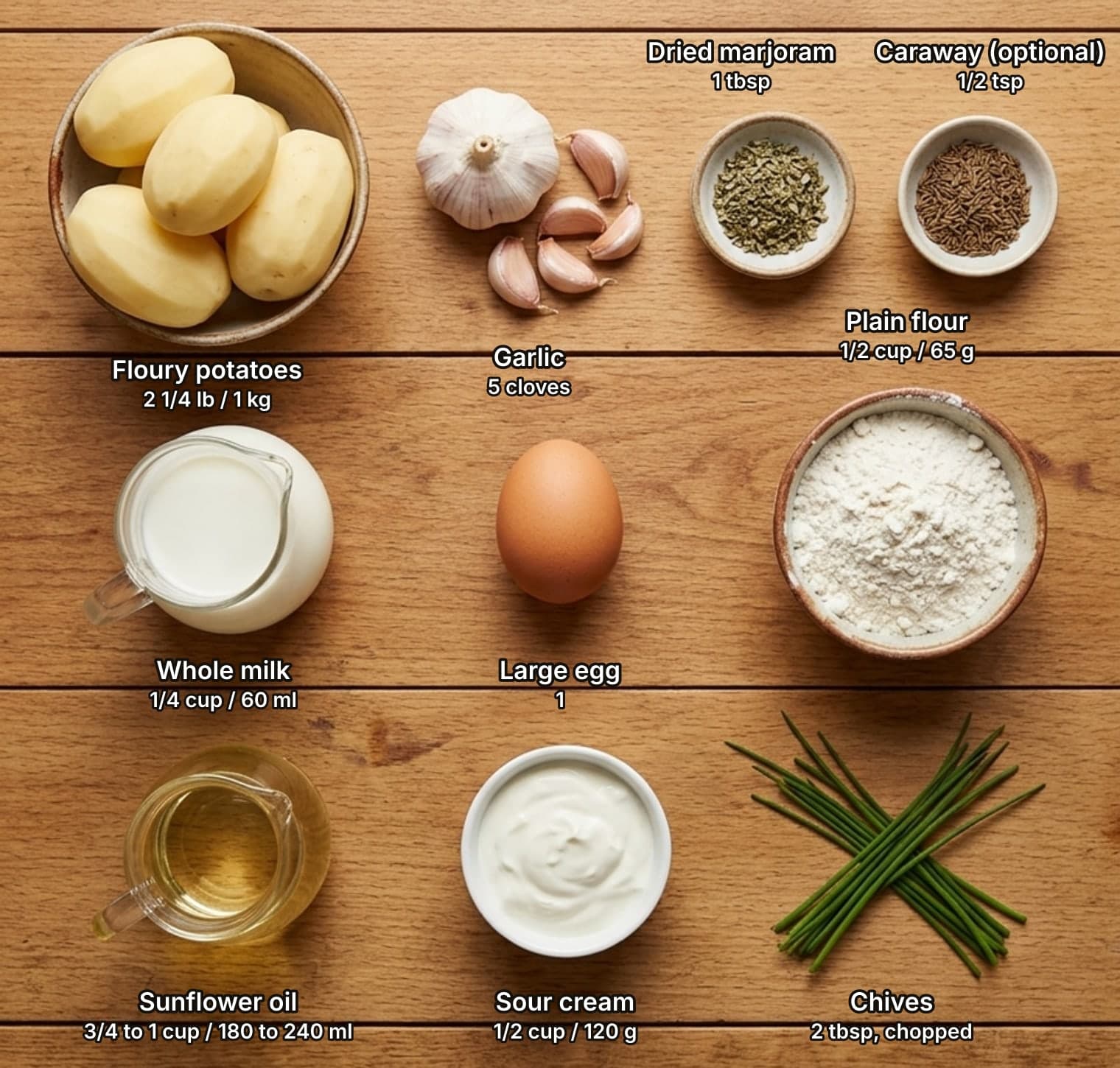
- floury potatoes (Czech cooking type C; in the US russet or Idaho, in the UK Maris Piper or King Edward; Yukon Gold works but binds less), peeled2 1/4 lb (1 kg) before peeling, about 2 lb (900 g) peeled
- garlic, crushed to a paste with a pinch of the salt (chunky mince burns on the surface and stays raw inside)5 cloves (about 15 g)
- dried marjoram, rubbed between your palms (or 3 tbsp chopped fresh)1 tbsp
- fine salt1 1/4 tsp (7.5 g)
- black pepper, freshly ground1/4 tsp
- caraway seeds, lightly crushed (optional, a common Czech addition)1/2 tsp
- whole milk, heated until steaming (optional but traditional; makes the middle more tender). Contains milk; use water or plant milk to leave it out1/4 cup (60 ml)
- large egg, beaten. Contains egg1
- all-purpose (plain) flour. Contains wheat (gluten); for gluten-free, use 2 to 3 tbsp cornstarch (cornflour) or potato starch, or 1/2 cup (65 g) buckwheat or rice flour, all labelled gluten-free (see the allergen note)1/2 cup (65 g), plus 1 to 2 tbsp if the batter is loose
- neutral oil for frying (refined sunflower or canola/rapeseed). Lard is the traditional Czech fat and tastes richer, but fried in lard the pancakes are no longer vegetarian3/4 to 1 cup (180 to 240 ml) in all, added in stages
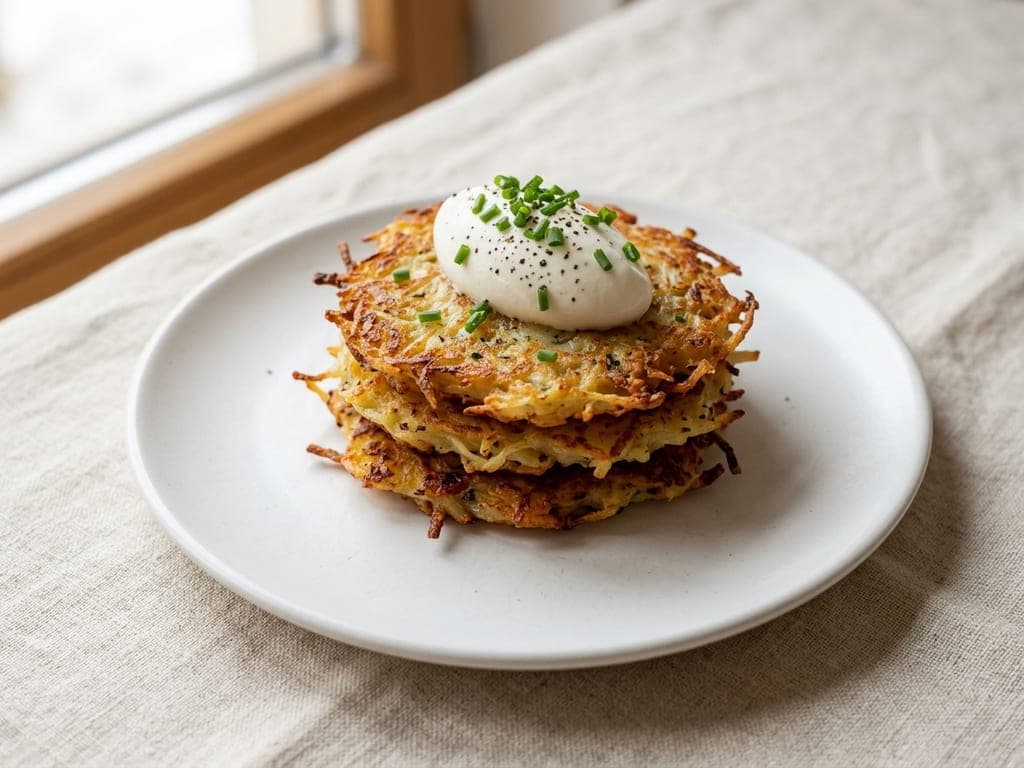
- sour cream and chopped chives, to serve (optional). Contains milk1/2 cup (120 g) sour cream, 2 tbsp chives
What bramborák is
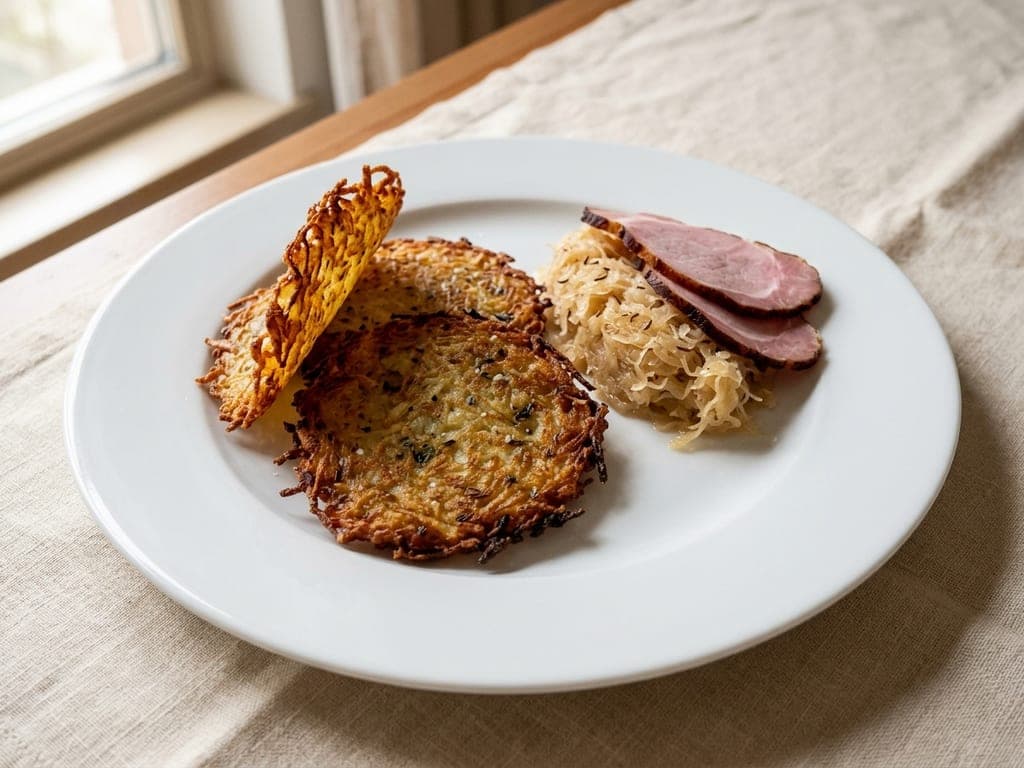
Bramborák (say BRAHM-boh-rahk, with the stress on the first syllable and a long “á”; IPA /ˈbramboraːk/) is a pancake of finely grated raw potato, bound with a little flour and egg and seasoned with garlic and marjoram, then shallow-fried until crisp. The plural is bramboráky (BRAHM-boh-rah-kee), and small ones are bramboráčky. Brambory is Czech for potatoes, so the name just means “the potato one”. Czechs eat it hot from the pan on its own, with sauerkraut and smoked meat, beside goulash, or folded around a filling.
It belongs to a big family that includes Jewish latkes, German Kartoffelpuffer and Reibekuchen, Polish placki ziemniaczane and Belarusian draniki. What makes it Czech is the seasoning: garlic and marjoram, where the Germans and Poles reach for onion (Polish cooks use marjoram only regionally) and latkes rely on onion too. It is traditionally fried in lard, served savoury rather than with apple sauce, and spread thinner than a latke.
It starts with raw potato, which sets it apart from our potato patties, their cooked-potato cousin made from boiled, mashed potato. Old Czech cookbooks had cooked-potato “bramborové placky” too, and they are a different dish.
How to make Bramborák (Czech potato pancake)
- Set everything up before you grate. Grated potato starts to darken within minutes, so do every other job first. Crush the garlic to a paste with a pinch of the salt, so it melts into the batter instead of leaving chunks that scorch, rub the marjoram between your palms over a large bowl (the friction releases its oils), and add the salt, pepper and caraway to the same bowl. Beat the egg, weigh the flour, heat the milk until it steams, and set a wire rack over a tray next to the stove, with a lid or baking sheet that covers your pan within reach. Have a sieve set over a second bowl and a clean tea towel ready. Once the potatoes are grated, the batter should be in the pan within 10 minutes, and this setup is what makes that possible.
- Grate the potatoes fine. Peel the potatoes, cutting away any green patches, and grate them on the fine side of a box grater (the small sharp teeth, not the rasp), straight into the sieve over the bowl. Fine shreds are the Czech default: they hold together in a thin pancake and cook through in minutes. Coarse shreds give a craggier, crunchier pancake a style Czechs call strouhanec, and you can do half and half if you like. Do not rinse the shreds: rinsing washes away the starch you are about to put back. Work steadily and leave them sitting in their own juice until you squeeze; the liquid shields them from air, which is what turns them grey.
- Squeeze hard and save the liquid. Tip the shreds into the tea towel, twist it closed and wring it over the bowl until barely a drip comes out. You will get a surprising amount of liquid back, roughly 3/4 to 1 1/4 cups (180 to 300 ml) from this batch by our estimate (we have not weighed it, and it varies with the potato). Wet shreds make a runny batter that needs extra flour, fries greasy and falls apart, so squeeze as hard as you can. Do not pour the liquid away yet: leave it to stand while you season, and the potato starch will settle to the bottom as a white layer.
- Season at once, then add the hot milk. Drop the squeezed shreds into the bowl with the garlic, marjoram and seasoning and toss straight away. This is more than flavour: in a 2022 lab study, garlic and marjoram extracts each cut the activity of potato polyphenol oxidase, the browning enzyme, by more than half, so mixing them in early helps slow the grey. Then pour over the steaming milk and stir. The milk keeps the middle soft and coats the shreds against air, but it does not cook the enzyme: 1/4 cup (60 ml) of milk poured over the squeezed shreds, about 1 1/2 lb (650 g), only brings the bowl to about 70 to 80°F (21 to 27°C), depending on how cool the potatoes were.
- Give the starch back, then bind. Carefully pour the brown water off the settled liquid and scrape the white starch from the bottom of the bowl into the shreds. That starch is the potatoes’ own binder, and returning it means you need less flour, which keeps the pancakes tender rather than gummy. Stir in the egg, then the flour. You want a thick, wet batter that slides slowly off a spoon and spreads without running. If liquid pools at the bottom, add flour 1 tbsp at a time; too much flour makes bramborák tough and bland, too little and it tears when you flip it.
- Heat the fat to the right temperature. Pour about 1/2 cup (120 ml) of oil or lard into a heavy 10 inch (26 cm) frying pan, or about 2/3 cup (160 ml) into a 12 inch (30 cm) pan: enough to cover the flat base about 1/8 inch (3 to 4 mm) deep with no dry spots. Pans are sold by the size of the rim; the flat base is smaller, about 8 inches (20 cm) and 9 1/2 inches (24 cm) across, and that is what the fat has to cover. Heat over medium high to 340 to 350°F (170 to 175°C): the fat shimmers, a drop of batter sizzles fiercely on contact, and nothing smokes. Hot fat matters because steam pushing out of the batter keeps oil from soaking in; batter dropped into lukewarm fat drinks it. Staying at or below 350°F (175°C) also follows the EU acrylamide advice for frying potatoes (320 to 350°F, 160 to 175°C). Stay with the pan while the fat is on the heat.
- Spread thin and fry until gold. Stir the batter (it weeps as it stands), then drop about 3 tbsp (45 ml) into the pan and spread it with the back of a spoon into a round about 4 inches (10 cm) across and about 1/4 inch (5 to 6 mm) thick, so you can almost see the pan through the edges. Fry two at a time in the 10 inch (26 cm) pan or three in the 12 inch (30 cm) pan, without letting them touch (two is a snug fit on a 10 inch pan’s base, so keep those just under 4 inches / 10 cm), for 2 1/2 to 3 1/2 minutes, until the edges are lacy, crisp and deep gold. Flip once and fry the second side the same way. Aim for deep gold, not dark brown: thin as it is, the pancake is cooked right through by then, and darker frying adds acrylamide, not flavour. The whole batch takes about 50 minutes at the stove in a 12 inch (30 cm) pan; in a 10 inch (26 cm) pan allow about 70 minutes, or run two pans side by side.
- Drain on a rack, top up the fat, eat hot. Lift each pancake onto the wire rack, tilt it for a second to shed surface fat, and blot the top with paper towels (kitchen paper) if you like. A rack beats a plate: research on fried potato shows most of the oil goes in as the food leaves the fat and cools, and a pancake lying on a plate steams its own crust soft. Top up with a splash of fat as the level drops, never past 1/4 inch (6 mm), and let it come back to temperature before every batch. Bramborák is at its best within minutes; if you must hold a batch, keep it on the rack in a 200°F (93°C) oven for no more than 20 minutes. This batter makes about 18 pancakes, four or five each, so serve them in rounds as they come out of the pan.
Safety & hygiene Important
- Hot shallow fat. Stay with the pan the whole time the fat is on the heat, and keep a lid that fits (or a baking sheet) within reach before you start. Keep the fat no deeper than about 1/4 inch (6 mm), turn pan handles inward and lower the batter in away from you: wet potato makes fat spit. Refined sunflower, canola (rapeseed) and lard all stay below their smoke points at 350°F (175°C). Whole butter (about 300°F / 150°C) and unrefined, cold-pressed seed oils such as sunflower or canola (about 225°F / 107°C) smoke well below it, so do not fry in them. If the fat smokes, take the pan off the heat. If the fat catches fire, turn off the heat if you can reach it safely and slide a metal lid or a baking sheet over the pan (or use a fire blanket). Leave it covered and on the stove until it is completely cool. Never use water, a wet or damp towel, or flour, and don’t try to carry the pan. If the fire doesn’t go out at once, get everyone out and call 911 (999 in the UK).
- Go for gold, not dark brown. Fried potato forms acrylamide, which forms in starchy food cooked above about 250°F (120°C) and increases with browning. The EU’s acrylamide regulation (2017/2158) tells food businesses to advise frying potato products at 320 to 350°F (160 to 175°C) and cooking them to a golden yellow, and the UK Food Standards Agency’s “Go for gold” advice says the same: aim for golden or lighter. For bramborák that means keeping the fat in that band, frying to deep gold and leaving any blackened lace on the plate. The FSA no longer advises against keeping raw potatoes in the fridge.
- Raw egg and holding the batter. The batter contains raw egg, so fry it promptly and cook every pancake through: at about 1/4 inch (5 to 6 mm) and these temperatures the centre is steaming hot and set when both sides are gold (USDA cooks egg dishes to 160°F / 71°C). Do not leave batter at room temperature for more than 2 hours (1 hour above 90°F / 32°C). Keep the raw-batter bowl, spoon and towel away from the cooked pancakes and ready-to-eat toppings like smoked meat and sour cream, and wash your hands with soap for 20 seconds before plating. For colour, fry within an hour of grating; if it must wait, press plastic wrap onto the surface, stir in 1 tsp vinegar or lemon juice, refrigerate and use within a few hours, squeezing off the liquid that collects.
- Leftovers, freezing and reheating. Cool leftover pancakes and refrigerate them within 2 hours (1 hour if the room is above 90°F / 32°C). The USDA allows 3 to 4 days in the fridge; the UK Food Standards Agency says to eat leftovers within 2 days. To freeze, cool completely, freeze in a single layer on a lined tray, then pack with parchment between them; quality is best within about 2 months. Reheat on a rack in a 400°F (200°C) oven for 10 to 15 minutes, in an air fryer at 350°F (175°C) for 3 to 5 minutes, or in a dry frying pan over medium heat (add a few minutes to any of these from frozen), until steaming hot all the way through: 165°F (74°C) in the middle is the USDA mark. Reheat only once (FSA). The microwave makes them soft.
- Allergens and the lard question. This recipe contains egg, wheat (gluten) and milk. It is vegetarian only when fried in vegetable oil: lard, the traditional fat, is pork. In Czech pubs and at market stalls bramboráky are often fried in lard, so vegetarians should ask. For gluten-free bramborák, replace the flour with 2 to 3 tbsp cornstarch (cornflour) or potato starch, or 1/2 cup (65 g) buckwheat or rice flour, rely on the recovered potato starch, and let the batter rest 15 minutes before frying. If you cook for someone with coeliac disease, check that every flour and starch is labelled gluten-free and fry in fresh fat. When eating out, ask: pub fryers are often shared with breaded dishes. For an egg-free version, leave out the egg and milk and add 1 to 2 tbsp potato starch; that version is milk-free too, but it still contains wheat unless you also use the gluten-free swap. Toppings and fillings such as goulash and cheese bring their own allergens.
3 ways to plate it
Why grated potato turns grey, and what actually helps
The moment you grate a potato you break open its cells, and an enzyme called polyphenol oxidase (PPO) meets the potato’s phenolic compounds and oxygen. The result is brown, grey or pinkish pigment. Finer grating breaks more cells, so a fine Czech batter colours faster than a coarse latke mix. The colour is cosmetic, and the pancake fries golden either way, but nobody wants a grey batter.
The top-ranking English recipe says hot milk “keeps the raw potato from turning gray”, and many Czech recipes pour scalding milk over the grated potato (milk is already in a printed recipe catalogued as about 1930, though it is not said to be hot); some Polish recipes do the same for placki. The arithmetic does not support the heat part. Potato PPO is happiest at room temperature to body temperature, and in one characterisation study lost only about half its activity after 12 minutes at 158°F (70°C). Pour 1/4 cup (60 ml) of steaming milk over the squeezed shreds from 2 lb (900 g) of potatoes, about 1 1/2 lb (650 g), and the bowl lands at about 70 to 80°F (21 to 27°C), depending on how cool the potatoes were; even a generous 2/3 cup (160 ml) only reaches about 88 to 95°F (31 to 35°C). A 2020 study on potato cubes found that whey protein solutions lowered PPO activity yet left the colour no different from plain water. The milk’s real job is probably to coat the shreds against air, as water would, and to make the middle tender. We keep it for the texture, not as magic.
What works at home: grate last and fry fast; keep the shreds under their own liquid until you squeeze; and stir in the garlic and marjoram the moment the shreds are squeezed. That last tip comes from a 2022 study (Bobo and colleagues, LWT) that screened 15 plant extracts against potato PPO: garlic and marjoram were both among those that cut its activity by more than half. Those were lab extracts, not cloves in a bowl, so they help slow the browning rather than stop it, but the dish’s two signature seasonings turn out to be on your side. For batter that has to wait, 1 tsp vinegar or lemon juice is a common Czech fallback.
Cooks have fought this for a long time. In 1905 F. Homolka, describing the folk food of the Říp region in the folklore journal Český lid, noted that bramboráky “must be eaten hot, because when it cools, it turns blue” (“Musí se pojídati horké, protože když vystydne, zmodrá”). That is probably a second, different reaction: after cooking, iron and chlorogenic acid in the potato form a complex that darkens to blue grey as it meets air, which potato scientists call after-cooking darkening. The cure is the same one Homolka gave: eat them hot.
The frying numbers
Most bramborák recipes stop at “fry until golden, 2 to 3 minutes”. Here are the numbers behind that. Fat: lard or neutral oil about 1/8 inch (3 to 4 mm) deep over the pan’s flat base, which is smaller than the size on the label: about 1/2 cup (120 ml) in a 10 inch (26 cm) pan or 2/3 cup (160 ml) in a 12 inch (30 cm) pan, topped up between batches but never past 1/4 inch (6 mm). Temperature: 340 to 350°F (170 to 175°C), inside the EU’s 320 to 350°F (160 to 175°C) frying band. Size: about 3 tbsp (45 ml) of batter spread to 4 inches (10 cm) across and about 1/4 inch (5 to 6 mm) thick, two at a time in the smaller pan or three in the larger. Time: 2 1/2 to 3 1/2 minutes a side, until deep gold.
Thin is the point. A thin pancake is mostly crust and lacy edge, with a soft middle that cooks through in the time it takes the outside to colour. Make it 1/2 inch (1.3 cm) thick, like a latke, and you need much longer in the fat to cook the middle; the outside browns further and the pancake soaks up more oil. The oldest fried recipe we found, in a growers’ brochure catalogued as about 1930 (the date is a library estimate), already asked for pancakes about 1/2 cm thick.
Greasy pancakes mean the fat was not hot enough, the pan was crowded and cooled, or the pancakes sat on a plate instead of a rack. Soggy ones are too thick, too wet or held too long. If they fall apart, the shreds were not squeezed hard enough, the potatoes were waxy, or you flipped before the crust set: squeeze harder, return the starch and add flour a spoonful at a time. Tough, bland bramboráky have too much flour and too little garlic and marjoram.
A word with many meanings: the real history
In print, a “bramborák” was a person before it was a pancake. Czech brambory comes from Brandenburg, and most Czech etymological dictionaries agree on that origin. In 1956 the linguist Antonín Frinta traced the Czech form brambor, with its -mb-, to villagers’ contact with Lower Sorbian-speaking soldiers on the Prussian side during the so-called Potato War of 1778 to 1779 (Lower Sorbian calls Brandenburg “Bramborska”), and the word is in writing from 1788. In 1858 a serialized story in the magazine Lumír used “Bramborák” for a Brandenburger, in a phrase about Czech names “on which an honest Brandenburger would break his teeth” (“jimž by si poctivý Bramborák zuby vylámal”). By 1880 Národní listy was warning of a dangerous potato beetle “called bramborák” (an 1892 Czech-German dictionary glosses the word as the Colorado beetle), and in the 1900s it was also a wicker potato basket, sold by the hundred in trade ads.
The earliest use for the dish we found is in Zlatá Praha on 11 December 1885, in Baron Josef Krušina of Švamberk’s notes on mountain cooking in the Krkonoše foothills. The batter is grated raw potato, a little flour, salt, and “whoever can afford it adds an egg” (“kdo může, dá i nějaké vejce”). Cakes called halušky or sejkory were cooked on the stove top like griddle cakes and greased afterwards, and the same batter was baked in a greased roasting pan as vaček. The dish, he wrote, had “almost as many names as there are villages in the district”; in the village of Hamroky, one of them was bramborák.
In 1892 the folklore journal Český lid described sejkory spread straight onto the bare iron stove plate, with no fat, egg, garlic or marjoram, and greased only after cooking. The earliest garlic and marjoram bramboráky we found are in the same journal in 1905, where Homolka describes the Říp region north of Prague: raw potato, flour, garlic, pepper, marjoram, salt and cracklings, “put in the oven and baked gently”. He called the dish “rarer, now almost never met with” (“Vzácnějším, nyní již téměř se nevyskytujícím”). A cooks’ union recipe book catalogued as about 1925 still bakes its “bramborák” in a pan in the oven, though from boiled potatoes, with marjoram, garlic and milk. The earliest individual fried pancakes under the name we found are in a vegetable and potato growers’ brochure catalogued as about 1930 (a library estimate): fry in fat “as placky about 1/2 cm thick”, with milk, garlic and marjoram and no egg.
That rewrites two stories you will read elsewhere. Radio Prague’s English service wrote in 2020 that the dish “became widespread from the moment potatoes first started to be grown in Europe”, but Magdalena Dobromila Rettigová’s cookbooks of 1826 and 1844, the foundation of Czech home cooking, have no raw potato pancake at all, and in 1905 a contributor to the folklore journal Český lid called it almost gone. A Czech-American recipe site says the original bramborák had no eggs and was baked in the oven, which is half right: oven-baked and eggless versions are documented, but the stove-top pancake existed alongside them in 1885, and the site gives no source.
At least 32 names
Radio Prague says the dish has “at least 32 different regional names”, and our own reading of the dialect sources supports that count. Combining Czech Wikipedia, the Czech Academy of Sciences dialect dictionary, a 2024 study of potato names and the old texts above, we find about that many distinct Czech names for the pancake itself; the list grows only if you add spelling variants, Slovak names and related dishes. Cmunda is the best known, and it is not only South Bohemian: the dialect dictionary records it across Bohemia and, as cmnda, in central Moravia. Plzeň says vošouch, Těšín Silesia stryk, the Krkonoše foothills and Podještědí bandorák and, in 1885, václavík, natáhlík, branc, fofrovanec, macek and strouhanec, all in one district. Elsewhere you will meet kramflek, kostrbák, křapáč, mrzák, pampuch, placek, prskanec, toč, trinčka, jabkanec, japčák and pokruta, among others.
Some names are really different dishes. Sejkory are cooked dry on the stove plate. A bác or bramborová buchta is baked in a tray. Kaplická cmunda, from Kaplice in South Bohemia, is a bramborák served with sauerkraut and smoked meat, which brings us to the plate.
How Czechs eat it, and the goulash-filled bramborák
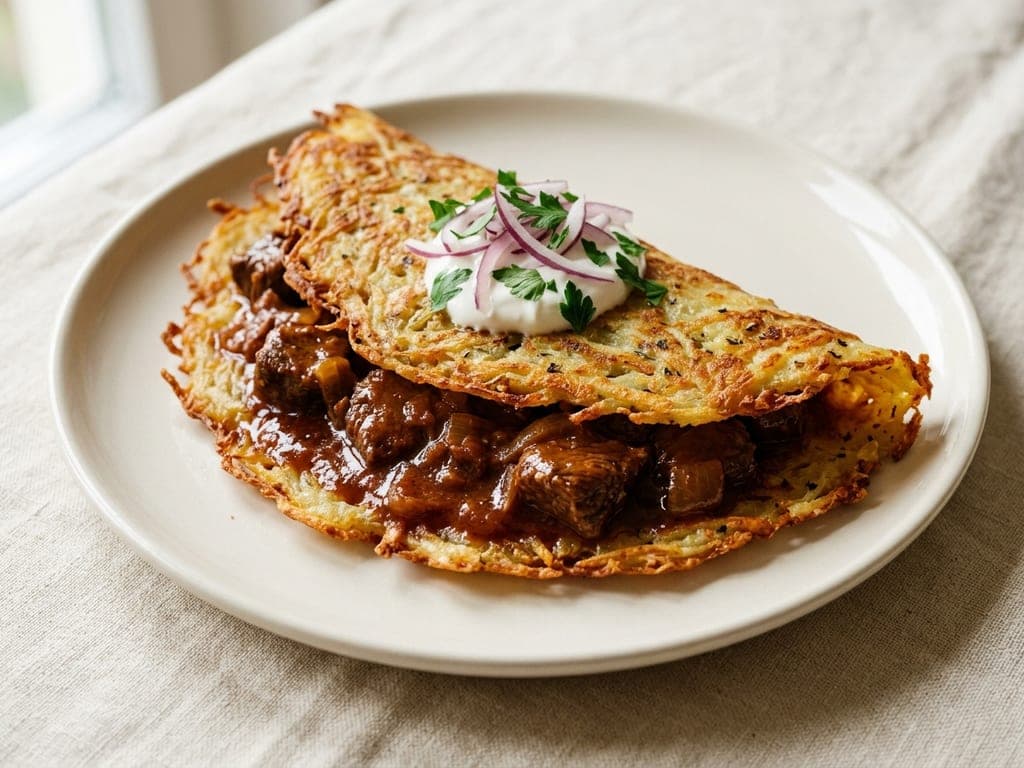
At home bramborák is often a meal in itself, eaten hot from the pan, maybe with sour cream. In pubs it comes with braised sauerkraut and smoked meat, as small bramboráčky beside beef goulash in place of dumplings, or as a wrapper. Radio Prague lists pancakes rolled around katův šleh (“executioner’s mix”, spicy pork strips), filled with Hermelín (the Czech Camembert-style cheese) or with pungent Olomoucké tvarůžky. Havířský and slezský řízek go further and coat a pork escalope in bramborák batter.
The plněný (filled) bramborák folded over goulash is now a fixture at Czech fairs and potato festivals, but we could not find a dated source for when it became fair food. It is often presented as old; we treat its history as unverified and most likely recent. The nearest documented relative is Polish placki po węgiersku, potato pancakes served with goulash.
Honest numbers: calories and the lard question
A serving, four or five pancakes, comes to about 430 kcal. The arithmetic, from USDA data: 2 lb (900 g) peeled potato 693 kcal, 1/2 cup (65 g) flour 237, one large egg 72, garlic 22, 1/4 cup (60 ml) whole milk 37 and marjoram 5, for 1,066 kcal before frying. Thin pancakes absorb fat; we estimate about 2 1/2 oz (75 g) across the batch, another 663 kcal. That makes about 1,730 kcal, or roughly 430 kcal a serving with about 21 g fat, 54 g carbohydrate and 9 g protein. As a cross-check, USDA’s generic potato pancake (268 kcal per 100 g) times a 5 1/2 oz (160 g) serving gives 429. Sodium is about 765 mg a serving, almost all from the salt (1 1/4 tsp fine salt is about 2,900 mg for the batch). Sour cream and chives add about 60 kcal a serving.
Lard is the traditional fat, and Czech cooks will tell you it tastes better; it has a similar calorie count to oil. It is pork fat, though, so this page fries in oil to keep the pancakes vegetarian. Use lard if you want the pub flavour, and know that it is then no longer a vegetarian dish.
Questions, answered
What is bramborák and how do you pronounce it?
Bramborák is the Czech potato pancake: finely grated raw potato with a little flour and egg, crushed garlic and dried marjoram, fried thin and crisp in lard or oil. Say BRAHM-boh-rahk, stressing the first syllable and holding the “á”. The plural is bramboráky (BRAHM-boh-rah-kee), and small ones are bramboráčky.
Why do Czech recipes pour hot milk over the potatoes?
Tradition says hot milk stops the potato going grey and keeps the middle tender. The tender middle is real. The anti-browning effect is mostly the milk coating the shreds against air, not the heat: 1/4 cup (60 ml) of steaming milk over the squeezed shreds from 2 lb (900 g) of potatoes only warms the bowl to about 70 to 80°F (21 to 27°C), far below what slows the browning enzyme much. In a study on potato cubes, whey solutions kept the colour no better than plain water. Keep the milk if you like the texture, and rely on speed for the colour.
Why does grated potato turn grey or brown, and how do I stop it?
Grating releases an enzyme (polyphenol oxidase) that reacts with air and the potato’s phenolics to make brown, grey or pink pigments. Grate last, leave the shreds in their own juice until you squeeze, mix in the garlic and marjoram immediately (both cut potato PPO activity by more than half as lab extracts, so they help slow it), and fry within the hour. If the batter must wait, stir in 1 tsp vinegar or lemon juice and press plastic wrap onto the surface. A slightly grey batter still fries gold.
Which potatoes are best for bramborák?
Floury, starchy potatoes: Czech cooking type C, which means russet or Idaho in the US and Maris Piper or King Edward in the UK. Their starch binds the batter so you need less flour. All-purpose potatoes like Yukon Gold work with a little more flour. Avoid waxy salad potatoes (type A), which make a loose batter that falls apart.
Should you squeeze the liquid out of grated potatoes for bramborák?
Yes, hard, in a clean tea towel. Wet shreds make a runny batter that needs more flour and fries greasy. But keep the liquid for a few minutes: the potato starch settles to the bottom, and once you pour off the water you can scrape that starch back into the batter as a natural binder. One Czech recipe site does exactly this, and good latke recipes keep it too; the English-language bramborák recipes we read pour it away.
How hot should the oil be for bramborák, and how long do you fry it?
Heat lard or neutral oil about 1/8 inch (3 to 4 mm) deep (about 1/2 cup / 120 ml in a 10 inch / 26 cm pan) to 340 to 350°F (170 to 175°C), where a drop of batter sizzles at once. Spread about 3 tbsp (45 ml) of batter to about 1/4 inch (5 to 6 mm) thick and 4 inches (10 cm) across, and fry 2 1/2 to 3 1/2 minutes a side until deep gold. Thicker pancakes, 1/2 inch (1.3 cm) or more, are latke territory: they need much longer and absorb more fat.
Why is my bramborák greasy, soggy or falling apart?
Greasy: the fat was too cool, the pan was overcrowded, or the pancakes drained on a plate rather than a rack. Soggy: too thick, too wet, or held too long. Falling apart: under-squeezed shreds, waxy potatoes, too little flour, or flipping before the crust set. Tough and bland: too much flour, too little garlic and marjoram.
Can you make bramborák batter ahead, freeze or reheat it?
The batter is best fried within an hour: it greys and weeps as it stands. If it has to wait, add 1 tsp vinegar or lemon juice, cover the surface, refrigerate and use within a few hours (and never leave it out more than 2 hours, or 1 hour above 90°F / 32°C). Fried pancakes keep 3 to 4 days in the fridge by USDA guidance (2 days by the UK FSA) and freeze well for about 2 months. Reheat once, on a rack at 400°F (200°C) for 10 to 15 minutes or in an air fryer at 350°F (175°C) for 3 to 5 minutes, until steaming hot all the way through (165°F / 74°C). Avoid the microwave.
What do you serve with bramborák?
On its own with sour cream; with braised sauerkraut and smoked meat (the South Bohemian Kaplice cmunda); as small pancakes beside beef goulash; or folded around a filling such as goulash, spicy katův šleh, Hermelín cheese or Olomoucké tvarůžky. A cold beer is the usual drink.
What is the difference between bramborák and latkes or Kartoffelpuffer?
All three are raw grated potato pancakes. Bramborák is seasoned with garlic and marjoram, spread thin, traditionally fried in lard and eaten savoury. Latkes are usually seasoned with onion, are often thicker, are fried in oil for Hanukkah and come with apple sauce or sour cream. German Kartoffelpuffer or Reibekuchen use onion, sometimes nutmeg and parsley, and are often eaten sweet with apple sauce. Swiss rösti is a single shredded potato cake fried in butter, usually with no egg, flour, garlic or marjoram.
Is bramborák vegetarian or gluten-free?
It is vegetarian when fried in vegetable oil, as here, but not when fried in lard, which is traditional and common in Czech pubs, so ask when eating out. It is not gluten-free as written; swap the flour for 2 to 3 tbsp cornstarch (cornflour) or potato starch, or 1/2 cup (65 g) buckwheat or rice flour, all labelled gluten-free, and rest the batter 15 minutes. For coeliacs, fry in fresh fat, and ask when eating out: pub fryers are often shared with breaded dishes.
Snap your finished plate and let the AI plate it again — more beautifully.