Marinated Hermelín (pickled soft Camembert-style cheese)
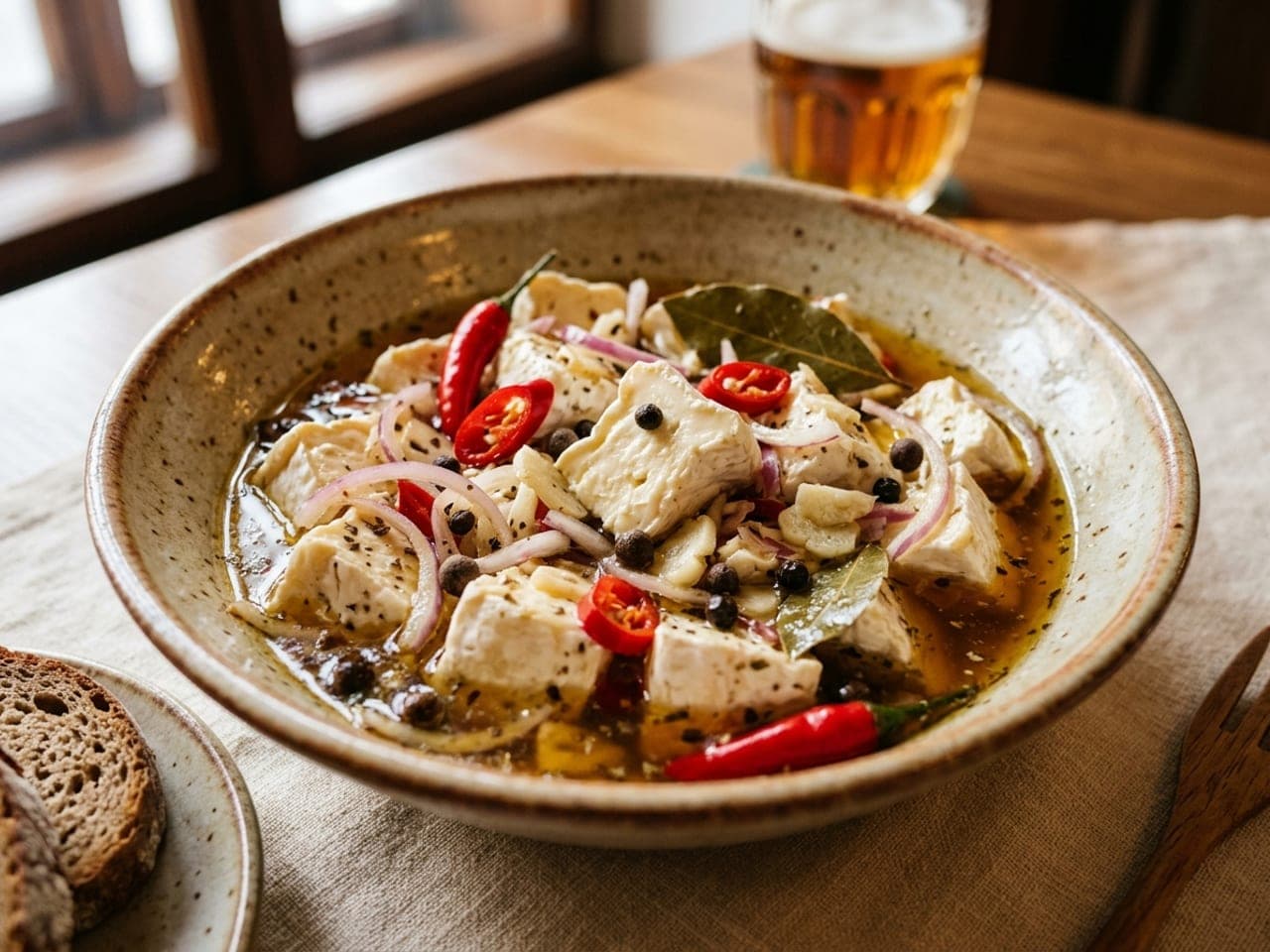
Nakládaný hermelín: soft Camembert-style cheese marinated in oil with garlic, chilli and allspice, then served under fresh onion rings; a much-loved Czech pub starter for four.
About 4 days
Time (20 min active)
4
Servings
320
Kcal
Ingredients
- Hermelín (Camembert-style cheese)2 pcs
- vegetable oil300 ml
- onion, sliced fresh at serving (not in the jar)1
- whole dried red chillies (not fresh)1 to 2
- garlic, chopped no larger than 1/4 inch (6 mm) and acidified (see method)2 medium cloves (about 1/3 oz / 10 g)
- allspice4 pcs
- bay leaf2 pcs
- citric acid powder (canning aisle or pharmacy; not ascorbic acid)1 tsp (5 g)
- warm water, for the citric acid solution2/3 cup (160 ml)
How to make Marinated Hermelín (pickled soft Camembert-style cheese)
- Acidify the garlic (the day before). Stir 1 tsp (5 g) citric acid powder into 2/3 cup (160 ml) warm water until it has completely dissolved; this is a 3% solution. Peel the garlic and chop it into pieces no larger than 1/4 inch (6 mm), because slices and whole cloves do not acidify all the way through. Weigh the chopped garlic and cover it with exactly three times its weight of the solution: for 2 medium cloves (about 1/3 oz / 10 g) that is 2 tbsp (30 ml). Cover and leave at room temperature for 24 hours, then drain well. Lemon juice and vinegar have not been tested for this and cannot replace the citric acid. If some pieces turn blue, that is harmless.
- Slice the cheese. Check the use-by date first: the cheese must still be in date on day 10, when the jar has to be finished. Cut each hermelín horizontally through the middle so you have four equal halves, or slice each wheel into thick rounds if you prefer more surface area for the marinade to work into.
- Layer the jar. Use a clean, completely dry, wide-mouthed jar or deep lidded container. Arrange a layer of cheese, then scatter over some of the drained garlic, a crumbled dried chilli, a bay leaf and a couple of allspice berries. Repeat the layers until everything is in. Keep the onion out of the jar: there is no tested way to make raw onion or fresh chilli safe for days under oil, so the onion goes on fresh at the table.
- Cover with oil. Pour the vegetable oil over the layers until the cheese is covered by at least 1/2 inch (1 cm), and press out any air pockets with a clean spoon. The oil carries the flavour and stops the cheese drying out, but it does not preserve anything: shutting out the air is exactly what botulism bacteria like, so the cold fridge and the 10-day limit are what keep this jar safe.
- Marinate in the fridge. Seal the jar, write today’s date and a discard date 10 days later on the lid, and refrigerate at 40°F (4°C) or colder, on a shelf rather than in the door. Marinate for at least 3 to 4 days; about a week gives the deeper, more rounded flavour and a creamy centre. Eat everything by day 10 and throw away whatever is left. The oil will solidify slightly in the cold, which is normal.
- Bring to room temperature. With a clean fork, lift out only the pieces you are going to eat and leave them on the plate for 30 to 60 minutes so the oil loosens and the cheese softens back to its creamy texture. Put the jar straight back in the fridge, and never return cheese that has been out.
- Plate and serve. Slice the onion into thin rings. Spoon a little of the marinating oil, garlic and chilli over the cheese, top with the fresh onion rings and serve with crusty bread or rye bread as a classic Czech pub starter.
Safety & hygiene Important
- Garlic, onion and chilli in oil. Raw garlic and other fresh vegetables kept under oil are a known cause of botulism, and US extension services limit homemade mixtures to 4 days in the fridge. Chopping the garlic and soaking it for 24 hours in 3% citric acid makes it too acidic for Clostridium botulinum to grow (the tested University of Idaho and University of California method). No home method has been tested for onion or fresh chilli, so this recipe uses dried chilli in the jar and fresh onion only at the table.
- Eat within 10 days. Hermelín itself is a moist, low-acid cheese, and under oil it sits without air, like vacuum-packed chilled food. UK food-safety guidance limits such foods to 10 days in the fridge unless they have extra protection, which a soft cheese does not. Finish the jar within 10 days of making it, and before the cheese’s own use-by date if that comes first. Never add fresh cheese to an old jar to keep it going.
- Keep it at 40°F (4°C) or colder. Keep the jar in the fridge the whole time, at 40°F (4°C) or colder. Many home fridges run warmer than their dial suggests, so check yours with a fridge thermometer, and keep the jar off the door shelf. Take out only what you will eat, and do not leave served cheese at room temperature for more than 2 hours.
- Keep it covered and clean. Keep the cheese completely covered by oil so no surface dries out or grows mould, topping up with a little more oil if the level drops, and use a clean, dry fork every time. Throw the jar away if the oil turns cloudy or bubbly, the lid bulges, or anything smells sour or off. Botulism toxin cannot be seen, smelled or tasted, though, so the date on the lid decides, not the look of the jar.
- The pregnant or high-risk guest. Hermelín is a mould-ripened soft cheese with a white rind, the Czech cousin of camembert, and this dish is eaten cold. That makes it one to leave off the plate for anyone pregnant or at higher risk of listeriosis: older people and anyone with a weakened immune system. UK and US advice get there differently. The NHS says mould-ripened soft cheeses such as brie and camembert, pasteurised or not, must be thoroughly cooked until steaming hot in pregnancy. The FDA’s line is the label: soft cheeses such as brie and camembert only if made with pasteurized milk (almost all hermelín is), while the CDC lists raw-milk brie and camembert as riskier and gives pasteurized soft cheese heated to 165°F (74°C), or until steaming hot, as the safer choice. Hermelín served hot, grilled or fried until steaming, meets both. Listeria also keeps growing slowly in the fridge, one more reason for the 10-day limit. (Not medical advice: a clinician’s narrower list wins.)
Made it? Re-plate your dish →
Snap your finished plate and let the AI plate it again — more beautifully.