Quesabirria Tacos (Crispy Cheese-Skirt Method)
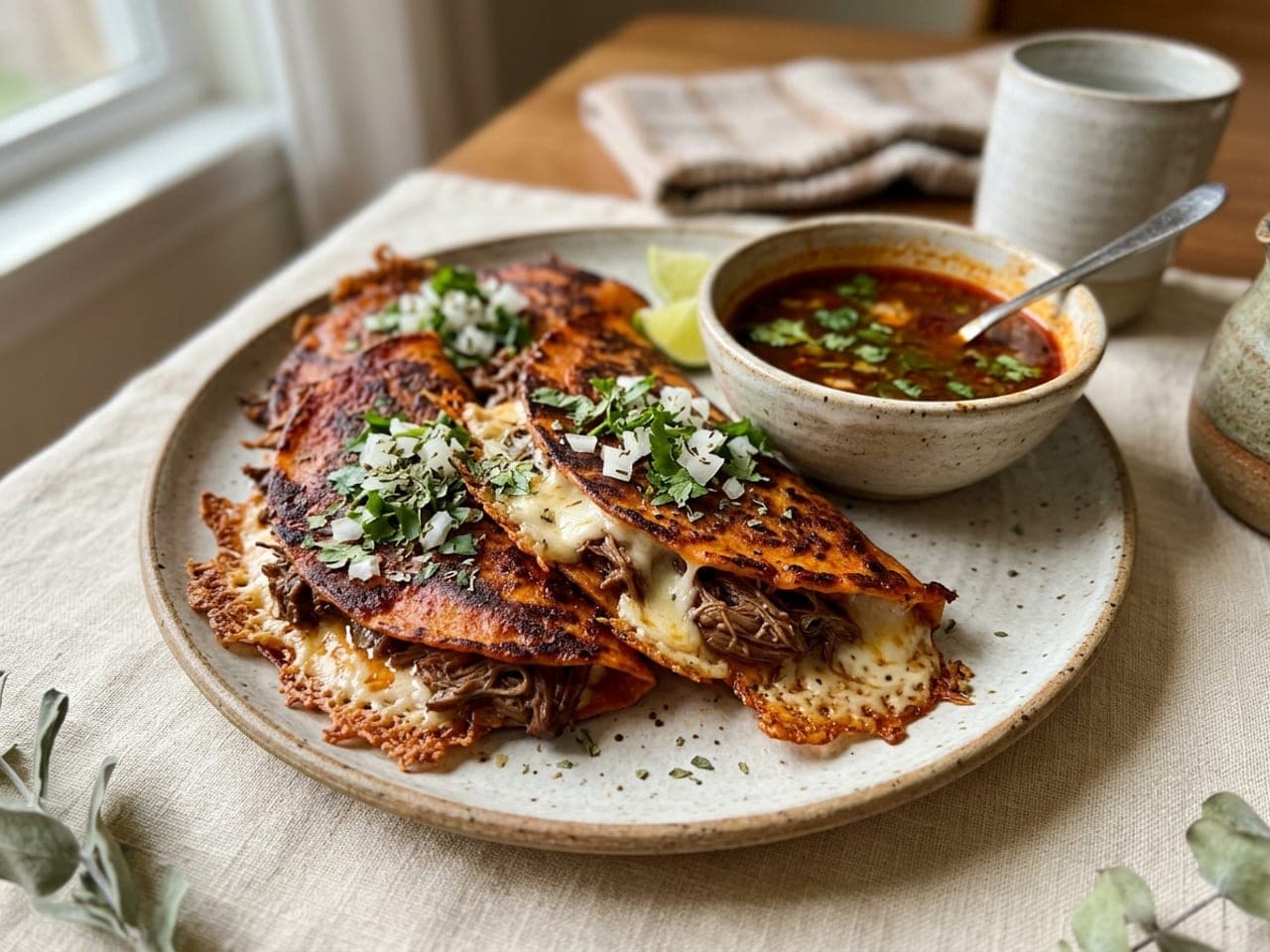
The taco-quesadilla cross from Tijuana: tortillas wiped through red consommé fat, griddled with Oaxaca cheese and shredded birria until crisp and lacquered — with a deliberate lacy cheese skirt, because if cheese is going to escape, it should escape on purpose.
Ingredients
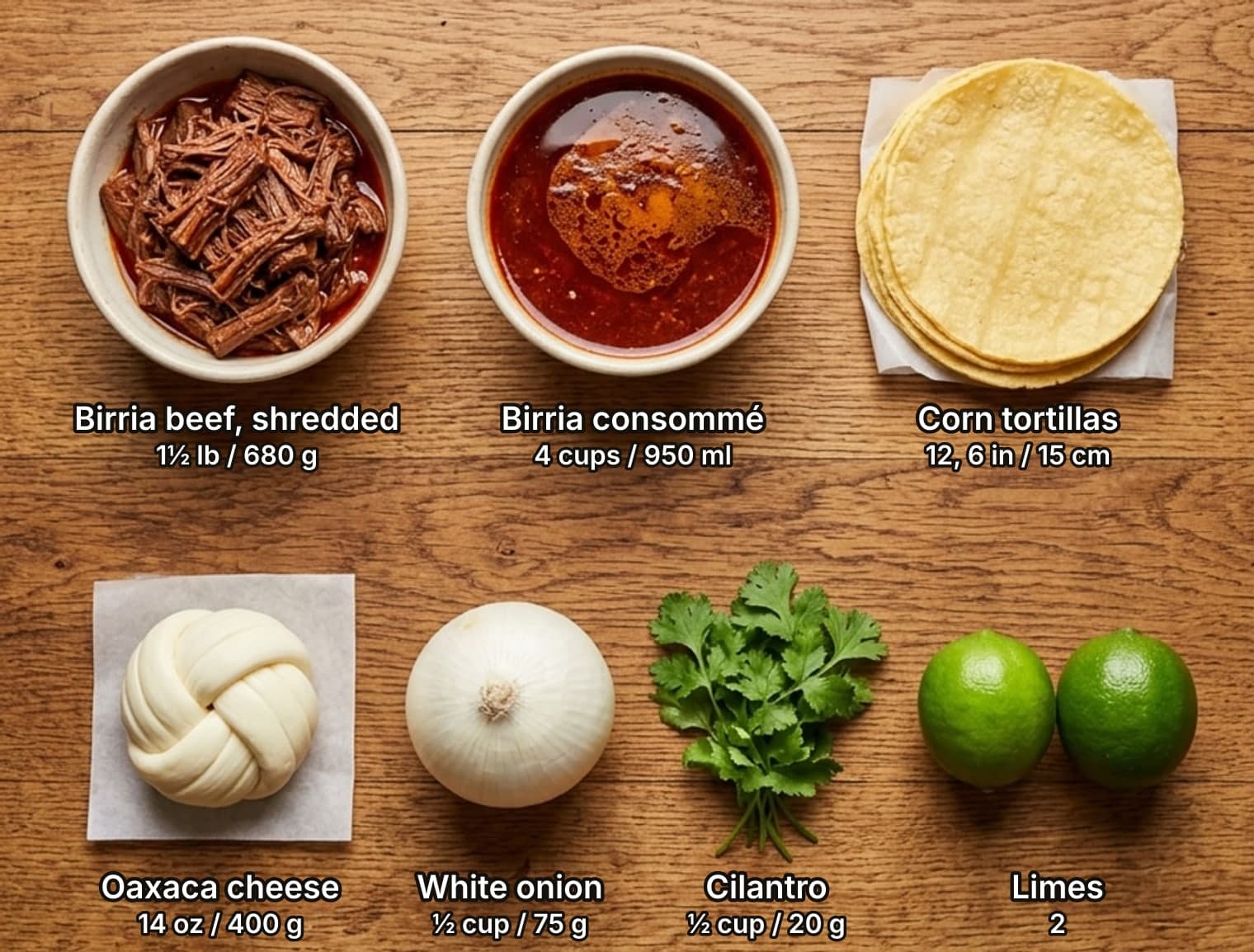
- cooked birria beef, shredded (see linked recipe)1½ lb / 680 g
- birria consommé, with its red fat cap (see linked recipe)4 cups / 950 ml
- corn tortillas, 6-inch (15 cm)12
- Oaxaca cheese (or block low-moisture mozzarella), grated14 oz / 400 g incl. the skirts
- white onion, finely diced, to serve½ cup / 75 g
- cilantro (fresh coriander), chopped, to serve½ cup / 20 g
- limes, in wedges2
Why this recipe works
The dip decides everything. Most versions online dunk the tortilla in the whole consommé; the original Tijuana move — and this recipe’s — is to dip in the skimmed red fat only. Fat fries; broth soaks. That single substitution is the difference between a shell that crackles and one that flops, and it costs nothing but a ladle and a shallow bowl.
The per-taco spec, since nobody publishes one: a 6-inch (15 cm) corn tortilla, 1 oz (28 g) of Oaxaca, 2 oz (55 g) of shredded beef, medium pan at about 350°F (175°C), 2–3 minutes a side. For the full dozen this card makes, that’s 12 oz (340 g) of cheese in the fills plus a little more for the skirts, and 1½ lb (680 g) of cooked beef. Weigh the first taco’s portions; eyeball the rest forever.
Cheese goes on the tortilla before the beef, not after — it melts against the hot surface and welds the filling in place, so the fold holds and the flip doesn’t shed. Corn tortillas only: flour soaks the fat instead of frying in it and tears under the weight.
How to make Quesabirria tacos
- Skim the red fat. Ladle the chile-stained fat from the top of your birria pot into a shallow bowl — you want 6–8 tablespoons. This is the authentic dip: fat fries the tortilla crisp and red, where the watery broth beneath it would only soak it. If the birria came out of the fridge, even easier — lift the solidified red cap straight off and melt it in the bowl.
- Warm and sauce the beef. Warm 1½ lb (680 g) of shredded birria beef with a splash of consommé so it’s glossy, not dry — juicy filling is half the taco. Keep it covered by the stove; assembly moves fast once the pan is hot.
- Heat the pan to a true medium. A large cast-iron skillet, griddle or comal over medium heat — about 350°F (175°C) on the surface, where a drop of water sizzles busily but doesn’t instantly vanish. Hotter than that burns the chile fat before the cheese melts; cooler steams the tortilla.
- Dip and lay. With tongs, wipe one side of a corn tortilla through the red fat and lay it fat-side down in the pan. It should murmur, not roar. Work three at a time, no more — crowding drops the pan’s temperature and the shells go leathery instead of crisp.
- Cheese first, then beef. Immediately scatter 1 oz (28 g) of Oaxaca cheese over the whole tortilla, then pile 2 oz (55 g) of warm beef on one half. Cheese goes down first on purpose: it melts against the hot tortilla and glues the meat in place when you fold.
- Build the cheese skirt. Here is the move nobody writes down: drop a small extra pinch of cheese onto the bare pan right beside each taco, then fold the tortilla into a half-moon so its edge lands on the melting pool. It fries into a lacy, golden skirt attached to the taco’s rim — the costra. It looks like a cheat and tastes like the best part.
- Press, flip, crisp. Press the folded taco gently with the spatula and give it 2–3 minutes a side, until the shell is deep red-brown, crackly, and the skirt has gone from lace-white to golden. One confident flip is all it needs.
- Rest, then serve with consommé. Give the tacos 1–2 minutes on a rack — the inside is molten in the literal sense — while you ladle hot consommé into cups and top them with diced white onion and cilantro (fresh coriander). Cup beside plate, lime wedge on the rim, and dip from the first bite.
Safety & hygiene Important
- The fat is hot and it stains. The skimmed red fat sits near 200°F (93°C) — dip tortillas with tongs, never fingers, and use a shallow bowl rather than reaching into the stock pot. It also dyes fabric on contact; today is an apron day.
- Splatter control. A fat-wiped tortilla meeting cast iron spits. Keep the pan at medium — not high — lay tortillas down away from yourself, and let excess fat drip back into the bowl for a second before the tortilla lands.
- Molten cheese burns. The shell cools faster than the inside — the cheese stays scalding a good minute after the taco feels touchable, the same physics as the roof-of-mouth pizza burn. Rest the tacos 1–2 minutes and warn the impatient.
- Storing and reheating. Store leftover tacos and consommé separately, refrigerated within 2 hours. Reheat the consommé to a full boil — comfortably past 165°F (74°C) — and re-crisp the shells dry: a medium skillet or an air fryer at 300°F (149°C) for 8–10 minutes. The microwave un-crisps everything you worked for.
3 ways to plate it
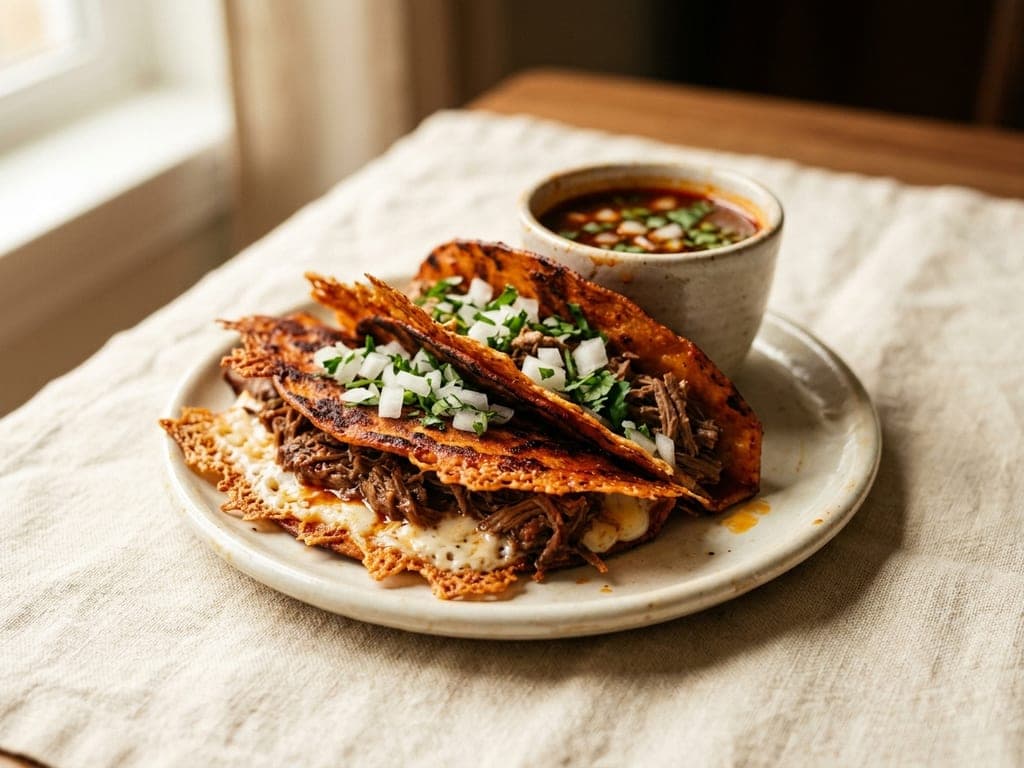
- Lean the tacos against each other with the skirted edges facing the eater — the lace is the hero, not the fold.
- Keep the garnish on top light: a pinch of onion and cilantro along the crest, nothing that hides the shell.
- Set the consommé cup behind the tacos, not in front — this plate’s first read is the crisp, the dip comes second.
- Serve within minutes; a skirt stays lacy about as long as a soufflé stays tall.
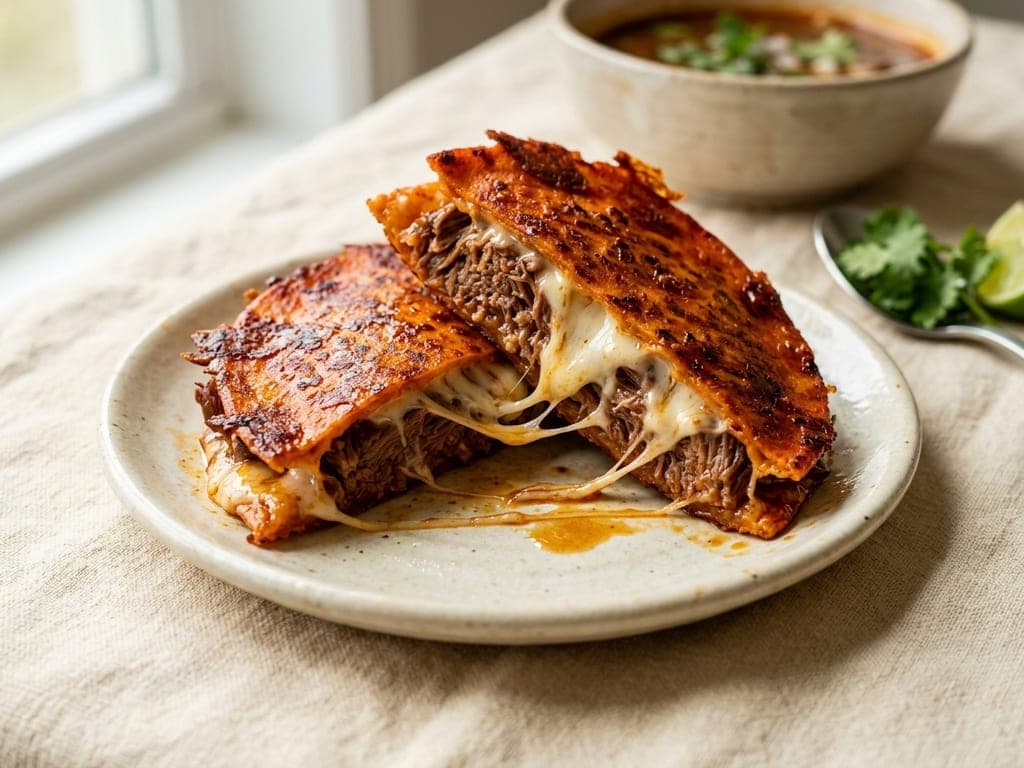
- Rest the taco one minute so the cheese thickens from liquid to stretchy, then cut it in half with one firm stroke.
- Pull the halves apart slowly and let the cheese strands drop onto the plate — arranged mess, the best kind.
- Lean one half on the other, both cut faces toward the front.
- Wipe the rim, leave the cheese strands, serve immediately.
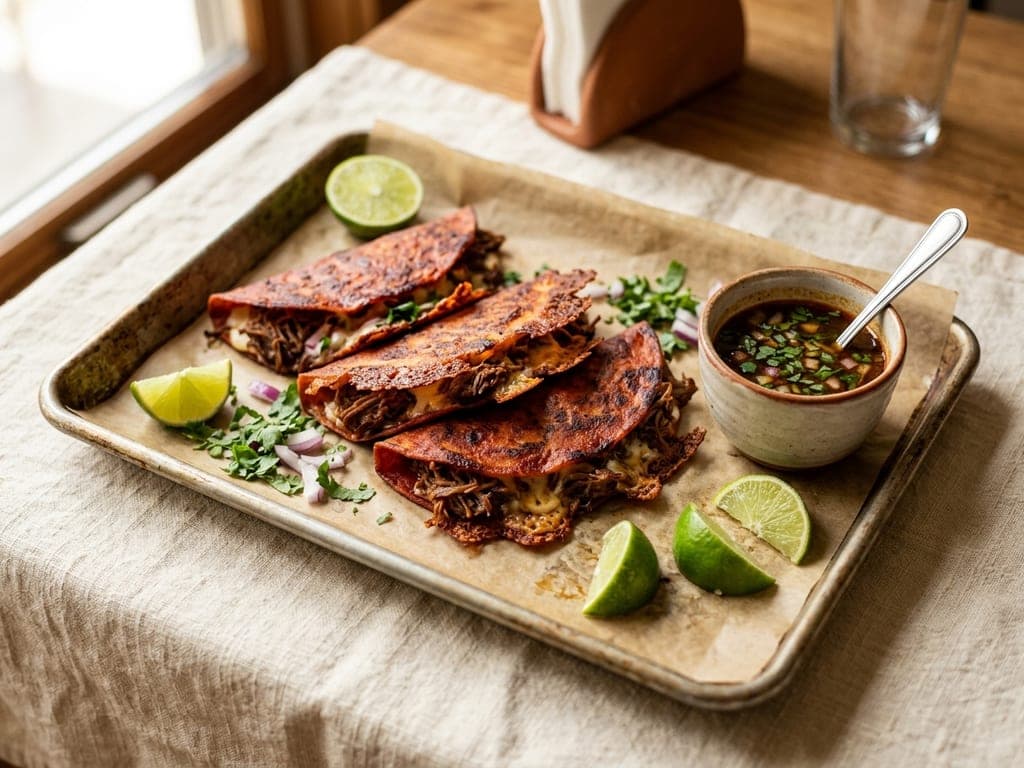
- Line a small metal tray with parchment — the grease spots it collects are part of the presentation’s honesty.
- Lay the tacos in a slightly overlapping row, skirts up, and scatter onion and cilantro across all three in one pass.
- Wedge the consommé cup into a corner of the tray with a spoon in it, and tuck lime wedges into the gaps.
- Serve the tray whole — no plates. Paper napkins, plenty of them, and no apologies.
The cheese question
Oaxaca is the cheese: a Mexican string cheese that melts into long, glossy pulls without turning greasy. Outside North America it can be genuinely hard to find, and the right substitute is block low-moisture mozzarella — the firm pizza kind, grated. Never fresh mozzarella in brine: its water content turns the taco’s interior to soup. Chihuahua and Monterey Jack are honorable middle grounds where available.
The skirt — la costra — deserves its paragraph. Frying a deliberate lace of cheese onto the taco’s edge is standard showmanship at quesadilla stands and somehow absent from every written quesabirria recipe that ranks. It adds ten seconds per taco, it photographs like a crown, and the crisp-cheese-to-soft-cheese contrast in one bite is the whole argument for quesabirria over the plain birria taco.
Make-ahead, and the two-day trick
Quesabirria is a leftover dish wearing party clothes — it is genuinely better when the birria was braised a day or two before. The flavors settle, and the chilled fat cap lifts off the consommé in one clean red disc, ready for the dipping bowl. Braise on Sunday (the full birria recipe is linked below), quesabirria on Tuesday, fifteen minutes flat.
For a crowd, run the assembly-line version: all tortillas dipped and laid out in batches, one person on cheese-and-beef, one on the pan. A big griddle takes six at once. Finished tacos hold briefly on a rack in a 200°F (93°C) oven — but the skirt is at its best inside ten minutes, and the table should know that.
Questions, answered
What is quesabirria?
A Tijuana-born cross between a taco and a quesadilla: shredded birria beef and melted Oaxaca cheese inside a corn tortilla that’s been dipped in red consommé fat and griddled crisp, served with a cup of consommé for dipping. The name is literally “cheese birria”.
What’s the difference between quesabirria and birria tacos?
Cheese and the fat-fried shell. A plain taco de birria is stewed meat in a soft warm tortilla; quesabirria adds melted cheese and the consommé-fat dip that crisps the tortilla red. In practice, most menus and recipes now use “birria tacos” to mean quesabirria.
What cheese goes in quesabirria?
Oaxaca, by strong consensus — with Chihuahua and Monterey Jack as respectable stand-ins. Outside North America, use block low-moisture mozzarella, grated; never fresh mozzarella in brine, which is too wet to melt into strings.
Why are quesabirria tacos red?
The tortilla is wiped through the fat that rises off the birria braise — fat stained brick-red by guajillo and ancho chiles — and then fried in it. The chile fat lacquers the shell; that’s the whole “red taco” effect.
Can I use flour tortillas for quesabirria?
Corn is the standard and the better tool — flour tortillas soak up the fat instead of crisping in it, and thin ones fall apart after dipping. If flour is truly all you have, use small sturdy ones and accept a softer taco.
How do I reheat quesabirria without it going soggy?
Store tacos and consommé separately, then re-crisp the shells dry — a medium skillet for a couple of minutes a side, or an air fryer at 300°F (149°C) for 8–10 minutes. The microwave is for the consommé only.
Can I make the birria ahead for quesabirria?
You should — birria braised 1–3 days ahead tastes deeper, and chilling solidifies the red fat cap into a disc you can lift straight off for the dipping bowl. The tacos themselves are always a fresh, last-minute act.
What meat is quesabirria made from?
Almost always beef — chuck roast (braising beef), ideally braised with bone-in short ribs or beef cheeks for richness. The birria tradition it descends from is goat, and a goat quesabirria is spectacular if you ever meet one.
Snap your finished plate and let the AI plate it again — more beautifully.