Oklahoma Onion Burger (El Reno Fried Onion Burger)
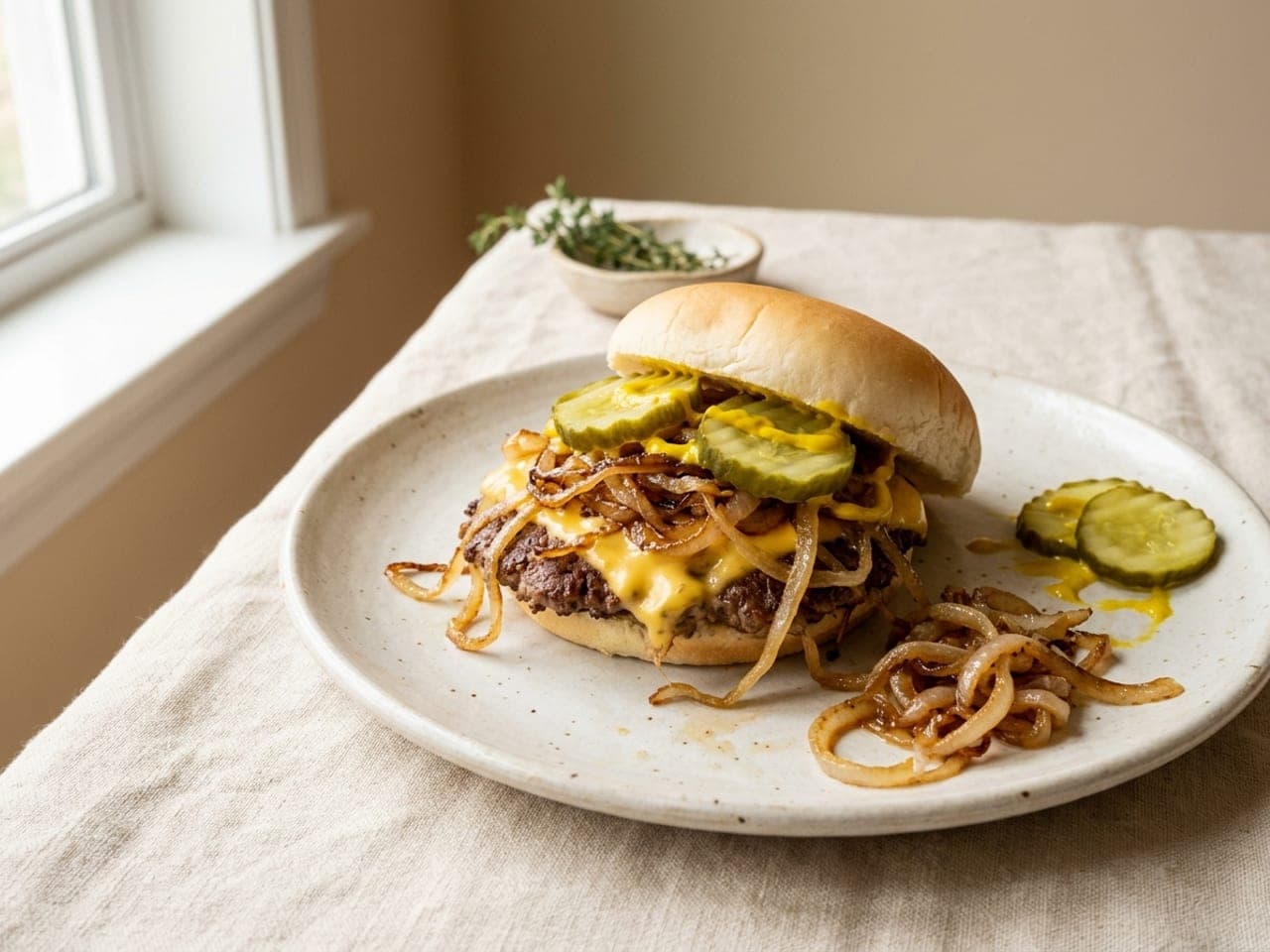
The Depression-burger classic from El Reno: a haystack of paper-thin onions smashed into a thin beef patty so the two fry into one crispy, sweet-savory whole — finished with American cheese on a bun steamed over the burger itself.
Ingredients
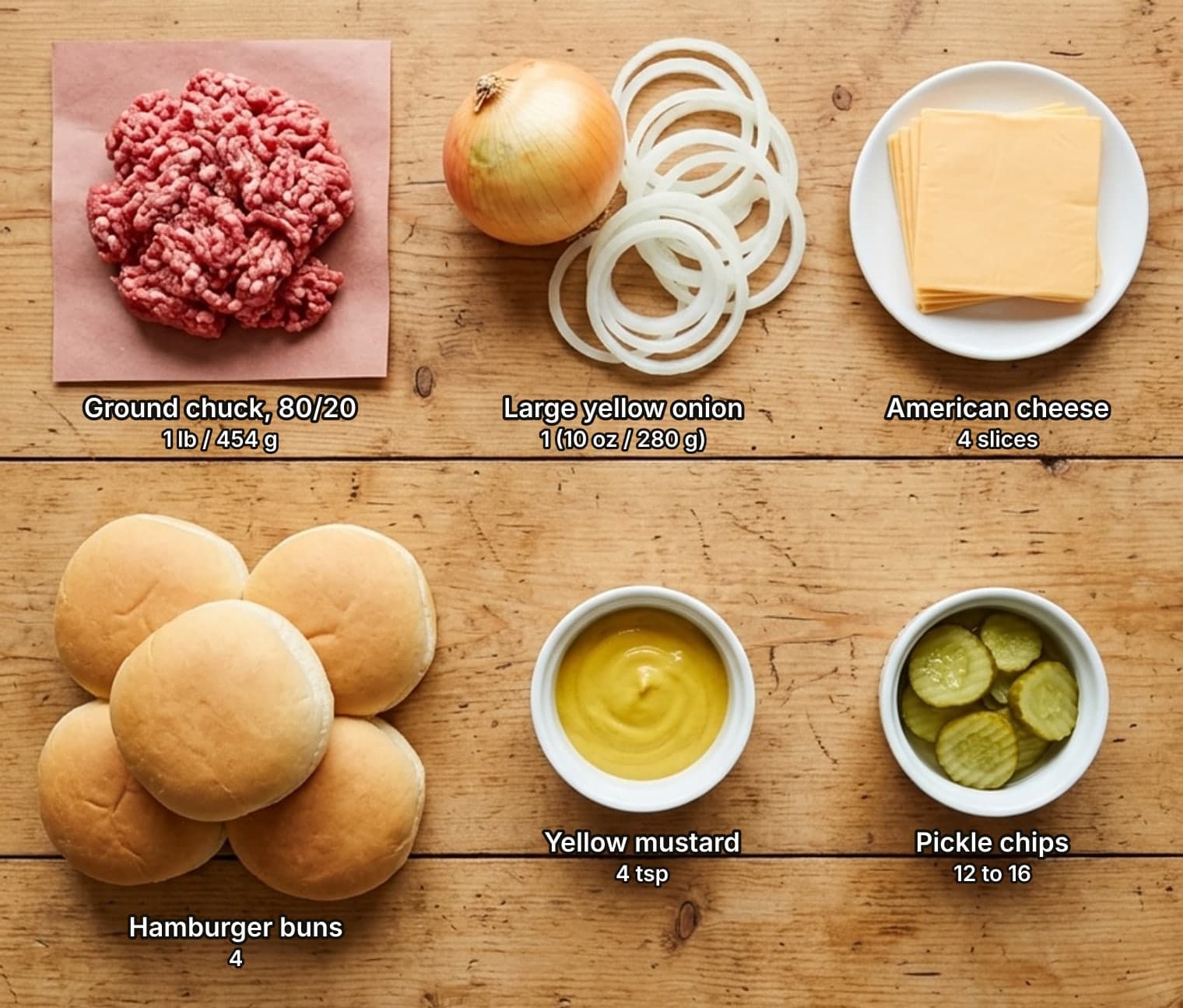
- ground chuck, 80/20 (beef mince with 20% fat)1 lb / 454 g
- large yellow onion, sliced paper-thin (1/16 in / 2 mm)1 (10 oz / 280 g)
- American cheese slices (sold as burger slices in Europe)4
- soft white hamburger buns (not toasted — they steam)4
- salt and black peppergenerous
- yellow mustard4 tsp
- dill pickle chips (sliced dill gherkins)12–16
Why this recipe works
This is a smash burger where the onion does half the work. Smashed together, patty and onions become one piece: the beef side sears into a crust while the onion side — after the flip — fries in rendered beef fat, going sweet, soft and caramelized at the edges. The onion steam also bastes a patty that would otherwise be well-done and dry, which is why a burger this thin eats this juicy.
Paper-thin is not a garnish instruction, it’s structural. At 1/16 inch (2 mm) the onions melt into the meat and cook through in the patty’s short window; at ⅛ inch (3 mm) or more they stay raw-crunchy and fall off. The onion type barely matters — any yellow or white storage onion sweetens in beef fat — but the thickness decides the burger.
And the buns steam instead of toasting because the burger is the toaster: stacked over the cheese under a lid, they arrive warm, soft and onion-scented. It’s the most distinctive step in the recipe and the first thing the El Reno diners would tell you not to skip.
How to make Oklahoma onion burger
- Shave the onion. Slice 1 large yellow onion (about 10 oz / 280 g) into paper-thin rings — 1/16 inch (2 mm), which in practice means a mandoline with the guard on. Slice into rings rather than pole-to-pole half-moons: cutting across the onion’s cells releases more of its flavor. Don’t salt the onions yet (more on that below). You want roughly 2.5 oz (70 g) of shaved onion per burger — close to equal volumes of onion and beef, which is the whole idea.
- Portion the beef. Divide 1 lb (454 g) of 80/20 ground chuck into four 4-oz (113 g) balls, rolled loosely, and keep them cold. Have the buns, cheese, mustard and pickles staged — the cook is fast and the finish happens in the pan.
- Heat the pan. Get a cast-iron skillet or griddle properly hot over medium-high — 400–425°F (204–218°C), a water drop skittering on contact. A thin wipe of oil at most; the beef brings its own fat. Vent fan on.
- Ball, haystack, smash. Set the balls in the pan well apart and immediately pile a loose haystack of onions — about 2.5 oz (70 g) — on top of each. Lay a square of parchment over onions and beef and smash hard with a stiff spatula pressed by a second spatula (or a burger press) until the patty is ¼ inch (6 mm) thin with the onions embedded in it. Stop pressing within about 10 seconds of the smash. Season the top with salt and pepper.
- Sear until the juices pool. Leave the patties alone for 2–3 minutes, until the edges go gray-brown and crisp and juices pool on top of the onions. The beef side is welding itself a crust — that’s the plan.
- The flip through the onions. Scrape the full edge of a stiff, non-slotted spatula under each patty and flip in one confident motion, so the onions land underneath and start frying in the beef fat. Press the spatula gently on each patty for the first 30 seconds after the flip to keep the onions in full contact with the pan.
- Cheese, then the bun stack. Lay a slice of American cheese on each patty right after the flip. Now the El Reno move: set the top bun cut-side down on the cheese, balance the bottom bun on top of it, and cover the pan with a lid for 1–2 minutes. The buns steam soft in onion vapor while the onions underneath caramelize against the pan — no toasting.
- Build and serve. Slide a spatula under patty and onions together, transfer to the bottom bun, and finish with dill pickle chips and a stripe of yellow mustard — the traditional cold condiments, and they’re not optional so much as correct. Serve immediately, with napkins.
Safety & hygiene Important
- Ground beef temperature. The USDA number is 160°F (71°C) for any ground beef, with no medium-rare exception — grinding spreads surface bacteria through the meat. A ¼-inch (6 mm) smashed patty can’t be thermometered meaningfully, but cooked as written — 2–3 minutes, flip, 1–2 minutes more — it passes 160°F (71°C) with room to spare. Look for no pink, crisp gray-brown edges, juices running clear.
- Respect the mandoline. Paper-thin onions are a mandoline job, and the mandoline is the sharpest thing in your kitchen. Use the guard or a cut-resistant glove every pass, especially the last inch of onion — that’s the moment every mandoline injury happens. No mandoline? A sharp knife and patience beat a fast knife and an urgent care visit.
- High heat and the lid. The pan runs near smoking and rendering beef fat spits — long spatula, vent fan on, no water near the fat. If you improvise a steam cover, use an actual lid or an upturned metal bowl, never a draped dish towel, which can catch on the burner.
- Raw beef handling. Cold balls straight from the fridge until the pan is ready; wash hands, board and the spatula that touched raw beef before anything else. The pressed-parchment squares are single-use — bin them.
3 ways to plate it
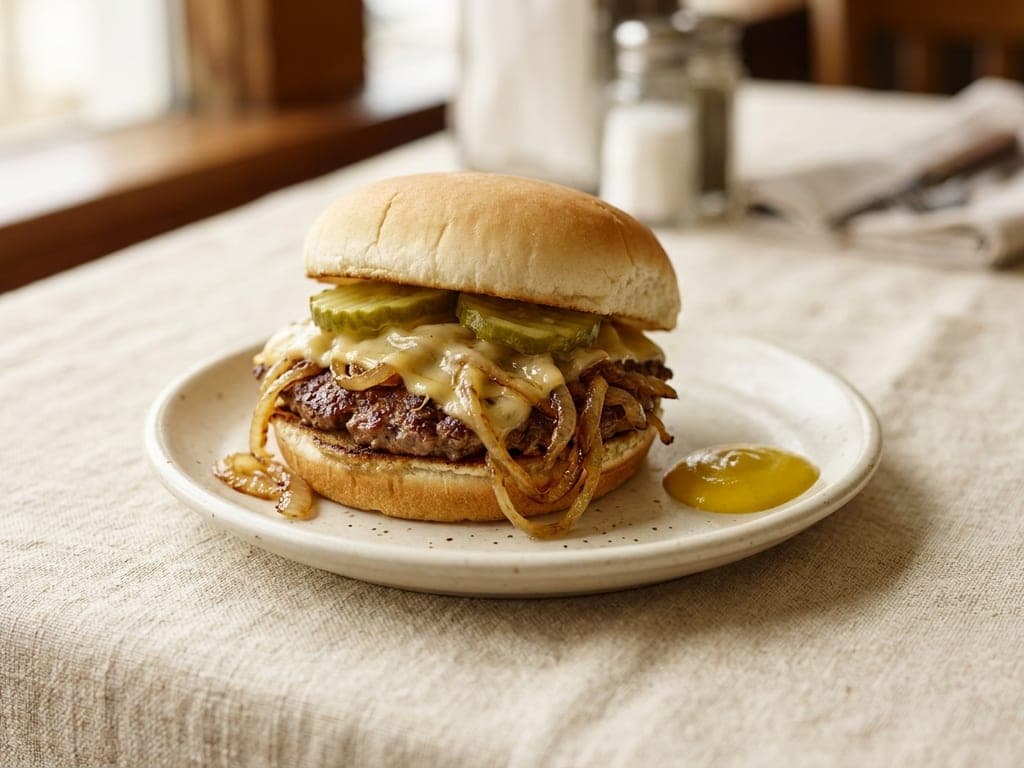
- Transfer patty and onions to the bun in one spatula motion — the strands that trail out from under the bun are the presentation, don’t tuck them in.
- Slide two pickle chips just under the top bun’s edge so they peek out.
- Spoon a small pool of yellow mustard onto the plate at four o’clock instead of hiding it in the burger — it reads as intent and doubles as a dip.
- Serve on the smallest plate the burger fits — diner portions on diner geometry.
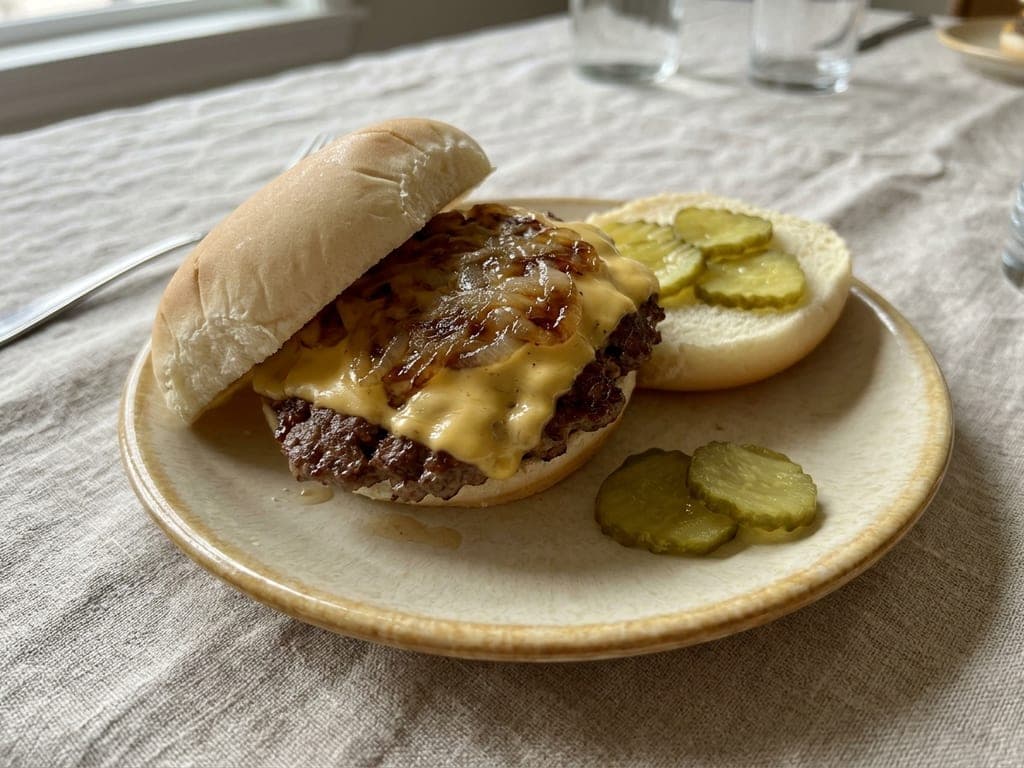
- Build the burger fully except the top bun — patty, onion mat up, cheese slumping over the edges.
- Lean the steamed top bun against the burger’s side at an angle, cut face out, pickles resting on it.
- Turn the plate so the deepest-caramelized onion edge faces forward; that mahogany fringe is the money shot.
- Cap it at the table — the lean is for looking, the closing is for eating.
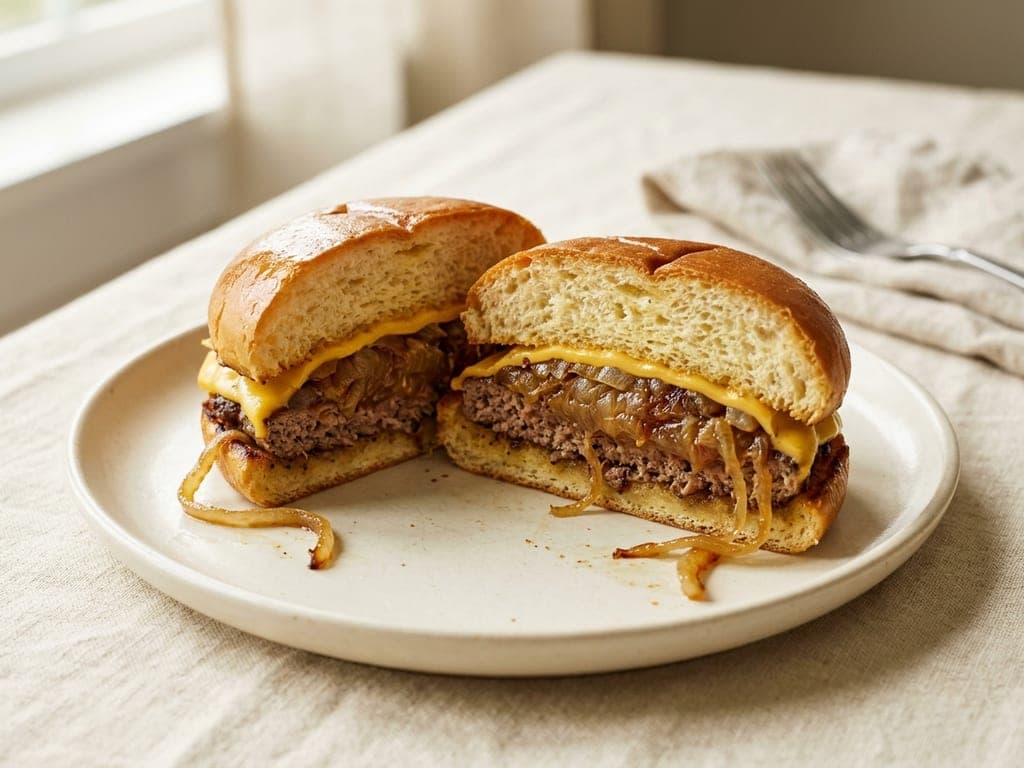
- Rest the built burger for a minute so the cheese sets, then cut straight down the middle with a sharp knife in one stroke.
- Offset the halves and lean one against the other, both cut faces toward the front of the plate.
- Pull two or three onion strands from the cut edge so they trail deliberately onto the plate.
- Wipe the rim, leave the juices where the cut released them, and serve while the cross-section still steams.
The Depression burger — a real history
El Reno, Oklahoma, 1920s: Ross Davis and his father Homer ran the Hamburger Inn near where Route 66 crosses US-81, selling five-cent hamburgers. When hard times hit in the 1920s — one oft-repeated telling ties it to feeding strikers in the 1922 railroad strike; the more common account simply dates the burger to 1926 — beef was dear and onions were nearly free, so they smashed a haystack of shredded onion into each patty to make a nickel burger look and eat bigger. Roughly half onion, it was honest scarcity cooking; they called it the Depression Burger, and through the actual Great Depression it fed the town.
A century later the burger never left. Robert’s Grill has served them at its 14-seat counter since 1926; Johnnie’s Grill since 1946; and Sid’s Diner — opened in 1989 by Marty Hall, who started at 13 peeling onions at Johnnie’s, and named for his father — is the benchmark most modern pilgrims cite. Food historian George Motz carried the burger to national fame in the 2010s.
Every first Saturday in May since 1989, El Reno throws the Fried Onion Burger Day Festival: about 30,000 visitors and a roughly 750-lb (340 kg) world-record burger — 250 lb (113 kg) of beef, 150 lb (68 kg) of onions and 350 lb (159 kg) of bun — griddled on a ten-foot (3 m) rig and handed out free. For a burger invented because beef was too expensive, that’s a decent ending.
Salt the onions first? The one real controversy
America’s Test Kitchen salts the shaved onions, drains them for 30 minutes and wrings them dry in a towel — drier onions stick to the patty better and brown instead of steaming. Kenji López-Alt’s NYT recipe says the opposite: don’t pre-salt, because pulling moisture out early inhibits the sear and the onions' steam is what keeps the thin patty juicy.
We side with Kenji and the majority: skip the pre-salt and season in the pan. The smash embeds the onions well enough that adhesion isn’t the problem ATK is solving, and the juicier patty is a bigger win than marginally browner onions. If your onions are watery spring onions rather than storage onions, a quick towel-press — no salt — splits the difference.
Questions, answered
What is an Oklahoma onion burger?
A Depression-era burger from El Reno, Oklahoma: a thin beef patty smashed together with a near-equal pile of paper-thin onions on a hot griddle, so the two fuse — onions caramelizing in beef fat — finished with American cheese, mustard and pickles on a bun steamed over the burger itself.
Why smash onions into the patty?
Originally economics: onions stretched a five-cent burger during the hard-up 1920s. It survives because it works — the onions fry in rendered beef fat, their steam keeps the thin patty juicy, and burger and onions become one crisp-edged piece instead of a patty with toppings.
What onions are best for onion burgers?
A regular yellow or white storage onion. Sweet onions aren’t needed — any onion mellows and sweetens as it fries in beef fat. Thinness matters far more than variety: paper-thin or it doesn’t fuse.
How thin should the onions be sliced?
About 1/16 inch (2 mm) — genuinely paper-thin, an eighth of an inch (3 mm) at the absolute most. That’s mandoline territory. Slice into rings rather than pole-to-pole: cutting across the cells releases more onion flavor into the beef.
Do you salt the onions before cooking?
Most recipes don’t, and neither do we. America’s Test Kitchen salts and squeezes them for adhesion, but Kenji López-Alt warns pre-salting pulls out the moisture that both feeds the sear and steams the patty juicy. Salt everything in the pan instead.
What’s the difference between an Oklahoma onion burger and a smash burger?
A smash burger maximizes beef crust — the onion burger trades some of that crust for a near-equal volume of onions fried into the patty, and traditionally steams its bun over the burger instead of toasting it. Same technique family, different philosophy: crust versus fusion.
Why is it called a Depression burger?
Ross Davis and his father Homer named it that at El Reno’s Hamburger Inn — nickel burgers bulked out with cheap onions during the hard times of the 1920s — and the name stuck through the Great Depression it went on to feed.
Where can you eat the original?
El Reno, Oklahoma: Robert’s Grill (since 1926), Johnnie’s Grill (1946) and Sid’s Diner (1989) all still smash onions into burgers daily — and the first Saturday of May is Fried Onion Burger Day, when the town griddles a burger of roughly 750 lb (340 kg) and hands it out free.
Snap your finished plate and let the AI plate it again — more beautifully.