Crustless Quiche Recipe — Silky, Sliceable, Gluten-Free by Design
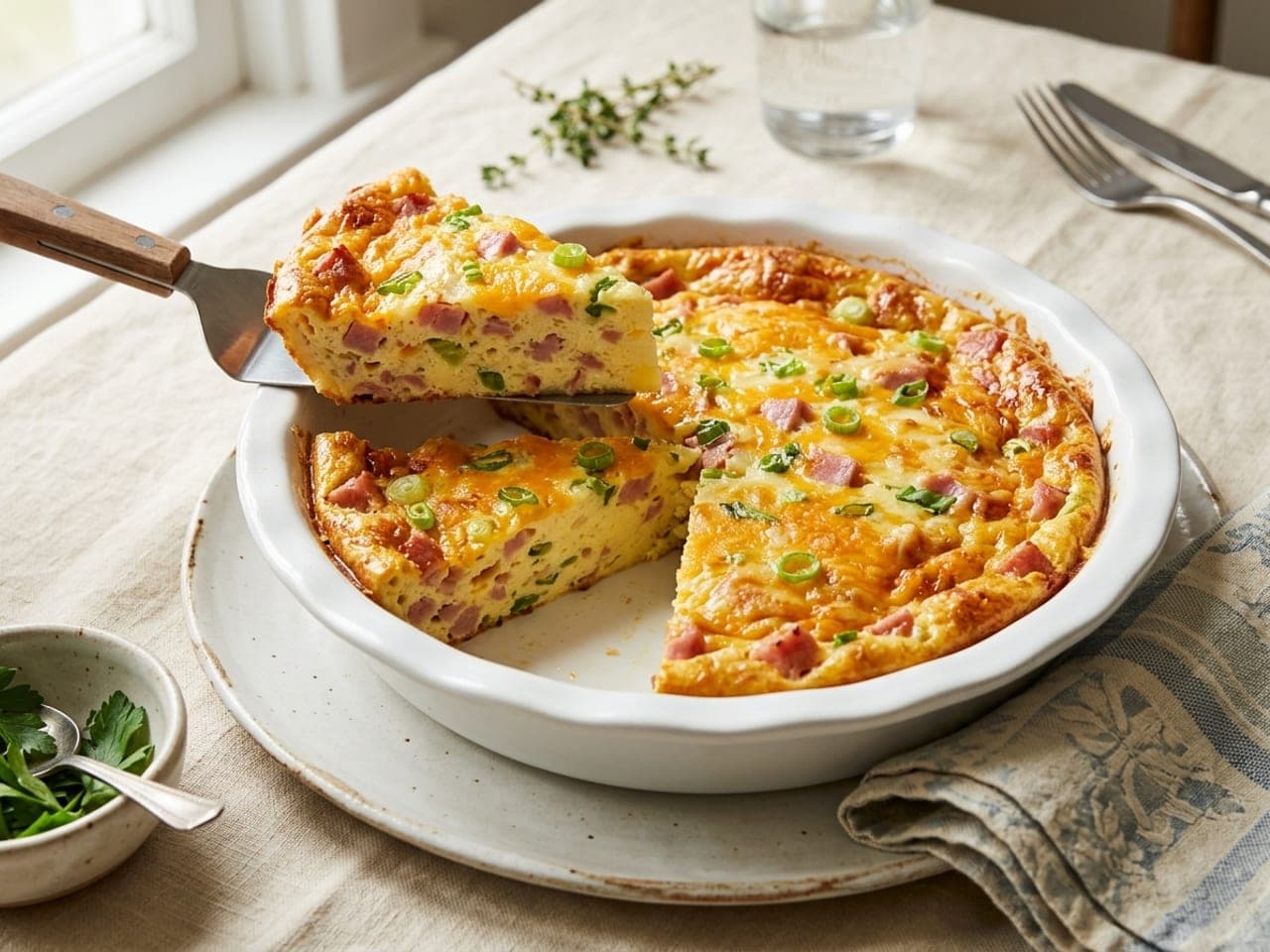
Quiche with the pastry subtracted and the recipe rebuilt to survive it: more eggs per cup of dairy, a well-buttered pie dish, and a custard that slices clean with no crust to lean on. Naturally gluten-free, accidentally low-carb, and the best meal-prep breakfast in the repertoire — this ham, cheddar and scallion build bakes in 35 minutes, reheats without complaint, and costs about 280 calories a wedge (a sixth of the dish) against the pastry version's 430 a slice (an eighth of the tart).
Ingredients
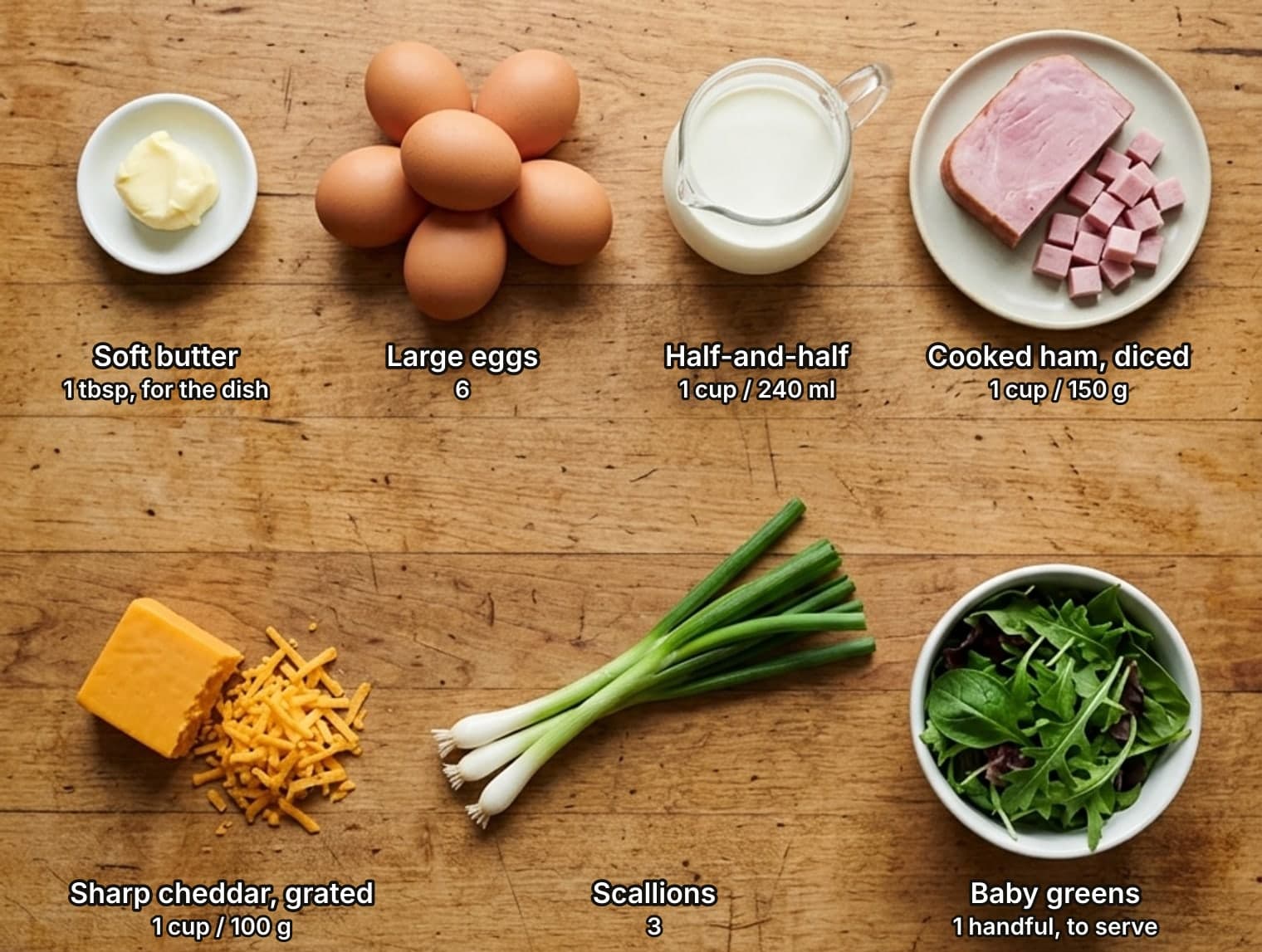
- soft butter, for the dish (be generous)1 tbsp
- large eggs6
- half-and-half (or ½ heavy cream + ½ whole milk)1 cup / 240 ml
- fine salt½ tsp
- black peppera few grinds
- cooked ham, diced1 cup / 150 g
- sharp cheddar, grated (half in, half on top)1 cup / 100 g
- scallions, thinly sliced3
- baby greens or avocado, to serve1 handful
The ratio, rebalanced for life without walls
The master quiche ratio — 1 egg per ½ cup (120 ml) of dairy — makes a custard so tender it needs pastry to hold its shape. Remove the pastry and keep the ratio, and you get a dish best eaten with a spoon and an apology. So the crustless version renegotiates: 6 eggs to 1 cup (240 ml) of dairy, roughly doubling the egg's structural share. More protein network, less liquid to bind — the custard becomes self-supporting, slicing into wedges that stand upright on the plate with no crust shoring them up.
The texture consequence is honest to name: a crustless quiche is a notch firmer than its pastry sibling — closer to silk-with-a-spine than pure wobble. The dairy choice tunes it: half-and-half (or the cream-plus-milk split) keeps maximum tenderness; all milk firms it further and leans egg-forward; all cream fights the structure and can weep. What doesn't change is the discipline around heat: 160°F (71°C) at the centre, out of the oven at the sway, rested before slicing. Eggs do not renegotiate.
The dish matters more than the pastry version too. Ceramic or glass pie dishes heat gently and release cleanly when properly buttered; dark metal browns the exterior faster than the centre sets. And the butter is load-bearing: it is the only thing between your custard and the dish, so it goes on generously, into the corner seam, every time.
How to make Crustless quiche
- Butter the dish like you mean it. Take a 9-inch (23 cm) ceramic or glass pie dish and butter it thoroughly — floor, walls, and especially the corner where they meet — with about 1 tbsp of soft butter. The crust used to be the non-stick layer and the serving armour; butter is its entire replacement, and a skimped job here is the difference between clean wedges and a served-with-a-spoon situation. Heat the oven to 350°F (175°C) with a rack in the middle.
- Precook and dry the add-ins. Dice 1 cup (150 g) of cooked ham, slice 3 scallions thin, and grate 1 cup (100 g) of sharp cheddar. This hero build needs no pan work — ham arrives cooked — but the rule stands for every variation: anything that would leave a wet mark on a paper towel gets precooked, drained and cooled first. With no crust in the game there is nowhere for extra water to hide except in your custard, where it bakes into weep and wobble of the wrong kind.
- Whisk the rebalanced custard. Whisk 6 large eggs with 1 cup (240 ml) of half-and-half (or half heavy cream, half whole milk), ½ tsp fine salt (the ham and cheddar carry the rest) and a few grinds of pepper until just combined — streak-free but not frothy. Note the arithmetic: the pastry version runs 1 egg per ½ cup of dairy; the crustless runs 6 eggs to 1 cup, roughly doubling the egg share, because the custard now has to be its own container. That shift is the entire secret of a crustless quiche that slices instead of slumps.
- Assemble in the dish. Scatter the ham and most of the scallions over the buttered floor, add half the cheddar, pour the custard over, then finish with the remaining cheddar and a last scatter of scallion on top — the surface cheese is what bakes into the bronzed, blistered lid the pastry version gets from its crust rim. Everything should sit comfortably below the dish's rim; this custard puffs in the oven and wants headroom.
- Bake to golden and just-set. Bake at 350°F (175°C) for 30–35 minutes, until the top is puffed and gold, the edges pull slightly from the dish, and the centre sways as one piece when nudged — an instant-read thermometer in the middle reads 160°F (71°C), the food-safe mark for egg dishes. In a glass dish you can check the floor: it should look set, not syrupy. No crust means no soggy-bottom anxiety — the only failure modes left are underdone and overdone, and the thermometer retires both.
- Expect the deflate — it is physics, not failure. Out of the oven, the proud puff will sink back level within ten minutes. That is steam leaving, exactly as it does from a soufflé, and the settled custard beneath is what you actually built — silky and sliceable. Rest the quiche 10–15 minutes on a rack before cutting; straight-from-oven custard is still finishing its set, and the rest is also what lets the butter layer release the wedges cleanly.
- Slice and serve, or box the week's breakfasts. Cut into 6 wedges with a thin knife, running a silicone spatula under each — the first wedge is the sacrificial awkward one, as with any pie. Serve warm with dressed greens or sliced avocado. For meal prep: cool the extras fast (see safety), box them, and reheat wedges covered in the microwave, 60–90 seconds plus a minute's stand, until the centre steams — 165°F (74°C); dense egg wedges hide cold spots, so check the middle, not the edge. With no pastry to ruin, the microwave is finally a legitimate quiche tool, which is half the reason this version owns the weekday morning.
- Or: the muffin-tin mini fleet. The same batter makes 12 minis in a WELL-buttered (or silicone) muffin tin: divide the solids, pour the custard to ¾ full, bake at 350°F (175°C) for 18–22 minutes to the same 160°F (71°C) centre. Minis freeze beautifully for 2 months in a zip bag and go fridge-to-microwave in about a minute — the commuter breakfast solved. Loosen each with a knife-tip while warm; they release best before fully cool.
Safety & hygiene Important
- The centre's number is 160°F (71°C). Egg dishes are food-safe at 160°F (71°C), and a crustless quiche should leave the oven with its centre right there — conveniently the same point where the sway is right and the texture peaks. The trap specific to this version is the puff: a dramatically risen top looks emphatically done while the middle of a deep dish can lag behind. The thermometer through the centre answers in three seconds; golden-and-puffed answers nothing.
- Meal prep lives or dies in the cooling. A dish of warm eggs, ham and dairy is a bacterial invitation, and meal prep multiplies the exposure: the 2-hour room-temperature ceiling (1 hour above 90°F / 32°C) covers the WHOLE window from oven to fridge. Cut the quiche into wedges so they cool fast, get them into shallow covered containers within the window, and they hold 3–4 days refrigerated or 2 months frozen. One physics note for the glass dish: hot glass hates cold — cool it on a dry rack, never a wet counter, and never straight into the fridge; the wedges travel, the dish stays. Reheat to steaming — 165°F (74°C) — and reheat each wedge once: the reheat-cool-reheat carousel is where week-old breakfast plans go wrong.
- Six raw eggs deserve basic respect. This recipe cracks half a dozen eggs, which is six chances for shell-borne Salmonella to tour the kitchen: crack against the counter (not the bowl rim, which pushes shell and surface bacteria inward), fish out fragments with a spoon rather than fingers, and wash hands and the cracking zone after. Baked to 160°F (71°C) the question closes itself; pasteurized eggs are the belt-and-braces option for pregnant, elderly, very young or immunocompromised eaters — or any kitchen where the raw mix gets tasted — and nobody will taste the substitution.
- Ham is cooked; it is not immortal. Because the ham goes in already cooked, it reads as inert — but opened deli ham is a perishable with a short fuse (3–5 days in the fridge) and a known Listeria vector past it. Smell is not a reliable test for Listeria; the date is. Use ham within its window, keep it refrigerated until assembly, and if the packet has been open since a forgotten Tuesday, the quiche deserves fresher — as do the pregnant and elderly eaters Listeria targets hardest. The bake itself is the resolution: at-risk eaters are told to heat deli meats until steaming, and this custard takes the ham far past that.
3 ways to plate it
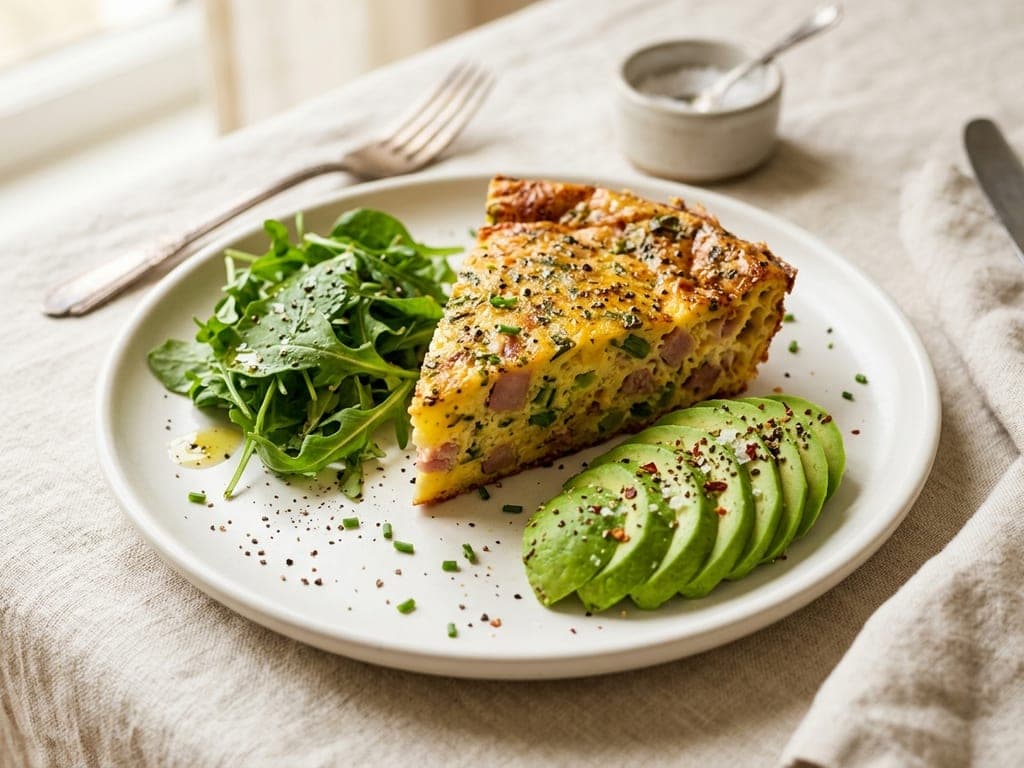
- Run a silicone spatula under the wedge and lift it standing — the crustless slice holds its shape, and upright is the whole visual argument.
- Fan half an avocado in overlapping slices along the wedge's long side; the cool green against the bronzed top is the plate's colour scheme.
- Add a small handful of baby greens dressed with lemon and oil only — acidity resets the custard's richness between bites.
- Crack pepper over the whole plate at the end, custard included — the black flecks read as intent, not garnish.
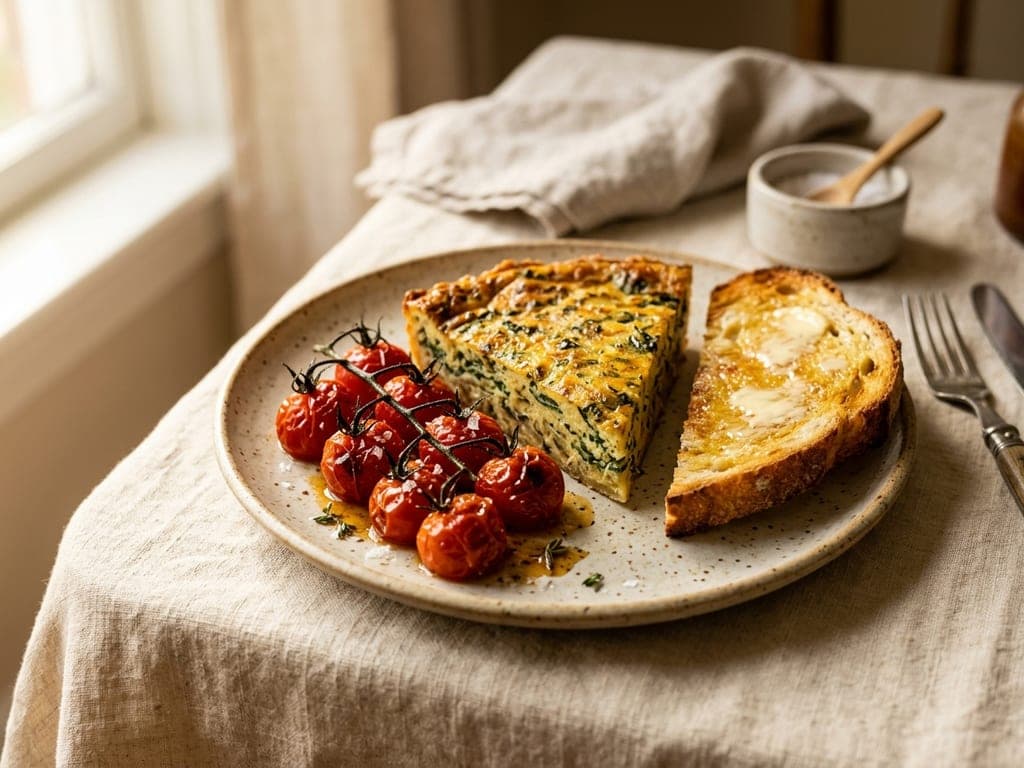
- Roast cherry tomatoes on the vine until they wrinkle and threaten to burst — their acid-sweet collapse is the sauce this plate doesn't otherwise have.
- Plate the wedge first, tomatoes draped beside it vine and all; the vine is scenery worth keeping.
- Lean a thick bias-cut slice of buttered toast against the wedge — the crunch contrast is the crust's understudy, performing nightly.
- Finish with flaky salt on the tomatoes only and a few thyme leaves across the plate — herbs land on the acid, not the custard.
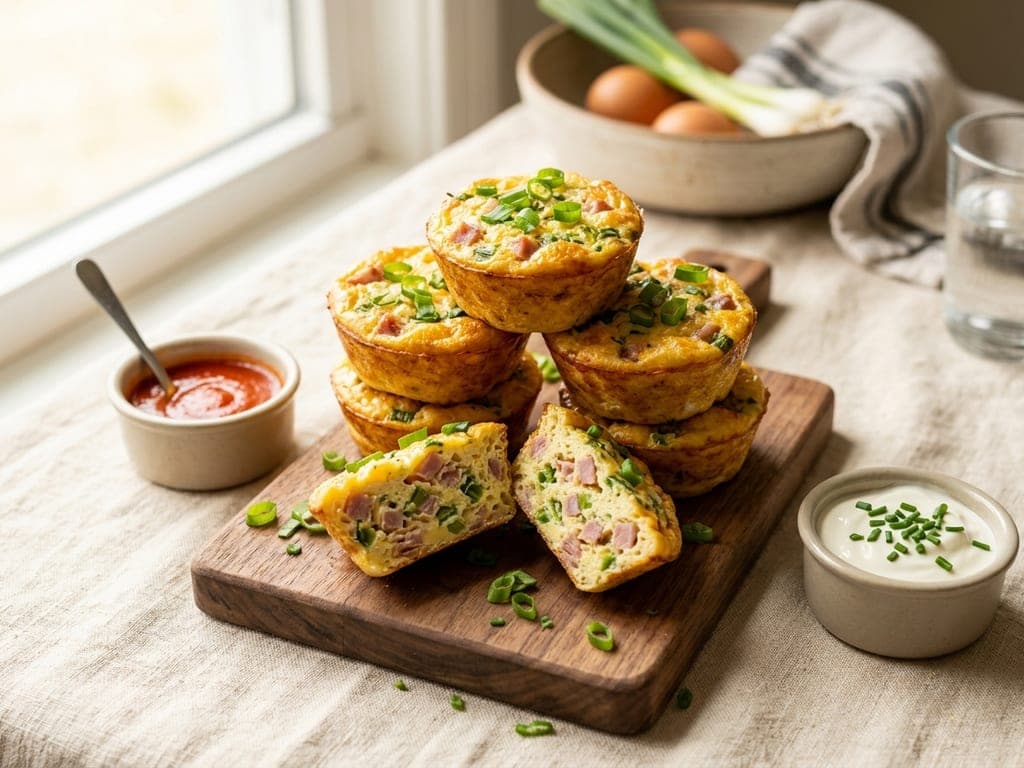
- Stack five minis in a 3-2 pyramid — casual, stable, and abundant-looking; precision-stacking eggs reads unsettling.
- Halve the sixth vertically and prop the halves cut-face out against the stack's base — the interior cross-section does the menu's talking.
- Flank with two ramekins — one hot sauce, one crème fraîche — so the fleet reads as a spread, not a snack.
- Scatter scallion greens over the stack from height at the last second; they lodge in the gaps and tie the tower together.
Crustless quiche vs frittata — the actual border
The two dishes wave at each other across a real line, and menus blur it daily. A frittata is an egg dish: a dozen eggs to a splash of dairy, started in a skillet on the stovetop, finished under heat, sturdy, rustic, faintly bouncy. A crustless quiche is a custard dish: half the eggs, four times the dairy, baked gently the whole way, silky and trembling. Same ingredients list, opposite centres of gravity — the frittata tastes of egg, the quiche tastes of cream that eggs have organised.
The border is the dairy fraction, and this build sits deliberately on the quiche side of it: 1 full cup of dairy to 6 eggs is more than any self-respecting frittata would tolerate, and the all-oven, moderate-heat bake is the custard's insurance policy — no aggressive stovetop base layer, no browned leathery floor. If your previous crustless quiches ate like thick omelettes, they were frittatas in a pie dish, and the missing ingredient was dairy, not technique.
Knowing the line also tells you when to cross it deliberately: campfire or ski-cabin cooking wants the frittata's stovetop resilience; a make-ahead brunch centrepiece wants the quiche's silk. Both are good dishes. Only one of them is this page.
The meal-prep quiche — why this version won the weekday
The crustless quiche's second life is as the internet's favourite meal-prep breakfast, and the logistics genuinely justify the fame. No pastry means the microwave — custard's historical enemy because it steamed crusts to flannel — becomes a legitimate tool: a wedge reheats in 60–90 seconds and tastes like itself. It means the whole thing assembles in 15 minutes flat on a Sunday. And it means one bake yields five weekday breakfasts at about 280 calories each, protein-forward, that require zero morning decisions.
The muffin-tin build sharpens all of this: twelve palm-sized minis, 18–22 minutes in the oven, frozen in a zip bag and revived one at a time in about a minute. Grease aggressively or use silicone — minis have six times the sticking surface per bite — and pour custard only to ¾, because they puff proportionally harder than the big dish. They are also the format most forgiving of experiments, since one weird flavour idea costs you a twelfth of the batch, not breakfast for a week.
The discipline that keeps the convenience safe is cooling: wedges into shallow containers and into the fridge inside the 2-hour window, 3–4 days refrigerated, 2 months frozen, one reheat per wedge to steaming. Meal prep is just catering for a very small, very loyal clientele — run the same cold chain a caterer would.
Add-ins, and the honest low-carb arithmetic
The add-in rule tightens without a crust: about 2 cups (300 g) of solids maximum against this 6-egg custard, everything precooked, drained and cooled. The hero build — ham, cheddar, scallion — is the proof of concept because ham and cheese bring no water at all. The other reliable citizens: blanched hard-squeezed broccoli with cheddar; sautéed mushrooms cooked until the pan is dry again, with swiss; wilted, wrung-out spinach with feta (the spinach quiche page turns that into a doctrine); roasted red pepper patted seriously dry, with goat cheese. Raw vegetables are not citizens — they are water in a costume.
The low-carb accounting, done without pom-poms: subtracting pastry removes about 15 g of carbohydrate per slice, leaving a wedge of this build at roughly 2–3 g of carbs, 20 g of protein and 280 calories — the pastry version runs about 430. That is why every keto and gluten-free roundup on the internet contains a crustless quiche. It earns the spot on merit: nothing about the format is a compromise; it is a different, sturdier custard with its own case for existing.
Gluten-free status comes free but check the supporting cast: the eggs, dairy and vegetables are safely flour-less, but processed ham and pre-grated cheese occasionally smuggle starch — a coeliac table reads those two labels, uses block cheese grated at home, and this dish becomes one of the easiest things on the site to serve them.
Questions, answered
What is the difference between crustless quiche and frittata?
The dairy fraction and the heat. Crustless quiche: 6 eggs to a full cup (240 ml) of dairy, baked gently the whole way — a self-supporting custard, silky and trembling. Frittata: a dozen eggs to a splash, started hard on the stovetop and finished under heat — sturdy, rustic, egg-forward. Same shopping list, opposite souls. If your crustless quiche eats like a thick omelette, it was short on dairy and long on heat: a frittata in a pie dish.
Is crustless quiche gluten-free?
Naturally — eggs, dairy, cheese and vegetables involve no flour, which is why this page is the site's easiest answer for a coeliac guest. Two labels still deserve a glance: processed ham (some brands bind with starch) and pre-grated cheese (often dusted with potato or corn starch — usually gluten-free but not always cleanly labelled). Block cheese grated at home and a clean-label ham close both gaps, and the whole dish is safely, boringly flourless.
How low-carb is it really?
A wedge of this ham-and-cheddar build carries roughly 2–3 g of carbohydrate, about 16 g of protein and around 280 calories — the pastry it lacks would have added about 15 g of carbs and 150 calories. That is genuine keto/low-carb territory without a single substitute ingredient, which is the honest reason the format rules those meal plans. Watch only the add-ins: caramelised onions and roasted peppers bring a few carbs; ham, cheese, spinach, mushrooms bring almost none.
Why did my crustless quiche deflate?
Because it was supposed to. The custard puffs in the oven as steam expands, then settles level within ten minutes of coming out, exactly like a soufflé standing down — the silky, sliceable layer left behind is the actual dish. Deflating is only a symptom of trouble if it collapses into a wet crater: that is underbaking (centre never hit 160°F / 71°C), or whisking to a froth, which builds extra air that has further to fall. Whisk to combine, bake to temperature, and let it sink in peace.
Why is it watery?
Water smuggled in by the add-ins, almost always — with no crust to blot the evidence, raw or under-drained vegetables weep straight into the custard. Everything precooks: mushrooms until the pan is dry again, spinach wrung by hand, broccoli blanched and drained cut-side down. Second suspect: overbaking, which makes egg proteins clench and expel their own moisture — pull at 160°F (71°C) at the centre. Third: low-fat dairy, which sets weepy; keep at least half-and-half richness.
Can I make it in a muffin tin?
Yes — it is the format's best trick. The full batter makes 12 minis: butter the tin aggressively (or use silicone), fill ¾ with solids and custard, bake at 350°F (175°C) for 18–22 minutes to 160°F (71°C) in the centres, and loosen with a knife-tip while warm. Minis freeze 2 months in a zip bag and microwave back to breakfast in about a minute. They puff harder and stick more enthusiastically than the big dish — the ¾ fill and the extra butter are not suggestions.
Can I make it ahead or freeze it?
It is the best make-ahead quiche precisely because there is no crust to protect: bake, cool wedges quickly into shallow containers (inside the 2-hour window), and refrigerate 3–4 days or freeze 2 months. Reheat a wedge covered in the microwave, 60–90 seconds plus a minute's stand, until the centre — not just the edges — steams at 165°F (74°C), or 10 minutes in a 325°F (163°C) oven if you want the top re-crisped. One reheat per wedge; portion so nothing rides the reheat-cool-reheat carousel.
What dairy should I use?
Half-and-half — or an even split of heavy cream and whole milk — is the sweet spot: enough fat to keep six eggs tender, enough water to set clean. All milk leans firmer and eggier (add a knob more cheese for insurance); all cream fights the structure and can weep richness. Skimmed milk and thin plant milks set rubbery and are the one refusal — if the goal is lighter, this quiche already dropped the pastry's 150 calories; let the custard keep its fat and its dignity.
Can I make it vegetarian?
Trivially: drop the ham and swap in any citizen of the dry-add-in list — blanched hard-drained broccoli, mushrooms sautéed until the pan is dry, wilted wrung-out spinach with feta, roasted red pepper patted dry with goat cheese — keeping the total around 2 cups (300 g). The custard neither notices nor cares. If spinach is the direction, the spinach quiche page runs the full water-management masterclass; its filling drops into this crustless build without modification.
What size dish do I need — and can I scale it?
A standard 9-inch (23 cm) pie dish, ceramic or glass, is the calibrated home for 6 eggs + 1 cup (240 ml). Scaling follows the ratio, not the clock: an 8×8 inch (20 cm) baking dish takes the same batch; a 9×13 inch (23×33 cm) takes it doubled and bakes closer to 40–45 minutes; ramekins and muffin cups drop to about 20. Depth is what moves bake time — whatever the vessel, the finish line stays 160°F (71°C) at the centre and a one-piece sway.
Snap your finished plate and let the AI plate it again — more beautifully.