Spinach Quiche Recipe — Green, Silky, Never Watery
The green quiche done properly, which means one thing above all: dry spinach. A pound of leaves is nine-tenths water, and the distance between silky green custard and a weeping swamp is the half-cup you wring out with your hands. This build wilts, squeezes and re-dries the spinach, folds it through a nutmeg-scented gruyère custard in crisp shortcrust, and comes out sliceable, deeply savoury and entirely vegetarian — with the feta variation one paragraph away.
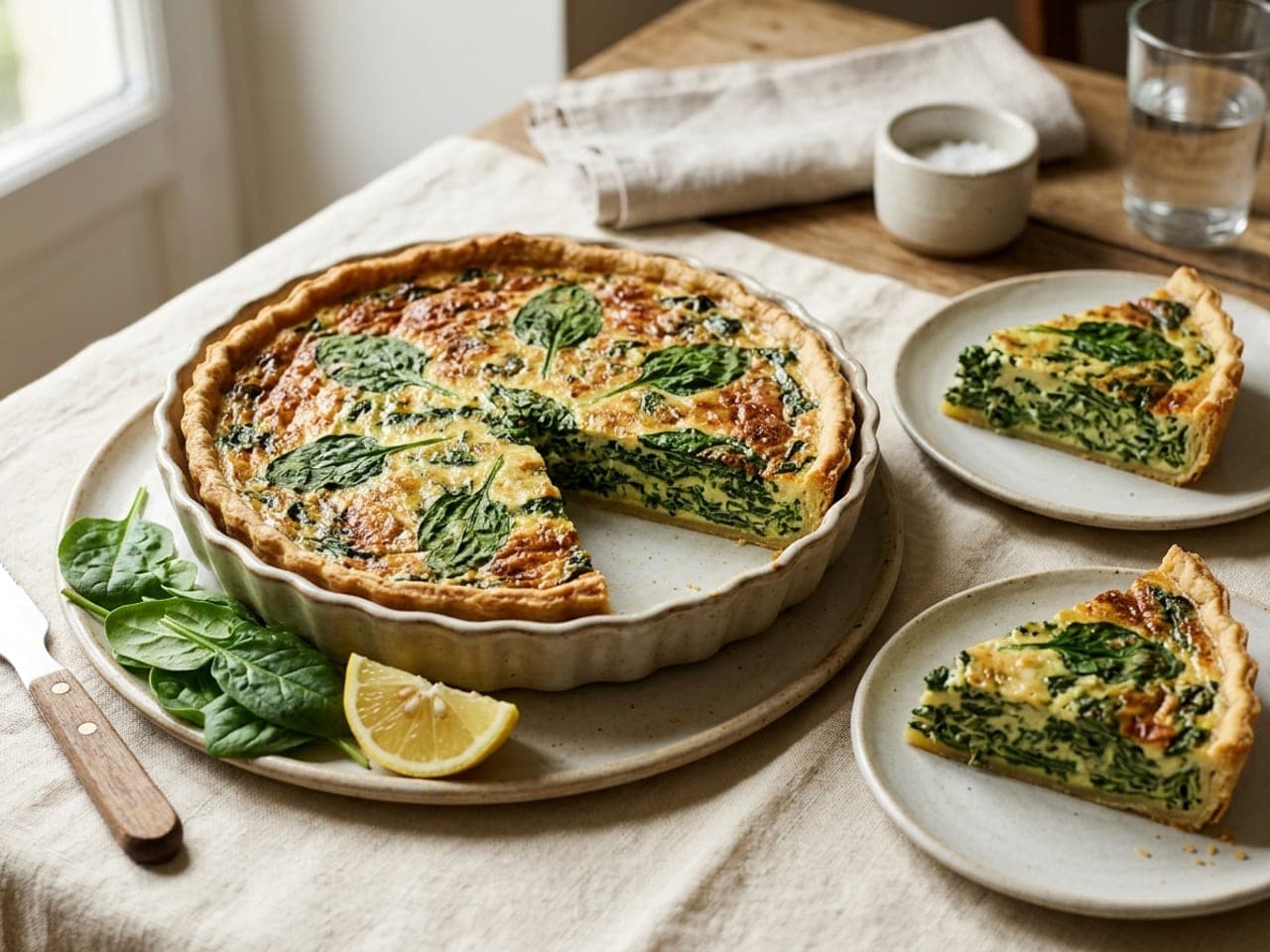
Ingredients
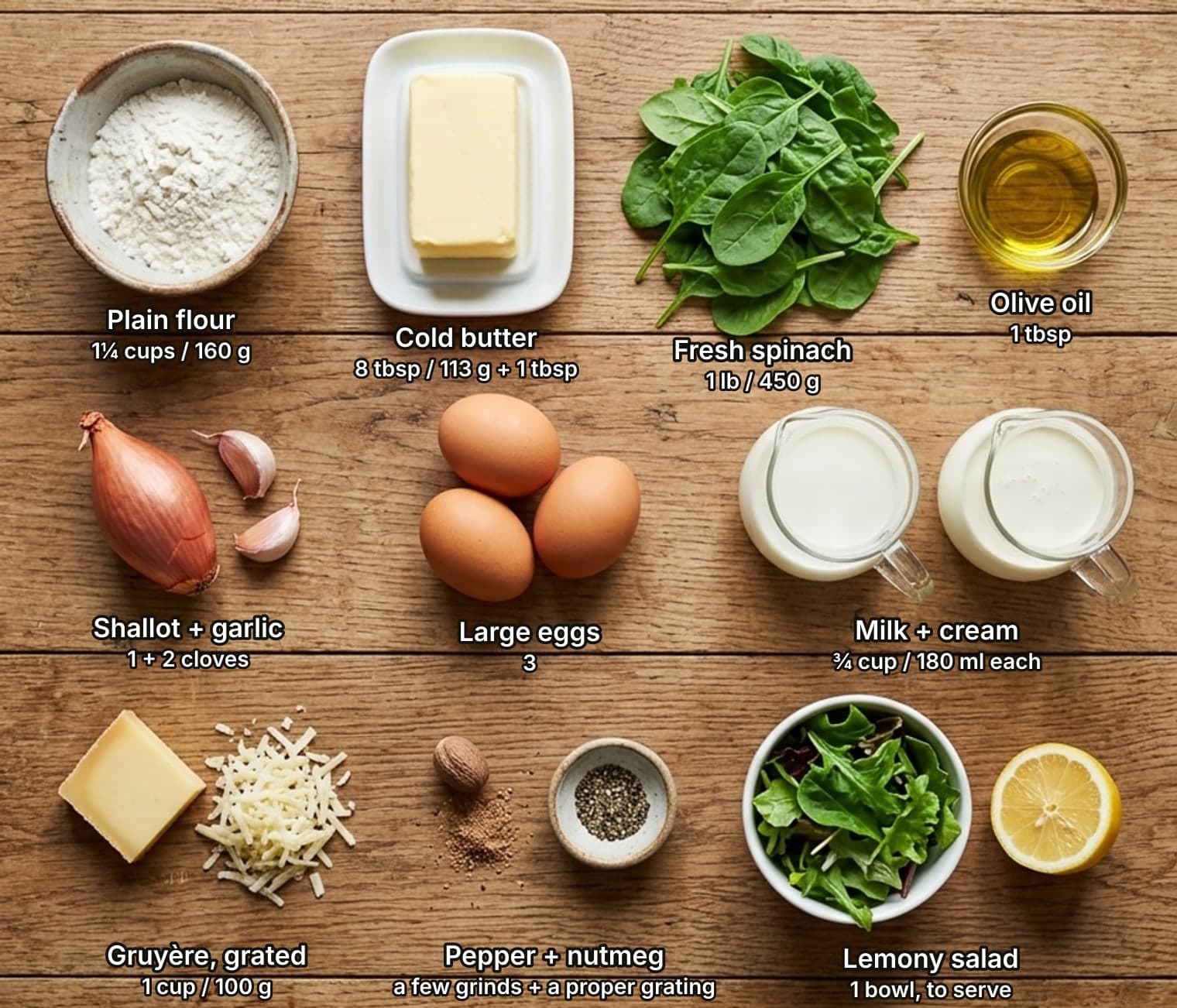
- plain flour (pâte brisée)1¼ cups / 160 g
- cold butter, cubed (pastry) + 1 tbsp (shallot pan)8 tbsp / 113 g + 1 tbsp
- fine salt (½ tsp pastry + ½ tsp custard + a pinch in the filling)1 tsp + a pinch
- ice water3–4 tbsp
- fresh spinach (or 10 oz / 280 g frozen chopped, thawed)1 lb / 450 g
- olive oil (for wilting)1 tbsp
- shallot, finely chopped1
- garlic cloves, minced2
- large eggs (plus a brushed teaspoon for the crust seal)3
- whole milk + heavy cream¾ cup / 180 ml each
- gruyère, grated (or ¾ cup / 110 g crumbled feta — see the fork)1 cup / 100 g
- black pepper and freshly grated nutmega few grinds + a proper grating
- lemony dressed leaves or a tomato salad, to serve1 bowl
Water management is the whole game
Spinach is about 91% water, which makes the arithmetic of this quiche brutal and simple. One pound (450 g) of proud fresh leaves wilts to roughly a single packed cup, and even that survivor is soaked: wring it in a towel and close to ½ cup (120 ml) of green liquid comes out. Leave that water in and it has exactly one place to go — into a custard already balanced at 1 egg per ½ cup of dairy, arriving as an uninvited extra half-cup of liquid that no ratio can absorb. Watery spinach quiche is not bad luck; it is unremoved water, every time.
Hence the doctrine: wilt, cool, wring like you mean it, then dry AGAIN on live heat with the shallot and garlic. The towel wring is the step that separates this page from the SERP — not a squeeze between your palms over the sink, but a twisted-towel extraction that ends in a compact ball leaving no wet print on the cutting board. It feels excessive. It is exactly sufficient. The second pass in the hot pan evaporates the last few spoonfuls and pays flavour interest while it works.
The same physics guards the other direction: because the spinach enters bone-dry, the custard can run the standard tender ratio instead of retreating to extra eggs for insurance — which is why a properly-built spinach quiche is every bit as silky as a lorraine, not the rubbery green brick café counters have taught people to expect.
How to make Spinach quiche
- Make, chill and blind bake the shell. Run the standard pâte brisée: 1¼ cups (160 g) flour, 8 tbsp (113 g) cold butter, ½ tsp salt, 3–4 tbsp ice water; rest 30 minutes, roll to 12 inches (30 cm), line a 9-inch (23 cm) tart tin, freeze 15 minutes, then blind bake at 375°F (190°C) with the tin on a baking sheet — 20 minutes weighted, 5–8 naked, until the floor is dry and golden — and varnish the hot floor with a teaspoon of beaten egg. The sheet stays in the oven with the tin from here on. The full pastry doctrine lives on the master quiche page; the spinach version simply cannot afford a weak floor, given what the filling almost was.
- Wilt the spinach in waves. Take 1 lb (450 g) of fresh spinach — yes, the whole absurd mountain; it is mostly air and water and both are leaving. Heat 1 tbsp of olive oil in your widest pan over medium-high and add spinach by the double-handful, turning with tongs and adding more as each wave collapses, 3–4 minutes total until every leaf is wilted and glossy dark. (Set aside a small handful of raw leaves first if you want the whole-leaf mosaic on the tart's surface later.) Tip the lot into a colander and press with the tongs while its steam escapes. (Frozen shortcut: 10 oz / 280 g of frozen chopped spinach, fully thawed, skips this step and joins at the wring.)
- The wring — this is the entire recipe. When the spinach is cool enough to handle, pile it into the centre of a clean kitchen towel, gather the corners, and twist over the sink like you are wringing a stubborn mop: you will extract close to ½ cup (120 ml) of green water, and every drop of it was headed for your custard. Twist, rest, re-grip, twist again — done means a compact fist-sized ball that leaves no wet print on the board. Chop the ball roughly. However dry you think it is, one more twist.
- Build the flavour base. In the emptied pan, soften 1 finely-chopped shallot in 1 tbsp of butter over medium heat, 2–3 minutes; add 2 minced garlic cloves for 30 seconds more, then the chopped spinach, and stir 1–2 minutes — partly for flavour, mostly as a final drying pass on live heat. Season with a pinch of salt, black pepper, and the classic: a proper grating of nutmeg, spinach's oldest ally in French cooking. Spread the mixture on a plate to cool; hot filling scrambles custard on contact.
- Whisk the custard. The master ratio, standard tune: 3 large eggs whisked with 1½ cups (360 ml) of dairy — half whole milk, half heavy cream — plus ½ tsp fine salt (the gruyère carries the rest) and more pepper. Combine without frothing; beaten-in air bakes into pocks instead of silk. If the feta road is calling (the sections make the case), the custard stays identical — only the cheese and its saltiness change.
- Assemble in layers that make every slice equal. Scatter the cooled spinach mixture evenly across the crust floor, breaking up any clumps — a fistful of spinach in one slice and none in the next is the amateur tell. Follow with 1 cup (100 g) of grated gruyère, then set the tin on its baking sheet — kept hot in the oven since the blind bake, for bottom heat — on the rack pulled halfway out, pour the custard over to a couple of millimetres below the rim, and slide the rack gently home; never reach into the hot cavity with a full jug. A few whole baby leaves pressed gently onto the surface bake into a pretty green mosaic, if the tart is having its photo taken.
- Bake to the wobble. Bake at 350°F (175°C) for 35–40 minutes: edges set and slightly puffed, centre swaying as one piece when nudged, 160°F (71°C) on a thermometer in the middle — the food-safe mark for egg dishes and the exact border between silk and curds. The spinach makes the surface mottle green-gold rather than brown evenly; judge by the sway, not the tan. Overbaking squeezes water out of eggs AND spinach at once — this quiche punishes it double.
- Rest, slice, serve at the right temperature. Rest on a rack 20–30 minutes. The spinach quiche is at its best barely warm or at room temperature, when the custard has fully set and the nutmeg-spinach-gruyère chord rings clearest; refrigerator-cold mutes it, oven-hot blurs it. Slice with a thin knife wiped between cuts, and serve with something bright — lemony leaves, a tomato salad in summer. Leftovers reheat at 325°F (163°C) for 12–15 minutes and honestly might be better the second day.
Safety & hygiene Important
- Wash loose spinach; do NOT rewash the triple-washed bag. Leafy greens sit at the top of the outbreak tables (E. coli, Salmonella, norovirus), so the washing rules are worth stating exactly. Loose and bunched spinach: submerge in cold water, agitate, lift OUT of the water (grit sinks), repeat until the bowl stays clean, then finish under running water — and never soap or produce wash, which leaves absorb. But bagged greens labelled triple-washed or ready-to-eat get used straight from the bag — the FDA's position is that home rewashing adds contamination risk from your sink and hands rather than removing any. Wash your hands before handling either kind; your fingers touch more surfaces than the leaves do.
- Frozen spinach is an ingredient, not a ready-to-eat food. Frozen vegetables have driven Listeria recalls, and freezing kills almost nothing — it only pauses bacteria, and Listeria is the one that even keeps growing at fridge temperatures — so frozen spinach is for cooking, never for thaw-and-eat shortcuts like dips or smoothies. In this recipe it bakes 35+ minutes to 160°F (71°C), which settles the matter completely. Thaw it in the fridge or microwave, not on the counter overnight, and wring it just as hard as fresh — it carries even more water and the same rules.
- The custard's number is 160°F (71°C). Egg dishes are food-safe at 160°F (71°C), and this one is harder to read by eye than any in the family: the green-flecked surface mottles instead of browning evenly, so colour tells you nothing and the puff can lie. The nudge test (centre sways as one set piece) plus a three-second thermometer check through the middle is the whole protocol. Under the number, tent with foil and give it minutes more — gently raw spinach custard is nobody's lunch. The raw side follows the usual rules too: eggs cracked against the counter (not the bowl rim), dairy back in the fridge between steps, hands washed before the pastry gets touched.
- Quiche hours: two on the table, four days in the fridge. Eggs, dairy and cooked greens are a hospitable trio: room-temperature service lives inside the 2-hour window (1 hour above 90°F / 32°C), then leftovers go covered into the fridge for 3–4 days. Reheat slices to steaming — 165°F (74°C) — in a 325°F (163°C) oven; the microwave rubberises custard and steams crust. Wrapped tight, baked slices also freeze for 2 months, and thaw overnight in the fridge, not on the counter.
3 ways to plate it
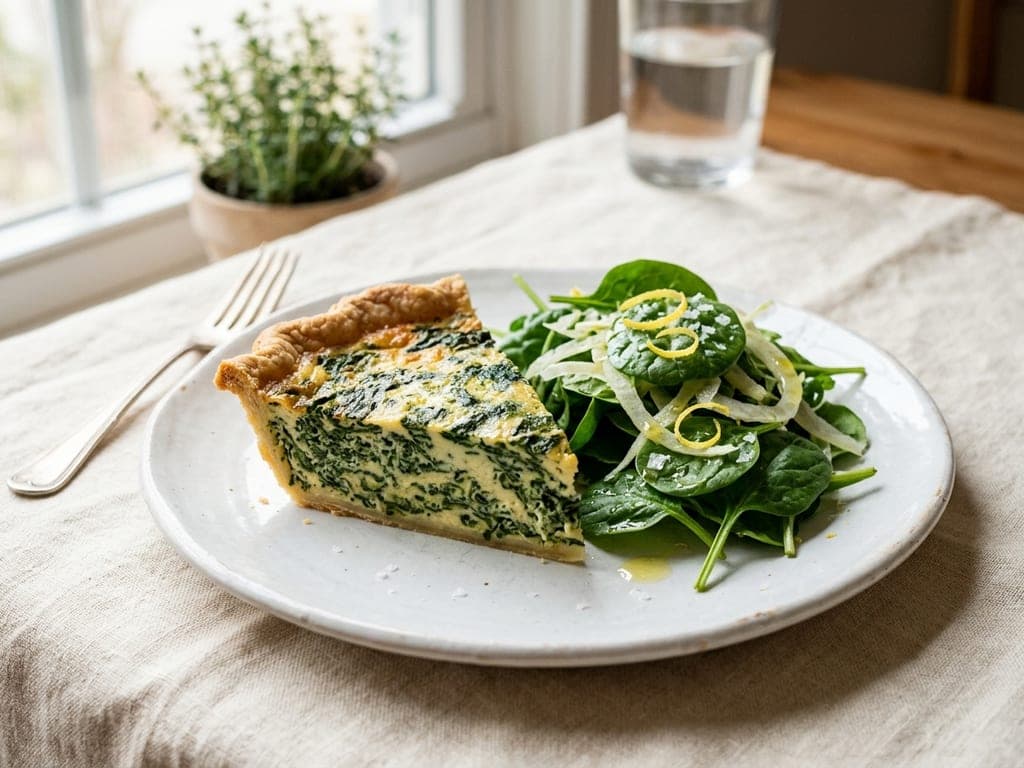
- Slice with a thin knife wiped between cuts — the green-marbled custard face is the entire argument, so it arrives clean.
- Set the wedge left of centre, cut face toward the diner's light; spinach custard photographs and eats best with its cross-section on display.
- Dress baby spinach and shaved fennel with lemon and oil at the last second and pile them loosely at the wedge's side — raw echoing cooked.
- Finish the greens — not the quiche — with lemon zest and flaky salt; the custard face stays untouched.
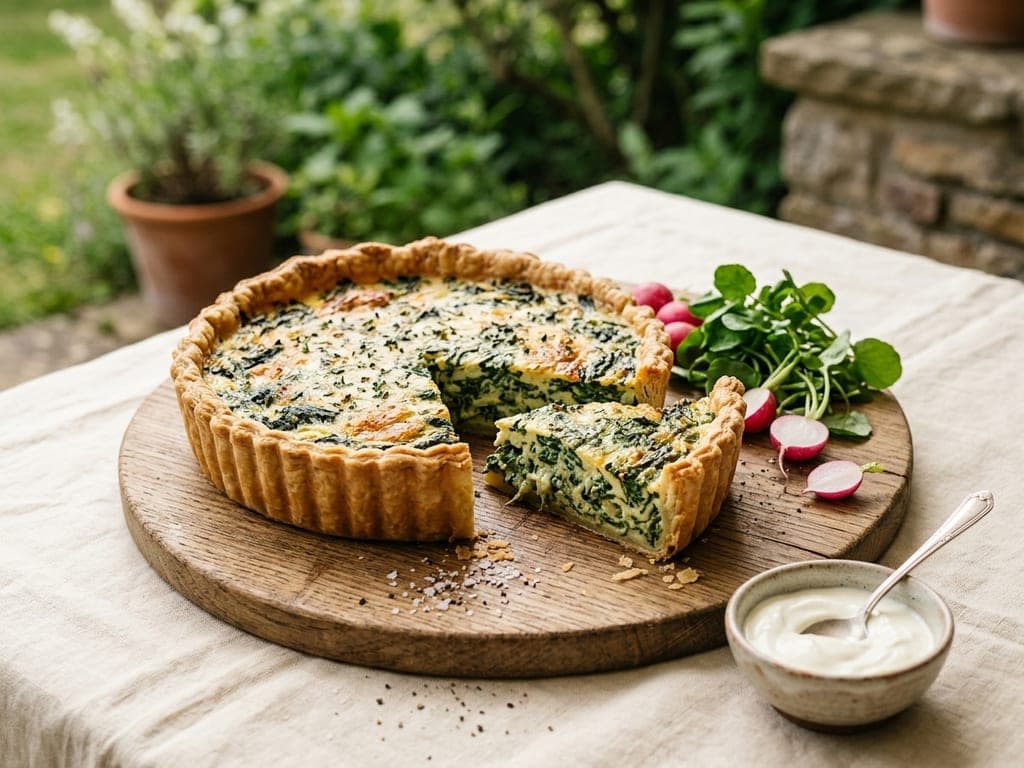
- Slide the cooled tart, on its tin base, onto a wooden board — room-temperature service is where this quiche peaks, so the board can wait for the table's schedule.
- Cut one wedge and lean it against the tart, green face out — the reveal recruits better than any announcement.
- Scatter halved radishes and a loose bundle of watercress along the board's length; peppery raw things are the spinach's natural relatives.
- Set a small bowl of crème fraîche with a spoon at the board's corner — a cool dollop against the warm slice is the quiet best bite of lunch.
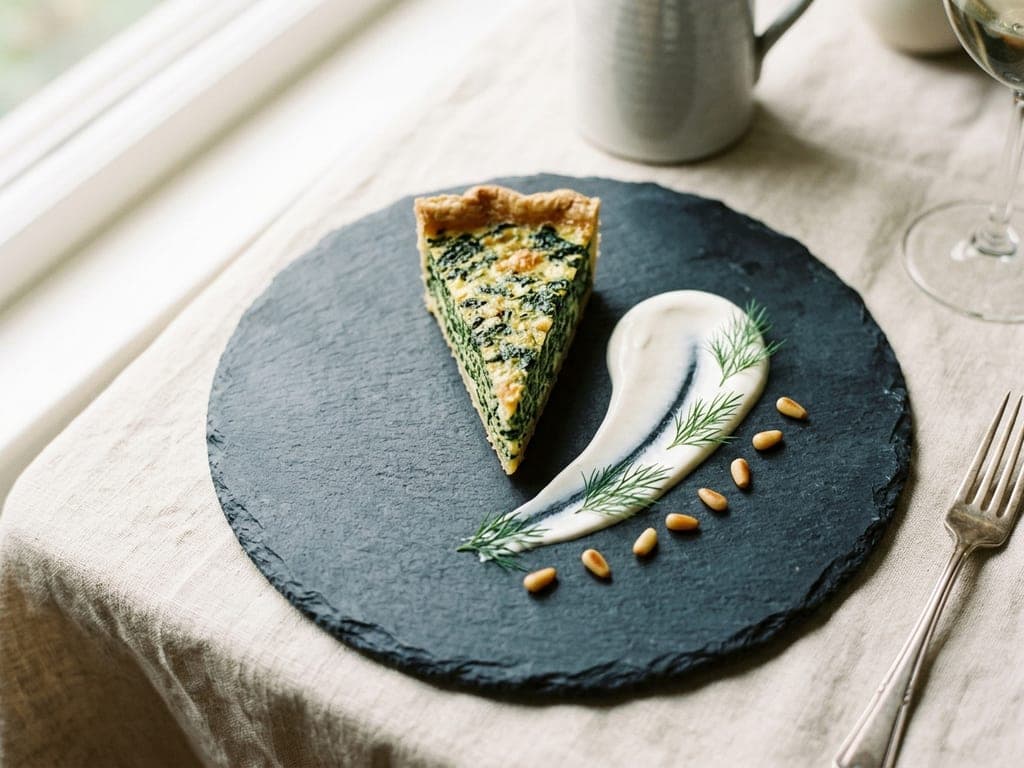
- Cut a half-width wedge and stand it upright — a first course is a promise, not a meal, and the tall slim slice reads elegant.
- Pull a teaspoon of crème fraîche into a comma with the spoon's back, landing the wedge's point at its head.
- Toast pine nuts to pale gold and scatter five or six down the plate's diagonal — the crunch against silk is the course's one trick, played once.
- Lay three small dill fronds along the crème fraîche line; on the dark plate the composition is green, white, gold, done.
Fresh versus frozen: an honest draw
Here is the admission most recipes bury: once wilted, wrung and baked into custard, fresh and frozen spinach finish within a rounding error of each other. Frozen chopped spinach was blanched at peak freshness, costs a fraction, skips the wilting step entirely, and arrives pre-collapsed — a 10 oz (280 g) brick thaws into almost exactly the cup of packed spinach this recipe wants. For a Tuesday quiche, frozen is not the compromise; it is the professional shortcut, and this page endorses it without a wink.
Fresh earns its premium in two places. First, texture at the margins: fresh-wilted leaves keep a little more distinctness in the custard, where frozen chop reads finer and more uniform. Second, the top: whole baby leaves pressed onto the surface before baking — the tart's photogenic green mosaic — only work from fresh. If the quiche is a centrepiece, buy the mountain of leaves; if it is lunch, open the freezer with your head held high.
Whichever road: the wring is identical and non-negotiable. Frozen spinach actually carries MORE free water than wilted fresh (ice crystals rupture the cells), so the thawed brick gets the same towel treatment, twisted until the ball is tight and the towel stops darkening. The recipe doesn't care where the spinach was born; it cares that the water is gone.
Florentine, the Medici legend, and what spinach actually brings
Any dish riding on spinach earns the name à la florentine in classical French cooking, and the standard origin story says Catherine de' Medici brought her beloved spinach — and cooks to prepare it — from Florence when she married into the French crown in 1533. Food historians file this one under charming but undocumented: the tale appears centuries after her death, and spinach was already well established in France. The name is real, the dish family is real, the duchess's spinach obsession is probably embroidery — this page reports the legend as a legend and enjoys it anyway.
Spinach's nutritional reputation carries its own folklore. It is genuinely excellent food — loaded with vitamin K, vitamin A, folate and fibre — but the iron mythology needs a footnote: spinach's iron is real on paper and poorly absorbed in practice, because the leaf's oxalates bind it (cooking helps somewhat). Popeye's PR was better than the leaf's bioavailability. What baking in a custard adds is the useful part: fat, which is exactly what spinach's fat-soluble vitamins need to be absorbed. A vegetable and its delivery vehicle, formally introduced.
The flavour logic of the classic pairings is chemistry as much as habit: nutmeg's warmth flatters spinach's faint bitterness (the French grate it over every creamed green), gruyère brings salt and roasted-nut depth, and egg custard rounds the leaf's metallic edge. The quiche is arguably the best thing that has ever happened to spinach — a sentence we are prepared to defend.
The feta fork, and other roads from this page
One decision point splits this quiche into two excellent dishes. The gruyère build — this page's default — is the French line: nutty, rounded, custard-forward. Swap in ¾ cup (110 g) of crumbled feta and it swerves Greek: brinier, sharper, spanakopita's sophisticated cousin in a French coat. The feta version wants two adjustments — drop the added salt entirely (feta is a salt delivery system) and add a small handful of chopped dill alongside the nutmeg, or instead of it. Both versions run the identical custard, shell and spinach doctrine; the cheese is the steering wheel.
Beyond cheese, the reliable extensions: sautéed mushrooms (cooked until the pan is dry — they obey the same water law as the spinach) turn it woodsy; caramelised onions from the master page's playbook add sweetness that flatters the feta build especially; sun-dried tomatoes, patted dry of their oil, punctuate the green with acid-sweet red. The ceiling holds at about 2 cups (300 g) of total cooked solids — past it, the custard can't govern the crowd.
And the two exits: adding lardons or bacon makes a fine tart while dissolving the dish's vegetarian identity — at which point the quiche lorraine page does smoky-pork custard with more conviction. Skipping the pastry entirely is not a loss but a lane change: the crustless quiche page runs its rebalanced ratio, and this spinach filling drops into that build without modification, feta and all.
Questions, answered
Fresh or frozen spinach for quiche?
Baked into custard, they finish nearly identical — frozen was blanched at peak freshness and arrives pre-collapsed, so 10 oz (280 g) thawed and hard-wrung equals the 1 lb (450 g) of fresh leaves this recipe wilts. Frozen is the honest Tuesday shortcut; fresh earns its price when you want distinct leaves in the bite or the whole-leaf mosaic on top. The one constant is the towel wring — frozen carries even more free water than wilted fresh.
How much fresh spinach do I need?
One pound (450 g) — a genuinely comic volume of raw leaves that wilts to about one packed cup, which is the correct amount against a 3-egg custard. It will not fit in the pan at once; add it in waves as each handful collapses. Buying less to save the wilting drama shorts the finished tart: spinach is the headline here, and a slice should be visibly, confidently green, not custard with a rumour of vegetation.
How dry is dry enough?
The test is physical: the wrung spinach forms a compact, fist-sized ball that leaves NO wet print when pressed on the cutting board, and the towel stops darkening on the final twist. Expect to extract close to ½ cup (120 ml) of green water — that volume was your watery-quiche insurance premium, paid up front. Then the pan pass with shallot and garlic dries the last spoonfuls on live heat. However dry you think it is: one more twist.
Why is my spinach quiche watery?
Unremoved spinach water, almost certainly — a squeeze between the palms leaves several tablespoons behind, and they surface as the pool under your slices. The towel wring is the cure. The two accomplices: overbaking (past 160°F / 71°C the eggs clench and expel their own moisture — pull at the sway) and a skipped or pale blind bake, which reads as soggy crust rather than wet custard. Fix all three and this quiche slices clean at room temperature.
Can I make it with feta instead of gruyère?
Yes — it is the page's official fork: ¾ cup (110 g) of crumbled feta swaps for the gruyère and the quiche swerves from French to Greek, spanakopita's custard cousin. Make the two amendments that keep it balanced: no added salt at all (feta is brine in solid form) and a small handful of chopped fresh dill with or instead of the nutmeg. Shell, spinach doctrine and custard stay identical. Goat cheese runs the same play at a softer, tangier volume.
Baby spinach or regular — does it matter?
Both work; they differ at the margins. Baby spinach is tender, mild, stemless and usually pre-washed — the convenient choice, and the only kind for the decorative whole leaves on top. Mature bunched spinach brings a deeper, more mineral flavour and sturdier texture for a few minutes more prep (stemming, grit-washing). Frozen is mature spinach by another door. For the wilted-and-wrung interior they converge; buy whichever the shop sells in good condition.
Can I add bacon or salmon?
Of course — with the note that either one changes the dish's passport. Blanched, browned lardons (the quiche lorraine page's technique) make a spinach-bacon tart that eats beautifully but is no longer vegetarian; hot-smoked salmon, flaked in at about 1 cup (150 g), pulls it toward a Scandinavian brunch and loves the dill-feta build. Keep total solids near 2 cups (300 g) and everything pre-cooked and dry. The vegetarian version is the page's default, not its ceiling.
Can I make it ahead or freeze it?
Happily — it may be better on day two, once the nutmeg-spinach-gruyère chord settles. Bake, cool, refrigerate covered up to 3–4 days; serve at room temperature or rewarmed at 325°F (163°C) for 12–15 minutes. Baked and wrapped tight it freezes 2 months (thaw in the fridge, refresh in the oven). The filling also preps ahead solo: wilted, wrung, seasoned spinach — cooled quickly and refrigerated within 2 hours — keeps for 2 days, turning bake day into a 10-minute assembly.
Is spinach quiche healthy? How many calories?
About 400 a slice as built — custard and pastry do what custard and pastry do — with genuine nutrition riding along: vitamin K and A, folate, fibre, and the custard's fat is precisely what those fat-soluble vitamins need for absorption. The iron legend deserves its footnote: spinach iron is poorly absorbed (oxalates bind it), Popeye notwithstanding. Want lighter? The crustless build with this same filling lands near 250 a slice — that is the honest lever, not thinner milk.
Can I skip the crust?
Yes, but not by simply omitting it — a crustless custard needs a different ratio to stand on its own. The crustless quiche page runs that build (6 eggs to 1 cup of dairy in a buttered pie dish), and this page's spinach-gruyère or spinach-feta filling drops into it unchanged: same wring, same quantities, roughly 250 calories a slice and naturally gluten-free. Consider the two pages a modular system: filling doctrine here, structural engineering there.
Snap your finished plate and let the AI plate it again — more beautifully.