Quiche Recipe — the Master Ratio, One Crust, Endless Fillings
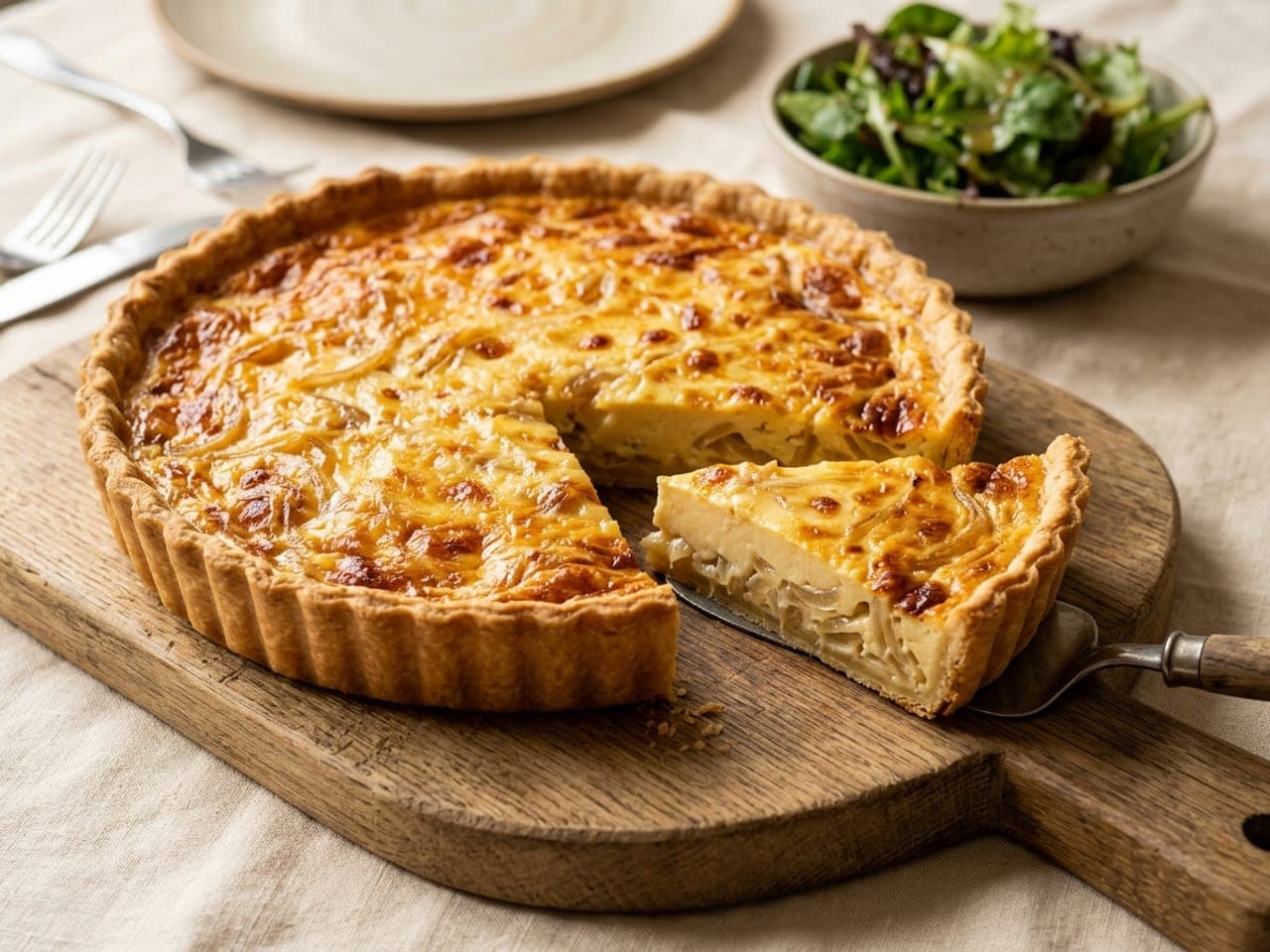
The French bistro's quiet flex: a crisp shortcrust shell holding a silky savoury custard that sets — not scrambles — around whatever the kitchen has to offer. Quiche is not a filling recipe, it's a ratio: one egg to every half-cup of dairy, poured into a properly blind-baked crust and taken out of the oven while the centre still wobbles. Learn that sentence and every quiche in your future is already made; this page teaches it with a caramelised-onion-and-gruyère build to prove it.
Ingredients
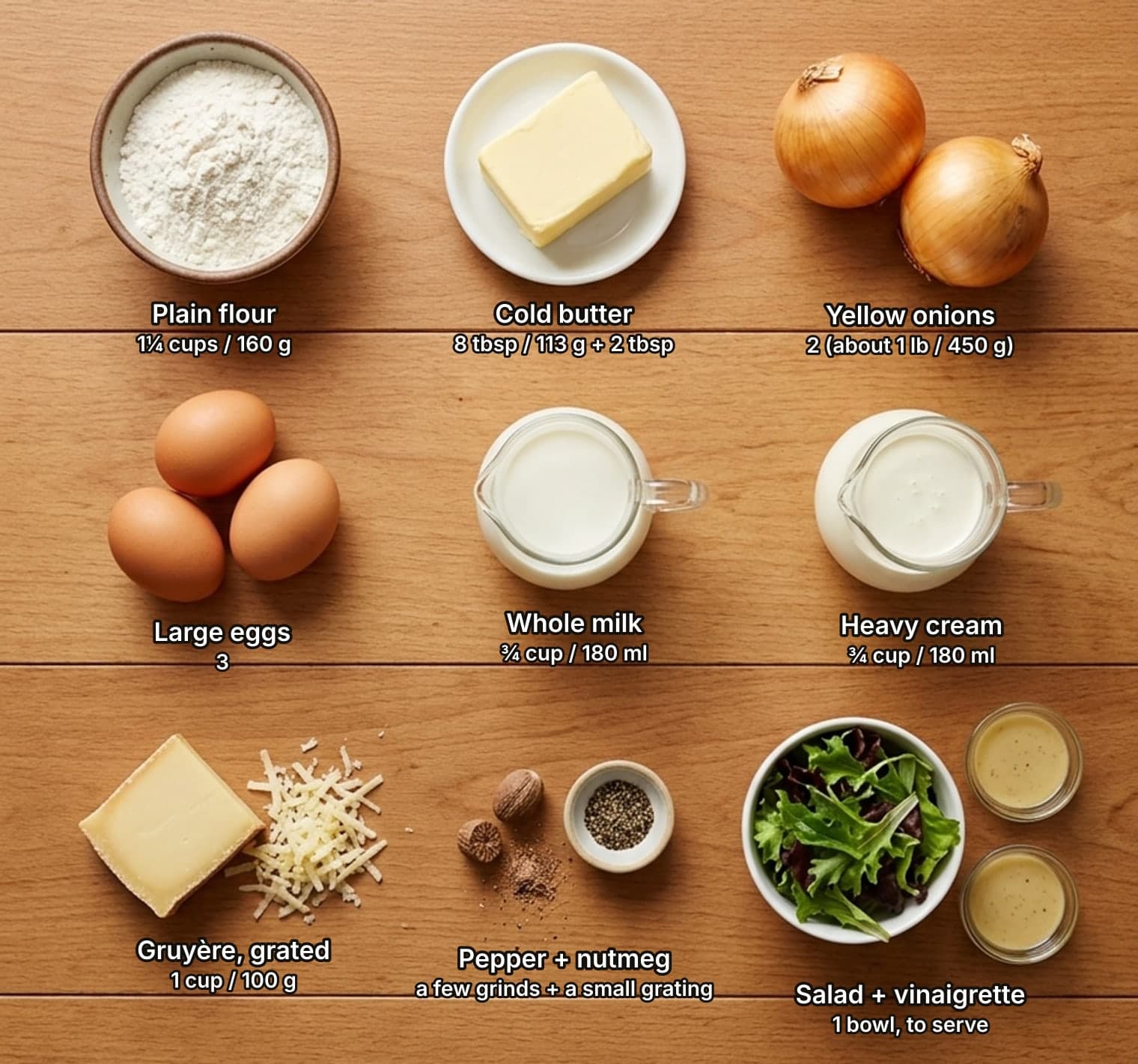
- plain flour (pâte brisée)1¼ cups / 160 g
- cold butter, cubed (pastry) + 2 tbsp (onions)8 tbsp / 113 g + 2 tbsp
- fine salt (½ tsp pastry + ¾ tsp custard)1¼ tsp total
- ice water3–4 tbsp
- medium-large yellow onions2 (about 1 lb / 450 g)
- large eggs (plus a brushed teaspoon for the crust seal)3
- whole milk¾ cup / 180 ml
- heavy cream¾ cup / 180 ml
- gruyère, grated1 cup / 100 g
- black pepper and freshly grated nutmega few grinds + a small grating
- green salad and mustard vinaigrette, to serve1 bowl
Quiche is a ratio wearing a recipe
Strip away the fillings and every quiche is the same object: a savoury custard — eggs set gently through dairy — held by pastry. The custard obeys arithmetic: 1 large egg per ½ cup (120 ml) of dairy. A standard 9-inch (23 cm) tart takes 3 eggs and 1½ cups (360 ml); a deep-dish version takes 4 and 2 cups (480 ml); a crustless one shifts the ratio egg-ward to stand on its own (that version has its own page). Learn the ratio and the recipe card becomes optional — you are two whisked minutes from quiche in any kitchen holding eggs and something creamy.
The dairy decides the character. Half milk, half heavy cream is the bistro standard — rich enough to be silky, light enough to slice clean. All half-and-half lands close by another road — a touch lighter, still silky. All cream makes a Sunday-decadent custard that barely holds a slice; all milk makes a lighter, slightly custard-tart texture that benefits from an extra yolk. What never works is the low-fat swap chain — fat is what keeps gently-cooked eggs tender, and a skimmed-milk quiche sets rubbery and weeps. If calories are the concern, the honest lever is the crustless version, not a sadder custard.
And the name for all this: quiche comes from the German Kuchen — cake — by way of the Lorraine region on the Franco-German border, where the dish began as bread dough under eggs and cream. The pedigree and the purism live on the Quiche Lorraine page; the takeaway here is that the dish was born frugal and flexible, which is exactly how it should be cooked.
How to make Quiche
- Make the pâte brisée — five minutes of work, thirty of rest. Whisk 1¼ cups (160 g) plain flour with ½ tsp fine salt, then work in 8 tbsp (113 g) of cold cubed butter — fingertips, pastry cutter or eight pulses in a food processor — until the biggest pieces are pea-sized and the rest looks like damp sand. Those butter pieces are the flakiness; do not chase uniformity. Sprinkle in 3–4 tbsp of ice water, toss until the dough just holds when squeezed, press into a disc, wrap, and refrigerate at least 30 minutes. The rest is non-negotiable: it hydrates the flour and relaxes the gluten so the crust bakes tender instead of tough — and cold butter is the whole argument.
- Roll, line the tin, and chill again. Roll the cold disc on a floured surface to a 12-inch (30 cm) circle, about ⅛ inch (3 mm) thick, rotating a quarter-turn between strokes so it stays round and unstuck. Drape it into a 9-inch (23 cm) tart tin — lift and settle it into the corners rather than stretching it; stretched dough remembers, and shrinks in the oven. Trim the overhang, prick the floor all over with a fork, and freeze the lined tin for 15 minutes while the oven heats to 375°F (190°C). Cold dough into a hot oven is the first rule of no-shrink, no-slump pastry.
- Blind bake — the step every soggy quiche skipped. Set the frozen tin on a baking sheet — it stays under the tart to the very end, and hot, it becomes half the soggy-bottom defence — then line the shell with crumpled parchment and fill to the rim with pie weights, dried beans or rice; the fill supports the walls while the pastry sets. Bake 20 minutes at 375°F (190°C), lift out paper and weights (they are HOT — see safety), and bake the naked shell 5–8 minutes more until the floor looks dry and lightly golden. A raw custard poured into a raw crust makes a steamed, grey, soggy bottom no oven can rescue afterwards — the blind bake is where crisp is decided.
- Waterproof the shell. Brush the hot crust floor with a teaspoon of the beaten egg you are about to use anyway and return it to the oven for 1–2 minutes, until the glaze turns shiny and set. That thin egg layer bakes into a varnish between wet custard and crisp pastry — a ten-second insurance policy the bistros never skip. Leave the oven on and drop it to 350°F (175°C).
- Caramelise the onions — the slow kind, not the browned kind. While the crust bakes, slice 2 medium-large yellow onions (about 1 lb / 450 g) thin, and cook them in 2 tbsp of butter with a pinch of salt over medium-low heat, stirring every few minutes, 30–40 minutes until they collapse into a sweet amber tangle. If they are frying and crisping, the heat is too high — add a splash of water and slow down. Then the crucial move: spread them on a plate to cool and let their steam escape. Hot, wet filling is one of the three ways a quiche turns to soup (the sections cover all three).
- Mix the custard by the master ratio. Whisk 3 large eggs with 1½ cups (360 ml) of dairy — the classic split is half whole milk, half heavy cream — plus ¾ tsp fine salt, a few grinds of pepper and a small grating of nutmeg. That is the entire formula: one egg per ½ cup (120 ml) of dairy, scaled to fit the tin. Whisk until just combined, not frothy — beaten-in foam bakes into a spongy, pocked surface instead of a silky one.
- Assemble in the right order. Scatter the cooled onions over the crust floor, then 1 cup (100 g) of grated gruyère — solids first, evenly, so every slice gets its share. Set the tin on its baking sheet — still hot from the blind bake — on the oven rack pulled halfway out, never reaching into the hot cavity; THEN pour the custard over the filling, right up to a couple of millimetres below the crust edge, and slide the rack gently home. Pouring at the oven means no cross-kitchen walk with a brimful tin — and the hot sheet gives the pastry base bottom heat, the second half of the soggy-bottom defence.
- Bake to a wobble, not to firm. Bake at 350°F (175°C) for 35–40 minutes, until the edges are puffed and set but a nudge of the tin makes the centre 2 inches (5 cm) sway like just-set jelly — an instant-read thermometer there reads about 160°F (71°C), which is also the food-safe mark for egg dishes. Custard keeps cooking from residual heat after it leaves the oven; a quiche baked until firm in the oven is an overbaked quiche on the table — curdled, grainy, weeping liquid.
- Rest, then serve barely warm. Cool on a rack at least 20–30 minutes before slicing — cutting early spills custard that would have set as it cooled. Quiche's best temperature is barely-warm or room temperature, when the custard is fully set, the flavours are loudest and the pastry is crispest; steaming-hot quiche is actually the worst version of itself. A sharp thin knife, wiped between cuts, gives the clean bistro wedge. Serve with dressed leaves and a sharp vinaigrette — the acid against the rich custard is the whole lunch.
Safety & hygiene Important
- The wobble has a number: 160°F (71°C). The jiggle test and the safety test agree, which is convenient: egg dishes are food-safe at 160°F (71°C), and that is almost exactly where the centre of a quiche should come out of the oven anyway. An instant-read thermometer in the middle settles both questions at once — under 160°F it needs minutes more; the vigorous slosh of raw custard is obvious against the set sway of a done one. This matters most for deep-dish quiches, where a browned top can sit over a raw middle.
- Quiche keeps brunch-buffet hours. A custard full of eggs and dairy is exactly what bacteria order for brunch. Room temperature service is traditional and fine — inside the 2-hour window (1 hour above 90°F / 32°C), and the clock starts when the tart leaves the oven, cooling included. Before it runs out, cut what remains into portions and refrigerate covered — pieces chill fast where a whole warm tart lingers — where they hold 3–4 days; reheat slices to steaming — 165°F (74°C) — in a 325°F (163°C) oven rather than a microwave, which rubberises custard and steams crust. A quiche that sat out all afternoon at the buffet is not leftovers, it is a write-off.
- Pie weights come out at 375°F. The parchment-and-weights lift is the step where blind baking bites: the beans or ceramic weights are at full oven temperature and pour-happy. Gather the parchment corners into a bundle with dry oven mitts, lift straight up over the tin, and land the bundle in a metal bowl — not a plastic one, not the compost. And label the cooled beans as pie weights for life; a bean that has done a 375°F (190°C) shift will never soften in a soup again, but it will blind-bake forever.
- Raw dough is raw flour — and raw flour is raw. The habit of tasting pastry scraps has an outbreak list behind it: flour is an uncooked agricultural product and has driven repeated E. coli and Salmonella outbreaks, which is why the FDA's advice is blunt — no raw dough, no raw batter, not even a pinch, and no dough handed to children as play-dough either. The raw eggs ask the same respect: crack them against the counter rather than the bowl rim, fish out shell with a spoon, and wash hands after. Everything is fully safe once baked to 160°F (71°C); until then, wash hands and the counter after rolling, and keep the scrap-nibblers away from the trimmings.
3 ways to plate it
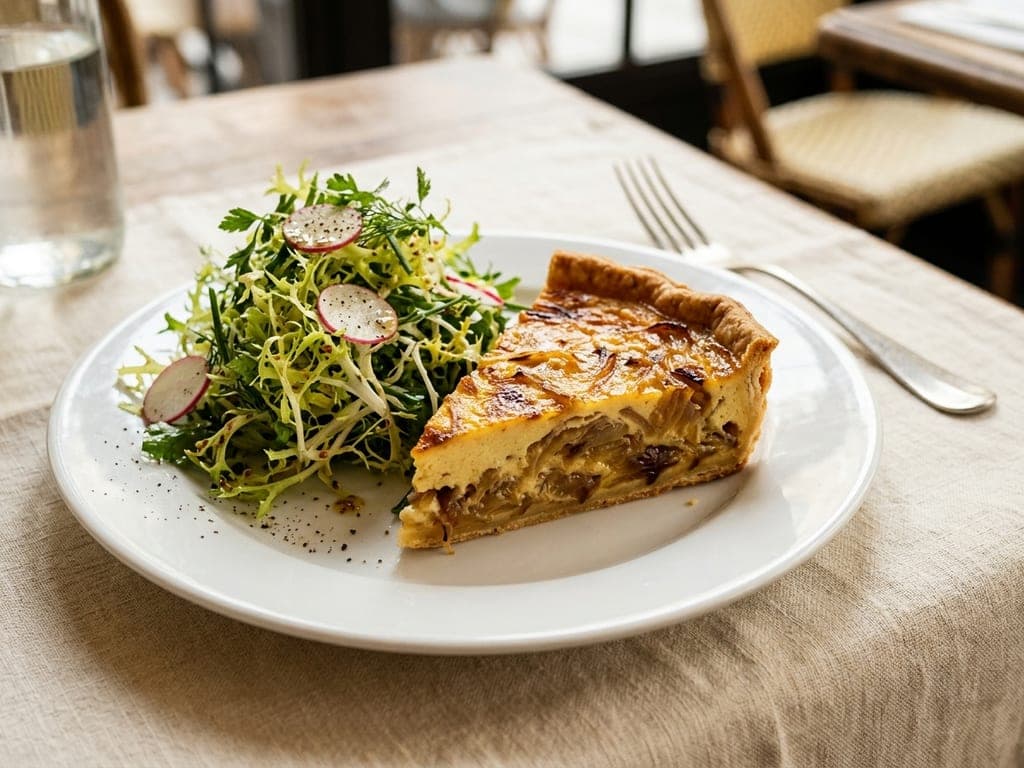
- Slice with a thin sharp knife wiped clean between cuts — the clean custard face, showing its layers, is the whole presentation.
- Set the wedge just off-centre with the point angled toward the diner; dead-centre plating reads cafeteria, off-centre reads bistro.
- Dress the frisée at the last second and pile it TALL beside the wedge — height and acidity against the low rich custard is the composition.
- Finish with halved radishes and a crack of pepper on the salad only — the quiche face stays clean and golden.
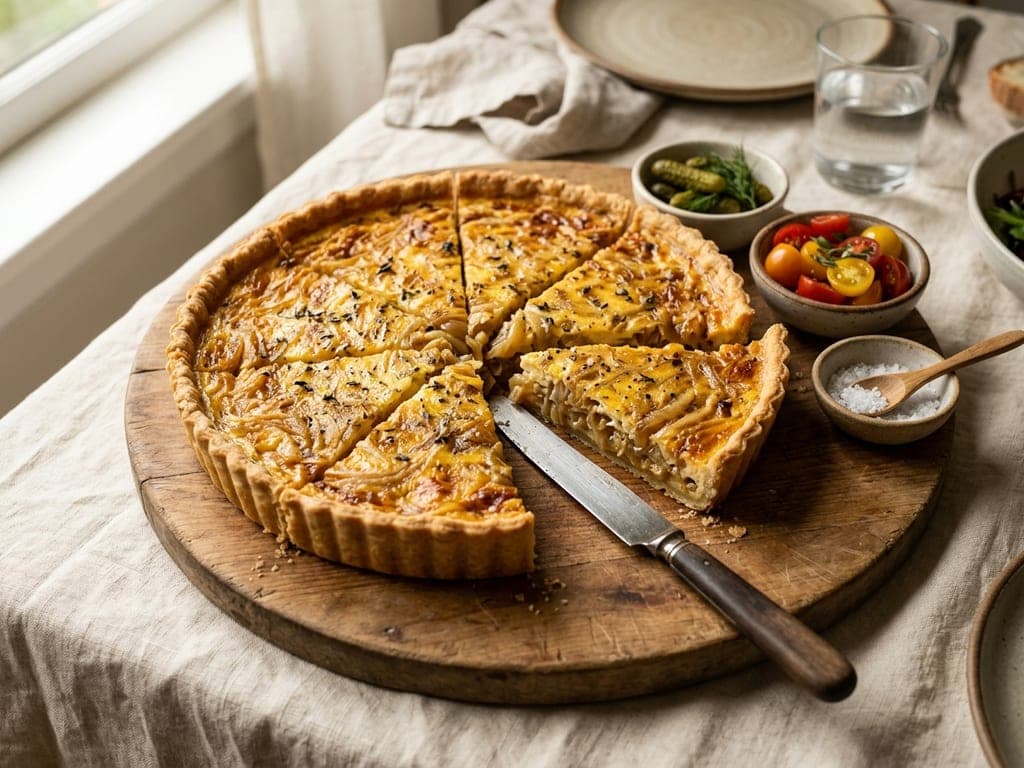
- Cool the quiche fully, then slide it — on the tin base — onto the board; room-temperature service is the picnic's engineering advantage, not a compromise — kept cool in transit and served inside the 2-hour window (1 hour above 90°F / 32°C).
- Pre-cut just two neighbouring wedges and slide them a centimetre out of formation — an untouched circle stays untouched; a started one disappears.
- Anchor small bowls of cornichons and halved cherry tomatoes at the edge of the board — sharp, cold and snackable against the rich custard.
- Lay the knife on the board pointing at the gap — table-service choreography that says continue without a word.
- Cut a half-width wedge — a tasting portion asks to be finished; a full lunch slice as a starter is a threat.
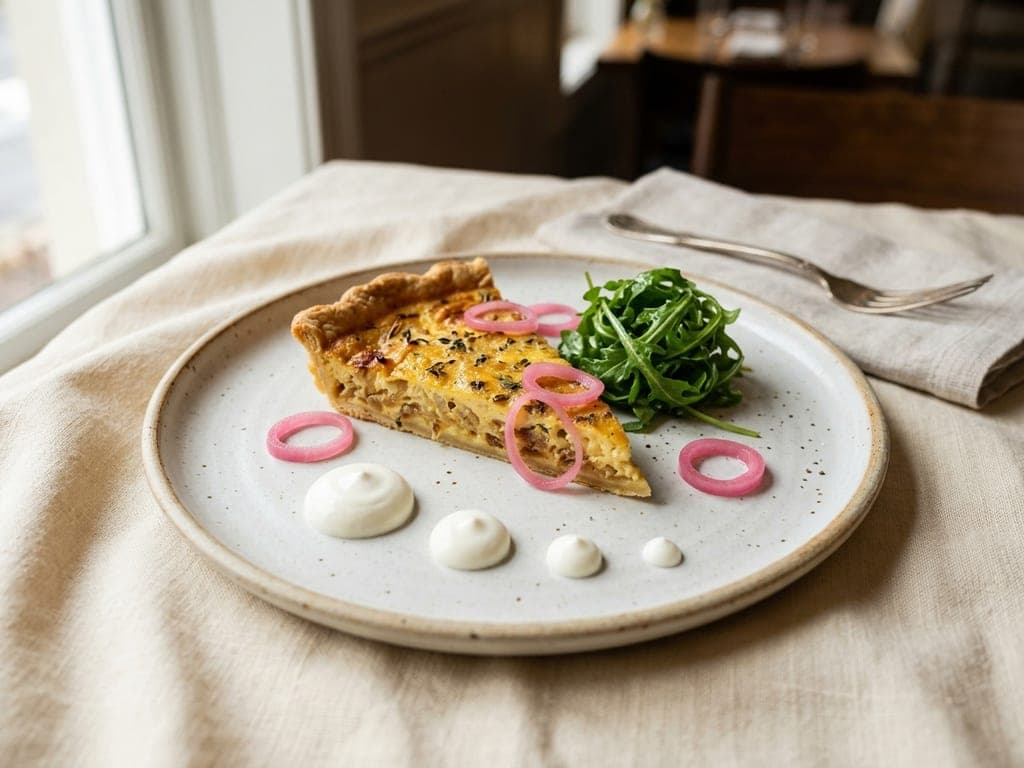
- Set a small, tight twist of dressed rocket beside the point — one gesture of green, not a salad.
- Dot crème fraîche three times along the plate's curve in descending size — the cool dairy echoes the custard and gives the fork somewhere to drag.
- Scatter five or six pickled shallot rings over plate and wedge — the pink is the plate's only loud colour, so let it land where it falls.
The crust: pâte brisée, and the war on the soggy bottom
The pastry is pâte brisée — flour, cold butter, salt, ice water, nothing else — and it asks for restraint more than skill: visible butter pieces, minimal handling, a real chill before rolling. Every quiche failure that isn't custard-related is moisture-related, so the playbook is worth stating as doctrine. One: blind bake fully, until the floor is dry and lightly golden — a pale blond crust is a crust that will steam under custard. Two: waterproof — brush the hot floor with beaten egg so it varnishes. Three: bake the filled tin on a preheated baking sheet, so the base gets conducted bottom heat instead of gentle oven air. Four: cool in the tin on a rack, where air circulates, not on a chopping board where trapped steam undoes your work.
Store-bought crust, honestly graded: the refrigerated roll-out kind is a B — real pastry, usually shortening-based, needs the same blind bake and docking as homemade and tastes like a supporting actor. The frozen pre-shaped foil-tin kind is a C+ — convenient, shallow (your custard will overfill; the ratio shrinks to 2 eggs + 1 cup / 240 ml), and prone to pre-cracked floors, which are custard leaks waiting to happen. Both are respectable Tuesday moves. The homemade shell is twenty minutes of actual work and freezes flat for a month, which is the real pro move: a frozen lined tin blind-bakes straight from the freezer.
One warning the packet never prints: sweetened pastry — pâte sucrée, dessert shells, most American "pie crust" mixes with sugar — turns a quiche into breakfast cake. Read for sugar; the right shell has none.
Three ways a quiche becomes soup, and the counter-moves
Watery quiche has exactly three causes, and none of them is bad luck. First: wet filling. Vegetables are mostly water and surrender it into the custard as they bake — so everything precooks. Onions caramelise, mushrooms sauté until their liquid is gone and evaporated, spinach wrings out by hand (its page takes this to extremes), blanched broccoli drains hard, tomatoes get seeded or left for another dish. The rule: nothing goes into the shell that would leave a wet ring on a paper towel.
Second: overbaking. Egg proteins set gently up to a point, then clench — squeezing out the water they had bound, which pools under the slices. This is syneresis, and it is why the quiche must leave the oven at a wobble (160°F / 71°C in the centre) and finish setting on the rack. The cruel part is that an overbaked quiche often looks perfect — puffed, golden, confident — and then weeps as it cools. Trust the wobble, not the puff; the puff is actually a warning that the eggs have soufflé'd past silky.
Third: too much filling. The custard is the dish; the filling is the seasoning. The ceiling is about 2 cups (300 g) of cooked, cooled, well-drained solids plus 1 cup (100 g) of cheese for a 9-inch tart — past that, the custard can't bind the crowd and the slice crumbles wetly apart. If the fridge-cleaning instinct runs hot, make two quiches; the ratio scales, that's the point of it.
The variations directory — one ratio, a hundred quiches
Once the ratio is in hand, variations are shopping lists, and the classics each have a page or a paragraph here. Quiche Lorraine — smoky lardons, the contested cheese question, the real history — has its own page, as does spinach quiche (the water-management masterclass) and crustless quiche (the ratio rebalanced to stand shell-free). Those three are the pillars; what follows are the reliable one-paragraph builds, all on the standard 3-egg custard and blind-baked shell.
Ham and cheese: 1 cup (150 g) diced cooked ham plus 1 cup (100 g) of gruyère or sharp cheddar — the moved-to-France ham sandwich, and the single most requested quiche in any bakery case. Broccoli: 2 cups (180 g) of small florets, blanched 2 minutes, shocked, and drained aggressively — cut-side down on towels — with cheddar; skip the blanch and the florets steam craters into the custard. Mushroom: 12 oz (340 g) of sliced mushrooms sautéed hard until their water is gone and the pan is dry again, with thyme and gruyère — the best cold-weather quiche there is. Leek: two leeks, sliced and melted in butter like the onions above, with goat cheese crumbled in — the spring bistro standard.
The pattern is visible from here: every filling precooks, dries and cools; every build totals about 2 cups of solids and a cup of cheese; the custard never changes. That is the entire genre. From this point on, the recipe card is a formality — which is the most French possible outcome for a dish born from leftovers on the German border.
Questions, answered
What is the quiche custard ratio?
One large egg per ½ cup (120 ml) of dairy, salted at about ¼ tsp fine salt per egg. A 9-inch (23 cm) tart takes 3 eggs + 1½ cups (360 ml); deep-dish takes 4 eggs + 2 cups (480 ml); shallow store-bought foil shells take 2 eggs + 1 cup (240 ml). Dairy = half milk, half cream as the default. Every quiche on this site runs on that arithmetic.
Can I use milk instead of cream?
All-milk works with a texture tax: the custard sets lighter and slightly less silky, and appreciates a fourth yolk for insurance. Half-and-half alone is the easiest single-carton answer. What fails is the diet ladder — skimmed milk or milk alternatives set rubbery and weepy, because fat is what keeps the eggs tender. If lighter is the goal, the crustless quiche drops more calories than any dairy swap, without the texture penalty.
Do I really have to blind bake the crust?
For a crisp bottom, yes — and it is the least skippable step on the page. Custard is liquid; pastry is flour and butter; pour one onto the other raw and the base steams instead of baking, permanently. Twenty minutes with weights, a few naked minutes to golden, an egg-wash varnish: that is the whole tax. The one legitimate way to skip it is to skip the crust entirely — the crustless quiche page is exactly that.
Why is my quiche watery?
One of three causes, all preventable: filling that went in wet (every vegetable precooks and drains — this is the big one), overbaking (egg proteins clench past 160°F / 71°C and squeeze their water back out — pull at the wobble), or filling overload (past about 2 cups of solids the custard can't bind it). The sections above walk each fix. A properly-built quiche slices clean at room temperature with no pool on the plate.
How do I know when quiche is done?
The centre sways like just-set jelly when the tin is nudged — set, not sloshing, not firm — and an instant-read thermometer in the middle reads 160°F (71°C), which happens to be the food-safe number for egg dishes. Ignore the top's colour; a golden dome can be raw beneath in a deep tin. And expect carryover: it finishes setting on the rack, which is why baked-until-firm is overbaked.
Can I make quiche ahead? Can I freeze it?
Quiche is genuinely better slightly aged: bake it the day before, refrigerate covered once cool, and serve at room temperature or rewarmed at 325°F (163°C) for about 15 minutes — the custard is set, the flavours are louder. Whole baked quiche also freezes well, wrapped tight, for up to 2 months; thaw overnight in the fridge and refresh in the oven. The one make-ahead that fails is holding raw custard in a raw shell — the crust drowns while you wait.
What is the difference between quiche and frittata?
Ratio and container. Quiche is a dairy-rich custard (½ cup per egg) that needs a crust or dish to hold it, baked gently, silky when cut. A frittata is nearly all egg with a splash of dairy, started on the stovetop and finished under heat, sturdy enough to stand alone — closer to an open omelette than to custard. The crustless quiche sits between them and is its own page; the short version is that it keeps quiche's custard soul, not the frittata's egginess.
Should quiche be served hot or cold?
Barely warm or room temperature — the texture and flavour peak as the custard finishes setting, about 30–60 minutes out of the oven, and the pastry is crispest before refrigeration ever touches it. Steaming hot, the custard is still loose and the flavours muted; fridge-cold, the butter in the crust is a brick. Reheat leftover slices gently in a 325°F (163°C) oven, never the microwave, which turns custard to rubber and crust to flannel.
What goes with quiche?
The bistro answer has never been improved: sharply-dressed leaves — frisée, rocket or soft lettuce in a mustardy vinaigrette — whose acid resets the palate against all that dairy. Beyond the salad: roasted or quick-pickled vegetables, a tomato salad in summer, soup in winter. It is rich; the plate around it should bite back. A cold glass of dry white — an Alsace riesling from the region next door, or a Lorraine Côtes de Toul white if honouring the dish's actual home — is the traditional escort.
How many calories in a slice of quiche?
About 430 for an eighth of this caramelised-onion-and-gruyère build — pastry, cream and cheese carry most of it, which is why quiche is a meal with salad, not a side. Fillings barely move the number; the crust and dairy do. The meaningful lever is the crustless version at roughly 280 a serving — the pastry is nearly a third of the total — not a lower-fat milk, which costs texture without saving much.
Snap your finished plate and let the AI plate it again — more beautifully.