Vepřo Knedlo Zelo: Czech Roast Pork, Dumplings & Sauerkraut
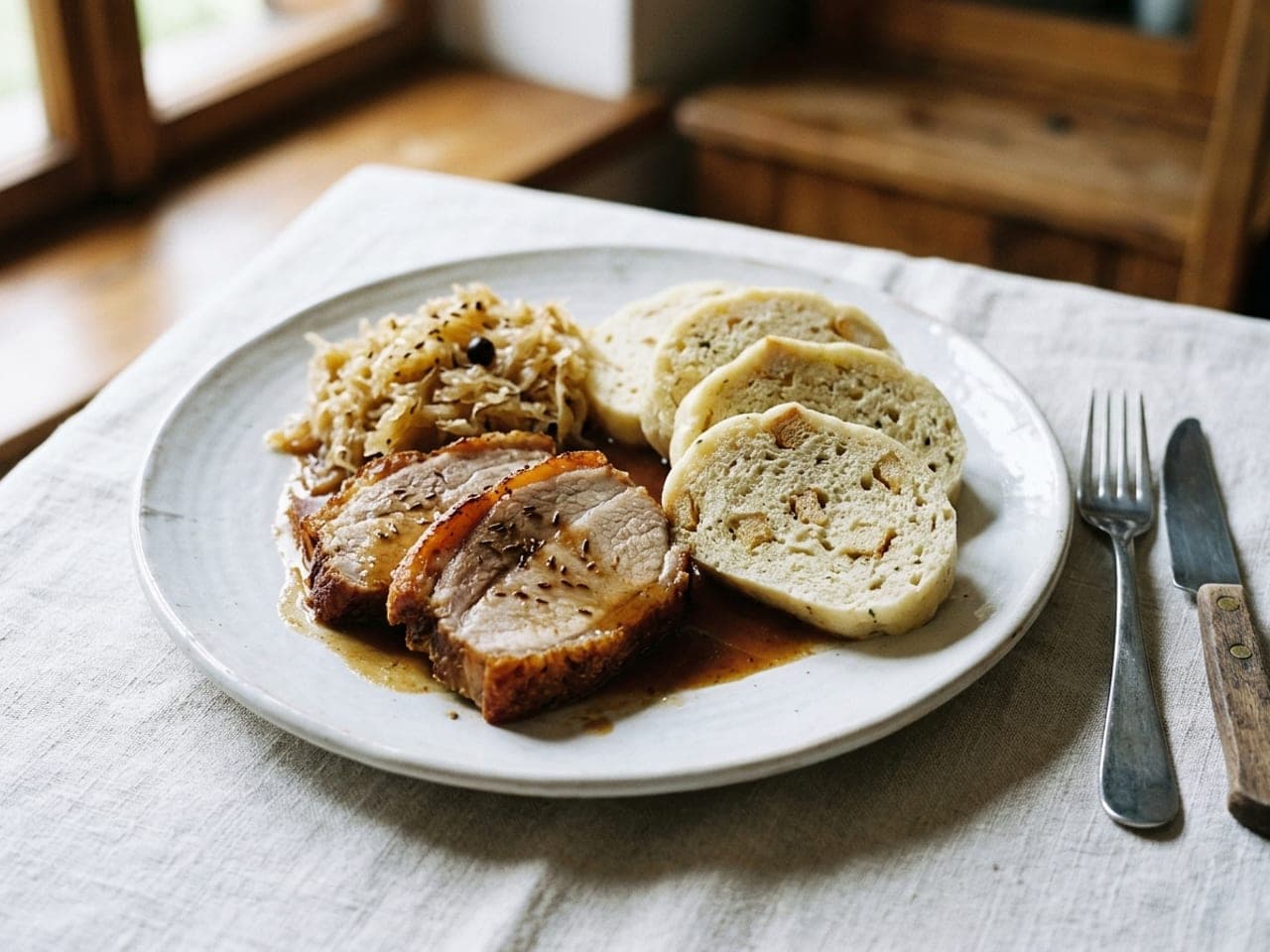
Vepřo knedlo zelo is Czech roast pork with dumplings and sauerkraut, the country’s great Sunday lunch: a caraway and garlic rubbed pork neck roasted slowly on onions until it slices like butter, light yeast bread dumplings cut with thread, and glossy sweet-sour braised sauerkraut, all tied together by a thin gravy from the roasting pan. This recipe makes all three from scratch for six and gives the one back-timed plan that lands them hot at the same minute, the two temperatures that matter (safe, and tender enough to slice), why dumplings that float are not done, and why the spice is caraway, never cumin. It also traces the name (knedlo vepřo zelo, if you prefer the other order) to the earliest print we could read: a 1929 Czechoslovak Legion novel. Contains wheat, milk and egg (and often celery, if you use ready-made stock).
Ingredients
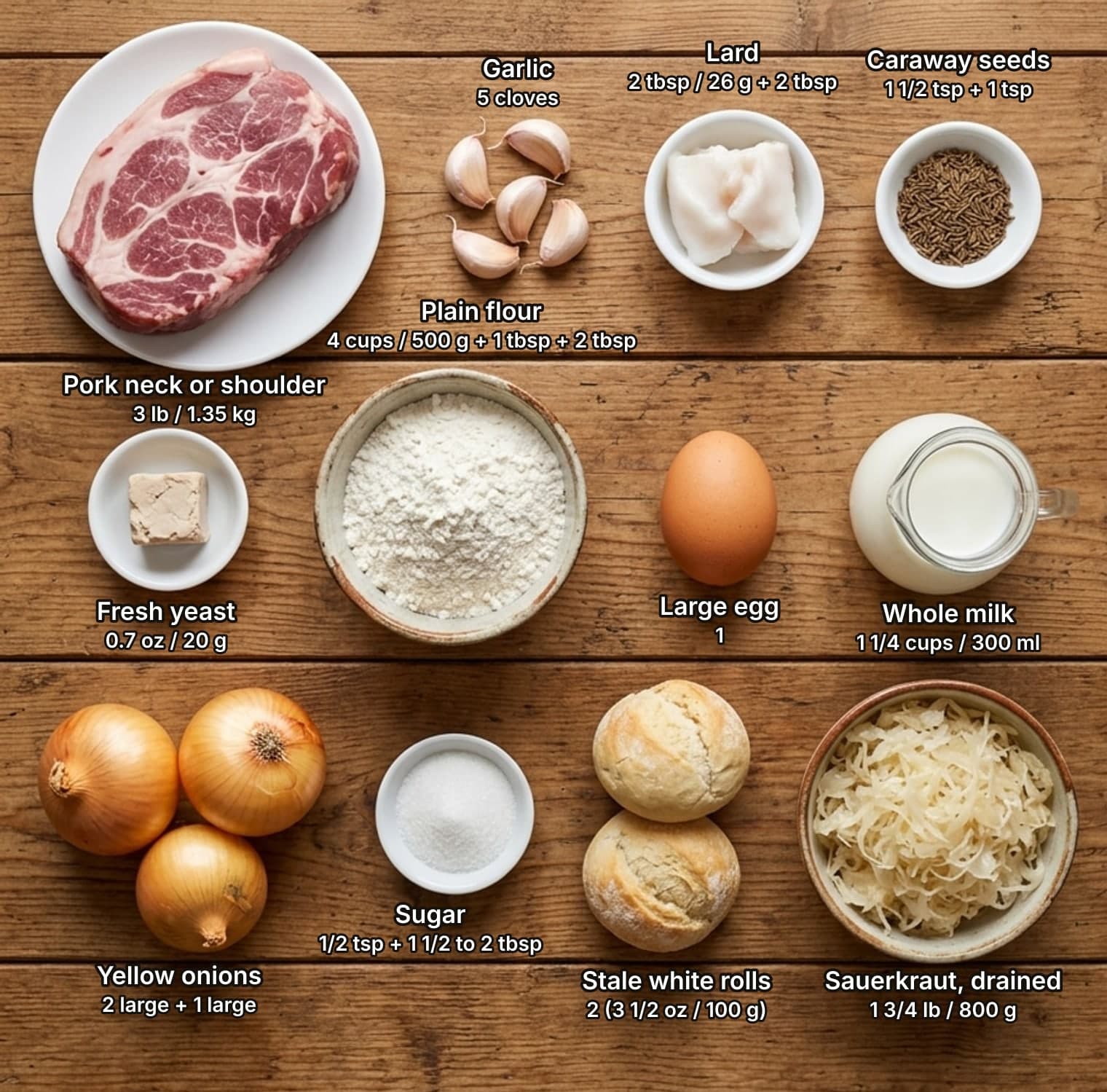
- Pork: boneless pork neck (collar, Czech krkovice; sold in the US as fresh (uncured) pork collar or coppa roast, not cured coppa; the top end of a Boston butt) or boneless pork shoulder, in one piece, fat cap left on3 lb (1.35 kg); 2.9 to 3.3 lb (1.3 to 1.5 kg) works
- Pork: fine salt (table or fine sea salt; about 0.9% of the meat’s weight)2 tsp (12 g)
- Pork: caraway seeds (Czech kmín; NOT cumin, which Czechs call římský kmín), lightly crushed1 1/2 tsp
- Pork: freshly ground black pepper1/2 tsp
- Pork: garlic cloves, crushed to a paste5
- Pork: lard (or sunflower or canola (rapeseed) oil)2 tbsp (26 g)
- Pork: yellow onions, roughly chopped2 large (10 1/2 oz / 300 g)
- Pork: hot water, for the pan (plus a splash more if it runs low)1 1/2 cups (360 ml)
- Gravy (šťáva): all-purpose (plain) flour (contains wheat)1 tbsp (8 g)
- Gravy (šťáva): water or unsalted pork or chicken stock (ready-made stock often contains celery)1 1/2 cups (360 ml)
- Dumplings: all-purpose (plain) flour, spooned and levelled (contains wheat; Czech cooks use hrubá mouka, a coarser flour, if you can find it)4 cups (500 g)
- Dumplings: whole milk, warmed to 98°F (37°C) (contains milk)1 1/4 cups (300 ml)
- Dumplings: fresh yeast (or 2 1/4 tsp / one 7 g packet instant or active dry yeast)0.7 oz (20 g)
- Dumplings: granulated sugar1/2 tsp
- Dumplings: large egg, lightly beaten (contains egg)1
- Dumplings: fine salt1 1/2 tsp (9 g)
- Dumplings: stale white bread rolls or white bread, 2 to 3 days old, cut into 3/8 inch (1 cm) cubes (contains wheat)about 3 cups (3 1/2 oz / 100 g), 2 rolls
- Dumplings: melted butter or lard, for brushing only if the dumplings must wait (optional)1 tbsp
- Sauerkraut: sauerkraut (white cabbage, jar or bag), drained, brine saved in a cup1 3/4 lb (800 g) drained: about 2 1/2 lb (1.1 kg) of jarred kraut, or a 2 lb (907 g) bag
- Sauerkraut: lard (or butter, which adds milk, or oil)2 tbsp (26 g)
- Sauerkraut: yellow onion, finely chopped1 large (5 oz / 150 g)
- Sauerkraut: caraway seeds1 tsp
- Sauerkraut: water1 cup (240 ml)
- Sauerkraut: granulated sugar, to taste1 1/2 to 2 tbsp (19 to 25 g)
- Sauerkraut: all-purpose (plain) flour, for thickening (contains wheat; for gluten-free, use 1 small floury potato, about 3 1/2 oz / 100 g, boiled and grated)2 tbsp (16 g)
- Sauerkraut: reserved sauerkraut brine, to re-sour if needed1 to 3 tbsp
What vepřo knedlo zelo is, and how to say it
Vepřo knedlo zelo is Czech roast pork with bread dumplings and sauerkraut, one of the first plates many visitors to Prague try, and the one Czech families still put on the table for Sunday lunch. The name is three clipped words: vepřo from vepřové (pork), knedlo from knedlík (dumpling) and zelo from zelí (cabbage, here sauerkraut). Say it VEP-rzhoh KNED-loh ZEH-loh, with the stress on the first syllable of each word and the k in knedlo sounded. The ř is a uniquely Czech sound, close to a rolled r and the “s” in “pleasure” at the same time. You will also see the words in another order, knedlo vepřo zelo, and both are correct.
This is a different page from our plain roast pork. Czech roast pork (vepřová pečeně) here means a fatty neck or shoulder joint rubbed with salt, caraway and garlic and roasted slowly on onions in a little water, so it ends up fully cooked yet juicy, with a thin šťáva made from its own pan juices. The dumplings are yeast-raised houskové knedlíky with cubes of stale bread roll inside, boiled as loaves and cut with thread; the sauerkraut is dušené zelí, braised with lard, onion, caraway and a little sugar until it is sweet-sour and glossy. Each of the three exists to fix something in the other two: the sour kraut cuts the fat of the pork, and the dumplings are there to carry the gravy.
How to make Roast pork with dumplings and sauerkraut
- Season the pork (T minus 3 3/4 hours). Heat the oven to 320°F (160°C), no fan; with a fan oven use 300°F (150°C). If your bread is not properly stale, spread the cubes on a tray and dry them in the oven for 10 to 12 minutes while it heats, then let them cool. Pat the pork dry with paper towels. If one end is much thinner than the rest, fold it under and tie the joint with cotton string every 1 1/2 inches (4 cm) so it is an even log; an uneven joint gives you a dry end and a tight middle. Mix the 2 tsp (12 g) salt, the crushed caraway and the pepper and rub it over every side of the meat, then smear the garlic paste over the top and sides. A dry surface is what lets the top brown later instead of steaming grey, and salting about 0.9% of the meat’s weight seasons a roast this size without making the pan juices too salty to turn into gravy. Crushing the caraway releases its oil so it perfumes the meat and the juices rather than sitting on top as whole seeds. You can season the pork the night before and keep it uncovered on a plate or rack on the bottom shelf of the fridge, below anything that will not be cooked (Cookipedia’s recipe for this dish rubs it a full day ahead); the salt has longer to work in, but it is not required.
- Roast it covered, on onions, in a wet pan (T minus 3 1/2 hours). Use a metal roasting pan about 9 x 13 inches (23 x 33 cm) with a lid, or a sheet of foil to cover it; a metal pan matters because you will make the gravy in it on the stove later. Smear the 2 tbsp (26 g) lard over the base, scatter the chopped onions over it and set the pork on top, fat side down. Pour the 1 1/2 cups (360 ml) hot water around the meat, not over it: with the roast taking up part of the base, that is about 3/8 inch (1 cm) of water, what Czech cooks call a finger’s depth. Cover and roast for 1 3/4 hours. Under a lid the pan stays humid and the meat’s surface stays near the boiling point of water, so the outside does not dry out while the centre climbs slowly through the 160 to 185°F (71 to 85°C) range where the tough connective tissue in neck and shoulder melts into gelatin. Check once halfway: if the water has dropped below about 1/4 inch (6 mm), add a splash of hot water. A pan that boils dry scorches the juices and turns the gravy bitter.
- Make the dumpling dough and let it rise (T minus 2 1/4 hours). Stir the fresh yeast and 1/2 tsp sugar into about 1/3 cup (80 ml) of the warm milk and leave it for 10 minutes until it foams (instant yeast can go straight into the flour). Keep the milk at about 98°F (37°C), comfortably warm on your wrist: much hotter and you kill the yeast, and the dumplings come out heavy. Put the 4 cups (500 g) flour and 1 1/2 tsp (9 g) salt in a large bowl, make a well, add the yeast mixture, the beaten egg and the rest of the milk, and mix to a shaggy dough (do not taste the raw dough: it contains raw flour and raw egg). Knead for about 8 minutes by hand (5 to 6 minutes with a dough hook) until it is smooth and elastic and comes away from the bowl; it should be soft but not sticky. Knead in the bread cubes for the last minute only, so they stay as cubes. Cover and leave in a warm place for 45 to 60 minutes, until roughly doubled. The bread must be stale or dried: fresh bread soaks up water from the dough and leaves wet, soggy pockets inside the dumpling. At 100 g of bread in roughly 980 g of dough, the cubes make up just over 10%, the low end of the 10 to 30% Czech cooks aim for.
- Uncover, turn and brown the roast (T minus 1 3/4 hours). Take off the lid or foil, lifting it away from you, far edge first, so the steam escapes away from your face and arms. Turn the pork fat side up and spoon the pan juices over it. Stir the onions so they do not catch at the edges, and top up with a little hot water if the pan looks dry. Roast uncovered for about 1 hour more, basting every 20 minutes. This is where the colour comes from: once the lid is off, the surface dries and can climb well past the boiling point, which is what browning needs, while the onions and juices underneath slowly turn deep gold and give the gravy its flavour. The pork is ready when a fork or skewer slides into the thickest part with almost no resistance and a probe thermometer there reads 176 to 185°F (80 to 85°C). Expect 2 1/2 to 3 hours in all for a 3 lb (1.35 kg) neck; a leaner shoulder is often ready sooner, so start checking at 2 1/4 hours. Trust the fork and the probe, not the clock.
- Put the dumpling water on and braise the sauerkraut (T minus 1 1/4 hours). First put the dumpling water on: at least 6 quarts (5.7 l) of water in a pot at least 11 inches (28 cm) across, lid on, over high heat; that much water takes 20 to 30 minutes to come to the boil. Then taste a strand of the drained sauerkraut. If it is pleasantly sour, use it as it is. If it is harsh (very sharp homemade kraut, or some barrel kraut), give it a quick rinse in cold water and squeeze it out. Melt the 2 tbsp (26 g) lard in a wide saucepan over medium heat, add the chopped onion and cook for 6 to 8 minutes until soft and pale gold. Stir in the 1 tsp caraway for 30 seconds, then the sauerkraut and the 1 cup (240 ml) water. Cover and braise over low heat for 30 minutes, stirring now and then, until the cabbage is tender. Stir in 1 1/2 tbsp sugar, dust the 2 tbsp (16 g) flour over the cabbage, stir well and simmer, uncovered, for another 15 minutes. That quarter hour is not optional: raw flour needs about 15 minutes of simmering to lose its pasty taste. Taste and balance: more sugar if it is too sharp, a spoonful of the saved brine if it has gone flat. It is right when it is glossy and a forkful holds together without thin liquid dripping off. Keep it covered over the lowest heat.
- Shape and boil the dumplings (T minus 1 hour to T minus 20 minutes). Knock the risen dough back, divide it into two equal pieces (weigh them: about 1 lb 1 oz / 490 g each) and roll each into a log about 8 inches (20 cm) long and 2 1/4 inches (6 cm) thick. Equal weight matters, because unequal loaves will not be done at the same moment. Leave them on a floured board under a cloth for 15 to 20 minutes while the water you put on earlier comes to a full boil (if your pot is narrower than 11 inches / 28 cm, cook the loaves one after the other). Lower the loaves in with a large slotted spoon or spider, not by hand, bring the water back to the boil, then hold it at a lively simmer with the lid ajar: a hard rolling boil tears the surface. Cook for 18 to 20 minutes, turning them over halfway with two spoons. Ignore the old advice to wait until they float: a yeast dumpling is full of air and floats almost as soon as it goes in, so floating tells you nothing. To test, lift one out and slide a thin skewer into the middle: it should come out clean and dry, not tacky. If in doubt, cut one slice with thread: a raw, glassy centre means it goes back in for a few minutes.
- Rest the pork and make the šťáva (T minus 40 minutes). Lift the pork onto a board, cover it loosely with foil and let it rest for 20 to 30 minutes; a roast this size stays hot that long, and resting lets the juice that has been pushed towards the centre settle back through the meat so it stays in the slices instead of running over the board. Set the roasting pan on the stove over medium heat. Glass or ceramic dishes must never go on a burner: scrape everything into a wide saucepan instead, as you would from any pan that cannot go on the hob. Use oven gloves on the pan handles; they get as hot as the pan. Simmer the juices and onions, scraping up the brown bits, until the water has evaporated and the onions are frying in clear fat. Tilt the pan and spoon off all but about 2 tbsp (26 g) of the fat. Sprinkle in the 1 tbsp (8 g) flour and stir for 1 minute, then whisk in the 1 1/2 cups (360 ml) water or unsalted stock a little at a time. Simmer gently for 15 minutes, then press everything through a sieve, pushing the soft onion through so it thickens and sweetens the sauce. Taste before adding any salt: the rub has already seasoned it. You want about 1 1/4 cups (300 ml) of thin, glossy šťáva that coats a spoon lightly, not a thick gravy. Keep the hob at medium while the fat is on its own: if it starts to smoke, take the pan off the heat at once.
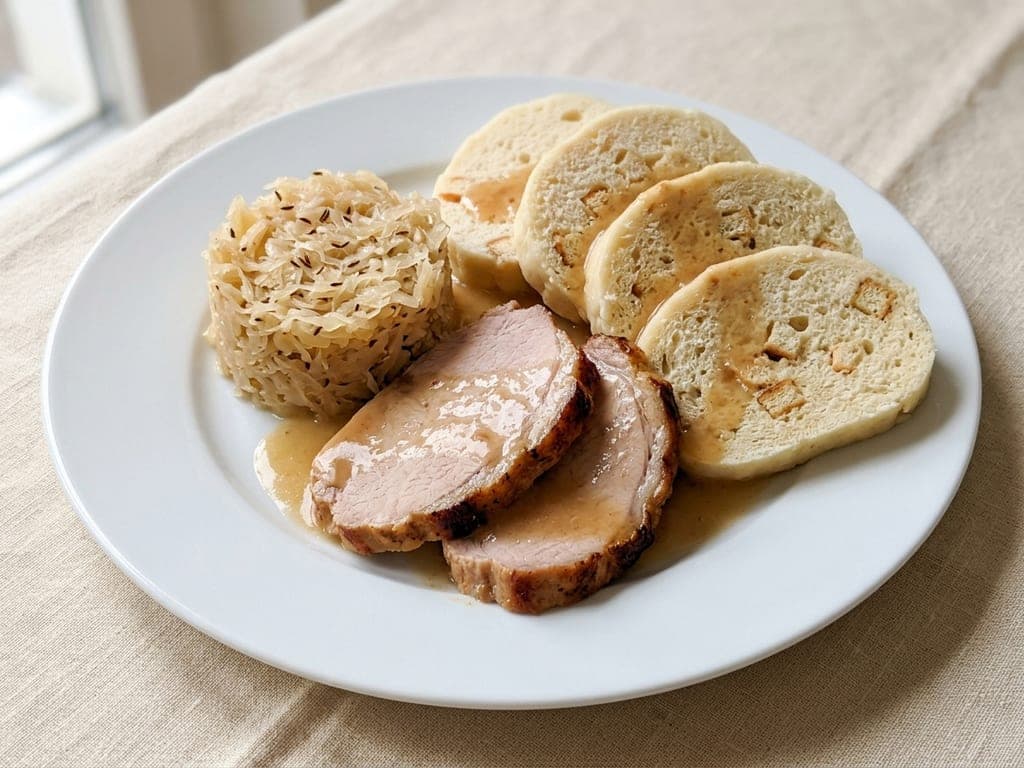
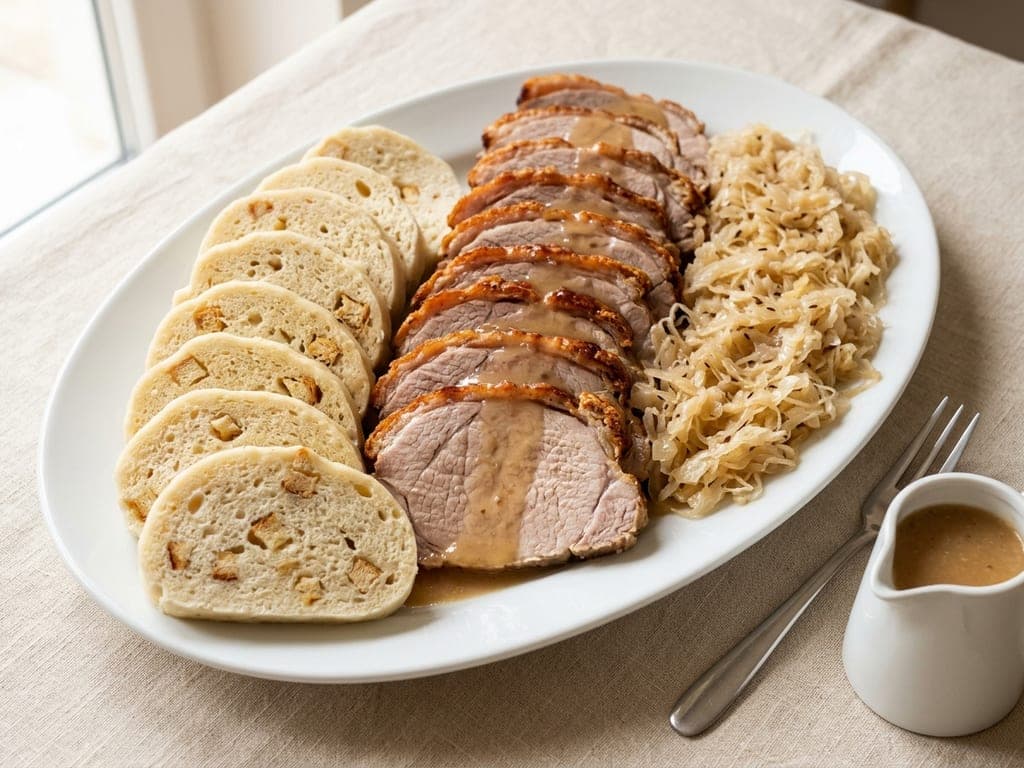
- Pierce, cut with thread, slice and serve (T minus 20 minutes to T). Lift the dumplings onto a board and immediately prick each one a few times with a skewer held at arm’s length (a jet of steam comes out), or tear the surface gently with a fork: the steam inside has to escape, or it condenses back into the crumb and the dumpling turns wet, dense and slumped. After a minute or two, slice them about 5/8 inch (1.5 cm) thick with a length of strong cotton thread (or unflavoured dental floss): slide it under the loaf, cross the ends over the top and pull. A knife presses the hot, open crumb flat and sticky; a thread cuts it without squashing it. Each loaf gives about 14 slices, so allow 4 or 5 per person. If they have to wait, brush the slices with a little melted butter or lard and keep them covered, off the heat, for up to 20 minutes; do not park them in a hot oven, which dries the edges. If you are running later than that, it is better to delay the dumpling boil than to hold cut dumplings. Slice the pork across the grain about 3/8 inch (1 cm) thick and plate everything hot: pork, dumpling slices fanned beside it, a mound of sauerkraut, and the šťáva spooned over the pork and the dumplings, which are there to soak it up.
Safety & hygiene Important
- Pork: the safe number and the tender number. The USDA safe minimum for whole pork roasts is 145°F (63°C), measured in the thickest part, followed by at least a 3 minute rest. Czech recipes commonly say at least 70°C (158°F) in the centre. This recipe takes the neck to 176 to 185°F (80 to 85°C) for tenderness, so it is well past both; the higher figure is about texture, not safety. Use an instant-read probe in the thickest part, away from the fat seam, and check a second spot.
- Raw pork and clean hands. Do not rinse the raw roast: washing raw meat splashes bacteria around the sink without making the meat safer. Pat it dry with paper towels and throw them away. Use a separate board for raw pork, wash your hands with soap and warm water for at least 20 seconds after rubbing in the seasoning and before you touch the dumpling dough, and use a clean plate for the rested, cooked roast rather than the one the raw meat sat on. Until you cook it, keep the raw roast on the bottom shelf of the fridge, below anything that will not be cooked.
- Leftovers: US and UK windows. USDA advice is to refrigerate leftovers within 2 hours (1 hour if the room is above 90°F / 32°C), to slice a whole roast into smaller pieces and use shallow containers so it cools fast, to eat cooked pork within 3 to 4 days, and to reheat it to 165°F (74°C). The UK Food Standards Agency says to cool leftovers and get them into the fridge (0 to 5°C) within one to two hours, eat them within 48 hours or freeze them, and reheat until steaming hot throughout, only once. While you are serving, keep the pork, gravy and sauerkraut hot, above 140°F (60°C), or chill them; do not leave them at room temperature for more than 2 hours (1 hour above 90°F / 32°C). Reheat pork slices covered in their šťáva. Cooked dumplings keep 2 to 3 days in the fridge (48 hours under UK advice); reheat slices over simmering water for 5 to 8 minutes, or in the microwave under a damp paper towel, until hot all the way through. Sliced dumplings and the pork in its sauce both freeze well; USDA suggests using frozen cooked pork within 2 to 3 months for best quality; kept at 0°F (-18°C), it stays safe longer.
- Do not let the pan run dry, and if fat catches fire. Keep about 1/4 to 3/8 inch (6 mm to 1 cm) of liquid in the roasting pan. A pan that boils dry scorches the juices and onions, which smoke and turn the gravy bitter. When you reduce the juices to fat on the stove for the gravy, keep the heat at medium, and if the fat starts to smoke, take the pan off the heat at once. If fat in a pan ever catches fire, turn off the heat and smother the flames with a metal lid or a baking sheet (or a fire blanket), then leave it covered until it has cooled completely. Never throw water on it, never use flour, and never use a damp or wet towel: water hitting burning fat flashes into steam and throws flaming fat out of the pan. If fat catches fire in the oven, turn the oven off and keep the door closed until the fire is out. If any fire does not go out at once, get everyone out, close the door and call the emergency number (911 in the US, 999 in the UK, 112 in the EU).
- Allergens and salt. The dumplings contain wheat, milk and egg; the gravy and the sauerkraut contain wheat (and the kraut contains milk if you braise it in butter). Ready-made stock often contains celery (and sometimes wheat), shop bread rolls can contain soya, milk or sesame, and some jarred sauerkraut contains sulphites, so check the labels. For gluten-free: thicken the sauerkraut with a boiled, grated floury potato instead of flour, thicken the šťáva with 2 tsp potato starch or cornstarch slaked in cold water and stirred in for the last few minutes (or leave it unthickened), use gluten-free stock, and serve boiled potatoes instead of bread dumplings. A full plate carries about 2,460 mg sodium by our arithmetic (see the FAQ), more than the 2,300 mg US Daily Value, and the unrinsed sauerkraut is the largest single share. To cut it: rinse the kraut, use 1 1/2 tsp salt in the pork rub instead of 2, cut the dumpling salt to 1 tsp, and keep the dumpling water unsalted, as this recipe assumes.
3 ways to plate it
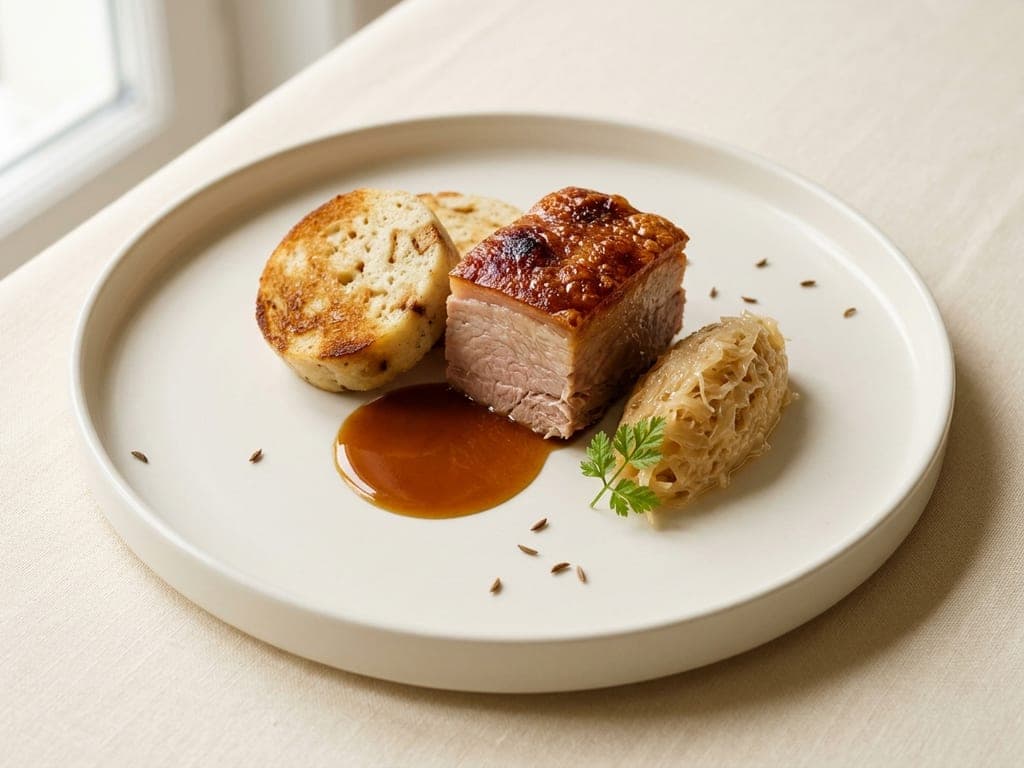
One plate, one timeline
The usual problem with this dish is not any single component; it is landing all three hot at the same minute. Most recipes send you to three separate pages. Here is the whole plan, counted back from the moment you serve (T). It works because each component waits in the right place: the dough rises while the roast is covered, the sauerkraut braises during the uncovered hour, and the dumplings boil while the roast rests.
T minus 3 3/4 h: oven on to 320°F (160°C); dry the bread cubes if needed; season the pork. T minus 3 1/2 h: pork into the oven, covered. T minus 2 1/4 h: make the dumpling dough; it rises for 45 to 60 minutes. T minus 1 3/4 h: uncover the pork, turn it fat side up, baste. T minus 1 1/4 h: start the sauerkraut (30 minutes covered, then 15 minutes after the flour goes in) and put the big pot of dumpling water on to heat (it takes 20 to 30 minutes). T minus 1 h: shape the two loaves and rest them 15 to 20 minutes. T minus 40 min: check the pork (176 to 185°F / 80 to 85°C) and take it out to rest under foil; dumplings into the water for 18 to 20 minutes; start the gravy in the roasting pan. T minus 20 min: dumplings out, pierce, slice with thread. T minus 15 min: strain the gravy. T minus 10 min: slice the pork. T: plate.
Two buffers keep the plan forgiving. The sauerkraut actually tastes better for waiting, so it can be finished early and held covered on the lowest heat, or made a day ahead. A 3 lb (1.35 kg) roast can rest for up to 30 minutes under loose foil and still be hot. If the pork is running late, hold the shaped dumplings in a cool spot so they do not overproof; if it is early, simply rest it longer.
Two temperatures: safe, and tender enough to slice
Ranking recipes for vepřo knedlo zelo give no temperature at all, only “roast until soft”. There are really two numbers. The first is safety: the USDA minimum for whole pork roasts is 145°F (63°C) plus a 3 minute rest. The second is texture. Neck and shoulder are working muscles full of collagen, and at 145°F (63°C) that collagen has barely started to soften. J. Kenji López-Alt at Serious Eats explains that “Beginning around 160°F [71°C] tough collagen begins to break down into tender, juicy gelatin. The hotter the meat, the faster this breakdown occurs.” In his sous-vide test, shoulder held at 145°F (63°C) took about 36 hours to become reasonably tender.
So a Czech roast is cooked well past “safe” on purpose, and the method is built to keep it juicy anyway. The covered, wet first stage keeps the surface near the boiling point while the outer layers spend hours, and the centre its last hour or so, between about 160 and 185°F (71 and 85°C), which is where the collagen melts and lubricates the meat. Our target for a neck you can still cut into neat slices is 176 to 185°F (80 to 85°C) in the centre, with a fork sliding in easily. That range is our guidance from the collagen data and Czech cooks’ “well past done but juicy” description, not a figure from a published test. Push on to 195 to 203°F (90 to 95°C) and you are into pulled-pork territory: lovely, but the slices fall apart.
Lower and slower also loses less juice. In another Serious Eats test, two equal pork shoulders roasted to the same tenderness, one at 375°F (190°C) for about 3 hours and one at 250°F (120°C) for about 8, the hotter roast lost about 8% more of its juices. At 320°F (160°C), covered for the first stretch, this recipe sits sensibly between speed and juiciness. A lean loin is the wrong cut for this treatment: at these temperatures it simply dries out.
Bread dumplings: why floating proves nothing
Houskové knedlíky are a yeast dough, lightened with stale bread cubes, shaped into loaves and boiled. The commonest bit of advice, “they are done when they float”, is a myth for this kind of dumpling: a yeast dough is full of gas and floats almost as soon as it hits the water. Time (18 to 20 minutes for a loaf 2 1/4 inches / 6 cm thick, turned halfway) plus a skewer or thread test is what tells you. Steaming works too: about 25 minutes over boiling water, lid on the whole time, no turning, and steamed loaves need no piercing.
Cutting with thread is not folklore. A knife has to push down through a hot, open, springy crumb and squashes it as it goes, leaving flat, sticky slices; a thread pulls through along a thin line and leaves the crumb standing. Czech cookbooks and household magazines describe it in print by about 1905 to 1910. Once the dumplings are cold, a sharp knife is fine.
When dumplings go wrong, the cause is nearly always one of these. Falling apart or a ragged surface: too much water in the dough, or a hard rolling boil; use the measured milk and hold a lively simmer. Wet, soggy pockets inside: the bread was fresh and soaked up the dough’s moisture; use 2 to 3 day old rolls or dry the cubes in the oven. Dense and slumped after cooking: they were not pierced as soon as they came out (or a steamer lid was lifted halfway through), so the steam condensed inside. Raw, glassy middle: the loaf was too thick or the two loaves were different sizes; weigh them, shape them no thicker than 2 1/4 inches (6 cm) and test before you lift them out. Heavy and barely risen: the milk was too hot and killed the yeast, or the dough did not get its full rise. Flat, gummy slices: cut hot with a knife instead of thread.
Sauerkraut: caraway, not cumin, and to rinse or not
The spice in Czech roast pork and its sauerkraut is caraway, kmín in Czech, with its warm, faintly anise-like bite. Cumin is římský kmín, “Roman caraway”, and that word overlap is how cumin ends up in some English-language recipes for this dish, including two pages that rank for it. It is a translation slip, and cumin’s smoky, earthy flavour does not belong here.
Whether to rinse depends on your sauerkraut, so taste it first. Mild jar or bag sauerkraut: do not rinse; drain it, keep the brine and use a spoonful to re-sour the pot at the end if it tastes flat. Very sharp homemade or barrel kraut: a quick cold rinse and a squeeze. A Czech cookery site’s ten rules for sauerkraut warn that rinsing it just to make it sweet throws away what is most valuable about it. Rinsing also removes some salt. We could find no study measuring that for sauerkraut; USDA research on canned vegetables found that draining and rinsing cut sodium by roughly 7 to 21%, so expect something in that region, not a miracle. Once it is braised, the live cultures are gone either way, so rinsing does not cost you any probiotic benefit.
The pub style is sweet-sour and lightly thickened. Start with 1 1/2 tbsp sugar for this 800 g of kraut and add more to taste; as one Czech cookery site puts it, braised kraut takes a surprising amount of both sugar and sourness, but Cookipedia’s 5 tbsp for 500 g is unusually sweet. To thicken, the Bohemian pub way is flour (a jíška, here sprinkled straight onto the fat-coated cabbage), which needs about 15 minutes to cook out. The other route, and the gluten-free one, is grated potato; cooked floury potato gives a smoother result than raw. If you want the “sweet cabbage” some families prefer, braise shredded fresh white cabbage instead and add the vinegar only at the end, because acid slows the softening.
Where the name comes from: the legionnaires’ joke
The dish is old, but its nickname is not, and none of the pages ranking for vepřo knedlo zelo that we read says where it comes from. Searching the digitised Czech newspapers and books in the Moravian Library’s Kramerius archive, the earliest print we could actually read is in a Czechoslovak Legion novel: Rudolf Vlasák’s Houpačky na magistrále, volume 2, published in Prague in 1929 by the legionnaires’ publishing house Za svobodu. On page 404, legionnaires who have been swapping stories of Siberia are dreaming up stunts, including a prank supper for Šalamoun, the cobbler of the non-combatant company, and one of them suggests ordering him a proper dinner: “Třeba ‘knédlo zélo, vepřo péčo’, jak on říká” (“Say, ‘knédlo zélo, vepřo péčo’, as he puts it”).
Look closely and it is not quite today’s phrase. It has four words, not three: dumpling, cabbage, pork and péčo, from pečeně, roast. The accents on the first syllables are spelling out how it was said, as a mangled catchphrase, not standard Czech. Every earlier hit we found also comes from legion publications: the magazine Legionářské besedy of 1 May 1926 (“vepřo pečo”, “knedlo vepřo” and “zelo knedlo” on one page, which is still in copyright, so we could only see the search hit), and the legionnaires’ daily Národní osvobození of 8 December 1928. Today’s order, vepřo knedlo zelo, turns up in newspaper hits from June 1933, and the first instance we could read is a Poděbrady spa bulletin of 3 July 1938 warning patients that a diet of vepřo, knedlo, zelo is, for some conditions, a serious offence against their whole treatment. Whether the -o endings were a joke on Russian, among men who had spent 1917 to 1920 in Russia, is a tempting guess, but no source we found says so.
Archive searches only find what has been digitised, so treat these as the earliest dates we could find, not proof of the first time anyone said it. What they do show is that claims of a centuries-old folk name are unsupported: the clipped name is a 20th-century joke, and it seems to have come home from the legion.
Older than its name: from Rettigová to the “national dish”
Roast pork with sauerkraut is in the first edition of Magdalena Dobromila Rettigová’s Domácí kuchařka (1826), the book that shaped modern Czech home cooking: “Kyselé zelí s vepřovou pečínkou”, sauerkraut braised with lard or bacon, a light roux, onion and sour cream, served with “well-roasted” pork in the middle of the platter and sausage around it. There are no dumplings. The full trio appears in print within forty years. On 25 April 1863 the Prague magazine Humoristické listy ran a mock encyclopedia entry on crackling which notes that pork can be eaten and enjoyed even without it, “zvláště jsou-li při tom knedlíky a zelí” (“especially if there are dumplings and cabbage with it”). By 1869 the same magazine has political prisoners longing for “kus vepřové se zelím a knedlíkem”, a piece of pork with cabbage and dumpling, and by 1888 a Plzeň paper uses it as the standard of food that goes down easily. A household cookbook of about 1905, Anuše Kejřová’s Úsporná kuchařka, sets it as Sunday lunch: “Vepřová pečeně, knedlík se zelím.” The bread dumpling as we know it is documented later: the earliest recipe for “knedlíky houskové” we found is in an 1886 cookbook, so the dumplings of 1863 were not necessarily the same kind.
So the plate was already spreading half a century before the First World War. The “national dish” label came later still. In the 1880s to 1900s, Czech papers gave that title to the dumpling itself (“České národní jídlo je knedlík”, Národní listy, 1884), especially plum dumplings. The earliest print we found calling pork with cabbage “our proverbial national dish” is the satirical weekly Kopřivy in January 1912, where it cost 1 crown 20 hellers a portion. And Czechs do not clearly vote for it: in a 2003 CVVM survey of favourite meat dishes, roast pork (including vepřo knedlo zelo) got 8% against 7% for svíčková, both far behind schnitzel and chicken, and in a 2025 Seznam Zprávy reader poll on the national dish, svíčková won 56% to 25%. It is fairer to call it one of the Czech national dishes.
Two popular origin stories are unsupported. Wikipedia’s line that the dish is “believed to have German origins” cites no historical source; similar pork-and-cabbage plates exist in Bavaria and Austria (in Bavaria often with red cabbage), and the honest description is a shared Central European plate. CzechTourism’s story that an unnamed Prague restaurateur put it on the menu in Emperor Franz Joseph’s day names no one and no date, and the earliest sightings we found, from 1863, are in humour magazines, not on a menu. The plate also crossed the Atlantic: a Czech-American cookbook printed in Chicago around 1896 (Emanuel Persein-Beránek’s, published by August Geringer) roasts a loin of pork with caraway and says “K této pečeni hodí se nejlépe knedlíky se zelím”, that dumplings with cabbage suit this roast best, while offering potato croquettes with apple sauce on the side as the alternative. Midwestern Czech festivals, such as the one in Dwight, Nebraska, still serve roast pork, dumpling and kraut dinners today.
Questions, answered
What does vepřo knedlo zelo mean?
Literally “pork, dumpling, cabbage”: vepřo, knedlo and zelo are clipped, slangy forms of vepřové (pork), knedlík (dumpling) and zelí (cabbage, here sauerkraut). It is the everyday name for vepřová pečeně s knedlíkem a zelím, Czech roast pork with bread dumplings and sauerkraut. Say it VEP-rzhoh KNED-loh ZEH-loh. Knedlo vepřo zelo is the same dish with the words in a different order.
What is the best cut of pork for vepřo knedlo zelo?
Boneless pork neck (Czech krkovice), sold in the US as fresh (uncured) pork collar or coppa roast, not cured coppa, the top of a Boston butt (boneless Boston butt is the easiest supermarket stand-in), and in the UK as pork collar or a spare rib joint (the British spare rib joint is the upper shoulder, not the American belly ribs). It is marbled with fat and full of collagen, so it stays juicy through the long roast. Boneless shoulder (plec) is the next choice; it is leaner and is often done a little sooner. Belly (bůček) works if you like it rich and want crackling, but needs a hot blast at the end. Avoid loin: taken to Czech doneness it dries out. Czech cooks use boneless neck almost by default; bone-in shoulder works but adds time.
How long do you roast Czech roast pork, and at what temperature?
At 320°F (160°C), about 2 1/2 to 3 hours for a 3 lb (1.35 kg) boneless neck: roughly 1 3/4 hours covered with about 3/8 inch (1 cm) of water in the pan, then about an hour uncovered, fat side up, basting every 20 minutes. That is roughly 2 hours per kg, but the fork and a probe decide, not the clock: it is ready when a fork slides in easily and the centre reads 176 to 185°F (80 to 85°C).
What internal temperature should Czech roast pork reach?
Two numbers matter. For safety, USDA says 145°F (63°C) plus a 3 minute rest for whole pork roasts. For a tender, sliceable neck or shoulder, take it much further, to 176 to 185°F (80 to 85°C), because the collagen in these cuts only melts at higher temperatures. That second range is our guidance, built from published collagen data rather than a single test. Above about 195°F (90°C) the meat starts to shred instead of slice.
Is it caraway or cumin in Czech roast pork?
Caraway. The Czech word is kmín; cumin is římský kmín, “Roman caraway”, and that overlap is why some English recipes for vepřo knedlo zelo wrongly list cumin. Use caraway seeds, lightly crushed, on the pork and whole in the sauerkraut.
Should you rinse sauerkraut for vepřo knedlo zelo?
Taste it first. Mild jar or bag sauerkraut needs no rinsing; drain it and keep the brine to re-sour the pot at the end. Very sharp homemade or barrel kraut can have a quick cold rinse. Rinsing also takes out some salt; there is no study on sauerkraut itself, but USDA work on canned vegetables found draining and rinsing cut sodium by roughly 7 to 21%.
How do you know Czech bread dumplings are done, and why cut them with thread?
Not by floating: yeast dumplings float almost at once, so it proves nothing. Boil loaves 2 1/4 inches (6 cm) thick for 18 to 20 minutes, turning halfway, then push a thin skewer into the middle; it should come out clean and dry. Pierce them as soon as they come out so the steam escapes, or they go wet and dense. Cut them hot with thread because a knife squashes the soft crumb into flat, sticky slices; once cold, a knife is fine.
Can I use store-bought dumplings or potato dumplings?
Yes. Czech supermarket bread dumplings are yeast dumplings, usually leaner than homemade, and reheat in about 5 minutes of steam, so they are a fair shortcut; slice them and steam the slices. Potato dumplings (bramborové knedlíky) are a classic alternative with this plate. The homemade loaves here are lighter and taste of milk and egg, and they are the reason to make the dish from scratch at least once.
Can I make vepřo knedlo zelo ahead, and how do I reheat it?
Yes, and the sauerkraut is better the next day. Roast the pork, let it cool for no more than an hour, then cut it into two or three thick pieces (or slice it), put them in a shallow covered container with the šťáva and refrigerate within 2 hours of cooking. It slices neatly cold. Reheat the slices covered in their šťáva until steaming and 165°F (74°C). Dumplings keep 2 to 3 days in the fridge (48 hours under UK advice); steam slices for 5 to 8 minutes until hot all the way through. Leftover dumpling slices make knedlík s vejci, fried in butter with beaten eggs. In the US, eat leftovers within 3 to 4 days; UK advice is within 48 hours, or freeze them, and reheat only once.
Is vepřo knedlo zelo the national dish of the Czech Republic?
It is one of them, and it is often called the national dish, but polls do not crown it. In a 2003 CVVM survey, roast pork (including vepřo knedlo zelo) scored 8% as a favourite meat dish against 7% for svíčková, both well behind schnitzel; in a 2025 Seznam Zprávy reader poll on the national dish, svíčková won 56% to 25%. The earliest print we found giving pork with cabbage the “national dish” label is a 1912 satirical magazine; before that, Czech papers gave the title to the dumpling.
How many calories are in a plate of vepřo knedlo zelo?
About 960 kcal per plate, with roughly 50 g protein, 41 g fat, 95 g carbohydrate and 2,460 mg sodium, by our arithmetic from USDA values. Pork: a 3 lb (1.35 kg) raw neck gives roughly 900 to 950 g cooked, so about 150 g each; roasted Boston butt is 269 kcal per 100 g, so 404 kcal, 35 g protein, 28 g fat and 100 mg sodium, plus 775 mg sodium from the 12 g rub salt split six ways. Gravy: 2 tbsp (26 g) fat 235 kcal, 8 g flour 29, 300 g onion 120, so 384 kcal, or 64 per plate. Dumplings: 500 g flour 1,820 kcal, 300 ml milk 183, one egg 72, 100 g bread 266, yeast and sugar about 29, so 2,370 kcal, or 395 per plate, with about 700 mg sodium (mostly the 9 g salt). Sauerkraut: 800 g kraut 152 kcal, 150 g onion 60, 26 g lard 235, 16 g flour 58, 25 g sugar (the top of the range) 97, so 602, or about 100 per plate, with about 880 mg sodium. Total: 404 + 64 + 395 + 100 = 963. The cooked-pork yield is an estimate; the brushing fat is not counted.
Snap your finished plate and let the AI plate it again — more beautifully.