6 New Year’s Eve dinner ideas full menus, made ahead and timed to midnight
Most lists of New Year’s Eve dinner ideas are single recipes. These are whole menus, from two guests to twenty, and each one says what to buy per guest, what to make in the days before, and what happens at what time between the doorbell and the toast.
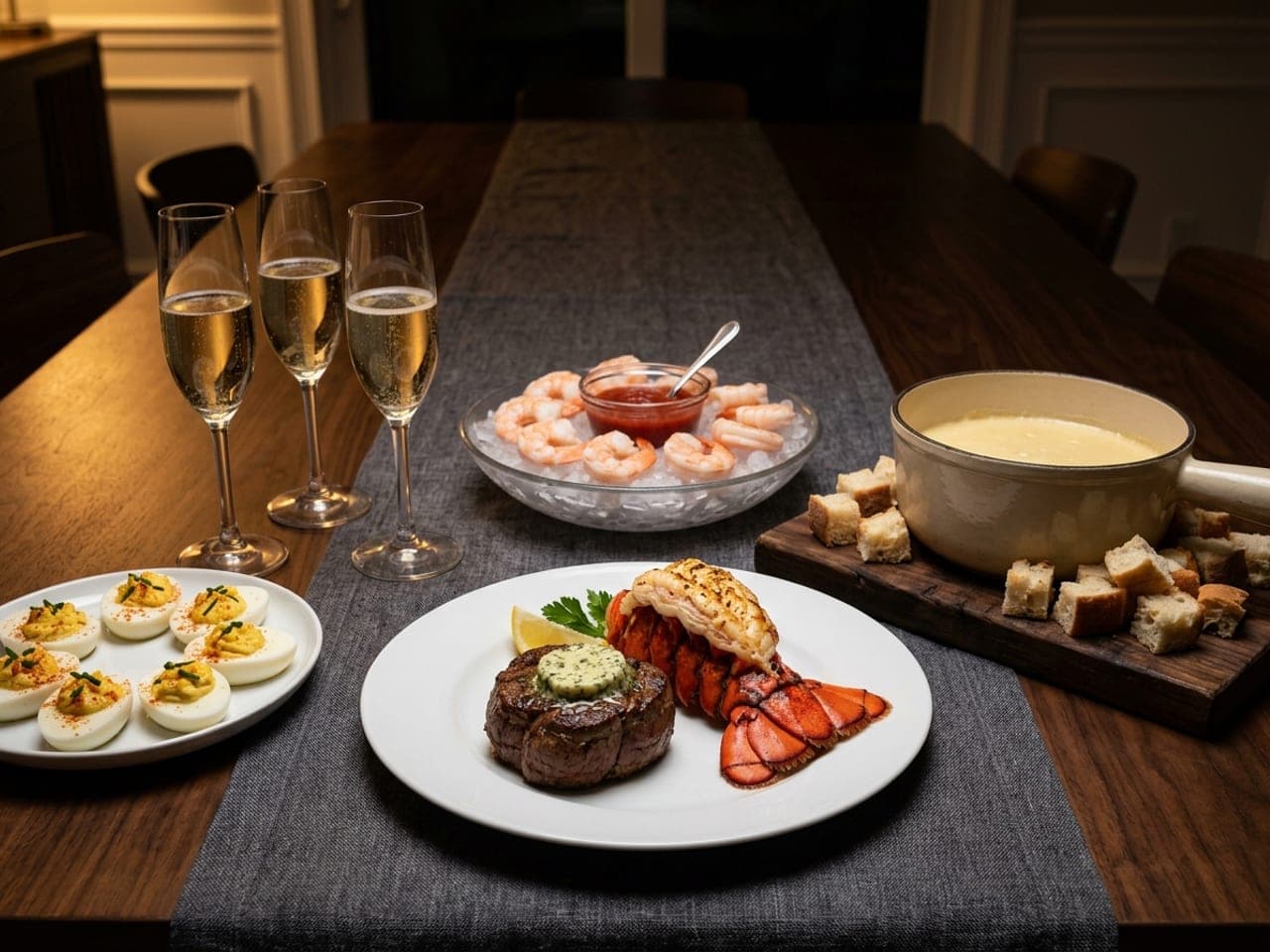
The photos on this page are AI-generated illustrations.
New Year’s Eve is the one dinner party that does not end with dessert. It runs from the doorbell to midnight, so a menu needs dishes mostly made ahead, and a bite and a glass for midnight. The six menus below are five sit-down dinners and an appetizer party. Every card gives the menu, the amounts per guest and whose figures they are, the dated jobs ahead, a timed plan, the midnight bite, one plating note and the allergens.
The clock is ours. Guests at 7:30 pm, dinner at 8:00 pm, dessert by about 10:00 pm, a midnight bite at 11:30 pm and the toast at 12:00 am: our suggestion, not a rule, so move every time in a plan together. The rule under it is USDA’s: perishable food comes off the table 2 hours after it left the oven or the fridge, so every plan puts each dish back by its own time, and the midnight bite is a separate, fresh plate (why).
How to use it. Pick a menu, then see the bites, the amounts per guest and the timeline, dated for Thursday 31 December 2026. Three others carry a short recipe that follows one named published recipe, credited and not kitchen-tested by us. Temperatures are USDA’s minimums; where a chef goes lower, the card says whose figure it is. Some guests should skip some dishes. Our own suggestions and arithmetic are labeled as ours.
Five sit-down dinners
From two guests to twelve, each with its plan counted back from an 8:00 pm dinner and forward to the toast.
- Menu
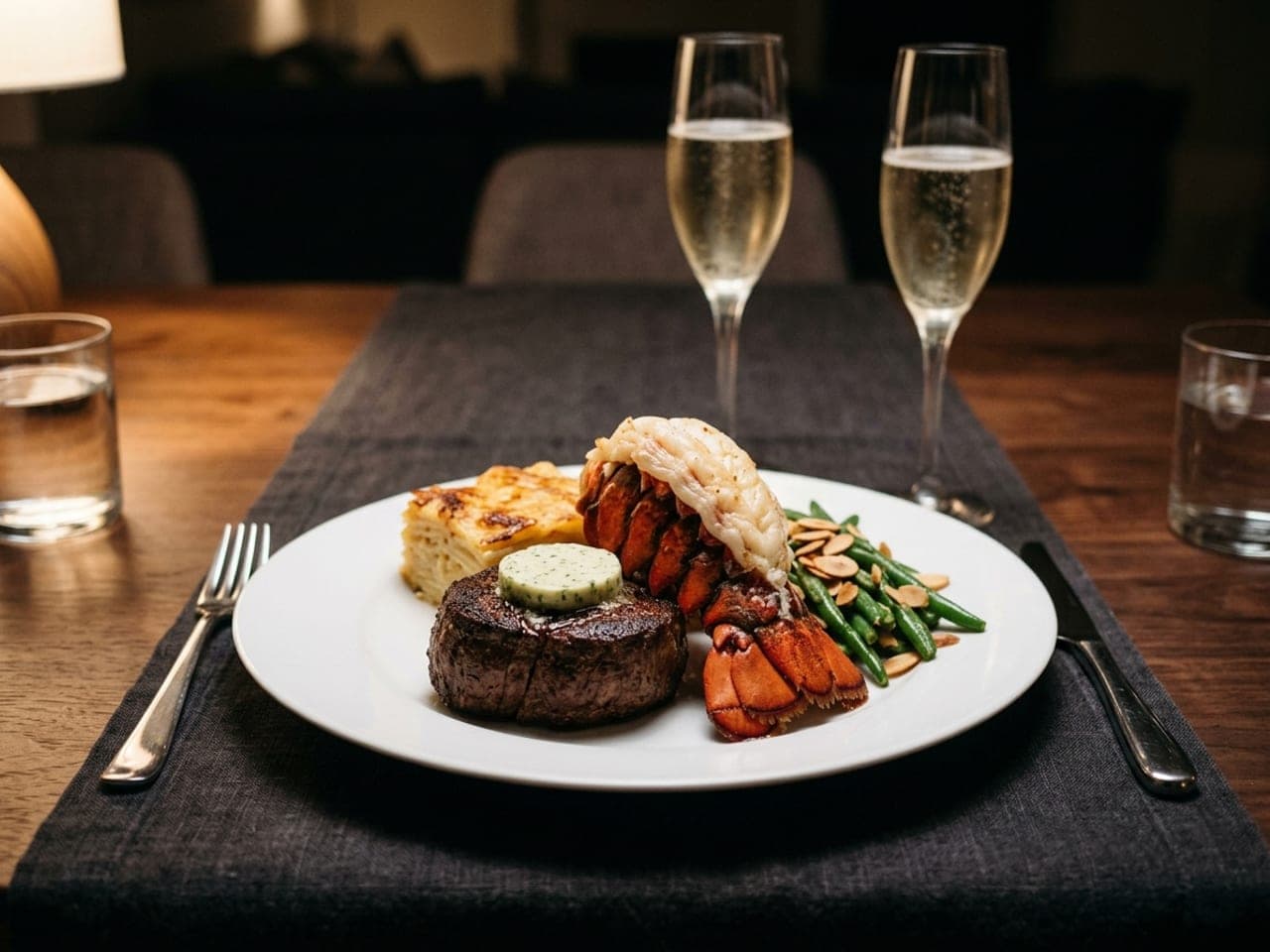
- Shrimp cocktail on ice with drinks; pan-seared filet mignon (recipe below) with a broiled lobster tail and a coin of herb butter; scalloped potatoes and green beans amandine; chocolate mousse. Vegetarian guests: the mushroom Wellington from our Christmas menus.
- Buy
- One 7 to 8 oz (200 to 225 g) filet, 1½ inches (4 cm) thick, a guest (America’s Test Kitchen), and one 4½ to 6 oz (130 to 170 g) lobster tail a guest (America’s Test Kitchen; Taste of Home). The shrimp recipe makes about 36 and gives 6 to 8 each when it is the only starter: for four at dinner and four midnight cocktails at 4 to 5 each, one and a half batches (our arithmetic). For eight: eight steaks in two heavy pans (America’s Test Kitchen fits six in a 12-inch (30 cm) pan), eight tails, three batches of shrimp and two of mousse; the potato recipe already serves ten.
- Lobster tails
- Thaw frozen tails in the fridge for 24 hours (America’s Test Kitchen). Cut along the top of the shell, lift the meat to sit on it, brush with melted butter and broil (under the overhead grill) 5 to 6 inches (13 to 15 cm) from the heat for 5 to 8 minutes (Taste of Home’s method), until the flesh is firm, pearly and opaque (the FDA’s cue is the flesh, so a red shell is not a test).
- Whose temperatures
- America’s Test Kitchen takes filets out at 120 to 125°F (49 to 52°C) for medium-rare (its lobster pull is in the plan); Serious Eats’ reverse sear ends steak at 130°F (54°C) after a 200 to 275°F (93 to 135°C) oven. All are below the 145°F (63°C) minimum (USDA for beef, with a 3-minute rest; FDA for lobster), and USDA does not recommend ovens below 325°F (163°C). For guests at higher risk, cook theirs to 145°F (63°C) on a thermometer.
- Ahead
- Tue 29 Dec: herb butter, rolled in a log and wrapped (America’s Test Kitchen keeps it 4 days in the fridge). Wed 30 Dec: frozen tails into the fridge in the morning (24 hours to thaw); the cocktail sauce (the recipe: up to a week); the beans blanched (America’s Test Kitchen: 2 days). Thu 31 Dec, morning: poach the shrimp (the recipe: no more than 24 hours ahead) and make the mousse (the fancy desserts card stops at 1 day for its raw egg white; it needs 4 hours to set). From 6:00 pm: the potatoes (below).
- Midnight
- The shrimp kept back for midnight stay in the fridge, untouched, and come out at 11:30 pm on fresh crushed ice. Then the toast at midnight.
- On the plate
- Steak in front, the tail leaning on it meat side up, the butter melting on the steak (America’s Test Kitchen: as it melts it becomes the sauce), a square of potatoes behind and the beans to one side (plating steak).
- Allergens
- Crustaceans (shrimp, lobster); fish, and barley (UK) in British Worcestershire (the cocktail sauce); milk (butter, potatoes, mousse); egg (mousse); almonds (beans); celery (UK) in the shrimp’s celery seed, which the recipe lets you leave out; sulphites (UK) in the wine at the toast.
Plan, dinner at 8:00 pm, toast at 12:00 am
- 6:00 pmOven to 350°F (175°C, the recipe’s figure). Potatoes simmered in their cream on the stove, as the recipe says, then into the dish.
- 6:45 pmPotatoes in, uncovered, 30 to 40 minutes.
- 7:25 pmPotatoes out to stand 20 minutes, covered (the recipe). Oven up to 450°F (232°C) with a baking sheet inside. Beans finished in their skillet (the card), then covered off the heat.
- 7:30 pmShrimp cocktail out of the fridge onto crushed ice, served with drinks as guests arrive.
- 7:40 pmSear the steaks, about 3 minutes a side.
- 7:46 pmSteaks onto the hot sheet in the oven. America’s Test Kitchen gives 6 to 8 minutes for medium-rare, below USDA’s 145°F (63°C) (see the card); a thermometer in the center decides. Lobster tails buttered on a broiler pan.
- 7:53 pmSteaks out to rest about 5 minutes under loose foil. A steak for a guest at higher risk goes back into the hot pan on the stove, turned now and then, until it reads 145°F (63°C), then rests 3 minutes (USDA; the pan is our route, so the oven stays free). With oven gloves, a rack moved 5 to 6 inches (13 to 15 cm) under the element; broiler on, tails under it 5 to 8 minutes.
- 8:00 pmEvery tail out when its thickest part reads 145°F (63°C), firm, pearly and opaque (FDA); America’s Test Kitchen and Taste of Home take them out at 140°F (60°C), below it. Oven off. Serve, with the butter.
- By 9:25 pmLeftover potatoes and beans in the fridge, 2 hours after they were cooked; shrimp left from the starter in the fridge or thrown away.
- By 9:50 pmLeftover steak, lobster and butter in the fridge.
- 10:00 pmMousse served, 10 minutes out of the fridge first (the fancy desserts card).
- 11:30 pmThe untouched midnight shrimp cocktails out of the fridge, on fresh ice.
- By 11:50 pmMousse back in the fridge or thrown away, 2 hours after it came out.
- 12:00 amMidnight: the toast.
- By 1:30 amThe midnight shrimp back in the fridge or thrown away.
- Menu
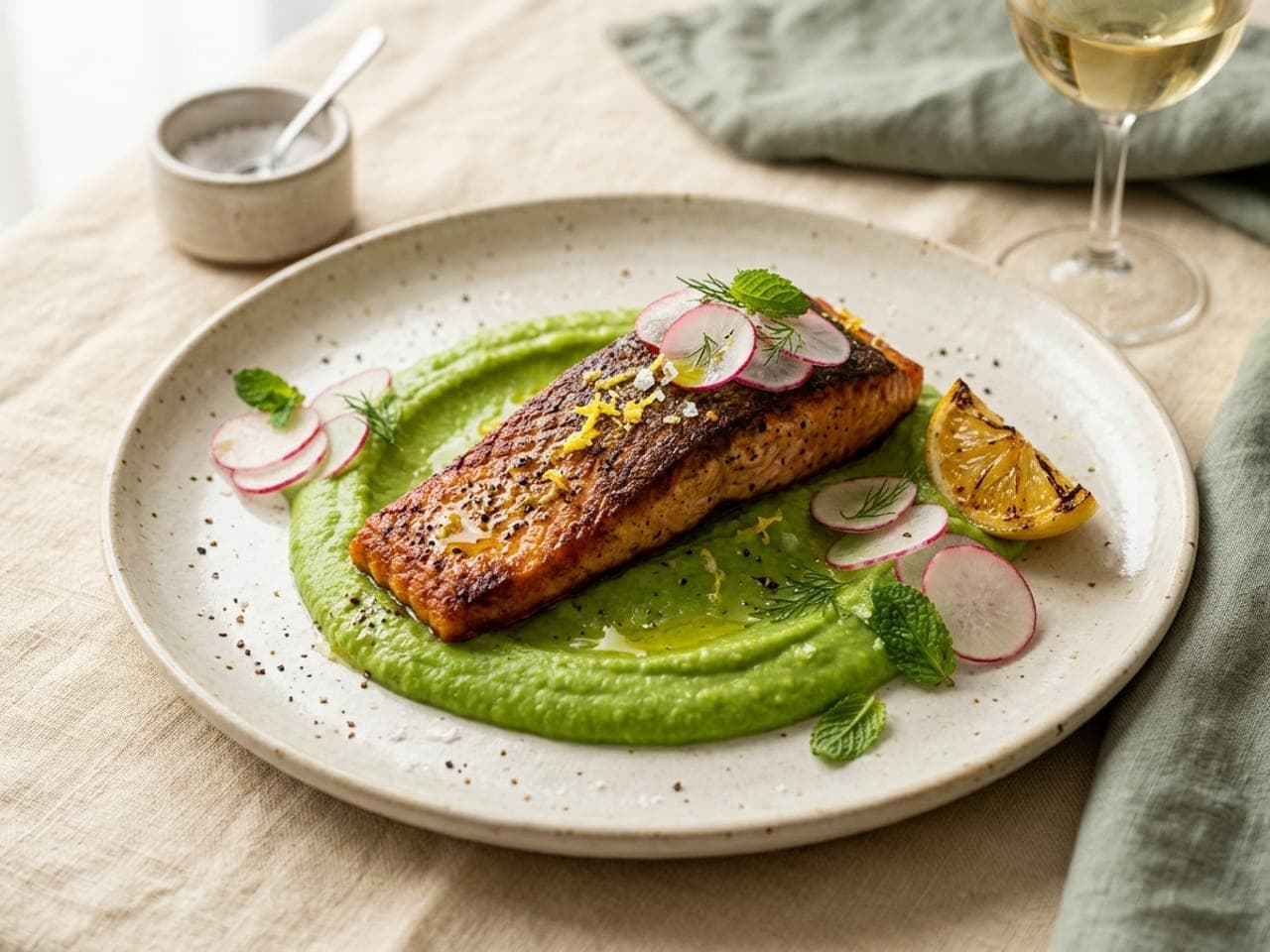
- Oysters on the half shell with a shallot mignonette, or the same oysters baked; citrus salmon with pea purée, written for two; chocolate pots de crème; at 11:30 pm a small tin of caviar with blini and crème fraîche (how to serve it). No vegetarian swap here: the fondue night, made with vegetarian-rennet cheeses, scales down to two.
- Buy
- Six oysters each, the average UK portion in Food Standards Scotland’s risk assessment: twelve. Choose live ones from a sack with its harvest tag, leave any with cracked shells or that stay open when tapped, and keep them at 40°F (4°C) or colder for no more than 2 days (FDA). The salmon recipe uses two 5 oz (150 g) fillets. Caviar: every per-guest figure we found is a seller’s, and the caviar guide lists them.
- Raw oysters
- The CDC: “Do not eat raw or undercooked oysters or other seafood. Cook them before eating.” Food Standards Scotland finds norovirus in oysters significantly higher in winter, the season of this dinner, and lemon juice, hot sauce and alcohol do not kill Vibrio (CDC). For guests at higher risk, or for both of you, bake the shucked oysters at 450°F (232°C) for 10 minutes, the CDC’s time.
- Ahead
- Wed 30 Dec: the pots de crème (the fancy desserts card keeps them 2 days, covered and chilled) and the mignonette (Chatelaine’s keeps 3 days, covered, in the fridge). Thu 31 Dec, morning: buy the oysters and keep them in the coldest part of the fridge; the caviar stays unopened in the fridge until 11:30 pm.
- Midnight
- The caviar tin on crushed ice with warm blini and crème fraîche. USDA’s 2 hours applies to it like any chilled food; three sellers we read set a limit of 15 to 30 minutes at room temperature, for taste, which the ice is for. Then the toast.
- On the plate
- Six oysters on a deep plate of crushed ice, the mignonette in a small dish in the middle; the salmon skin side up on a pool of the purée, radishes on top, as the recipe plates it.
- Allergens
- Molluscs (UK) (oysters); fish (salmon, caviar); milk (butter, pots de crème, crème fraîche); egg (pots de crème, blini); wheat (blini); sulphites (UK) in the wine vinegar of the mignonette and in the wine; soy lecithin in most chocolate.
Plan, dinner at 8:00 pm, toast at 12:00 am
- 7:00 pmOven to 450°F (232°C) if any oysters are to be baked. Radishes sliced and lemon zested for the salmon.
- 7:20 pmOysters shucked: the raw ones onto crushed ice, any to bake in their half shells onto a baking sheet and into the oven for 10 minutes (CDC). Mignonette out of the fridge.
- 7:30 pmOysters served. Oven off.
- 7:40 pmPeas on, then the purée made and kept warm over a very low heat (the recipe).
- 7:50 pmSalmon in the pan, skin side down 4 to 5 minutes, then 2 to 3 on the other side. The recipe stops at a blush of pink, below USDA’s 145°F (63°C) for fish; for a guest at higher risk, cook theirs on until the thickest part reads 145°F (63°C) (America’s Test Kitchen says immune-compromised people should avoid salmon cooked below it).
- 8:00 pmServe.
- By 9:20 pmOysters not eaten thrown away, not kept for later (our caution); the mignonette back in the fridge.
- 9:40 pmPots de crème out of the fridge to stand 20 to 30 minutes (America’s Test Kitchen, as the fancy desserts card quotes it); any salmon and purée into the fridge.
- 10:00 pmDessert.
- 11:30 pmCaviar, blini and crème fraîche out of the fridge; the blini warmed as their packet says; the tin opened and set in crushed ice.
- By 11:40 pmPots de crème back in the fridge or thrown away, 2 hours after they came out.
- 12:00 amMidnight: the toast.
- By 1:30 amCaviar and crème fraîche back in the fridge or finished.
- Menu
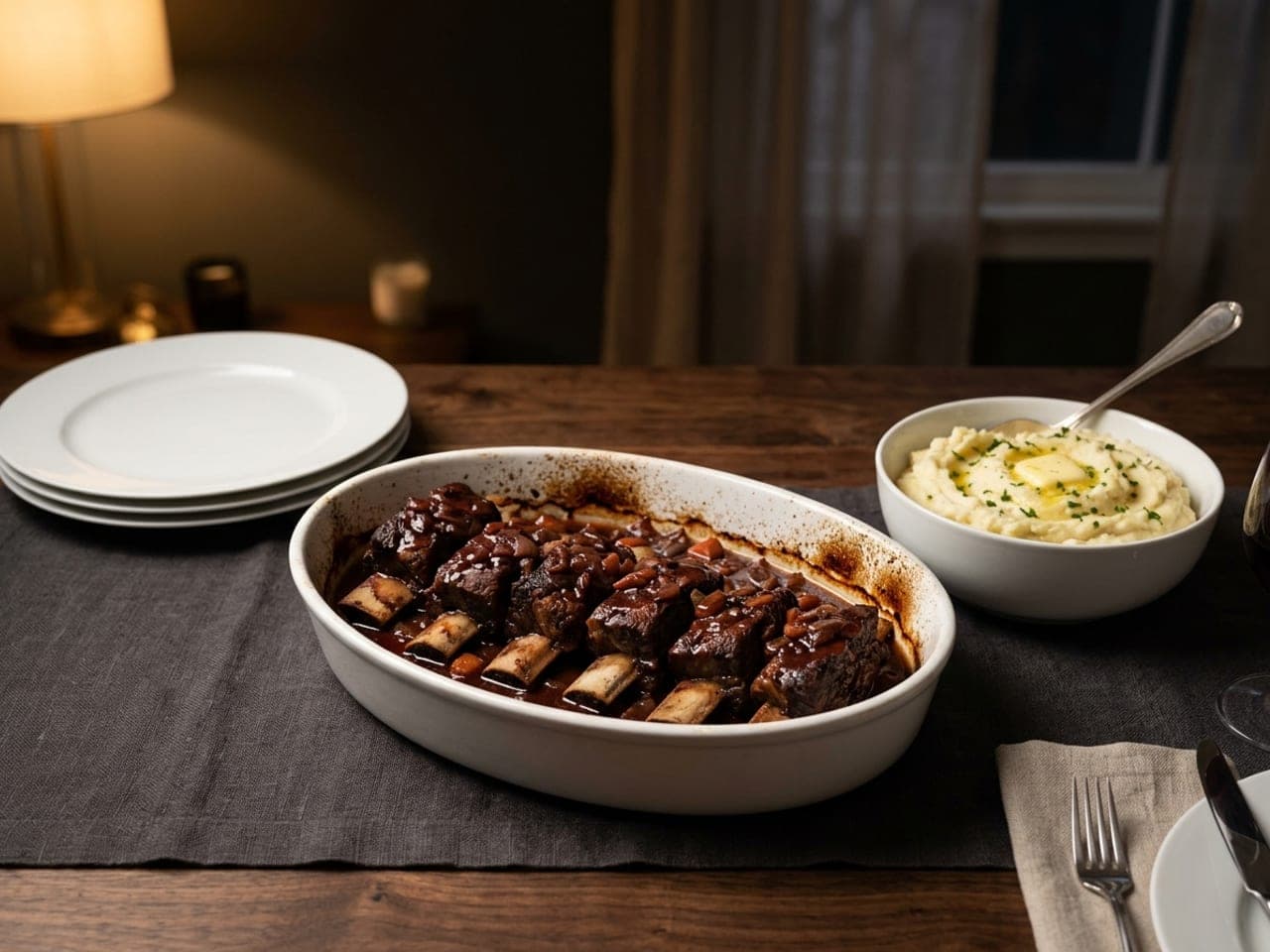
- Deviled eggs with drinks; red wine braised short ribs (recipe below) with mashed potatoes and a green salad; crème brûlée cheesecake. At 11:30 pm, short rib sliders on dinner rolls. For one big cut instead, the brisket in our Christmas crowd menu works the same way. Vegetarian guests: a mushroom Wellington.
- Buy
- Bon Appétit braises 5 lb (2.3 kg) of bone-in short ribs for six: 10 lb (4.5 kg) in two pots for twelve (our scaling), and one 750 ml bottle of wine a pot. Half a pound (227 g) of potatoes a guest (Whole Foods Market). The deviled egg recipe makes 12 halves for six: two batches for twelve. One batch of rolls makes 16. The catering calculator sizes a buffet for any other count.
- Ahead
- Rolls par-baked and frozen from early December (King Arthur Baking: up to 6 weeks). Tue 29 Dec: the cheesecake (at least 6 hours to chill; 4 to 5 days before it is torched). Wed 30 Dec: eggs hard-cooked, inside both the recipe’s US week and its UK 2 days; braise, then cool it the way our brisket recipe does: ribs in one layer in shallow dishes no more than 2 inches (5 cm) deep, the sauce in wide containers of the same depth, all in the fridge within 2 hours of leaving the oven, never in the pot (Bon Appétit cools its ribs in the sauce; we do not). One rib for every two guests goes in its own container: the sliders. Thu 31 Dec: fill the eggs; lift the set fat off the sauce.
- Safety
- Two pots of ribs fill a fridge: leave space between the containers and check it stays at 40°F (4°C) or colder. Every reheat goes to 165°F (74°C) in the center, and the sauce to a rolling boil (USDA).
- Midnight
- Sliders from the meat kept back in the fridge, reheated to 165°F (74°C), never from the buffet dish. Then the toast.
- On the plate
- Ribs bone side down in one layer in the dish with the sauce spooned over until they shine; the mash in its own warm bowl, so the sauce does not flood it.
- Allergens
- Wheat (flour in the sauce, rolls); milk (mash, cheesecake); egg (deviled eggs, cheesecake); mustard (UK) (deviled eggs, salad dressing); celery (UK) (in the braise and most stock); sulphites (UK) (wine).
Plan, buffet at 8:00 pm, toast at 12:00 am
- 6:30 pmOven to 350°F (177°C).
- 6:45 pmSauce for the first dish brought to a rolling boil on the stove (USDA) and poured over its ribs; the dish covered with foil and in (Bon Appétit reheats them covered at 325 to 350°F (163 to 177°C)).
- 7:00 pmSecond dish in, the same way. Potatoes on.
- 7:30 pmDeviled eggs out of the fridge as guests arrive. Mash made, brought to 165°F (74°C) and into a preheated slow cooker, which holds at 140°F (60°C) or above but does not reheat (USDA).
- 7:45 pmCheck both dishes: 165°F (74°C) in the center of the thickest rib, or they stay in until it does. The first comes out, covered; oven down to 225°F (107°C), the FDA’s range for hot back-ups, with the second inside.
- 8:00 pmBuffet opens with the first dish, the mash and the salad.
- 9:00 pmThe first dish swapped for the second, never topped up (FDA).
- By 9:30 pmDeviled eggs off the table: thrown away at 2 hours out (the recipe), or back in the fridge before that.
- By 9:45 pmThe first dish and the salad in the fridge.
- 10:00 pmCheesecake torched and served.
- By 11:00 pmThe second dish and the mash in the fridge, 2 hours after the dish left the oven.
- 11:10 pmOven to 425°F (218°C). The kept-back ribs pulled into pieces and reheated in their sauce, brought to a boil, in a covered pan until the meat reads 165°F (74°C).
- 11:20 pmFrozen rolls in, 8 to 12 minutes.
- 11:30 pmSliders. Oven off.
- By 12:00 amCheesecake back in the fridge or thrown away, 2 hours after it came out.
- 12:00 amMidnight: the toast.
- By 1:30 amSlider meat in the fridge or thrown away. UK readers: it has had its one reheat.
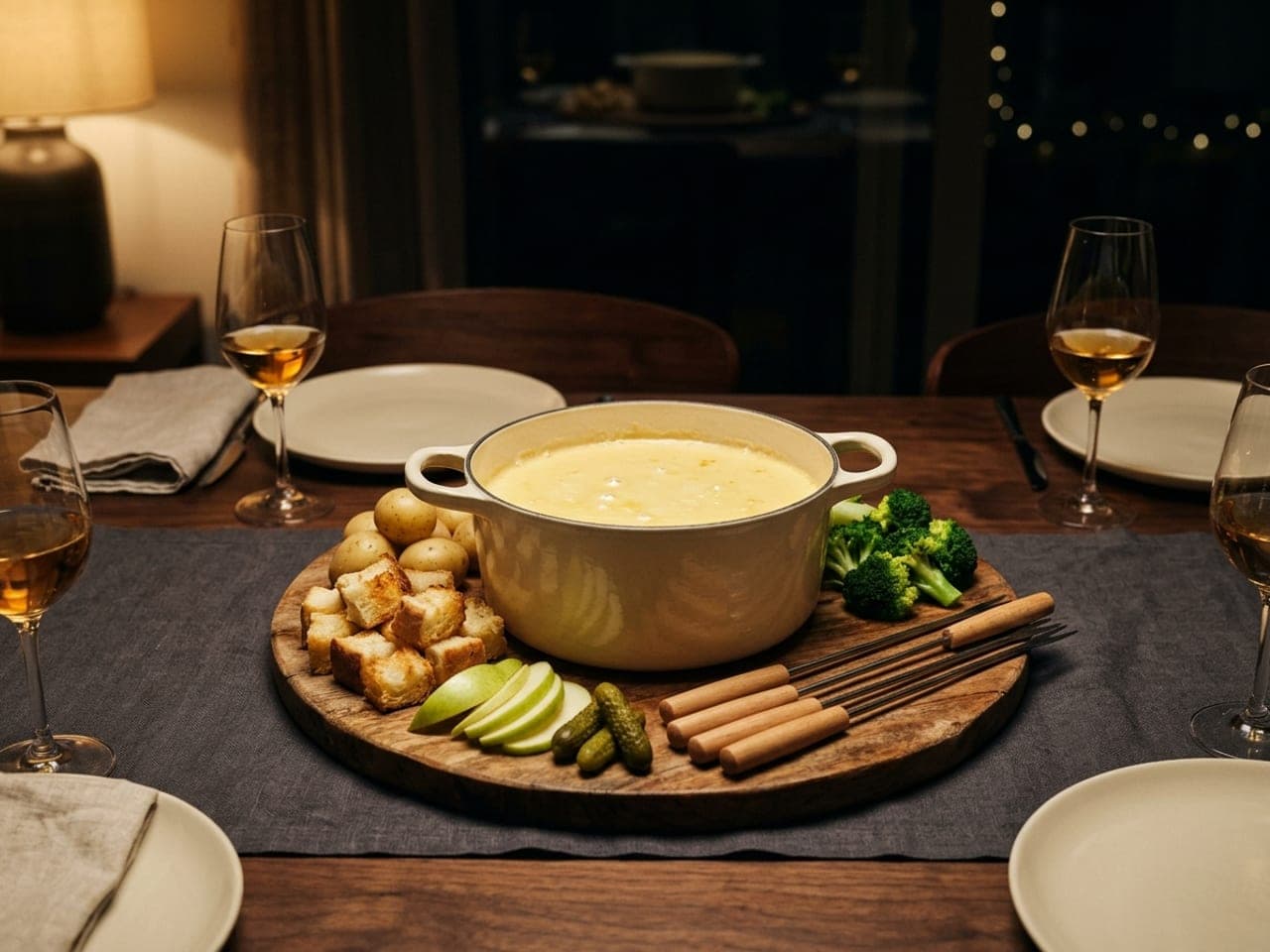
- Menu
- Cheese fondue (recipe below) with Gourmet’s dippers, via Epicurious: bread cubes, apple and pear slices and blanched broccoli; plus boiled new potatoes (ours; Gourmet roasts them) and cornichons; a green salad; a pot of melted chocolate with fruit to dip for dessert. At 11:30 pm, marinated Hermelín with bread. Raclette instead: a raclette grill does the same job over the same potatoes and cornichons.
- Buy
- America’s Test Kitchen’s batch makes 3 cups (720 ml): one batch for four, one and a half for six (our reading; the recipe gives no servings), plus whatever goes in the apple juice pot. Buy the cheese in blocks; America’s Test Kitchen says deli Swiss turns stringy.
- Vegetarian?
- No meat, but not automatically vegetarian: as our scalloped potatoes recipe notes, traditional Gruyère is made with animal rennet, as Parmesan always is. For vegetarian guests, buy cheeses labelled as made with vegetarian rennet, the midnight Hermelín included.
- Wine stays in
- A cheese fondue cooks for minutes, so most of its wine stays in: Sucht Schweiz, the Swiss addiction body, says a dish boiled ten minutes keeps up to 60 percent of its alcohol, and SRF, Swiss public radio, says kirsch stirred in at the end keeps up to 85. Make a second pot without wine for children, pregnant guests and drivers: apple juice and a little more lemon juice (ours; SRF’s kitchen experiment suggests Apfelwein, cider, which itself usually contains alcohol). It needs its own cheese and its own heat.
- The burner
- Never pour liquid or gel fuel into a burner that is lit or still hot: the vapour can ignite and shoot flames across the table, and in Canada this has killed people (Health Canada). Use sealed gel or paste cans or electric bases, one for each pot: the cheese, the apple juice pot and, later, the chocolate, which goes on an electric base or a burner not lit tonight, so nothing is ever refilled hot. Put a flame out with the burner’s snuffer lid, never by blowing; keep curtains and blankets at least 3¼ feet (1 m, the BFB’s figure) away and children back (the Swiss fire-prevention body BFB).
- Meat fondue instead
- Germany’s post-holiday Campylobacter peak is linked to meat fondue and raclette, most strongly with chicken (Robert Koch Institute); separate plates for raw and cooked meat cut the risk in a Swiss study. Raw meat on its own plates, nobody eats from the fondue fork, chicken to 165°F (74°C) (USDA; Germany’s BfR: 70°C in the core for 2 minutes). Use a heavy, stable or electric pot; fat burns from about 536°F (280°C, the TÜV association’s figure), and a fat fire takes a lid, never water.
- Ahead
- Marinated Hermelín: garlic acidified on Sat 26 Dec (24 hours, the recipe’s first step), the jar layered on Sun 27 Dec and marinated at least 3 to 4 days in the fridge (finish it by day 10). Wed 30 Dec: salad dressing made; potatoes bought. Thu 31 Dec: everything else is cut in the hour before dinner.
- Midnight
- The Hermelín on a fresh board with bread: only the pieces you will serve, lifted out of the jar 30 to 60 minutes ahead; what is left on the board is thrown away, never returned to the jar (the recipe). Then the toast.
- On the plate
- The pot in the middle on its stand, the dippers grouped by kind on one board around it, a long fork and a small plate for every guest.
- Allergens
- Milk (cheese, chocolate, Hermelín); wheat (bread); sulphites (UK) in the wine (not in the apple juice pot); soy lecithin in most chocolate; mustard (UK) in most salad dressings.
Plan, dinner at 8:00 pm, toast at 12:00 am
- 7:00 pmBread cut into cubes.
- 7:30 pmPotatoes on to boil; broccoli blanched. Cheese shredded, tossed with the cornstarch and left 15 to 20 minutes at room temperature (America’s Test Kitchen). Salad dressed.
- 7:45 pmWine and garlic to the boil, the cheese whisked in a handful at a time, 2 to 4 minutes; the apple juice pot beside it. Apples and pears sliced.
- 7:55 pmGel cans or electric bases on at the table, then the pots on top.
- 8:00 pmFondue.
- By 9:30 pmLeftover potatoes, broccoli and salad in the fridge, 2 hours after they were made.
- 9:45 pmThe cheese pots off; each burner put out with its snuffer lid, never blown out (BFB), and left to cool: none is refilled until it is cold (Health Canada). Leftover cheese and the dinner fruit in the fridge. Chocolate melted on the stove; fresh fruit cut from the fridge.
- 10:00 pmChocolate fondue, over its own heat: an electric base, or a fresh sealed gel can in a burner not lit tonight, never a hot one.
- 11:00 pmOnly the Hermelín pieces you will serve lifted out of the jar to soften 30 to 60 minutes; the jar straight back in the fridge (the recipe).
- 11:30 pmHermelín served with bread and fresh onion rings.
- By 11:45 pmFruit for the chocolate in the fridge or thrown away, 2 hours after it was cut; the chocolate’s heat off, a burner put out with its lid.
- 12:00 amMidnight: the toast.
- By 1:00 amHermelín left on the board thrown away, never returned to the jar (the recipe).
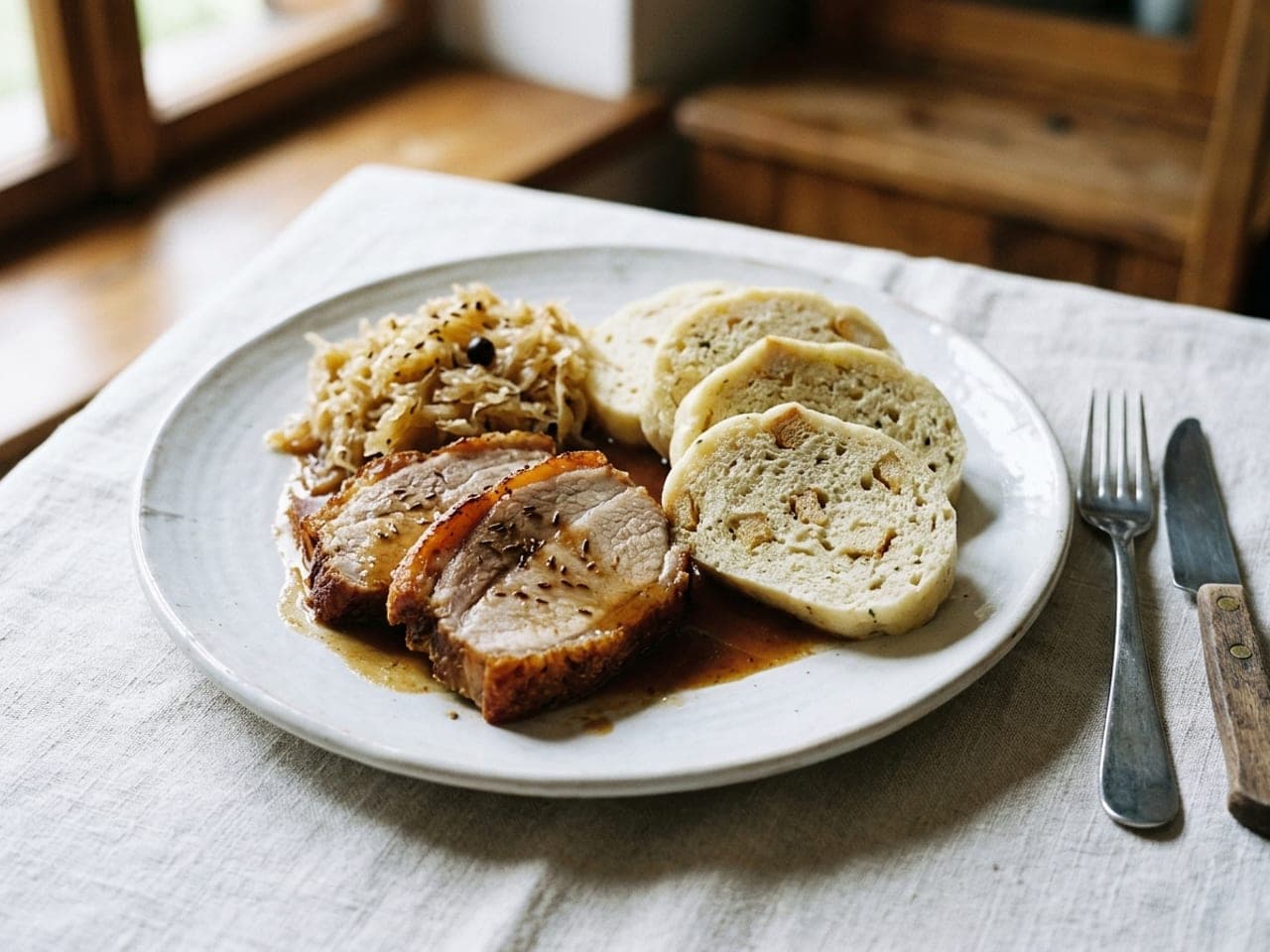
- Menu
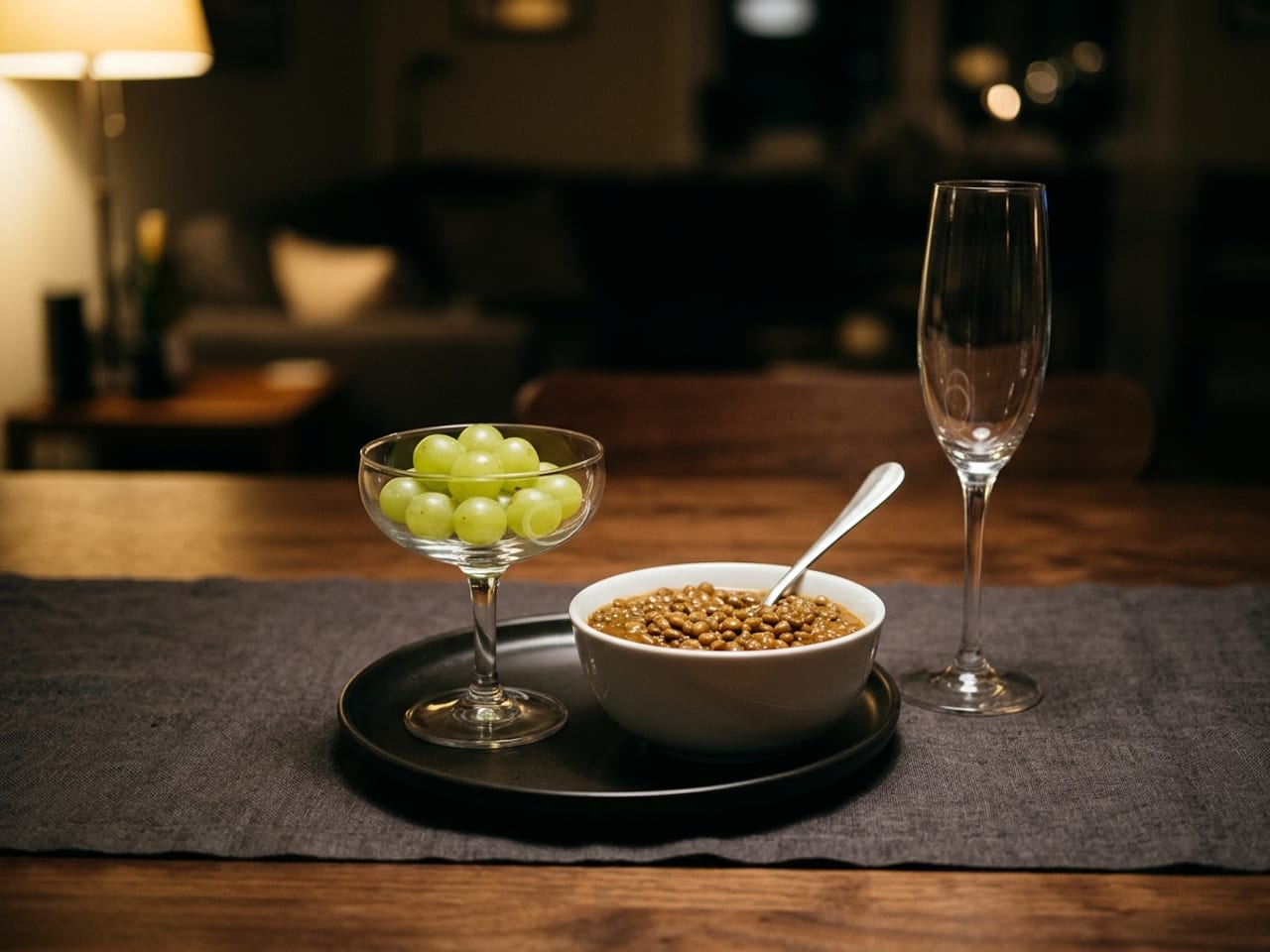
- A small bowl of Czech sour lentils to start; roast pork with dumplings and sauerkraut, the Czech vepřo knedlo zelo; sautéed greens; lemon posset. At midnight, twelve grapes each and chlebíčky, Czech open-faced sandwiches. Vegetarian guests: the lentils made with butter, not lard (the recipe says lard makes them non-vegetarian), with their fried egg, as a main.
- Why these foods
- Pork and sauerkraut (Pennsylvania Dutch), lentils (Czech) and greens (the US South) are eaten for luck (what the sources say); serving them together on 31 December is our choice. Other ways: Hoppin’ John, or cotechino with lentils (Il Post).
- Buy
- The pork recipe serves six from a 3 lb (1.36 kg) boneless neck or shoulder. One batch of lentils (four servings) as six small starter bowls (our reading). Twelve grapes a guest, and a few more.
- Ahead
- Wed 30 Dec, after lunch: the lentils, cooked without the vinegar and cooled quickly (the recipe keeps them 3 to 4 days in the US, 48 hours in the UK, so New Year’s Day lunch is inside both); UK readers keep New Year’s Day’s portion apart, unheated (the Food Standards Agency: reheat once). The sauerkraut, which the recipe says is better made a day ahead; the posset (America’s Test Kitchen keeps it 2 days). Thu 31 Dec, afternoon: the chlebíčky toppings sliced and the eggs boiled, kept in the fridge (the recipe chills the finished chlebíčky no more than an hour, so the bread stays crisp); grapes washed and counted.
- Midnight
- One grape with each of the twelve chimes, the Spanish custom (where it comes from). For children under 5, cut them up (the CDC lists uncut grapes among choking hazards) and let them eat at their own pace, not one a chime (our caution). Chlebíčky, assembled at 10:45 pm, from the fridge, then the toast.
- On the plate
- Two slices of pork overlapping, gravy spooned beside them and not over the crust, four dumpling slices fanned on one side and the sauerkraut in a neat mound on the other.
- Allergens
- Wheat (dumplings, gravy, sauerkraut, lentils, bread); egg (dumplings, the lentils’ egg, chlebíčky); milk (dumplings, posset); celery (UK) in ready-made stock; mustard (UK) and sulphites (UK) in the lentils’ pickles, mustard and wine vinegar, and sulphites (UK) in some jarred sauerkraut (the recipe). Chlebíčky toppings vary: check the recipe.
Plan, dinner at 8:00 pm, toast at 12:00 am
- 4:30 pmOven to 320°F (160°C), or 300°F (150°C) with a fan (the recipe). Pork seasoned.
- 4:45 pmPork in, covered, for 1¾ hours.
- 5:45 pmDumpling dough made; it rises 45 to 60 minutes.
- 6:30 pmLid off, pork fat side up, about 1 hour more, basted every 20 minutes. Dumpling water on: it takes 20 to 30 minutes to boil.
- 7:00 pmDough shaped into two loaves to rest 15 to 20 minutes. Sauerkraut reheated, covered, to 165°F (74°C), then kept covered over the lowest heat (the recipe).
- 7:20 pmDumplings in, 18 to 20 minutes.
- 7:30 pmPork out when a probe reads 176 to 185°F (80 to 85°C) in the thickest part (the recipe), to rest 20 to 30 minutes. Oven off. Lentils reheated to 165°F (74°C) and re-soured with their vinegar (the recipe). Gravy made in the roasting pan.
- 7:45 pmLentils served as guests sit down. Dumplings out, pricked and sliced; the greens on in their place.
- 8:00 pmPork carved and served.
- By 9:30 pmPork, dumplings, gravy, sauerkraut, lentils and greens in the fridge, 2 hours after the roast left the oven.
- 10:00 pmPosset, 10 minutes out of the fridge first (the fancy desserts card).
- 10:45 pmChlebíčky assembled and chilled, uncovered (the recipe: no more than an hour in the fridge).
- 11:30 pmChlebíčky out of the fridge; twelve grapes in a small glass at each place.
- By 11:50 pmPosset back in the fridge or thrown away, 2 hours after it came out.
- 12:00 amMidnight: the grapes, then the toast.
- By 1:15 amChlebíčky, and any grapes cut for children, back in the fridge or thrown away: 2 hours out, counting the assembly.
An appetizer party, no sit-down dinner
For a bigger crowd, a standing party in three rounds.
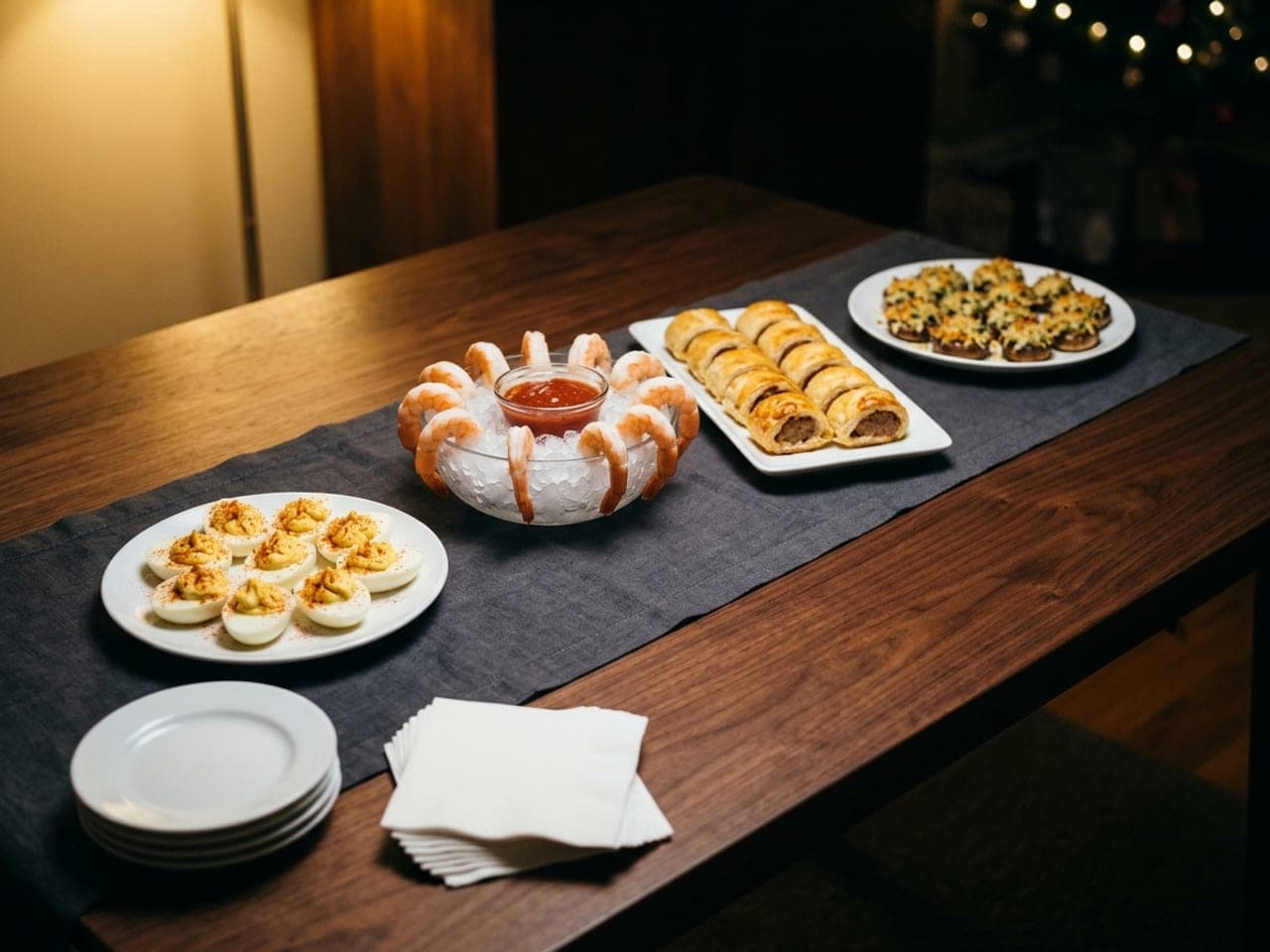
- Menu
- Cold, from the fridge: shrimp cocktail, deviled eggs, gravlax on pumpernickel and a cheese and charcuterie board. Hot, from the oven: sausage rolls, stuffed mushrooms and spinach and artichoke dip; for the late round, pigs in blankets and cocktail meatballs. Sweet: chocolate truffles. Vegetarian guests: the eggs, the dip and the mushrooms made with a vegetarian hard cheese (the cards say why).
- Buy
- Appetizers instead of dinner: 12 to 15 pieces a guest, at least 6 kinds (Dummies; Nicolet College’s catering textbook, as our appetizers hub prints them): 240 to 300 pieces for 20 (our arithmetic). The party food calculator does the sums for any count.
- The rounds
- Cold rounds at 7:30 pm, 9:30 pm and 11:30 pm (our schedule, on the FDA’s method): each replaces the last, which goes back in the fridge or is thrown away, never topped up; hot back-ups wait in a 200 to 250°F (93 to 121°C) oven.
- Ahead
- Weeks before: sausage rolls frozen raw, meatballs and their sauce frozen (America’s Test Kitchen: a month); from Thu 17 Dec, pigs in blankets frozen (BBC Good Food: two weeks). Mon 28 Dec: the gravlax cure starts (2 to 3 days). Wed 30 Dec: eggs hard-cooked; the cocktail sauce; mushrooms stuffed and the dip assembled (The Kitchn: a day ahead for both). Thu 31 Dec, morning: the shrimp poached (the recipe: no more than 24 hours ahead) and the boards arranged (Penn State Extension); in the afternoon, every cold bite split into three small platters and chilled, the eggs filled last, as close to the party as the day allows (the recipe).
- Midnight
- Round three at 11:30 pm: the late hot bites, fresh from the oven, and fresh cold platters from the fridge. Then the toast.
- On the plate
- One kind per small platter, so a round is swapped whole (arranging the bites). A dish for used picks beside the meatballs and shrimp, and picks kept out of small children’s reach (our caution).
- Allergens
- Crustaceans (shrimp); fish (gravlax; Worcestershire in the cocktail sauce and the meatballs); barley (UK) in British Worcestershire and rye (UK) in most pumpernickel; egg; milk; wheat; mustard (UK); celery (UK); sulphites (UK) in cured meats and wine. Each linked card lists its own.
Plan, first round at 7:30 pm, toast at 12:00 am
- 7:00 pmOven to 425°F (218°C).
- 7:20 pmSausage rolls in from frozen, 30 to 35 minutes (the card: Delia’s 20 to 25, plus 10), until the middle reads 160°F (71°C) (USDA).
- 7:30 pmRound one, cold, out as guests arrive: shrimp on crushed ice, eggs, gravlax, the board (straight from the fridge: the hour it might warm counts toward its 2 hours).
- 7:55 pmSausage rolls out and served. Oven to 400°F (204°C), mushrooms in for 16 to 18 minutes, plus 2 to 3 from the fridge.
- 8:20 pmMushrooms out and served. Oven to 375°F (190°C), the dip in for about 30 minutes.
- 8:50 pmDip out and served. Oven down to 225°F (107°C) for hot back-ups.
- 9:30 pmRound two: fresh cold platters from the fridge replace round one’s, which come off at 2 hours out: deviled eggs thrown away (the recipe), the rest in the fridge or thrown away.
- By 9:55 pmSausage rolls in the fridge or thrown away, 2 hours after they left the oven; the mushrooms by 10:20 pm and the dip by 10:50 pm.
- 10:00 pmThe truffles. Meatballs simmered in their sauce to 165°F (74°C), then into a preheated slow cooker.
- 10:45 pmOven up to 375°F (190°C).
- 11:00 pmPigs in blankets in from frozen, 20 to 30 minutes (BBC Good Food), until the middle of a sausage reads 160°F (71°C) (USDA).
- 11:30 pmRound three: pigs in blankets, meatballs and fresh cold platters, which replace round two’s, never added to them; round two’s come off at 2 hours out, the eggs thrown away, the rest in the fridge or thrown away. Oven off.
- 12:00 amMidnight: the toast.
- By 1:20 amRound three in the fridge or thrown away, the eggs thrown away: the cold platters, the pigs in blankets and the meatballs.
New Year’s Eve appetizers and midnight bites, by how far ahead
Every bite from the six menus, earliest first: mix them as you like.
| Bite | Make by | Finish at | Per guest, and whose figure |
|---|---|---|---|
| Marinated Hermelín (fondue night) | Sat 26 Dec: garlic acidified for 24 hours, then at least 3 to 4 days in the jar | Only the pieces you will serve, lifted out 30 to 60 minutes ahead (the recipe), with bread | No figure |
| Gravlax on pumpernickel (party) | Mon 28 Dec: a 2 to 3 day cure | Sliced and laid on the bread on the day, then chilled | No figure |
| Deviled eggs (crowd, party) | Wed 30 Dec: eggs hard-cooked, inside the recipe’s US week and UK 2 days | Filled late on Thu 31 Dec, served cold from the fridge | Two halves (the recipe: 12 halves for six) |
| Shrimp cocktail (surf and turf, party) | Thu 31 Dec, morning: the recipe cooks them no more than 24 hours ahead | From the fridge onto crushed ice | 2 to 3 among several appetizers (The Spruce Eats); 4 to 5 among several starters, 6 to 8 as the only starter (our recipe) |
| Oysters, raw or baked (for two) | Bought on the morning of Thu 31 Dec; mignonette Wed 30 Dec | Shucked at 7:20 pm; baked at 450°F (232°C) for 10 minutes (CDC) | Six, the average UK portion (Food Standards Scotland) |
| Stuffed mushrooms | Wed 30 Dec: The Kitchn stuffs them a day ahead | 400°F (204°C), 16 to 18 minutes | No figure |
| Spinach and artichoke dip | Wed 30 Dec: assembled in its dish (The Kitchn) | 375°F (190°C), about 30 minutes | 1 oz (28 g) counts as one piece (Dummies) |
| Sausage rolls | Weeks ahead, frozen raw | From frozen at 425°F (218°C), 30 to 35 minutes (Delia’s time, plus 10) | No figure |
| Cheese and charcuterie board | Arranged on the morning of Thu 31 Dec (Penn State Extension) | From the fridge; a 2-hour item | 1 to 2 oz (28 to 57 g) of cheese before a meal (Penn State Extension) |
| Chlebíčky (lucky foods) | Toppings on the afternoon of Thu 31 Dec; assembled at 10:45 pm (the recipe: no more than an hour in the fridge) | From the fridge at 11:30 pm | No figure |
| Pigs in blankets | From Thu 17 Dec, frozen (BBC Good Food: two weeks) | From frozen at 375°F (190°C), 20 to 30 minutes, to 160°F (71°C) in the middle (USDA) | Two (Good Food magazine) |
| Cocktail meatballs | Weeks ahead, frozen with their sauce (America’s Test Kitchen: a month) | Simmered in the sauce to 165°F (74°C), then a preheated slow cooker | About 80 for 20 in America’s Test Kitchen’s batch |
| Short rib sliders (crowd) | Wed 30 Dec: braised, the slider meat kept apart | Reheated to 165°F (74°C) at 11:10 pm, on rolls from the freezer | One rib for two guests (ours) |
| Caviar with blini (for two) | Bought ahead, unopened in the fridge | 11:30 pm, the tin set in crushed ice | Sellers’ figures only: the caviar guide |
Counting pieces. Before dinner, 6 to 8 a guest; as the meal, 12 to 15 (Dummies). Every count we found is in how many canapés per person.
What is left to do on the night
Our estimates, from each card’s plan.
| Menu | Hands-on after 7:30 pm (our estimate) | What is left |
|---|---|---|
| Surf and turf | About 35 minutes | Beans, shrimp, steaks, tails, plating |
| Dinner for two | About 45 minutes | Shuck the oysters, cook the salmon |
| Short ribs for a crowd | About 25 minutes, then 20 at 11:10 pm | Mash, the dish swap, sliders |
| Fondue night | About 30 minutes | Melt the cheese, cut the fruit, then the chocolate |
| Lucky foods | About 40 minutes, after an afternoon of oven time | Dumplings, gravy, reheats, carving, chlebíčky |
| Appetizer party | About 60 minutes, spread over the evening | Oven changes, two round swaps, the late hot round |
How much per guest
Named sources’ figures, with the arithmetic for eight. Where two disagree, both are printed.
| Food | Per adult | For 8 | Who says |
|---|---|---|---|
| Filet steak | One 7 to 8 oz (200 to 225 g) filet, 1½ inches (4 cm) thick | Eight, 3½ to 4 lb (1.6 to 1.8 kg) | America’s Test Kitchen |
| Lobster tail | One 4½ to 6 oz (130 to 170 g) tail | Eight | America’s Test Kitchen; Taste of Home |
| Bone-in short ribs | About 13 oz (370 g), our division | 6⅔ lb (3 kg) | Bon Appétit’s recipe braises 5 lb (2.3 kg) for six |
| Oysters | Six | 48 | Food Standards Scotland’s average UK portion; the party food calculator’s 6 to 10 is a main-course figure (Cooking For Crowds For Dummies) |
| Shrimp, among several appetizers | 2 to 3 medium or larger | 16 to 24 | The Spruce Eats |
| Potatoes for mash | ½ lb (227 g) raw | 4 lb (1.8 kg) | Whole Foods Market; Melissa Clark says 5 to 6 oz (142 to 170 g) |
| Appetizers instead of dinner | 12 to 15 pieces, at least 6 kinds | 96 to 120 pieces | Dummies; Nicolet College’s catering textbook |
| Wine with dinner | Half a 750 ml bottle | 4 bottles | Better Homes & Gardens; Whole Foods Market and Food Network print 2 to 3 for eight |
| Wine for a long evening | At least a whole 750 ml bottle; or 3 to 4 glasses of sparkling over 2 to 3 hours | 8 bottles; or about 6 of sparkling (8 × 4 ÷ 6, rounded up) | Bon Appétit’s wine writer, Marissa A. Ross; Moët & Chandon for the sparkling |
| Sparkling wine for the toast | One glass: a 75 cl bottle pours six 12.5 cl glasses | 2 bottles (8 ÷ 6, rounded up) | Comité Champagne for the glasses; Moët & Chandon divides the guests by six |
The make-ahead timeline for New Year’s Eve 2026
Planned for Thursday 31 December 2026 and New Year’s Day, Friday 1 January 2027. Pick out your menu’s jobs.
- Early December
- Rolls par-baked and frozen for the crowd menu (King Arthur Baking: up to 6 weeks); the party’s sausage rolls and meatballs (a month).
- Thu 17 Dec
- Pigs in blankets for the party, frozen (BBC Good Food: two weeks).
- Sat 26 Dec and Sun 27 Dec
- Acidify the garlic (24 hours), then layer the marinated Hermelín for the fondue night’s midnight board.
- Mon 28 Dec
- Start the gravlax cure for the party. Make room in the fridge, which must stay at 40°F (4°C) or colder.
- Tue 29 Dec
- Herb butter for the steaks (America’s Test Kitchen: 4 days wrapped in the fridge).
- Bake the crème brûlée cheesecake for the crowd menu (4 to 5 days before it is torched).
- Wed 30 Dec
- Morning: frozen lobster tails into the fridge to thaw for 24 hours (America’s Test Kitchen). Eggs hard-cooked for the deviled eggs, inside the recipe’s US week and UK 2 days.
- Braise the short ribs and chill them the card’s way, never in the pot. After lunch, cook the lentils without their vinegar and cool them quickly; make the sauerkraut for the pork.
- Desserts: pots de crème and lemon posset (2 days). The mignonette, the cocktail sauce and the blanched beans. Party: stuff the mushrooms and assemble the dip.
- Thu 31 Dec, morning
- Poach the shrimp (the recipe: no more than 24 hours ahead). The chocolate mousse for the surf and turf menu: it keeps 1 day and needs 4 hours to set.
- Buy the oysters; arrange the party’s cheese boards. Sparkling wine into the bottom of the fridge for a few hours (Comité Champagne).
- Thu 31 Dec, afternoon
- Chlebíčky toppings, the party’s cold bites split into three small platters each, deviled eggs filled last. Pork in at 4:45 pm; the surf and turf potatoes in at 6:45 pm. Each plan has the rest.
- 7:30 pm and 8:00 pm
- Guests, the first course and the party’s first round at 7:30 pm, dinner at 8:00 pm (our clock).
- About 10:00 pm
- Dinner off the table and into the fridge, 2 hours after it left the oven; dessert out, and back in the fridge by about 12:00 am, 2 hours after it came out. Each plan gives its exact time.
- 11:30 pm and 12:00 am
- The midnight bite, fresh from the fridge or the oven, then the toast at midnight. The midnight bite goes back in the fridge, or is thrown away, by about 1:30 am.
- Fri 1 Jan 2027, New Year’s Day
- Lentils for lunch, the Czech way: reheat to 165°F (74°C) and add the vinegar again (the recipe). UK readers reheat only the portion kept apart, once (Food Standards Agency).
- Fri 1 Jan to Mon 4 Jan
- US leftovers (USDA FSIS): 3 to 4 days, counted from the day each dish was first cooked. Thursday’s steak, pork, shrimp and lobster to Sun 3 Jan or Mon 4 Jan, the dumplings to Sat 2 Jan or Sun 3 Jan (the recipe gives them 2 to 3 days); the short ribs and lentils, cooked on Wednesday, to Sat 2 Jan or Sun 3 Jan.
- UK leftovers (Food Standards Agency): 48 hours from cooking, reheated once. Thursday’s cooking by Sat 2 Jan; Wednesday’s by Fri 1 Jan. The short ribs had their one reheat at dinner: the slider meat kept apart had its own at 11:30 pm.
A long evening: food safety from dinner to midnight
American and British advice differ in places, so each rule names its authority.
- Dinner in the fridge by about 10:00 pmUSDA: nothing perishable sits out more than 2 hours, or 1 hour above 90°F (32°C), because bacteria grow fastest between 40 and 140°F (4 to 60°C). The clock starts when food leaves the oven or the fridge, not when guests sit down. So every plan puts dinner away around 10:00 pm, dessert and each party round 2 hours after they come out, and brings a separate, fresh plate for midnight. Nothing on this page is meant to sit out from dinner to midnight.
- Swap, never top upThe FDA’s buffet method: make several small platters ahead, keep the cold ones in the fridge and the hot ones in an oven at 200 to 250°F (93 to 121°C), and replace a platter rather than add new food to one that is already out. Cold seafood that stays out longer than 2 hours sits on ice (FDA).
- Holding food hotUSDA’s line is 140°F (60°C) or above; the FDA suggests an oven at 200 to 250°F (93 to 121°C) and warns that some warmers only reach 110 to 120°F (43 to 49°C), so check the product label. A slow cooker holds food that went in hot; it does not reheat (USDA). Britain’s 63°C is a legal rule for food businesses; the Food Standards Agency’s pages for home cooks give no hot-holding temperature.
- The UK clockThe Food Standards Agency says to cool and refrigerate cooked food within 1 to 2 hours, and to keep chilled food out of the fridge “for the shortest time possible during preparation (a maximum of four hours)”; Food Standards Scotland gives buffet food no longer than four hours. Four hours is a ceiling, never an allowance: this page plans on the US 2 hours.
- Hot food and the fridgeThe two countries give opposite instructions. USDA and the CDC say hot food can go straight into the refrigerator; the Food Standards Agency says to cool it at room temperature first. Either way, divide big pots and roasts into shallow containers. The CDC says most outbreaks of Clostridium perfringens food poisoning happen in November and December, most often from food cooked in large batches and held at unsafe temperatures.
- Leftovers, by countryUnited States (USDA FSIS): into the fridge within 2 hours, in shallow containers; eat within 3 to 4 days, reheated to 165°F (74°C). United Kingdom (Food Standards Agency): within 48 hours, reheated until steaming hot throughout, once only. We count both from the day each dish was first cooked, so food made on Wed 30 Dec runs out first (the dates).
- Alcohol stays in the foodUSDA’s nutrient retention table keeps 75 percent of the alcohol in a flamed dish, 70 percent in an uncooked one left overnight, 40 percent after 15 minutes of simmering 10 percent after two hours and 5 percent after two and a half, the short ribs’ braise. A cheese fondue is cooked for minutes, not hours (the fondue card). Offer children, pregnant guests and anyone who avoids alcohol a version without it.
- AllergensThe US names 9 major allergens (sesame since 1 January 2023) and UK law 14, adding celery, mustard, sulphites, lupin and molluscs. Oysters and scallops are molluscs, on the UK list only; shrimp and lobster are crustaceans, on both. US wine says “Contains sulfites” at 10 parts per million or more (TTB). Cooking does not remove an allergen: ask guests beforehand and keep the packets (Food Standards Agency).
- Smoking drinks and sparklersNo dry ice in drinks: the FDA says it must never be swallowed and must have fully evaporated first. Sparklers burn at about 2,000°F (1,090°C) (CPSC): never for young children; and never on food (our caution).
Guests who should skip some dishes
For pregnant guests, older adults, young children and anyone with a weakened immune system.
- Raw oystersThe CDC: “Do not eat raw or undercooked oysters or other seafood. Cook them before eating.” The FDA tells pregnant women, children, older adults and anyone with a weakened immune system to avoid raw oysters even if they were treated after harvest. Freezing does not kill Vibrio either (North Carolina’s public health division). In the UK the NHS puts raw shellfish on its avoid list in pregnancy. Bake theirs: 450°F (232°C) for 10 minutes, the CDC’s time.
- Cold shrimp cocktailThe NHS says cold, pre-cooked ready-to-eat prawns must be cooked until steaming hot in pregnancy; the FDA’s list names only partially cooked shrimp. The starter and midnight shrimp on the surf and turf menu and the party’s shrimp are served cold.
- Caviar, gravlax and cold-smoked fishNo authority page we read names caviar; the nearest lines: the NHS says “You should avoid raw, cold-smoked and cured fish” in pregnancy; the FDA lists raw fish and refrigerated smoked seafood as higher-risk foods; in July 2023 the Food Standards Agency and Food Standards Scotland told pregnant women and people with weakened immunity to avoid ready-to-eat cold-smoked or cured fish unless cooked until steaming hot. None of these makes an exception for pasteurized caviar: ask a doctor or midwife (our advice).
- Rare beef, lobster and pink salmonMedium-rare steak, lobster pulled at 140°F (60°C) and salmon with a blush of pink are below the 145°F (63°C) minimum (USDA for beef, with a 3-minute rest; FDA for seafood), which the CDC repeats for adults 65 and older. For these guests, cook theirs to 145°F (63°C) on a thermometer; do not judge by color: the FDA judges the flesh, not the shell. The NHS pregnancy page counts whole cuts of beef “thoroughly cooked on the outside” as safe; the US advice is the thermometer.
- Raw-egg desserts and saucesThe chocolate mousse on the surf and turf menu has raw egg white: the FDA says to use pasteurized eggs for anything served raw or lightly cooked; in the UK, British Lion eggs can be eaten raw by pregnant women, children and older people, but not by the severely immunocompromised (Food Standards Agency, 2017). Hollandaise and béarnaise are a last-two-hours job: Gisslen’s Professional Cooking holds them no longer than 2 hours and then throws them away, so the steak gets a herb butter.
- Soft cheese and cured meatThe NHS says to cook camembert-style cheeses until steaming hot in pregnancy, so the marinated Hermelín at midnight is not for pregnant guests, and the recipe also leaves it off the plate for older guests and anyone with a weakened immune system; the CDC lists unheated deli meats, such as the charcuterie on the party board, for pregnant women, people 65 or older and people with weakened immunity. The hot cheese fondue is cooked.
- AlcoholThe CDC: “There is no known safe amount of alcohol use during pregnancy.” The NHS: “It’s safest to avoid alcohol.” That includes the wine in the fondue and the short rib sauce (what stays in) and the rum in the mousse; the toast has an alcohol-free version.
- Small childrenThe CDC’s list of foods to avoid for young children, from USDA’s WIC program, includes uncut grapes, marshmallows, hot dogs and sausages, whole or chopped nuts, bones in meat or fish, raw apple pieces and large chunks of cheese. For under-fives, cut the twelve grapes and the fondue apples small and the pigs in blankets lengthwise into strips, not coins (our advice), and keep whole nuts, such as any on the cheese board, off their plates: the NHS says no whole nuts under 5, and no raw shellfish for babies. At the fondue table a child’s face is at flame height (the Swiss fire-prevention body BFB).
The midnight toast
Chilling, opening and pouring, with an alcohol-free glass for anyone who wants one.
- How coldThe Comité Champagne, the Champagne trade body, serves it at 46 to 50°F (8 to 10°C). The American Academy of Ophthalmology wants the bottle at 45°F (7°C) or colder before it is opened, which a bottle from an ice bucket meets.
- How to chill itAn ice bucket half filled with water and ice for 20 to 30 minutes, or the bottom of the fridge for a few hours (Comité Champagne); Perrier-Jouët says about 2½ hours there. Perrier-Jouët says never to freeze it.
- Opening itThe American Academy of Ophthalmology: chill it, do not shake it, take off the foil and wire, hold the bottle at 45 degrees pointed away from yourself and everyone else, put a towel over the top, hold the cork and slowly twist the bottle, not the cork. The Comité Champagne eases the cork out “without letting it escape”. If a cork hits an eye, see an eye doctor at once (AAO).
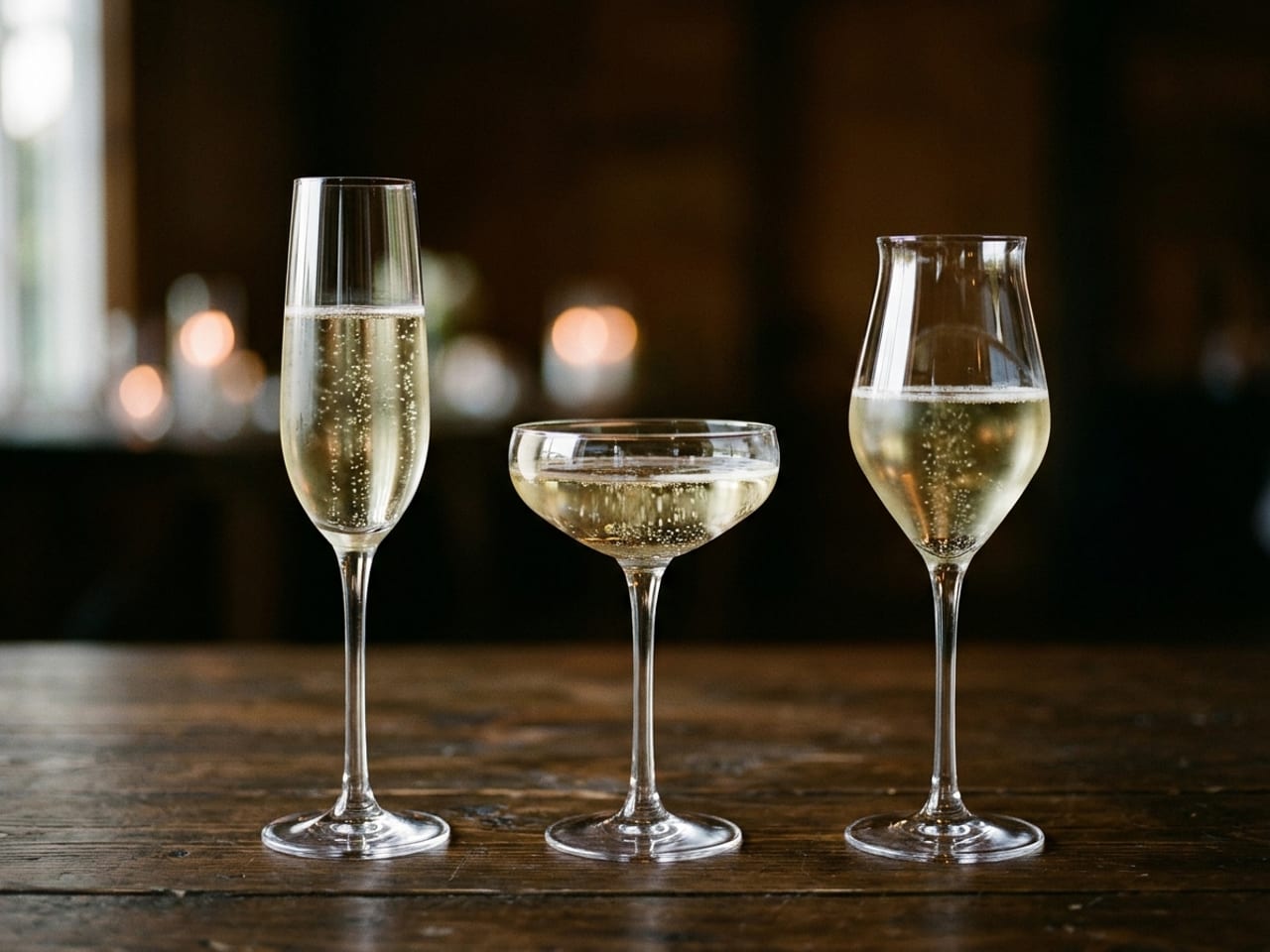
- The glassFlute or coupe is on our types of glasses guide. The Comité Champagne itself prefers a tall tulip-shaped glass, though it says flutes and coupes are fine if you like them.
- How muchSix 12.5 cl glasses to a 75 cl bottle (Comité Champagne); Moët & Chandon divides the guests by six, rounded up (per guest).
- A toast without alcoholChildren, drivers, pregnant guests and anyone else not drinking get the same glass at the same moment: sparkling grape juice, or an alcohol-free sparkling wine (check the label’s alcohol figure), chilled the same way (our suggestion).
Lucky foods for New Year’s Eve, by country
What named sources say, in brief. Several are New Year’s Day customs, and the stories behind some are disputed: where they are, we say so.
- Twelve grapes, SpainOne grape with each of the twelve chimes at midnight. Madrid newspapers describe the custom by the 1890s; the popular story that it began with a 1909 grape surplus in Alicante is contradicted by those earlier papers (ABC; El País). Cut them up for children under 5.
- Lentils, Czechia and ItalyCzechs eat lentils on New Year’s Day for money (Radio Prague International). Lentils looking like coins is the modern explanation; the old Czech folklore records, and what they actually say, are on our sour lentils recipe: the custom is documented by the 1890s. In Italy most families eat cotechino with lentils on 31 December (Il Post).
- Pork and sauerkraut, PennsylvaniaThe Pennsylvania Dutch New Year’s Day dinner. Pigs root forward, so pork moves you ahead into the new year (the folklorist Don Yoder, as LancasterOnline quotes him); chicken stays off the plate because it scratches backward. Butchering often fell around Christmas, so fresh pork was at hand (the food historian William Woys Weaver, same article).
- Hoppin’ John and greens, the US SouthPeas and rice with bacon on New Year’s Day; its first written recipe in English is in Sarah Rutledge’s The Carolina House-wife of 1847 (South Carolina Encyclopedia), and Robert Moss found its New Year link in print by 1909. Collards stand for dollars, “or so they say” (Moss). Cornell Botanic Gardens counts it part of Watch Night, the African American New Year’s Eve tradition that remembers 31 December 1862, quoting the Smithsonian’s National Museum of African American History and Culture on Watch Night itself.
- Soba, JapanToshikoshi soba on 31 December: Japan’s agriculture ministry gives two of the explanations, long thin noodles for a long life and noodles easy to cut, to cut off the old year’s hardships, and says more than 60 percent of Japanese households eat it.
- Round fruit, the PhilippinesTwelve kinds of round fruit for the Media Noche, the midnight meal, round for money (Inquirer); Arab News’s Manila report gives thirteen, one for each month and one for extra luck. No chicken, because it scratches backward (Arab News).
- Vasilopita, GreeceA bread or cake with a coin baked inside, cut on 1 January, St Basil’s day, a slice for each person present (the Greek Orthodox Archdiocese of America). Wrap the coin in foil: a loose coin is a choking hazard (our caution).
See your New Year’s Eve main re-plated first
Photograph a trial run of the dish you are planning and Plate Artists shows it re-plated on a plate from its library, with the moves to get there. Your first re-plate is free with an account.
Start free · 1 enhancement →Free account · 1 free enhancement · No credit card
New Year’s Eve dinner questions, answered
What is the traditional dinner for New Year’s Eve?
There is no single one. Most foods tied to the turn of the year are eaten for luck, many on 1 January; on the 31st itself, twelve grapes in Spain, soba in Japan and cotechino with lentils in Italy (lucky foods).
What are the lucky foods to eat on New Year’s Eve?
Twelve grapes at midnight (Spain); lentils (Czechia, Italy, Brazil); pork and sauerkraut (the Pennsylvania Dutch); Hoppin’ John and greens (the US South); soba (Japan); round fruits (the Philippines). Several are New Year’s Day customs. Menu 5 puts some on one table.
Why do people eat 12 grapes at midnight?
It is a Spanish custom: one grape with each of the twelve chimes, for a lucky year. Madrid newspapers describe it by the 1890s, earlier than the popular 1909 surplus story allows. The CDC lists uncut grapes as a choking hazard for young children: cut them up for under-fives.
What can I make ahead for New Year’s Eve dinner, and how far ahead?
Braised short ribs, pots de crème, posset and hard-cooked eggs the day before; shrimp cocktail and a raw-egg chocolate mousse on the morning itself; a herb butter and a cheesecake two days before; frozen rolls, sausage rolls and meatballs weeks before. Each card dates its own jobs and the timeline puts them together.
What time should you serve New Year’s Eve dinner?
Our suggestion: guests at 7:30 pm, dinner at 8:00 pm, dessert by about 10:00 pm, a midnight bite at 11:30 pm and the toast at 12:00 am. It is our clock, not a rule; it keeps every perishable dish to USDA’s 2 hours on the table.
How long can party food sit out on New Year’s Eve?
In the US, 2 hours from when it left the oven or the fridge, 1 hour above 90°F (32°C) (USDA); the UK’s four hours is a ceiling. So put party food out in rounds and swap platters, never top them up (FDA).
How many appetizers per person for a New Year’s Eve party?
If the appetizers are the meal, 12 to 15 pieces a guest in at least six kinds (Dummies; Nicolet College); before a dinner, 6 to 8 (Dummies). The party food calculator does the sums, and our appetizer party shows them in three rounds.
What should I serve at midnight?
Something fresh from the fridge or the oven, never what is left of dinner: kept-back shrimp cocktails, short rib sliders, caviar on ice, chlebíčky or a late hot round (the bites).
What’s an easy New Year’s Eve dinner for two?
Oysters, a salmon recipe that takes under 40 minutes, pots de crème made the day before and caviar at midnight: the menu for two. The surf and turf menu also scales down to two.
How much champagne do I need for a midnight toast?
A 75 cl bottle pours six 12.5 cl glasses (Comité Champagne), and Moët & Chandon divides the guests by six: two bottles for eight, four for twenty. For a whole evening, Bon Appétit’s wine writer says at least a bottle a guest; Moët & Chandon plans 3 to 4 glasses each over 2 to 3 hours (per guest).
The research behind this guide
Agencies, publications and recipes named in the text:
- USDA FSIS, Danger zone (40°F to 140°F; 2 hours, 1 hour above 90°F)
- USDA FSIS, Leftovers and food safety (3 to 4 days; shallow containers; 165°F; hot food into the fridge)
- USDA FSIS, Safe minimum internal temperature chart (beef 145°F and a 3-minute rest; fish 145°F; sausage 160°F; poultry 165°F)
- USDA FSIS, Slow cookers and food safety (reheat first, then hold at 140°F)
- USDA FSIS, Roasting those “other” holiday meats (no ovens below 325°F)
- USDA Table of Nutrient Retention Factors, Release 6 (2007): alcohol retention
- FDA, Serving up safe buffets (small platters swapped, never topped up; back-ups at 200 to 250°F; warmers at 110 to 120°F)
- FDA, Selecting and serving fresh and frozen seafood safely (raw oysters even if treated after harvest; tags; tap test; 145°F; firm, pearly and opaque; on ice)
- FDA, What you need to know about preventing Listeria infections (smoked seafood)
- FDA, What you need to know about egg safety (pasteurized eggs for raw dishes)
- FDA, The FASTER Act: sesame is the ninth major food allergen
- FDA, Liquid nitrogen and dry ice in the Food Code (31 October 2018)
- TTB, Wine labeling: declaration of sulfites (10 parts per million)
- CDC, Vibrio and oysters (any month of the year; hot sauce, lemon juice and alcohol do not kill Vibrio)
- CDC, Preventing Vibrio infection (“Do not eat raw or undercooked oysters or other seafood”; bake shucked oysters at 450°F for 10 minutes)
- CDC, About Vibrio infection (who is at higher risk)
- CDC, About C. perfringens food poisoning (November and December; large batches)
- CDC, Preparing your holiday turkey safely (no need to cool food before refrigerating)
- CDC, Preventing Listeria infection (unheated deli meat; higher-risk groups)
- CDC, Safer food choices for adults 65 and older (145°F and a 3-minute rest)
- CDC, Choking hazards (11 March 2026: uncut grapes, marshmallows, sausages, nuts, bones, raw apple pieces, large chunks of cheese)
- CDC, About alcohol use during pregnancy (no known safe amount)
- CPSC, Fireworks safety (sparklers burn at about 2,000°F)
- North Carolina Division of Public Health, Vibrio vulnificus food safety advice (freezing does not kill it)
- American Academy of Ophthalmology, How to pop a champagne cork without harming your eye (2024)
- American Academy of Ophthalmology via ScienceDaily, flying champagne corks (17 December 2012: chill to 45°F)
- Food Standards Agency, Cooking your food (GOV.UK: 70°C for 2 minutes; leftovers within 48 hours; reheat once)
- Food Standards Agency, How to chill, freeze and defrost food safely (GOV.UK: a maximum of four hours; do not put hot food in the fridge)
- Food Standards Agency, Christmas food hygiene (GOV.UK: cool within 1 to 2 hours)
- Food Standards Scotland, Christmas food safety (buffet food no longer than four hours)
- Food Standards Scotland, Risk assessment to support guidance for norovirus outbreaks in oysters (13 November 2023: higher in winter; six oysters a portion)
- Food Standards Scotland and Food Standards Agency, updated advice on ready-to-eat cold-smoked and cured fish (27 July 2023)
- Food Standards Agency, New advice on eating runny eggs (press release of 11 October 2017, copy at Wired-Gov)
- GOV.UK, Food hygiene for your business: cooking (hot food kept at or above 63°C is a business rule)
- Food Standards Agency, Food allergy and intolerance advice for consumers (GOV.UK: the 14 allergens)
- NHS, Foods to avoid in pregnancy (raw, cold-smoked and cured fish; camembert-style cheese; alcohol)
- NHS, Foods to avoid giving babies and young children (no whole nuts under 5; raw shellfish)
- Rosner, Gassowski, Albrecht and Stark (Robert Koch Institute), Investigating the Campylobacter enteritis winter peak in Germany, 2018/2019, Scientific Reports (25 November 2021)
- German Federal Institute for Risk Assessment (BfR), Sociable, enjoyable, dangerous? Fondue and raclette (15 December 2023: 70°C for two minutes)
- Health Canada, Flame-jetting risk (portable fireplaces, fire pots, fondue fuel)
- BFB, Swiss fire-prevention advice, Fondue essen ohne Unfälle (29 July 2020, in German)
- TÜV-Verband, So wird der Fonduekocher kein Brandherd (17 December 2021, in German: fat burns from 280°C)
- Sucht Schweiz, Alkohol im Festtagsmenü (9 December 2008, in German: up to 60 percent after ten minutes of boiling)
- SRF, Alkohol in der Küche (Andrin Willi, 25 April 2022, in German: up to 85 percent when kirsch goes in just before serving)
- SRF, Experiment in der Küche: wieviel Alkohol bleibt trotz der Hitze im Essen? (Sandra Büchi, 28 November 2016, in German: Apfelwein and more lemon juice for fondue)
- America’s Test Kitchen, Pan-seared filet mignon (450°F; 3 minutes a side; 6 to 8 minutes; 7 to 8 ounce filets; six in a 12-inch pan)
- America’s Test Kitchen, Pan-roasted filets mignons for two (120 to 125°F for medium-rare)
- Serious Eats, Reverse-seared steak (J. Kenji López-Alt: 200 to 275°F oven; 130°F)
- America’s Test Kitchen, Grilled lobster tails (4½ to 6 ounce tails for four; thaw 24 hours in the fridge; 140°F)
- Taste of Home, Broiled lobster tail (5 to 6 inches from the heat, 5 to 8 minutes; 140°F; 5 to 6 ounce tails)
- America’s Test Kitchen, Compound butters (4 days in the fridge; as it melts it becomes a sauce)
- Wayne Gisslen, Professional Cooking, 8th edition: holding hollandaise sauce (no longer than 2 hours), via ckbk
- Chatelaine, Classic mignonette (Soo Kim: 3 days in the fridge)
- Bon Appétit, Red wine-braised short ribs (Jenny Rosenstrach and Andy Ward: 5 lb for six; reheated covered at 325 to 350°F)
- America’s Test Kitchen, Cheese fondue (2013: makes 3 cups; no deli Swiss)
- Epicurious, Cheese fondue (the Gourmet Test Kitchen: what to dip)
- King Arthur Baking, Homemade brown and serve rolls (frozen up to 6 weeks; baked from frozen at 425°F for 8 to 12 minutes)
- The Spruce Eats, Shrimp counts per pound and serving sizes (2 to 3 a person with several appetizers)
- Dummies, Cooking for Crowds For Dummies cheat sheet (6 to 8 or 12 to 15 pieces; kinds; oysters 6 to 10 as a main; dips)
- Plate Artists, How many canapés per person: Nicolet College, WebstaurantStore and the other counts, with their references
- Penn State Extension, Creating a healthy charcuterie board (1 or 2 ounces of cheese a person; a board that fits the fridge)
- Good Food magazine, December 2023, Portion planner (pigs in blankets)
- Whole Foods Market, Holiday servings calculator
- TODAY, How much food should you cook for Thanksgiving? (Melissa Clark)
- Better Homes & Gardens, party drinks chart (one bottle of wine per two guests; 1.5 to 2 pounds of ice a guest)
- Food Network Kitchen, Thanksgiving dinner portion planner (2 to 3 bottles of wine for eight)
- Bon Appétit, How many bottles of wine for a dinner party (Marissa A. Ross: at least one bottle per guest)
- Comité Champagne, Frequently asked questions (six 12.5 cl flutes a bottle; the tulip glass; rinse without detergent)
- Comité Champagne, Make sure my bottle is chilled (8 to 10°C; ice bucket half water, half ice; the bottom of the fridge)
- Comité Champagne, What sort of glass should I enjoy my Champagne in?
- Comité Champagne, Serving Champagne factsheet 2025 (30 to 45 degrees; rotate the bottle)
- Perrier-Jouët, How to serve champagne (about 2.5 hours in the fridge; never freeze it)
- Moët & Chandon, How many glasses of champagne are in a bottle? (guests divided by six for a toast; 3 to 4 glasses each over 2 to 3 hours)
- Israel Viana, ABC, La verdad sobre las uvas de Nochevieja (31 December 2018, in Spanish)
- El País, Las preuvas y las uvas (26 December 2019, in Spanish: an article of 1894)
- Il Post, Lo assaggio per augurio, dai (28 December 2025, in Italian: cotechino with lentils on 31 December)
- Pavla Horáková, Radio Prague International, Czech New Year’s table (28 October 2005)
- Exame, why Brazilians eat lentils at New Year (28 December 2023, in Portuguese)
- Dan Nephin, LancasterOnline, New Year’s pork and kraut pairing (Don Yoder)
- John Martin Taylor, South Carolina Encyclopedia, Hoppin’ John (27 April 2016)
- Robert Moss, Serious Eats, The historic problem with Hoppin’ John (24 December 2014)
- Pam Shade, Cornell Botanic Gardens, Lucky peas for the new year (19 December 2022, quoting the National Museum of African American History and Culture on Watch Night)
- Ministry of Agriculture, Forestry and Fisheries of Japan, Soba: our regional cuisines
- Ministry of Agriculture, Forestry and Fisheries of Japan, toshikoshi soba (in Japanese: more than 60 percent of households)
- Mary Villegas, Inquirer.net USA, Filipino traditions for the new year (28 December 2024)
- Ellie Aben, Arab News, From round fruits to lucky charms (31 December 2025)
- Greek Orthodox Archdiocese of America, Vasilopita coins
Keep going
12 Christmas dinner ideas
Whole menus planned around one oven, with amounts per guest and a dated timeline for 2026.
24 Christmas appetizers
Bites sorted by when the work happens, from the freezer to the last 30 minutes, with how many per guest.
Fancy desserts for a dinner party
Desserts sorted by how much work is left once guests sit down.
How to serve caviar
How much per guest, keeping it cold, the spoon and the ways to plate it.
Types of glasses for drinks
Flute, coupe or tulip for the toast, and what goes in every other glass.