Italian Grinder Salad Recipe (the Viral Original)
The crown that outgrew its sandwich: finely shredded iceberg tossed with ribbons of salami, capicola and pepperoni, cubes of provolone, banana peppers and slivered red onion in a sharp mayo-and-red-wine-vinegar dressing. The viral 2022 original made properly — dressed at the last second so it never weeps — with the honest numbers, the make-ahead spec, and the way back onto the sandwich it came from.
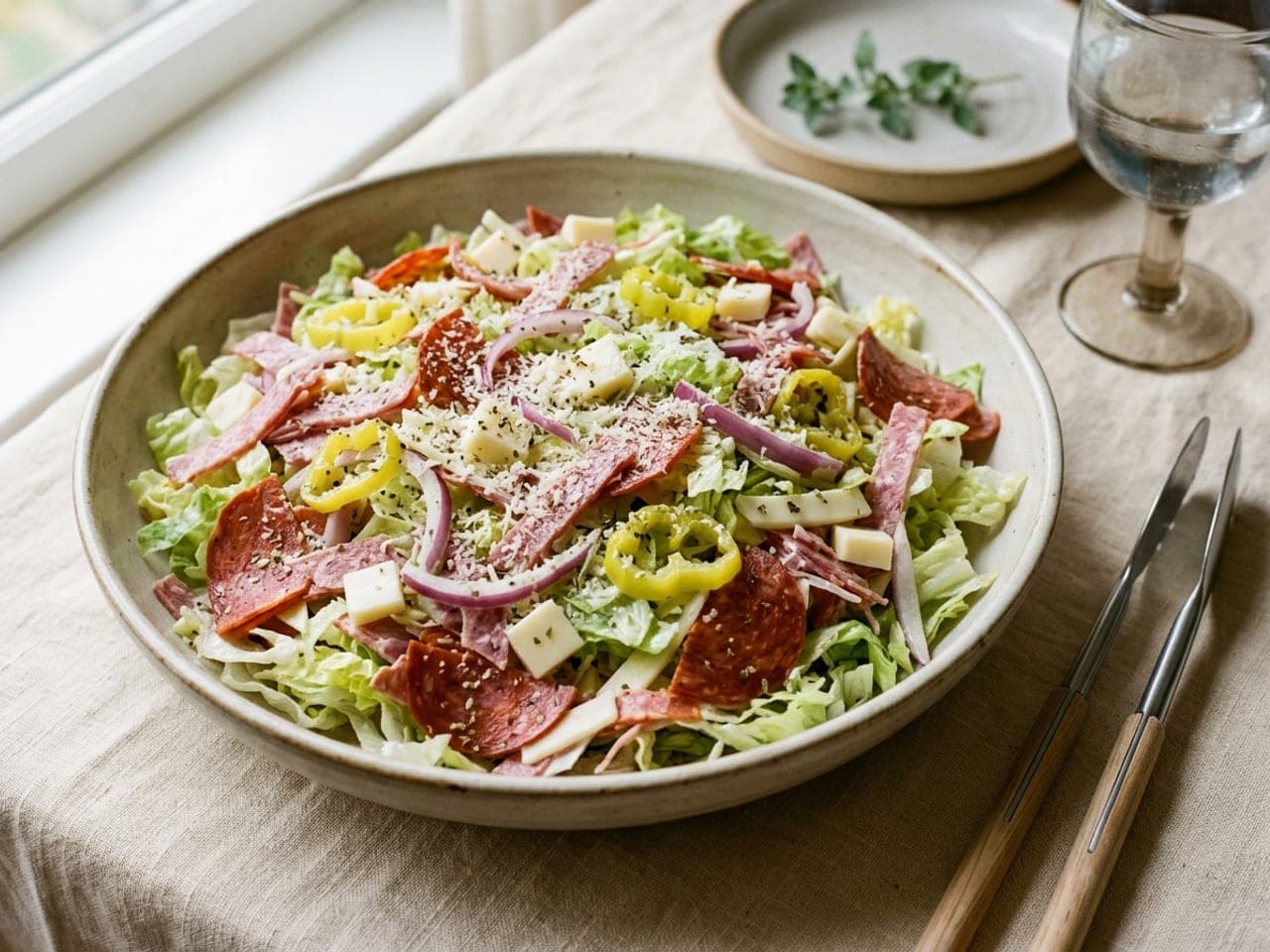
Ingredients
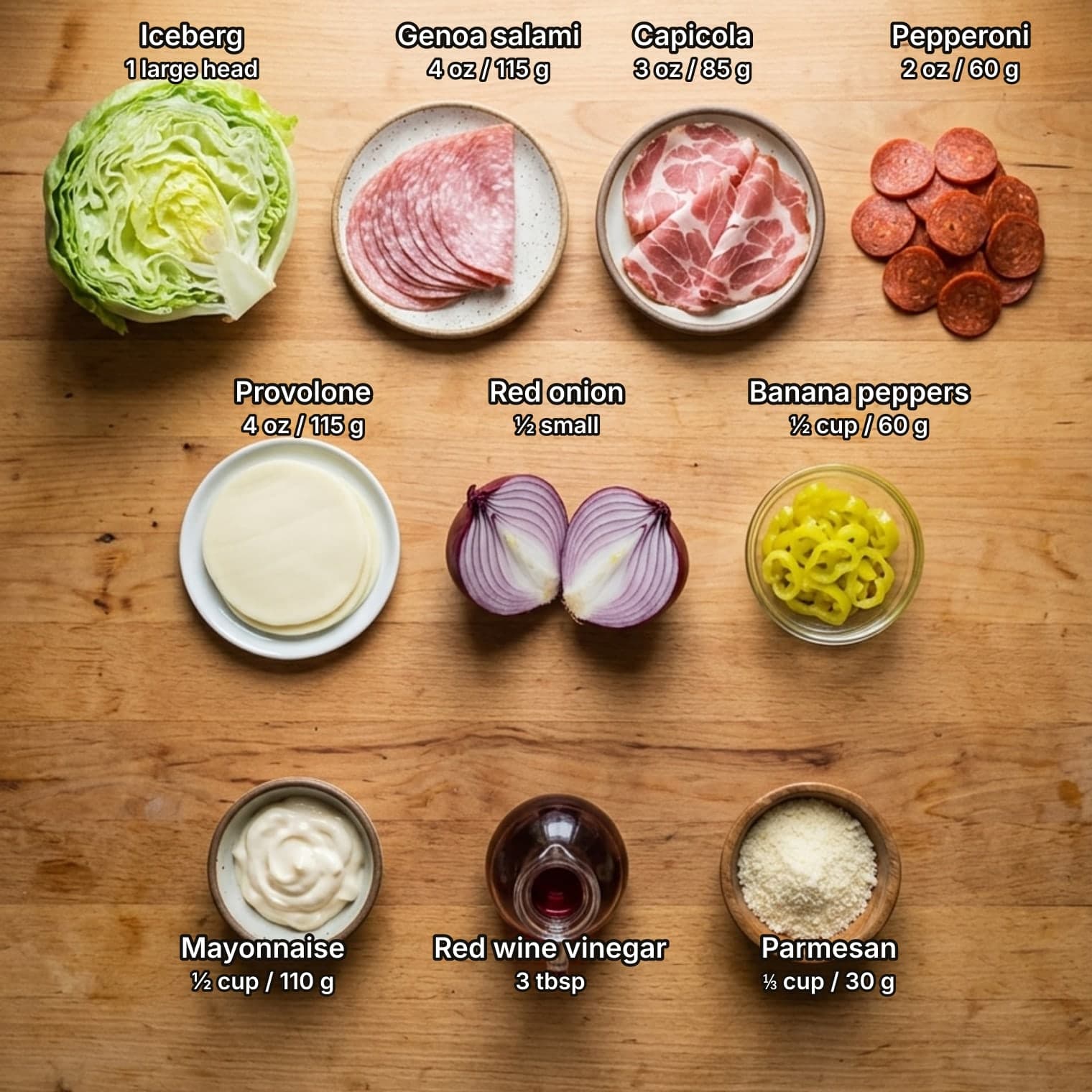
- iceberg lettuce, finely shredded and kept COLD — the structure of the dish; its rigid, high-water leaves are the crunch budget, don’t substitute soft leaves1 large head (about 8 cups / 550 g shredded)
- Genoa salami, sliced, cut into short ribbons4 oz (115 g)
- capicola (coppa), sliced, cut into short ribbons — or deli ham for a milder, leaner build3 oz (85 g)
- pepperoni, sliced, halved or quartered — swap for mortadella for the classic deli trio2 oz (60 g)
- provolone, cut into small cubes — cubes, not shreds; shredded cheese vanishes into the dressing4 oz (115 g)
- red onion, slivered thin1/2 small
- banana pepper rings, drained, 1 tbsp of their brine reserved for the dressing — or pepperoncini; different peppers, same job1/2 cup (60 g)
- cherry tomatoes, halved — optional; good in the bowl build, left out of the sandwich crown1 cup (150 g)
- mayonnaise1/2 cup (110 g)
- red wine vinegar — the classic sub acid; most bottles run 5–6% (US law sets a 4% floor, EU wine vinegar 6%)3 tbsp
- extra-virgin olive oil1 tbsp
- Parmesan, finely grated — about half into the dressing, the rest snowed over the top1/3 cup (30 g)
- dried oregano1 tsp, plus a pinch to finish
- garlic, finely grated, plus kosher salt (coarse), black pepper and optional red pepper flakes (UK: chilli flakes)1 small clove; salt and pepper to taste
Five days in March, and a salad older than its name
The grinder salad has an unusually precise birthday, and it was born wearing a sandwich. On 28 March 2022, a Richmond, Virginia creator named Gray Fultz — roughly seventy followers at the time — posted the loaded focaccia sub her boyfriend Josh Wright used to build when he ran a local restaurant: twenty-one ingredients, and riding on top of the meats and cheese, his mayonnaise-and-red-wine-vinegar iceberg salad. The video passed a hundred thousand views in two days. A week later Erica Kuiper rebuilt it on a baguette across a run of videos that pulled millions more, and by 26 May the grinder-salad tag sat at thirty-six million views, with Business Insider tracking down who actually started it — Axios Richmond profiled the couple in early June. Note what the tag the trend settled on was called: grinder SALAD, not grinder sandwich — Fultz’s own video never even carried the hashtag; the name came from her narration, and within the first week other creators had turned it into the tag. The salad was the star of the sandwich from the first video — the cold, sharp, crunchy stratum that made the melt underneath make sense — and it took almost no time for people to start ordering the crown without the building under it. The bunless bowl became the movement’s low-carb order, then a meal-prep staple, then simply a salad people make on Tuesdays. The chopped Italian sandwich, the format the algorithm fell for next, followed a full year later, in the spring of 2023.
The name is inherited, not descriptive. A “grinder” is what much of New England — Connecticut above all — calls a submarine sandwich, a regional word that has been in print since a Hartford Courant advertisement of December 1935, decades before anyone dressed iceberg with mayonnaise on a phone camera. Nothing about the salad grinds; it is simply the salad FROM the grinder, and the name rode along when the crown went solo. This site’s grinder sandwich page tells the word’s full story — the dates, the refuted shipyard legend, the cold-grinder history — and this page won’t repeat it, except to note the pleasing symmetry: a sandwich named by New England, reinvented in Virginia, that ended up donating its name to a salad.
And the salad itself is older than either video, which is the part no ranking recipe mentions. Italian-American delis and red-sauce restaurants have served essentially this assembly for generations under another name: the antipasto salad — iceberg, cured meats, provolone, pickled peppers and onion, usually under a sharp oil-and-vinegar dressing. Set the two side by side and the 2022 invention comes into focus: what Wright’s recipe actually changed was the dressing. Mayonnaise where the antipasto runs vinaigrette — creamy, clinging, Parmesan-thickened, still carrying the red wine vinegar that marks the whole tradition. That is not a diminishment; it is a good edit to a hundred-year-old dish, and knowing the ancestry tells you exactly how to judge every variant you’ll meet: the closer a “grinder salad” stays to the deli case — real cured meats, real provolone, pickled peppers, aggressive acid — the more it is the thing itself, whatever the dressing base.
How to make Italian Grinder Salad
- Shred the iceberg fine, and get it properly cold. Halve the iceberg, cut out the core, and shred it fine — quarter-inch (5 mm) ribbons, a chef’s knife rocking through a stacked wedge, not a food processor, which bruises the cut edges and starts the wilt early. One large head gives you about 8 cups (550 g) shredded, and that is not a typo: iceberg is the entire structure of this salad, and a bowl that looks over-lettuced before dressing is a bowl that eats right after it. Rinse what you’ll use under plain running water unless the bag says washed or ready-to-eat, then dry it THOROUGHLY in a salad spinner or a clean towel — every drop of rinse water left on the leaves becomes dressing you didn’t make, and water is this salad’s one real enemy. Then put the shredded lettuce in a covered bowl in the FRIDGE while you do everything else. Cold, dry, rigid leaves are what let a creamy dressing cling instead of slide, and they’re what keep the famous crunch alive from the first forkful to the last.
- Ribbon the meats, cube the provolone. Stack the salami slices, roll the stack loosely, and slice it crosswise into short ribbons about a quarter inch (5 mm) wide; do the same with the capicola (coppa), and cut the pepperoni slices in half or quarters depending on their size. Cut the provolone into small cubes, about a third of an inch (8 mm). This knife geometry is the whole trick of the dish, so spend the extra five minutes: the promise of a grinder salad is the entire Italian sub in every forkful, and that only works if every piece is small enough to share a fork with three other things. Whole deli slices draped through lettuce clump, fold and monopolise the bite — you get a forkful of salami, then a forkful of plain lettuce, which is just an antipasto plate with extra steps. Ribbons distribute. Cubes of provolone rather than shreds are deliberate too: shredded cheese vanishes into the dressing, while a cube is a discrete, squeaky bite the way a good deli case intends. Sliver the half red onion as thin as your knife allows, and drain the banana pepper rings well, reserving a tablespoon of their brine for the dressing.
- Whisk a dressing that tastes almost too sharp. In a small bowl, whisk 1/2 cup (110 g) mayonnaise with 3 tbsp red wine vinegar until smooth, then whisk in 1 tbsp extra-virgin olive oil, the reserved tablespoon of banana-pepper brine, 1 small garlic clove finely grated, about half of the grated Parmesan, 1 tsp dried oregano, a pinch of kosher salt (coarse), plenty of black pepper and — if you want the low hum of heat the original had — a pinch of red pepper flakes (UK: chilli flakes). Taste it on its own: it should read aggressively sharp and a little too salty, because it is about to season 8 cups of lettuce that bring no acid and no salt of their own, and it will be diluted the moment it hits them. Red wine vinegar is the non-negotiable — it is the acid of the Italian-American sub tradition this salad descends from, and most bottles run 5–6% acidity (US law sets a 4% floor, EU wine vinegar 6%), which is the assertiveness the job needs. The pepper brine is the deli trick worth stealing: it carries the same vinegar sharpness plus the peppers’ mild heat, and it loosens the mayonnaise to a coating consistency without watering the flavour down. Then put the dressing in the fridge and leave it alone — it does not meet the lettuce until the last five minutes.
- Stage it — this salad is better prepped than tossed ahead. If you’re eating immediately, skip to the next step. But this salad’s real superpower is how well it stages, and the rule is worth stating plainly: prep ahead, dress late. The shredded lettuce keeps a day in a covered container with a sheet of paper towel (kitchen paper) to catch stray moisture; the ribboned meats and cubed provolone keep together in a second container for 3–4 days; the slivered onion and drained peppers in a third; and the dressing keeps 3–4 days in a jar — it actually improves overnight as the oregano hydrates and the garlic mellows. If you’re adding the optional cherry tomatoes, halve them and keep them with the onions, not the lettuce. What you cannot do is toss any of it with the dressing and hold it: salt and acid start pulling water out of cut iceberg within minutes, and a grinder salad dressed an hour early arrives as a limp, weeping slaw — the single most common way this dish fails. Four containers in the fridge means a five-minute salad on a weeknight, lunch for days, or a party bowl assembled in front of your guests, and every version of it crunches.
- Toss in two stages, at the last minute. Five minutes before you eat, take everything out of the fridge. In your biggest bowl — bigger than seems polite; tossing needs room — toss the cold shredded lettuce with about two-thirds of the dressing until every ribbon is lightly glossed. Then add the meats, provolone, onion, banana peppers and the tomatoes if you’re using them, pour the rest of the dressing over, and toss again, gently, just until the heavy things are distributed and coated. Two stages matter: dress everything at once and the dense, slippery meats slide to the bottom of the bowl while the top eats like plain lettuce; coat the leaves first and they hold their gloss while the second toss folds the heavy pieces evenly through. Now taste a full forkful — lettuce, meat, cheese, pepper together — and correct: more vinegar if it reads flat, black pepper almost certainly, salt rarely (the meats, cheese and brine usually carry it there). The salad should taste bright and sharp, not creamy-bland; if it tastes politely mild in the bowl, it will taste like nothing at the table.
- Snow, scatter, and serve it NOW. Pile the salad into a wide, shallow serving bowl — shallow on purpose, because depth crushes the bottom layers and hides the good stuff — and finish with the rest of the Parmesan snowed over the top and a last pinch of dried oregano crushed between your fingers. Set it down with tongs and serve immediately: a dressed grinder salad has a happy life of about twenty minutes, and it is all downhill from there — not unsafe, just steadily less crunchy, as the salt keeps pulling water out of the iceberg. If you’re serving it as the crown on sandwiches — the job it was invented for — this is the moment: heap it straight onto the hot, cheese-melted rolls (the grinder sandwich page has the full hot build) and eat standing up if you have to. Leftover DRESSED salad does not keep worth eating; leftover components keep beautifully, which is exactly why step four exists. Build another one tomorrow.
Safety & hygiene Important
- Deli meats, listeria — and why this is the strictest page of the family. This salad is built on ready-to-eat cured meats, eaten cold, so it inherits the cold-cut rulebook with none of the escape hatches. The named risk is Listeria monocytogenes: unlike most bacteria it survives and keeps multiplying at refrigerator temperatures, and deli meats are one of its documented vehicles — the CDC’s 2024 investigation into meats sliced at delis closed with 61 people infected across 19 states and 10 deaths, which is why this rulebook gets taken seriously rather than treated as history. The CDC names four groups who need to care: people who are pregnant (listeriosis can cause miscarriage, stillbirth and premature delivery), newborns, adults 65 and over, and anyone with a weakened immune system. For those groups the standing advice is to avoid deli meats unless they have been reheated to 165°F (74°C) or until steaming hot — and here is the honest sentence this page owes its readers, because its sandwich sibling got the opposite one: a grinder salad has NO heat step anywhere, so that carve-out simply does not exist here. The grinder sandwich can at least put its meat under a broiler with a thermometer; a bowl of cold salami cannot be made pregnancy-safe by any amount of good technique. For a high-risk guest, the honest builds are a swap, not a workaround: freshly cooked chicken (cooked to 165°F / 74°C, then cooled in the fridge, not on the counter), or the cheese-forward vegetarian route — and note that the CDC flags deli-SLICED cheese for the same slicer reason it flags the meats, so that build starts with pre-packaged pasteurized provolone, not counter-cut. For everyone else, the storage windows do the work: opened packages and deli-counter-sliced meat keep 3–5 days refrigerated at 40°F (4°C) or below, unopened factory packs about two weeks, per USDA guidance — and the meat you ribbon for this salad counts as opened the day you cut it.
- The two-hour clock, and clearing mayonnaise’s name again. First, the acquittal, because this salad is exactly the dish the myth attaches to: commercial mayonnaise is not the villain of summer food poisoning — it is acidified to kill pathogens and made with pasteurized eggs, and food-safety researchers have spent years un-teaching the picnic-mayo panic. Two honest boundaries on that acquittal. Homemade mayonnaise from raw shell eggs is a genuine salmonella risk in a dressing that will never be cooked, and it is the one mayo this page rules out. And the jar’s acidity protects the jar, not your bowl: whisked with brine and stirred through low-acid lettuce, meat and cheese, it is diluted past the point of doing any preserving work. What actually governs this salad is the ordinary clock. Bacteria grow fastest between 40 and 140°F (4–60°C), doubling in as little as 20 minutes; cold food is safe held at or below 40°F (4°C), and nothing perishable should sit out longer than 2 hours, cut to 1 hour above 90°F (32°C) — a real number for a dish that gets carried to summer potlucks. The graceful version of compliance is the one the recipe already wants for texture reasons: keep the components in the fridge until the last five minutes, toss, serve, and let the bowl be empty twenty minutes later. For a buffet, set the salad bowl inside a larger bowl of ice rather than gambling on the clock, keep the dressing jarred and cold until assembly, and dress in batches instead of all at once — the second batch will be crunchier anyway. Leftovers: store the salad as PARTS, never dressed. The ribboned meats and cubed cheese keep 3–4 days at 40°F (4°C) or below, the undressed vegetables likewise, the dressing 3–4 days in its jar; a dressed leftover salad is safe in the fridge into the next day but eats like a regret, and this page won’t pretend otherwise.
- Allergens and labels — three meat labels, one slicer, and the gluten question. The obvious allergens first: milk in the provolone and the Parmesan, egg in the mayonnaise — and no wheat anywhere in the bowl build, which is part of this salad’s appeal and gets its own honest paragraph below. The quieter allergens live on labels, and this dish has the same labelling asymmetry as the rest of the family. The cheese, the mayonnaise and the jarred peppers are FDA-regulated, so a major allergen must be declared plainly. The MEATS are USDA-regulated, and there the familiar bold “Contains:” box is voluntary rather than required — FSIS accepts such statements but does not mandate them — so with the salami, capicola and pepperoni you read all three ingredient lists yourself instead of trusting a summary line. Milk and soy protein genuinely do turn up in some cured meats, and undeclared-allergen recalls in this category are routine. The celery correction, repeated here because the internet keeps getting it backwards: celery IS one of the UK FSA’s fourteen declarable allergens, but in cured meat it belongs to products labelled “Uncured,” where celery powder supplies the nitrite — traditional Genoa salami, capicola and pepperoni are cured with sodium nitrite and contain no celery at all. Sulfites are in the red wine vinegar and the jarred peppers, not the meat, and are declared above threshold in both the US and EU. Now gluten, because “grinder salad” is half a low-carb search and the answer deserves precision: as built, this bowl contains no gluten ingredient, but no-gluten-ingredients is not the same claim as certified gluten-free — cured meats and jarred peppers can carry gluten through processing or shared lines, so celiac disease means checking each label for a gluten-free claim, and the deli counter itself is the bigger issue: one slicer runs through every meat and cheese in the case, past bread-crumbed loaves included, and the honest advice from the celiac charities is pre-packaged product where the stakes are medical. The same slicer logic covers severe milk or soy allergy. And the moment you serve this salad on its ancestral sandwich — or with croutons, or garlic bread — the wheat comes back; say so to the table when you serve it, because a “gluten-free salad” with a crouton bowl beside it is how cross-contact stories start.
3 ways to plate it
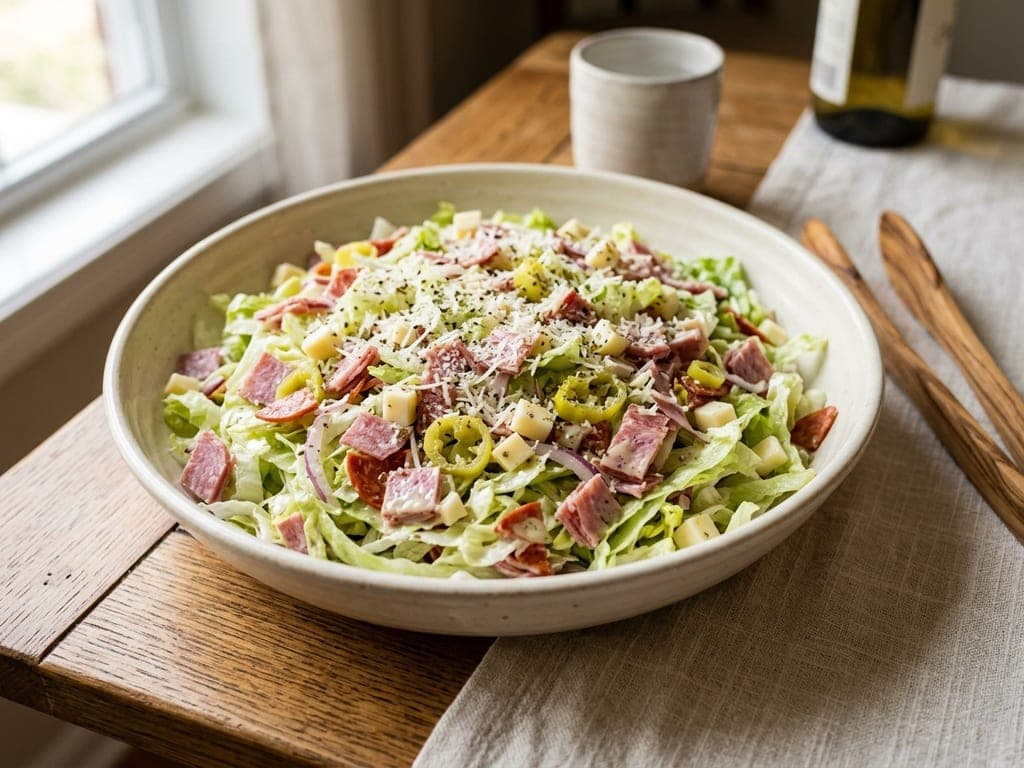
- Toss in your biggest bowl, then transfer to a wide shallow serving bowl — the tossing bowl is never the serving bowl.
- Pile the salad loosely toward the middle; don’t press it down or level it off.
- Snow the remaining Parmesan over the top and crush a pinch of dried oregano between your fingers as it falls.
- Set it down with tongs and serve within twenty minutes, while the crunch is at its peak.
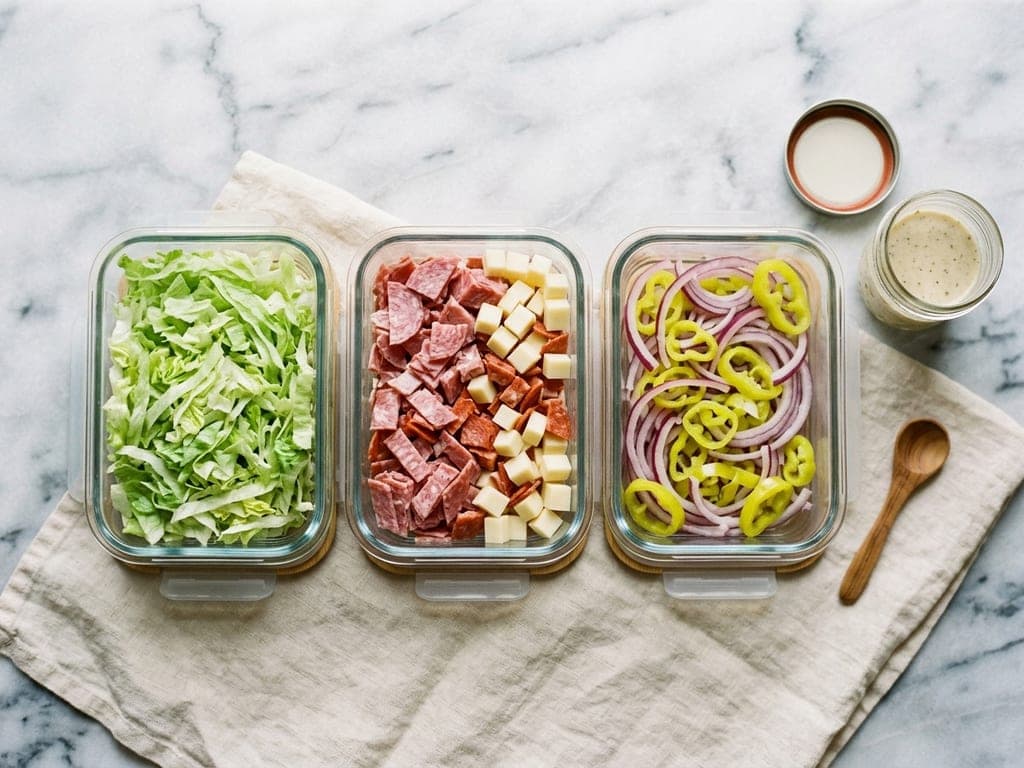
- Pack the shredded lettuce in its own container with a sheet of paper towel (kitchen paper) inside to catch stray moisture.
- Keep the ribboned meats and cubed provolone together in a second container — they keep 3–4 days.
- Give the slivered onion and drained banana peppers a third container so their moisture never sits against the leaves.
- Jar the dressing and refrigerate everything; at mealtime, toss leaves with two-thirds of the dressing, add the rest with the heavy things, and eat.
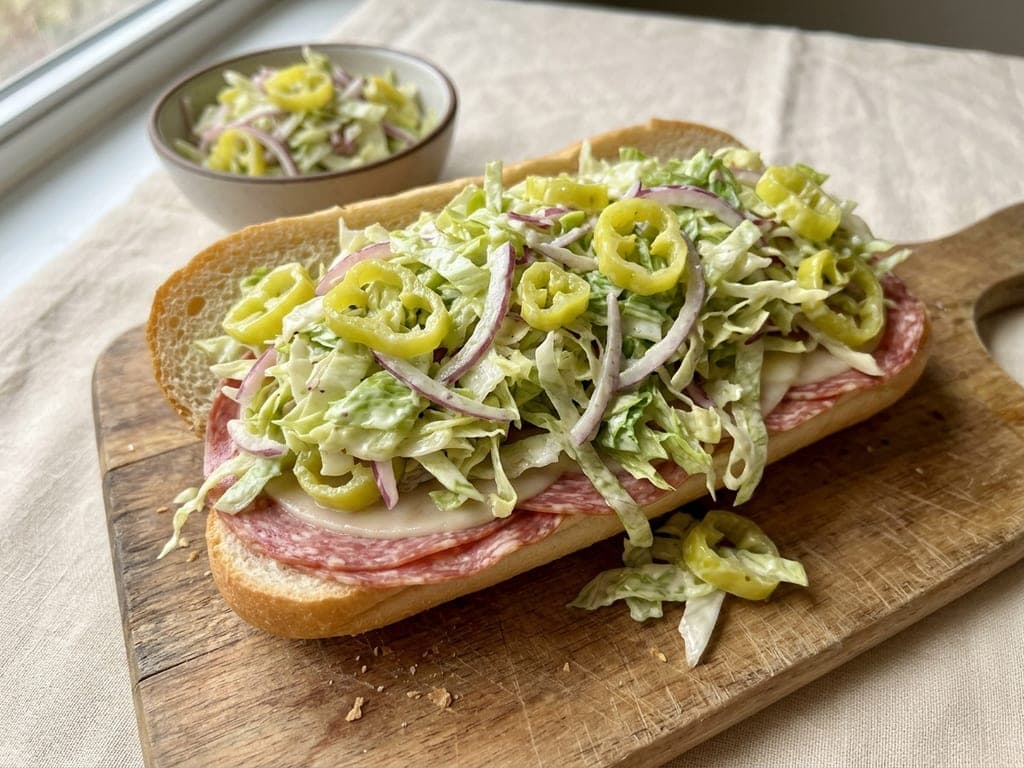
- Lay split rolls open-faced, layer with salami, capicola and provolone, and melt under the broiler per the grinder sandwich page.
- While the cheese melts, give the salad its final toss — the broiler is the timer, exactly as that recipe teaches.
- Heap the cold salad generously over the hot cheese the moment the pan comes out, letting it tumble over the sides.
- Serve on a board with the salad bowl alongside, so the table can re-crown or refill — the party trick that serves both pages.
The doctrine: cold, fine, and dressed at the last second
Every disappointing grinder salad fails in one of two ways — it is bland, or it is wet — and both failures are decided before the first toss. The blandness failure is a seasoning error dressed up as virtue: a bowl of iceberg brings no salt and no acid of its own, so a dressing that tastes polite on a spoon vanishes when it is spread across 8 cups (550 g) of lettuce. The dressing must be built to taste almost too sharp in the bowl — vinegar-forward, properly salted, black-pepper-heavy — because dilution is coming. The wetness failure is chemistry on a timer: salt and acid start pulling water out of cut iceberg within minutes of contact, and that water thins the dressing, which slides off the leaves, which is how a salad that looked glossy at the counter arrives at the table as a puddle. The fix is not a better dressing; it is a calendar. Prep everything ahead — this salad stages better than almost anything else in the deli tradition — and let dressing meet lettuce only in the final five minutes. Cold helps the same cause twice: chilled leaves are more rigid, so they shear cleanly and hold their crunch, and a cold bowl slows the osmotic clock.
The other half of the doctrine is knife geometry, and it is what separates a grinder salad from a plate of antipasto over lettuce. Everything is cut to fork scale: the lettuce in quarter-inch (5 mm) ribbons, the meats in short ribbons rather than draped slices, the provolone in small cubes rather than shreds. The promise of this dish is the entire Italian sub in every forkful — meat, cheese, pepper, onion and cold crunchy lettuce sharing one bite — and that promise is kept or broken on the cutting board. Whole slices clump and monopolise; shredded cheese dissolves into the dressing and disappears; big wedges of anything turn the salad back into a composed plate you eat in courses. Small, distinct, evenly distributed pieces are the point. It is the same insight the chopped Italian sandwich rode to fame a year later — the chop IS the recipe — applied one geometry earlier, to the bowl the sandwich was already wearing.
Two refinements from the deli case finish the doctrine. First, the brine: a tablespoon of the banana peppers’ jar liquid whisked into the dressing carries vinegar sharpness, a little sweetness and the peppers’ mild heat, and it loosens the mayonnaise to the consistency that coats a ribbon of lettuce instead of clotting on it — the trick half the good delis use and almost no recipe writes down. Second, the two-stage toss: leaves first with most of the dressing, heavy things second with the rest. Dense, slippery meats and cheese sink through a one-shot toss and leave the top of the bowl underdressed and the bottom overloaded; coating the leaves first and folding the heavy pieces through second is thirty extra seconds that makes every serving the same serving.
Bowl, crown, or chopped — and the honest numbers
One family, three geometries, and this page is the bunless one. The GRINDER SANDWICH keeps the sub intact: meats and provolone layered on a toasted roll, melted under the broiler (the overhead grill), with this salad piled cold on top — hot below, cold above, eaten immediately. The CHOPPED ITALIAN abolishes the layers: everything chopped together into one dressed confetti and packed cold into an untoasted roll, the travel-proof picnic build. The GRINDER SALAD is the crown by itself, and it is both the movement’s low-carb order and, historically, the senior partner — the salad is what made the sandwich famous, not the other way round. Both sandwich pages live on this site, and the crown you build here is exactly the crown they call for: heap it over hot melted provolone on a toasted roll and you have converted this recipe into that one, which is the family’s best party trick. Serve the salad in its bowl with a sheet pan of open-faced, cheese-melted rolls beside it and let everyone choose their own geometry.
Now the numbers, because “is grinder salad healthy?” sits in the search box for a reason and the pages answering it wave their hands. As built here, a main-course serving — a quarter of the bowl — runs about 620 calories: roughly 240 from the cured meats, 100 from the provolone, 250 from the dressing’s share of mayonnaise, olive oil and Parmesan, and about 30 from the vegetables. It is also, honestly, a salty dish: the meats, cheese, brined peppers and dressing land a serving around 1,600–1,800 mg of sodium, which is most of the 2,300 mg the US Dietary Guidelines suggest for a whole day. That is what charcuterie in a bowl costs, and it is fine — as a meal, not as a side salad you add to a meal. The genuine nutritional case for it is the carbohydrate column: with no bread, the bowl build carries only about 5 g of net carbs per serving (call it 6 with the optional tomatoes), which is why the low-carb and keto communities adopted it as a house dish. The levers, if you want them lighter, are real: halve the meats and lean on the peppers and onion (saves ~120 calories and a third of the sodium), cut the mayonnaise half-and-half with plain Greek yogurt (saves ~90 calories and adds tang — a legitimate variant, not a compromise, though the dressing gets looser and should be used the same day), and go heavier on the lettuce, which costs nothing and dilutes everything.
The variants you will meet elsewhere, graded from the ancestry: the Greek-yogurt dressing cut, covered above, is faithful in spirit — the acid still leads. Cherry tomatoes are a genuinely good addition to the BOWL build (halve them, add with the heavy things), and this page lists them as optional; they stay out of the sandwich crown, where their water has nowhere to go but the bread. Shaved Brussels sprouts as a partial lettuce swap — the twist the current #1 result rides — is a real texture upgrade for meal prep, because sprouts don’t weep on the clock iceberg does; it also moves the flavour noticeably away from the deli case toward a slaw, so grade it a fork, not an upgrade. Chickpeas make the best vegetarian protein here, with the cheese doubled and a few extra peppers; and if you see “grinder salad” with grilled chicken, croutons and ranch — that is a perfectly nice chicken salad wearing a trending name, and now you know exactly why it isn’t this dish.
Questions, answered
What is a grinder salad?
A grinder salad is the cold, creamy-sharp iceberg salad that rides on top of a grinder — the New England name for an Italian submarine sandwich — served as a dish in its own right, without the bread. The canonical build is finely shredded iceberg lettuce, ribbons of Italian cured meats (Genoa salami, capicola, pepperoni), cubes of provolone, pickled banana pepper rings and slivered red onion, all tossed at the last minute in a dressing of mayonnaise, red wine vinegar, olive oil, grated Parmesan, garlic and dried oregano. It went viral in spring 2022 as the crown of a TikTok grinder sandwich from Richmond, Virginia, and the bunless bowl quickly became its own dish — the low-carb order of the trend, and functionally a creamy-dressed cousin of the Italian-American antipasto salad delis have served for generations. Eaten as a main it serves four generously; as a sandwich topping it crowns four to six grinders.
What is in the grinder salad?
Seven things do the work, plus a dressing. The base: one large head of iceberg lettuce, shredded fine — about 8 cups (550 g). The deli layer: 4 oz (115 g) Genoa salami, 3 oz (85 g) capicola and 2 oz (60 g) pepperoni, all cut into short ribbons, plus 4 oz (115 g) provolone in small cubes. The bite: 1/2 cup (60 g) pickled banana pepper rings and half a small red onion, slivered thin; cherry tomatoes are a good optional add in the bowl version. The dressing: 1/2 cup (110 g) mayonnaise, 3 tbsp red wine vinegar, 1 tbsp olive oil, a spoonful of the banana-pepper brine, a grated garlic clove, grated Parmesan, dried oregano, black pepper and a pinch of red pepper flakes (UK: chilli flakes). More Parmesan goes over the top at the table. What is deliberately NOT in it: bread, croutons, and anything that needs cooking — the entire dish is knife work and a whisk.
Why do they call it a grinder salad?
Because it is the salad from a grinder — nothing in it is ground. “Grinder” is what much of New England, Connecticut especially, calls a submarine sandwich; the word has been in print since a Hartford Courant advertisement of December 1935, and the full story of where it came from (including the submarine-shipyard legend the dates refute) lives on this site’s grinder sandwich page. The viral 2022 sandwich that started the trend was built in that tradition and named accordingly, and its signature element — the cold mayonnaise-and-red-wine-vinegar iceberg salad piled on top of the melted cheese — was so clearly the star that the tag the trend formed around within the first week was #grindersalad — named for the salad, not the sandwich, and not even used on the original video. When people began eating the crown on its own, bunless, the name simply came along. So the chain is: New England names the sandwich, Virginia reinvents it on TikTok, and the salad inherits the word from the sandwich it used to sit on.
What is the best dressing for grinder salad?
Mayonnaise sharpened hard with red wine vinegar — that combination IS the grinder salad, and losing either half loses the dish. This page’s formula, enough for one large head of iceberg: 1/2 cup (110 g) mayonnaise, 3 tbsp red wine vinegar, 1 tbsp extra-virgin olive oil, 1 tbsp brine from the banana pepper jar, 1 small garlic clove finely grated, 2–3 tbsp finely grated Parmesan, 1 tsp dried oregano, plenty of black pepper, a pinch of coarse salt and an optional pinch of red pepper flakes. Three rules make it work. First, it should taste slightly too sharp and too seasoned on a spoon, because 8 cups (550 g) of unseasoned lettuce are about to dilute it. Second, red wine vinegar specifically — it is the acid of the Italian-American sub tradition, and most bottles run 5–6% acidity, assertive enough to survive mayonnaise. Third, the pepper brine is the deli trick: sharpness, mild heat, and it loosens the dressing to coating consistency without watering down flavour. Worthwhile variant: cut the mayonnaise half-and-half with plain Greek yogurt for a lighter, tangier dressing — use it the same day, as it loosens faster. The dressing keeps 3–4 days in a jar in the fridge and improves overnight.
Is grinder salad healthy?
It is charcuterie in a bowl, and the honest answer follows from that. As built here, a main-course serving runs about 620 calories — roughly 240 from cured meats, 100 from provolone, 250 from the mayonnaise-based dressing’s share, 30 from vegetables — and around 1,600–1,800 mg of sodium, which is most of the 2,300 mg the US Dietary Guidelines suggest for an entire day. So: as a complete meal, it is a reasonable and very satisfying dinner; as a side salad next to a sandwich, it is a sodium event. Its genuine nutritional strength is the carbohydrate column — about 5 g net carbs per serving with no bread anywhere — which is why low-carb and keto eaters adopted it. The levers if you want it lighter are real: halve the meats (−120 kcal and a third of the sodium), cut the mayo with plain Greek yogurt (−90 kcal), skip the Parmesan snow, and let lettuce dilute the rest. What it is not, whatever the algorithm implies, is a light green salad — the lettuce is the delivery system, not the payload.
Is grinder salad keto and gluten-free?
Keto, comfortably: the bowl build as written lands around 5 g net carbs per serving — the lettuce, onion and peppers carry almost all of it — with fat from the meats, cheese and mayonnaise doing the caloric work, which is exactly the macro shape the keto community wants and why this salad became one of its house dishes. Add the optional tomatoes and it is still only about 6 g. Gluten-free needs the more careful sentence: the bowl contains no gluten ingredient, but for celiac disease that is not the same as certified gluten-free. Cured meats and jarred peppers occasionally pick up gluten via processing or shared lines, so check each label for an explicit gluten-free claim — and the deli counter is the bigger risk, because one slicer runs through every product in the case; buy pre-packaged meats and cheese where the stakes are medical. And obviously the moment the salad goes back on its sandwich, or gets croutons, the wheat returns — the gluten-free claim belongs to the bowl, not the family.
Can I make grinder salad ahead of time?
Yes — in parts, never assembled. This is the house rule the texture depends on: prep ahead, dress late. Shredded iceberg keeps a day in a covered container with a paper towel (kitchen paper) inside to catch moisture; the ribboned meats and cubed provolone keep 3–4 days in a second container; slivered onion, drained peppers and optional halved tomatoes in a third; and the dressing keeps 3–4 days in a jar and genuinely improves overnight as the oregano hydrates. Assembled from cold parts, the salad takes five minutes. What does not survive is a DRESSED salad: salt and acid pull water out of cut iceberg within minutes, so a bowl tossed an hour ahead arrives limp and weeping, and a day-old dressed leftover is safe but sad. For a party, stage the containers in the fridge and toss in front of people; for meal prep, portion the parts into per-lunch containers and carry the dressing in a little jar on the side — the desk-lunch version of this salad, dressed at 12:29, is better than most restaurants’ version, and that is entirely because of when the dressing went on.
What is the difference between a grinder salad, a grinder, and a chopped Italian sandwich?
Same deli DNA, three geometries. A GRINDER (this site has the full recipe) is the hot sandwich: meats and provolone LAYERED on a toasted roll, melted under the broiler, then crowned with this salad, cold — eaten immediately, hot and cold in one bite. A CHOPPED ITALIAN (also on this site) is the cold, travel-proof one: meats, cheese and vegetables all chopped together into one dressed confetti and packed into an untoasted roll — wrapped, rested and portable. A GRINDER SALAD is the crown served bunless in a bowl — the low-carb order, and historically the senior member: the salad is what went viral in March 2022, riding on the sandwich, and the chopped format followed a year later. The practical rule of thumb: eating now with something hot, build the grinder; eating later or outdoors, build the chopped; eating without bread — or feeding people who each want a different answer — make this salad and put a pan of hot cheese-melted rolls next to it.
Why did my grinder salad get watery?
Because dressing met iceberg too early — it is chemistry, not a quality problem with your ingredients. Salt and acid on the cut surface of lettuce pull water out osmotically within minutes; that water thins the mayonnaise, the thinned dressing slides off the leaves and pools, and the leaves, having given up their water, go limp. Three habits fix it permanently. Dress at the last minute — five minutes before eating, not thirty. Dry the lettuce completely after rinsing (a salad spinner is the honest answer); rinse water on the leaves is a head start on the puddle. And keep everything COLD until the toss — warmth accelerates the whole process. Salvage, if it has already happened: pour off the pooled liquid, add a fresh handful of dry shredded lettuce and a spoonful of undiluted dressing, toss and serve immediately — it will be decent, not great. Note that the pre-dressed clock is the one thing the Brussels-sprout variant genuinely improves: shaved sprouts barely weep, which is why they show up in meal-prep versions. Iceberg still wins the argument at the table; sprouts win it in a Tuesday lunchbox.
Can I use romaine or another lettuce instead of iceberg?
You can, with your eyes open: iceberg is a structural choice here, not a budget one. Its tight, rigid, high-water leaves shear into ribbons that stay springy under a creamy dressing — the crunch IS the dish’s argument, and no other common lettuce holds it as long. Romaine is the acceptable substitute: use hearts only, slice them fine, and expect a leafier, slightly bitter salad that softens a little sooner. Half iceberg, half romaine hearts is a genuinely good compromise if all-iceberg feels austere. Shaved Brussels sprouts, the current fashion, trade the deli-case character toward a slaw but hold up far better dressed ahead — the right call for meal prep, the wrong one for the table. What does not work: soft lettuces (butter, spring mix, baby spinach) collapse under mayonnaise in minutes and turn the bowl into compost with salami in it; and kale, even massaged, fights the dressing instead of carrying it. If you can’t or won’t do iceberg, romaine hearts; if you’re prepping for Thursday, sprouts; otherwise, trust the boring lettuce — this is the dish it was born for.
What meats go in a grinder salad, and what are the swaps?
The classic trio is the Italian-American deli case in miniature: Genoa salami (the backbone — fatty, garlicky, wine-scented), capicola (coppa — silky, spiced pork shoulder), and pepperoni (the heat and the chew). This page runs them 4 oz / 3 oz / 2 oz (115/85/60 g) so no single meat dominates a forkful. Good swaps, graded: mortadella for the pepperoni is the smoothest upgrade — it completes the classic deli trio both sandwich pages recommend as the deli-counter upgrade; plain deli ham for the capicola gives a milder, leaner salad the way it does on a grinder; hot capicola or hot soppressata swap in for genuine heat; and turkey-based versions of all three exist and behave, at some cost in character. Leftover rotisserie or grilled chicken makes it a different (perfectly nice) salad — see the healthy-question answer for why that is really a chicken salad wearing the name. Vegetarian: skip the meats, double the provolone, add a can of drained chickpeas and a few extra banana peppers — the dressing and the pickled things carry the deli identity surprisingly far. Whatever you choose, cut it to ribbons, not draped slices; the knife geometry matters more than the brand.
Snap your finished plate and let the AI plate it again — more beautifully.