Chopped Italian Sandwich Recipe (Viral, No-Cook, 30 Minutes)
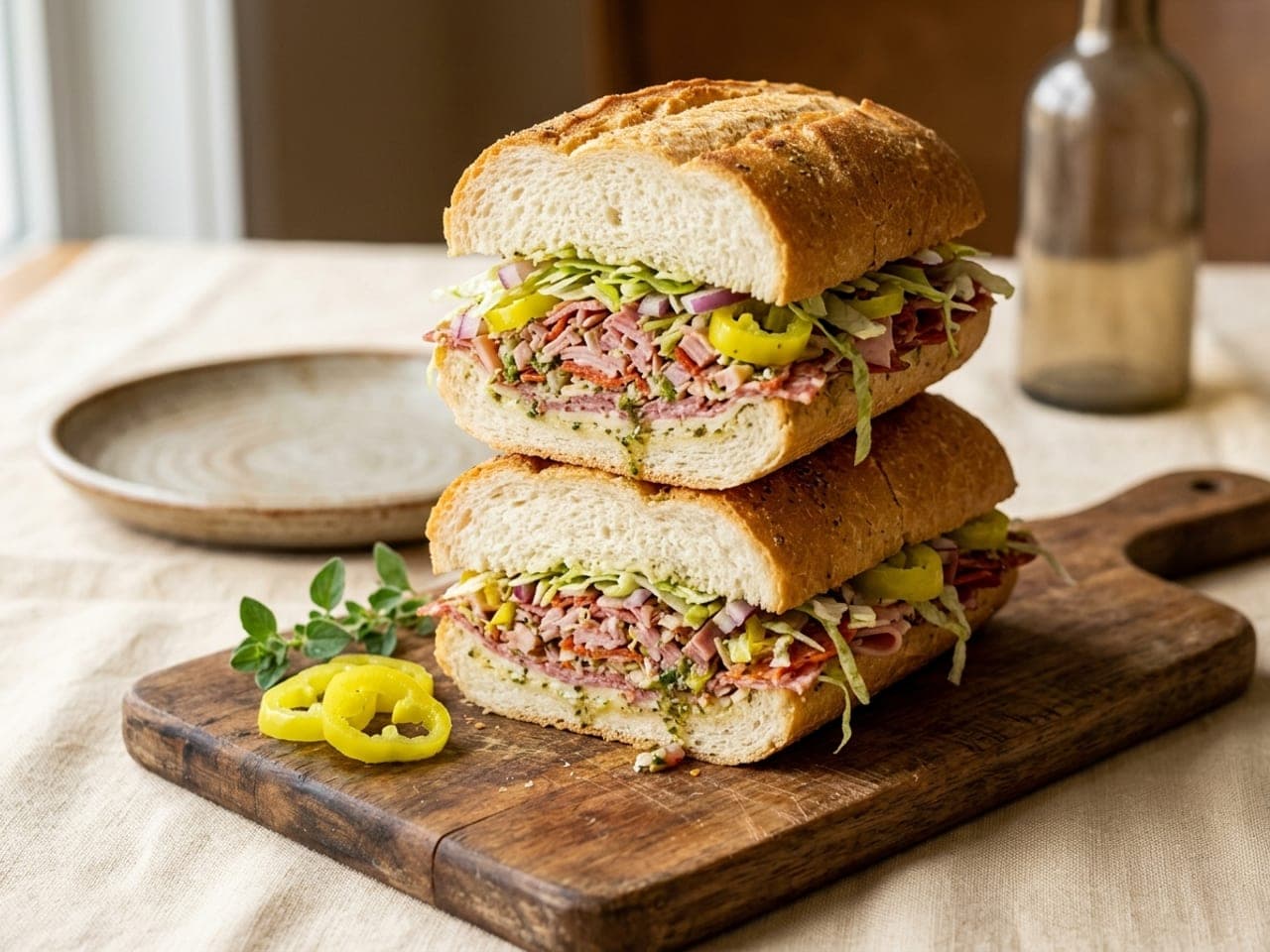
The viral no-cook sandwich, engineered so it doesn’t turn to mush: salami, ham, pepperoni and provolone chopped to confetti, lettuce left in ribbons, everything dressed on the board it was chopped on. With the origin story dated and sourced, an honest calorie count, and a straight answer to what separates a chopped Italian from a grinder.
Ingredients
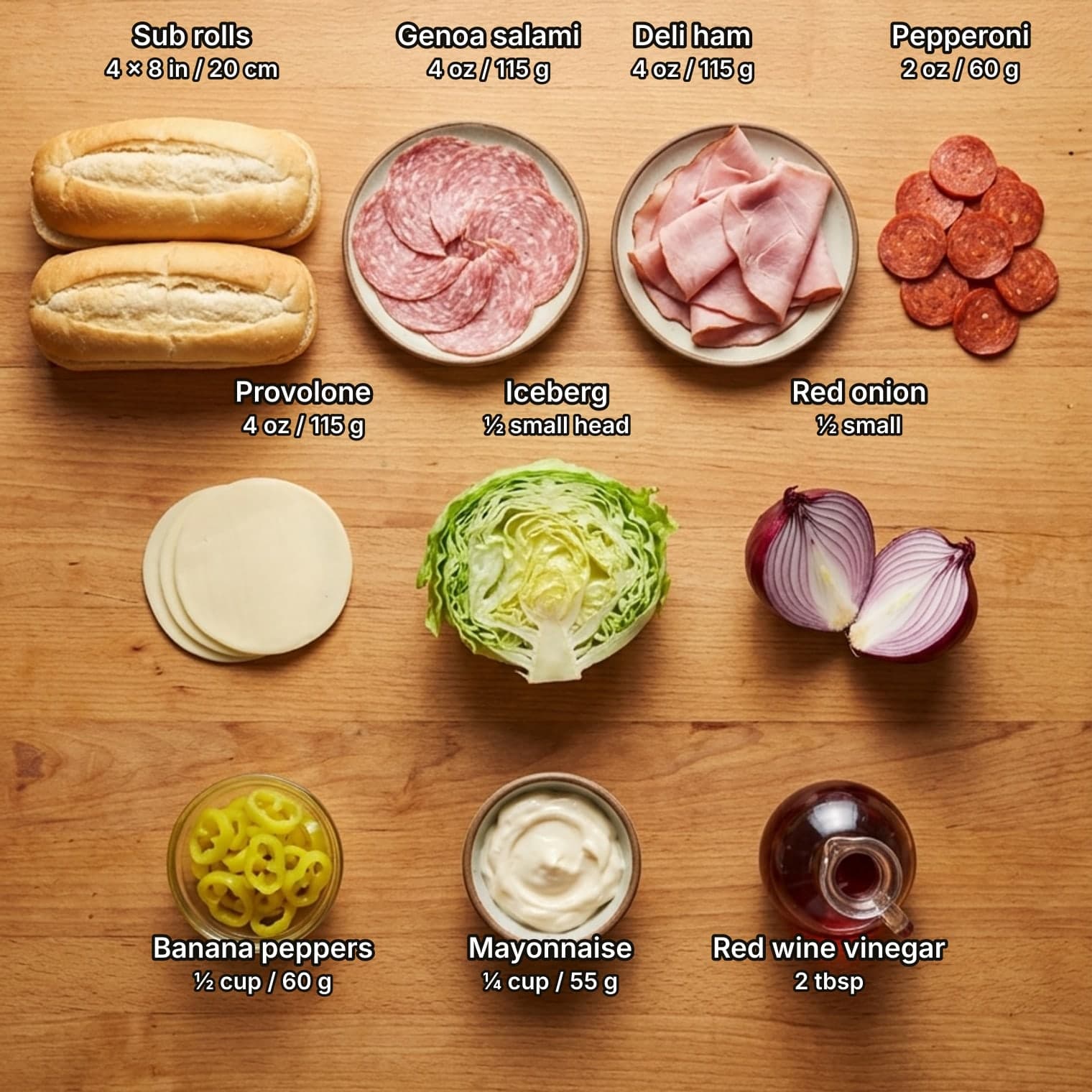
- soft Italian-style sub rolls, 8-inch (20 cm), thin tender crust, no seeds — hoagie/grinder rolls; the bread ruling (and the ciabatta warning) is in the FAQ4
- Genoa salami, thinly sliced4 oz (115 g)
- deli ham, thinly sliced — or swap half for mortadella for the classic deli build (see sections)4 oz (115 g)
- pepperoni, thinly sliced — the everyday-counter pick; capicola is the classic-trio swap2 oz (60 g)
- provolone, sliced — the canonical sub cheese; low-moisture mozzarella seconds4 oz (115 g)
- iceberg lettuce, shredded — the crunch budget; its rigid layered leaves are structural, don't substitute soft leaves1/2 small head (about 3 cups / 200 g)
- red onion, finely chopped1/2 small
- banana pepper rings, drained — or pepperoncini; different peppers, same job (see FAQ)1/2 cup (60 g)
- roma (plum) tomato, halved, SEEDED, diced — optional; the seed jelly is the wettest thing in the building1
- mayonnaise1/4 cup (55 g)
- red wine vinegar — the classic sub acid; most bottles run 5–6% (US law sets a 4% floor, EU wine vinegar 6%)2 tbsp
- extra-virgin olive oil2 tbsp
- dried oregano1 tsp
- kosher salt (coarse), black pepper, and optional red pepper flakes (UK: chilli flakes)to taste
Born on a cutting board: the actual, dated history
The chopped Italian sandwich has a traceable birthday, which is rare for a viral dish and worth writing down properly. The lineage starts a year before the sandwich itself, with a salad: in late March 2022, a Richmond, Virginia creator named Gray Fultz — about seventy followers at the time — posted the 21-ingredient sandwich her boyfriend had built back when he ran a restaurant: toasted focaccia stacked with meats and cheeses, crowned with his mayo-and-red-wine-vinegar iceberg “grinder salad.” The video pulled six figures of views inside two days, then detonated when a bigger creator, Erica Kuiper, ran with the idea (on a baguette) in early April; by that May the grinder-salad tag had racked up tens of millions of views, and Business Insider had interviewed Fultz to establish who started it — Axios Richmond profiled the couple in early June. That was the internet learning that the salad ON a sandwich could be the star.
The chop came the following spring. The version everyone now makes — every filling chopped together on a cutting board, then loaded into the roll — is widely credited to the barbecue account Big Eric’s BBQ, whose chopped Italian video posted March 19, 2023 and pulled hundreds of thousands of likes and got the format written up by Tasting Table, PopSugar and Taste of Home within months; Tasting Table’s description is still the best one-line definition the dish has: an antipasto salad in a hoagie bun. The attribution isn’t entirely settled, and this page won’t pretend it is — the barbecue creator NinjaCue published one of the first properly measured recipes and is credited as the source by some of the recipe sites that rank for this dish today — but the dated, documented viral moment belongs to Big Eric’s, and the format conquered delis, chain-sub copycats and home boards from there. (New Yorkers will note the bodega chopped cheese got there decades earlier with a griddled beef sandwich built on the same insight; it’s a different dish with its own history, and it deserves better than being footnoted as a trend ancestor.)
Why did a chopping technique go viral twice in two years? Because it fixes the layered sub’s oldest engineering flaw. In a stacked sandwich the first bite is all bread, the third is all salami, and somewhere in the middle a full slice of ham slides out as a sheet and takes half the filling with it. Chopping is even distribution: every bite of a chopped Italian is the whole sandwich in miniature — a little salami, a little provolone, a little pickled pepper, all dressed — and nothing can slide because nothing is a sheet anymore. That’s also why the format films so well, which is the less romantic half of the answer: a knife working through a rainbow of deli meats, and a cut face like terrazzo, is simply better video than layering cold cuts. The dish is honest about being both things — a genuine improvement and a camera-native one.
How to make Chopped Italian Sandwich
- Whisk the dressing first — it needs five minutes to become itself. In a small bowl, whisk 1/4 cup (55 g) mayonnaise with 2 tbsp red wine vinegar until smooth, then stream in 2 tbsp extra-virgin olive oil, whisking, and add 1 tsp dried oregano, a pinch of kosher salt (coarse), a generous grind of black pepper and — if your table likes a hum of heat — a pinch of red pepper flakes (UK: chilli flakes). This is a deliberate hybrid, and the reasoning is on the page below: the internet’s chopped sandwiches split into a mayo camp and a vinaigrette camp, and the mayo-plus-vinegar middle path clings to chopped meat the way a vinaigrette can’t while cutting the deli-meat richness the way plain mayo won’t. Set it aside while you chop — those five minutes let the oregano wake up in the acid. Taste before it goes anywhere near the board: it should read slightly too sharp on its own, because it’s about to season ten ounces (285 g) of meat and a mountain of lettuce that bring no acid of their own.
- Prep the rolls — hollow the tops, and hold the toast question. Split the 4 sub rolls lengthwise without cutting all the way through — a hinge keeps the filling in later. With your fingers, pull a shallow trench of crumb out of the TOP half of each roll and save it for breadcrumbs: a chopped filling is loose, and that hollow is the difference between a sandwich that closes and one that sheds confetti from the first bite. You want a soft Italian-style roll with a thin, tender crust here, not a hard artisan baguette — the filling has no structural slices to hold it together, so the bread has to do the gripping, and a shattery crust squeezes loose filling out the sides (the full bread ruling, with the ciabatta warning, lives in the FAQ). Toasting is a fork in the road, not a default: eating now, keep the rolls untoasted and soft, the way the delis that inspired this format serve theirs. Packing the sandwiches to travel, toast the split faces lightly and then paint them edge to edge with a thin coat of mayonnaise once cool — the fat is a moisture barrier, and it buys a dressed filling a couple of hours before the bread notices.
- Stack the meats and cheese, then chop — stage one of two. Lay the salami, ham, pepperoni and provolone in a flat stack on the largest cutting board you own — this dish was born on a cutting board and the board is genuinely the right tool, so give it room. Now chop with intent: work the knife across the stack in close parallel cuts, turn the board a quarter, and cross-chop until the pile is an even confetti of pea-sized pieces — small enough that every piece carries salami AND cheese in one bite, big enough that each still tastes like itself. Stop there. This two-stage chop — meats and cheese to confetti FIRST, vegetables coarser and SECOND — is the page’s core doctrine, and it exists because the trend’s loudest critique is correct: chef Andrew Zimmern complained publicly that the viral videos hack everything together until the texture is gone, and if you chop lettuce as long as you chop salami, he’s describing your lunch. The fix isn’t abandoning the chop; it’s staging it. Dense things get chopped fine; crisp things get chopped briefly; nothing gets minced into paste.
- Add the vegetables and chop briefly — stage two, coarser on purpose. First, the unglamorous step a no-cook sandwich makes mandatory: strip the iceberg’s outer leaves, rinse what you’ll use under plain running water and dry it THOROUGHLY (bagged greens labelled washed or ready-to-eat skip the rinse), and rinse the tomato before it meets a knife — cutting drags whatever rides on the skin straight through the flesh, and this filling will never see heat. The drying earns its capitals twice: wet lettuce is a food-safety courtesy done badly, and it’s also the fastest way to violate this page’s whole anti-sog doctrine. Then pile the shredded iceberg, the chopped red onion, the drained banana pepper rings and — if you’re using it — the seeded, diced tomato on top of the meat confetti. Now chop just enough to marry them: a dozen relaxed passes, turning the board once, until the vegetables are cut into the mix but the lettuce still shows ribbons a half-inch (1.3 cm) wide. The lettuce is the entire crunch budget of this sandwich, and iceberg earns its place through structure: its leaves are layered and rigid and stay crisp under weight where softer leaves collapse. Seeding the tomato isn’t fussiness — the seed jelly is the wettest thing in the building, and a chopped filling has a hundred times the exposed surface of a layered one, so water finds everything fast. If your tomato is a watery specimen, this is a sandwich that loses nothing when you leave it out; the banana peppers are already carrying the bright, pickled end of the flavor.
- Dress on the board and fold — the board is the bowl. Drizzle about three-quarters of the dressing over the chopped pile and fold it together with the flat of the knife or a bench scraper (UK: dough scraper) — scoop under, fold over, turn the board, repeat five or six times, like folding a batter, until every piece is glossed but nothing is swimming. Dressing goes on LAST and on the BOARD, and the order is the point: salt and acid pull water out of cut lettuce on contact, so a filling dressed even ten minutes early starts weeping into a puddle that the bread will find. Taste a forkful now — this is the whole sandwich in miniature, and the moment to fix it: flat usually means it wants the rest of the vinegar-sharp dressing or a pinch of salt; too sharp means a drizzle more olive oil. It should taste like the best bite of an Italian sub, distributed. If the pile sits more than a few minutes while you deal with bread, tilt the board and let any pooled dressing run off before packing.
- Pack the rolls with the bench scraper — generous, not architectural. Slide the bench scraper under a quarter of the filling and load it into a roll, pressing it gently into the hollowed top as you close — the scraper matters, because a chopped filling picked up by hand or tongs sheds its smallest, best-dressed pieces back onto the board. Mound each roll a little past what looks sensible: the filling compresses when the sandwich is closed and again when it’s wrapped, and a chopped Italian that isn’t generous at the cut face has missed the entire photogenic point of the format. Even so, resist the tallest possible mountain — the format’s honest advantage over a layered sub is that NOTHING can slide out as a sheet, no full slice of salami pulling free in one bite, but that only holds if the bread’s hinge stays intact. Four rolls, four passes of the scraper, and whatever confetti is left on the board goes proudly onto the last one.
- Wrap tight, rest ten minutes, cut through the paper. Wrap each sandwich tightly in parchment or deli paper — snug against the bread, ends twisted or folded under — and let them sit 10 minutes before cutting. This is the deli move the viral videos got exactly right, and it’s doing real work: the gentle compression fuses the loose filling and the soft crumb into one sliceable thing, the dressing finishes seasoning every surface it touches, and the sandwich stops being a pile and becomes a unit. Then cut straight through the paper with a serrated knife, one confident saw per sandwich — the paper holds the cross-section together as the knife passes, which is why every good deli cuts this way and why the cut face comes out looking like the photo instead of an avalanche. Eat within the hour for the ideal crunch window; the make-ahead schedule, the picnic rules and the honest limits of a dressed sandwich all live in the FAQ and safety notes below.
Safety & hygiene Important
- Deli meats and the pregnant guest — the cold-cut briefing. This is a cold sandwich built on ready-to-eat deli meats, so it inherits the cold-cut rulebook whole. The named risk is Listeria monocytogenes: unlike most bacteria it keeps growing at fridge temperatures, and deli meats are one of its documented vehicles — the CDC ran a major deli-meat listeriosis investigation in 2024, and closed its most recent listeriosis investigation (prepared meals, different vehicle) in early 2026; this rulebook is not historical. Who actually needs to care: pregnant women (listeriosis can cause miscarriage, stillbirth, premature delivery and life-threatening infection in the newborn), adults 65 and over, and anyone immunocompromised. For those groups, the CDC and FDA advice is blunt — skip deli meats, or eat them only heated to 165°F (74°C), steaming hot, just before serving. A chopped Italian is served cold, so the honest options for a high-risk guest are a hot sandwich served steaming hot or sitting this one out; there is no cold workaround, and this page won’t invent one. For everyone else, the storage windows do the protecting: opened packages and fresh deli-counter meat keep 3–5 days refrigerated at 40°F (4°C) or below (unopened factory packs, about 2 weeks) — per USDA guidance — and chopping doesn’t extend the clock of the oldest meat on the board; it inherits it, and cutting shortens it, because every fresh-cut surface is new territory for board, knife and hands. Buy freshly sliced (counter meat is already a day into its own window when you carry it home), keep it cold, chop close to eating, and build this sandwich inside the window.
- The two-hour clock, the picnic cooler, and the mayo that was framed. First, clear mayonnaise’s name, because this sandwich travels to picnics and the myth travels with it: commercial mayonnaise is not the villain of summer food poisoning — it’s acidified with vinegar or lemon juice and made with pasteurized eggs, and food-safety educators have been un-teaching this one for years. One honest boundary on the acquittal: it covers the commercial jar (and homemade made with pasteurized eggs) — homemade mayonnaise from raw shell eggs is a genuine salmonella risk in a dressing that will never be cooked, and it’s the one mayo this page rules out. The real story is temperature, and it governs the whole sandwich: the danger zone is 40–140°F (4–60°C), bacteria on perishable food can double in as little as 20 minutes there, and USDA’s rule for anything perishable — these sandwiches very much included — is a maximum of 2 hours at room temperature, cut to 1 hour when it’s above 90°F (32°C) outdoors. For a picnic or a packed lunch, that means an insulated cooler with ice packs holding everything at 40°F (4°C) or below, sandwiches wrapped and eaten within the window once they come out. Leftover assembled sandwiches keep to the next day in the fridge — quality fades before safety does, since dressed filling softens the bread overnight — and anything that sat out past its window gets thrown away, not sniffed and pardoned. When in doubt, the bin is cheaper than the alternative.
- Allergens and the deli counter — what hides where. The obvious flags first: wheat in the rolls (gluten-free rolls genuinely work here — the chopped filling doesn’t depend on the bread’s crumb structure the way a layered sub does), milk in the provolone, and egg in the mayonnaise. The quieter ones live in labels and at the counter. Cured meats can carry milk, soy or celery among their ingredients — celery is one of the UK FSA’s fourteen declarable allergens and likes to hide in cures and stocks — so a sandwich for an allergic guest starts with reading three meat labels, not one. Red wine vinegar may carry sulfites (declared on the label in both the US and EU when above threshold), and jarred banana peppers sometimes ride in sulfited brine too. At the deli counter itself, ask for a freshly cleaned slicer AND a glove change if celiac disease or a severe allergy is in play — the same blade runs through cheese and every meat in the case, cross-contact is the norm, not the exception, and for medical stakes the pre-packaged product is the reliable buy. A fully vegetarian chop is a real dish, not a concession — provolone plus low-moisture mozzarella, the same vegetables, the same dressing, chopped the same way — and it retires the cold-cut storage rulebook above. What it does NOT retire is the deli slicer: the CDC lists unheated deli-sliced cheese as a riskier choice for pregnant guests for exactly the reason the meats are, so a vegetarian chop for a high-risk table starts with pre-packaged pasteurized cheese, not the counter.
3 ways to plate it
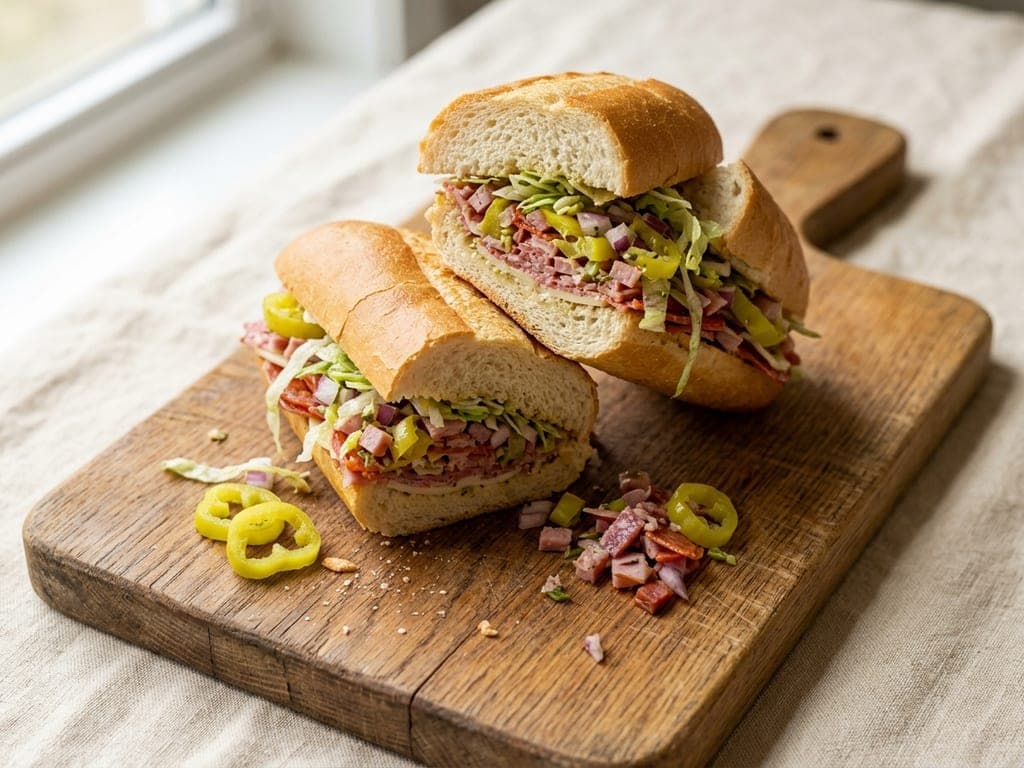
- Cut each wrapped sandwich through the paper, then unwrap and stack the halves against each other, cut faces toward the diners.
- Leave a small pile of the chopped filling and a few banana pepper rings on the board beside them.
- Wipe the board’s edges — rustic is a look, smeared dressing isn’t.
- Serve on the board with a knife resting alongside for splitting halves further.
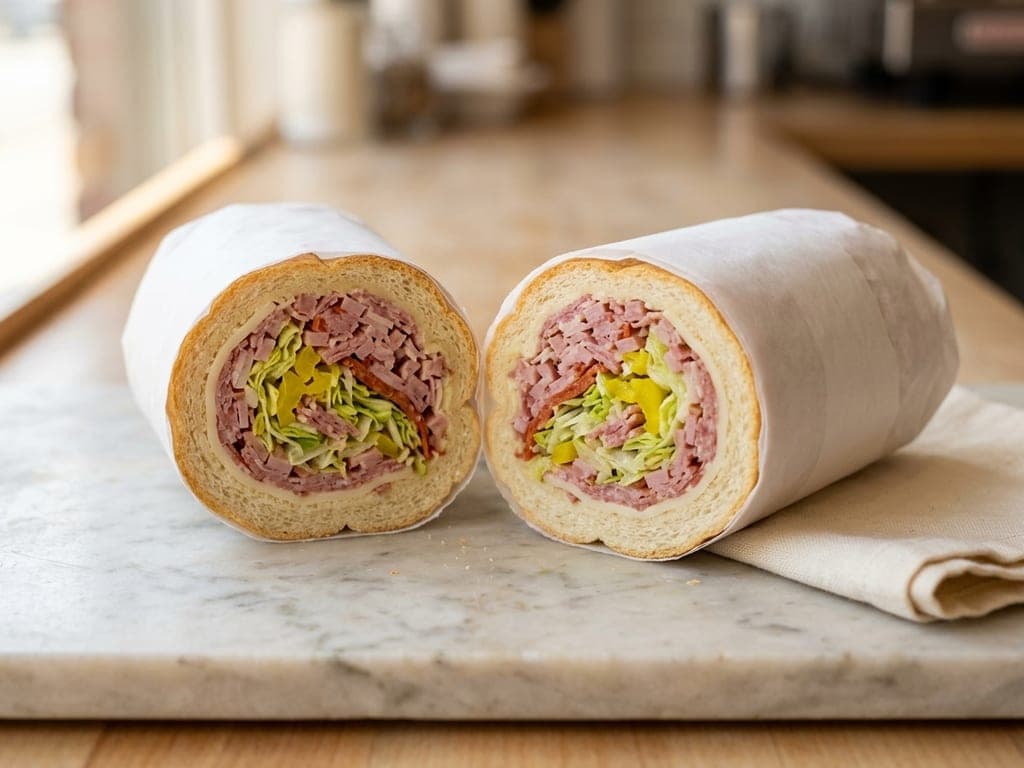
- Wrap each sandwich snugly in white deli paper or parchment, ends folded under, and rest 10 minutes.
- Saw straight through paper and sandwich with a serrated knife in one confident pass.
- Set the halves cut-face-up, slightly offset, paper still on — it’s the handle.
- Tuck a folded napkin under one edge; the paper does the rest of the presentation.
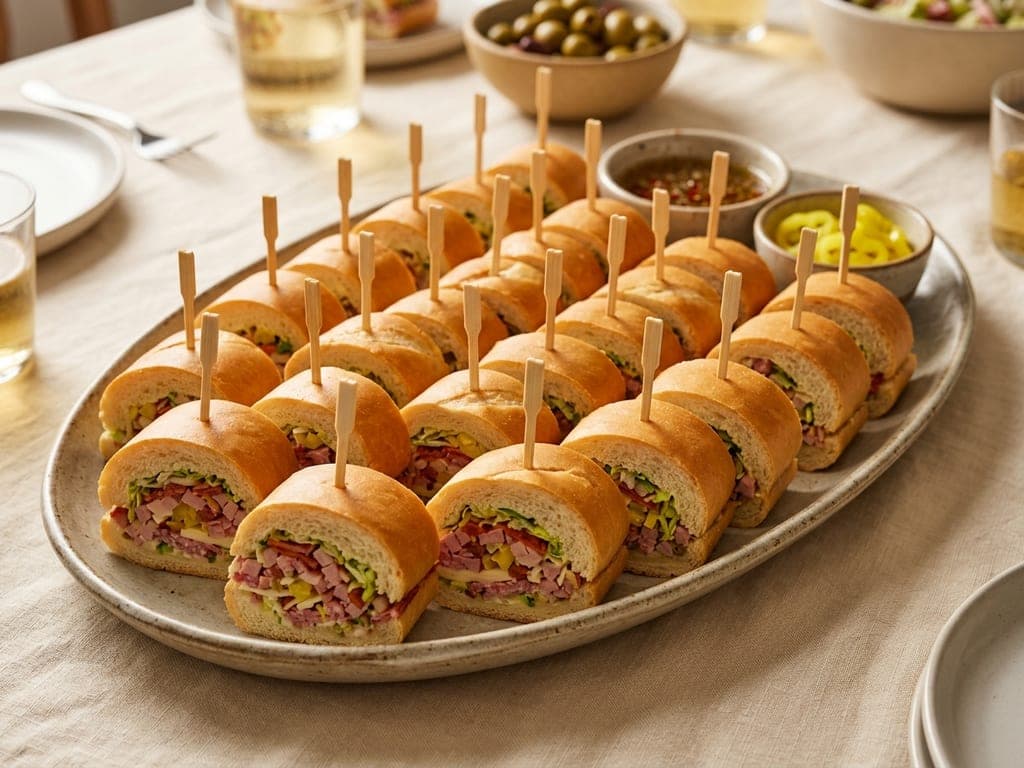
- Pack the filling into full-length soft loaves, wrap tightly, and rest 15 minutes — five longer than a single sandwich; a full loaf needs it — so the slices hold.
- Slice through the paper into 2-inch (5 cm) segments with a serrated knife, unwrapping as you go.
- Stand the segments cut-face-up in rows on a long platter, one cocktail pick straight down through each.
- Set a small bowl of the reserved dressing and one of banana pepper rings at the platter’s end for the optimists.
The doctrine: confetti, not mush
The trend’s loudest critic is worth answering by name — and agreeing with. Andrew Zimmern complained publicly that the chopped-sandwich videos get it all wrong: hack everything together with the same frantic knife and you lose the texture, because each ingredient deserves its own cut. His diagnosis is exactly why so many homemade chopped sandwiches disappoint — run a knife through iceberg for as long as it takes to confetti a stack of salami and you’ve made lettuce slurry, and the sandwich eats like something that was chewed in advance. His prescription is differentiated cuts, ingredient by ingredient, and this page’s doctrine is the home-kitchen version of the same idea: instead of prepping each ingredient separately, stage one chop. Dense, flexible things — the meats, the cheese — want to be pea-sized confetti, chopped first and thoroughly, because that’s what makes every bite carry everything. Crisp, wet things — the lettuce, the onion, the peppers — join afterward for a dozen relaxed passes and stay in ribbons, because they’re the crunch budget and a knife spends that budget fast. Two stages, one board, maybe ninety seconds of actual chopping — Zimmern’s differentiation with one knife instead of five prep bowls. That’s the entire doctrine, and it takes the critique seriously instead of ignoring it.
The dressing argument splits the ranking recipes into two honest camps. The mayo camp binds the chop with mayonnaise sharpened by red wine vinegar — it clings beautifully, reads as deli salad, and can slide toward heavy. The vinaigrette camp goes oil-forward with a spoonful of Dijon and sugar — brighter, lighter, and prone to running straight off chopped meat and pooling in the bread. This page’s dressing is the deliberate middle: mayonnaise for cling, a full two tablespoons of red wine vinegar for cut, olive oil to loosen, oregano because an Italian sub without oregano is a missed handshake. Red wine vinegar is the one non-negotiable — it’s the acid of the classic sub tradition, and most bottles run 5–6% (US law sets a 4% floor, EU wine vinegar 6%), which is exactly the assertiveness ten ounces of cured meat need. Dress on the board, dress last, and hold a quarter of the dressing back: a chopped filling you can still adjust is a luxury a layered sub never offers.
Bread is where the chopped format quietly changes the rules. A layered sub can carry a crusty artisan loaf because the slices inside are structural — they flex and hold each other. A chopped filling has no structure at all; the bread is the only thing gripping it, so the roll needs a soft, thin crust that compresses around the filling instead of shattering and squeezing it out the sides. The soft Italian sub roll — the hoagie roll, the grinder roll, whatever your region calls it — is the engineered answer, and hollowing a shallow trench from the top half turns the roll from a lid into a socket. Toasting is situational, not doctrinal: untoasted keeps the classic deli softness for a sandwich eaten now; a light toast plus a thin mayo moisture-barrier is the pack-ahead play, buying the bread a couple of hours against a dressed filling. The one genuine mistake is chewy, open-crumbed ciabatta — the crumb’s big holes shed confetti and the crust’s chew squeezes the filling like a toothpaste tube.
Chopped vs grinder vs the names on the map
The internet uses “chopped Italian” and “grinder” almost interchangeably, and they are not the same sandwich — here is the boundary, drawn once. A GRINDER, in the viral 2022 sense, keeps the sub intact: meats and cheese are layered on a toasted roll, usually run under heat until the cheese melts, and the famous mayo-dressed iceberg “grinder salad” rides ON TOP of the layers. A CHOPPED Italian abolishes the layers entirely: meats, cheese and vegetables are chopped together into one dressed confetti before they ever meet bread, and nothing is toasted or melted. The grinder is a hot-adjacent, layered sandwich wearing a salad; the chopped is a cold salad wearing bread. The grinder salad alone — no bread at all — is the third dish in the family, and the low-carb order of the whole movement. All three descend from the same classic Italian-American deli sub; they just disagree about geometry. (The hot layered grinder has its own full recipe on this site — it’s linked at the foot of this page; this one belongs to the chop.)
About that word “grinder,” and the rest of the sandwich map, because the names are half the fun and mostly older than the internet thinks. SUB is the national default — named for the roll’s shape, in print by 1940. HERO is New York’s, in print by 1936 — and the famous explanation, “it takes a hero to eat one,” is no legend: that citation says it in so many words; what nobody has ever verified is the food columnist long credited with coining it, so the why stands while the who stays open. HOAGIE is Philadelphia’s: it shows up in print as “hoogie” in 1941, and the beloved story that it began with Hog Island shipyard workers in World War One has a fifteen-year hole in the written record — word researchers call it doubtful, and rate the humbler account more likely: Al De Palma, who heard fellow musicians joke in 1928 that you had to be a hog to eat one, and opened a shop selling “hoggies” in 1936 (his own telling, decades later — graded accordingly). GRINDER is New England’s, and older than the internet assumes — a Hartford Courant advertisement carries it in December 1935, ahead of both sub and hoagie — most plausibly named for the jaw work a crusty roll demands. Boston’s fading SPUCKIE comes from spuccadella, an Italian-American roll; Westchester County orders a WEDGE, which beat the whole field into print in 1932. One sandwich, six names, one doubtful legend and one unattributable coinage — worth knowing before a comment section knows it at you.
Two practical notes to finish. Scaling: this is secretly one of the best party formats in the sandwich world — build the chop in one big batch (it multiplies without complaint), pack it into full-length loaves, wrap, rest, and slice into 2-inch (5 cm) segments with a pick through each; a 16-inch (40 cm) loaf cuts into about eight party pieces, and the cut faces do the advertising. And the classic-deli upgrade path: the viral build’s ham-salami-pepperoni trio is the supermarket answer, and it’s genuinely good — but the traditional Italian-American deli core is Genoa salami, capicola (the “gabagool” of New Jersey dialect fame) and mortadella, and swapping the pepperoni and half the ham for those two turns the sandwich from very good to serious. Same chop, same dressing, better cold case. When a deli counter is between you and lunch, that’s the order to read off this page.
Questions, answered
What goes in a chopped Italian sandwich?
The viral standard, which this page follows: Genoa salami, deli ham and pepperoni (about 10 oz / 285 g total for four sandwiches), provolone, shredded iceberg lettuce, red onion, banana peppers, an optional seeded tomato, and a mayo–red wine vinegar–oregano dressing, all chopped together on a board and packed into soft sub rolls. Worth knowing: pepperoni has been on deli-counter Italians for a century — Brooklyn institutions have treated it as essential since the 1920s — but the CLASSIC Italian-American sub core omits it: Genoa salami, capicola and mortadella, with provolone as the canonical cheese and an oil-and-red-wine-vinegar dressing. Swap the pepperoni and half the ham for capicola and mortadella and you’ve upgraded from the viral build to the deli-counter one, no other change needed. The non-negotiables are fewer than you’d think: cured meat, provolone, iceberg, something pickled, red wine vinegar somewhere in the dressing, and a roll soft enough to grip a loose filling.
How do you make the viral chopped sandwich?
The method in one paragraph: whisk a dressing (1/4 cup / 55 g mayo, 2 tbsp red wine vinegar, 2 tbsp olive oil, 1 tsp dried oregano, salt, pepper). Stack the meats and cheese on a big cutting board and chop them — cross-chop, turning the board — into pea-sized confetti. Add the vegetables and chop BRIEFLY, a dozen passes, so the lettuce stays in ribbons. Dress on the board, fold with a bench scraper, load into hollowed soft sub rolls, wrap each tightly in paper, rest 10 minutes, and cut through the paper with a serrated knife. The two details the viral videos skip: chop in two stages (meats fine, vegetables coarse — that’s the difference between confetti and mush), and dress last, because salt and acid start pulling water out of cut lettuce the moment they touch it.
What is a chopped Italian sandwich at Jersey Mike’s?
There’s no cold chopped Italian on Jersey Mike’s standing menu — the question exists because the viral homemade sandwich and the chain’s Italian subs blurred together online, and the chains have started chasing the trend: in January 2026 Jersey Mike’s launched Mike’s Hot Italian, a limited-time 70th-anniversary sub with ham, salami and pepperoni hand-chopped on the grill under melted provolone (a hot grinder-style build, not the cold viral one), and Capriotti’s carries a Chopped Italian on its permanent menu. The closest standing Jersey Mike’s order remains the #13 Original Italian (provolone, ham, prosciuttini, cappacuolo, salami and pepperoni) served “Mike’s Way” with onions, lettuce, tomato, oil, vinegar and spices — published nutrition aggregates put a regular at about 900 calories as served Mike’s Way, with the oil and vinegar. Some counters will chop any sub on request; that’s goodwill, not policy, so ask. The honest answer to the question behind the question: the homemade version on this page IS the thing people are trying to order — same meat family, same oregano-and-red-wine-vinegar flavor, cold-chopped the way the videos do it, at fewer calories and a fraction of the price.
What is the difference between a chopped Italian sandwich and a grinder?
Geometry, heat, and where the salad sits. A grinder — in the sense the 2022 viral wave fixed in place — is a LAYERED sub: meats and cheese stacked on a toasted roll, typically melted, with a mayo-dressed iceberg “grinder salad” piled on top of the intact layers. A chopped Italian has no layers at all: every ingredient, vegetables included, is chopped together into one dressed mixture before it goes into an untoasted roll. Cold and uniform versus warm and stratified. (Historically, “grinder” is simply New England’s word for a sub — in print since 1935 — so a New Englander may fairly claim every sub is a grinder, hot or cold; the internet has narrowed the word to the melty-layered-salad-on-top build.) The grinder salad alone, bunless, is the family’s low-carb member. Same deli DNA, three different geometries — and the hot layered grinder has its own full recipe on this site, linked at the foot of this page, built on the boundary drawn here.
What is a chopped sandwich called, and why chop it at all?
The format has no older name — “chopped Italian sandwich” (or just “chopped sandwich”) is the name the 2023 TikTok wave settled on, and food media’s best definition remains “an antipasto salad in a hoagie bun.” The point of the chop is even distribution, and it fixes the layered sub’s two oldest flaws at once. Flaw one: stratified bites — all bread, then all salami, then the naked-lettuce stretch. Chopped, every bite is the whole sandwich in miniature. Flaw two: the slide — a full slice of ham pulling out as a sheet and taking the filling with it. Chopped, nothing is a sheet, so nothing can slide. The trade-off is real and worth naming: chopping spends the sandwich’s crunch and increases its wet surface area, which is why this page chops in two stages and dresses last. Done that way, you keep the even distribution and the texture both — which is the whole argument.
Can I make chopped Italian sandwiches ahead?
Yes, with a schedule — and the schedule is not the one you’d guess. A week ahead: the dressing, jarred in the fridge. A day or two ahead: the shopping, with the meats freshly sliced (counter-sliced deli meat is already inside its 3–5-day window when you carry it home). Day of — ideally within a few hours of eating: the chopping, all of it. Chopping is the one job that doesn’t bank well: every cut multiplies the meat’s exposed surface and adds fresh board-knife-hand contact, so a pile chopped days early is a worse version of itself in both safety and texture. If life demands it, chopped meats and cheese hold 24 hours boxed airtight in the fridge; the vegetables and the dressing-to-filling moment stay day-of, always. The line you can’t cheat is dressing-to-bread time — once dressed filling meets bread, the clock runs in hours even in the fridge, mayo barrier or not. For packed lunches: toast the split rolls lightly, cool, paint the crumb thinly with mayonnaise edge to edge, pack the dressed filling, wrap tight — that buys a couple of hours in a cooler at 40°F (4°C) or below. Assembled leftovers keep overnight refrigerated and eat softer the next day; undressed components are the version of this sandwich that meal-preps properly.
What bread is best for a chopped Italian sandwich?
A soft Italian-style sub roll with a thin, tender crust — hoagie roll, grinder roll, the 8-inch (20 cm) soft white baton of your region — and the reason is structural, not aesthetic. A chopped filling has no slices to hold itself together; the bread does ALL the gripping, so the roll must compress gently around the filling. A hard, shattery baguette crust does the opposite: every bite squeezes loose confetti out the sides. The one bread this page will actively warn against is open-crumbed, chewy ciabatta — the holes shed filling and the chew works like a press. Hollowing a shallow trench from the top half of any roll turns it from a lid into a socket and is worth the ten seconds every time. Brioche is too sweet against cured meat; whole-wheat is fine if soft. And because the filling doesn’t rely on the crumb’s structure, this is genuinely the best sandwich in the family for gluten-free rolls — pick a soft one and the chop hides its shortcomings.
How many calories is a chopped Italian sandwich?
About 780 per sandwich as this page builds it — an honest estimate, not a lab number: roughly 290 for the 8-inch (20 cm) roll, 210 for the 2 1/2 oz (71 g) of mixed cured meats, 100 for the provolone, 150 for the sandwich’s share of the mayo-and-oil dressing, and 25 or so for the vegetables and vinegar. For calibration against published chain data: a Subway 6-inch Italian B.M.T. runs about 360–400 (smaller sandwich, no oil dressing), and a Jersey Mike’s regular #13 Original Italian lands about 900 as served Mike’s Way, with the oil and vinegar — so high 700s for a fully dressed, full-size build is exactly where the arithmetic says it should be. You’ll meet claims of 300 calories for essentially this sandwich; the roll alone forecloses that. To genuinely lighten it, with the arithmetic done honestly (the levers save less than diet copy usually pretends): halving the meat saves about 100 (~680), swapping the mayo share toward vinegar-forward saves about 90 (~690), open-face on one roll half saves about 145 (~635), and skipping the bread entirely — eating it as the chopped salad it secretly is — lands near 490, still a real lunch because the meat and cheese are the calories, not the lettuce.
Banana peppers or pepperoncini — and is the sandwich spicy?
They’re genuinely different peppers doing the same job, and either is correct. Both are Capsicum annuum cultivars sold pickled in rings: banana peppers run 0–500 Scoville units (one of the only “hot” peppers that can score an outright zero), pointier and sweeter; pepperoncini run 100–500, rounder, wrinkle-skinned, tangier and faintly bitter — figures per the pepper-reference site PepperScale, so treat them as conventions rather than lab constants. In practice pepperoncini read brighter and more sour, banana peppers milder and sweeter; delis reach for whichever jar is closer, and so should you. As written, the sandwich is not spicy — cured-meat warmth, pickled tang, no burn — and the heat ladder is short and optional: red pepper flakes (UK: chilli flakes) in the dressing is rung one, hot capicola instead of ham is rung two, sliced fresh jalapeño chopped in with the vegetables is rung three. The pepperoni contributes paprika flavor, not meaningful heat.
Can I make a vegetarian chopped Italian?
Yes, and it ranks among the internet’s quiet surprises that the vegetarian version holds up — one of the pages competing for this exact search is meat-free and earns its spot. The honest approach is cheese-forward rather than imitation-forward: double the cheese to about 8 oz (225 g) total for four, split between provolone and low-moisture mozzarella, keep every vegetable, add something with body and brine — quartered artichoke hearts, olives, or roasted red peppers all chop beautifully — and consider a handful of chickpeas for the protein the meat left behind. Keep the same two-stage chop and the same dressing; the oregano and red wine vinegar are doing more of the Italian-sub identity work than the salami ever did. Marinated mozzarella balls, drained well, are the luxury version — for tables without a high-risk guest, since fresh soft cheeses sit on the pregnancy caution list. One honest asterisk: going vegetarian retires the cold-cut storage windows, but not the deli counter itself — the CDC flags unheated deli-SLICED cheese for pregnant guests just as it does the meats, since the same slicer handles both. Build the vegetarian chop from pre-packaged pasteurized cheeses and it genuinely is the lowest-worry version of this sandwich for a mixed crowd.
Snap your finished plate and let the AI plate it again — more beautifully.