Italian Grinder Sandwich Recipe (Hot, Melted, Grinder Salad)
The hot one: salami, capicola and pepperoni layered in ruffles, blanketed with provolone and broiled until it’s molten, then crowned with a cold, crisp mayo-and-red-wine-vinegar iceberg salad. Two temperatures in one sandwich, the trick for keeping them apart until the last second — and a straight, sourced answer to what actually makes a sandwich a grinder.
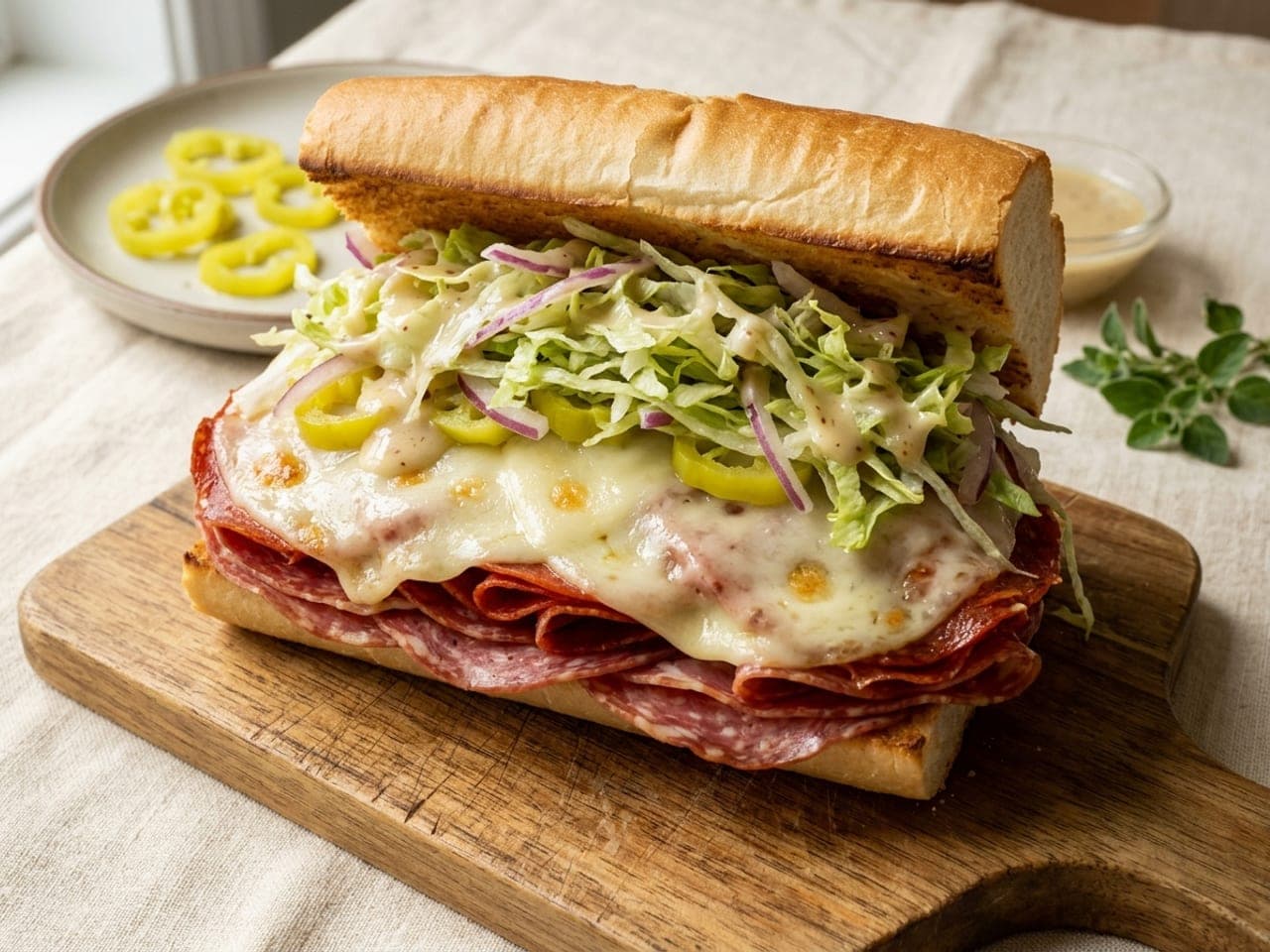
Ingredients
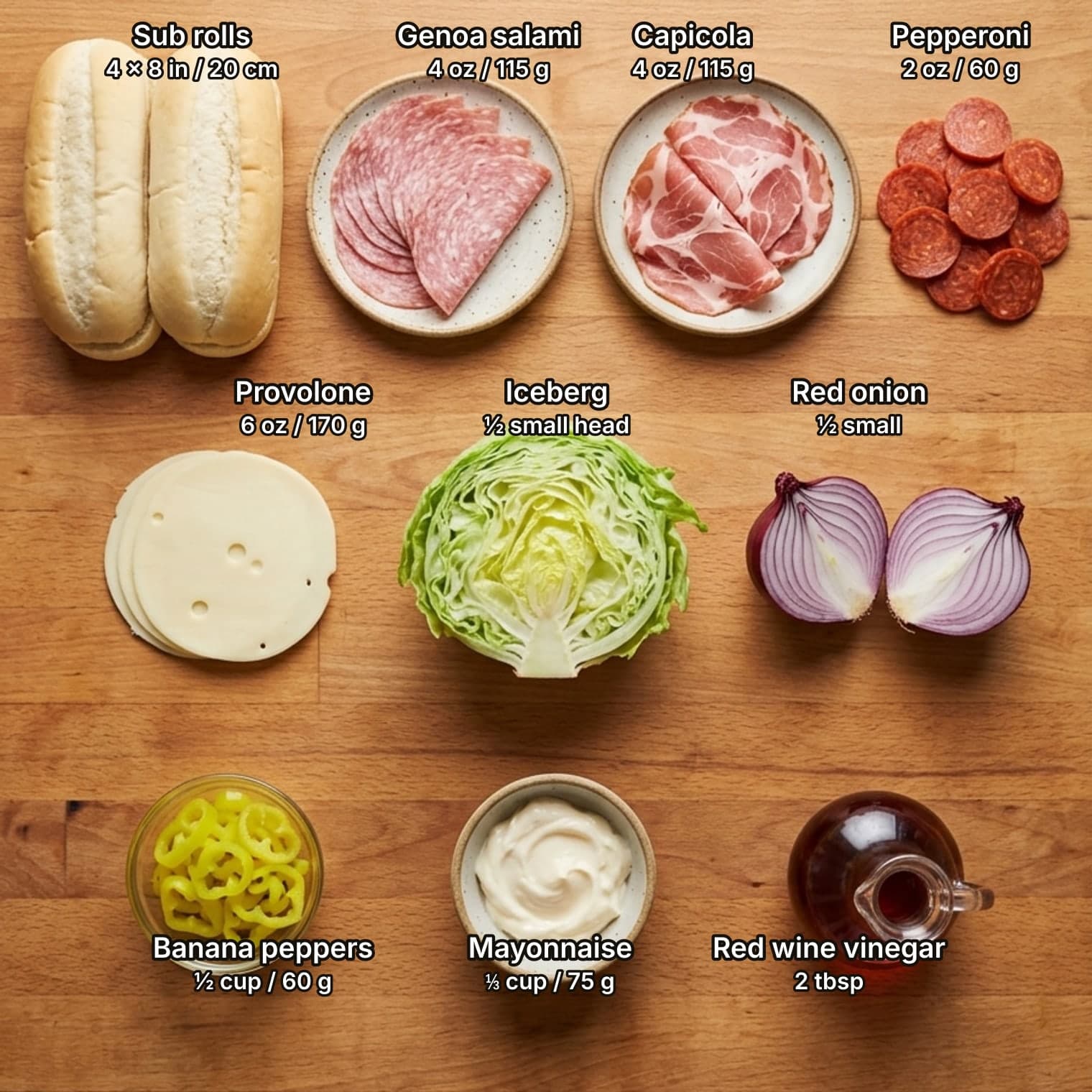
- soft Italian-style sub rolls, 8-inch (20 cm), thin tender crust, no seeds — hoagie/grinder rolls; split, hollowed on top and toasted on the cut faces4
- Genoa salami, thinly sliced4 oz (115 g)
- capicola (coppa), thinly sliced — or deli ham for a milder, leaner build4 oz (115 g)
- pepperoni, thinly sliced — swap for mortadella for the classic deli trio2 oz (60 g)
- provolone, sliced — ask for MILD (dolce); sharp aged piccante is a grating cheese that turns greasy and grainy under heat rather than melting cleanly. Cut it half-and-half with low-moisture mozzarella for a softer, stretchier melt6 oz (170 g)
- iceberg lettuce, finely shredded and kept COLD — the crunch budget; its rigid layered leaves are structural, don’t substitute soft leaves1/2 small head (about 3 cups / 200 g)
- red onion, slivered thin1/2 small
- banana pepper rings, drained — or pepperoncini; different peppers, same job1/2 cup (60 g)
- mayonnaise1/3 cup (75 g)
- red wine vinegar — the classic sub acid; most bottles run 5–6% (US law sets a 4% floor, EU wine vinegar 6%)2 tbsp
- extra-virgin olive oil1 tbsp
- Parmesan, finely grated — into the salad dressing2 tbsp
- dried oregano1 tsp
- kosher salt (coarse), black pepper, and optional red pepper flakes (UK: chilli flakes)to taste
The word, the region, and the paper trail
A grinder is a submarine sandwich, and “grinder” is what much of New England — Connecticut above all — calls one. The same object is a hero in New York City, a hoagie in Philadelphia, a spuckie in Boston’s older shops, a wedge in Westchester County. What nearly every page about this sandwich gets backwards is the chronology, so here it is straight: grinder is not a latecomer to that list. The earliest published citation anyone has produced is a Hartford Courant advertisement of 14 December 1935 — the Elm Tavern in Wethersfield, Connecticut, offering “Delicious Grinders and Sandwiches.” That is earlier than submarine, which surfaces in a Wilmington, Delaware phone-book advertisement in January 1940, and earlier than hoagie, which appears as “hoogie” in 1941. Only wedge clearly beats it (New Rochelle, New York, August 1932), with hero roughly level, turning up in an Associated Press story in 1934. The citation work behind all of these is the lexicographer Barry Popik’s, and it deserves the credit, because the dates are what settle every argument below.
So why “grinder”? The honest answer is that nobody knows, and every origin story in circulation postdates the earliest evidence. The likeliest explanation is also the plainest, and the dictionaries endorse it as a guess: a crusty Italian roll takes real jaw work — “perhaps from the amount of chewing required.” It has one genuinely good piece of period support, too. Writing in June 1950, the New London Day noted that grinders were “sometimes called” jawbreakers — a parallel jaw-effort nickname, alive in the same place at the same time. The romantic alternative is the one every recipe blog repeats: that the sandwich was named for the “grinders” who ground metal in the submarine yards around Groton during the Second World War. That story is not merely unproven, it is refuted by the calendar. The word was in print in Wethersfield in December 1935 — fifty miles from Groton and years before the wartime yards filled up — and it does not appear in a New London directory until 1946. Grade it a legend, exactly like the Hog Island tale behind “hoagie.” And there is a documented kernel underneath it that beats the myth: Benedetto Capalbo — Capalbo, not the “Capaldo” a hundred pages have copied from one another — was reported to have sold something like a thousand sandwiches a day to the New London Submarine Base ship’s service during the war. Submarine customers, not shipyard grinders.
That leaves the question this recipe actually turns on: is a grinder the hot one? Partly, sometimes, and never as a rule. Where both words share a menu — more often at the edges of grinder country than in its Connecticut heartland — “grinder” tends to mean the oven-melted sandwich and “sub” the cold one, and that is the sense the internet has adopted wholesale. But it was never the original meaning. A Naugatuck, Connecticut advertisement from February 1947 sells ham, cheese, tomato and lettuce under the heading “POPULAR ‘GRINDER’ SANDWICHES,” and the grinder the New London Day described in 1950 was entirely cold: salami, cheese and tomato with chopped lettuce, sluiced with olive oil. If you want the argument settled by someone with standing, Nardelli’s of Waterbury — a Connecticut grinder institution trading since the 1920s — prints “Hot Grinders” and “Cold Grinders” as two separate headings on its own menu. Which sets up the honest framing for this whole page. A New England grinder is a regional name for a sub, dressed in oil, and it is roughly a century old. The TikTok grinder is a specific modern recipe — layered cold cuts, melted cheese, and a mayonnaise-dressed iceberg salad laid on as its own distinct stratum — invented in Richmond, Virginia in 2022 and named after the regional sandwich rather than descended from it. This page makes the second one, and says so plainly.
How to make Italian Grinder Sandwich
- Shred the iceberg and get it properly cold. Halve the iceberg, cut out the core, and shred it fine — quarter-inch (5 mm) ribbons, a chef’s knife rocking through a stacked wedge, not a food processor. Rinse what you’ll use under plain running water unless the bag says washed or ready-to-eat, then dry it THOROUGHLY in a salad spinner or a clean towel, because every drop of rinse water left on the leaves becomes dressing you didn’t make. Now the step most recipes skip: put the shredded lettuce, the slivered half red onion and the drained banana pepper rings in a bowl in the FRIDGE while you do everything else. This sandwich is a temperature contrast — molten cheese against cold, crunchy salad — and the contrast is the whole point of the dish. Room-temperature lettuce piled on hot cheese wilts on contact and turns the crown into a warm, sad slaw before it reaches the table. Cold lettuce fights back.
- Whisk the dressing, and keep it away from the lettuce. In a small bowl, whisk 1/3 cup (75 g) mayonnaise with 2 tbsp red wine vinegar until smooth and pourable, then whisk in 1 tbsp extra-virgin olive oil, 2 tbsp finely grated Parmesan, 1 tsp dried oregano, a pinch of kosher salt (coarse), plenty of black pepper and — if you like a hum of heat — a pinch of red pepper flakes (UK: chilli flakes). It should taste aggressively sharp on its own: it has to season a bowl of lettuce that brings no acid and no salt of its own, and it’s about to sit next to cured meat and melted cheese, both of which flatten a timid dressing. Red wine vinegar is the non-negotiable — it’s the acid of the Italian-American sub tradition, and most bottles run 5–6% (US law sets a 4% floor, EU wine vinegar 6%), which is the assertiveness this job needs. Then set it down and leave it alone. Dressing does NOT meet lettuce until step five; salt and acid start pulling water out of shredded iceberg within minutes, and a salad dressed early arrives as a puddle.
- Split and toast the rolls — here the toast is structural. Split each sub roll lengthwise without cutting all the way through, so a hinge holds it together, and pull a shallow trench of crumb out of the top half to make a socket for the salad. Toast the cut faces — under the broiler (the overhead grill) for a minute, or in a dry pan — until they’re dry to the touch and just golden. On the chopped Italian this is optional; here it is not, and for a specific reason: a toasted cut face is a moisture barrier standing between hot fat rendering out of the meat, molten cheese, and a dressed salad, all landing on the same piece of bread. Untoasted crumb takes on that liquid instantly and the bottom of your sandwich turns to paste before you finish building it. Use a soft Italian-style roll with a thin, tender crust — hoagie roll, grinder roll, whatever your region calls it. This is one sandwich where a hard, shattery crust genuinely hurts: it fights the knife, and the pressure that takes to bite squeezes the salad out the far end.
- Layer the meats in ruffles, not sheets. Lay the salami, capicola and pepperoni onto the bottom halves — but do not lay them FLAT. Fold or gather each slice loosely so it sits in ruffles and waves, and shingle the ruffles down the length of the roll, alternating the three meats so no bite is all one thing. This is the layered sandwich’s answer to the chopped sandwich’s knife-work, and it does two jobs. It traps air, so ten ounces (285 g) of cured meat eats light and lofty instead of like a dense compressed brick. And it stops the sheet-slide — a flat stack of whole slices pulls out in one piece on the first bite and takes the sandwich with it, which is the oldest structural failure of the sub and the exact complaint the chopped format was invented to fix. Ruffled slices grip each other and stay put. Spend the extra sixty seconds; it is the difference between a good grinder and a great one.
- Blanket with provolone and broil — then toss the salad while it melts. Lay the provolone over the meat, edge to edge and slightly overlapping, so it covers everything like a blanket — the cheese is the lid that fuses the ruffles into one sliceable stratum, and it is also the sandwich’s waterproofing. A sealed sheet of melted cheese is the barrier that keeps the dressed salad’s moisture off the bread, which is the trick test kitchens use to stop a wet filling turning a sub to paste. Leave gaps and the dressing finds them. Set the open-faced bottoms (and the hollowed top halves, cut side up) on a foil-lined sheet pan (baking tray) — FOIL, not parchment, which is not rated for broiler temperatures — and slide them about 6 inches (15 cm) under a high broiler for 2 to 4 minutes, until the cheese is fully molten, slumping over the edges of the meat and just starting to blister gold in spots. Broilers vary wildly and this is a stand-and-watch job, not a set-a-timer one: the gap between molten and scorched is about forty seconds. And here is the useful part — those few minutes are exactly the dressing window. While the pan is under the heat, pour the dressing over the cold lettuce, onion and peppers and toss until every ribbon is coated. The broiler is the timer. Dress when it goes in, crown when it comes out, and the salad never sits dressed long enough to weep.
- Crown it cold, close it, press it once. Pull the pan out and work fast, because the clock that matters now is the temperature contrast. Pile the cold dressed salad straight onto the hot melted cheese, mounding it far higher than looks sensible — it compresses to about half when you close the sandwich, and an under-crowned grinder is just a hot sub. Bring the hollowed top half over, press down once, firmly and evenly, with the flat of your palm. One press: enough to set the salad into the socket and marry the halves into something you can pick up, not so much that dressing is forced down into the crumb. If any salad escapes at the sides, push it back in with the knife rather than adding more — the sandwich should close.
- Cut and serve immediately — this one does not wait. Cut each sandwich in half on the diagonal with a serrated knife, one confident sawing pass, and take it to the table now. This is where the grinder and the chopped Italian part company for good: a chopped Italian is wrapped tight and RESTED ten minutes so the loose filling fuses, and it travels beautifully. A grinder is the opposite animal — it is built on a contrast between hot and cold that begins dying the moment it’s assembled, and a rest is the one thing that can’t help it. Ten minutes in and the cheese has set to rubber, the salad has slumped, and the bread has taken on everything above it. Eat it standing at the counter if you have to; that is not a failure of hospitality, it is the recipe. If you’re feeding a crowd, don’t pre-assemble — build the hot loaves and set the salad bowl beside them so each person crowns their own (see the plating notes), and don’t crown a sandwich that’s going into a lunchbox at all: the safety notes explain why a hot sandwich under a cold mayonnaise salad is a make-and-eat dish rather than a picnic one.
Safety & hygiene Important
- Deli meats, listeria, and the one advantage this sandwich has. This sandwich is built on ready-to-eat cured meats, so it inherits the cold-cut rulebook. The named risk is Listeria monocytogenes: unlike most bacteria it survives and keeps multiplying at refrigerator temperatures, and deli meats are one of its documented vehicles — the CDC’s 2024 investigation into meats sliced at delis closed with 61 people infected across 19 states and 10 deaths, which is why this rulebook gets taken seriously rather than treated as history. The CDC names four groups who need to care: people who are pregnant (listeriosis can cause miscarriage, stillbirth and premature delivery), newborns, adults 65 and over, and anyone with a weakened immune system. For them the advice on deli meat is to avoid it unless it has been reheated to 165°F (74°C) or until steaming hot — and note who says what, because it matters: the number is the CDC’s, while the FDA’s own wording asks only for “steaming hot”. Now the honest part, because there is a real advantage here and it would be easy to overclaim it. A grinder CAN put the meat through that carve-out in a way a cold chopped sandwich never can. But a broil aimed at melting cheese does not certify that the meat underneath got there — broiling is top-down radiant heat and the cheese IS the top surface, so melted provolone is not a thermometer, and USDA’s position is blunt that a thermometer is the only reliable way to know a food reached a safe temperature. So for a high-risk guest, treat it as a cooking step rather than a melting step: broil for as long as the thermometer asks rather than as long as the cheese asks, inserting the probe through the SIDE of the sandwich into the meat layer itself — the thickest part of a grinder is bread and salad, which will tell you nothing — and look for 165°F (74°C). Two honest limits on what that buys. The cold salad is added afterwards and never heated, so the carve-out covers the meat rather than the finished sandwich — and if the provolone came off a deli slicer it carries its own flag, which the allergen note below covers. Heating also cannot undo mishandling that happened earlier. For everyone else the storage windows do the work: opened packages and deli-counter-sliced meat keep 3–5 days refrigerated at 40°F (4°C) or below, unopened factory packs about two weeks, per USDA guidance.
- Two temperatures, one clock — why this isn’t a picnic sandwich. First, clear mayonnaise’s name, since it will be blamed anyway: commercial mayonnaise is not the usual villain of summer food poisoning — it is acidified to kill pathogens and made with pasteurized eggs, and food-safety researchers have spent years un-teaching that myth. Two honest boundaries on the acquittal, though. Homemade mayonnaise from raw shell eggs is a genuine salmonella risk in a dressing that will never be cooked, and it is the one mayo this page rules out. And the acidity protects the jar, not your salad: stirred through a bowl of low-acid shredded lettuce it is diluted past the point of doing any preserving work, which is a second reason the grinder salad stays in the fridge until the moment it is needed. The real issue is temperature — not a special hazard unique to this sandwich, just the ordinary one arriving from both directions at once. Bacteria grow fastest between 40 and 140°F (4–60°C), doubling in as little as 20 minutes; hot food is safe held at or above 140°F (60°C) and cold food at or below 40°F (4°C), and nothing perishable should sit out longer than 2 hours, cut to 1 hour above 90°F (32°C). An assembled grinder is held neither hot nor cold: the broiled half is falling, the dressed half is rising, and they meet in the middle of that range by design, with the two-hour clock starting at assembly. That is completely fine for a sandwich eaten within minutes, which is how this dish is meant to work — and it is exactly why a crowned grinder is a poor traveller. Don’t build these for a lunchbox, a cooler or a picnic; that is the chopped Italian’s job and it does it well. If you want a grinder away from home, carry the hot and cold parts separately and build at the table, and for a party hold the loaves hot and the dressed salad cold and let people crown their own. There is also no good way to keep this one assembled, and that is a safety point as much as a quality one: refrigerating a built sandwich afterwards does not reset the clock that started when you made it. So store leftovers as PARTS — the cooked meat and the dressed salad each keep 3–4 days at 40°F (4°C) or below — and build a fresh sandwich. Reheating an assembled one isn’t an option, since you would be cooking the salad.
- Allergens, the deli slicer, and the broiler itself. The obvious allergens first: wheat in the rolls, milk in the provolone and the Parmesan, egg in the mayonnaise. The quieter ones live in labels, and this sandwich has a labelling asymmetry worth knowing about. The cheese, the bread and the jarred peppers are FDA-regulated, so a major allergen must be declared plainly. The MEATS are USDA-regulated, and there the familiar bold “Contains: milk, soy” box is voluntary rather than required — FSIS accepts such statements but does not mandate them, so with cured meat you read the ingredient list itself instead of trusting a summary line. Three meat labels, not one. Milk and soy protein genuinely do turn up in some cured meats, and undeclared-allergen recalls in this category are routine. Celery deserves a correction, because it gets repeated carelessly: it IS one of the UK FSA’s fourteen declarable allergens, but in cured meat it belongs to products labelled “Uncured,” where celery powder supplies the nitrite — traditional Genoa salami, capicola and pepperoni are cured with sodium nitrite and contain no celery at all. Sulfites are in the vinegar and the jarred peppers, not in the meat (US regulation specifically excludes sulfites from meats), and they are declared above threshold in both the US and EU. At the counter, the honest advice for celiac disease or a severe allergy is what the celiac charities actually say rather than the tidy line the blogs repeat: treat the slicer, the knives and the neighbouring product as cross-contact risks, and buy pre-packaged where the stakes are medical — one blade runs through every meat and cheese in the case, and the CDC’s own survey of retail delis found slicer cleaning falling short of the recommended schedule often enough to matter. A vegetarian grinder — double provolone, or provolone plus low-moisture mozzarella, everything else unchanged — retires the cold-cut rulebook but NOT the slicer: the CDC flags deli-SLICED cheese for pregnant guests for the same reason it flags the meats, and note that this is about where it was sliced rather than the cheese being soft, since provolone is a pasteurised semi-hard cheese. So a vegetarian build for a high-risk table starts with pre-packaged cheese, or goes under the broiler until properly steaming. Finally the equipment, because this is one of the few recipes here that puts a pan under a live element. Line a rimmed sheet pan with FOIL, never parchment: parchment is rated only to roughly 420–450°F (215–230°C) depending on the brand, a broiler element runs far hotter than that, and the manufacturers do not hedge — Reynolds’ instruction is simply not to use it with a broiling unit. Under a broiler it will darken and smoke, and a dry edge curling up toward a glowing element is precisely the direct contact every one of those manufacturers tells you to avoid. Keep foil to a flat sheet pan or a broiler pan’s drip tray, never lining the oven floor or the racks, and never covering the slotted insert of a broiler pan, where trapped fat becomes its own fire risk. And do not walk away: NFPA’s fire data puts unattended cooking at the head of the list — 28% of home cooking fires and 48% of the deaths — and names broiling among the methods needing continuous attention. Two minutes at the oven door, every time.
3 ways to plate it
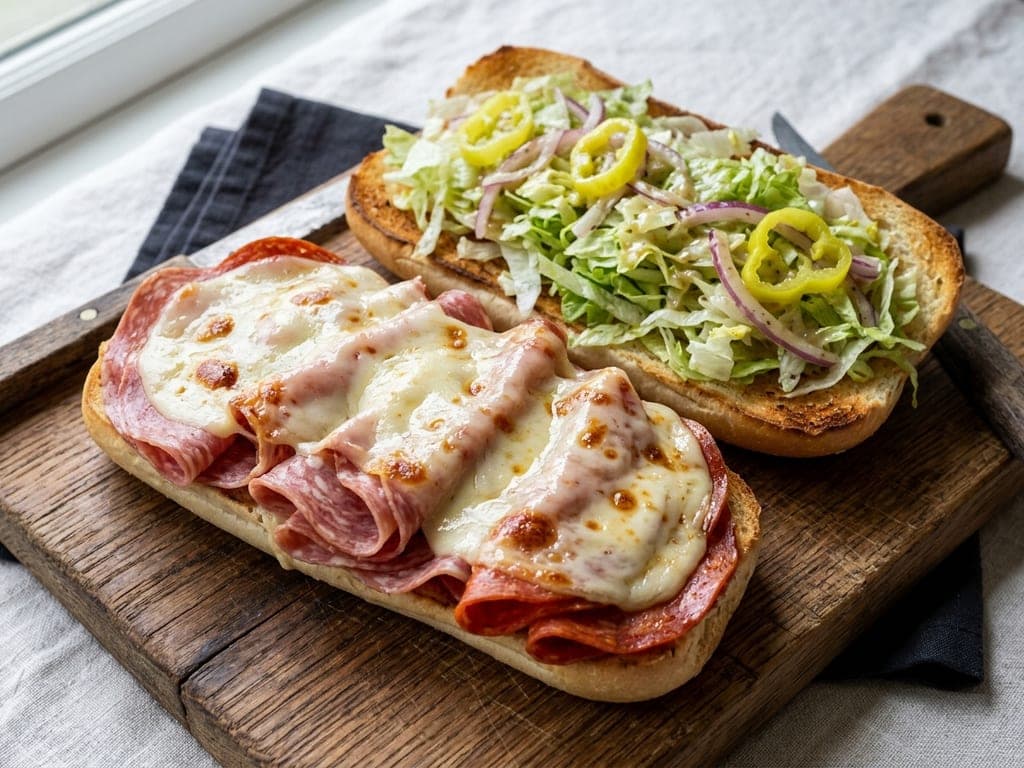
- Bring the pan straight to a warm wooden board and set the two halves side by side, cheese half nearest the light.
- Heap the cold salad onto the toasted top half rather than the cheese, so it stays crisp while it’s admired.
- Angle both halves so the melt and the salad catch the same light; the contrast is the picture.
- Close it at the table, in front of whoever is eating it.
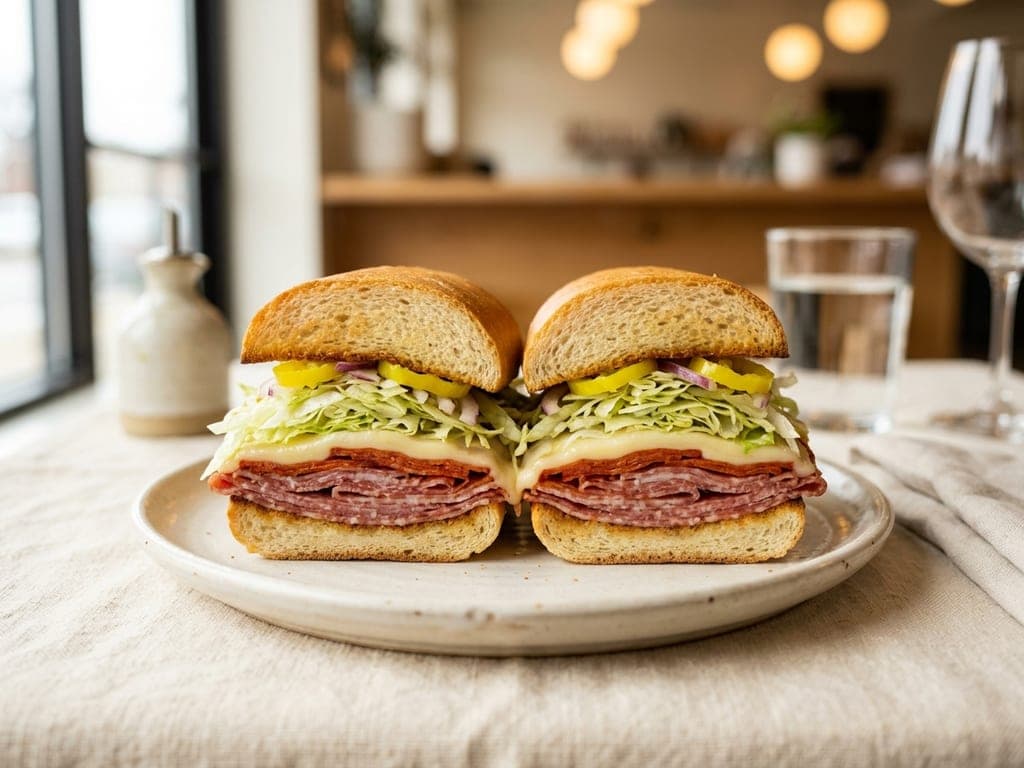
- Press the closed sandwich once, firmly, so the layers set before the knife goes in.
- Cut on the diagonal with a serrated knife in one sawing pass — a longer cut face shows more strata.
- Stand the halves against each other on a cream plate, cut faces toward the diner.
- Serve immediately; this plating has a two-minute shelf life and that is the point.
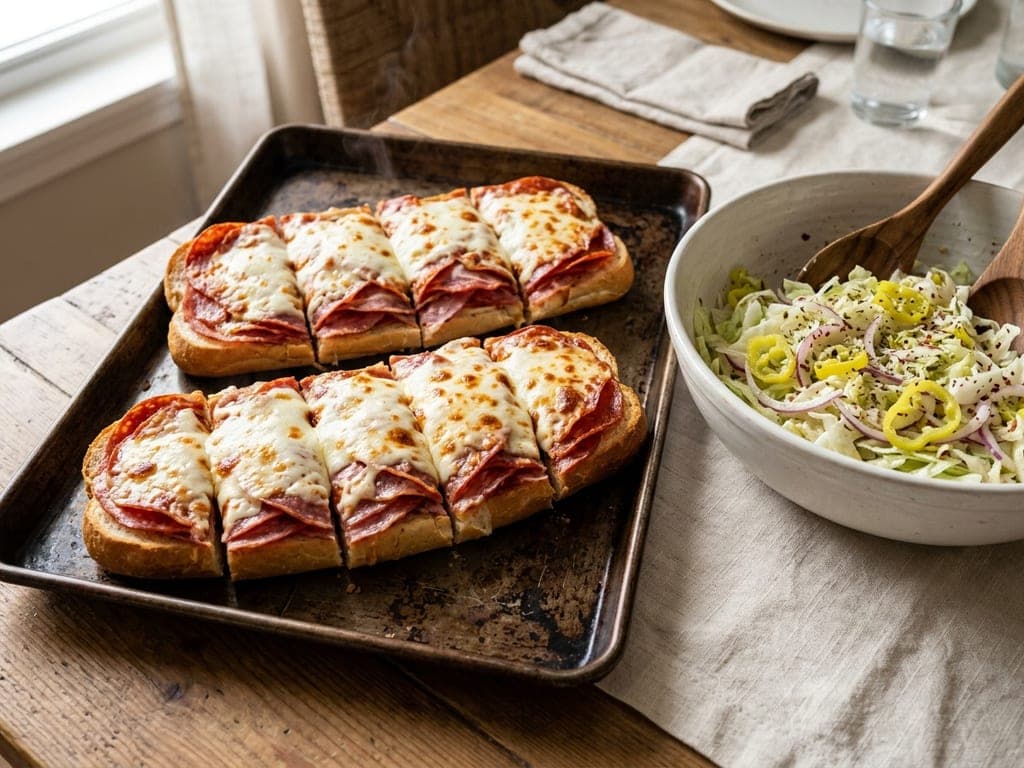
- Broil two full-length loaves open-faced on a foil-lined sheet pan until the cheese is molten and blistered.
- Slice them crosswise into portions in the pan and take the whole pan to the table, still steaming.
- Set the cold dressed salad beside it in a wide bowl with tongs, and keep the bowl in the fridge until the pan lands.
- Let people crown their own — and put a second bowl of banana pepper rings out for the optimists.
The doctrine: hot layers, cold crown, and the ruffle
The modern grinder is a temperature-contrast sandwich, and almost everything that goes wrong with a homemade one is a failure to keep the two temperatures apart until the last possible second. Hot side: cured meat ruffled on toasted bread under a blanket of provolone, broiled until the cheese is molten and slumping. Cold side: finely shredded iceberg with slivered red onion and pickled banana peppers, dressed sharply with mayonnaise and red wine vinegar and kept in the fridge until the pan comes out. Bring them together and you get the thing worth making: fat and salt and molten cheese underneath, cold acid and crunch on top, in the same bite. Let them meet early and you get a warm slaw on a soggy roll, which is what most disappointing grinders are.
That is why the dressing window matters more than any other timing on this page. Salt and acid start drawing water out of shredded iceberg almost immediately, so a salad dressed while you preheat the broiler has already begun weeping by the time it’s needed. The fix is a piece of kitchen choreography rather than a technique: the two-to-four minutes the cheese spends under the element is the same two-to-four minutes the salad needs to be dressed and tossed. Dress when the pan goes in, crown when it comes out. Nothing waits, nothing weeps, and the sandwich is assembled at the exact moment both halves are at their best.
The ruffle is the other half of the doctrine, and it is what a layered sandwich has instead of a chop. Deli slices laid flat behave like sheets: they compress into a dense band, and the first bite pulls a whole slice free and drags the filling with it — the structural flaw that made the chopped Italian go viral in the first place. Slices folded and gathered into loose waves do the opposite. They trap air, so a heavy stack of cured meat eats lofty rather than leaden; they interlock, so nothing slides; and they give the melted cheese somewhere to run, which is what fuses the whole stratum into something a knife can cut cleanly. Chopping is not the only answer to the layered sub’s problem. The ruffle is the other one, and it keeps the meat tasting like slices of meat.
Grinder, chopped Italian, or grinder salad — and baked versus broiled
The internet uses three names for what are genuinely three dishes, so here is the boundary drawn once. A GRINDER — this page — keeps the sub intact: meats and cheese LAYERED on a toasted roll, run under heat until the cheese melts, with a cold mayo-dressed iceberg salad piled on top of the layers. A CHOPPED ITALIAN abolishes the layers: every ingredient, vegetables included, chopped together into one dressed confetti and packed cold into an untoasted roll — a different sandwich with its own page on this site. And the GRINDER SALAD is the crown by itself, bunless, which is both the low-carb order of the whole movement and, historically, the part that went viral first. The salad came before the sandwich, and its birthday is unusually precise. On 28 March 2022 a Richmond, Virginia creator named Gray Fultz — roughly seventy followers at the time — posted the loaded focaccia sub her boyfriend Josh Wright used to build when he ran a local restaurant: twenty-one ingredients, crowned with his mayonnaise-and-red-wine-vinegar iceberg salad. It passed a hundred thousand views in two days. A week later Erica Kuiper rebuilt it on a baguette across a run of videos that pulled millions more, and by 26 May the grinder-salad tag was at thirty-six million views with Business Insider tracking down who started it — Axios Richmond profiled the couple in early June. The chopped sandwich followed in spring 2023. Same deli DNA, three geometries, one very good year for iceberg lettuce.
The other fork worth understanding is baked versus broiled, because the recipes competing for this dish split on it and none of them explain the trade. BROILED — this page’s method — means open-faced under a high element for two to four minutes: fast, the cheese goes molten and blisters, the toasted bread stays crisp because nothing traps steam. BAKED means a moderate oven for ten minutes or so, and it comes in two versions. Open-faced on a sheet pan is a perfectly good, more forgiving route, and the honest choice when you’re making eight of them and don’t trust your broiler. Wrapped in foil is the one to think twice about: foil traps steam, which is exactly how you get a deli-style soft warm sandwich if that’s what you want, and exactly how you get a damp roll if it isn’t. Choose deliberately. Broil for contrast and crunch, open-bake for a crowd, wrap only when softness is the goal.
Two practical notes to finish. Scaling: this is a genuinely great sandwich to feed people, but not by pre-assembling it — build full-length loaves, broil them open-faced, slice them, and set the bowl of cold dressed salad beside the pan so each person crowns their own portion. It stays hot, the salad stays cold and crisp, and nobody eats a sandwich that has been sitting. The deli upgrade path: the supermarket trio of salami, capicola and pepperoni is genuinely good, and swapping the pepperoni for mortadella and asking for the capicola sliced properly thin takes it to the version a good Italian-American counter would hand you. Provolone is the canonical cheese and worth keeping — but ask for the MILD one, and this is the detail no competing recipe bothers with. Provolone is genuinely the stiffest of the everyday melting cheeses: laboratory work on baked cheeses put its softening point around 169°F (76°C) against roughly 129°F (54°C) for mozzarella, which is why a grinder wants a real melt rather than a quick warm-through. Mild young provolone behaves almost exactly like low-moisture whole-milk mozzarella and melts into a proper blanket. Sharp aged piccante is a different animal and a bad choice here: it is drier, its protein network has been broken down by months of ageing, and under heat it goes greasy and grainy instead of stretchy. It is a grating cheese. If you want an easier, stretchier melt, cut the mild provolone half and half with low-moisture mozzarella and let the provolone carry the flavour.
Questions, answered
What makes a sandwich a grinder?
Two answers, because the word does two jobs. Regionally, “grinder” is simply what much of New England — Connecticut especially — calls a submarine sandwich, the local equivalent of New York’s hero and Philadelphia’s hoagie; by that definition a grinder is any sub, hot or cold. It is also older than most people assume: the earliest known citation is a Hartford Courant advertisement from 14 December 1935, which puts it ahead of both “submarine” (1940) and “hoagie” (1941). The second job is the modern one. Where both words appear on the same menu, “grinder” tends to mean the oven-melted sandwich and “sub” the cold one — a real convention, though a local and intermittent one rather than a rule, and one the internet has since adopted wholesale. Today a grinder online means a layered Italian sub on a toasted roll, the cheese melted over the meat, with a cold mayo-and-red-wine-vinegar iceberg “grinder salad” piled on top. So the practical test is heat and geometry: layered (not chopped), toasted, melted, salad on top, eaten immediately. As for the name, the likeliest explanation is the plainest — a crusty Italian roll takes real jaw work, and the New London Day was recording “jawbreaker” as a local synonym for grinder by 1950. The popular story that it was named for the “grinders” who worked the submarine yards at Groton is not just undocumented, it is refuted by the dates: the word was already in print in Wethersfield in 1935, before those wartime yards filled up.
What makes up a grinder sandwich?
Three components, in this order. (1) The meats: Italian cured meats layered on a soft sub roll — this page uses 4 oz (115 g) Genoa salami, 4 oz (115 g) capicola and 2 oz (60 g) pepperoni for four sandwiches, ruffled rather than laid flat. (2) The cheese: provolone, the canonical Italian-American sub cheese, laid over the meat edge to edge and broiled until molten. (3) The grinder salad: finely shredded iceberg lettuce with slivered red onion and pickled banana pepper rings, dressed with mayonnaise, red wine vinegar, olive oil, grated Parmesan and dried oregano, kept cold and piled on top of the hot cheese at the last second. The roll should be a soft Italian-style sub roll with a thin crust, split, hollowed slightly and toasted on the cut faces. Everything else — hot capicola instead of mild, mortadella in place of the pepperoni, a handful of pepperoncini instead of banana peppers — is a legitimate variation. The non-negotiables are the melt, the cold dressed iceberg, and red wine vinegar somewhere in the dressing.
What is an American grinder sandwich?
It is the American Italian-American deli sandwich, under its New England name — not an Italian dish. Italian immigrants and their children built the sub in the United States in the first half of the twentieth century, and every region named it something different — with the print record running, earliest first: wedge in Westchester County and its neighbours (1932), hero in New York City (1934), grinder across New England (1935), submarine nationally (1940), hoagie in Philadelphia (1941), plus Boston’s spuckie, from the spuccadella roll. The “American grinder” people search for is the hot version: Italian cured meats and provolone layered on a toasted roll, melted under heat, then crowned with a cold dressed iceberg salad. If you order a grinder in Connecticut or Massachusetts you may equally be handed a meatball grinder, a steak-and-cheese grinder or a sausage grinder — locally the word describes the format and the heat, not one specific filling.
What do New Yorkers call a grinder?
A hero — but only in New York City, and the rest of the state splits three ways. In the city it is a hero, one of the oldest names in the family in print (an Associated Press story carries it in 1934). In the counties immediately north — Westchester, Putnam and Dutchess, plus Fairfield County just over the Connecticut line — it is a wedge, which is actually the earliest attested name of the lot, in print in New Rochelle in August 1932. Across the rest of New York State it is simply a sub. Nationally that is the pattern too: the Harvard Dialect Survey, which asked more than ten thousand Americans what they call this sandwich, came back 77% sub, 7% hoagie, 5% hero and just under 3% grinder — “grinder” is a genuinely regional minority word, which is why it sounds exotic outside New England. In practice a New Yorker ordering a hero and a New Englander ordering a grinder are describing the same Italian-American sub; the New York deli will generally build it cold unless you ask otherwise, while a New England shop is the one more likely to treat the word as meaning the hot, melted version.
What is the difference between a grinder and a chopped Italian sandwich?
Geometry and temperature. A grinder is LAYERED and HOT: whole slices of salami, capicola and pepperoni shingled on a toasted roll, blanketed with provolone and broiled until molten, with the cold dressed iceberg salad added on top at the end. A chopped Italian is CHOPPED and COLD: the meats, cheese AND vegetables are all chopped together into one dressed confetti on a cutting board, then packed into an untoasted roll — no heat anywhere, nothing layered. They also behave differently: a chopped Italian is wrapped, rested ten minutes and travels well, which makes it the picnic and lunchbox sandwich; a grinder is assembled and eaten immediately, because its whole appeal is a hot half and a cold half meeting in the same bite. Third member of the family: the grinder salad on its own, without bread, which is where the trend actually started in 2022. If you want the cold, chopped, packable one, this site has a full page for it.
What is grinder salad, and can I make it ahead?
Grinder salad is the crown: finely shredded iceberg lettuce tossed with slivered red onion and pickled banana pepper rings in a sharp, creamy dressing of mayonnaise, red wine vinegar, olive oil, grated Parmesan and dried oregano. It went viral on its own in spring 2022 — the salad predates the chopped-sandwich trend by a year — and it is genuinely good as a bunless bowl, which is how a lot of people eat it now. Making it ahead has one hard rule: prep ahead, dress late. The shredded lettuce, onion and peppers keep happily in a covered bowl in the fridge for a day, and the dressing keeps 3–4 days in a jar — in fact it improves overnight as the oregano hydrates. What you cannot bank is the dressed salad. Salt and acid pull water out of cut iceberg quickly, so a salad dressed an hour early is already weeping and limp. Toss the two together while the sandwiches are under the broiler and not before; that is the whole trick, and it is why this recipe treats the broiler as a timer.
Is a grinder served hot or cold?
Both, depending on who you ask and when — which is exactly why the question keeps getting asked. In strict regional terms “grinder” is New England’s word for a sub, and a sub can be either; the historical record is clear that cold grinders were completely normal, with a Connecticut shop advertising ham, cheese, tomato and lettuce grinders in 1947 and the New London Day describing a cold, olive-oil-dressed grinder in 1950. The hot-versus-cold split is a later and looser convention: where a menu carries both words, “grinder” often means the oven-melted one and “sub” the cold one, but that is a local habit that has faded in and out for decades rather than a definition. What is not ambiguous is the modern online meaning. The viral 2022–2023 version that dominates search today is emphatically hot: layered meats under provolone, melted under heat, then topped with cold salad. This page makes that one. If you want it entirely cold, you have two better options than simply skipping the broiler — build it as a classic cold Italian sub with the salad tucked inside, or make the chopped Italian, which is engineered from the ground up to be eaten cold. Skipping the melt here mostly wastes the technique: without molten cheese fusing the ruffled layers, the temperature contrast that justifies the whole method disappears.
What bread is best for a grinder sandwich?
A soft Italian-style sub roll with a thin, tender crust — 8 inches (20 cm), the hoagie/grinder roll of your region — split, hollowed slightly on top and toasted on the cut faces. It needs to do two contradictory things: stay sturdy enough to carry hot fat, molten cheese and a dressed salad without going to paste, and stay soft enough that biting it doesn’t squeeze the crown out the other end. Toasting the cut faces is what buys the first one; a thin crust is what buys the second. Avoid a hard, shattery baguette — it fights the knife and presses filling out under bite pressure — and avoid open-crumbed ciabatta, whose holes let dressing straight through to your hands. A sturdy French bread loaf works well for the full-length party build. Brioche is too sweet against cured meat, and while a soft gluten-free roll is workable, this is a harder sandwich for one than the chopped Italian is, because here the bread is under real thermal and moisture stress.
Can I make grinders in the oven for a crowd?
Yes, and for more than about four sandwiches the oven is the better tool. Build full-length loaves rather than individual rolls, leave them open-faced on foil-lined sheet pans, and bake at 400°F (205°C) for 5–10 minutes, until the cheese is fully melted — a moderate oven is far more forgiving than a broiler when you’re running two pans and can’t stand over both. Then slice the hot loaves crosswise into portions and set the bowl of cold dressed salad beside the pan so people crown their own. Do not pre-assemble and hold: a crowned grinder starts losing the contrast that makes it worth eating within a couple of minutes, and holding an assembled hot-and-cold sandwich is a food-safety problem as well as a texture one (see the safety notes). One warning on the popular foil-wrapped method — wrapping traps steam, which gives you a soft, warm, deli-style sandwich rather than a crisp one. That is a legitimate thing to want, just not what this recipe is aiming at.
How many calories is a grinder sandwich?
About 900 per sandwich as this page builds it — an honest estimate rather than a lab number, and the arithmetic is on the table: roughly 290 for the 8-inch (20 cm) roll, 250 for the 2 1/2 oz (71 g) of layered salami, capicola and pepperoni, 150 for the 1 1/2 oz (43 g) of provolone, 200 for that sandwich’s share of the mayonnaise-and-oil dressing plus Parmesan, and about 25 for the vegetables and vinegar. Worth knowing why you will see wildly different numbers elsewhere: published figures for “a grinder” run from about 700 to over 1,500, because no two recipes define the sandwich — or the serving — the same way. One of those 1,500-calorie versions simply uses half a cup of mayonnaise in the dressing. So here is the calibration that actually helps, from the chains that publish audited numbers: a Jersey Mike’s regular #13 Original Italian, made Mike’s Way with oil and vinegar, is about 900, and a D’Angelo Italian Toasted starts around 810 for a small. A Subway 6-inch Italian B.M.T. runs about 360–410, but that is a much smaller sandwich with no creamy dressing at all. A hot grinder loaded with three meats, melted cheese AND a mayonnaise-dressed salad is simply not a 400-calorie lunch, whatever a recipe card tells you. If you want it lighter, the levers are real but smaller than diet copy pretends: halving the meat saves about 125 (≈775), dropping the mayonnaise to 2 tbsp total and going vinegar-forward saves about 95 (≈805), eating it open-faced on one roll half saves about 145 (≈755), and skipping the bread entirely — the grinder salad in a bowl with the meat and cheese on top — lands near 610, because the calories live in the meat, cheese and dressing rather than the lettuce.
Can I make a vegetarian grinder?
Yes, and the melt does more of the work here than it does in the cold chopped version, so it holds up well. Go cheese-forward rather than imitation-forward: about 8 oz (225 g) total for four, provolone plus low-moisture mozzarella for a better melt, layered thickly enough to brown and blister. Then give the sandwich back the salt, brine and body the cured meat was providing — quartered marinated artichoke hearts, roasted red peppers, sliced olives or a layer of caramelised onions all work, and all of them can go under the broiler with the cheese. Keep the grinder salad exactly as written; the oregano, Parmesan and red wine vinegar are carrying more of the Italian-sub identity than the salami ever was. One asterisk worth knowing: going vegetarian retires the cold-cut storage rulebook, but not the deli counter — the CDC flags unheated deli-sliced cheese for pregnant guests for the same reason it flags the meats, so for a high-risk table use pre-packaged pasteurized cheese, or make sure the cheese goes under the broiler until it is properly steaming.
Snap your finished plate and let the AI plate it again — more beautifully.