Risotto alla Milanese Recipe (Saffron Risotto)
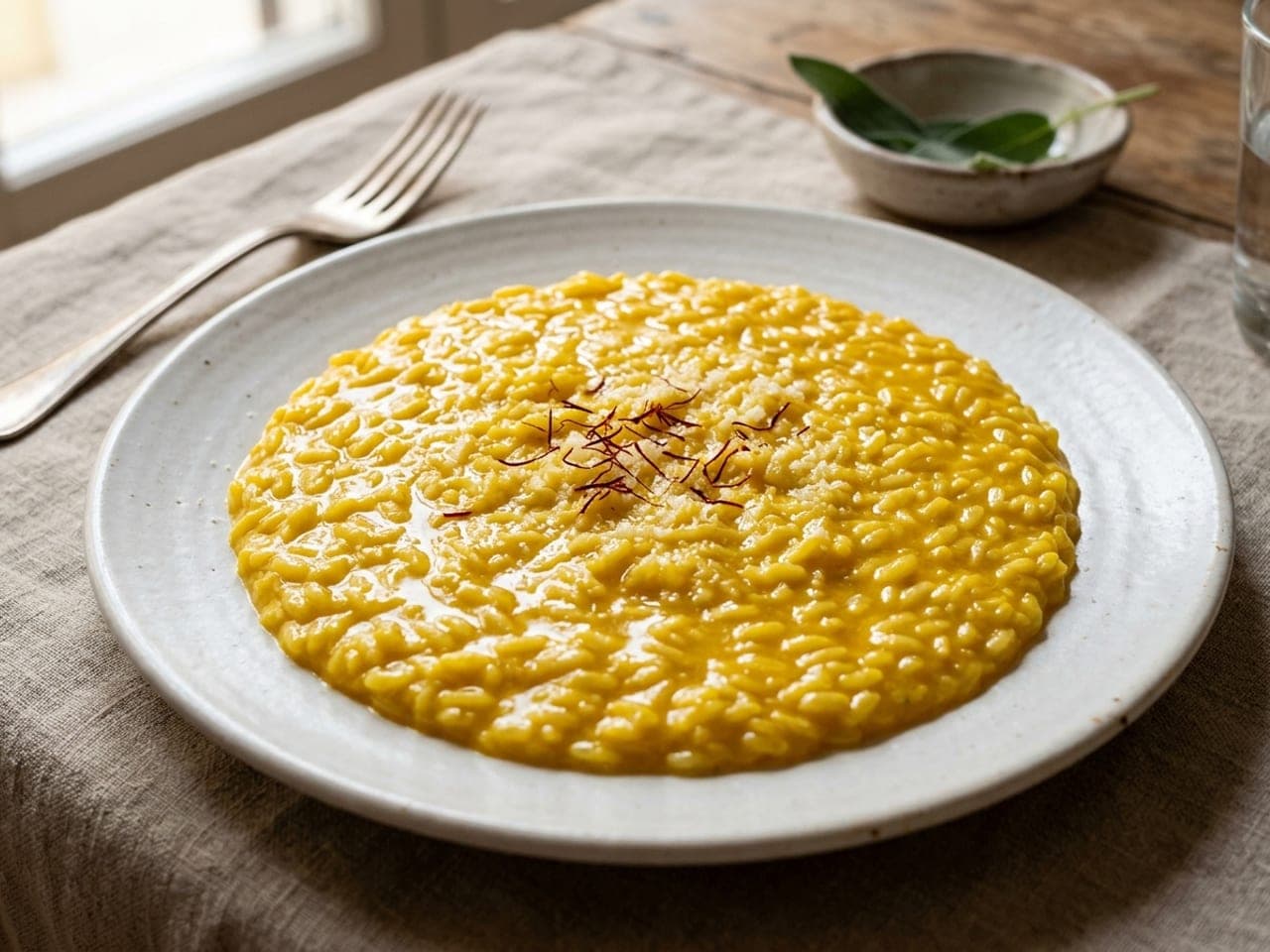
The saffron risotto Milan deposited with its own city hall: beef marrow (and roast drippings if you have them) in the soffritto, real saffron threads bloomed and added at the two-thirds mark, no wine (the deposited recipe bans it as a saffron-killer), and a finish loose enough to wave. Plated flat and leveled with a smack of the palm so it settles all’onda, the texture that document actually specifies.
Ingredients
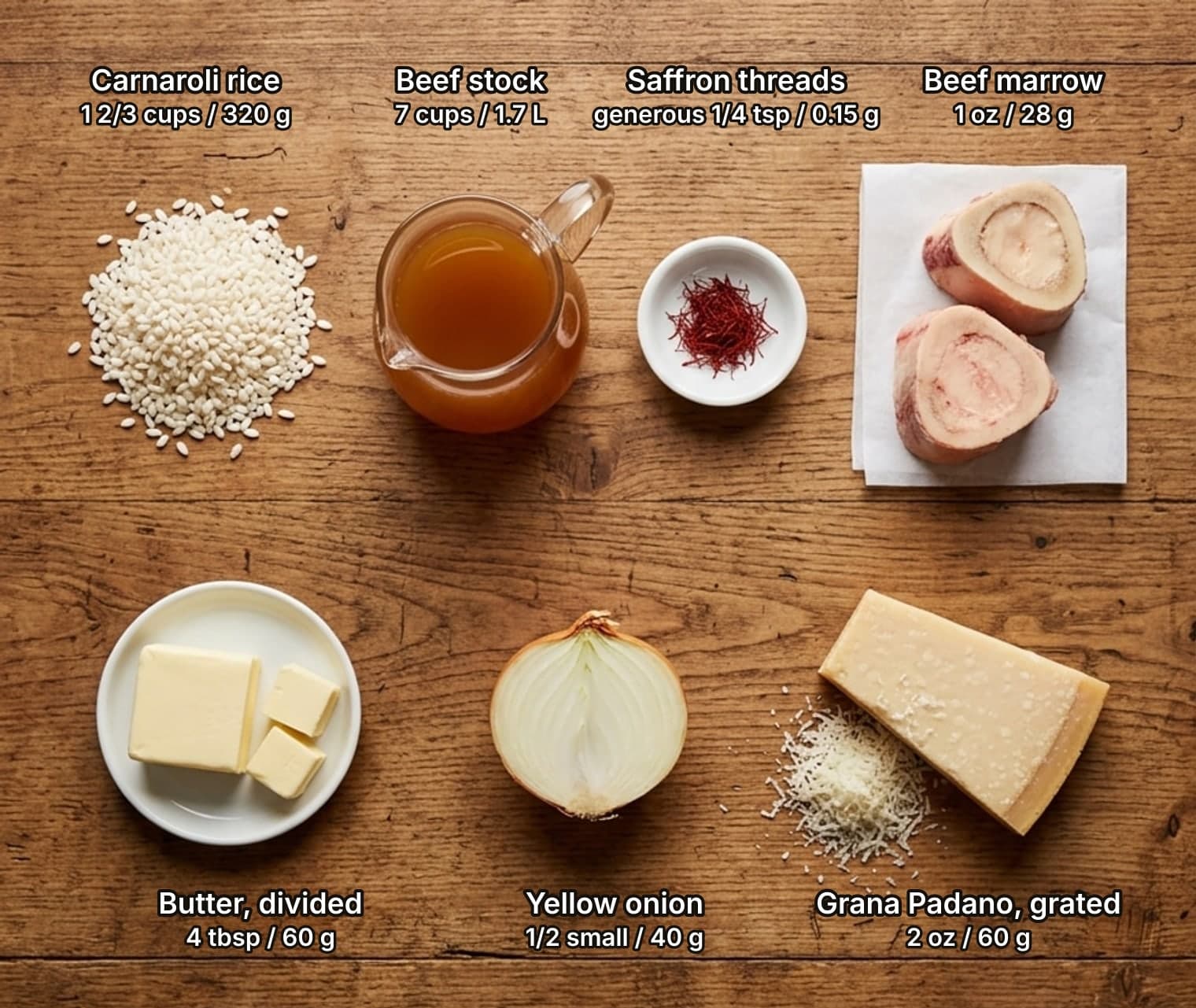
- Carnaroli rice (Vialone Nano or Arborio also work; never rinse risotto rice)1 2/3 cups (320 g)
- beef stock, homemade or low sodium, or half beef half chicken (kept at a bare simmer; not bouillon cubes; check the label for celery, wheat or soy if you are cooking for allergies)7 cups (1.7 L), divided (you will not use it all; heat extra so you never run short)
- saffron threads, ground and bloomed (roughly 70 threads; avoid powder sachets and anything cheap enough to be fake)generous 1/4 tsp (0.15 g)
- beef bone marrow, chopped (optional but canonical; ask the butcher for femur rounds; if skipping, add 1 more tbsp cold butter at the finish)1 oz (28 g)
- beef roast drippings, grasso d’arrosto (optional; in the deposited recipe, and the reason it says to add more marrow when you have none)1 tbsp (15 g)
- unsalted butter, divided: half for the soffritto, half fridge-cold and cubed for the finish (dairy)4 tbsp (60 g)
- small yellow onion, finely chopped1/2, about 1/4 cup (40 g)
- Grana Padano DOP, finely grated, plus more for the table (dairy, and see the allergen note: most Grana Padano contains egg-white lysozyme, which Parmigiano-Reggiano never does)2 oz (60 g)
- fine sea salt (go easy; the broth and cheese carry salt)to taste
- lemon juice or white wine vinegar, stirred in off the heat (optional; the brightness other recipes get from wine; wine vinegar can carry sulphites, lemon juice does not)1/2 tsp
What is a Milanese style risotto?
Risotto alla Milanese is the signature rice dish of Milan: risotto cooked in meat broth, dyed gold and perfumed with real saffron, enriched with beef bone marrow melted into the soffritto, and finished off the heat with cold butter and grated grana cheese. In Milanese dialect it is risott giald, yellow risotto, and it is served loose enough to spread across a flat plate in one slow wave, the texture Italians call all’onda. It is traditionally a primo, a first course on its own, and it is also one of the very few places in the Italian canon where risotto doubles as a side, under osso buco.
The two names on this page are not interchangeable, and Italians police the border. With marrow in the soffritto, and traditionally a spoonful of roast drippings (grasso d’arrosto) beside it, the dish is risotto alla Milanese; without them, what you have made is properly risotto allo zafferano, saffron risotto, still golden, still delicious, but missing the beefy undertow that defines the Milanese original. This page gives you the full version and the honest downgrade path. One boundary further out: saffron rice, the pilaf-style dish where rice steams in saffron liquid, is a different preparation entirely and no amount of stirring turns one into the other.
And it is official in a way almost no dish is. Since 14 December 2007, risotto alla Milanese has held a De.Co. (Denominazione Comunale), a municipal designation granted by resolution of Milan’s city government (the Giunta Comunale, the mayor’s executive board, rather than the elected council), with a codified recipe deposited at the Comune di Milano. It is a recognition, not a law: it protects nobody’s use of the name. Almost no English-language recipe mentions that document, which is a shame, because what it says is genuinely surprising.
How to make Risotto alla Milanese (Saffron Risotto)
- Bloom the saffron first. Measure a generous 1/4 tsp of saffron threads, roughly 70 threads (0.15 g), and grind them to a coarse powder with a small pinch of salt in a mortar, or crush them between two spoons. Warm 1/2 cup (120 ml) of your stock until it is hot to the touch but nowhere near boiling, about 130 to 160°F (55 to 70°C), pour it over the ground saffron, and let it steep 15 to 20 minutes while you do everything else. The why: crocin, the pigment, is water soluble but releases slowly, and grinding exposes more of every thread to the liquid, so the same 0.15 g gives you more color and more flavor. Safranal, the aroma, is volatile and scorches if dry threads hit boiling stock. The glass should turn a deep marigold and keep darkening; that is the color budget for the whole pot.
- Heat the stock and keep it there. Bring the remaining stock, about 6 1/2 cups (1.6 L), to a simmer in a second pot, then drop it to the barest bubble and leave it there, ladle resting in it, next to your risotto pan. Every splash of cold liquid knocks the risotto out of its simmer, which stalls both absorption and starch release and stretches the cook into something gluey, then watery. Taste the stock now: it concentrates as it is absorbed, so an aggressively salty stock becomes an aggressively salty risotto. Homemade beef, or mixed beef and chicken, is the classic choice, though two of Milan’s best known kitchens now use vegetable broth for a cleaner, simpler flavor. If you buy it, buy low sodium, and read the carton if you are cooking for allergies: most commercial stocks and bouillons carry celery, and many carry wheat or soy. The recipe Milan deposited with the city specifies a concentrated boiling broth and pointedly rules out stock cubes, in as many words: “non deve essere di dado”. Heat more than you think you need. Unused stock is cheap; a stalled pan is not.
- Render the marrow, sweat the onion. In a wide, heavy 12-inch (30 cm) sauté pan, melt 2 tbsp (30 g) of the butter with the chopped marrow over low heat. If you have a spoonful of drippings from a roast, the grasso d’arrosto the deposited recipe asks for, add it here. Add the onion and cook gently, 5 to 6 minutes, until translucent and completely soft; do not let anything take color. (The deposited text actually says to cook the soffritto until the onion has taken a golden color; modern practice keeps it pale, and the color of the finished dish is the reason.) The marrow will mostly dissolve into the butter, and that is the point: it seasons the cooking fat itself with a beefy, glossy depth that broth alone cannot supply, which is why the deposited recipe treats marrow and roast fat as defining ingredients rather than garnishes, and tells you to add more marrow if the drippings are missing. Browned onion would push the flavor toward caramel and fleck the gold with brown, so keep the heat honest and low. If you are skipping the marrow, just use the butter; your finished dish will be a saffron risotto in the strict naming, and it will still be excellent.
- Toast the rice (tostatura). Raise the heat to medium and add the rice, unrinsed. Never rinse risotto rice: the loose surface starch you would wash away is the future sauce. Stir to coat every grain in the marrow butter and toast 2 to 3 minutes, until the edges of the grains turn translucent around a chalky white pearl at the center, the pan smells faintly nutty, and a grain lifted out on a spoon is too hot to keep on your fingertip: touch it briefly and drop it. That fingertip test is the classic cue. Toasting sets the surface of each grain so the starch releases gradually across the whole cook instead of dumping at once, keeping the grains distinct inside the cream. Do not push further; over-toasted grains seal shut and then cannot release starch at all. There is no wine deglaze in this method, on purpose. If you cannot imagine risotto without it, add one small splash now and let it evaporate completely before moving on.
- First ladles, one vigorous minute. Add two ladles of simmering stock, about 1 cup (240 ml), pouring at the side of the pan rather than from height, because near-boiling stock hitting a hot pan spits. It will hiss and bubble hard; good. Stir vigorously for a full minute, scraping across the whole floor of the pan. Most of the starch you can coax out of risotto rice sits on the exterior of the grain and releases early in the cook, so this initial agitation is the single most consequential stirring of the entire dish; it starts the cream that everything else builds on. Note the time: from this first addition, Carnaroli wants roughly 16 to 19 minutes of simmering. Keep the heat at a lively simmer, stronger than most recipes admit. Milk Street, watching Max Masuelli cook it at his Milan trattoria, described “dump-and-go risotto cooked at a rollicking boil”, not a timid murmur.
- Cook loose, stir with intent. Keep adding hot stock a ladle or two at a time, whenever the pan starts to look thick rather than soupy, and give the rice a real stir every minute or two with the occasional dramatic fold or flip of the pan to redistribute it. Constant motion is not required; even cooking is. The constant-stir dogma fails every test it has been given: a nearly hands-free covered method, a method that rinses the rice into its own stock and pours the starch back, and the observed practice of Milan trattorie all produce creamy risotto with only occasional stirring, because agitation matters most at the start and at the finish. What nonstop stirring mostly buys is even cooking in a pan that is too small, which is why this recipe asks for a wide one. Begin tasting at minute 14: you are steering toward al dente, a fine white point at the center of the grain with no chalky crunch.
- Saffron at the two-thirds mark. About 12 minutes into the simmer, roughly two-thirds of the way through, pour in the saffron with every drop of its steeping liquid and stir it through. The pan turns pale gold at once and keeps deepening for several minutes as the crocin disperses, so wait before deciding it needs more. The timing is chemistry, not superstition: safranal, the compound that carries saffron’s aroma, evaporates readily above about 160°F (70°C), with roughly a quarter lost after 5 minutes at 194°F (90°C) and more than half after 15. Add saffron at the start and you keep the color but cook off the perfume; add it here and both survive to the plate. The recipe deposited with the Comune di Milano codifies exactly this: pre-dissolved threads at two-thirds of the cooking, and powdered saffron, if that is what you have, only at the very end.
- Mantecatura, off the heat. When the rice is al dente and still distinctly brothy, looser than you think finished risotto should be, pull the pan off the heat. Add the remaining 2 tbsp (30 g) butter, fridge-cold and cubed, and all 2 oz (60 g) of the grated grana, and beat hard with the spoon, or grip the handle and jerk the pan so the rice folds over itself in waves, for a minute or two until glossy; keep the pan flat on the counter or on a low burner while you do it, because hot risotto that leaves the pan does not come off skin quickly. The thermal shock of cold fat hitting hot rice is what tightens the emulsion into velvet; soft butter simply oils out. This off-heat beating is the mantecatura, and it, not cream, is where the creaminess comes from. Lid on, rest 2 minutes so the starch network relaxes, then stir in one last splash of hot stock. If you want the lift other recipes get from wine, this is the moment: stir in 1/2 tsp of lemon juice, or a few drops of white wine vinegar, off the heat. Test a spoonful on a plate: it should slump and spread in one slow wave, what Italians call all’onda. A standing mound is too tight; loosen it. A runny puddle needs a minute uncovered.
- Plate flat, smack the plate, serve now. Ladle onto warmed flat plates, never into deep bowls: a bowl traps steam and carryover-cooks the rice to mush, while a flat plate stops the cook at al dente. Warm the plates under hot tap water and towel them dry rather than heating them in the oven, because of what comes next. Hold the rim with one hand and smack the bottom of the plate once or twice with the flat of your other palm, so the risotto settles into an even, glistening pool that spreads almost to the rim on its own. Shower with more grana at the table; if you want pepper, use white, so the gold field stays unflecked. Risotto waits for no one; it keeps drinking its own sauce as it stands, so the table should already be sitting when the first plate lands. A serving note, ours rather than Milan’s: eat it with a fork, working from the edge inward, because the rim cools first.
Safety & hygiene Important
- The cooked-rice clock, US rules. Cooked rice is the classic Bacillus cereus food: the spores survive cooking, and at room temperature they germinate into bacteria that multiply and produce cereulide, a toxin that is heat stable, meaning no amount of reheating rescues rice that sat out too long. USDA guidance: refrigerate leftovers within 2 hours (1 hour if the room is above 90°F / 32°C), keep them at or below 40°F (4°C), use within 3 to 4 days, and reheat to 165°F (74°C). Spread leftover risotto shallow in a container so it cools fast; do not leave the pot out through dinner.
- The cooked-rice clock, UK rules. The UK Food Standards Agency runs a stricter clock for rice: cool it within 1 hour of cooking, refrigerate at 41°F (5°C) or below, eat within 24 hours, and reheat only once, until steaming hot all the way through. The two regimes do not actually agree with each other, since the USDA allows 3 to 4 days and the FSA allows one, but for risotto al salto, the Milanese leftover fry-up, tradition lands inside the stricter of the two clocks anyway: chill the risotto fast tonight, fry it tomorrow, reheat it exactly once. If you are following the UK rule, tomorrow is the deadline, not a suggestion.
- Raw marrow handling. Treat raw bone marrow like the raw beef it is. Keep it refrigerated, and if you are purging it (a 12 to 24 hour soak in salted water to draw out blood), do that soak in the refrigerator, never on the counter, and pour the soaking water away afterwards. Use a separate board and knife for the raw bones and marrow, then wash your hands for 20 seconds with hot soapy water and wash the board, knife and spoon, before any of them touch the cheese or the finished plates. In this recipe the marrow is fully cooked: it renders into the butter over direct heat in the soffritto and then simmers with the rice for the rest of the cook, so there is no separate precaution to take for pregnant, elderly or immunocompromised eaters. The risk to manage is the raw handling above, not the finished dish. If you would simply rather not, the butter-only version is a complete recipe.
- Saffron and pregnancy. Culinary pinches of saffron are generally considered fine in pregnancy; the documented concerns are about gram-level medicinal doses. Around 5 g is where toxic effects are reported, and 10 g and above is the range used historically as an abortifacient, with a real risk of maternal death. The standard toxicology phrasing is that amounts larger than those found in food are likely unsafe in pregnancy. For scale: this whole pot uses 0.15 g across 4 servings, about 0.04 g per person, roughly a hundred times below the lower of those two thresholds. If you have specific concerns, ask your doctor.
- Two allergens that hide in plain sight. Neither of the allergens most likely to catch you out on this page is in the obvious place. The first is egg, in the cheese: Grana Padano DOP’s production standard permits hen egg-white lysozyme (E1105) as a preservative and most wheels contain it, which EU and UK labels declare as an egg allergen and a US import carrying it must declare too. Parmigiano-Reggiano’s standard bans all additives, so it never contains it, and Trentingrana and several grated products sold as senza lisozima are lysozyme free. (Provocation-test studies have found egg-allergic children tolerate lysozyme-containing Grana Padano, so treat this as a label question rather than an alarm.) The second is the broth, which is the largest ingredient here by volume: most commercial stocks and bouillons carry celery, and many carry wheat or soy, so read the carton. If you take the optional wine or wine-vinegar route, both can carry sulphites; lemon juice is the clean alternative. Butter and both grana cheeses are dairy, and the dish is not vegetarian on three counts: beef marrow, beef broth, and animal rennet in the cheese.
3 ways to plate it
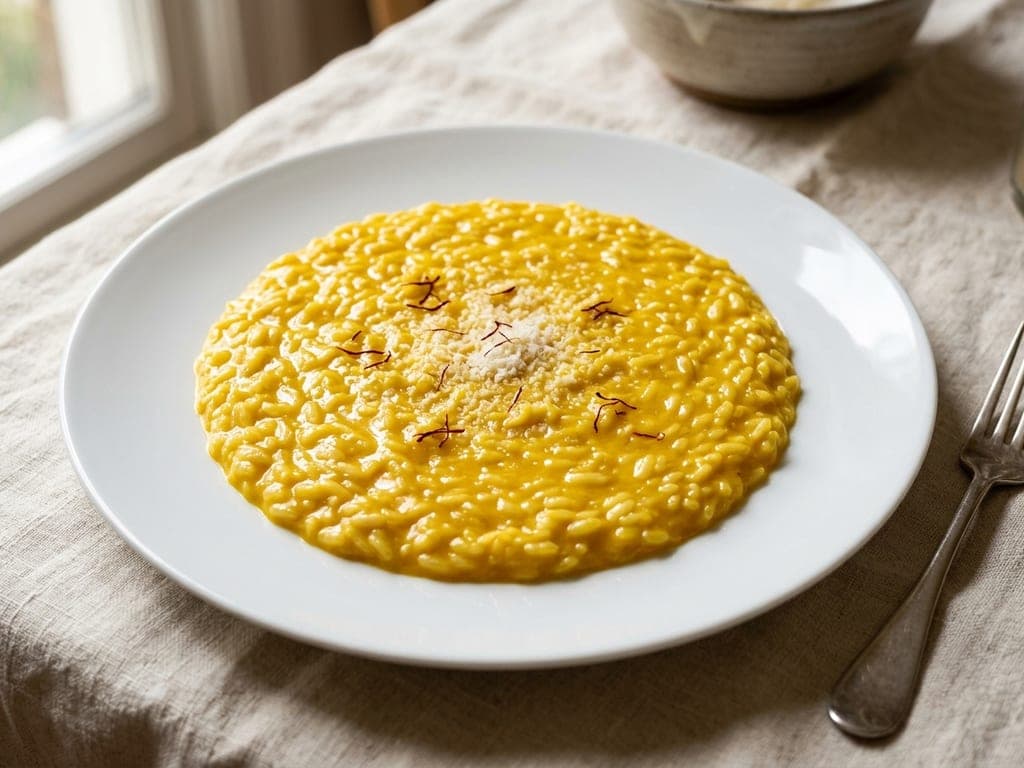
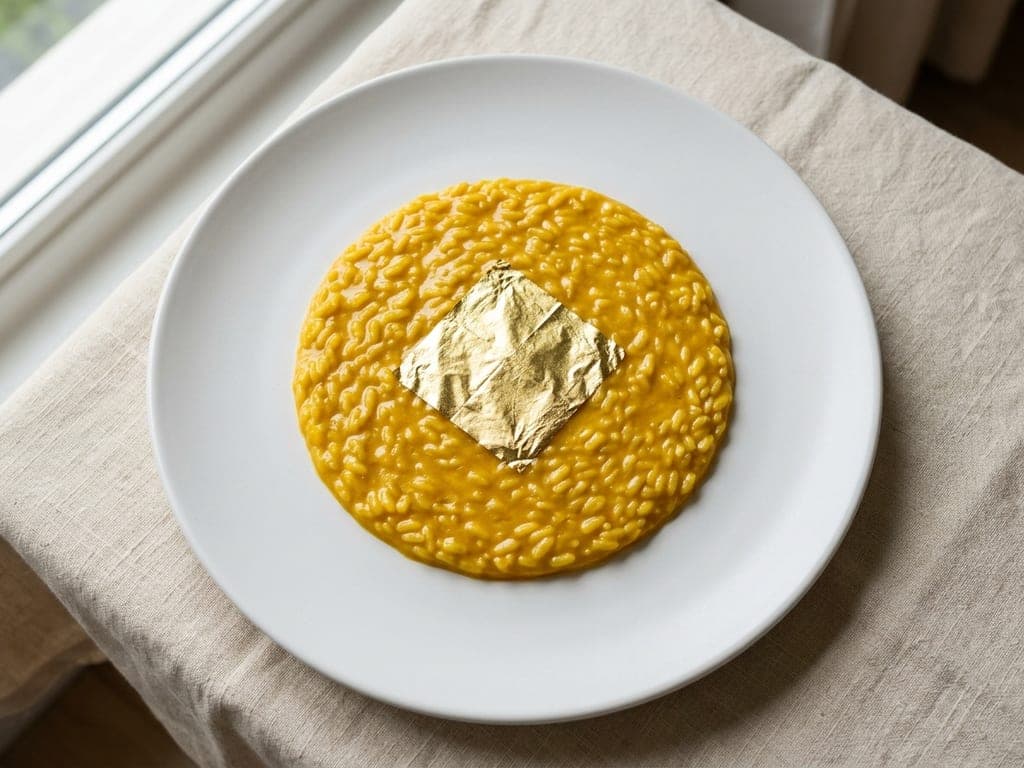
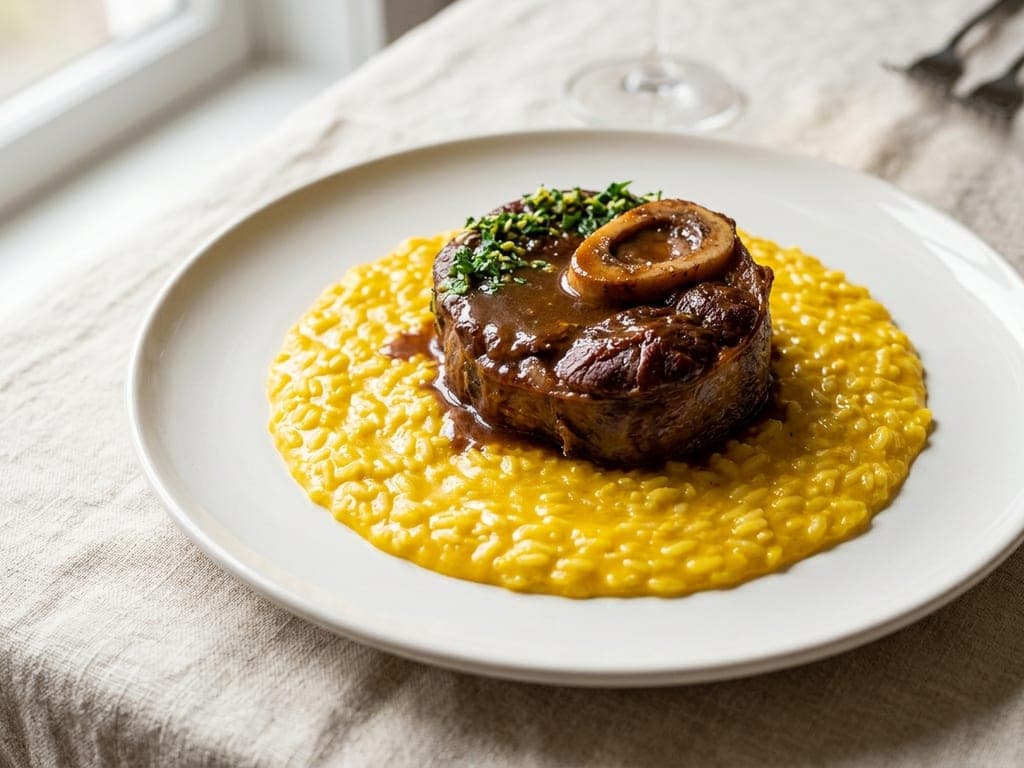
No wine: the recipe Milan actually deposited
Nearly every famous version of this dish starts the same way: toast the rice, splash in dry white wine, let it evaporate. The recipe Milan deposited with its own city government does not. As reported by the Italian sources that transcribe it, the deposited text forbids wine outright, warning that it “ucciderebbe il profumo dello zafferano”, it would kill the saffron’s perfume. The same spec calls for minced beef marrow and beef roast fat (grasso d’arrosto) in the soffritto, with the instruction to add more marrow if the drippings are missing; a concentrated boiling broth that “non deve essere di dado”, never from a stock cube; “abbondante formaggio grana grattugiato”, abundant grated grana; and saffron pistils dissolved in broth beforehand and added around two-thirds of the way through the cook. (Honesty note: the city has not published the delibera’s primary text online, and secondary reports disagree on details, so we hold to the qualitative spec and quote no contested quantities from it.)
The no-wine position has serious company in Milan. Gualtiero Marchesi, the most influential Italian chef of the last century, kept wine in his risotto but moved it out of the soffritto: in his own description the dish is made “alla rovescia”, in reverse, with the onion cooked separately and doused with white wine and vinegar, that liquid strained off and worked into butter, and the resulting acid butter folded in only at the mantecatura, acidity under control, saffron untouched. (His published recipe still gives the rice one small splash of white wine, 5 cl or about 3 1/2 tbsp, so this is a relocation rather than an exorcism.) Diego Rossi of the acclaimed Milan trattoria Trippa skips wine altogether and finishes with a few drops of sherry vinegar, on the argument that wine leaves a booziness that muddles the other flavors. Cooking this dish without wine is therefore not a compromise: it is the version the city itself deposited, and it has real support among Milan’s own cooks. Milanese practice is genuinely split, though, and the counter-evidence is Milanese too. The culinary historian Eugenio Medagliani wrote that the distance between the “with wine” and “without wine” parties has narrowed and that wine, white above all, now enters almost every risott giald; Aimo Moroni’s famously dogmatic definition of the dish includes a glass of it; and at least one published rendering of the “official” De.Co. recipe puts the wine back in.
So if you came here searching for a risotto without wine: this is it, on the authority of the city that owns the dish. Skip the deglaze, go straight from toasted rice to hot broth, and if you miss the brightness, stir 1/2 tsp of lemon juice or a few drops of white wine vinegar in at the end, off the heat. In other risotti, replace the 1/2 cup (120 ml) of wine with the same volume of broth plus 1 to 2 tsp of lemon juice or white wine vinegar, added off the heat. Here, skipping is not the workaround; wine is.
Saffron: the dose, the timing, and the fakes
The dose for four servings is smaller than most cooks fear: 0.10 to 0.15 g of threads, roughly 45 to 70 threads, a generous 1/4 tsp, for 1 2/3 cups (320 g) of rice. That is a deliberately restrained dose, not a ceiling: the codified Milanese specs run 0.2 to 0.5 g for four, and Marchesi’s own recipe goes well past that. Somewhere above about 0.5 g, picrocrocin bitterness starts to shoulder past the butter and cheese. Grind the threads and steep them 15 to 20 minutes in warm, never boiling, liquid at about 130 to 160°F (55 to 70°C): the color compound, crocin, is water soluble and releases slowly, and grinding exposes more of it. Dry threads tossed into boiling stock scorch their own perfume.
Timing is where the famous recipes quietly contradict each other: one blooms saffron in the wine and adds it at the start, another stirs it unbloomed into the stock, a third steeps it and adds it at the very end. The chemistry settles the argument. Crocin survives cooking, but safranal, the aroma, evaporates above about 160°F (70°C), losing roughly a quarter of itself in 5 minutes at 194°F (90°C) and more than half in 15. Early saffron gives you a risotto that looks the part and smells like less. The deposited Milanese recipe splits the difference exactly where the numbers point: bloomed threads at two-thirds of the cook, powder only at the last moment.
Now the consumer-protection section no recipe page runs. Real saffron takes about 150,000 hand-picked crocus flowers per kilogram, three stigmas per flower, which also tells you what a thread weighs: roughly 450 to 550 threads to the gram, so the 0.15 g here is about 70 of them, not the dozen or two that some recipes imply. That labor is the price: expect roughly $8 to $25 per gram at retail. Under about $5 per gram, be suspicious; under $2, you are almost certainly buying dyed safflower, corn silk, or colored fibers. Check for an ISO 3632 rating and look for the crocin coloring-strength number (Category I means an absorbance reading of at least 190) rather than trusting “Grade A” marketing. And run the water test at home: real threads bleed gold slowly over 15 minutes or more while staying red themselves; crude fakes dump red color instantly and go pale. It is a filter, not a certificate. It catches dyed fibers, but not genuine stigmas bulked out with safflower or floral waste, and not real saffron dyed to boost its color, which is the fraud regulators actually chase; an ISO 3632 certificate from a seller willing to show you one is worth more than any kitchen test. Turmeric is not a substitute. It makes yellow rice, pleasant and entirely different, with none of saffron’s hay-and-honey perfume.
What rice for risotto, and how much stirring, really
Any true risotto rice works; three are worth knowing. Carnaroli, the first choice of this page and of most Milanese kitchens, carries more amylose (about 25 percent against Arborio’s high teens), so each grain holds its shape and gives you a forgiving 3 to 4 minute window at al dente. Arborio, the supermarket standby, is the creamiest and the least forgiving: it slides from al dente to mush in a minute or two. Vialone Nano, the small plump Veneto grain, drinks the most broth and suits the loosest all’onda styles. What never works is long-grain rice, basmati or jasmine: without that clinging outer layer of amylopectin there is no sauce, only soup with rice in it. And never rinse any of them; risotto inverts the usual rice rule, because the surface starch is the cream.
One myth to retire while we are here: there is nothing ancient about “traditional Carnaroli.” The variety was bred in 1945 on a farm near Paullo in Milan’s own province and registered in 1974, and Arborio dates from the same era. Every risotto cooked before the Second World War used older varieties. Choose Carnaroli because it works, not because 1829 did.
As for the stirring: the stand-and-stir sermon fails every controlled test it has been given. America’s Test Kitchen’s almost-hands-free method adds most of the broth at once, covers the pan, and stirs about twice. J. Kenji López-Alt’s Serious Eats method rinses the raw rice in its own measured stock, reserves that starchy liquid for the finish, and stirs only occasionally in between. And Milk Street’s reporter, watching Max Masuelli work at his Milan trattoria, found him running risotto at a rollicking boil with a bit of stirring and some dramatic pan flips, twenty minutes and done. The mechanism is simple: most extractable starch sits on the grain’s exterior and releases early, so the vigorous initial stir matters enormously and the middle of the cook mostly needs even heat and an attentive cook, not a tired arm. Stir with intent at three moments, after the first ladles, at the mid-cook checks, and hardest of all at the mantecatura, and let the wide pan do the rest.
Honest timing, while we are being honest: the famous “18 minutes” clock starts at the first ladle of broth. Start to plate, count 38 to 46 minutes: 10 to 15 to bring stock to a simmer, about 8 for soffritto and tostatura, 16 to 19 of simmering, and 4 for the mantecatura and rest. The saffron blooms while the stock heats, so it costs you nothing.
Marrow, cervellata, and two centuries of fat
Is marrow required? The honest answer is that both hard-line positions are false, and the record proves it. The earliest printed recipe yet identified, “riso giallo in padella” in the anonymous Milanese cookbook Il cuoco moderno (1809), fries the rice in butter with onion and cervellata, Milan’s medieval sausage, itself tinted yellow with saffron, and, in some transcriptions of it, marrow. Giovanni Felice Luraschi’s Nuovo cuoco milanese economico (1829), the earliest book known to name the dish, keeps beef fat, marrow and half a cervellata, plus a little nutmeg (the text everyone quotes is transcribed from the book’s 1853 printing). Pellegrino Artusi’s great manual, first published in 1891 and expanded by Artusi himself through 1911, dropped the sausage and made even the marrow optional: of the three risotti alla milanese he ended up printing, only the second uses it, and that marrow-and-wine version entered only with the seventh edition. The nutmeg quietly died out too. So “it was always just butter” is wrong, and so is “no marrow, no Milanese”; the marrow is the surviving marker of a much heavier original, canonized in the 2007 deposited recipe, and skipped in home kitchens since Artusi.
What the marrow actually does: it is almost pure fat, largely monounsaturated, and it melts into the soffritto to give the dish a glossy, beefy undertow that butter alone cannot fake, at about 110 kcal per tablespoon (14 g). The deposited recipe pairs it with grasso d’arrosto, the fat and juices left by a roast, and says to add more marrow if you have no drippings; if a roast has been through your oven this week, a spoonful of what it left behind is the most authentic thing you can put in this pan. Sourcing the marrow is the only hard part, and it is not very hard: ask a butcher for beef femur or shank marrow bones cut crosswise into rounds, or split lengthwise into canoes. Soak them 12 to 24 hours in salted water in the refrigerator to purge blood, then scoop the marrow out with a small spoon; it comes free easily if slightly tempered. Rinse the cut bones and run a finger over the scooped marrow before you chop it: bandsawn bones shed bone dust and the occasional splinter, and neither dissolves in the soffritto. A brief roast, 400°F (200°C) for about 5 minutes, loosens it too, though that is not long enough to cook it through. One ounce (28 g) covers the whole pot.
Skip it, and add an extra tablespoon of cold butter at the mantecatura to make up the richness; call the result risotto allo zafferano and no Italian will argue. Or run the roasted variant: roast the bones hard, 450°F (230°C) for 10 to 15 minutes, and use the roasted marrow in place of butter at the finish, which trades subtlety for a deep, almost braise-like savor.
From gilded banquets to gold leaf: a history you can date
The story everyone tells: in 1574, at the wedding of the daughter of Valerio di Fiandra, a Flemish master glazier working on the stained glass of Milan’s Duomo, an apprentice nicknamed Zafferano, for the saffron he snuck into his glass pigments, tinted the wedding rice gold as a joke, and the joke became the dish. It is a wonderful story, and it should be told as a story. The Duomo’s own custodians tell it with every hedge in the book, the manuscript that supposedly records it has never surfaced with so much as a shelfmark, and Alberto Grandi, who teaches food history at the University of Parma, calls the origin tale “un’origine affascinante, ma totalmente inventata”, a fascinating origin, but a completely invented one. Saffron was never a glass pigment in the first place: the yellow in a Renaissance window comes from silver stain, not from a spice. And the trail of the legend itself stops in the twentieth century rather than the sixteenth. It appears to reach print for the first time in Otto Cima’s Milano vecchia (1931), and it owes its fame to the Ente Nazionale Risi, which recycled it through the 1930s in a rice-promotion booklet. The glazier himself was real (Valerio Profondavalle of Leuven, 1533 to about 1600, is documented in Milan), which is exactly how good legends work: true man, invented risotto, and a ninety-year-old story about a four-century-old dish.
The dated record is better than the legend anyway. Rice growing in the Duchy of Milan is documented from 1475, when Duke Galeazzo Maria Sforza sent twelve sacks of rice from his estate at Villanova di Cassolnovo, in the Lomellina, to the Duke of Ferrara: the first firm evidence of rice cultivated in the Po plain. Saffron-yellow rice was on Lombard tables by 1570, when Bartolomeo Scappi printed a “vivanda di riso alla lombarda” yellowed by cervellata, Milan’s saffron sausage, in the very decade the legend claims to explain. Then a gap of roughly 235 years between the legend’s date and the first printed recipe for the dish itself: not silence about yellow rice, which never stopped, but silence about the risotto. That recipe surfaces in 1809, the name “risotto alla milanese” in 1829 (one ranking English history page prints that date as 1929, a full century off), and Artusi’s manual, published in 1891 and grown by its author through 1911, ends up offering three variants while bowing to the source as he introduces the third: “senza la pretensione di prender la mano ai cuochi ambrosiani”, without presuming, he said, to outdo the learned and ingenious Ambrosian cooks. In 2007 the city closed the file and deposited an official recipe.
The gold thread runs through all of it. Sforza-era Milanese banquets gilded food with actual gold leaf, and saffron’s yellow read in the same register, the gold you could afford by the pinch. (That reading is ours, and it is worth saying so: no period cook wrote down that saffron stood in for gold.) Which is why the most famous plate of the modern era reads as a homecoming: in 1981, at his Milan restaurant, Gualtiero Marchesi laid a single square of edible gold leaf on a disc of saffron risotto and called it Riso, oro e zafferano, describing his own reason as “il gesto meditato e casuale di sovrapporre un quadrato a un cerchio”, the considered and casual gesture of laying a square over a circle. No cream, no pilaf trick, whatever the retellings claim; his documented recipe builds its creaminess from broth, starch, a little Parmigiano, and that sieved acid butter. “Riso, oro e zafferano è nato sia dalla piena consapevolezza dei propri mezzi sia dal piacere di osare,” he wrote in December 2017, weeks before his death: the dish was born as much from full awareness of his own means as from the pleasure of daring. From 2018 his foundation even issued numbered certificates to diners, starting at 100,001, one for every plate after the roughly hundred thousand served since 1981. Five centuries of Milanese cooking, and the plate ends where the banquets began: gold on gold.
What is risotto alla Milanese served with?
Classically, with osso buco alla milanese. Riso e ossobuco is the canonical pairing and a small structural miracle: it is one of the very few places in traditional Italian cooking where risotto works as a side dish. It is also a rhyme, because the marrow appears twice, melted into the rice and standing in the braised veal shank’s own bone (osso buco means “bone with a hole”), while the gremolata on the meat, raw lemon zest, parsley, and garlic, is the acid that keeps the double richness from going heavy. If you make one addition to this recipe, make it that braise. Otherwise the risotto stands happily alone as a primo, or alongside cotoletta alla milanese and other roasted or braised meats; pour an earthy, medium-bodied Italian red either way.
Serve it on warmed flat plates, never in bowls. A deep bowl traps heat and carries the rice past al dente into mush; a flat plate stops the cook. Warm the plates under hot water rather than in the oven, because you are about to hit them with the flat of your hand: ladle into the center and level it the Milanese way, smacking the bottom of the plate with your palm until the risotto lies in an even, glistening pool. Eat from the edge inward with a fork; the rim cools first.
And plan your leftovers on purpose, because the day-after dish is a Milanese institution of its own: risotto al salto. Chill the risotto fast, then tomorrow press it into a buttered nonstick pan about 1/2 inch (1.25 cm) thick and fry it undisturbed in butter about 5 minutes per side, flipping it with the help of a flat plate, until it forms a crackling golden crust around a creamy saffron center. It is a reheat, so treat it as one: the cake has to be steaming hot all the way through, 165°F (74°C) at the center, and a crisp crust over a cool middle does not count. Keep it thin, and finish it over lower heat if the crust is ready before the center is. Born as thrifty home cooking, it was consecrated in the early 1970s at Savini in the Galleria, served to the after-theatre crowd from La Scala. (Sicily has its own saffron-rice cousin in arancini, cooked for the purpose rather than made from leftovers, and worth its own page.) Mind the rice clock in the safety notes: chill fast, eat within the window, reheat once.
Questions, answered
What is a Milanese style risotto?
Risotto alla Milanese is Milan’s signature risotto: rice toasted in a soffritto of butter, onion, and beef bone marrow, simmered in concentrated broth, colored and perfumed with real saffron threads added late in the cook, and finished off the heat with cold butter and grated grana cheese. Its dialect nickname is risott giald, yellow risotto. The correct texture is all’onda, loose enough that it spreads across a flat plate in a slow wave, and since 2007 the recipe has been officially codified as a De.Co. (municipal denomination) by resolution of Milan’s city government, the Giunta Comunale. Without the marrow it is properly called risotto allo zafferano, saffron risotto.
How to cook risotto alla Milanese?
For 4 servings: 1) Grind a generous 1/4 tsp (0.15 g) saffron threads and steep 15 to 20 minutes in 1/2 cup (120 ml) warm stock. 2) Hold 6 1/2 cups (1.6 L) beef stock at a bare simmer. 3) Sweat 1/2 small chopped onion with 1 oz (28 g) chopped marrow in 2 tbsp (30 g) butter over low heat. 4) Toast 1 2/3 cups (320 g) Carnaroli rice 2 to 3 minutes until pearl-centered and too hot to touch; no wine (the deposited Milanese recipe bans it). 5) Add hot stock in generous ladles, stirring vigorously for the first minute and then with intent every minute or two, 16 to 19 minutes total. 6) Stir in the saffron and its liquid at the two-thirds mark, about minute 12. 7) Off the heat, beat in 2 tbsp (30 g) cold butter and 2 oz (60 g) grated grana, rest 2 minutes under a lid, loosen with a last splash of stock, and serve on warmed flat plates.
What is risotto alla Milanese served with?
The classic partner is osso buco alla milanese: riso e ossobuco is one of the very few traditional Italian plates where risotto plays the side dish, the shank’s marrow bone echoing the marrow in the rice while the lemon-zest gremolata cuts the richness. It is just as traditional on its own as a primo, or with cotoletta alla milanese and other roasted or braised meats, with an earthy, medium-bodied Italian red in the glass. Leftovers become risotto al salto, the crisp-fried Milanese rice cake, which is a reheat: fry it thin and get it steaming hot right through, 165°F (74°C) at the center.
What are some common mistakes to avoid when making risotto milanese?
The Milanese-specific list: 1) Fake or substituted saffron; turmeric and “saffron flavoring” make yellow rice, not this dish, and real threads under about $5 per gram are usually dyed fibers. 2) Adding saffron at the start, which cooks off the volatile aroma and keeps only the color; bloom it and add at the two-thirds mark. 3) A heavy wine reduction; the city’s deposited recipe bans wine entirely as a saffron-killer. 4) Rinsing the rice or using long-grain varieties; the surface starch is the sauce. 5) Adding cold stock, which stalls the simmer and the starch release. 6) Doing the mantecatura on the heat with soft butter; it must be off heat with cold butter or the emulsion oils out. 7) Cooking it stiff and serving it in cold bowls; it should wave on a warm flat plate and go to the table immediately.
Can you make risotto without wine?
Yes, and for risotto alla Milanese that is arguably the most authentic way: the recipe deposited with the Comune di Milano forbids wine outright, reasoning that it would kill the saffron’s perfume, and Milanese chefs like Diego Rossi of Trippa skip it too (plenty of other Milanese kitchens do splash it in, so the city is not unanimous). Go straight from the toasted rice to hot broth. If you want the brightness wine provides, stir in 1/2 tsp lemon juice or a few drops of white wine vinegar at the end, off the heat. In other risotti, replace the 1/2 cup (120 ml) of wine with the same volume of broth plus 1 to 2 tsp of lemon juice or white wine vinegar, added off the heat.
What rice is best for risotto?
Carnaroli is the first choice: higher amylose (about 25 percent) means the grains hold their shape and give you a forgiving 3 to 4 minute al dente window. Arborio, the easiest to find, is creamiest but tips from al dente into mush in a minute or two. Vialone Nano suits the loosest, wave-textured risotti. Avoid long-grain, basmati, jasmine, or brown rice; without the clinging surface starch of Italian risotto varieties you get soup, not cream. And never rinse risotto rice, whatever the bag says.
Do I need bone marrow, and what is the dish called without it?
Marrow is the defining ingredient of the true Milanese version, listed as such by the 2007 deposited recipe (alongside grasso d’arrosto, the drippings from a roast) and traceable in the early sources back to the 1820s, and in some readings of the 1809 recipe, but home cooks have skipped it since Artusi, whose marrow-free variants have been in print since 1891. Without it, the dish is properly risotto allo zafferano, saffron risotto. Skipping the marrow does not make the dish vegetarian: the broth is beef, and both grana cheeses are made with animal rennet. To skip it, add an extra tablespoon of cold butter at the finish. To include it, ask a butcher for beef marrow bones cut into rounds, soak 12 to 24 hours in salted water in the fridge, and scoop out the marrow; 1 oz (28 g) covers the pot.
Grana Padano or Parmigiano-Reggiano?
Both work, and the deposited recipe asks only for “abbondante formaggio grana grattugiato”, abundant grated grana. Grana Padano is the grana of the whole Po plain, Lombardy very much included; Parmigiano-Reggiano comes from a tighter zone centered on Parma, Reggio Emilia and Modena, plus part of Mantua (which is in Lombardy) and part of Bologna. In the pan, Parmigiano (matured at least 12 months by law, usually sold at 24) is drier, sharper, and slightly denser in the bind; Grana (sold from 9 months) is milder, a touch sweeter, melts a little more easily, and costs less. One allergen difference settles it for some households: Grana Padano’s standard permits hen egg-white lysozyme (E1105) as a preservative and most wheels contain it, declared on EU and UK labels as an egg allergen, while Parmigiano-Reggiano’s standard bans all additives, so it never does. Provocation-test studies have found egg-allergic children tolerate lysozyme-containing Grana Padano, but if egg is off the table in your kitchen, buy Parmigiano-Reggiano, Trentingrana, or a wheel labeled senza lisozima. Otherwise use whichever is in your refrigerator, freshly grated.
How many calories are in risotto alla Milanese?
About 545 per serving as a primo, and unlike the published counts for this dish, which run anywhere from 317 to 834, you can check the math: 2.8 oz (80 g) dry rice per person at about 3.6 kcal per gram is 288; 1 tbsp (15 g) total butter is 108; 1/2 oz (15 g) grana is 60; about 1/4 oz (7 g) marrow is 55; the absorbed cup (240 ml) of broth adds 15 to 40; onion and saffron round it out with about 5. Total: roughly 530 to 560. The number that really swings is sodium: around 450 to 550 mg with unsalted homemade broth, but roughly 900 to 1,150 mg with regular commercial broth and the salted cheese, so the broth choice, not the cheese, decides whether this is a moderate or high sodium plate. For comparison, Alessi’s boxed Risotto alla Milanese Style mix lists 710 mg sodium and 0 g fat per dry serving; the zero fat advertises exactly what is missing, no marrow and no mantecatura.
Is saffron safe during pregnancy?
In culinary amounts, saffron is generally considered fine. The documented risks concern gram-level medicinal doses far beyond cooking: around 5 g is where toxic effects are reported, and 10 g and above is the range used historically as an abortifacient, with a real risk of maternal death. Toxicology references phrase it as “amounts larger than found in food are likely unsafe” in pregnancy. This recipe uses 0.15 g across 4 servings, about 0.04 g per person, roughly one hundred times below the lower of those thresholds. If you have specific concerns, ask your doctor, but a plate of risotto alla Milanese is not a medicinal dose.
Can I use turmeric instead of saffron?
No, not for this dish. Turmeric delivers a similar gold color but an earthy, gingery flavor with none of saffron’s hay-and-honey perfume; what you would make is yellow rice, pleasant but unrelated. Saffron is also less expensive per pot than its reputation suggests: at typical retail prices the 0.15 g this recipe needs costs roughly one to four dollars. Buy threads rather than powder (powder is the main adulteration vector), check for an ISO 3632 crocin rating, and be suspicious of any “saffron” priced under about $5 per gram.
Snap your finished plate and let the AI plate it again — more beautifully.