Cacio e Pepe Recipe (the Roman Way, Without the Clumps)
Cacio e pepe is Rome’s three-ingredient dare: pasta, Pecorino Romano and black pepper, bound into a creamy sauce by nothing but starchy cooking water and technique. Most attempts fail in the same thirty seconds — the cheese seizes, the pan goes grainy, and dinner becomes a lump — because there is no cream, butter or egg to catch you. This page is about the physics of not letting that happen: a cheese paste built off the heat, a pepper infusion, and, if you want certainty, the measured-starch method Italian physicists published in 2025.
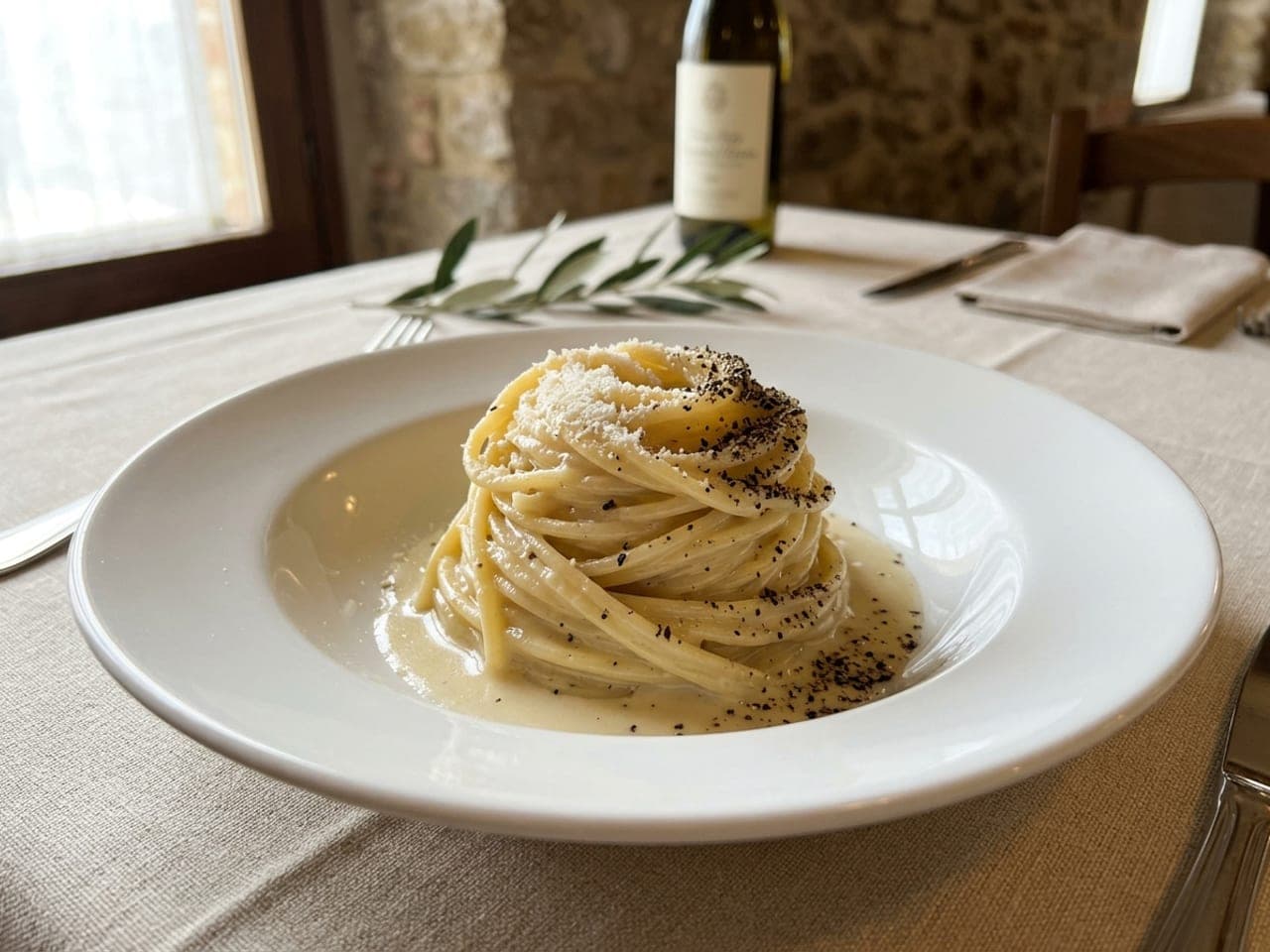
Ingredients
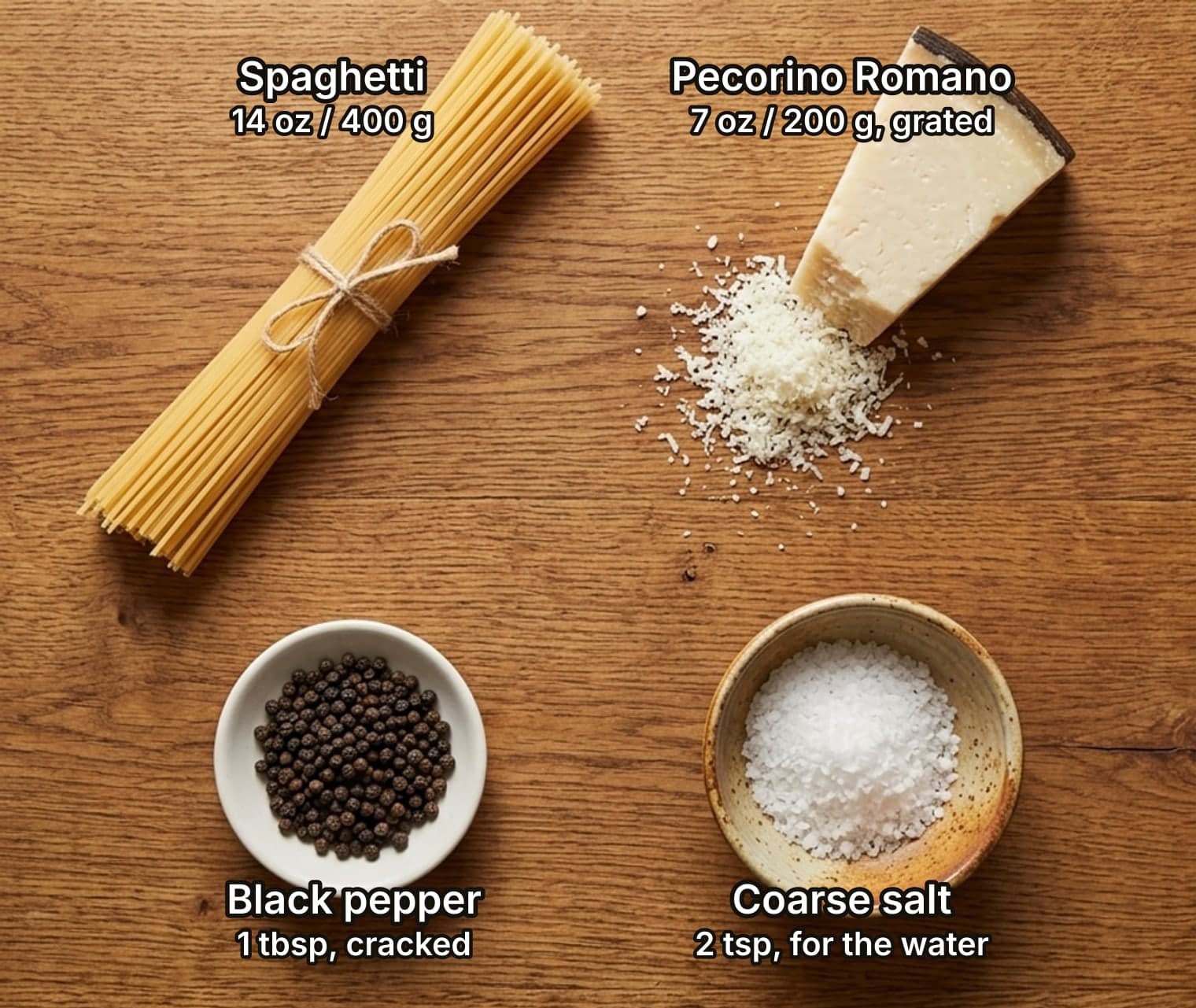
- spaghetti or tonnarelli — bronze-cut spaghetti is the reliable choice; its rough, floury surface holds the emulsion. Tonnarelli (fresh square-cut egg pasta, the Roman classic) if you can get it14 oz (400 g)
- Pecorino Romano, finely grated to a powder on a microplane — buy a wedge and weigh it; pre-grated cheese is coated in anti-caking cellulose and will not melt into a sauce. Made with lamb rennet, so the dish is not strictly vegetarian7 oz (200 g), plus more for serving
- black peppercorns — whole, toasted in a dry pan and cracked coarse; a named ingredient, not a garnish. Half goes into the sauce, half on top1 tbsp
- coarse salt (kosher salt), for the pasta water — a third of the usual amount; Pecorino Romano is one of the saltiest cheeses made and it is doing the seasoning2 tsp (about 10 g)
- water, for the pasta — deliberately less than the package says: a smaller pot makes starchier water, and starch is the only thing holding this sauce together2 1/2 quarts (2.4 liters)
- optional insurance: potato starch or cornstarch (cornflour), dissolved in 1/3 cup (80 ml) cold water — the measured-starch method from the 2025 physics paper, and the gluten-free cook’s best friend1 1/2 tsp (4-5 g)
What cacio e pepe is, and why three ingredients are harder than ten
Cacio e pepe is, literally, ‘cheese and pepper’: pasta tossed with finely grated Pecorino Romano, coarsely cracked black pepper and some of its own starchy cooking water until a creamy sauce forms and clings to the strands. That is the entire dish. There is no butter, no oil, no cream and no garlic in the Roman version — the creaminess is an emulsion the cook builds in the pan, and it exists for about two minutes before it begins to set.
It is also, by common Roman consent, the easiest of the city’s pastas to ruin. Carbonara gives you egg yolk — lecithin, a born emulsifier — to hold the sauce together. Gricia and amatriciana give you rendered guanciale fat. Cacio e pepe gives you nothing: cheese proteins, water and heat, with only the starch from the pasta water standing between you and a clumped, greasy failure. That is why a search for an easy version so often leads to a different dish — butter and cream make the emulsion nearly unbreakable, and they are not what the name describes.
This page follows the same doctrine as our carbonara: understand the emulsion and the dish becomes reliable. The levers here are the same three — temperature, starch, agitation — turned further, because there is no safety net under them.
How to make Cacio e Pepe
- Grate the cheese to a powder, and toast and crack the pepper. Grate 7 oz (200 g) of Pecorino Romano on a microplane into a fine, fluffy powder, plus a small extra handful beyond that for serving — this matters more here than in any other pasta, because coarse shreds do not dissolve: they hydrate on the outside, stay dry and squeaky in the core, and wind themselves into clumps. Weigh the cheese rather than measuring by volume; a cup of grated pecorino can be 2 oz or 4 oz (60 or 115 g) depending on the grater. Toast 1 tbsp of whole black peppercorns in a dry skillet over medium heat, shaking often, for a minute or two, until they smell toasty, resinous, almost floral — aroma, not scorch. Crack them coarsely under the flat of a heavy knife or in a mortar: jagged shards that read as flecks in the sauce, not powder that turns it grey.
- Boil less water than feels right, and under-salt it. Bring 2 1/2 quarts (2.4 liters) of water to a boil in a pot that looks slightly too small for the job, and salt it with only 2 tsp (about 10 g) of coarse salt (kosher salt) — a third of what you would normally use. Both numbers are deliberate. Less water means the starch the pasta sheds stays concentrated, and that cloudy water is the backbone of the sauce; Pecorino Romano carries so much salt that water seasoned the normal way makes an inedible dish. Do not oil the water — you are trying to keep starch, not rinse it off. If you are using the measured-starch insurance from the ingredient list, stir 1 1/2 tsp (4-5 g) of potato starch or cornstarch (cornflour) into 1/3 cup (80 ml) of cold water now and keep it by the stove.
- Make the pepper infusion. Put half the cracked pepper into a wide skillet — wide enough to hold all the pasta later — over medium heat for 30 seconds, until fragrant. Once the pasta is in the pot and its water has turned cloudy, add a ladleful, about 1/2 cup (120 ml), of that water to the skillet. It will hiss and bubble; let it simmer gently, scraping so the pepper stains the liquid. This pepper infusion does two things: it blooms the pepper’s aromatics into the liquid the pasta will finish in, and it starts reducing that liquid so its starch concentrates. You want a speckled, slightly silky puddle, not a dry toast — add another splash of pasta water if it threatens to dry out.
- Cook the pasta two minutes short, then move it to the skillet. Cook the spaghetti in the boiling water, stirring for the first 30 seconds so it does not weld together, until 2 minutes short of the package’s al dente time. Just before you lift it, scoop out 2 cups (480 ml) of the cooking water — and pour about 1/2 cup (120 ml) of that straight into a wide, shallow bowl, where a thin layer cools fast: that is the crema water. The rest stays hot in a jug by the stove; you will not use it all, but you cannot get it back after the pot is drained. Transfer the pasta into the skillet of simmering pepper water with tongs, dragging some water with it, and finish cooking it there, tossing and adding splashes of the reserved water as the pan goes dry. In these two minutes the pasta sheds its last starch into a small amount of liquid, which is exactly what the sauce needs: by the end the pasta should be al dente and sitting in a couple of spoonfuls of cloudy, slightly thickened liquid.
- Make the cheese cream off the heat. While the pasta finishes, make the crema. Put the powdered pecorino in a bowl and add the cooled shallow-bowl water from step 4 — warm, about 140°F (60°C) or below; the test is that a quick, clean fingertip finds it hot-bath warm, not scalding — a tablespoon at a time, working it with the back of a spoon or a small whisk into a thick, smooth paste the texture of hummus, then loosen it with another spoonful or two until it flows like heavy cream (double cream). This is the single biggest protection against clumping: every grain of cheese is already wrapped in water and starch before it ever meets the hot pasta, the same reason the carbonara method whisks the cheese into the egg first. Boiling water poured straight onto dry grated pecorino does the opposite — it seizes the proteins on contact and gives you a fused, squeaky mass. If you are using the starch insurance: stir the slurry into the simmering pepper water in the skillet for the last 30 seconds of the pasta’s time, so it thickens faintly, and make the crema slightly thicker to compensate.
- Off the heat, count to twenty, then bring it together. Kill the flame under the skillet, and wait 20-30 seconds — the pan and pasta need to drop from boiling toward the temperature the cheese can survive: pecorino’s proteins begin to knit and clump somewhere past 140-150°F (60-65°C), so cooler is safer where cheese meets liquid. Pour the crema over the pasta and toss hard and continuously with tongs — agitation is not theater; it shears the cheese into the starchy water so the emulsion can form — for a full minute. The sauce will go from watery to streaky to a pale, glossy cream that clings to every strand. Adjust with the reserved water a tablespoon at a time: the sauce should flow and pool very slightly at the bottom of the pan, because it will tighten in the bowl within a minute. If you see the cheese beginning to gather into strings, stop — add a tablespoon of water, move the pan somewhere cooler and toss faster; dilution and motion are the rescue, more heat never is. Taste before you even think about salt; you will not need it.
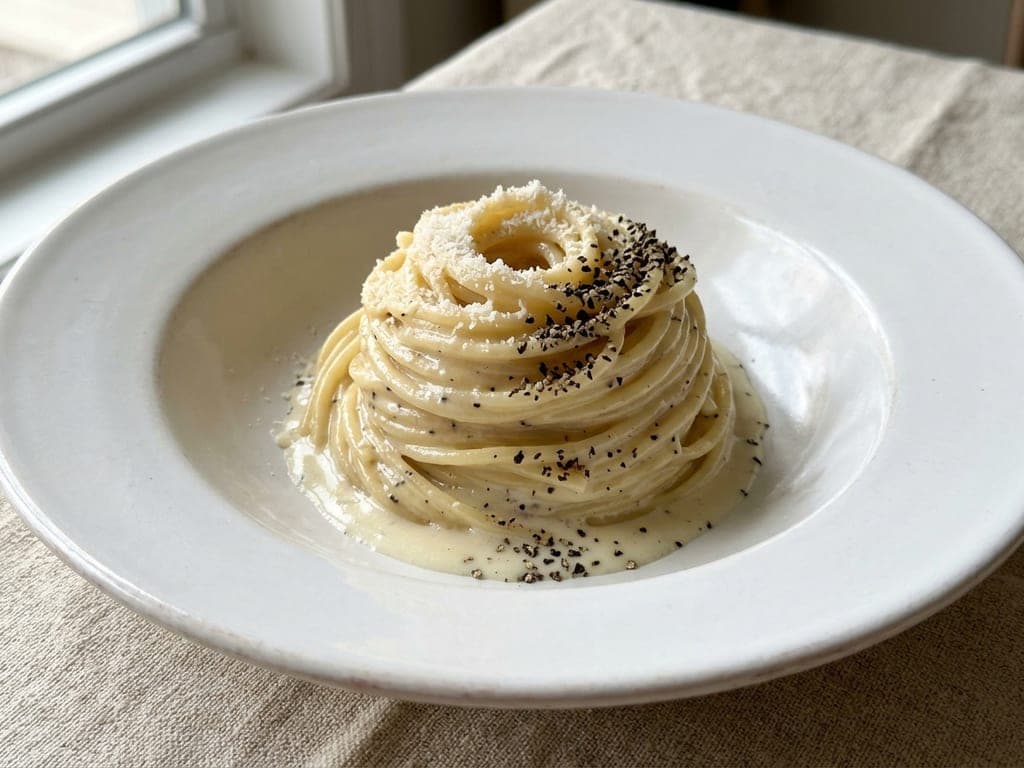
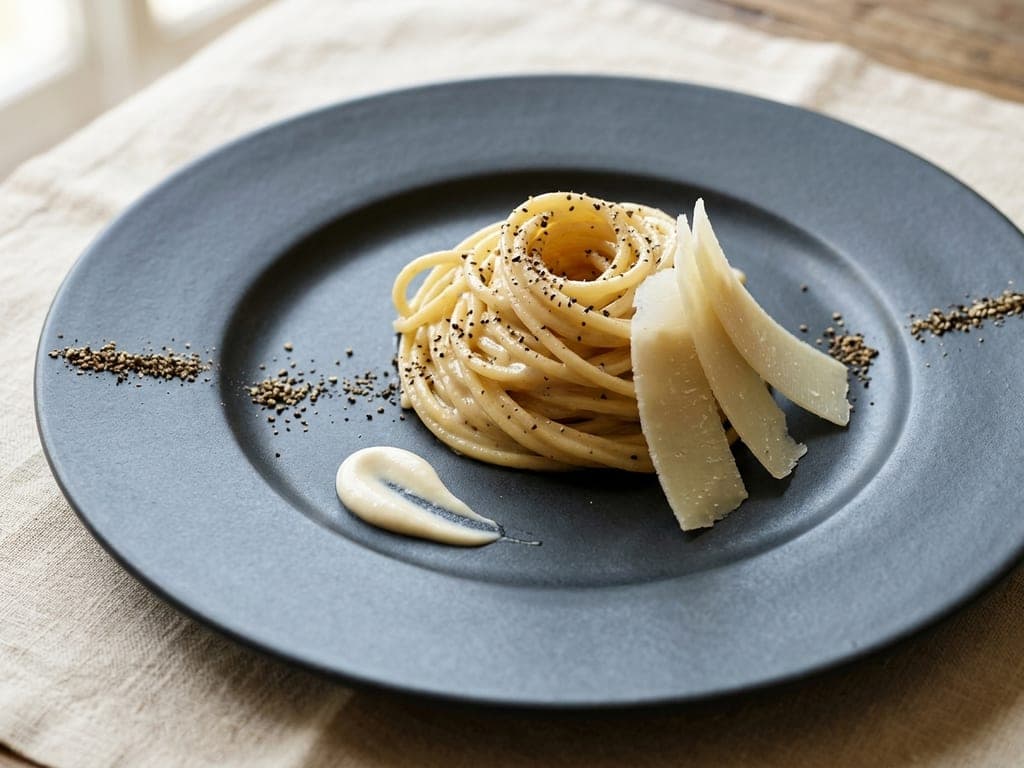
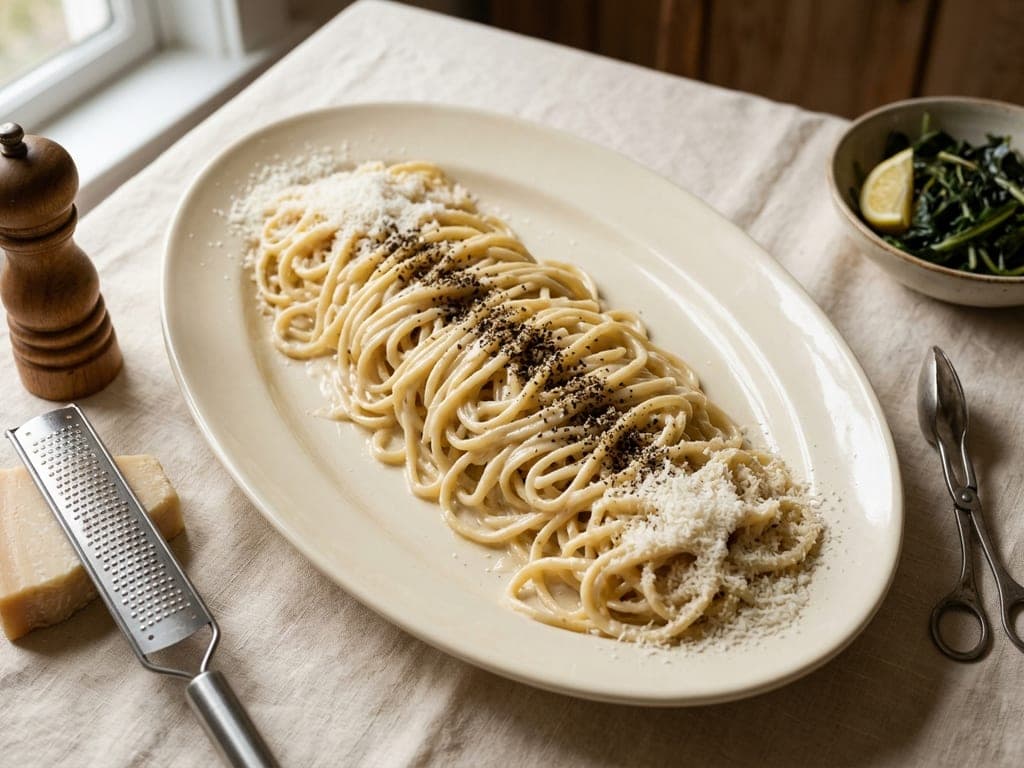
- Serve instantly, in warm bowls. Cacio e pepe has a shorter fuse even than carbonara: the sauce is perfect for about two minutes, then the cheese begins to set as it cools. Warm the bowls (a rinse with pasta water is enough), twirl the pasta into a tall nest with tongs turned inside a ladle, and set it in the center. Spoon any sauce left in the pan around the base, dust the crown with the reserved powdered pecorino, and finish with the remaining cracked pepper — concentrated in a rough line or crescent rather than scattered, so the first forkful gets a jolt of it. Nothing else goes on the plate: no parsley, no oil, no lemon. Gold, ivory and black. Carry it to the table before you take your apron off.
Safety & hygiene Important
- A low-risk dish — the clock is still the clock. There is no raw egg and no meat here, which makes cacio e pepe one of the lower-risk dishes on this site. The standard rules still apply: cooked pasta should not sit at room temperature for more than 2 hours in total (1 hour above 90°F / 32°C), because cooked starches are a friendly environment for Bacillus cereus, the bacterium behind reheated-rice food poisoning, which is just as happy in pasta. Refrigerate leftovers promptly in a shallow container. US guidance (USDA) keeps cooked leftovers 3-4 days and reheats them to 165°F (74°C); UK guidance (FSA/NHS) says 48 hours, reheat only once, until steaming hot throughout.
- Allergens: milk and wheat — and sheep’s milk is still milk. This dish contains milk (the pecorino) and wheat (the pasta), two of the major allergens that must be declared in both the US and the EU; tonnarelli adds egg. A note that matters: Pecorino Romano is a sheep’s-milk cheese, and that is no refuge for anyone with a cow’s-milk allergy — the caseins and whey proteins that trigger the allergy are shared across species, so a cow’s-milk-allergic eater must treat sheep and goat cheeses as equally off-limits. Pre-grated cheese can also carry traces from shared equipment. For a gluten-free version, use a good gluten-free spaghetti and read the starch section above — and treat the result as a wheat-free plate rather than a celiac-safe one unless your boards, tongs and pot are dedicated.
- Not vegetarian, strictly — and the pregnancy question. Pecorino Romano DOP is made with lamb rennet, an animal product written into the cheese’s production rules, so despite containing no meat this dish is not strictly vegetarian — a fact most recipe sites quietly skip. Vegetarians can make a version with a hard cheese made with microbial rennet (check the label; several producers make one), accepting that it will not taste quite like Rome. For pregnancy: hard, aged cheeses like Pecorino Romano are considered safe under UK NHS guidance, even when made with unpasteurized milk, because their low moisture and acidity make Listeria growth very unlikely — the caution attaches to soft and mold-ripened cheeses, not to a granite wedge of pecorino. One asterisk for US readers: FDA advice on unpasteurized dairy is stricter and carves out no hard-cheese exemption in its consumer guidance, and imported DOP pecorino is commonly made from raw sheep’s milk — a pasteurized-milk pecorino removes the question entirely.
- The only burns in this recipe are steam and boiling water. The dangerous moments are unglamorous: ladling boiling pasta water, and the hiss when it hits the hot skillet for the pepper infusion — add it away from you, and hold the ladle low so it cannot slop. Drain-side, remember the jug of reserved water stays scalding for longer than you think; a 2-cup (480 ml) glass jug of just-boiled water on a counter edge is a child-height hazard. The skillet toss is done off the flame, so by the time the cheese goes in, the pan is past its spitting-hot worst — still hot enough to burn skin, so respect it.
3 ways to plate it
Three ingredients, and what each one is really doing
Pecorino Romano is a hard, salty, sharp cheese made from whole sheep’s milk in a protected zone covering the whole of Lazio, the whole of Sardinia — where most of it is now made — and the Grosseto province of Tuscany, aged a minimum of five months (eight for grating wedges), and salted heavily along the way — it was provisioning food for shepherds and travelers long before it was a pasta cheese, and salt is how it survived. In this dish it is the sauce, the seasoning and most of the calories at once. Its proteins are also the failure mode: heat them too fast and they cross-link into elastic strings, squeezing out fat and water — which is exactly what a clump is. ‘Cacio’ is the old central-Italian word for cheese itself, from the same Latin caseus that gives us ‘casein’ — regional, not textbook, Italian — and in Rome the default cheese it meant was, always, pecorino.
The pepper is the second named ingredient, and it arrives in three registers. First, toasting: a minute or two in a dry pan wakes the volatile oils, and you will smell the difference immediately — resinous, citrusy, almost floral over the sharp bite. Second, the infusion: half the cracked pepper simmered in pasta water in the skillet, so pepper flavor is inside the sauce, not sitting on it. Third, the finish: coarse cracks over the plated nest, where they hit the nose before the fork moves. Buy whole peppercorns — pre-ground pepper lost its aromatics months ago and contributes only heat and grey dust — and crack them jagged, not fine: powder makes the sauce muddy, coarse cracks make it ivory with black constellations. Our 1 tbsp for four portions is a floor, not a ceiling; Roman versions often go further, and if you have a choice of peppercorns, a bright Tellicherry suits the cheese. The dish is meant to bite.
The pasta and its water are one ingredient in two states. The wheat starch that the pasta sheds as it cooks is the emulsion’s stabilizer: dissolved starch granules swell, burst and coat the cheese proteins, physically getting in the way of the cross-linking that makes clumps. This is why every serious recipe cooks the pasta in less water than usual — the same starch in half the water is twice the protection — and why the sauce is built from cloudy cooking water rather than tap water. Understand that and you understand the dish.
Why it clumps: the physics, including the 2025 paper
Pecorino clumps because its casein proteins aggregate. Somewhere past 140-150°F (60-65°C) they denature, knit to their neighbors and squeeze out fat and water — elastic wads in a thin, greasy puddle. Boiling pasta water is 212°F (100°C). A heap of grated cheese meeting a screaming-hot pan of it is a reliable way to make squeaky curds, and no amount of stirring will argue the proteins back apart. Starch is the bodyguard: dissolved starch raises viscosity and physically blocks protein-to-protein bonding, which is why cloudy, concentrated pasta water works and clear water does not. Agitation — the unphotogenic tossing — shears the cheese into the starchy liquid so the fat stays in small droplets and the proteins stay separate. Heat, starch, agitation: skip any one and the sauce breaks.
In 2025 a group of Italian physicists living abroad — who cooked together in their expat kitchens and, as one of them put it, had ‘the practical aim to avoid wasting good pecorino’ — published a peer-reviewed study of exactly this in the journal Physics of Fluids, mapping when and why the sauce collapses. Their phase diagram gives the failure a name: the ‘Mozzarella Phase’, the regime where the proteins fuse into stretchy clumps. Two variables drive the transition — temperature and starch concentration — and the paper’s central finding is that starch moves the cliff edge: with almost no starch in the water, the cheese collapses into clumps at around 150°F (65°C), while at the right starch level the same sauce shrugs off far higher heat. Their number for the right level: starch at about 2-3% of the cheese’s weight. Real pasta water is the gamble — its starch content is wildly variable, and a big pot of barely cloudy water may carry a fraction of what the sauce needs — which is why the same technique works one night and fails the next, and the cook gets the blame when the water was the problem.
Their recommendation for certainty: stop gambling and measure. Dissolve a small, weighed amount of potato starch or cornstarch in water, heat it gently until it thickens and turns nearly clear, and build the cheese cream on that. For the 7 oz (200 g) of cheese in this recipe, that is the 1 1/2 tsp (4-5 g) ‘insurance’ in the ingredient list. (The paper also names a second stabilizer — trisodium citrate, the melting salt behind processed cheese — for a perfectly smooth, slightly clinical sauce; and the whole enterprise won its authors the 2025 Ig Nobel Prize in Physics, the award for research that makes you laugh and then think.) You do not need a physics degree to make cacio e pepe, and Romans made it for generations without one — but the paper explains the dish’s reputation honestly: the traditional method has an invisible variable in it. The crema method in our steps narrows the gamble; the measured starch removes it. Use the insurance the first few times, then decide whether you still need it.
Cacio e pepe sauce: there is no jar
Cacio e pepe sauce is not a condiment you hold in the fridge; it is an emulsion that comes into existence in the pan in the last two minutes and begins dying the moment you stop tossing. Searches for ‘cacio e pepe sauce’ often want something pourable, something to bottle. What you can bottle is closer to alfredo — the jarred products sold under this name are often cream-based, alfredo-style sauces flavored with pecorino, and even the best-known cream-free jar holds together with cornstarch and sodium citrate, which are, delightfully, the exact two stabilizers the physics paper reached for. What you can make is pecorino, cracked pepper and starchy water forced into a single glossy phase, and it does not exist until the pasta is in the pan.
In practice the sauce has two moments. First, the crema: finely grated cheese worked with a little cooled pasta water into a paste, then loosened to heavy-cream thickness — already an emulsion, built below the temperature where the proteins panic. Second, the marriage in the skillet: underdone pasta, the pepper infusion, the crema and more starchy water, tossed off the heat until the strands are lacquered. If you have watched a Roman cook finish the dish in the pan, that is all that is happening — no secret fourth ingredient, just water and temperature controlled with the wrists.
When the sauce is right it clings, stretches slightly between strands, and looks wet without puddling. When it is short of water it turns to salty paste as it sits; when it is broken you will see either sandy grains or elastic clumps. Both are recoverable if you catch them early — the rescue protocol is at the bottom of this page — and both are why you plate immediately.
The methods, honestly ranked
The trattoria toss — cheese grated fine, pasta tossed with pepper and starchy water, cheese rained in off the heat while tossing hard — is the fastest and the most fragile. In a Roman kitchen like Felice a Testaccio’s, where the dish is finished with two forks at the table and the cooks make forty a night, it produces the best plate of the four methods. At home it is the highest-variance route: the pan is often still too hot, the water ratio is a guess, and there is no paste stage to absorb mistakes. It is authentic, and it is how most first attempts fail.
The crema method, which this page teaches, moves the risk off the stove: the cheese is worked into a smooth paste with warm-not-hot pasta water in a bowl, so hydration happens gently and completely before the cheese ever meets the pasta. The pan then only has to coat and loosen. It costs two minutes, forgives a lot, and it is still nothing but cheese, pepper, pasta and water. Most modern Roman restaurant kitchens work this way in some form; it is the method to learn first.
The measured-starch method is the crema method with the physics paper’s correction: a weighed teaspoon of potato starch, dissolved and heated, replaces the guess about what your pasta water contains. It is the most reliable route to the true no-fat Roman sauce, and for gluten-free pasta — whose water carries far less usable starch — it is effectively mandatory. Purists may bristle at starch from a box; the sauce cannot tell the difference, and neither, honestly, can the purists.
Butter — a knob mounted into the pan with the pasta water before the cheese goes in — is the American restaurant road, and it deserves a civil word rather than a sneer: butter is already an emulsion, its milk proteins and fat widen the temperature window almost unconditionally, and the result is glossy, rich and nearly foolproof. It is also a different dish — rounder, blunter, tilted toward cow rather than sheep — closer to a burro e formaggio wearing cacio e pepe’s name. If you are cooking for eight, or for the first time for guests, nobody at the table will file a complaint. Make it on purpose, and know what the Roman version tastes like so you know what you are trading. Cream goes further still and erases the point of the pecorino; save it for a sauce that wants it.
Tonnarelli, spaghetti, and what the sauce wants from a shape
In Rome the dish’s classic partner is tonnarelli — the Roman name for spaghetti alla chitarra, a fresh egg pasta cut square on the steel wires of a chitarra so each strand has four rough faces. Its porous, eggy surface drinks the sauce, and its extra chew stands up to the pepper. If you can buy or make it, it is the reference experience — with two caveats: fresh egg pasta sheds less starch into its water than dry semolina pasta (have the starch insurance ready), and it cooks in a few minutes, so the crema must be ready before the pasta hits the water.
Dry spaghetti is what most Romans cook at home and what this recipe assumes: choose a bronze-cut brand, whose matte, sandpapery surface holds the emulsion the way glossy Teflon-die pasta cannot, and whose semolina sheds generous starch. Rigatoni and mezze maniche work on the same logic as they do for carbonara. What the sauce cannot use is anything too thin — angel hair overcooks in the time the toss takes and cools so fast the cheese sets on contact — or fresh ribbons soft enough to tear under the vigorous tossing this dish demands.
A shepherd’s dish that was in the canon before carbonara existed
In the usual telling, cacio e pepe is the oldest of Rome’s four pastas: the shepherds of the Roman campagna and the Apennine transhumance routes walked for months with exactly this pantry — dried pasta, whole aged pecorino and black peppercorns, three foods that survive a saddlebag in summer, weigh little and carry enormous calories — and cheese and pepper over pasta is simply what they make when water is the only other thing available. Hold the story a little loosely: it is traditional attribution rather than documented history, gricia’s partisans tell an almost identical shepherd story and claim their dish as the elder, and pepper was a bought trade good, not something a flock provides. What a responsible page can date is the cookbook record.
And the record is clear on the order of things: cacio e pepe was already canon when the Roman repertoire was first written down — Ada Boni’s La cucina romana of 1930 includes it as a matter of course — while carbonara is absent from the record before 1939. The family tree we drew on the carbonara page starts here: cacio e pepe is the trunk. Add guanciale and you have gricia; add tomato to gricia and you have amatriciana; add egg to gricia and you have carbonara. Master this dish — the emulsion with no help — and the other three are additions, not new techniques.
Its recent history is a second act: in the 2010s cacio e pepe went from Roman comfort food to global restaurant obsession, turning up butter-mounted in New York, folded into cocktails and croissants, and — in the version that helped make Riccardo Camanini’s Lido 84 famous — cooked inside an inflated pig’s bladder presented at the table. The dish survived the fame intact at home: it still costs three ingredients and half an hour, and the trattoria plate in Testaccio has not changed.
Is cacio e pepe healthy? The honest ledger
A serving of this recipe — a quarter of 14 oz (400 g) of pasta and 1.75 oz (50 g) of Pecorino Romano — comes to roughly 570 calories: dried pasta at about 370 kcal per 100 g gives 370, the pecorino at about 390 kcal per 100 g gives just under 200, and the pepper is a rounding error. That is a genuine Roman primo portion, and it is lighter than our carbonara’s 770, for the simple reason that there is no pork fat, cream or butter in it — the entire fat load is the cheese’s own, roughly 15 g per serving, of which about 9 g is saturated.
Sodium is this dish’s honest problem — nearly as big as carbonara’s, despite containing no cured pork at all. Pecorino Romano is among the saltiest cheeses sold — about 1,400 mg of sodium per 100 g in USDA figures for domestic Romano, and up to nearly 2,000 for some imported DOP wedges — so the 50 g on each plate carries roughly 700-1,000 mg before the pasta water contributes its share. Call it 850-1,200 mg a serving with our deliberately under-salted water, and more if you salt the water normally: a third to half of the 2,300 mg daily ceiling in US dietary guidelines, in one primo. The recipe’s levers are already pulled — a third of the usual salt in the water, none anywhere else, and nothing extra at the table. The remaining lever is portion, which is why the Roman answer is a modest first course, not a main-course trough.
Do not try to lighten it by substitution. Low-fat hard cheese seizes faster and tastes of less; stretching the sauce with yogurt or cottage cheese makes a different, sadder dish; and cutting the cheese in half just makes weak, watery pasta. Eat the real thing, in the Roman portion, beside something green and bitter, and not every night.
Serving it: the two-minute window, the wine, the scaling trap — and the rescue
Everything about serving cacio e pepe is downstream of one fact: the sauce sets as it cools, and it is cooling from the moment the tossing stops. Bowls warmed with a splash of pasta water, the table already set, the diners already sitting — the Roman habits are not fussiness, they are engineering. Serve it as a primo in the Italian portion, with something sharp and bitter beside or after: puntarelle with anchovy dressing in winter if you can find it, otherwise chicory or arugula (rocket) with lemon. No bread; there is nothing to mop that the pasta has not already claimed. For wine, stay in Lazio and stay crisp: a Frascati or another dry Castelli Romani white against the salt, or — if you want red — a young, unoaked Cesanese served slightly cool. The salt is the loudest thing on the table, and tannin quarrels with it.
The scaling trap, stated plainly: this recipe does not double well. Eight portions means a pot of water so large the starch dilutes to nothing, a mass of pasta too heavy to toss, and a pan that cools unevenly — the pasta at the edges cold while the center scalds, so the crema meets two wrong temperatures at once. Four portions in one pan — this recipe — is the sweet spot; six is the ceiling, with the measured-starch method and a very wide pan. For eight, cook two batches back to back with the crema already mixed, or take the honest butter off-ramp, which scales without complaint.
And the rescue, for the night it breaks anyway. Sandy grains or the first elastic strings: pull the pan off the heat immediately, add a splash of cool or lukewarm pasta water — never boiling, which cooks the clumps into permanent rubber — and toss hard; you are dropping the temperature and putting shear and dilution back to work, and a borderline sauce will often come back. Escalation: work a fresh spoonful of powdered pecorino with cool water into a quick new crema and beat it in off the heat, or add a pinch of the starch slurry — the physics paper’s insight in miniature, more starch between the proteins. Fully seized, squeaky lumps you could pick out with a fork are past saving: fish them out, re-dress the strands with a fresh crema, and say nothing. Every Roman has been there.
Questions, answered
What is cacio e pepe?
A Roman pasta dish whose name means ‘cheese and pepper’: spaghetti or tonnarelli tossed with finely grated Pecorino Romano, coarsely cracked black pepper and starchy pasta cooking water until the cheese and water emulsify into a creamy sauce. The authentic Roman version contains nothing else — no butter, no oil, no cream, no garlic. It is one of Rome’s four canonical pastas, alongside gricia, amatriciana and carbonara — the simplest of the four, and in the usual telling the oldest.
What are the main ingredients in cacio e pepe?
Three, plus water: pasta (classically tonnarelli or spaghetti), Pecorino Romano cheese, and black pepper. The unlisted fourth ingredient is the pasta’s own starchy cooking water, which binds the melted cheese into a creamy sauce — without it the dish cannot exist. Salt in the pot is used lightly because the cheese is already briny. Butter, oil, cream and garlic are not main ingredients in the Roman recipe; versions that add them are making a different (easier, and honestly pleasant) dish.
What’s the secret to perfect cacio e pepe?
Temperature control, in one habit: never let the cheese meet anything close to boiling. Work the finely grated pecorino into a smooth cream with warm — not hot — pasta water before it goes anywhere near the pasta, take the pan off the flame, wait twenty seconds, then toss the crema through without mercy. The supporting secrets: grate the cheese to a powder, cook the pasta in less water than usual so the water is starchier, and keep everything moving while the sauce comes together. Heat, starch and agitation cover almost every failure.
What are common mistakes when making cacio e pepe?
In rough order of damage: adding grated cheese directly to hot pasta over a live flame (it seizes into clumps on contact); pouring boiling water onto the cheese (same result in a bowl); grating the cheese coarsely (shreds soften into squeaky strings instead of dissolving); cooking the pasta in a huge pot (the starch dilutes until it cannot protect the sauce); using pre-grated cheese (anti-caking cellulose stops it melting); salting the water as if the cheese were not already briny; putting the pan back on high heat to ‘help it melt’; and doubling the recipe for a crowd. Every one is avoidable, and the recipe on this page is built to route around all of them.
Why is cacio e pepe difficult to make?
Because it is an emulsion with no emulsifier to help you. Carbonara’s egg yolk and alfredo’s butter and cream are natural stabilizers that hold fat and water together; cacio e pepe asks cheese proteins and water to form a cream with nothing but dissolved pasta starch standing between success and a seized, stringy clump. The window is real: with too little starch in the water, the cheese proteins fuse the moment the pan runs hot — the ‘Mozzarella Phase’, as the 2025 physics study of the sauce named the failure — and the study’s finding is that starch is what moves that cliff edge: almost none, and the sauce collapses around 150°F (65°C); enough, and it holds. Three ingredients means nowhere to hide, which is exactly why the techniques on this page exist.
What is cacio e pepe sauce made of?
Only Pecorino Romano, black pepper and starchy pasta water, emulsified in the pan in the minute before serving. It is not a sauce that can sit in a jar: it exists as a stable cream only briefly, at a narrow temperature, held together by starch. Jarred ‘cacio e pepe sauce’ products are mostly cream-based, alfredo-style sauces flavored with pecorino — a reasonable product wearing a misleading name. If you want the real sauce made reliably, make the cheese crema in our step 5, or the measured-starch version, and use it immediately.
Why did my cacio e pepe clump, and can I fix it?
It clumped because the cheese got too hot, too fast — straight onto flame-hot pasta, or hit with boiling water — or because your pasta water carried too little starch to protect it. If it is just turning sandy or stringy: off the heat immediately, a splash of cool pasta water, and fast, hard tossing; dilution and motion can pull a borderline sauce back. A fresh spoonful of pecorino worked with cool water into a new paste, beaten in off the heat, rescues the next tier; a pinch of dissolved potato starch is the physics-paper fix. What never works is more heat or boiling water, which cook the clumps into rubber. Fully seized, squeaky lumps are one-way — fish them out, make a quick fresh crema, and re-dress the pasta.
Can I use Parmesan instead of Pecorino Romano?
You can make a good pasta that way, but a noticeably different one: Parmigiano-Reggiano is a cow’s-milk cheese, nuttier, sweeter and about a third as salty, so the dish loses the sharp, salty edge that defines it — and it melts more cooperatively, so it is easier. A half-and-half blend is a legitimate softer setting and a reasonable way to learn the emulsion; all-Parmesan crosses into pleasant, anonymous cheese-and-pepper pasta. If pecorino’s punch is the problem, blend rather than replace, and correct the pasta-water salt upward slightly, since Parmesan seasons less.
Does authentic cacio e pepe have butter or cream in it?
No. The Roman dish is pasta, Pecorino Romano, black pepper and pasta water — the creaminess is an emulsion of cheese and starch, not dairy cream. Butter-mounted versions are the American restaurant standard because butter is a ready-made emulsion that widens the temperature window and stabilizes the sauce; cream goes further and mutes the sheep’s-milk sharpness that is the point. Both taste good and both are different dishes. Make them knowingly if you like — the original does not need them, and its sharper flavor is the argument.
What is tonnarelli, and is it better than spaghetti here?
Tonnarelli is the Roman name for spaghetti alla chitarra: fresh egg pasta cut into square-sectioned strands on the steel wires of a chitarra frame. Its rough, porous surface and dense chew make it the classic Roman partner for cacio e pepe, and if you can get it, it is the reference version. Two practical notes: fresh egg pasta releases less starch into its cooking water than dry semolina pasta, so keep the measured-starch insurance handy, and it cooks in a few minutes, so have the crema ready before the pasta hits the water. Good bronze-cut dry spaghetti is not a compromise — it is what most Roman homes use.
Is cacio e pepe vegetarian?
Not strictly. Pecorino Romano DOP is made with lamb rennet — an animal-derived coagulant written into the cheese’s production rules — so the authentic cheese, and therefore the authentic dish, does not meet a strict vegetarian standard, though it contains no meat. Vegetarians can substitute a hard sheep-style or Italian-style cheese made with microbial (vegetarian) rennet, which several producers make; check the label, and expect a slightly different, still worthwhile dish built exactly the same way.
Can cacio e pepe be made gluten-free?
Yes, with one adjustment that matters: gluten-free pasta sheds less usable starch into its water, and starch is what holds this sauce together — so for GF cacio e pepe the measured-starch method stops being optional. Cook a good GF spaghetti, and build the sauce on 1 1/2 tsp (4-5 g) of potato starch or cornstarch (cornflour) dissolved in water and heated until faintly thickened, then proceed exactly as written. Pecorino Romano and black pepper are naturally gluten-free. For celiac diners, dedicated tools and pots matter as much as the pasta.
How many calories are in cacio e pepe?
This recipe comes to roughly 570 calories per serving: about 370 from 3.5 oz (100 g) of dry pasta and just under 200 from 1.75 oz (50 g) of Pecorino Romano. The bigger number to know is sodium — pecorino is one of the saltiest cheeses made, and a serving carries roughly 850-1,200 mg even with deliberately under-salted pasta water. Restaurant versions mounted with butter, or with the cheese scaled up, commonly pass 800 calories.
Can I reheat cacio e pepe?
Reluctantly, yes. The emulsion does not survive the refrigerator: the cheese sets and the sauce breaks on reheating, no matter how gently you go — and the microwave will not restore it. The least-bad method is a skillet over low heat with a splash of water, tossing constantly, until steaming hot throughout — 165°F (74°C) — accepting a result closer to cheese-buttered noodles than to the original. Refrigerate leftovers within 2 hours, keep 3-4 days (USDA) or 48 hours with one reheat (UK FSA/NHS). The better plan is the Roman one: cook the amount you will eat, because the whole dish takes half an hour anyway. (Freezing is technically allowed by the agencies and pointless in practice — the sauce will not survive that either.)
Snap your finished plate and let the AI plate it again — more beautifully.