Traditional Bolognese Recipe (Ragù alla Bolognese)
Every ‘authentic bolognese’ on the internet contradicts the next one on the points that matter: wine color, milk, browning, even the meat. Bologna settled the argument twice. The city’s Accademia Italiana della Cucina deposited the official ragù alla bolognese at the Chamber of Commerce in 1982, then updated it by notarial act in April 2023, and almost nobody cooking ‘traditional’ online has read either text. This page cooks the deposited recipe (coarse-cut beef, fresh pancetta, a knife-cut soffritto, wine of either color, milk if you want it) and explains every choice. On tagliatelle, as Bologna insists.
Ingredients
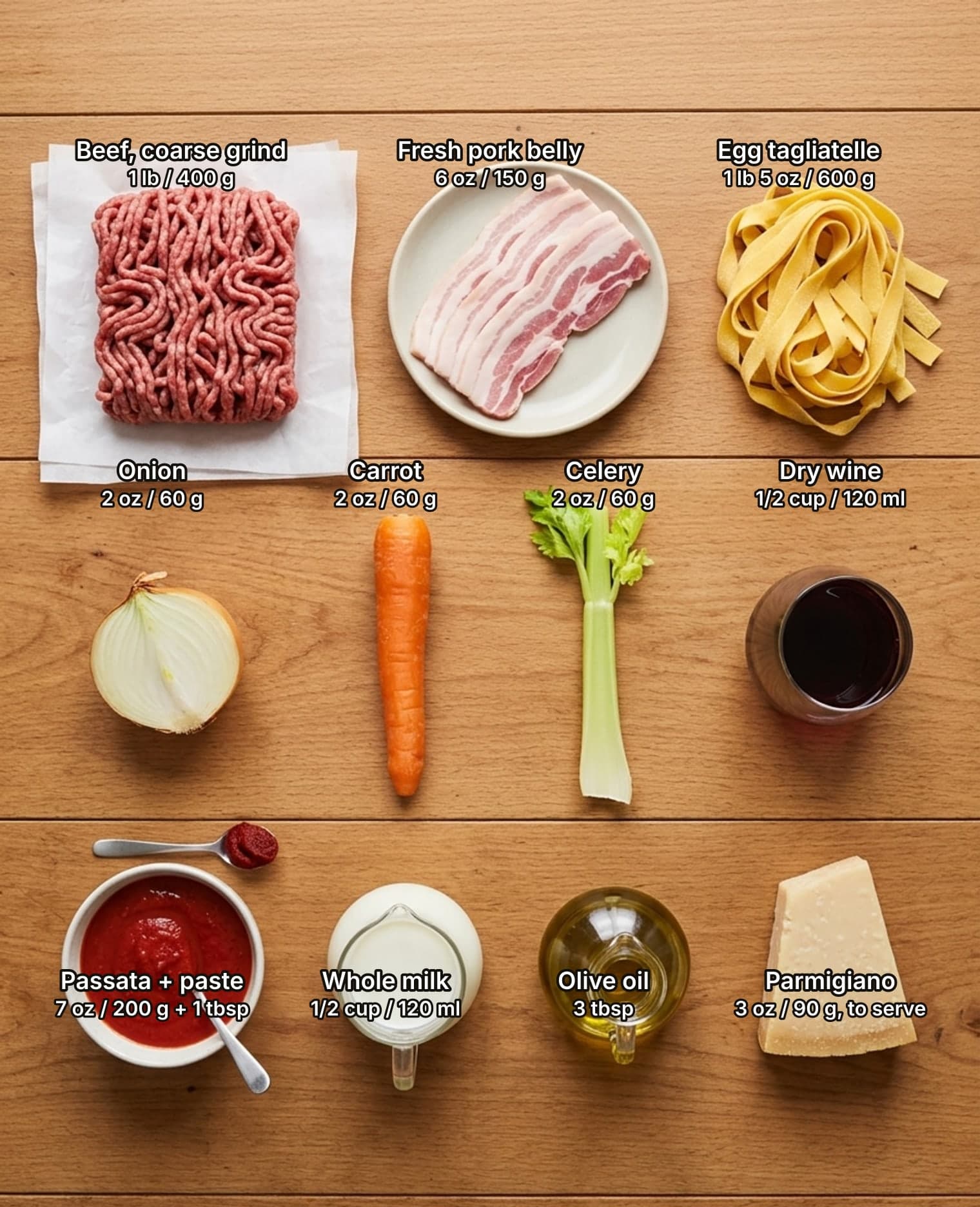
- beef, coarsely ground: chuck (shoulder), brisket or flank, the collagen-rich front cuts the official recipe points to (traditionally cartella, the skirt, scarce even in Bologna). Ask for a single coarse grind or hand-chop; fine supermarket mince (beef mince) is the one downgrade that shows. A roughly 60/40 beef-pork mix is a permitted variant1 lb (400 g)
- fresh pork belly, thinly sliced then finely chopped (the official 2023 choice, sold as fresh pancetta in Italy); cured UNSMOKED pancetta is the sanctioned substitute (salt the pot lighter). Smoked bacon is banned outright: smoke takes over a three-hour simmer6 oz (150 g)
- yellow onion, chopped fine with a knife; the official text bans the food processor, which bruises the soffritto into wet pulp1/2 medium, about 2 oz (60 g)
- carrot, peeled and chopped fine1 medium, about 2 oz (60 g)
- celery, trimmed and chopped fine (a declared allergen in the EU and UK)1 stalk, about 2 oz (60 g)
- dry wine, red or white: the deposited recipe allows either color and says nothing about sweetness; dry is our rule, and the 1982 text’s. (Avoiding alcohol: replace with hot broth plus 1 tsp wine vinegar at the deglaze)1 glass (1/2 cup / 120 ml)
- strained tomatoes (passata): the tomato is a supporting voice in this sauce, not the lead; resist the urge to add more7 oz (200 g)
- double-concentrated tomato paste1 tbsp
- whole milk: ‘traditionally used’, says the 2023 official text, which made it optional; added halfway and evaporated in. Use it1/2 cup (120 ml)
- light meat or vegetable broth, kept hot and fed in as the ragù drinks; stock cubes are officially permitted (watch their salt, and their celery)1 cup (240 ml) to start, plus about 1 more as needed
- extra virgin olive oil (the 2023 text dropped butter; oil is the fat)3 tbsp
- fine salt and black pepper, and nothing else: garlic, rosemary, parsley and ‘other herbs and spices’ are on the official forbidden list; a pinch of nutmeg is the one sanctioned exceptionto taste
- fresh egg tagliatelle, the registered partner, 8 mm wide when cooked; or dried egg tagliatelle (1 lb / 450 g). Pappardelle for a wider ribbon; spaghetti belongs to a different dish1 lb 5 oz (600 g) fresh
- Parmigiano-Reggiano, finely grated at the table (Parmigiano, not pecorino, this far north)3 oz (90 g), to serve
What bolognese actually is, and what it is not
Bolognese, properly ragù alla bolognese, is a slow-cooked meat sauce from Bologna, in Italy’s Emilia-Romagna: coarsely ground beef and fresh pancetta, built on a knife-cut soffritto of onion, carrot and celery, loosened with wine and a little milk, colored (not flooded) with tomato, and simmered gently for two to three hours until it turns thick, glossy and maroon. In Bologna it is served with fresh egg tagliatelle, or layered into lasagne verdi. Never, in Bologna, with spaghetti.
Notice what that definition excludes. Bolognese is not a tomato sauce with meat in it; it is a meat sauce with tomato in it. The deposited recipe holds the tomato to 7 oz (200 g) of passata and a spoonful of paste against more than a pound of meat, a supporting voice rather than a lead. It contains no garlic, no oregano, no basil, no ‘Italian herbs’ of any kind: the official text lists garlic and herbs among the variants it refuses outright. And it is less a sauce than a condiment of meat. Italians talk about tagliatelle al ragù, pasta dressed with ragù, not drowned in it.
The word ragù itself is a borrowing, from the French ragoût, a stew, naturalized in Emilian kitchens around the turn of the nineteenth century and now meaning any long-simmered meat sauce for pasta. Bologna’s is the most famous of a whole family; Naples simmers whole cuts in tomato for its own, very different ragù. That is why ‘is bolognese the same as ragù’ has a real answer: every bolognese is a ragù; most ragùs are not bolognese.
How to make Ragù alla Bolognese
- Chop the soffritto with a knife, and get the meat right. Chop 2 oz (60 g) each of onion, carrot and celery into a fine, even dice, about 1/8 inch (3 mm), with a knife. The official recipe is blunt about this: ‘do not use a food processor’. Spinning blades bruise the vegetables into a wet pulp that steams instead of sweating, and the soffritto is the ragù’s foundation, not its garnish. Chop the 6 oz (150 g) of fresh pork belly the same way: thin slices first, then small bits. For the beef, you want 1 lb (400 g) of a collagen-rich front cut, coarsely ground: chuck (shoulder), brisket or flank, standing in for cartella, the skirt cut the tradition names and even Bologna struggles to find. Ask the butcher for a single coarse grind, or hand-chop it the way Massimo Bottura does. Coarse pieces braise into tender nubs; fine supermarket mince packs into dense grains no simmer can loosen. Put a kettle of light broth on to warm at the back of the stove.
- Melt the pancetta, then sweat the vegetables soft, not brown. Set a heavy 10-inch (24-26 cm) casserole, enameled cast iron (a Dutch oven), heavy aluminum, or terracotta if you own it, over low heat with 3 tbsp of extra virgin olive oil and the chopped pork belly. Let the belly melt gently for 4-5 minutes, until its fat runs clear and the bits turn translucent, not crisp: you are building a cooking fat, not making bacon bits. If you are using the cured-pancetta variant, it renders faster and salts the pot harder, so season later and lighter. Add the chopped onion, carrot and celery and cook them low and slow, stirring often, for 8-12 minutes, ‘until softened but not browned’, in the official text’s words. The vegetables should slump, sweeten and turn glossy while staying pale; if they take on color, pull the pan off the heat for a minute. Browning here would write a caramelized note over the whole sauce. The soffritto’s job is to dissolve into the background of every spoonful.
- Brown the beef until it sizzles. Raise the heat to medium, add the coarsely ground beef, and break it up with a wooden spoon. Now cook, stirring near-constantly, for about 10 minutes; the official method says until it ‘sizzles and browns’. The meat will first weep its juices and go grey. Keep going: the sizzle you are listening for is that liquid boiling away, and the browning only starts once the pan runs dry enough to fry. You are aiming for damp and rust-colored, not grey and steamed, and not a hard dark crust that tastes roasted rather than braised. Do not rush it with high heat, which hardens coarse beef into pellets. If you prefer the restaurant method of searing the meat hard in a separate skillet, in batches, then adding it to the softened vegetables, the 2023 text explicitly blesses it as ‘the modern technique’. Either road ends the same place: meat with savor, not just bulk. Season lightly with salt and pepper.
- Pour the wine, and let it go completely. Pour in 1 glass (1/2 cup / 120 ml) of dry wine, red or white. The deposited recipe genuinely allows either, whatever partisans on both sides tell you. Let it bubble over medium heat, scraping the bottom of the pot, until it has evaporated completely: no wine smell, no liquid sheen, and a wooden spoon dragged across the pan leaves a brief clean track. This matters more than the color does. Wine that never cooks off leaves a raw, sour edge that three hours of simmering will not fully erase; wine that evaporates leaves only its acids and aromatics, folded into the fat. The whole recipe runs on this rhythm (add a liquid, drive it off, concentrate what it leaves behind) and this is the first rehearsal.
- Tomato, broth, and down to the barest simmer. Stir in 1 tbsp of double-concentrated tomato paste and let it fry for a minute in the fat. Add 7 oz (200 g) of strained tomatoes (passata) and 1 cup (240 ml) of boiling broth. Stir, bring it back to a bubble, then drop the heat to its lowest setting and cover the pot. From here the ragù wants what Marcella Hazan called ‘the laziest of simmers’: an intermittent bubble breaking the surface, no more. Set a timer for 2 hours and plan on 3 if your beef is very coarse or your patience allows; the official text itself says ‘about 2 hours (or 3 depending on preference and type of meat)’. Check every 20-30 minutes, stir, and add a splash of hot broth whenever the sauce looks dry enough to catch. The meat should stay in a moist braise, never frying in its own fat and never swimming. Low and long is not folklore: it is the temperature range where collagen dissolves into gelatin, and gelatin is what makes a ragù feel expensive.
- Milk at the halfway mark, broth as it drinks. At the halfway mark of your simmer (about one hour in on a two-hour pot, ninety minutes on the three-hour road), pour in 1/2 cup (120 ml) of whole milk, stir, and let it evaporate completely into the sauce over the following half hour or so. The 2023 text marks milk ‘(optional)’ and defends it in the same breath (‘(traditionally used)’ is its exact parenthesis), and tradition has it right: the dairy rounds the tomato’s acidity, feeds the sauce’s slow browning, and gives the finished ragù its signature softness. What milk does not verifiably do is ‘tenderize the meat’. That claim circulates everywhere and is chemistry folklore; the tenderness comes from the cut and the clock. Keep feeding the pot small ladles of hot broth through the back half of cooking as the sauce tightens. You are aiming for a sauce that falls off a spoon in a slow, reluctant heap.
- Read the endpoint: maroon, thick, glossy. If the ragù is still loose near the end, cook the last 20-30 minutes with the lid off. The deposited recipe describes its own finish line better than any photograph: ‘a rich maroon hue, thick and glossy’ in the Accademia’s English (the Italian original says arancione scuro, dark orange). Either way, not tomato-red: the color of meat, milk and time with the tomato behind them, the fat risen in small shining beads at the edges. The sauce should mound on a spoon, not pour, and a line drawn across the bottom of the pot should stay open for a second before closing. Taste and season with salt and black pepper only. Garlic, rosemary, parsley and ‘other herbs and spices’ sit on the official recipe’s forbidden list, and a pinch of nutmeg is the single sanctioned exception, grated in now if you want it. If you land here early, let the pot rest off the heat, lid on. Like every braise, ragù is better after it has stood, and better still tomorrow.
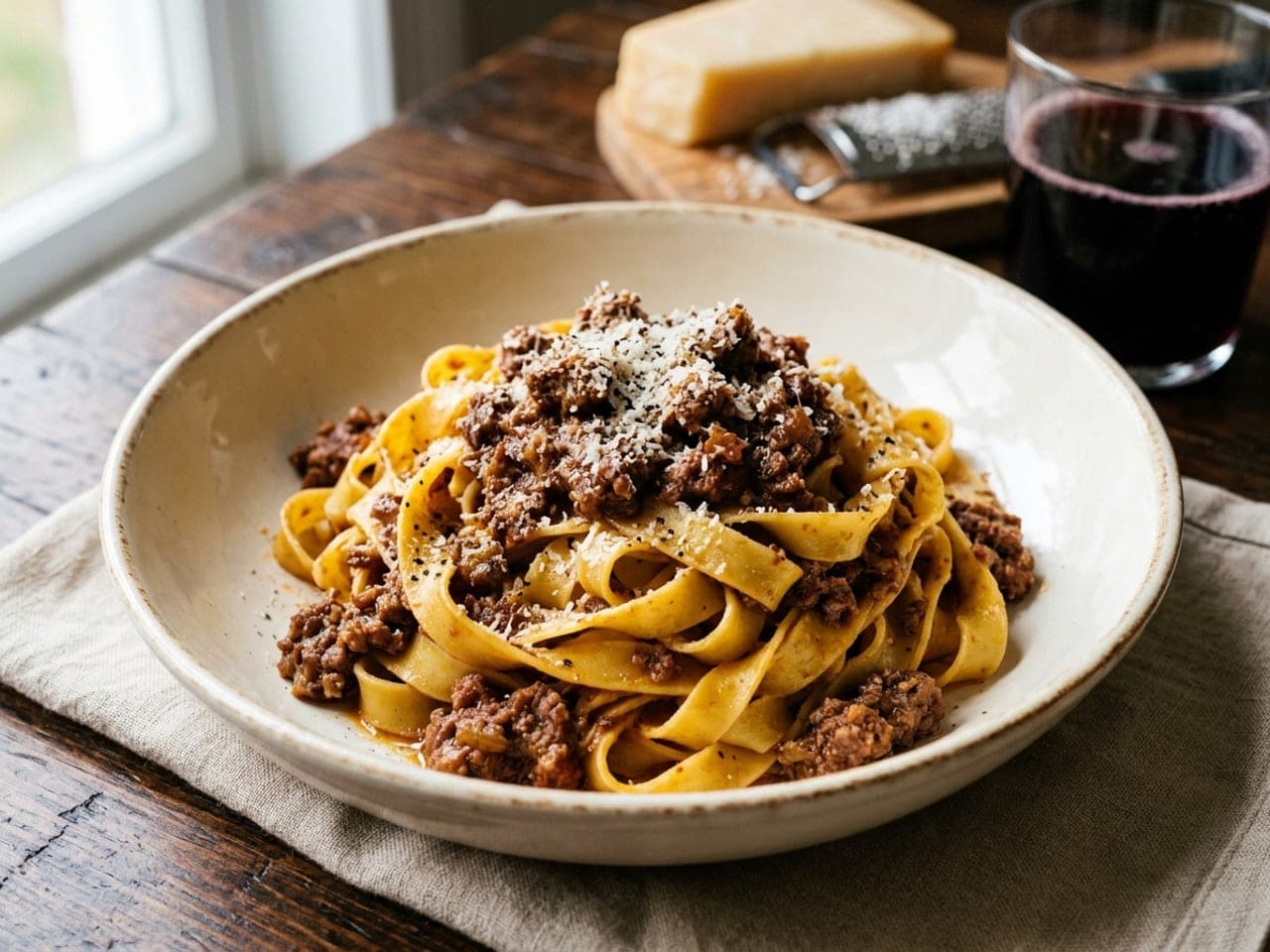
- Cook the tagliatelle and marry them properly. Boil 1 lb 5 oz (600 g) of fresh egg tagliatelle (or 1 lb / 450 g dried egg tagliatelle) in well-salted water. Fresh pasta needs only 2-3 minutes, so have everything else ready: bowls warmed, cheese grated, table sat. While it cooks, ladle enough hot ragù for the table into a wide skillet or warmed serving bowl; the rest of the pot goes to the freezer, gratefully. Lift the tagliatelle straight into the ragù with tongs, dragging a little pasta water with them, and toss for a full 30 seconds so every ribbon is coated and the starch pulls sauce and pasta into one glossy fabric. This marriage is the whole point of the shape: Bologna does not ladle sauce on top of naked pasta, ever. Serve immediately in the warmed bowls with finely grated Parmigiano-Reggiano over the top (Parmigiano, not pecorino, this far north) and nothing green anywhere.
Safety & hygiene Important
- A big batch means cooling it properly. A pot of ragù holds heat for hours, and the danger window for bacteria is the slow drift through room temperature, not the simmer. Get leftovers refrigerated within 2 hours of turning off the heat (1 hour above 90°F / 32°C): decant into shallow containers so the heat can escape. Professional kitchens run a two-stage clock for exactly this reason (the FDA Food Code wants 135°F down to 70°F within 2 hours, then to 41°F within 6 hours total: 57°C to 21°C to 5°C), and a deep, covered pot straight into the fridge fails it; shallow containers within 2 hours are USDA’s home version of the same physics. US guidance (USDA) keeps cooked leftovers 3-4 days with reheating to 165°F (74°C); UK guidance (FSA/NHS) says use within 48 hours and reheat only once, until steaming hot throughout. Frozen at 0°F (-18°C), ragù keeps its quality for 2-3 months, and unlike the emulsion pastas it freezes beautifully.
- Ground meat is a 160°F ingredient; the simmer clears it by miles. Grinding distributes any surface bacteria through the whole mass of the meat, which is why US guidance (USDA) wants ground beef and pork cooked to 160°F (71°C) with no rest, a stricter bar than whole cuts. A ragù that simmers for 2-3 hours passes this test by an enormous margin, which is why the pot itself, freshly cooked, holds little fear for pregnant guests or anyone vulnerable: everything in it is long-cooked, and the Parmigiano is a hard cheese the NHS explicitly clears. Two caveats travel with that sentence: cooking for a pregnant guest, skip the chicken-liver enrichment the official recipe otherwise sanctions (the NHS says to avoid liver entirely, for its vitamin A), and guests avoiding alcohol are covered in the wine note below. The care belongs before the pot. Keep raw ground meat cold until the minute you need it, do not let its juices touch anything that will not be cooked, and wash hands and board after handling. If you hand-chop the beef, treat the board and knife as raw-meat equipment until they are washed hot.
- The allergen list is longer than it looks, including celery. This dish carries milk (the added milk and the Parmigiano), wheat and egg (fresh tagliatelle is an egg pasta, a point worth saying out loud to an egg-allergic guest, since dried semolina pasta would not carry it), and celery in the soffritto. Celery is one of the 14 allergens EU and UK law requires declaring, and it surprises US cooks because FDA’s major-allergen list does not include it. If you are cooking for someone with a celery allergy, the soffritto can be made without its stalk (the sauce survives; the deposited ratio does not), and say what is in it either way. The sanctioned enrichments (chicken livers, sausage) bring their own labels; check sausage for wheat rusk if gluten matters, and check stock cubes, which often carry celery too.
- The wine question, honestly. Wine’s alcohol does not vanish the instant it hits a hot pan; that is a kitchen myth. What is true here: the glass of wine is fully evaporated early, then the sauce simmers for 2-3 hours, and long cooking drives the residual alcohol down to a trace of a trace. For most tables, including children’s, a properly cooked ragù is a non-issue. If you cook for someone avoiding alcohol entirely, for faith, recovery or medical reasons, skip the wine rather than negotiate with it: deglaze with a splash of broth plus a teaspoon of red or white wine vinegar for the acidity, and do not announce it as a compromise, because at three hours nobody can tell. (For the curious: USDA’s retention tables put stirred-in alcohol at roughly 5-10% remaining after 2-2.5 hours of simmering, and this pot boils its wine off separately before the simmer even begins.)
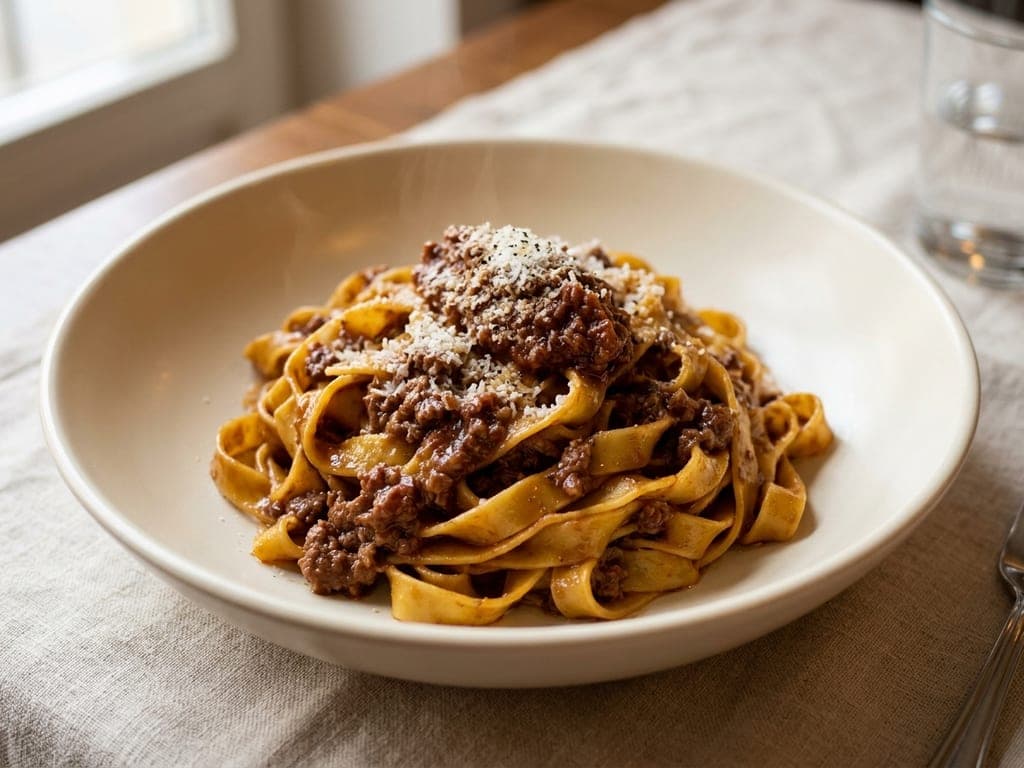
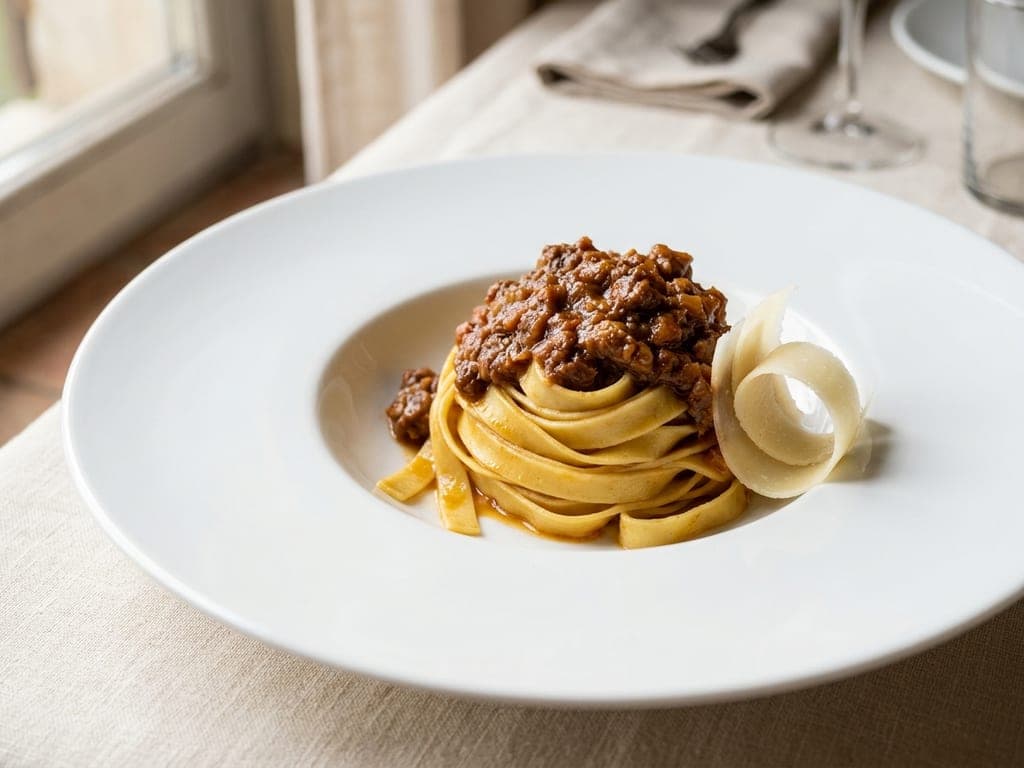
3 ways to plate it
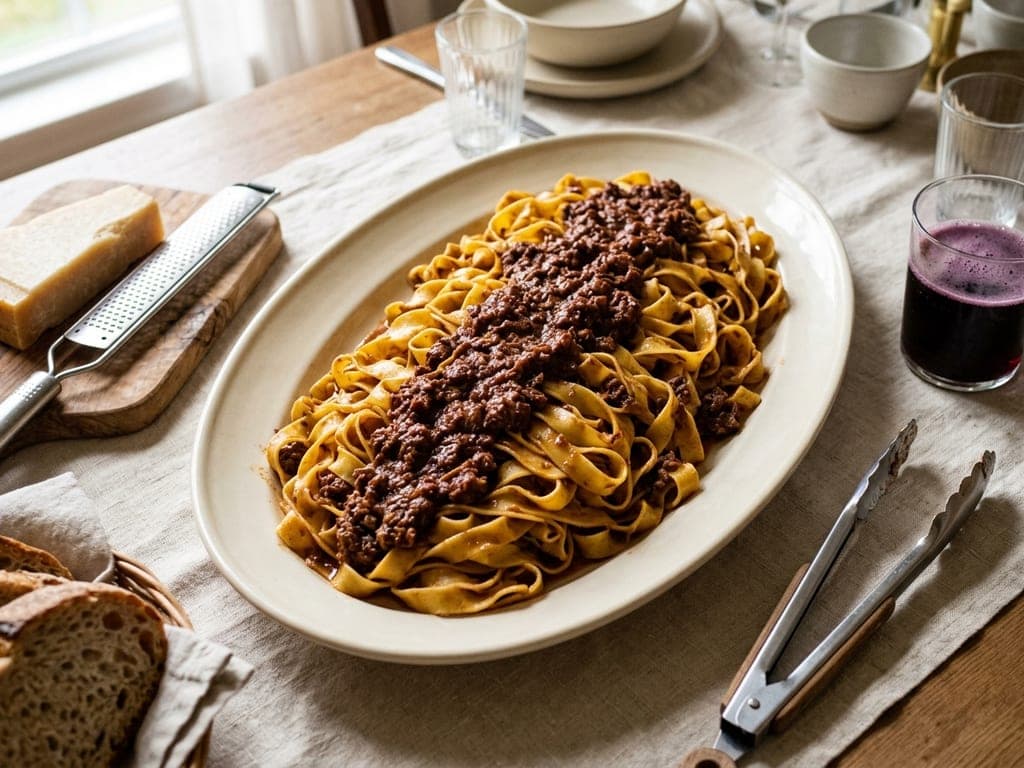
The dish with an official recipe: 1982, and the 2023 update
Bolognese is that rare thing, a dish with a legal text. On 17 October 1982, the Bologna delegation of the Accademia Italiana della Cucina, Italy’s gastronomic academy, deposited the recipe for ‘ragù classico bolognese’ at the Bologna Chamber of Commerce in the Palazzo della Mercanzia, the way you might deposit a patent. And on 20 April 2023 the Accademia did it again: its secretary general handed the Chamber’s president a revised recipe, by notarial act, after a study committee had canvassed the city’s best restaurants, old family kitchens and gastronomes by questionnaire about what Bologna actually cooks. Nearly every English-language ‘authentic bolognese’ page online either ignores both documents or cites the 1982 one and then quietly contradicts it.
The 2023 text is refreshingly specific. For six people: 1 lb (400 g) of coarsely ground beef; 6 oz (150 g) of fresh pork pancetta; 2 oz (60 g) each of knife-chopped onion, carrot and celery; a glass of wine, red or white; 7 oz (200 g) of passata plus a tablespoon of double-concentrated paste; a glass of whole milk, now marked optional; light broth as needed; 3 tbsp of extra virgin olive oil. It names the traditional beef cut (cartella, the skirt from the diaphragm, ‘difficult to find today’) and points modern cooks to collagen-rich front cuts instead: chuck, brisket, plate, flank. It permits: a roughly 60/40 beef-and-pork mix, hand-minced meat, cured pancetta, a pinch of nutmeg, and enrichments of chicken livers, crumbled sausage, blanched peas or rehydrated porcini. It forbids: veal, smoked pancetta or bacon, pork alone, brandy, flour as thickener, and garlic, rosemary, parsley ‘or other herbs and spices’.
Reading the two texts side by side is the most honest answer available to the question ‘what is traditional, really?’, because Bologna’s own answer moved. Between 1982 and 2023 the beef grew from 300 to 400 grams and its cartella-first framing loosened into a list of collagen-rich front cuts; beef-only became a sanctioned beef-and-pork blend; the cured pancetta of 1982 became fresh; the soffritto vegetables were levelled at 60 g each; the wine doubled to a full glass; the tomato options collapsed to passata plus paste; butter gave way to olive oil; the terracotta pot acquired enameled cast-iron company; and hard-searing the meat separately, heresy to a certain kind of nonna, was blessed in writing as ‘the modern technique’. Most strikingly, milk, a defining flourish of the 1982 text, became optional, and the 1982 option of finishing with cream disappeared. (One thing the 2023 text does not do, despite what you may read: it never mentions pressure cookers.) Tradition, the Accademia is quietly saying, is a living argument the city keeps having with itself, which is worth remembering the next time a stranger on the internet tells you there is exactly one real bolognese.
The ingredients, and what each one is doing
The beef does its work through collagen. The official note steers you to the front of the animal (chuck, brisket, plate, flank) because those hard-working muscles carry the connective tissue that dissolves, over hours, into the gelatin that gives ragù its silky, mouth-coating body; lean, tender cuts have nothing to give the pot. Grind matters as much as cut: coarse or hand-chopped beef braises into distinct, tender nubs, while fine supermarket mince, ground fine to hide sinew, packs into dense grains that no simmer can loosen. If your butcher will grind chuck coarse once, this recipe gets measurably better for zero extra effort. (Some American test kitchens patch collagen-poor mince with bloomed powdered gelatin. It works as a texture fix; the Bologna solution is the cut, the coarse grind, the pancetta and time.)
The fresh pork belly is the sauce’s quiet luxury. Rendered slowly at the start, it becomes the cooking fat and a seasoning at once: sweet, faintly porky depth with none of the smoke of bacon, which the official text bans outright, because smoke colonizes a three-hour simmer. Cured, unsmoked pancetta is the sanctioned substitute and brings a hammier, saltier note; if you use it, salt the pot later and lighter. The soffritto beneath it follows one strict rule: chopped with a knife, never a food processor, whose spinning blade bruises the vegetables into wet pulp that steams grey instead of sweating sweet. Sixty grams each is a deliberate ratio, enough to found the flavor, too little to announce itself.
The liquids arrive in a strict order, and each one is driven off before the next. Wine first, and the color argument that fills comment sections is settled by the deposited text itself, which allows red or white and says nothing about sweetness (dry is our rule, and the 1982 text’s); what matters is that it evaporates completely, leaving acidity and perfume without rawness. Tomato next, and briefly: 200 grams of passata and one spoon of concentrate is all the deposited recipe wants, which is the single clearest line between bolognese and the red, oregano-scented ‘bolognese’ of the wider world. Then broth, in patient ladles, keeping the pot’s hydration honest for hours; the official text allows stock cubes, your sodium ledger may not. And halfway through, milk, of which more below, because no ingredient in this dish carries more myth.
The milk question: tradition, chemistry, and the 2023 demotion
Do Italians put milk in their bolognese? Yes: traditionally, and often. The 1982 deposited recipe called for half a glass of whole milk near the end of cooking; Marcella Hazan’s canonical American version simmers a full cup into the meat before the wine ever arrives; and the 2023 update keeps milk in the recipe, marked ‘(optional)’ in its ingredient list for the first time and defended as ‘(traditionally used)’ at the very moment the method adds it, halfway through the simmer. Milk is not an internet invention or a cheffy flourish. It is Bolognese home cooking. What changed in 2023 is only that Bologna stopped requiring it.
What the milk actually does deserves honest handling, because the internet’s favorite explanation (milk ‘tenderizes the meat’, usually with confident talk of calcium-activated enzymes) is folklore wearing a lab coat. We could not find that mechanism in any serious food-science source, and neither can the people who repeat it. (Calcium-activated tenderization is real in meat science; it takes injected calcium chloride at concentrations milk comes nowhere near.) What dairy verifiably brings: fat that carries fat-soluble flavor compounds the watery ingredients cannot; a rounding of the tomato’s and wine’s sharpness on the palate, the same reason a splash of cream civilizes a tomato soup; and milk sugars and proteins that brown gently over a long reduction, the dulce de leche principle in savory form. The tenderness of a great ragù comes from the cut and the clock. The gentleness comes, in part, from the milk.
When to add it is the one genuine fork in the road. The 2023 official text says halfway through the simmer, left to evaporate completely; this recipe follows it. The 1982 text said near the end, little by little. Hazan put it first, before the wine, and built a legend on the order. The differences are real but small: milk-first gives the softest, sweetest register, milk-at-the-end the most distinct dairy note, milk-halfway a clean middle path. None of them will rescue or ruin a pot the way the grind, the simmer and the evaporations will. Choose one, and argue about it recreationally.
The method: gentle where it matters, brown where it counts
Every bolognese argument that is not about ingredients is about browning, and the poles are well staffed. At one end stands Marcella Hazan, who cooked the beef only until it lost its raw color, never browned, protecting the meat’s softness and the sauce’s pale, gentle register. At the other stands the modern restaurant school: sear the meat hard, in batches, for maximum Maillard depth, then braise. Between them, quietly, sits the 2023 official text, which browns the meat in the pot for about ten minutes, until it sizzles, and in its closing note gives an explicit blessing to ‘the modern technique of browning the meat separately’. Bologna, in other words, has room for both instincts, and the recipe above takes the official middle road: rust and sizzle, not grey stew, not hamburger crust. A hard sear buys deeper roasted notes at the cost of some softness; grey, steamed mince tastes of boiled beef. The middle is the point.
What no school negotiates is the simmer. Collagen begins dissolving into gelatin around 160°F (71°C) and does its work slowly, over hours, in gentle moist heat. That is why the pot must barely murmur, why the front cuts matter, and why a 45-minute ‘bolognese’ is a different and thinner-bodied sauce no matter what it contains. The evaporation rhythm is the method’s other spine: wine driven fully off, then tomato and broth concentrated, then milk reduced into the fabric of the sauce. Each cycle trades water for flavor. Rushing any of them leaves rawness in the pot; honoring them is most of what ‘authentic’ tastes like. (No stovetop patience available? A covered 300°F / 150°C oven for the same 2-3 hours is the restaurant’s babysitter, and an honest one.)
The endpoint is written into the official text with unusual poetry for a notarized document: ‘a rich maroon hue, thick and glossy’ (arancione scuro, dark orange, in the Italian original). The tell, either way, is that tomato-red has left the pot. A bright red pot has too much tomato or too little time; a grey one skipped the sizzle; a watery one was flooded with broth it never earned back. And like every braise, ragù improves as it rests. The fat re-emulsifies, the flavors settle into each other, and the finest version of your pot is usually served tomorrow, which makes this the rare showpiece dish that prefers you cook it ahead.
Tagliatelle: the 8-millimeter law, and why not spaghetti
Bologna did not only register its sauce; it registered the pasta. On 16 April 1972, a decade before the ragù, the Confraternita del Tortellino and the Accademia deposited, at the same Chamber of Commerce, the official dimensions of the true Bolognese tagliatella: 8 millimeters wide when cooked (about a third of an inch, cut at 6.5-7 mm raw), and by tradition 0.6 to 0.8 mm thick. The width is defined, with perfectly straight municipal face, as the 12,270th part of the height of Bologna’s Torre degli Asinelli, and the arithmetic checks: the tower stands 97.2 meters, and 97,200 divided by 12,270 is 7.92 millimeters. A solid-gold specimen, the ‘golden tagliatella’, is displayed at the Chamber to keep everyone honest. ‘Any other size’, the deed warns, ‘would make it lose its inimitable character.’
The romance around the shape is older and shakier. The story that a court cook named Zafirano invented tagliatelle in 1487 for Lucrezia Borgia’s wedding, inspired by her blond hair, is a fabrication, invented in 1931 by the Bolognese humorist Augusto Majani and repeated as history by half the recipe pages on the internet. The engineering, though, is real. A wide, porous, slightly rough ribbon of fresh egg pasta gives a fatty, chunky sauce something to hold: surface area, texture, absorbency. Smooth, round, extruded durum spaghetti offers a clingy meat sauce almost nothing, and the ragù slides to the bottom of the bowl, which is precisely the sad international experience the dish’s reputation suffers from. Pappardelle, the same idea wider, is a legitimate heartier variant; lasagne verdi, layered with besciamella, is the sauce’s other canonical home; dried egg tagliatelle is the fair supermarket stand-in for fresh.
The marriage matters as much as the shape. Bologna does not ladle ragù on top of a nest of naked pasta for the camera. The tagliatelle go into the sauce, with a splash of their cooking water, and are tossed until ribbon and ragù become one glossy fabric; the starch on fresh egg pasta is half the sauce’s final cling. However you plate it, that toss is non-negotiable. It is also why the dish is served in warmed bowls and eaten immediately: fresh tagliatelle hold heat poorly and drink sauce fast.
Spaghetti bolognese: a real dish, just not from Bologna
In February 2019 the mayor of Bologna, Virginio Merola, began collecting photographs of ‘spaghetti alla bolognese’ menus from around the world (London, Berlin, New York) and posting them, with civic mischief, under the label of fake news. ‘It is strange’, he told reporters, ‘to be famous all over the world for a dish that isn’t ours.’ He was right on the facts: there is no spaghetti bolognese in Bologna, and there never was. But the export’s passport is more interesting than the meme suggests. The earliest documented English-language pairing of bolognese-style sauce with spaghetti in print is American, not British: Julia Lovejoy Cuniberti’s ‘Practical Italian Recipes for American Kitchens’ of 1917, a booklet sold to raise funds for the families of Italian soldiers in the First World War. Dried spaghetti traveled the world in a way fresh egg tagliatelle never could; emigrant cooks used the pasta the new country stocked, and the name came along for the ride.
Post-war Britain then made the dish its own: Soho’s Italian cafés, and Elizabeth David’s ‘Italian Food’ arriving in 1954, the year rationing ended (her own ragù was Bolognese to the bone, taken from a trattoria in the city, and she deplored the spaghetti habit). What Britain evolved has almost nothing to do with either: beef mince with garlic (always), dried oregano or ‘mixed herbs’, red wine, tinned tomatoes and purée, a Worcestershire-sauce jolt, a stock cube, sometimes mushrooms or bacon, simmered under an hour and served over spaghetti with grated cheese. Call it what it is: the chicken tikka masala of pasta, an immigrant dish’s descendant, beloved on its own terms, and no more fraudulent than any other naturalized citizen. Its wetter, smoother sauce even suits spaghetti, which is more than the real ragù can say. The mistake is not cooking spag bol; the mistake is believing it is what Bologna eats.
This page will not pretend to hate it. If Tuesday needs dinner in 45 minutes, make the honest weeknight version of this recipe rather than a caricature: keep the soffritto (chop it small and sweat it fast), use coarse beef and skip the belly, double the tomato paste for depth you do not have time to build, simmer hard for 30-40 minutes uncovered, finish with the milk. It will not be ragù alla bolognese (collagen keeps its own calendar), but it will be a good, honest meat sauce from the same family tree. Serve it on spaghetti without apologizing to anyone, including Bologna.
What a Michelin kitchen changes, and what it does not
Search ‘michelin star bolognese’ and you are watching short-form video culture, not Bologna: Massimo Bottura hand-chopping his ragù meat on MasterClass; Paul Foster, who won a Michelin star at Salt in Stratford-upon-Avon (closed in 2025), going viral for finishing the best bolognese with milk; Mario Carbone building his New York version on three meats seared separately. Line the clips up against the notarized text, though, and a pattern emerges that the algorithm never mentions: most of what plays as elite technique is either already in the official recipe or standard French finishing applied to Bologna’s dish. Foster’s milk revelation is the 1982 deposited recipe. Bottura’s hand-chopped meat is a sanctioned variant, in writing. Carbone’s sausage is on the official enrichment list, next to the chicken livers Artusi was already offering as an option in 1891. His three-meats plate is Italian-American and allowed to be (its veal sits on Bologna’s forbidden list, which is rather the point); he is not claiming a Chamber deposit.
The genuinely restaurant-native moves are worth knowing, clearly labeled as style rather than authenticity. Searing the meat hard, in batches, before it meets the vegetables (permitted by the 2023 note) buys deeper Maillard flavor at the cost of some softness. A Parmesan rind dropped into the simmer feeds the sauce free glutamates. Pushing the tomato paste well past our brief fry, to a deep brick caramel, rounds its metallic edge further. An oven finish, the covered pot at 250-300°F (120-150°C), replaces stovetop vigilance with all-around gentle heat, and it is how restaurants hold consistency across a service. A knob of cold butter mounted into the finished sauce, monter au beurre, adds a Parisian gloss Bologna never asked for. Each is defensible; none is the secret, because the secret is not a move. (And Marco Pierre White’s stock-cube bolognese, the one Italian YouTube loves to be horrified by, is an advertisement, not a method. One sentence is all it needs.)
The honest answer to ‘what is the secret to the best bolognese’ is unglamorous: the right cut of beef, ground coarse; fat from pork belly, not smoke; a soffritto that never browns; every liquid fully evaporated in its turn; and two to three hours at a murmur. A Michelin brigade executes those fundamentals with better discipline than a Tuesday kitchen, and that, not a secret ingredient, is the gap. Which is encouraging, if you think about it: discipline is free, and your Tuesday kitchen is allowed to have it.
Marcella Hazan, the American canon
No account of bolognese in English is complete without Marcella Hazan: born in Cesenatico, Emilia-Romagna, in 1924, doctorates in natural sciences and biology, teaching Italian cooking from a New York apartment from 1969, and, through books her husband Victor translated, the person who taught America that bolognese has no garlic. Craig Claiborne’s verdict still stands: no one did more to spread the gospel of pure Italian cookery in America. Her ‘Essentials of Classic Italian Cooking’ version is a pole star of gentleness, and a different, fully coherent sauce from Bologna’s deposit: three-quarters of a pound of chuck never allowed to brown, a small soffritto cooked in butter and oil, a full cup of whole milk simmered into the meat with a grating of nutmeg before the wine arrives, one cup of dry white wine, tomatoes as an accent, and her deathless instruction to cook ‘at the laziest of simmers, with just an intermittent bubble breaking through to the surface’ for three hours or more.
Connoisseurs of the argument should know one delicious detail: in her 1973 ‘The Classic Italian Cook Book’ the order was reversed, wine first, then milk. She changed her mind in print for the 1992 book, and the milk-before-wine order became the American gospel. If you are cooking ‘the Hazan’, pick an edition and follow it; do not blend her sequences with the 2023 deposit and call the hybrid authentic. Relative to Bologna’s text she uses less beef, more tomato, butter alongside oil, nutmeg by default rather than permission, and a no-brown rule the Accademia has since moved away from. Both are legitimate. Hers is the sound of the tradition’s tender pole, and this page’s recipe is the other document. It is very Bolognese of her to have revised the canon; the city’s own notary has now done it twice.
The honest ledger, the freezer, and the glass
Is bolognese healthy? Here are the numbers, done in public with USDA figures. The pot: 1 lb (400 g) of 85/15 beef, about 860 kcal; 6 oz (150 g) of fresh pork belly, about 780; 3 tbsp of olive oil, about 360; the milk, 75; the passata and paste, 77; the soffritto, about 60; the wine, counted in full at 100 though most of its alcohol leaves; the broth, 15. Call it 2,330 kcal, or about 390 per serving of sauce if the whole pot is shared across six. Plate that on 100 g of fresh egg tagliatelle (about 290) with a 1/2 oz (15 g) snow of Parmigiano (about 63) and a serving lands near 740 calories, with roughly 32 g of protein. Sodium is this dish’s quiet good news: with fresh belly, unsalted broth and a teaspoon of salt in the pot, the plate runs roughly 750-1,000 mg once the salted pasta water and the cheese have said their piece: well under our carbonara’s 1,100-1,600 mg and a touch under our cacio e pepe’s 850-1,200, because nothing here is cured except by your own choice. The levers that raise it: cured pancetta (roughly 1,500 mg per 100 g), stock cubes, and a heavy cheese hand.
Do not try to lighten it by hollowing it out. Ninety-five-percent lean mince, no belly, no oil and no milk will save calories and delete the dish: the collagen, the fat and the dairy are the texture. The honest lighter paths are a smaller bowl, more tagliatelle-to-ragù restraint (Bologna dresses about 130 g of ragù onto 100 g of fresh pasta, a ratio that already looks frugal to American eyes; dressed that way, a plate runs nearer 625 calories and the pot stretches to eight or nine servings), and the skimmed spoon of surface fat that a rested pot offers you for free. Or cook the 45-minute Anglo version and eat it as what it is.
Practical service, briefly. A pot ‘for six’ shared generously is six plates; dressed the Bologna way it is eight or nine, and either way the surplus is the point: ragù freezes beautifully for 2-3 months. Portion it flat in bags before any pasta is dressed, and future-you owns the best fast dinner in the house; this is the make-ahead showpiece, cooked Saturday, served Sunday, banked for the month. And the glass: stay in Emilia if you can. A dry Lambrusco di Sorbara, chilled, pale as onion skin with a pink froth and a nose of violets, made just north of Modena an hour up the via Emilia, is the Emilian pour and a genuinely great one; otherwise a young Sangiovese. Nothing oaky, nothing heavy. The sauce brings the weight, the wine brings the lift.
Questions, answered
What are the ingredients for a traditional bolognese?
Going by the official recipe deposited at the Bologna Chamber of Commerce (updated April 2023), for six people: 1 lb (400 g) coarsely ground beef from collagen-rich front cuts (chuck, brisket, plate or flank; traditionally cartella, the skirt), 6 oz (150 g) fresh pork pancetta, 2 oz (60 g) each of knife-chopped onion, carrot and celery, a glass of red or white wine, 7 oz (200 g) strained tomatoes plus 1 tbsp double-concentrated paste, an optional glass of whole milk, light broth, 3 tbsp extra virgin olive oil, salt and pepper. Permitted variants: a roughly 60/40 beef-pork mix, cured pancetta, a pinch of nutmeg. No garlic, no herbs, no veal, no bacon: those are on the official forbidden list.
What is the difference between Italian bolognese and American bolognese?
The Italian dish is a meat sauce with a tomato accent; the American and British dish is usually a tomato sauce with meat in it. Bologna’s registered recipe holds tomato to 200 g of passata and a spoon of paste against more than a pound of meat, uses wine, milk and broth as its liquids, bans garlic and herbs, simmers 2-3 hours, and dresses fresh egg tagliatelle. The international version runs on garlic, oregano, red wine, canned tomatoes and often Worcestershire or a stock cube, cooks in under an hour, and lands on spaghetti. They are different dishes sharing a name. This page teaches the first and respects the second.
What is the secret to the best bolognese?
There is no single secret; there are five disciplines. A collagen-rich cut of beef (chuck, brisket, flank) ground coarse, not fine. Fresh pork belly rendered as the cooking fat. A knife-cut soffritto sweated soft but never browned. Every liquid fully evaporated in its turn: wine, then tomato and broth, then milk. And 2-3 hours at the barest simmer, where collagen slowly becomes gelatin and gives the sauce its silky body. The finish line is written in the official recipe: ‘a rich maroon hue, thick and glossy’. Everything else (searing style, milk timing, red versus white) is legitimate personal register.
Do Italians put milk in their bolognese?
Traditionally, yes. The 1982 official recipe called for half a glass of whole milk near the end; Marcella Hazan simmered a full cup into the meat before the wine; and Bolognese home cooking has long used milk to round the sauce’s acidity and soften its register. The April 2023 update keeps milk in the recipe (‘traditionally used’, says the text) but marks it optional for the first time, added halfway through cooking and left to evaporate completely. What milk does not verifiably do is tenderize the meat; that popular claim has no serious food-science support. This recipe uses it, and so should you unless dairy is off your table.
What is bolognese?
Bolognese, properly ragù alla bolognese, is a slow-simmered meat sauce from Bologna, in Italy’s Emilia-Romagna region: coarsely ground beef and pancetta cooked on a knife-cut soffritto of onion, carrot and celery, with wine, a little milk, and a restrained amount of tomato, simmered gently for 2-3 hours until thick, glossy and maroon. In Italy it dresses fresh egg tagliatelle or fills lasagne verdi, not spaghetti. It is the most famous member of the ragù family, and its recipe has been formally registered at the Bologna Chamber of Commerce since 17 October 1982, with an updated version deposited on 20 April 2023.
What is the difference between bolognese and ragù?
Ragù is the family; bolognese is its most famous member. In Italian cooking, ragù (from the French ragoût) means any long-simmered meat sauce for pasta, and nearly every region keeps one. Naples slow-cooks whole cuts of meat in tomato for ragù napoletano, a completely different dish. Ragù alla bolognese is Bologna’s version: minced rather than whole meat, a soffritto base, wine, milk, and only a little tomato. So every bolognese is a ragù, but calling any meat sauce ‘bolognese’ is like calling any sparkling wine Champagne: locals will notice, and in Bologna’s case the locals wrote it down at the Chamber of Commerce.
Why tagliatelle and not spaghetti for bolognese?
Mechanics, then law. A rich, fatty, chunky ragù needs pasta with surface and grip: tagliatelle, the wide, porous, slightly rough ribbons of fresh egg pasta, hold the sauce in their folds, while smooth, round, extruded spaghetti lets a clingy meat sauce slide straight to the bottom of the bowl. Bologna feels strongly enough about the pairing that the tagliatella itself was registered at the Chamber of Commerce in 1972: 8 mm wide cooked, formally one 12,270th of the Asinelli tower’s height, with a golden specimen on display. You can still eat it on spaghetti; the plate will behave like the Anglo dish, which is fine if that is the dinner you wanted. Pappardelle (wider) is a fine heartier variant; lasagne verdi is the other canonical home.
Red or white wine in bolognese?
Either, and this argument was settled by a notary: the deposited recipe allows ‘red or white’ wine and says nothing more (dryness is our rule, inherited from the 1982 text, and a good one). Partisans of each color will tell you theirs is the tradition, and the current text quietly refuses to pick. White, the choice of many Bolognese homes and of Marcella Hazan, reads slightly brighter; red reads deeper and darkens the maroon; after a full evaporation and three hours of simmering, the difference is a whisper. What actually matters is dryness (nothing sweet, nothing fizzy) and driving the wine off completely before the tomato arrives. Brandy is explicitly forbidden. No wine at all? Deglaze with broth plus a teaspoon of wine vinegar; at three hours, nobody can tell.
Is there garlic in traditional bolognese?
No, and this is not a style choice; it is in writing. The official recipe’s list of unacceptable variants names garlic explicitly, alongside rosemary, parsley ‘or other herbs and spices’; the one sanctioned aromatic beyond the soffritto is a pinch of nutmeg. The sauce’s aromatic base is onion, carrot and celery, knife-chopped and sweated pale. Garlic, oregano and basil are the fingerprints of the international spaghetti-bolognese tradition, a legitimate dish in its own right, but a different one. If a recipe titled ‘authentic bolognese’ opens with garlic, you have learned something about the recipe.
How long does bolognese need to cook, and can I shortcut it?
The official recipe says about 2 hours of gentle simmering, ‘or 3 depending on preference and type of meat’; Marcella Hazan asked for 3 or more at ‘the laziest of simmers’. The time is not ceremony, it is collagen chemistry: the connective tissue in coarse-cut chuck or brisket starts dissolving into gelatin around 160°F (71°C) and needs hours of barely-bubbling moist heat, and that gelatin is the sauce’s silky body. A 40-minute version can still be a good meat sauce (the spag bol section tells you how to make it honestly), but it is a different, thinner-bodied dish. A pressure cooker tenderizes fast but still needs a long open reduction for body, and it is not in the official text. If you must compress attention rather than time, a covered 300°F (150°C) oven for the same 2-3 hours needs no babysitting.
What is a michelin star bolognese?
Mostly, a video genre. The phrase comes from short-form clips of starred chefs: Massimo Bottura hand-chopping his meat, Paul Foster finishing with milk, Mario Carbone layering three seared meats. The surprise, once you read Bologna’s notarized recipe, is how little of it is new: milk is the 1982 official text, hand-cut meat and sausage are sanctioned variants, and chicken livers go back to Artusi in 1891. The genuinely restaurant-native moves are hard batch-searing, a Parmesan rind in the simmer, caramelized tomato paste, a low oven braise for consistency, and a cold-butter finish: style, not authenticity. The real Michelin difference is discipline with the fundamentals, and that part is free.
What did Marcella Hazan do differently in her bolognese?
Three things made her ‘Essentials of Classic Italian Cooking’ version the American canon. She never browned the beef, cooking it only until it lost its raw color, protecting the sauce’s soft, pale register. She simmered a full cup of whole milk into the meat, with nutmeg, before adding the wine (in her 1973 book the order was reversed, wine first; she changed her mind in print). And she demanded patience: ‘the laziest of simmers’, three hours or more, no garlic anywhere. Relative to Bologna’s deposit she used less beef, more tomato, and butter alongside oil. Both are legitimate documents; hers is the tradition’s tender pole, and knowing both keeps you from blending them by accident.
Can you freeze bolognese?
Yes, better than almost any pasta sauce, and you should plan on it: a six-serving pot is the same work as a three-serving pot. Cool it fast (shallow containers, refrigerated within 2 hours of cooking), then freeze the undressed sauce, never sauced pasta, flat in freezer bags or in portion tubs; it keeps its quality 2-3 months at 0°F (-18°C). Thaw overnight in the fridge and reheat gently with a splash of water or broth, to 165°F (74°C) in US guidance; UK guidance (FSA/NHS) prefers fridge leftovers used within 48 hours, reheated only once until steaming hot, and defrosted food reheated and eaten within 24 hours. The fat may separate on thawing; a minute of stirring over low heat brings the emulsion back. A bowl of already-dressed leftovers follows the same clock as the sauce (fridge within 2 hours, same windows, steaming hot), though the pasta will have drunk its gloss. Cook the tagliatelle fresh, always.
How many calories are in bolognese?
This recipe comes to roughly 740 calories per plated serving when the pot is shared across six: about 390 from a sixth of the sauce (the coarse beef and fresh pork belly carry most of it, with the olive oil and milk behind), about 290 from 100 g of fresh egg tagliatelle, and about 60 from a generous 15 g of Parmigiano. Dressed at Bologna’s leaner trattoria ratio, a plate runs nearer 625. Protein is around 32 g. Sodium is comparatively modest for a pasta plate, roughly 750-1,000 mg as written, because nothing in the pot is cured unless you take the pancetta variant, and the cheese stays a garnish. Restaurant plates run higher, mostly through more pasta, more cheese, and a heavier sauce ladle.
Snap your finished plate and let the AI plate it again — more beautifully.