How to make a charcuterie board quantities, arrangement, twenty board ideas
Most pages on how to make a charcuterie board are shopping lists. This one is a plating guide: it weighs the board per guest, builds it in four labelled stages, audits the rules everyone repeats, and puts the food-safety clock and the salt ledger next to twenty themed boards.
The photos on this page are AI-generated illustrations.
A good charcuterie board is 2 oz (57 g) of cheese and 2 oz (57 g) of cured meat per guest as an appetizer, about the same again in crackers, nuts, olives and dried fruit, with bread and fresh fruit on top of that, and about 25 to 35 sq in (160 to 225 cm²) of board a head. Three cheeses in three textures, two or three meats, something sweet, something briny, something with crunch. Anchors first, cheeses at the points of a triangle, meat as the lines between them, fillers into the gaps, garnish last, edges wiped.
The arrangement is where this page earns its keep. Identical food is rated tastier when arranged with intent 12, and the rule every tutorial repeats, work in odd numbers, does not survive testing 3. We treat a board as a very large plate, with the vocabulary of Plating 101: anchors, negative space, color, flow, height, the wiped edge.
And we did the reading: the two-hour clock, the pregnancy rules, the salt ledger, and why the guild that named the board could not sell cheese.
What are good items to put on a charcuterie board?
Google answers with fourteen ingredient chips; we answer with eight jobs, because a job tells you what to substitute.
Salty: the cured meat
2 oz (57 g) a guest: one whole-muscle cure, one salami. Most of the salt lives here.
Creamy: one soft cheese
Brie, camembert, triple cream, burrata or chèvre. The one the clock is really on.
Firm and aged: hard cheese
Manchego, aged cheddar, Comté, aged Gouda. They slice cleanly and give the board its geometry.
Sweet: fruit, honey or jam
One fresh, one preserved. Sweet against salt is why the board works.
Briny: olives and pickles
The palate reset between fatty bites. Always bowled, or the crackers around them go soft.
Crunch: crackers and bread
Six pieces a guest, two kinds, one plain. Water crackers (water biscuits) and baguette suit every cheese.
The anchor: one showpiece
A wheel with wedges cut out, a blue on its own knife, a salami rose. The thing the eye lands on first.
Vegetables and a dip
Radishes, snap peas, tomatoes, hummus or whipped feta. Color on a mixed board; structure on a vegetarian one.
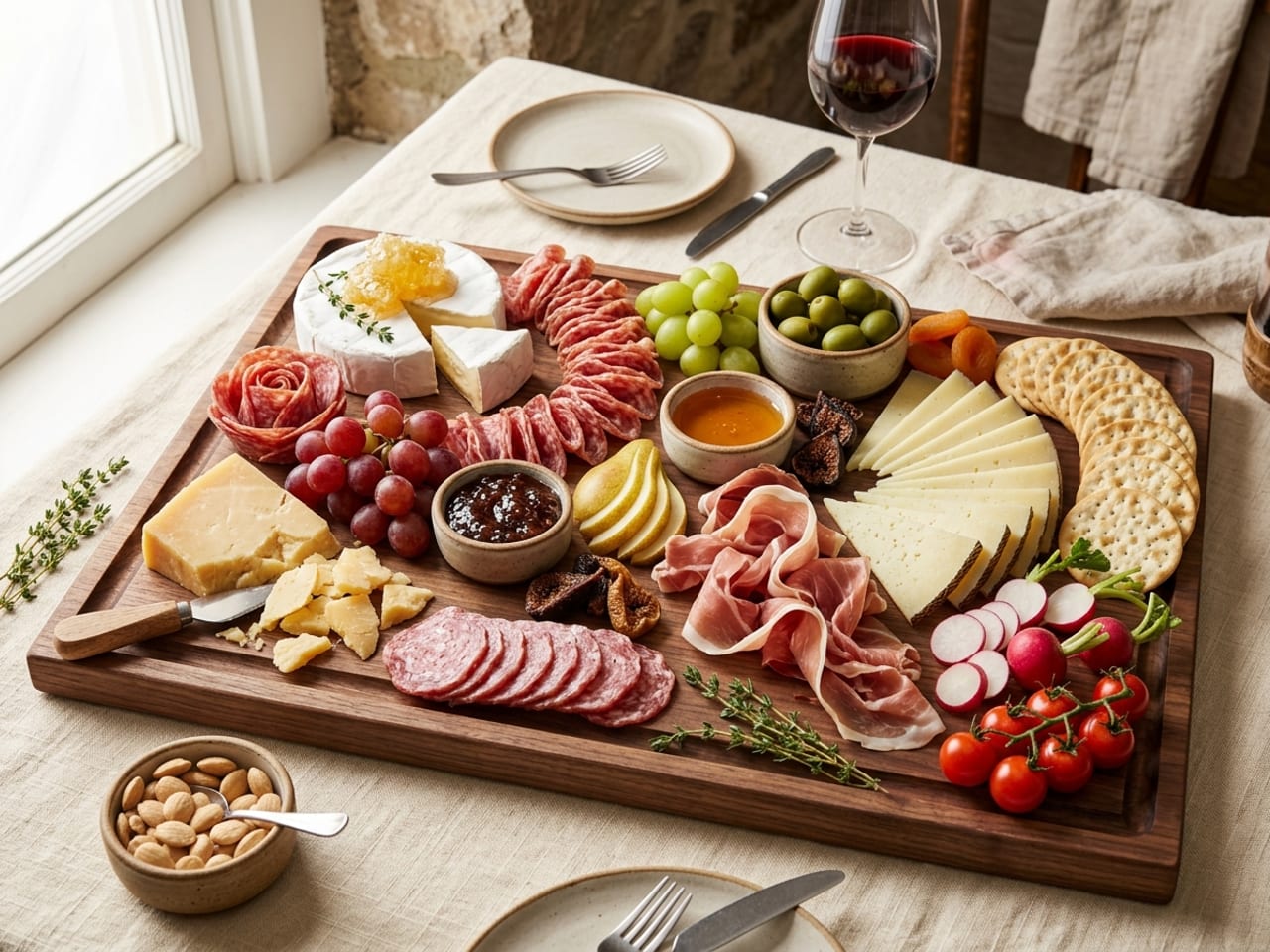
How to make a charcuterie board in six steps
The whole page in one pass; every step points at the section below that does the work.
- Step 1: weigh it, do not count it2 oz (57 g) of cheese and 2 oz (57 g) of cured meat a guest as an appetizer, with about 4 oz (113 g) of crackers, nuts, olives and dried fruit on top; as the meal, 4 oz (113 g) cheese and 3 oz (85 g) meat. The ledger below tapers the numbers for bigger groups.
- Step 2: shop by jobOne whole-muscle cure and one salami; a soft, a firm and an aged or blue cheese; two kinds of cracker or a baguette; fresh fruit and a preserve; olives, nuts, a vegetable and a dip. The shopping list for eight below carries the weights.
- Step 3: temper the cheese, keep the meat coldCheese tastes right at 65 to 70°F (18 to 21°C), so it comes out of the fridge first, and the two-hour clock starts the moment it does. Cured meat and anything wet stay cold until you build.
- Step 4: build in four stagesBowls and the cheese wheel as anchors, off-center; the other cheeses at the points of a triangle; meat as the lines that connect them (a salami river, prosciutto ribbons, one rose); fruit, nuts and crackers last, crackers never under meat. The labelled diagram is below.
- Step 5: check it like a plateWood must show: negative space is what makes a board read as arranged rather than heaped. Spread the color to three points instead of grouping it, allow one moment of height, and ignore the odd-numbers rule, which the only controlled test did not support.
- Step 6: serve on the clockTwo hours at room temperature, one when it is above 90°F (32°C), per USDA FSIS. Refill from the fridge instead of piling the board high, give every cheese its own knife, and keep the nuts bowled.
How much charcuterie per person
The numbers online disagree because they count different things. Nora Singley, formerly a cheesemonger and the director of education at Murray’s Cheese, gives The Kitchn a per-cheese formula, not a per-board one: about 1½ oz (43 g) of each cheese a person for hors d’oeuvres, about 1 oz (28 g) of each for a post-dinner cheese course. Her own worked example is three cheeses for eight people, so her appetizer board is roughly 4½ oz (128 g) of cheese a head. Food blogs quote 2 to 3 oz (57 to 85 g) of cheese in total. Read the unit before you shop: a formula written per cheese doubles when you add a third wedge.
Our house numbers: appetizer, 2 oz (57 g) cheese and 2 oz (57 g) meat a guest, plus about the same again in crackers, nuts, olives and dried fruit, with bread and fresh fruit beyond that; as the meal, 4 oz (113 g) cheese, 3 oz (85 g) meat, 2 oz (57 g) bread. Per-head amounts fall as the headcount rises while varieties climb, so the table tapers from 2.5 oz (70 g) of cheese a head for two to 1.8 oz (52 g) for twelve. The taper is our model, anchored on sourced figures at each end. For any other headcount, the charcuterie board calculator runs the same numbers and writes the shopping list.
The quantity table: two to twelve guests
Appetizer board, everything weighed. Count columns are kinds to buy; weights are totals.
| Guests | Cheese total | Meat total | Cheeses | Meats | Board size |
|---|---|---|---|---|---|
| 2 | 5 oz (140 g) | 4 oz (113 g) | 2 | 2 | 10 x 7 in (25 x 18 cm) |
| 4 | 9 oz (255 g) | 8 oz (225 g) | 3 | 2 | 12 x 9 in (30 x 23 cm) |
| 6 | 12 oz (340 g) | 12 oz (340 g) | 3 | 3 | 15 x 12 in (38 x 30 cm) |
| 8 | 16 oz (450 g) | 16 oz (450 g) | 3 | 3 | 18 x 12 in (45 x 30 cm) |
| 12 | 22 oz (625 g) | 22 oz (625 g) | 5 | 4 | 24 x 16 in (60 x 40 cm), or two boards |
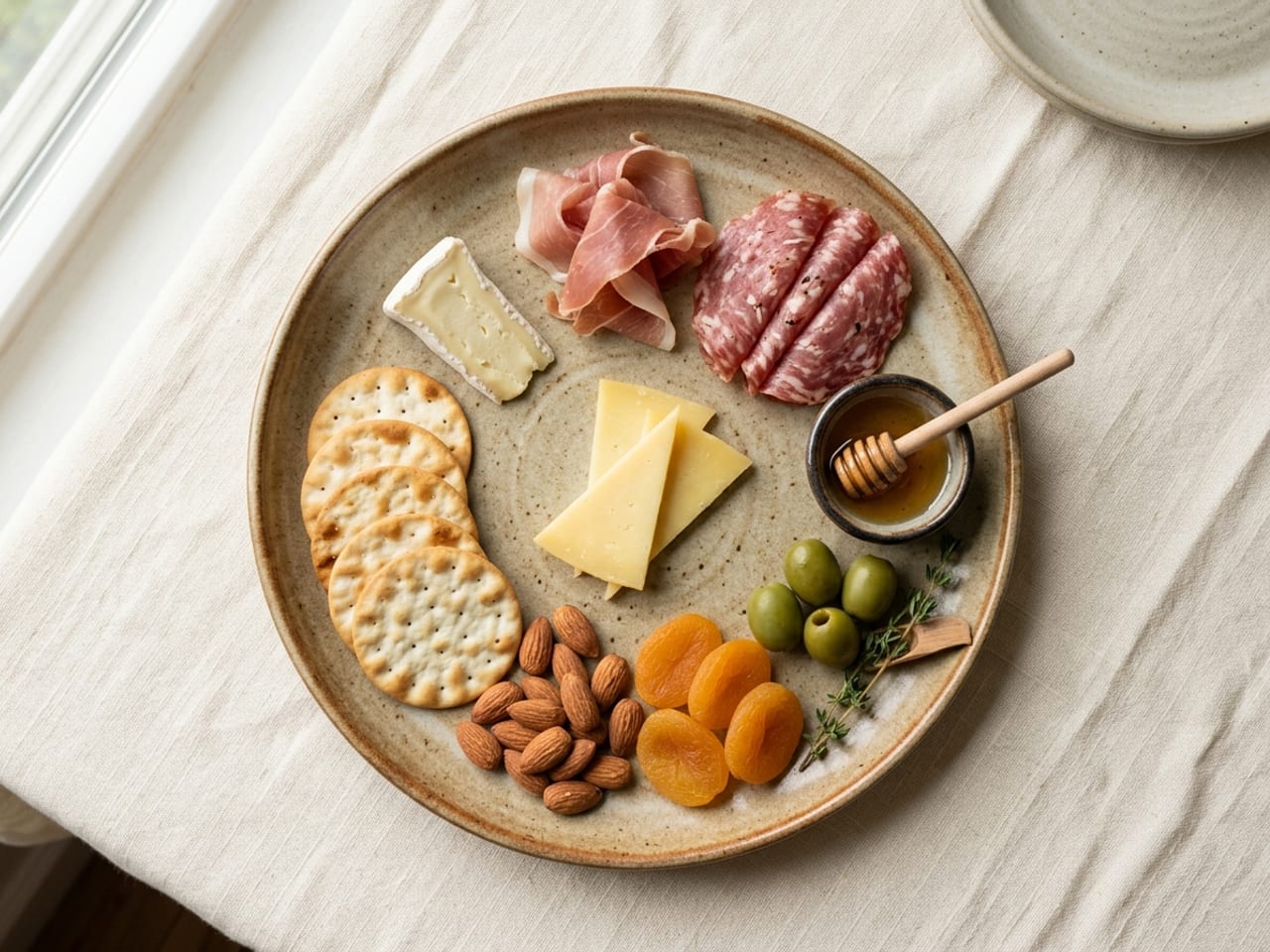
What is the 3-3-3 rule for charcuterie boards?
Three cheeses, three cured meats, three accompaniments; 3-3-3-3 adds three starches. Search for the first and, as of September 2026, most top answers describe the second. Nobody attributes it to a cheesemonger, a book, a chef or a brand: a folk rule of the blog era, in two versions.
It fails arithmetic at both ends because it counts varieties and never weighs anything. At the flat 2 oz (57 g) rule, before the taper: two guests across three cheeses is 1.3 oz (38 g) of each, a wedge no counter cuts and one that dries before it is eaten; twelve guests is 24 oz (680 g), 8 oz (225 g) per cheese, easy to buy but too few flavors. The rule balances at six to eight guests, where 12 to 16 oz (340 to 450 g) over three cheeses is one honest wedge each. Under four, two of each; over ten, five cheeses; and convert every three into a weight before you shop.
Charcuterie board ingredients for eight
The board in the illustrations, an appetizer for eight: 16 oz (450 g) of cheese and 16 oz (450 g) of meat, the table’s row for eight. Jars, boxes and a baguette come whole, so the bag weighs more than the per-head rule and the surplus goes back to the fridge.
- Prosciutto, 6 oz (170 g)Paper-thin; the ribbon meat.
- Salami, 10 oz (285 g), two kindsA mild Genoa plus a soppressata or finocchiona.
- Soft cheese, 8 oz (225 g)A small brie served whole, two wedges cut out.
- Firm cheese, 5 oz (140 g)Manchego or aged cheddar, fanned.
- Aged or blue cheese, 3 oz (85 g)Aged Gouda in shards, or Stilton with its own knife.
- Crackers, two boxesOne plain, one seeded; the second box stays in the kitchen.
- Bread, one baguetteSliced on the diagonal, ⅜ in (1 cm) thick.
- Fresh fruit, 1 lb (450 g) grapes plus one pearGrapes snipped into clusters; the pear sliced last.
- Dried fruit, 6 oz (170 g)Apricots or figs: the sweet that will still look good at hour three.
- Preserves, one jarFig jam, or quince paste (membrillo) for the Manchego.
- Nuts, 8 oz (225 g)Marcona almonds or candied pecans, bowled.
- Vegetables, a handfulRadishes, cherry tomatoes on the vine, cucumber.
- Olives and cornichons, one jar eachDrained and bowled.
- A dip, oneWhipped feta, hummus or grainy mustard: the vegetarian guest’s slot.
Charcuterie board cheeses: the texture-and-milk grid
Cheesemongers run two rules at once: one of each texture (soft, semi-firm, hard, blue as a fourth) and one of each milk (a sheep or goat cheese stops three wedges tasting like the same dairy). Three cheeses cannot satisfy both unless you check the grid. A trio that does: fresh chèvre (goat, soft), Manchego (sheep, semi-firm), aged cheddar or Gouda (cow, hard). Add a blue and a brie for twelve.
Serve at 65 to 70°F (18 to 21°C): cold milkfat holds the aroma compounds inside the paste, and since most of flavor is smell, cold cheese tastes of salt and texture. A wedge needs 30 minutes, a 1 lb (450 g) block an hour, so stagger. Hard cheese and dry salami go out first: neither is on the safety clock, so they can temper for an hour without spending any of it. The soft cheese follows 20 minutes before guests, short of its 30 deliberately, because its clock is the one that matters. Cooked meats and pâté come out last. The two-hour clock starts when the soft cheese, the cooked meat or the pâté leaves the fridge, and that is the part nobody says out loud: an hour of tempering would be an hour of the two.
Cut so every piece carries rind and heart, because cheese ripens from the rind inward: wheels in wedges, wedges from the point, logs in rounds, aged cheese levered into shards (shards read as a board; cubes read as a catering tray). Pre-cut two-thirds; leave the rest as a wedge with a knife in it.
Charcuterie board meats: two families, two thicknesses
Whole-muscle cures (prosciutto, coppa, bresaola, speck) want to be paper-thin and translucent; a thick slice of long fibers chews like leather. Fermented salami (Genoa, soppressata, finocchiona) wants about ⅛ in (3 mm), thick enough to fold without tearing. Stiff dry sausages (Spanish chorizo, saucisson sec) do not fold; slice them into coins. Cooked charcuterie (mortadella, pâté, terrine) must stay cold. Meat comes out 15 to 20 minutes before serving: cold pork fat is waxy on the tongue and turns translucent and aromatic as it warms.
Two labels. Uncured on a US pack does not mean no nitrite. Only sodium and potassium nitrite and nitrate are approved curing agents, so a salami cured with celery powder, which is nitrate-rich and which a starter culture turns into nitrite, cannot be sold as cured: 9 CFR 319.2 makes it carry “Uncured” in front of the name and 9 CFR 317.17(c) makes it carry “No Nitrate or Nitrite Added” beside it. It is cured; the word is a labelling artefact. CSPI and Consumer Reports petitioned USDA over exactly this in 2019, FSIS agreed in December 2020 to propose a fix, and no proposed rule had reached the Federal Register when we checked in September 2026. One thing that label does buy you: celery powder makes celery an ingredient, and celery is a declarable allergen in the UK and EU, though not in the US. And prosciutto, coppa and salami are, strictly, salumi; charcuterie is the French word.
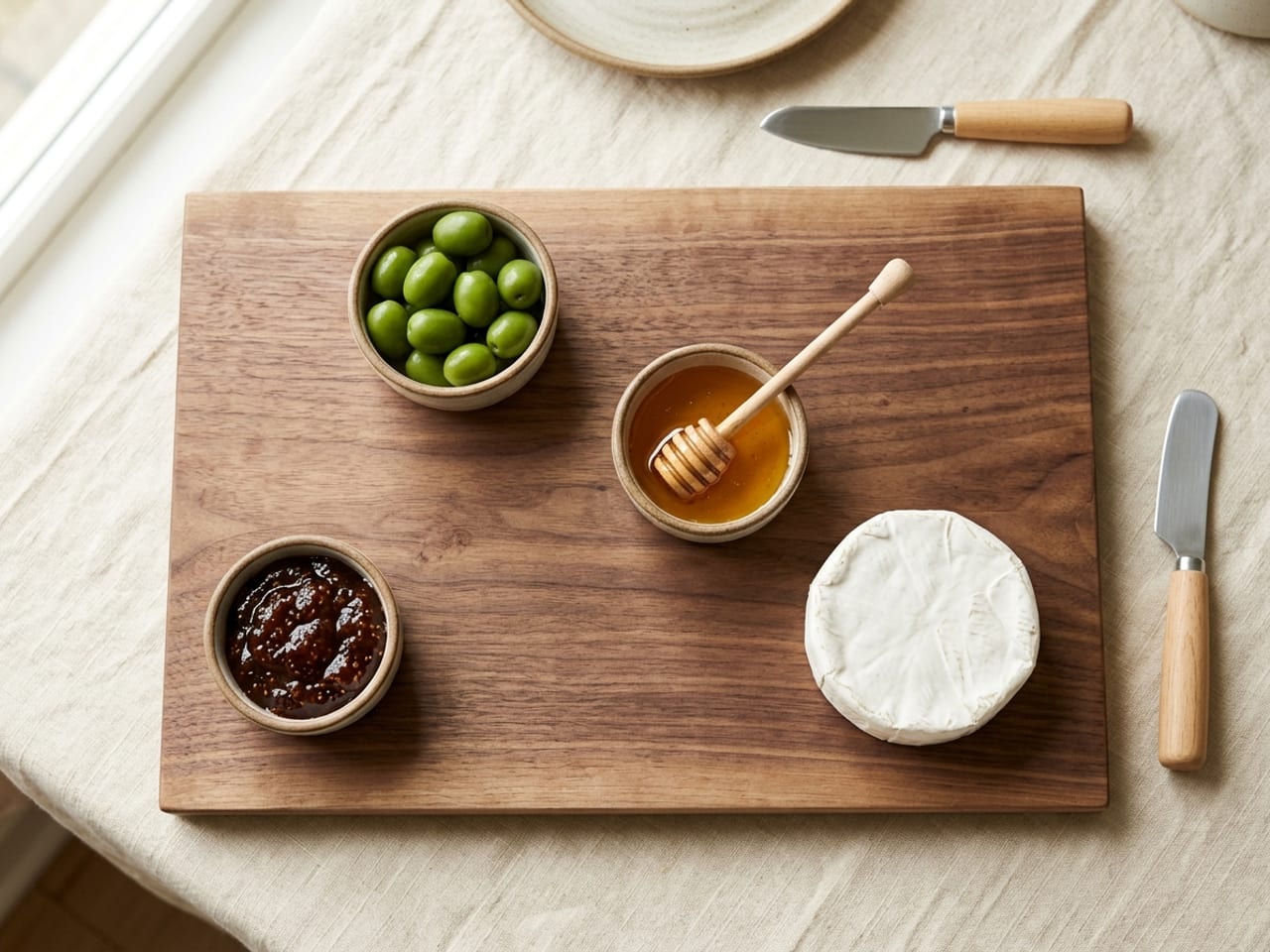
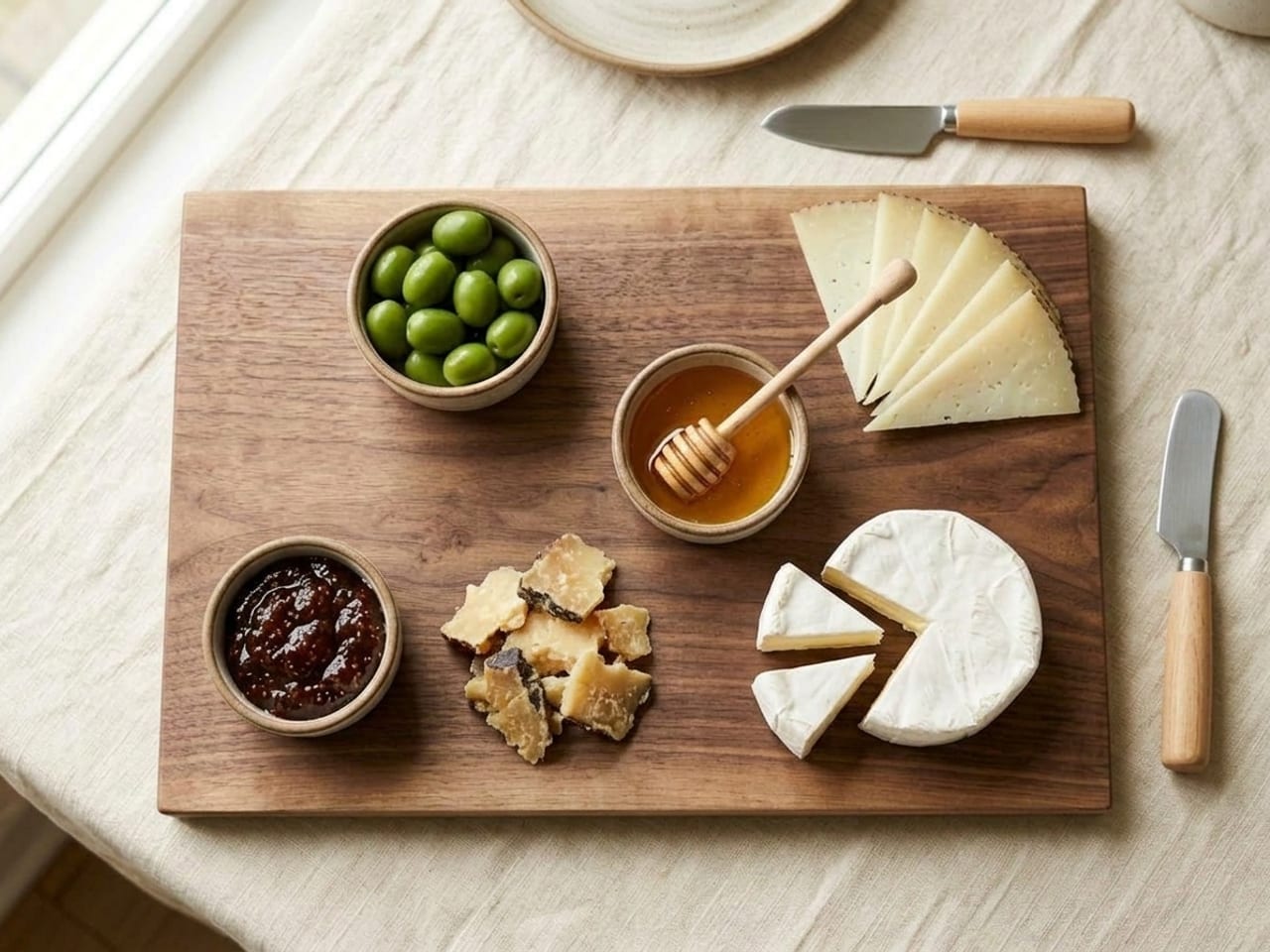
How to arrange a charcuterie board: the four-stage build
The labelled diagram people keep asking for; each stage is placed relative to the last.
- Stage 1: anchorsBowls first, then the largest thing: two or three ramekins and the cheese wheel, off-center in a loose triangle, never dead center. Leave a 1 in (2.5 cm) margin at every edge for hands.
- Stage 2: cheeses at the points of a triangleFirm cheese fanned at one point, aged shards at another, the wheel at the third. The eye now has three stops, and the wood between them is your negative space. Keep it.
- Stage 3: meat as the linesA salami river meanders from one cheese to the next, prosciutto ribbons drape between another pair, the rose lands beside the wheel. The meat connects the anchors and gives the board flow: one composition, not three piles.
- Stage 4: fillers, garnish, wipeGrape clusters and dried fruit into the largest gaps, nuts bowled, crackers last and never under meat (they steam). Edible herbs only; a knife per cheese. Wash your hands before you build, and set tongs or a fork beside anything guests would otherwise pick up with fingers that have already been in the cheese. Wipe the rim as you would a plate; photograph before the first hand lands.
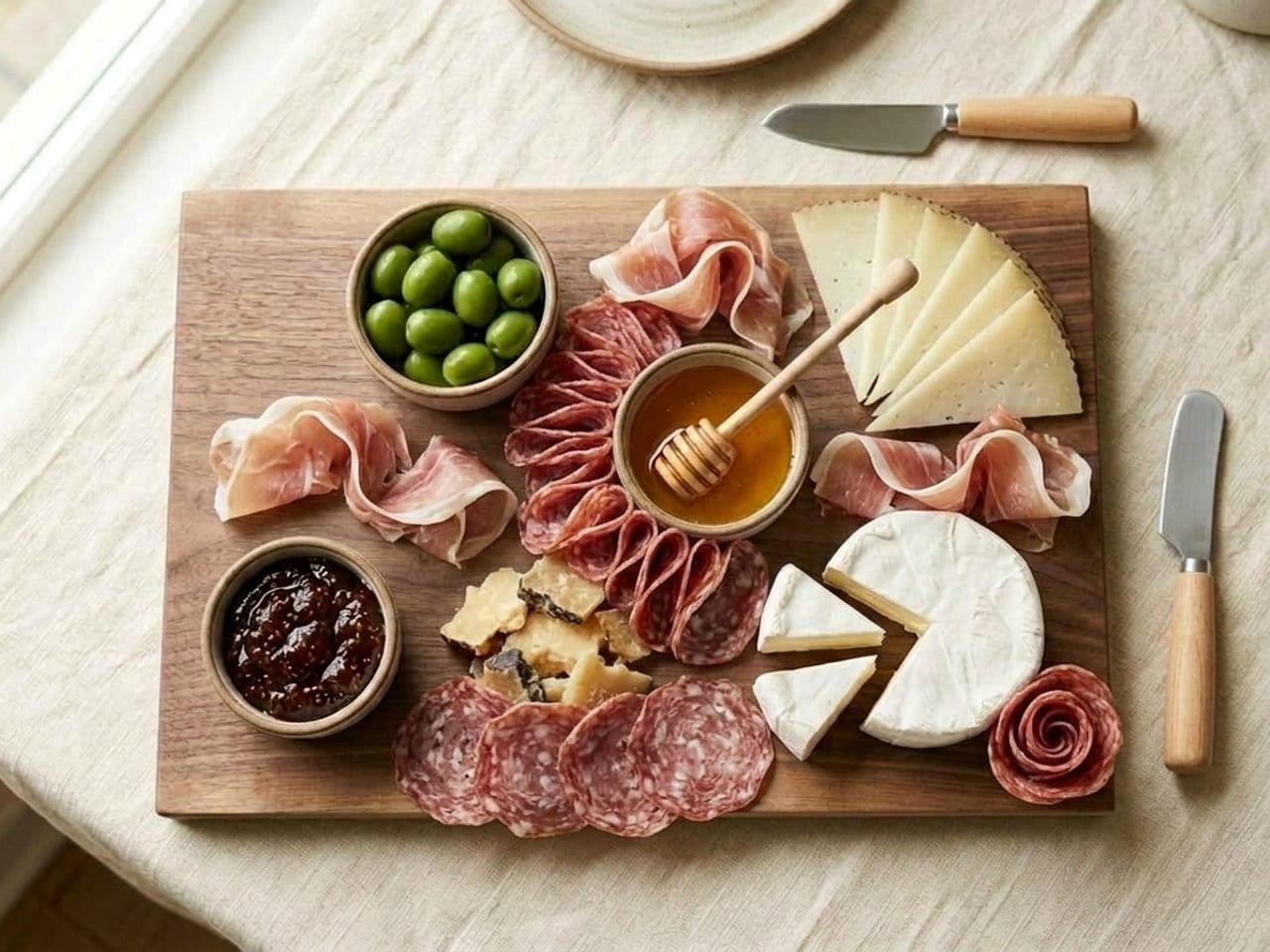
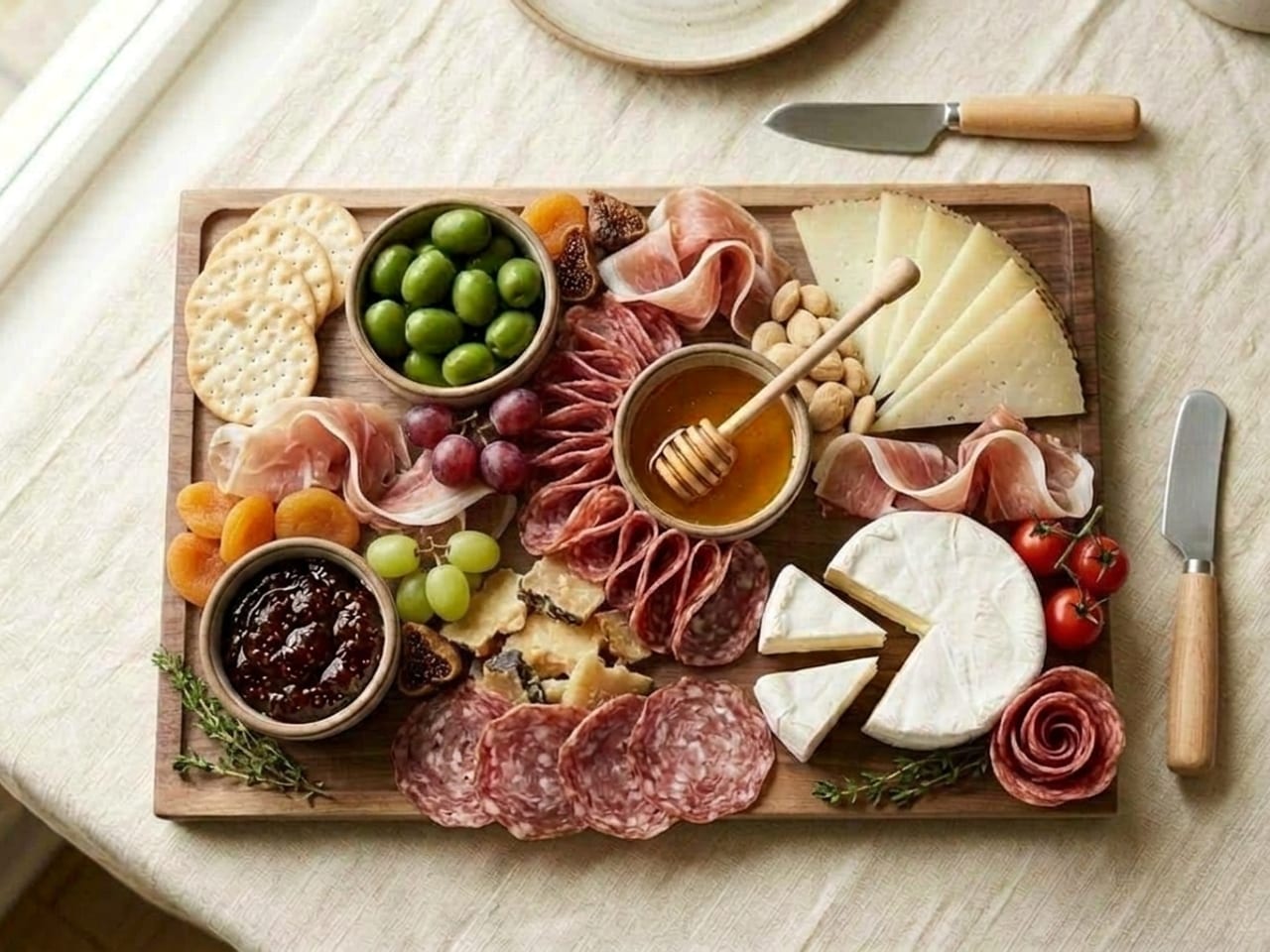
Charcuterie board layout: the plating rules that survive the evidence
Negative space first. A board that shows no wood reads as a heap, and the research is consistent: identical food arranged with visible intent is liked more, rated tastier, and diners pay more for it 12.
Distribute the color; do not group it. Reds at three points, ambers between them, greens as accents, the logic of color on the plate. A scattered assortment also reads as more varied, and perceived variety drives how much people eat 5: to make the board last, group; to see it demolished, scatter. (Co-author Brian Wansink was found by Cornell in 2018 to have committed academic misconduct and left the university the following year; this 2004 paper is not among his retractions.)
The odd-numbers rule is folklore: the only controlled test found no preference for odd over even and, with portions equated, preferred four to three 3. Plate the count the board needs. One moment of height: the wheel or the rose. Size the board to the headcount, not up: guests serve themselves, the condition under which a bigger surface raises intake 7.
Salami roses, prosciutto ribbons and the salami river
- The salami roseLine the rim of a stemless wine glass with thin salami, each slice overlapping the last by about ¼ in (6 mm); add a second row bridging the seams, then a third, pinching the glass so the layers fold inward; flip onto the board and lift. Cold slices crack. Built ahead, refrigerate it on the glass. One rose per board.
- The prosciutto ribbonNever lay it flat; it looks like wet paper and glues itself to the wood. Lift each slice by one end and set it down in a loose S-curve so air stays under it.
- The salami riverFold each slice in half, rounded edge up, nestle pairs folding opposite ways, and run them in a meandering line between two cheeses; the folded edges catch the light in a wave.
- Cheese cuts and coinsWheel: wedges from the center. Block: ⅛ in (3 mm) planks, then triangles, fanned. Log: rounds, with a wire. Aged hard cheese: levered into shards. Stiff chorizo or saucisson: coins on a bias.
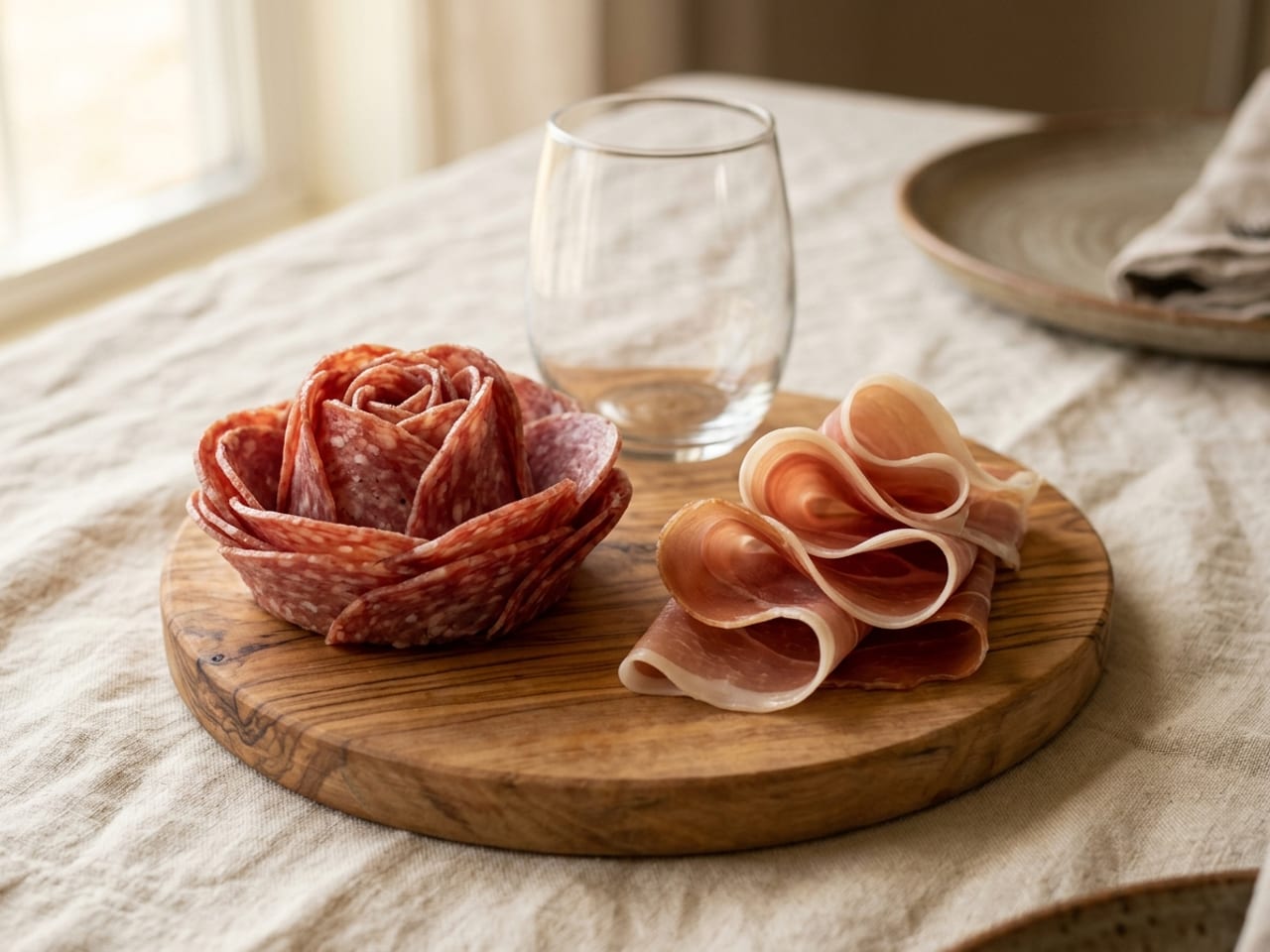
The board for two, and the simple board
Small charcuterie board ideas fail when they are a big board shrunk; six items at 1 oz (28 g) each is a crumb board. For two, cut the variety, not the weight: two cheeses at about 2.5 oz (70 g) each, two meats at 2 oz (57 g) each (a rose, four ribbons), one bowl, one fruit, one cracker, on a 10 by 7 in (25 by 18 cm) board. Two anchors, one line, one filler: a diagonal, not a triangle.
The simple charcuterie board is the same discipline for six: three cheeses in three textures, two meats rather than the table’s three, one sweet, one briny, one crunch, everything pre-cut. Twenty minutes, a third of the cost, and it photographs better, because the negative space does the work the missing items would have crowded out.
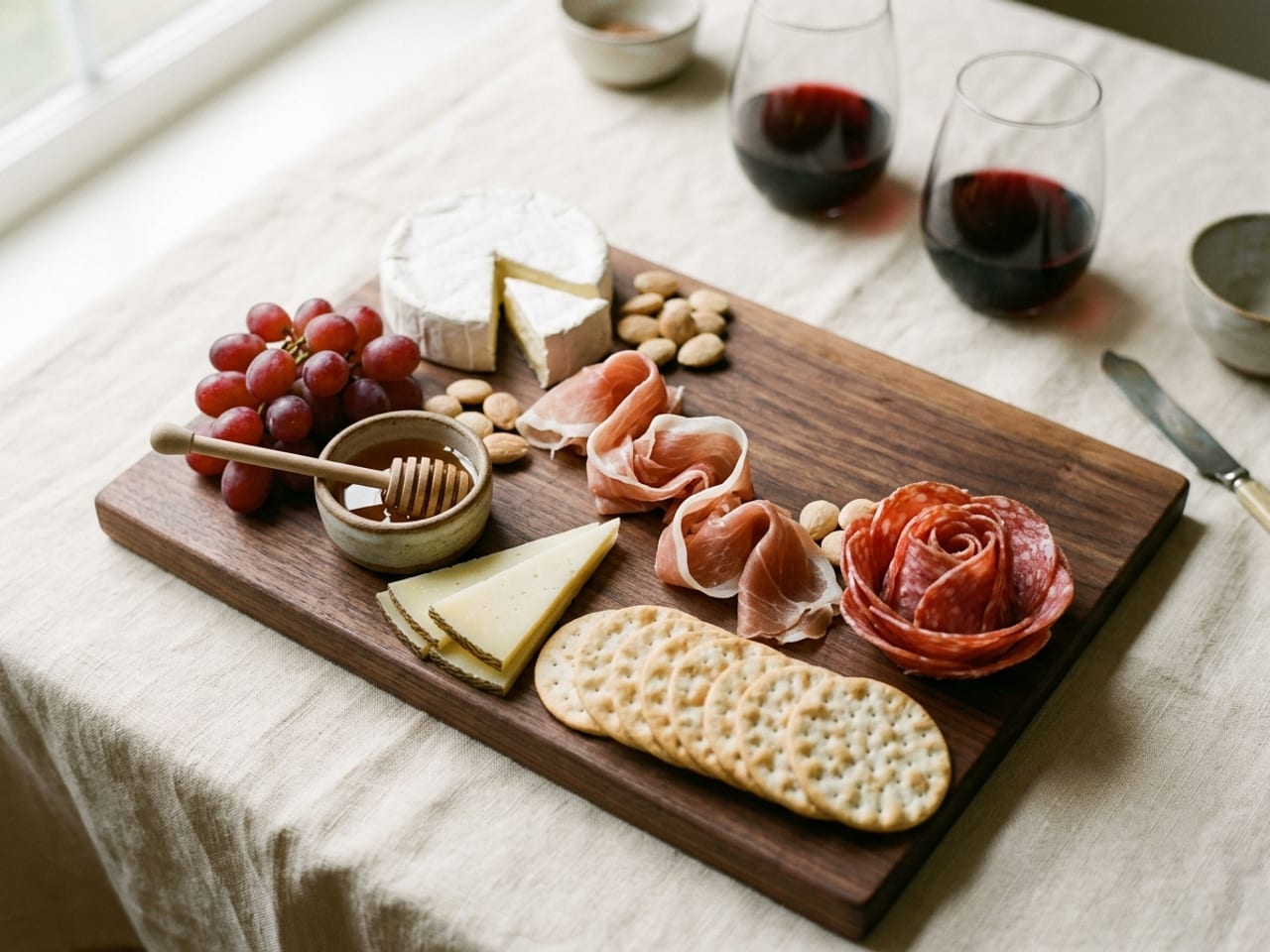
Charcuterie board themes by season, region, meal and diet
Each keeps the four-stage build and swaps the cast.
- Fall harvestAged cheddar, Comté, a blue; soppressata; apple, pear, dried figs, candied pecans, apple butter. For October, the Halloween board keeps this cast and does black, orange and purple with real food, pigment named; for November, the Thanksgiving board builds it smaller, as the opener before the turkey.
- Winter holiday wreathAnchors in a ring: brie in the middle, a salami river circling it, rosemary and pomegranate.
- Valentine’s for twoTriple cream, young Manchego, prosciutto ribbons, strawberries, dark chocolate, honeycomb.
- Summer burrata and stone fruitBurrata cut open on the board, peaches, cherries, prosciutto, basil, dressed tomatoes. Burrata and cut tomatoes are both on the clock, and outdoors above 90°F (32°C) that clock runs an hour, not two.
- Game dayCheddar cubes, pepper jack, pepperoni, summer sausage, pretzels, pickles, beer cheese in the center bowl. Warm beer cheese is on the clock too: send out a small bowl and refill it from the stove.
- Italian salumi boardProsciutto di Parma, finocchiona, mortadella; Parmigiano shards, Taleggio; artichokes, olives, grissini.
- Spanish tablaJamón serrano, chorizo coins, lomo; Manchego, Cabrales; membrillo, Marcona almonds, piquillo peppers.
- French apéro plateauSaucisson sec, jambon de Bayonne, a country pâté kept chilled; Comté, chèvre; cornichons, Dijon, baguette.
- German BrotzeitSpeck, Landjäger, Leberwurst; Emmental, a smoked cheese; pretzels, radishes, sweet mustard, gherkins, rye.
- New York deliSwiss and sharp cheddar, pastrami or beef salami, spicy mustard, half-sour pickles, rye crisps.
- Mediterranean mezze, vegetarianWhipped feta, seared halloumi, labneh; olives, roasted peppers, dolmas, hummus, warm pita. The dips are the anchors.
- Ploughman’s boardFarmhouse cheddar, Stilton, cold ham, pickled onions, chutney, apple, a crusty roll (a 1957 marketing name for an older meal).
- Breakfast boardSmoked salmon ribbons, cream cheese, halved soft-boiled eggs, bagel chips, berries, honey. Plate last: the eggs and the salmon are both on the clock, and both are on the cook-it-first list for a pregnant guest.
- Kids’ boardCheddar in thin sticks rather than cubes, mozzarella pearls quartered or left off, rolled turkey, apple slices, grapes quartered lengthwise, pretzels, yogurt dip. No honey for anyone under one (CDC). For under-fours the AAP choking list is the guide: no whole grapes, no chunks of cheese, no whole nuts, and round firm foods chopped small.
- Budget boardThree cheeses from the deli end-cuts bin, a 12 oz (340 g) salami, grapes, water crackers, olives. About $25 for six.
- Keto boardCheeses, meats, olives, nuts, cucumber and radish for crunch; no crackers or fruit.
- Gluten-free boardCheeses in their rinds, cured meats, grapes, cucumber; gluten-free crackers in their own bowl, and for a coeliac guest a separate plate off the board, because the crumbs in the wood are the problem, not just the knives.
- Dairy-free, meat-forwardProsciutto, salami, coppa, olives, mustard, grapes, dairy-free crackers: strictly, the only actual charcuterie board here.
- Vegan boardA cashew soft cheese, a smoked almond cheese, plant-based salami; the sweet, briny and crunch cast unchanged.
- After-dinner cheese courseThree cheeses at 1.5 to 2 oz (43 to 57 g) a head, walnuts, a pear and port: the Anglo-American cheese course the board descends from, documented in British and American cookbooks of the 1840s and 1860s.
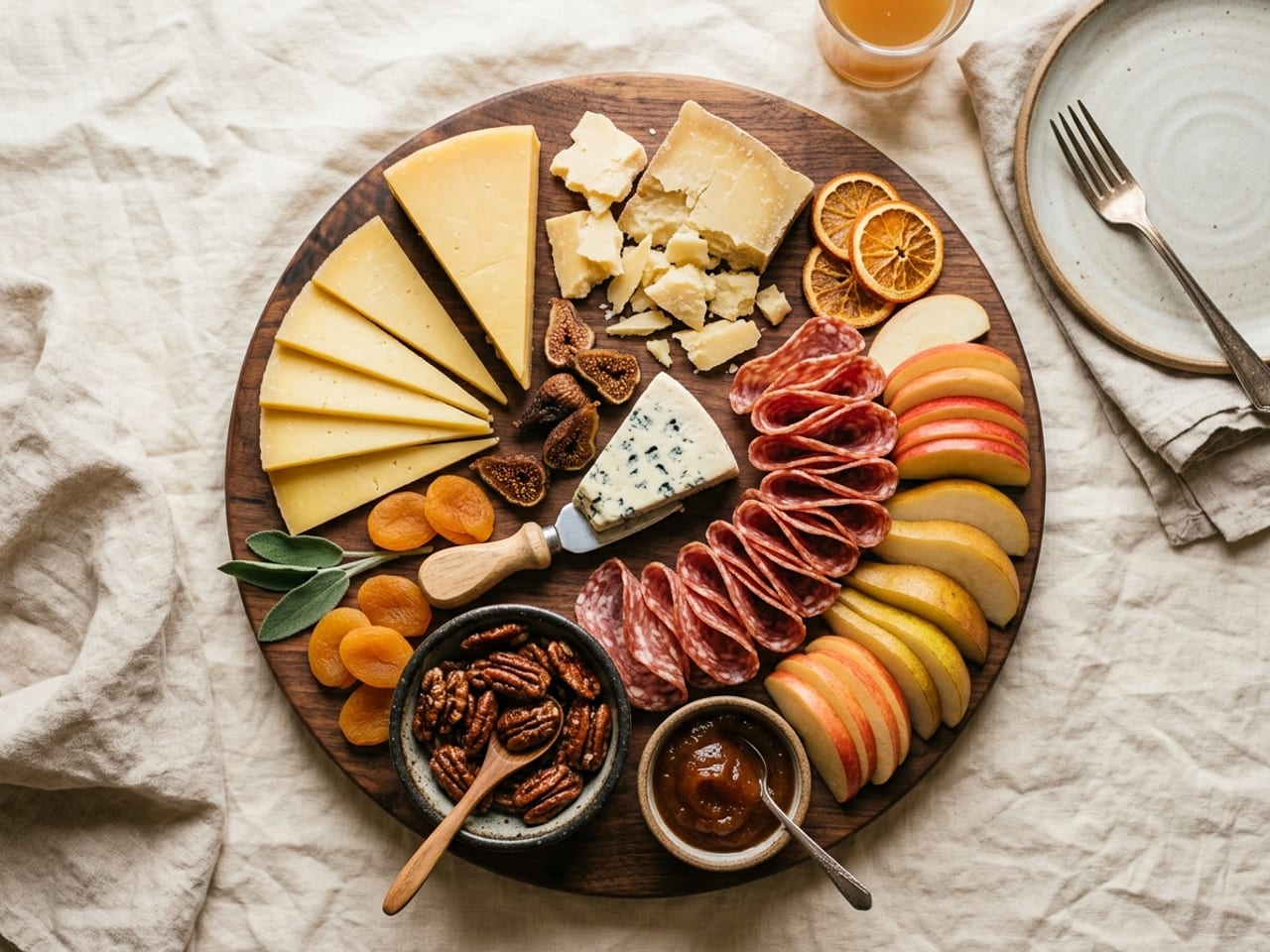
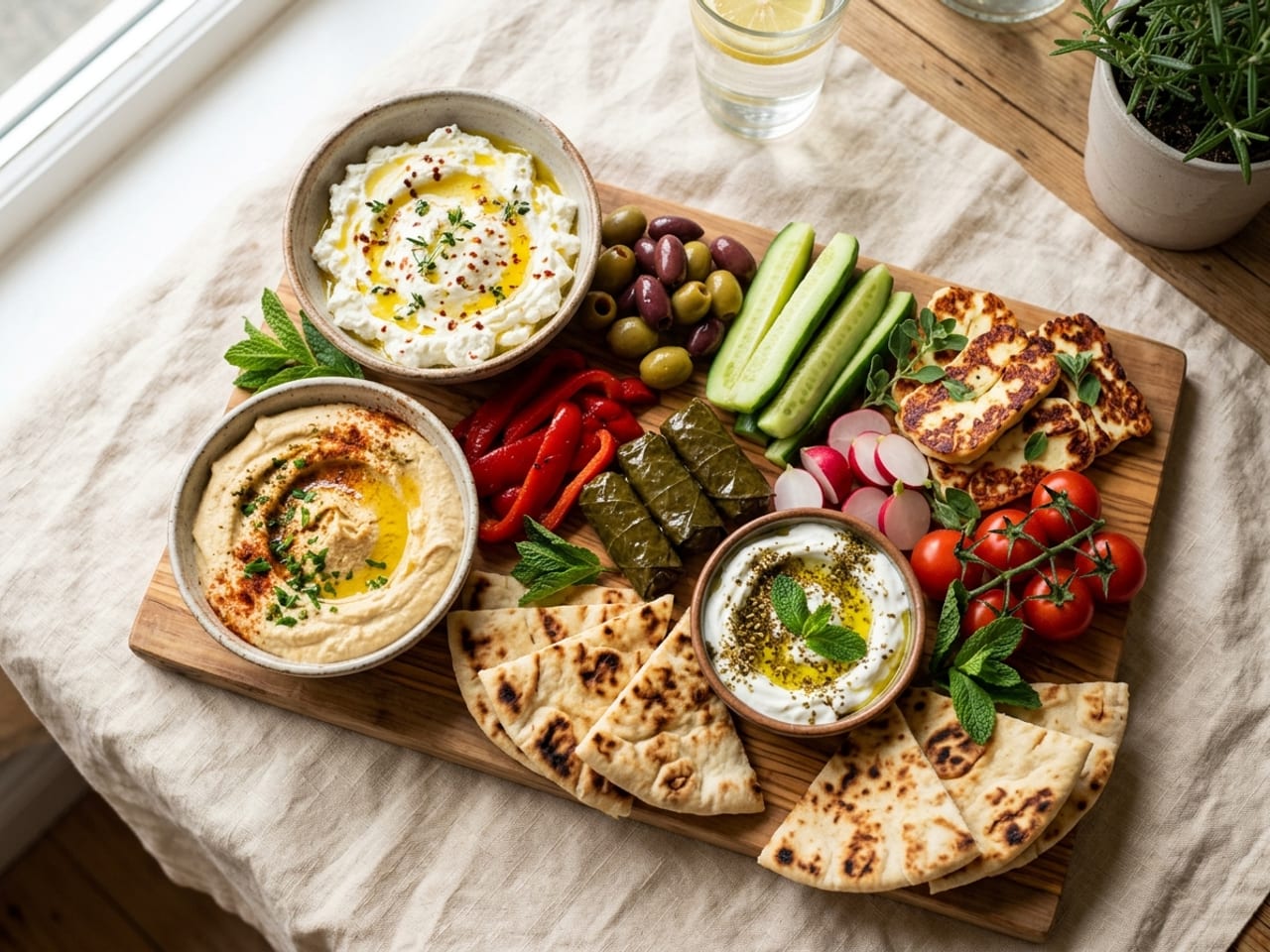
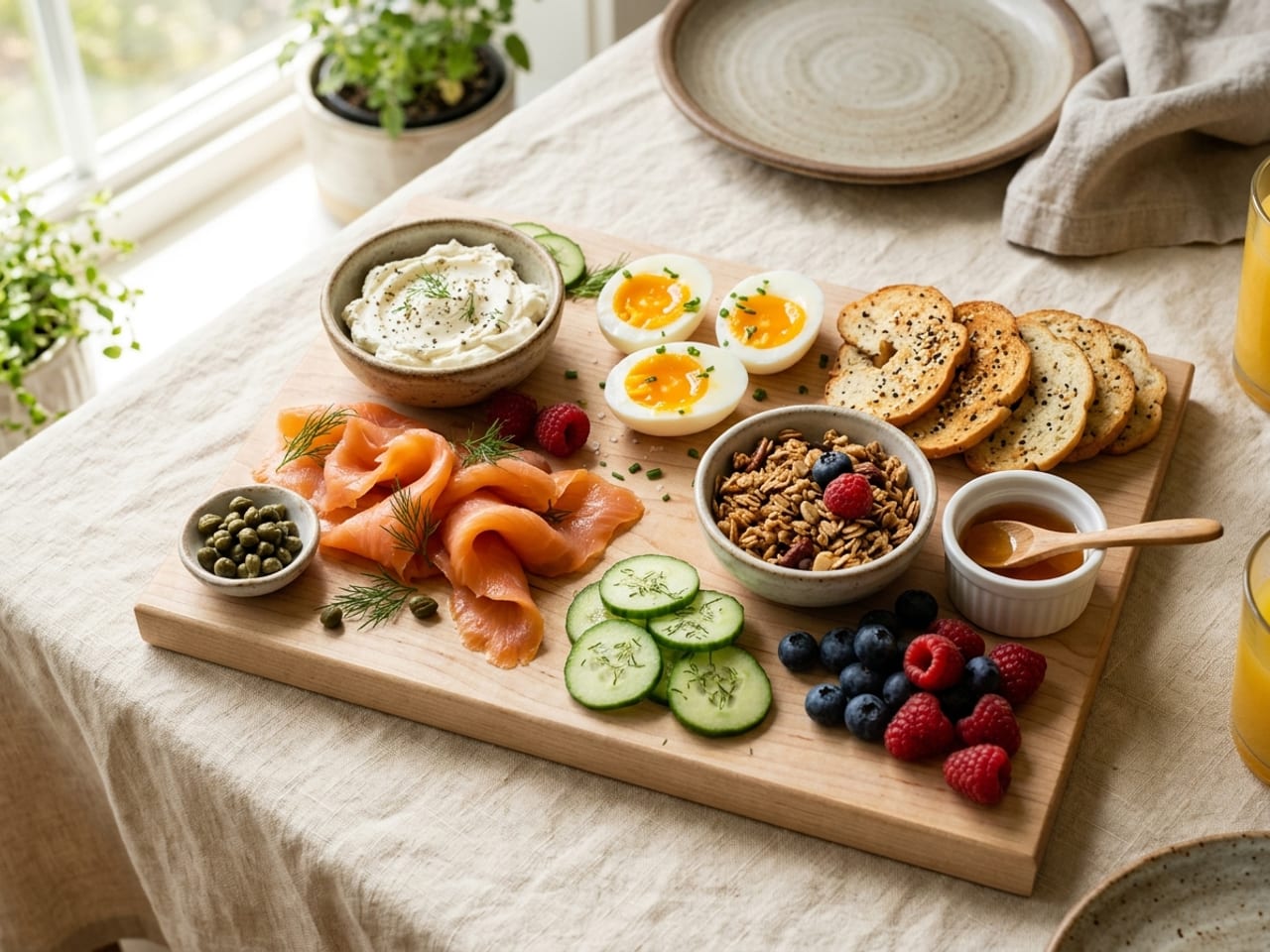
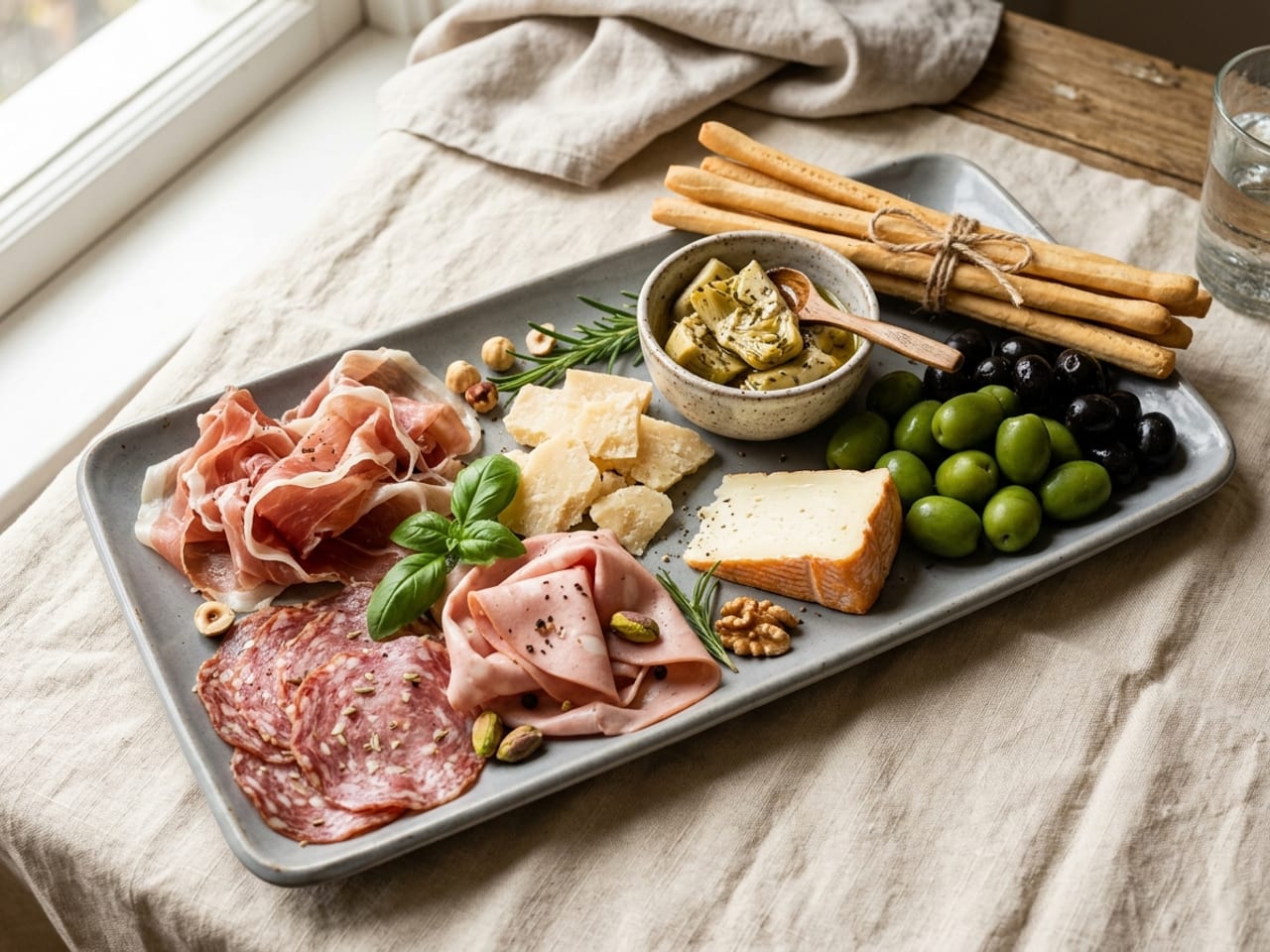
What are 5 things to avoid on a charcuterie board?
Every list online gives taste problems (wet olives loose, an overpowering cheese, crumbly crackers, strong fish). None of those can hurt a guest. These five can.
- Honey, with a baby presentHoney can carry Clostridium botulinum spores, and CDC says none before 12 months; the spores survive heat, so honeycomb and glazed nuts count 6. Ramekin with its own spoon, or off the board.
- Soft cheese and deli meat, with a pregnant guestUS and UK rules differ; the safety section gives both. The practical move is a labelled separate plate: hard cheese, fruit, crackers, nothing sliced at a deli counter, and no fresh Latin-style cheese unless it has been heated.
- Perishables past two hoursUSDA FSIS: 2 hours between 40°F (4°C) and 140°F (60°C), 1 hour when it is above 90°F (32°C) out. Soft cheese, cooked meats, pâté and cut melon are what the clock governs; the fridge does not reset it.
- Loose nuts on a shared boardNut dust in the grain and on shared tongs makes the whole board unsafe for a nut-allergic guest; nut-flour crackers count, and so does a board finished with walnut oil. No regulator publishes allergen rules for a home grazing board, and the Food Code’s allergen provision is aimed at food employees, so this is practice borrowed from buffet guidance: bowl the nuts with their own spoon, say which items carry them, and for a known allergy take them off the board.
- One knife for all the cheesesA shared blade moves allergens, the nut-rolled chèvre onto the plain cheddar, and it moves whatever is on the soft cheese onto everything else. Cheesemongers mind the flavor too: a knife off a blue carries Penicillium roqueforti onto the brie, which blues within days and tastes flatter at once. One knife per cheese, or at minimum one for the blue and one for anything rolled in nuts.
And five composition mistakes
Crowding until no wood shows. Cold cheese straight from the fridge. Slicing everything hours ahead, so the soft cheese skins, the pear browns and the prosciutto welds to itself. Grouping every color in one place. And odd-number dogma, which has you removing the fourth cheese the board needed 3.
The two-hour clock, and the four-hour rule caterers use
At home the rule is USDA FSIS’s Danger Zone: no more than 2 hours between 40°F (4°C) and 140°F (60°C), 1 hour when it is above 90°F (32°C) out, because bacteria there can double in as little as 20 minutes. A food business works to a different number. FDA’s Food Code is a model code that states adopt with local variations, and its section 3-501.19 lets an establishment use time instead of temperature for ready-to-eat TCS food: the food leaves cold holding at 41°F (5°C) or below, is marked with a time four hours out, and is served or thrown away by then, with no putting it back in the fridge. A colder variant allows six hours if the food starts at 41°F (5°C) or below and is monitored so it never passes 70°F (21°C), which is exactly a cold grazing table. All of it runs on a written procedure that exists before the party does. Caterers can buy four hours that way, six for a cold table; at home you have two, and no marking system.
The clock is really on specific items. The Food Code decides which by crossing water activity against pH in two tables (paragraph 1-201.10(B)). For food that is not heat-treated and packaged, which is everything on a board, anything drier than 0.88 water activity sits outside the rule at any pH, and a wet food needs a pH under 4.2 to get out of it. The table below is our reading, not an FDA statement about boards. Aged cheddar, Parmesan, prosciutto and dry salami hang or sit unrefrigerated in a salumeria or a cheese cave; once they share a board, a knife and a dozen hands with brie and pâté, clock the whole board. Keep a second wave chilled and swap at 90 minutes.
Which board items the clock is on
Our reading of the Food Code’s Table B, item by item: an inference from the thresholds, not an FDA ruling about boards.
| Item | On the clock? | Why |
|---|---|---|
| Fresh mozzarella, burrata, ricotta, fresh chèvre, cream cheese | Yes | High moisture, near-neutral pH |
| Brie, camembert, triple cream, blue cheeses | Yes | Water activity well above 0.88, pH near neutral |
| Mortadella, cooked ham, pâté, terrine | Yes | Cooked, high-moisture meat |
| Cut melon, cut tomatoes, soft-boiled eggs | Yes | Cut melon and cut tomato are named in the definition; a shelled egg is heat-treated animal food |
| Aged cheddar, Parmesan, aged Gouda, Manchego, Pecorino | No | Hard cheese, not more than 39% moisture, which the Food Code exempts from date marking |
| Prosciutto, coppa, bresaola, dry salami | Generally no | Shelf-stable dry fermented sausage and salt-cured ham; a refrigerated pack of pre-sliced prosciutto is not |
| Grapes, berries, apple slices, dried fruit, nuts, brined olives, honey, jam, crackers | No | Low water activity, or acidic below pH 4.2 |
Pregnancy, raw milk, the wooden board and leftovers
The pregnancy advice differs by country. The US rules mostly by pasteurization: FDA says no feta, brie, camembert, blue-veined cheese, queso blanco, queso fresco or panela unless the label says pasteurized, and hard cheeses are fine. CDC goes further on queso fresco and its relatives, which are out unheated whether or not they are pasteurized, because pasteurized soft cheese has repeatedly been contaminated after pasteurization during cheese-making; heated to 165°F (74°C) or steaming hot is the safe form. Deli meats get that same 165°F (74°C), and refrigerated pâté is avoided. The UK NHS rules by rind and mold instead: mold-ripened soft cheeses and soft blues must be thoroughly cooked, pasteurized or not, and cold cured meats such as salami and prosciutto should be cooked until steaming hot, for toxoplasmosis as well as listeria. The US asks the same of fermented or dry sausages such as salami, for listeria (CDC), but says nothing about whole-muscle hams like prosciutto. A pasteurized brie is a yes in Ohio and a no in Oxford.
The breakfast board is the hardest one to serve a pregnant guest: NHS puts cold-smoked salmon and runny eggs without a British Lion stamp both on the cook-it-first list, and FDA puts refrigerated smoked seafood and undercooked eggs on the US one. Cook that board’s salmon and eggs, serve them on a separate plate, or leave that guest out of it.
One organism is doing most of this work. Listeria monocytogenes is rare and unusually dangerous in pregnancy, and unlike most foodborne bacteria it grows at refrigerator temperature, which is why deli meat gets a window of days rather than weeks and why “it has been cold the whole time” is not an answer.
Raw-milk cheese on a US counter is at least 60 days old. Federal rules make pasteurization the default for milk products in interstate commerce (21 CFR 1240.61) and let unpasteurized milk through only where a cheese standard provides an alternative: cheddar at 21 CFR 133.113, soft ripened cheeses at 133.182, each requiring the cheese be cured at not less than 35°F (1.7°C) for not less than 60 days. Rules for cheese made and sold inside one state vary. That is why there is no raw-milk fresh cheese at an American counter.
Wood is fine, and better than the scarred plastic in most kitchens. The FDA Food Code (4-101.17) permits hard maple or an equivalently hard, close-grained wood, which is generally read to rule out open-grained oak and the softwoods, though the Code names no species and that section governs food businesses rather than home kitchens; the trade treats walnut, cherry, beech and olive as equivalents, which is what the boards in these illustrations are. The experiment behind the folklore was Nese Ak, Dean Cliver and Charles Kaspar’s at the University of Wisconsin-Madison Food Research Institute: new and knife-scarred wooden and plastic blocks inoculated with E. coli including O157:H7, Listeria and Salmonella. Clean wood drew the liquid and the bacteria in by capillary action and they could not be recovered afterwards; new plastic cleaned easily; knife-scarred plastic with fat in the cuts was the surface that could not be cleaned by hand. Cliver, who carried the work on at UC Davis, put the conclusion carefully: food can be prepared safely on wooden surfaces, and plastic has disadvantages that had been overlooked. Oil the board with food-grade mineral oil, never a nut oil, which is its own cross-contact problem.
Leftovers, and the two countries disagree here too. USDA’s FoodKeeper gives opened store-sliced deli meat 3 to 5 days, sliced dry salami or pepperoni 2 to 3 weeks, opened hard cheese 3 to 4 weeks and soft cheese 1 to 2 weeks. The UK FSA is shorter and blunter: leftovers into the fridge within one to two hours, eaten within 48 hours, reheated once, fridge at 0 to 5°C (32 to 41°F). Neither rescues anything that sat out past the clock; refrigerating it afterwards does not undo the two hours.
One pass at the board: 728 calories and 93% of a day’s sodium
One appetizer serving, every line from a named USDA FoodData Central entry; kcal = kcal per 100 g x grams / 100. It weighs cheese, meat and the dry accompaniments only: the bread and fresh fruit in the shopping list add roughly another 100 kcal on top. The cracker line is modelled on standard snack crackers, so the water crackers this page prefers (FDC 171856) save about 24 kcal and 29 mg.
| Item (FDC entry) | Amount | kcal | Sodium mg |
|---|---|---|---|
| Brie (172177) | 1 oz (28 g) | 95 | 178 |
| Cheddar (328637) | 1 oz (28 g) | 116 | 185 |
| Prosciutto (2705879) | 1 oz (28 g) | 55 | 764 |
| Dry salami, pork (172938) | 1 oz (28 g) | 115 | 641 |
| Snack crackers (174982) | 6 (19 g) | 98 | 139 |
| Almonds, dry roasted, salted (168596) | 1 oz (28 g) | 170 | 66 |
| Dried apricots (173941) | 5 halves (18 g) | 42 | 2 |
| Green olives (169096) | 4 small (11 g) | 16 | 168 |
| Honey (169640) | 1 tsp (7 g) | 21 | 0 |
| Total | 195 g | 728 | 2,143 |
Where the salt is, and what the board costs
The FDA Daily Value for sodium is 2,300 mg, so one serving is 93% of a day. Everyone blames the cheese; the cheese is 17% of the salt. The 2 oz (57 g) of cured meat is 1,405 mg, two-thirds of the total, and four green olives weighing 11 g carry almost as much sodium as an ounce (28 g) of brie, 168 mg against 178, off a third of the weight: olive brine is two and a half times as salty as brie gram for gram. The cheapest lever, from the FDC entries, is a reduced-sodium salami (FDC 172966, 936 mg per 100 g): 265 mg an ounce instead of 641, a saving of about 375 mg a head. Variety is part of why the board gets finished: offered four fillings instead of one, people ate about a third more 4.
Cost, three ways. Delivered: Boarderie’s Large board, checked in September 2026, is $249 for 70 oz (2 kg) of cheese, meat and accompaniments plus 13 oz (370 g) of crackers, serving 10 to 14. That is 83 oz (2.35 kg) of food in all, $3.00 an ounce (about $106 a kilo), $17.79 to $24.90 a head, and at 5.8 oz (165 g) of food a person against our 4 oz (113 g) of cheese and meat it is a meal board, not an appetizer. Self-assembled: an eight-person appetizer board from Aldi at 2026 shelf prices (cheese and meat quoted, the rest our estimates in the same band) is about $43 for the whole board, $5.40 a head, about $1.35 an ounce across the 32 oz (900 g) of cheese and meat inside it. Commodity floor: the Bureau of Labor Statistics’ July 2026 average for natural cheddar is $5.741 a pound ($12.66 a kilo), and a Costco price tracker had Kirkland Signature reduced-sodium salame at $11.49 for 32 oz (900 g) in mid-2026, so 16 oz (450 g) of each for eight is about $11.50, $0.36 an ounce ($12.66 a kilo). The food is cheap; the arrangement is where the $249 goes, and that part you can do.
What charcuterie means, and why the board is a misnomer
Charcuterie is pronounced shar-KOO-tuh-ree. From chair cuite, cooked flesh, it names a trade and its products: cured, salted, smoked and cooked pork. In French it never meant a board and never meant cheese, and the American sense is so new that Merriam-Webster now carries it as a second sense, “a selection of charcuterie accompanied by other foods (such as cheese, nuts, fruit, crackers, or bread) and served usually on a board.” The dictionary caught up with the drift; the word’s own history did not cause it. The Paris charcutiers received their first statutes on Wednesday 17 January 1476 by letters of Robert d’Estouteville, provost of Paris (the document says 1475 because Paris then began the year at Easter, hence every retelling’s 1475 and Louis XI). Article 5 forbade them to sell “beurres, fromages”, butter and cheese, allowing “saulsisses, chars cuites, saindoulx”, sausages, cooked meats and lard, plus the other butchery goods they were used to selling; the 1477 revision permitted cheese during Lent. The cheese-and-meat board would have been illegal for the guild that named it.
The OED’s earliest evidence for the English word is 1858, in Peter Lund Simmonds’ Dictionary of Trade Products, though Merriam-Webster dates a first use to 1825. The entry, as it reads in the 1863 printing: “CHARCUTERIE, formerly Chair cuit, the French name for cooked flesh, such as dressed hams, cold meats and fowls, tongues, sausages, &c.” Note what is not in it: cheese, crackers, fruit, a board. The phrase charcuterie board is younger than it feels: in Google Books, charcuterie plate outnumbers it about twenty to one across the 2000s, thirty to one at its widest in 2005, and board overtakes plate only in 2017. Google Trends shows no measurable US search interest in the phrase until September 2015, and every annual peak since 2017 has fallen in December. The cheese board is the older Anglo-American thing; the American charcuterie board is that format wearing a French trade’s name, married around 2015 to 2017.
What is replacing charcuterie boards?
Nothing has replaced it; it gets renamed about every eighteen months. The best-documented challenger is the butter board. Justine Doiron published “How to Make a Butter Board” on 12 September 2022 and opened it, in writing rather than in the video everyone remembers it from: “A butter board is the next charcuterie board trend. Don’t quote me on it, but if it happens, then you can quote me on it.” In the same post she credited the technique to chef Josh McFadden, whose 2017 book Six Seasons is where it comes from, so the trend was a five-year-old cookbook idea and the creator said so at the time. US searches went from 402 a month in August 2022 to 145,097 in October, a 361-fold spike in two months, and back to 2,674 by May 2023, a 98% collapse in the seven months after the peak. It never came back as a trend and it did not vanish either: a September 2026 reading of 25,729 is a reminder that fads leave residue.
Jarcuterie (credited to Noble Graze, reported as July 2020) never registered as a search term. Girl dinner (Olivia Maher, 11 May 2023, a plate of bread, cheese, grapes and pickles offered as a good dinner rather than a lesser one) never went away, because it named a habit, not a format. The snackle box, a tackle box of board items, is the real successor at about 45,000 US searches a month, holding steady rather than climbing, and still the largest of the challengers. Grazing tables are the catering scale-up; their Australian origin has no source, and the only named, dated, first-person claim is Lucy Zee’s New Year’s Eve party of 31 December 2015 in New Zealand, on brown paper, “inspired by a Filipino kamayan meal I had as a teenager,” as she wrote in Stuff in 2019. The board itself: December searches fell from 1,295,910 in 2021 to 902,555 in 2025, still twenty times the nearest challenger in the same month and nine times it averaged across the year.
Your board, re-arranged
Photograph the board you just built, upload it, and Plate Artists returns it re-arranged with anchors, flow and negative space, plus the moves to get there with your own hands. Same cheese, same meat, better board.
Start free · 1 enhancement →Free account · 1 free enhancement · No credit card
Charcuterie board questions, answered
What is the 3-3-3 rule for charcuterie boards?
Three cheeses, three cured meats, three accompaniments; 3-3-3-3 adds starches. No traceable author, two versions in circulation, and it balances only for six to eight guests: under four, two of each; over ten, five cheeses. Weigh 2 oz (57 g) of cheese and of meat a head regardless.
What are 5 things to avoid on a charcuterie board?
Honey where a child under one might eat (CDC); soft cheese and cold deli meat with a pregnant guest (FDA, CDC, NHS); perishables out past 2 hours, or 1 hour when it is above 90°F (32°C) out (USDA); loose nuts on a shared board; one knife doing all the cheeses. The usual taste list comes after those.
What are good items to put on a charcuterie board?
One item per job: a whole-muscle cured meat and a salami; a soft, a firm and an aged or blue cheese; fresh fruit and a preserve; olives in a bowl; two kinds of cracker or a baguette; nuts in a bowl; a vegetable and a dip. Weigh 2 oz (57 g) cheese and 2 oz (57 g) meat a guest.
What is a charcuterie board?
A board or platter of cured meats (the charcuterie proper), almost always with cheeses, crackers or bread, fruit, nuts, olives and a preserve, arranged to be eaten by hand and shared. In French the word names the cured-pork craft and the shop that sells it, never a board; the mixed board is an American usage. Build it by weight: 2 oz (57 g) cheese and 2 oz (57 g) meat a guest.
What is replacing charcuterie boards?
Nothing, measurably. The butter board (September 2022) spiked 361-fold in two months and lost 98% of its searches in the seven after the peak; jarcuterie never registered; girl dinner (May 2023) named a habit and stuck; the snackle box, about 45,000 US searches a month, is the closest successor. Charcuterie board searches still peaked above 900,000 in December 2025, down from 1.3 million in December 2021 and an order of magnitude above every challenger.
How much charcuterie do I need per person?
Appetizer: 2 oz (57 g) cheese and 2 oz (57 g) cured meat a person, plus about 4 oz (113 g) of crackers, nuts, olives and dried fruit, with bread and fresh fruit on top. As the meal: 4 oz (113 g) cheese, 3 oz (85 g) meat, 2 oz (57 g) bread. Amounts taper as the group grows; twelve guests need about 22 oz (625 g) of each.
How do you spell and pronounce charcuterie, and what does it mean?
C-h-a-r-c-u-t-e-r-i-e, said shar-KOO-tuh-ree. From the French chair cuite, cooked flesh: the craft of curing, salting, smoking and cooking pork, and the shop that sells it. It never meant a board or cheese; the Paris guild’s 1476 statutes forbade charcutiers to sell cheese outside Lent.
What is the difference between a cheese board and a charcuterie board?
A cheese board is led by cheese, a charcuterie board by cured meat: no meat, call it a cheese board; no cheese, it is still charcuterie. Americans say charcuterie board for any mixed board. Build both the same way.
How long can a charcuterie board sit out?
Two hours at room temperature, one when it is above 90°F (32°C) out, per USDA FSIS, and the clock starts when the soft cheese leaves the fridge to temper. Soft cheese, cooked meats, pâté and cut melon are what it is really on. The Food Code’s four hours, six for a cold table, is written for food businesses with a written procedure and time marking.
Can pregnant guests eat from a charcuterie board?
Parts of it, and the parts differ by country. US (FDA, CDC): hard cheeses and pasteurized soft cheeses are fine, but queso fresco and its relatives are out unless heated; deli meats only heated to 165°F (74°C); no refrigerated pâté. UK (NHS): mold-ripened soft cheeses and soft blues must be cooked, and cold cured meats cooked until steaming. Make a labelled separate plate.
What is the best cheese for a charcuterie board?
A trio rather than a single cheese: fresh chèvre (goat, soft), Manchego (sheep, firm) and an aged cheddar or Gouda (cow, hard) cover three textures and three milks. Add a brie for the crowd and a blue on its own knife. Serve at 65 to 70°F (18 to 21°C).
The research behind this guide
Peer-reviewed studies, retrieved via PubMed and Crossref. Every numbered figure quoted above comes from one of these papers.
- Michel, C., Velasco, C., Gatti, E., & Spence, C. (2014). A taste of Kandinsky: assessing the influence of the artistic visual presentation of food on the dining experience. Flavour, 3, 7. doi:10.1186/2044-7248-3-7
- Zellner, D. A., Loss, C. R., Zearfoss, J., & Remolina, S. (2014). It tastes as good as it looks! The effect of food presentation on liking for the flavor of food. Appetite, 77, 31-35. doi:10.1016/j.appet.2014.02.009
- Woods, A. T., Michel, C., & Spence, C. (2016). Odd versus even: a scientific study of the ‘rules’ of plating. PeerJ, 4, e1526. doi:10.7717/peerj.1526
- Rolls, B. J., Rowe, E. A., Rolls, E. T., Kingston, B., Megson, A., & Gunary, R. (1981). Variety in a meal enhances food intake in man. Physiology & Behavior, 26(2), 215-221. doi:10.1016/0031-9384(81)90014-7
- Kahn, B. E., & Wansink, B. (2004). The influence of assortment structure on perceived variety and consumption quantities. Journal of Consumer Research, 30(4), 519-533. doi:10.1086/380286
- Tanzi, M. G., & Gabay, M. P. (2002). Association between honey consumption and infant botulism. Pharmacotherapy, 22(11), 1479-1483. doi:10.1592/phco.22.16.1479.33696
- Holden, S. S., Zlatevska, N., & Dubelaar, C. (2016). Whether smaller plates reduce consumption depends on who’s serving and who’s looking: a meta-analysis. Journal of the Association for Consumer Research, 1(1), 134-146. doi:10.1086/684441
Agency guidance, dictionaries and archives cited by name in the text:
- USDA FSIS, Danger Zone (40°F to 140°F, 4°C to 60°C)
- USDA FSIS, Cold Food Storage Charts (FoodKeeper windows for deli meat, dry sausage and cheese)
- FDA Food Code 2022 (paragraph 1-201.10(B) Tables A and B, sections 3-501.17, 3-501.19, 4-101.17)
- FDA, Food safety for moms-to-be: soft cheeses and ready-to-eat foods
- CDC, Preventing Listeria infection (queso fresco, deli meats, pâté, soft cheese in pregnancy)
- CDC, Foods and drinks to avoid or limit (no honey before 12 months)
- NHS, Foods to avoid in pregnancy
- UK Food Standards Agency, How to chill, freeze and defrost food safely (48-hour leftovers, 0 to 5°C)
- American Academy of Pediatrics, HealthyChildren.org, Choking Prevention (grapes, cheese chunks, nuts, under-fours)
- 21 CFR 1240.61, mandatory pasteurization of milk products in interstate commerce, eCFR
- 21 CFR part 133 cheese standards (cheddar 133.113, soft ripened 133.182): 60-day cure for unpasteurized milk, eCFR
- 9 CFR 317.17(c), ‘No Nitrate or Nitrite Added’ labelling, eCFR
- 9 CFR 319.2, ‘Uncured’ in front of the standard product name, eCFR
- FDA, Sodium in your diet (Daily Value 2,300 mg)
- USDA FoodData Central (entries 172177, 328637, 2705879, 172938, 174982, 171856, 168596, 173941, 169096, 169640, 172966)
- US Bureau of Labor Statistics, Average Price Data, July 2026 (cheddar cheese, natural, series APU0000710212)
- The Kitchn, Nora Singley on how much cheese to buy for a crowd (per cheese, per person)
- America’s Test Kitchen, How to make a salami rose
- Boarderie, Large charcuterie board (Arte), product page checked September 2026
- Ak, N. O., Cliver, D. O. & Kaspar, C. W., Decontamination of plastic and wooden cutting boards for kitchen use, J Food Prot 57(1), 23 to 30 (1994); Cliver (2006), J AOAC Int 89(2), PubMed 16640304
- Lespinasse, R. de, Les métiers et corporations de la ville de Paris, vol. I (1886), Titre VII, Charcutiers, statutes of 17 January 1476 (archive.org)
- Simmonds, P. L., A Dictionary of Trade Products (1858; 1863 printing, archive.org), entry ‘Charcuterie’
- Merriam-Webster, charcuterie (sense 1b, charcuterie board; first known use 1825)
- Cambridge Dictionary, charcuterie
- Google Books Ngram Viewer, ‘charcuterie board’ vs ‘charcuterie plate’, 1900 to 2022
- Google Trends, ‘charcuterie board’, United States, 2004 to 2026
- Wassberg Johnson, S., The Food Historian, The history of cheese and charcuterie boards (20 December 2021)
- wordhistories.net, ‘ploughman’s lunch’: first print use 15 May 1957
- Doiron, J., How to Make a Butter Board (justinesnacks.com, 12 September 2022)
- Zee, L., Stuff (NZ), ‘I believe I invented the grazing table trend’ (26 July 2019)
- Ahrefs Keywords Explorer, US monthly volumes for ‘charcuterie board’, ‘butter board’, ‘snackle box’, ‘jarcuterie’ (retrieved 2 September 2026)
Keep going
Plating 101: the composition guide
Anchors, negative space, the clock method and the wiped rim: the vocabulary this board is built with, on a plate.
Color on the plate
How to distribute reds, ambers and greens so a board, or a plate, reads as composed rather than sorted.
Cook something for the board
100+ recipes with step-by-step methods and three plating ideas each; the warm element for a brunch board lives here.