Halloween charcuterie board ideas spooky by palette, not by dye
Every Halloween board online is a shopping list with candy eyes on it. This one is a plating guide: black, orange and purple from real food with the pigment named, a skull built silhouette first, weights for six to twenty, and a safety clock that starts at dusk.
The photos on this page are AI-generated illustrations.
A spooky charcuterie board is a colour composition first (black, orange, purple and white from real food, one acid green), then a silhouette (a brie skull, a Manchego ribcage, a coffin drawn in salami), and only then the tricks. Weigh it like any board, 2 oz (57 g) of cheese and 2 oz (57 g) of meat a head plus a quarter, because Halloween grazes for hours; the arithmetic is on the charcuterie board flagship.
Two things the ranking pages have backwards. All serve on a black tray for mood; the plate-colour research found the same dessert rated about 10% sweeter, 15% more intense and 10% better liked from a white plate than a black one 12, so black for negative space, pale under the food. And none mentions a clock, a choking list or an allergen, on boards built for children.
We did the reading too: why cheddar is orange, why a canned olive is black, which candy eye is vegan (the British one), who built the skeleton board, and the two deaths behind fifty years of razor-blade warnings.
What to put on a Halloween charcuterie board
Google answers with a list of dark foods. We answer with five colours and a silhouette: a colour tells you what to substitute, a silhouette where it goes.
Orange: an annatto cheese
Sharp cheddar for the jack-o’-lantern cutouts, or Mimolette, whose cratered rind is the most Halloween thing in the cheese case; dried apricot for the small orange.
White: the shape-holders
Mozzarella for ghosts, a brie for the web, a Monterey Jack block for carving. Only white reads as a shape across a room, so the white cheese is the one you cut.
Black: the shadow
Canned ripe olives, blackberries, black grapes, squid-ink crackers, an ash-lined goat cheese. Kalamatas photograph purple; the cheap can is the better black.
Purple: the bruise
Drunken Goat in wedges from the centre so every piece carries its wine rind; black Mission figs, radicchio, Concord grapes.
Green: one accent
Castelvetrano olives, cornichons, pistachios bowled at the adults’ end. One green; two and the board turns Christmas.
Meat: three jobs
A salami that folds for the web and the ribs, a dark or paprika-orange one (Spanish chorizo) for shadow, prosciutto for wrapping. Prosciutto is what you run out of.
The silhouette
One shaped thing the eye lands on first: a brie skull, a salami-bordered coffin, a pumpkin cheese ball. Never a plastic prop.
Candy, bowled
Candy eyes and candy corn (sugar, corn syrup, gelatin and honey in a tricolour kernel) are garnish: ramekins, the last 15 minutes, and nut candy never touches the meat.
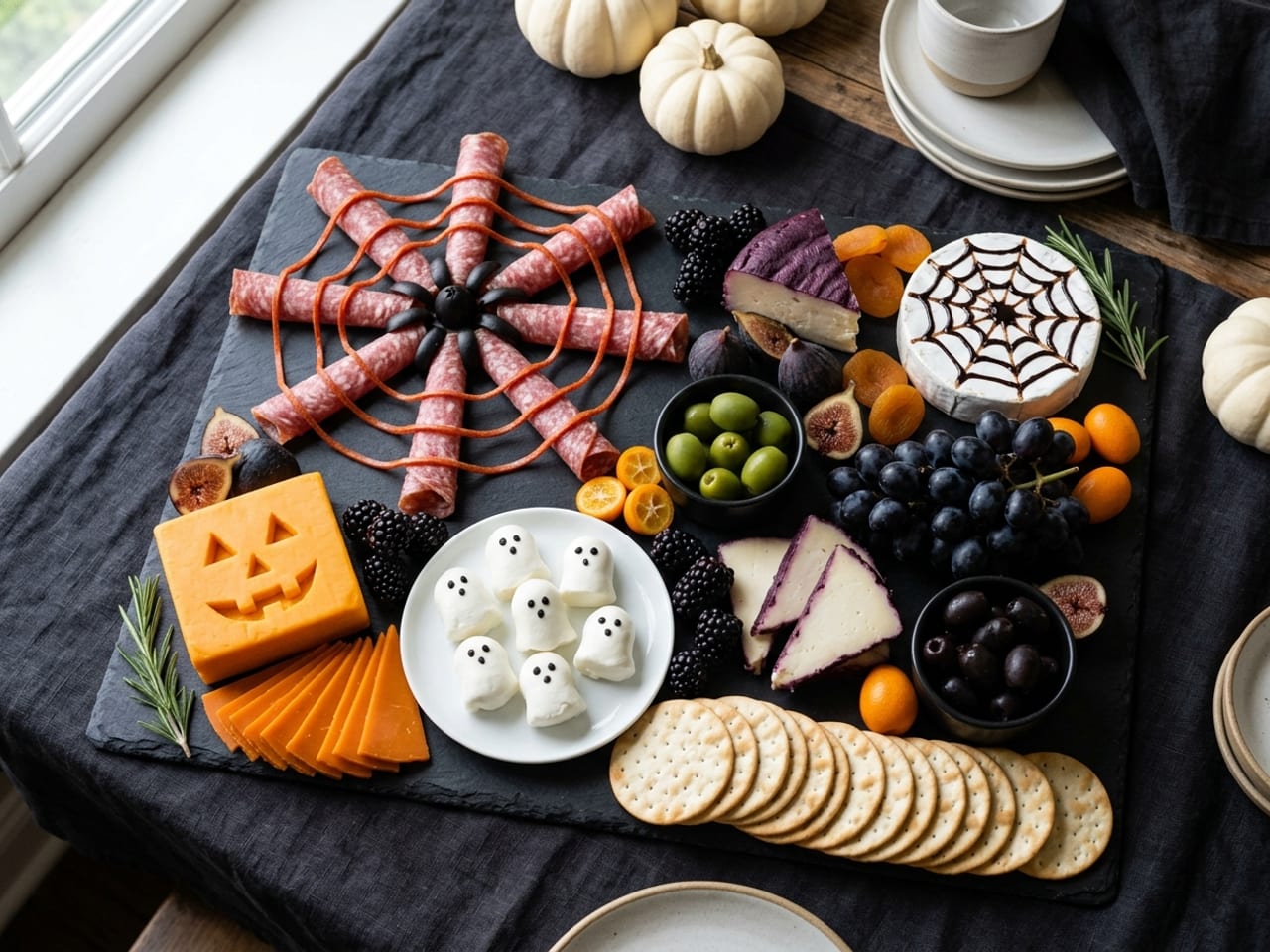
Black, orange, purple, white and green from real food
Every colour on the board is a pigment in the food, a reaction somebody engineered, or a dye. Orange cheddar is a seed: annatto (E160b, 21 CFR 73.30), the extract of the achiote tree, its pigments bixin and norbixin. English makers had been tinting cheese since the 1600s, first with saffron, marigold and carrot, because a golden cheese sold as a rich summer one; annatto took the job over in the 1700s and 1800s and kept it. It colours cheddar, Red Leicester, Mimolette and Shropshire Blue; carrot, persimmon and orange pepper are carotenoids in the flesh.
The canned black olive is the surprise: picked green, cured in lye, blackened by bubbling air through the brine 3, then fixed with ferrous gluconate, an iron salt whose only permitted US use as a colour is, in the regulation’s words, “for the coloring of ripe olives” (21 CFR 73.160); its other legal life is as an iron supplement (21 CFR 184.1308). It is on the $1.86 Great Value label. A Kalamata is truly ripe and photographs purple; for spider legs and eye sockets the cheap can wins. Black also comes honestly from ash rinds (vegetable carbon as a pH buffer, not a colour), squid-ink crackers (cephalopod eumelanin 4: a mollusc, one of the UK’s fourteen declarable allergens but not one of the US nine, so it goes on your card by choice), black garlic (Maillard browning) and anthocyanins, which shift with pH: lemon turns a red-cabbage garnish pink, baking soda turns it blue-green, a potion with no dye in it. Castelvetrano is bright green because it is young and lye-cured fast.
What not to use. Activated charcoal has no entry in the US colour-additive list (not one of the colours listed in 21 CFR 73 Subpart A is carbon in any form) and appears in FDA’s Substances Added to Food inventory only as a processing aid: unlisted as a colour, not banned. When New York City’s health department made Morgenstern’s dump about $3,000 of black ice cream in the weeks before 7 June 2018, its spokeswoman called such food “prohibited by the U.S. Food and Drug Administration,” which overstates the FDA’s own record; the EU permits it as E153 5. It also adsorbs medicines. Black gel colouring is Blue 1, Red 3, Yellow 5 and Yellow 6 in corn syrup, and one of those four, Red 3, loses its US food listing in January 2027; it bleeds grey into mozzarella and stains teeth. The candy eye is the transatlantic joke: black with a dye blend in the US, black with E153 in the UK.
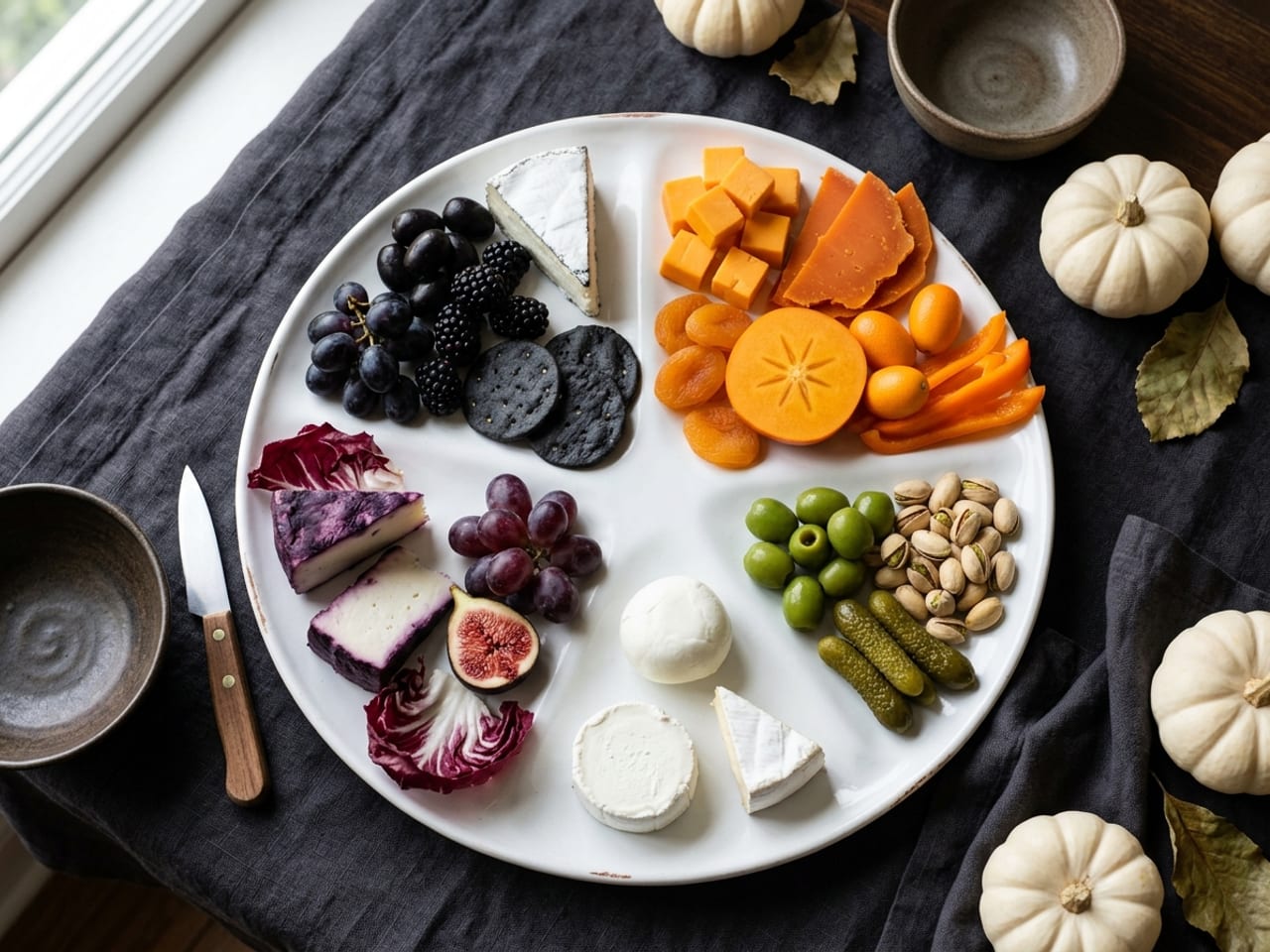
Pigment, reaction or dye: the sorting table
Which colour is doing what, so you know which to trust and which to skip.
| Colour on the board | Mechanism | Verdict |
|---|---|---|
| Orange cheddar, Red Leicester, Mimolette | Annatto in the milk (E160b, 21 CFR 73.30): bixin and norbixin | Plant pigment, added; use freely |
| Carrot, kabocha, apricot, persimmon, kumquat, orange pepper | Carotenoids in the tissue | True pigment |
| Spanish chorizo | Paprika carotenoids, mainly capsanthin | True pigment, from the spice; the darkest orange meat |
| Cheese crackers, orange corn chips | Added colour, annatto or FD&C dyes | Added; fine as filler |
| White cheddar, Monterey Jack, fresh mozzarella | The same milk with no annatto | No additive; the cheeses to carve |
| Canned ripe black olive | Lye, forced air, fixed with ferrous gluconate (21 CFR 73.160, E579) | Reaction plus an iron salt; the best black |
| Kalamata | Ripe fruit, brine and vinegar cure | True pigment; reads purple |
| Ash-rinded cheese (Valençay, Humboldt Fog, Morbier) | Vegetable carbon as a pH buffer | True carbon, non-colour use |
| Squid-ink cracker | Cephalopod eumelanin | True pigment; mollusc, declarable in the UK, not on the US list |
| Black garlic | Maillard browning at 140 to 194°F (60 to 90°C) over 10 to 90 days | Reaction; the glossiest soft black |
| Blackberry, black grape, fig, radicchio, purple cauliflower | Anthocyanins (cyanidin in blackberries, malvidin in black grapes), pH-sensitive | True pigment |
| Drunken Goat rind | Monastrell red-wine maceration | Pigment, transferred |
| Castelvetrano | Young fruit, fast lye cure | True pigment, preserved |
| Black gel colouring | Blue 1, Red 3 (US listing revoked; off food from 15 January 2027), Yellow 5, Yellow 6 | Dye blend; skip |
| Activated charcoal | No US colour listing; processing aid only | Neither; skip |
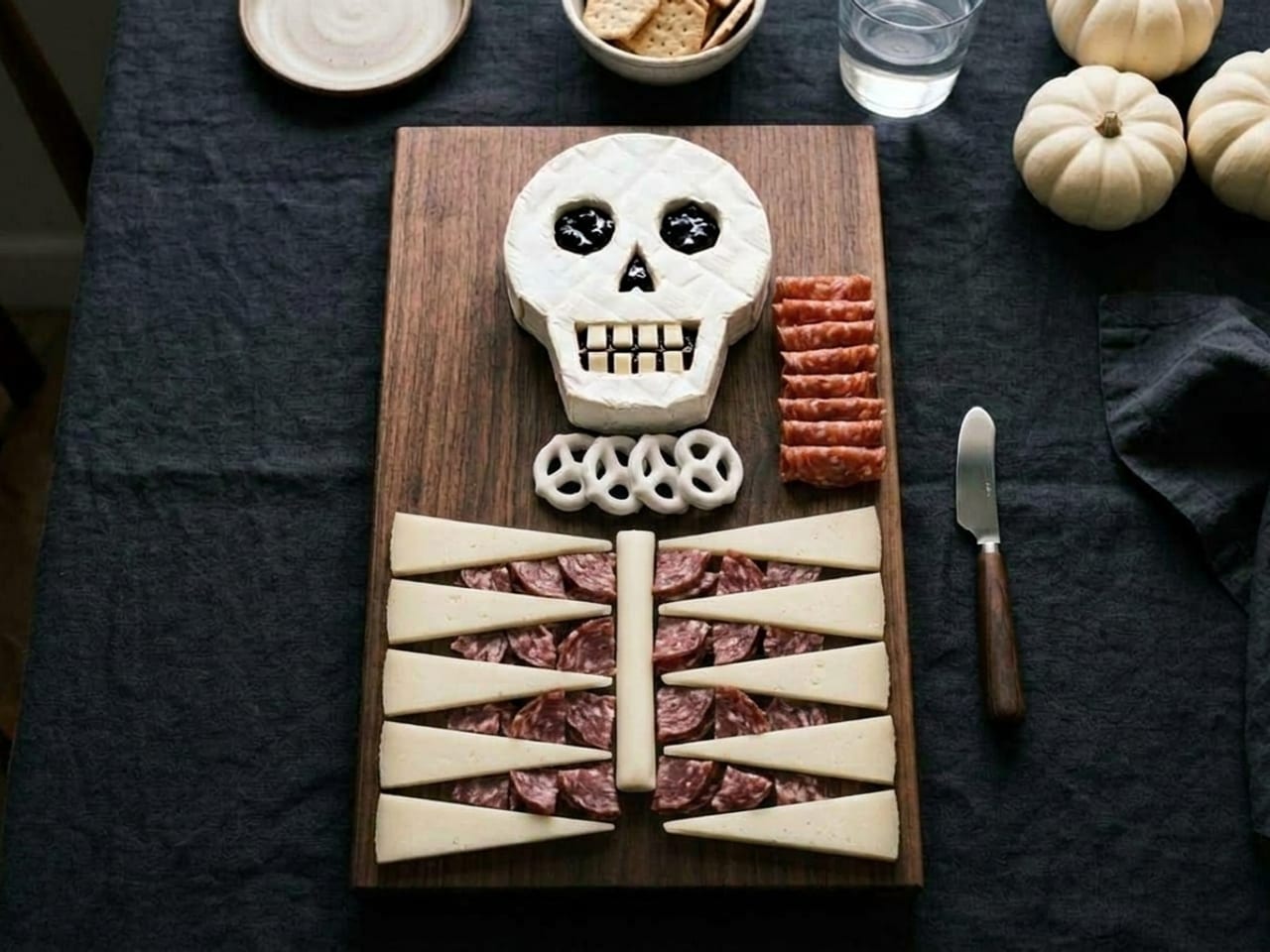
Skeleton charcuterie board: the brie skull, built silhouette first
A shaped board is a drawing you eat, so the figure goes down first. The skeleton is Meg Quinn’s (@ainttooproudtomeg), a paid post for Columbus Craft Meats that Taste of Home reproduced with credit in October 2023; pages that copy her list to the ounce, one of them down to the sponsor’s product names, never name her.
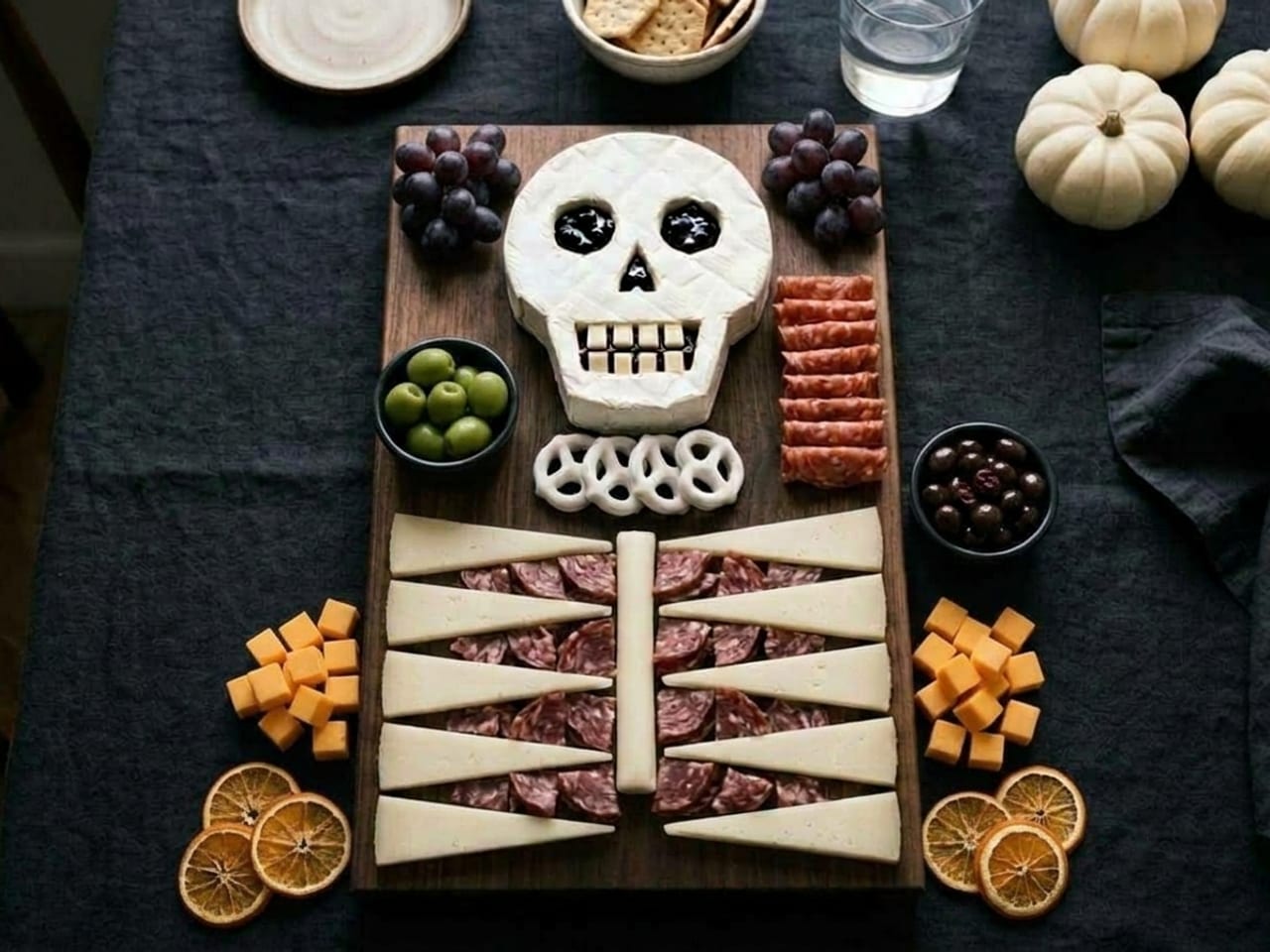
- Stage 1: skull, neck, spineFreeze a 13 oz (370 g) brie 15 to 20 minutes; warm brie tears. Trim the bottom third to a mushroom taper (the jaw), halve horizontally, cut a rectangular mouth, a triangular nose and two round eyes into the top half. Spoon 2 oz (57 g) blueberry jam on the bottom half and replace the top: the jam, contained, is the shadow in the sockets (loose blueberries bleed). Five squares of Manchego are the teeth. Skull at the top, four yogurt-coated pretzels in a row as the neck, one string cheese (a peelable mozzarella stick) as the spine. Stop: the bare board around it is the drawing.
- Stage 2: ribs16 oz (450 g) young Manchego in even triangles, laid as horizontal rungs either side of the spine, point touching the spine, base out toward the edge, a finger’s width of bare board between them. Parallel rungs make ribs rather than a fan.
- Stage 3: innards and border12 oz (340 g) dry salami folded in quarters inside the ribcage; a line of Calabrese beside the skull, 1 in (2.5 cm) inside the rim. Dark salami reads as organs.
- Stage 4: fill up to the figureRamekins of Castelvetrano olives and chocolate-covered cranberries either side; 10 to 12 oz (285 to 340 g) cubed cheddar, 30 oz (850 g) dark grapes and eight dried orange slices into the gaps, never over the bones. Keep at least 1 in (2.5 cm) of bare board round the figure; that margin keeps it legible after the first hand lands.
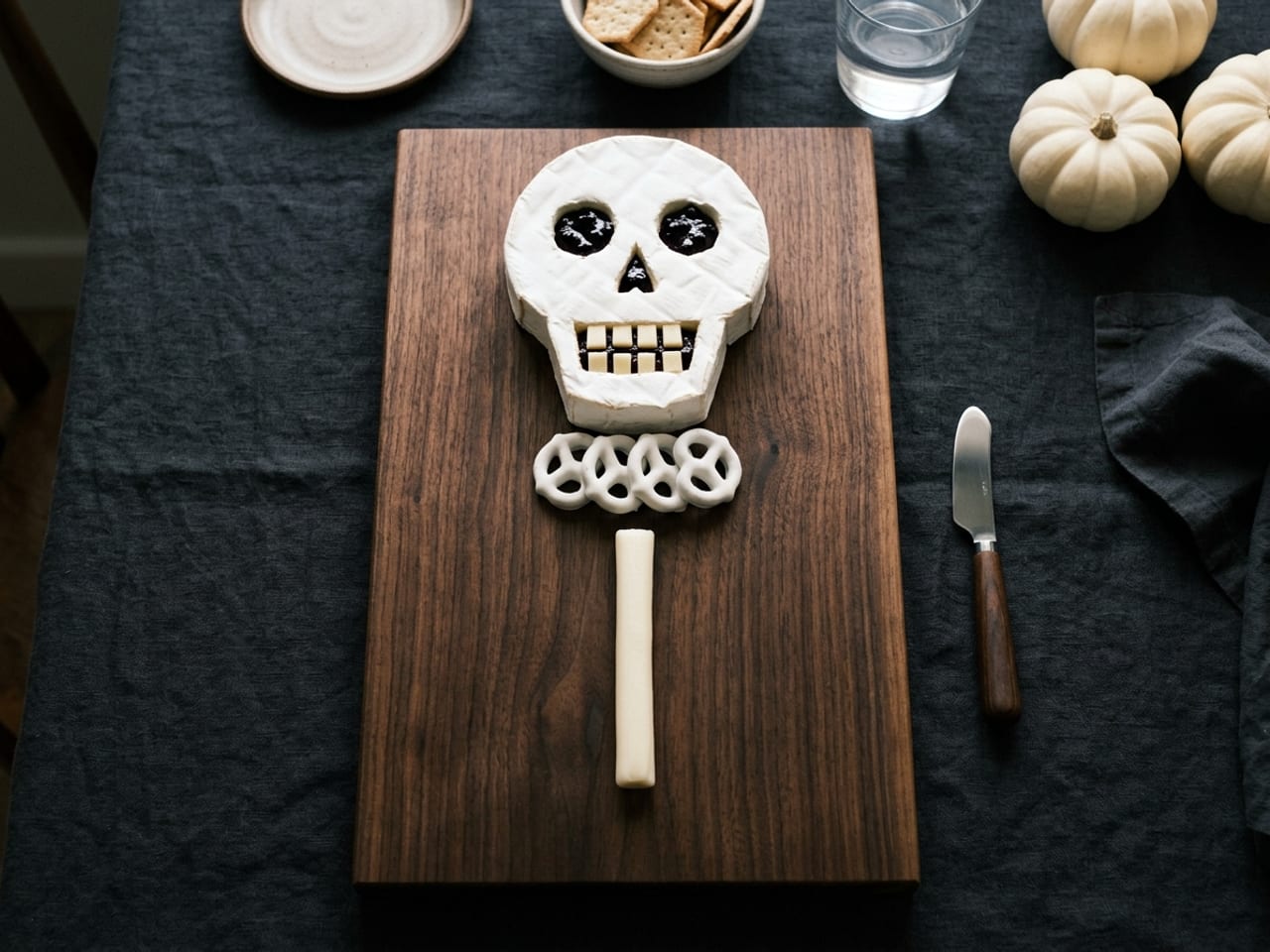
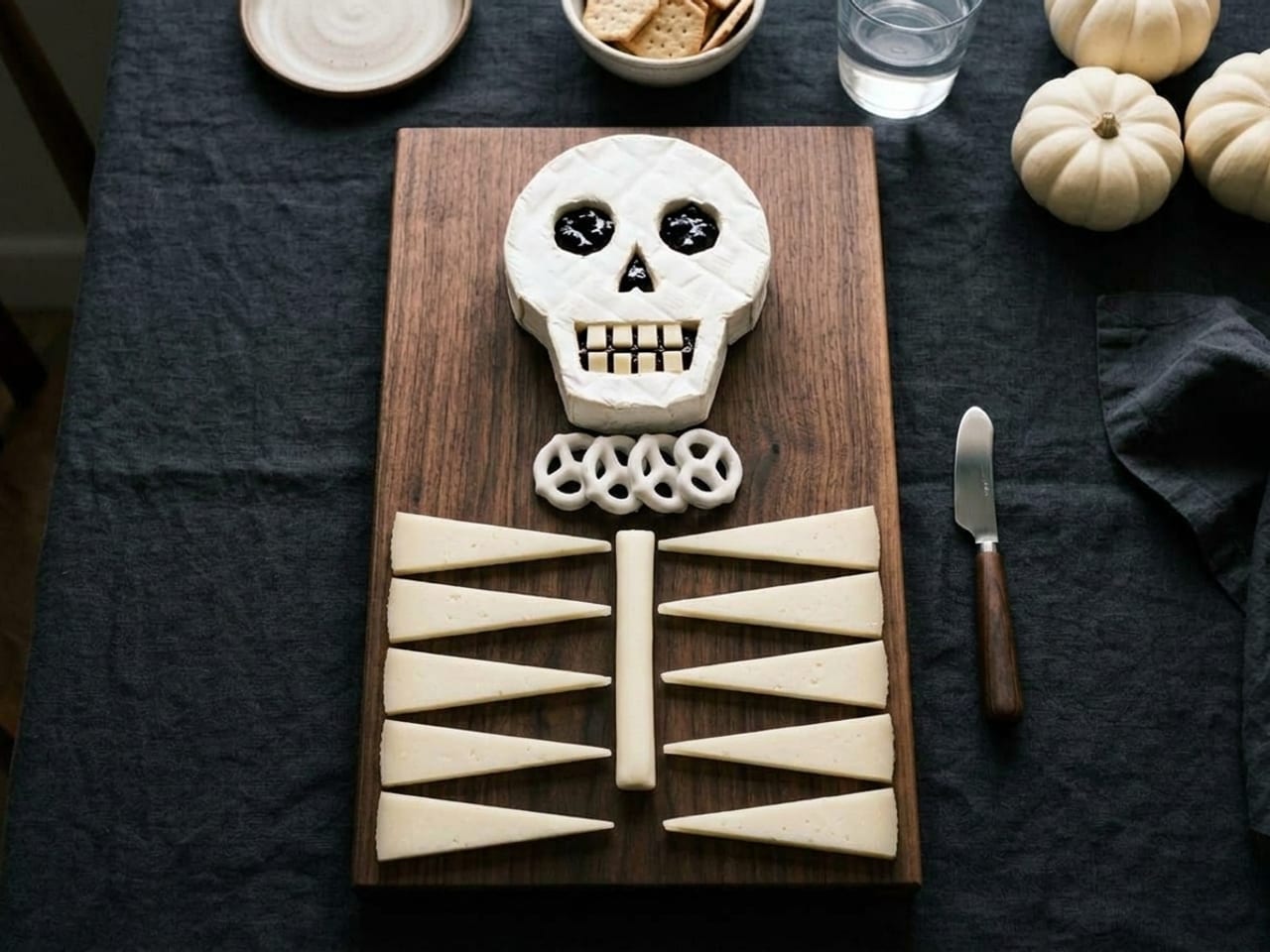
The coffin, the pumpkin and the cheese hand
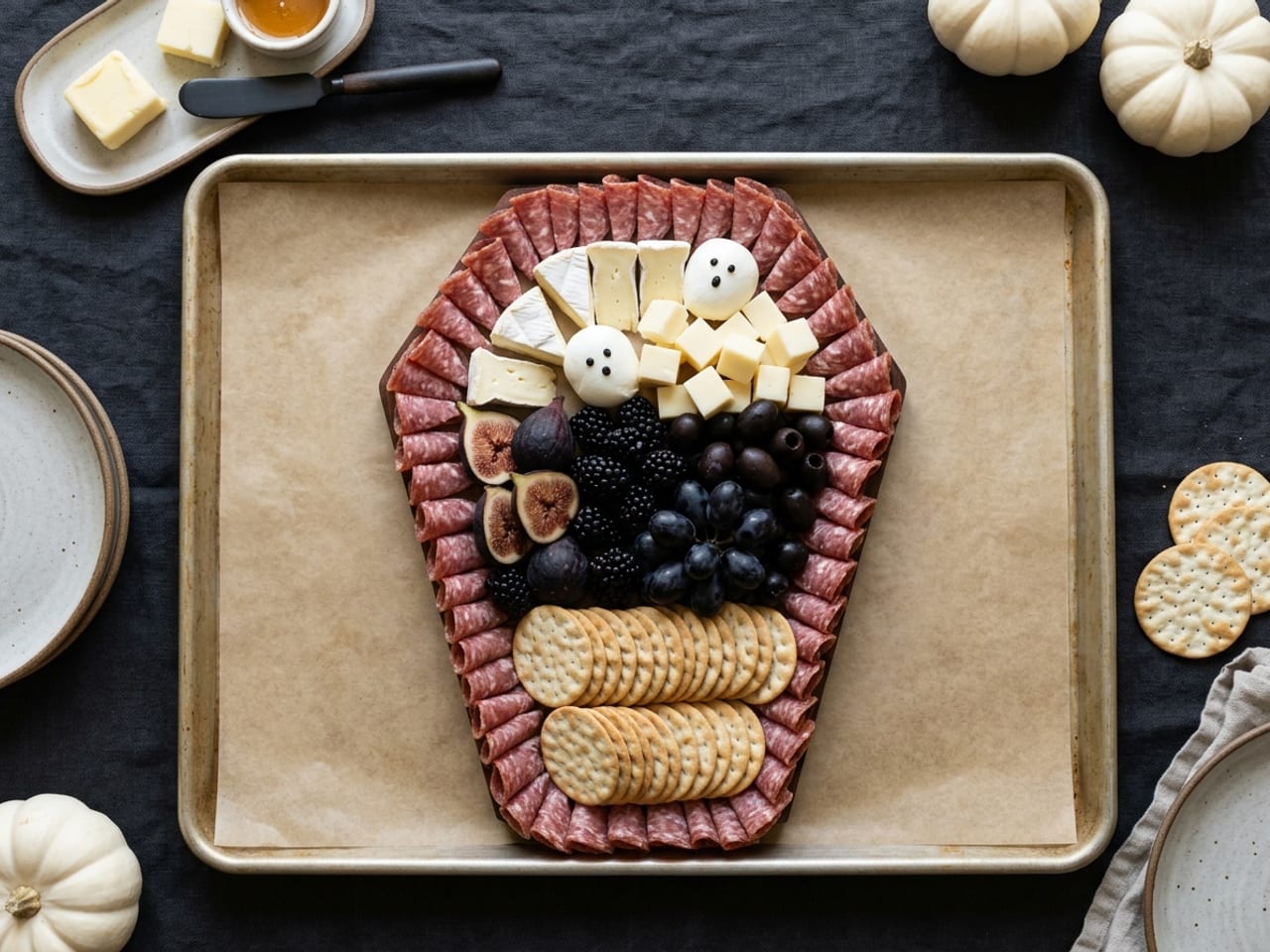
The coffin is the shape that survives being eaten: an elongated hexagon, wide at the shoulders, tapering to the feet. Run a continuous border of quarter-folded salami round the outline, then fill in three bands, pale cheeses at the head, dark fruit through the middle, crackers (water biscuits) at the foot. A border-defined shape stays legible as guests eat into it; a figure-defined one does not. A DIY builder who saw one at Target in October 2022 puts the shop price at about $25; a sheet pan and a marker do the job. The pumpkin is the oldest silhouette we can document: The BakerMama’s jack-o’-lantern face in black foods on orange, 8 October 2018.
The cheese hand has a credit chain nobody prints. The earliest posted version is Lori Castellon’s “Amputated Appetizer” of 11 July 2014, and she opens it by handing the idea to a friend called Zach who had made one the Halloween before; she reposted it on Ghoul at Heart in 2021. Stephanie of Healthy Holme simplified it to three supermarket ingredients in an October 2022 reel, credited Ghoul at Heart in her own caption, and says it went from there to Good Morning America, Fox News and USA Today. Chef Genevieve LaMonaca traces her own arm on parchment. Do it that way: trace a hand, spread 8 oz (225 g) cream cheese mashed with 5 oz (140 g) herbed goat cheese inside the line, lay halved string cheese down each finger as bone beside a strip of roasted red pepper, drape 4 oz (113 g) prosciutto over, press halved green olives in as nails. Not the glove method: a food-service glove is made for minutes of contact, not hours of moulding, a costume or exam glove is not food grade at all, latex is an allergen, and a hand full of rice sits beside food at a party with children. Prosciutto over a plastic skull, or tucked into the plastic skeleton the #1 page uses, is the same problem: cling film between prop and food, or a food-grade silicone mould.
One warning from the disgust literature: disgust develops over the first eight years of life 6, which is why a severed hand delights a seven-year-old and stops a forty-year-old reaching for the salami beside it. Gore at the children’s end, gothic at the adults’; the more realistic the body part, the fewer adults will eat it.
Mozzarella ghosts, the salami spider web and the prosciutto mummy
Each trick with its thickness, and whether it is on the two-hour clock.
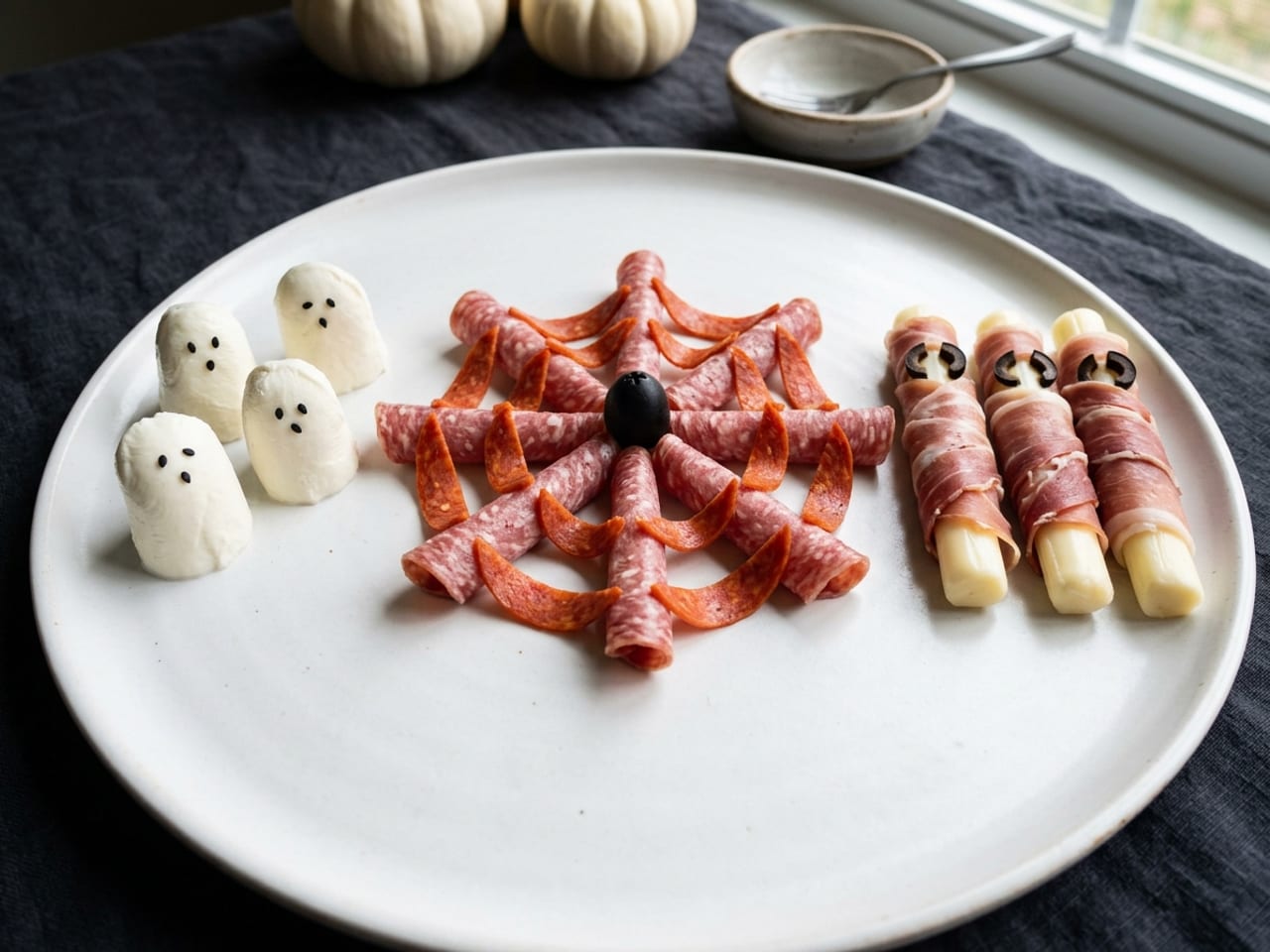
- Mozzarella ghosts (on the clock)Freeze a mozzarella log 10 minutes, slice ¼ in (6 mm) planks, cut with a 2 in (5 cm) ghost cutter: thinner tears, thicker crushes. Black sesame eyes, and sesame has been a major US allergen since 2023, so it goes on the card; a caper or an olive sliver does the same job without it. The same rule runs the cheddar jack-o’-lanterns and brie ghosts: cutters work on cold, firm cheese and fail on ripe, so cut at fridge temperature and let the board temper afterwards, the reverse of the usual advice.
- The salami spider web (off the clock if the salami is shelf stable; a refrigerated pre-sliced pack is not)Eight spokes of quarter-folded dry salami from a centre point to the rim, like clock hands at every 45°, then bridge neighbouring spokes with short chords of thin pepperoni in three or four rings, each chord sagging toward the centre. Radials plus sagging chords read as a web; drawn flat it is a wheel. An olive spider (one whole olive, eight slivers) sits off-centre so the web still reads.
- The piped web on brie (on the clock)Warm 2 tbsp balsamic glaze with 2 tbsp seedless blackberry jam about 2 minutes until it bubbles, cool, pipe three bullseye rings on an 8 oz (225 g) wheel, drag a knife from centre to rim every inch (2.5 cm). Food Network Kitchen’s mechanism; the jam stops it sliding off the rind.
- Prosciutto mummies (on the clock)Wrap a mozzarella stick, breadstick or cornichon in torn ribbons of prosciutto, crossing at random, a gap left for two olive-sliver eyes. Prosciutto shrinks and darkens in air: wrap, cover, chill, unwrap within 20 minutes of serving.
- The pumpkin cheese ball (on the clock)Two 8 oz (225 g) blocks of cream cheese with 1½ cups (170 g) grated cheddar, a cup in and half rolled on. Ball it in cling film, tie twine round it four times (six reads more pumpkin), chill 4 hours to overnight, unwrap, press in a bell-pepper stem, or a pretzel rod for an edible one. The twine sits on the film, never the cheese.
How much for a Halloween party: adults, children and the candy inversion
The base rate is the flagship’s, 2 oz (57 g) cheese and 2 oz (57 g) cured meat a head with most of the same again in crackers, fruit, nuts and olives; the taper is on the charcuterie board flagship. Halloween changes two things. It grazes from dusk until late, so add a quarter; a four-colour board also goes faster, because visible variety made people eat about a third more while flavour-only variety did nothing 7. And children count as half an adult on cheese and meat, as every caterer’s calculator agrees, then invert on candy: double the adult rate per child, capped, as decoration with a top-up bowl, because a child is the high consumer of sweets and arrives carrying a bag of them.
The 3-3-3 rule (three cheeses, three meats, three accompaniments; no traceable author, balanced only for six to eight guests, as the flagship audits) gets a fourth axis here: colour. Three cheeses in three colours, orange cheddar, white mozzarella, a black-rinded goat, are three textures too, so the classic rule comes free. Three meats: one that folds, one dark, one that wraps. Three produce: black, orange, purple. Three props: candy eyes, a shaped centrepiece, a dip. Past ten guests, two boards.
The Halloween quantity table: 6, 12 and 20 guests
Appetizer board grazed all evening. Adult-equivalents = adults + ½ × children; cheese, meat and produce at 2 oz (57 g) per adult-equivalent and seven crackers, about 3 oz (85 g) of fillers in all, plus a quarter for the long graze; candy at 1 oz (28 g) an adult and 2 oz (57 g) a child, not uplifted, because the cap is the point. We do not taper this board the way the flagship tapers its own, because the graze eats the taper. As dinner, use the flagship’s meal rate, 4 oz (113 g) cheese and 3 oz (85 g) meat a head, before the quarter.
| Guests | Cheese | Cured meat | Produce and fillers | Crackers | Candy, as garnish | Boards |
|---|---|---|---|---|---|---|
| 6 adults | 15 oz (425 g) | 15 oz (425 g) | 15 oz (425 g) | about 52 | 6 oz (170 g) | One, 15 x 12 in (38 x 30 cm) |
| 12 adults | 30 oz (850 g) | 30 oz (850 g) | 30 oz (850 g) | about 105 | 12 oz (340 g) | Two, swapped at the clock |
| 20 adults | 50 oz (1.42 kg) | 50 oz (1.42 kg) | 50 oz (1.42 kg) | about 175 | 20 oz (565 g) | Three, or a grazing table |
| 8 adults, 8 children | 30 oz (850 g) | 30 oz (850 g) | 30 oz (850 g) | about 105 | 24 oz (680 g) | Two: a gore end and a gothic end |
| 12 adults, 8 children | 40 oz (1.13 kg) | 40 oz (1.13 kg) | 40 oz (1.13 kg) | about 140 | 28 oz (795 g) | Two, plus a top-up bowl |
The Halloween cheese board: orange, white and black cheeses, no meat
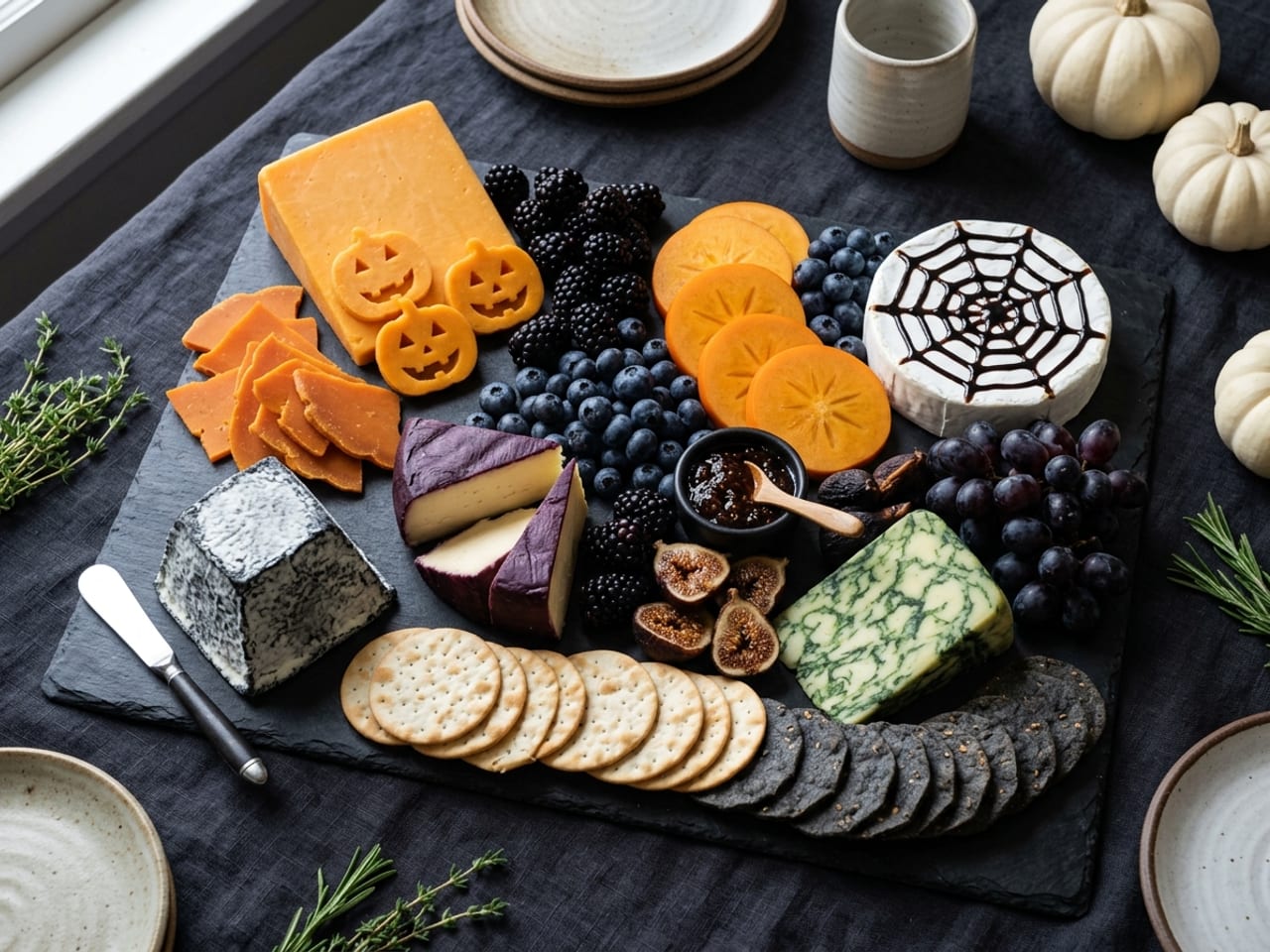
Meat-free is the easiest Halloween board to make look deliberate, because cheese carries the theme by itself. Orange: an aged annatto cheddar and Mimolette, whose pitted rind is the work of cheese mites, the one true gross fact on the board. White: a brie for the piped web, a mozzarella log for ghosts. Black: an ash rind. Valençay is a truncated pyramid coated in vegetable ash and bloomed white, the most Halloween-shaped cheese there is and never sold as one; Humboldt Fog wears its ash as fog; Morbier’s seam is ash between the evening and morning curd, and it was the ash, never GRAS-listed in powdered form, that kept real Morbier off American shelves for nine years, from 2014 until the first compliant wheels landed in January 2024. Purple from Drunken Goat, green from Sage Derby.
For twelve, 30 oz (850 g): 8 oz (225 g) orange, 8 oz (225 g) white, 6 oz (170 g) ash-rinded, 4 oz (113 g) purple, 4 oz (113 g) green, at three anchors with fruit drawing the lines the meat would have.
The Halloween snack board, the party platter and the grazing table
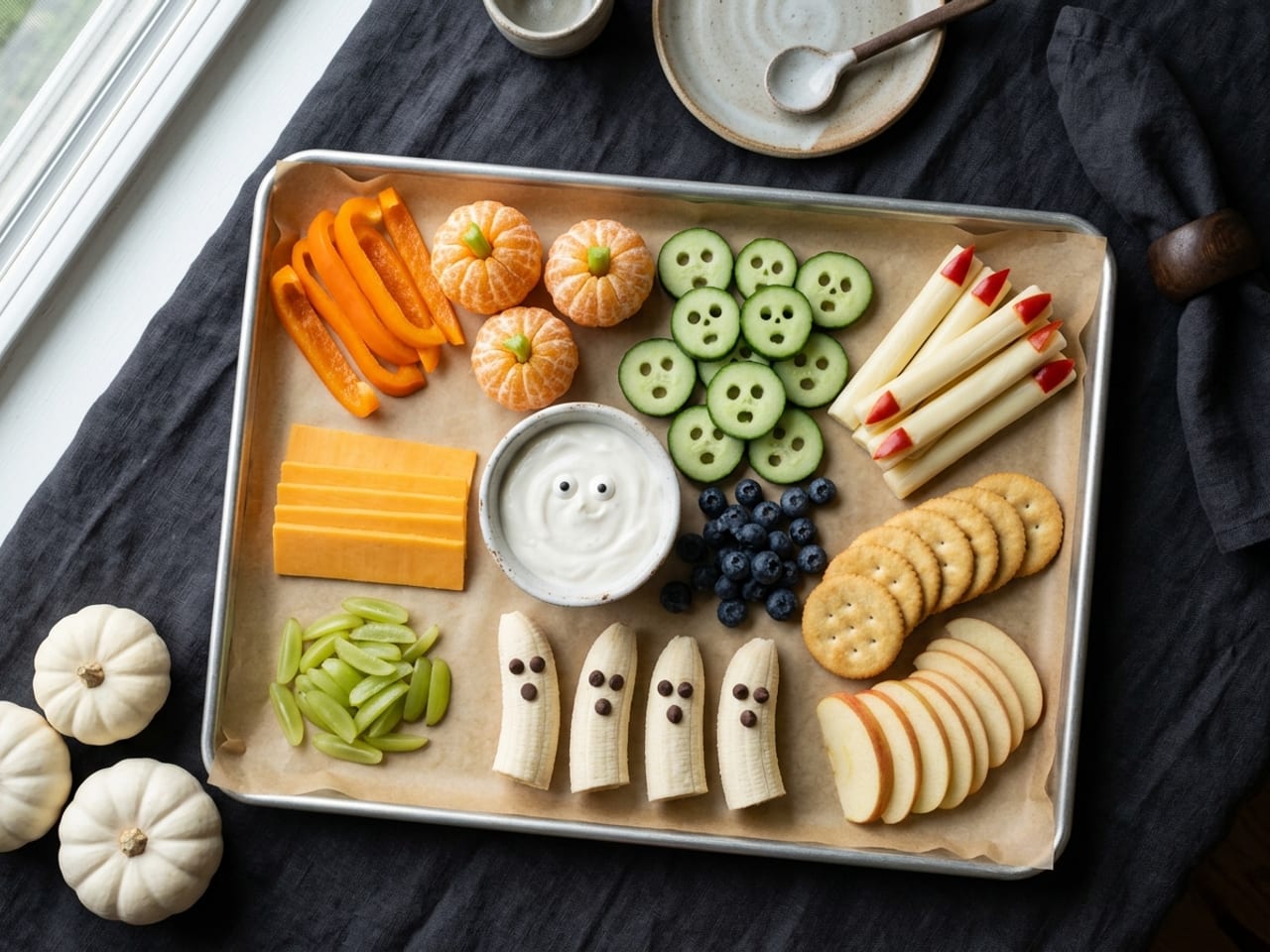
The snack board is the same composition with the cheese case swapped for the seasonal aisle, and it is what most people put out for children before the doorbell starts (over-fours; the toddler subset is in the kids’ section below). Anchors: hummus with candy eyes pressed in at the last minute (the dip is on the clock), the pumpkin cheese ball, a tray of mummy pigs in a blanket refilled from the oven. Lines: orange pepper strips, clementines with a celery stem as pumpkins, cucumber rounds carved into skulls with a chopstick. Fill: blue-corn chips for black, cheese crackers for orange, pretzels, candy corn in a ramekin. Serve on a parchment-lined sheet pan; a $99 skeleton board changes nothing about the taste, and a pan fits the fridge for the swap.
A grazing table is the board multiplied, not enlarged: the same anchor triangle every 24 in (60 cm) along parchment, each with its own knife and colours, shaped pieces at the ends where the photographs happen, fragile items in small piles you replace from the fridge; twenty guests is the 50 oz (1.42 kg) row. Mini pumpkins are risers under a plate, never bowls: Michigan State Extension calls a carved pumpkin a potentially hazardous food once carved.
The Halloween candy and dessert board, with the sugar ledger
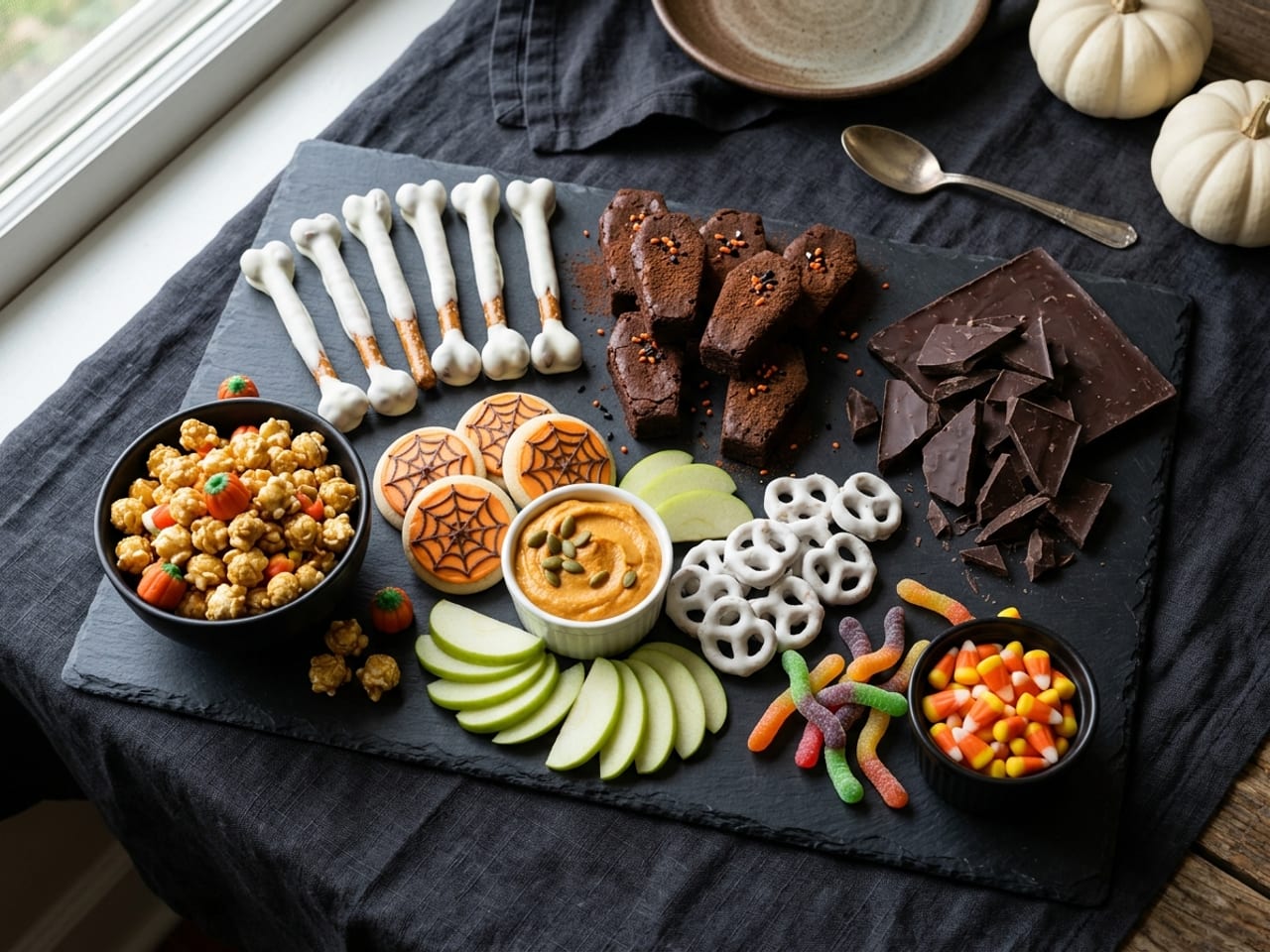
A candy board is where colour costs nothing and sugar is the whole story. Build it as a board, not a pile: anchors of white-chocolate-dipped pretzel bones (adults’ end; pretzel and raisin are both choking hazards under four), a dark chocolate slab in shards, a bowl of caramel corn; fills of gummy worms, sugar cookies, candy corn in a ramekin. The dessert version adds brownies cut into coffins and a pumpkin dip with lemon-brushed apple; the dessert plating rules hold: one dark, one pale, one crunch, black tray showing.
The ledger. The FDA Daily Value for added sugars is 50 g, and 25 g for a child of one to three. Nineteen pieces of Brach’s candy corn (39 g, the old label serving; the current pack says 15) is 140 kcal and 28 g of sugar, every gram of it added: 56% of an adult’s day and more than a toddler’s whole allowance. Add two fun-size Snickers and three Reese’s miniatures and the handful is 430 kcal and 60 g of sugars, about 57 g of it added, 114% of the Daily Value from what the recipe calls garnish. The cheese-and-meat serving carries essentially no added sugar (its cost is sodium, on the flagship): the theme, not the charcuterie, is where the sugar is, and the theme weighs 39 g. One ramekin per six guests, not a scatter, is the sugar fix, the allergen fix and the end of syrup sweating onto the cheese.
The sugar ledger
Label servings, from the manufacturers and USDA FoodData Central, against the FDA Daily Value of 50 g. Candy corn’s current pack serving is 15 pieces (31 g, 110 kcal, 22 g sugar, all of it declared added); we use 19 pieces (39 g, 28 g), the older label serving, because a handful is nearer that. Its ingredients are sugar, corn syrup, dextrose and honey, plus gelatin, shellac, sesame oil and three dyes, so every gram of the sugar counts as added.
| Item | Serving | kcal | Sugars | Added sugars |
|---|---|---|---|---|
| Candy corn, Brach’s Classic | 19 pieces (39 g) | 140 | 28 g | 28 g (all of it; the current 15-piece label reads 22 g, 44% DV) |
| Snickers, fun size | 1 bar (17 g) | 80 | 9 g | 8 g (16% DV) |
| Snickers minis | 3 pieces (27 g) | 130 | 14 g | 13 g (26% DV) |
| Reese’s peanut butter cup miniatures | 3 pieces (26 g) | 130 | 14 g | 13 g (26% DV) |
| Reese’s minis, unwrapped | 9 pieces | 160 | 18 g | 17 g (34% DV) |
| The handful: 2 fun-size Snickers, 3 Reese’s miniatures, 19 candy corn | 99 g | 430 | 60 g | about 57 g (114% DV) |
The Halloween charcuterie board for kids: choking geometry, allergens, the teal pumpkin
Three of the five pages ranking for this board are aimed at children; none has a choking or allergen note.
- Under four: the geometryThe AAP keeps high-risk foods from children until four unless cut small, and names whole grapes, hot dogs and sausages, popcorn, nuts and seeds, hard or sticky candy, marshmallows, raw vegetable sticks and chunks of cheese or string cheese; CDC’s WIC-based list adds pretzels, chips, raisins, jelly beans and gummy candy. FDA says the same about the bag: take the gum, peanuts, hard candies and small toys out of a very young child’s haul. So at the toddler end: grapes quartered lengthwise, cheese in thin planks not cubes, no mozzarella-pearl eyeballs (airway-shaped, and the #1 page’s signature), no candy eyes (picked off and eaten alone), no pretzel bones, sausage in half-moons not coins.
- Four to eight: the fun endThe age that has not yet learned disgust 6: cucumber skulls, banana ghosts, string-cheese fingers with a red-pepper nail, cheddar witch’s brooms, candy eyes stuck on with a dab of cream cheese in the last 15 minutes.
- Allergens: the candy problemPeanut and tree-nut candy sheds oil and fragments across a board one knife and twenty hands are working, and an allergic child can no longer trust the cheddar. Nut candy never goes on the board; candy stays in ramekins that lift off entirely; one knife per cheese; an index card naming which of the nine FDA major allergens (sesame since 2023) are present, plus mollusc if the squid-ink crackers are out. Name sesame whenever the ghosts have sesame eyes, and again for candy corn, which lists sesame oil. Candy eyes carry a shared-facility soy statement, wheat on some packs, and store brands may warn of peanut traces. For a child with a known allergy, a sealed pack of their own safe snack beats any board.
- The teal pumpkin cornerThe Teal Pumpkin Project (Becky Basalone of FACET, 2012; national with FARE in 2014; 12,500 mapped locations in 2024) is a separate bowl of non-food treats and a teal pumpkin to say so. On a board it means the same: a separate bowl, never a substituted one, the candy kept apart to avoid cross-contact.
- Honey, under oneNone before twelve months (CDC); the spores are not reliably killed by cooking (Health Canada), so honeycomb, honey-glazed nuts and Brach’s candy corn, which lists honey, all count.
Halloween charcuterie board ideas by mood, age, diet and budget
Each keeps the palette and the silhouette rule and swaps the cast.
- Spooky classicThe hero board: cheddar jack-o’-lanterns, mozzarella ghosts, the salami web with an olive spider, blackberries and black grapes as shadow.
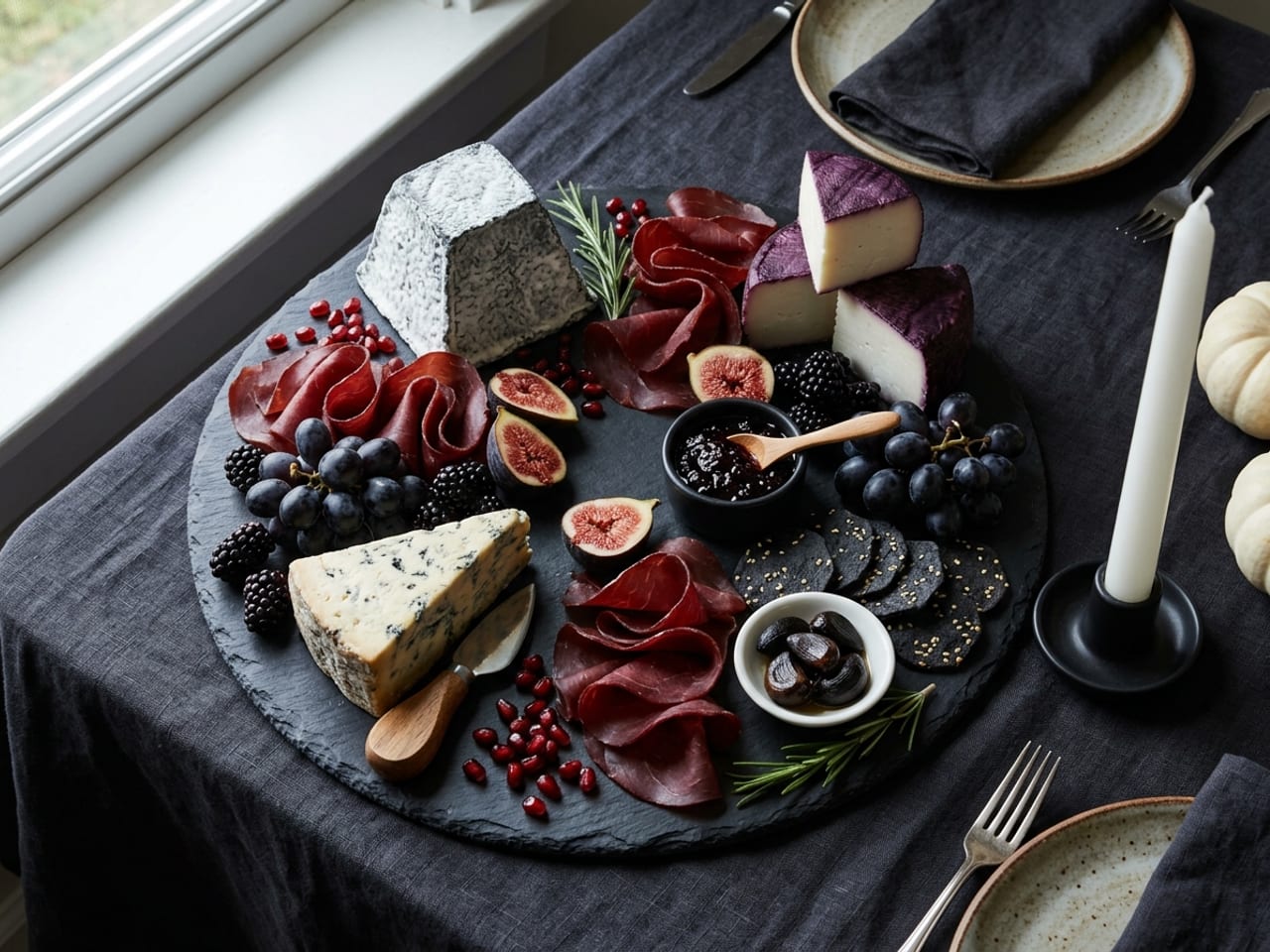
- Gothic and elegantBlack slate, Valençay whole, Drunken Goat wedges, black figs cut open, Stilton on its own knife, bresaola, squid-ink crackers, black garlic, one unlit candle. No eyes.
- Skeleton boardThe four-stage build above, on a board long enough for the figure.
- Coffin boardThe salami-bordered hexagon; the border holds the shape while it is eaten.
- Hocus Pocus movie nightThree cheeses for three sisters (purple-rinded, orange, ash-black), a brie spell book with the web piped on, candy corn in a cauldron ramekin, green grapes and kiwi as the potion.
- Kids’ boardThe under-four rules: planks not cubes, quartered grapes, cucumber skulls, clementine pumpkins, yogurt dip, no candy eyes at the toddler end.
- Día de Muertos, namedA different holiday, 1 to 2 November, a welcome for the dead, UNESCO-listed since 2008. If it is the theme, build the ofrenda: marigolds, pan de muerto, the person’s favourite foods, a photograph, sugar skulls named as such, no cobwebs. Halloween imagery arriving in Mexico is read there as US encroachment 8; the skulls travelling the other way as party decor is the same exchange in reverse.
- Adults only, with a winePeppered and truffled salami, Mimolette, Shropshire Blue (orange paste, blue veins: the palette in one wedge), black garlic, dark chocolate. Pour a Monastrell, the wine the Drunken Goat is washed in: salt wants fruit and low tannin.
- Budget, about $25An 8 oz (225 g) cheddar cut into pumpkins, 12 oz (340 g) mozzarella for ghosts, two salamis, 10 oz (285 g), two cans of black olives, black grapes, crackers, on a sheet pan: about $25 at the cost table’s prices, six people.
- VegetarianThe cheese-only board with a vegetable skeleton: cucumber spine, pepper-strip ribs, a cauliflower skull, hummus in the pelvis.
- Gluten-freeCheeses in their rinds, cured meats, grapes, olives, dipped gluten-free breadsticks as bones, and a separate plate for a coeliac guest, because crumbs in the wood grain are the problem; wafers and malted candy carry wheat, and barley malt, which is gluten but not a US labelled allergen.
- Mini boards for twoTwo anchors, one line, one filler on a 10 x 7 in (25 x 18 cm) board: a cheddar pumpkin, a small brie with the web, four prosciutto mummies along the diagonal, blackberries, six crackers.
- The 15-minute boardNo cutting: a can of olives, a tub of ciliegine patted dry, candy eyes on cream-cheese dabs, sliced salami laid as a web, cheddar cubes, grapes, crackers. Fifteen minutes is the eye-adding window anyway.
- Fruit tray jack-o’-lanternClementine segments as the face, blackberries and black grapes as eyes, nose and grin, a pear stem, lemon-brushed apple. Whole fruit is off the clock; cut melon is on it.
- Nutcrack NightHazelnuts in shell with a cracker, apples, pears and plums (the souling song’s own ask), a barmbrack with the ring wrapped in parchment and announced, aged cheddar, dry cider. The nuts and the fruit are documented Halloween food before 1900; the rest is period, not evidence.
What are 5 things to avoid on a Halloween charcuterie board?
The generic answer (unpitted olives, crumbly crackers, runny glaze) is about texture. The flagship’s five are about guests who can be hurt: honey with a baby, soft cheese with a pregnant guest, the two-hour clock, loose nuts, one knife. These five are Halloween’s; the composition mistake, filling every gap until the silhouette dies, comes free.
- Activated charcoal for blackNot a listed US colour additive, an adsorbent that interferes with medicines, and unnecessary: olives, ash rinds, squid ink and blackberries are black and are food.
- Black gel colouring on pale cheeseA four-dye blend that bleeds grey and stains teeth; colour that does not match taste is the one cue shown to suppress appetite 9. A black sesame seed is an eye.
- Nut candy loose among the meatCross-contact onto everything a hand touches. The Teal Pumpkin principle is a separate bowl.
- Props on the foodPlastic skeleton hands, craft spiders, cupcake-topper knives, painted mini pumpkins as bowls: none is sold as a food-contact article, and those are regulated (21 CFR parts 174 to 178). Cling film between prop and food, or a food-grade silicone mould. Dry ice never touches the food or a drink: it burns, and a swallowed pellet is a hospital.
- Choke-shaped items at the toddler endWhole grapes, mozzarella pearls, cheese cubes, candy eyes, popcorn, whole nuts, hard candy, sausage coins: the AAP and CDC lists, plus the board’s own round items (pearls, candy eyes) that fit the same geometry. And candy left on cheese until it sweats syrup.
The trick-or-treat clock: two hours, from dusk
USDA FSIS: no more than 2 hours between 40°F (4°C) and 140°F (60°C), 1 hour above 90°F (32°C), and replace platters with fresh chilled ones rather than topping up. Applied to a party that starts at dusk and empties the house; one person owns the clock.
| Time | What is happening | The board |
|---|---|---|
| 16:00 | Two boards built, covered, in the fridge | Clock not running |
| 17:15 | Board A out to lose its chill: only what will be eaten before the doorbell | Clock starts |
| 17:30 | Trick-or-treating begins; the adults leave; the person on the door owns the clock | 15 minutes gone |
| 19:15 | Two hours on board A’s soft cheese, dips and cut fruit; the flagship’s own margin is 90 minutes | Swap it: bin the soft cheese, dips and cut fruit, because past two hours they do not go back in the fridge; crackers, candy and uncut hard cheese can stay |
| 20:30 | Everyone home; the party proper | Board B, fresh from the fridge |
| 22:30 | Two hours on board B | Discard what is on the clock |
Which Halloween items the clock is on, the dry ice, and the candy check
On the clock: mozzarella ghosts and pearls (the most perishable thing on the board, and the trick every page teaches), the brie web and the ash-rinded goats, the cream-cheese hand, skull and pumpkin ball, opened prosciutto, every dip, cut melon. Off it: crackers, pretzel bones, cookies, whole and dried fruit, nuts, candy, and aged hard cheese in the piece; cut into pumpkins it joins the clock, more forgivingly. Put the drama in the hard cheese and the fragile things in small replaceable piles. Candy is the trap: it looks perfect at hour four and makes the board beside it look safe. For a pregnant guest the brie, the ash goats, the Stilton and the cold prosciutto are the items in question; the US and UK rules differ and are set out on the flagship, and the answer here is a labelled separate plate.
Dry ice goes under the board, never on it: a chunk in a bowl of warm water inside a larger vessel, the food on a plate above, in a ventilated room, out of children’s reach. It sublimes at minus 109°F (minus 78.5°C). New York State’s health department says it burns skin like frostbite, that the gas is heavier than air and pools in low areas, and to keep it away from children and never swallow it. Never in a punch bowl people ladle from.
And the check every parent makes. FDA says inspect wrapped candy at home for pinholes and tears and discard anything unwrapped; do it, it costs nothing. But the record: Best and Horiuchi read four daily newspapers for 1958 to 1984 and found 76 reports and two deaths, both inside the child’s own family (heroin found in an uncle’s home, Detroit, 1970; Timothy O’Bryan’s father, Ronald Clark O’Bryan, Pasadena, Texas, 1974) 10. Newsweek told readers in 1975 that “several children have died”; the papers had recorded two. The 1982 spike in reports follows the Tylenol murders. Spend the worry on grapes, nuts and cars.
What is the most eaten food on Halloween?
Candy, and the defensible number is money, because nobody measures what is eaten on 31 October. The National Retail Federation’s 2025 survey (8,045 consumers, fielded 2 to 9 September, released 18 September) put Halloween candy at $3.9 billion of a record $13.1 billion, $114.45 a person, with 66% planning to hand it out; 2024 was $3.5 billion of $11.6 billion. The National Confectioners Association’s $7.4 billion measures retail confectionery sales across the season, not what shoppers said they would spend. The 2026 survey is due in late September.
The state-by-state “most popular candy” maps are one bulk retailer’s order book: CandyStore.com’s October 2024 edition, whose own headline is that M&M’s overtook Reese’s, has California’s winner at 1,375,652 lb (624 t) and Connecticut’s at 3,108 lb (1.4 t) in a state of 3.7 million people; ask people instead and Reese’s wins by a distance. The folk figures, 3.4 lb (1.5 kg) of candy a person and 7,000 calories a child, are estimates rather than measurements: the calorie number is the top of an epidemiologist’s 3,500 to 7,000 range worked out from candy labels, and the poundage traces to retail aggregation, not to anyone who weighed a haul. By hot dinner the answer is pizza, on a Domino’s press release from 2013, so directional only: on Halloween a board competes with a delivery, not a cooked meal.
What a Halloween board can honestly carry
The scoop is the treat bag. “Trick or treat” surfaces earliest in print in the Sault Daily Star of Sault Ste. Marie, Ontario, on 1 November 1917, as “Tricks or treats,” and in the modern word order in the Red Deer News of 4 November 1925, already a “time-honored threat”; the 1927 Blackie, Alberta report that CBC calls the first is one of four items in three papers that week, ten years late. What householders handed over was coin, nuts, apples, peanuts, gum and candy, in that mixture rather than candy alone: the ancestral haul is closer to a grazing board than to a bag of bars. Older still: souling, the Allhallowtide door-to-door for soul cakes, whose Cheshire chorus of 1891 asks for “an apple, a pear, a plum or a cherry”; Burns’s Halloween, written in 1785 and printed in 1786, has nuts named for a lad and a lass and set on the fire, burning quietly together or starting apart; the Irish barmbrack with a ring, coin, pea and rag baked in as fortunes (wrap the charm in parchment and say it is there). A bowl of hazelnuts in shell is the most historically honest thing on the board.
Orange and black are not ancient. Lisa Morton, who wrote a history of the holiday, has said that party guides of the early 1900s called Halloween’s colours yellow and brown, for corn and hay; the pumpkin won around 1910, and Dennison of Massachusetts, whose Bogie Books ran from 1909 into the 1930s, sold the pairing in crepe paper. The Bogie Book menus are seated suppers, sandwiches and potato salad and doughnuts and cider: no dip, and nothing to graze from standing up. The board is the course the tradition never had. The board itself is eight years old: the earliest post we can document is Sugar and Charm’s meat-and-cheese board of 28 September 2018; “charbooterie” appeared twice, independently, in October 2020; the shaped boards and a roughly $25 Target coffin followed in 2021 and 2022; Boarderie shipped one from 2023; search demand peaked in 2022 and 2023 and has fallen every October since. As for the Celts, Hutton in Folklore (2024) retires the Celtic new year and feast of the dead as a century-old scholarly guess 11; pumpkins are a New World plant, and the earliest pumpkin lantern anyone has found at Halloween is in Kingston, Ontario, in 1866.
The cheddar and the olive have their own histories, told in the palette section: a seventeenth-century English cream-skimming trick that Paul Kindstedt calls fraud and cheesemakers call consistency, and Freda Ehmann’s 1890s Oroville olives, which come in cans because jarred ripe olives killed people in three states in 1919 and 1920, and only a can survives the 240°F (115.6°C), forty-minute retort California imposed in 1920. Her own company’s olives were implicated in one of the cases.
What the Halloween board costs: grocery, delivered, and the listed $99 skeleton
Ten adult-equivalents at Trader Joe’s and Walmart first-party prices read 2 September 2026 (a marketplace seller lists the same candy corn at $11.49; take the first-party price): $57.61, $5.76 a head, roughly 55 to 70 cents an ounce ($19 to $25 a kilo). This ledger is meat-light by design, one salami for the web and one prosciutto for the mummies; at the table’s full meat rate for ten, 25 oz (710 g), add two more salamis and a second prosciutto, about $12 more. Boarderie’s Halloween Medium, $169, serves four to six at $28 to $42 a head, its food weight unpublished; its Large, $249 for 70 oz (2 kg) of cheese, meat and accompaniments plus 13 oz (370 g) of crackers, serving ten to fourteen, is $3.00 an ounce ($106 a kilo) and $18 to $25 a head, arranged, overnight, free-shipped, with a sculpted white-cheddar witch hat you cannot buy loose. The board under it, Pottery Barn’s Skeleton Cheese Board, listed at $99, 20 x 12.75 in (51 x 32 cm), costs more than all the food below. A black pizza steel or a parchment-lined sheet pan gives the same negative space for nothing, and the food should sit on something pale on top of it anyway 1, with the caveat that a black square plate lifts quality and liking ratings in a way a black round one does not 12.
| Item | Where | Price |
|---|---|---|
| Orange cheddar block, 8 oz (225 g) | Great Value, Walmart | about $3.00 |
| Mimolette wedge | Trader Joe’s (an October cheese) | $7.99 |
| Fresh mozzarella, 12 oz (340 g), marinated: pat it dry before cutting | Trader Joe’s | $5.99 |
| Goat milk brie, 4.4 oz (125 g) | Trader Joe’s (a small wheel; the piped web scales down) | $2.99 |
| Calabrese salami, 5 oz (140 g) | Trader Joe’s | $2.99 |
| Prosciutto, 4 oz (113 g) | Trader Joe’s | $6.79 |
| Crackers, two 9 oz (255 g) boxes | Trader Joe’s | $4.98 |
| Sliced black ripe olives, two 3.8 oz (108 g) cans | Great Value, Walmart | $3.72 |
| Black grapes and blackberries | Supermarket produce | about $6.00 |
| Orange bell pepper | Supermarket produce | about $1.50 |
| Candy eyes, 0.88 oz (25 g) | Great Value, Walmart | $4.48 |
| Candy corn, 11 oz (310 g) | Brach’s, Walmart first-party | $2.68 |
| Three mini pumpkins, as props | Seasonal produce | about $4.50 |
| Total for ten | $57.61, or $5.76 a head |
Your board, re-arranged
Photograph the Halloween board you built, upload it, and Plate Artists returns it re-arranged: silhouette first, colours distributed, negative space back. Same olives, same cheddar, better skull.
Start free · 1 enhancement →Free account · 1 free enhancement · No credit card
Halloween board questions, answered
What is the 3-3-3 rule for charcuterie?
Three cheeses, three cured meats, three accompaniments: a blog-era rule with no traceable author that balances only for six to eight guests, audited on the flagship. For Halloween add colour as a fourth axis: three cheeses in three colours, three meats, three produce in black, orange and purple, three props. Still 2 oz (57 g) of cheese and of meat a head.
What to put on a Halloween charcuterie board?
Five colours from real food and one silhouette. Orange: annatto cheddar or Mimolette, dried apricot. White: mozzarella for ghosts, a brie for the piped web. Black: canned ripe olives, blackberries, black grapes, an ash-rinded goat cheese. Purple: Drunken Goat, figs. Green: Castelvetrano olives. Salami for the web, prosciutto for mummies, crackers, candy in a ramekin added last.
What are 5 things to avoid on a charcuterie board?
For Halloween: activated charcoal, black gel colouring on pale cheese, nut candy loose among the meat, plastic props touching food, and choke-shaped items (whole grapes, mozzarella pearls, candy eyes, popcorn) at the toddler end. The flagship’s five, honey with a baby, soft cheese with a pregnant guest, the two-hour clock, loose nuts, one knife, still apply.
What's the most eaten food on Halloween?
Candy, by spending: $3.9 billion of a record $13.1 billion in the National Retail Federation’s 2025 survey, $114.45 a person, with 66% of celebrants handing it out. Nobody measures what is eaten; the 3.4 lb (1.5 kg) a person figure is retail aggregation, not a measurement. By hot dinner, pizza, on a chain’s own 2013 press release.
How far ahead can I make a Halloween charcuterie board?
The brie skull and the pumpkin cheese ball the day before (the ball keeps 3 to 4 days wrapped, USDA’s general leftovers window), refrigerated; mozzarella ghosts and cheddar cutouts the same day, since cut faces dry; prosciutto wraps a few hours ahead, covered. Assemble the cold half the morning of, covered, in the fridge: the two hours only start when it comes out. Crackers, candy and candy eyes in the last 15 to 20 minutes.
How long can a Halloween charcuterie board sit out?
Two hours from when the soft cheese leaves the fridge (USDA FSIS), one hour above 90°F (32°C). At a party that starts at dusk that means a swap at about 19:00 to 19:15 for a 17:15 board, the flagship’s own margin being 90 minutes, so build two. Crackers, dried fruit, nuts, candy and uncut hard cheese can stay out.
Can I use activated charcoal to make a black Halloween board?
Better not. It has no listing in the US colour-additive regulations, New York City treats charcoal-coloured food as adulterated, and it adsorbs medicines. The EU permits it as E153, which is why UK candy eyes are black with it. Olives, ash rinds, squid ink and blackberries are black without it.
Are canned black olives really black?
Not by ripeness. California-style ripe olives are picked green, debittered in lye, blackened by forced air and fixed with ferrous gluconate, the only iron salt the FDA lets you colour a food with, and only that food (21 CFR 73.160). That engineered, uniform black is why they make better spider legs and eye sockets than a Kalamata, which is ripe and reads purple.
Are candy eyes vegan or allergen-free?
US Wilton candy eyes are not vegan. The standard 0.88 oz (25 g) pack lists gelatin and the dyes Red 40, Blue 1 and Yellow 5; the large size drops the gelatin and adds titanium dioxide, which the EU banned as a food additive in 2022 (Great Britain did not, and the US still lists it at 21 CFR 73.575); both carry confectioner’s glaze, which is shellac. Shared-facility soy, and wheat on some packs. The UK version is coloured with E153 and sold as vegan. Store brands may warn of peanut traces.
How do you make a skeleton charcuterie board?
Freeze a 13 oz (370 g) brie 15 to 20 minutes, carve it into a skull with blueberry jam between the halves, stand four yogurt pretzels as the neck and a string cheese as the spine, then 16 oz (450 g) of Manchego triangles alternating as ribs, salami folded inside, and fill around the figure without covering it. Meg Quinn’s build.
Is a Halloween charcuterie board safe for kids?
With the toddler end built to the AAP list: grapes quartered, cheese in planks, no mozzarella pearls, candy eyes, popcorn, whole nuts or hard candy for under-fours, nut candy off the board, an allergen card beside it, no honey under one.
The research behind this guide
Peer-reviewed studies, retrieved via PubMed and Crossref. Every numbered figure quoted above comes from one of these papers.
- Piqueras-Fiszman, B., Alcaide, J., Roura, E., & Spence, C. (2012). Is it the plate or is it the food? Assessing the influence of the color (black or white) and shape of the plate on the perception of the food placed on it. Food Quality and Preference, 24(1), 205-208. doi:10.1016/j.foodqual.2011.08.011
- Spence, C., Harrar, V., & Piqueras-Fiszman, B. (2012). Assessing the impact of the tableware and other contextual variables on multisensory flavour perception. Flavour, 1, 7. doi:10.1186/2044-7248-1-7
- Charoenprasert, S., & Mitchell, A. E. (2014). Influence of California-style black ripe olive processing on the formation of acrylamide. Journal of Agricultural and Food Chemistry, 62(34), 8716-8721. doi:10.1021/jf5022829
- Derby, C. D. (2014). Cephalopod ink: production, chemistry, functions and applications. Marine Drugs, 12(5), 2700-2730. doi:10.3390/md12052700
- EFSA Panel on Food Additives and Nutrient Sources added to Food (ANS) (2012). Scientific opinion on the re-evaluation of vegetable carbon (E 153) as a food additive. EFSA Journal, 10(4), 2592. doi:10.2903/j.efsa.2012.2592
- Rozin, P., & Fallon, A. E. (1987). A perspective on disgust. Psychological Review, 94(1), 23-41. doi:10.1037/0033-295X.94.1.23
- Rolls, B. J., Rowe, E. A., Rolls, E. T., Kingston, B., Megson, A., & Gunary, R. (1981). Variety in a meal enhances food intake in man. Physiology & Behavior, 26(2), 215-221. doi:10.1016/0031-9384(81)90014-7
- Brandes, S. (1998). The Day of the Dead, Halloween, and the quest for Mexican national identity. Journal of American Folklore, 111(442), 359-380. doi:10.2307/541045
- Spence, C. (2015). On the psychological impact of food colour. Flavour, 4, 21. doi:10.1186/s13411-015-0031-3
- Best, J., & Horiuchi, G. T. (1985). The razor blade in the apple: the social construction of urban legends. Social Problems, 32(5), 488-499. doi:10.2307/800777
- Hutton, R. (2024). The Celtic New Year and feast of the dead. Folklore, 135(1). doi:10.1080/0015587X.2023.2282282
- Stewart, P. C., & Goss, E. (2013). Plate shape and colour interact to influence taste and quality judgments. Flavour, 2, 27. doi:10.1186/2044-7248-2-27
Agency guidance, dictionaries and archives cited by name in the text:
- USDA FSIS, Danger Zone (40°F to 140°F, 4°C to 60°C)
- USDA FSIS, Leftovers and food safety (2-hour discard, 1 hour above 90°F (32°C); keep cold food on ice and replace small trays often)
- FDA Food Code 2022, TCS food definition (paragraph 1-201.10(B), Tables A and B)
- 21 CFR 73.30, annatto extract (exempt from certification), eCFR
- 21 CFR 73.160, ferrous gluconate ‘for the coloring of ripe olives’, eCFR
- 21 CFR Part 73 Subpart A, colour additives exempt from certification for food (annatto to turmeric oleoresin; no carbon in any form among them), eCFR
- FDA, Substances Added to Food: activated carbon, listed only as a processing aid (its single CFR citation, 177.1210, is a packaging-gasket regulation, not a clearance to put carbon in food)
- 21 CFR parts 174 to 178, indirect food additives (food-contact substances), eCFR
- Eater NY, NYC health department confirms activated charcoal is not permitted in food (7 June 2018; the DOHMH quote and the FDA nuance)
- NYC Department of Health, Adulterated food workshop (activated charcoal: approved only to filter food; may reduce absorption of medication)
- American Cheese Society, Chapter 6 addendum: vegetable ash, FDA position and labelling as ‘vegetable ash (acidity regulation)’
- Fletcher, J., Remember Morbier? (5 February 2024): compliant powdered ash cleared September 2023, PDO Morbier back in the US January 2024 after a nine-year absence
- Wilton, Black gel food coloring 1 oz (28 g): ingredients and shared-facility statement
- Wilton Candy Eyeballs 0.88 oz (25 g), ingredients (gelatin, confectioners’ glaze, FD&C Red 40, Blue 1, Yellow 5), Open Food Facts
- Cake Thrive (UK), Candy Eyeballs 57 g: colour E153, vegan, 10 mm, about 123 per bag
- Walmart, Great Value Sliced Olives 3.8 oz (108 g), $1.86: ingredients olives, water, salt, ferrous gluconate
- Walmart, Great Value Candy Eyeballs 0.88 oz (25 g), $4.48, ‘may contain traces of peanuts’
- Walmart, Brach’s Classic Candy Corn (first-party $2.68 for 11 oz (310 g))
- Trader Joe’s Fearless Flyer and price trackers (crackers $2.49, marinated fresh mozzarella $5.99, Mimolette $7.99, prosciutto $6.79, goat milk brie $2.99, Calabrese salami $2.99)
- Boarderie, Halloween Medium Cheese & CharBOOterie Board ($169, serves 4 to 6; food weight not published), product page checked 2 September 2026
- Pottery Barn, Skeleton Cheese Board ($99, 20 x 12.75 x 4.5 in (51 x 32 x 11 cm))
- Taste of Home, Skeleton charcuterie board by Meg Quinn (@ainttooproudtomeg) for Columbus Craft Meats (12 October 2023)
- Healthy Holme, Scare-cuterie board (10 November 2022), crediting Ghoul at Heart
- Castellon’s Kitchen (Lori Castellon), Amputated Appetizer: Three Cheeses in Prosciutto (11 July 2014), the earliest posted version, which credits the idea to a friend
- Ghoul at Heart (Lori Castellon), Amputated Appetizer (9 March 2021), her own repost of the 2014 original
- Tasting Table, Chef Genevieve LaMonaca’s parchment-traced edible arm (28 September 2024)
- Platein28, Severed hand Halloween snack board (quantities: 8 oz (225 g) cream cheese, 5 oz (140 g) goat cheese, 4 oz (113 g) prosciutto, 3 string cheeses)
- Food Network Kitchen, Halloween charcuterie board (balsamic and blackberry-jam web; white-chocolate pretzel bones)
- Ain’t Too Proud To Meg, Pumpkin cheese ball (twine method, 4 hours to overnight)
- Liz Morrow Studios, DIY coffin charcuterie board (11 October 2022; the $25 Target coffin board)
- Sugar and Charm, Halloween meat and cheese board, datePublished 28 September 2018 (Internet Archive capture, July 2019)
- Tasty (BuzzFeed), Halloween Charbooterie Board (8 October 2020)
- American Academy of Pediatrics, HealthyChildren.org, Choking prevention (under four; round, firm foods cut small)
- CDC, Choking hazards for infants and toddlers (grapes, cheese chunks, popcorn, pretzels, hard and gummy candy, marshmallows)
- CDC, Foods and drinks to avoid or limit (no honey before 12 months)
- FDA, Food allergies: the nine major food allergens (sesame added by the FASTER Act, effective 1 January 2023)
- FARE, Teal Pumpkin Project (the 2024 map: over 12,500 locations and 91 events in all 50 states)
- Dairy Free Kids, interview with Becky Basalone, founder of the Teal Pumpkin Project (keep the candy separate to avoid cross-contact)
- FDA, Halloween safety tips: costumes, candy and colored contact lenses (inspect wrapped candy at home)
- Best, J., Halloween sadism: the evidence (updated annually, 1958 to 2023), University of Delaware
- New York State Department of Health, Dry ice safety (contact burns; carbon dioxide pools in low areas)
- Michigan State University Extension, Carved pumpkins are for decorating, not for consumption
- FDA, Added sugars on the Nutrition Facts label (Daily Value 50 g)
- USDA FoodData Central, Brach’s Classic Candy Corn (FDC 1531895: 19 pieces, 39 g, 140 kcal, 28 g sugars; the current pack label is 15 pieces, 31 g, 110 kcal, 22 g added)
- Snickers, Fun Size and Minis nutrition (8 g and 13 g added sugars)
- USDA FoodData Central, Reese’s Peanut Butter Cups Miniatures (FDC 1823835: 3 pieces, 130 kcal, 13 g added sugars)
- National Retail Federation, Halloween spending to reach a record $13.1 billion (18 September 2025; candy $3.9 billion; 8,045 consumers, 2 to 9 September)
- National Confectioners Association, State of Treating 2025 (Halloween confectionery sales $7.4 billion)
- CandyStore.com, The most popular Halloween candy by state (October 2024 edition, Internet Archive)
- Medical Xpress, on Time’s reporting of Donna Arnett (University of Alabama at Birmingham): a 3,500 to 7,000 calorie estimate for a night’s haul, worked out from candy labels
- Monmouth University Polling Institute, Halloween candy poll: Reese’s the favourite by more than twice the next brand
- Domino’s investor relations, Halloween among the five busiest delivery days (company release, 2013)
- Curated Spread, How much charcuterie do you need (kids count as half portions; add 25% for an all-evening graze)
- word histories, ‘trick or treat’: dated newspaper citations from 1917 (Sault Ste. Marie) to 1927 (Blackie)
- Mainly Norfolk, The souling song (Cheshire chorus collected 1891, published by Lucy Broadwood 1893)
- RTÉ Brainstorm, Halloween barmbrack charms: ring, pea, bean, rag, stick, button (23 October 2025)
- Wikipedia, Barmbrack: the ring, pea, bean, rag, stick and button baked in as fortunes, and the commercial bracks that have carried them since the late nineteenth century
- Wikipedia, Halloween (Burns poem, 1785): the nut-burning divination and Nutcrack Night
- TODAY, Lisa Morton on why Halloween’s colours were once yellow and brown
- WorthPoint, Dennison’s Bogie Books (publication history: first 1909, annual from 1912)
- The Food Historian, A history of Dennison’s Bogie Book and Halloween (launched 1909, annual 1912 to 1935; the party menus: cold ham, potato salad, olives, cheese, sandwiches, doughnuts, cider)
- NPR, How 17th-century fraud gave rise to bright orange cheese (Paul Kindstedt)
- Neal’s Yard Dairy, Sparkenhoe Red Leicester (annatto in Leicester cheese from the 1840s)
- Marketplace, Why green olives come in jars and black ones in cans (Freda Ehmann, the 240°F (115.6°C) standard after botulism outbreaks)
- UNESCO, Indigenous festivity dedicated to the dead (Día de Muertos), Representative List 2008
- The BakerMama, Pumpkin snack board (October 2018): the jack-o’-lantern face in black foods on orange
- Ahrefs Keywords Explorer, US monthly volumes for ‘halloween charcuterie board’, January 2019 to September 2026 (retrieved 3 September 2026)
- USDA FSIS, Safe handling of take-out foods (use small platters and replace them with fresh refrigerated ones rather than adding food to a dish already on the table; exceptions: cookies, crackers, bread, whole fruits)
- 21 CFR 184.1308, ferrous gluconate affirmed GRAS as a nutrient supplement (and for infant formula), eCFR
- Observer, New York City prohibits activated charcoal in food and drinks (7 June 2018): the DOHMH spokeswoman’s statement
- FDA, FD&C Red No. 3: authorisation revoked 15 January 2025, food reformulation deadline 15 January 2027
- 21 CFR 73.575, titanium dioxide (still a listed US colour additive for food), eCFR
- UK Committee on Toxicity, Statement on the safety of titanium dioxide (E171) as a food additive (2024): E171 remains permitted in Great Britain
- Brach’s, Classic Candy Corn: ingredients (sugar, corn syrup, confectioner’s glaze (shellac), salt, dextrose, gelatin, sesame oil, honey, Yellow 6, Yellow 5, Red 3) and the 15-piece label serving
- Health Canada, Infant botulism (the spores are not easily destroyed by heat or boiling; no honey before 12 months)
- Nemours KidsHealth, Choking prevention (cut hot dogs and sausages into half-moons or triangles, not rounds; watch the party bowls)
- 21 CFR 101.9(c)(9), Daily Values for added sugars (50 g; 25 g for children 1 through 3), eCFR
- Kazanjian, P., The short-lived epidemic of botulism from commercially canned foods in the United States, 1919 to 1925, Annals of Internal Medicine (2018)
- Boarderie, Large Halloween Charcuterie Board ($249, 70 oz (2 kg) of food plus 13 oz (370 g) of crackers, serves 10 to 14), product page checked 2 September 2026
Keep going
How to make a charcuterie board: the flagship
Quantities per person with the arithmetic, the four-stage build, the 3-3-3 rule audited, the full two-hour clock, sodium and cost. Everything this page leans on.
22 Halloween appetizers
The rest of the party table around this board: spider eggs, ghost crostini, a kids’ table and dinner ideas, each with how far ahead it keeps, plus a make-ahead timeline to the doorbell.
Color on the plate
How to distribute a palette so a board reads as composed rather than sorted; the rule the orange, black and purple here obey.
Cook something for the board
100+ recipes with step-by-step methods and three plating ideas each; the warm mummy tray for the snack board lives here.