Thanksgiving charcuterie board ideas the opener, built small and warm
Most Thanksgiving boards online are party boards, and their turkeys are cute rather than legible. This one is the opener of the year’s heaviest meal: smaller, warm from real food, a turkey that reads across the room, and a clock that ends at the carving.
The photos on this page are AI-generated illustrations.
A Thanksgiving charcuterie board opens a very large dinner, so build it small and warm: our pre-dinner rate is about 1½ oz (43 g) of cheese and 1 oz (28 g) of cured meat an adult, plus fruit, relishes and a few crackers (savoury biscuits), in cranberry, persimmon orange, pecan brown and sage green. Out when the guests arrive, away when the turkey is carved. The general rules are on the charcuterie board flagship.
The ranking pages serve up to 4.8 oz (136 g) of meat and cheese a head as an appetizer, and none states the two-hour rule. Their turkeys have a pear, a cheese ball or a cheddar cutout for a body, and none says why the fan works; we plate it as a silhouette.
The scoop: the board’s American ancestor is the relish tray, celery, olives, pickles and salted almonds in glass and silver dishes, on Thanksgiving tables from the 1880s, whose menus served the cheese last.
What should I put on a Thanksgiving charcuterie board?
Eight jobs, sized to leave room for dinner.
Three cheeses, one for the cranberry
Aged cheddar, brie or fresh chèvre, and a 5.3 oz (150 g) wedge of Yorkshire Wensleydale & Cranberries.
Two meats, one of them turkey
A dry salami that folds and holds, and smoked turkey or sliced roast turkey breast, rolled loosely on its own section.
November fruit
Fuyu persimmon sliced crosswise, firm pears, red grapes, pomegranate in a ramekin, clementines; fresh figs only if the shop still has them.
Sugared cranberries, not raw
A cup (100 g) of raw ones has about 4 g of sugar, say Cape Cod’s growers; syrup and a roll in sugar make them rubies.
A relish corner
Crisp celery, olives, cornichons, radishes, salted almonds: the 1880s Thanksgiving relishes, still the best foil for fat.
Brown crunch
Toasted pecans and walnuts, and a rectangular cracker sturdy enough to stand in a turkey’s fan.
One sweet spread
Cranberry sauce (jellied, from the can, slices into neat rounds) or fig jam. The pie is coming.
Sage and rosemary
A few sprigs at the rim, not a lawn of kale.
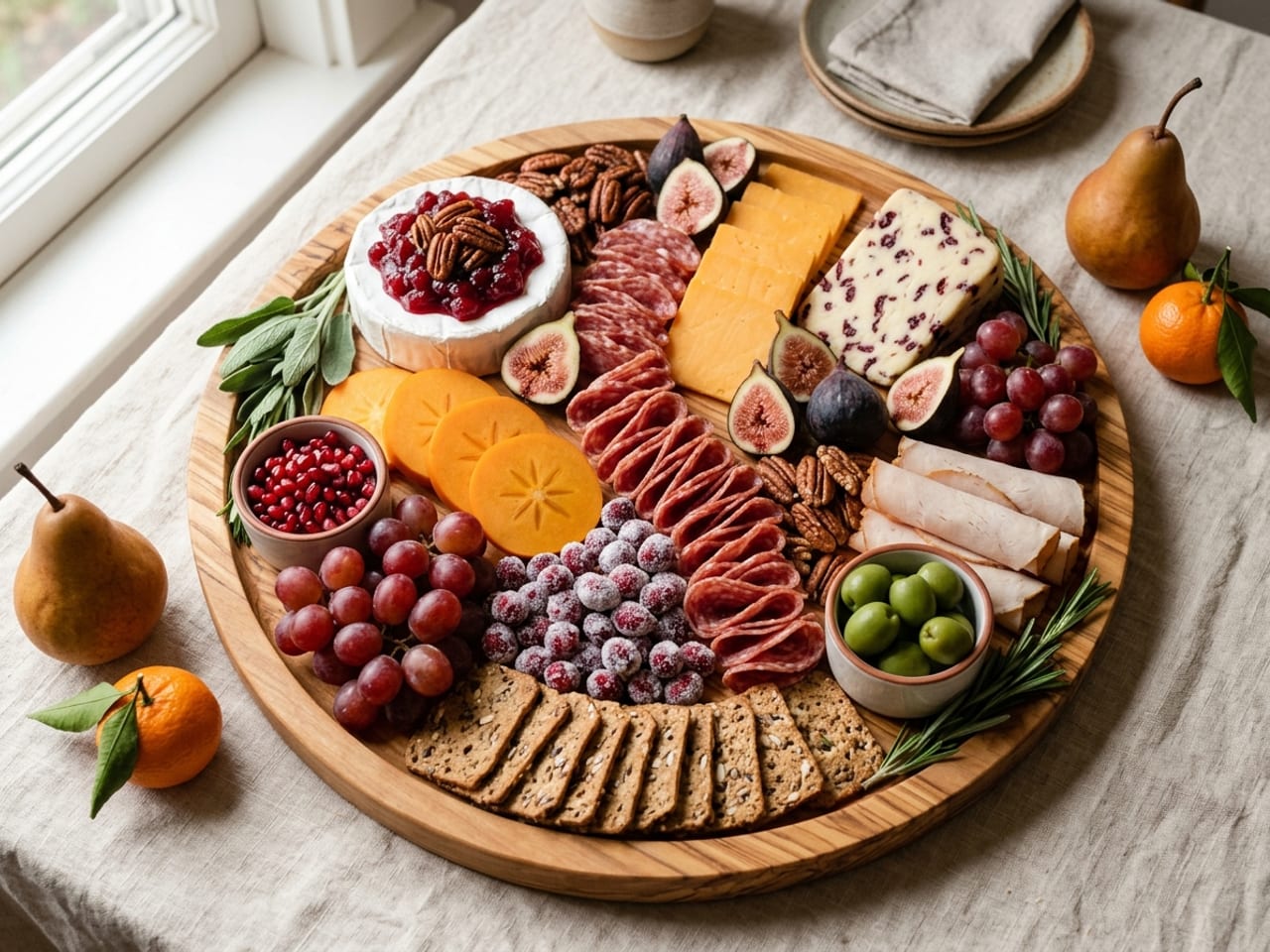
The autumn palette from real food, pigment named
Reds and burgundy are anthocyanins: cranberries 1, pomegranate, red grapes, radicchio, a black fig’s skin. Oranges and golds are carotenoids 2: Fuyu persimmon, clementine, kumquat, dried apricot. Orange cheddar is neither; its colour is annatto, told on the Halloween board. Browns are the Maillard pigments of toasted nuts, crackers and dark bread, plus the pecan’s own seed coat. Green is chlorophyll: sage, rosemary, celery leaf. Put each colour in two or three spots and let wood show (colour on the plate). The claim that warm colours make people hungrier has little evidence behind it: reviewing food-colour research, Charles Spence notes, after Garber and colleagues, that while colour is often said to influence food preferences, “good, marketing-relevant insights tend to be a little harder to come by” 3.
Four November traps. Hachiya persimmons, the acorn-shaped ones, stay astringent until jelly-soft; slice only the squat Fuyu, raw and firm (University of Florida IFAS). Fresh figs end with November (California Figs); after that, dried. Pears finish ripening at room temperature, 60 to 70°F (16 to 21°C) in a paper bag, and never in the fridge (Purdue Extension): buy them the weekend before. Sugar the cranberries: stir them into syrup just off the simmer (boiled, they burst), cool 30 minutes, drain, roll in sugar, dry an hour; they keep 24 hours uncovered (America’s Test Kitchen).
Cut pears and apples brown when cutting lets polyphenol oxidase turn the fruit’s phenolics into quinones, which polymerise brown 4: harmless, but tired. The best-supported dip is ascorbic acid, 1 tsp of powder in 2 cups (480 ml) of water for 3 to 5 minutes (Illinois Extension). In four published side-by-side kitchen tests, dilute lemon water never won: salt water took three (Food Network, Southern Living, and Cubby, where honey water came a half-point behind), honey water one (Yes! Apples, which did not test salt). Honey 5, pineapple juice 6 and chloride 7 all inhibit the enzyme in the lab. We use Food Network’s salt water, ½ tsp kosher (coarse flake) salt to a cup (240 ml), five minutes, rinsed: no lemon taste, and no honey near a baby under one 8.
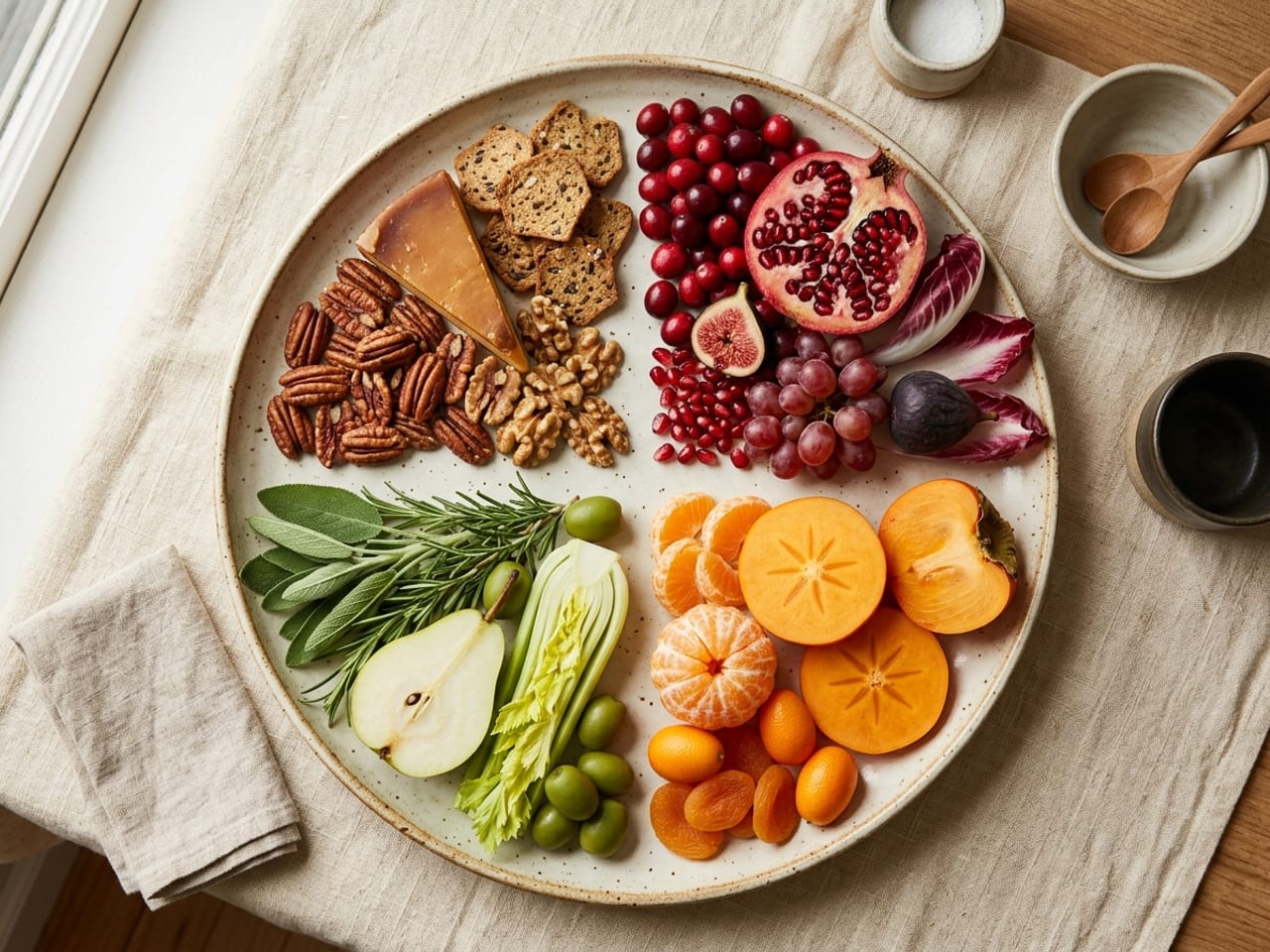
The turkey charcuterie board, built silhouette first
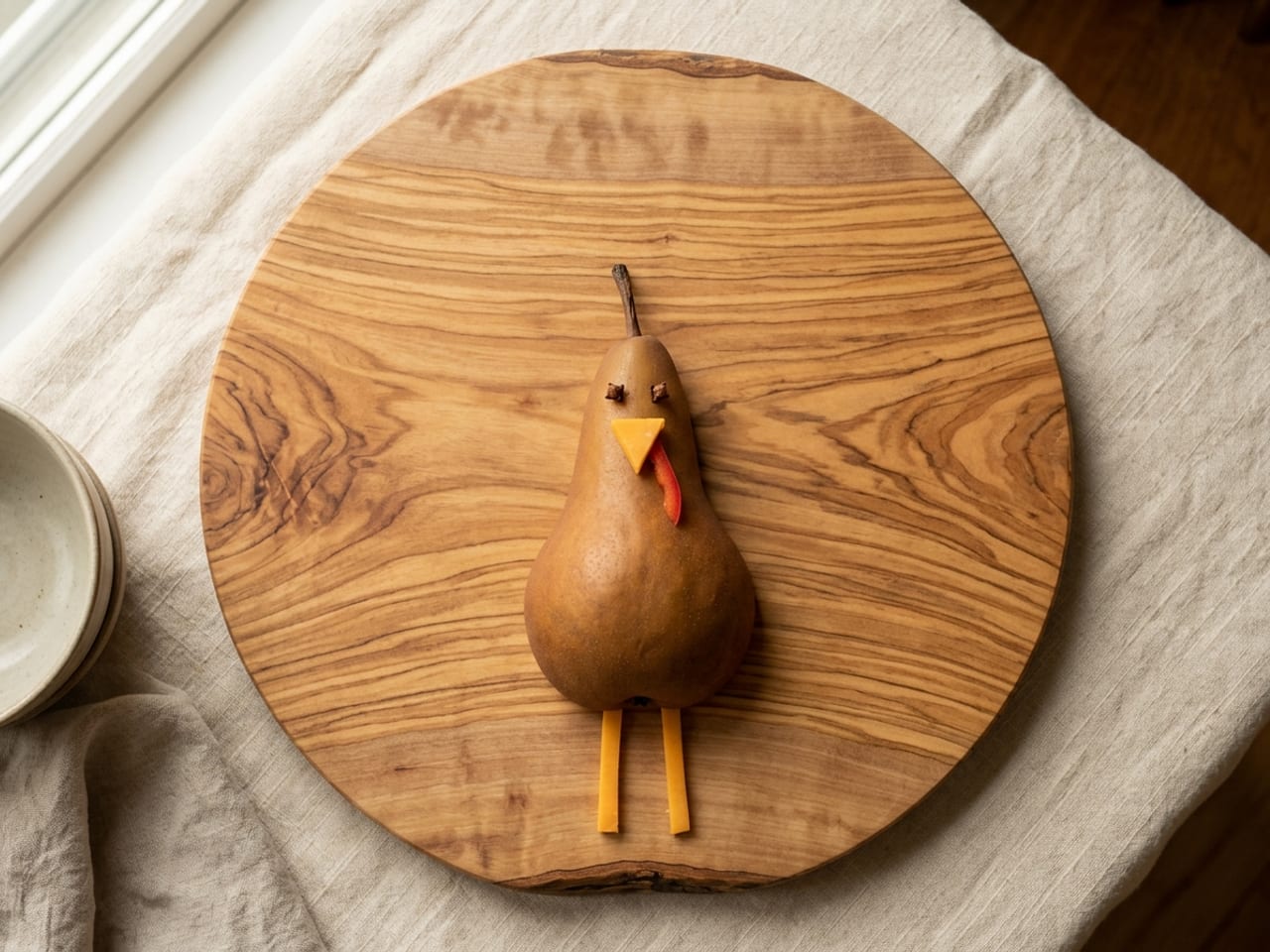
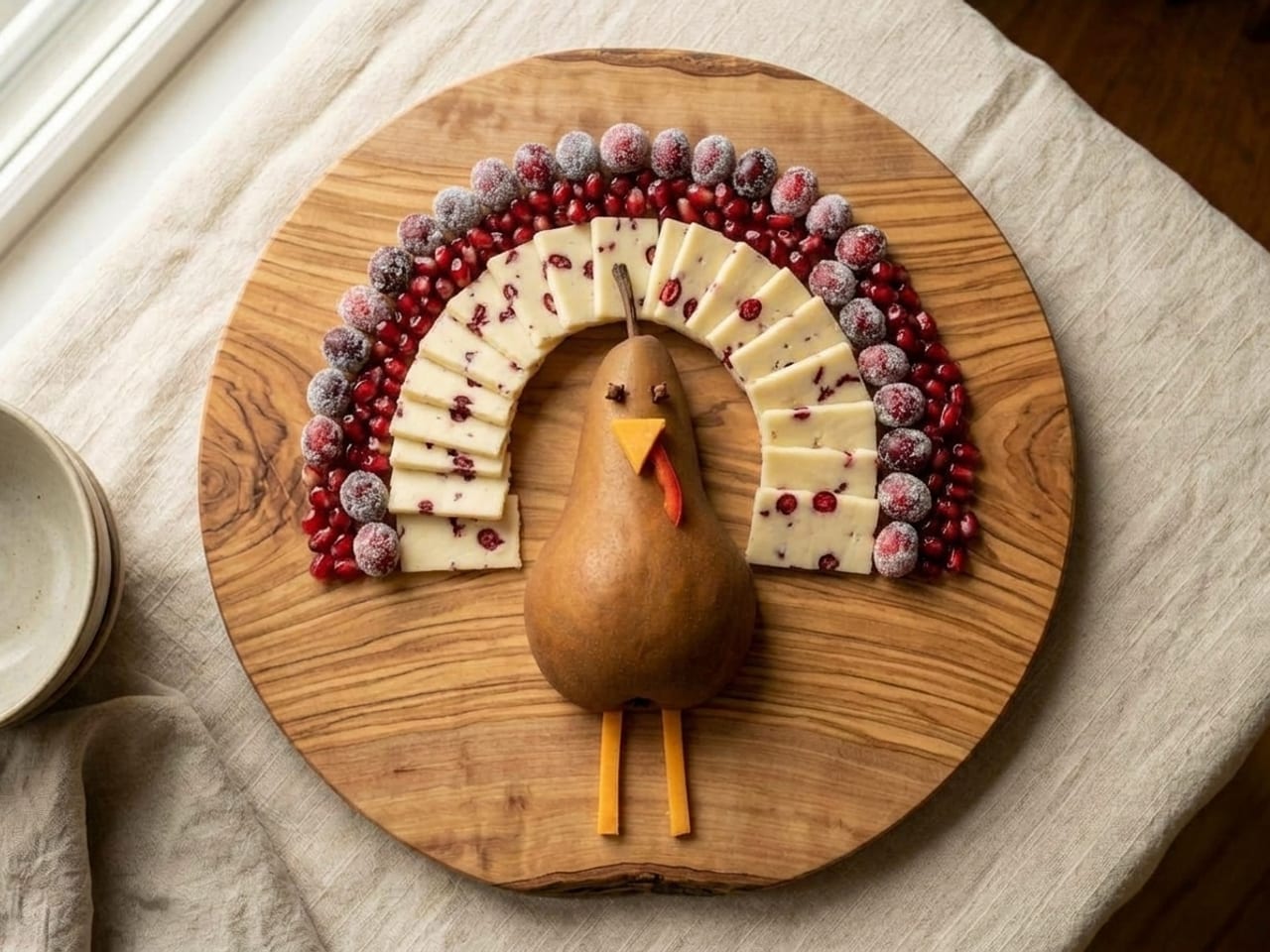
The pear-bodied turkey was fully formed by November 2013 (The Kitchen Prep Blog’s “Turkey-tizer Platter”); none of the ranking tutorials says why it reads. A strutting tom fans 18 tail feathers, all the same length in an adult (Texas Parks and Wildlife); seen head-on, that is a half-disc. So the board’s job is a clean 180° arc centred on the body, silhouette first; everything else is filling.
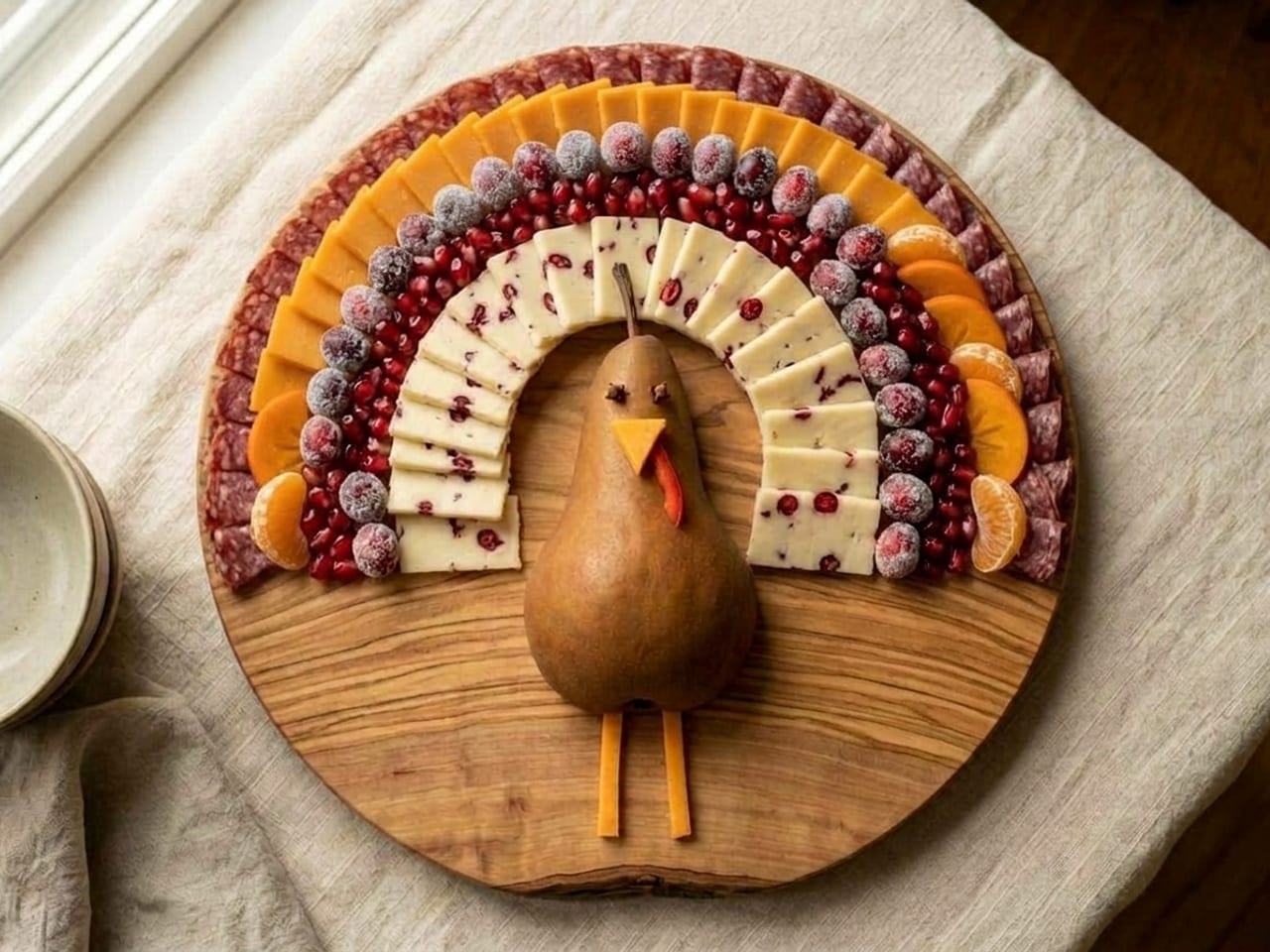
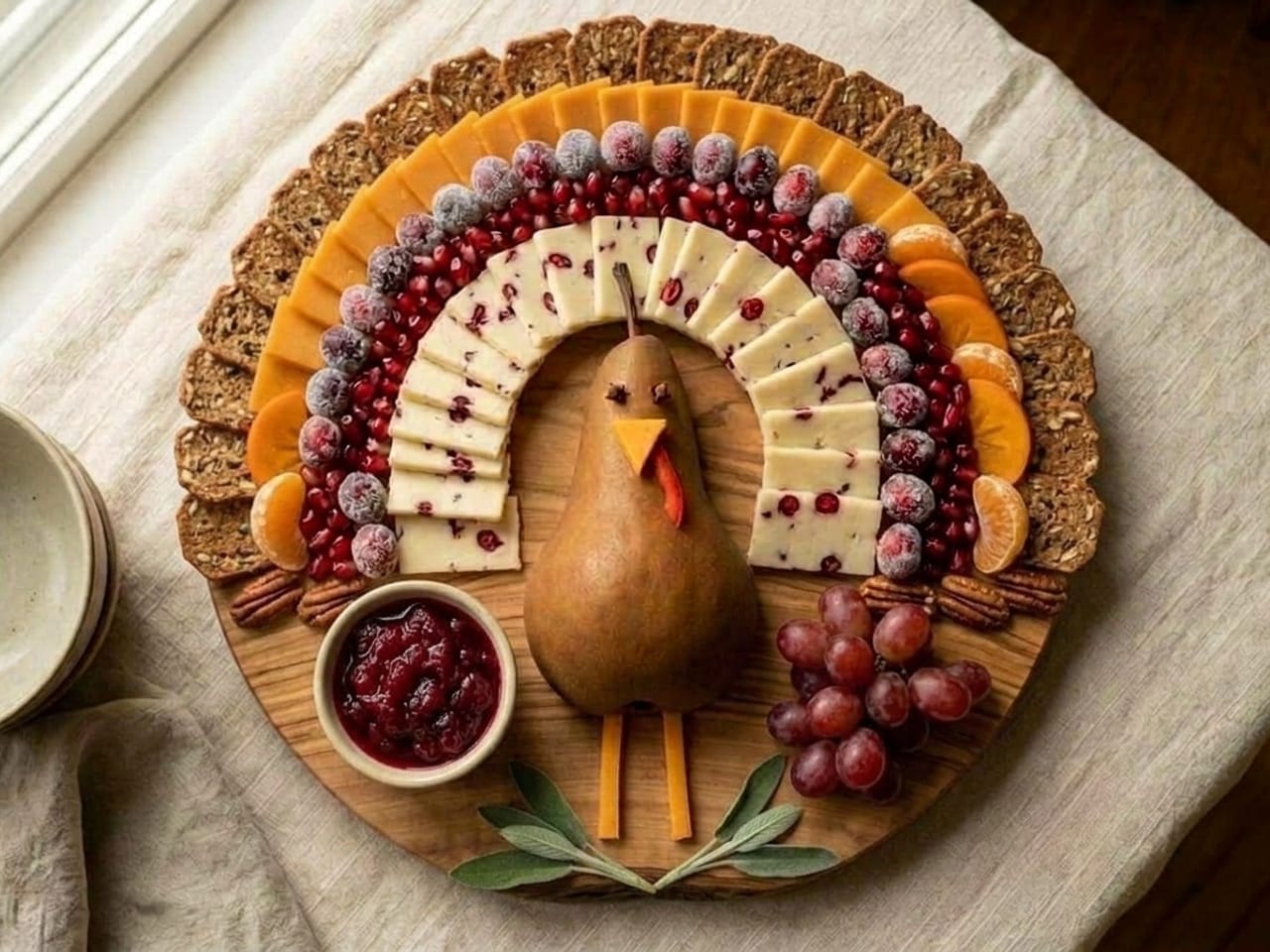
- Stage 1: body and faceOn an 18 in (46 cm) round board, a firm Bosc pear half, cut face down (salt-dipped, rinsed, dried), neck up, a third of the way up from the bottom edge. Two whole cloves for eyes, a cheddar triangle for the beak, a red pepper sliver for the wattle, cheddar strips for legs. Stop: the bare wood is the drawing.
- Stage 2: the inner bandsHugging the body, a half-circle band of pale cheese (Wensleydale & Cranberries in thin slabs), then a narrow arc of sugared cranberries and pomegranate. Bands about 1 in (2.5 cm) wide, the fruit arc narrower, so six fit inside an 18 in (46 cm) round; every arc ends level with the pear’s base, so the fan is exactly half a circle.
- Stage 3: meat and fruitShingled aged cheddar, then Fuyu rounds alternating with clementine, then salami folded in quarters, a dark brown edge like the brown-tipped tail of an Eastern wild turkey (Texas Parks and Wildlife). Four to six bands; past six they blur across a table.
- Stage 4: crackers stand, lastAt serving time, rectangular crackers stand on edge in the outer arc, shingled, the first braced against a cheese, feet seated in pecans. Flat, they read as scales; standing, as feathers. Cranberry sauce and grapes below the body; a finger’s width of wood round the silhouette.
Feathers, spokes and the round board
Spokes or bands. A tom’s fan is typically nine feathers each side of centre (Wild Turkey Lab), 18 in all; nine lines of food, one every 20°, one per pair, make a graphic tail that suits crudités. Bands suit cheese and meat, which come in slices, and four to six is a legibility rule: the odd-number rule does not survive testing 9.
A round board supplies the arc; The Country Cook uses one 15 to 18 in (38 to 46 cm) wide. On a rectangle keep the half-disc and fill the corners with relishes; a stretched oval tail reads as a peacock, a full circle as a sunflower. The test is the doorway: if it is not a turkey from 10 ft (3 m) away, remove filling, don’t add eyes.
Is turkey good on a charcuterie board?
Yes, as smoked or roast turkey breast, handled as a wet cooked meat: at 76% water it will not hold a salami rose, and it weeps onto crackers. Fold each slice in half and roll a loose cone (Meg Quinn threads hers on a rosemary stem behind a cranberry), or fold it in thirds lengthwise into a rosette. Per 100 g, sliced turkey breast has 898 mg of sodium, a smoked lemon-pepper one 1,160, to dry salami’s 2,260 (USDA FoodData Central): the swap cuts the meat’s salt by half or more.
The Thanksgiving part is who is at the table. CDC tells anyone pregnant, 65 or older or immunocompromised to avoid unheated deli meat (sliced cooked meats), cold cuts and fermented or dry sausages unless reheated to 165°F (74°C) or steaming hot. The 2024 Listeria outbreak linked to meats sliced at delis sickened 61 people in 19 states and killed 10; CDC’s first analysis found early patients more likely to have eaten deli-sliced turkey and liverwurst (a later one pointed to liverwurst from one Boar’s Head plant), and the average patient was 68 (CDC; CIDRAP). Dry salami is on the same list, so it is no safe swap: give those guests the hot bird and a board end of hard cheese and fruit.
The turkey veggie tray
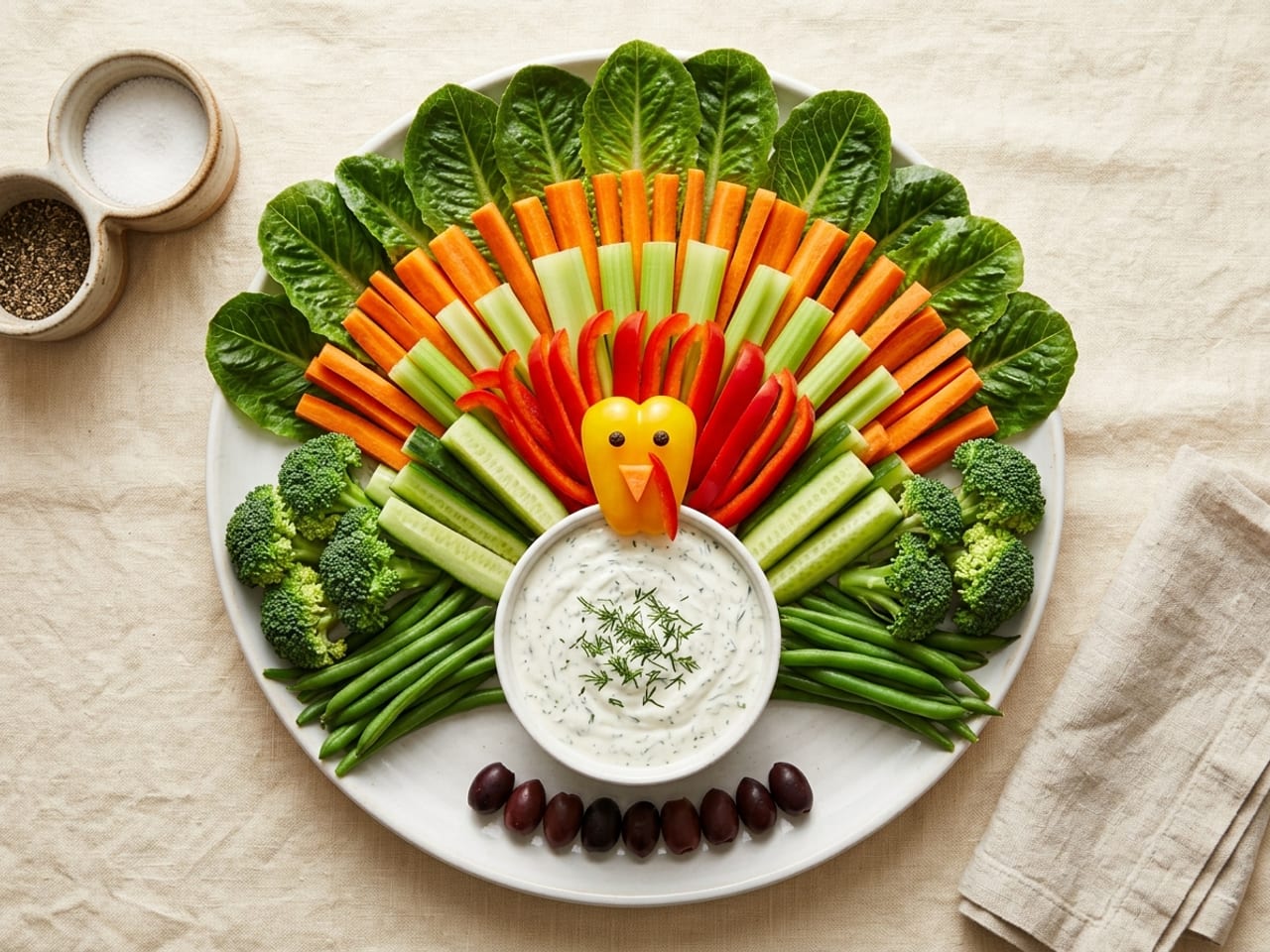
The same silhouette in crudités. The top-ranking build: a dip bowl for the body, the cut-off base of a yellow bell (sweet) pepper for the head, feathers from lettuce at the rim through celery, cucumber, red pepper and carrot, olives at the base (I Heart Naptime). Keep the build, fix the colour: celery beside cucumber reads as one pale band, so alternate warm and cool: romaine (cos), carrot, celery, red pepper, cucumber.
Celery and carrots crisp in ice water (see the relish tray). Broccoli and green beans get a 1 to 2 minute blanch and an ice bath, which drives out trapped air and shows the full green (Ali Bouzari, Scientific American); acid dulls it again 10, so vinegar and lemon dips stay in their bowls. Cut cucumbers last, as spears. The dairy dip is on the two-hour clock; for a long afternoon, nest the dip bowl in a bowl of ice (USDA FSIS).
The relish tray: what it is, and how it came before the board
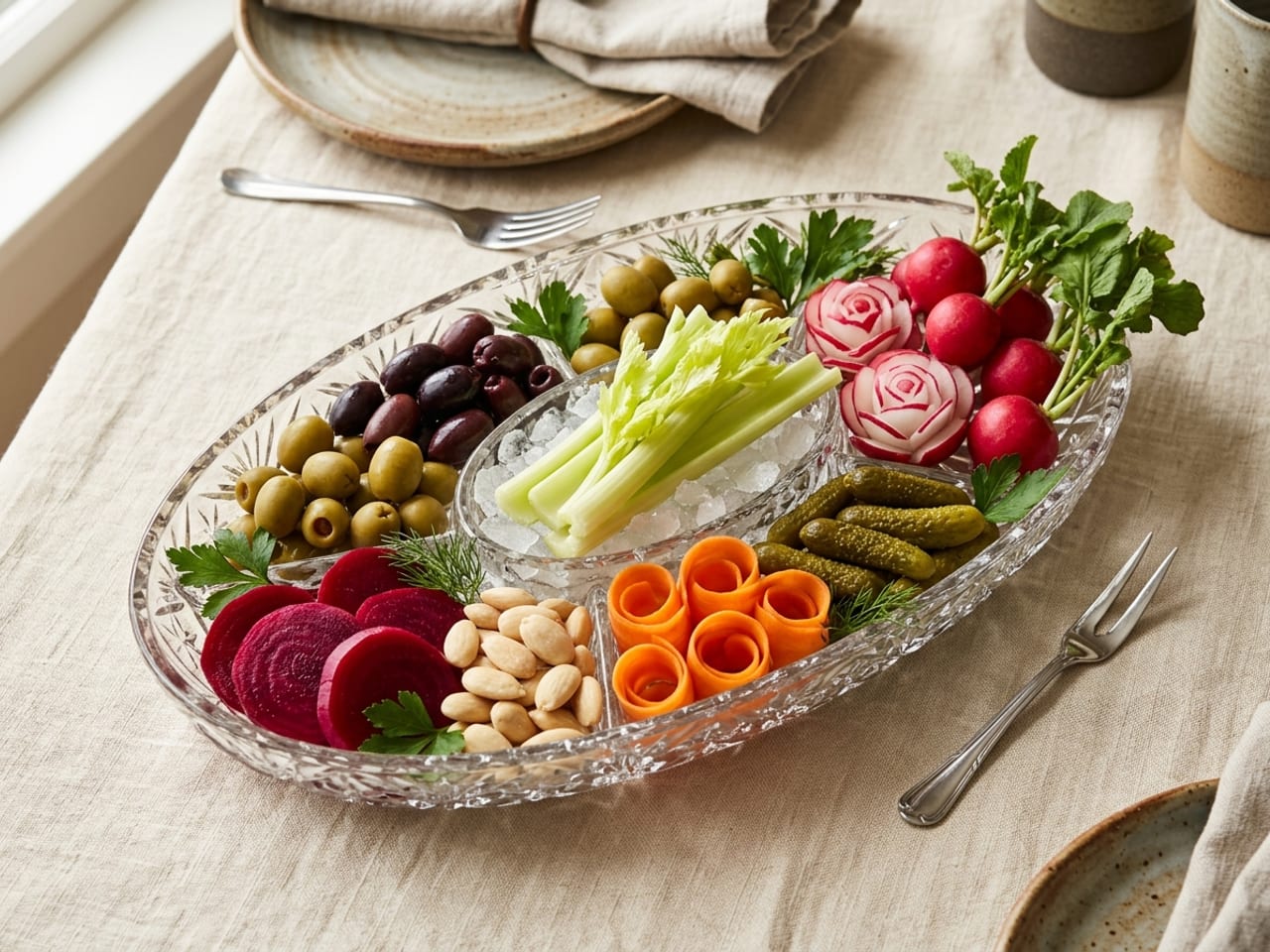
A relish tray is a long dish of sharp, crisp things eaten with or before the meal: celery, ripe and green olives, pickles, radishes, carrot curls, salted almonds, later stuffed celery; in a Wisconsin supper club, cottage cheese and bean salad on crushed ice (The Takeout). The name is literal: Merriam-Webster’s relish is “something adding a zestful flavor; especially a condiment (as of pickles or green tomatoes)”, and also an appetizer. Charles Perry, in the Los Angeles Times: “The relish tray is not a salad and never has a dressing.”
A veggie tray is raw or blanched vegetables with a dip, eaten before dinner; a relish tray is mostly brined and pickled things plus a few crisp raw ones, no dip, and it stayed on the table through dinner to cut the richness. Brined olives and pickles are off the two-hour clock by the flagship’s Food Code reading, and a dairy dip is on it: kept to brine and celery on ice, the relish tray can follow you to the table; the veggie tray cannot.
Limp celery has lost water; cold water refills the cells until their walls push back, which is turgor (PlantingScience). Stand trimmed sticks in cold water in the fridge, 30 minutes or overnight, unsalted. Recovery has a limit: celery dried below a water activity of 0.987 does not fully come back 11.
Build it on your longest narrow dish (types of plates): celery on crushed ice at the centre, olives, cornichons, pickled beets, radishes, salted almonds, deviled eggs on their own plate beside it: they are on the two-hour clock, so they go back in the fridge with the board when the turkey is carved, even if the relish tray stays. Reduced-sodium dill pickles carry 18 mg of sodium per 100 g against 809 (USDA FoodData Central). Better Homes & Gardens, November 1938: parsley round the rim, pickled beets mounded in the centre, “mounds of celery curls, whole pickled onions, green and ripe olives, and radishes” around them, “bouquets of parsley between the groups.” Anchor, group, fill: a board build, 80 years early.
How much for a board before a big dinner
Our pre-dinner rate per adult, a house figure rather than a published one: 1½ oz (43 g) of cheese, 1 oz (28 g) of cured meat, about 4 oz (113 g) of fruit and relishes and four crackers, roughly 7 oz (200 g) of food. The reason is the dinner behind it: the cheese and meat together, 2½ oz (71 g), are five eighths of the flagship’s party rate of 2 oz (57 g) each, set for a board that is the evening’s food. Caterers cut too: Messina’s plans 3 to 4 pieces a person before a main course, 4 to 6 an hour when appetizers are the event. Cheesemonger rates run higher because they count per cheese: Nora Singley’s hors-d’oeuvre figure is 1½ oz (43 g) of each cheese a head, 4½ oz (128 g) across three, sized for cheese as the event. Variety raises intake 12, and a board is variety. Added up in USDA FoodData Central, the portion is about 450 kcal and 935 mg of sodium, 41% of the 2,300 mg Daily Value before anyone sits down.
The 3,000-calorie Thanksgiving is usually credited to the Calorie Control Council, a diet-food and sweetener trade group that, as far as we can find, has never published how it got the number (its 2006 release said 4,500 for the day). Tara Parker-Pope’s deliberately generous 2012 New York Times plate came to about 2,486 kcal before drinks; the board portion is 18% of it. Proportion, not guilt: measured holiday gain averaged 0.37 kg (0.8 lb), not the folklore 5 lb (2.3 kg) 13.
The 3-3-3 rule for Thanksgiving: cut it down. Three cheeses, two meats, three fruits, one relish corner. The rule is audited on the flagship; the charcuterie board calculator weighs yours. A child counts as half, Messina’s rule of thumb.
The pre-dinner quantity table: 8, 12 and 20
Per adult 1½ oz (43 g) cheese, 1 oz (28 g) meat, 4 oz (113 g) fruit and relishes, four crackers; a child counts as half. Soft cheese and meat out 85 minutes, assembly to carving.
| Guests | Cheese | Cured meat | Fruit and relishes | Crackers | Board |
|---|---|---|---|---|---|
| 8 adults | 12 oz (340 g) | 8 oz (225 g) | 2 lb (905 g) | about 32 | One round, 15 in (38 cm) |
| 12 adults | 18 oz (510 g) | 12 oz (340 g) | 3 lb (1.36 kg) | about 48 | One round, 18 in (46 cm) |
| 12 adults, 6 children | 22½ oz (640 g) | 15 oz (425 g) | 3¾ lb (1.7 kg) | about 60 | One 18 in (46 cm) board plus a relish tray |
| 20 adults | 30 oz (850 g) | 20 oz (565 g) | 5 lb (2.27 kg) | about 80 | Two 18 in (46 cm) boards, or one board and a long relish tray |
One adult’s portion, added up
USDA FoodData Central values; sodium against the FDA Daily Value of 2,300 mg.
| Item | Portion | kcal | Sodium (mg) |
|---|---|---|---|
| Aged cheddar | 21 g (0.74 oz) | 85 | 137 |
| Brie | 21 g (0.74 oz) | 70 | 132 |
| Dry salami | 14 g (0.5 oz) | 57 | 316 |
| Deli turkey breast | 14 g (0.5 oz) | 15 | 126 |
| Wheat crackers, about 4 | 14 g (0.5 oz) | 64 | 98 |
| Pear slices | 40 g (1.4 oz) | 23 | 0 |
| Red grapes | 40 g (1.4 oz) | 28 | 1 |
| Pecans | 7 g (0.25 oz) | 48 | 0 |
| Dried sweetened cranberries | 7 g (0.25 oz) | 22 | 0 |
| Cranberry sauce, 1 Tbsp | 17 g (0.6 oz) | 27 | 1 |
| Green olives, 3 | 8 g (0.3 oz) | 12 | 124 |
| Total | 203 g (7.2 oz) | about 450 | about 935 (41% DV) |
The Thanksgiving-day clock for the board
For a 4:00 pm dinner and an 18 lb (8.2 kg) turkey for twelve, roasting 3¾ to 4¼ hours at 325°F (163°C) plus a 20-minute rest (turkey calculator). USDA FSIS allows perishable food no more than 2 hours out of the fridge, 1 hour above 90°F (32°C); putting it back does not reset the count (University of Nebraska Extension: “2 hours, TOTAL time”). Only hard cheese, 39% moisture or less, is off that clock. The whole day, from the bird going into the fridge to thaw on Saturday (USDA FSIS: about 24 hours for every 4 to 5 lb (1.8 to 2.3 kg)), is on the tablescape timeline.
| When | Board task | Why |
|---|---|---|
| Weekend before | Buy pears; ripen at room temperature, check the necks Wednesday | Pears finish ripening at 60 to 70°F (16 to 21°C) in a paper bag, never in the fridge (Purdue) |
| Wednesday | Slice hard cheeses, wrap in parchment; fold meats into a lidded box; olives and cornichons into covered ramekins; celery and carrots into water | Components stack; a built board takes the shelf the pies need, and cut cheese dries in the air (Chowhound) |
| Wednesday evening | Sugared cranberries | Keep uncovered at room temperature up to 24 hours (America’s Test Kitchen) |
| Thursday 1:30 pm | Aged cheddar out of the fridge to temper | Hard cheese is off the two-hour clock (the flagship’s Food Code reading), so its 45 minutes to an hour costs nothing (Dominick DiBartolomeo, The Cheese Store of Beverly Hills) |
| 2:15 pm | Brie or chèvre, Wensleydale and meats out of the fridge; assemble; pears cut last into salt water; crackers last | The two-hour clock starts now for soft cheese and meat, so they temper 15 minutes, not an hour; fridge-soft crackers slump; cut fruit browns |
| 2:30 pm | Board out, in the living room, away from the oven and range | Guests arrive; the bird’s last hour and its rest |
| 3:40 pm | Turkey carved: board and deviled eggs back in the fridge; relish tray to the table | 85 minutes used for the soft cheese and meat, 35 left; the clock does not restart after dinner |
| After pie | A cheese course from the fridge: the reserved wedge, never set out, one cheese, about 1 oz (28 g) a head | The 1880s order: cheese last |
The Thanksgiving cheese board
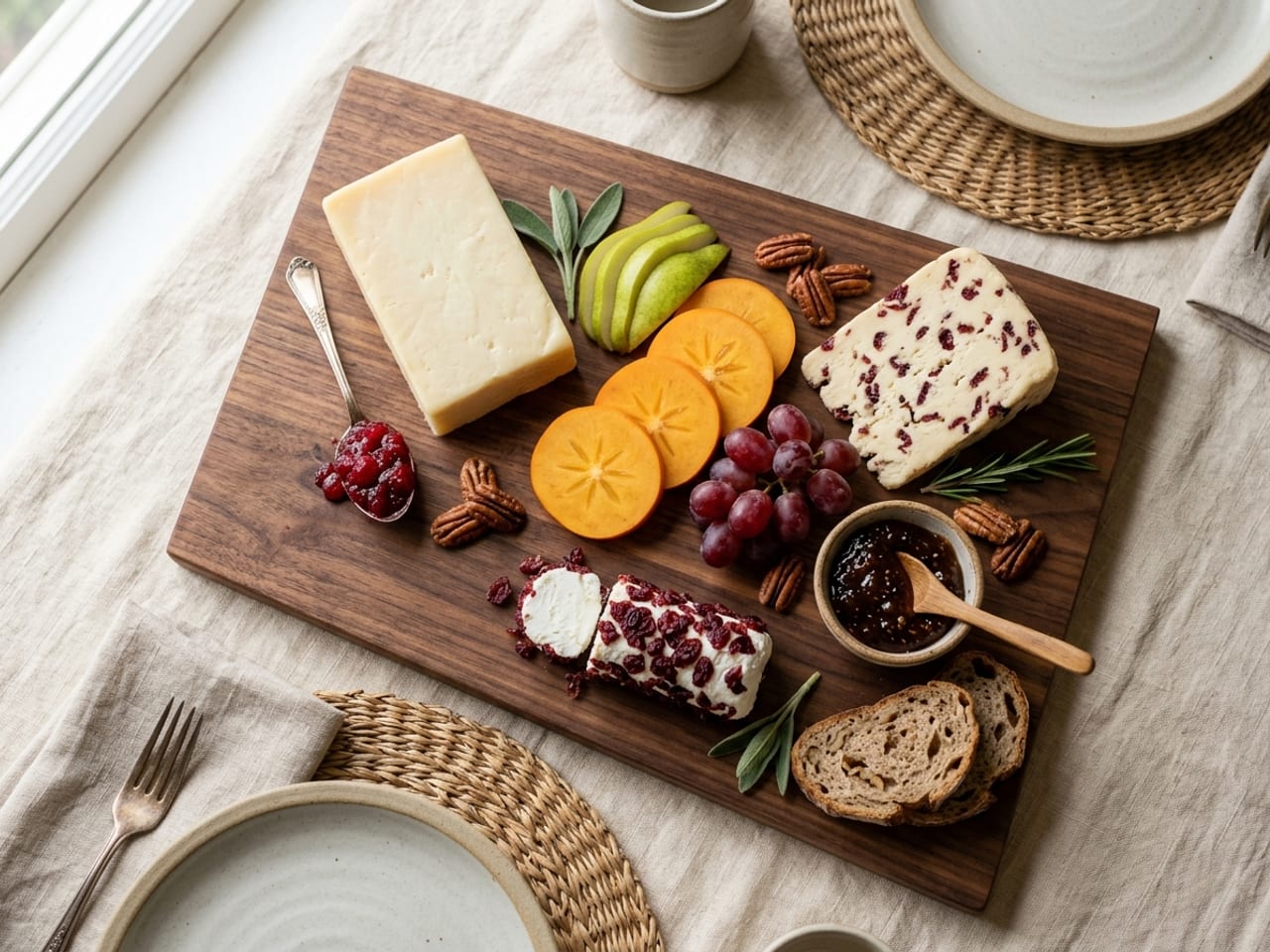
Three cheeses and the season: aged cheddar with a spoon of cranberry sauce, Yorkshire Wensleydale & Cranberries (the Wensleydale Creamery says it created it, in 1996), and a brie, or a fresh chèvre (Trader Joe’s sells one rolled in cranberries in season). Add pears, Fuyu, grapes, pecans, fig jam and walnut bread. Twelve guests need 18 oz (510 g): a 6 oz (170 g) wedge of each, placed as a triangle.
Keep a wedge back, in the fridge and never set out: the 19th-century Thanksgiving ended with cheese (see the history), and a post-dinner cheese course runs about 1 oz (28 g) of each cheese a head (Nora Singley, The Kitchn); after this dinner, one cheese is plenty. Cheese after the pie is the older custom. The soft-cheese rules for pregnancy are on the flagship; check that the Wensleydale label says pasteurized.
The Thanksgiving dessert board, and the day-after board
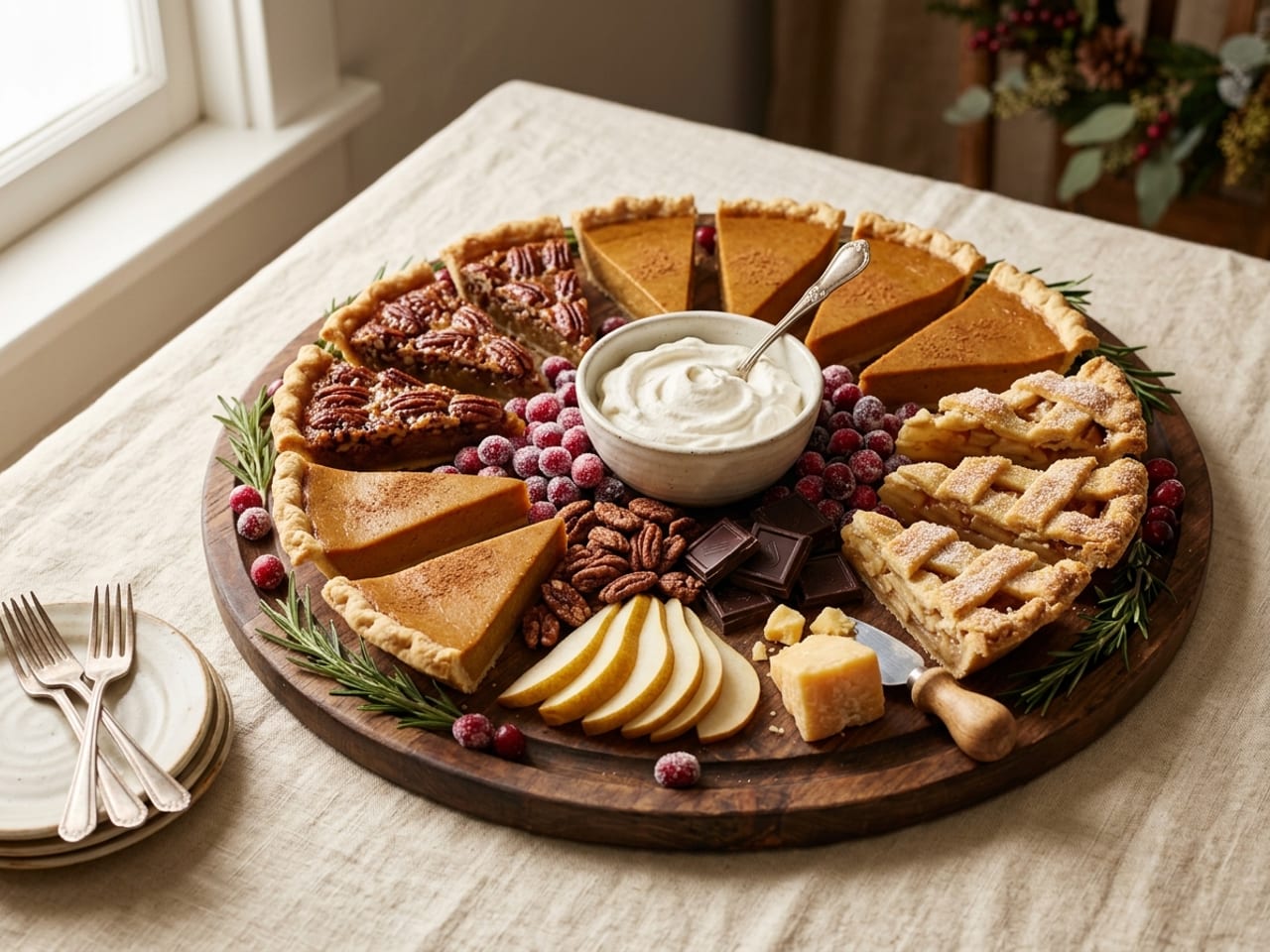
The pie board serves pie to a crowd: slim wedges of pecan, pumpkin and apple, cut before they reach the board, points in; whipped cream in a bowl; sugared cranberries, candied pecans (made with sugar, not honey, if a baby is at the table), dark chocolate, pear slices and the reserved cheddar. Cut the dense pecan thinnest. Pumpkin and pecan pie (both egg-rich) and the cream are back in the fridge within two hours (USDA); apple pie can wait.
The day-after board: cold turkey, cranberry sauce, stuffing squares, the last cheese, pickles and rolls, out of the fridge and straight back. The leftovers clocks are on the tablescape page.
Friendsgiving and potluck boards
Friendsgiving is young: Merriam-Webster finds the word in print from 2007, not from the show Friends, and added it to the dictionary in 2020. When the board is the meal rather than the opener, use the flagship’s meal rate, 4 oz (113 g) of cheese and 3 oz (85 g) of meat a head.
Assign the board to one guest: four boards means four clocks. Travel in parts, in a cooler with ice packs, and assemble on arrival; if the cooler held 40°F (4°C) or below, the clock starts at unpacking. Put a card by the board naming what is on it: tree nuts (pecans, walnuts, almonds), milk, wheat, egg, soy and sesame are among FDA’s nine major allergens; in the UK, celery, mustard and the sulphites in dried apricots must be declared too. The party food calculator sizes the rest.
The Thanksgiving charcuterie board for kids
About half an adult’s portion. The American Academy of Pediatrics lists whole grapes, chunks of cheese, and nuts and seeds among choking hazards for under-fours.
- Grapes, olives and berries cut smallGrapes quartered lengthwise, not halved crosswise; olives pitted and quartered, or left off; sugared cranberries halved. For under-fours, pieces no bigger than ½ in (1 cm) (AAP).
- Cheese in thin planksSlices, not cubes.
- Nuts and seeds at the adult endWhole pecans, almonds, candied nuts and pumpkin seeds stay on the far side.
- No cloves, no picksThe turkey’s clove eyes, any toothpicks and rosemary-stem skewers come off; two dots of cream cheese will do.
- Salt water, not honeyFor their pear slices; no honey for a baby under one 8.
- Seated, with their own turkeyChildren eat sitting down (AAP). Give them a pear half to build on, thin apple slices, cheddar and clementine segments on their own small board; for under-fours, cut the fruit into pieces no bigger than ½ in (1 cm) and keep carrot and celery sticks off their board.
Thanksgiving charcuterie board ideas by theme, size, diet and budget
Same palette, same pre-dinner portion, new cast.
- Turkey-shaped boardThe four-stage build above.
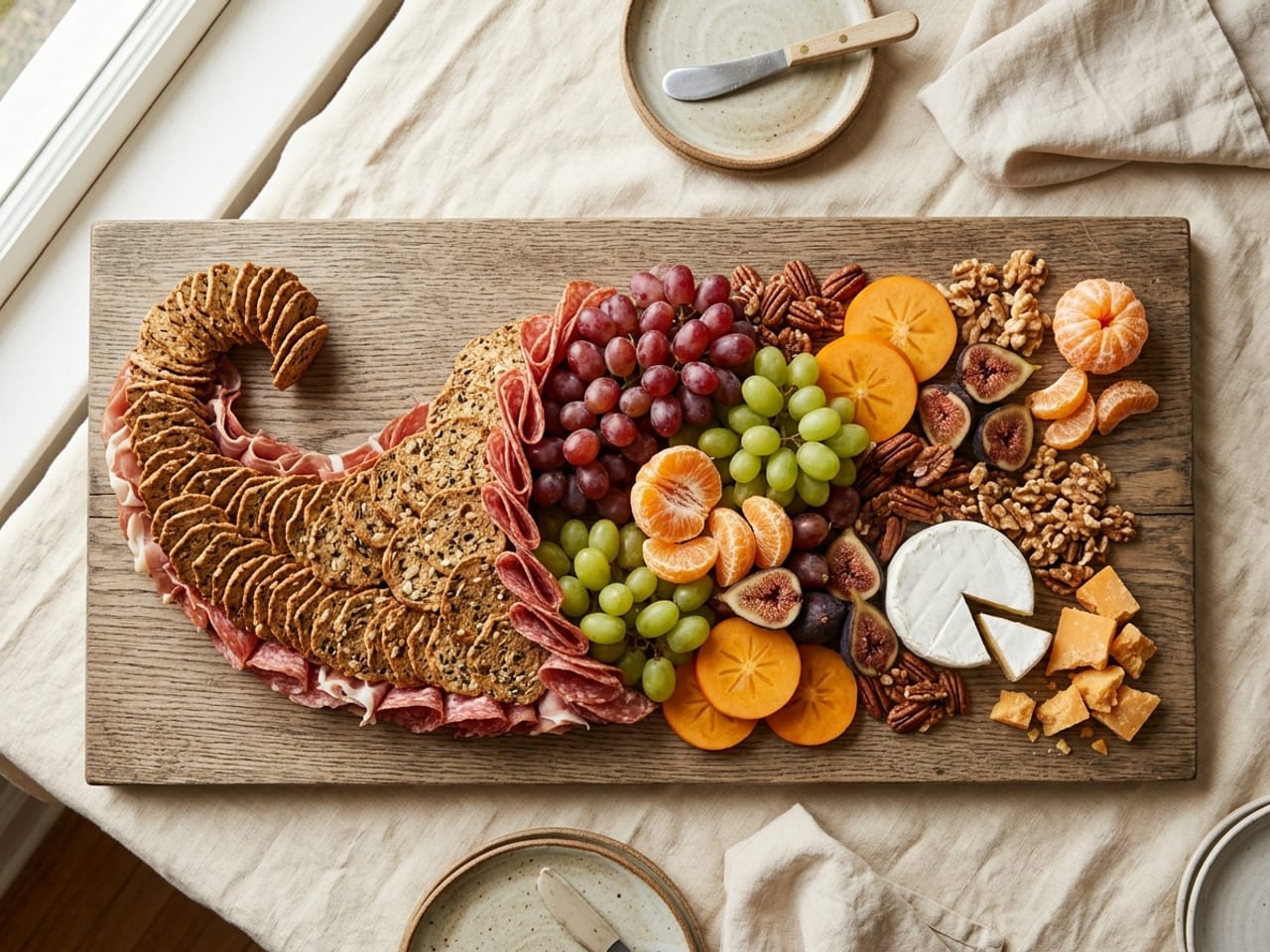
- CornucopiaA horn drawn in crackers and salami, spilling grapes, clementines, figs and pecans across the board.
- Harvest farmhouseA long plank, wedges not slices, a walnut loaf, whole pears, grainy mustard, sage.
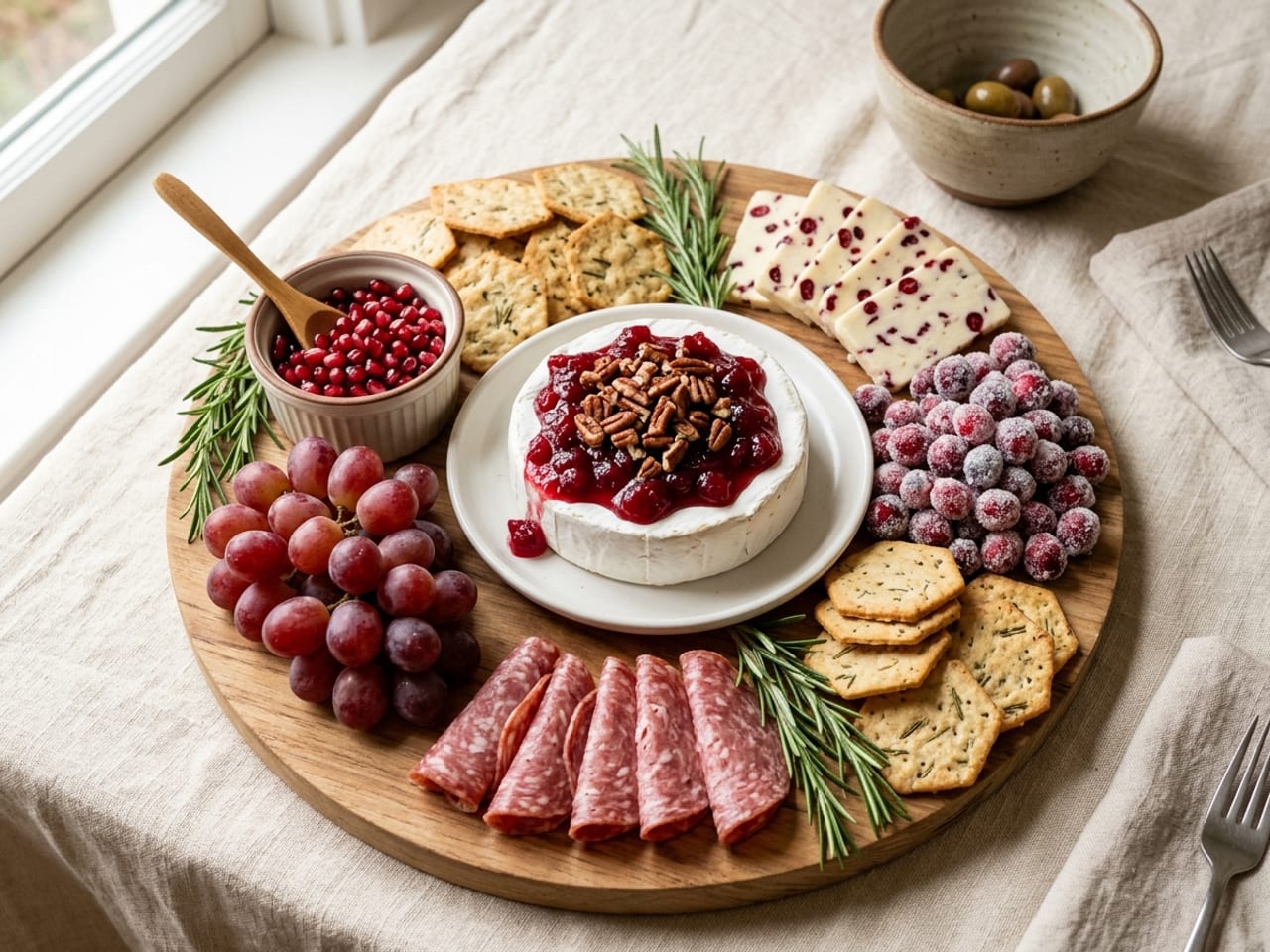
- Cranberry and brieBrie under cranberry sauce and pecans, Wensleydale & Cranberries, sugared cranberries, pomegranate: the red board.
- Apple orchardThree apples, salt-dipped, aged cheddar, smoked Gouda, apple butter, walnuts.
- Pumpkin patchClementines, Fuyu, dried apricots, Mimolette, pumpkin seeds, pumpkin hummus: the orange board.
- Relish-tray revivalThe 1889 table on a long narrow dish; it stays for dinner.
- Friendsgiving boardThe meal itself, at meal-rate quantities: baked brie, roast turkey, stuffing bites, two breads.
- Small board for twoOne cheese, one salami, half a pear, grapes and eight crackers on a 10 in (25 cm) plate.
- Budget, about $26 for eightAldi Brie and English Cheddar and Trader Joe’s salami ($12.73 for the three, checked), grapes, pears, olives, celery, crackers (estimated).
- VegetarianThe cheese board plus a doubled relish corner; check cheese labels for animal rennet.
- Gluten-freeCrackers labelled gluten-free on a separate plate with their own cheese and knife, so a coeliac guest avoids the crumbs; many rice crackers are seasoned with wheat-based soy sauce, so read the label.
- The 15-minute boardNo knife work: whole brie, folded salami, grapes, clementines, olives, pecans, crackers.
- Day-after leftovers boardCold turkey, cranberry sauce, stuffing, pickles, rolls.
Five things to avoid on a Thanksgiving charcuterie board
The flagship’s five are about guests who can be hurt: honey and babies, soft cheese in pregnancy, the two-hour clock, loose nuts, one knife. These five are Thanksgiving’s.
- A second dinnerOne top-ranking recipe sets 1½ lb (680 g) of meat and 1½ lb (680 g) of cheese for ten, 4.8 oz (136 g) a head, and calls it an appetizer. Halve it.
- Four hours on the tableAnother says “about 4 hours at room temperature.” USDA FSIS says two hours out of the fridge, and the count does not reset: 85 minutes before dinner leaves 35, not a fresh two after pie.
- Cold deli meat for the grandparentsCDC’s at-risk list includes everyone 65 and older, and covers dry salami too. Serve them the hot bird.
- Crackers and cut pears built the night beforeCrackers soften and cut fruit browns; both go on last.
- A firm Hachiya, a bowl of raw cranberriesOne coats the mouth with tannin, the other is simply sour. Slice Fuyu; sugar the cranberries.
What a Thanksgiving board can honestly carry
The board’s American grandparent is the relish tray. Amelia Simmons, in the first known cookbook by an American (1796), serves the turkey “with boiled onions and cramberry-sauce, mangoes, pickles or celery.” By the 1880s the relishes stood on the table from the start: Catherine Owen (The Cosmopolitan, 1886) called salted almonds “a fashionable appetizer” for “ornamental dishes at the beginning of dinner,” and Harper’s Bazar, 30 November 1889, set out celery, cranberry jelly, pickles, olives and salted almonds “and other relishes which make the board attractive”, the board being the table.
The tall celery glass had become “so exceedingly common,” the hotel steward Jessup Whitehead wrote in 1889, that fashionable tables laid celery “upon very long and narrow dishes”; a Chicago Sunday Tribune advertisement of 21 February 1897 sells a “cut relish tray”, the earliest dated use we found. So the line quoted in Our State, from Replacements Ltd.’s Julie Robbins, that celery was “super expensive and hard to come by” is half right: a showpiece early in the century, ordinary by the 1880s.
The twist: those menus served the cheese last. Maria Parloa’s 1885 Thanksgiving puts “Crackers. Cheese.” after the pies; Fannie Farmer’s 1896 menu ends on “Crackers. Cheese. Café Noir.” The board moved the cheese course to the front and added salami. The 2013 “Turkey-tizer Platter” is now titled “Thanksgiving Turkey Charcuterie Board”, and in Google Trends the board overtook the relish tray as America’s November search in 2021.
Of 1621, Edward Winslow’s letter names only “fowle” and the five deer Massasoit’s men brought for the feast; the turkey and the “first Thanksgiving” come from Alexander Young’s 1841 footnote, “they no doubt feasted on the wild turkey.” Plymouth had no cattle until 1624 (William Bradford), so no cheese of its own; the ship’s Holland cheese, which the settlers were still handing to Samoset in March 1621, is not mentioned at the feast. The earliest printed cranberry sauce we know of is John Josselyn’s, in 1672: “a delicate Sauce, especially for roasted Mutton.”
Is it cheaper to make or buy a charcuterie board?
Make, by more than four times. Our board for twelve comes to about $55, $4.60 a head; the $19.72 of cheese and meat is at checked prices, the rest estimated. For scale, the Bureau of Labor Statistics’ natural cheddar average (series APU0000710212) was $5.98 a pound ($13.19 a kilo) in August 2026; Aldi’s English Cheddar, $9.81 a pound ($21.62 a kilo), is 1.6 times that.
Boarderie’s Thanksgiving Large Cheese & FALLcuterie Board is $249 delivered overnight, $239 with the $10 it was taking off at checkout for delivery before 15 December (read 25 September 2026): 70 oz (1.98 kg) of cheese, meat, dried fruit, nuts and chocolate and 13 oz (370 g) of crackers on a 17 x 13 in (43 x 33 cm) acacia board you keep (the 16 lb (7.3 kg) in its listing data is shipping weight). Its page says two things: its size picker reads serves 10 to 14 and its description serves 9 to 10, so $18 to $28 a head at list price; at our pre-dinner portion its 83 oz (2.35 kg) feeds eleven or twelve, between the two. You pay for arranging, the board and delivery; you get no fresh fruit, and storage advice ranging from 5 to 10 days on one page. Make it if you have Wednesday evening; buy it if you have neither time nor fridge space.
The Thanksgiving board for twelve, priced
Checked: Aldi and Trader Joe’s as read for the flagship (2 September 2026); Wensleydale on Instacart listings (25 September 2026, $6.99 to $13.49, lowest taken). Estimates marked. Bought in whole packs: 20.3 oz (575 g) of cheese against the table’s 18 oz (510 g), and fruit and relishes past its 3 lb (1.36 kg), because they include the turkey’s body pear, the sugared-cranberry batch and jars that outlast the day. The after-pie cheese is extra.
| Item | Quantity | Price | Status |
|---|---|---|---|
| Aldi Emporium Selection double crème Brie | 8 oz (225 g) | $3.95 | Checked |
| Aldi Emporium Selection English Cheddar | 7 oz (200 g) | $4.29 | Checked |
| Wensleydale Creamery Wensleydale & Cranberries | 5.3 oz (150 g) | $6.99 | Checked |
| Trader Joe’s sliced Italian dry salami | 8 oz (225 g) | $4.49 | Checked |
| Smoked turkey breast, deli | 4 oz (113 g) | $3.00 | Estimate |
| Crackers, two boxes | $5.00 | Estimate | |
| Pears, three | about 1½ lb (680 g) | $3.00 | Estimate |
| Red grapes | 1½ lb (680 g) | $4.00 | Estimate |
| Pomegranate or three Fuyu persimmons | $3.00 | Estimate | |
| Fresh cranberries and sugar | 12 oz (340 g) bag | $3.50 | Estimate |
| Pecans | 6 oz (170 g) | $5.00 | Estimate |
| Olives and cornichons | two jars | $6.00 | Estimate |
| Celery and radishes | $3.00 | Estimate | |
| DIY total, 12 guests | 20.3 oz (575 g) cheese, 12 oz (340 g) meat | $55.22 | $4.60 a head |
| Boarderie Thanksgiving Large | 70 oz (1.98 kg) food, 13 oz (370 g) crackers, acacia board | $249.00 | $18 to $28 a head at its own 9 to 14 |
Your board, re-arranged
Photograph the Thanksgiving board you built, upload it, and Plate Artists returns it re-arranged: silhouette first, the warm colours distributed, wood showing again. Same pears, same cheddar, a better turkey.
Start free · 1 enhancement →Free account · 1 free enhancement · No credit card
Charcuterie board questions, answered
What should I put on a Thanksgiving charcuterie board?
Aged cheddar, brie and Wensleydale & Cranberries, salami and smoked turkey, Fuyu, pears, grapes, pomegranate, sugared cranberries, pecans, a relish corner and crackers: about 1½ oz (43 g) cheese and 1 oz (28 g) meat an adult.
Is it cheaper to make or buy a charcuterie board?
Make it, by more than four times: our Thanksgiving board for twelve costs about $55, $4.60 a head, against $249 for Boarderie’s Thanksgiving Large, which its page says serves 9 to 10 in one place and 10 to 14 in another. Buying pays for arranging, a board and delivery.
Is turkey good on a charcuterie board?
Yes, smoked or roast turkey breast rolled loosely, away from crackers. But CDC tells anyone pregnant, 65 or older or immunocompromised to avoid unheated deli meat, dry salami included; the 2024 deli-meat Listeria outbreak’s average patient was 68. Serve them the hot turkey.
What is the difference between a veggie tray and a relish tray?
A veggie tray is raw or blanched vegetables with a dip, eaten before dinner. A relish tray is mostly brined and pickled things (olives, pickles, pickled beets) with a few crisp raw ones (celery, radishes), no dip, and at Thanksgiving it traditionally stayed on the table through dinner.
How to fold turkey for a charcuterie board?
Fold each slice in half and roll a loose cone, or fold it in thirds lengthwise and roll a rosette. Turkey is too wet for a salami rose.
Why do they call it a relish tray?
It holds relishes: in Merriam-Webster, “something adding a zestful flavor; especially a condiment (as of pickles or green tomatoes)”, and also an appetizer. The “relish dish” was in 1880s dinner services; “relish tray” is in print by 1897.
What is normally on a relish tray?
Celery, ripe and green olives, pickles, radishes, carrot curls and often salted almonds.
How far ahead of time should I make a charcuterie board?
For Thanksgiving, in parts: hard cheese sliced and meat folded the day before, the board assembled 15 minutes before guests arrive with the soft cheese and meat straight from the fridge, cut fruit and crackers last. A built board takes fridge space the turkey needs.
What is the 3-3-3 rule for charcuterie?
Three cheeses, three meats, three accompaniments, audited on the flagship. Before Thanksgiving dinner: three cheeses, two meats, three fruits, a relish corner.
How long can a Thanksgiving charcuterie board sit out?
Two hours out of the fridge, counted in total, one hour above 90°F (32°C) (USDA FSIS; Nebraska Extension). Only hard cheese can temper earlier: the soft cheese and meat come out at assembly and go back in the fridge when the turkey is carved, 85 minutes later on our clock.
The research behind this guide
Peer-reviewed studies, retrieved via PubMed and Crossref. Every numbered figure quoted above comes from one of these papers.
- Pappas, E., & Schaich, K. M. (2009). Phytochemicals of cranberries and cranberry products: characterization, potential health effects, and processing stability. Critical Reviews in Food Science and Nutrition, 49(9), 741-781. doi:10.1080/10408390802145377
- Khoo, H.-E., Prasad, K. N., Kong, K.-W., Jiang, Y., & Ismail, A. (2011). Carotenoids and their isomers: color pigments in fruits and vegetables. Molecules, 16(2), 1710-1738. doi:10.3390/molecules16021710
- Spence, C. (2015). On the psychological impact of food colour. Flavour, 4, 21. doi:10.1186/s13411-015-0031-3
- Nicolas, J. J., Richard-Forget, F. C., Goupy, P. M., Amiot, M.-J., & Aubert, S. Y. (1994). Enzymatic browning reactions in apple and apple products. Critical Reviews in Food Science and Nutrition, 34(2), 109-157. doi:10.1080/10408399409527653
- Oszmianski, J., & Lee, C. Y. (1990). Inhibition of polyphenol oxidase activity and browning by honey. Journal of Agricultural and Food Chemistry, 38(10), 1892-1895. doi:10.1021/jf00100a002
- Lozano-de-Gonzalez, P. G., Barrett, D. M., Wrolstad, R. E., & Durst, R. W. (1993). Enzymatic browning inhibited in fresh and dried apple rings by pineapple juice. Journal of Food Science, 58(2), 399-404. doi:10.1111/j.1365-2621.1993.tb04284.x
- Janovitz-Klapp, A. H., Richard, F. C., Goupy, P. M., & Nicolas, J. J. (1990). Inhibition studies on apple polyphenol oxidase. Journal of Agricultural and Food Chemistry, 38(4), 926-931. doi:10.1021/jf00094a002
- Tanzi, M. G., & Gabay, M. P. (2002). Association between honey consumption and infant botulism. Pharmacotherapy, 22(11), 1479-1483. doi:10.1592/phco.22.16.1479.33696
- Woods, A. T., Michel, C., & Spence, C. (2016). Odd versus even: a scientific study of the ‘rules’ of plating. PeerJ, 4, e1526. doi:10.7717/peerj.1526
- Koca, N., Karadeniz, F., & Burdurlu, H. S. (2007). Effect of pH on chlorophyll degradation and colour loss in blanched green peas. Food Chemistry, 100(2), 609-615. doi:10.1016/j.foodchem.2005.09.079
- Willis, C. A., & Teixeira, A. A. (1988). Controlled reduction of water activity in celery: effect on membrane integrity and biophysical properties. Journal of Food Science, 53(1), 111-116. doi:10.1111/j.1365-2621.1988.tb10188.x
- Rolls, B. J., Rowe, E. A., Rolls, E. T., Kingston, B., Megson, A., & Gunary, R. (1981). Variety in a meal enhances food intake in man. Physiology & Behavior, 26(2), 215-221. doi:10.1016/0031-9384(81)90014-7
- Yanovski, J. A., Yanovski, S. Z., Sovik, K. N., Nguyen, T. T., O’Neil, P. M., & Sebring, N. G. (2000). A prospective study of holiday weight gain. New England Journal of Medicine, 342(12), 861-867. doi:10.1056/NEJM200003233421206
Agency guidance, dictionaries and archives cited by name in the text:
- USDA FSIS, Danger Zone (40°F to 140°F, 4°C to 60°C; 2 hours, 1 hour above 90°F (32°C))
- USDA FSIS, The big thaw: safe defrosting of turkey (fridge: about 24 hours per 4 to 5 lb (1.8 to 2.3 kg))
- University of Nebraska-Lincoln Extension, How to prevent cut fruit turning brown (“2 hours, TOTAL time”)
- University of Illinois Extension, How do I stop my apples turning brown (ascorbic acid dip)
- Food Network, How to keep apples from turning brown (five-method test, 2024)
- Southern Living, How to keep apples from turning brown (side-by-side test)
- Yes! Apples, How to prevent browning (2023 test)
- Cubby, How to keep apples from browning (2022 test; salt water 10/10, honey water 9.5/10)
- CDC, Preventing Listeria infection (deli meat, dry sausages; 165°F (74°C) or steaming hot)
- CDC, Listeria outbreak linked to meats sliced at delis (2024)
- CDC, Investigation details: Listeria outbreak linked to meats sliced at delis (2024; deli-sliced turkey and liverwurst, then liverwurst)
- CIDRAP, CDC closes investigation into Listeria outbreak tied to deli meat (22 Nov 2024)
- USDA FoodData Central (SR Legacy): water, energy and sodium values used on this page
- FDA, Sodium in your diet (Daily Value 2,300 mg)
- American Academy of Pediatrics, HealthyChildren.org, Choking prevention
- University of Florida IFAS, EDIS HS1479, persimmon types (astringent and non-astringent)
- California Figs, FAQ (fresh season mid-May through November)
- Purdue Extension FoodLink, Pears (ripen at 60 to 70°F (16 to 21°C) in a paper bag; never refrigerate an unripe pear)
- Cape Cod Cranberry Growers’ Association, FAQs (harvest season; sugar per cup)
- America’s Test Kitchen, Sugared cranberries
- Wensleydale Creamery, Yorkshire Wensleydale & Cranberries (“originally created by the Wensleydale Creamery in 1996”)
- Texas Parks and Wildlife, Know your turkey parts (18 tail feathers, uniform in adults; brown tips on eastern birds)
- Wild Turkey Lab, Tail feathers (nine each side of centre)
- The Country Cook, Thanksgiving charcuterie board (15 to 18 in, 38 to 46 cm, board; cheese-ball turkey)
- I Heart Naptime, Turkey veggie tray
- Ain’t Too Proud To Meg, Cheesegiving: the Thanksgiving meal board (turkey kebabs)
- Dinner at the Zoo, Thanksgiving charcuterie board (serves 10, 1½ lb (680 g) meat and 1½ lb (680 g) cheese)
- Eating on a Dime, Thanksgiving turkey charcuterie board (cheddar-cutout turkey; “about 4 hours at room temperature”)
- Scientific American, Ali Bouzari, How good cooks keep green veggies from going brown
- PlantingScience, Celery Challenge teacher packet (turgor)
- Merriam-Webster, relish (senses 4a and 4b)
- Los Angeles Times, Charles Perry on relish trays
- Our State, Remembering the relish tray (2023; quotes Julie Robbins of Replacements Ltd.)
- Messina’s Catering, How much food to serve
- The Kitchn, Nora Singley, Buying cheese for a crowd (per cheese: 1 oz after dinner, 1½ oz as hors d’oeuvre)
- Chowhound, How far in advance to assemble a charcuterie board (2026)
- Foodie, Dominick DiBartolomeo on making a charcuterie board ahead (2024)
- Calorie Control Council, holiday release of 1 November 2006 (4,500 calories)
- TIME, Is a Thanksgiving dinner really 4,500 calories? (on Tara Parker-Pope’s 2012 NYT plate)
- Merriam-Webster, Friendsgiving: meaning and origin
- US Bureau of Labor Statistics, Average Price Data item list (710212 natural cheddar)
- US Bureau of Labor Statistics, series APU0000710212 via the public API
- Chowhound, Aldi charcuterie board picks (Aldi prices)
- Clark’s Market via Instacart, Wensleydale Creamery with Cranberries 5.3 oz
- Boarderie, Thanksgiving Large Cheese & FALLcuterie Board ($249; serves 9 to 10 and 10 to 14 on one page; $10 off before 15 Dec)
- Amelia Simmons, American Cookery (Hartford, 1796), archive.org
- Good Housekeeping, 28 Nov 1885, Maria Parloa, For Thanksgiving, archive.org
- The Cosmopolitan, Nov 1886, Catherine Owen, Thanksgiving dinner, and how to cook it, archive.org
- Harper’s Bazar, 30 Nov 1889, Christine Terhune Herrick, A Thanksgiving menu, archive.org
- Jessup Whitehead, The Steward’s Handbook (Chicago, 1889), archive.org
- Fannie Merritt Farmer, The Boston Cooking-School Cook Book (1896), archive.org
- Chicago Sunday Tribune, 21 Feb 1897 (cut relish tray advertisement), archive.org
- Better Homes & Gardens, Nov 1938 (relish tray), archive.org
- The Kitchen Prep Blog, Thanksgiving Turkey-tizer Platter, Wayback Machine capture 26 Nov 2013
- Google Trends, relish tray vs thanksgiving charcuterie board (US, 2004 to 2026, pulled 25 September 2026)
- Mourt’s Relation (Winslow’s letter of 11 Dec 1621), Dexter edition 1865, archive.org
- Alexander Young, Chronicles of the Pilgrim Fathers (Boston, 1841), archive.org
- William Bradford, Of Plimoth Plantation (1856 edition; cattle in 1624), archive.org
- John Josselyn, New-Englands Rarities Discovered (1672; 1865 reprint), archive.org
- FDA, Food allergies: what you need to know (nine major allergens: milk, eggs, fish, crustacean shellfish, tree nuts, peanuts, wheat, soybeans, sesame)
- Iowa State University Extension, AnswerLine, Storing pumpkin and pecan pie (USDA: egg-rich pies refrigerated)
- Food Standards Agency, Allergen guidance for food businesses (the 14 allergens, incl. celery, mustard, sulphites)
- The Takeout, What is a relish tray (Wisconsin supper clubs, 2020)
- Tasting Table, Trader Joe’s finds under $5 for a charcuterie board (Colombo dry salami, $4.49 for 8 oz (225 g))
Keep going
How to make a charcuterie board: the flagship
Quantities per person with the arithmetic, the four-stage build, the 3-3-3 rule audited, the full two-hour clock, sodium and cost. Everything this page leans on.
The Thanksgiving tablescape
The table this board opens: the setting, the whole day’s cooking timeline and the leftovers clocks.
Charcuterie board calculator
Enter your guest count and whether dinner follows; it weighs the cheese, meat and crackers for you.