Spicy Tuna Roll Recipe (One Filling, Four Shapes — Temaki, Nigiri, Dragon)
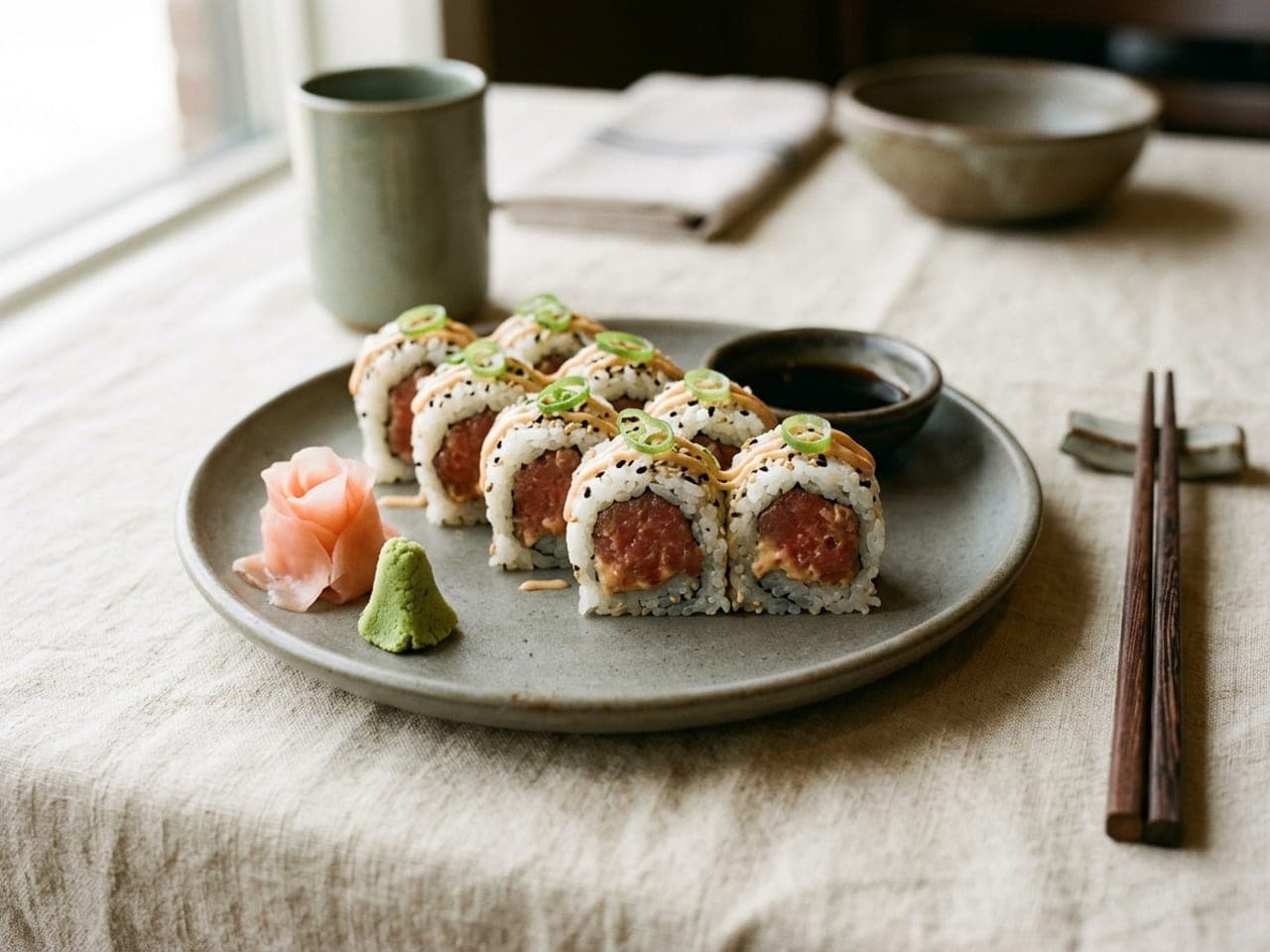
The roll that made sushi American: chopped raw tuna bound in chili-warmed mayonnaise, rolled inside-out in seasoned rice. Born in 1980s Los Angeles from the scraps sushi bars could not sell, it asks for exactly two skills — buying tuna honestly and rolling patiently — and this page teaches both, then turns the same bowl of filling into temaki cones, nigiri and a dragon roll.
Ingredients
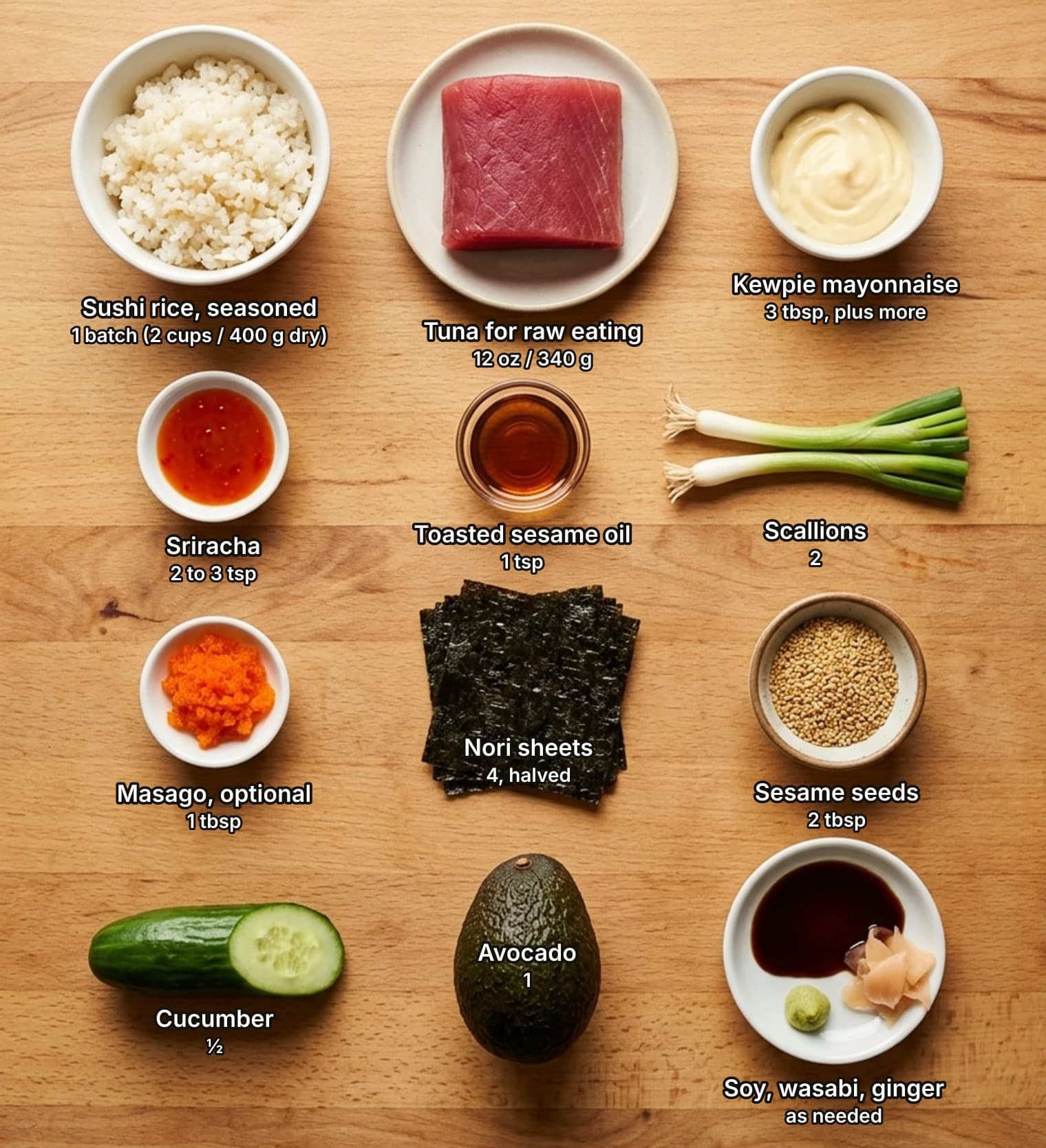
- seasoned sushi rice (see the sushi rice page)1 batch (2 cups / 400 g dry)
- tuna for raw eating (yellowfin saku block or fishmonger centre cut)12 oz / 340 g
- Kewpie mayonnaise (or Hellmann's + pinch of sugar + drop of rice vinegar)3 tbsp, plus more to drizzle
- sriracha2–3 tsp, to taste
- toasted sesame oil1 tsp
- scallions (spring onions), thinly sliced2
- masago or tobiko (optional, for pop)1 tbsp
- nori sheets, halved crosswise4
- toasted sesame seeds2 tbsp
- cucumber, in thin batons (for temaki and the dragon roll)½
- ripe avocado, sliced paper-thin (dragon roll)1
- soy sauce, wasabi and pickled ginger, to serveas needed
An American roll with a Japanese spine
The spicy tuna roll is a Los Angeles invention of the early 1980s, and like most origin stories in food, the details blur the closer you look — several South Bay sushi bars have a claim, and nobody was writing it down. What is documented is the logic: sushi chefs trimming expensive tuna were left with scraps and scrapings too good to bin, and a spoonful of chili-warmed sauce turned offcuts into the most ordered roll in America. It is the same thrift that gave Japan negitoro — fatty tuna scraped off the bone with a spoon, chopped with scallion — which is this roll’s respectable older cousin.
The original versions leaned on chili oil and ground chilies; the sriracha-and-mayo filling that now defines the roll came later, as Kewpie and the rooster bottle colonized American sushi bars. We make no apology for using them — the roll is American, the way the california roll next door is American, and pretending otherwise serves nobody. What we do insist on is the Japanese spine underneath: properly seasoned rice, honest fish, a tight roll, and restraint with the sauce. The chili is a frame around the tuna, not a disguise over it.
One American habit worth refusing: the pre-made spicy tuna mix some counters sell, ground fine as pâté and dyed courage-red. It exists because grinding hides age. Chop a piece of tuna you would eat plain, dress it yourself, and the roll tastes like fish that met chili five minutes ago — which is the entire dish.
How to make Spicy tuna roll
- Cook the rice first, because the rice is the recipe. Make one batch of seasoned sushi rice — 2 cups (400 g) dry short-grain rice, cooked, dressed with the vinegar seasoning and cooled to just-warm under a damp towel. Our sushi rice page below walks every step, including the fan trick and why the rice must never see the fridge. Nothing else in this recipe matters if the rice is gluey or cold-hardened, so give it the twenty minutes it asks for.
- Buy the tuna like it is the main event, because it is. You need 12 oz (340 g) of tuna sold for eating raw — a saku block of yellowfin from a fishmonger or the freezer of an Asian grocer is the reliable buy (the shopping section below explains why frozen is not a downgrade). It should be deep red to ruby, translucent, and smell of nothing. Keep it on ice in the fridge until the minute you cut it.
- Chop, never process. With your sharpest knife, cut the tuna into strips, then crosswise into a fine dice, then run the knife through the pile a few times until it is a coarse, glossy mince — distinct pieces, not a paste. A food processor turns tuna to pink putty in two pulses; the whole pleasure of the roll is small slick cubes that still eat like fish. Chill the bowl while you work.
- Season the tuna, then taste it. Fold the tuna with 3 tbsp of Kewpie mayonnaise, 2–3 tsp of sriracha, 1 tsp of toasted sesame oil, and two thin-sliced scallions. Taste with a piece of cucumber or a spoon of rice: it should lead with tuna and finish with warmth, not open with chili. Tighten with more sriracha only after the first roll — heat compounds across eight pieces in a way one taste does not predict. A spoonful of masago folded in now adds the pop the best bars use.
- Set up an inside-out station. Wrap your bamboo mat tightly in plastic wrap (cling film) — spicy tuna rolls are uramaki, rice on the outside, and an unwrapped mat will keep half your rice. Halve 4 nori sheets crosswise. Set out the rice, the filling, a small bowl of water with a splash of rice vinegar for your fingers (tezu), and a scatter plate of toasted sesame seeds.
- Spread thin, then flip. Lay a half sheet of nori shiny-side down, wet your fingertips, and spread about ¾ cup (150 g) of rice edge to edge in a thin, even, see-the-nori-in-places layer — thick rice is the number-one homemade tell. Sprinkle with sesame, then flip the whole sheet rice-side down onto the wrapped mat.
- Fill, roll, tighten. Lay a finger-thick line of spicy tuna across the centre of the nori. Lift the mat edge nearest you and roll it over the filling until the near edge of rice meets the far one, then pull the mat back, tug the roll snug, and finish rolling. Squeeze gently along the length — a tight tube, not a crushed one. Rest it seam-down for a minute while you roll the next.
- Cut wet, wipe often. Wipe your knife with a damp cloth, and cut each roll in half, then each half into four, wiping between cuts — rice glue is cumulative, and a dragged blade squashes the roll it took you ten minutes to build. Eight pieces per roll, cut sides up. Finish with a thin zigzag of sriracha-spiked mayo if you like the sushi-bar look.
- Or stop rolling and hand it over. The same rice, nori and filling make temaki — hand-roll cones — with zero technique: quarter-sheet of nori in your palm, a spoon of rice on the left third, a spoon of tuna, roll into a cone, eat within minutes while the nori still snaps. This is the party format, and the variations section below turns the batch into nigiri and a dragon roll too.
Safety & hygiene Important
- The freezing rule has a tuna exemption — with a catch. For most fish eaten raw, the FDA rule is freeze first: -4°F (-20°C) for 7 days, or -31°F (-35°C) for 15 hours, to destroy parasites. Tuna is the documented exception — six named Thunnus species (albacore, yellowfin, blackfin, bigeye and both bluefins) carry so little parasite risk that the FDA Food Code exempts them from the freezing requirement; skipjack and yellowtail are not on that list. Two catches: the exemption is a US rule — EU law has no tuna carve-out, which is one more reason frozen-at-sea saku is simply how Europe buys it — and it assumes tuna handled for raw consumption. Buy from a counter that sells fish for sushi and says so out loud — not the generic steak destined for the grill.
- Tuna’s real hazard is histamine, and the freezer does not fix it. Scombroid poisoning — flushing, headache, hives within the hour — comes from histamine that forms when tuna sits above 40°F (4°C), and once formed it survives cooking and freezing alike. The defence is an unbroken cold chain: buy last, carry it home cold, keep it on ice in the fridge, chop it chilled, and serve the dish the day you make it. If a piece of tuna smells sharp or peppery, it is not an ingredient anymore. And treat the board and knife as raw-fish-only until washed — board, blade and hands all meet soap before they meet the rice.
- Cooked rice has its own clock. Seasoned sushi rice holds at cool room temperature under a damp towel for up to about 4 hours — the vinegar dressing is what buys the time (unvinegared rice gets the standard 2) — and refrigerating it ruins it. What it does not do is hold overnight: cooked rice left warm too long is the classic Bacillus cereus vehicle, and reheating does not undo that. Make the rice the day you roll, hold it hours not days, and let leftovers go.
- Who should skip this roll. Pregnant women, young children, the elderly and the immunocompromised are advised to skip raw fish entirely — the standard list, and spicy mayo does not change it. For that table, the same filling method works beautifully with cooked shrimp chopped and dressed the same way, or make our california roll, which is cooked-ingredient sushi by design.
3 ways to plate it
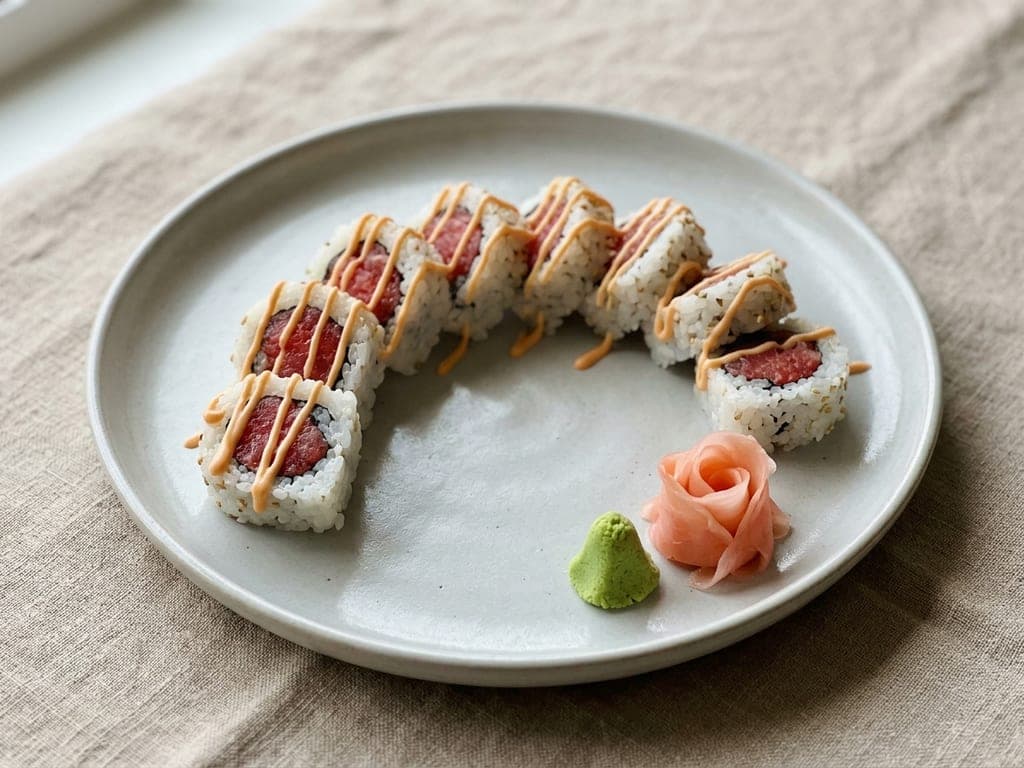
- Cut with a wet, wiped blade so every piece stands the same height — matched pieces are the single loudest professional signal on the plate.
- Arrange the eight pieces in a gentle arc with even gaps, cut sides up; a straight soldier-row reads takeaway, an arc reads counter.
- Drizzle the spicy mayo across the whole arc in one continuous zigzag — hesitation shows; practice the pass once over the empty board.
- Set pickled ginger in one loose rose and the wasabi beside it at the arc’s end — condiments grouped, never scattered, and the plate stays calm.
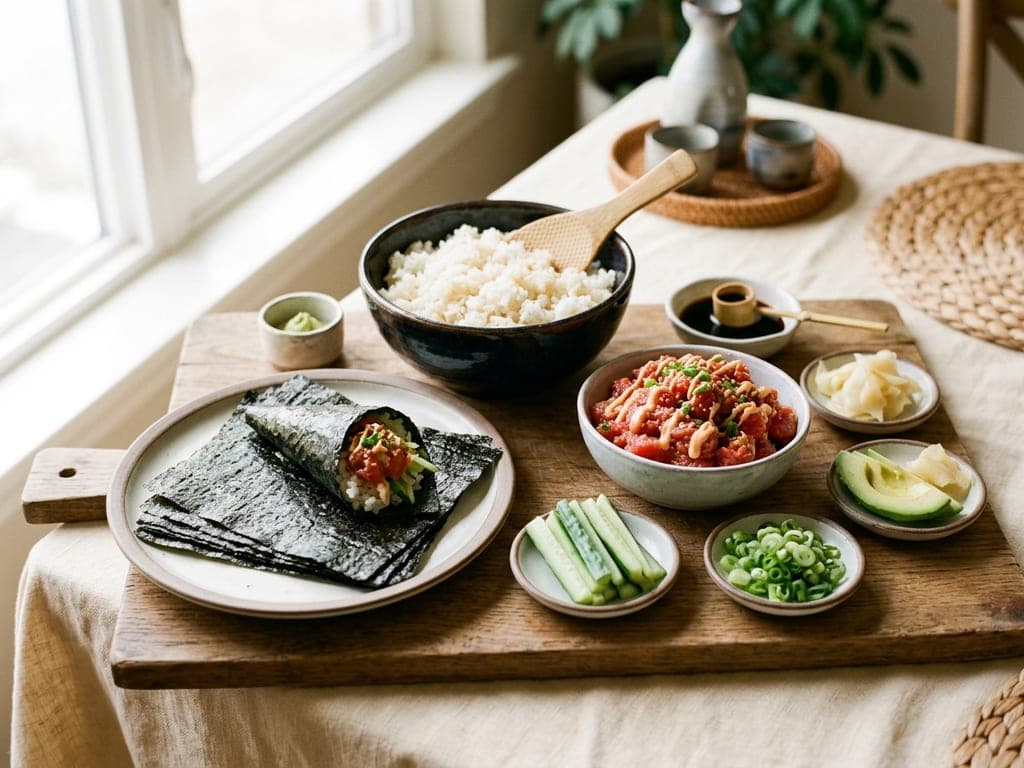
- Arrange components in the order hands will use them — nori stack, rice, filling, extras — a station, not a scatter; the layout teaches the technique.
- Keep the nori bone-dry: on its own dry board or plate, never touching a wet bowl rim, and put out half now, half when the first stack softens.
- Mound the spicy tuna high in a small chilled bowl and re-smooth the surface once — a full, tidy bowl reads generous where a wide shallow smear reads sparse.
- Add one demonstration cone, half-rolled, resting on the nori stack — nobody asks how, everybody copies it.
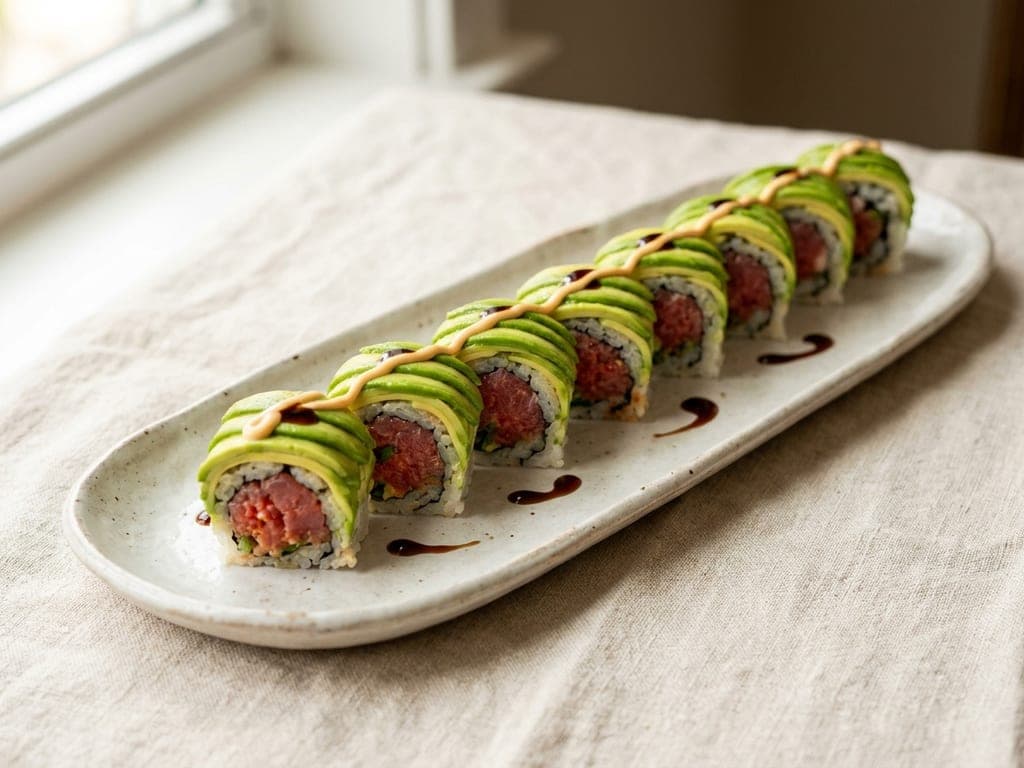
- Slice the avocado paper-thin with a wet knife and fan it along the roll’s spine before pressing — overlaps should be even as roof tiles; the press through plastic wrap does the smoothing.
- Cut through the plastic wrap and peel it away after cutting — it holds the scales in place through the blade’s pass; this is the step that separates shingles from salad.
- Lay the pieces in one line on a long plate, each piece nudged a finger’s width from the next, so the pattern reads as one dragon rather than eight rounds.
- Glaze restraint: a thin mayo drizzle and three or four drops of dark soy or unagi sauce pulled into commas with the bottle tip — the avocado is the decoration; the sauce just points at it.
Buying tuna without a sushi bar’s connections
The tuna at the heart of this roll is easier to buy well than the internet suggests. The reliable object is the saku block — a trimmed, rectangular loin portion, usually yellowfin, frozen at sea and sold in the freezer case of any decent Asian grocer and increasingly at fishmongers. Frozen-at-sea is not the consolation prize: it is often fresher in every way that matters than a “fresh” loin that spent five days in a display case, and it thaws overnight in the fridge into exactly the deep, clean-tasting red you want. In Europe, where EU rules already require freezing for fish served raw, the frozen route is simply how it is done.
At a fresh counter, the question is not “is this sushi-grade” — that phrase has no legal meaning anywhere — but “do you sell this for eating raw?” A fishmonger who answers directly, cuts you a centre piece and mentions how it was handled is worth loyalty. Two flags to walk away from: tuna in an unnaturally vivid watermelon-pink (carbon-monoxide treatment fixes the colour of tired fish, and is banned in the EU precisely because it hides age), and any counter where the answer to the raw question is a shrug.
Species-wise, yellowfin (ahi) is the workhorse — lean, firm, clean; bigeye is a fattier upgrade (and the species FDA/EPA mercury advice tells pregnant eaters and young children to avoid outright — yellowfin is the safer default); albacore is paler and softer but honest. Skip bluefin here: its price buys marbling this filling would only bury in mayonnaise.
The filling, calibrated
Texture first: the tuna should be a coarse, knife-cut mince — small slick cubes that hold their edges, not a purée. Cut strips, then dice, then a few passes of the knife, stopping while you can still count pieces. The knife matters less than the restraint; the food processor is disqualified on principle. Cold matters too — chill the bowl, work quickly, and the filling stays glossy instead of weeping.
The sauce is three ingredients doing separate jobs. Kewpie mayonnaise — richer and rounder than Western jars, sold in the squeeze bottle at any Asian grocer (Hellmann’s plus a pinch of sugar and a drop of rice vinegar is the accepted understudy) — carries the fat that makes lean tuna eat like toro. Sriracha brings heat with a garlic-sugar edge; start at two teaspoons and remember that heat reads louder across a whole roll than in a single taste. Toasted sesame oil is the smallest and loudest bottle: one teaspoon perfumes the batch, two takes it over. Scallions freshen; a spoonful of masago (capelin roe, freezer aisle, Asian grocer) adds the quiet crunch that makes people ask what is different about yours.
Purists can chase the pre-sriracha original: swap the sriracha for ½ tsp of Japanese chili oil (rāyu) and a pinch of ichimi or Korean chili flakes. Sharper, less sweet, very 1984.
One bowl of filling, four shapes
The roll is only the beginning of what this filling does, and the other three shapes are how the same ingredients serve different evenings. Temaki — hand rolls — are the weeknight and party format: a quarter sheet of nori flat in the palm, rice on the left third, a generous spoon of spicy tuna, optionally a few cucumber batons, rolled into a loose cone and eaten standing up within two minutes, while the nori still cracks. No mat, no cutting, no skill, and a table of guests assembling their own is the cheapest dinner theatre there is. The one rule: assemble at the last second — nori and wet rice are enemies on any timeline longer than five minutes.
Nigiri is the same fish taken seriously: instead of chopping the whole block, slice the best centre portion against the grain into ¼-inch (6 mm) slabs the size of two fingers. Wet your hands, press a walnut of seasoned rice into a gentle oval — squeeze until it just holds, no further — smear the faintest streak of wasabi on the fish, and lay it over the rice with two fingers. A dab of the spicy mayo and a scallion ring on top turns classic nigiri into the spicy-tuna version honestly. Rice at body temperature, fish cool: that contrast is what you are paying for at the counter, and it is free at home.
The dragon roll is the show-off finish, and it is assembly, not new technique: make an inside-out roll exactly as in the method — spicy tuna and cucumber batons in the centre — then shingle very thin avocado slices over the top of the whole roll, lay plastic wrap over, and press gently with the mat so the avocado wraps the roll in overlapping green scales. Cut through the plastic, peel it away, and finish with spicy mayo and a few drops of soy or unagi sauce. Classic dragon rolls put tempura shrimp or eel in the middle; the spicy-tuna version is the one this batch was already holding.
Questions, answered
What is spicy tuna made of?
Chopped raw tuna folded with mayonnaise (Kewpie by preference), sriracha, a little toasted sesame oil and sliced scallion — plus, at good counters, masago for pop. The original 1980s Los Angeles versions used chili oil and ground chilies rather than sriracha; both are on this page. What it should never be is a smooth ground paste — that texture is how tired fish hides.
Is the tuna in a spicy tuna roll raw?
Yes — the chili and mayonnaise season it, they do not cure or cook it. Nothing on this page changes the fish; it goes in raw and comes out raw, which is why the buying advice and the cold chain matter more than any step of the rolling.
Can I use canned tuna?
Not for this roll — canned tuna is fully cooked and shreds dry, and the dish becomes a tuna-salad roll wearing sushi’s clothes. If raw fish is off the table, the honest alternatives are chopped cooked shrimp dressed with the same spicy mayo, or the california roll, which was designed around cooked ingredients from the start.
What does “sushi-grade” tuna actually mean?
Legally, nothing — no regulator in the US or EU defines the term. The meaningful questions are whether the fish was handled and sold for raw consumption, and (for most species) whether it was frozen to the parasite-destruction schedule. Tuna is the special case: the FDA exempts the major commercial tuna species from the freezing rule because their parasite risk is low — but buy it from someone who sells it for raw eating on purpose.
Do I need a bamboo mat?
It helps, but a clean kitchen towel inside a large zip bag, or a sheet of parchment, rolls a respectable uramaki. Better answer: make temaki instead — the hand-roll cones in the variations section need no equipment at all and use the identical rice and filling. The mat is for the day you want eight identical pieces in an arc.
How do I make a spicy tuna roll less (or more) spicy?
The mayo is the volume knob: more Kewpie mellows the same sriracha, and starting at 2 tsp of sriracha per 12 oz (340 g) of tuna keeps the fish in front. Going hotter, add sriracha a teaspoon at a time or bring in a pinch of ichimi chili flakes; going milder, halve the sriracha and let the sesame oil and scallion do the talking. Taste on rice, not off a spoon — rice absorbs more heat than you expect.
What is the difference between a spicy tuna roll and a dragon roll?
Shape and wardrobe. A spicy tuna roll is an inside-out roll with the tuna filling and a mayo drizzle. A dragon roll is any inside-out roll dressed on the OUTSIDE with shingled avocado pressed into overlapping scales — classically around tempura shrimp or eel, here around the same spicy tuna. Same rice, same rolling, five extra minutes of avocado.
Can I make spicy tuna rolls ahead of time?
The components, yes; the rolls, no. Rice can hold up to about 4 hours at room temperature under a damp towel (the vinegar buys the time), the filling can be mixed a few hours ahead and kept very cold, and then rolls are made and eaten the same evening. Overnight, the rice hardens in the fridge, the nori goes leathery, and raw tuna leaves its safe window. Sushi is a same-day food — plan the shopping, not the leftovers.
What is spicy tuna crispy rice?
The LA restaurant classic — a Katsuya signature since the early 2000s — that became a 2020s social-media hit: pressed sushi-rice blocks fried until the outside crackles, topped with exactly this spicy tuna and a slice of jalapeño. It is this recipe wearing evening clothes — if you have the filling and the rice, pan-fry 1-inch (2.5 cm) thick rice rectangles in a film of neutral oil until deep gold on both faces, top and serve immediately.
How many calories in a spicy tuna roll?
About 350 per serving as built here — one full roll, eight pieces — with the rice carrying most of it and the mayonnaise the rest; the tuna itself is among the leanest proteins on the counter. A restaurant roll with heavy sauce runs higher; temaki with the same ingredients run a little lower because the cone holds less rice.
Snap your finished plate and let the AI plate it again — more beautifully.