Onigiri Recipe (Japanese Rice Balls, 3 Classic Fillings)
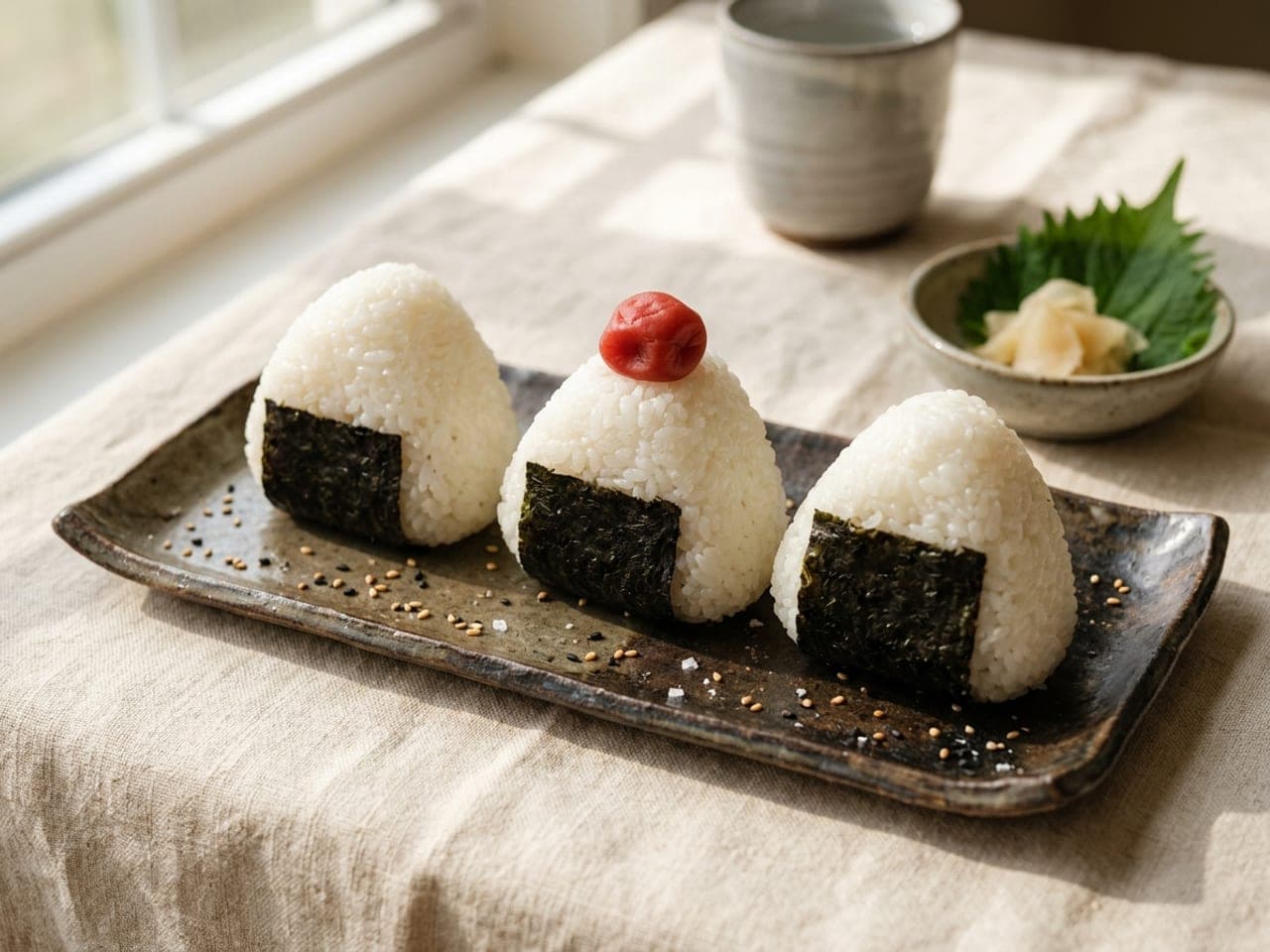
Japan’s original packed lunch: warm short-grain rice pressed into plump triangles with salted wet hands, a spoonful of filling hidden in the center, a crisp band of nori added at the last minute. No vinegar, no rolling mat, no raw fish — just rice, salt and the press-and-rotate move this page teaches. Makes 9; tuna-mayo, salted salmon and umeboshi fillings included.
Ingredients
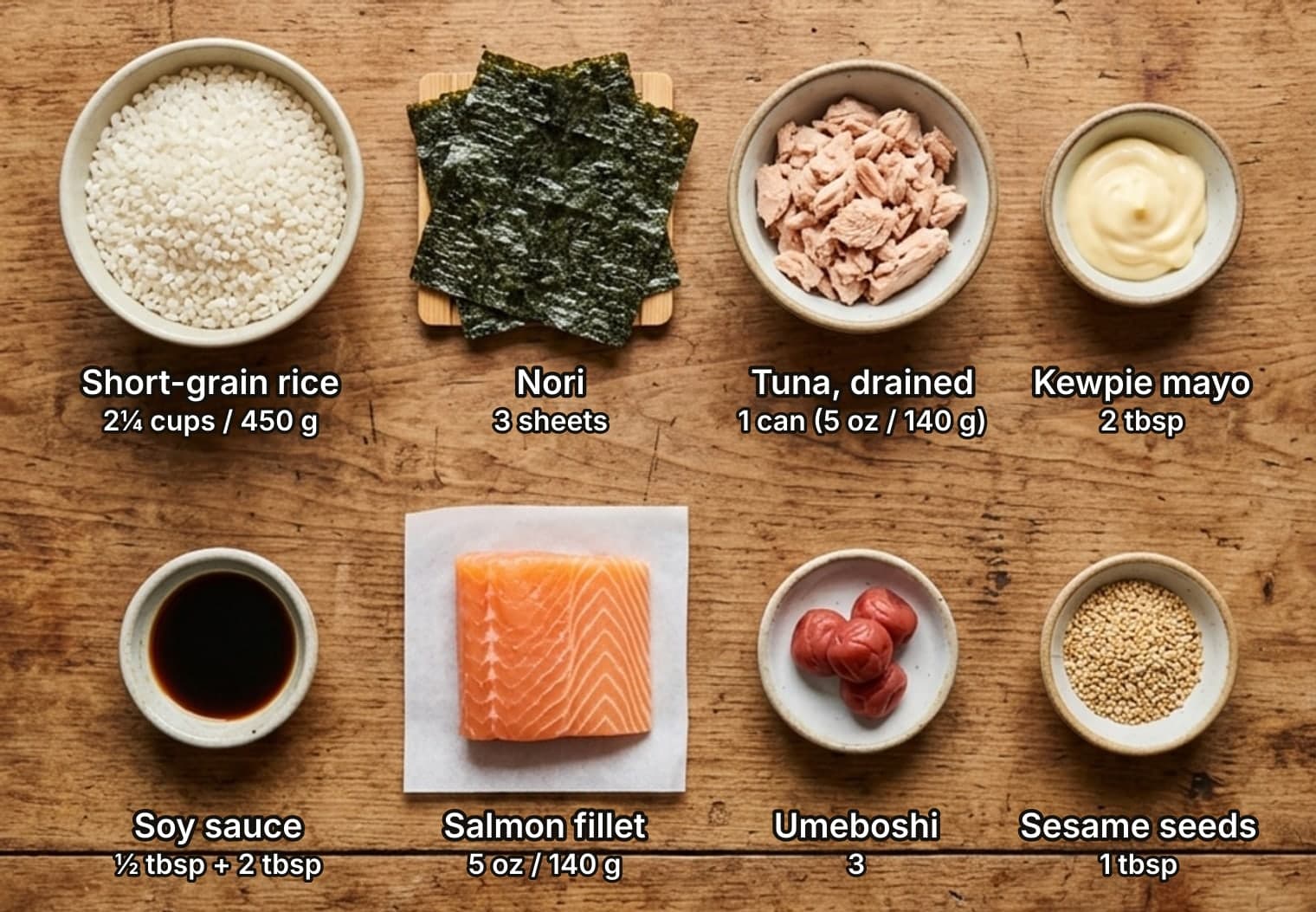
- Japanese short-grain rice (sold as “sushi rice” — used PLAIN here)2¼ cups / 450 g
- water, for cooking2½ cups / 600 ml
- fine or kosher (coarse) salt, for your palmsabout 1 tsp
- nori, cut into wide strips3 sheets
- canned tuna, drained hard (filling 1)1 can (5 oz / 140 g)
- Kewpie or good mayonnaise (filling 1)2 tbsp
- soy sauce (filling 1)½ tbsp
- salmon fillet (filling 2)5 oz / 140 g
- fine salt, for curing the salmon (filling 2)1 tsp
- umeboshi (salted pickled plums), pitted (filling 3)3
- toasted sesame seeds, to serve1 tbsp
- soy sauce, for the yaki-onigiri glaze (optional)2 tbsp
Onigiri rice is not sushi rice
Here is the confusion half the internet trips on: onigiri and sushi start from the same bag of Japanese short-grain rice — the one labeled “sushi rice” in European supermarkets — but sushi rice is that grain seasoned with vinegar, sugar and salt, while onigiri rice is the same grain left completely plain, seasoned only by the salt on your palms and the filling at the center. Buy the bag; skip the vinegar. If a recipe tells you to season onigiri rice with sushi vinegar or a base of furikake, it is teaching you a different dish.
The rice is also cooked a shade wetter than sushi rice — about 1:1.1 rice to water instead of sushi’s strict 1:1 — because there is no vinegar coming to loosen it later, and a slightly softer grain presses into a triangle that holds without force. Plain, warm, faintly salted rice is the entire canvas: it’s why onigiri live or die on rice quality, and why the filling can be as humble as one pickled plum.
How to make Onigiri
- Cook the rice plain — this is not sushi rice. Rinse 2¼ cups (450 g) of Japanese short-grain rice until the water runs nearly clear, soak it in its cooking water for 20–30 minutes, then cook with 2½ cups (600 ml) of water — a touch more than the 1:1 sushi ratio. And that is the whole seasoning story: onigiri rice stays plain. No vinegar, no sugar. Same grain as our sushi rice below, opposite treatment — the sections explain why the difference matters.
- Make the tuna-mayo filling. Drain a 5 oz (140 g) can of tuna hard, then mix with 2 tbsp of Kewpie or good mayonnaise and ½ tbsp of soy sauce. This is Japan’s best-selling convenience-store filling for a reason, and every ingredient is already in a European supermarket. The mix makes more than three onigiri need; the surplus is tomorrow’s sandwich.
- Make the salted salmon. Salt a 5 oz (140 g) salmon fillet on both sides with about 1 tsp of fine salt, rest it 10 minutes (overnight in the fridge is even better), pat dry, and bake at 425°F (220°C) for 10–12 minutes until it flakes and has lost its translucence at the center. Flake it with a fork, discarding skin and any stray bones. Salty is correct here — each flake seasons a fistful of plain rice.
- Pit the umeboshi. Tear 3 umeboshi (Japanese salted pickled plums) open and remove the stones. One plum per onigiri, tucked whole into the center — the puckering salt-sour against plain rice is the oldest filling there is, and its preserving saltiness is why it earned the job.
- Set up your station. You need three things within reach: a bowl of cold water for your hands, a small dish of fine or kosher (coarse) salt, and the warm rice. Work while the rice is hot enough to be just handleable — hot rice is tacky and fuses into a shape that holds; cooled rice crumbles. Wet hands are what keep it from sticking to you.
- Wet, salt, scoop. Dip both hands in the water, shake off the excess, and rub a generous pinch of salt across both palms (halve it if using fine table salt). Scoop about 100 g of rice — a scant handful, around ⅔ cup — into your cupped hand, press a dent into the center with a thumb, and drop in 1–2 tsp of filling. Fold the rice over to bury it.
- Press and rotate. Cup your non-dominant hand into a V — that’s the triangle’s bottom two corners — and roof your dominant hand over the top to form the third. Press gently, rotate the ball a third of a turn, press again, rotate, press: three corners in three moves, then once more around. Firm enough to hold, gentle enough that the rice stays airy — over-squeezed onigiri turn dense and crack. Flatten the two faces last.
- The plastic-wrap shortcut. For a beginner-proof (and lunchbox-hygienic) version: lay plastic wrap (cling film) in a small bowl, sprinkle it with salt, add rice, dent, fill, cover with more rice, then gather the wrap and twist. Shape the triangle through the film — no hot fingers, no bare-hand contact, and it’s already wrapped for the road.
- Nori at the last minute. Wrap a strip of nori around the base of each triangle just before eating — against warm rice it softens in minutes, which is exactly why convenience-store onigiri come with that clever pull-tab wrapper keeping the seaweed in its own compartment. Packing a lunch? Carry the nori strips separately and wrap at your desk. Crisp nori against tender rice is the whole textural point.
- Or grill them: yaki-onigiri. Skip the filling and nori, press plain triangles, and pan-grill them in a lightly oiled skillet over medium heat until both faces turn golden and crusty, brushing with soy sauce (about 2 tbsp) in the last minutes so it caramelizes into a glossy, toasted shell. Yaki-onigiri also freeze beautifully — the make-ahead answer this dish otherwise refuses to give.
Safety & hygiene Important
- The rice clock applies here too. Cooked rice can carry Bacillus cereus spores whose toxins survive reheating, so time at room temperature is the real hazard: eat onigiri within about 6 hours of shaping when they’re wrapped and kept cool — a lunchbox with a cold pack — within 4 hours on an open counter, and inside 2 hours in a warm room. The salt on your palms seasons and helps at the margins — it is not a preservation system.
- Shape through plastic for packed lunches. Onigiri made for eating hours later should be shaped through plastic wrap rather than with bare hands — hands carry Staphylococcus even when clean, and a lunchbox is a warm incubator. It’s the one food-safety habit Japanese lunch culture treats as non-negotiable.
- Check the salmon is cooked through. Bake the salted salmon until it flakes and is opaque to the center — 145°F (63°C) at the thickest point if you use a thermometer. Fully cooked, well-salted salmon is the traditional filling precisely because it keeps; this is not the place for a rosy medium fillet.
- Reheat once, and only the grilled kind. Refrigerated or frozen yaki-onigiri reheat well — once, until steaming hot. Fresh filled onigiri are a make-and-eat food: if one has sat out past its window, the bin is cheaper than the alternative.
3 ways to plate it
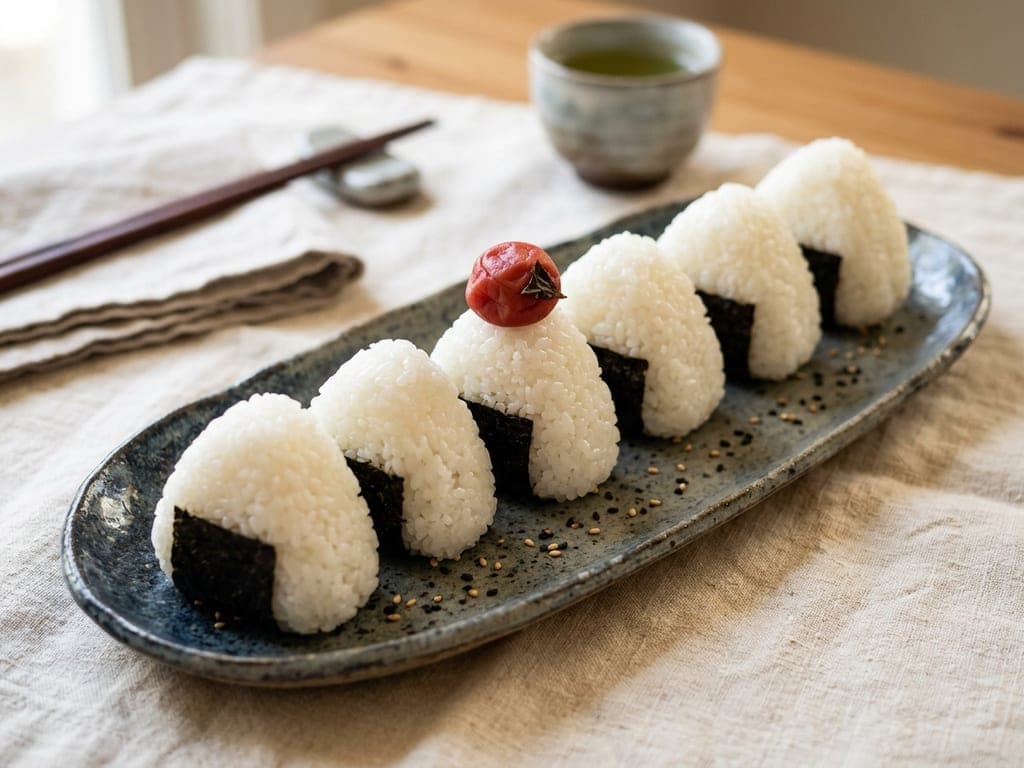
- Choose a long, narrow plate or board and set the onigiri in one leaning row, shoulder to shoulder, nori bands facing forward.
- Let them touch and lean — the shoulder-to-shoulder row reads generous, and the repetition is the design.
- Top a single onigiri with one whole umeboshi and leave the rest bare — one red dot carries the entire composition.
- Scatter black sesame and two pinches of flaky salt on the plate around them, then stop; plain rice rewards restraint.
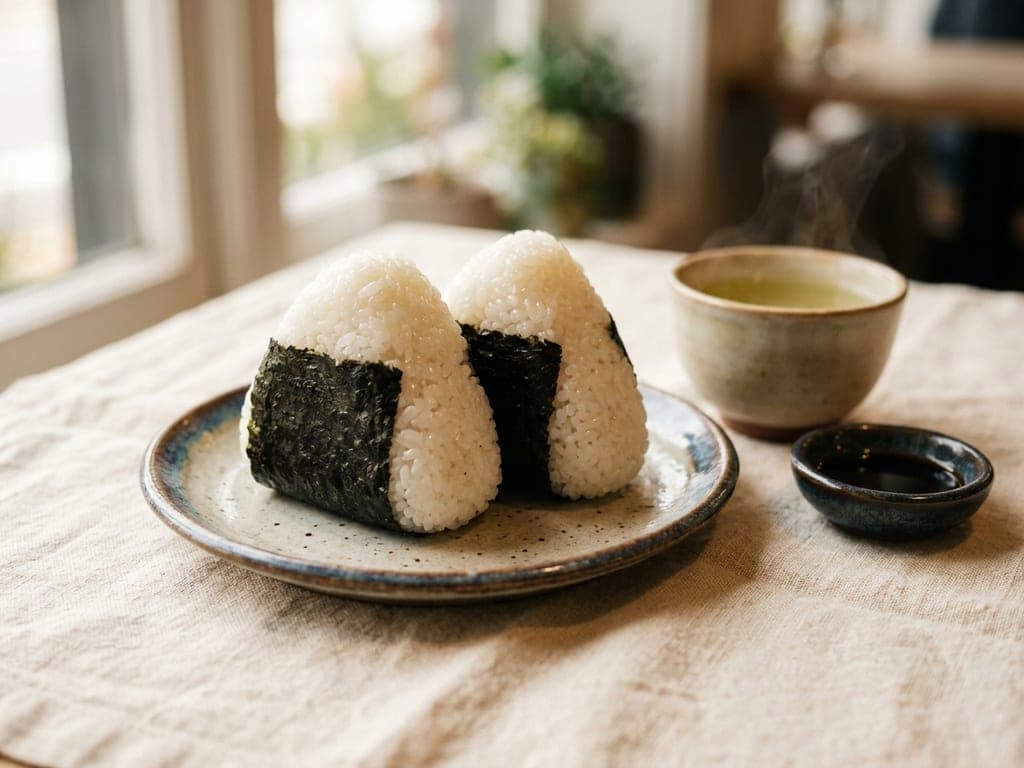
- Lean two onigiri against each other at a slight angle, nori bases down — the pairing reads generous where one reads lonely.
- Pour the tea just before serving so it steams next to the rice; the wisp is the plate’s only movement.
- Set a tiny dish of soy at the plate’s edge for dipping corners — a saucer of it, not a pour.
- Serve on linen or a wooden tray rather than bare table: the humble ingredients earn one layer of ceremony.
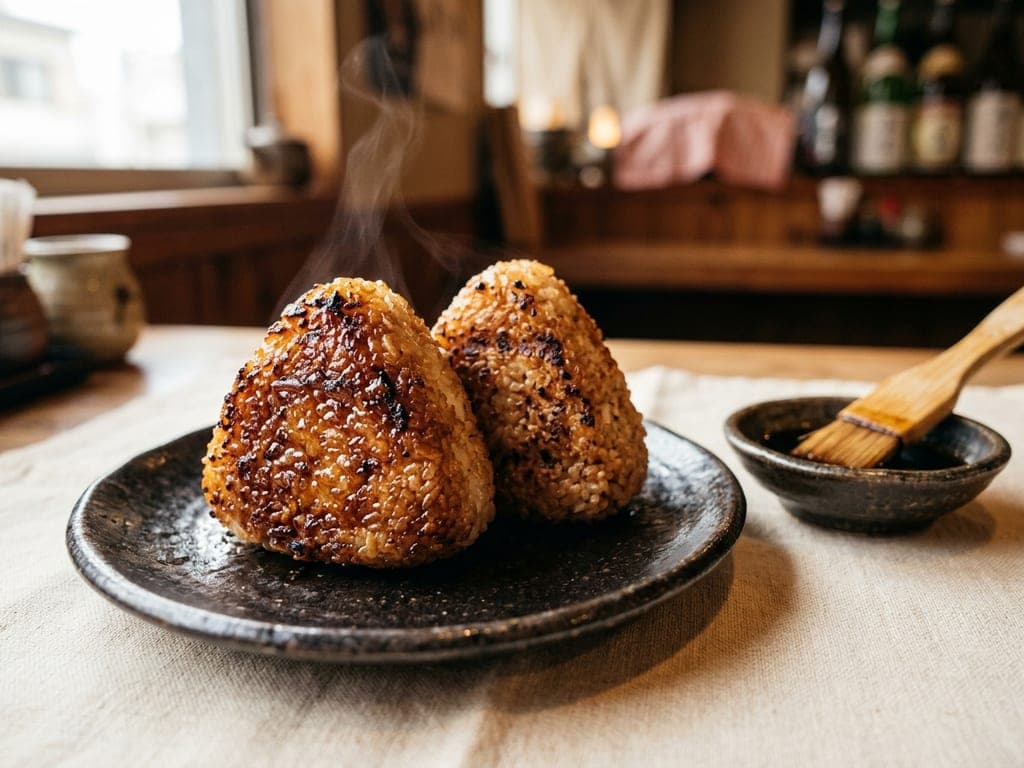
- Grill until both faces are properly bronzed — pale yaki-onigiri photograph and eat like disappointment; the crust is the dish.
- Brush a final coat of soy glaze at the table so it’s still glossy and fragrant when served.
- Plate on the darkest dish you have, faces angled toward the eater to show the lacquered crust.
- Set the brush and its little dish of glaze beside the plate — the implied ritual of one more coat is part of the appetite.
From samurai rations to the konbini shelf
Onigiri is one of Japan’s oldest foods. Rice balls called tonjiki were handed to the guards and lower-ranking attendants at Heian-court banquets over a thousand years ago, and pressed, salted rice — sometimes with a preserving umeboshi at its heart — provisioned samurai armies through the Sengoku era. The name comes from nigiru, “to clasp”: food defined by the grip that makes it (omusubi, the other name you’ll hear, is the same food by regional habit). Wrapping onigiri in nori is the newer flourish: sheet nori spread through Edo from around 1700, once Asakusa fishermen borrowed papermaking to press seaweed into sheets.
The modern chapter belongs to the convenience store. In the late 1970s, Japanese konbini engineers solved onigiri’s one flaw — nori that sogs against warm rice — with the pull-tab wrapper that seals the seaweed in its own film compartment until the moment of eating; Seven-Eleven Japan popularized it, and the format turned onigiri into arguably Japan’s default lunch, sold in the billions every year. The dish is having its moment abroad too: specialty onigiri shops have multiplied across Tokyo (the storied Onigiri Bongo queue is measured in hours), and dedicated onigiri counters now trade from New York to Paris. Your kitchen version needs no patent — just the same respect for crisp nori, added last.
Hot rice, gentle hands
The two physical facts that decide whether onigiri hold together: temperature and pressure. Fresh-cooked rice is coated in gelatinized, tacky starch — press it warm and the grains fuse at their contact points into a shape that survives a lunchbox. Let it cool and that surface starch begins retrograding — recrystallizing and shedding water — so the grains stop bonding and the triangle crumbles in your hands. That’s why the shaping window is “hot but handleable,” why wet hands matter (water keeps the tack pointed at the rice, not your skin), and why cold leftover rice needs a steam back to life before it will shape at all.
Pressure is the other half: three or four firm-gentle presses, rotating between them, then stop. The goal is a triangle that holds its corners while staying airy enough to bite through — over-squeezing compacts the rice into something dense that cracks along pressure lines and eats like a puck. And the same retrogradation science explains the storage rule: the refrigerator is where onigiri go hard (recrystallization runs fastest at fridge temperature), so same-day onigiri wait at cool room temperature, wrapped, while the freezer — which skips that temperature zone — is the only long-term home, ideally for the grilled kind.
Fillings, and finding it all in Europe
The classic filling canon: umeboshi (the original), salted salmon, okaka (bonito flakes moistened with soy), tuna-mayo (the konbini era’s champion), kombu simmered sweet-salty, and spicy cod roe. The rule underneath them all: fillings are salty, concentrated things that season plain rice from the inside — not sauces, which leak, and not anything watery. Leftover teriyaki chicken, chopped fine, is a thoroughly respectable modern entry.
European sourcing is easier than it looks. The rice is any supermarket bag labeled “sushi rice” (avoid paella and pudding rice — the former is bred not to stick, the latter cooks to mush). Nori sheets are in the world-food aisle; cut full sheets into thirds for wrapping bands. Tinned tuna and mayonnaise you own already — that single filling makes this whole recipe supermarket-complete. Umeboshi and bonito flakes are the Asian-grocer trip (or an online order), worth making once for the real thing. Furikake to scatter over the finished plate follows the same route, or improvise with toasted sesame, crumbled nori and salt.
Questions, answered
Can I use leftover cold rice for onigiri?
Not straight from the fridge — cooled rice has retrograded (its starch recrystallized), so it won’t bind and the triangles crumble. The fix: steam it or microwave it with a splash of water under a damp paper towel until hot and tender again, then shape while warm. Freshly cooked rice is still the gold standard.
What is the difference between onigiri rice and sushi rice?
Same grain, opposite seasoning. Both use Japanese short-grain rice (sold as “sushi rice” in Europe); sushi rice is seasoned with vinegar, sugar and salt after cooking, while onigiri rice stays completely plain — only the salt on your wet palms and the filling season it. Onigiri rice is also cooked slightly softer (about 1:1.1 rice to water against sushi’s 1:1).
Can I make onigiri the night before?
They’re best shaped the same day, because the fridge hardens rice. If you must: shape them through plastic wrap, then wrap the bundle in a thick kitchen towel before refrigerating — the towel keeps them at the cool-but-not-cold edge of the fridge’s range — and pack the nori separately. Better still, freeze yaki-onigiri ahead and reheat; the grilled kind takes storage gracefully.
Why won’t my onigiri hold together?
Almost always one of four things: the wrong rice (long-grain jasmine or basmati won’t bind — you need short-grain), rice that cooled before shaping (press it hot), too little pressure, or so much pressure the ball compacted and cracked. Wet salted hands, hot rice, three gentle press-and-rotate moves — that combination holds.
How much rice per onigiri?
About 100 g of cooked rice — a scant handful, roughly ⅔ cup — plus 1–2 tsp of filling. This recipe’s 2¼ cups (450 g) of dry rice cooks up to around 9–10 onigiri; as a rule of thumb, every 1 cup (200 g) of dry short-grain rice yields 4 of them.
What fillings go in onigiri?
The classics: umeboshi (salted pickled plum), salted salmon, tuna-mayo, okaka (soy-moistened bonito flakes), simmered kombu and spicy cod roe. The underlying rule: salty and concentrated, never wet — the filling’s job is to season plain rice from the center out. Finely chopped leftover teriyaki chicken is a respectable modern addition.
Do you eat onigiri hot or cold?
At room temperature or gently warm — that’s when the rice is tender and the nori still snaps. Fridge-cold onigiri are hard and dull (cold is what stales rice fastest); the exception is yaki-onigiri, eaten hot off the grill with its soy crust crackling.
Is onigiri gluten-free?
The rice, salt, nori and umeboshi are naturally gluten-free — the tripwire is soy sauce, which contains wheat and hides in the tuna-mayo, okaka and yaki-onigiri glaze. Swap in tamari and check your furikake’s label, and the whole lineup is gluten-free.
Is onigiri healthy?
It’s an honest lunch: mostly rice carbohydrate for steady energy, modest fat (unless the mayo is generous), and portable portion control built in — a filled onigiri runs roughly 230–260 calories (nearer 200 for a lean umeboshi one). The number to watch is sodium, which arrives via the salted palms, the filling and the soy; balance the meal with something green, as every bento does.
What is yaki-onigiri?
Grilled onigiri: plain, unfilled triangles pan-grilled or charcoal-grilled until crusty, brushed with soy sauce that caramelizes into a toasted glaze — no nori needed. It’s also the practical variant: yaki-onigiri freeze and reheat beautifully, which fresh filled onigiri never quite forgive.
Snap your finished plate and let the AI plate it again — more beautifully.