California Roll Recipe (Inside-Out, No Raw Fish)
The roll that taught the West to eat sushi: seasoned rice on the outside, nori hidden within, surimi, avocado and cucumber at the center, toasted sesame all over. Everything in it is fully cooked or fresh produce — no raw fish anywhere — which makes it the right first roll to ever come off your mat. Makes 8 rolls / 64 pieces; contested origin story included.
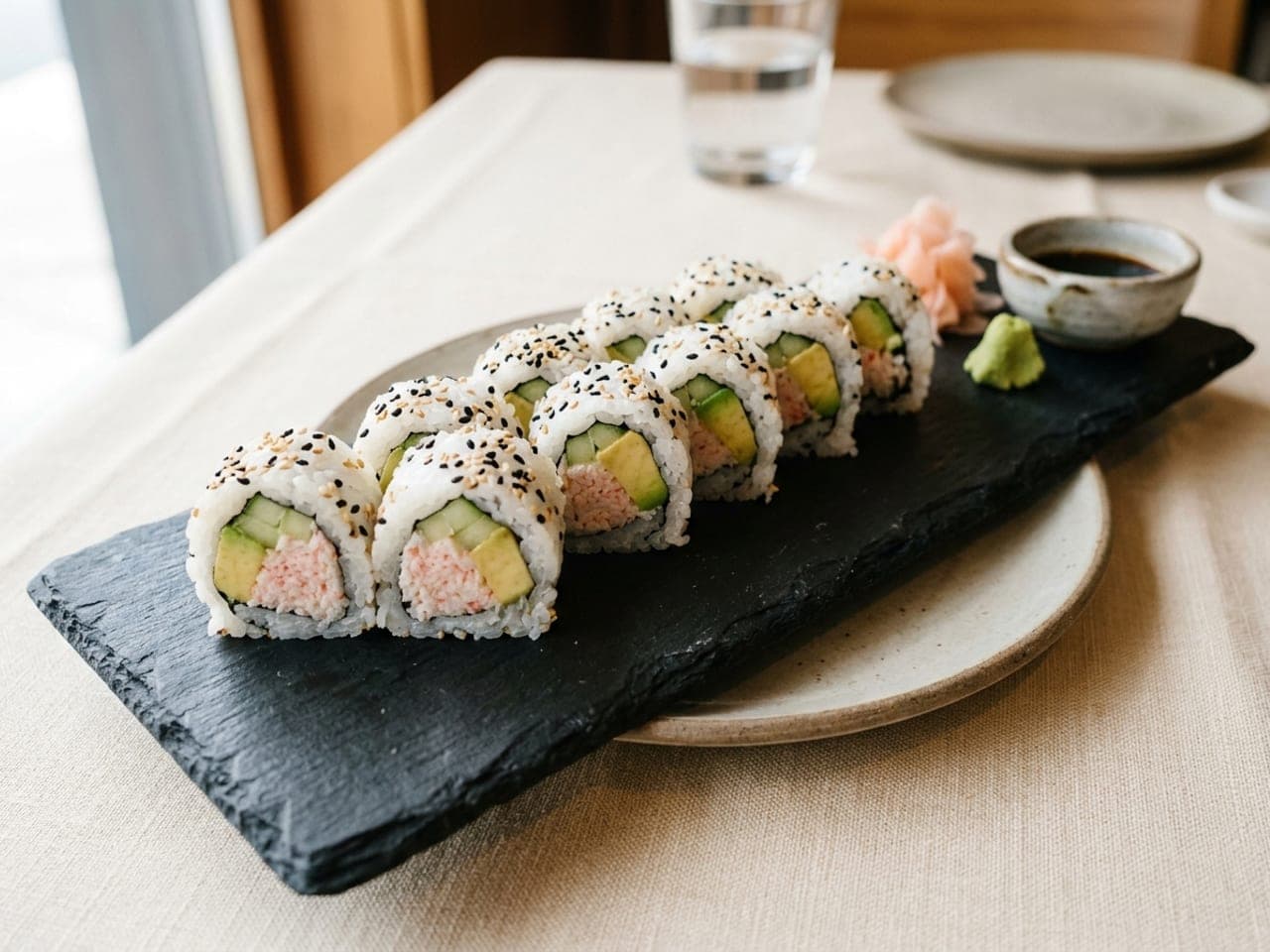
Ingredients
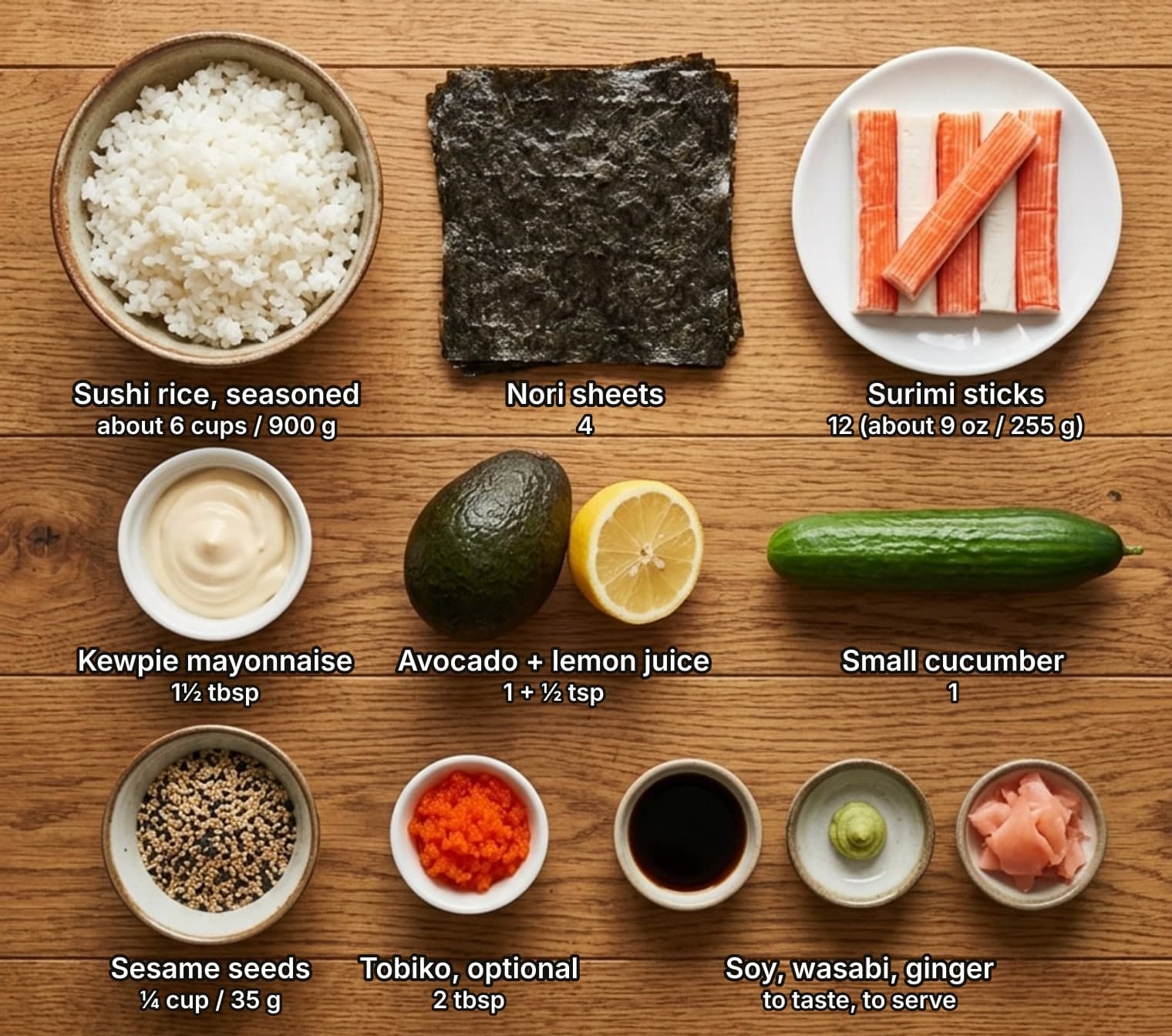
- seasoned sushi rice (our linked recipe, from 2 cups / 400 g dry rice)about 6 cups / 900 g
- nori sheets, halved crosswise4
- surimi sticks (seafood sticks / imitation crab)12 (about 9 oz / 255 g)
- Kewpie mayonnaise (or mayo + a splash of rice vinegar), for the crab mix1½ tbsp
- avocado, ripe but firm1
- lemon juice, for the avocado½ tsp
- small cucumber, seeded, in long thin strips1
- toasted white and black sesame seeds, for the exterior¼ cup / 35 g
- tobiko or masago (optional upgrade)2 tbsp
- soy sauce, wasabi and pickled ginger, to serveto taste
Who invented the California roll?
Three kitchens claim this roll, and honest adjudication beats a tidy story. Claim one: Los Angeles. Food historians’ books most often credit chef Ichiro Mashita of Tokyo Kaikan in Little Tokyo, who in the late 1960s and early ’70s began substituting rich avocado for fatty tuna; when American diners kept unwrapping the seaweed, the Tokyo Kaikan kitchen is also credited with flipping the roll inside out to hide the nori. Claim two: Vancouver. Chef Hidekazu Tojo, who arrived from Japan in 1971, says he created the inside-out roll in 1974 — cooked local Dungeness crab and avocado at its heart, the supporting cast varying by telling — for Western customers who wouldn’t eat visible seaweed; he called it the Tojo-maki, and says the “California roll” name arrived later, from his delighted Los Angeles customers. In 2016 Japan’s agriculture ministry named Tojo a goodwill ambassador for Japanese cuisine — an honor for his career, sometimes misreported as an official ruling on the roll’s paternity. Claim three, the paper trail: the earliest known print appearances of the name are from November 25, 1979 — in the Los Angeles Times and, the same day, a Florida newspaper — and within a month an Associated Press story credited chef Ken Seusa of the Kin Jo restaurant near Hollywood, a claim that went unquestioned for some twenty years.
Where does that leave the honest scoreboard? The documentary evidence points to Los Angeles; the best single-inventor narrative belongs to Vancouver; and the likeliest truth is that a dish this obvious-in-hindsight emerged in several West Coast kitchens serving the same nervous 1970s customers. What nobody disputes: it isn’t Japanese. The California roll traveled the other way — becoming popular enough in America by the 1980s that Japan eventually imported it back as “California maki,” the rare dish that migrated into its own parent cuisine. It’s also why you’ll find it filed under American food here — the name was telling us all along.
One practical footnote from the origin stories: Tojo’s original used real cooked crab, and surimi became the standard as the roll went mass-market. Both are legitimate; this page defaults to surimi for price and availability, and upgrades to real crab meat — or the tobiko-topped “Super California” treatment — whenever the occasion justifies it.
How to make California roll
- Make the rice first. A California roll is mostly rice, so start with our sushi rice recipe below: 2 cups (400 g) of dry short-grain rice, cooked 1:1 with water and seasoned hot with sweetened rice vinegar. You want about 6 cups (900 g) of seasoned rice, still faintly warm — cold rice tears nori and refuses the mat.
- Dress the mat. Wrap your bamboo rolling mat in plastic wrap (cling film) — front and back, leaving the ends open so air isn’t trapped — because inside-out rolls put sticky rice directly against the mat. No mat? A doubled sheet of baking parchment rolls a perfectly respectable first batch.
- Prep the fillings. Pull 12 surimi sticks (sold as seafood sticks or crab sticks in Europe) into shreds and — the Japanese-authority move — fold them with 1½ tbsp of Kewpie mayonnaise (Japanese mayo — or regular mayo with a splash of rice vinegar) into a loose salad. Halve, pit and peel a ripe-but-firm avocado and slice it into ¼-inch (6 mm) wedges; a squeeze of lemon keeps them green. Seed a small cucumber and cut it into long, pencil-thin strips.
- Rice the nori. Cut 4 nori sheets in half crosswise — a half sheet is about 10.5×19 cm (4×7½ in). Place one shiny-side down on the mat, wet your fingers, and spread a scant ¾ cup (110 g) of rice edge to edge in a thin, even layer, leaving a ¼-inch (6 mm) bare strip along the top edge. Even beats fast: a lumpy rice layer is the number-one cause of lopsided rolls.
- Sesame, then flip. Sprinkle the rice generously with toasted sesame seeds (add a spoon of tobiko here too if you’ve found it), press them in lightly with your palm, then flip the whole sheet over in one confident motion — rice now facing the mat, bare nori facing you, the empty strip furthest away.
- Lay the filling line. Across the center of the nori, build one tidy horizontal line: the crab salad first, then avocado wedges staggered so their thin ends overlap into a continuous ribbon, then two cucumber strips. Less is structural: an overstuffed roll bursts its seam on the mat, every time.
- Roll with tension. Lift the mat’s near edge with your thumbs while your fingers hold the filling in place, and roll forward until the near rice edge meets the far one. Then the move that separates tidy rolls from loose ones: grip the roll through the mat and gently pull the mat’s far edge away from you while squeezing — that opposing tension is what tightens the spiral. Press the mat’s edge along the roll to seat the bare nori strip as the seam.
- Shape and rest. Still in the mat, press lightly along the top with your index fingers and against the sides with thumbs and middle fingers, working down the length — the goal is a gently squared cylinder that slices into pieces that sit rather than roll. Set each finished roll seam-down and let it rest 2–3 minutes; the rice fuses and the seam locks. Repeat for all 8 rolls, re-wetting your hands between each.
- Slice with a wet knife. Wipe your sharpest knife with a damp cloth, then cut each roll in half with one long pulling stroke — no sawing. Line the halves up and cut each into 4, wetting and wiping the blade between every cut; a dry blade drags rice and smears the spiral. You’ll have 8 pieces per roll, 64 in all. Re-form any piece that slumped with a gentle pinch of the mat.
- Serve properly. Arrange cut-side up with soy sauce, a dab of wasabi and a mound of pickled ginger — ginger is the palate reset between pieces, not a topping. Eat within the hour if you can: this roll is at its absolute best while the nori inside still has snap and the rice sits at body temperature. A bowl of miso soup makes it dinner.
Safety & hygiene Important
- Nothing here is raw. The California roll contains no raw fish: surimi is fully cooked and pasteurized at the factory, and everything else is produce. That’s exactly why it’s the right roll for beginners, pregnant guests avoiding raw seafood, and anyone nervous at a sushi table. Keep surimi refrigerated and use an opened pack within about 5 days. One nuance: the optional tobiko upgrade is cured roe, not cooked — skip it when serving anyone avoiding raw seafood.
- The rice clock still runs. The perishable part of this dish is the seasoned rice: it holds safely at cool room temperature for about 4 hours (its vinegar acidity is the traditional control), so count your rolling session and the meal inside that window. Assembled rolls sitting out all evening are the thing to avoid.
- A sharp wet knife is the safe knife. Sushi slicing accidents come from dull, dry blades dragging through a resistant roll and slipping. A properly sharp knife, wiped wet between cuts, glides with almost no downward force — sharper is genuinely safer here, and the cut faces look better for it.
- Same-day food, honestly. California rolls don’t keep: refrigeration hardens the rice, the avocado browns and the nori sogs. Wrap uncut rolls in plastic for a few hours at cool room temperature at most, and skip the freezer entirely. Make the batch you’ll eat — 64 pieces have a way of disappearing.
3 ways to plate it
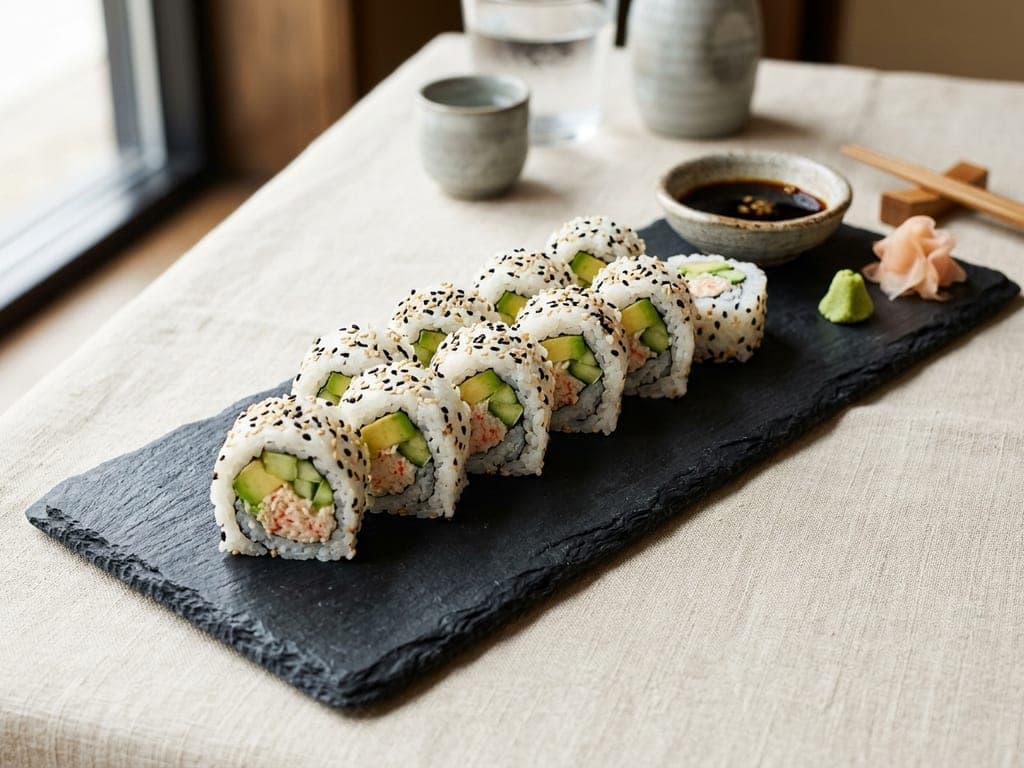
- Wipe each piece’s base and set them cut-face up in one line down the board, edges almost touching — let the board’s long edge be your guide.
- Keep the pieces facing the same way as best your cuts allow; the repetition is what reads professional.
- Cluster ginger, wasabi and the soy dish together at one end of the board, not scattered around the pieces.
- Serve with the board’s line running toward the diner — the perspective makes eight pieces look like a procession.
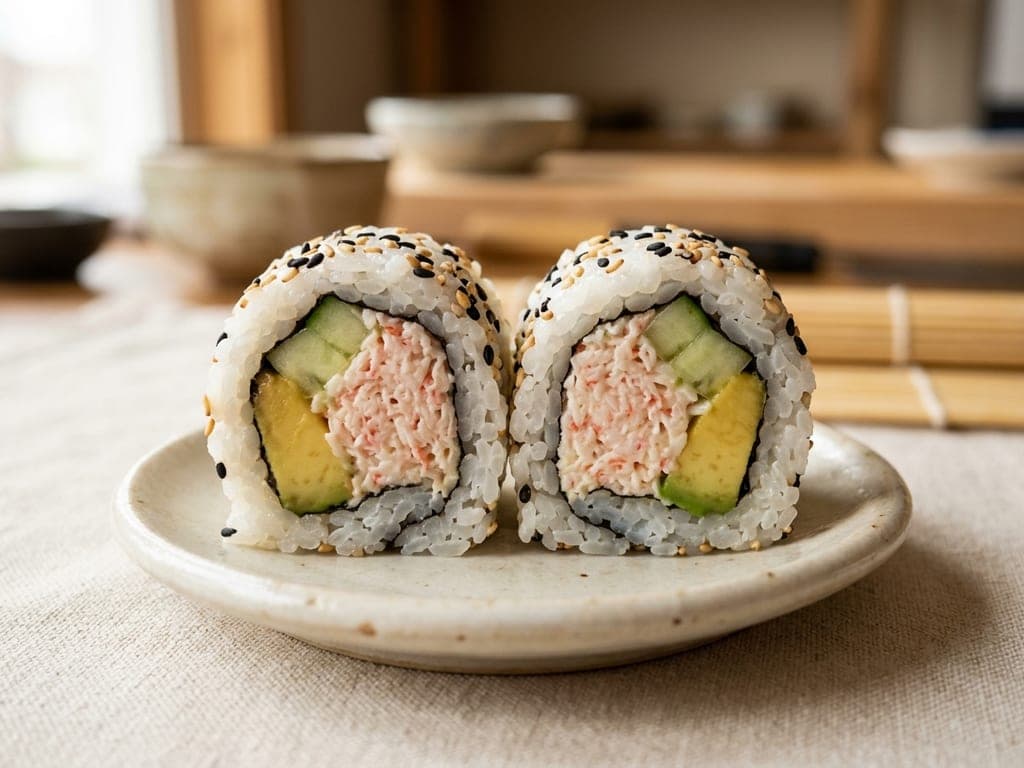
- Pick the two cleanest-cut center pieces of the batch — this plating forgives nothing, which is its charm.
- Stand them side by side, cut faces toward the diner, almost touching, centered on a small pale plate.
- Add nothing else on the plate; condiments live in their own dishes beside it.
- Serve immediately after slicing, while the cut faces are still glossy — this one is a first-30-seconds plate.
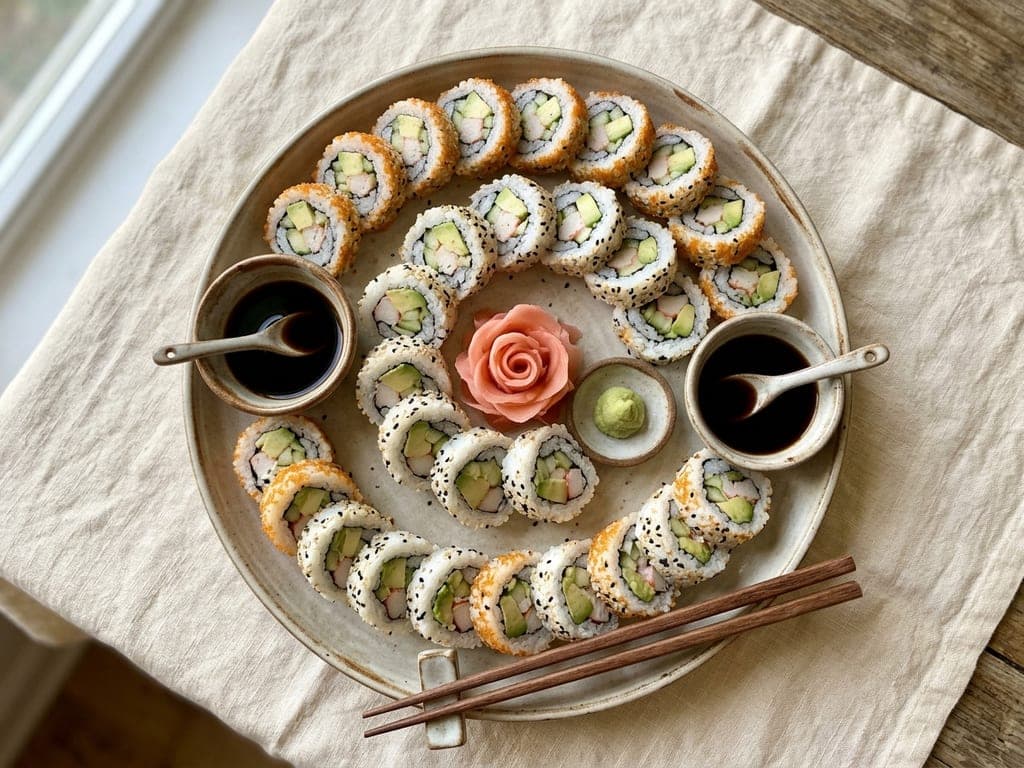
- Coat half the rolls in sesame and half in tobiko (or paprika-toasted sesame for the budget version) before slicing, so the platter has two alternating textures.
- Start from the platter’s center: shape the pickled ginger into a loose rose, dab the wasabi beside it, then coil the pieces outward cut-face up, alternating the two finishes.
- Coil outward keeping the spacing even, tucking stray pieces into the outer ring.
- Set two or more small soy bowls at opposite rims, so nobody reaches across the spiral.
The inside-out logic
Uramaki — the inside-out roll — was customer psychology before it was technique: 1970s Western diners found a wrapper of black seaweed alarming, so the seaweed went inside and friendly white rice went out. The engineering consequences are exactly the things this recipe has you do: the mat gets a plastic-wrap jacket because rice would otherwise weld to the bamboo, the exterior gets rolled in toasted sesame (or tobiko) because bare rice looks unfinished, and the nori — now interior — still does the structural work of holding the spiral.
The inside-out format is also more forgiving than the traditional kind, which is the quiet reason it’s the right first roll: small rice-layer sins hide on the inside of the spiral, and the exterior coating covers the rest. Master this one and the classic nori-out hosomaki is a downhill walk.
The spec sheet
The numbers that make rolls consistent, collected in one place: a scant ¾ cup (110 g) of seasoned rice per half-sheet roll; the half sheet itself 10.5×19 cm (about 4×7½ in), laid shiny-side down; a ¼-inch (6 mm) bare nori strip at the far edge for the seam; 1½ surimi sticks (about 1 oz / 30 g) per roll; avocado in ¼-inch (6 mm) wedges, staggered; 8 pieces per roll, cut half-then-quarters with a wet blade.
Two rules do most of the quality control. Rice layer: thin and even, to the edges, and stop — the impulse to add more rice is how bloated, bursting rolls happen. Tension: rolls tighten from the opposing pull of mat and roll, not from squeezing harder; if your pieces unravel, the fix is the pull-away move in the rolling step, not more force.
European shopping notes
Everything in this roll now lives in mainstream European supermarkets. Surimi is chilled-aisle standard — labeled seafood sticks or ocean sticks in the UK (the word “crab” quietly left the packaging, since there was never crab meat in them) and simply surimi on the continent. Nori, sushi rice, rice vinegar and even bamboo mats sit in the world-food aisle of the big chains; Asian grocers remain the value play for nori in quantity and for Kewpie.
The one genuinely hard-to-source item is tobiko (flying-fish roe) — specialty online shops carry it, and masago is the cheaper stand-in — but here’s the liberating truth: a sesame-only exterior is completely standard, used by most recipes and plenty of sushi bars. Nobody’s roll is lesser for lacking orange eggs. One allergy note for European labels: surimi is made from white fish bound with wheat starch and egg white, so it isn’t gluten-free by default — worth knowing before you promise the batch to a coeliac friend.
Questions, answered
Is a California roll raw fish?
No — there is no raw fish in a California roll. Surimi is fully cooked at the factory, and the rest is avocado, cucumber, rice and seaweed. That’s why it’s the standard first roll for sushi beginners and the safe pick for anyone avoiding raw seafood.
What is in a traditional California roll?
Seasoned sushi rice on the outside, nori inside, filled with crab (surimi or real cooked crab), avocado and cucumber, with toasted sesame — or flying-fish roe — on the exterior. Many Japanese-trained cooks bind the crab with a spoon of Kewpie mayonnaise; the very first versions in the 1970s used real cooked crab.
Real crab or imitation crab?
Both are legitimate. Surimi (cooked Alaska pollock, shaped and seasoned) is what most sushi bars use and what keeps the roll affordable; real cooked crab meat is the upgrade — and is actually what Vancouver’s Hidekazu Tojo used in his 1970s original. Choose by budget and occasion, not by guilt.
How many calories in a California roll?
Roughly 250–300 calories per 8-piece roll as made here — mostly from the rice — with the mayo and avocado moving it up or down. Published numbers vary widely because roll sizes do; ours is the standard 110 g-of-rice half-sheet roll.
Can I make a California roll without a bamboo mat?
Yes — a doubled sheet of baking parchment (or a clean tea towel under plastic wrap) gives enough structure to roll and tighten. The mat makes the squared shaping easier, and supermarket versions cost a few pounds or euros, but no equipment gap should stand between you and a first roll tonight.
Why does my California roll fall apart?
Four usual suspects: too much rice (thin and even wins), overstuffing the center line, rolling without tension (the tighten comes from pulling the mat’s far edge away while gripping the roll), or slicing with a dry, dull knife that drags the spiral open. Fix those in that order.
What is a Super California roll?
Menus vary, but it usually means the upgraded roll: real crab meat instead of surimi, often crowned or coated with tobiko, sometimes extra avocado draped on top. Make it at home by swapping in cooked crab and pressing flying-fish roe onto the exterior instead of sesame.
Can I use brown rice?
You can, with honest expectations: short-grain brown rice seasons the same way but its bran coat keeps grains from clinging, so the roll holds less confidently and eats chewier. Cook it softer than usual, press the rice layer a little firmer, and accept a rustic spiral — or blend it half-and-half with white sushi rice as the gateway version.
Can I make California rolls ahead?
A few hours at most: keep the rolls uncut, wrapped snugly in plastic, at cool room temperature, and slice just before serving. The refrigerator hardens the rice and browns the avocado, and the freezer ruins everything it touches here. This is same-day food — happily, it’s also fast food once the rice is made.
Why is the rice on the outside?
Marketing, from 1970s North America: customers kept unwrapping visible seaweed, so chefs flipped the roll to hide the nori inside — the uramaki, or inside-out roll. It stuck because it works: the format is more forgiving to roll, the sesame coat looks finished, and the structural nori still does its job out of sight.
Snap your finished plate and let the AI plate it again — more beautifully.