Miso Ramen Recipe (The Sapporo Wok Method — a Real Bowl on a Weeknight)
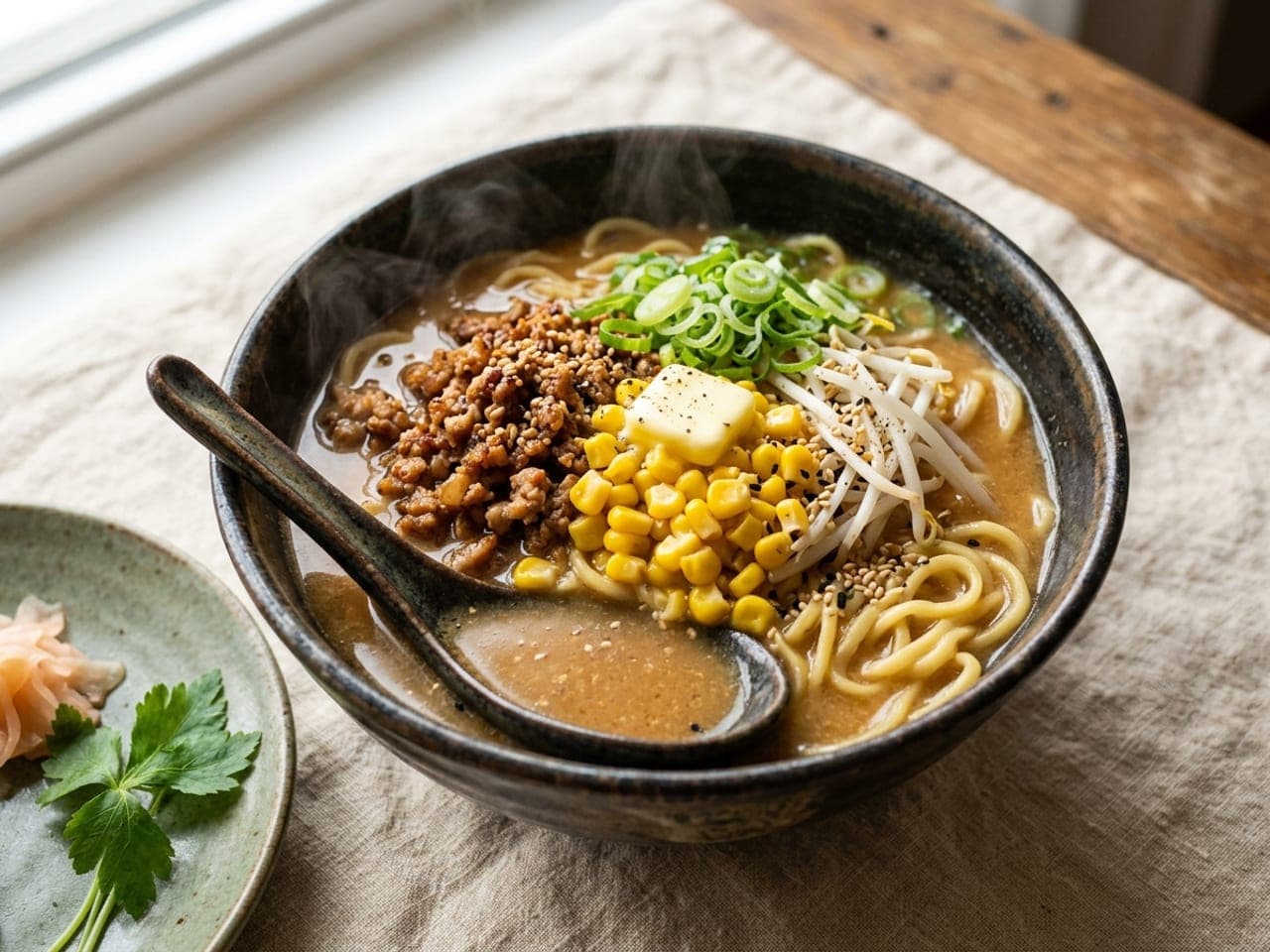
The youngest of the great ramen styles — invented in snowbound Sapporo in the 1950s — and the only one you can honestly make well on a weeknight. The trick is not the broth, it is the order of operations: ground pork and miso tare fried hard in a wok, stock poured over the sizzle, thirty seconds of violence, done. Corn and a melting pat of butter on top, because Hokkaido grows both and winter is long.
Ingredients
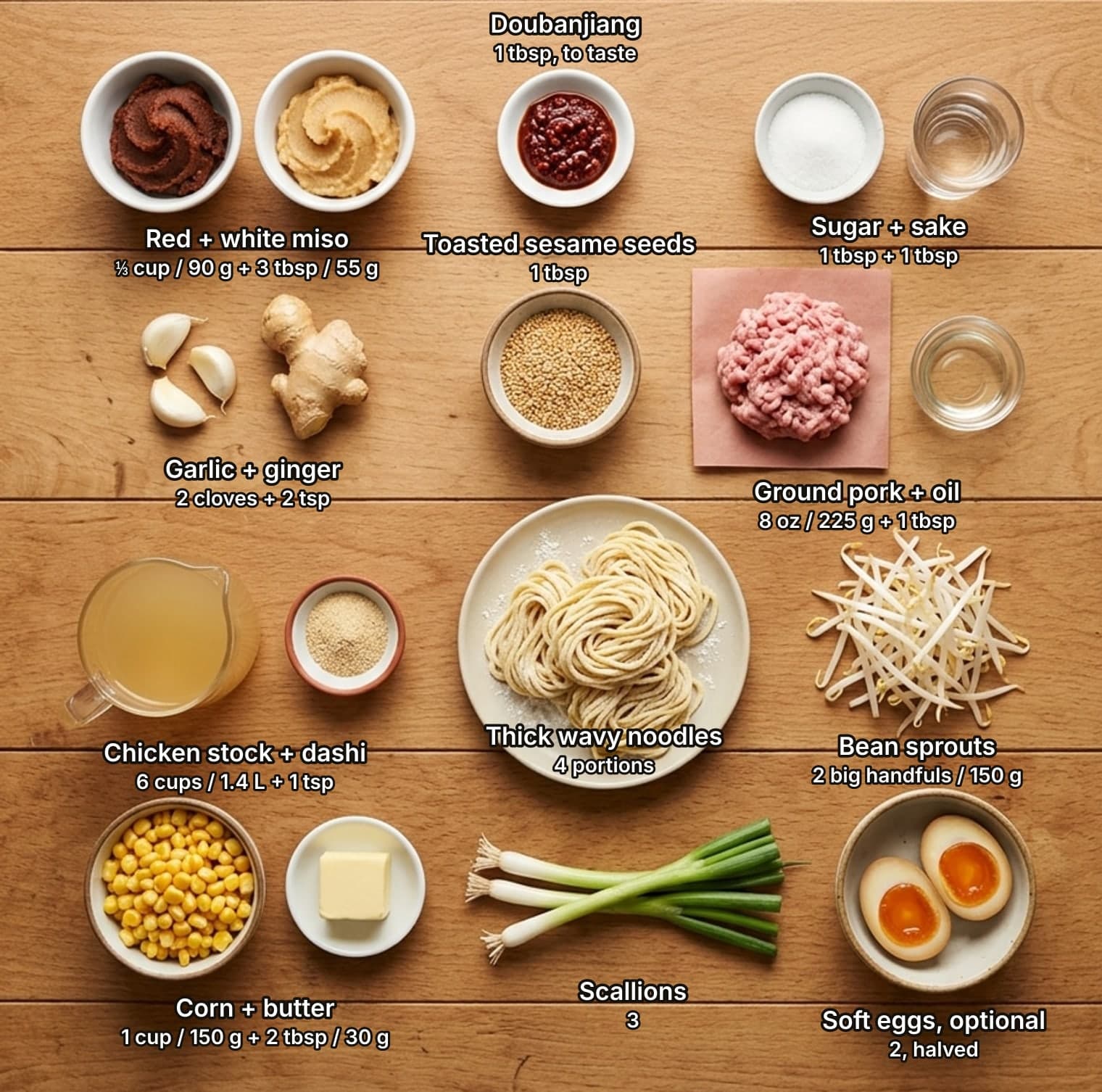
- red (aka) miso⅓ cup / 90 g
- white (shiro) miso3 tbsp / 55 g
- doubanjiang (toban-djan chili-bean paste)1 tbsp, to taste
- sugar1 tbsp
- sake1 tbsp
- garlic, grated2 cloves
- ginger, grated2 tsp
- toasted sesame seeds, rough-ground (or 2 tsp tahini)1 tbsp
- ground pork8 oz / 225 g
- neutral oil1 tbsp
- chicken stock (low-sodium)6 cups / 1.4 L
- instant dashi powder (or a 2-inch / 5 cm piece of kombu)1 tsp
- thick wavy ramen noodles4 portions
- bean sprouts2 big handfuls / 150 g
- corn kernels (frozen is fine)1 cup / 150 g
- butter, in 4 small pats2 tbsp / 30 g
- scallions (spring onions), finely sliced3
- marinated soft eggs (optional — method on the tonkotsu page)2, halved
The youngest ramen, from the coldest city
Shoyu ramen has a century of history and tonkotsu has its pre-war yatai, but miso ramen is younger than rock and roll. The origin story belongs to Sapporo, capital of Japan’s snow-buried northern island of Hokkaido, and to a cook named Morito Ōmiya at a shop called Aji no Sanpei: sometime in the mid-1950s — the tellings vary, and a customer asking for noodles in his miso-pork soup features in the most repeated one — he began building a ramen around miso rather than soy, and spent years refining it into the style that put Sapporo on the eating map. By the late 1960s the city’s Ramen Yokocho alley was a national destination and miso ramen was a boom, the first new ramen style to conquer the whole country.
Geography wrote the recipe. Hokkaido winters are brutal, and miso ramen is armour: a hotter, fattier, saltier, more insulating bowl than anything Tokyo was serving — pork fat, garlic, chili-laced bean paste, thick noodles that hold heat. And Hokkaido is Japan’s farm: the island grows much of the country’s sweetcorn and produces most of its butter and dairy, which is how a pat of butter melting over corn kernels became the style’s signature crown rather than a tourist gimmick. It is regional agriculture served as a topping, the same logic as cream in a Normandy sauce.
For the home cook the youth of the style is good news: there is no thousand-year orthodoxy to offend, and the founding move — miso fried in pork fat, thinned with whatever good stock you have — was a shop shortcut to begin with. This is the great ramen you are allowed to make on a Tuesday.
How to make Miso ramen
- Make the miso tare — five minutes, keeps two weeks. Stir together ⅓ cup (90 g) red miso, 3 tbsp (55 g) white miso, 1 tbsp doubanjiang (fermented chili-bean paste — the heat and the funk), 1 tbsp sugar, 1 tbsp sake, 2 grated garlic cloves, 2 tsp grated ginger and 1 tbsp toasted sesame seeds ground rough in a mortar (or 2 tsp tahini). It should be a thick, terracotta-coloured paste that tastes almost too intense — it is seasoning four bowls. Jarred in the fridge it keeps two weeks and also glazes eggplant, so double it.
- Line up the toppings first — the soup waits for nobody. Once the wok starts, the bowl is four minutes away, so be ready: 1 cup (150 g) corn kernels (frozen, thawed, is Hokkaido-honest), 2 big handfuls (150 g) of bean sprouts rinsed and drained hard, 3 scallions finely sliced, butter cut into 4 small pats, sesame for the top. If you are adding marinated soft eggs, they were made yesterday — the ajitama method lives on our tonkotsu page and works identically here.
- Get the stock hot in its own pot. Heat 6 cups (1.4 L) of chicken stock with 1 tsp of instant dashi powder (or a 2-inch / 5 cm square of kombu, pulled out as it reaches a bare simmer) and hold it at a low simmer with a lid on. Store-bought stock is fine and this page will not pretend otherwise — the wok stage adds the depth that boxed stock lacks. Low-sodium boxes give you room to season with the tare, which is where the salt should come from.
- Fry the pork hard — the browning is the broth’s backbone. Get a wok or your widest pot properly hot with 1 tbsp of neutral oil, and fry 8 oz (225 g) of ground pork, pressing it against the metal and leaving it alone in 30-second stretches, until it is deeply browned in spots and the fat has rendered — 3–4 minutes. Undercooked-pale pork crumble is the most common homemade miso ramen failure; the toasty edges are flavour that no amount of miso can substitute.
- Fry the tare in the pork fat. Push the pork to one side, drop the whole batch of tare into the rendered fat, and fry it, stirring, for 30–45 seconds until it darkens a shade, sticks slightly, and the kitchen smells like a Sapporo counter. This is the step the saucepan recipes skip and the reason theirs taste flat: hot fat blooms the miso and chili the way water never will. Throw in the bean sprouts and toss for 20 seconds — they should stay loud and crunchy.
- Broth over the sizzle, thirty seconds of boil. Pour the hot stock over the frying pork and tare — it will hiss and churn, which is the point — bring it to a hard boil for just 30 seconds so the fat, pork and miso emulsify into a cloudy amber soup, then cut the heat. Taste: it should be assertively seasoned, a soup that stands up to noodles. Adjust with a spoon more miso melted at the edge if it whispers. Do not let it sit boiling — miso’s aroma is volatile, and a long boil dulls what the fry just built.
- Noodles: thick, wavy, cooked while the wok finishes. Miso ramen takes the opposite noodle to tonkotsu: thick, wavy, chewy — the curls trap the gritty miso body. Boil 4 portions in plain water per the packet (usually 2–3 minutes fresh), drain hard, and divide between four scalded bowls. Chilled or frozen “Sapporo-style” noodles from an Asian grocer are the target; any thick wavy ramen noodle is close enough for a Tuesday.
- Assemble: soup, territories, and the butter goes on last. Ladle the soup with its pork over the noodles. Build the top in territories: the wok-kissed bean sprouts on one side, corn in one bright cluster, scallions opposite, sesame over everything, egg halves if they exist. The butter pat sits on the corn, where it melts into a gold slick across the surface — add it at the table, not in the kitchen, so everyone watches it go. Eat immediately, and loudly; this bowl was engineered for a Sapporo winter and it does not improve with patience.
Safety & hygiene Important
- Ground pork is a cook-it-through meat. Grinding distributes surface bacteria all the way through, so pork crumble has none of a chop’s pink privileges: cook it until fully browned with no grey-raw pockets — past 160°F (71°C), which the hard wok fry achieves with margin. The browning the recipe demands for flavour is also the doneness insurance; pale, steamed-looking crumble has failed both tests at once.
- Bean sprouts have a reputation for a reason. Raw sprouts are a recurring outbreak vehicle (their sprouting conditions are a bacterial spa), which is why this recipe sends them through the wok’s heat for their 20 seconds rather than scattering them raw. Rinse them well, buy them crisp and fresh — slimy or sour-smelling sprouts are done sprouting and starting rotting — and if you are cooking for pregnant, elderly or immunocompromised eaters, boil their sprouts a proper 1–2 minutes until limp and add them at the end instead — pathogens live inside sprout tissue, not just on it, and the raw-crisp wok toss does not reach them. The crunch is the trade that table makes.
- The soft egg keeps its usual rules. If you crown the bowl with a marinated soft-boiled egg, it is still a soft egg: kept refrigerated in its marinade, eaten within 3–4 days, never left out beyond the meal. Fully-cooked (10-minute) eggs are the right call for anyone in the vulnerable-eaters column — the marinade treats both the same.
- Miso is salt wearing a costume. Not a hazard, but an honesty note: between the miso, doubanjiang and stock, a full bowl of miso ramen is a serious sodium event — restaurant bowls routinely carry most of a day’s allowance, and this one is seasoned to that standard because that is the dish. The levers if you need them: low-sodium stock (already the default here), drinking less of the broth than you slurp of the noodles, and resisting the urge to salt anything before the tare has spoken.
3 ways to plate it
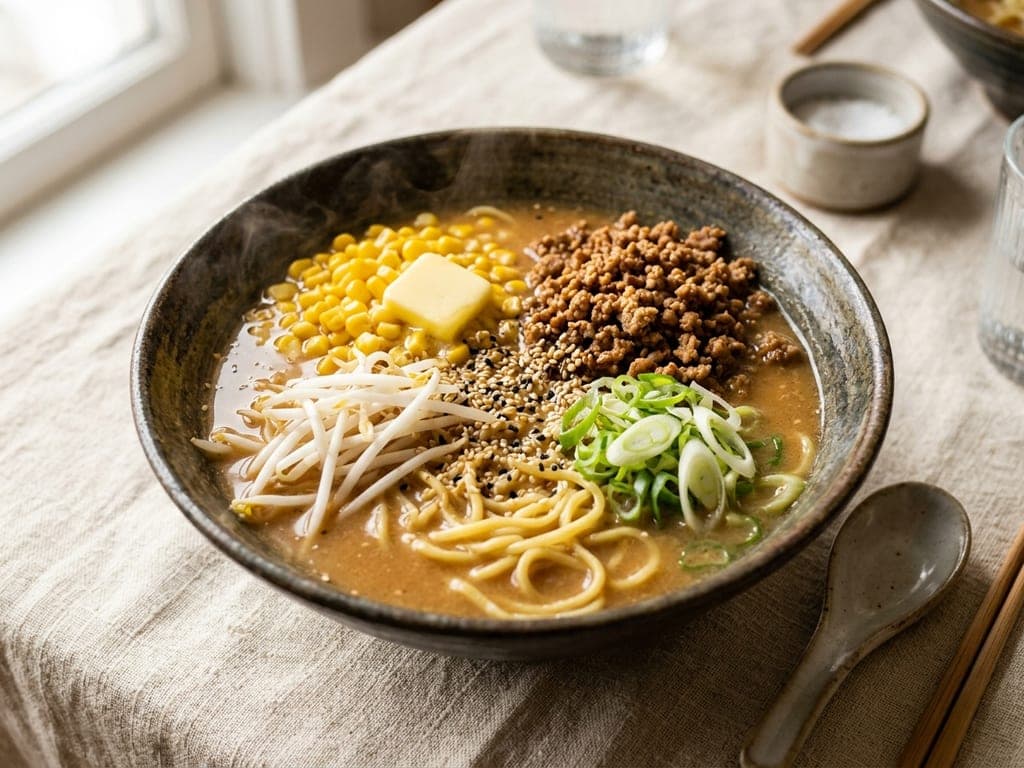
- Ladle soup first and let the surface settle a moment — the toppings sit ON the bowl, and a still amber surface is the canvas the territories need.
- Pile the corn in one tight cluster at the bowl’s edge, never sprinkled — the cluster is what makes room for the butter to have an address.
- Set the butter pat on the corn at the table, not in the kitchen: the thirty seconds of it melting outward is the style’s signature moment and it belongs to the eater.
- Keep the pork crumble mounded high at the opposite edge so the bowl reads pork-and-corn at first glance — the two proteins of the Hokkaido winter, facing each other.
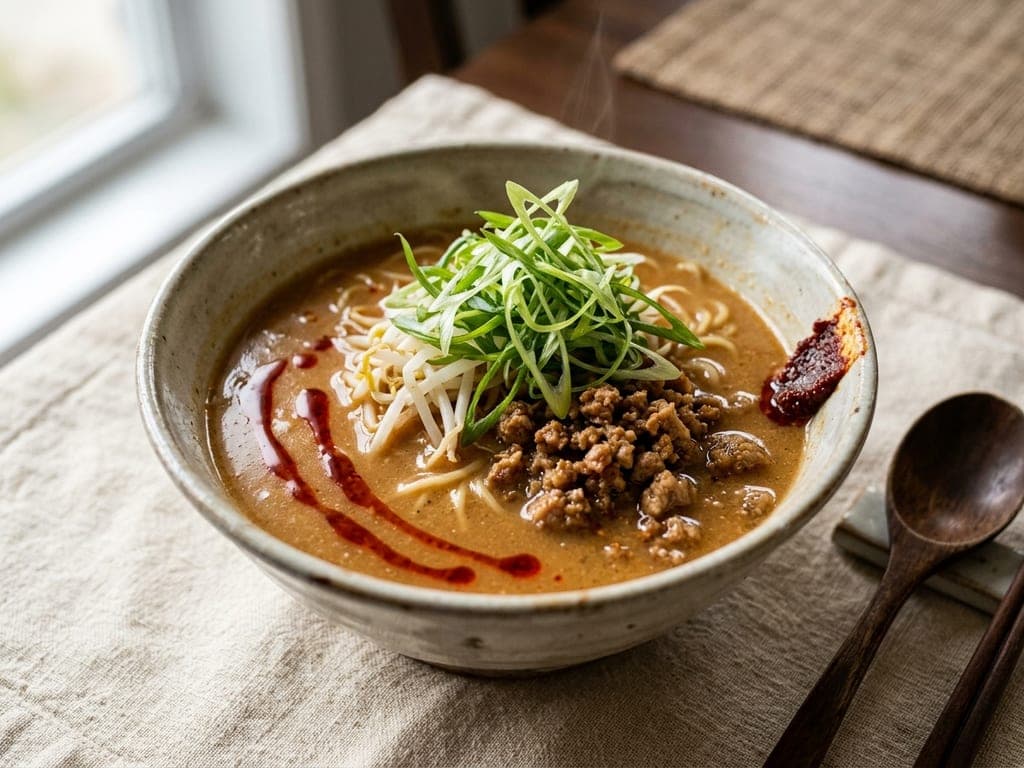
- Drag chili oil across the settled surface in three or four commas with the spoon’s tip — pulled strokes read intentional where a poured pool reads accidental.
- Smear the extra doubanjiang against the bowl’s inside wall just above the soup line, so the eater stirs the heat in themselves and the first sip is a choice.
- Double the scallions and slice them on a hard bias into long ribbons — the extra green is what keeps a red-and-amber bowl from reading as murk.
- Skip the butter here or halve it: gold slick and chili lacquer fight for the same surface, and this bowl has picked its winner.
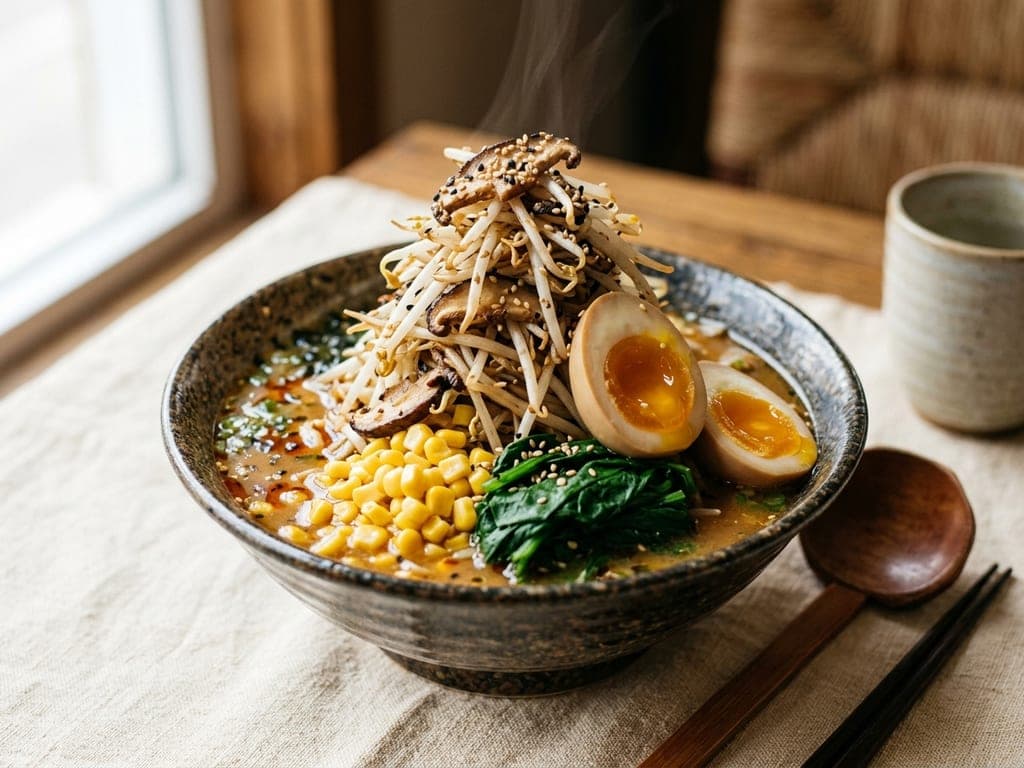
- Build a genuine haystack: tong the sprouts and shiitake into a peak at the bowl’s centre rather than a flat layer — vertical is the entire argument of this plating.
- Ring the base of the haystack with corn and a folded bundle of blanched greens so the peak rises out of colour instead of out of soup.
- Lean the egg halves against the haystack yolk-out at two different heights; asymmetry keeps a composed bowl from reading like a diagram.
- Finish with sesame rained from a foot above the bowl — the even scatter that height gives is the difference between seasoning and dandruff, and yes, it matters on camera.
The wok is the recipe
Watch the counter at a Sapporo shop and the revelation is where the soup gets made: not in the stockpot, in the wok, one serving at a time. Ground pork hits screaming metal; garlic, ginger and the miso tare go into the rendered fat and fry — fry, not dissolve — for half a minute; stock goes over the sizzle; thirty seconds of hard boil marry it; and the wok pours straight over the noodles. The stockpot behind the cook holds plain unseasoned broth. All the flavour theatre happens in ninety seconds of high heat.
The order matters because of what hot fat does to miso and chili that hot water cannot. Miso’s aroma compounds and doubanjiang’s capsaicin and fermented depth are fat-soluble; frying the pastes blooms them, adds a toasted edge to their sugars, and suspends them in droplets that carry flavour to your palate the way a vinaigrette carries mustard. Stirring miso into simmering stock — the saucepan method on most of this keyword’s front page — extracts perhaps half of that, which is why those bowls taste like miso soup with noodles rather than miso ramen. Same ingredients, different chemistry, different dinner.
The same ninety seconds explains the style’s one real rule: the boil is brief. A short hard boil emulsifies the fat and pork juices into the stock — you want that cloudy amber body — but miso’s aromatics are volatile, and held at a rolling boil the soup goes dull and flat-salty within minutes. Fry hard, boil briefly, serve instantly. It is weeknight-shaped by construction.
A tare worth keeping in the fridge
The tare is where a fifteen-minute dish earns its depth, and it is a stirring job. The spine is miso — and the blend matters more than any single jar. Red (aka) miso brings age, salt and a bass note that stands up to pork fat; white (shiro) miso brings sweetness and roundness that keeps the bowl from austerity; roughly two parts red to one part white is the house ratio, and a tub of each in the fridge covers everything from this tare to soup to glazed fish. If the shop has only “awase” (mixed) miso, that is the blend pre-made — use it and move on.
Around the miso: doubanjiang, the Sichuan fermented broad-bean-and-chili paste that Sapporo shops quietly adopted, brings heat with fermented depth rather than raw fire (the jar labelled toban-djan in Japanese groceries is the same condiment); sugar and sake round the salt; garlic and ginger go in raw because the wok will cook them; ground toasted sesame — or a spoon of tahini, which is the same seed — adds the fat-slicked nuttiness that makes the soup feel richer than it is. Five minutes of assembly, two weeks of fridge life, four bowls per batch.
Calibration notes: doubanjiang brands vary wildly in salt and heat, so taste yours before doubling anything; a tare built on saltier miso may want the sugar nudged up; and if you like the Sapporo-shop sesame signature louder, toast and grind 2 tbsp of seeds instead of one. The tare is a preference in paste form — write your ratios on the jar lid like the shops do.
The honest base, the right noodles, and the vegetarian bowl
Purists build miso ramen on pork-and-chicken stock simmered overnight, and if you own our tonkotsu weekend, a ladle of that broth here is spectacular. But the style’s own history is on the side of pragmatism, and the weeknight truth is this: good boxed chicken stock plus a teaspoon of instant dashi powder — the umami seasoning in every Japanese home kitchen — makes a base that the wok stage upgrades into a bowl you would pay for. The pork fry, the bloomed tare and the 30-second emulsion do the heavy lifting; the stock just needs to show up warm and not too salty. Spend your ambition on the wok, not the pot.
Noodles: thick and wavy is not an aesthetic, it is engineering — the curls trap the slightly gritty miso body that would slide off tonkotsu’s thin straight strands. Asian grocers sell chilled or frozen thick ramen noodles (sometimes labelled Sapporo-style); dried thick ramen works; the sachet-less brick of a good instant packet is the emergency option that still beats spaghetti, because the alkaline chew is the part with no substitute.
The vegetarian bowl is genuinely good rather than a concession, because miso is doing the umami work anyway: swap the stock for a kombu-and-dried-shiitake steep (soak 2 postcard-size pieces of kombu and 6 shiitake in the warm water 20 minutes, then heat), swap the pork for 8 oz (225 g) of crumbled firm tofu or chopped shiitake fried hard in a little more oil until browned at the edges, and check your doubanjiang label for the rare fish-flavoured variant. Everything else — tare, wok order, corn, butter (the one decision: butter or not) — proceeds unchanged.
Questions, answered
What miso should I use for miso ramen?
A blend: about two parts red (aka) miso for depth and salt to one part white (shiro) for sweetness and body. All-red makes an austere, salty bowl; all-white a mild, almost dessert-ish one. The pre-mixed tubs labelled awase are exactly this compromise in one container and work fine. Avoid only the very fancy chunky barley misos here — their texture fights the soup.
Can I just stir miso into hot stock?
You can, and you will get decent miso soup with noodles in it. The Sapporo method — frying the miso tare in rendered pork fat before the stock goes in — blooms the fat-soluble aroma and chili compounds that plain hot water leaves locked up, and the brief hard boil then emulsifies everything into that cloudy amber body. Same ingredients, five extra minutes, a different class of bowl.
What is doubanjiang, and what can I substitute?
A fermented broad-bean-and-chili paste from Sichuan (sold as toban-djan in Japanese brands) that gives Sapporo-style miso ramen its warmth and funk. Nearest substitutes, in order: gochujang (sweeter — cut the tare’s sugar), a spoon more red miso plus a big pinch of chili flakes, or chili crisp with its oil. Plain sriracha works at a discount; heat without the ferment.
Why is there butter and corn on miso ramen?
Because Hokkaido, the style’s home island, is Japan’s corn and dairy farm, and a Sapporo bowl wears the local harvest. Functionally the butter melts into a gold slick that rounds the chili and salt, and the corn pops sweet against the fermented depth — it is seasoning, not decoration. Add the butter at the table so it melts in front of the eater; that is half the point.
What noodles are right for miso ramen?
Thick, wavy, chewy — the opposite of tonkotsu’s thin straight strands. The waves trap the miso-thickened broth so every bite carries soup. Chilled or frozen thick ramen from an Asian grocer is ideal, dried thick ramen is fine, and a good instant brick (sachet binned) is the honest emergency. The alkaline bounce is the non-negotiable part — plain wheat pasta reads as soup with spaghetti.
Is it true you should never boil miso?
It is a half-truth worth getting right. Long boiling drives off miso’s volatile aromatics and dulls the bowl — that part is real, and it is why the soup is served the minute it comes together. But the brief, hard 30-second boil in the wok is load-bearing: it emulsifies fat, pork and tare into the broth’s body. Fry hard, boil briefly, serve immediately; the rule is about duration, not temperature.
Can I make miso ramen vegetarian or vegan?
Better than most ramen styles, because miso carries the umami regardless. Kombu-shiitake steep instead of chicken stock, browned crumbled firm tofu or chopped shiitake instead of pork, doubanjiang checked for the rare fish-containing variant, and for vegan bowls skip the butter or use a plant one and confirm your noodles are egg-free (most ramen noodles are). The wok order stays identical — the fry is doing the flavour work either way.
Can I make any of this ahead?
The tare is the make-ahead: two weeks jarred in the fridge, and it also glazes eggplant, fish and grilled onigiri. Toppings prep to a day ahead; marinated eggs want yesterday anyway. The soup itself is a ninety-second à la minute event and does not hold or reheat with dignity — miso’s aroma fades and the emulsion splits. Prep everything, then make bowls one dinner at a time.
How spicy is this bowl?
As written, warm rather than hot — one tablespoon of doubanjiang across four bowls reads as a glow. For proper Sapporo-in-January heat, double the doubanjiang in the tare or finish bowls with chili oil to order; for none, halve it and let the miso and sesame carry the depth — plenty of Sapporo shops sell exactly that milder bowl. The tare model means every eater can be right at the same table.
How many calories in a bowl?
About 620 as built — the noodles and pork carry most of it, the butter pat is 50-odd calories of pure signature, and the broth’s richness is more emulsion than oil slick. Skipping the butter saves less than skipping seconds; the honest lightening lever, as with all ramen, is a smaller noodle portion under the same amount of soup and toppings.
Snap your finished plate and let the AI plate it again — more beautifully.