Tonkotsu Ramen Recipe (Real Milky Broth — the 12-Hour Truth and the 3-Hour Path)
The white one: pork bones boiled — actually boiled, hard, for half a day — until collagen and fat emulsify into an opaque ivory broth with the body of thin cream. Tonkotsu is not seasoned stock, it is a transformation, and this page refuses to pretend it happens in an afternoon. One honest weekend method, one pressure-cooker path that earns its shortcut, and the chashu, jammy egg and black garlic oil that finish the bowl.
Ingredients
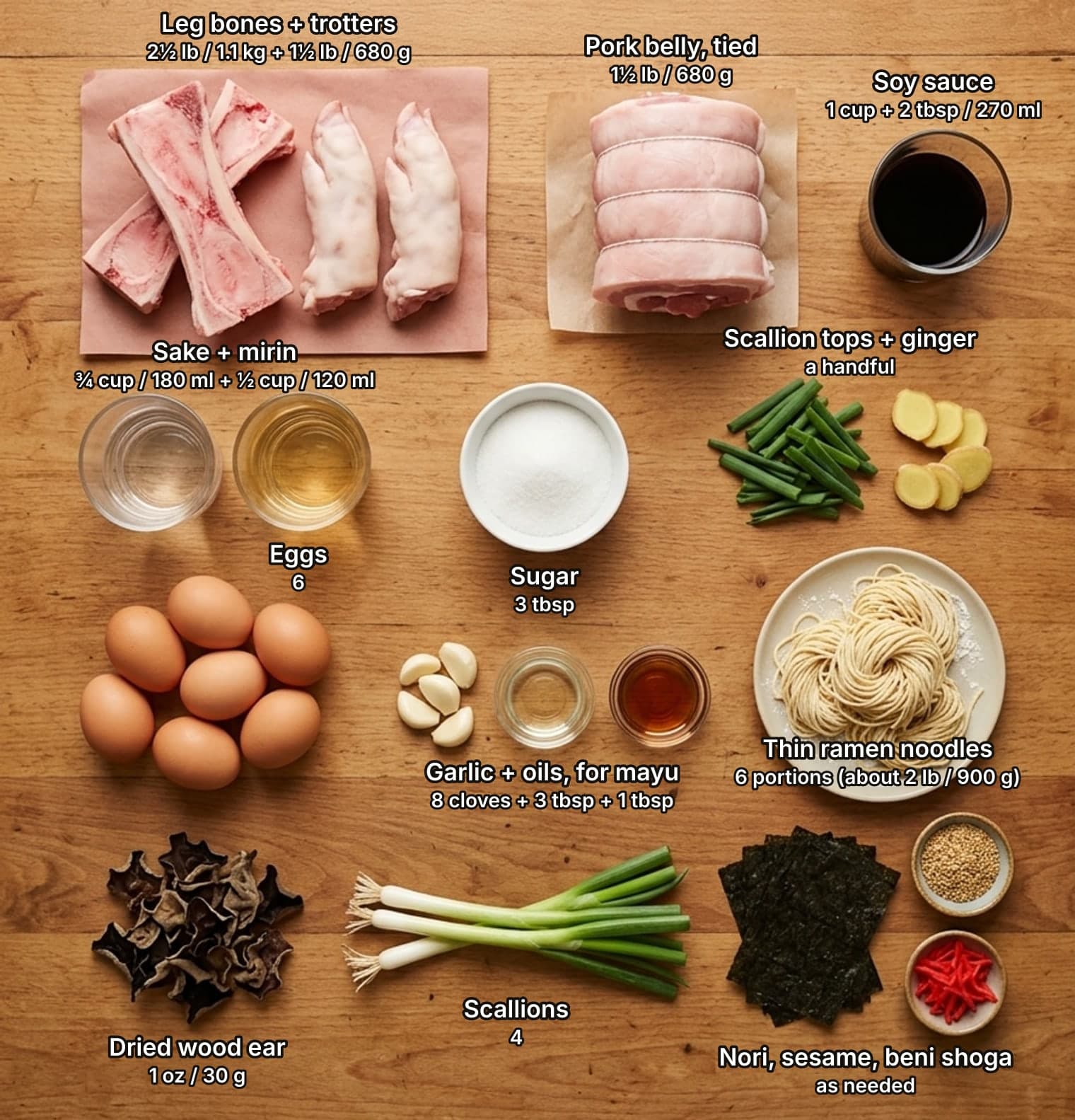
- pork leg bones (femur/knuckle), split by the butcher2½ lb / 1.1 kg
- pork trotters, split1½ lb / 680 g
- skinless pork belly, rolled and tied (chashu)1½ lb / 680 g
- soy sauce (chashu braise + tare)1 cup + 2 tbsp / 270 ml
- sake¾ cup / 180 ml
- mirin½ cup / 120 ml
- sugar3 tbsp
- scallion tops + ginger coins (for the braise)a handful
- eggs (ajitama)6
- garlic, sliced (mayu)8 cloves
- neutral oil (mayu)3 tbsp
- toasted sesame oil (mayu)1 tbsp
- fresh thin straight ramen noodles (Hakata-style)6 portions (about 2 lb / 900 g fresh)
- dried kikurage (wood ear), rehydrated and sliced1 oz / 30 g
- scallions (spring onions), finely sliced4
- nori sheets + toasted sesame + beni shoga, to finishas needed
What tonkotsu is (and what it is not)
Tonkotsu — 豚骨, pork bone — names the broth, not a flavour on a menu. Ramen taxonomy runs on two axes that the West keeps collapsing into one: the soup (what the bones were, and how hard they were treated) and the tare (the concentrated seasoning in the bottom of the bowl — soy, salt, or miso). Shoyu and shio and miso are tares; tonkotsu is a soup, and a tonkotsu bowl is usually seasoned with a salt- or soy-leaning tare. Our shoyu and miso pages sit on the other axis, which is why the three pages together read as a map rather than three versions of one dish.
The style belongs to Fukuoka prefecture in Japan’s south — Kurume is the origin city, where a yatai stall was serving pork-bone ramen by 1937, and the local legend credits the milky version to a later happy accident: a pot left boiling too hard, too long, that came out white instead of clear and turned out to be better. Whatever the precise truth, the accident is repeatable, which is all a cook needs from a legend. Hakata, Fukuoka’s port district, made the style famous — thin hard noodles, kaedama refills, bowls served at a sprint to shift workers — and exported it to the world as Hakata ramen.
What it is not: a broth you can talk into existence in ninety minutes. The internet is full of “quick tonkotsu” built on milk, soy milk, or blended cooked fat; they are dinner, but they are cosplay. The white is structural — you cannot stir it in.
How to make Tonkotsu ramen
- Blanch the bones, then scrub them like you mean it. Cover 4 lb (1.8 kg) of pork leg bones and split trotters with cold water, bring to a hard boil for 10 minutes — the water will turn grey and dramatic — then drain, and scrub every bone under running water, picking off the dark marrow and clotted bits with a chopstick. This ten-minute chore is the difference between ivory broth and grey broth, and it cannot be done later. The pot gets rinsed too.
- Start the boil — and mean boil. Return the clean bones to the pot, cover with fresh water by 2 inches (5 cm), and bring to a full rolling boil. This is the un-Western move: stock rules say simmer gently for clarity, and tonkotsu breaks the rule on purpose. The churn is the machine — it batters gelatine and melted fat into each other until the liquid itself turns white. A lid set ajar keeps evaporation survivable; the bubble should never fall below a steady roll.
- Feed the pot for 10–12 hours. Top up with boiling water from a kettle whenever the level drops toward the bones — every 45 minutes or so — and give the bottom a scrape with a wooden spoon each time so nothing catches. Hour by hour the broth moves from cloudy, to milk-tea, to a proper opaque ivory that coats a spoon. From hour eight, taste: done is when it is frankly creamy and the bones surrender their cartilage to a squeeze. Add nothing yet — no salt, no aromatics; tonkotsu broth is bones and water and violence.
- Or run the pressure-cooker path — with the finish that saves it. The honest shortcut: pressure-cook the blanched bones just covered with water at high pressure for 3 hours, then — this is the step the shortcut recipes skip — take the lid off and boil hard for 45–60 minutes, mashing the softened bones about with a spoon. Pressure extracts the collagen but it cannot emulsify a still liquid; only the open hard boil turns extraction into milk. Skip the finish and you get gelatinous beige stock — good soup, not tonkotsu.
- Strain, and decide how rich you are feeling. Strain the broth through a colander then a fine sieve, pressing the solids, into a clean pot; you want about 10 cups (2.4 L). Let it stand two minutes: the fat rides on top. The Hakata call is to leave it — kotteri, rich — or skim some off for a cleaner bowl and save it for frying rice. If the broth tastes thin, boil it down uncovered; if it set solid in the fridge overnight, congratulations, that is exactly right.
- Chashu and the eggs, while the pot rolls. Roll a 1½ lb (680 g) slab of skinless pork belly into a log, tie it, sear all over, then braise it — submerged in ¾ cup (180 ml) soy sauce, ¾ cup (180 ml) sake, ½ cup (120 ml) mirin, 3 tbsp sugar, scallion tops and a few ginger coins, topped with water — at a bare simmer, covered, for 3 hours until a chopstick slides in. Cool it IN the liquid — sink the pot in iced water so the whole thing is fridge-bound within 2 hours — then chill wrapped: chashu slices only when cold. The strained braising liquid is your egg marinade: soft-boil eggs 6½ minutes, ice-shock, peel, and steep them in it, refrigerated, 4 hours to overnight.
- Make the tare and the black garlic oil. Tare is the per-bowl seasoning the unsalted broth is waiting for. Simple and correct: warm ¼ cup (60 ml) of the chashu braising liquid with 2 tbsp soy sauce and 1 tsp salt per two bowls (build to taste — the target is broth seasoned like a soup you would slurp, not a sauce). For mayu, the Kumamoto signature: cook 8 sliced garlic cloves in 3 tbsp neutral oil over LOW heat, stirring, through gold, brown, and — trust it — fully black, about 15 minutes, then blitz with 1 tbsp toasted sesame oil. Bitter-roasty, jet black, absurdly effective in drops.
- Noodles: thin, straight, firm — and cooked at the last second. Tonkotsu takes thin, straight, low-hydration noodles (the packet will say Hakata-style; any Asian grocer’s chilled or frozen ramen section has them — the noodles section below has substitutes). Boil them in plain unsalted water 45–90 seconds — Hakata bars ask how firm you want them, and barikata (extra-hard) is the house answer — and drain them with a violence that would alarm a pasta cook. Wet noodles dilute a broth you spent twelve hours on.
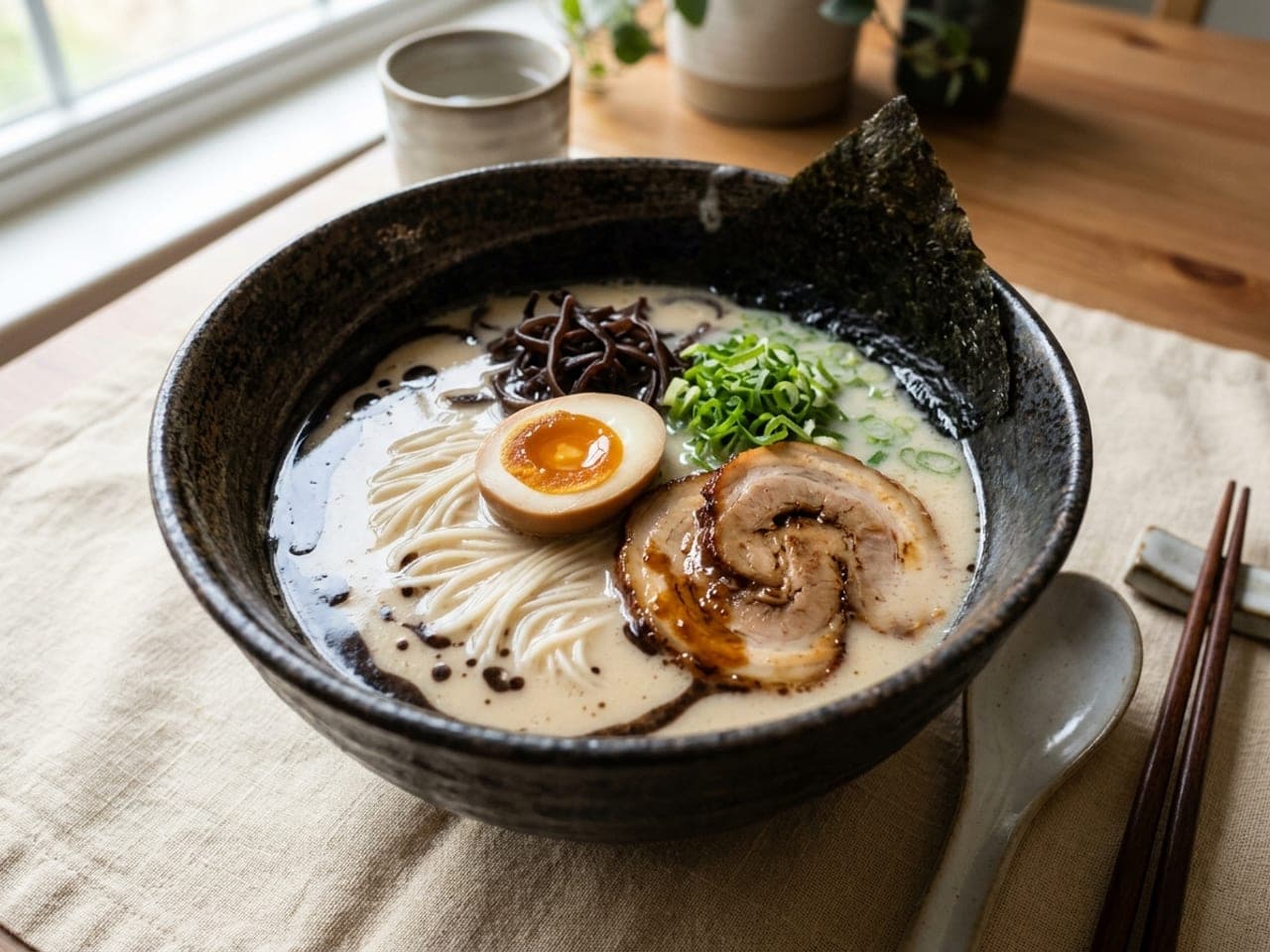
- Assemble in a hot bowl, eat without conversation. Scald the bowls with boiling water and empty them. Into each: 2–3 tbsp tare, a few drops of mayu, then 1⅔ cups (400 ml) of broth straight off the boil, whisked once. Noodles in, lifted and folded so they lie combed. On top, working fast: two slices of chashu, the halved egg, a pile of kikurage, scallions, sesame, nori against the rim, more mayu in black rings. Ramen is a hot dish with a five-minute lifespan — the table waits for the bowl, never the reverse.
Safety & hygiene Important
- A 12-hour boil is a supervised activity. A stockpot at a rolling boil for half a day is a live appliance, not a slow cooker: it can boil dry in under an hour once the level drops, and scorched bones ruin the batch (and eventually the pot). Top up on a timer, keep the handle turned in, keep children and tails out of the kitchen, and if you must leave the house, kill the heat — and if the pause will run past an hour, cool the pot fast (iced sink, shallow containers) into the fridge and bring it back to a full rolling boil to resume. A stockpot drifting down through lukewarm all afternoon is exactly the bacterial scenario the cooling note below exists for; the pot does not forgive dry, and the broth does not forgive a warm nap.
- Cooling two litres of broth is the genuinely risky step. A deep pot of hot broth can sit in the bacterial danger zone (40–140°F / 4–60°C) for many hours if you just fridge it whole — and the fridge suffers too. Split it across shallow containers, or sink the pot in iced water and stir until it drops below lukewarm, then refrigerate uncovered until cold. Target: down through 70°F (21°C) within 2 hours of the heat going off, and fridge-cold within 4 more — the two-stage standard professional kitchens run on. Kept cold it holds 4 days; frozen in portion tubs, 3 months.
- Marinated eggs are a fridge food with a clock. Ajitama are soft-boiled — the yolk never cooks through — so they live in the refrigerator, in their marinade, and are eaten within 3–4 days. Do not hold them at room temperature beyond the meal, and do not stretch the marinade across batches: it has been holding raw-ish egg for days and its work is done. Pregnant and immunocompromised eaters should take the egg fully cooked (10 minutes) — the marinade does not care.
- Reheating: broth hard, toppings gentle. Reheat broth to a full rolling boil before serving — it is a protein-rich medium and it earns the same respect as the first time. Chashu is the opposite: slices go leathery if boiled, so lay them cold on the hot assembled bowl (the broth warms them in seconds) or wave them briefly under a hot grill. The egg is never reheated at all — halved cold onto the hot bowl, where it belongs.
3 ways to plate it
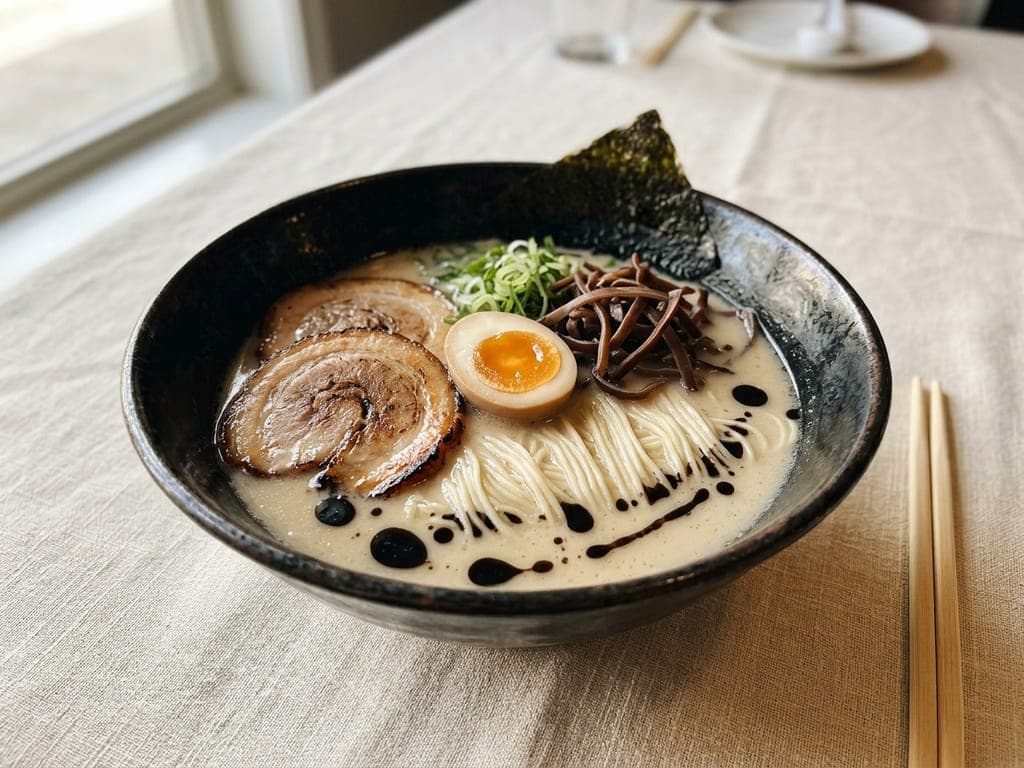
- Scald the bowl first — a hot bowl keeps the broth’s surface shimmering instead of skinning, and it is the single most restaurant-signalling habit in noodle cookery.
- Lift the noodles in with chopsticks and fold them over themselves so the strands lie parallel — the combed fold is the difference between served and dumped.
- Place toppings in territories, not a heap: proteins on one arc, vegetables on another, the egg’s cut faces angled toward the eater, yolk catching the light.
- Finish with mayu in three or four deliberate rings and the nori leaning at the rim, added last so it stays crisp for the photograph and the first bite.
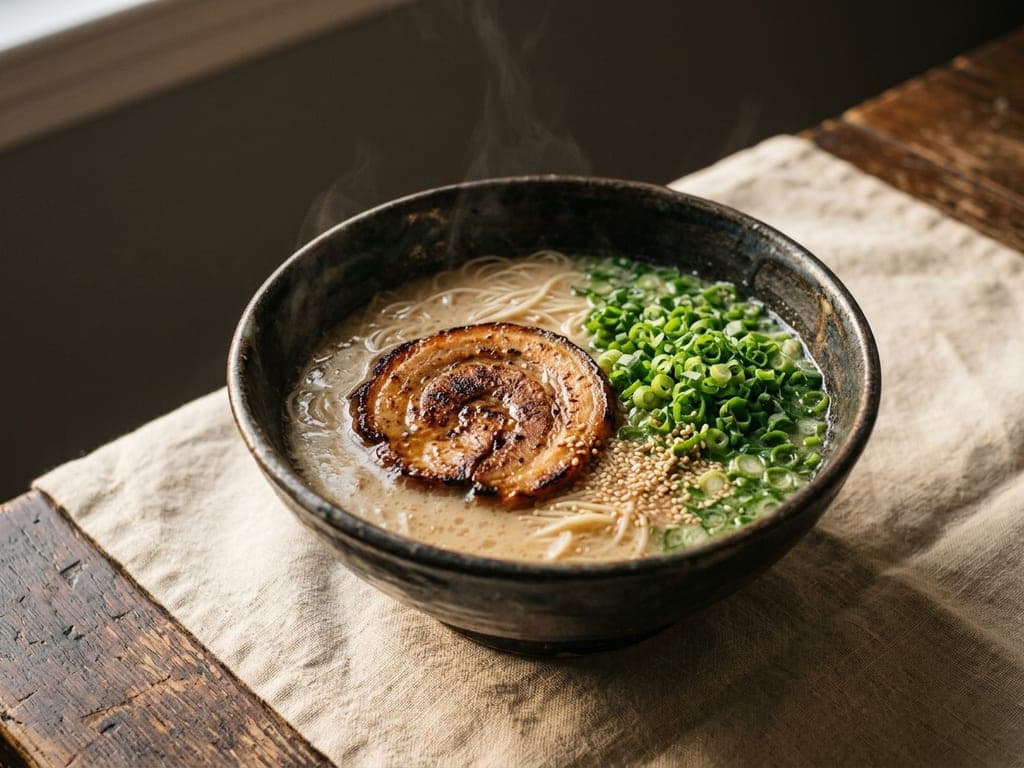
- Choose a smaller, deeper bowl than you think — the yatai bowl is intimate, and broth climbing high on the walls reads generous where a wide half-filled basin reads mean.
- One slice of chashu, laid flat and centred, seared side up — a single confident element beats three apologetic ones.
- Cover a full third of the surface with finely sliced scallion — at this density it is a component, not a garnish, and the green-on-ivory is the whole colour story.
- Sesame from a height at the last second, and serve with the beni shoga and pepper on the table — the yatai hands the finishing decisions to the eater.
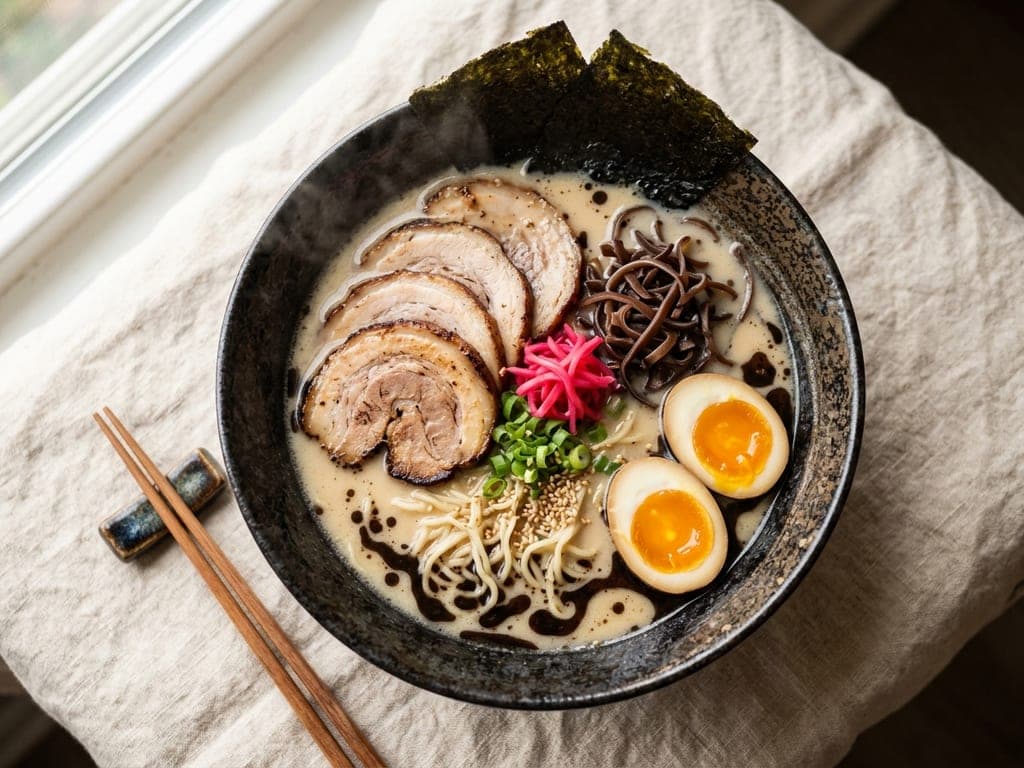
- Shingle three or four chashu slices in an overlapping fan across half the bowl — the fan turns quantity into pattern instead of pile.
- Set the beni shoga in one tight, deliberate island; its pink is loud, and one contained accent electrifies the ivory where a scatter would clutter it.
- Give the mayu a pool at the bowl’s edge as well as the rings — the eater drags noodles through it at their own pace, and the black-on-white marbling is the signature photograph.
- Double the nori and stand both sheets tall at the back rim like a screen — height at the back frames the bowl and keeps the composition facing its audience.
Why the broth turns white — the emulsion, explained once
Every stock rule you know says simmer, never boil, or the stock goes cloudy. Tonkotsu reads that warning as instructions. Hours of collagen breakdown fill the water with gelatine; the marrow and connective tissue melt into liquid fat; and the rolling boil — the mechanical part — shears that fat endlessly into droplets so small they stay suspended, with gelatine and other proteins coating each one like a courier bag. Light scatters off the droplets instead of passing through, and the liquid reads as white. It is the same physics as mayonnaise or a beurre blanc: an emulsion, made with a boil instead of a whisk.
This is why the two failure modes are what they are. Simmer politely for twelve hours and you extract everything but emulsify nothing: clear-ish, gelatinous, beige — excellent stock, not tonkotsu. Pressure-cook and stop at extraction (the pot is silent and still under pressure — no shear) and you get the same beige result faster; the open-pot hard boil afterwards is what whips the milk. And it is why you stop skimming after the first hour: those proteins and that fat are not impurities to remove, they are the ingredients of the colour. Skim the blanching boil ruthlessly, skim the first grey scum of the real boil, then put the spoon down and let the pot work.
The practical target: broth that visibly coats the back of a spoon, opaque enough that the spoon disappears a knuckle under the surface, and sets to a wobble in the fridge. Colour between ivory and pale café-au-lait; grey means the scrubbing step was skipped, thin means the boil was shy or short.
The honest timeline (and how the pressure cooker actually fits)
Call it what it is: a weekend project with a lazy shape. Saturday morning, twenty minutes of blanching and scrubbing; then the pot needs nothing but a kettle top-up every 45 minutes while you live your life within earshot. The chashu braises inside those hours, the eggs take ten active minutes, mayu fifteen, and by Saturday evening you have broth for six bowls plus a freezer deposit. Sunday the eggs are perfect and assembly is a 15-minute dinner. Against a restaurant bowl at today’s prices, the pot pays for itself the first weekend — and portioned frozen broth turns every future tonkotsu craving into a weeknight noodle boil.
The pressure cooker compresses the extraction — three hours at high pressure does what eight-plus do in an open pot, and trotters emerge poachable-soft — but it cannot do the emulsion, because emulsion is agitation and a sealed pot is still. So the honest hybrid: pressure for extraction, then 45–60 minutes of open, hard, bone-mashing boil for the white. Total wall-clock around four hours, and the result stands next to the long version with its head up. What no machine shortens is the chashu’s three gentle hours or the eggs’ overnight steep — start those first, not last.
Scale sanity: bones are cheap, freezers are small. Double the bones and water if your pot allows — the boil time barely changes, and broth is the only part of this dish that cannot be made on a Tuesday.
Shopping the bowl in Europe and America
The bones are the easy, cheap part — the asking is the skill. You want weight-bearing leg bones (femur, knuckle) for marrow and collagen, plus split trotters, which are the collagen jackpot; any butcher has both, often for pocket change, and will split them if you ask (do ask — whole femurs laugh at home saws). Supermarket meat counters in Europe routinely stock trotters and “soup bones”; Asian grocers sell pork neck and leg bones bagged and frozen, pre-cut. Neck bones alone make a leaner, faster-cloudy broth — a fine reinforcement, not a foundation.
Noodles are the place not to improvise. Ramen noodles are alkaline — kansui gives them their bounce, chew and yellow cast — and no Italian pasta shares the chemistry. Chilled or frozen “Hakata” or “tonkotsu” straight thin noodles from an Asian grocer are ideal; dried ramen from the same aisle is honourable; the famous hack of baking soda-treated spaghetti exists and works at maybe 70%, for the day the grocer is far. Instant-packet noodles survive the swap better than their reputation — bin the sachet, keep the brick. Kikurage (wood ear) sells dried everywhere and rehydrates in ten minutes; beni shoga (red pickled ginger) and toasted sesame finish the Hakata set. Kewpie-aisle adjacency will find you the mayu ingredients already in your pantry: garlic, neutral oil, sesame oil, patience.
Questions, answered
How long does tonkotsu broth really take?
In an open pot, 10–12 hours at a genuine rolling boil, after a 10-minute blanch and scrub. The pressure-cooker hybrid gets there in about four: 3 hours sealed for extraction, then 45–60 minutes of open hard boiling to emulsify. Anything promising white pork broth in 90 minutes is either using dairy or redefining white.
Why is my broth not white?
Three usual suspects. You simmered instead of boiled — no agitation, no emulsion, no milk. You pressure-cooked and stopped when the timer went — extraction without the open-boil finish stays beige. Or you skimmed all day — after the first hour’s grey scum, the fat and protein you are lifting out ARE the white. Grey rather than ivory is the fourth story: the blanch-and-scrub step was skipped.
Can I make tonkotsu in a pressure cooker or Instant Pot?
Yes, and it is the best shortcut in ramen — with one condition. Pressure does the extraction (3 hours, high), but the milky colour comes from agitation, so you must finish with 45–60 minutes of hard, uncovered boiling, mashing the softened bones as it rolls. An Instant Pot on sauté can do the finish, though a stove pot boils harder and faster.
What bones do I need — and what do I ask the butcher for?
Pork leg bones (femur and knuckle) for marrow and body, plus split trotters for collagen — about 4 lb (1.8 kg) for six bowls, and ask the butcher to split or crack everything so the interior is open to the water. Neck bones are a fine supplement. Total spend at most butchers is famously small; the trotters are usually the cheapest thing in the case.
What noodles go with tonkotsu ramen?
Thin, straight, firm — low-hydration Hakata-style, from the chilled or frozen section of an Asian grocer, cooked 45–90 seconds and served on the hard side (barikata, in the Hakata dialect of noodle firmness). Dried ramen works; alkaline chemistry is the non-negotiable, so ordinary pasta only survives via the baked-baking-soda hack, at a discount. Kaedama — ordering a second helping of bare noodles for the broth you have left — is the traditional compliment to the cook.
What is the difference between tonkotsu and shoyu or miso ramen?
Different axes. Tonkotsu names the SOUP — pork bones boiled to a white emulsion. Shoyu and miso name the TARE, the seasoning concentrate in the bowl — soy sauce or fermented bean paste — which is usually paired with a clear chicken or pork stock. A tonkotsu bowl typically runs a salt- or soy-leaning tare under its white broth; our shoyu and miso pages cover the other axis of the map. And tonkotsu is not tonkatsu, the breaded pork cutlet — one vowel, different dinner.
What is the black oil on tonkotsu ramen?
Mayu — garlic cooked in neutral oil, deliberately, all the way past brown to black, then blended with toasted sesame oil. It reads bitter alone and transformative in the bowl: roasty, dark, and exactly what two litres of pork sweetness needs for contrast. Drops, not spoonfuls; the recipe on this page makes a small jar that keeps a week in the fridge — garlic in oil is never a long keeper, charred or not, so freeze cubes for anything longer.
Can I freeze tonkotsu broth?
It is the whole point of making six bowls’ worth. Chill it fast (shallow containers), refrigerate up to 4 days, or freeze in per-bowl portions — 1⅔ cups (400 ml) — for up to 3 months; it thaws into exactly what it was. Freeze the broth unseasoned and add tare per bowl, so future-you keeps the seasoning decision. Chashu freezes sliced; eggs do not freeze, but they were never going to survive that long anyway.
How fatty is a bowl of tonkotsu — can I lighten it?
The style is rich by design — around 650 calories as built here, before extra chashu. The honest lever is the fat cap after straining: skim more of it for a cleaner (assari) bowl, keep it all for the full kotteri experience, and know that the emulsified white body itself is mostly gelatine and water — the spoon-coating texture is not pure fat, whatever it implies. Halve the noodles before you halve the broth; the broth is the dish.
What toppings are traditional on tonkotsu?
The Hakata set: chashu, the marinated soft egg, kikurage (wood ear mushroom in fine strips), scallions, sesame, nori, and on the table — not in the kitchen — beni shoga (red pickled ginger) and spicy mustard greens. Corn and butter belong on the miso page; sweet corn drowns here. The bowl is pale on purpose: the palette is ivory, brown, black and green, and restraint photographs better than confetti.
Snap your finished plate and let the AI plate it again — more beautifully.