Shoyu Ramen Recipe (Tokyo's Original Bowl — Clear Broth, Deep Soy)
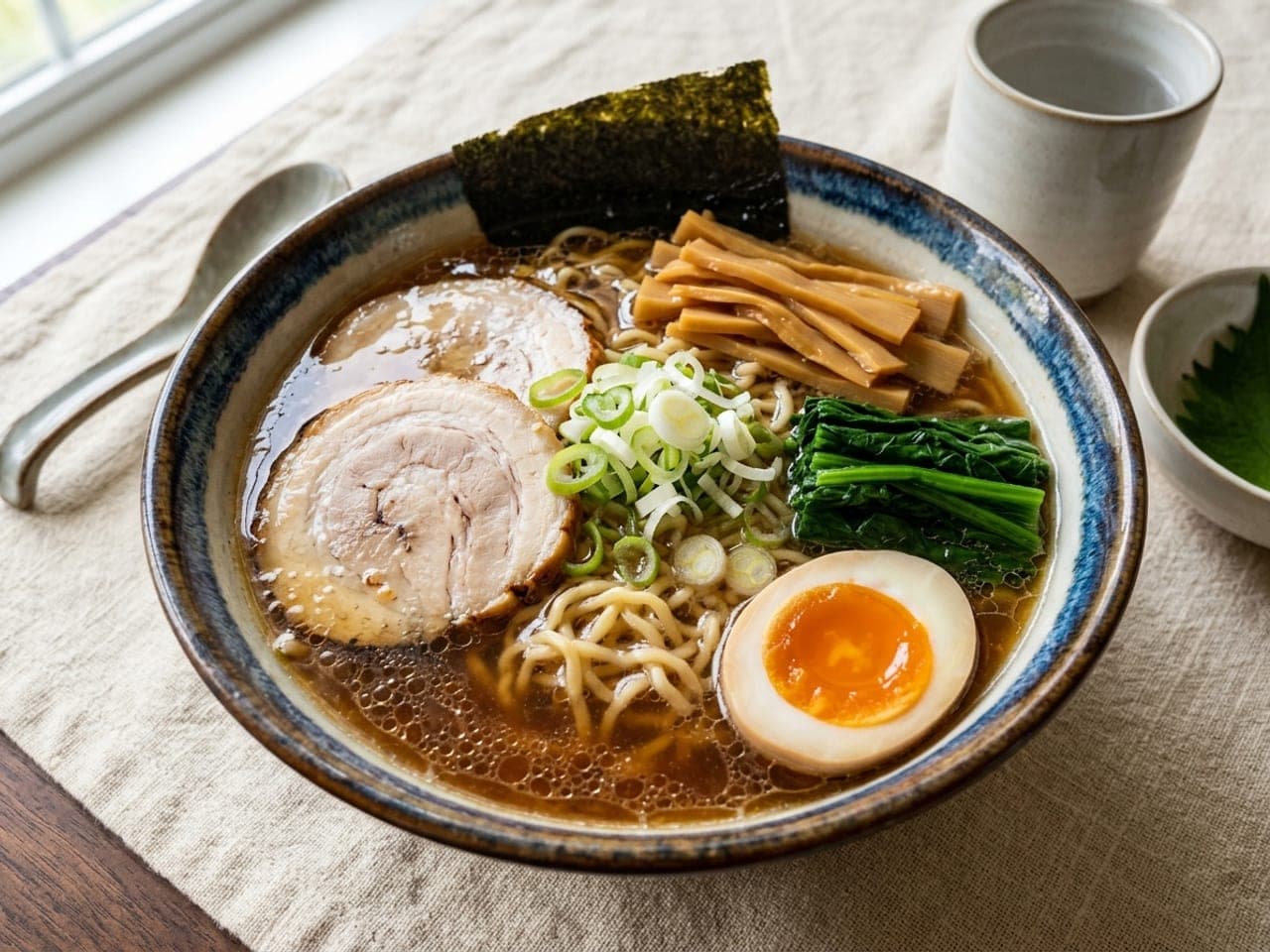
The original: the clear, soy-brown bowl that Tokyo has been eating since 1910, and the style every other ramen is arguing with. Where tonkotsu boils bones into white violence, shoyu is discipline — chicken broth kept so gently below a simmer it stays transparent, seasoned in the bowl with a soy tare and a spoon of scallion-chicken oil. Quietly the hardest style to hide behind, and the best one to learn ramen on.
Ingredients
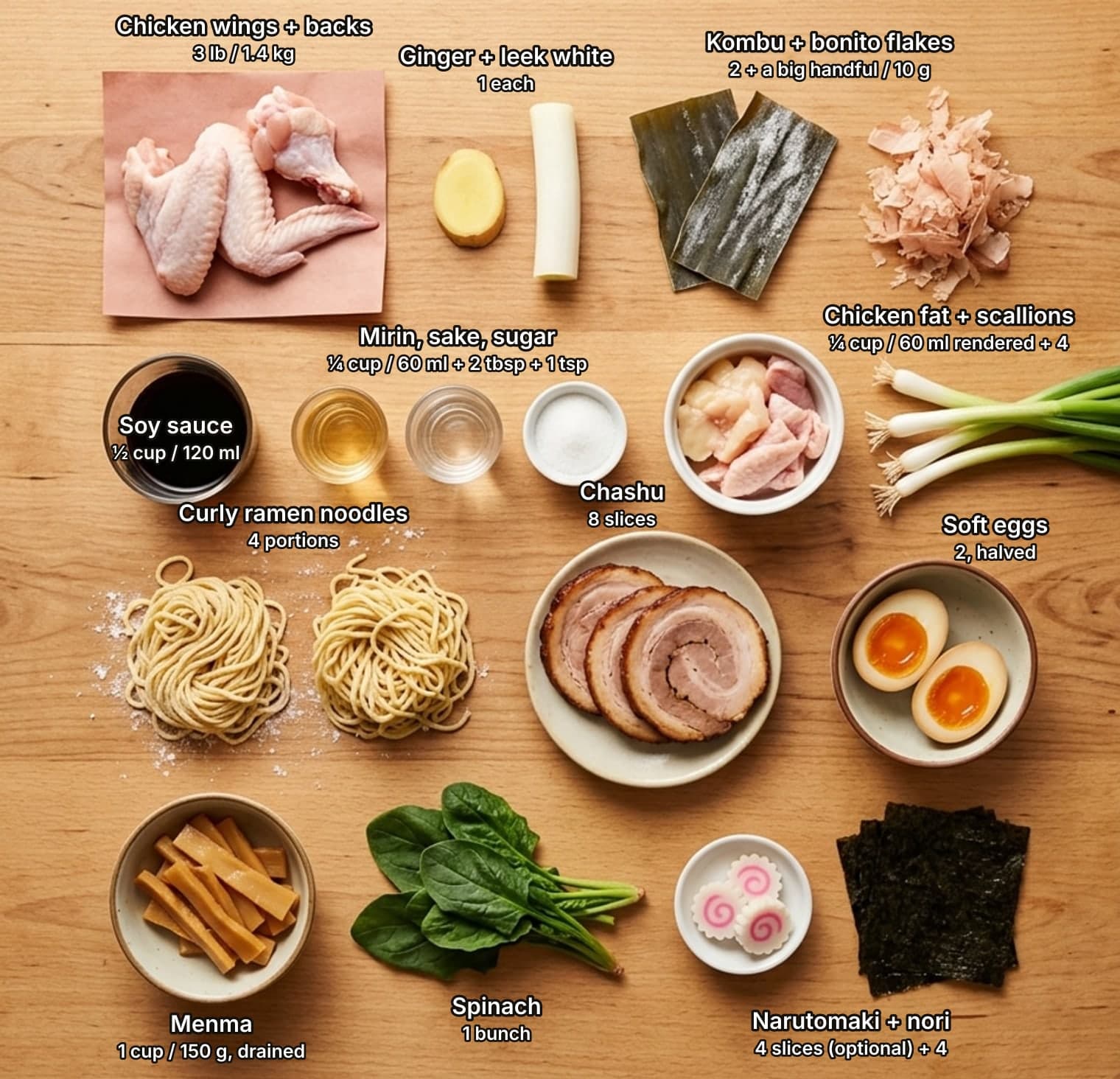
- chicken wings and backs (or a carcass plus wings)3 lb / 1.4 kg
- ginger, a thick coin, plus the white of 1 leek1 each
- kombu (postcard-size pieces: dashi + tare)2
- katsuobushi (bonito flakes)a big handful / 10 g, plus a pinch for the tare
- soy sauce (good koikuchi)½ cup / 120 ml
- mirin¼ cup / 60 ml
- sake2 tbsp
- sugar1 tsp
- chicken fat and skin trimmings (or bought chicken fat)¼ cup / 60 ml rendered
- scallions (spring onions) — greens for the oil, whites to finish4
- medium curly ramen noodles4 portions
- chashu (method on the tonkotsu page) or 2 chicken thighs for tare-poaching8 slices
- marinated soft eggs (ajitama — method on the tonkotsu page)2, halved
- menma (seasoned bamboo shoots, jarred)1 cup / 150 g, drained
- spinach, blanched, squeezed, in bundles1 bunch
- narutomaki (optional, for the spiral) + nori sheets4 slices + 4
The bowl ramen started as
Every ramen family tree, shaken hard enough, drops you in the same place: Rairaiken, a small shop that opened in Tokyo’s Asakusa district in 1910, generally credited as Japan’s first dedicated ramen shop. The owner hired Cantonese cooks away from Yokohama’s Chinatown, and what they served — wheat noodles in a soy-seasoned broth with roast pork — was called shina soba, later chūka soba: “Chinese noodles.” The dish was an immigrant invention refined for Tokyo palates, it was cheap and hot and fast, and it drew queues from the start. Shoyu ramen is not a variety of ramen so much as the thing the word originally meant.
A century of evolution later, “Tokyo-style” still describes that founding bowl: clear brown broth of chicken and dashi, medium curly noodles, chashu, menma, spinach, nori, scallion — and, in its most nostalgic dress, a coin of narutomaki, the white fishcake with the pink spiral that functions as ramen’s national logo. The style survived the war, the street stalls, the instant-noodle revolution (the first instant ramen, in 1958, was chicken-and-soy for a reason), and the later booms of miso and tonkotsu, and it remains the default bowl of the capital — the one a Tokyo cook means by just “ramen.”
Learning ramen through shoyu is learning it in the right order. The styles that came later — Sapporo’s miso armour, Fukuoka’s white tonkotsu — are each a rebellion against this bowl’s restraint, and they make more sense once you have tasted the thing they were rebelling against. Our miso and tonkotsu pages are those arguments; this page is the original position.
How to make Shoyu ramen
- Start the chintan — and define “simmer” down. Cover 3 lb (1.4 kg) of chicken — wings and backs, or a carcass plus wings — with 10 cups (2.4 L) of cold water, bring it JUST to the edge of a simmer, and hold it there, uncovered, 3 hours: surface barely trembling, one lazy bubble at a time, never rolling. Skim the first grey foam in the opening 20 minutes, then leave it alone. This is the anti-tonkotsu — agitation is what makes broth cloudy, so clarity is simply gentleness sustained. A scrap of ginger and the white of one leek may join the pot; nothing else.
- Steep the dashi separately — the second half of the double soup. While the chicken barely moves, make the sea half: soak a postcard-size piece of kombu in 2 cups (480 ml) of cold water for 30 minutes, bring it almost to a simmer, pull the kombu, kill the heat, and rain in a big handful (10 g) of katsuobushi flakes. Three minutes, then strain. Tokyo bowls are a DOUBLE soup — bird and sea kept apart until serving so each stays distinct. (Weeknight honesty: 1 tsp of instant dashi in hot water replaces this step at a modest discount.)
- Build the shoyu tare. Warm ½ cup (120 ml) of good soy sauce with ¼ cup (60 ml) mirin, 2 tbsp sake and 1 tsp sugar until steam rises — do not boil — then drop in a small square of kombu and a pinch of katsuobushi, and let it cool completely before straining into a jar. It tastes like soy sauce that went somewhere: rounder, sweeter, smoked at the edges. If the recipe reads familiar, it should — this is teriyaki’s family tree, pointed at soup instead of a glaze. Keeps a month refrigerated.
- Make the negi-chicken oil — the bowl’s perfume. Render the fat: simmer the skin and fat trimmed from your chicken (or ¼ cup / 60 ml bought chicken fat) in a small pan over low heat until the cracklings go gold, then add the green tops of 3 scallions, roughly chopped, and let them fry to the edge of browning, 3–4 minutes. Strain. This is the aroma oil — the shimmering droplets on a Tokyo bowl’s surface — and it carries the scent that hits before the first sip. Without it the bowl is soup; with it, ramen.
- Chashu and eggs — borrowed from next door. The rolled chashu and marinated ajitama on this bowl are the same ones built on our tonkotsu page — braise and steep them exactly as written there (the braising liquid even doubles as extra tare). The 30-minute shortcut when there is no chashu in the fridge: slide 2 boneless chicken thighs into the warm tare with a splash of water, poach gently 25 minutes, rest, slice — Tokyo shops sell chicken chashu with straight faces, and so may you. That poaching liquid is now a diluted, protein-washed bonus tare for this week only (3 days, refrigerated) — never tip it back into the keeping jar.
- Menma, spinach, and the spiral. The supporting cast, all ready-to-eat: menma (seasoned bamboo shoots) come in jars and pouches at any Asian grocer — drain and they are done; blanch a bundle of spinach 30 seconds, shock, squeeze, and cut into neat lengths; slice narutomaki — the pink-spiralled fishcake from the freezer aisle — into 4 coins if you want the bowl wearing its Tokyo nostalgia (it is optional and it is also the most photographed object in ramen). Scallion whites, sliced fine, finish the set.
- Combine the soups, cook the noodles. Ten minutes out: combine the chicken broth with the dashi — about 4 parts bird to 1 part sea — bring it to a bare simmer (still no boiling; clarity dies at the finish line too), and taste it plain: it should be delicate, savoury, and almost unseasoned, because the tare is waiting in the bowl. Boil 4 portions of medium curly noodles in plain water per the packet, and drain them properly — a shake, a snap, no clinging water.
- Assemble in the bowl, not the pot. Scald the bowls. Into each: 2–3 tbsp tare and 1 tbsp of the negi-chicken oil. Ladle in 1⅔ cups (400 ml) of the hot combined broth and give one stir — watch the clear broth take its soy colour in the bowl, which is the whole shoyu ceremony. Noodles in, folded combed. Top in territories: chashu, menma pile, spinach bundle, egg halves, the naruto coin, nori at the rim, scallion whites last. The surface should show clear amber with gold oil droplets — if you cannot see into the broth, next door’s tonkotsu page is laughing.
Safety & hygiene Important
- A sub-simmer is still a full cook — with one check. The barely-trembling chintan hold sits well above the temperatures that matter for poultry safety, and three hours clears any doneness question for broth purposes. The check is the poached-chicken shortcut: thighs poached in warm tare must reach 165°F (74°C) at the centre — poaching liquid this gentle can lag, so give it the thermometer rather than the benefit of the doubt, and hold the poach at a visible bare simmer, never a warm soak.
- Cool the broth like it is a hazard, because warm broth is one. Same physics as every stockpot: two litres of hot broth refrigerated whole can idle for hours in the 40–140°F (4–60°C) danger zone. Shallow containers or an iced-sink bath, stirred until lukewarm, into the fridge uncovered until cold — down through 70°F (21°C) inside 2 hours of the heat going off, fridge-cold within 4 more. Chilled it keeps 4 days; frozen in per-bowl portions, 3 months. The tare is the shelf-stable teammate by comparison — a month refrigerated. The aroma oil is not: it is an allium infusion in fat, the classic botulism-caution category, so a week in the fridge and the freezer for anything longer.
- The soft egg rules do not soften. Ajitama are refrigerated, eaten within 3–4 days, and never left out past the meal — the marinade seasons them; it does not preserve them. Cook the eggs through (10 minutes) for pregnant, elderly, young or immunocompromised eaters. Narutomaki and menma are pasteurised ready-to-eat products: refrigerate after opening and treat them like deli goods, not pantry ones.
- Reheat the broth honestly, the toppings barely. Stored broth comes back to a full simmer before it touches a bowl — no lukewarm shortcuts on a protein-rich liquid. But do not re-boil an assembled bowl, and do not simmer the toppings: chashu toughens, spinach dissolves, and the egg was never negotiable. Cold toppings on properly hot broth warm through in the sixty seconds the bowl takes to reach the table — that is the design.
3 ways to plate it
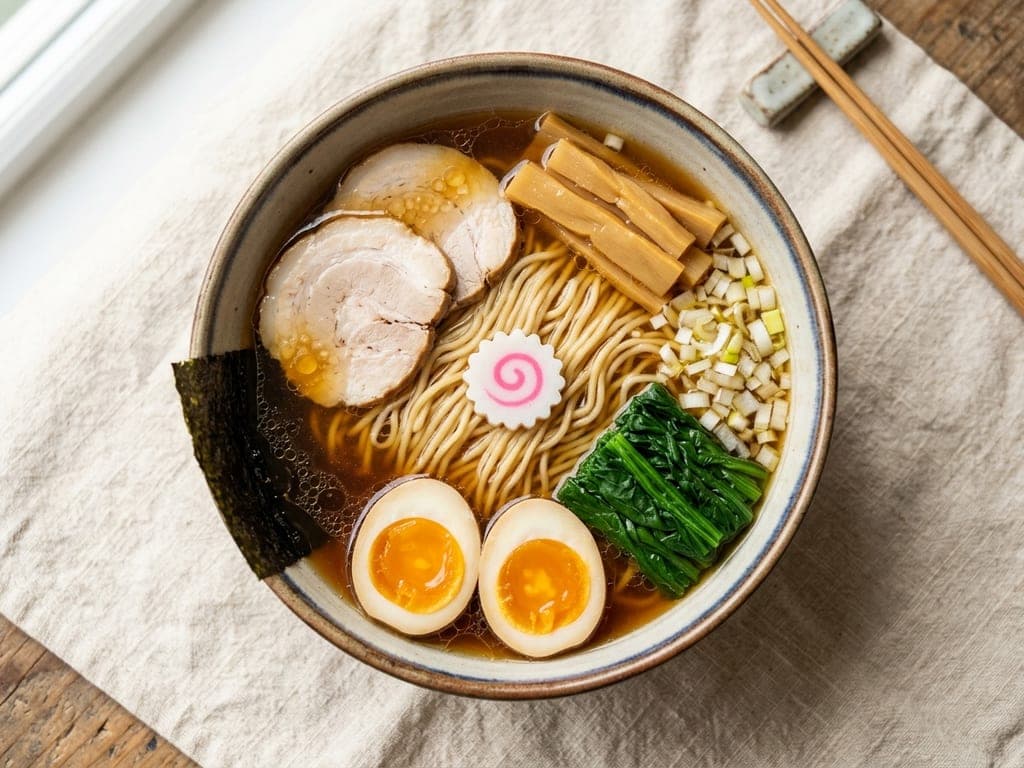
- Comb the noodles: lift and fold them so the strands lie parallel across the bowl — in a clear broth every strand is visible, and order reads as craft.
- Place toppings as a clock face — pork, menma, spinach, egg each holding a station — so the bowl reads composed from above, where the camera and the eater both sit.
- Centre the narutomaki coin last, flat on the noodles, spiral up: it is the bowl’s logo, and off-centre it just looks like it fell there.
- Wipe the rim and check the surface before serving — in shoyu the broth IS the presentation, and one stray drop or film of oil on the rim breaks the transparency spell.
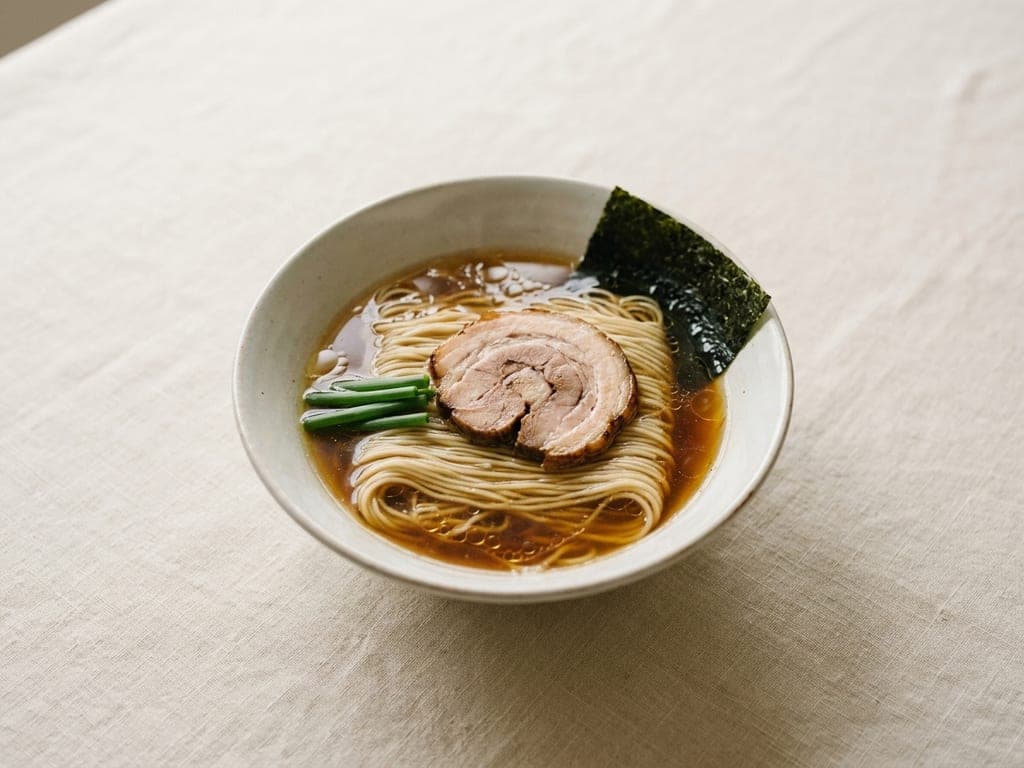
- Choose a wide, shallow bowl in a pale glaze — clarity is the exhibit, and depth plus dark ceramic would hide the one thing this plating is about.
- Pour the broth down the bowl’s side, not over the noodles, so the surface arrives still and the oil droplets sit in distinct gold circles rather than a broken sheen.
- Lay the single chashu slice half-on, half-off the noodle fold — one element placed with intent reads as a statement; centred, it reads as a shortage.
- Resist every garnish impulse past the three scallion lengths — the empty amber surface is the design, and each addition spends clarity you cooked three hours for.
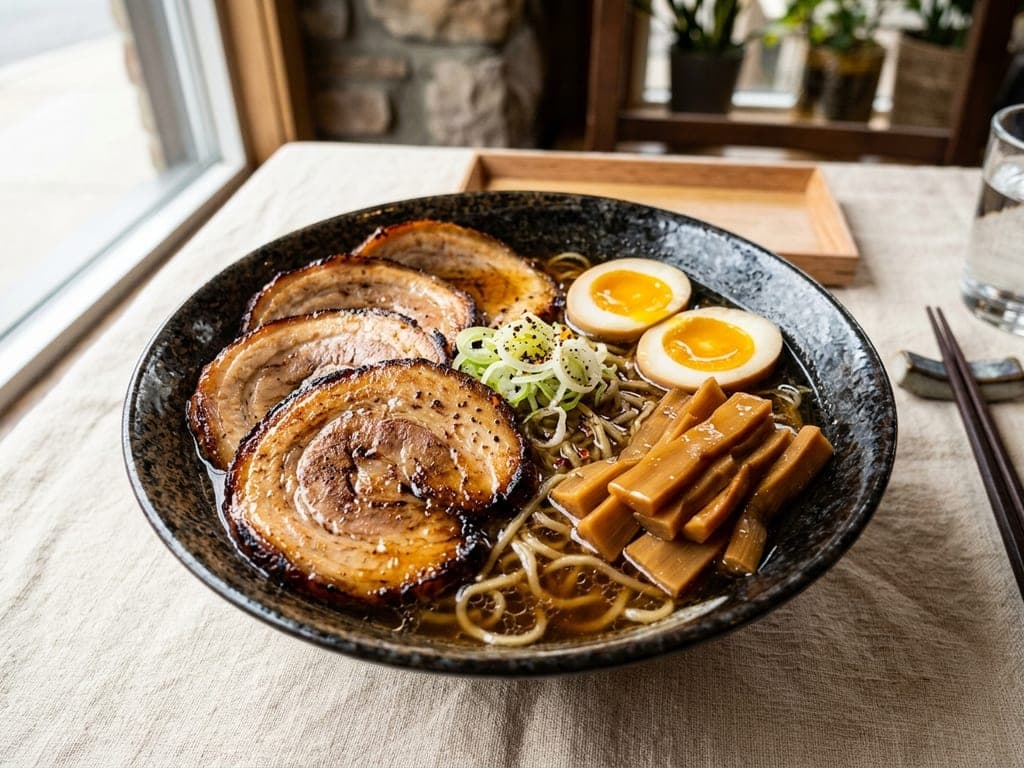
- Fan the chashu slices in an overlapping crescent covering half the surface, edges aligned — a fan is abundance with geometry; a pile is just lunch.
- Mirror the fan with the egg halves and menma sharing the other half, yolks facing centre, so the bowl splits into a warm side and a bright side.
- Torch or hard-sear the chashu edges just before plating if you can — the caramelised border against clear broth is the contrast this bowl is built on.
- Finish with the aroma oil spooned deliberately over the pork rather than the broth — the slick makes the meat gleam, and the first chopstick pull drags perfume across the whole bowl.
Chintan: clarity as a discipline
Japanese broth-making splits down one line: chintan, clear soup, and paitan, white soup — and the difference is nothing but violence. Collagen, fat and heat are the same in both pots; what changes is agitation. Boil hard and you shear melting fat into suspended droplets that scatter light — that is tonkotsu’s whole engine, explained on its own page. Hold the pot below a simmer, where the surface trembles but never churns, and fat rises to be skimmed while the liquid underneath stays transparent as tea. Same physics, opposite settings. The two pages are one lesson taught twice.
In practice chintan is a patience test with three rules. Start from cold water, so proteins coagulate slowly into skimmable rafts instead of dispersing. Skim seriously in the first twenty minutes, then stop fussing — late scum is minimal if the heat is honest. And never let it boil, including at the end, including the reheat: thirty seconds of rolling can cloud three disciplined hours. (If it happens, the soup is not ruined, merely humbler — cloudy chicken broth is a fine thing that is no longer quite this dish.)
Tokyo adds one structural idea: the double soup. The animal broth and the sea broth — kombu and katsuobushi dashi — are made separately and combined only at service, roughly four to one, because three hours of chicken would flatten the dashi’s top notes if they shared a pot. It is more counter space, not more work, and it is why a Tokyo bowl tastes layered rather than blended: bird underneath, smoke and sea on top, soy lighting both.
The two vials: tare and aroma oil
Watch a ramen cook build a bowl and the broth arrives last, not first. Into the empty bowl go two measured pours — a dark one and a gold one — and everything the eater will name when they praise the soup is already sitting there before any broth appears. The dark pour is the tare: soy sauce that has been rounded with mirin, sake and a breath of sugar, then steeped with kombu and katsuobushi until it is less a condiment than a concentrate of the whole cuisine. Broth carries body; tare carries identity. Keeping them apart until the bowl is why a shop can run one stockpot and serve three menus — and why your batch of unseasoned broth in the freezer stays so flexible.
The gold pour is the aroma oil, and it is the vial home recipes skip — which is identifiable from across the room, because the oil is the part you smell. Fat carries volatile aromatics that water cannot; a spoonful of chicken fat in which scallion greens were fried to the edge of browning floats to the surface, glosses every strand of noodle on its way out of the bowl, and delivers scent a half-second before flavour. It is ninety seconds of work with trimmings you already own, and it is the loudest single upgrade in this entire cluster.
The construction also explains how to taste-correct like a cook instead of a gambler: broth bland? More tare, in the bowl, per eater. Aroma flat? More oil. Body thin? That was the stockpot, and no bowl-side pour fixes it. Three variables, three levers, no mystery.
The weeknight bowl, and shopping the Tokyo set
The honest 45-minute version exists and is worth having: chicken wings — one of the most collagen-rich parts of the bird for the money — barely simmered 40 minutes with a slice of ginger make a light but genuine chintan; instant dashi stands in for the steep; the tare and oil are already in your fridge because you made them Sunday in fifteen minutes flat. It will not have the three-hour version’s spine, and it will still beat anything on the block, because tare and aroma oil — the identity and the perfume — are at full strength either way. That asymmetry is the entire trick of ramen economics: the slow parts store, the fast parts shine.
Shopping is one Asian-grocery basket. Noodles: medium-thickness, curly — the Tokyo spec; chilled or frozen by preference, dried without shame. Menma is a jar or pouch, done. Narutomaki lives in the freezer case near the fishcakes; one log garnishes twenty bowls and keeps frozen for months. Katsuobushi and kombu are pantry staples with year-long lives; mirin and sake, the real versions rather than “seasoning” bottles if the shelf offers both. Soy sauce is the one to spend on — it is the dish’s surname. A koikuchi (standard dark) of good pedigree is right; save tamari for dipping and the pale usukuchi for the day you chase Kyoto refinement.
Europe-specific notes: every one of these items ships from the big Asian online grocers if the nearest shop is far; “spring onions” are scallions; and if the freezer case offers only unlabelled white fishcake logs, look for the pink spiral through the wrapper — narutomaki is the only one wearing lipstick.
Questions, answered
What does shoyu ramen mean — what am I actually ordering?
Shoyu is soy sauce, and the word names the TARE — the seasoning concentrate in the bowl — not the broth. A shoyu bowl is typically clear chicken-and-dashi broth seasoned with a soy tare; shio (salt) and miso are the sibling tares, and tonkotsu names a broth instead, which is why the menu categories feel inconsistent — they are labelling different layers of the same bowl. Our tonkotsu and miso pages map the other branches.
How do I keep the broth clear?
Never let it boil — that is nearly the whole answer. Start the chicken in cold water, bring it only to the point where the surface trembles, skim the first twenty minutes’ foam, and hold it there for the duration, including reheats. Clouding is emulsification, emulsification is agitation; the white bowls do it on purpose, and one hard rolling minute can undo a clear afternoon.
What soy sauce should I use?
A good koikuchi — standard Japanese dark soy — is the correct default; it is the style’s namesake and its backbone. Skip the “less sodium” bottles here (the tare model already portions salt per bowl) and skip Chinese dark soy, which is heavier and sweeter and belongs to other dishes. If you own one great soy sauce, this tare is where it shows; the mirin, sake and katsuobushi round it into something more than the sum.
What is menma?
Lacto-seasoned bamboo shoots — amber, faintly funky, pleasantly chewy — and the most traditional topping on the bowl after the pork itself. Nobody makes menma at home; shops buy it and so should you, in jars or pouches at any Asian grocer. Drain, pile, done. Fresh or tinned plain bamboo shoots are NOT the same object — if that is what the shop has, warm them briefly in a spoonful of the tare first.
What is the pink and white spiral thing?
Narutomaki — cured fish paste (surimi, the same family as seafood sticks) steamed in a log with a pink whirl, named for the Naruto whirlpools. It tastes of very little and signifies a great deal: the coin on the noodles is ramen’s most nostalgic image, Tokyo-style’s badge in particular. Freezer aisle, slices thin, optional — but the bowl does photograph better wearing it.
Can I use store-bought stock?
For the weeknight bowl, yes — a good low-sodium chicken stock plus instant dashi, with full-strength tare and aroma oil, makes an honest Tuesday ramen. What a box cannot bring is body: real chintan carries gelatine that gives the sip its faint cling, and boxes run watery. The fix is either the 40-minute wing broth (wings are cheap collagen) or accepting the trade with eyes open. Never buy “ramen broth” in a pouch and skip the tare — that inverts the one part worth owning.
What noodles fit shoyu ramen?
Medium and curly is the Tokyo spec — enough wave to hold the light broth, not so thick they bully it. Chilled or frozen ramen noodles from an Asian grocer first, dried second, a good instant brick third; the alkaline (kansui) chew is the non-negotiable, as everywhere in this cluster. Cook in plain unsalted water and drain like you mean it — clinging water is broth dilution on a schedule.
Can I make shoyu ramen ahead or freeze it?
Componentwise, beautifully: broth freezes in per-bowl portions for 3 months (unseasoned — that is the point of tare), tare keeps a month refrigerated, aroma oil a week (allium-in-fat is a short keeper — freeze it for more runway), chashu freezes sliced, menma and narutomaki outlast your interest. The assembled bowl keeps for the length of dinner and not a minute more. Ramen is a mise-en-place cuisine — the freezer is your stockpot annex, and Tuesday-you assembles in ten minutes.
Shoyu vs shio ramen — what is the actual difference?
Both usually sit over the same clear chintan; the tare differs. Shio (salt) tare is built on salt, often with citrus or seafood accents — the palest, most delicate reading of ramen, where the broth itself stands most exposed. Shoyu adds soy’s colour, roundness and faint sweetness — deeper, more forgiving, and the better first bowl to learn on. If your broth came out spectacular, try a shio bowl from the same pot: salt, a squeeze of yuzu or lemon, and honesty.
How many calories in a bowl?
About 550 as built — the leanest of our three ramen styles, which tracks the design: clear broth carries far less fat than emulsified white, and the richness arrives by the measured spoon of aroma oil rather than by the ladle. The oil is 100-odd of those calories and worth every one; halve the noodles, not the perfume, if you are trimming.
Snap your finished plate and let the AI plate it again — more beautifully.