Teriyaki Chicken Recipe (Glossy Pan Glaze, No Cornstarch)
The real method is faster than the shortcut: no marinade, no cornstarch — just chicken thighs seared plain, then glazed in the last minutes with a four-ingredient tare of soy, sake, mirin and sugar that reduces to its own glossy lacquer. The shine is caramelization, not starch. Bowl variation, thermometer numbers and the Seattle story included.
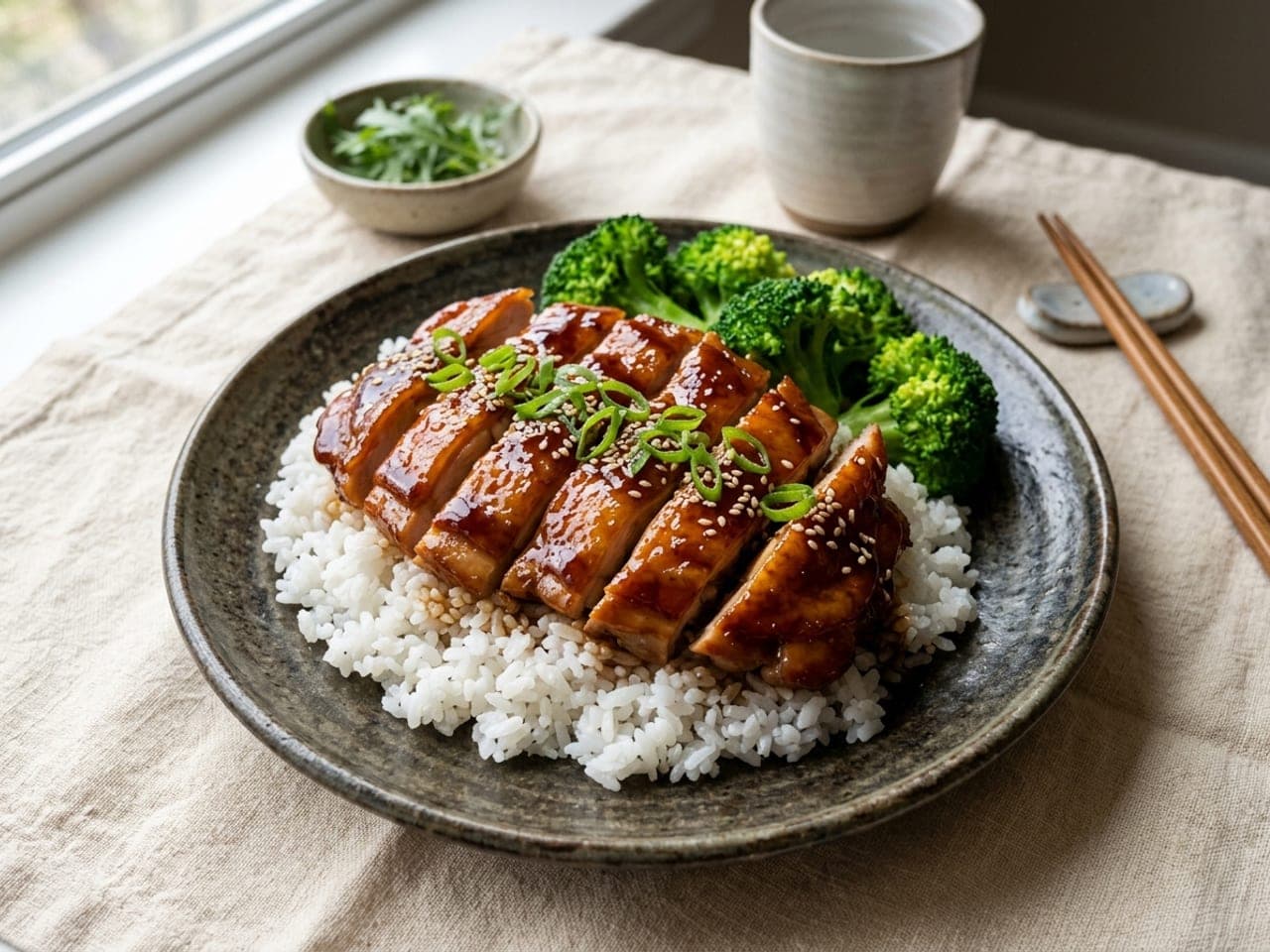
Ingredients
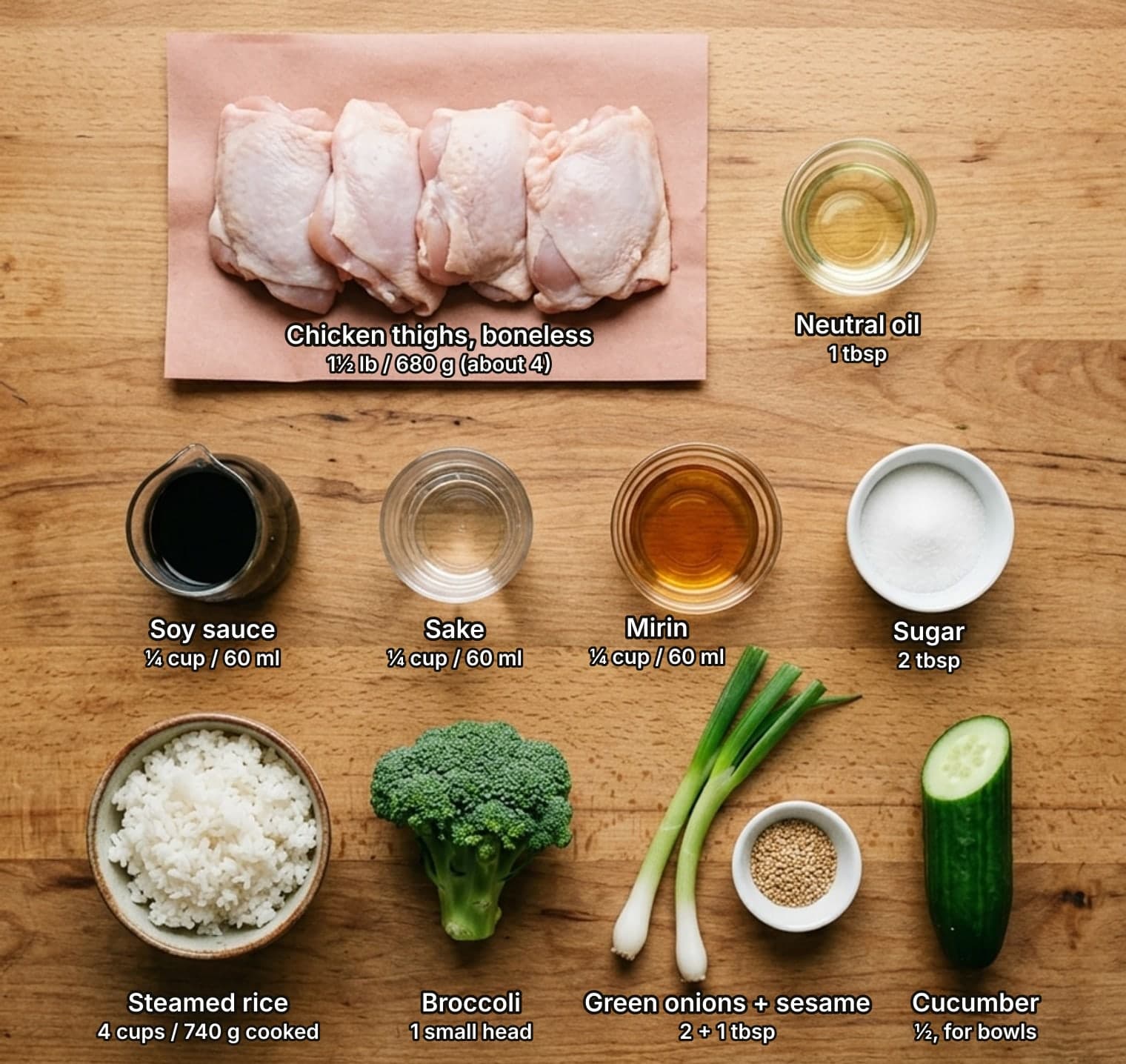
- boneless chicken thighs (skin-on if you can get them)1½ lb / 680 g (about 4)
- neutral oil1 tbsp
- soy sauce (Japanese all-purpose / koikuchi)¼ cup / 60 ml
- sake (or dry sherry)¼ cup / 60 ml
- mirin (supermarket mirin-style works)¼ cup / 60 ml
- sugar2 tbsp
- steamed short-grain rice, to serve4 cups / 740 g cooked
- broccoli, steamed, to serve1 small head
- green onions (spring onions), sliced2
- toasted sesame seeds1 tbsp
- cucumber, in ribbons (for the bowl variation)½
Glaze, not marinade — and never cornstarch
The three top-ranking versions of this recipe all thicken the sauce with a cornstarch slurry, and all three are solving a problem they created: a sauce built on water and cold pantry swaps has nothing to reduce into, so it needs starch to fake body. The traditional tare — soy, sake, mirin, sugar — thickens by itself in three minutes of honest reduction, and what you get is different in kind: translucent, glossy, intense, clinging to the chicken like varnish instead of sitting on it like gravy. Starch also clouds the finish and dulls the flavor. If you take one technique from this page, take this: pour the sauce into a hot pan at the end and let evaporation do the thickening.
The other quiet correction: authentic teriyaki isn’t marinated. Japanese home cooks season the chicken, sear it dry, and glaze it — the marinade version is a Japanese-American evolution that trades subtlety for a deeper cure, and it’s genuinely good in its own right, especially for the grill. We keep the two methods on two pages: this one glazes, and our teriyaki marinade page soaks. The teriyaki sauce page holds the make-ahead batch that serves both.
How to make Teriyaki chicken
- Start with thighs. Use 1½ lb (680 g) of boneless chicken thighs — skin-on if your butcher offers them, skinless works fine. Thighs are the forgiving cut here: their fat and collagen shrug off the extra minutes the glaze needs to reduce, where breast meat would dry out. Pat them very dry; dry chicken sears, wet chicken steams. (Breast version in the FAQ below.)
- Skip the marinade. This surprises people: the authentic Japanese method doesn’t marinate. Teriyaki is a finishing glaze, not a soak — dry-seasoned chicken sears better, and the sauce gets its whole say in the pan at the end. If you love the deeper-dyed, Western-style marinated version, that’s a legitimate variant — it lives on our teriyaki marinade page below.
- Mix the tare. Stir together ¼ cup (60 ml) each of soy sauce, sake and mirin with 2 tbsp of sugar until dissolved. That’s the entire sauce — the classic home tare runs 2:2:2:1, equal liquids with half as much sugar, and no garlic, no ginger, no thickener. Substitutions and the mirin label trap are covered in the sections below; a bigger batch that keeps for weeks is our teriyaki sauce page.
- Sear undisturbed. Set the chicken presentation-side down in a cold or barely-warm pan with 1 tbsp of neutral oil, then bring it up to medium — starting gentle renders the fat instead of scorching the surface. Leave it alone for 4–6 minutes until deeply golden, then blot away all but a film of the rendered fat with a paper towel; a greasy pan thins the glaze.
- Flip and cook through. Flip and give the second side about 3–4 minutes more. Poultry’s safe line is 165°F (74°C); thighs are actually at their best around 175°F (79°C), when the collagen has melted — a few degrees past “done” improves them, which is exactly why they suit this dish.
- Glaze late, over heat. Pour the tare into the hot pan and raise the heat. It will bubble hard — that’s the point. Turn the chicken every 30 seconds or so as the sauce reduces, painting both sides, for 2–3 minutes, until the tare has thickened to a syrup that coats the chicken and the back of a spoon. No cornstarch: starch clouds the sauce and mutes it. The shine — the teri in teriyaki — comes from mirin and caramelizing sugar, nothing else.
- Watch the last minute. The line between lacquered and burnt is about 30 seconds wide. When the bubbles turn large and glossy and the sauce leaves a trail behind the spoon, pull the pan off the heat — it keeps thickening as it cools. (Swapping honey or maple for the sugar? They cross that line even faster.)
- Rest, then slice on the bias. Give the chicken 2 minutes on a board, then slice it across the grain at a slight angle — wide, glossy slices that fan beautifully over rice. Spoon every last bit of pan glaze back over the top; it’s the sauce course and the varnish in one.
- Plate it — or bowl it. Classic plate: sliced chicken over steamed rice, broccoli alongside, green onions (spring onions) and toasted sesame over everything. The meal-prep favorite is one step further: rice in a bowl, chicken on one side, steamed broccoli and ribboned cucumber on the other — the teriyaki chicken bowl that half the takeout menus really mean.
Safety & hygiene Important
- 165°F (74°C) is the poultry line. All chicken is safe at 165°F (74°C) in the thickest part. For thighs, keep going to about 175°F (79°C) — safety and quality point the same direction here. For breast, pull at 160°F (71°C) and rest 3 minutes; carryover heat finishes the job without wringing it dry.
- The glaze is molten sugar. A reducing tare runs far hotter than boiling water, and it splatters as it bubbles. Turn the chicken with tongs, not fingers, keep the heat off the very last taste-check, and let the pan cool before it goes anywhere near a sink or a dishwasher’s hands.
- Raw-chicken traffic rules. The board and tongs that touched raw chicken don’t touch the finished dish — swap or wash them at the flip. If you took the marinated-variant route instead, never spoon used marinade over cooked food unless you’ve brought it to a full rolling boil for a few minutes first — the marinade page below has the full rules.
- Leftovers keep honestly. Cooked teriyaki chicken keeps 4 days refrigerated in an airtight box — the glaze actually helps, sealing the surface. Cool it within 2 hours of cooking, reheat until steaming, and reheat once. The plain tare itself, with no chicken through it, keeps 2–3 weeks in a clean jar — the full storage rules are on our teriyaki sauce page.
3 ways to plate it
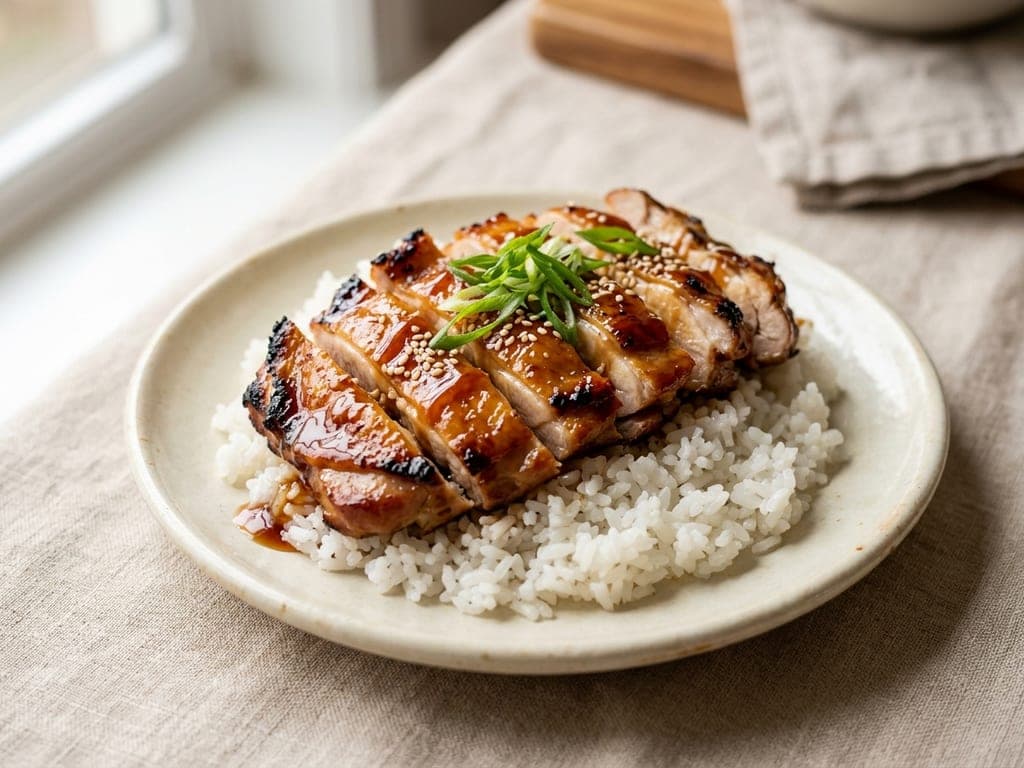
- Rest the thigh 2 minutes, then slice across the grain at a 45-degree angle into wide, even pieces.
- Lay the slices over the rice in one overlapping fan, glazed side up, keeping the fan’s curve deliberate.
- Spoon the last of the pan glaze along the fan in one slow ribbon — resist painting every gap.
- Scatter the sesame over the slices, then pinch the green onion into one tight cluster at the fan’s center — one concentrated point keeps the fan readable.
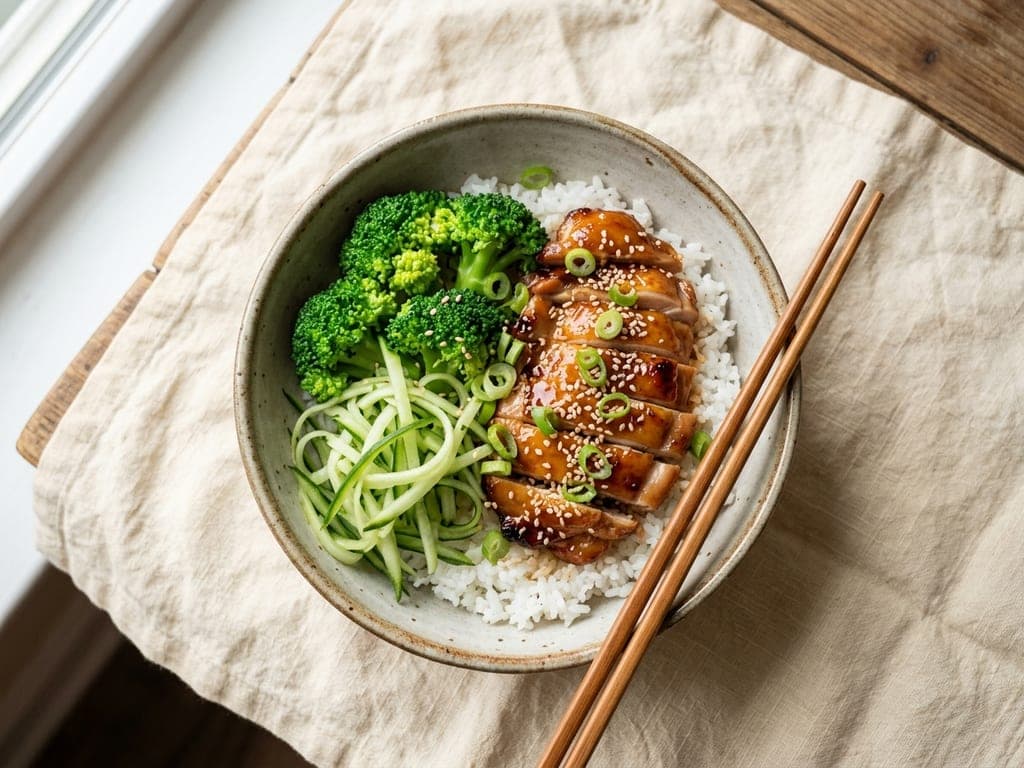
- Keep each element in its own zone — chicken at four o’clock, broccoli at ten, cucumber ribbons between; a bowl reads composed when nothing is stirred together.
- Slice the chicken before it goes in so the glazed faces tile upward, catching the light.
- Cut the cucumber into fine julienne and heap it rather than spreading it flat — height is what separates a bowl from a container.
- Finish with sesame over everything and rest the chopsticks across the rim; the bowl is dressed, not garnished.
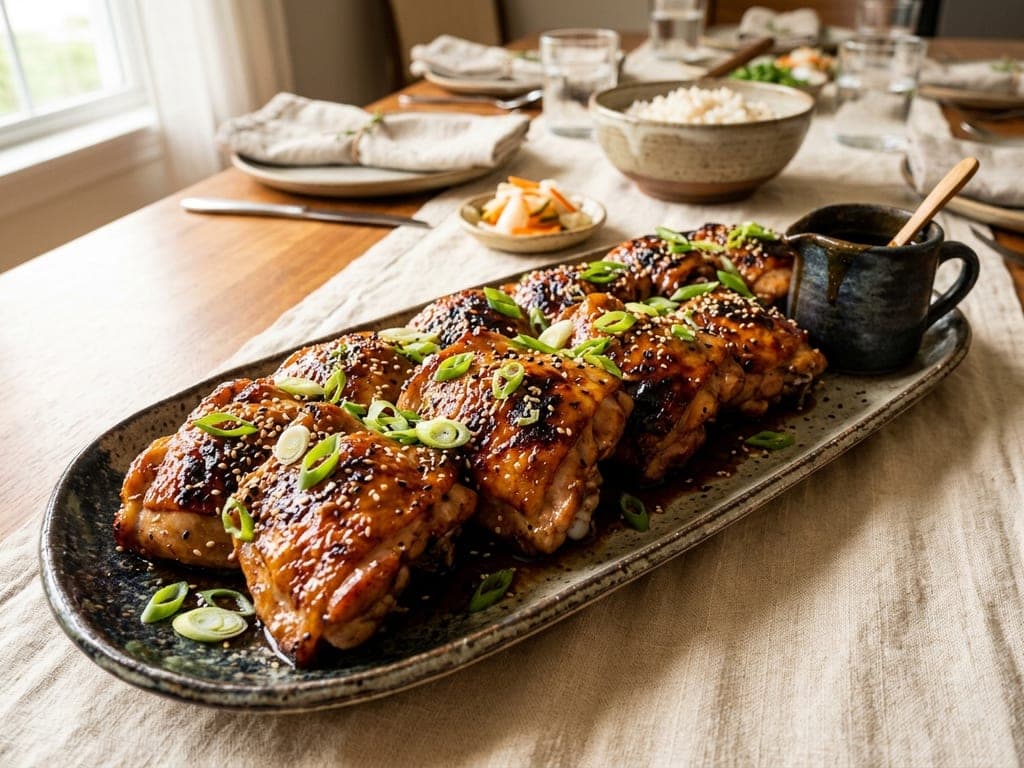
- Leave the thighs whole — the platter’s drama is the deep-lacquered surfaces, so slicing waits for the table.
- Overlap them down the platter’s length like fallen dominoes, each showing two-thirds of its glaze.
- Scatter green onion and sesame generously across the thighs — this is the one look in the set that wants abundance rather than restraint.
- Put warmed extra tare in a small jug at the platter’s end — pouring at the table is the hospitality gesture that sells the meal.
From Edo fish to Seattle fast food
Teriyaki is older than chicken teriyaki by about three centuries. The word describes a technique — teri is luster, yaki is grill — from Edo-period Japan, where cooks brushed fish like yellowtail with a soy-mirin glaze as much to keep it as to flavor it. Chicken entered the story with Japanese emigration: plantation workers in Hawaii sweetened the sauce with sugar and local fruit and put it on cheaper meats, and in 1961 Kikkoman launched America’s first bottled teriyaki sauce — developed for the American market, with its US employees whispering what the country wanted.
Then Seattle happened. On March 2, 1976, Toshihiro Kasahara — from Ashikaga, nine years after coming over to study business in Portland — opened Toshi’s Teriyaki on Lower Queen Anne, a block off Seattle Center: thirty seats, five menu items, a chicken teriyaki plate for $1.85, the sauce sweetened with sugar instead of mirin, most likely on cost. The formula — fast, cheap, grilled to order over rice — spread until teriyaki shops were a Seattle institution numbering in the hundreds across Western Washington, many opened by Korean immigrant families who learned and passed on the trade. By 2010 The New York Times was counting more than eighty teriyaki businesses inside the city limits and calling the dish “the closest this city comes to a Chicago dog.” So: the technique is Japanese, and the chicken teriyaki plate you’re picturing — rice, glaze, scallions, styrofoam clamshell — is Japanese-American, with a Seattle accent.
The thermometer paragraph nobody writes
Almost no ranking version of this recipe tells you a temperature, which is strange for a dish whose sauce needs more pan time than a thin cutlet wants. The numbers: chicken is safe at 165°F (74°C). Thighs improve past it — around 175°F (79°C) their collagen has melted into gelatin and the meat turns silky, which is why they can sit in the pan while the glaze reduces and come out better for it. Breast is the opposite: pull it at 160°F (71°C), rest it 3 minutes, and carryover heat lands it at the safe line still juicy.
That asymmetry is the whole thigh-versus-breast argument in two sentences. If you cook breast, cut it into even 1-inch (2.5 cm) pieces, sear them fast, and add the tare earlier so meat and glaze finish together — the diced-breast version is the true 15-minute weeknight route, it just demands you watch the clock instead of the collagen.
Shopping the Japanese aisle in Europe
Three bottles, three notes. Soy: you want Japanese all-purpose soy (koikuchi — the standard Kikkoman bottle, brewed in the Netherlands for Europe since 1997). Chinese light soy substitutes at a pinch; Chinese dark soy does not — it’s a molasses-heavy different animal that turns the glaze bitter and black. Mirin: most European supermarket “mirin” is mirin-style condiment — sweetened, low-alcohol, and completely fine for this dish. If you score true hon-mirin from an Asian grocer, it brings its own sugar: halve the added sugar and taste. Sake: any cheap drinking or cooking sake works; no sake, use dry sherry, or plain water with an extra pinch of sugar.
And the bottled-sauce question, answered without snobbery: bottled teriyaki is a legitimate pantry shortcut with sixty years of history behind it. The homemade tare simply costs thirty seconds, keeps for weeks (the batch recipe is on our teriyaki sauce page), and lets you decide how sweet dinner gets.
Questions, answered
What are the ingredients in teriyaki chicken?
Five things: chicken thighs and the four-ingredient tare — equal parts soy sauce, sake and mirin with half as much sugar. The authentic version has no garlic, no ginger, no cornstarch and no marinade; rice, green onions and sesame are the serving cast.
Do you add teriyaki sauce before or after cooking the chicken?
After the sear, in the pan, over heat — teriyaki is a finishing glaze. Sear the chicken nearly through first, then pour in the tare and reduce it for the last 2–3 minutes, turning constantly. Sauce added at the start burns its sugar long before the chicken cooks.
Do you need to marinate chicken for teriyaki?
No — the traditional method doesn’t marinate at all; dry chicken sears better and the glaze supplies the flavor at the end. Marinating is the Western-style variant: deeper color and cure, especially good for grilling. We keep a dedicated teriyaki marinade recipe for exactly that.
Can I use bottled teriyaki sauce?
Yes — and there’s history in that bottle: Kikkoman launched America’s first bottled teriyaki sauce in 1961. Warm it as a finishing glaze rather than a marinade for the best result. The homemade tare takes thirty seconds and lets you control the sweetness, but nobody’s dinner is ruined by the shortcut.
Thighs or breasts for teriyaki chicken?
Thighs, and it isn’t close: their fat and collagen ride out the glaze’s reduction time and actually improve at 175°F (79°C). Breast works as the fast version — dice it into 1-inch (2.5 cm) pieces, sear hard, glaze early, and pull it the moment it hits 160°F (71°C) to rest to a safe, juicy finish.
How do I thicken teriyaki sauce without cornstarch?
Reduce it. Pour the tare into a hot pan and let it bubble 2–3 minutes until it coats the back of a spoon — evaporation plus caramelizing sugar is the traditional thickener, and it’s where the glossy shine comes from. Cornstarch clouds the sauce and mutes the flavor; it exists in this dish only to rescue watered-down recipes.
Is teriyaki chicken actually Japanese?
The technique is — Edo-period cooks glazed fish with soy and mirin centuries ago, and teriyaki remains a standard Japanese home preparation. The chicken teriyaki plate with rice and scallions is Japanese-American: sweetened in Hawaii’s plantation kitchens, bottled by Kikkoman in 1961, and turned into an institution by Seattle’s teriyaki shops from 1976 on.
How many calories in teriyaki chicken?
As plated here — thighs, glaze, a bowl of rice and broccoli — about 560 calories per serving. The chicken and glaze alone run around 320. The tare’s sugar is the adjustable dial; the sodium (mostly from soy) is the number worth watching if that matters to you.
Can I meal-prep teriyaki chicken?
It’s one of the best meal-prep dishes there is: cooked chicken keeps 4 days refrigerated and reheats without drying, the tare keeps 2–3 weeks (make a double batch), and the bowl format — rice, chicken, broccoli, cucumber — packs and travels. Add the sesame and green onion fresh on the day.
How do I make a teriyaki chicken bowl?
Rice in a wide bowl, sliced glazed chicken over one half, steamed broccoli and ribboned cucumber over the other, extra glaze zigzagged across, sesame and green onion everywhere. It’s this exact recipe rearranged — the bowl is an assembly, not a different dish.
Snap your finished plate and let the AI plate it again — more beautifully.