Quiche Lorraine Recipe — Smoky Lardons, Silky Custard, Real History
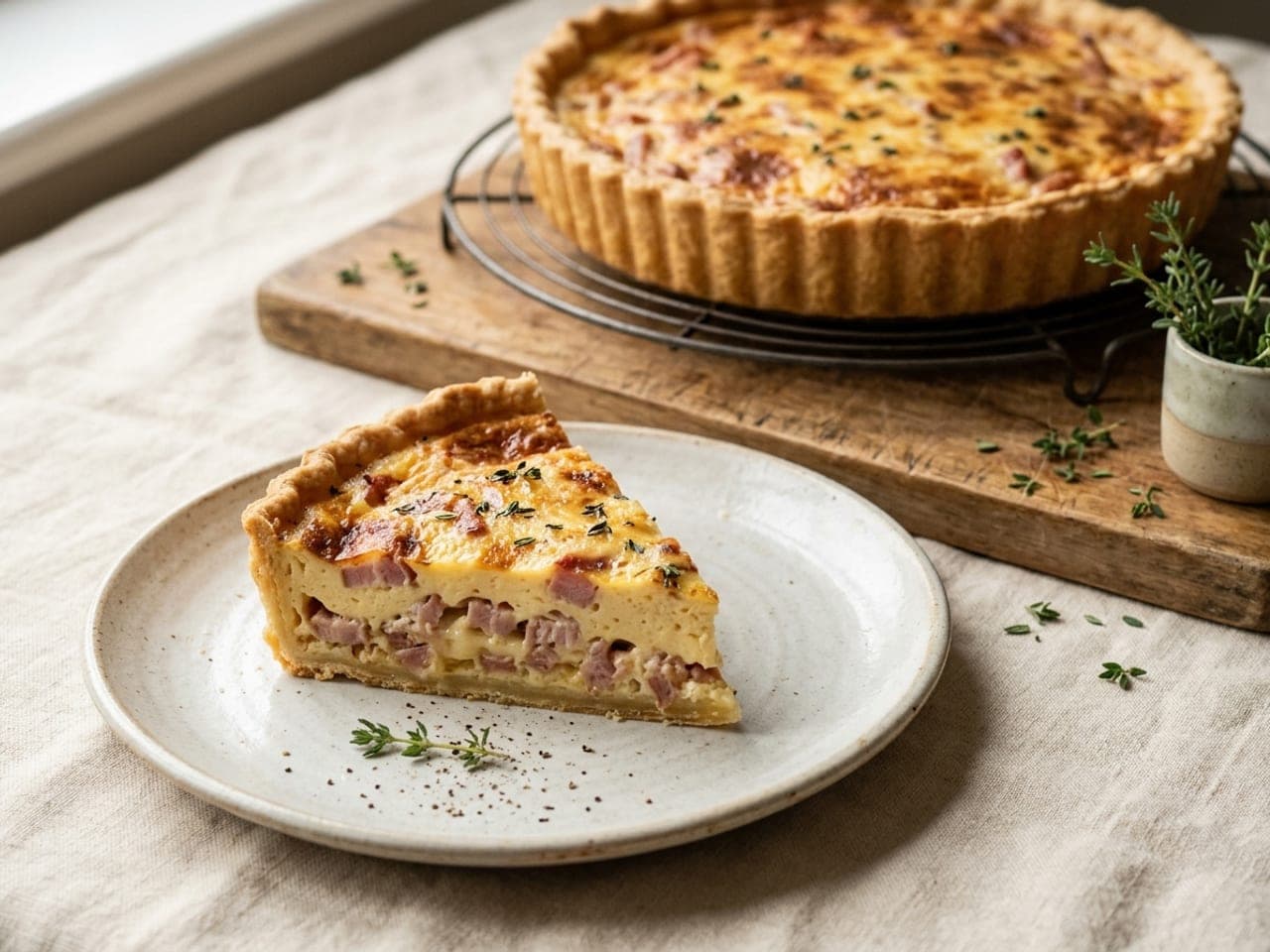
The quiche that named the genre: smoky lardons suspended in a rich cream custard inside crisp shortcrust, from the French region that borrowed the word from German and lent it to the world. The purist version is startlingly austere — eggs, crème fraîche, bacon, and not a gram of cheese — and this page teaches both that and the gruyère-laced modern standard, plus the lardon-blanching trick that keeps the smoke from shouting down the custard.
Ingredients
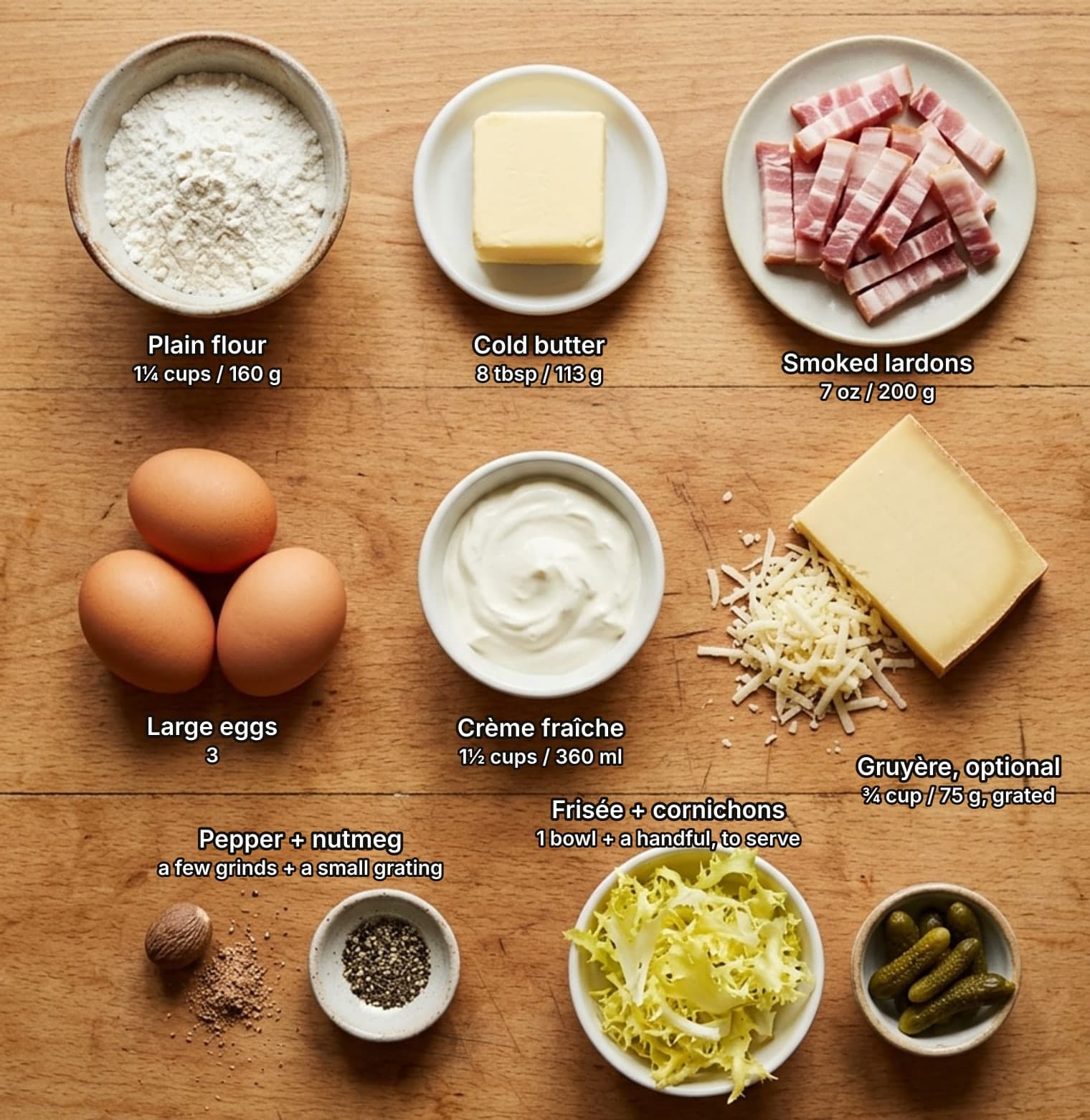
- plain flour (pâte brisée)1¼ cups / 160 g
- cold butter, cubed8 tbsp / 113 g
- fine salt (pastry only — the custard takes none)½ tsp
- ice water3–4 tbsp
- smoked bacon lardons (or thick-cut smoked bacon in ¼-inch / 6 mm batons)7 oz / 200 g
- large eggs (plus a brushed teaspoon for the crust seal)3
- crème fraîche (or heavy cream)1½ cups / 360 ml
- gruyère, grated (modern standard — omit for the purist original)¾ cup / 75 g
- black pepper and freshly grated nutmega few grinds + a small grating
- frisée salad and cornichons, to serve1 bowl + a handful
The quiche that named them all
Lorraine sits on France's north-eastern shoulder against Germany, and the dish wears the border in its name: quiche arrived from the German Kuchen — cake — through the regional dialect. The earliest versions, traced to the 16th century around Nancy (first documented in 1605, in the accounts of a Nancy hospice), were frugal bakery work: leftover bread dough stretched thin, covered with migaine — the local name for the egg-and-cream mixture — and baked hot. Shortcrust came later, and so did the bacon — a 19th-century addition, from a region that cured and smoked its pork as winter insurance; the lardons are what made it a meal.
The austerity is the point. The traditional quiche lorraine is eggs, crème fraîche and smoked lardons in pastry — no cheese, no onion, nothing else — and Lorraine's food purists defend that roster with real feeling. Cheese arrives with the neighbours: the Vosges version adds it, and onion belongs to the Alsatian tarte next door. What the world now sells as quiche lorraine — gruyère melted through, sometimes onions — is really a family portrait of the whole region. This page builds the gruyère version by default because it is what most kitchens want, and keeps the purist build one omission away, clearly marked.
Either way, the dish's conquest of the world ran through the same logic as its birth: cheap staples, one luxurious texture. By the time it reached mid-century Britain and America it had become shorthand for French sophistication — a fate the bakers of Nancy, stretching leftover dough, could not have seen coming.
How to make Quiche Lorraine
- Make and chill the pâte brisée. Work 8 tbsp (113 g) of cold cubed butter into 1¼ cups (160 g) plain flour and ½ tsp fine salt until the biggest butter pieces are pea-sized, bring it together with 3–4 tbsp of ice water, press into a disc, wrap and refrigerate at least 30 minutes. The full pastry doctrine — why cold, why rest, why visible butter — lives on the master quiche page; the Lorraine only insists the shell be unsweetened and blind-baked, because its custard is the richest in the family and deserves a floor that stays crisp.
- Roll, line, freeze. Roll the cold dough to a 12-inch (30 cm) round about ⅛ inch (3 mm) thick and settle — never stretch — it into a 9-inch (23 cm) tart tin. Trim, prick the floor with a fork, and freeze the lined tin 15 minutes while the oven heats to 375°F (190°C). Stretched or warm dough shrinks down the tin walls mid-bake, and a shrunken shell cannot hold a three-egg custard: this is the step where overflow is prevented.
- Blind bake and waterproof. Bake the frozen shell — tin set on a baking sheet that stays with it to the end — lined with parchment and pie weights for 20 minutes, remove paper and weights carefully — they are at full oven heat — then bake naked 5–8 minutes until the floor is dry and lightly golden. Brush the hot floor with a teaspoon of beaten egg and give it 1–2 minutes more to set into a glaze. Drop the oven to 350°F (175°C). The varnish matters more here than on any other quiche: cream custard is the wettest of them all.
- Blanch the lardons — the step French grandmothers refuse to skip. Put 7 oz (200 g) of smoked bacon lardons (thick-cut smoked bacon sliced crosswise into little batons works exactly, if the labelled thing is missing) in a small pan, cover with cold water, bring to a simmer and give them 3 minutes; drain and pat dry. The blanch pulls out the brine-salt and softens the smoke so the bacon seasons the custard instead of dominating it — skip it and the quiche eats one note louder and considerably saltier, which is also why no extra salt goes into this custard.
- Brown the lardons. Dry the pan, return the blanched lardons over medium heat, and cook 5–7 minutes, stirring now and then, until they are lightly golden with their fat rendered — supple, not shattered; crisp-fried bacon bits turn to gravel inside soft custard. Lift them out with a slotted spoon onto paper towels and let them cool while you build the custard. The rendered fat is cook's treasure — but not for this dish; save it for fried potatoes.
- Whisk the migaine. The Lorraine name for the custard is migaine, and the regional build is the family's richest: whisk 3 large eggs with 1½ cups (360 ml) of crème fraîche (or heavy cream, or half cream half whole milk for a lighter hand), a few grinds of pepper and a small grating of nutmeg. No salt — the lardons carry it, even blanched. Whisk to combine, not to froth; foam bakes into holes, and this custard's whole ambition is silk.
- Assemble — bacon, the contested cheese, then custard at the oven. Scatter the cooled lardons over the crust floor, then — modern standard, purist heresy, your call — ¾ cup (75 g) of grated gruyère. Set the tin on its hot baking sheet on the oven rack — rack pulled halfway out, poured, then slid gently home; never reach into the hot cavity with a full jug — and pour the migaine over, stopping a couple of millimetres below the rim. The purist version simply omits the cheese, and it is genuinely worth trying once: without gruyère the smoke and cream argue more clearly, and you can taste why the dish conquered Europe with three ingredients.
- Bake to the wobble. Bake at 350°F (175°C) for 35–40 minutes until the edges are puffed and the centre sways like just-set jelly when nudged — about 160°F (71°C) on an instant-read thermometer, the food-safe mark for egg dishes. The top should be patched gold and brown; if it is browning ahead of the set, loosely tent foil over it. Overbaked lorraine weeps — the cream squeezes out and puddles — so trust the wobble over the clock and the colour.
- Rest, then serve warm with something sharp. Rest on a rack 20–30 minutes; the custard finishes setting as it cools, and warm — not hot — is where lorraine's smoke and cream are loudest. Serve with bitter dressed leaves (frisée is canonical) and cornichons; the region would add a cold glass of local white. Room temperature the next day, it might be even better — one of the few dishes improved by a night of thinking about what it did.
Safety & hygiene Important
- Smoked is not cooked. Lardons and bacon are cured and smoked at temperatures too low to cook them through — the USDA files bacon under not-ready-to-eat — so treat them as raw pork until the pan says otherwise, and the blanch does not change that (3 minutes at a simmer is a seasoning adjustment, not doneness). Handle them like raw meat: board and knife washed after, hands too — the raw eggs and cream deserve the same courtesy (crack on the counter, not the bowl rim; dairy chilled until the whisk). Brown the lardons fully anyway: supple, rendered, cooked-through is both the safe version and the texture the custard wants.
- Bacon fat and the burner have history. Rendering lardons leaves a pan of hot fat that spits at any drop of water and lights if badly overheated. Keep the heat at medium — rendering wants patience, not power — slide the pan OFF the burner before pouring fat out, and never pour it down the drain hot (or cold, says the plumber). If fat ever does flame: burner off, lid on, pan unmoved — and the lid stays on until the pan is stone cold, because uncovered too soon it can re-ignite. Never carry a burning pan, never a damp towel, and water turns a pan fire into a wall fire. The quiche is French; the fire safety is universal.
- The custard's number is 160°F (71°C). Egg dishes are food-safe at 160°F (71°C), and the centre of the quiche should read exactly that as it leaves the oven — conveniently the same point where the wobble is right. A cream-rich custard in a deep tin can brown handsomely on top while the middle lags, so the thermometer outranks the eye here. Under temperature, it needs minutes more under a foil tent; there is no version of gently raw custard that is worth serving.
- Rich custard keeps short hours. Cream, eggs and pork make the perfect bacterial buffet, so the lorraine lives by the 2-hour room-temperature rule (1 hour above 90°F / 32°C). Leftovers go covered to the fridge within that window and hold 3–4 days; reheat slices to steaming — 165°F (74°C) — in a 325°F (163°C) oven. It also freezes surprisingly well for 2 months, wrapped tight. What it does not survive is an afternoon on the buffet followed by optimism.
3 ways to plate it
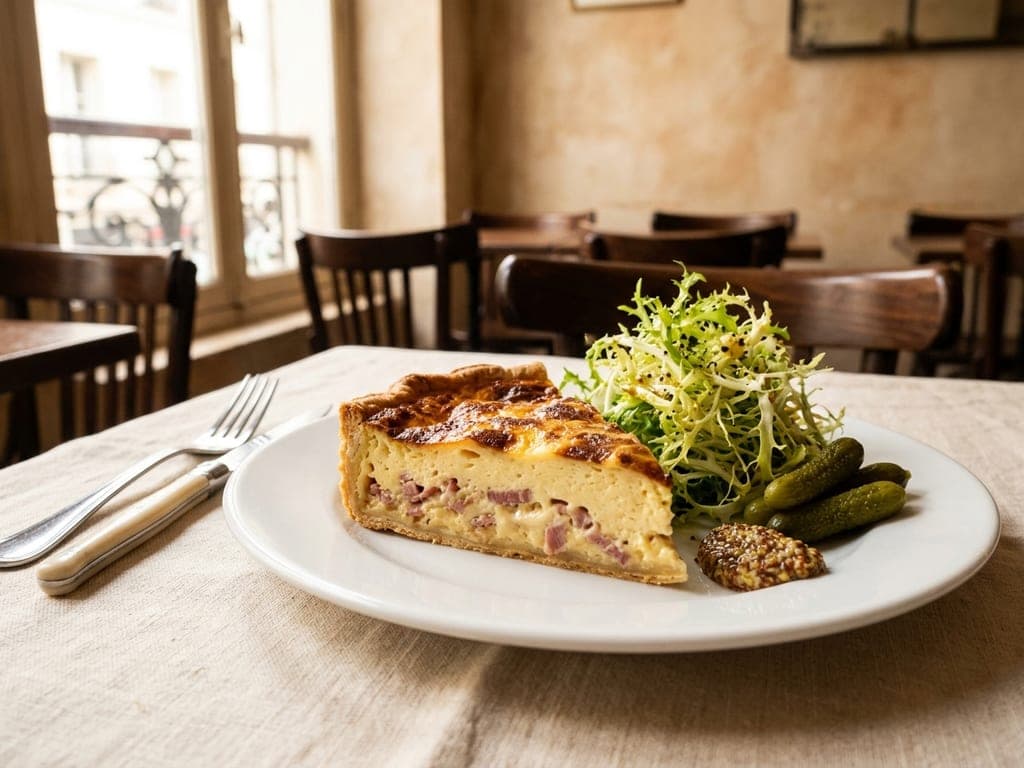
- Cut with a thin knife wiped between slices so the custard face shows its suspended lardons cleanly — the cross-section is the dish's ID card.
- Plate the wedge off-centre, point toward the diner, and resist warming it past barely-warm: hot lorraine tastes half as loud.
- Pile the dressed frisée as tall as the wedge — the bitterness is a co-star with equal billing, not a garnish.
- Line up three cornichons and a small spoon of grainy mustard at the rim; the vinegar hits are what send the fork back.
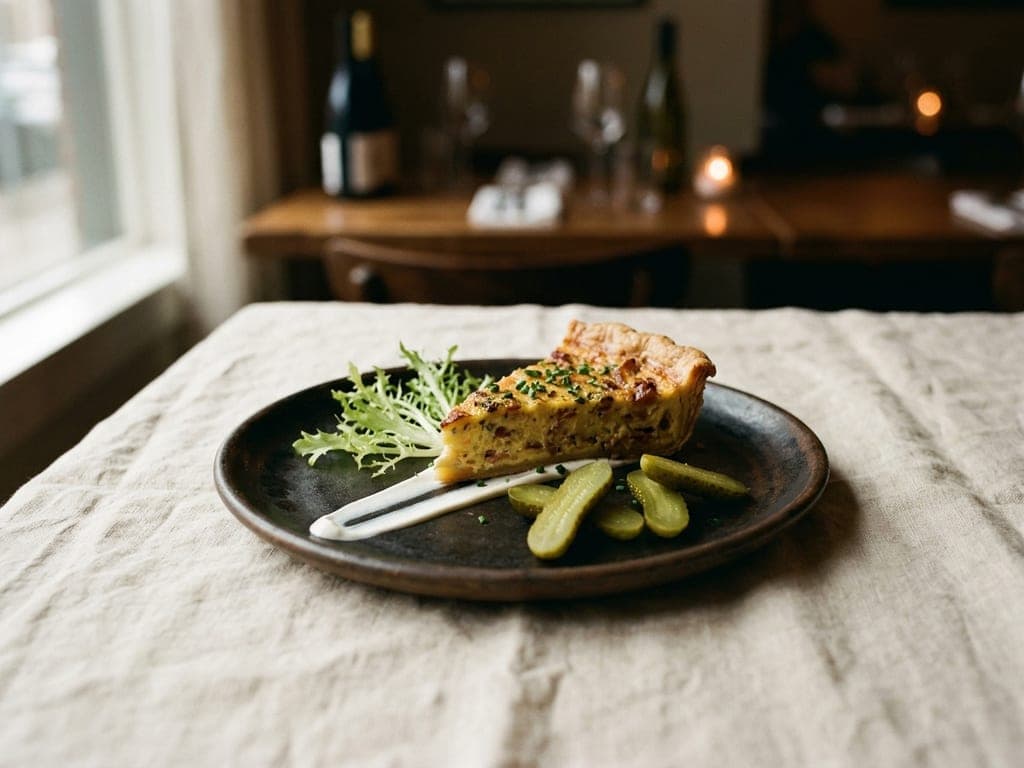
- Cut a half-width wedge — wine-bar portions ask for a second glass, not a nap.
- Pull a stripe of crème fraîche across the plate with the back of a spoon and land the wedge's point on it — cool cultured cream against warm smoky custard.
- Tuck three frisée fronds under the wedge's long side so the green lifts the slice without hiding the cut face.
- Halve cornichons lengthwise and scatter them cut-side up — more vinegar surface, prettier scatter.
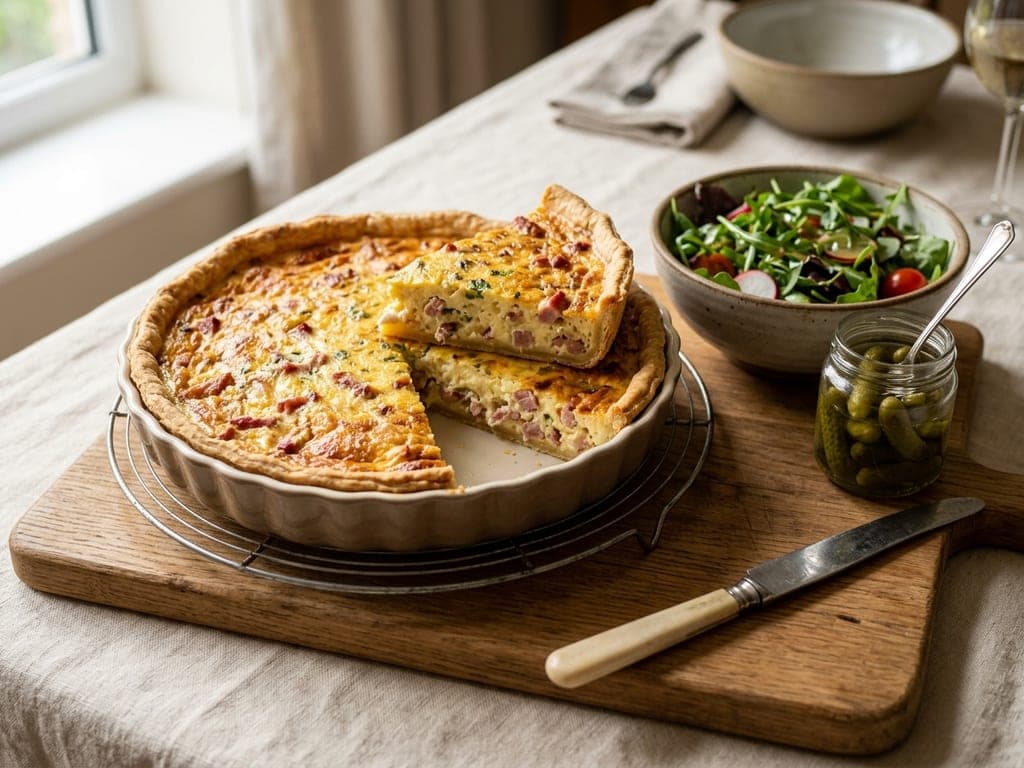
- Serve from the rack it cooled on, set over a board — air under the crust keeps the base crisp through lunch (a lunch that stays inside the custard's 2-hour window), and the workshop look is honest.
- Cut one wedge ahead and lean it against the tart's edge, cut face out — the reveal does the inviting.
- Put the salad in one shared bowl and the cornichon jar on the board, open, fork in the jar, no ceremony.
- Lay the knife across the board's corner pointing at the gap in the tart — Sunday choreography for continue without asking.
Lardons, and how to shop for them elsewhere
A lardon is a baton of cured pork belly — smoked (fumé) for the lorraine, though French supermarkets sell smoked and unsmoked (nature) side by side — think of it as bacon with a third dimension. The shape is functional: cubes and batons stay juicy inside the custard where thin rashers dry to paper, and they distribute through the slice instead of layering. In France they are sold labelled and ready; elsewhere, buy the thickest-cut smoked streaky bacon available and slice it crosswise into ¼-inch (6 mm) sticks, or ask a butcher for a single slab piece and cut batons like small dice. American thick-cut smoked bacon is nearly exact; unsmoked pancetta gives the cure without the smoke — pleasant, but it makes a different, softer-spoken quiche.
The blanch is the technique the SERP skips and the French consider table stakes: three minutes in simmering water pulls excess salt and coarse smoke out of the pork before it browns. Julia Child taught Americans the same move for every French bacon dish, and the logic holds here better than anywhere — the custard is delicate, the bacon is loud, and blanching turns the volume knob. It is also why this recipe adds no salt at all to the custard: even blanched, lardons and gruyère season the whole tart from inside.
Render gently after blanching, and stop at light gold. The lardon should finish supple — cooked through, edges toasted, centre tender. Deep-fried crunchy bacon is a virtue in a sandwich and a flaw in a custard, where it eats like gravel in silk and keeps neither texture past the first hour.
Migaine: the custard at its richest
Lorraine's custard runs the master ratio — 1 egg per ½ cup (120 ml) of dairy — at the creamy extreme of the dial: traditionally all crème fraîche, the thick cultured cream of eastern French farm kitchens. Its gentle lactic sourness is the quiet secret of a real lorraine, cutting the pork's richness the way the salad on the plate cuts the tart's. Heavy cream lands close (a teaspoon of lemon juice whisked in closes half the gap); half cream, half whole milk gives the lightest version that still deserves the name.
Rich custard is fragile custard. The more fat and the less water, the narrower the window between silk and split — which is why the lorraine, more than any quiche, leaves the oven at a wobble and finishes on the rack. It is also why the eggs are whisked to combine rather than beaten: air is structure the custard doesn't want, puffing it soufflé-high in the oven and collapsing it wrinkled on the counter. Flat, glossy, barely-set is the target picture.
Season like a minimalist: pepper, a small grating of nutmeg, and no salt — the bacon and cheese are the salt. Taste discipline this severe feels wrong while whisking and proves right at the table, where the custard reads clean against the smoke. If a finger-dip of the raw mix tastes properly seasoned, the baked slice will eat salty; raw custard should taste slightly under.
The cheese question, answered honestly
No self-respecting page about quiche lorraine gets to dodge it: the original has no cheese, and the version nearly everyone loves has gruyère. Both facts are true; the fight between them is the most Franco-French argument in the baking canon. The purist case: without cheese, the dish is a duet — smoke and cream — and you can actually hear both. The pragmatist case: gruyère's nutty salt deepens the custard, browns the top, and is what quiche lorraine has meant to the rest of the planet for seventy years.
Our default build includes ¾ cup (75 g) of gruyère and admits it plainly. Comté is the closest stand-in (same mountain-cheese family, slightly sweeter); Emmental melts prettier and tastes shyer; sharp white cheddar works in a pinch and shouts a little. Pre-grated bagged cheese, dusted with anti-caking starch, melts waxy — grate from a block, it takes one minute.
But try the austere version once, on a day the lardons are good: eggs, crème fraîche, bacon, pastry. It is the rare case where subtracting an ingredient makes a dish taste more expensive — and afterwards you will hold the cheese debate with the confidence of someone who has actually eaten both sides of it.
Questions, answered
Does traditional quiche lorraine have cheese?
No — the traditional Lorraine build is eggs, crème fraîche and smoked lardons in pastry, full stop. Cheese belongs to the neighbouring Vosges variant, and onion to the Alsatian tarte next door; the gruyère-laced version the world knows is a happy regional blur. This page bakes the gruyère version by default and marks the purist build clearly — it is one omission away, and worth meeting at least once.
What are lardons, and what do I use outside France?
Batons of cured pork belly, smoked for the lorraine (France shelves lardons fumés and unsmoked nature side by side) — bacon in three dimensions, cut so it stays juicy inside the custard. Closest substitutes, in order: thick-cut smoked streaky bacon sliced crosswise into ¼-inch (6 mm) sticks; a slab of smoked bacon diced into batons by you or a butcher; unsmoked pancetta if smoke must be forfeited (a softer-spoken quiche, still good). Thin pre-sliced bacon works at a texture cost — it bakes to papery flecks rather than tender batons.
Why blanch the lardons first?
Three minutes at a simmer pulls out excess cure-salt and the coarsest smoke, so the bacon seasons the custard instead of steamrolling it — the same trick French cooking applies to bacon in coq au vin. It is also the reason this custard takes no added salt. Skipping the blanch does not ruin the quiche; it just makes a saltier, one-note version, and the fix costs three minutes and a small pan.
Crème fraîche or heavy cream?
Crème fraîche is traditional and slightly better: its gentle cultured sourness cuts the pork the way vinaigrette cuts the tart. Heavy cream is a very close second — add a teaspoon of lemon juice to nod at the tang. Half cream, half whole milk gives the lightest custard that still deserves the name. What the lorraine refuses is the low-fat ladder: this is the richest quiche in the family on purpose, and lean dairy sets it rubbery.
Can I add onions?
You can — and in Lorraine they would gently tell you that you have made something Alsatian. Onion belongs to the tarte of the neighbouring region, not the lorraine; the purist roster is bacon, eggs, cream, pastry, and its austerity is the dish's signature. If onions call to you anyway, caramelise them properly (the master quiche page shows how) and enjoy your excellent, differently-named tart with our blessing.
Why did my quiche lorraine curdle or weep?
Overbaking, almost every time — cream-rich custard has the narrowest window in the quiche family between silky and split. Egg proteins clench past about 160°F (71°C) and wring their moisture out, and the puddle under the slices is that moisture. Pull the tart when the centre still sways like set jelly and let carryover finish it on the rack. Second suspect: unblanched, undrained lardons adding their own water and salt to the equation.
How do I know when it is done?
Nudge the tin: the edges stand set and slightly puffed while the centre 2 inches (5 cm) sway together like just-set jelly — and an instant-read thermometer in the middle says 160°F (71°C), which is also the food-safe number for egg dishes. Colour is a liar here: the cream custard browns handsomely on top well before the middle sets in a deep tin. If the top races ahead, tent foil over it and keep baking to the wobble.
Can I make it ahead or freeze it?
Gladly — lorraine may be the best make-ahead in the quiche family. Bake the day before, cool, refrigerate covered, and serve at room temperature or rewarmed at 325°F (163°C) for 15 minutes; the smoke deepens overnight. Baked and wrapped tight, it freezes 2 months (thaw in the fridge, refresh in the oven — never the microwave, which rubberises custard). The only unworkable shortcut is holding raw custard in the raw shell: the crust drowns.
What do you serve with quiche lorraine?
Bitter leaves and something pickled: frisée in a sharp mustard vinaigrette is the canonical plate, cornichons the canonical sidearm — the quiche is smoke and cream, and everything beside it should bite. In its home region the glass is a cold local white; Alsace riesling or pinot blanc carries the same idea anywhere. As a lunch with salad it feeds six to eight; cut slim as a first course, a 9-inch tart stretches to ten.
How many calories in a slice?
About 520 for an eighth of the gruyère build — the crème fraîche, bacon and pastry stack up; this is the richest quiche in the family and proud of it. The purist no-cheese version trims roughly 40 calories a slice and loses none of its identity. For a genuinely lighter custard dish the honest move is the crustless quiche's page, not a low-fat lorraine — lean dairy breaks exactly the silkiness that makes this dish worth its price.
Snap your finished plate and let the AI plate it again — more beautifully.