Katsu Curry Recipe (Real Japanese Curry From Scratch — or the Block, No Shame)
Japan's national comfort dish: a glossy, mahogany, roux-thickened curry — sweeter and rounder than anything Indian, by way of the British Navy — flooding half a plate of rice, with a panko-crusted cutlet laid across the border so the crust stays loud. This page makes the curry honestly from scratch, defends the store-bought block without blushing, and teaches the hidden-flavour tricks (apple, honey, chocolate) that Japanese home cooks argue about at the table.
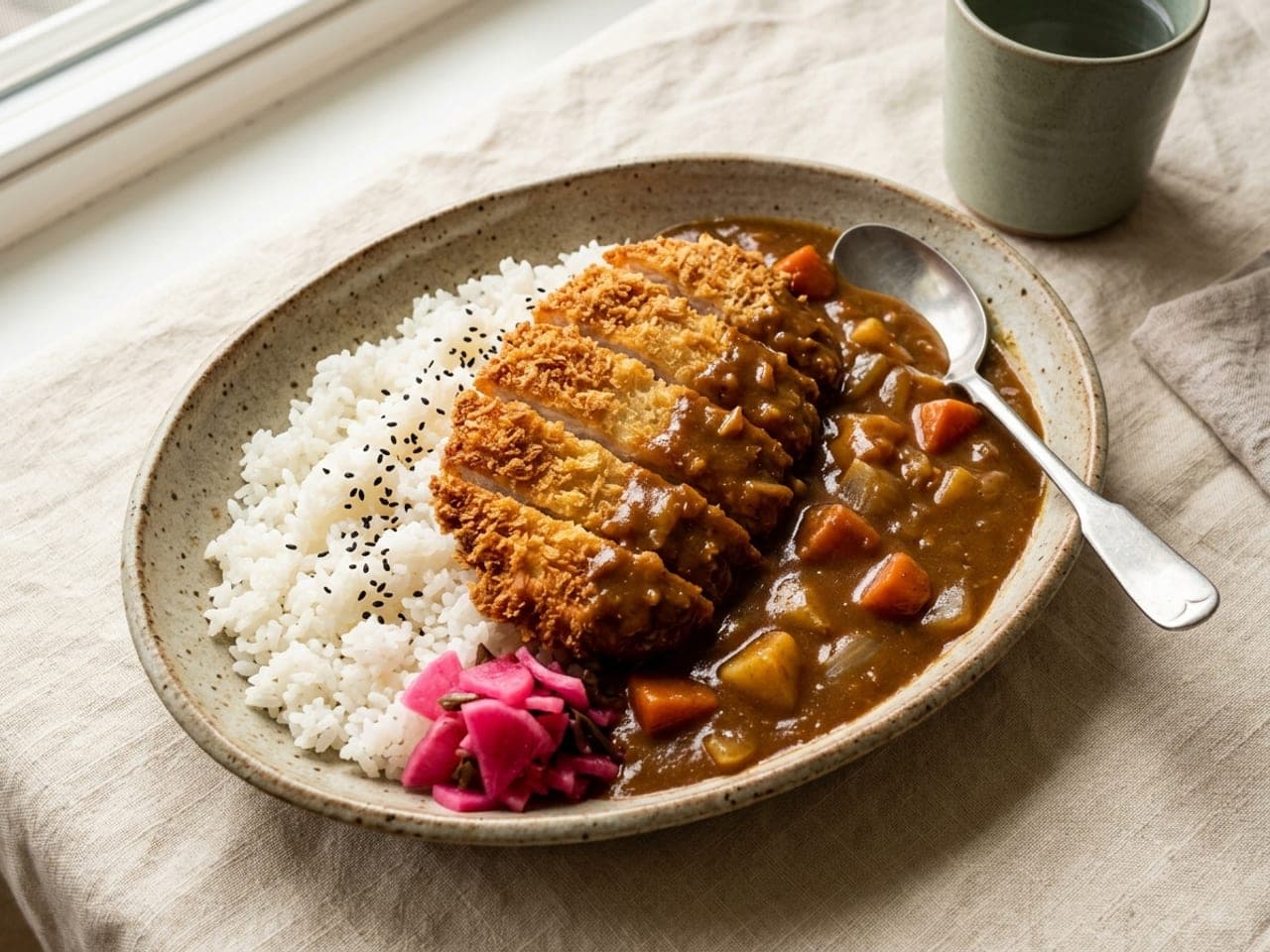
Ingredients
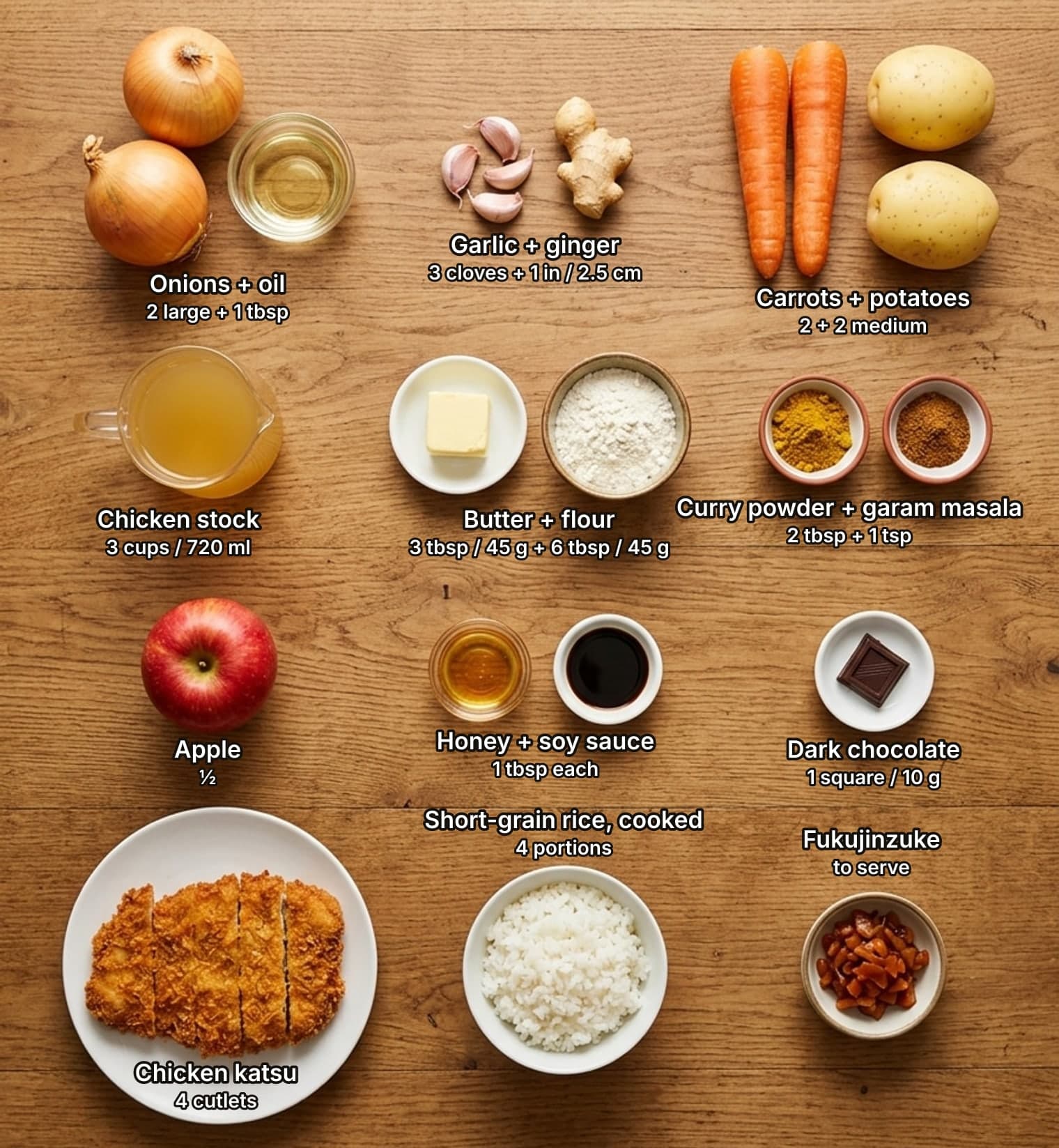
- onions, sliced thin (curry)2 large
- neutral oil, for the onions (curry)1 tbsp
- garlic, grated (curry)3 cloves
- fresh ginger, grated (curry)1-inch (2.5 cm) piece
- carrots, rolling-cut chunks (curry)2
- waxy potatoes, large chunks (curry)2 medium
- chicken stock (curry)3 cups / 720 ml
- butter (roux)3 tbsp / 45 g
- all-purpose flour — plain flour (roux)6 tbsp / 45 g
- curry powder, S&B if possible (roux)2 tbsp
- garam masala (roux)1 tsp
- apple, grated (kakushi aji)½
- honey + soy sauce (kakushi aji)1 tbsp each
- dark chocolate (kakushi aji)1 square / 10 g
- chicken katsu — see the chicken katsu page (2 breasts, flour, egg, panko, frying oil)4 cutlets
- cooked short-grain rice, to serve4 portions
- fukujinzuke pickles, to servea jarful of courage
Japan's national curry, by way of the Royal Navy
Japanese curry did not come from India — it came from Britain, which had already flattened Indian cooking into a mild, flour-thickened "curry powder" gravy the Royal Navy could serve at sea. Meiji-era Japan, modernising its own navy on the British model in the late 1800s, adopted the dish along with the uniforms; sailors carried it home, army and school canteens spread it, and by the twentieth century karē raisu — curry rice — had become what it remains today: arguably Japan's most-eaten home dinner, a dish schoolchildren rank above sushi. The Maritime Self-Defense Force still serves curry every Friday, officially, so crews at sea don't lose track of the days.
Because it descends from a gravy, not a masala, Japanese curry plays by European rules: a butter-and-flour roux does the thickening, the spicing is mild and rounded, and sweetness is a design feature, not an accident. It is closer in spirit to a very good stew than to anything on an Indian table — our Indian chicken curry page, linked below, is the other end of that spectrum and worth reading side by side. Neither is the "real" curry; they are two different journeys the same word took.
Katsu curry — the cutlet-on-curry collision — is credited to Tokyo's Ginza Swiss around 1948, when a regular (a professional baseball player, the story insists) asked for his tonkatsu and curry on one plate to save time. The restaurant still sells it as the original. Whether the legend is precise hardly matters: it is the single best lunch decision in recorded sports history.
How to make Katsu curry
- Sweat the onions past patience. Slice 2 large onions thin and cook them in 1 tbsp oil in a heavy pot over medium-low heat for a full 20–30 minutes, stirring now and then, until deep golden and collapsed — not browned crisp, melted. This is the sauce's backbone and the step every rushed katsu curry skips; Japanese curry's roundness is mostly onion cooked past the point where you wanted to move on. Add 3 grated garlic cloves and a grated inch (2.5 cm) of ginger for the last two minutes, until the pot smells like the beginning of something.
- Vegetables in, stock in, simmer. Add 2 carrots cut in rolling chunks and 2 medium waxy potatoes in large bites, pour in 3 cups (720 ml) chicken stock, and simmer, partly covered, 15 minutes or until a knife slides through the carrot with light resistance. The vegetables are canon — Japanese curry without soft carrot and potato is somebody's fusion — and the rolling cut (turn the carrot a quarter between diagonal cuts) gives maximum sauce-grabbing faces. Undercook them slightly; they finish in the sauce. This is also when ½ a grated apple and 1 tbsp honey go in — early on purpose: both carry amylase, an enzyme that can quietly liquefy a finished roux, and the twenty-odd minutes of simmering ahead of the thickener denatures it harmlessly (the hidden-flavour section explains). One clause of fine print: skip the honey entirely if anyone under one year old is eating — infant botulism spores shrug off a simmer.
- Make the roux — a blond one, then spiced. In a small pan, melt 3 tbsp (45 g) butter, whisk in 6 tbsp (45 g) flour, and cook over medium, stirring constantly, 3–4 minutes to a pale blond that smells like shortbread. Off the heat, stir in 2 tbsp curry powder (S&B brand if you can — it IS the flavour of Japanese curry) and 1 tsp garam masala until you have a thick, fragrant, brick-coloured paste. The flour gives Japanese curry its gravy body; the brief cooking kills the raw-flour taste without losing thickening power. This little pan of paste is a curry block you made yourself.
- Marry the roux into the pot. Ladle a cup (240 ml) of the hot stock into the roux pan and whisk smooth — it will seize, then relax; that's normal — then scrape the whole thing back into the pot and stir as it returns to a simmer. Within two minutes the sauce turns glossy and thickens to the correct Japanese-curry body: thick enough to coat rice in a blanket rather than a puddle, loose enough to flow off the ladle. Too thick, add stock; too thin, simmer uncovered — it also thickens noticeably as it stands.
- The block path, stated without shame. The alternative to steps 3–4: drop about half a standard pack of store-bought Japanese curry roux — 5–6 cubes; cube sizes vary by brand, so trust the box's ratio for 3 cups (720 ml) of liquid — (Golden Curry, Vermont, Java — see the section below) into the simmered pot off the heat, stir until dissolved, then simmer 5 minutes. This is what most kitchens in Japan actually do, and the box is engineered well. The from-scratch roux wins on freshness of spice and lets you steer sweetness and heat; the block wins on Tuesday. Both are Japanese curry; nobody at the table files a complaint either way.
- Kakushi aji — the hidden flavour. Now the part Japanese home cooks treat as family signature. The sweet half — the grated apple and honey (the Vermont box built its brand on exactly that pair) — has been simmering since step 2, where the enzyme chemistry wants it; what goes in now is the umami half: 1 tbsp soy sauce and — trust the country that invented this — one square (10 g) of dark chocolate. Simmer 5 more minutes and taste: the curry should be sweet-savoury, round, mild-spiced, gently fruity, with nothing poking out. Ketchup, instant coffee, Worcestershire and miso are all legitimate plays in the same game; pick two, not six, or the hidden flavours stop hiding.
- Fry the katsu. The cutlet is its own discipline with its own page — chicken katsu, linked below, with the full two-hand dredge, the 340°F (170°C) shallow fry and the rack rest. The short version for this plate: two chicken breasts split into four cutlets and pounded to ½ inch (1.25 cm), floured, egged, pressed hard into panko, fried 3–4 minutes a side in ¾ inch (2 cm) of neutral oil to deep gold and 165°F (74°C) inside, rested on a rack, sliced into 1-inch (2.5 cm) strips. Time it so the katsu finishes as the curry does — the cutlet waits for no sauce.
- Assemble by the half-flood rule. Rice on one side of a wide plate, curry ladled over the OTHER side, and the sliced katsu laid across the border — sauce climbing halfway up the crust, top edges dry and audibly crisp. This is the one assembly law of katsu curry: flood the whole cutlet and you've made expensive soggy chicken; keep sauce and crust apart entirely and you've plated a divorce. A spoonful of hot-pink fukujinzuke pickles at the rice's edge, and serve immediately — this plate has a five-minute prime, same as ramen.
Safety & hygiene Important
- A thick curry spits like a volcano. Starch-thickened sauce doesn't bubble politely — it builds pressure and bursts in slow, scalding plops that can jump clear of the pot. Once the roux is in, keep the heat low, stir often from the handle side with a long spoon, and set the lid ajar rather than sealed. The burns from a thick sauce are worse than from thin liquids because it clings; treat the final simmer with the respect you'd give hot caramel, and keep small helpers away from the stove for this stage. If sauce does land on skin: twenty minutes under cool running water — genuinely twenty — rings and watches off, no ice and no butter, and anything blistered, larger than the person's palm, or on a child gets medical eyes on it.
- The overnight-curry rule. Japan's beloved wisdom that curry tastes better the next day comes with a catch the folklore skips: a big pot left to cool on the stove overnight is a textbook incubator for Bacillus cereus — thick, insulating, slow to cool through the bacterial danger zone of 40–140°F (4–60°C), and linked to real outbreaks (its spores and toxin survive boiling, so reheating will not save a pot that sat warm). Next-day curry is genuinely better, so earn it safely: cool the pot fast — divide into shallow containers, or sink the pot in iced water and stir — and refrigerate within 2 hours. It keeps 3 days in the fridge; reheat to a full rolling boil, loosened with a splash of water. The same bug's other famous vehicle is the one beside the curry: cooked rice. Leftover rice cools spread shallow, hits the fridge within the hour, gets eaten within a day, and reheats once, until steaming hot throughout — never a warm nap in the cooker overnight.
- Chicken doneness lives under the crust. The cutlet's mahogany crust says nothing about the meat inside — panko browns faster than chicken cooks. The verdict is 165°F (74°C) on an instant-read thermometer in the thickest part, taken before the cutlet meets the sauce. And the dredge line that built the crust — leftover flour, egg, panko that touched raw chicken — is binned, not saved; the full raw-poultry protocol lives on the chicken katsu page and applies unchanged here.
- Freezing: the sauce yes, the potato no, the katsu separately. Japanese curry freezes beautifully for 3 months with one exception: potato chunks turn grainy and wet in the freezer, so fish them out (eat them — cook's tax) or freeze a batch made without. Freeze sauce flat in portions, thaw overnight in the fridge, reheat to a full boil. Fried katsu freezes too, but separately and never sauced — re-crisp from frozen on a rack at 350°F (175°C) for about 20 minutes, to 165°F (74°C) at the centre — thickness moves the clock, the thermometer doesn't negotiate. Freezing an assembled plate produces a dish with no name and no friends.
3 ways to plate it
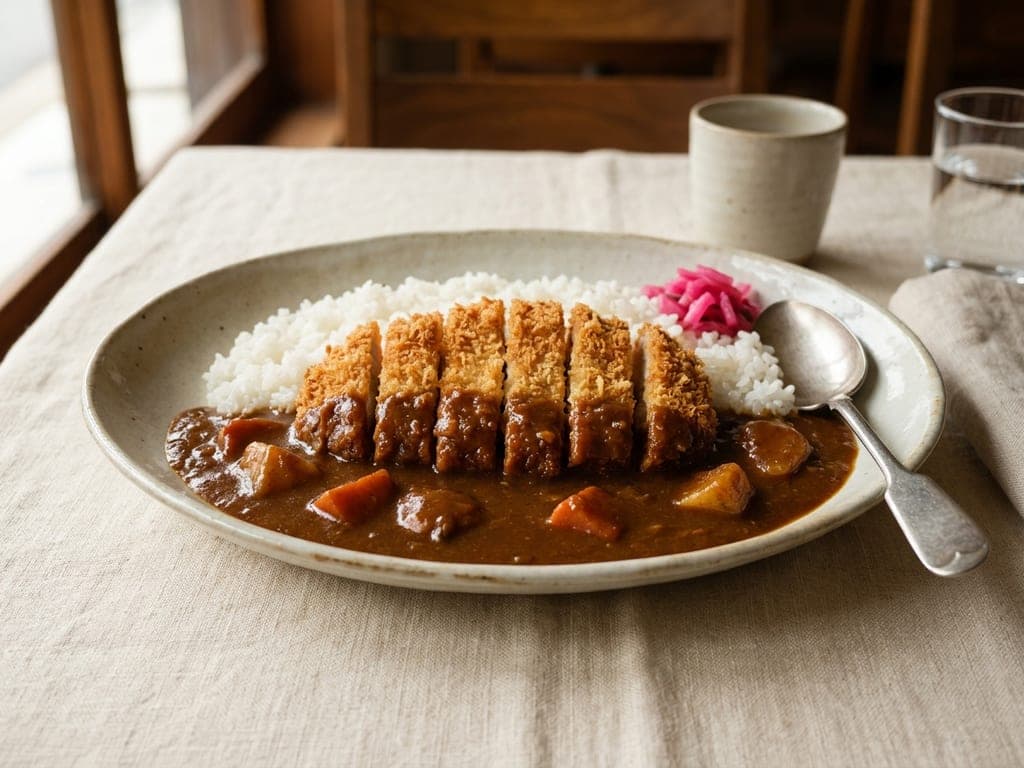
- Plate the rice first and give it a clean straight shoreline with the back of the spoon — the levee line is the composition, so draw it on purpose.
- Ladle the curry against the shoreline, not over it: the sauce should meet the rice and stop, flooding its own half of the plate.
- Lay the katsu strips across the border in their sliced order, crust edges up — sauce reaching halfway up each strip, the golden tops staying visibly dry.
- One tight spoonful of fukujinzuke at the rice's edge: a single hot-pink accent electrifies the mahogany-and-white plate the way beni shoga does a ramen bowl.
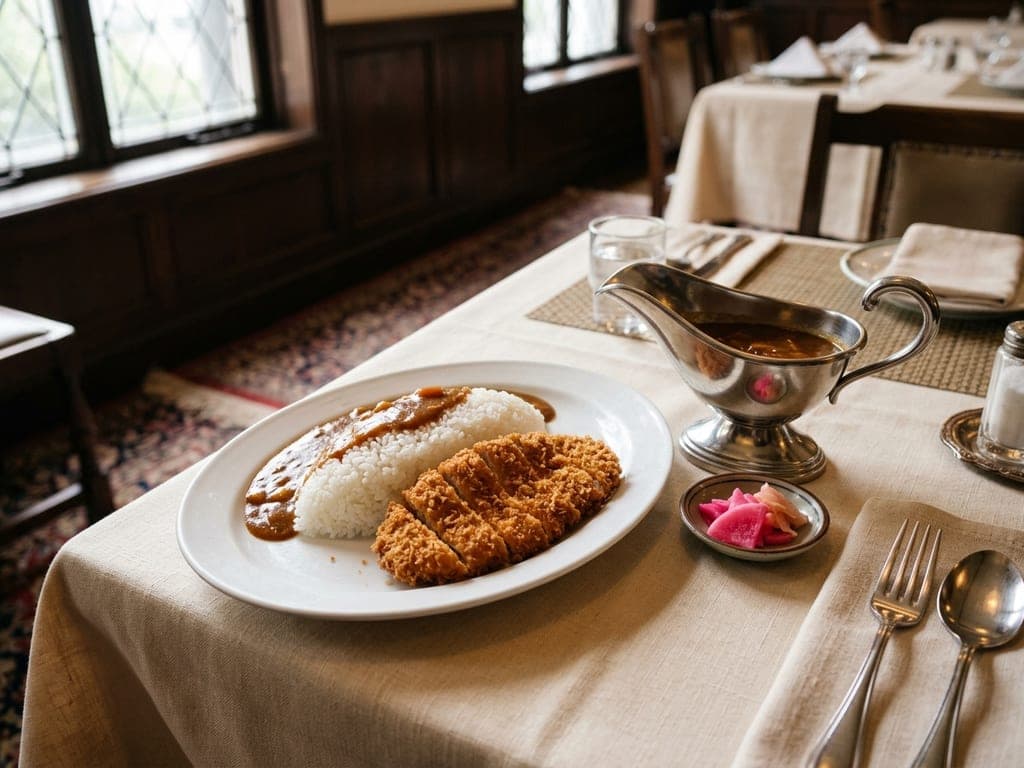
- Shape the rice in a smooth low dome or a neat oval — moulding it with a rice-paddle or small bowl reads intentional, and the boat's pour needs a landform to break against.
- Lean the katsu strips along the rice in a shingled line, cut faces forward, so the pour can reach the plate without drowning the crust.
- Serve the sauce genuinely hot in the boat — it is travelling and pouring, and a lukewarm pour is the format's one failure mode.
- Set the boat beside the plate handle-first toward the eater; the first pour belongs to them, and the gleam of steel against cream linen is the photograph.
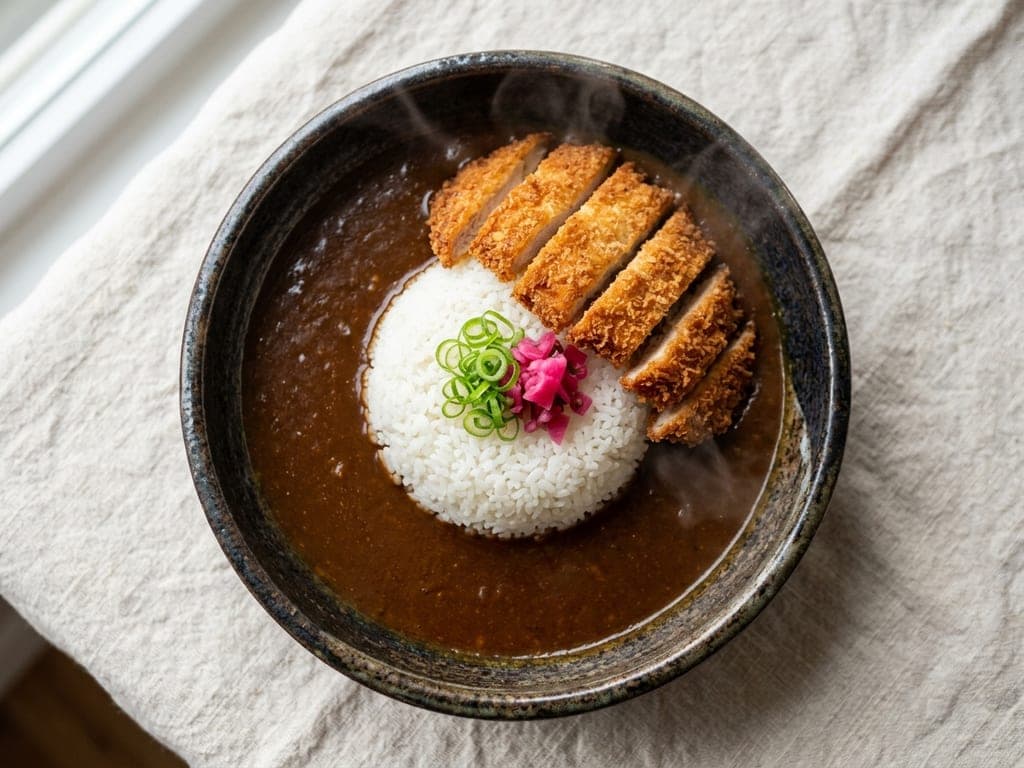
- Mould the rice dome firmly (pack it in a small bowl and invert into the centre) — the whole composition depends on the mountain holding its shape in the moat.
- Ladle the curry around, never over: the moat should reach perhaps a third up the dome, leaving a clean white summit.
- Fan the katsu strips against one slope in a steep overlap, leaning on the rice like a staircase — height is this format's entire argument.
- Finish at the summit: a pinch of fukujinzuke and a few scallion rings at the peak give the overhead camera its focal point, and the first spoonful its target.
The roux: from scratch, or the block without shame
Walk any Japanese supermarket and the curry aisle is a wall of chocolate-bar-shaped boxes: S&B Golden Curry, House Vermont Curry, Java Curry, each in mild, medium and hot. Inside is exactly what step three of this recipe makes — fat, flour and curry spices pressed into breakable cubes. The block is not a cheat; it is the dish's standard form, engineered over decades, and most home katsu curry in Japan starts there. If that's your path: 3–4 cubes into the simmered pot, off the heat so the starch doesn't clump, dissolved, then a short simmer. Done, and done honestly.
The from-scratch roux earns its fifteen minutes in two ways. First, freshness: curry powder blooms hard in hot butter, and the difference between just-opened S&B powder in your own roux and a box that crossed an ocean two years ago is real. Second, control: the box fixes your sweetness, salt and heat; your own roux lets you steer all three — more garam masala for warmth, cayenne for actual heat, less honey for a sharper plate. The blend matters less than the brand of powder: S&B's red tin IS the canonical Japanese curry flavour, oriental and slightly sweet, and it's stocked by most Asian grocers and every online spice shop in the US and EU.
Whichever route, respect the body. Japanese curry should coat rice like a duvet — thick, glossy, self-levelling slowly. Too thin reads as soup and slides off the katsu; too thick reads as school-canteen paste. The fix is always simple: simmer uncovered to tighten, splash stock to loosen, and remember it thickens more as it cools on the plate.
Kakushi aji — the hidden-flavour game
Kakushi aji, "hidden taste," is the Japanese home-cook institution of slipping unlisted ingredients into the curry pot — each family convinced theirs is the one true secret. The canon: grated apple (House built the entire Vermont Curry brand on "apple and honey"), honey, soy sauce, a square of dark chocolate, ketchup, Worcestershire-family sauce, instant coffee, a spoon of miso. These all work the same three levers — sweetness, acidity and umami depth — on a sauce whose mild spicing leaves room for them to hum underneath.
The discipline is restraint: pick two or three levers, add in small doses, taste between. This recipe's default set — apple, honey, soy, chocolate — lands at the sweet, round, faintly fruity profile of a good curry-house plate. If you want it more adult, swap the honey for a shot of instant coffee and a dash of Worcestershire; more depth, a teaspoon of miso whisked in at the end. The failure mode is enthusiasm: six secrets at once and your curry tastes like the back of the fridge. Hidden flavour that can be named by a guest at the table has failed at its one job.
One warm technical note, because the internet has this backwards: raw honey and grated apple carry amylase, an enzyme that eats starch — and starch is your sauce's entire skeleton. The failure mode is adding them AFTER the roux, where active enzyme meets gelatinised starch and quietly thins the pot (the famous watery-overnight-curry mystery). The fix is timing, and it is why this recipe sends apple and honey in with the stock in step 2: House Foods' own guidance is to add honey before the roux and give it a twenty-minute simmer, which denatures the enzyme before the thickener ever arrives. Late addition is rescuable — boil it properly, don't just stir it warm — but early is the path with no story to tell.
Shopping it in Europe and America (and the Wagamama problem)
Everything on this plate is now easy on both continents. Curry blocks (Golden Curry and Vermont lead) are in every Asian grocer and increasingly on ordinary supermarket world-food shelves; S&B curry powder's red tin likewise. Fukujinzuke — the sweet, crunchy, alarmingly pink daikon-and-cucumber pickle that is katsu curry's licensed sidekick — is an Asian-grocer item; a fine substitute is nothing at all, and a wrong substitute is anything vinegar-sharp, which fights the sauce. Short-grain "sushi" rice, cooked plain, is the base; long-grain works but sheds the sauce it should be holding.
Waxy potatoes (in the US, red potatoes — or Yukon Gold, technically all-purpose but sturdy in a simmer; in Europe, Charlotte or any "salad potato") hold their shape in the simmer where floury bakers dissolve — unless you like the dissolve, which is a legitimate school of thought that thickens the sauce further. The chicken, panko and frying-oil shopping notes live on the chicken katsu page; buy for both pages in one trip, because you will make this again. And the same allergy fine print as the katsu page, plus one: wheat, egg and the sauces' fish and mollusc, with dairy joining via the roux butter — worth a word when guests are eating.
And the naming story, for our UK readers especially: Britain's katsu boom — Wagamama's katsu curry chief among the engines — quietly taught a nation that "katsu" means the SAUCE, and supermarkets now sell "katsu sauce" noodles, crisps and dips containing no cutlet whatsoever. It doesn't: katsu is the breaded cutlet (from katsuretsu, "cutlet"), and the sauce is just Japanese curry. You are holding the page that does both parts properly, which puts you ahead of several national grocery chains.
Questions, answered
What is Japanese curry and how is it different from Indian curry?
Japanese curry is a roux-thickened, mild, sweet-leaning gravy — descended from British Navy curry adopted during the Meiji era, not from Indian cooking directly. Indian curries build from whole and ground spices bloomed in fat, layered masalas, and no flour; Japanese curry blooms one curry powder in a butter-flour roux and aims for roundness over fire. Think excellent stew versus spice architecture — the two share a word, not a method.
Which Japanese curry roux block is best?
The big three: S&B Golden Curry (the most classic, spice-forward, widely stocked), House Vermont Curry (sweeter, apple-and-honey, the family favourite in Japan), and House Java Curry (darker, hotter, more adult). Mild/medium/hot inside each brand is a genuine spread — Japanese "hot" is a polite medium by Thai standards. Start with Golden Curry medium-hot; graduate to Java when the sweetness stops charming you. Dose by the box, not by vibes: manufacturer ratios work out to about half a standard pack — 5–6 cubes — per 3 cups (720 ml) of liquid (cube sizes vary by brand), and always dissolve off the heat.
How do I make Japanese curry without a block?
Make the block yourself: cook 3 tbsp (45 g) butter with 6 tbsp (45 g) flour to pale blond, stir in 2 tbsp curry powder (S&B's red tin is THE flavour) and 1 tsp garam masala off the heat, then whisk the paste into your simmered pot. That is the entire secret — a curry block is just roux and spices in a box. From-scratch wins on spice freshness and control; it costs you fifteen minutes and one small pan.
What is the secret ingredient in Japanese curry?
Pick a family, get an answer: grated apple, honey, soy sauce, dark chocolate, ketchup, instant coffee, Worcestershire-style sauce, miso. The tradition is called kakushi aji — "hidden taste" — and the rule is that the addition deepens the curry without being identifiable. This recipe uses apple, honey, soy and one square of chocolate. The real answer is: two or three levers, small doses, taste between — and long-cooked onions, which are the least secret and most important ingredient of all.
Why do British menus call the sauce itself "katsu"?
Blame the boom: Wagamama's katsu curry became so popular in the UK that "katsu" detached from the cutlet and stuck to the sauce, and supermarkets now sell cutlet-free "katsu sauce" everything. In Japanese, katsu is short for katsuretsu — cutlet — and the sauce is simply Japanese curry (karē). Order "chicken katsu" in Tokyo and you get a breaded cutlet, no curry in sight. Linguistically wrong, commercially unstoppable; this page loves you anyway, Britain.
Is katsu curry made with pork or chicken?
The original Ginza plate was tonkatsu — pork — and pork remains the default in Japan; chicken katsu curry is the international favourite and every bit as legitimate. The curry doesn't care: same sauce under either cutlet. Pork loin wants the identical technique (pound even, panko pressed hard, 340°F/170°C, rest, slice); it runs a couple of minutes quicker for a thin chop, and the finish line moves: pork loin is done at 145°F (63°C) plus a three-minute rest by the US standard — a lower bar than the chicken's 165°F (74°C), so mind which meat your thermometer is judging (EU guidance runs more conservative on pork, closer to 158°F/70°C, if that is the book your household cooks by).
What are the pink pickles served with katsu curry?
Fukujinzuke: daikon, cucumber and lotus root in a sweet soy brine, dyed a pink that does not occur in nature and should not be questioned. It's the canonical curry-rice sidekick — sweet crunch against the thick sauce — with rakkyo (sweet-pickled Japanese scallion bulbs) the traditional alternative. Asian grocers stock both in jars. If you skip them, skip toward nothing; a sharp vinegar pickle fights the curry's sweetness.
Can I make katsu curry ahead or freeze it?
The sauce improves overnight (cool it fast and refrigerate within 2 hours — see the safety note; the folklore is true but the food safety is not optional) and keeps 3 days, or freezes 3 months minus the potato, which goes grainy. The katsu is best same-day but re-crisps startlingly well on a rack at 400°F (200°C) for 8–10 minutes — to 165°F (74°C) in the middle, once, not on rotation — and freezes fried, unsauced. Assemble only at the table: rice, boiling-hot sauce, hot cutlet, and the half-flood — never store the three together.
Is katsu curry spicy?
Not unless you make it so. The default profile is mild, sweet and round — Japanese curry is a dish children are raised on, and even the "hot" blocks sit well below a mild Thai green curry. Heat is easy to add at the pot (cayenne in the roux, a hot block, extra garam masala at the end) or at the plate — shichimi tōgarashi, the seven-spice chilli blend, is the traditional table move. Sweetness is the dial to watch instead: taste before adding the honey, not after.
What rice goes with katsu curry?
Plain steamed short-grain rice — the sticky, pearly kind sold as sushi rice — cooked without seasoning; its cling is structural, holding a clean levee between the flooded and dry halves of the plate. (Our sushi rice page covers the cooking method; skip the vinegar step.) Long-grain and basmati taste fine but shed the sauce, and the plate turns into soup with croutons. Portion generously: the rice-to-sauce ratio is a personal constant every curry eater discovers and then defends for life.
Snap your finished plate and let the AI plate it again — more beautifully.