Chicken Katsu Recipe (Shattering Panko Crust — No Deep Fryer Required)
The Japanese cutlet: chicken pounded even, dredged with discipline, and shallow-fried in a skillet until the panko sets into a deep-gold crust that audibly shatters. No deep fryer, no mystery — the whole dish is one technique done properly, plus the three things that make it katsu rather than fried chicken: the sauce, the mountain of cabbage, and the knife work at the end.
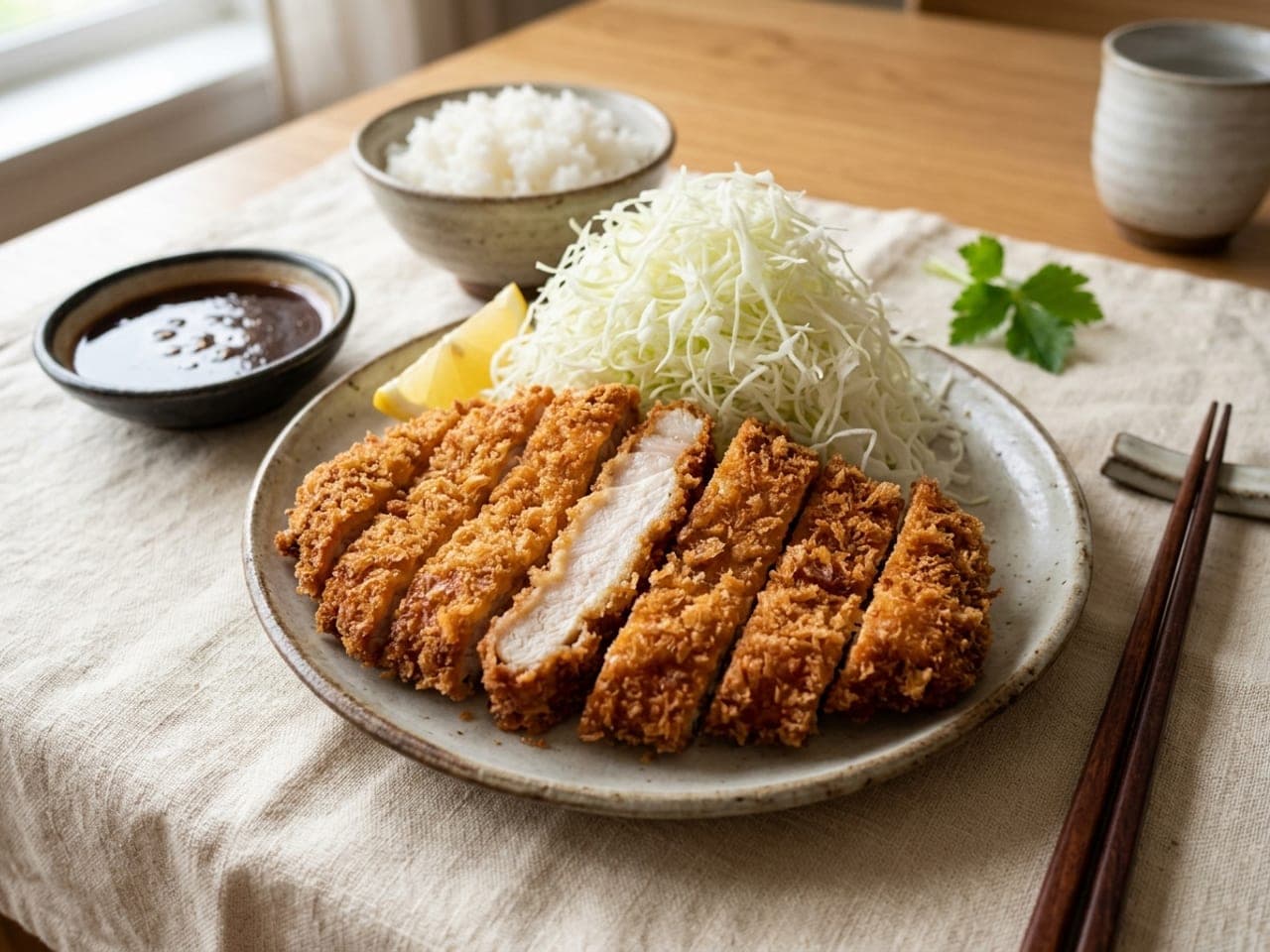
Ingredients
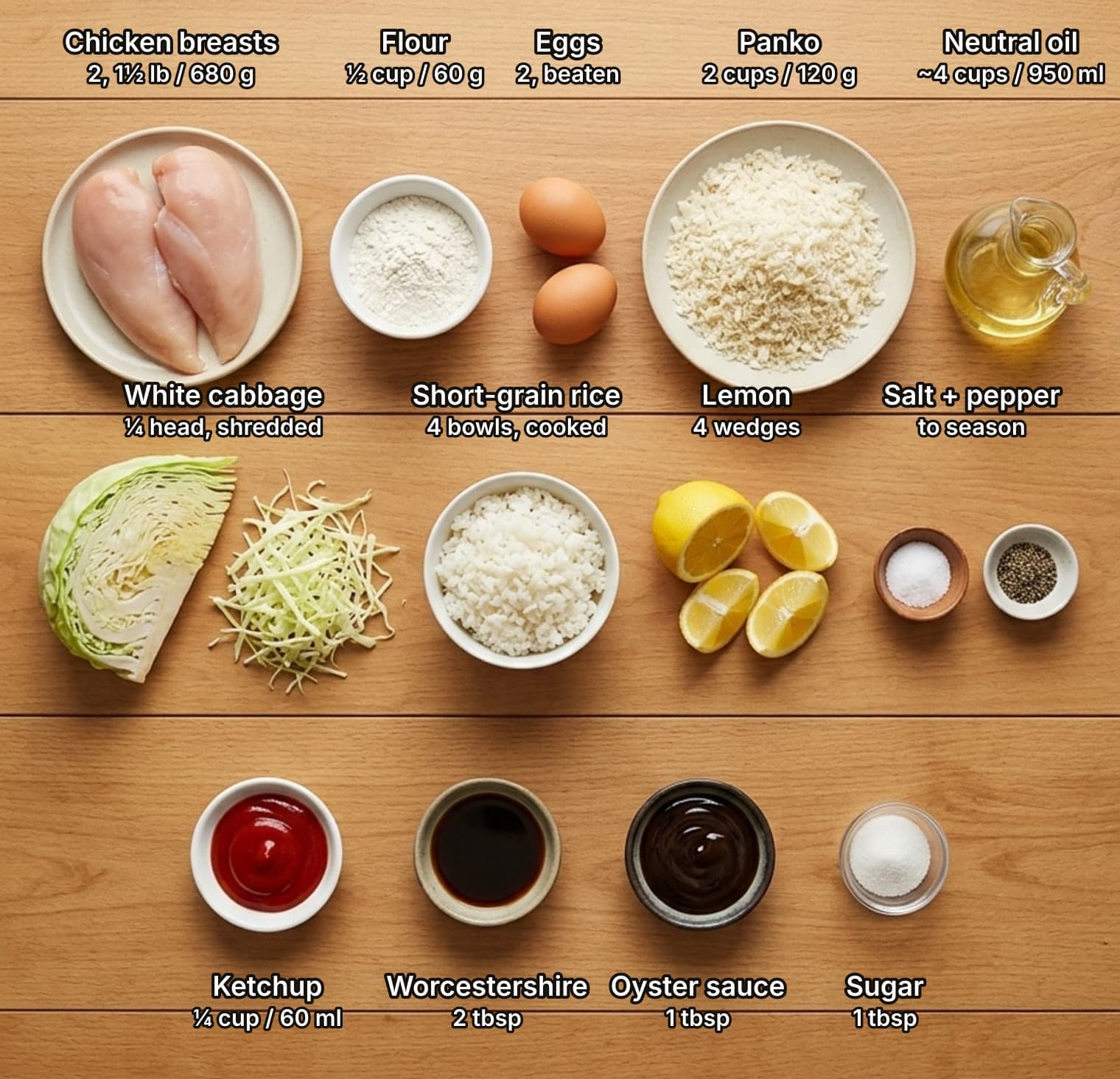
- chicken breasts, butterflied into 4 cutlets2 large (1½ lb / 680 g)
- fine salt + black pepperto season
- all-purpose flour (plain flour)½ cup / 60 g
- eggs, beaten2
- panko (Japanese-style coarse breadcrumbs)2 cups / 120 g
- neutral oil for shallow frying (canola/sunflower)~4 cups / 950 ml
- white cabbage, shredded hair-fine and iced¼ head
- cooked short-grain rice, to serve4 bowls
- lemon wedges4
- ketchup (tonkatsu sauce)¼ cup / 60 ml
- Worcestershire sauce (tonkatsu sauce)2 tbsp
- oyster sauce (tonkatsu sauce)1 tbsp
- sugar (tonkatsu sauce)1 tbsp
What makes katsu katsu
Katsu is short for katsuretsu, which is Japanese for cutlet, which is the whole origin story in one word: this is yōshoku — Western food, run through a Japanese kitchen until it came out better organised. The Tokyo restaurant Rengatei was serving pork katsuretsu by 1899, deep-frying a breaded chop tempura-style instead of pan-frying it in butter the French way, and pairing it with shredded raw cabbage because a busy kitchen could not be sautéing vegetables to order. The chicken version is the same idea on a lighter bird, and it has become the one most of the world meets first — on Hawaiian plate lunches, in Japanese convenience stores, in every bento cabinet on earth.
What separates katsu from generic fried chicken is discipline, not ingredients. The meat is a flat, even cutlet, not a bone-in thigh; the crumb is panko, pressed on over a flour-and-egg base; the fry is clean neutral oil at a held temperature; and the finish is a knife, a sweet-dark sauce, and cold shredded cabbage. Nothing on that list is difficult. Everything on that list is deliberate — which is the most Japanese sentence in this recipe.
One vocabulary note while we are here: katsu (カツ) the cutlet is not katsuo the fish, and tonkatsu (pork katsu) is not tonkotsu, the milky ramen broth two pages over. One vowel, different dinner — we keep the map pinned to both pages.
How to make Chicken katsu
- Split, then pound — evenness beats thinness. Split each chicken breast horizontally clean through, so two breasts become four flat cutlets, then lay each between two sheets of plastic wrap (cling film) and pound with a pan or rolling pin to an even ½ inch (1.25 cm). The number matters less than the evenness: a cutlet that is ½ inch (1.25 cm) everywhere cooks through in the time the crust takes to go deep gold, which is the entire trick of katsu. A thick middle means pale crust or raw centre — you do not get to choose which.
- Season early and set up the line. Salt and pepper both sides and let the cutlets sit while you build the dredge line: a plate of flour, a shallow bowl of beaten eggs, and a wide tray of panko — more than looks reasonable, at least 2 cups (120 g). Ten minutes of salt time seasons the meat, not just the crust. Line the stations up in order ending nearest the stove; katsu is an assembly line and the geometry is part of the recipe.
- Dredge with the two-hand rule. One hand for dry, one hand for wet, and never swap: dry hand presses the cutlet into flour and shakes off every bit of excess — flour is glue, not a coat — then lowers it into the egg; wet hand turns it and lifts it dripping into the panko; dry hand buries it and PRESSES, properly, both sides, so the shards embed in the egg rather than resting on it. Pressed panko fries into armour; sprinkled panko rains off in the pan. Set the breaded cutlets on a rack for five minutes while the oil heats — the rest sets the crust.
- Heat ¾ inch (2 cm) of oil to 340°F (170°C). Pour neutral oil ¾ inch (2 cm) deep into a heavy, high-sided skillet — this is a shallow fry, not a deep one, and a skillet does it better than a wobbling stockpot of oil. Bring it to 340°F (170°C): a pinch of panko dropped in should fizz to gold in about 30 seconds, sinking slightly then dancing. Oil that smokes is far past temperature; oil where the panko sits quietly is far under. A cheap probe thermometer removes the guessing and earns its price in one dinner.
- Fry to deep gold, one flip. Lay the cutlets in away from you and fry without fiddling — 3 to 4 minutes a side, one confident flip with tongs, to a deep even amber. Two cutlets at a time at most: crowding drops the oil's temperature and a cool fry is a greasy fry. The colour cue outranks the clock, and the thermometer outranks both: 165°F (74°C) in the thickest part. If the crust races ahead of the meat, your oil is hot — nudge it down, not the other way.
- Rest on a rack — never on paper. Lift the cutlets onto a clean wire rack set over a tray — not the rack that held them raw; swap it, or wash it hot while the first batch fries and give them three minutes. Paper towels are the crust's funeral: the underside steams against the wet paper and the shatter you just engineered goes quietly soft. On a rack, air circulates, oil drains, and the crust stays loud. This is also when the meat's juices settle — a katsu cut too early bleeds onto the board.
- Slice into strips — the knife is part of the dish. Cut each cutlet crosswise into 1-inch (2.5 cm) strips with your sharpest knife, pressing straight down in one motion rather than sawing, then reassemble the slices in order on the plate. Katsu is eaten with chopsticks, so the kitchen does the knife work — and the sliced presentation, cut faces forward, is half the reason the dish photographs the way it does. A serrated or dull knife crushes the crust it took four steps to build.
- The sauce, the cabbage, the table. Whisk the tonkatsu sauce: ¼ cup (60 ml) ketchup, 2 tbsp Worcestershire, 1 tbsp oyster sauce, 1 tbsp sugar — thick, dark, sweet-tangy, embarrassingly close to the bottled original. Shred cabbage hair-fine (a mandoline or your knife's thinnest work), hold it in iced water for ten minutes, spin it dry: the cold crunch against the hot crust is not garnish, it is the other half of every bite. Serve cutlet, cabbage mountain, lemon wedge, rice, sauce in its own small dish — pour just before eating so the crust meets it loud.
Safety & hygiene Important
- Shallow frying is the safest frying — treated with respect. Three-quarters of an inch (2 cm) of oil in a heavy pan is far more controllable than a pot of it, but the rules hold, and the first is presence: hot oil never gets left alone — not for a phone call, not for the doorbell. Pat the cutlets dry before dredging (water is what makes oil spit), keep the pan on a back burner with the handle turned away from the edge but not over a neighbouring burner, and set a lid or baking sheet within reach BEFORE the oil goes on — a high-sided skillet often has no lid of its own. If oil ever ignites: heat off, slide the lid over, and leave it there until the pan is stone cold — lifting it early relights the show. Never water (a pan fire becomes a fireball), never carry the burning pan anywhere, and never flour, sugar or baking powder, which can flash like fuel — plain salt or baking SODA are the only powders that help. Not out within seconds? Everyone leaves and the fire service gets the call; the pan is replaceable.
- Crust colour is not doneness. Panko browns on its own schedule and chicken cooks on another; hot oil can hand you a mahogany crust around raw poultry. The only trustworthy verdict is 165°F (74°C) on an instant-read thermometer in the thickest part of the cutlet. No thermometer: cut into the thickest strip after resting and look for opaque white to the centre — while knowing this is the weakest test in the book, not a substitute: safely cooked chicken can still blush pink and underdone chicken can run clear juices. When the cut face leaves any doubt, the answer is another minute in the oil — a katsu slightly over is dinner; under is not.
- The dredge line is a raw-chicken zone. Everything the raw cutlets touched — the pounding pin and the board under the plastic wrap, the flour plate, the egg bowl, the leftover panko in the tray, the rack the breaded cutlets rested on, and both of your hands, whatever the two-hand system promised — is contaminated and gets binned or washed hot, never saved for next time. Wash hands with soap for a real 20 seconds the moment the dredge line closes, before you touch a pan handle, a tap or a phone. Board and tongs that handled raw chicken do not touch the cooked cutlets; give tongs a hot soapy wash mid-recipe or use a second pair. And do not rinse the chicken first — rinsing removes nothing and sprays raw-chicken water around the sink. It is two minutes of admin against the least fun kind of leftovers.
- The oil afterwards. Let the oil cool completely in the pan — an hour, longer than feels necessary — pushed to a back corner of the stove, out of small arms' reach, and not moved until cold; then strain it through a fine sieve into a jar. Kept dark and cool it will fry twice more before it darkens and smells tired — though oil that was ever pushed past smoking retires immediately, whatever its colour. Toss it when it's done, into the bin via a sealed container or a collection point, never down the drain, where it sets like candle wax in pipes you own. Hot oil and a sink also share one more rule: a drop of water in the jar means Vesuvius, so the jar is dry.
3 ways to plate it
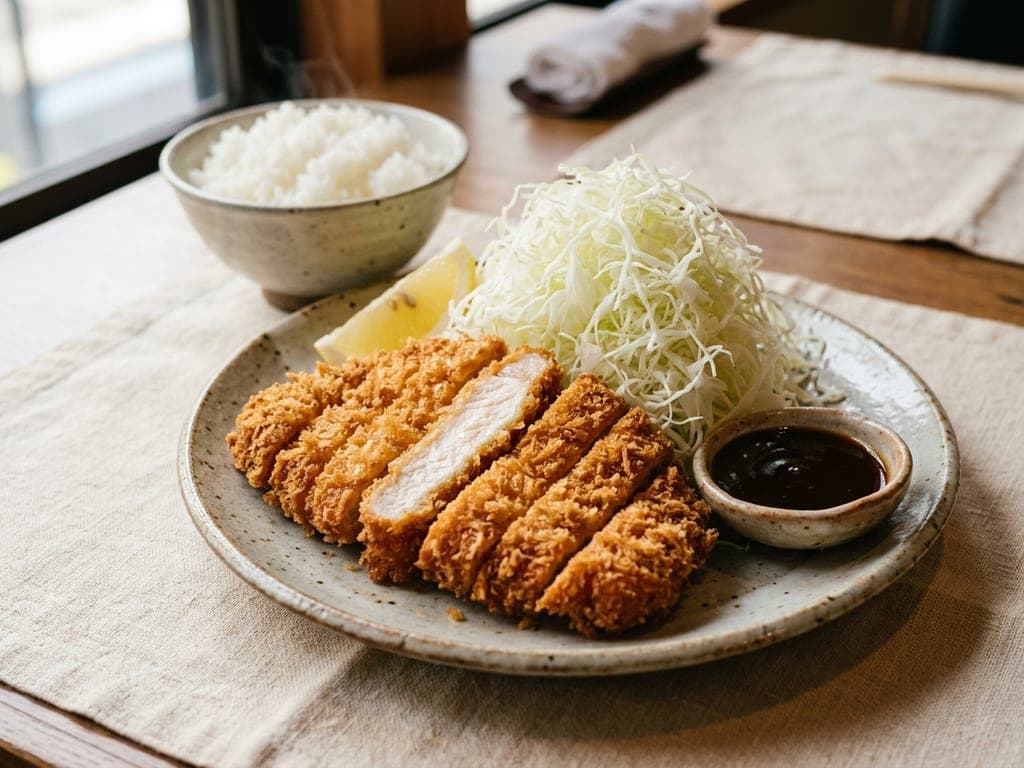
- Slice, then reassemble the cutlet in its original shape but shifted on the diagonal — the cut faces forward, showing the white interior under the amber crust, is the money shot of the whole dish.
- Build the cabbage TALL, not wide: a fine-shredded mountain holds its height if the cabbage is dry, and vertical cabbage reads generous where a flat pile reads like coleslaw.
- Keep the sauce in its own dish until the table — a pre-sauced katsu is already going soft, and the pour-over moment is part of the meal.
- One lemon wedge leaning on the cabbage, cut side out: it seasons the pile AND puts the only bright colour exactly where the composition needs it.
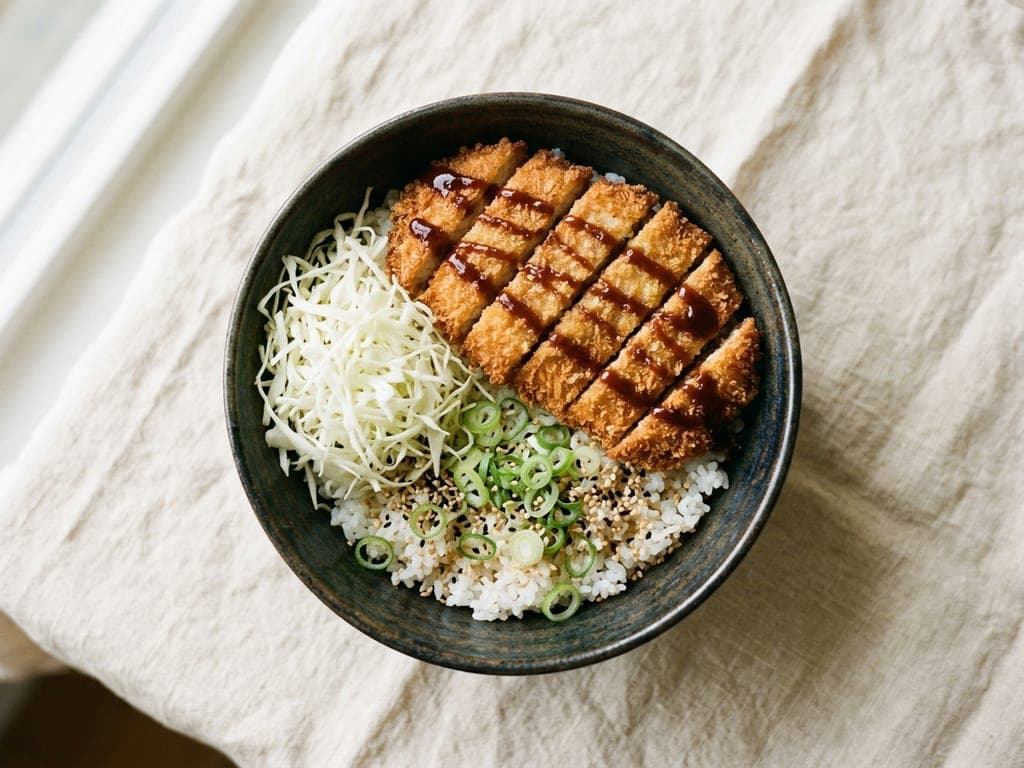
- Fan the strips in an overlapping arc across half the rice, each slice leaning on the last — the overlap keeps them warm and turns six pieces into one confident shape.
- Zigzag the sauce across the chicken only, never the rice: white rice stays white, and the dark-on-gold stripes do the graphic work.
- Tuck the cabbage into the bowl's remaining third so the three territories — gold, white, pale green — meet at the centre like a pie chart.
- Sesame and scallion rings from a height at the end; overhead is this bowl's best camera angle, so garnish for the bird's-eye view.
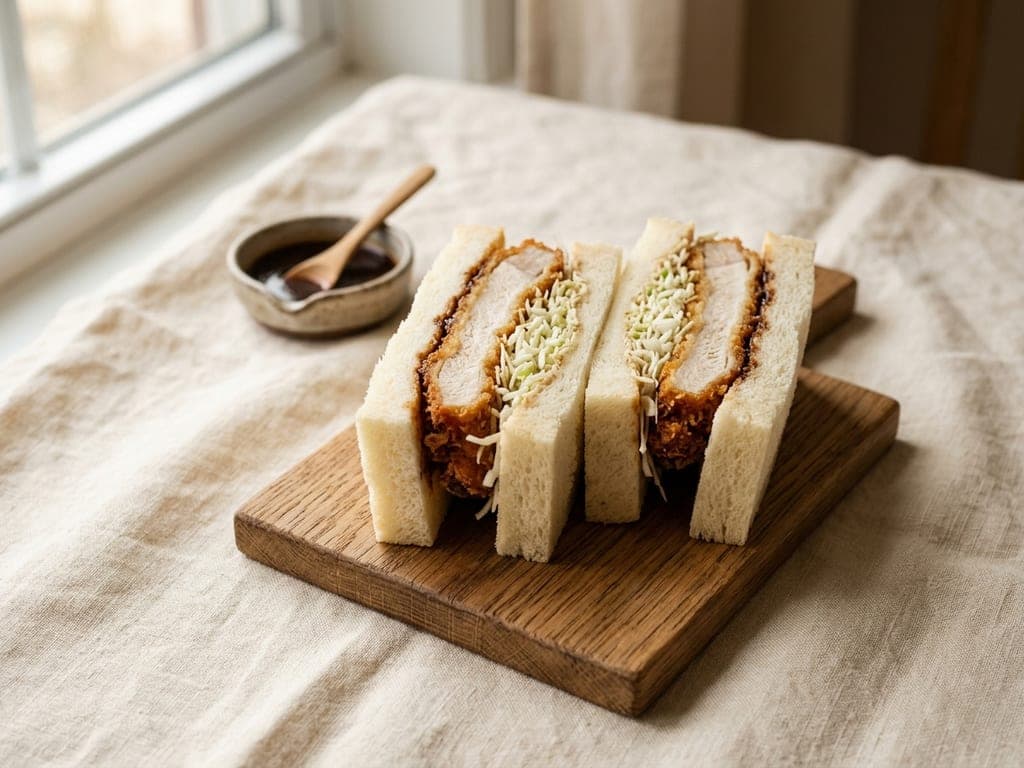
- Trim the crusts and halve with one straight down-stroke of your sharpest knife — the sando lives and dies on the cleanness of its cross-section.
- Stand both halves upright, cut faces forward and level with each other: the layers — bread, cabbage, sauce line, cutlet, bread — should read like a geological diagram.
- Keep the sauce as a thin painted layer on the bread, not a pour; the sando is engineered, and drips break the drawing.
- Serve on a small board with nothing else but a dish of extra sauce — the empty space around the sandwich is what makes it look like a Tokyo depachika counter.
Panko, and why the crust shatters
Panko is bread baked without a crust — in the classic industrial method, by electric current running through the dough itself, which is why the loaf never browns — then shredded into long, jagged, airy shards rather than ground into sand. Those shards are the entire physics of katsu: they bond to the egg layer at their tips and stand off the meat like scaffolding, so hot oil crisps each shard on all sides and the finished crust is full of air. Fine European-style crumbs lie flat and fry into a dense, oil-holding jacket; panko fries into a lattice that breaks like thin ice. Same wheat, different architecture.
The technique serves the crumb. Flour is wiped down to a film because it is primer, not paint. The egg is the mortar. And the panko gets pressed — genuinely pressed, palm-flat, both sides — because a shard that is embedded fries in place while a shard that is resting floats off to burn alone in the oil. The five-minute rest before frying lets the layers marry, and the rack after frying keeps steam from undoing the whole construction. Every katsu failure — bald patches, sliding crust, sogginess — is one of those small steps skipped, never bad luck.
Buy panko anywhere now: every US supermarket and most European ones shelve it as "Japanese-style breadcrumbs" next to the ordinary kind, and Asian grocers sell bigger bags of shardier stuff for less. If you are stranded: coarsely grate a stale white loaf, dry the shreds in a low oven without colouring them, and you have built respectable field-expedient panko. Ordinary fine breadcrumbs are the last resort — the dish works, but it comes out schnitzel, which brings us to the neighbours.
Schnitzel's Tokyo cousin
This catalog grew up in a Czech kitchen, so let it be said with love: katsu and schnitzel (řízek) are the same beautiful idea separated by geography, and the differences are a tidy little essay in what each cuisine values. The schnitzel is pounded thinner — sometimes to a plate-flopping wafer — coated in fine crumbs, and fried in a shallow slick of oil or butter to a soft gold, its crust bonded tight to the meat. Katsu keeps the cutlet thicker and juicier, armours it in standing panko shards, and fries it at a held temperature so the crust is a separate, audible layer. One is tender and lemon-bright; the other is crunchy and sauce-dark.
The table tells the rest. Schnitzel arrives whole with a lemon wedge and potato salad, and you address it with knife and fork. Katsu arrives pre-sliced for chopsticks, with raw cabbage for freshness, rice for ballast, and a Worcestershire-based sauce that does the acidity job the lemon does in Central Europe — though a lemon wedge on the katsu plate is traditional too, and squeezing it over the cabbage is the move. Neither is the original: both descend from the same French côtelette that toured the world's kitchens in the nineteenth century and simply never went home.
If you grew up on řízek, katsu will feel like meeting a cousin who emigrated and did well: familiar bones, sharper suit. Our Czech schnitzel pages — the pork classic and the chicken version — are linked below for the side-by-side; frying both in one week is a legitimate research project.
Shopping the plate, and the sauce question
Chicken: two large breasts, about 1½ lb (680 g), butterflied into four cutlets. Breast is the classic for chicken katsu and behaves best — it pounds even and its lean flesh stays juicy behind the crust when the cutlet is uniform. Boneless thighs work and forgive an extra minute of frying, but they pound unevenly and fry wavy; if you use them, flatten with intent. The oil is anything neutral with a high smoke point — canola (rapeseed), sunflower, or peanut (skip that one when cooking for a peanut allergy) — about 4 cups (950 ml) to reach ¾ inch (2 cm) in a 10-inch (26 cm) skillet, and you are reusing it, so it is cheaper than it looks.
Tonkatsu sauce is a Worcestershire-family brown sauce: fruity, sweet, faintly spiced. The bottled standard is Bull-Dog — any Asian grocer, many supermarket world-food aisles — and there is no shame in the bottle. The pantry version in the steps (ketchup, Worcestershire, oyster sauce, sugar) lands remarkably close and takes ninety seconds; UK readers will notice the family resemblance to HP Sauce, which is not a coincidence but a shared Worcestershire ancestor, and HP thinned with a little ketchup and sugar is a fine emergency katsu sauce. One allergy note the sauce hides: Worcestershire is anchovy-based and oyster sauce is exactly what it says, so this plate quietly contains fish and mollusc on top of the obvious wheat and egg — worth a word when guests are eating.
The cabbage is ordinary white cabbage — the dense, cheap, keeps-forever kind sold everywhere from Osaka to Ostrava — shredded as fine as your sharpest knife or mandoline allows, iced, and dried. The rice is short-grain (sold as sushi rice); our sushi-rice page covers cooking it properly, minus the vinegar seasoning — plain steamed is what sits beside katsu. Lemon wedge, hot rice, cold cabbage, loud crust: the whole plate costs pennies over the price of the chicken.
Questions, answered
Should I use chicken breast or thigh for katsu?
Breast is the classic and the better student: butterflied and pounded to an even ½ inch (1.25 cm) it cooks through exactly as the crust peaks, and its clean flavour lets the panko and sauce lead. Thighs bring insurance — more fat, harder to dry out — but they pound unevenly and fry wavy. If you go thigh, trim well, flatten hard, and give it an extra minute; either way the thermometer, not the cut, is the referee: 165°F (74°C).
Can I make katsu without a deep fryer?
Katsu never needed one — this whole recipe is a shallow fry in ¾ inch (2 cm) of oil in a heavy skillet, flipped once. The cutlet is flat, so it fries evenly lying down; deep immersion adds nothing but oil to buy and a pot to fear. What actually matters is temperature discipline — 340°F (170°C), held — and an uncrowded pan.
Can I bake or air-fry chicken katsu?
Yes, with one non-negotiable trick: toast the panko in a dry pan to gold BEFORE breading, because ovens and air fryers cook the chicken faster than they colour raw crumbs. Bread with the toasted panko, spray or brush with oil, then air-fry at 400°F (200°C) about 12–14 minutes, flipping once, or bake at 425°F (220°C) on a rack about 15–18 minutes, to 165°F (74°C) inside. It lands at a genuine 85% of the fried version — crisp, gold, lighter — and loses only the deepest register of the crunch.
What is panko and can I substitute regular breadcrumbs?
Panko is Japanese-style breadcrumbs made from crustless white bread, shredded into airy jagged shards rather than ground to sand — the shards stand off the meat and fry into a lattice that shatters instead of a dense coat that soaks. Regular fine crumbs work mechanically but come out heavier and softer: you will have made a perfectly nice schnitzel. Panko is in every US supermarket and most European ones now; a stale white loaf, coarsely grated and dried pale in a low oven, is a solid homemade stand-in.
What is tonkatsu sauce and what can I use instead?
A thick Worcestershire-family brown sauce — fruity, sweet, lightly spiced — with Bull-Dog the bottled benchmark. The homemade version is embarrassingly simple: ¼ cup (60 ml) ketchup, 2 tbsp Worcestershire, 1 tbsp oyster sauce, 1 tbsp sugar, whisked. UK readers: HP Sauce is a close relative (same Worcestershire ancestry) — loosened with a little ketchup and a pinch of sugar it passes at a family dinner. Barbecue sauce is not it; the flavour family is tamarind-date-tangy, not smoke.
Why does my crust fall off?
One of four skipped disciplines, almost always: flour not shaken off (a thick flour layer is a crumbly wall between meat and egg), panko not PRESSED on (resting shards float away in the pan), no rest between breading and frying (five minutes on a rack lets the layers bond), or fiddling in the pan — every poke and premature flip is a crust-loosening event. Bread with intent, rest, lay it in, leave it alone, flip once.
What is the difference between katsu and schnitzel?
Same family, different upbringing. Schnitzel: pounded thinner, fine crumbs bonded tight to the meat, pan-fried soft-gold, served whole with lemon and knife-and-fork. Katsu: thicker cutlet, coarse panko standing off the meat in a shatter-layer, temperature-held shallow fry, pre-sliced for chopsticks, served with tonkatsu sauce, raw cabbage and rice. Both descend from the French côtelette; neither will admit the other might be better with beer. Our Czech schnitzel page is linked below for the head-to-head.
What is the difference between katsu and karaage?
Katsu is a flat breaded CUTLET: flour-egg-panko on a pounded piece, fried flat, sliced, sauced. Karaage is Japanese fried chicken NUGGETS: bite-size thigh pieces marinated in soy, sake and ginger, dusted in potato starch, and double-fried — no panko, no slicing, lemon instead of sauce. Different textures, different jobs; katsu is a knife-and-plate dinner, karaage is a pile you eat with your fingers before it reaches the table.
Can I make katsu ahead and reheat it?
Better than most fried food, if you respect the crust and the clock. Fry, cool on a rack and get it into the fridge within two hours of frying (loosely covered, up to 2 days) — then re-crisp on a rack in a 400°F (200°C) oven for 8–10 minutes, until a probe reads 165°F (74°C) in the middle again; reheat once, not on rotation. The microwave is where crusts go to die. For lunchboxes, Japan solves it differently: cold katsu in a sandwich — the katsu sando, milk bread, cabbage, sauce — where soft crust is the point, not the failure; pack an ice pack alongside, because cooked chicken tolerates a warm afternoon no better than raw. And the highest use of a day-old cutlet is katsudon: sliced, simmered briefly in sweet dashi-soy broth with onion and finished under barely-set egg over rice — our oyakodon page teaches the exact method, and the result arguably outranks the fresh cutlet. Freezing works too: freeze fried and cooled, reheat from frozen at 350°F (175°C) about 20 minutes, to the same 165°F (74°C) finish line.
Why is katsu so popular in Hawaii?
Japanese immigration brought the cutlet to the islands over a century ago, and the plate-lunch tradition adopted it wholesale: chicken katsu over two scoops of rice with macaroni salad is a Hawaiian institution, usually with a mayo-spiked or ketchup-forward katsu sauce sweeter than the Japanese bottle. It is the same dish wearing a lei — and a good reminder that katsu has always travelled well: it started as a French cutlet in a Tokyo kitchen and never stopped moving.
Snap your finished plate and let the AI plate it again — more beautifully.