Okonomiyaki Recipe (Osaka Style — Cabbage Pancake, Mayo Lattice, Dancing Bonito)
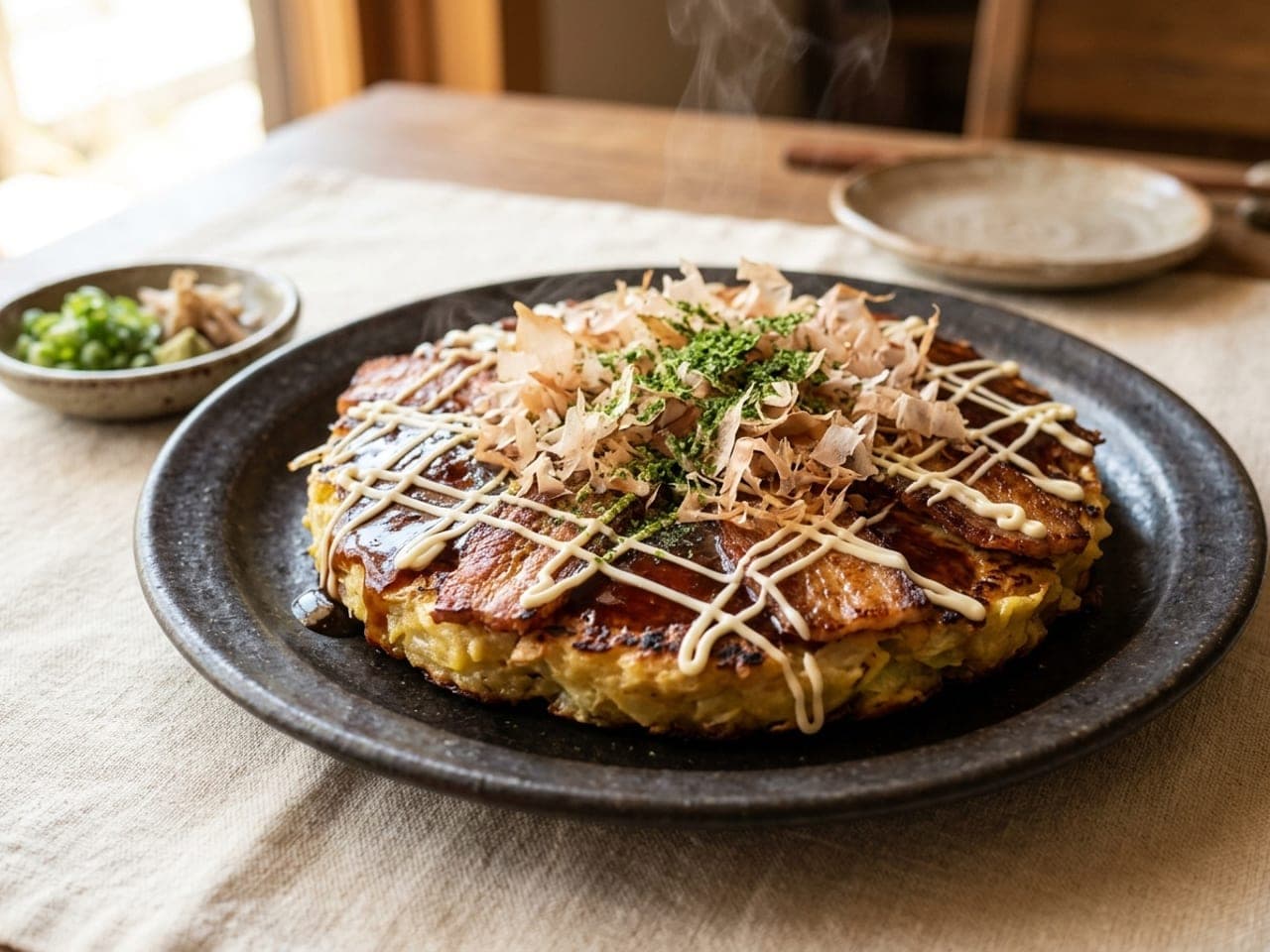
Osaka's "grill-what-you-like" pancake: a skillet-size round of finely shredded cabbage held together by just enough dashi batter, seared under strips of pork belly, then dressed like nothing else in cooking — dark sweet sauce, a mayonnaise lattice, green aonori, and a flurry of bonito flakes that move in the rising heat. It is the best thing that can happen to half a cabbage, and the batter takes five minutes.
Ingredients
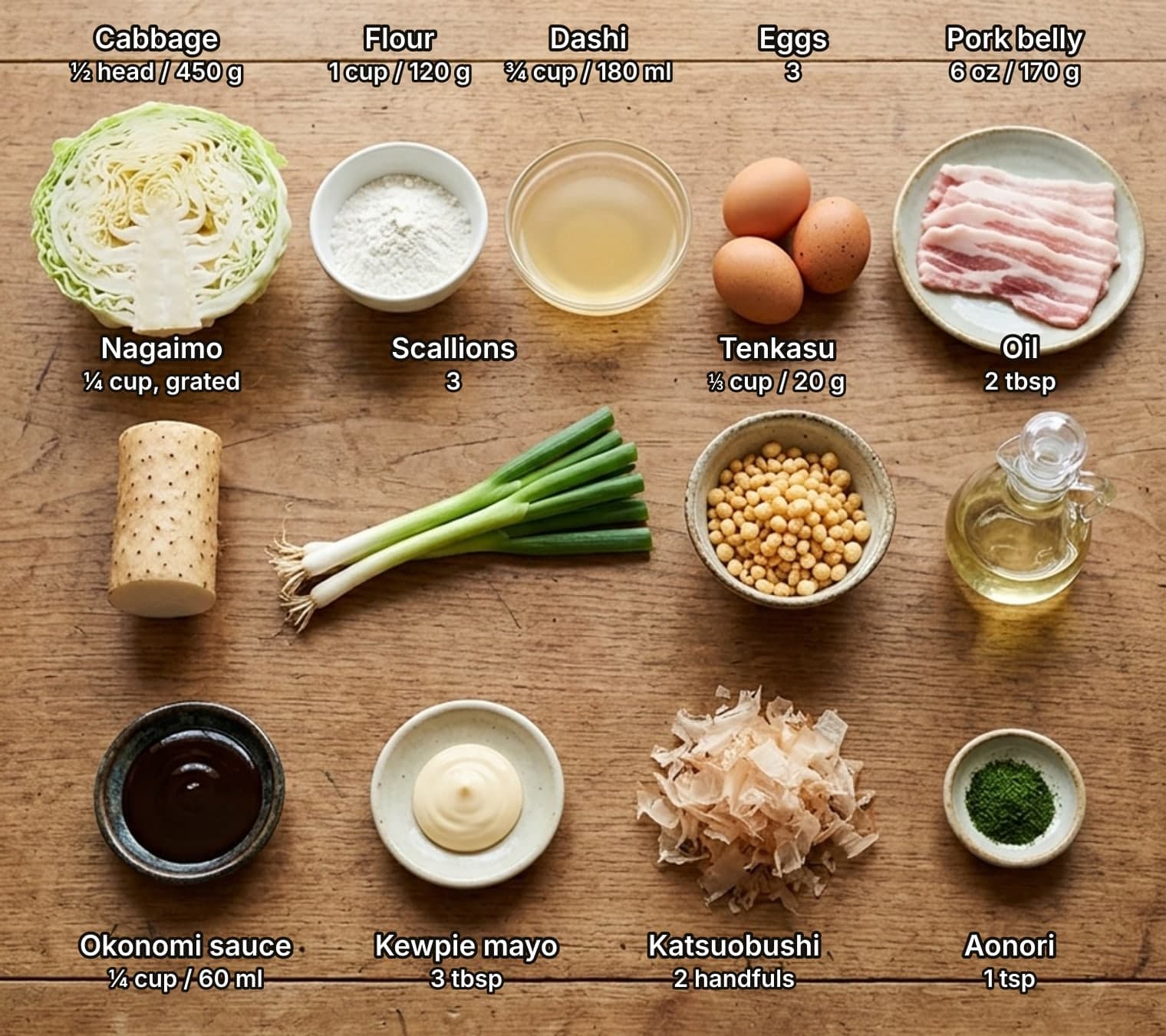
- white cabbage, shredded fine then cross-chopped½ head (1 lb / 450 g)
- all-purpose flour (plain flour)1 cup / 120 g
- cold dashi (or water + ½ tsp hondashi granules)¾ cup / 180 ml
- eggs3
- nagaimo, grated (optional — or ½ tsp baking powder)¼ cup / 60 ml
- scallions (spring onions), sliced3
- tenkasu / agedama tempura crumbs (optional)⅓ cup / 20 g
- thin-sliced pork belly (shabu-shabu cut)6 oz / 170 g
- neutral oil, for the pan2 tbsp
- okonomiyaki sauce (Otafuku, or the pantry clone)¼ cup / 60 ml
- Japanese mayonnaise (Kewpie), for the lattice3 tbsp
- katsuobushi (bonito flakes), to finishtwo generous handfuls
- aonori (green seaweed powder), to dust1 tsp
As you like it — the pancake with an attitude
Okonomiyaki translates, charmingly and literally, as "grilled as you like it" — okonomi (preference) + yaki (grilled) — and the name is the recipe's constitution: the cabbage-batter base is fixed law, everything else is amendment. Pork belly is the Osaka classic; shrimp, squid, cheese, kimchi and mochi are all street-legal, and the dish descends from Depression-era and post-war frugality cooking, when a hot griddle plus flour plus whatever-the-kitchen-had was dinner. It remains the best answer in world cuisine to the question "what do I do with half a cabbage."
Osaka owns the dish culturally — teppan counters where it is mixed in a bowl, griddled in front of you and eaten off the iron with a metal spatula — and this page teaches the Osaka (mixed) style, where everything folds into one batter. Hiroshima will be cross: their version is a layered construction — crepe-thin batter, a mountain of cabbage, pork, a block of yakisoba noodles, a fried egg — assembled like geology rather than mixed like batter. It is a magnificent, different dish requiring a bigger griddle and a steadier nerve, and it deserves its own page rather than a compromised paragraph here. Choosing sides in the Osaka–Hiroshima question is not required to eat well, but locals will ask.
One more relative worth naming: monjayaki, Tokyo's looser, lava-textured cousin, eaten with tiny spatulas directly off the griddle. Same family, different physics; mentioned so the vocabulary does not surprise you in Japan.
How to make Okonomiyaki
- Make the batter first and let it rest. Whisk 1 cup (120 g) all-purpose flour (plain flour) with ¾ cup (180 ml) cold dashi — from-scratch if you have it, water plus ½ tsp hondashi granules if it is Tuesday — until just smooth, and rest it in the fridge while you prep everything else. If you found nagaimo (the section below explains the hunt), grate ¼ cup (60 ml) of it in now: the slime you are looking at is the fluff agent, and yes, it is supposed to look like that. No nagaimo: add ½ tsp baking powder instead and accept a still-excellent pancake. The eggs wait — they go in at assembly.
- Shred the cabbage like it owes you money. Cut ½ a head of white cabbage — about 1 lb (450 g) — into fine shreds, then cross-chop the shreds into rough ¼-inch (6 mm) confetti, discarding the hard core. Fine matters: big pieces steam into wet slabs and the pancake splits along them like a geological fault. If the cabbage is washed, dry it properly (spin it, or towel it) — surface water is the enemy of the batter ratio, and okonomiyaki failure is nearly always a hydration failure wearing a different mask. Slice 3 scallions in while you are there.
- Fold — do not stir — at the last minute. Just before the pan is hot: add 3 eggs to the rested batter along with the cabbage, scallions and ⅓ cup (20 g) tenkasu (crunchy tempura crumbs — optional but transformative, adding little pockets of richness that stay half-crisp inside). Fold with a spatula until every shred is BARELY coated and you can still see the mixture fighting you — ten seconds too many and the cabbage weeps water into the batter, the batter thins, and the loft is gone. The mixture should look like far too much cabbage for far too little batter. That is correct. The batter is grout, not concrete.
- Pour thick, and lay the pork on the wet top. Heat a heavy skillet or flat griddle over medium heat with 1 tbsp neutral oil, and pile in half the mixture as a round about 8 inches (20 cm) across and a defiant 1 inch (2.5 cm) tall — use the spatula to tidy the edge into a drum shape, but do not press it flat. Lay 3 strips of thinly sliced pork belly across the wet top so they will sear into the surface on the flip. Lid on, 4–5 minutes: the lid steams the cabbage tender inside while the bottom crisps gold.
- The flip — two spatulas, one decision. Slide a spatula under each side of the pancake, lift, and turn it in one committed motion — the okonomiyaki flip is a decision, not a negotiation, and hesitation at the apex is how it ends up on the burner. (First-timer insurance: slide the pancake onto a plate, cap with a second plate, invert, slide back — slower, dignity intact.) Now the pork side is down: 5–6 minutes uncovered, pressing NOTHING, until the belly is crisped and lacquered onto the face of the pancake. One more flip for 60 seconds to reheat the first side, and out.
- Check the middle before the paint goes on. A skewer into the centre should come out clean of wet batter — a 1-inch (2.5 cm) pancake full of cabbage can look confidently bronzed while its core is still raw flour and egg. Not done: lid back on, heat down a notch, two more minutes. This is a two-minute patience test that decides whether the inside eats custardy-tender or like a damp secret, and no amount of topping choreography rescues an undercooked middle.
- Dress it like Osaka means it. On the plate, pork side up: brush okonomiyaki sauce edge to edge — the bottled truth is Otafuku; the pantry clone is the tonkatsu sauce from our chicken katsu page loosened with a teaspoon of honey and one of water (same Worcestershire family, sweeter accent). Then the lattice: Japanese mayonnaise in thin parallel lines from a squeeze bottle, quarter-turn the plate, cross them. Aonori (green seaweed powder) dusted over, then a generous handful of katsuobushi — the paper-thin bonito flakes will curl and wave in the rising heat. They are not alive; it is convection; announce this to the table before someone panics.
- Cut like a pizza, eat off the plate it fears. Repeat with the second pancake (the first holds happily in a low 250°F (120°C) oven, undressed — sauce and flakes only ever go on at the last second). Cut each round into six wedges pizza-style and serve three per person with extra sauce and mayo on the table. In Osaka this comes off a teppan with a metal spatula straight to your patch of the griddle; at home, hot plates and speed are the respectful translation. Beer or cold barley tea; nobody in Osaka would argue with either.
Safety & hygiene Important
- The flip is a hot-fat event. The pan under an okonomiyaki holds hot oil and rendering pork fat, and the flip drops a wide, heavy object into it from height if it goes wrong. Flip LOW — lift, turn and lay it down in one motion close to the surface, never a toss — with sleeves pushed up and the pan pulled briefly off the heat if it gives you nerve. The plate-cap method (pancake onto a plate, second plate on top, invert, slide back) removes the drama entirely and no Osaka grandmother would judge you for it. Keep small spectators back for this thirty seconds; splashed pork fat holds its heat.
- A thick pancake cooks on trust — verify it. Raw flour-and-egg batter in the centre is both unpleasant and a genuine food-safety miss (raw flour and undercooked egg both carry real, if small, risks — this is not just texture). The skewer test is mandatory on a pancake this thick: clean skewer, done; wet batter, lid on for two more minutes. Cooked through, the centre should read moist and tender — steamed cabbage bound in set custard — which is easy to distinguish from flowing batter once you have seen both. Probe owners have a number too: the centre of an egg dish is done at 160°F (71°C). When in doubt, more lid, less heat.
- The allergen roll-call is longer than it looks. Okonomiyaki as dressed carries wheat (batter, both sauces AND the tenkasu), egg (batter and mayonnaise), soy (sauces), fish twice — the dashi and the katsuobushi on top — and mollusc in the sauce lane: the standard Japan-made Otafuku bottle lists oyster extract (and meat extract besides), and the pantry clone's oyster sauce certainly counts; anchovy joins only if the clone's Worcestershire is the Western kind. Sesame rides in if your mayo includes it. "It is a vegetable pancake" undersells a plate with this much fish in the seasoning; say the list out loud when cooking for guests. The genuinely fish-free version exists and the FAQ covers it — kombu dashi, no katsuobushi, and a checked sauce label.
- Leftovers re-crisp; toppings do not. Undressed pancake keeps 2 days refrigerated (cool it within two hours, wrapped once fully cold) and revives well: 4–5 minutes per side in a dry skillet over medium, or a 400°F (200°C) oven on a rack for 8–10 minutes, until hot through — 165°F (74°C) at the centre; steam it back to life in a microwave and it eats like a compress. Sauce, mayo, aonori and katsuobushi are a moment-of-serving ritual only; dressed leftovers are a loss the fridge cannot undo. The pork belly on top follows pork rules: reheat until properly hot, once.
3 ways to plate it
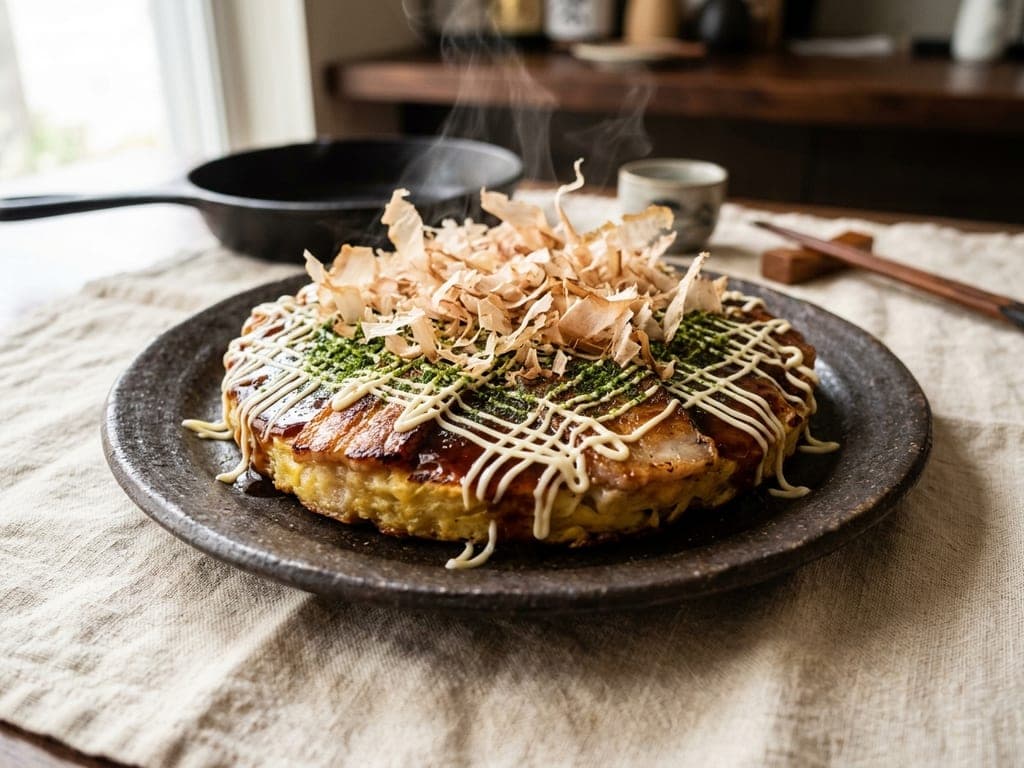
- Sauce first and edge to edge — brushed or spread with the back of a spoon; bare rim reads unfinished, and the gloss is the base coat everything else draws on.
- Lattice second: thin parallel mayo lines from height, quarter-turn the plate, cross them — the squeeze bottle's fine tip makes this automatic; a cut corner on a freezer bag is the improvised nozzle.
- Aonori before katsuobushi, so the green shows on the sauce rather than vanishing under the flakes.
- Katsuobushi last, from a height, in one generous flurry — then serve immediately, while the flakes still move; the dance lasts two minutes and it is the best free theatre in cooking.
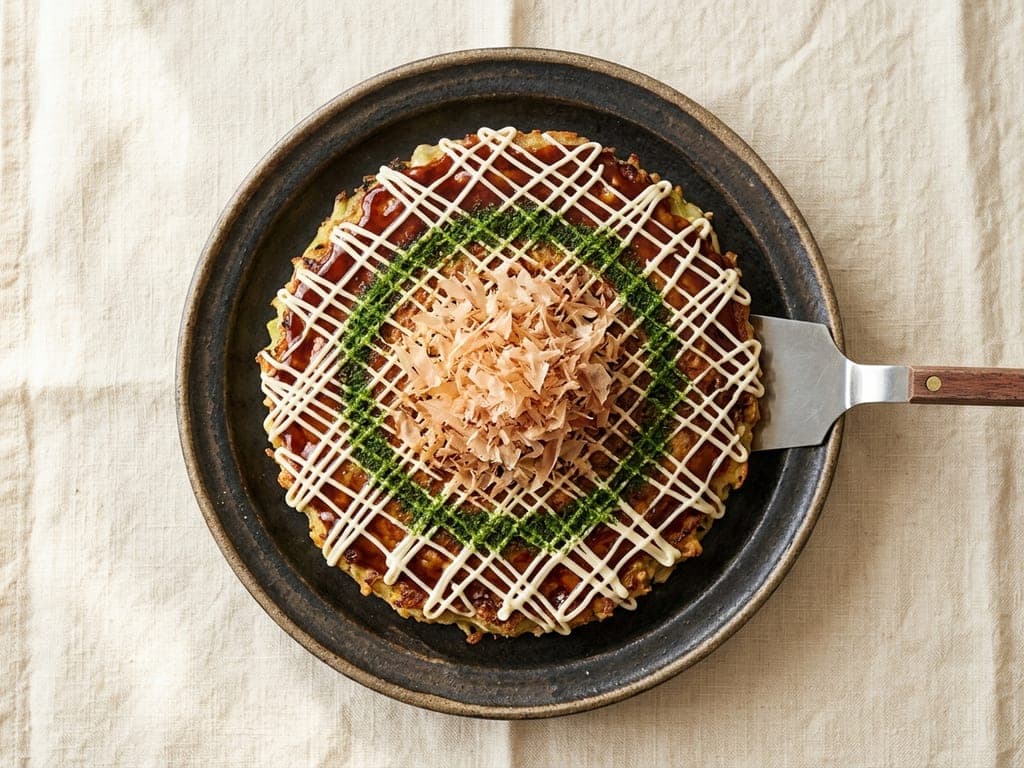
- Centre the pancake on a plate with real margin — the dark round on empty plate is the composition, and crowding it with sides breaks the poster.
- Draw the lattice slower than feels natural: even spacing beats fine lines, and the crossing angle (45 degrees, not 90) is what makes it read as designed rather than gridded.
- Cluster the katsuobushi in the centre rather than broadcast — a dense pile moves more dramatically and leaves the lattice legible around it.
- Ring the aonori near the edge like a border stamp, and lay the spatula on the rim: the single tool in frame says teppan counter without a word.
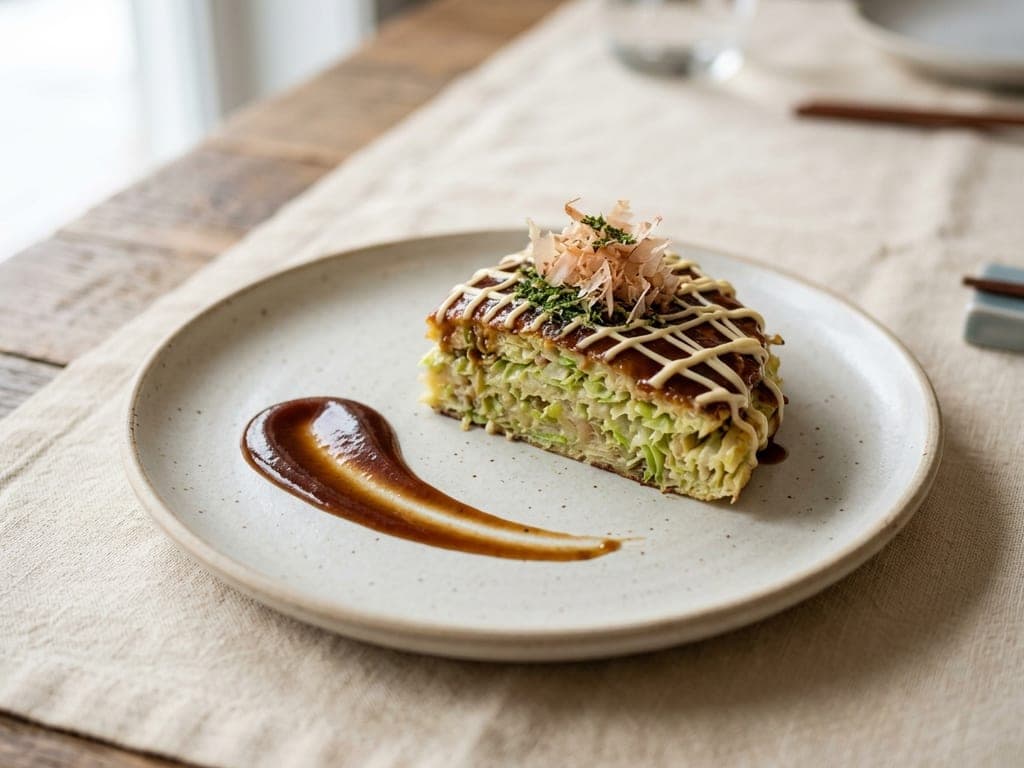
- Cut the wedge with a sharp knife pressed straight down while the pancake is fresh — the cross-section of cabbage layers under the dark top is the entire argument of this plate.
- Pull one confident swoosh of sauce across the plate with the back of a spoon and stand the wedge on it, point forward.
- Dress the wedge's top only — a thread of mayo, a pinch of aonori, three or four flakes at the peak; miniature plate, miniature dose.
- Serve two wedges per person as a starter portion and keep the rest of the round back — the reveal that there is a whole pancake where that came from is the evening's second-best moment.
The batter and the yam question
The batter is deliberately minimal — flour, dashi, egg — because it is mortar, not the building. Dashi instead of water is the invisible upgrade: the batter itself carries umami, so the pancake tastes seasoned from within rather than rescued by its toppings (hondashi granules in water are the accepted weekday truth, exactly as the curry page admits about roux blocks). The eggs join late, with the cabbage, so the rested flour-dashi base stays relaxed and the fold stays brief.
Nagaimo — Japanese mountain yam — is the traditional fluff agent: grated, it collapses into a slippery foam that bakes into a light, almost soufflé tenderness the internet calls fuwa-fuwa. Asian grocers sell it (long, pale, hairy roots, often wrapped in sawdust; handle the raw slime with a bag over your hand — it can itch bare skin, and the itch stops at cooking). It is genuinely optional: ½ tsp baking powder replicates most of the lift with none of the safari, and plenty of Osaka kitchens shrug and use neither. What is NOT optional is restraint in mixing — the loft lives in unbroken cabbage structure more than in any additive.
Tenkasu, the crunchy tempura droplets, are the other quiet upgrade: little fat-crisp pockets through the interior that half-survive the steam. Buy a bag at the Asian grocer (agedama is the same thing), hoard the rest in the freezer, or skip them without grief.
Cabbage discipline and the flip
Every okonomiyaki failure is a cabbage failure until proven otherwise. The shred wants to be fine — ¼ inch (6 mm) confetti, not slaw ribbons — because fine cabbage steams tender inside the batter's set custard, while coarse cabbage stays half-raw, sheds steam-water and breaks the pancake along its own pieces. Dry cabbage, and a fold measured in seconds: salt and shear pull water out of cut cabbage fast, and a wet mixture makes a thin batter, a flat pancake and a long sigh. Mix at the last second, pour immediately, and the ratio the recipe promises is the ratio the pan receives.
The flip is the dish's only athletic moment and it is 90% psychology: two spatulas, lift from both sides, one smooth committed rotation, laid down low. The pancake is sturdier than fear suggests — set custard and cabbage weave hold together — but only if the first side finished its 4–5 lidded minutes and the edge released. The plate-cap escape route (slide out, cap, invert, slide back) is taught in the steps and endorsed here in writing, permanently, for anyone whose first attempt ended abstract.
And once flipped: press nothing. The spatula-squash instinct belongs to smash burgers, where flat is the point; here it evicts the steam that is cooking the middle and compacts the loft the folding discipline just paid for. The pancake needs height to finish custardy — protect it.
Shopping the toppings (and the sauce kinship)
Okonomiyaki sauce is a Worcestershire-family brown sauce — same lineage as the tonkatsu sauce on our chicken katsu page, tuned sweeter and fruitier. Otafuku is the bottled standard (Asian grocers, world-food aisles, unmistakable label), and the pantry clone is honest: the katsu page's four-ingredient tonkatsu sauce plus a teaspoon of honey, loosened with water to brushing consistency. One family of sauce, three pages of this site — the chicken katsu page (whose FAQ holds the HP-cousin note for UK readers), the katsu curry it seasons, and here — which is the kind of pantry economics this catalog approves of.
Japanese mayonnaise (Kewpie) draws the lattice — its squeeze bottle has a fine star tip that makes anyone look practiced, and its extra-yolk tang stands up to the sweet sauce. Aonori is green seaweed powder, not crumbled nori sheets — the flavour is brighter and greener; a nori sheet blitzed fine is the emergency substitute at maybe 70%. Katsuobushi (bonito flakes) come in bags of impossible lightness; buy the bigger shavings for topping — the wide, paper-thin ones do the famous dance. They move because rising heat and escaping steam curl their thin structure — convection, not vitality — and telling the table BEFORE the flakes start waving is both kindness and better theatre.
The pork is thin-sliced belly, sold in shabu-shabu or hot-pot packs at any Asian grocer, or asked for at a butcher (unsmoked, paper-thin; streaky bacon works at the cost of a smoky accent Osaka would notice but forgive). Vegetarian and fish-free routes exist honestly — the FAQ has the full map.
Questions, answered
What is the difference between Osaka and Hiroshima okonomiyaki?
Osaka style — this page — mixes everything into one batter and griddles it as a thick pancake. Hiroshima style layers: a crepe-thin batter round, a mountain of cabbage and bean sprouts, pork, a block of yakisoba noodles and a fried egg, built and flipped in stages like edible geology. Hiroshima's is bigger, noodle-hearted and technically fussier; Osaka's is faster and homier. Both cities consider the question settled and disagree on the answer.
What can I use instead of nagaimo?
Half a teaspoon of baking powder in the batter gets you most of the lift, and it is the standard substitute — plenty of Japanese home kitchens use it. You can also just leave it out: the pancake is denser but still excellent if your cabbage is fine and your fold is brief (the loft lives more in unbroken cabbage than in any additive). If you do find nagaimo, grate it skin-off with a bag over your hand — the raw slime can itch bare skin; cooking neutralises it.
Can I make okonomiyaki vegetarian or vegan?
Genuinely, with honest substitutions: skip the pork (or use halloumi or extra cheese), make the dashi from kombu (or shiitake) instead of bonito, and skip the katsuobushi topping — the aonori and mayo lattice carry plenty of finish. Mind the sauce, because the obvious bottle is the trap: the standard Japan-made Otafuku (the import most Asian grocers stock) contains oyster extract AND meat extract — buy Otafuku's vegan-labelled sauce instead (the US-made bottle is a vegan reformulation), and skip this site's pantry clone here, whose oyster sauce disqualifies it. Vegan additionally swaps the egg (the nagaimo route helps here — it is a binder too) and uses vegan mayo. The result is a different, still-legitimate pancake; cabbage was always the star.
Why did my okonomiyaki fall apart?
One of four cabbage crimes: shredded too coarse (big pieces are fault lines), mixed too early or too long (the cabbage wept and thinned the batter), too little batter for the pile (the ratio should look wrong but coat every shred), or flipped before the first side set (4–5 lidded minutes, and the edge should release before you commit). The pancake is sturdier than it looks — when it breaks, the cause is nearly always upstream of the flip that took the blame.
What is okonomiyaki sauce — and what if I can't find it?
A sweet, fruity Worcestershire-family brown sauce; Otafuku is the benchmark bottle. The pantry clone: whisk ¼ cup (60 ml) ketchup, 2 tbsp Worcestershire, 1 tbsp oyster sauce and 1 tbsp sugar (that is the tonkatsu sauce from our chicken katsu page), then add 1 tsp honey and loosen with water to brushing consistency. Same family, sweeter accent — and one mixing bowl covers three dishes on this site.
Why do the bonito flakes move?
Convection, not resurrection. Katsuobushi is shaved so thin — micrometres — that rising heat and escaping steam are enough to curl and wave the flakes, and on a fresh-off-the-pan okonomiyaki they genuinely dance for a minute or two. It is the dish's signature party trick and has startled at least one dinner guest per household since records began; announce it as theatre and it lands as delight instead.
Can I use bacon instead of pork belly?
Yes — streaky bacon is structurally the same cut (belly), just cured and usually smoked, so the pancake picks up a smoky accent Osaka would raise an eyebrow at and then eat anyway. Lay the strips on the wet top exactly as the recipe describes. For closer-to-canon, ask a butcher for unsmoked thin-sliced belly, or raid the shabu-shabu freezer at an Asian grocer — those hot-pot packs are precisely the right thing.
Can I make okonomiyaki ahead?
The pancake, yes — the dressing, never. Cook both rounds, cool undressed within two hours, refrigerate up to 2 days, and re-crisp in a dry skillet (4–5 minutes a side) or a 400°F (200°C) oven until properly hot through; the cabbage interior revives surprisingly well. Sauce, mayonnaise, aonori and katsuobushi go on in the final thirty seconds of the pancake's life, whichever life that is. A dressed pancake in the fridge is a compress by morning.
What does okonomiyaki actually mean?
"Grilled as you like it" — okonomi is preference, yaki is grilled (the same yaki in teriyaki, yakitori and takoyaki). The name is licence: the cabbage-dashi-batter base is the constitution, and shrimp, squid, cheese, kimchi, mochi and corn are all ratified amendments. Its ancestry is thrift cooking — a hot plate, flour, and whatever the kitchen held — which is why the correct answer to "can I add X?" is almost always yes.
Is okonomiyaki gluten-free?
Not as written — wheat flour is the batter, and both the sauce and the soy in it usually carry wheat too. A workable GF version: swap the flour for a rice-flour blend (or a GF all-purpose mix; the nagaimo or an extra egg helps bind what gluten no longer holds), use tamari-based and GF-labelled sauces, and skip tenkasu (wheat). The cabbage, egg, dashi, pork, mayo, aonori and katsuobushi are all naturally GF. The result is slightly more fragile at the flip — the plate-cap method is your friend.
Snap your finished plate and let the AI plate it again — more beautifully.