Karaage Recipe (Japanese Fried Chicken — the Potato-Starch Lace and the Double Fry)
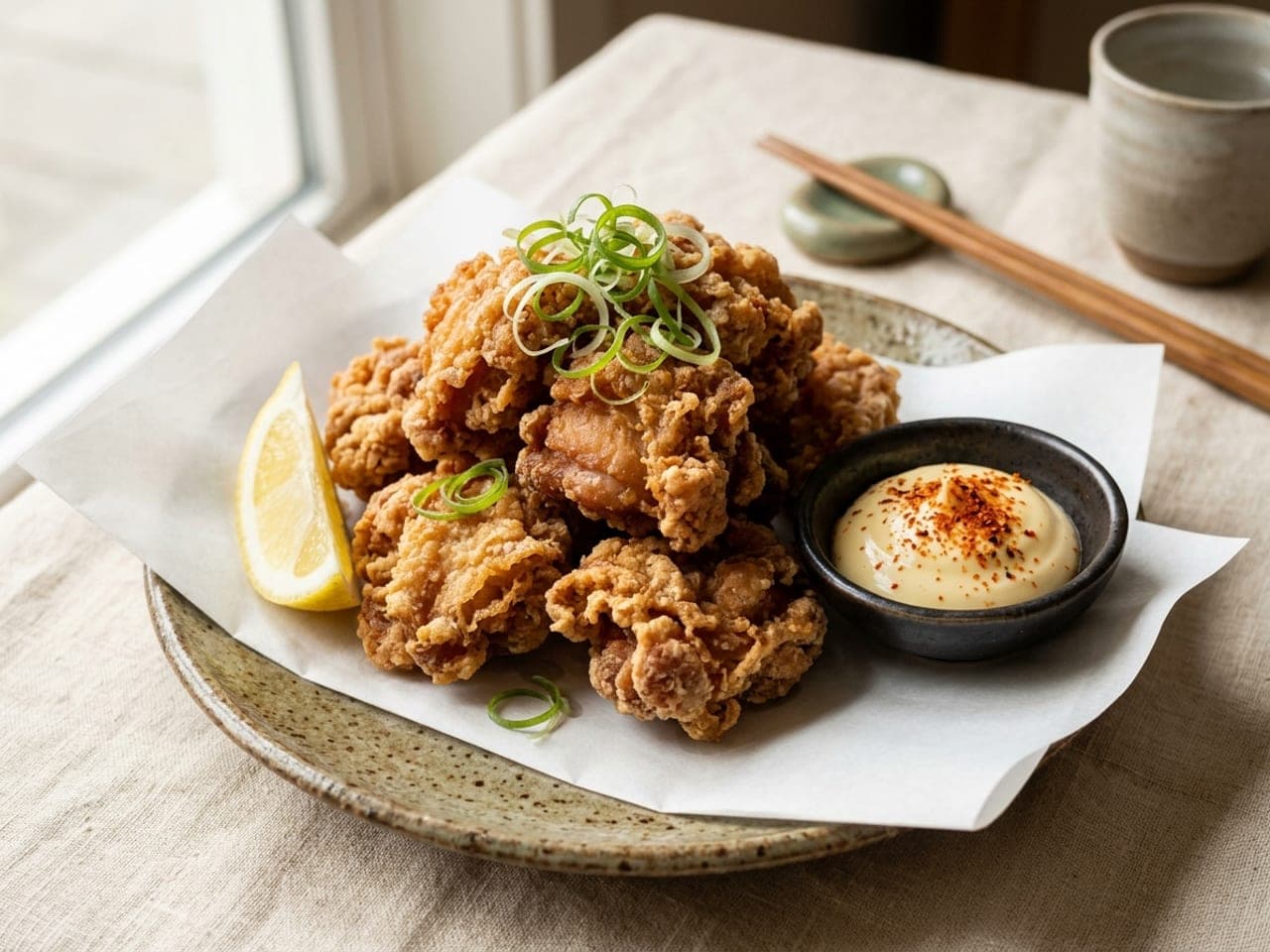
Japanese fried chicken: bite-size thigh pieces marinated in soy, sake and ginger, dredged in potato starch and fried twice, so the crust comes out lacy and crackling-thin instead of breaded and heavy. Karaage is the fried chicken that stays good cold — it was engineered for the bento box — and the whole method is two rules: potato starch, and two trips through the oil.
Ingredients
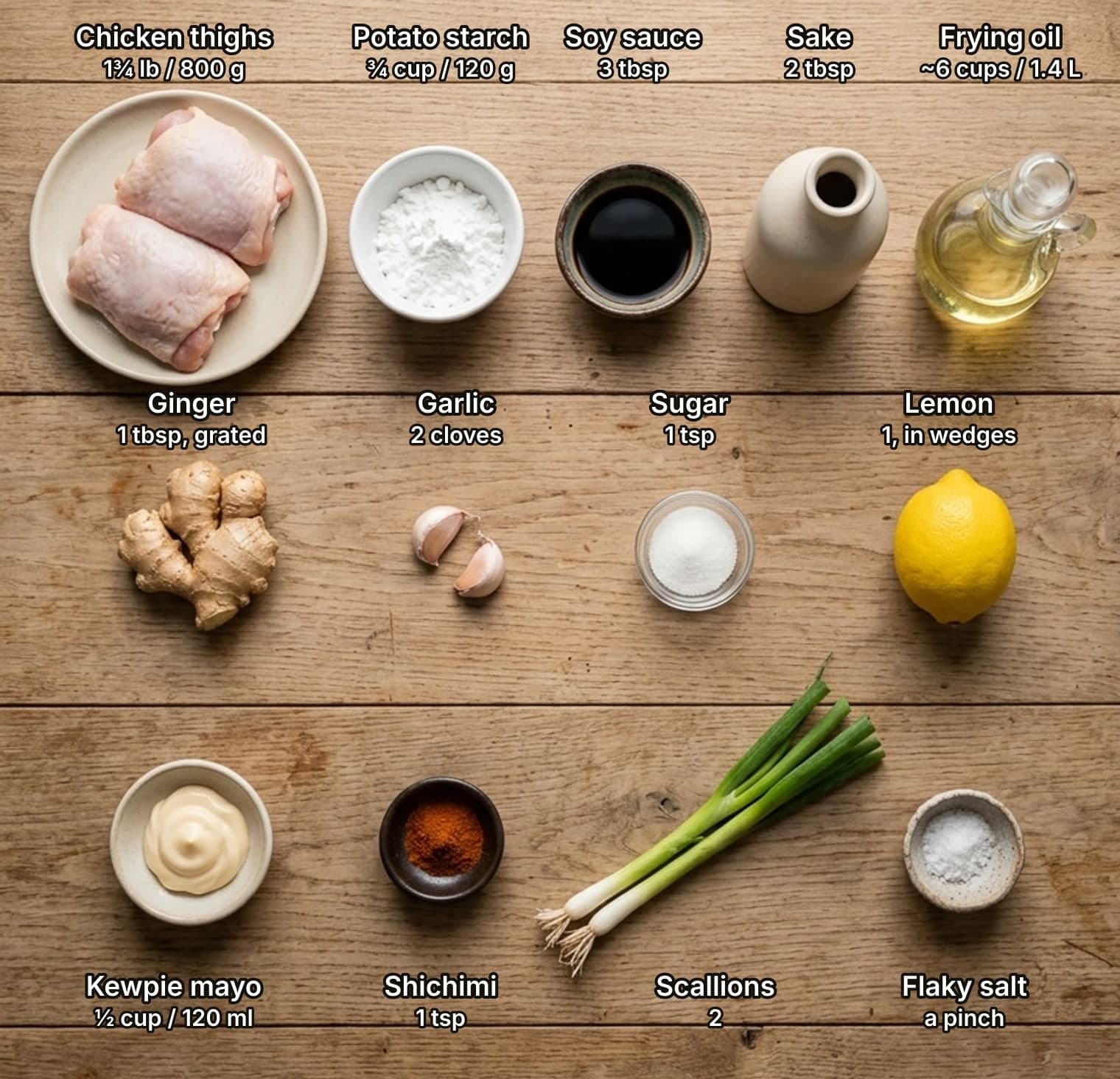
- boneless skin-on chicken thighs, in 2-inch (5 cm) pieces1¾ lb / 800 g
- soy sauce (marinade)3 tbsp
- sake (marinade — or dry sherry)2 tbsp
- fresh ginger, grated (marinade)1 tbsp
- garlic, grated (marinade)2 cloves
- sugar (marinade)1 tsp
- potato starch (katakuriko / Kartoffelstärke / Solamyl)¾ cup / 120 g
- neutral oil for deep-frying~6 cups / 1.4 L
- lemon, in wedges1
- Japanese mayonnaise (Kewpie), to serve½ cup / 120 ml
- shichimi tōgarashi (seven-spice chilli), to dust1 tsp
- scallions (spring onions), finely sliced2
- flaky salt, if needed after tastinga pinch
What karaage is (and what it is not)
Karaage — 唐揚げ, literally "Tang-style frying," by the popular account a nod to cooking techniques associated with Tang-dynasty China (it is also written 空揚げ, "empty frying," i.e. batter-free — the etymology is happily disputed territory) — is Japan's everyday fried chicken: bite-size, boneless, marinated, starch-dredged, twice-fried. It lives everywhere in Japanese life at once — izakaya tables, convenience-store counters, school bentos, festival stalls — and the city of Nakatsu in Oita prefecture has claimed the title of karaage capital so seriously that Japan holds an annual Karaage Grand Prix with gold medals and factional rivalries over ginger ratios. This is not a novelty dish; it is infrastructure.
What it is not: katsu, which is a flat panko-breaded cutlet with a pressed-on crumb armour (our chicken katsu page covers that discipline); Korean fried chicken, which is batter-dipped, double-fried for glass-crunch and then usually sauced; and American fried chicken, which is bone-in, buttermilk-soaked and flour-crusted. Karaage's identity is the thin, craggy, unbreaded shell — starch and marinade fused directly onto the meat — and the fact that it is deliberately engineered to be as good cold as hot — a design goal it shares only with America's picnic fried chicken, and executes with a far lighter shell.
One naming footnote: menus sometimes say "chicken karaage," which is technically redundant the way "beef hamburger" is — karaage without qualification means chicken. The technique applies to anything (octopus karaage is an izakaya standard), but chicken is the citizen the word defaults to.
How to make Karaage
- Cut the thighs into two-bite pieces. Cut 1¾ lb (800 g) of boneless, skin-on chicken thighs into pieces about 2 inches (5 cm) across — two confident bites each, with a bit of skin riding on as many pieces as possible. Bigger pieces stay juicier through two fries; smaller ones turn into all crust, which sounds appealing and eats like gravel. Trim any hard cartilage but keep the fat: thigh fat is where karaage's flavour lives, and the skin crisps into the best part.
- Marinate 30 minutes — and no longer than a few hours. Toss the chicken with 3 tbsp soy sauce, 2 tbsp sake, 1 tbsp grated fresh ginger, 2 grated garlic cloves and 1 tsp sugar, and let it sit 30 minutes in the fridge — up to 2–3 hours if dinner drifts. Thirty minutes is genuinely the sweet spot: the aromatics season the surface and the sake starts tenderising. Overnight is the classic beginner upgrade that is actually a downgrade — the salt keeps travelling, the texture goes wet and ham-like, and the fry spits harder. This is a marinade with a timer, not a slow project.
- Drain hard before the starch goes anywhere near. Tip the chicken into a sieve and let it drain a full minute, then press gently — you want the surface damp, not dripping. A wet piece turns its starch coat into glue-paste that fries into a hard shell; a damp piece grabs exactly enough starch to become lace. The marinade that drains off has been holding raw chicken and its work is done — it goes down the drain, not into a sauce, not into next week.
- Dredge in potato starch at the last minute. Put ¾ cup (120 g) of potato starch in a wide bowl and dredge the chicken in two or three batches, tossing each piece so it is fully coated, then shaking off the excess. Do this right before frying, not ahead — starch left sitting on damp chicken slowly dissolves into batter and the lace is lost. The little clumps and ragged patches where damp starch clusters are not mistakes; they are exactly what fries into karaage's signature craggy shell. Smooth and even is for katsu; karaage wants a rough coat.
- First fry: 320°F (160°C), gently, in batches. Heat 2 inches (5 cm) of neutral oil — about 6 cups (1.4 L) in a heavy medium pot, never more than half full — to 320°F (160°C). Fry the chicken in three or four batches, 90 seconds each, until the crust is set and pale gold but not browned, lifting each batch to a rack. The first fry's job is cooking, not colour: crowding the pot drops the temperature and turns frying into simmering, so keep the batches honest and let the oil recover between them.
- Rest — the fry that happens outside the pot. Let the pieces sit on the rack 3–4 minutes while the oil climbs to the second-fry temperature. This is not idle time: carryover heat keeps cooking the centres gently while the crust's moisture migrates outward, which is what lets the second fry crisp it properly. Every serious karaage shop in Japan builds this pause into the line — the rest is a cooking stage, and skipping it is why single-fried chicken is either pale and greasy or brown and dry.
- Second fry: 375°F (190°C), fast, for the crackle. Bring the oil to 375°F (190°C) and fry the rested pieces again, 45–60 seconds per batch, until deep golden brown and audibly crisp. This pass is all crust: it drives off surface moisture, blisters the starch into its lacy shell and finishes the skin. Check one thick piece from each batch with a thermometer — 165°F (74°C) at the centre — and trust the probe over the colour, because a starch crust browns on its own schedule. Rack again, never paper; a sprinkle of flaky salt while hot if the marinade ran short.
- Lemon, mayo, and the etiquette question. Pile the karaage on a paper-lined plate with a lemon wedge and a small dish of Japanese mayonnaise dusted with shichimi (the seven-spice chilli blend). One cultural note that doubles as table manners: in Japan, squeezing the lemon over the SHARED plate without asking is a genuine faux pas — the crust is the point, and not everyone wants theirs softened. Lemon on your own pieces, mayo for dragging, and eat while it crackles; the bento section below covers the cold second act.
Safety & hygiene Important
- Deep-frying rules, condensed and non-negotiable. A pot of oil is a supervised appliance: never filled past half, never left alone — not for a phone call, not for the doorbell — on a back burner, handle away from the edge but not over a neighbouring flame, with a lid or baking sheet within reach BEFORE the heat goes on. If it ignites: heat off, lid on, and the lid stays until the pot is stone cold. Never water, never carry the pot, never flour or baking powder on a fire — plain salt or baking SODA if you must throw a powder. Not out in seconds? Everyone leaves, fire service gets the call. And dry hands and dry chicken before anything meets the oil: water is what makes it spit. The burn rule, stated once for every fried page on this site: cool a burn under cool running water for a full 20 minutes — no ice, no butter — rings and watches off, and medical eyes on anything blistered, larger than the person's palm, or on a child.
- Small pieces still get the thermometer. Bite-size pieces feel too casual for a probe, which is exactly how underdone karaage happens — the craggy crust browns beautifully around chicken the first fry never finished. Probe the thickest piece of each batch after the second fry: 165°F (74°C). The visual fallback (cut one open: opaque throughout, no pink at the bone-side seams) is the weakest test in the book — colour and clear juices can both lie on poultry — so when a cut face leaves any doubt, the piece goes back for another 30 seconds. Slightly over is still juicy thigh; under is not a conversation.
- The marinade and the dredging bowl are raw-chicken zones. The drained marinade, the sieve, the starch bowl and its leftover starch, and both your hands have all handled raw chicken. Marinade and leftover starch are binned — never reused, and this page doesn't turn marinade into sauce (USDA technically allows it after a hard boil; neither the texture nor the wisdom survives the trip). Wash hands with soap for a real 20 seconds when dredging ends, before touching the pot handle or the thermometer. And no rinsing the chicken at any point — it removes nothing and sprays raw-chicken water around the sink.
- The bento clause — cold karaage has rules. Karaage's cold-lunch career is legitimate but scheduled: cool the fried pieces completely on the rack (within an hour, not sealed hot into a box where they steam and sweat), refrigerate within two hours of frying, pack the bento cold with an ice pack, and eat it the same day or the next. Room-temperature hours are the enemy — a bento that rides warm from morning to lunch is a science experiment, which is why Japanese bento culture packs everything cooled and runs on ice packs. Reheating is optional (cold is traditional); if you do, a 375°F (190°C) oven on a rack for 8–10 minutes — to 165°F (74°C) inside, once, not on rotation — brings the crackle back; the microwave does not.
3 ways to plate it
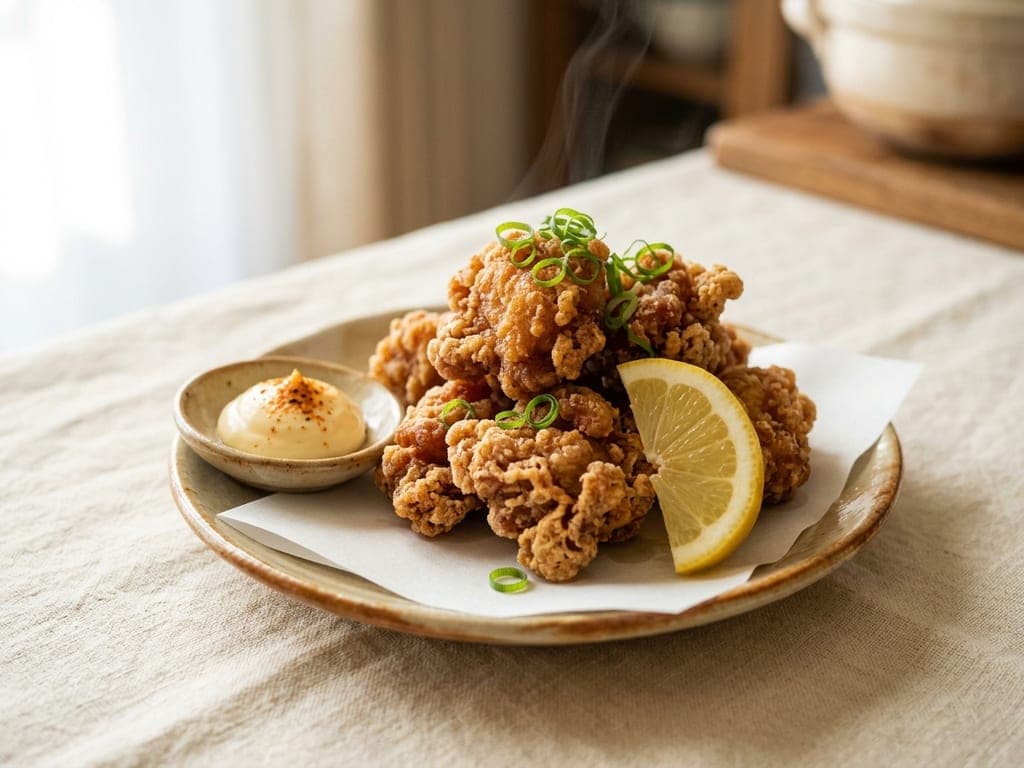
- Pile, don't arrange: karaage reads generous in a loose mound with height, and reads catered when pieces are spaced out in rows.
- Fold a square of plain kitchen paper under the pile — the izakaya signature — and change it if it saturates; the paper says fresh, a grease slick says regret.
- Keep the mayo in a separate small dish, dusted with shichimi at the last second so the red sits on top in flecks rather than blending in.
- One lemon wedge, placed against the pile rather than on it — softening someone's crust without consent is an izakaya crime, so the lemon waits for a volunteer.
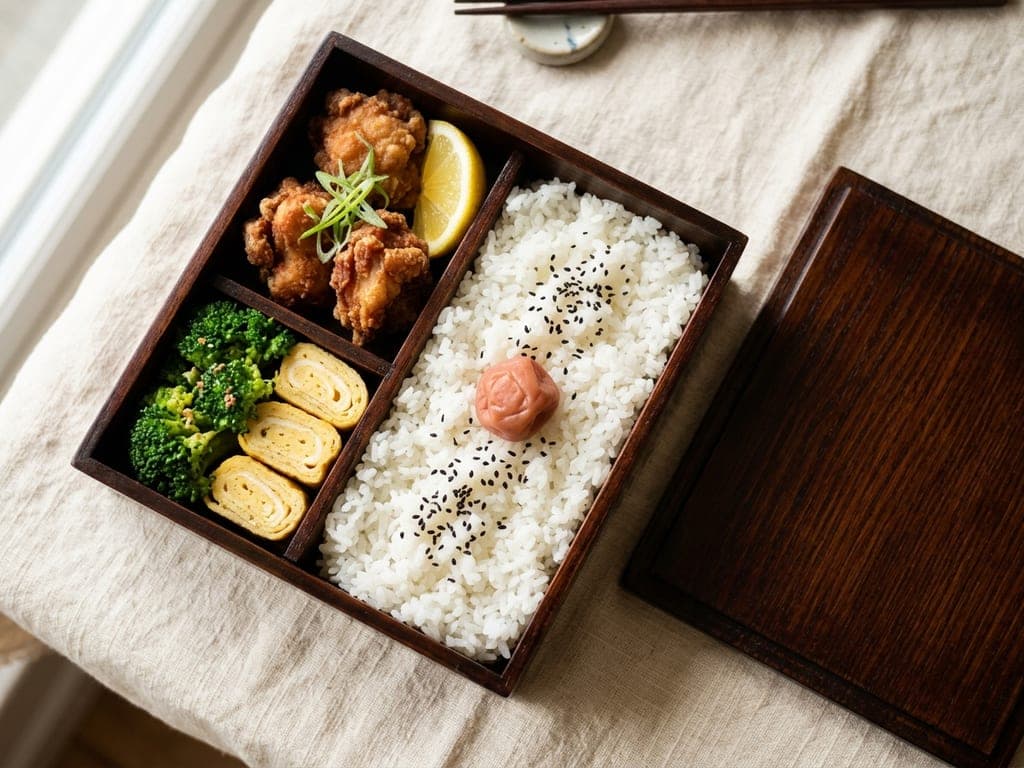
- Pack everything COLD — hot karaage sealed in a box steams its own crust off and breaks the safety rules besides; patience the night before buys the crackle at noon.
- Give the chicken its own compartment or a lettuce-leaf divider so the starch shell never sits against wet vegetables.
- Fill gaps tightly — bento physics: food that cannot shift cannot smear, and a packed box looks abundant where a loose one looks like leftovers.
- One point of colour discipline: the pink umeboshi or a wedge of lemon in the rice compartment gives the box its single accent, same job as fukujinzuke on curry.
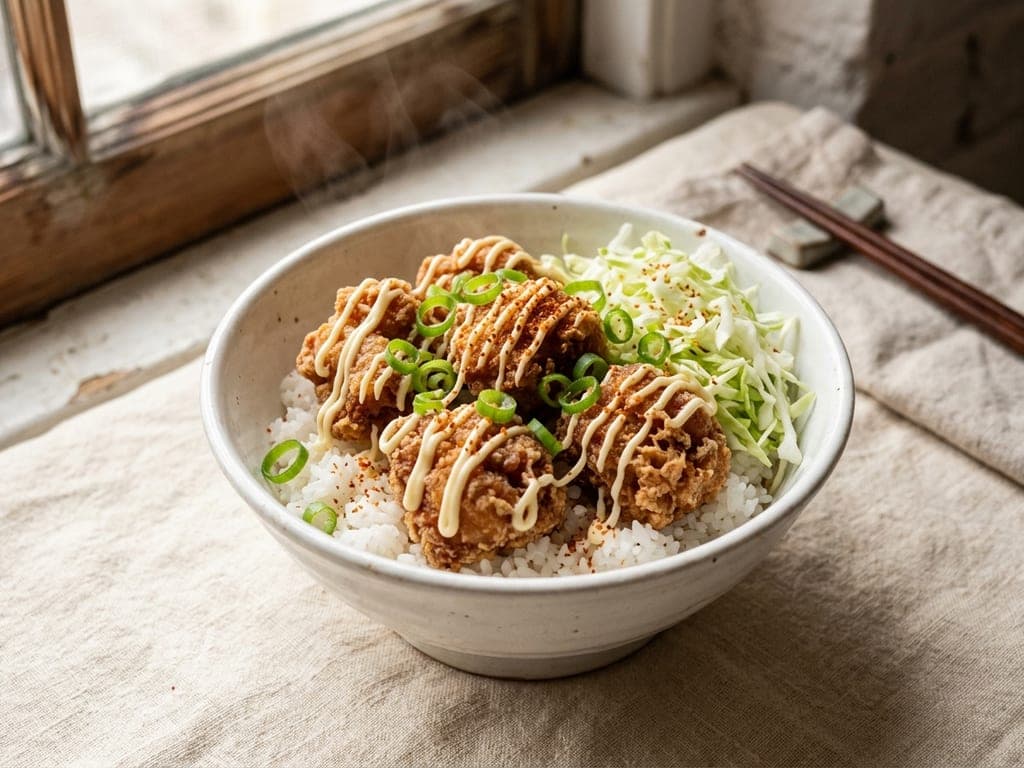
- Arrange the pieces in a loose ring rather than a heap so each one stays in contact with the hot rice — reheating from below is the bowl's quiet trick.
- Zigzag the mayo across the chicken only, thin lines from height; it should read as drawing, not dressing.
- Tuck the shredded cabbage into one side like the katsu plate in miniature — cold crunch belongs next to the rich pieces, not under them.
- Finish with scallion rings and shichimi from a height, and serve with a spoon as well as chopsticks — the mayo-slicked rice at the bottom is the part people fight over.
Potato starch, and why the crust is lace
The crust decision is the whole dish. Potato starch — katakuriko in Japanese kitchens — is pure starch with no protein, and it behaves nothing like flour in hot oil: it gelatinises fast, blisters into a thin glassy-crisp shell, and holds almost no oil, which is why karaage eats light where flour-crusted chicken eats rich. Flour's gluten fries into a bready jacket; potato starch fries into lace. It is also why karaage survives refrigeration: a gelatinised starch shell stays intact and pleasantly chewy-crisp where a flour crust goes damp and sad, which is the entire secret of its bento career.
Cornstarch (cornflour, for UK readers) is the honest substitute at about 90% of the effect — slightly less craggy, slightly more delicate, completely respectable. European readers are sitting on a supply already: potato starch is the default box in every German, Czech and Polish supermarket (Kartoffelstärke; Czech cooks know it as Solamyl, the dumpling-and-sauce starch that has lived in the pantry all along). Asian grocers sell katakuriko-labelled bags for purists, but the contents are the same molecule.
Technique serves the starch: dredge at the last minute so it does not dissolve into batter, keep the coat rough — the clumps ARE the future crags — and never rest the dredged pieces wet. The marinade-damp surface grabs exactly the right amount; anything drier sheds the coat, anything wetter turns it to paste.
The double fry, explained once
Two fries solve fried chicken's central contradiction: crust wants violent heat, meat wants gentle heat, and one temperature betrays one of them. The first pass at 320°F (160°C) is the gentle one — 90 seconds that set the crust and cook the chicken most of the way without colouring it. The rest on the rack is the hidden third fry: carryover heat finishes the centres while internal steam pushes moisture out of the crust, loading it for the finale. The second pass at 375°F (190°C) is pure exterior — under a minute that blisters the starch deep gold and crisp enough to hear across the table.
This is the same physics as Belgian fries and Korean fried chicken, and Japan's karaage chains treat the rest between fries as seriously as the fries themselves. The home-kitchen translation: batches small enough that the oil recovers, a rack (never paper — steam undoes everything), and a thermometer clipped to the pot, because the difference between the two temperatures IS the recipe. Guessing them collapses the whole design into one mediocre middle fry.
Thigh is not negotiable so much as strongly advised: it carries the fat and collagen that forgive two heat exposures. Breast karaage exists and dries out on schedule; if you must, cut bigger pieces, marinate the full 3 hours, and accept the ceiling.
Shopping it, serving it, and the second act
The list is short and the exotics are optional. Sake for the marinade is worth buying (cheap cooking sake is fine; dry sherry is the accepted emergency substitute, or skip it and add a teaspoon of water — mirin is NOT the swap, it is sweet and would candy the fry). Japanese mayonnaise — Kewpie, the baby-on-the-bottle brand — is richer and tangier than Western jars thanks to extra yolk and a tangy blend of vinegars; a squeeze bottle of it with shichimi dusted on top is the canonical dip, and a Western mayo sharpened with a half-teaspoon of rice vinegar gets you most of the way. Shichimi tōgarashi (seven-spice chilli) finishes both the mayo and the chicken.
Serving, izakaya-style: paper-lined plate, lemon wedge, shredded cabbage if you want the katsu-adjacent freshness, cold beer being the traditional companion this page trusts you to arrange. The one etiquette landmine — squeezing lemon over a shared plate unasked — is covered in the steps and has genuinely ended friendships in izakaya folklore.
The second act is the point: cold karaage in tomorrow's bento, over rice as a karaage don with mayo zigzags, or tucked into a sandwich roll. It was designed for this — the starch shell holds, the thigh stays juicy cold, and the seasoning is already inside the meat rather than in a coating that needed to be hot. Fry once, eat twice; the bento safety clause in the notes keeps the second meal honest. Allergy fine print for the plate as served: soy and wheat in the soy sauce (tamari makes it gluten-free — the starch already is), egg in the mayo, and sesame in the shichimi.
Questions, answered
What makes karaage different from regular fried chicken?
Three decisions: the marinade goes INTO the meat (soy, sake, ginger, garlic) instead of living in a thick crust; the dredge is potato starch, which fries into a thin, craggy, lacy shell rather than a bready jacket; and it is fried twice — gentle then hot — so bite-size boneless thigh comes out juicy under a crackling exterior. No buttermilk, no batter, no bones — and it is engineered to be eaten cold, a goal it shares with the American picnic tradition and pursues with a much lighter shell.
Potato starch or cornstarch for karaage?
Potato starch (katakuriko) is the canonical answer — it blisters into the craggiest, lightest, most crackly shell and holds up best cold. Cornstarch (cornflour) is a genuine 90% substitute: slightly finer, slightly less dramatic, completely acceptable. Flour is the one wrong answer — gluten turns the coat bready and the dish stops being karaage. European kitchens usually own potato starch already: it is the Kartoffelstärke/Solamyl box that thickens sauces and dumplings.
Why is karaage fried twice?
Because crust and meat want different temperatures. The first fry at 320°F (160°C) cooks the chicken gently; the rest on the rack lets carryover heat finish the centre while the crust's moisture migrates out; the second fry at 375°F (190°C) spends under a minute doing nothing but blistering the starch deep gold. One fry forces a compromise — pale and greasy, or brown and dry. Two fries (and the rest between, which is secretly a third) refuse the compromise. Same physics as Belgian fries.
Can I use chicken breast for karaage?
You can, with eyes open: thigh is the dish. Skin-on boneless thigh carries the fat and collagen that survive two fries juicy; breast dries on a schedule no marinade fully rescues. If breast is what's in the fridge, cut larger pieces — 2½ inches (6 cm) — marinate the full 2–3 hours, pull at exactly 165°F (74°C), and serve with more of the shichimi mayo than pride suggests.
Can I air-fry karaage?
A compromised yes. The potato-starch coat needs oil to blister — dry-air-fried starch goes dusty and pale. The workable method: spray or toss the dredged pieces generously with oil, air-fry at 375°F (190°C) for 12–14 minutes, shaking twice, to 165°F (74°C) inside. You get a respectable 75% — crisp-ish, juicy, weeknight-legitimate — but the signature lace and crackle belong to the pot. The double fry is the dish; the air fryer is a different, decent dish wearing its clothes.
Should I marinate karaage overnight?
No — and this is the counterintuitive one. Thirty minutes in the fridge (up to 2–3 hours) seasons the surface and lets the sake work; overnight keeps the salt travelling until the meat turns wet, dense and faintly ham-cured, and the extra surface moisture fights the starch coat. Karaage's marinade is a seasoning pass, not a brine project. If your schedule demands prepping ahead, cut and marinate the chicken in the morning, refrigerated, and it will hold till dinner — just inside the window.
Why is my karaage soggy or greasy?
Four usual suspects, in order of likelihood: oil too cool (crowded batches drop the temperature — fry fewer pieces and let the oil recover), no second fry (the first pass alone always eats greasy), rested on paper towels (steam against wet paper unbuilds the crust — always a rack), or dredged too early (starch sitting on damp chicken dissolves into paste). Karaage that was crisp and softened in minutes is the paper-towel signature; karaage that never crisped is the temperature.
What is the difference between karaage and katsu?
Shape and shell. Katsu is a flat cutlet in pressed-on panko breadcrumbs — flour, egg, crumb armour, sliced for chopsticks, sauced with tonkatsu sauce. Karaage is bite-size pieces with marinade fused into the meat under a thin fried-starch lace — no breading, no slicing, lemon and mayo instead of sauce. Katsu is architecture; karaage is geology. Both pages live on this site and disagree about which is better with beer.
How is karaage different from Korean fried chicken?
Karaage seasons the inside and keeps the outside minimal: marinade in the meat, thin starch lace, eaten naked with lemon. Korean fried chicken seasons the outside: a batter or heavier starch coat double-fried to glass, then usually tossed in sauce — yangnyeom's sweet-hot lacquer being the famous one. Both double-fry, both worship crunch; they just put the flavour on opposite sides of the crust. (Korea's street-food answer to "what else can we fry" — the corn dog — has its own page here.)
Can I eat karaage cold?
You are supposed to — cold karaage is a load-bearing pillar of Japanese bento culture, and the dish is engineered for it: the gelatinised starch shell stays intact where flour crusts go soggy, thigh meat stays tender refrigerated, and the seasoning sits in the meat, not in a coating that needed heat. Cool it fully before boxing, keep it cold in transit (ice pack), eat within a day. Room-temperature afternoons are the one thing the design does not cover.
Snap your finished plate and let the AI plate it again — more beautifully.