White Chicken Chili Recipe (Creamy, One Pot, 50 Minutes)
Poached chicken, white beans and green chiles in a pot that thickens itself — one cup (240 ml) of the beans through the blender, no flour, no cream cheese. Gentle by default and honest about the rest: what's actually in the chile can, why the sour cream only goes in off the heat, and what Texas would say about calling this chili at all. The toppings bar is half the recipe.
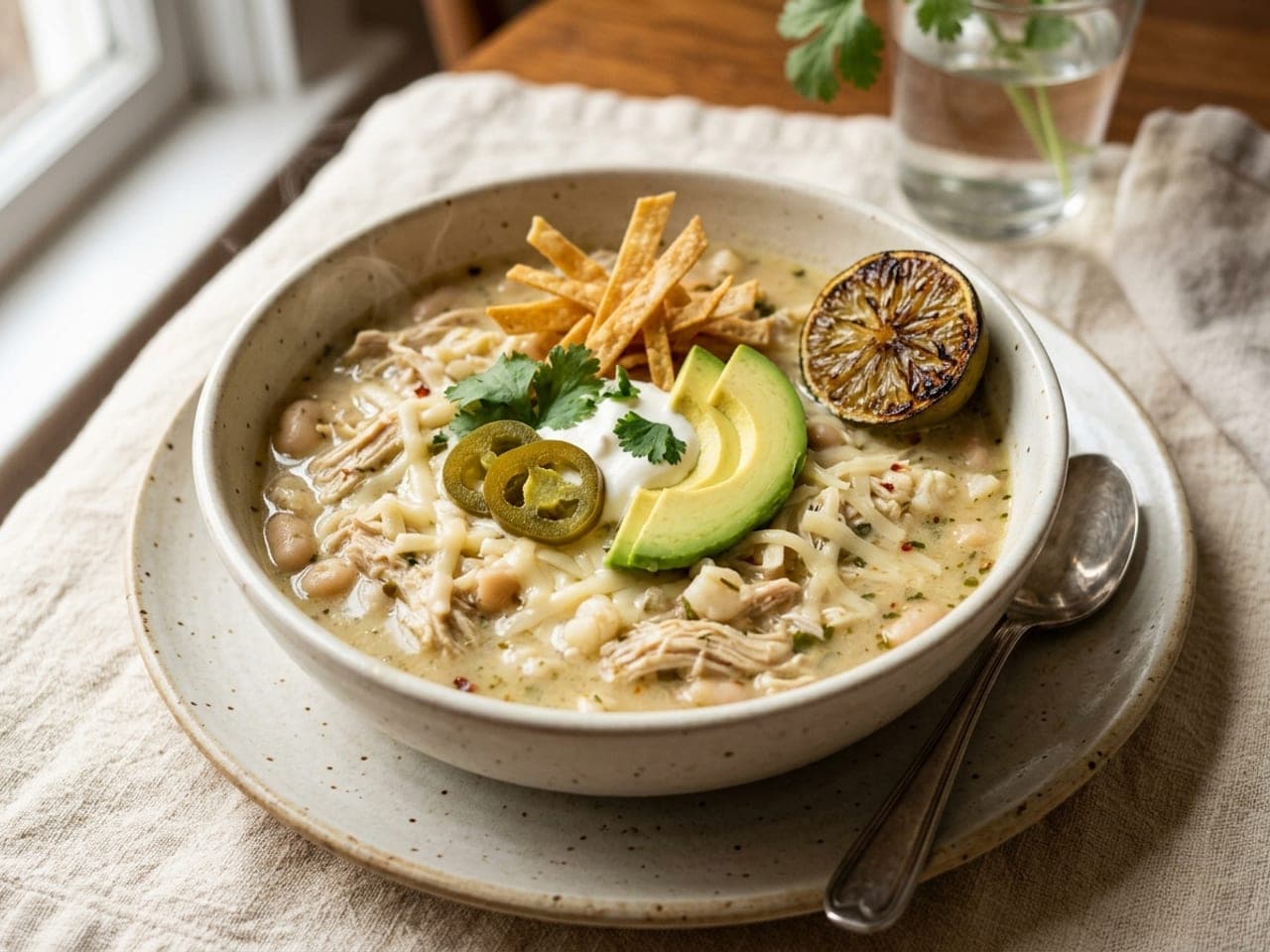
Ingredients
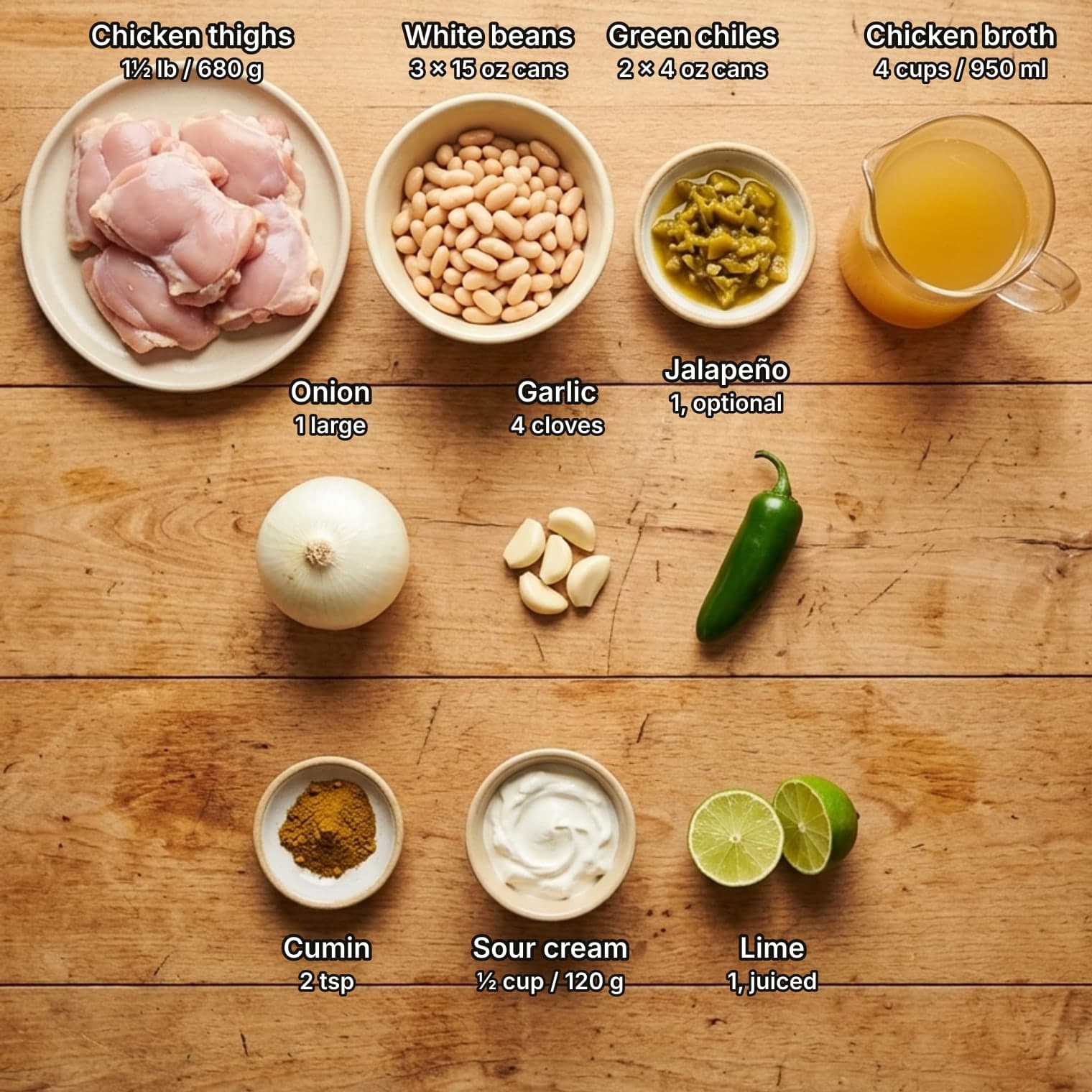
- boneless, skinless chicken thighs — the forgiving choice; breasts work, watched (see FAQ)1 1/2 lb (680 g)
- white beans, drained and rinsed — Great Northern classic; cannellini or navy (UK: haricot) work, mixing two kinds is a genuinely good move3 × 15 oz (425 g) cans
- canned diced green chiles, mild, with their liquid — fire-roasted if you can find them (UK/EU: roast 2 poblanos or mild long green peppers + 1 jalapeño instead — method in the doctrine section)2 × 4 oz (113 g) cans
- chicken broth (stock), low-sodium — label matters for gluten-free pots4 cups (950 ml)
- white or yellow onion, diced1 large
- garlic, minced4 cloves
- jalapeño, seeded and minced — optional; rung two of the heat ladder1
- ground cumin2 tsp
- ground coriander1 tsp
- dried oregano — Mexican oregano if you have it (a different plant, with a citrusy edge that suits chiles)1 tsp
- neutral or olive oil2 tbsp
- sour cream (UK: soured cream), full-fat — tempered in off the heat; skip for a dairy-free pot1/2 cup (120 g)
- lime — juiced into the pot, plus wedges to serve1–2, plus wedges to serve
- masa harina — optional thickener with a pedigree (nixtamalized corn flour; certified gluten-free if the stakes are medical)2 tbsp
- corn kernels, fresh or frozen — optional and openly contested1 cup (150 g)
- kosher salt (coarse) and freshly ground black pepper — salt LAST, the cans carry plentyto taste
- to serve: Monterey Jack (UK: a mild white cheddar), cilantro (fresh coriander), tortilla chips or strips, avocado, pickled jalapeñosthe toppings bar
Is white chicken chili even chili? An honest answer
Ask Texas first, because Texas has written its answer down. The chili that competition culture canonized — the "bowl of red" cooked at Terlingua since the first cookoff in 1967 — is beef and red chiles, and the rulebooks of both major sanctioning bodies, CASI and the International Chili Society, forbid beans outright in traditional red. By that constitution, this pot commits three violations before the first spoonful: it's full of beans, it contains no red chile, and the meat clucks. If a Terlingua purist tells you white chicken chili isn't chili, they're right — by the only rulebook they recognize, and it's a rulebook worth respecting, because the bowl of red is one of America's great dishes.
But the green-chile stew is not an upstart either. New Mexico and southern Colorado have simmered pork chile verde — green chiles, slow pork; in New Mexico usually no tomato to speak of, while Pueblo's version famously adds them — for generations longer than the cookoff circuit has existed, and that's the older country this recipe grew up next to. White chicken chili itself is younger and has a traceable birth: it appears in the late 1980s out of the Southwestern-cooking moment, when American restaurant kitchens began looking at New Mexico and Arizona the way they had long looked at France, and chiles became dinner-party food. The earliest version food historian Anne Byrn points to came from chef Michael Roberts at Trumps in Los Angeles, who made headlines pairing duck with white bean chili — a Southwestern read on French cassoulet. Food writers of the late 80s and 90s embraced the pale chili as the fresh departure from the heavy red, and then the dish did the most American thing possible: it left the restaurants and naturalized into potlucks, church cookbooks and slow cookers, until a 1980s cheffy invention became one of the country's default cold-weather dinners.
So the honest ruling: the institutions themselves left a door open — the ICS Homestyle category requires beans and lets chili be any color, which makes this pot legal chili by the letter of at least one official rulebook. But the better answer is that the argument matters less than the labels being honest. Texas red is beef, chiles and conviction; chile verde is pork and green chile patience; white chicken chili is the weeknight child of both, born in a restaurant and raised in a crockpot. All three pots are honest as long as you call them what they are — and in this one, the beans are the point, not an apology. This page cooks the third pot, without pretending Terlingua approves; calling it a Terlingua bowl would start a fight you'd lose.
How to make White Chicken Chili
- Sweat the onion, then bloom the spices in the fat. Warm 2 tbsp oil in a heavy pot or Dutch oven (casserole) over medium heat and add the diced onion with a pinch of kosher salt (coarse). Cook 5–6 minutes, stirring now and then, until it's soft and translucent — no color to speak of; this is a pale chili and browned onion muddies it. Add the minced garlic and the jalapeño, if you're using it, and give them 1 minute more. Then the move that separates a chili from a soup: add the cumin, coriander and oregano straight into the fat and stir for 30–60 seconds, until the spices darken a shade and the kitchen suddenly smells like dinner. Ground spices carry most of their aroma in fat-soluble compounds, so a short toast in hot oil wakes up flavors that would stay flat if the spices just went swimming in broth. Don't walk away — ground cumin goes from fragrant to scorched fast, and there's no rescuing a burnt spice base except starting over. While the onion works, pat the chicken thighs dry and salt both sides with about 1 tsp of the kosher salt — even for a poach, early salt seasons the interior.
- Add the chiles, beans and broth — liquid from the chile can included. Tip in both cans of diced green chiles with every drop of their liquid — that's roasted-chile flavor you paid for, and this pot wants it. Follow with the drained, rinsed beans and the 4 cups (950 ml) of chicken broth (stock), scraping the bottom of the pot so the toasted spices lift up into the liquid rather than staying behind to scorch. If you're wondering whether canned beans are cutting a corner: they aren't — they're fully cooked, they hold their shape through a simmer, and the dried-bean route has an actual safety protocol attached to it that lives in the safety notes below. Bring everything to a simmer over medium-high. Note what's missing on purpose: no tomatoes, no chili powder, no red anything. The whole identity of this pot is the green chile and the pale broth — the moment tomato enters, you're cooking a different (and also honorable) dinner.
- Poach the chicken right in the pot. When the pot is at a steady simmer, drop the heat until the surface barely shudders and nestle in the salted chicken thighs, whole, pushing them under the liquid — straight from the board, unrinsed: washing raw chicken sprays bacteria around the sink, and the simmer is the wash. Put the lid on ajar and poach gently 15–20 minutes, until a thermometer in the thickest piece reads 165°F (74°C). Gentle is the operative word: a rolling boil tightens muscle fibers and turns poached chicken stringy and dry, while a sub-simmer poach leaves it silky enough to shred with two forks and no effort. Every drop of flavor the chicken gives up lands in the broth instead of down a drain — that's the argument for poaching in the pot rather than cooking the chicken separately. Thighs are the forgiving choice here: they're safe at the same 165°F (74°C) as any chicken, but their connective tissue actually relaxes and improves a little past it, around 175–185°F (79–85°C), so an extra few minutes costs you nothing. Breasts work too — they cook a couple of minutes faster and punish inattention; pull them the moment they hit temperature.
- Shred the chicken — the pot keeps working without it. Lift the cooked chicken onto a cutting board and let it sit a few minutes while the pot stays at its lazy simmer. Poultry needs no safety rest — the 3-minute rest rule belongs to 145°F (63°C) beef and pork — so this pause is purely practical: chicken straight out of a poach is too hot to handle and shreds better once the surface steam has flashed off. Pull it apart with two forks into rough, bite-and-a-half pieces — not floss. Over-shredded chicken disappears into the broth and reads as texture, not as meat; you want shreds substantial enough to land on a spoon with beans around them. When you're done, tilt the board and slide the collected juices back into the pot — that's seasoned gelatin, and it belongs with the beans. If a thick piece is blushing pink at the center, don't agonize — drop it back into the simmering broth for a few minutes rather than trusting color; the thermometer, not the eye, is the judge of poultry.
- Blend one cup of the pot — the chili thickens itself. Here is the spine of this recipe: ladle about 1 cup (240 ml) of beans and broth into a blender and purée it smooth, then stir it back into the pot. That's the whole thickener. White beans are mostly starch and a creamy purée of them gives the chili real body — no flour, no cornstarch, no brick of cream cheese — while keeping the dish naturally gluten-free and dairy-free until you decide otherwise. One genuine caution: hot liquid in a sealed blender builds steam pressure and blows the lid off — a mess at best, a burn at worst. Fill the jar no more than halfway, pull the little center cap out of the lid, drape a folded kitchen towel over the opening, and start on low. An immersion blender dodges the problem entirely: three or four short pulses in one corner of the pot does the job (chase the smooth patch, don't purée the whole pot). Want a step further? Whisk 2 tbsp masa harina into 3 tbsp cool water or broth until smooth — cold liquid first, so it can't clump — and stream the slurry into the simmering pot for the last few minutes, until the raw-corn smell cooks off. Masa is the nixtamalized corn flour tamales are made of, it's what old-school Texas red thickens with, and it leaves a faint sweet-corn depth that makes people ask what's in this. It's an upgrade, not a rescue — if the pot is already where you want it after the blend, skip it.
- Return the chicken, simmer to body, then brighten. Stir the shredded chicken back in, along with the corn if your house is a corn house (the debate is handled honestly further down the page). Simmer everything gently, uncovered, 8–10 minutes, until the chili has the body you want — it should coat the back of a spoon loosely, thicker than soup, looser than dip, and it will tighten a little more as it stands. Now brighten: squeeze in the juice of a lime — a second if yours is stingy — and taste. This is also the moment to fix the seasoning — canned chiles, canned beans and broth all carry salt in unpredictable amounts, which is why the recipe held back until everything was in the pot. Add kosher salt (coarse) in small pinches, tasting between, until the flavors step forward; grind in black pepper. If it tastes flat, it almost always wants salt or lime, not more cumin. If it's thicker than you like, loosen it with a splash of broth; thinner, give it five more uncovered minutes.
- Kill the heat, then temper in the sour cream. Take the pot off the burner and let the bubbling stop completely. Sour cream (UK: soured cream) is a cultured dairy — its proteins are already halfway curdled by acid, which is what makes it thick and tangy — and dropping it into boiling, lime-spiked broth finishes the job: heat plus acid seizes the casein into fine white grit that no stirring will smooth. So temper it instead: put the 1/2 cup (120 g) sour cream in a small bowl, whisk in a ladleful of the hot broth until it's loose and warm, then stir the mixture back through the pot. The chili turns from clear-brothed to gently creamy, pale as its name. If you're keeping the pot dairy-free, skip this entirely — the blended beans have already done the creamy work, and the bowls that want richness can get a spoonful of sour cream on top instead of in the pot. Once the dairy is in, keep the pot below a simmer; reheats want the same gentleness.
- Build the bowl — the toppings are half the recipe. Ladle into deep bowls and treat the toppings as the second half of the recipe, not decoration. The classic build: a handful of grated Monterey Jack (any mild melting cheese — in the UK, a mild white cheddar is the honest stand-in) that softens into the hot surface, a spoonful of sour cream, sliced or diced avocado, fresh cilantro (fresh coriander) torn over, a few pickled jalapeño rings for people who want the heat the pot politely withheld, and — non-negotiable in this house — a fistful of tortilla chips or fried tortilla strips crushed over the top or wedged into the rim, because this chili wants crunch the way ramen wants toppings. A lime wedge on every bowl; the squeeze at the table hits different from the one in the pot. For a crowd, put the pot in the middle and every topping in its own small bowl — the toppings bar isn't a compromise, it's the best version of this dinner.
Safety & hygiene Important
- Dairy, gluten, corn — and what this pot is without them. The base of this chili — chicken, beans, chiles, onion, spices, broth — is naturally free of dairy and gluten, and the recipe is built so it stays that way until the last ten minutes. The dairy arrives only as tempered-in sour cream and the cheese on top, so a dairy-free bowl just skips both (the blended beans carry the creaminess alone, honestly well). For gluten, the ingredients carry none by nature, but labels do the deciding: some chicken broths (stocks), bouillon cubes and seasoning blends sneak in wheat or barley derivatives, so a celiac pot needs a broth that's labelled gluten-free, and tortilla chips that are corn, not flour. UK readers get two extra label-reads: the FSA's fourteen declarable allergens include celery and mustard, both of which like to hide in stock cubes — a carton of plain chicken stock is the cleaner buy. Masa harina is corn through and through — nixtamalized corn flour — but like any flour it can be milled alongside wheat, so look for a certified gluten-free bag if the stakes are medical rather than preference. Corn itself is an allergen for a small number of people, and in this recipe it hides in three places: the optional corn kernels, the masa, and the tortilla chips — all three are skippable without losing the dish. The bean thickener keeps everything together no matter which flags your table flies.
- Leftovers love this pot — and the freezer is its superpower. This is the anti-cream-sauce: white chicken chili keeps and freezes brilliantly, and most cooks think it's better on day two, once the beans have finished trading starch with the broth. The clock rules first: get leftovers into shallow, covered containers and into the fridge within 2 hours of cooking (within 1 hour above 90°F / 32°C) — shallow matters, because a deep, full pot can hold its warm middle in the 40–140°F (4–60°C) danger zone for hours. US guidance (USDA and FDA agree) gives refrigerated leftovers 3–4 days; UK advice is tighter — the NHS says use them within two days, and reheat only once. Reheat to 165°F (74°C) — steaming hot through the middle — but gently once the dairy is in: a hard boil grains the sour cream, so use medium-low heat and a stir, and add a splash of broth as it loosens. Don't reheat in a slow cooker — USDA guidance is that a slow cooker can't bring cold food through the danger zone fast enough; reheat on the stove, then let the crock hold it warm at 140°F (60°C) or above. For the freezer: portion it before the sour cream goes in if you can — the base freezes and thaws perfectly, while frozen dairy comes back slightly grainy (edible, just less pretty; a fresh spoonful at reheat erases it). Frozen at 0°F (-18°C) it's safe indefinitely; it's at its best inside 2–3 months. Thaw in the fridge overnight, never on the counter.
- The raw chicken, the dried-bean trap, and the pregnant guest. Three separate briefings. The chicken: don't wash it — rinsing raw poultry sprays campylobacter around the sink and counters, and it takes very little to make you ill; pat it dry, bin the towel, and cook to 165°F (74°C) on a thermometer, because pink-versus-white is folklore, not a reading. Everything raw chicken touched — board, hands, tongs, the plate it sat on — gets hot soapy water before it goes near anything else. The beans: this recipe uses canned on purpose, and canned beans are fully cooked and carry no issue. But if you cook the dried-bean version, know the trap: raw beans contain phytohaemagglutinin, a lectin that causes hours of violent vomiting, and white kidney beans (cannellini) still carry roughly a third of the dose red kidney beans do. The FDA route, echoed by state extension services: soak dried beans at least 5 hours, drain, then boil hard — a true 10-minute boil destroys the toxin; FDA's recommendation is 30 — before any long, low simmer. Never cook dried beans from raw in a slow cooker: the gentle heat can fail to destroy the toxin, and undercooked beans held around 176°F (80°C) have tested up to five times more toxic than raw. The pregnant guest: the pot itself is good news — everything in it is thoroughly cooked. The caution lives on the toppings bar: queso fresco and other Hispanic-style fresh cheeses are a known Listeria vehicle — the CDC warns that pregnant women are about ten times more likely to get listeriosis, and its current advice is that pregnant guests skip queso-fresco-type cheeses altogether, even pasteurized ones (outbreaks have happened in pasteurized product from unsanitary plants), unless the cheese is heated to 165°F (74°C), steaming hot. Pasteurized aged and standard supermarket cheeses — the Monterey Jack this page calls for — are the safe end of the counter. Not medical advice; a clinician's narrower list wins.
3 ways to plate it
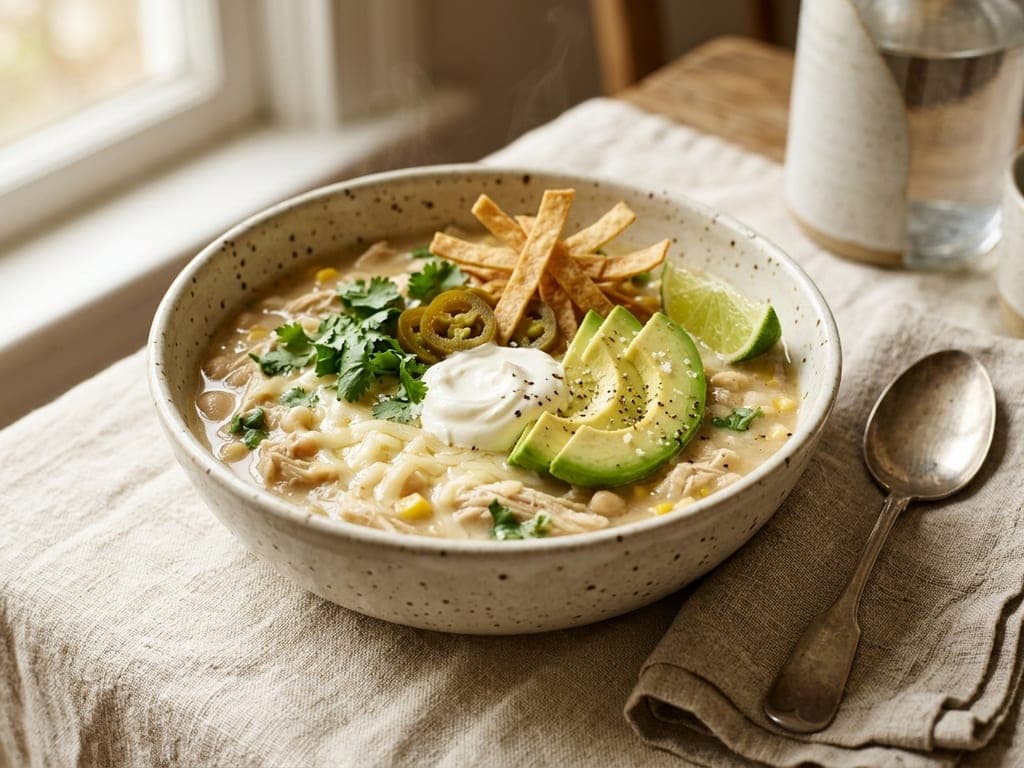
- Ladle into a deep bowl, leaving a clear rim, and grate Monterey Jack straight onto the hot surface so it softens.
- Add a spoonful of sour cream just off-center and fan three or four avocado slices against it.
- Tear cilantro (fresh coriander) over, then a few pickled jalapeño rings for the heat-seekers.
- Finish with a fistful of tortilla strips wedged upright and a lime wedge on the rim.
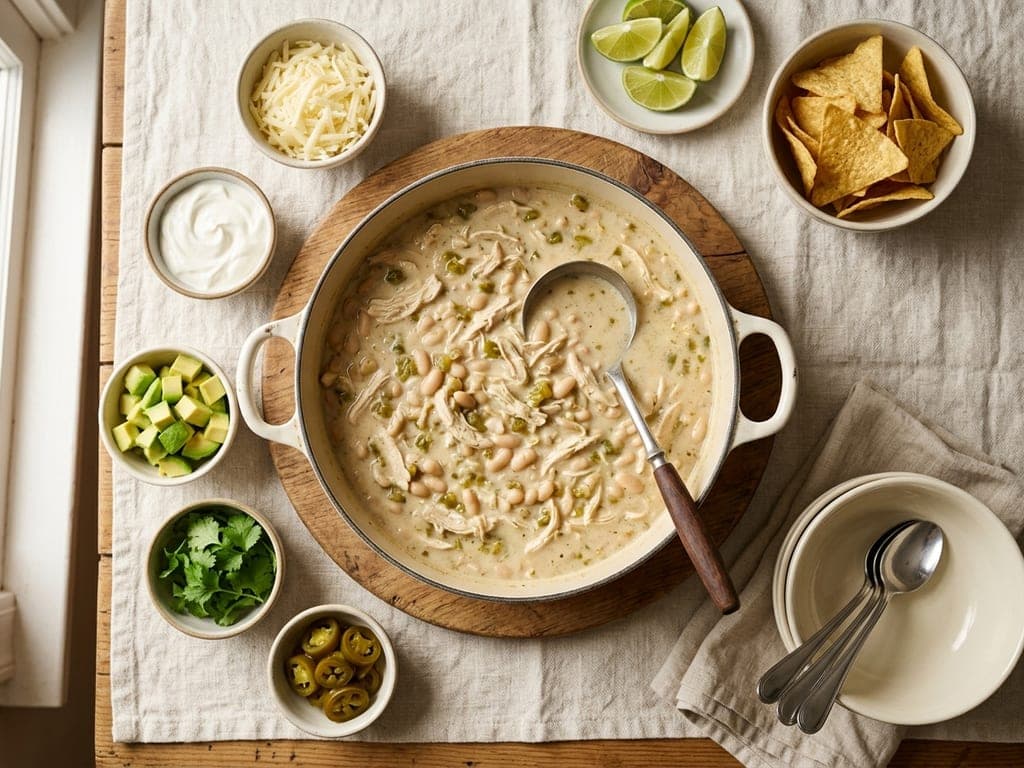
- Set the pot on a board or trivet mid-table, ladle in, and say out loud that it's hot.
- Ring it with small bowls: grated Jack, sour cream, avocado, cilantro (fresh coriander), pickled jalapeños, tortilla chips.
- Add a plate of lime wedges and a stack of deep bowls at one end so the line flows.
- Keep a small pitcher of warm broth beside the pot for loosening late-arriving refills — the chili tightens as it stands.
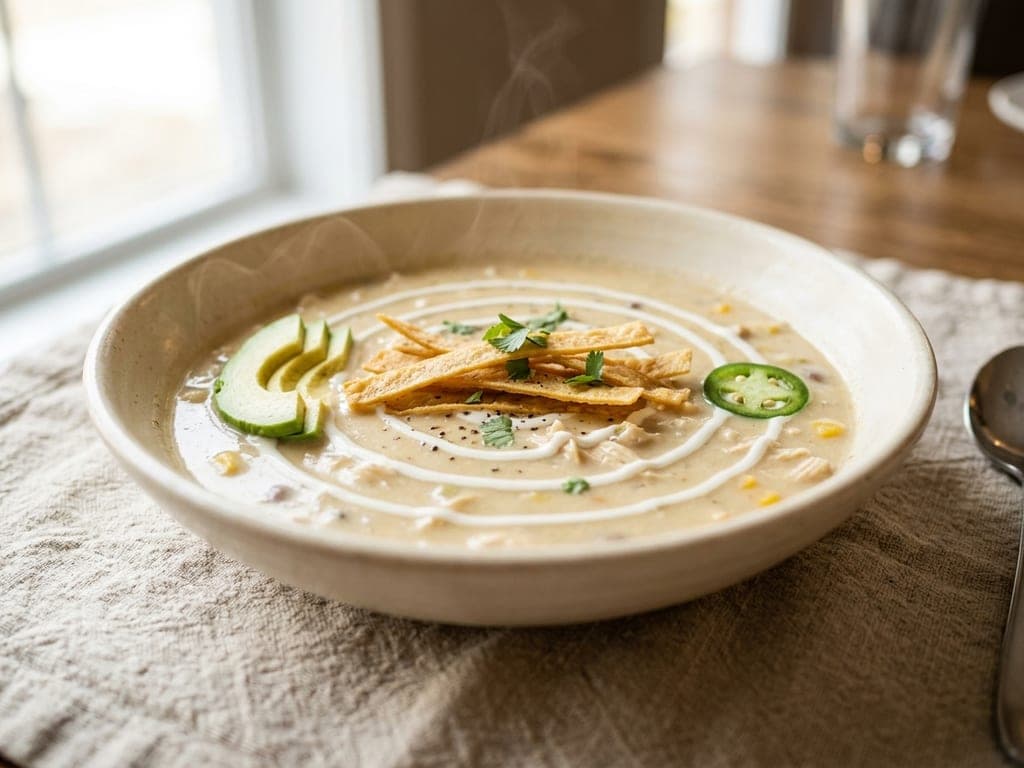
- Ladle into a warmed wide shallow bowl, keeping the surface level and the rim clean.
- Draw a loose spiral of thinned sour cream across the surface with a spoon.
- Place a small avocado fan at one edge and a single thin jalapeño ring at the other.
- Finish with a pinch of the smallest cilantro (fresh coriander) leaves and a thin stack of tortilla strips laid across the center.
The doctrine: the bean, the chile, and heat that never touches the dairy
The first law: the chili thickens itself. White beans are little packets of starch, and blending one cup (240 ml) of them with their broth gives the pot genuine, creamy body with no roux, no cornstarch and no brick of cream cheese — which means the dish stays naturally gluten-free and dairy-free until the moment you choose otherwise, and the flavor stays clean bean-and-chile instead of muted by flour. If you want one step more, the masa slurry is the thickener with a pedigree: masa harina is corn nixtamalized with slaked lime, the flour of tortillas and tamales, and a spoonful whisked into broth is exactly how old-school Texas red gets its body. In a white chili it adds a quiet sweet-corn depth that reads as cooked-all-day. Bean purée for body, masa for soul; use one or both. What you never need is the brick of cream cheese — not because it's wrong, but because it's a different dish, and it gets its own honest paragraph below.
The second law: know your chile. The unglamorous 4 oz (113 g) can of "diced green chiles" is mild roasted Anaheim/New Mexico-type chile, skinned and chopped, and it is the pantry backbone of every white chicken chili in America — buy the fire-roasted kind when you see it, and always tip in the liquid. The word "Hatch" on the label is a place, not a pepper: the Hatch Valley of New Mexico, whose growers have fought a real certification battle (a federal appeals court handed the certification fight a procedural win in 2016, and New Mexico law protects chile labeling) precisely because the name got borrowed by chiles grown nowhere near it. Treat it like Champagne: genuine Hatch-certified chile is worth seeking out in the late-summer harvest, and an honest can of plain fire-roasted green chile is better than a dishonest label. The fresh route, and the standard one in the UK and Europe where the cans are scarce: blister 2 poblanos (or any large mild green chile) and 1 jalapeño under the broiler (the overhead grill) until blackened, steam them 10 minutes in a covered bowl, then peel, seed and chop. Poblanos run a little darker and earthier than the canned Anaheim type — a trade most people count as an upgrade.
The third law: the dairy never meets direct heat. Sour cream is cultured — its proteins already sit at the edge of curdled, held there by acid — and a boiling, lime-brightened broth pushes them over: heat plus acid seizes casein into fine grit, permanently. So the pot comes off the burner, the bubbling dies, and the sour cream is tempered — loosened with a ladle of hot broth before it goes in — so it never crosses a harsh temperature line. Same law at reheat: medium-low and a stir, never a hard boil. This is the same casein physics that rules our alfredo page, wearing a Southwestern shirt. And if you plan to freeze half the pot, freeze it before the dairy goes in — the base thaws flawless, and a fresh spoonful of sour cream at reheat costs nothing.
Cream cheese, corn, the packet — and other honest choices
The internet's favorite white chicken chili is a slow cooker, a block of cream cheese and, often, a packet of ranch seasoning — the "crack chicken chili" family. A civil word about it: cream cheese is a stabilized dairy that shrugs off long heat, which is exactly why it works so well in a crockpot, and the result is thicker, tangier, more of a warm dip wearing a chili costume. People love it for real reasons — it's rich, it's foolproof, and it holds on warm for hours. If that's the version that brought you here, welcome, and make it knowingly: drop the tempering step, stir cubed cream cheese in for the last 30 minutes, and accept that you've traded the clean chile-and-bean flavor for plush. What this page won't do is pretend they're the same dish. The blended-bean version tastes like its ingredients; the cream-cheese version tastes like comfort. Both are honest as long as the pot admits it. The ranch packet, though, mostly adds salt, buttermilk powder and MSG — named outright on the classic packet's label, wearing politer aliases on the store brands — taste the finished chili first; it rarely needs what the packet sells.
Corn divides white-chili houses the way nutmeg divides alfredo houses, and this page keeps it optional on purpose: a cup (150 g) of kernels adds sweetness and pop that some cooks find essential and purists find distracting — there's no wrong answer, only a house style. The chicken question is easier to rule on: thighs, for a pot like this — they poach forgiving, shred silky and stay tender through reheats; breasts are fine if watched, and punished if not. And the rotisserie shortcut is honest, not lazy: a storebought bird is already cooked, so it skips the poach entirely — shred 3 to 4 cups (about 1–1 1/4 lb / 450–570 g) of meat and stir it in for the last ten minutes, just long enough to warm through and swap flavor with the broth. Two adjustments: rotisserie birds are salted hard, so hold back on added salt until the final taste, and since the chicken never poached in the pot, the broth deserves the masa slurry to make up the body it didn't earn.
The dials, honestly: this pot serves six and doubles without complaint — it's the rare recipe that's actually better cooked for a crowd, and the toppings bar scales into a party trick. Heat lives on a ladder you climb to taste: the canned mild chiles alone are gentle enough for kids; a seeded jalapeño in the sauté is rung two; leave the seeds in or swap a serrano for rung three; a pinch of cayenne in the spice bloom is rung four — and pickled jalapeños on the bar let every bowl pick its own rung, which is the real reason the mild pot is the right pot. Thickness is a dial too: more blended beans or the masa slurry to tighten, a splash of broth to loosen, and remember it thickens as it stands. If the pot tastes flat at the end, the answer is almost never more cumin — it's salt, then lime, in that order.
Questions, answered
Why did my sour cream curdle in the chili?
Heat plus acid. Sour cream is a cultured dairy — its proteins are already held at the edge of curdling by lactic acid — and stirring it into a pot that's still bubbling, especially one you've just brightened with lime juice, pushes the casein over the line into fine white grit that never smooths back out. The fix is sequencing, not a different brand: take the pot off the burner, let the bubbling stop completely, and temper — whisk a ladleful of hot broth into the sour cream in a bowl until it's warm and loose, then stir that back through the pot. Full-fat sour cream is also meaningfully more stable than light or fat-free, whose extra stabilizers and lower fat give the proteins less protection. Once the dairy is in, keep every reheat below a simmer. If it's already curdled: the flavor is unharmed and the bowl is safe — call it rustic, add toppings, and temper next time.
Can I use rotisserie chicken in white chicken chili?
Yes — it's an honest shortcut, and this page respects it. A rotisserie bird is already cooked, so the poaching step disappears: build the pot as written, and stir in 3 to 4 cups (about 1–1 1/4 lb / 450–570 g) of shredded meat for the last 8–10 minutes, long enough to heat through — 165°F (74°C) if you're checking, which is also USDA's number for reheating any cooked chicken — and to trade some flavor with the broth. Two honest adjustments. First, salt: rotisserie birds are brined and seasoned hard, so hold all added salt until the final taste. Second, body: the broth never got the collagen and juices a raw-poached thigh gives up, so the pot deserves the masa slurry (2 tbsp masa harina whisked smooth into 3 tbsp cool water or broth) to earn back the depth it skipped. Use both light and dark meat — the dark carries the dish.
Chicken breasts or thighs for white chicken chili?
Thighs, and it isn't close — for this pot. A poach is gentle, but reheats and standing time aren't, and thigh meat forgives all of it: it's safe at the same 165°F (74°C) as any chicken, and its connective tissue actually relaxes and improves a little past that, around 175–185°F (79–85°C), so the leftover bowls on day two are as silky as the first. Breast meat is leaner and drier-edged: it works, it shreds prettily, and it punishes inattention — a breast that coasts past temperature turns to flannel, and day-two breast meat always reads a little thirstier. If breasts are what's in the freezer, poach them whole at a bare shudder, pull them at 165°F (74°C) sharp, and shred coarsely so the pieces hold broth. If you're cooking for a crowd or planning leftovers on purpose, buy thighs and stop thinking about it.
Can I make white chicken chili in a slow cooker?
Yes, with two rules. The easy version: everything except the dairy — sautéed aromatics and bloomed spices (do that 8 minutes on the stove; raw onion and unbloomed cumin never quite catch up in a crock), raw chicken thighs (thawed, never frozen — USDA's one hard slow-cooker rule), canned beans, chiles, broth — goes in on LOW for 4–6 hours; shred the chicken, blend the cup of beans, and temper the sour cream in at the end with the cooker off. Rule one is the dairy: sour cream added at hour one splits by hour three — it always goes in last. Rule two is beans, and it's a genuine safety line: canned beans are fully cooked and fine, but never run dried beans from raw in a slow cooker — raw white kidney beans carry a real dose of the lectin phytohaemagglutinin (about a third of what red kidney beans carry), and a slow cooker's gentle heat can fail to destroy it — undercooked beans held around 176°F (80°C) have tested up to five times more toxic than raw. Dried beans get a 5-hour soak and a hard boil before they meet any crock: 10 minutes at a true boil destroys the toxin, and FDA's own recommendation is 30. And use a slow cooker for cooking, not for reheating leftovers — USDA says it can't bring cold food through the danger zone fast enough; reheat on the stove, then let the crock hold it warm.
What beans go in white chicken chili?
Any white bean works; the classic is Great Northern — medium-sized, mild and sturdy enough to hold its shape through the simmer while its neighbors melt into the broth. Cannellini (white kidney beans, and the easiest find in UK and European supermarkets) are larger and meatier with a more assertive skin; navy beans (UK: haricot — the baked-beans bean) are the smallest and creamiest and break down the most, which quietly thickens the pot for you. A genuinely good move is mixing two kinds — one that holds, one that melts. Drain and rinse canned beans (the canning liquid tastes tinny and throws off your salt), and remember one cup (240 ml) of them is destined for the blender — that purée, not any dairy, is what makes this chili creamy. Cooking from dried? Lovely — and read the safety note first: raw white kidney beans carry a real fraction of the kidney-bean lectin, so they need a 5-hour soak and a hard boil before the long simmer, and they never go into a slow cooker raw.
Is white chicken chili gluten-free?
Naturally, yes — as written, nothing in the pot contains gluten: chicken, beans, green chiles, aromatics, spices, broth, sour cream, lime. The thickening is the reason this stays true: this recipe uses puréed beans and optional masa harina (a corn flour) where other versions reach for wheat flour or a roux. What decides it in practice is labels, not ingredients. Broths (stocks) and bouillon are the usual ambush — some carry wheat or barley derivatives, so a celiac pot needs one labelled gluten-free. Masa harina is corn through and through, but it can be milled on shared equipment, so look for a certified gluten-free bag when the need is medical. Spice blends can carry flour as an anti-caking agent (single-ingredient spices, as here, are safer). And the toppings bar: corn tortilla chips are fine, flour tortillas are not, and anything fried in a shared fryer is a question worth asking. Cross-contact, not the recipe, is where this dish ever goes wrong for a celiac guest.
Can I freeze white chicken chili?
Yes — this is one of the best freezer dinners in the American canon, and the opposite of a cream sauce: the beans, chicken and broth thaw back to almost exactly what they were. One planning move makes it perfect: if you know half the pot is headed for the freezer, portion it off before the sour cream goes in. The base freezes flawlessly; frozen dairy comes back faintly grainy — safe and edible, just less pretty — and a fresh spoonful tempered in at reheat costs you nothing. Cool it fast (shallow containers, fridge within 2 hours), then freeze in meal-sized portions with a little headroom — bean broth expands. At 0°F (-18°C) it's safe indefinitely by USDA guidance; it's at its best inside 2–3 months. Thaw overnight in the fridge — never on the counter — or run the sealed container under cold water and reheat straight from loose-frozen, gently, to 165°F (74°C), adding a splash of broth as it comes back together.
How do I thicken white chicken chili?
In order of preference: beans, masa, patience — and never flour out of reflex. The house method is to blend 1 cup (240 ml) of the beans and broth and stir it back — pure bean starch, real body, nothing added; a second cup if you want it thicker still. The upgrade is a masa slurry: 2 tbsp masa harina whisked smooth into 3 tbsp cool water or broth, streamed into the simmer for the last few minutes — it's the traditional chili thickener (Texas red uses it too) and adds a soft corn depth, not just viscosity. Cornstarch (UK: cornflour) works too if masa isn't in the house — 1 tbsp, whisked into cold water first, always cold, because cornstarch clumps instantly in hot liquid — added before the dairy. Ten minutes of uncovered simmering tightens everything further, and the pot thickens noticeably as it stands and again overnight. Wheat flour needs cooking out and mutes the chile — skip it. And the block of cream cheese thickens beautifully but changes the dish's whole character; that trade is covered honestly in the section above.
What's the difference between white chicken chili and chile verde?
Age, meat and paperwork. Chile verde is the older dish by generations: a New Mexico and southern Colorado tradition of pork shoulder simmered slow with roasted green chile — in New Mexico the chile itself is the gravy and tomato barely figures, while Colorado's Pueblo-style pot adds tomatoes and thickens with a roux; in both, "green" is less a recipe than a regional religion, and the chile is the point. White chicken chili is a 1980s American invention from the Southwestern-restaurant moment — poached chicken, white beans, a milder green-chile presence, and usually a creamy finish — that spread through magazines, potlucks and slow cookers. In the bowl: verde is darker, hotter, pork-rich and beanless more often than not; white chicken chili is pale, gentle, bean-thickened and built for toppings. They're neighbors, not rivals — this page's pot is the newer dish and says so. If a menu offers you real pork chile verde made with actual roasted New Mexico chile, order it; make this one on Tuesday.
Is white chicken chili spicy?
Not as written — and that's a design decision, not a timidity. Canned mild green chiles are gentle enough that this pot, as printed, is a kids-eat-it dinner: warm, cumin-forward, more aromatic than hot. The heat is a ladder you climb deliberately: rung one is the pot as written; rung two, a seeded jalapeño sautéed with the onion; rung three, leave the seeds and ribs in, or swap in a serrano; rung four, a pinch of cayenne into the spice bloom, where the fat carries it evenly. Above that, you're cooking a different regional dish and should enjoy it. (One buying note: don't confuse Hatch heat with canned-chile heat — the supermarket can is reliably mild, while true Hatch-valley lots range from gentle to fierce.) The real trick is finishing heat at the table instead: pickled jalapeño rings on the toppings bar mean the same pot serves the six-year-old and the hot-sauce evangelist without compromise, which is the whole argument for keeping the base mild. If you overshot, dairy is the brake — an extra spoonful of sour cream in the bowl, more cheese, more avocado.
Snap your finished plate and let the AI plate it again — more beautifully.