Hot Honey Chicken Recipe (Crispy Thighs, 3-Ingredient Hot Honey)
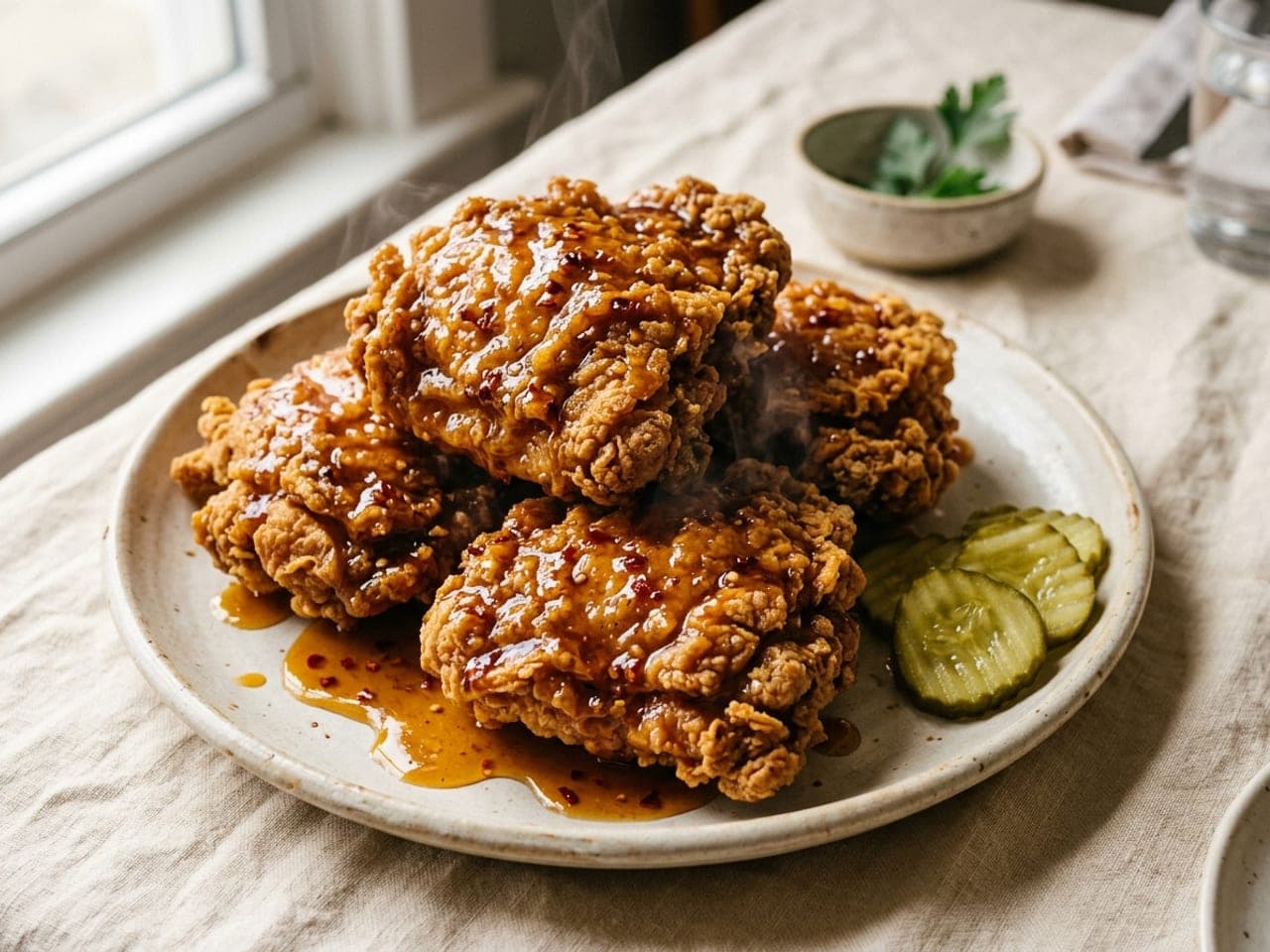
Crispy buttermilk-fried chicken thighs under a chili-infused honey that you make yourself in ten minutes from three pantry things. The recipe is two disciplines wearing one name: a craggy cornstarch crust engineered to survive a wet glaze, and a honey warmed gently enough to keep its perfume — plus the honest rule that the two only meet at the last possible moment.
Ingredients
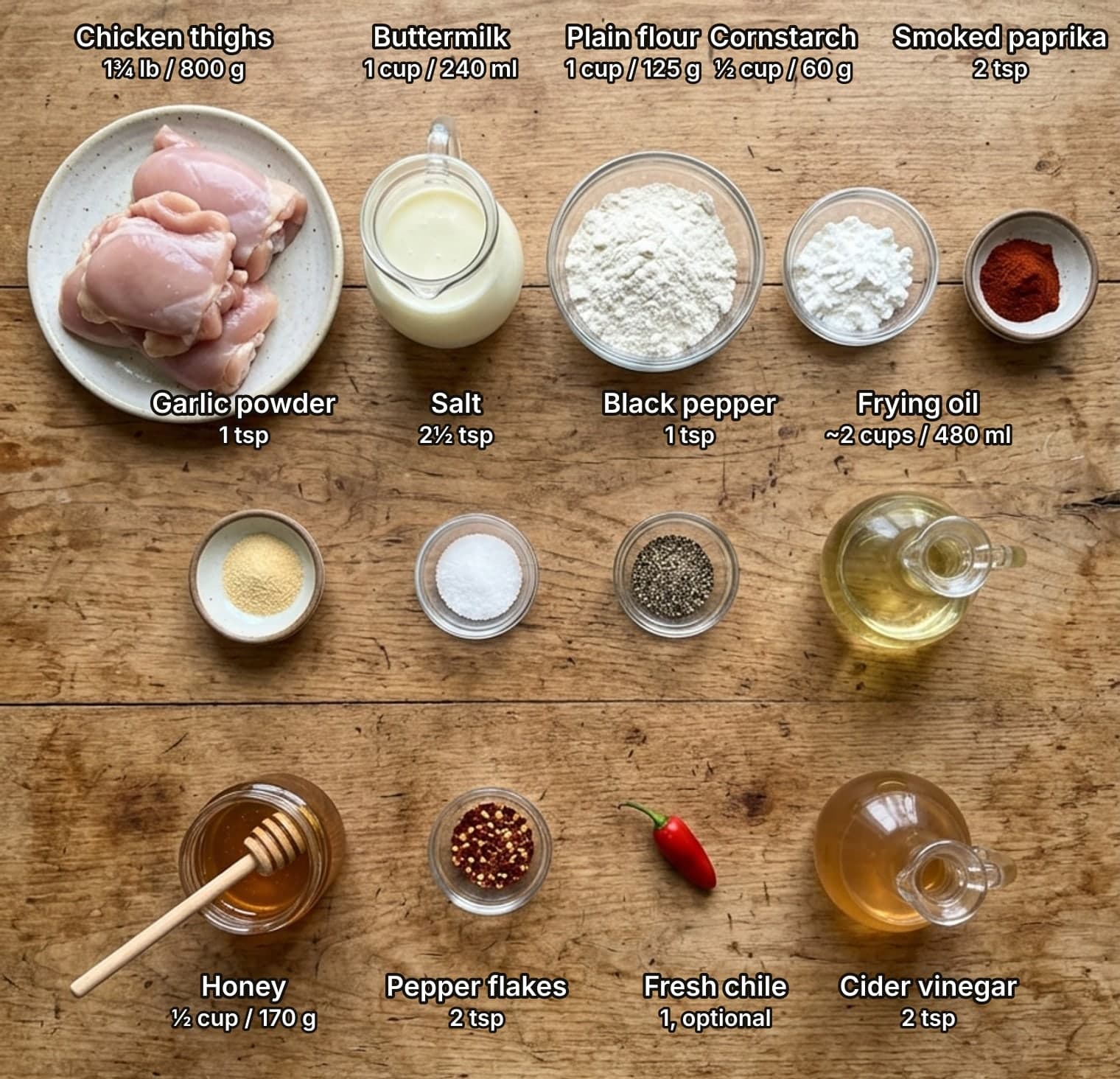
- boneless, skinless chicken thighs1 3/4 lb (800 g)
- buttermilk (or milk plus 1 tbsp lemon juice, rested 10 minutes)1 cup (240 ml)
- all-purpose flour (plain flour)1 cup (125 g)
- cornstarch (cornflour)1/2 cup (60 g)
- smoked paprika2 tsp
- garlic powder1 tsp
- fine salt — 1 tsp for the buttermilk soak, 1 1/2 tsp for the dredge — plus more for after the fry2 1/2 tsp
- freshly ground black pepper1 tsp
- neutral oil, for shallow fryingabout 2 cups (480 ml)
- honey (a runny, everyday one — save the fancy jar)1/2 cup (170 g)
- red pepper flakes2 tsp
- fresh red chile, thinly sliced (optional, for a fruitier heat)1 small
- apple cider vinegar2 tsp
- pickles, slaw or waffles, to serve
What hot honey chicken is (and the pizza it escaped from)
Hot honey — honey infused with chiles — is old folk practice, but its modern American life began, of all places, on pizza: Mike Kurtz, who met chile-infused honey while backpacking in Brazil, began drizzling his version over the soppressata pie — the Hellboy — at Paulie Gee's pizzeria in Greenpoint, Brooklyn, in 2010, and the cult that followed became the bottled brand on every grocery shelf. From there the bottle escaped the pizza box. The combination turned out to be a universal amplifier — sweet, heat, salt and fat in one ribbon — and nothing amplifies it back quite like fried chicken, which supplies the salt, the fat and the crunch in a single package. By the 2020s, hot honey chicken had gone from menu novelty to fast-food canon, and the internet did the rest.
It helps to say clearly what this dish is not: Nashville hot chicken. Nashville hot is the older, fiercer tradition — fried chicken brushed with a paste of cayenne bloomed in frying fat, savory and punishing, its faint sweetness a background note. Hot honey chicken inverts the ratio: the sweetness leads, the heat rides behind it, and the glaze is glossy rather than greasy. One is a dare; the other is a crowd-pleaser with a warning label. (Korean yangnyeom chicken completes the fried-heat triangle — a gochujang-garlic glaze tossed over double-fried chicken, its own excellent thing and not this either.) This page builds the crowd-pleaser, and calibrates the warning label to taste.
The trend deserves one more honest note: hot honey chicken is a young dish with no orthodoxy, which is freedom. The version here — buttermilk thighs, craggy shallow-fried crust, honey applied at the last moment — is built for maximum contrast between shell and glaze, because that contrast IS the dish. But the same honey over grilled thighs, roasted wings or an air-fryer batch is not a lesser recipe; it's the same idea wearing different clothes.
How to make Hot Honey Chicken
- Make the hot honey first — gently, and never to a boil. In your smallest saucepan, warm 1/2 cup (170 g) honey with 2 tsp red pepper flakes (and the sliced fresh chile, if using) over the lowest heat until it loosens and the flakes start to bleed color — warm, pourable and steamy but silent, around 120–140°F (49–60°C); if it bubbles, you've overshot — then off the heat. Honey's aroma lives in volatile compounds that a boil drives off, and boiled honey also thickens toward candy as it cools; you want it warmed like a sauna, not cooked like a caramel. Let it steep 15 minutes (longer = hotter), stir in 2 tsp apple cider vinegar, and set it aside. The vinegar isn't optional-optional: that small sour note is what keeps sweet-plus-heat from collapsing into just sweet.
- Buttermilk the thighs — 30 minutes buys you tender and tangy. Trim the thighs of any big fat flaps, pat them dry, and submerge them in the buttermilk whisked with 1 tsp of the salt in a bowl or zip-top bag — salting the soak seasons deeper than any sprinkle on the surface can — 30 minutes in the fridge does real work, and up to overnight is even better. Buttermilk's mild acidity seasons and tenderizes without the mush risk of aggressive marinades, and its clingy body is the glue the dredge needs. No buttermilk in the fridge? Milk plus a tablespoon of lemon juice, rested 10 minutes, is the standard stand-in and genuinely fine here.
- Build a dredge with deliberate lumps. Whisk the flour, cornstarch, smoked paprika, garlic powder, the remaining 1 1/2 tsp salt and the pepper in a wide shallow dish. Now the crust-maker's trick: spoon 2–3 tablespoons of the buttermilk from the chicken bowl into the flour and rake it through with a fork until the mixture holds small ragged clumps. Those clumps fry into the craggy, shattering bits that make fried chicken look and eat like fried chicken — a smooth dredge gives you a smooth shell, and a smooth shell under honey turns to a raincoat. The cornstarch is doing quiet structural work too: less gluten, more crunch, and a crust that holds its crispness minutes longer — minutes you will need.
- Dredge with one wet hand and one dry hand. Set up left-to-right: chicken in buttermilk, dredge dish, a clean tray or rack. Use one hand for wet and one for dry — lift a thigh from the buttermilk with the wet hand, drop it in the flour, then bury, press and flip it with the dry hand, really packing the dredge into every fold before setting it on the tray. The pressing matters: crust adheres where it's pressed, and bald patches are where glaze and steam get under the shell later. Let the dredged thighs sit 10 minutes while the oil heats — that short rest hydrates the coating so it fuses instead of flaking off in the pan.
- Heat the oil properly — a thermometer beats courage. Pour about 1/2 inch (1.3 cm) of neutral oil into a heavy 12-inch (30 cm) cast-iron or carbon-steel skillet and bring it to 350°F (175°C) over medium-high heat. A clip-on or instant-read thermometer is the honest tool; without one, a pinch of dredge should sizzle instantly and steadily, not spit violently or sink quietly. Too cool and the crust drinks oil and sogs from birth; too hot and it browns before the thigh inside is anywhere near done. Set a wire rack over a sheet pan beside the stove — the fried chicken lands there, never on paper towels, which steam the underside soft.
- Fry in batches to 165°F — and salt the instant they land. Lay in half the thighs, leaving honest space between them, and fry 4–5 minutes per side, until deeply golden with darker ridges and an instant-read thermometer in the thickest part reads 165°F (74°C). Between batches, let the oil climb back to temperature and skim out any loose dredge crumbs before they burn bitter. As each piece hits the rack, salt it lightly while the surface still glistens — seasoning sticks to hot fat and bounces off cool crust. Give the last batch a 3–4 minute rest; a just-fried crust is at its structural peak, and that peak is exactly when the honey should arrive.
- The glaze moment — drizzle at the table, don't bathe in the kitchen. You have two honest options, on a clock. The presentation move: pile the chicken on a platter and spoon the hot honey over in thick ribbons at the table, so every piece gets its lacquer 30 seconds before it's eaten. The indulgent move: toss the pieces in a big bowl with half the honey for full coverage — knowing you've started a 10-minute timer on the crust. What you never do is glaze early 'so it soaks in': hot honey on a crust is a countdown, not a marinade — the glaze's own moisture soaks in on contact, honey's hygroscopic sugars keep the coating damp, and an oven rescue mostly caramelizes glaze before the crust can dry — and the whole architecture of this recipe — the cornstarch, the craggy bits, the rack — exists to buy the crunch a few extra minutes under the sweetness.
- Serve with something sharp — sweet heat needs an opponent. Hot honey chicken wants an acidic second act on the plate: a pile of dill pickle chips (sliced dill gherkins), a sharp vinegar slaw, or quick-pickled onions all cut the sweetness so the third bite tastes as good as the first. From there it goes wherever American comfort food goes — over waffles or beside biscuits for the brunch table, on white bread with mayo and pickles as the sandwich (the FAQ has the build), or over rice with slaw as the weeknight bowl. Put the rest of the hot honey in a small pitcher on the table; someone will ask, and the jar in the fridge is next week's pizza upgrade.
Safety & hygiene Important
- Raw chicken, a wet marinade and a flour station. This recipe spreads raw chicken across three stations, so run it like a line: everything the raw thighs, the buttermilk and the used dredge touched — bowls, dish, fork, tray, both hands — is on poultry rules until hot soapy water says otherwise. The leftover buttermilk and any dredge that met wet chicken are done: trash, never reused, never 'saved for gravy' (that flour has been touching raw poultry for the whole cook). Doneness is a number, not a color: fried coatings brown long before centers finish, so check the thickest part of the thickest thigh for 165°F (74°C) — USDA's line for all poultry — and remember dark thigh meat can keep a slight pinkish tinge — especially along the seam where the bone was removed — even at a safe 165°F; color is never the doneness test. Two more station rules: raw flour is raw food, so no tasting the dredge — and after slicing fresh chiles, wash your hands before they go anywhere near your eyes.
- Shallow frying is a discipline, not a danger — treated correctly. Half an inch of 350°F (175°C) oil deserves deep-fry posture: dry your chicken's surface drips before they hit the pan (water in hot oil spits), lay pieces in away from you, never fill the pan more than halfway up its sides, keep a lid within arm's reach, turn the handle inward and keep kids and pets out of the stove's orbit, and never leave the pan — the glaze can wait, the oil can't. If oil ever smokes hard or catches: heat off, lid on, and never, ever water. Let the spent oil cool completely in the pan before you deal with it, and pour it into a jar for the trash, not down the drain. The burn rule, same as every high-heat page on this site: cool a burn under cool running water for a full 20 minutes — no ice, no butter, rings off before the swelling — and get medical eyes on anything blistered, large, or on the face, hands or a joint.
- Hot honey, leftovers and the clock. Warmed honey is liquid sugar and clings like it — taste it from a spoon you've let cool, not a finger in the pan, and keep the pot handle turned in if small hands share the kitchen. The finished honey itself: as written — with its splash of vinegar — it keeps about a month sealed at room temperature, and the fridge stretches that to three; a flakes-only, no-vinegar batch is pantry-stable for months (the vinegar's water is what shortens the clock). Strain fresh chile slices out before jarring, and a fresh-chile batch lives in the fridge with a two-week window. Whatever the version, if it ever foams, fizzes, smells boozy or shows mold, it's compost, not condiment. And one hard rule for that table pitcher: honey — plain or infused, warmed or not — must NEVER be given to babies under 1 year (infant botulism risk); keep it out of reach and off any plate headed to an infant. The chicken follows the standard clock — fridge within 2 hours (1 hour above 90°F/32°C), eaten within 3 to 4 days, re-crisped in a hot oven, 400°F (200°C) for about 10 minutes, until it hits 165°F (74°C) again; the microwave turns crust and glaze into one sweet sponge. Glazed pieces store worse than naked ones — if you know there will be leftovers, hold some chicken back dry.
3 ways to plate it
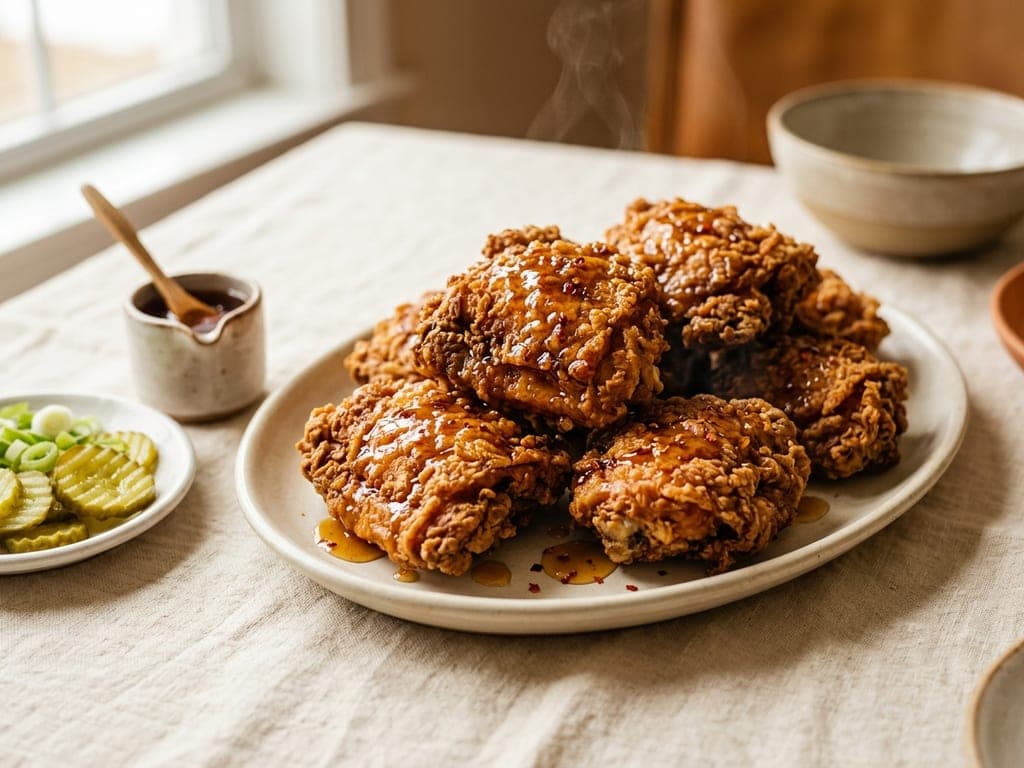
- Warm the platter first — a cold plate steals the fry's heat and shortens the crust's best minutes.
- Pile the chicken loosely rather than arranging it flat; height shows off the craggy crust and keeps steam escaping upward instead of pooling underneath.
- Spoon the hot honey over in thick ribbons AT the table, letting it catch in the crags — and leave the pitcher out so everyone can add their own second pass.
- Put something sharp within reach — a small dish of dill pickle chips or quick-pickled onions — and let the acid do the plate's balancing.
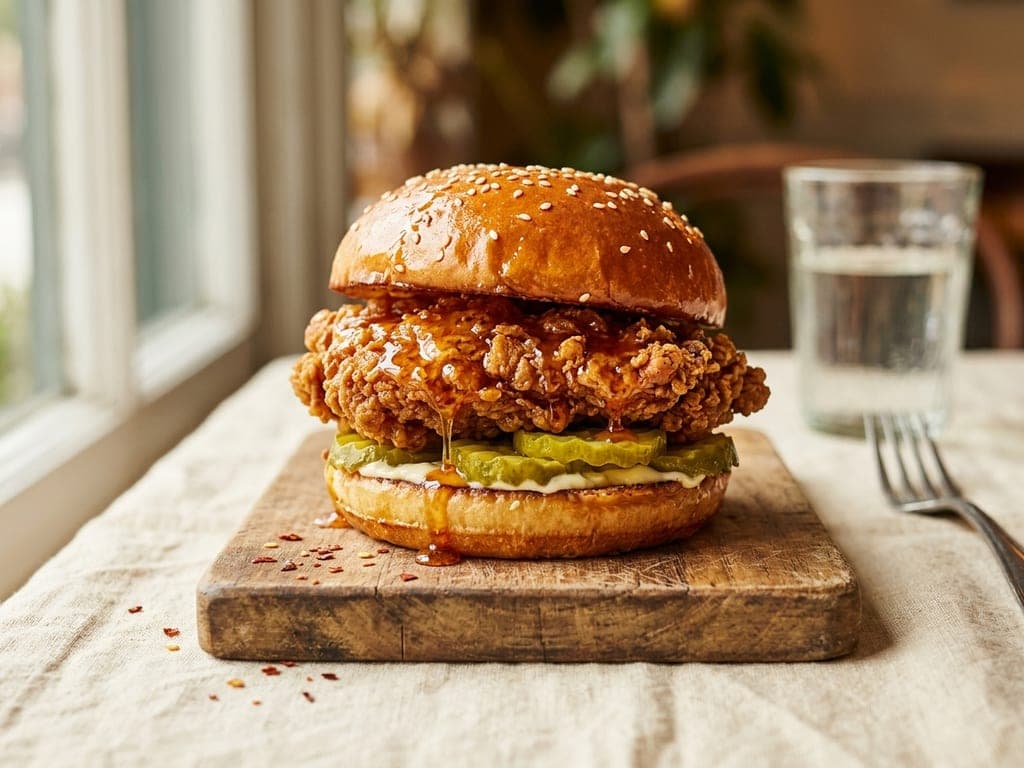
- Toast the cut faces of a soft brioche or burger bun lightly — just enough to waterproof them against mayo and honey.
- Mayo on both faces, then a full layer of dill pickle chips on the bottom bun — under the chicken, where they stay put.
- Set the fried thigh on the pickles and drizzle the hot honey directly onto the crust so it runs into the crags and down the edges.
- Crown, press gently for ten seconds so the layers commit to each other, and serve immediately — this sandwich has a shorter clock than the platter.
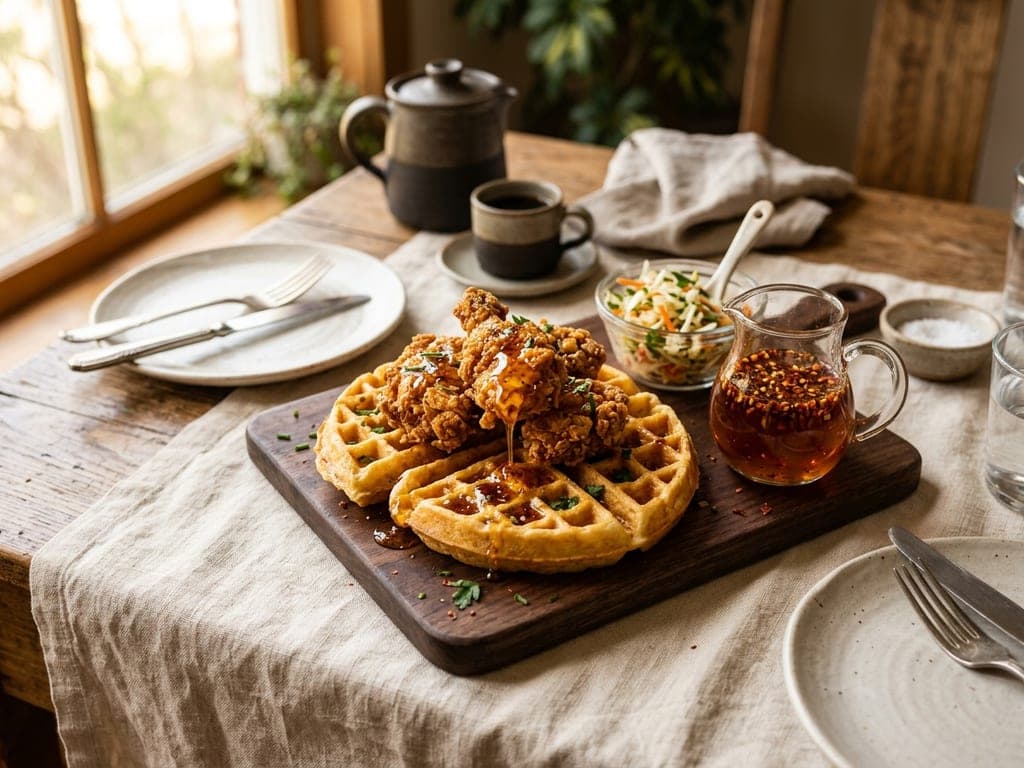
- Lay waffles on a wooden board and set the fried chicken pieces on top while both are hot — the board keeps everything casual and shareable.
- Give the honey its own small pitcher with the pepper flakes visible in it; pouring at the table is half the brunch theater.
- Add one sharp sidekick — a bowl of vinegar slaw earns its place better than any fruit here — and let coffee do the rest.
- Drizzle chicken AND waffle just before eating: the honey soaking into the waffle's pockets is the bite people remember.
The two decisions: the honey and the crust
Decision one is thermal, and it's about restraint. Honey is mostly sugar, but everything that makes a honey taste like itself — the floral, waxy, faintly acidic top notes — rides in volatile aromatics that heat evicts. Boil honey and you get sweetness with the personality steamed off, plus a texture that sets toward taffy as it cools. So the infusion is a warm bath, not a simmer: lowest heat, first bubbles at the rim, then off — the residual warmth extracts plenty from the flakes during the 15-minute steep. The vinegar goes in after, off the heat, for the same reason. If you want serious heat, add more chile rather than more heat-time: a second teaspoon of flakes or a hotter fresh chile scales the burn without cooking the honey. One legitimate variant: a tablespoon of butter melted into the finished honey gives a glossier, more sauce-like coat that clings where straight honey sometimes sheets off — at the cost of some brightness, and of the jar: the butter version is a refrigerated leftover, not a pantry bottle.
Decision two is structural. A glaze is an attack on a crust — moisture plus sugar, exactly what crispness fears — so the crust must be over-built to survive it. Every choice in the dredge is armor: cornstarch dilutes the flour's gluten and fries more brittle-crisp than flour alone; the buttermilk droplets raked in make craggy nuggets that multiply surface area, so there's more crunch per bite and further for the glaze to soak; the ten-minute pre-fry rest fuses coating to chicken so the shell can't be peeled off by a sticky ribbon of honey. Then the rack, never paper towels, so steam leaves instead of recirculating. None of this is fussiness — it's the difference between a glaze sitting ON crust and a glaze dissolving it.
And still, physics wins eventually — which is why the timing rule is the real recipe. Glazed crust has a lifespan of minutes, and no dredge extends it indefinitely. Restaurants solve this the way this page does: glaze at the pass, serve immediately. At home that means the honey goes on at the table, or in a tossing bowl seconds before plates. If your dinner runs family-style and slow, serve the honey as a pour-over in a little pitcher and let each person start their own countdown.
Shopping and the honest alternatives
The chicken: boneless, skinless thighs are this page's pick because they stay juicy through a shallow fry and forgive a minute of overshoot; they're also the cut most hot-honey-chicken cravings are actually about. Tenders (chicken mini fillets in Europe) make the classic shareable version — same dredge, 2–3 minutes per side, great for a crowd. Breast works sliced into cutlets about 1/2 inch (1.3 cm) thick, with the caveat every breast recipe owes you: the window between done and dry is small, so trust the thermometer, not the clock. Bone-in pieces are a different, longer recipe — this dredge and these times are built for boneless.
The honey and the heat: an everyday runny honey is correct here — a delicate single-origin jar's subtleties are exactly what infusing and frying will bulldoze, so save it for toast. Red pepper flakes give the classic pizzeria heat; a sliced fresh red chile adds fruitier, brighter fire (and moves the jar to the fridge — see the safety notes); cayenne works in a pinch but makes a cloudier, dustier honey. Going the fresh-chile route, strain the slices out after 20 minutes or so — their infusion turns vegetal if it overstays — and know that any batch's flavor peaks in its first couple of weeks, after which it just gets hotter and a little duller. And the store-bought bottle deserves respect, not guilt: bottled hot honey is exactly this condiment made consistently, and on a weeknight, 'fry the chicken, open the bottle' is a legitimate reading of this page. The homemade version wins on cost, heat control and the smug feeling — not on authenticity, because a dish barely five years into its fame doesn't have any to protect.
The no-fry translations, honestly ranked: the air fryer is the strong second place — dredge as written but spritz the surface generously with oil, 400°F (200°C) for 13–16 minutes, flipping once; you get real crunch, a bit less shatter, dramatically less cleanup. The oven is the distant third: a rack over a sheet pan at 425°F (220°C) for 20–25 minutes gives you 'crisped' rather than 'fried', respectable under enough hot honey. Both still obey the glaze clock. What doesn't work is skipping the fat entirely — a dry-baked naked thigh under hot honey is a sauced chicken, not a hot honey chicken, and it's better to know that before dinner than after.
Questions, answered
How do I make hot honey, and how long does it keep?
Warm 1/2 cup (170 g) honey with 2 tsp red pepper flakes over the lowest heat until the first bubbles show at the edge, pull it off, steep 15 minutes, then stir in 2 tsp apple cider vinegar. Never let it boil — heat strips honey's aroma and thickens it toward candy. As written (with vinegar) it keeps about a month at room temperature — refrigerate to stretch it to three; a flakes-only, no-vinegar batch is pantry-stable for months. Fresh chile slices or the butter variant make it a fridge item, best within two weeks, and any batch that foams or smells boozy is done. And never give honey — plain or infused — to a baby under 1 year. It doubles and triples cleanly, and the surplus belongs on pizza, biscuits, fried halloumi and vanilla ice cream.
Can I make hot honey chicken in the air fryer or oven?
Yes, with honest expectations. Air fryer: same buttermilk and dredge, spritz the coated chicken well with oil, 400°F (200°C) for 13–16 minutes flipping once, until 165°F (74°C) inside — real crunch, slightly less shatter than the fry. Oven: on a rack over a sheet pan at 425°F (220°C), 20–25 minutes — 'crisped' rather than 'fried', still good under the honey. Both versions obey the same rule as the fried one: glaze at the last moment.
Should I use thighs, breast or tenders?
Thighs are this page's default — juicy through a shallow fry, forgiving of an extra minute, and the right rich counterweight to a sweet glaze. Tenders (mini fillets) are the crowd-pleaser format: 2–3 minutes per side, built for sharing and dipping. Breast works as 1/2-inch (1.3 cm) cutlets if you fry to the thermometer, not the clock — its done-to-dry window is short. All three take the identical dredge and honey.
What's the difference between hot honey chicken and Nashville hot chicken?
Direction of travel. Nashville hot chicken — the older Prince's-lineage tradition — brushes fried chicken with a paste of cayenne and other spices bloomed in hot frying fat: savory, greasy-glossed, heat-forward, sweetness barely present. Hot honey chicken leads with sweetness and lets chile ride behind it, in a glossy honey glaze rather than a spiced fat. If you want this recipe to lean Nashville-ward, double the flakes, add 1/2 tsp cayenne to the honey, and whisk in a tablespoon of the frying oil at the end.
Why did my crust go soggy?
Almost always the glaze clock, and occasionally the fry itself. If the chicken was crisp and then died: the honey went on too early, or the pieces were tossed and then sat — glaze at the table, and never 'let it soak in'. If it was never properly crisp: the oil was under 350°F (175°C) when the chicken went in (thermometer, not vibes), the pan was crowded, or the fried pieces rested on paper towels, which steam the underside — use a wire rack, always.
How spicy is it, and how do I adjust?
As written — 2 tsp of flakes steeped 15 minutes — it's a friendly medium: real warmth that most heat-cautious eaters finish happily. Milder: 1 tsp of flakes, steep 10 minutes, strain the flakes out. Hotter: add a sliced fresh hot chile or a pinch of cayenne, or simply steep longer — heat keeps extracting for hours in the jar. The chicken itself carries no heat, so the honey pitcher on the table lets everyone set their own level, which is the family-dinner cheat code.
How do I turn it into the sandwich?
One fried thigh per soft white bun (brioche or the softest burger rolls you can find), mayonnaise on both cut faces, a layer of dill pickle chips (sliced dill gherkins) under the chicken, hot honey over the chicken so it drips into the crumb, top on, ten seconds of downward pressure. Slaw instead of (or on top of) the pickles is legitimate. The bun's job is to be soft and absorb; the pickles' job is to argue with the honey — don't skip them.
What do you serve with hot honey chicken?
Something sharp and something plain. Sharp: dill pickles, vinegar slaw, quick-pickled red onions — acid resets the palate against the sweet heat. Plain: waffles or biscuits for the brunch table, white rice for the weeknight bowl, good white bread for the sandwich. A cold, bitter drink — lager, iced tea, grapefruit soda — finishes the argument. Skip sweet sides entirely; the honey has that covered.
Snap your finished plate and let the AI plate it again — more beautifully.