Chicken Enchilada Recipe (Fry, Dip, Roll — No Soggy Tortillas)
The difference between good enchiladas and a soggy tray is an order of operations: fry each corn tortilla for ten seconds, dip it in warm sauce, fill it, roll it — then sauce lightly on top, not lavishly. That oil film is a raincoat. Includes the three-region map (Mexico, Tex-Mex, New Mexico), the cold-on-hot finish, and what to do when your supermarket has no queso fresco.
Ingredients
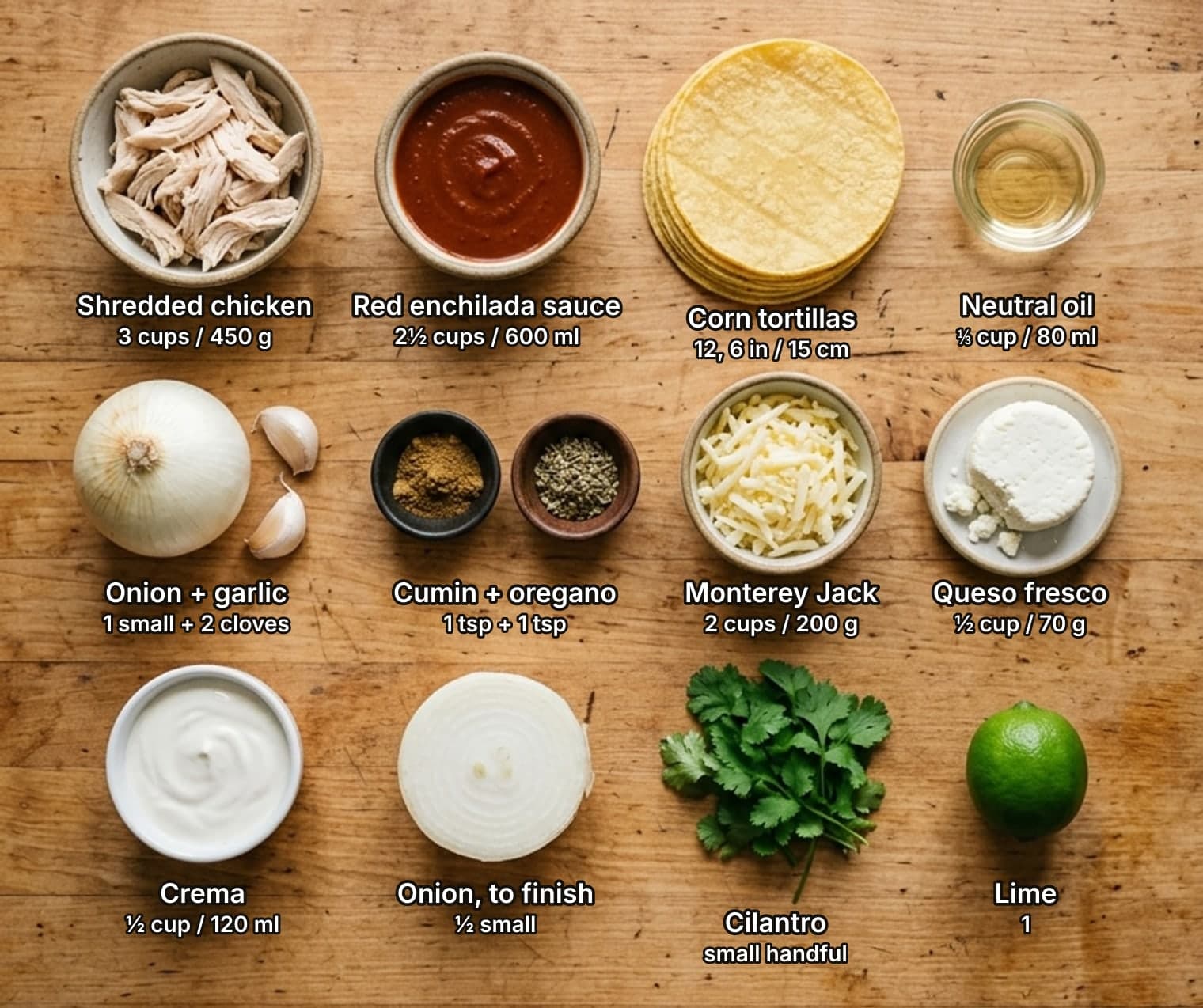
- cooked chicken, shredded (rotisserie or poached thigh)3 cups / 450 g
- red enchilada sauce (see our recipe, or tinned)2½ cups / 600 ml
- corn tortillas, 6-inch / 15 cm12
- neutral oil, for frying the tortillas⅓ cup / 80 ml
- white onion, finely chopped1 small
- garlic, minced2 cloves
- ground cumin1 tsp
- dried oregano (Mexican if you have it)1 tsp
- Monterey Jack or mild cheddar, grated2 cups / 200 g
- queso fresco, crumbled (or rinsed feta)½ cup / 70 g
- crema, or soured cream loosened with milk½ cup / 120 ml
- white onion, in thin rings, to finish½ small
- cilantro (fresh coriander leaf), choppedsmall handful
- lime, in wedges, to serve1
The order of operations nobody follows
Search this dish and you will find a remarkably consistent method: warm the tortillas in a microwave or a dry pan, fill them, roll them, line them up, pour the whole jar of sauce over the top, bury them in cheese, cover with foil, bake. Then, further down the same pages, a note about how enchiladas can come out a bit soft. The two facts are the same fact. A dry corn tortilla is a sponge, a foil lid is a steam chamber, and half a litre of sauce poured over the top is the water supply — of course it collapses.
The traditional sequence solves it before it starts. The tortilla goes through hot oil for ten seconds, which sets a hydrophobic film across the corn — a raincoat, not a crust. Then it is dipped in sauce while pliable, so it is seasoned all over rather than sauced only on top. Then it is filled, rolled, and given a modest band of sauce down the centre. It bakes uncovered, briefly, because everything in the dish is already cooked; the oven’s only job is to melt cheese and marry the layers. Fifteen minutes, not forty.
There is one more quiet variable: heat the sauce before you dip. Cold sauce on a hot fried tortilla seizes and slides off in patches, and it drops the tray’s starting temperature so far that the bake stretches long enough to soften everything anyway.
How to make Chicken enchiladas
- Warm the sauce in something wide. Pour 2½ cups (600 ml) of red enchilada sauce into a wide skillet or a pie dish and warm it through — you want a shallow bath you can lay a tortilla flat in, not a deep saucepan. Homemade is a twenty-minute job (our enchilada sauce page below); a good tinned sauce is an honest shortcut. Keep it just below a simmer while you work.
- Build a filling that isn’t dry. Soften 1 finely chopped small white onion in a little oil for 4–5 minutes, add 2 minced garlic cloves, 1 tsp ground cumin and 1 tsp dried oregano, and give it 30 seconds until fragrant. Off the heat, fold in 3 cups (450 g) of shredded cooked chicken and ½ cup (120 ml) of your warm sauce. The filling should look glossy and just-damp — dry filling is the second reason enchiladas disappoint, and it’s the one nobody blames.
- Heat the oven and prime the dish. Oven to 375°F (190°C). Spread ½ cup (120 ml) of sauce across the bottom of a 9×13-inch (23×33 cm) baking dish in a thin film — enough that nothing welds itself to the base, not so much that the enchiladas sit in a puddle and steam from below.
- Fry the tortillas — ten seconds, no more. This is the step page-one recipes skip, and it is the whole recipe. Heat about ⅓ cup (80 ml) of neutral oil in a small skillet over medium until it shimmers — around 350°F (175°C) — and pass each of 12 corn tortillas through it for 5–10 seconds a side. You are not making a tostada: the tortilla should stay floppy. What you have added is a film of oil that stops the corn from drinking the sauce, plus a toasted-corn smell that tinned sauce cannot fake. Drain them on paper towels.
- Dip each tortilla in the warm sauce. Lay a fried tortilla in the sauce bath, flip it once, and lift it out coated on both sides. Every tortilla gets sauced now, individually, while it is still supple. This is the order that separates enchiladas from a casserole: the sauce goes on the tortilla, not over the tray.
- Fill and roll, seam down. Move the sauced tortilla to a plate, lay a scant ⅓ cup of filling in a line across the lower third with a pinch of the grated cheese, and roll it up snugly. Set it seam-side down in the dish — the seam’s own weight is what keeps it shut, so no toothpicks. Carry on until the dish holds 12 rolls in one tight row; crowding them is good, they hold each other closed.
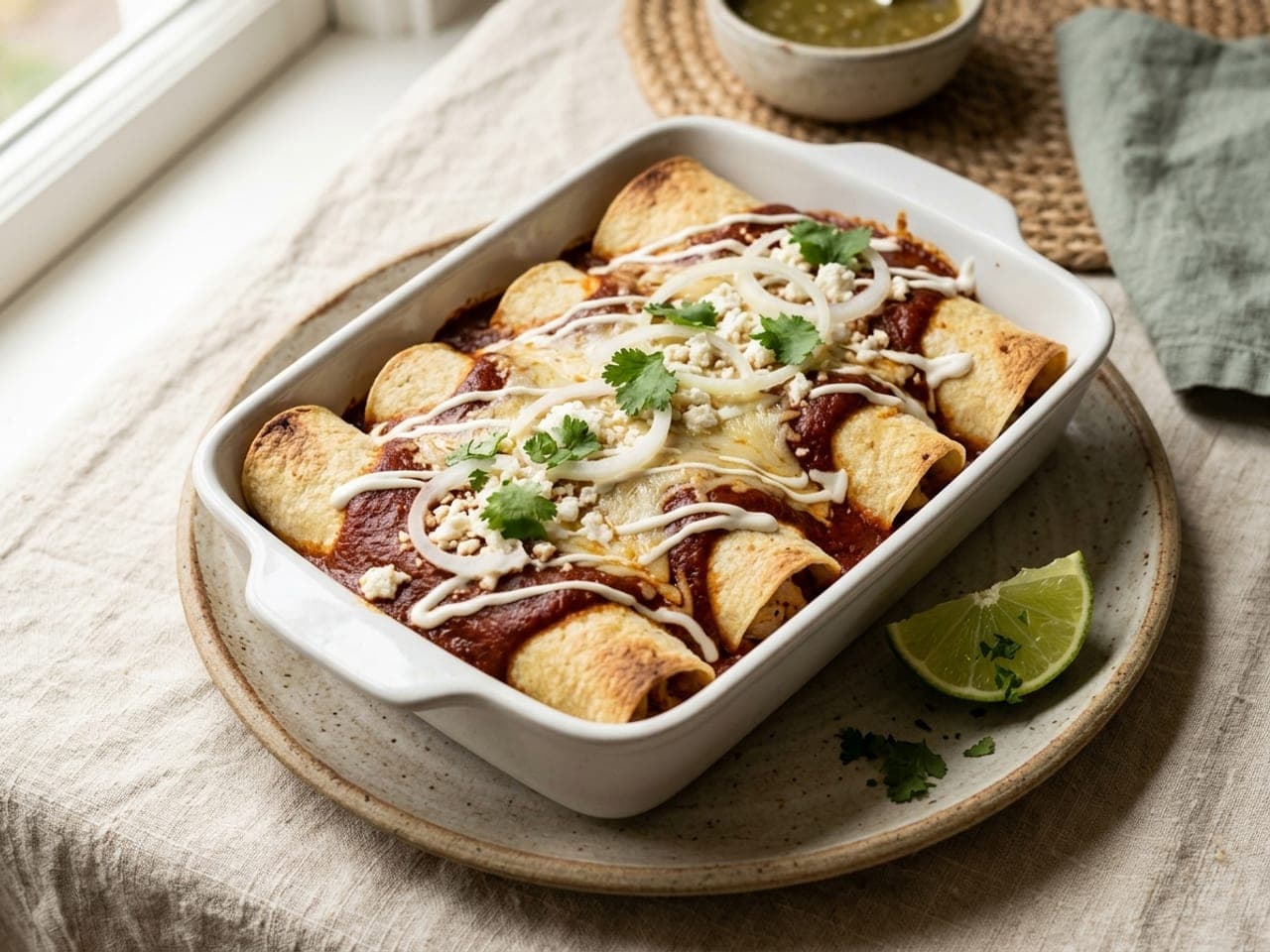
- Sauce the top with restraint. Spoon the remaining sauce over the enchiladas in a band down the middle, leaving the ends of the rolls exposed. Those bare, oil-fried ends will crisp slightly in the oven and give the tray its texture contrast. Scatter over 2 cups (200 g) of grated Monterey Jack (a mild semi-hard melting cheese; mild cheddar or a young gouda stands in), concentrating it along the sauced band.
- Bake straight away, uncovered. Into the oven the moment it’s assembled — an assembled tray left standing on the counter for half an hour softens exactly the way you spent all that oil preventing. 15–18 minutes at 375°F (190°C), uncovered, until the cheese is molten and the sauce blips at the edges. Covering it with foil traps steam and undoes the raincoat.
- Finish cold on hot. The last move is temperature contrast, and it is what makes a home tray look like a restaurant plate: drizzle ½ cup (120 ml) of crema (or soured cream loosened with a spoon of milk) over the hot enchiladas, crumble ½ cup (70 g) of queso fresco across, scatter thin raw white onion rings and chopped cilantro (fresh coriander leaf), and serve with lime wedges. Cool, sharp, and raw against hot, soft and rich — the whole dish is built on that one contrast.
Safety & hygiene Important
- Shallow hot oil, treated properly. The tortilla oil sits around 350°F (175°C) — hot enough to burn on contact and to spit if anything wet meets it. Pat the tortillas dry, lower them in with tongs rather than fingers, keep the pan handle turned inward, and never carry the hot pan to the sink. Let the oil cool in the pan; if it ever catches, the lid goes on and the heat goes off — water never.
- 165°F (74°C) if you poach your own chicken. Cooking the chicken yourself? Poached breasts or thighs are done at 165°F (74°C) in the thickest part, and the board and tongs that touched them raw don’t touch the finished dish. Shop-bought rotisserie chicken is already cooked — just keep it refrigerated and use it within 3–4 days.
- Assembled trays and the two-hour rule. You can build the tray a day ahead, but chill it within 2 hours of the filling being cooked and bake it from the fridge (add 8–10 minutes). Don’t leave an assembled tray at room temperature to wait — that’s both a food-safety window and, separately, how the tortillas go to mush.
- Leftovers keep 4 days. Baked enchiladas keep 3–4 days refrigerated in a covered dish and reheat well in a moderate oven until steaming hot right through. Reheat once, not repeatedly. They freeze better unbaked than baked — see the FAQ.
3 ways to plate it
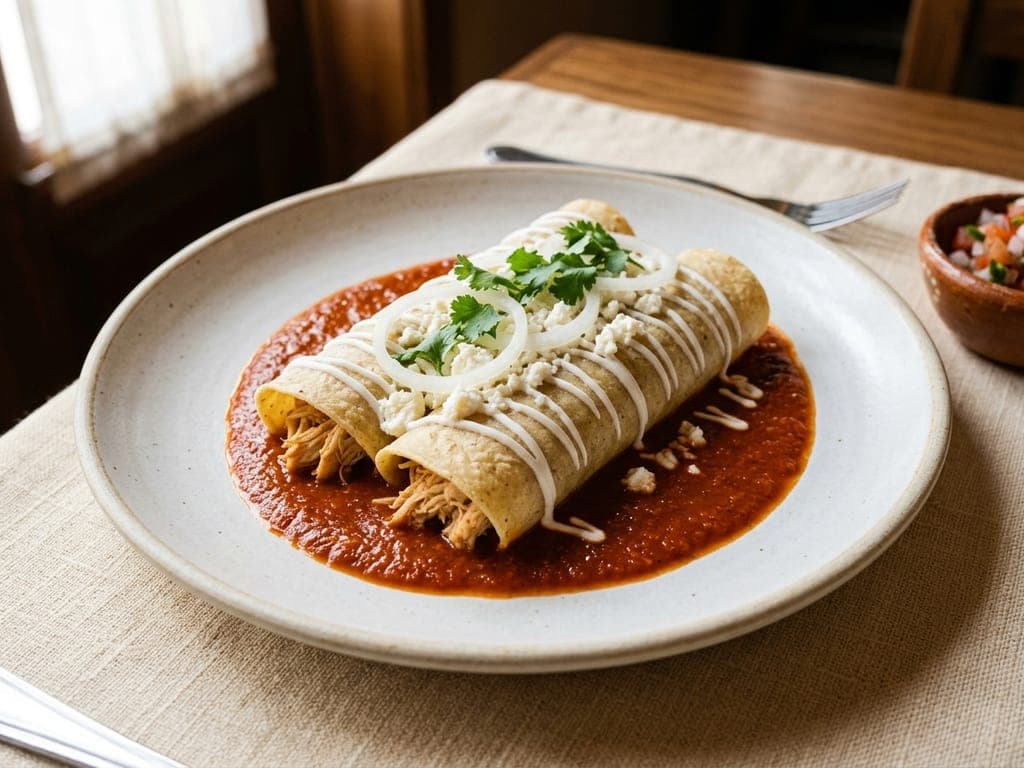
- Spoon a shallow pool of warm sauce onto the plate first and set the enchiladas into it — sauce underneath keeps their tops glossy instead of flooded.
- Lay the two rolls parallel and slightly offset, seams down, leaving one clean crescent of plate visible.
- Pull the crema across in a fine zigzag from a squeeze bottle or a spoon tip — thin lines read as deliberate, thick blobs read as accidental.
- Finish along the length of the rolls only: queso fresco, three or four onion rings, a few cilantro leaves. Leave the plate rim untouched.
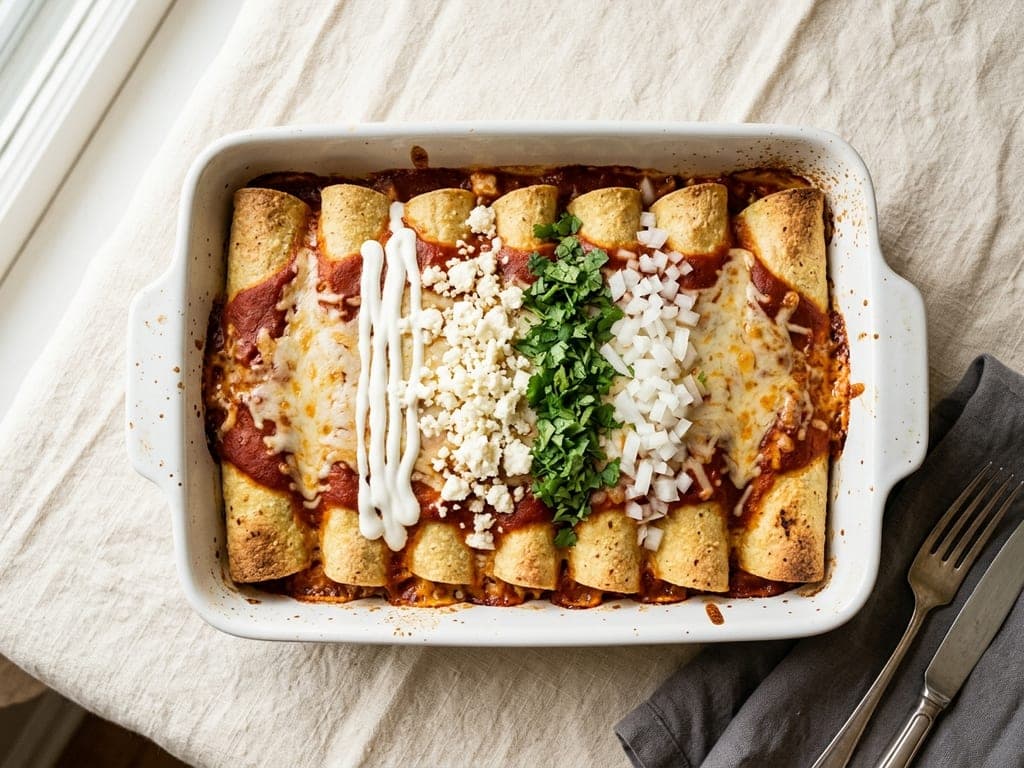
- Keep the enchilada ends bare of sauce during assembly — the contrast between the glossy band and the toasted ends is what makes the tray photograph.
- Garnish in stripes running across the rolls, not scattered evenly: one stripe of crema, one of queso fresco, one of cilantro and onion.
- Add every fresh garnish after baking, never before — heat wilts cilantro and turns crema grey.
- Bring the dish to the table in its baking dish on a board; enchiladas lose their shape in transfer and gain nothing by it.
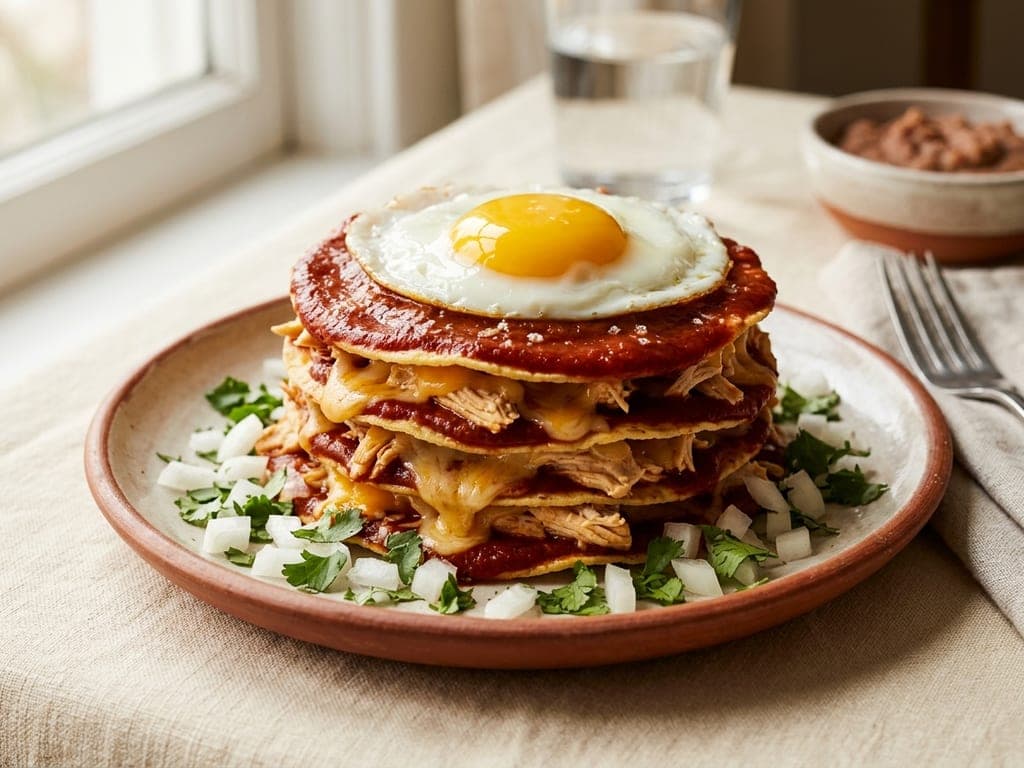
- Layer flat instead of rolling: sauced tortilla, filling, cheese, repeat three times, finishing with sauce and cheese on the top tortilla.
- Keep the stack low and slightly irregular — a tower that is too neat looks like a cake, and the appeal here is rustic.
- Fry the egg gently so the white sets while the yolk stays liquid, and slide it on just before serving.
- Ring the base with raw onion and cilantro so the plate has a bright edge under all that chile.
Three enchiladas, three places
Nearly every argument about “authentic” enchiladas is really two people describing different regional dishes correctly. It is worth having the map, because it tells you which recipe you actually want tonight.
In Mexico — corn tortillas, a thin chile sauce that seasons rather than smothers, a modest filling of shredded chicken, and the finish doing the heavy lifting: crema, crumbled queso fresco, raw onion, cilantro. Often not baked at all — assembled hot and served immediately, which is why the tortilla’s integrity is prized. Enchiladas suizas are the creamy tomatillo cousin, and their origin is genuinely disputed: the most-repeated story credits a cook at the Sanborns department-store café in Mexico City around 1950, though other accounts push it back to the 1919 Sanborns era or to a Swiss cook in Maximilian’s 1860s court. What everyone agrees on is that “suizas” points at the dairy, not at Switzerland.
In Texas — chili gravy, a cumin-heavy, roux-thickened, beef-broth sauce rather than a pure chile purée — poured over rolled tortillas and finished with melting yellow cheese and raw onion. This is not a degraded copy of the Mexican dish; it is its own cuisine with its own century of history, running back to San Antonio’s Chili Queens, the Mexican-American women whose lantern-lit plaza stands sold chili con carne, tamales and enchiladas from the 1860s until the city closed them on sanitation grounds in the early 1940s. Our beef enchiladas page is this version, made properly.
In New Mexico — stacked, not rolled: tortillas layered flat with red or green chile between them, often crowned with a fried egg. Order them “Christmas” and you get both chiles on the same plate. It is a genuinely different construction, and worth knowing exists before somebody tells you your rolled enchiladas are wrong.
A very old dish with a short paper trail
Rolling a tortilla around a filling and dressing it with chile is about as old as the tortilla. Bernal Díaz del Castillo, who arrived in Tenochtitlán with Cortés in 1519, describes Mexica food of exactly this shape, and the Nahuatl word usually offered as the ancestor, chīllapītzalli, is generally read as “chilli flute” — a fair description of a filled, rolled tortilla, though the direct line from that word to this dish is more often asserted than demonstrated.
The word we actually use is Spanish and much later: enchilada is the past participle of enchilar, to season with chile — literally “chilied”. Its first appearance in print is usually dated to the 1831 Mexican cookbook El cocinero mexicano. So the dish is pre-Columbian in technique and colonial in name, and the version most Americans picture — flour tortillas, yellow cheese, a tin of sauce — is a twentieth-century Texan and Californian development on top of both. All three layers are real; none of them cancels the others.
The chicken, the cheese, and shopping in Europe
The chicken: a shop-bought rotisserie chicken (a roast chicken from the deli counter) is the sensible weeknight answer and yields roughly the 3 cups (450 g) this recipe wants from one bird. Poaching your own is better and takes twenty minutes: cover thighs with water, add half an onion, a garlic clove and salt, simmer gently until 165°F (74°C), then shred with two forks and save a ladle of the poaching liquid to loosen the filling. Thighs beat breast here — shredded breast dries out on the second day, thigh doesn’t. Leftover roast chicken is the best answer of all.
The cheese: two of them, doing two jobs. The melting cheese is Monterey Jack or a mild cheddar; in Europe a young gouda, edam or a mild Cheddar-style block melts the same way. The finishing cheese is queso fresco — fresh, salty, crumbly, and it does not melt. If your supermarket has none, crumbled feta rinsed briefly under cold water to knock the salt back is the closest common substitute, and mild French or Greek fresh cheese works too. Do not swap in mozzarella for the melt: it strings rather than flows and turns the top rubbery as it cools.
The tortillas: corn, always, for this dish — 6-inch (15 cm) ones, and fresher is better since dry supermarket tortillas crack even after frying. If yours are elderly, a 10-second pass in the oil plus 20 seconds under a clean towel makes them pliable again. Crema is thinner and less sour than soured cream; loosen soured cream with a spoonful of milk and you have it. And cilantro is the leaf sold as fresh coriander across Europe — the seed is a different spice and does nothing here.
Questions, answered
What is the secret to good enchiladas?
Fry each corn tortilla in hot oil for 5–10 seconds, then dip it in warm sauce before filling and rolling. The oil is a waterproof film that stops the tortilla drinking the sauce, and dipping seasons it all over. Then sauce the top lightly, not lavishly, and bake uncovered for 15–18 minutes. Almost every soggy-enchilada complaint traces back to skipping the oil and pouring the whole jar over the tray.
Do you have to fry corn tortillas for enchiladas?
For rolled enchiladas, effectively yes — it is what keeps them intact and prevents sogginess, and it takes about two minutes for a dozen. If you would rather not fry, brush both sides with oil and heat them on a baking sheet at 375°F (190°C) for 3–4 minutes; it is not quite as good a barrier but it is a real improvement on a bare tortilla. Warming them dry in a microwave gives you pliability with no protection at all.
Corn or flour tortillas for enchiladas?
Corn is traditional and structurally correct: it holds up to sauce, and its toasted flavour is half the dish. Flour tortillas are standard in much of Tex-Mex and taste good, but they go pasty under sauce and don’t need the oil step. If you use flour, skip the frying, use less sauce, and bake a little shorter.
Why do my enchiladas fall apart?
Three usual causes: the tortillas went in cold and dry so they cracked as you rolled; they were over-filled — a scant ⅓ cup per tortilla is plenty; or they were rolled loosely and set seam-up. Fry them, fill them modestly, roll them snugly, and pack them tightly seam-down so they brace each other.
Can I make enchiladas ahead of time?
Yes, but assemble and refrigerate rather than assemble and wait on the counter — an assembled tray standing at room temperature is exactly how tortillas go soft. Build it up to a day ahead, cover, chill, and bake from cold with 8–10 extra minutes. For longer than that, freeze unbaked.
Can you freeze chicken enchiladas?
Freeze them unbaked and they are excellent: assemble in a freezer-safe dish, hold back the crema and fresh garnishes, wrap well, and freeze up to 3 months. Bake from frozen at 375°F (190°C), covered for 40 minutes, then uncovered for 15–20 until bubbling and steaming hot through. Frozen after baking they survive, but the tortillas soften noticeably.
What chicken is best for enchiladas?
Shredded thigh, from a rotisserie chicken or poached at home — it stays moist through baking and reheats without turning stringy. One shop-bought roast chicken yields about the 3 cups (450 g) this recipe needs. Leftover roast chicken is ideal. Whatever you use, moisten the shredded meat with a little sauce before rolling.
Red or green enchilada sauce for chicken?
Both are traditional and the choice is about the finish you want: red (dried guajillo and ancho chiles) is deeper, earthier and sweeter, green (tomatillos) is brighter and sharper. Chicken is the classic partner for green — that is what enchiladas verdes are — while red suits beef and cheese especially well. We have a page for each; the method on this page is identical either way.
How much sauce do I need for a tray of enchiladas?
About 2½ cups (600 ml) for 12 enchiladas, but the split matters more than the total: ½ cup (120 ml) thinly across the base, most of the rest used for dipping the tortillas, and only what remains spooned in a band down the middle. The classic mistake is using the same volume all in one pour over the top.
How many calories are in chicken enchiladas?
About 620 per serving as plated here — three enchiladas with cheese, crema and queso fresco. The cheese and the frying oil are the two big dials: draining the tortillas properly and halving the melting cheese takes roughly 150 calories off without touching the method that makes the dish work.
Snap your finished plate and let the AI plate it again — more beautifully.