Enchiladas Verdes Recipe (Roasted Tomatillo Salsa, Stays Green)
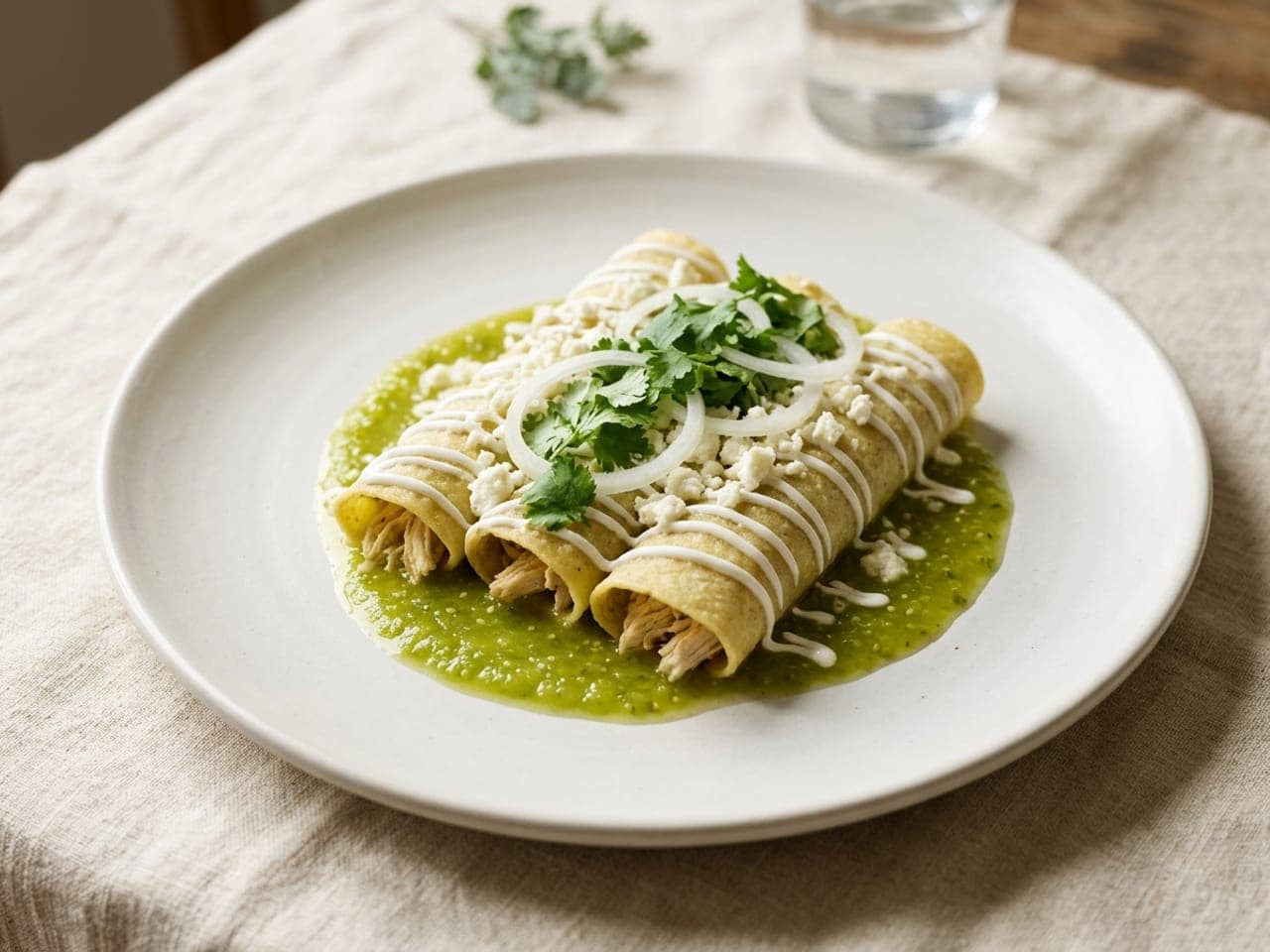
Blister the tomatillos under the grill rather than boiling them, blend the cilantro in off the heat so the sauce stays green instead of going olive, and fry the salsa in hot oil before it ever meets a tortilla. Bright, sharp, chicken-filled and finished with crema and crumbled cheese — the green half of the enchilada family, and the one Mexican cooks reach for most.
Ingredients
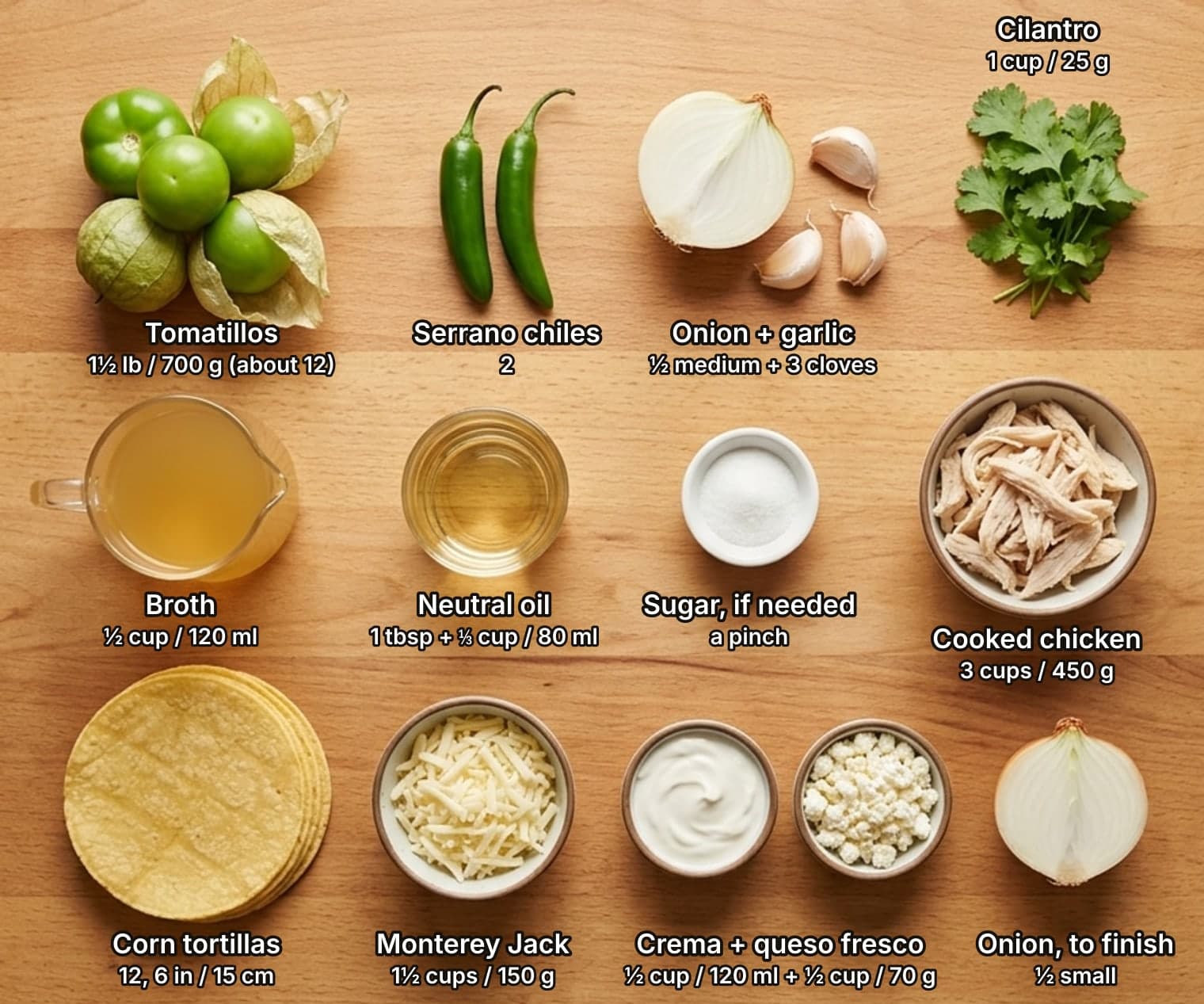
- tomatillos, husked and rinsed1½ lb / 700 g (about 12)
- serrano or jalapeño chiles2
- white onion, in wedges½ medium
- garlic, unpeeled3 cloves
- cilantro (fresh coriander leaf), packed1 cup / 25 g
- chicken or vegetable broth½ cup / 120 ml
- neutral oil, for the salsa1 tbsp
- sugar, only if the tomatillos are very tarta pinch
- cooked chicken, shredded (rotisserie or poached thigh)3 cups / 450 g
- corn tortillas, 6-inch / 15 cm12
- neutral oil, for frying the tortillas⅓ cup / 80 ml
- Monterey Jack or other mild melting cheese, grated1½ cups / 150 g
- crema, or soured cream loosened with milk½ cup / 120 ml
- queso fresco, crumbled (or rinsed feta)½ cup / 70 g
- white onion, in thin rings, to finish½ small
- saltto taste
Roast or boil the tomatillos
Both methods are traditional and they make genuinely different sauces, so the honest answer is that it depends what you want — but for enchiladas verdes, roast. Blistering the tomatillos under a hot grill concentrates them as water evaporates, caramelises their sugars, and adds the faint burnt-skin bitterness that gives the sauce its backbone under a rich, cheesy tray. Boiling, by contrast, is the gentler and more common everyday method in Mexican kitchens: it softens the fruit and rounds off the acidity in about ten minutes, giving a cleaner, brighter, purely fruity salsa — which is exactly right spooned raw over tacos, and which tends to read as thin once it is baked under cheese and crema.
The practical differences are small. Roasting takes 6–8 minutes under the grill and dirties one tray; boiling takes about 10 minutes and one pan, and gives you a milder result you may prefer if you are feeding children. A third option, dry-roasting on a comal or in a heavy dry skillet, sits between them and is the most traditional of the lot. Whichever you choose, use the liquid: roasted tomatillos leak juice onto the tray and boiled ones leave a pan of pale green water, and in both cases that is flavour you paid for.
How to make Enchiladas verdes
- Husk and wash the tomatillos. Peel the papery husks off 1½ lb (700 g) of tomatillos — about 12 — and rinse them in warm water, rubbing to remove the sticky resin underneath. That film is bitter and it is the reason some green sauces have an off note nobody can place. Halve any that are much bigger than a golf ball so everything chars evenly.
- Blister them under the grill. Spread the tomatillos cut-side down on a foil-lined tray with 2 serrano or jalapeño chiles, ½ a white onion in wedges and 3 unpeeled garlic cloves. Under a hot broiler (the overhead grill) for 6–8 minutes, until the skins blacken in patches and the tomatillos slump and leak. Turn them once. You want real char in places — that smoky bitterness is the backbone of the sauce, and boiled tomatillos never develop it. Slip the garlic out of its skins.
- Blend — and add the cilantro last, off the heat. Tip everything, juices included, into a blender with 1 cup (25 g) of packed cilantro (fresh coriander leaf) and ½ cup (120 ml) of broth, and blend to a coarse purée. Add the cilantro now, cold, and never boil the sauce hard afterwards: heat destroys the chlorophyll and a vivid green salsa turns army-olive in about four minutes. Blend it just short of completely smooth — verde should have a little texture.
- Fry the salsa in hot oil. Heat 1 tbsp of neutral oil in a wide saucepan until it shimmers and pour the purée in all at once, standing back from the sputter. Cook at a lively simmer for 5 minutes, stirring — the salsa deepens, thickens and loses its raw edge. Season with salt and, if your tomatillos were very tart, a pinch of sugar. Keep it at a simmer rather than a rolling boil from here on, both for the colour and because it spits.
- Warm the chicken in the sauce. Fold ½ cup (120 ml) of the warm salsa through 3 cups (450 g) of shredded cooked chicken — rotisserie (a shop-bought roast chicken) or poached thigh. Bound filling stays moist through baking and doesn’t crumble out of the rolls. Taste and salt it properly now.
- Heat the oven and prime the dish. Oven to 375°F (190°C). Spread ½ cup (120 ml) of salsa thinly across the base of a 9×13-inch (23×33 cm) baking dish — a film to stop things sticking, not a pool to poach them in.
- Fry the tortillas, then dip them. Heat ⅓ cup (80 ml) of neutral oil in a small skillet until it shimmers, about 350°F (175°C), and pass each of 12 corn tortillas through for 5–10 seconds a side — pliable, never crisp. Drain on paper towels, then dip each in the warm green salsa until coated on both sides. The oil is what stops the tortilla drinking the sauce; the dip is what seasons it.
- Fill, roll and sauce lightly. A scant ⅓ cup of chicken along the lower third of each tortilla, rolled snugly, set seam-side down in a tight row. Spoon the remaining salsa in a band down the centre, leaving the ends bare so they crisp, and scatter over 1½ cups (150 g) of grated Monterey Jack (any mild semi-hard melting cheese — young gouda or mild cheddar in Europe). Verdes wear less cheese than the Tex-Mex tray; the sauce is meant to stay the loudest thing on the plate.
- Bake briefly, finish cold on hot. 15 minutes at 375°F (190°C), uncovered, straight after assembly — everything in the dish is already cooked, so this is a melt, not a bake. Out of the oven, drizzle ½ cup (120 ml) of crema (or soured cream loosened with milk), crumble ½ cup (70 g) of queso fresco over, and finish with thin raw white onion rings and cilantro leaves. Cold, sharp and white against hot green is the entire point of the dish.
Safety & hygiene Important
- The broiler needs watching. Tomatillos go from blistered to incinerated in about ninety seconds under a hot grill, and a foil-lined tray of leaking fruit close to an element is a genuine smoke risk. Stay in the room, keep the tray on the middle shelf rather than jammed against the element, and pull it the moment the skins have blackened in patches. Use dry oven gloves — the tray comes out with hot juice sliding around on it.
- Chile oils and hot purée. Serranos and jalapeños leave capsaicin on your fingers that a quick rinse will not shift, so wash twice with soap and keep your hands from your eyes. When blending hot ingredients, fill the jug no more than halfway, remove the lid’s centre cap to vent the steam, and hold a folded towel over the gap — a sealed blender of hot purée can force the lid off.
- The salsa sputters when it hits the oil. Wet purée poured into shimmering oil throws hot droplets for a few seconds. Pour from a low angle, keep the pan lid in your other hand as a shield, and use a long spoon for the first stir. Drop the heat to a simmer once it settles — which the colour wants anyway.
- Chicken and leftovers. If you poach your own chicken, it is done at 165°F (74°C) and the board and tongs that touched it raw don’t touch the finished dish. Cooked shredded chicken keeps 3–4 days refrigerated; so do the baked enchiladas, covered, reheated once in a moderate oven until steaming through. The salsa verde alone keeps 5 days in the fridge and freezes for 3 months, though it loses some of its colour.
3 ways to plate it
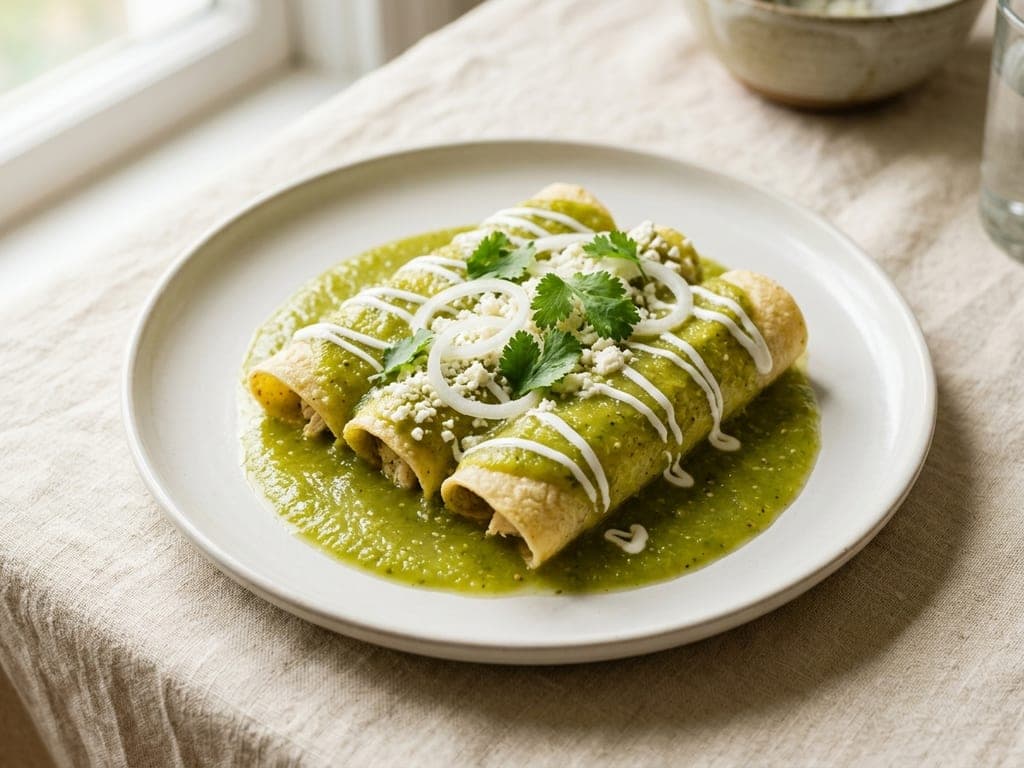
- Spoon the salsa onto the plate first and set the rolls into it; sauce underneath keeps the tops glossy rather than flooded.
- Choose the palest plate you own — green sauce reads dull on warm-toned pottery and vivid on white or bone.
- Draw the crema in fine lines across the rolls rather than dolloping it; thin white lines make the green look brighter, a white puddle deadens it.
- Finish along the rolls only, leaving a clean margin of plate all the way round.
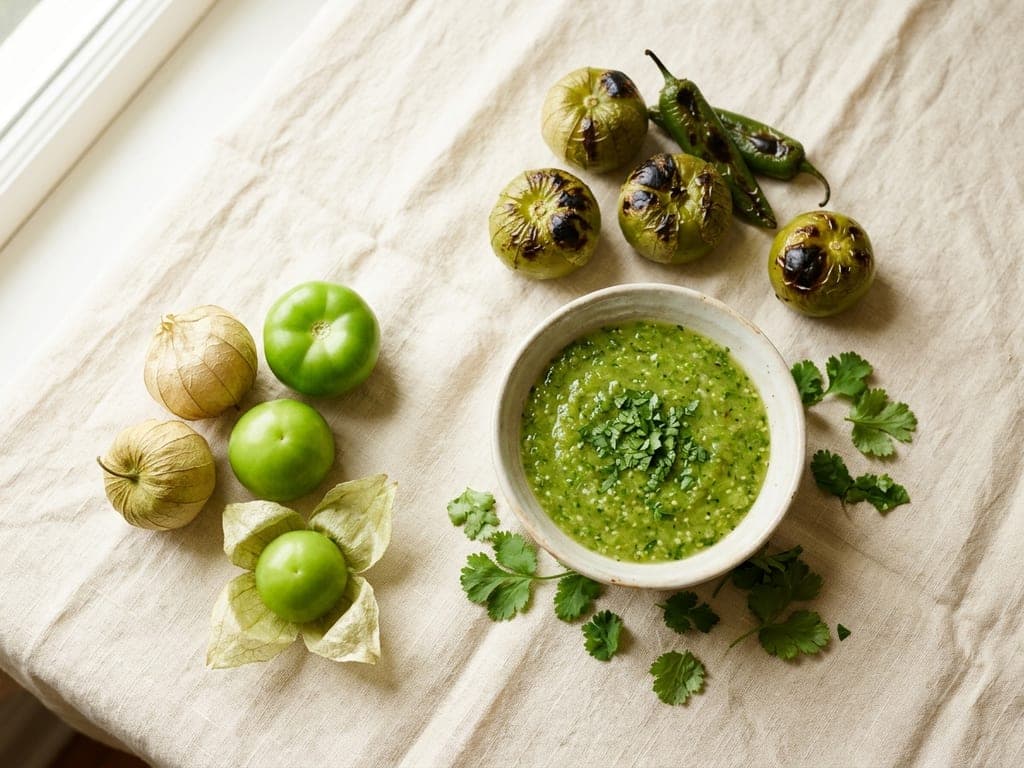
- Leave two or three tomatillos in their husks and half-peel one — the papery texture is what tells the viewer what this fruit is.
- Show the blackened patches on the roasted tomatillos and chiles clearly; the char is the recipe’s argument, not a blemish.
- Put the finished salsa in a shallow pale bowl so its colour can be compared directly with the raw fruit beside it.
- Shoot from overhead with soft side light and keep real empty space between the groups — a crowded flat lay reads as clutter.
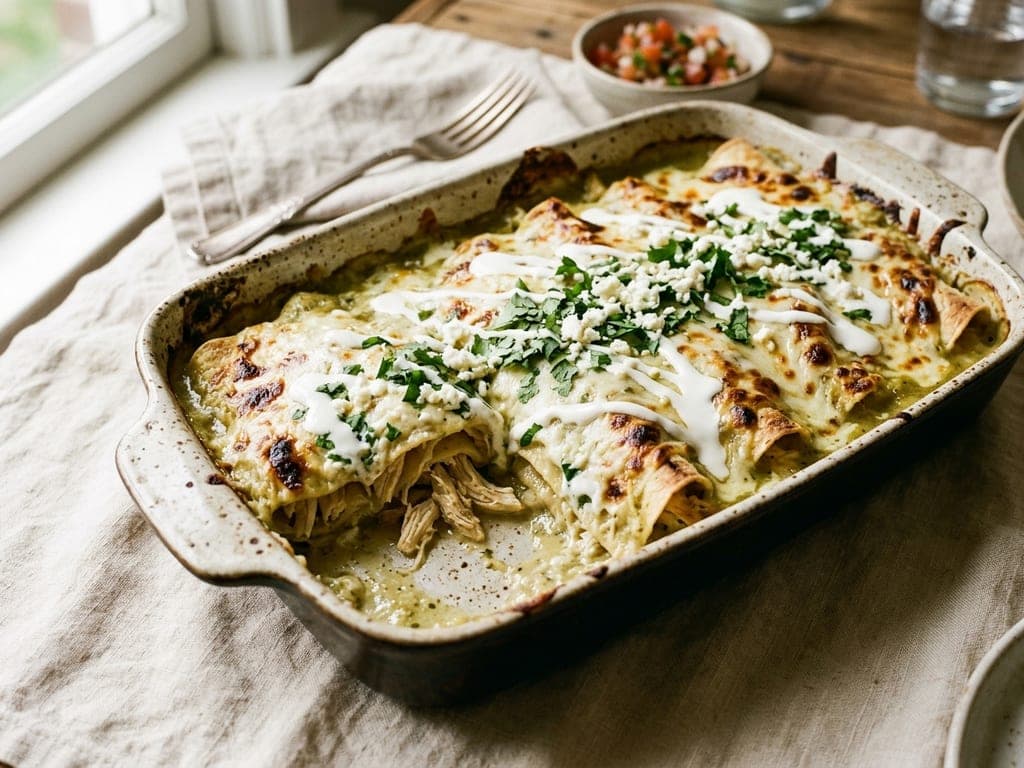
- Enrich the sauce with cream before it goes over so the surface reads pale sage rather than vivid green — this look is meant to be softer.
- Let the cheese blister properly under the grill; the dark patches are the whole appeal and an evenly pale top looks underdone.
- Cut and lift one portion before shooting so the layers inside are visible; an untouched dish hides what is in it.
- Add the crema and cilantro after grilling, in a loose scatter rather than neat lines — this plate is generous, not composed.
Verdes, suizas, and the green casserole
Three green chicken dishes get confused constantly, and the differences are worth knowing before you follow the wrong recipe. Enchiladas verdes are this page: tortillas dipped in tomatillo salsa, filled with chicken, dressed with crema and crumbled cheese. In much of Mexico they are not baked at all — assembled hot, plated, and eaten immediately, which is why the tortilla’s integrity matters so much. The short bake here is a concession to feeding four people at once.
Enchiladas suizas are the creamy cousin: the same tomatillo base enriched with cream and blanketed in melting cheese, then browned. The name points at Swiss dairy rather than Switzerland, and the origin is disputed — the most-told story credits a cook at the Sanborns department-store café in Mexico City around 1950, while other accounts push it back to the 1919 Sanborns era or to a Swiss cook in Maximilian’s 1860s court. To make them from this recipe, stir ½ cup (120 ml) of double cream into the salsa and use twice the cheese.
The green chile chicken casserole common in American home cooking is a third thing entirely: tinned green chiles, soured cream and often condensed soup, layered with tortillas. It is comfort food with its own following and nothing wrong with it — it simply is not this dish, and searching for one will constantly hand you the other.
Why green sauce turns olive
The green comes from chlorophyll in the cilantro and the tomatillo skins, and chlorophyll is not heat-stable: sustained boiling breaks it down, and acid — which tomatillos have in abundance — accelerates the reaction. A salsa that goes into the pan vivid and comes out the colour of split-pea soup has simply been cooked too long and too hard.
Three habits keep it bright. Blend the cilantro in cold, at the end, rather than simmering it in the sauce. Cook the salsa at a lively simmer for five minutes rather than a rolling boil for twenty — long enough to fry off the raw edge, short enough to keep the colour. And assemble the dish soon after the sauce is made, since it dulls in the pan as it sits over heat. If you are making the salsa ahead, cool it quickly and refrigerate it; reheat gently at the last minute. A handful of fresh cilantro blended in just before serving revives both the colour and the smell of a batch that has been standing.
Buying tomatillos, and the green-tomato myth
Tomatillos are not unripe tomatoes. They are a different plant — a relative of the cape gooseberry, sold in a papery husk — and they are tart, faintly citrusy and full of natural pectin, which is what gives salsa verde its body. Choose fruit that fills its husk firmly and feels dense, with the husk still fresh rather than dried and shredded; the sticky residue underneath washes off in warm water. They keep two to three weeks refrigerated in their husks.
In Europe, fresh tomatillos are seasonal and scarce outside Latin-American grocers, but tinned whole tomatillos are widely available online and in Mexican food shops and make an excellent sauce — drain them, put them under the grill just as you would fresh ones to get some char, and cut the added liquid since they are packed wet. Substituting green tomatoes is the internet’s standard advice and it is not a like-for-like swap: green tomatoes lack both the acidity and the pectin, so the sauce comes out flatter and thinner. If it is your only option, add the juice of a lime and accept that you are making something adjacent rather than the same dish. Green gooseberries, oddly, get you closer on acidity than green tomatoes do.
Questions, answered
What is the difference between enchiladas verdes and enchiladas suizas?
Verdes are tomatillo salsa, chicken, crema and crumbled fresh cheese — sharp and bright, often not baked at all. Suizas take the same green base, enrich it with cream, and bury it in melting cheese to be browned in the oven. The name refers to Swiss dairy rather than to Switzerland. To turn this recipe into suizas, stir ½ cup (120 ml) of double cream into the salsa and double the cheese.
Should I roast or boil tomatillos for salsa verde?
Roast them for enchiladas: blistering under a hot grill for 6–8 minutes concentrates the fruit and adds a smoky backbone that stands up to cheese and crema. Boiling for about 10 minutes is the more common everyday method in Mexico and gives a cleaner, milder, fruitier salsa that is lovely spooned over tacos but can taste thin once baked. Both are traditional; use the cooking liquid either way.
Why did my salsa verde turn brown or olive?
It was boiled too long. Chlorophyll breaks down with sustained heat, and the acidity of tomatillos speeds it up. Blend the cilantro in cold at the end, simmer the sauce for about five minutes rather than boiling it for twenty, and assemble soon after making it. Blending a fresh handful of cilantro into a dulled batch just before serving brings much of the colour back.
What can I use instead of tomatillos?
Tinned tomatillos are the honest answer and they are widely available online in Europe — drain them, char them under the grill, and use less added liquid. Green tomatoes are the usual internet substitute but they are a different plant with less acid and no pectin, so the sauce comes out flatter and thinner; add lime juice and expect a related rather than identical dish.
Are enchiladas verdes spicy?
As written, mildly — two serranos give a clear but comfortable heat, and jalapeños are gentler still. Remove the seeds and veins for a milder sauce, or add a third chile for real heat. Tomatillos are tart rather than hot, so the chiles are the only dial, and the crema and cheese at the end soften whatever you have done.
Do you have to fry the tortillas for enchiladas verdes?
For rolled enchiladas, yes — 5–10 seconds a side in hot oil creates the film that stops the corn absorbing the sauce and going to mush. It is about two minutes' work for a dozen. Brushing them with oil and heating them on a tray at 375°F (190°C) for 3–4 minutes is a reasonable second-best; warming them dry gives pliability but no protection.
Can I make enchiladas verdes ahead of time?
Make the salsa up to five days ahead and refrigerate it — that is the part worth doing early. Assemble the tray no more than a day ahead, chill it rather than leaving it standing, and bake from cold with 8–10 extra minutes. Assembled trays left at room temperature soften exactly the way the frying was meant to prevent.
What chicken should I use?
Shredded thigh — from a shop-bought roast chicken or poached at home — because it stays moist through the bake where breast dries and goes stringy. One rotisserie chicken gives roughly the 3 cups (450 g) needed. Always moisten the shredded meat with a little of the salsa before rolling.
Can I make them vegetarian?
Easily: the sauce is already vegetarian if you blend it with vegetable broth. Swap the chicken for roasted courgette and sweetcorn, sautéed mushrooms, or black beans with a little onion and cumin — beans in particular hold their own against the tartness of the tomatillos. Keep the crema and queso fresco finish, which is doing most of the work anyway.
How many calories are in enchiladas verdes?
About 590 per serving as plated here, which makes them the lighter half of the enchilada family — the green sauce is mostly fruit and the cheese is used with more restraint than on a Tex-Mex tray. Most of the remaining calories are the frying oil and the crema; draining the tortillas well matters more than skipping either.
Snap your finished plate and let the AI plate it again — more beautifully.