Spanish Rice Recipe (Restaurant-Style Mexican Rice)
The tomato-red rice from the combination plate, cooked the way restaurants actually do it: the grains toasted golden in oil before any liquid, a blended tomato-onion-garlic purée fried into them, and then the hardest instruction in cooking — leave the lid alone. Two names, one dish: Americans say Spanish rice, menus say Mexican rice, Mexico says arroz rojo, and this page answers to all three.
Ingredients
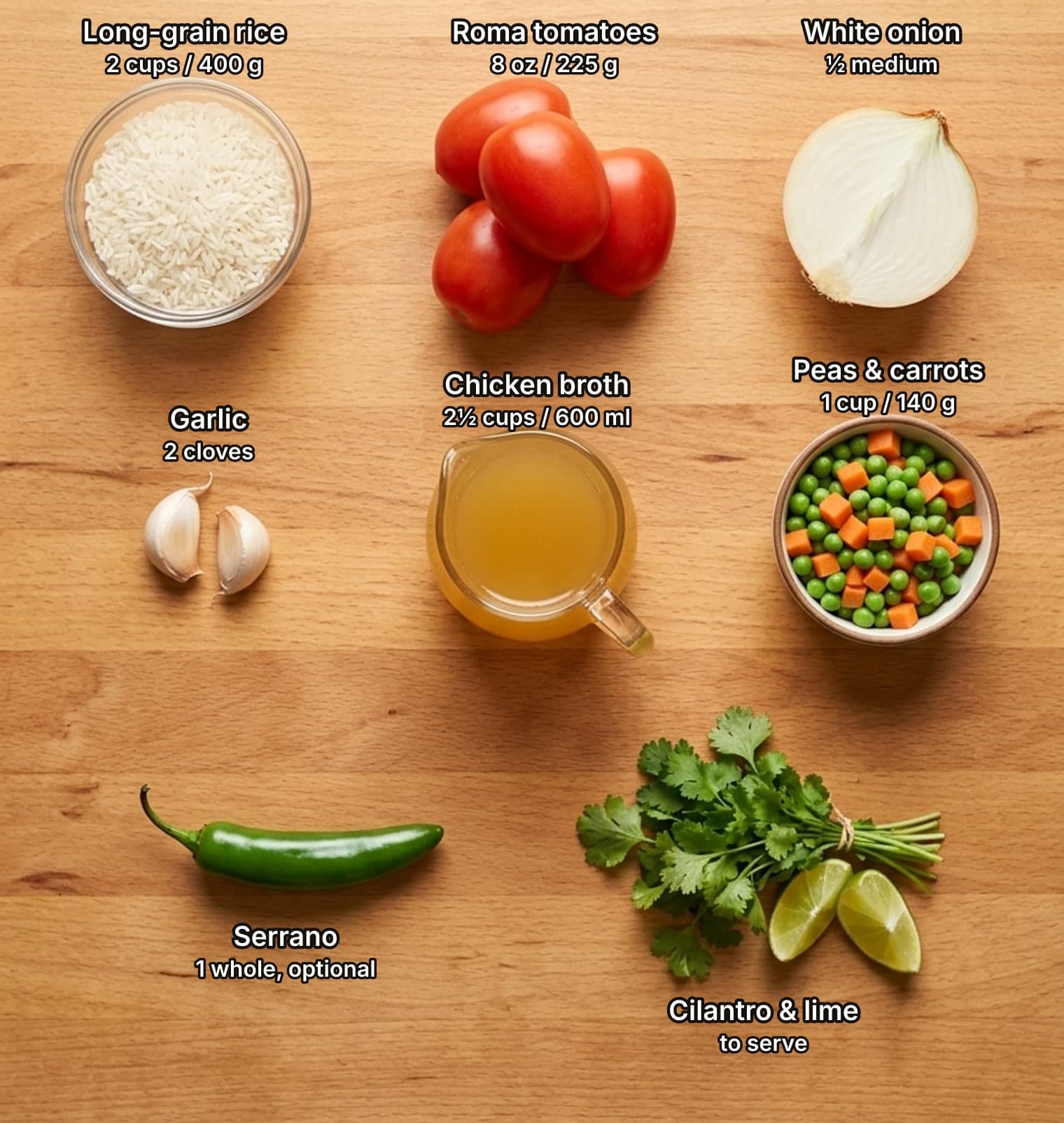
- long-grain white rice — jasmine works; never short-grain (see the shopping section)2 cups (400 g)
- neutral oil — for the toast that is the whole secret3 tbsp
- ripe roma (plum) tomatoes, roughly chopped — the blender route; OR one 8 oz (227 g) can tomato sauce (UK: passata), the weeknight route3 medium (about 8 oz / 225 g)
- white onion, roughly chopped for the blender (mince it instead if using canned sauce)1/2 medium
- garlic2 cloves
- tomato paste (UK: tomato purée) — optional rescue for pale tomatoes1 tbsp
- chicken broth (stock), hot — enough to bring TOTAL liquid, purée included, to 3 1/2 cups (840 ml); or water + 2 1/2 tsp chicken bouillon powder (the Knorr caldo move; vegetable broth makes it vegan)about 2 1/2 cups (600 ml)
- frozen peas and diced carrots — optional and openly contested1 cup (140 g)
- serrano chile, whole — laid on top to perfume the pot, removed at serving; optional1
- kosher salt (coarse) — taste FIRST, the bouillon and broth carry plentyto taste
- cilantro (fresh coriander), torn, and lime wedgesto serve
Two names, one dish: why Spanish rice isn't Spanish
Start with the honest map. The tomato-red rice on the American combination plate is Mexican — in Mexico it's arroz rojo (red rice) or arroz a la mexicana, and it belongs to a course tradition older than any US menu: the sopa seca, the "dry soup," served after the wet soup and before the main in the classic Mexican comida. Rice itself is an Asian grain that reached Mexico with the Spanish in the 1500s, landing on the Atlantic side through Veracruz — decades before the Manila galleons began tying Acapulco to Asia — and Mexican cooks have been frying it in fat and simmering it in seasoned broth for centuries since. So there is Spain in the story, the way there is Spain in the language: as the carrier, not the cook.
Ask for "Spanish rice" in Spain and you'll get a puzzled look, because no dish by that name exists there. Spain's rice cooking is its own civilization — paella and the arroces of Valencia and the Levante coast, built on short- and medium-grain rice like bomba that drinks broth while staying firm, cooked shallow and wide and never fluffed. The dish on this page is that tradition's opposite in almost every particular: long-grain rice, cooked covered, finished separate and light. The name is American English, and it's old — by the early twentieth century, US cookbooks were printing "Spanish rice" for tomato-tinted rice dishes — it's in Sarah Tyson Rorer's 1902 New Cook Book — at a time when American menus reached for "Spanish" as the genteel label for anything from the Spanish-speaking world, Mexico included, and cafeteria steam tables carried the name from there. Those older American "Spanish rice" recipes are a mixed bag, too — some close to this dish, some a baked casserole of rice, tomatoes, peppers and cheese that would puzzle a cook in Puebla. The lineage is messy; the plate in front of you is not. The name stuck the way the Spanish words "chili con carne" stuck to a dish invented in Texas — a label pointing at the wrong country, permanent, and by now carrying real affection.
So what's the difference between Spanish rice and Mexican rice? On a US menu and in a US kitchen: nothing. They are two names for the same pot — tomato, onion, garlic, toasted long-grain rice, chicken broth — and which one you say mostly depends on where you grew up and which cookbook your family owned. (Some cooks will tell you Spanish rice is the yellower, saffron-or-turmeric-tinted version and Mexican rice the red one; that distinction is real in some kitchens and absent in most, and no authority enforces it.) This page answers to both names without embarrassment, and to arroz rojo with respect, because the searcher typing either name wants the same thing: the loose, savory, brick-colored rice from the restaurant, made at home without mush. That's a technique problem, and the next section solves it.
How to make Spanish Rice
- Rinse the rice, then let it actually dry. Put 2 cups (400 g) of long-grain white rice in a fine-mesh sieve and rinse under cold water, working it with your fingers, until the water running through goes from milky to nearly clear — a minute or two. That cloudiness is loose surface starch, and left on the grains it turns into glue at the bottom of the pot. Then the step the recipe actually depends on: drain the rice well and let it sit in the sieve 10–15 minutes, shaking it now and then, until the grains no longer glisten. Wet rice hitting hot oil spits at you and then steams instead of toasting — you can't brown what you're simultaneously boiling. Use the waiting time to make the purée in the next step. If you're in a hurry, spread the rice on a clean kitchen towel and pat it; bone-dry isn't required, just not dripping.
- Blend the tomatoes, onion and garlic into a smooth red purée. Roughly chop 3 ripe roma (plum) tomatoes — about 8 oz (225 g) — and drop them into a blender with half a white onion, also rough-chopped, and 2 peeled garlic cloves. Blend until completely smooth, a full 30–60 seconds; flecks of raw onion that survive the blender survive the pot too. Now measure what you made — actually measure it, in a measuring jug — because this purée is liquid: it counts toward the rice's total, and the whole pot targets 3 1/2 cups (840 ml) of liquid all-in. Three romas and half an onion usually blend to about 1 cup (240 ml), sometimes a little more; whatever the jug says, you'll subtract it from the target when the broth goes in. Pale winter tomatoes making a wan, pink purée? Blend in 1 tbsp of tomato paste (UK: tomato purée) — the color and depth of August, from a tube. The canned route — 8 oz (227 g) of tomato sauce (UK: passata) with the onion and garlic minced fine and sautéed in the pot instead of blended — is honest weeknight cooking and handled in the section below; this step is the restaurant flavor.
- Toast the rice until it sounds and smells different. Warm 3 tbsp of neutral oil in a wide, heavy pot or deep skillet (frying pan) with a tight lid over medium heat, and add the drained rice. Now stir, more or less constantly, for 6–10 minutes — and pay attention with your ears and nose as much as your eyes. The grains go from translucent to chalk-white, then a scattering of them turn the color of light toast; the sound shifts from a wet slide to a dry rustle; and somewhere past minute five the pot suddenly smells like popcorn. That smell is the point. This is the step that separates restaurant rice from gummy home rice, and it's doing two jobs at once: browning builds the nutty, toasted backbone the tomato will sit on, and the hot oil coats every grain in a thin film of fat that helps them cook up separate instead of clumped. Don't rush it and don't walk away — pale rice here means bland rice later, and scorched rice means starting over.
- Fry the purée into the rice — don't just pour and move on. Pour the tomato purée over the hot rice — it will hiss and steam dramatically; that's correct — and stir it through. Then keep cooking, stirring often, for 2–3 minutes, until the loud sizzle quiets, the raw-onion sharpness cooks off, and the purée visibly darkens from bright red toward brick and thickens as it loses water. In Mexican cooking this frying-down of a blended base is the standard move behind everything from rice to cooked salsas to the sauce on your enchiladas, and skipping it is the second-most-common reason home versions taste thin: a purée that's merely heated tastes like warm tomato juice, while a purée that's been fried tastes cooked, sweet and concentrated — and it dyes every toasted grain evenly instead of streaking the pot. This is also the moment the kitchen starts smelling like the restaurant. If you took the canned-sauce route, this same fry-down applies to the sauce once your minced onion has softened.
- One pour of hot broth, one honest taste, then hands off. Pour in enough hot chicken broth (stock) to bring the pot's total liquid — purée included — to 3 1/2 cups (840 ml): if your purée measured a cup, that's 2 1/2 cups (600 ml) of broth; a cup and a quarter of purée, 2 1/4 cups (540 ml). Hot broth, so the pot doesn't lose its momentum and the toasted grains don't sit soaking while it recovers. That's the 1 : 1.75 rice-to-liquid ratio this dish wants — a little less than plain steamed rice gets, because the purée carries body as well as water, and because treating the broth as the only liquid and pouring a standard 2 : 1 on top of a cup of tomato is exactly how the drowned, heavy pots happen. Stir once, just to level the rice, and taste the liquid: it should taste slightly saltier than you want the finished rice, because the grains will drink the seasoning down. If you built the broth from water and bouillon — the standard move in Mexican home kitchens — it likely needs nothing; if it tastes flat, salt it now, since there's no fixing the inside of a grain later. Scatter over the peas and carrots if your table votes yes, lay the whole serrano on top like a garnish that hasn't happened yet, and bring everything to a real boil.
- Lid on, heat low — and the no-stir law begins. The moment the pot boils, drop the heat to its lowest setting, put the lid on, and start a timer: 15–18 minutes. From here the recipe is self-driving, and the only way to crash it is to interfere. Stirring is the cardinal sin: every pass of the spoon rubs starch off the softening grains and into the liquid, and starch in the liquid is the difference between rice that falls apart into separate grains and rice that holds together like risotto's sad cousin. Peeking is the venial one: the pot cooks on trapped steam, and every lift of the lid dumps the atmosphere and adds minutes. You'll know things are nearly done when the bubbling sound fades to silence — that's the free water gone, absorbed or steamed off. At 15 minutes, look once: the surface should show small steam craters and no standing liquid. If it's still wet, lid back on for 3 more minutes.
- Rest ten minutes off the heat — the step everyone skips. Turn the burner off and move the pot somewhere cool — and do not open it for 10 minutes. This is the step most home cooks skip and no restaurant does, and it's not a nicety: at the end of cooking, the pot is a gradient — wetter, softer grains at the bottom, firmer ones up top, and a last reserve of steam holding it all at temperature. Ten sealed minutes lets the moisture equalize, the bottom layer surrender its excess to the top, and every grain finish swelling gently instead of over a flame that can only scorch the base. Open the lid at minute one and you release the steam that was still doing work; you'll get a wet bottom, a chalky crown, and the vague sense that the recipe lied to you. Set a timer, walk away, warm the tortillas. The pot is more patient than you are, and it's using the time better.
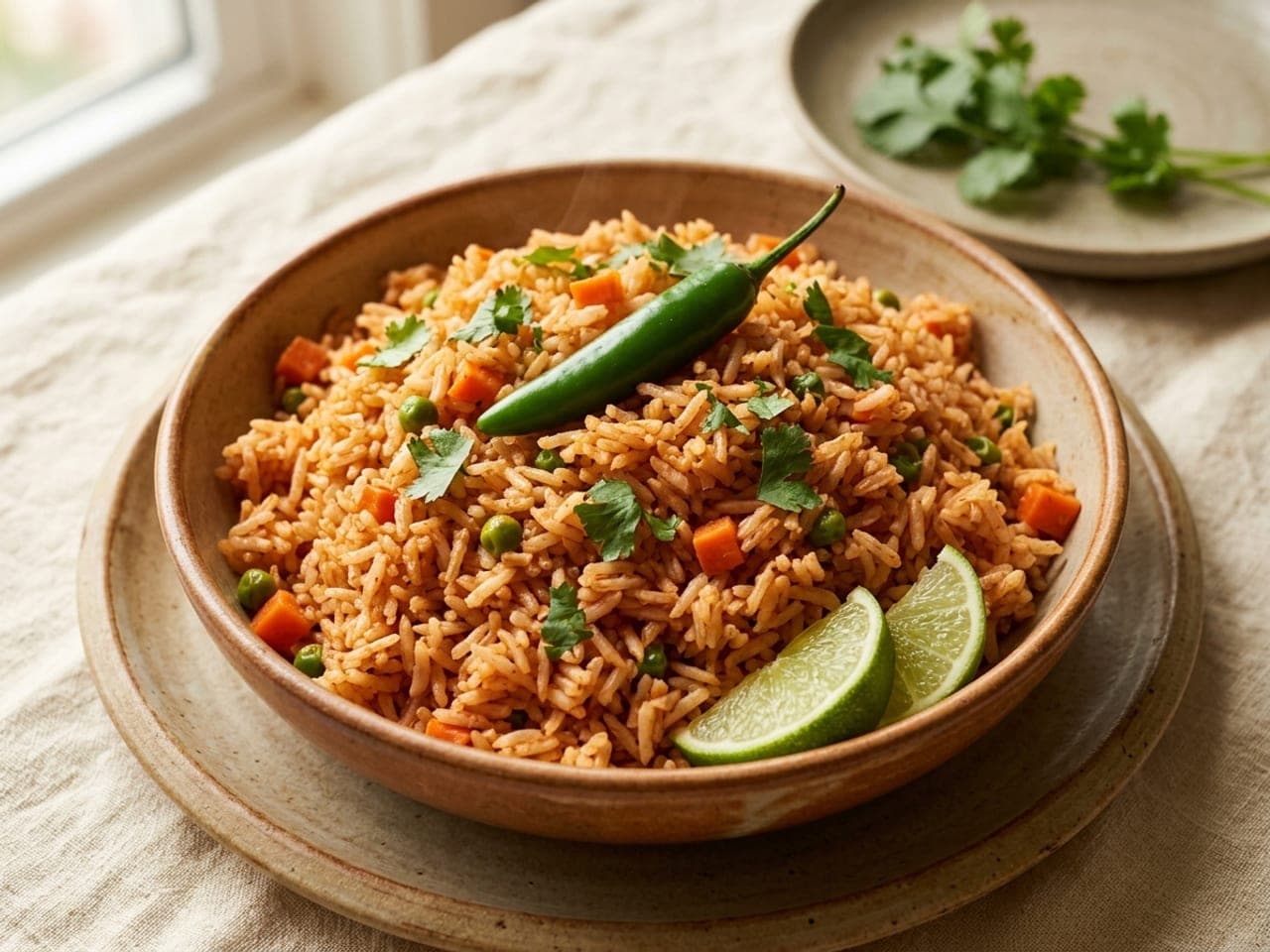
- Fluff with a fork, finish, and serve it proud. Lift the lid — the surface should look dry, the grains distinct, the color somewhere between terracotta and brick. Retrieve the serrano and set it aside for whoever at the table wants to claim it. Then fluff with a fork, not a spoon: slide the tines down the side of the pot and lift and toss, turning the rice over on itself, rather than stirring — a spoon drags and mashes warm, tender grains, undoing in ten seconds the separateness you spent half an hour building. Taste; this is where you learn whether the broth's salt landed, and a small pinch now, tossed through, is the only correction left to you. Pile it into a warm bowl or straight onto plates, tear a little cilantro (fresh coriander) over, and put lime wedges on the table — a squeeze wakes the whole pot up. It belongs next to enchiladas, birria, grilled meat, or eaten from the pot standing up, which is tradition too.
Safety & hygiene Important
- Allergens: a naturally clean pot that the bouillon can complicate. As written, this is one of the friendliest dishes on the site: rice, tomatoes, onion, garlic, oil and broth — naturally free of gluten, dairy, eggs, nuts and soy. In practice, the label on your broth or bouillon decides everything. Some stock cubes and broth cartons carry wheat or barley derivatives, so a celiac pot needs broth that says gluten-free on the package; many mainstream US bouillon powders list no gluten ingredients, but only a package that actually says gluten-free settles it — formulations differ between countries and change over time. UK readers get the FSA's fourteen-allergen framing: celery and mustard are declarable allergens in the UK and both like to hide in stock cubes and bouillon, so a carton of plain chicken stock is often the cleaner buy. The vegan version is genuinely vegan — swap in vegetable broth or vegetable bouillon and the dish doesn't miss a step — with the same label caveats. The optional peas and carrots add nothing allergenic for most tables; the serrano is removed before serving and contributes aroma, not allergen.
- The rice clock — the one briefing this page insists on. Cooked rice has a food-safety story of its own, and it's not folklore: uncooked rice can carry spores of Bacillus cereus, and the spores survive cooking. In a pot of warm rice left out on the stove, they wake, multiply, and can produce a toxin (cereulide, the emetic one) that is heat-stable — later reheating does not destroy it, which is why the entire game is time at room temperature, not how hot you reheat. The US rule: refrigerate leftover rice within 2 hours of cooking (1 hour if it's above 90°F / 32°C), in shallow containers so it cools fast, and use it within 3–4 days (USDA's standard leftover window). UK advice runs stricter, and it's worth hearing: the Food Standards Agency (the guidance the NHS long carried and now points to) says cool rice quickly — ideally within 1 hour — keep it in the fridge no more than one day until reheating, reheat only once, and always until steaming hot all the way through. Wherever you live, reheat to 165°F (74°C), add a splash of water so the grains steam rather than dry, and never leave the pot sitting warm on the stove for the afternoon. None of this makes rice dangerous — it makes rice a dish with a clock, and the clock starts when the burner goes off.
- Leftovers, the freezer, and the chile in your fingers. Handled on the clock above, leftover Spanish rice is a gift: the grains firm up overnight and day-two rice actually fries better than fresh — a skillet (frying pan), a little oil, and yesterday's side becomes the base of burritos, stuffed peppers, or a quick rice-and-egg lunch. The freezer is even better: portion the cooled rice into flat freezer bags (flat = fast freeze and fast thaw), press the air out, and freeze within a day of cooking — and UK readers following the stricter FSA line get the best version of this anyway: rice that goes into the freezer within an hour of cooking never gives the bacteria a window at all. At 0°F (-18°C) it keeps safely indefinitely and at its best for about 3 months; reheat straight from frozen with a splash of water, covered, to 165°F (74°C) — steaming hot throughout — and it comes back looser than day-two fridge rice ever does. Two small notes to finish: wash your hands with soap after handling the serrano and before touching your eyes or a contact lens — capsaicin doesn't rinse off with water alone — and take the whole chile out before the bowl reaches the table, so no child or unsuspecting guest bites what looks like a green bean; and when scaling the recipe up for a crowd, cool the extra rice in several shallow containers rather than one deep one; a deep tub of warm rice holds its middle in the danger zone for hours.
3 ways to plate it
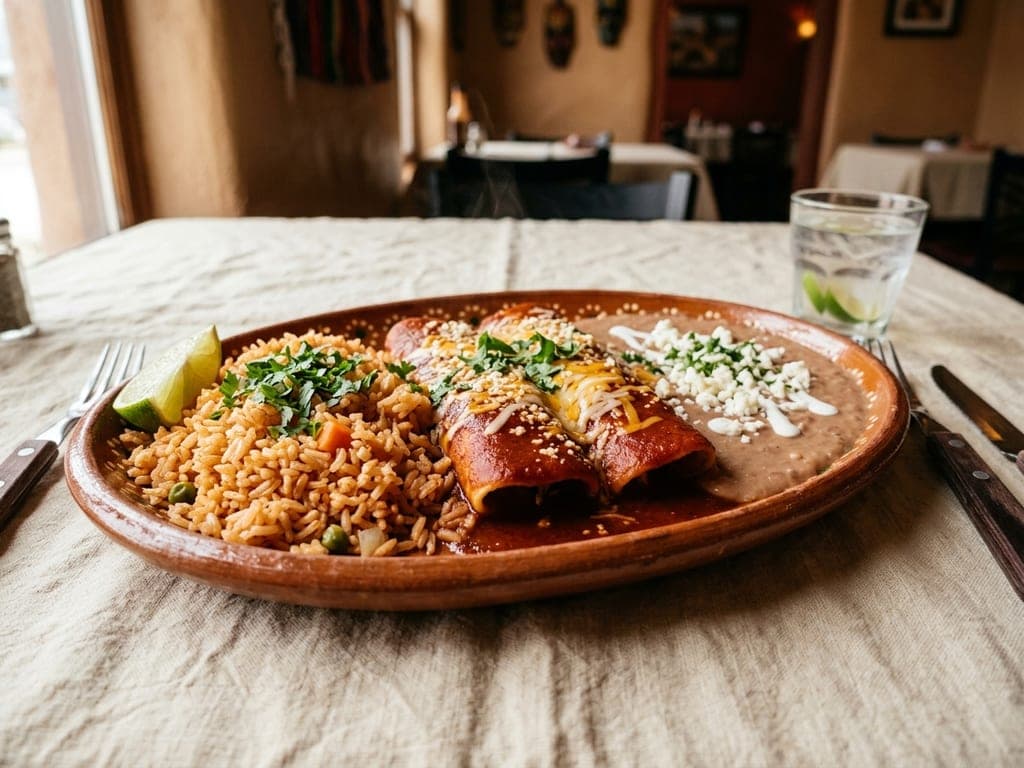
- Warm an oval platter or wide plate — steam-table plates are always hot, and the homage deserves the detail.
- Spoon the rice into a loose, generous mound on one third of the plate, fluffed high rather than pressed flat.
- Lay the main — enchiladas, grilled meat — along the center, and the refried beans on the last third, edges touching but not flooding.
- Finish the rice corner with torn cilantro (fresh coriander) and a lime wedge propped against the mound.
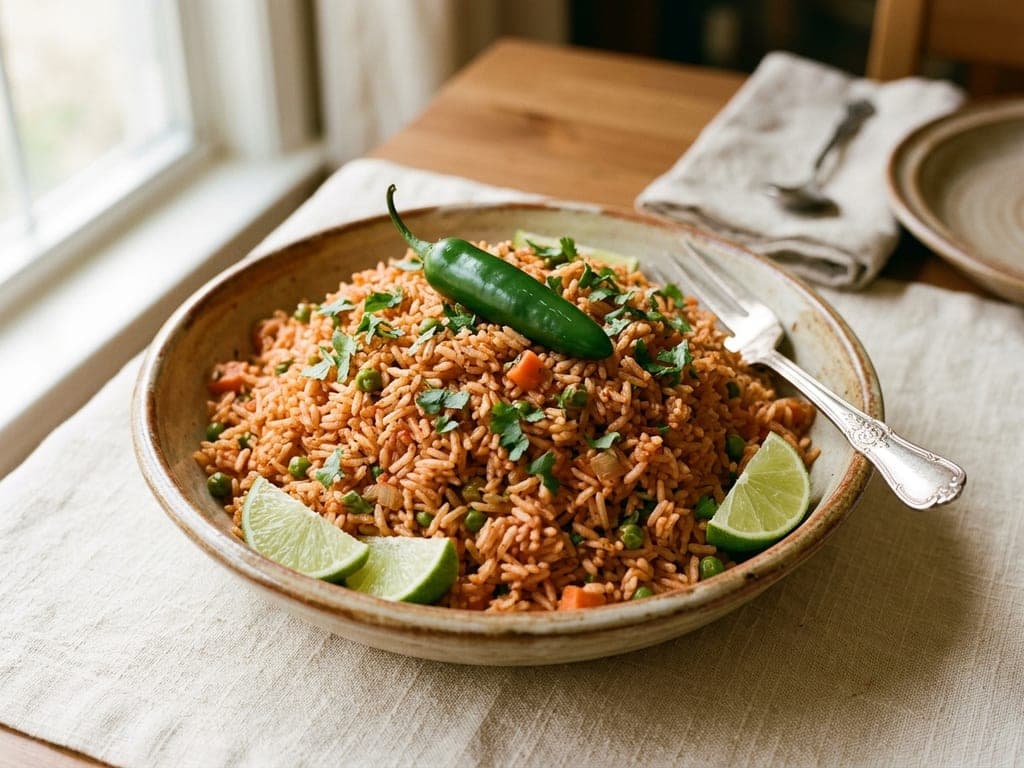
- Fork-fluff the rice in the pot, then pile it into a warmed wide serving bowl, keeping the mound airy.
- Lay the whole cooked serrano diagonally across the crown — it's perfume and a trophy for whoever claims it.
- Tear cilantro (fresh coriander) leaves over the surface and tuck three lime wedges around the rim.
- Set it mid-table with a serving fork, next to whatever it's supporting tonight.
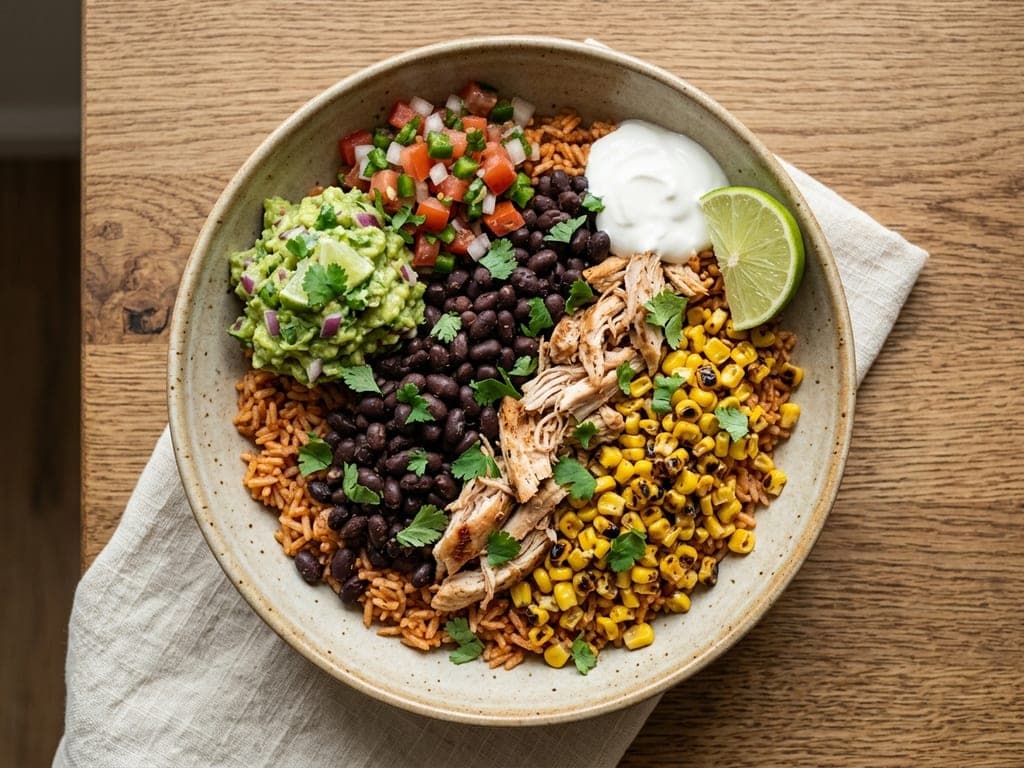
- Spread a warm, shallow layer of rice across the base of a wide bowl — coverage, not a mountain.
- Lay the stripes across it: black or refried beans, shredded or grilled protein, and charred corn or sautéed peppers.
- Add the cool lane last: guacamole or diced avocado, pico de gallo or salsa, and a spoonful of crema at one edge.
- Finish with cilantro (fresh coriander), a lime wedge, and a hot-sauce bottle within reach.
The doctrine: toast, fry, pour once, leave it alone
The first law: toast the rice. This is the whole secret — the answer to why restaurant rice tastes toasty and separate while home rice tastes steamed and clumped — and it costs nothing but eight minutes of attention. Rinsed, dried grains fried in oil until a scattering of them turn golden do two things: they build a nutty, browned flavor base that plain simmered rice never develops, and they seal each grain in fat so the finished pot falls apart into individual grains instead of holding together in clots. The nose knows when it's done — the pot smells like popcorn — and the shortcut-shaped question of whether you can skip the rinse-and-dry has an honest answer: you can rinse quickly and toast a wet-ish pot, but you'll spend the first five minutes boiling off rinse water before any browning starts. Dry rice toasts; wet rice steams. The sieve does the work while you blend.
The second law: the tomato gets fried, not poured. A smooth purée of roma tomatoes, white onion and garlic, tipped over the hot toasted rice and fried down for two or three minutes until it darkens and thickens, is the sofreír move that runs through the whole Mexican kitchen — the same fry-the-blended-base move our enchilada sauce is built on. Frying does what warming never will: it cooks out the raw-onion edge, concentrates the tomato's sugars, and stains every grain evenly so the pot finishes uniformly brick-red instead of streaky. And the purée is part of the water math — which is the trap that produces most mushy Spanish rice. The rule is subtraction: 2 cups (400 g) of rice want about 3 1/2 cups (840 ml) of total liquid — 1 : 1.75, deliberately tighter than plain rice's usual 1 : 2 — so measure the purée and add only enough broth to reach the target. Treat the broth as the only liquid and pour a full measure on top of a cup of tomato, and you've quietly built a 1 : 2.25 pot; it will finish wet and heavy no matter how well it was toasted.
The third law: once the lid is on, the cook's job is to not be there. Stirring simmering rice rubs starch off the grains and thickens the cooking liquid into glue — stirring is how risotto is made creamy on purpose, and how Spanish rice is made gummy by accident. Peeking dumps the steam the pot cooks on. And the ten-minute off-heat rest is non-negotiable: it's when the moisture gradient inside the pot — wet at the bottom, firm at the top — evens itself out, and skipping it is why a pot that did everything else right still serves wet at the base. Fluff with a fork, tines down the side, lifting and tossing; a spoon mashes what half an hour built. None of these laws is difficult. All of them are the difference between the rice you get out and the rice you make at home, and every one of them is about restraint rather than skill.
Shopping honestly: the rice, the tomato question, and the little yellow tub
The rice is long-grain white, full stop. Long-grain's starch balance is what lets the grains cook separate, which is this dish's whole texture; standard American long-grain is the canonical choice and jasmine works beautifully if that's your pantry staple — a touch softer and more aromatic, no apology needed. Basmati cooks up drier and more perfumed and makes a noticeably different (not bad, just different) pot; medium-grain like calrose runs softer and stickier; and the short-grain specialists are the wrong tool twice over — risotto rice's job is to release starch and cling, and paella rice is bred to drink broth uncovered in a wide shallow pan; neither is built for a covered, fluffed pot. Brown rice is an honest variation with a real cost: it needs roughly half again as much liquid and 40–50 minutes under the lid — more than double the simmer — and the toasted-tomato flavor has to fight the bran's own nuttiness. It works; it just isn't this dish. Rinse whatever you choose.
The tomato question splits into two honest routes. The blender route — fresh roma tomatoes, white onion, garlic, puréed smooth — is the restaurant flavor and the traditional one, and roma is the right tomato because it's fleshy, low-water and available year-round; a tablespoon of tomato paste (UK: tomato purée) rescues the pale specimens of February. The canned route — 8 oz (227 g) of tomato sauce (UK: passata), with the onion and garlic minced and sautéed instead of blended — is the American weeknight standard, and it makes genuinely good rice: what you lose is the fresh-tomato brightness, what you gain is ten minutes and total consistency. Choose by the night you're having. What this page won't pretend is that they're identical — the blender route tastes a notch fresher and cleaner, and on a weekend it's worth the extra dishes.
Now the little yellow tub. Walk into a large share of Mexican and Mexican-American home kitchens and you will find powdered chicken bouillon — Knorr's caldo de pollo above all — doing the seasoning work in pots exactly like this one, and any honest page about this rice says so instead of pretending everyone simmers backyard hens into stock. The powder is mostly salt and monosodium glutamate, padded with cornstarch, with a little chicken fat and powdered cooked chicken further down the label (formulations vary by country and by cube versus tub); that MSG is why a teaspoon of it makes broth taste rounder and more chicken-y than most cartons — and MSG itself carries decades of stigma and no scientific conviction: food-safety regulators including the FDA consider it safe, and the glutamate in the tub is the same molecule that occurs naturally in tomatoes and parmesan. So: water plus bouillon is the culturally standard move and seasons the pot in one gesture; good chicken broth (stock) is the from-scratch upgrade; vegetable broth makes the dish fully vegan. Whichever you use, remember the salt discipline — the tub and most cartons arrive salted, so the pot gets tasted before it gets salted, never after. As for the peas and diced carrots: they divide tables the way corn divides white-chili houses. Restaurant steam tables mostly include them, purists mostly don't, and this page keeps them optional and takes no side beyond this — frozen is fine, fresh is fussier than the dish deserves.
Questions, answered
What ingredients go in Spanish rice?
The core is short and stable: long-grain white rice, neutral oil, tomatoes, white onion, garlic, chicken broth (stock) and salt. This page's version — 2 cups (400 g) rice toasted in 3 tbsp oil, a blended purée of 3 roma tomatoes with half an onion and 2 garlic cloves fried into the grains, then 2 1/2 cups (600 ml) of hot broth — adds only options after that: a spoonful of tomato paste if the tomatoes are pale, frozen peas and diced carrots if your table likes them (openly contested territory), a whole serrano laid on top to perfume the pot, and cilantro (fresh coriander) with lime wedges at the table. Many American kitchens swap the fresh tomatoes for an 8 oz (227 g) can of tomato sauce (UK: passata), and many Mexican home kitchens build the broth from water and powdered chicken bouillon — both honest moves this page covers. What never goes in: short-grain rice, and anything that requires stirring once the lid is on.
What is the difference between Spanish and Mexican rice?
On an American menu, nothing — they're two names for the same tomato-tinted, long-grain side dish, and which one a restaurant prints mostly reflects region and habit, not recipe. The dish itself is Mexican: arroz rojo, the red rice of the sopa seca tradition. It isn't Spanish in origin or repertoire — Spain has no dish called Spanish rice, and its emblematic rice cooking (paella, the Valencian arroces) uses short- and medium-grain rice, mostly cooked shallow and uncovered — a different technique family altogether. The American name dates to the early twentieth century, when US cookbooks and menus used "Spanish" as a catch-all label for food from the Spanish-speaking world. You'll occasionally meet a stricter house rule — Spanish rice as the yellower, saffron-tinted version, Mexican rice as the red — but no authority enforces it, most kitchens use the names interchangeably, and a writer insisting Spanish rice means the yellow one is usually describing a separate American invention, or reaching toward paella and missing. If you order either one anywhere in the United States, you'll get the same plate of rice, and this recipe makes it.
What is the secret to Mexican rice?
Toasting the rice — and then leaving it alone. The single biggest gap between restaurant rice and gummy home rice is that restaurants fry the dry grains in oil until some turn golden and the pot smells like popcorn before any liquid arrives: that builds the nutty base flavor and coats each grain in fat so they finish separate. The supporting secrets are restraint: fry the blended tomato base for a few minutes instead of just pouring it in (concentrates the flavor, dyes the grains evenly), get the liquid math right counting the purée as liquid — about 1 part rice to 1.75 parts total liquid — and then obey the no-stir law: lid on, lowest heat, no stirring (rubs off starch, makes glue), no peeking (dumps the steam), and a full 10-minute off-heat rest before the fork-fluff. Restaurants also lean on chicken bouillon for seasoning — the Knorr caldo move — which is less a secret than a fact nobody prints. None of it is hard; all of it is discipline.
What are the 3 ingredients needed to make Mexican rice?
If the question means the irreducible core: rice, tomato, and seasoned broth. With just long-grain white rice toasted in a little oil, something tomato (blended fresh tomatoes or canned tomato sauce), and salted chicken broth, you are genuinely cooking Mexican rice — the technique, not the shopping list, is what makes the dish. The honest fourth and fifth ingredients are onion and garlic, which almost every real-world version includes, and the quiet sixth in many Mexican home kitchens is powdered chicken bouillon standing in for the broth. Three-ingredient shortcut versions you'll see online — rice, a jar of salsa, broth — work on exactly this logic: the salsa is the tomato, onion and garlic pre-blended. This page's full ingredient list runs to about a dozen lines, but everything past the core three is either aromatics, enrichment (the oil for toasting matters more than any of them), or optional garnish. Skip the peas before you skip the toast.
Why is my Spanish rice mushy?
One of four mechanisms, usually in this order. First: too much liquid — the classic trap is not counting the tomato purée or sauce as liquid; a cup of purée plus a standard 2:1 broth ratio drowns the pot. Count everything wet and target about 1 : 1.75 rice to total liquid. Second: unrinsed, untoasted rice — surface starch plus no protective fat coating means the grains glue together as they cook; rinse until the water runs nearly clear, dry, and toast until golden and popcorn-scented. Third: stirring after the lid goes on — every stir rubs starch into the liquid, which is how risotto gets creamy on purpose and Spanish rice gets gummy by accident. Fourth: no rest — a pot opened and served straight off the heat is still wet at the bottom; ten sealed minutes off the burner lets the moisture equalize. If the damage is already done: spread the mushy rice on a sheet pan to cool and firm for a few minutes, get it into the fridge inside the usual window (2 hours US, ideally 1 hour UK), and fry it in a hot skillet tomorrow — day-two rice is the best fried rice, and nobody at that table will ask questions.
Can I make Spanish rice in a rice cooker or Instant Pot?
Yes, with the honest caveat that the flavor steps still happen in a pan. The toast and the purée-fry are stovetop moves (or Sauté mode), and skipping them is why most appliance versions taste flat — so toast the rice and fry the tomato base first, then transfer everything to the machine. Rice cooker: add the toasted rice, fried base and hot broth, keeping the same 1 : 1.75 total-liquid ratio, and run the white-rice cycle; let it rest 10 minutes after the switch flips before fluffing. Instant Pot / pressure cooker: use Sauté for the toast and fry, then cut the liquid — pressure cooking loses almost nothing to evaporation, so drop to roughly 1 : 1.25 (for this recipe: the cup of purée plus about 1 1/2 cups / 360 ml broth), cook at high pressure 4–6 minutes, and give it a 10-minute natural release, which doubles as the rest. The stovetop still gives the best texture margin — but the machine versions are real dinner, not a compromise to apologize for.
Is Spanish rice gluten-free?
The dish is; the label decides. Rice, tomatoes, onion, garlic and oil contain no gluten, so a from-scratch pot with plain chicken broth is naturally gluten-free — this recipe thickens nothing and breads nothing, so there's no hidden flour anywhere in the method. The practical risk lives entirely in the broth aisle: some stock cubes, broth cartons and bouillon powders carry wheat or barley derivatives or are made on shared lines, so a celiac pot needs a broth or bouillon whose label says gluten-free — read the actual package, because formulations differ between countries and change over time. The same label-reading applies to anything served alongside: corn tortillas are naturally gluten-free, flour tortillas are not, and restaurant rice cooked in a shared kitchen carries the usual cross-contact questions. UK readers should also glance for celery and mustard on stock labels — not gluten, but two of the FSA's fourteen declarable allergens, and frequent stowaways in exactly the same products.
How long does Spanish rice last in the fridge?
US guidance: 3–4 days, refrigerated within 2 hours of cooking (1 hour in hot conditions above 90°F / 32°C), in shallow containers so it cools fast. UK guidance is stricter and worth understanding rather than dismissing: the Food Standards Agency says cool rice quickly — ideally within an hour — keep it in the fridge no more than one day, and reheat only once. The reason rice gets its own rules is Bacillus cereus: its spores survive cooking, and in warm rice left sitting out they can produce a toxin that reheating does not destroy — so the danger isn't the days in the fridge, it's the hours the pot spent warm on the stove before it got there. Practical translation: serve, then refrigerate the rest promptly and spread thin; never leave the pot out for the afternoon; reheat portions to 165°F (74°C), steaming hot throughout, with a splash of water. If the rice sat out past the window, the disappointing-but-correct answer is the bin — the toxin is invisible, odorless, and immune to your microwave.
Can I freeze Spanish rice?
Yes — rice is one of the best freezer staples in the kitchen, and this rice freezes better than plain steamed because the oil coating keeps thawed grains loose. The method matters more than the fact: cool the rice quickly (shallow layer, into the fridge within 2 hours of cooking), portion it into flat freezer bags, press the air out and freeze flat within a day — flat packs freeze fast, thaw fast, and stack like books. At 0°F (-18°C) it's safe indefinitely and at its best inside about 3 months. Reheat straight from frozen: into a covered skillet or microwave-safe bowl with a splash of water, heated to 165°F (74°C), steaming hot throughout — the trapped steam brings the grains back looser than day-old fridge rice ever manages. (UK guidance prefers defrosting in the fridge and reheating once, steaming hot, eaten immediately — either way, to 165°F / 74°C.) Freeze it in meal-sized portions rather than one brick, and label the date. The one rule carried over from the fridge answer: the freezer stops the clock, it doesn't rewind it — rice that sat out too long before freezing is not rescued by the cold.
What do you serve with Spanish rice?
Whatever the combination plate would put next to it — this is the most sociable side dish in the repertoire. The canonical partners: enchiladas of any stripe (the rice was born to sit beside our chicken and beef enchiladas and catch stray sauce), refried or charro beans as the third corner of the plate, and anything grilled — carne asada, chicken, shrimp. It's the standard companion to birria tacos, where a forkful of rice between dipped tacos does the resetting, and it earns its keep inside things as much as beside them: burritos, stuffed peppers, and burrito bowls where it's the foundation lane under beans, protein and salsa. For a full spread, it shares the table with guacamole and a bright salsa without competing. And day-two rice has its own agenda: fried in a hot skillet with an egg on top, or folded into a quesadilla, it stops being a side at all. If dinner has tomatoes, chiles, lime or smoke anywhere in it, this rice fits.
Snap your finished plate and let the AI plate it again — more beautifully.