Beef Enchilada Recipe (Tex-Mex, with Real Chili Gravy)
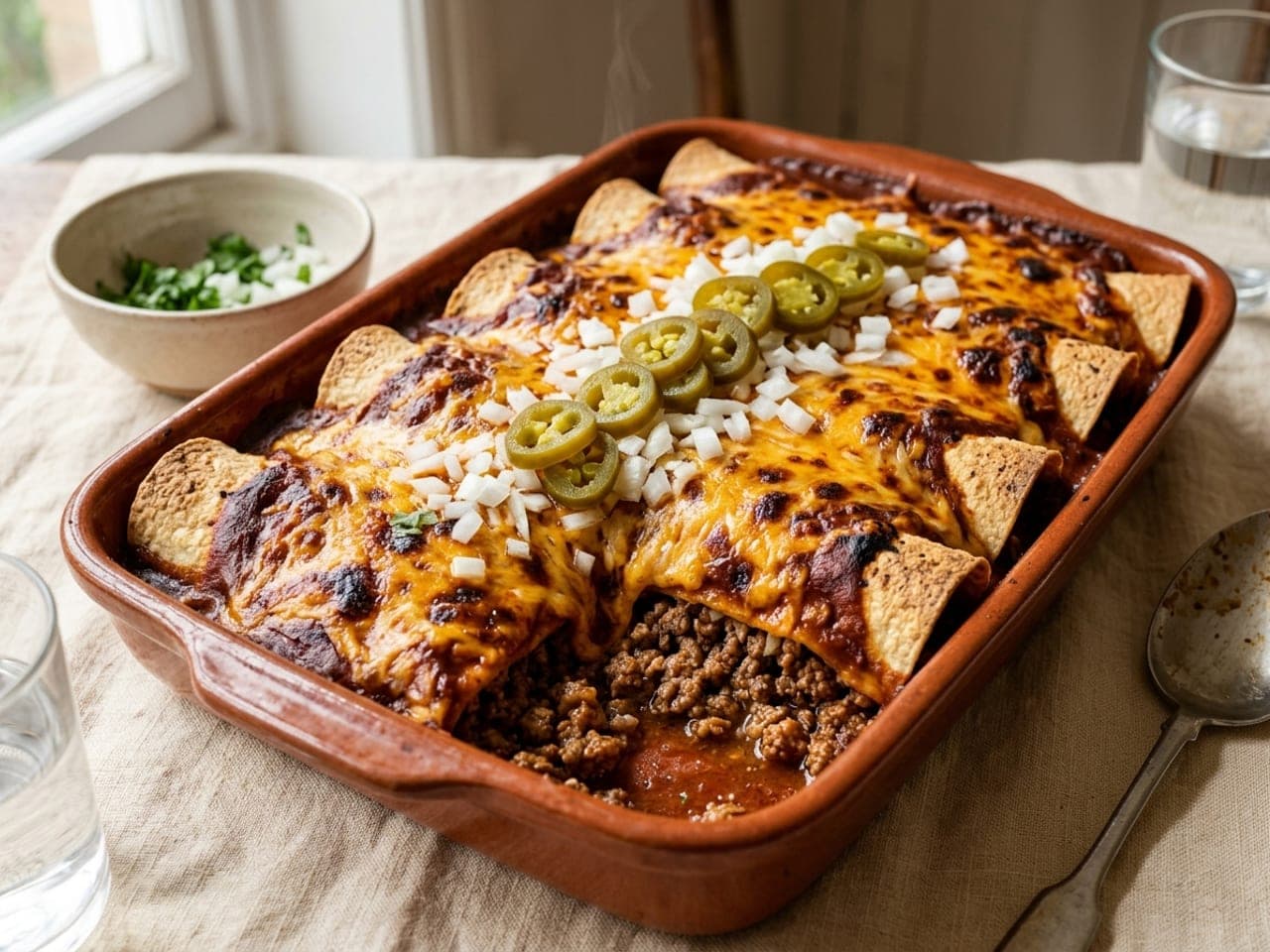
The Tex-Mex plate done properly, which means chili gravy — a cumin-heavy roux gravy on beef broth, not a chile purée out of a tin. Brown the mince hard, bind it with a little of the gravy, fry and dip the tortillas, and finish under a blanket of melting yellow cheese with raw onion on top. A hundred years of San Antonio behind it and no apologies for any of it.
Ingredients
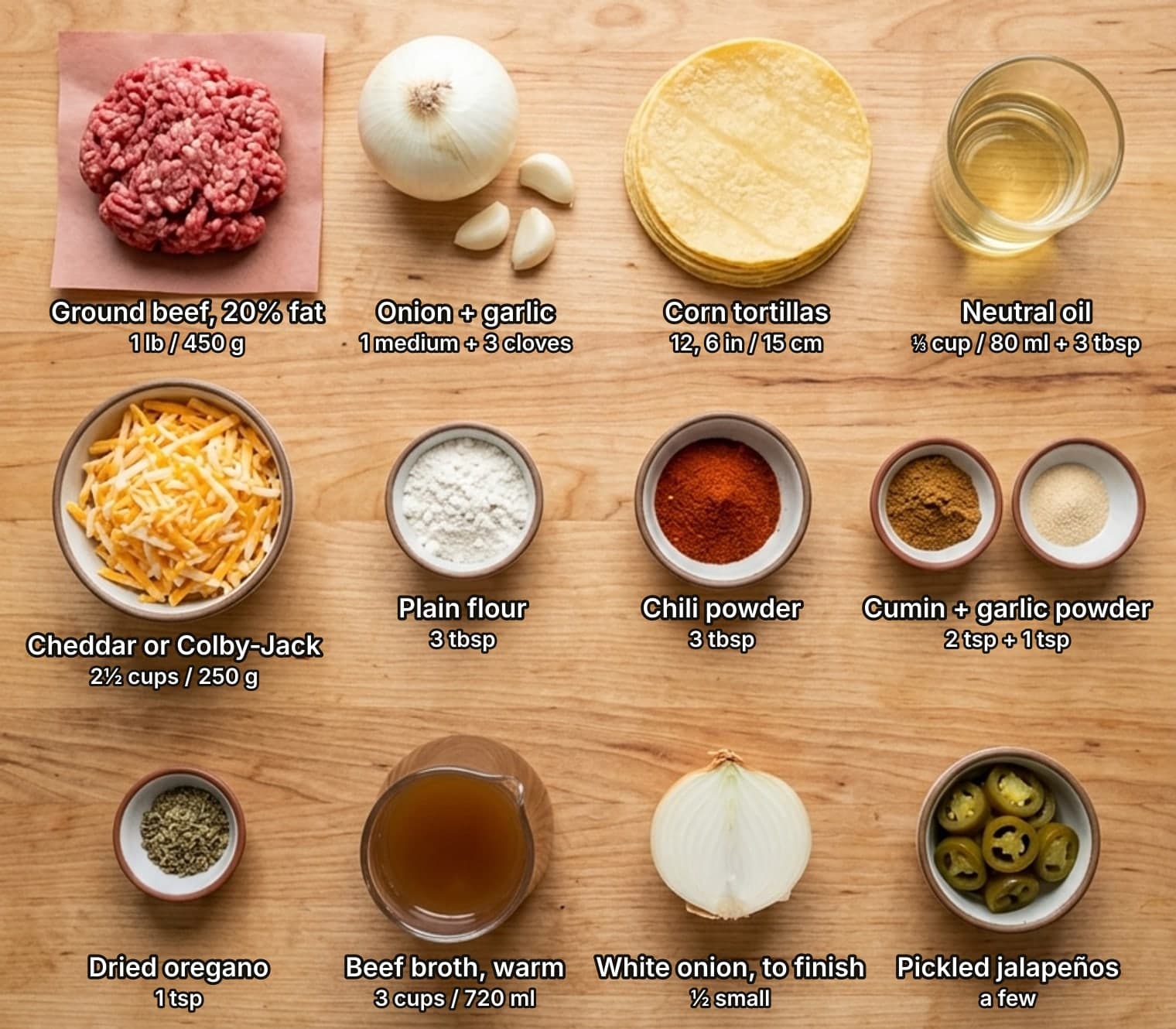
- ground beef (beef mince, 20% fat)1 lb / 450 g
- white onion, chopped1 medium
- garlic, minced3 cloves
- corn tortillas, 6-inch / 15 cm12
- neutral oil, for frying the tortillas⅓ cup / 80 ml
- mild cheddar or Colby-Jack, grated2½ cups / 250 g
- neutral oil or beef dripping, for the gravy3 tbsp
- plain flour3 tbsp
- chili powder (the American blend)3 tbsp
- ground cumin2 tsp
- garlic powder1 tsp
- dried oregano1 tsp
- beef broth, warm3 cups / 720 ml
- salt and black pepperto taste
- white onion, finely chopped, to finish½ small
- pickled jalapeños (sliced pickled chillies), to servea few
Chili gravy is not enchilada sauce
This is the distinction the whole page rests on, and most recipes for beef enchiladas quietly ignore it by opening a tin of red sauce and treating beef as a swap for chicken. Mexican red enchilada sauce is a chile purée: whole dried chiles toasted, soaked, blended and strained, with the chiles themselves supplying both flavour and body. Tex-Mex chili gravy is a roux gravy: fat and flour cooked together, chili powder and cumin bloomed in the fat, beef broth whisked in. One is a sauce made of chiles; the other is a gravy seasoned with chile powder and built on beef.
They taste properly different. The purée is fruitier, sharper and more complex, and it sits lightly on a tortilla. The gravy is savoury, rounder, cumin-forward and clings like a proper gravy should, which is exactly what you want against rich mince and a lot of melted cheese. If you have only ever had beef enchiladas made with red purée, the gravy version is a genuine surprise — and it is what the Texan combination plate has meant by enchiladas for a century. Our enchilada sauce page has the purée, and our chicken enchiladas page uses it; this page is deliberately the other tradition, cooked properly rather than treated as the cheap one.
How to make Beef enchiladas
- Start the roux. Warm 3 tbsp of neutral oil (or beef dripping, which is better) in a saucepan over medium heat, whisk in 3 tbsp of plain flour, and cook for a minute or two until it smells nutty and turns the colour of wet sand. This is a gravy, not a purée — the flour is doing structural work, and skipping it gives you soup.
- Bloom the spices in the fat. Straight into the roux go 3 tbsp of chili powder, 2 tsp ground cumin, 1 tsp garlic powder and 1 tsp dried oregano. Stir for 30 seconds only. Ground spices are fat-soluble and this half-minute in hot fat is what stops the finished gravy tasting dusty — the most common failing of quick enchilada sauces. Note for European cooks: American chili powder is a mild blend, not pure ground chile. If your tin says only chilli, use 1 tbsp of it and add 2 tsp sweet paprika to make up the volume.
- Whisk in the broth and simmer. Pour in 3 cups (720 ml) of warm beef broth in a thin stream, whisking as you go so no lumps form — warm liquid into a hot roux is the lump-free rule. Simmer gently for 10 minutes until it coats the back of a spoon like a thin gravy, then season with salt and plenty of black pepper. You will have about 3 cups (720 ml); it thickens as it cools.
- Brown the beef properly. Get a wide skillet genuinely hot, add 1 lb (450 g) of ground beef (beef mince, ideally 20% fat) in one layer, and then leave it alone for 3–4 minutes. Most people stir immediately, which drops the pan temperature and steams the meat grey. Let a crust form, break it up, brown the second side, then add 1 chopped white onion and 3 minced garlic cloves and cook 4–5 minutes more until soft.
- Drain, then bind the filling. Tip off the rendered fat but leave about a tablespoon behind for flavour, then stir ½ cup (120 ml) of the chili gravy through the meat. Filling bound with its own sauce stays moist through baking and doesn’t spill out of the rolls; dry mince is why some beef enchiladas eat like a crumbly taco. Taste and salt it now — under-seasoned filling can’t be fixed later.
- Heat the oven and prime the dish. Oven to 375°F (190°C). Ladle ½ cup (120 ml) of gravy across the base of a 9×13-inch (23×33 cm) baking dish in a thin film — enough to stop things sticking, not enough to poach the bottoms.
- Fry the tortillas, then dip them. Heat ⅓ cup (80 ml) of neutral oil in a small pan until it shimmers, around 350°F (175°C), and pass each of 12 corn tortillas through for 5–10 seconds a side — soft and pliable, never crisp. Drain on paper towels, then dip each one in the warm gravy so it is coated on both sides. The oil is a raincoat and the dip is the seasoning; together they are the reason these hold their shape instead of dissolving.
- Fill, roll, and bury in cheese. A scant ⅓ cup of the beef along the lower third of each tortilla with a pinch of grated cheese, rolled snugly and set seam-side down in a tight row. Spoon the remaining gravy in a band down the middle, leaving the ends bare, then scatter over 2½ cups (250 g) of grated mild cheddar or Colby-Jack (any mild orange melting cheese; a young gouda works in Europe). Tex-Mex is generous here and that is not a flaw.
- Bake, then finish cold on hot. 15–18 minutes at 375°F (190°C), uncovered, until the cheese has gone molten and the gravy blips at the edges. Bake it the moment it is assembled. Out of the oven, scatter raw finely chopped white onion over the top and add pickled jalapeños (sliced pickled chillies) — the sharp raw finish against the rich hot tray is the whole architecture of the dish, and it is what the combination plate has always done.
Safety & hygiene Important
- Ground beef is 160°F (71°C), not 145°F. Whole cuts of beef are safe at 145°F (63°C), but mincing spreads any surface bacteria all the way through, so ground beef needs 160°F (71°C) throughout. Browned properly in a hot pan and then simmered with the gravy, this filling passes comfortably — but if you are working from a large batch, check it with a thermometer rather than by colour, which is an unreliable guide in minced meat.
- Shallow hot oil, treated properly. The tortilla oil sits near 350°F (175°C). Pat the tortillas dry, use tongs, turn the pan handle inward, and let the oil cool in the pan rather than carrying it anywhere. If it ever catches fire, the lid goes on and the heat goes off — never water, and never move the pan.
- Hot roux spits when liquid hits it. Adding cold broth to a hot roux both lumps and sputters. Warm the broth first, pour it in a thin stream while whisking, and keep your face back from the pan for the first few seconds. If lumps form anyway, a stick blender or a quick pass through a sieve rescues the gravy completely.
- Cool it down, keep it 3–4 days. Baked enchiladas keep 3–4 days refrigerated, covered, and reheat in a moderate oven until steaming hot right through — once, not repeatedly. Cool leftovers within 2 hours rather than leaving the dish out to reach room temperature. The chili gravy on its own keeps a week refrigerated and freezes for 3 months.
3 ways to plate it
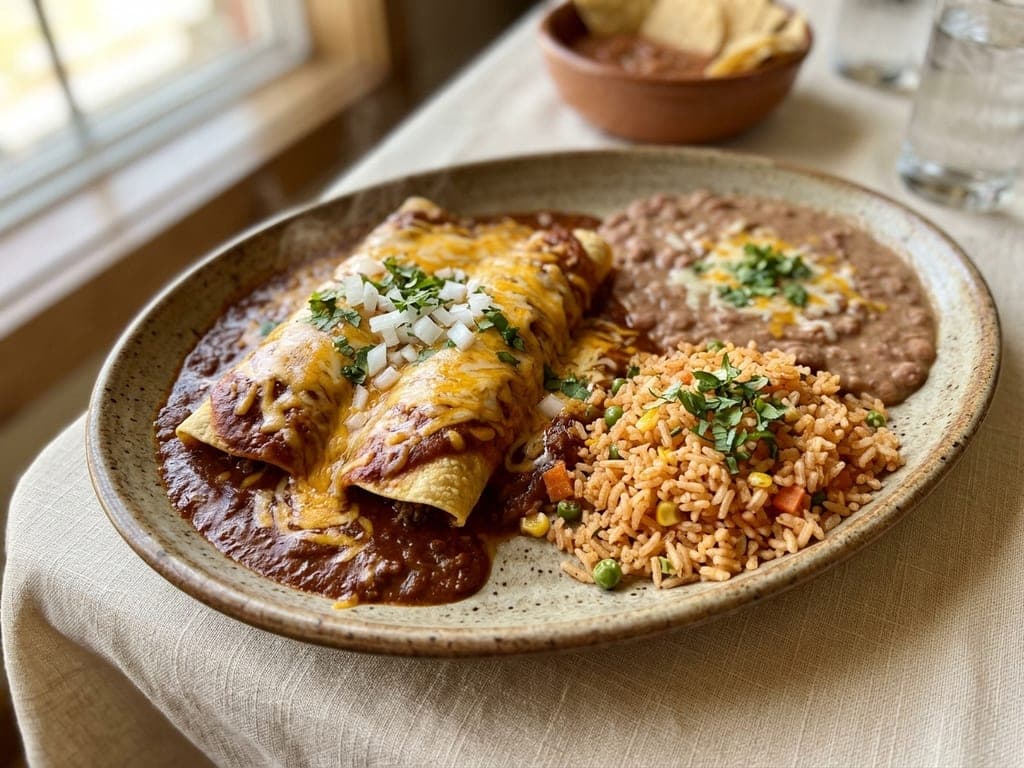
- Give each element its own third of the plate and let nothing touch — the combination plate’s look is order, not composition.
- Serve the enchiladas straight from the dish while the cheese still stretches, and keep the pull visible as you set them down.
- Scatter the raw onion only on the enchiladas, never across the whole plate, so the white specks read as a deliberate finish.
- Shoot within a minute of plating; melted yellow cheese sets fast and a congealed surface is unphotographable.
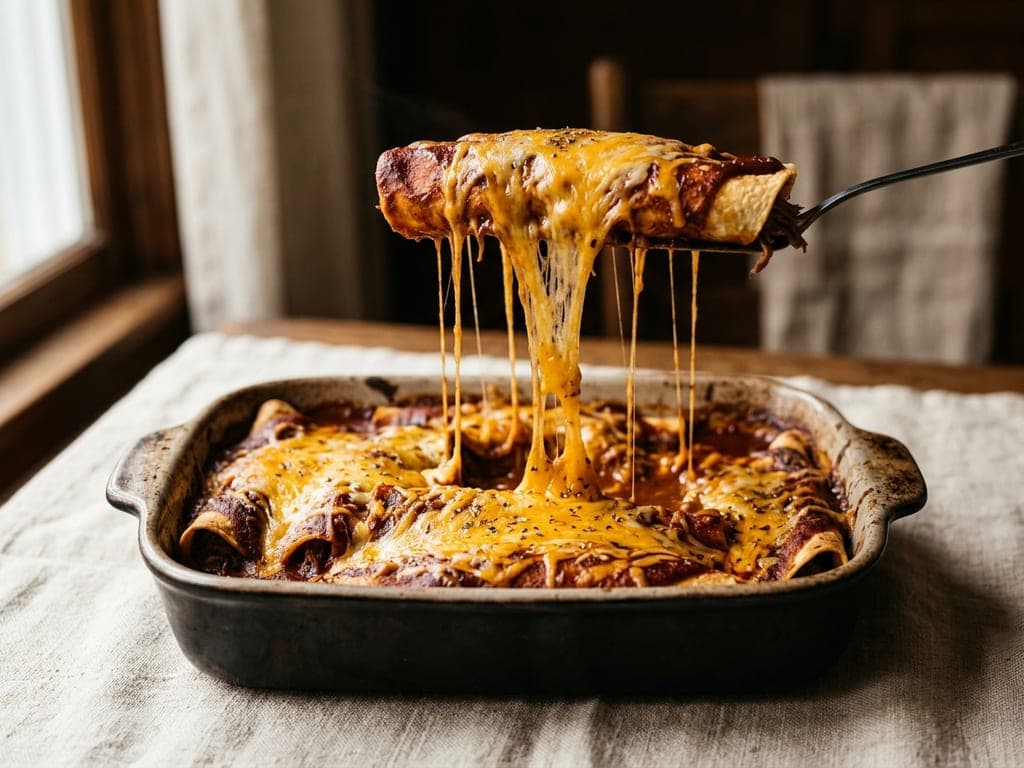
- Lift within seconds of the dish leaving the oven; the window for a good pull is about a minute long.
- Use a narrow spatula and raise it slowly and vertically — a fast lift snaps the thread, a sideways lift drags the roll apart.
- Keep the background dark and simple so the pale cheese thread reads clearly against it.
- Have the tray still full underneath; a pull from a half-empty dish loses the abundance that makes the picture work.
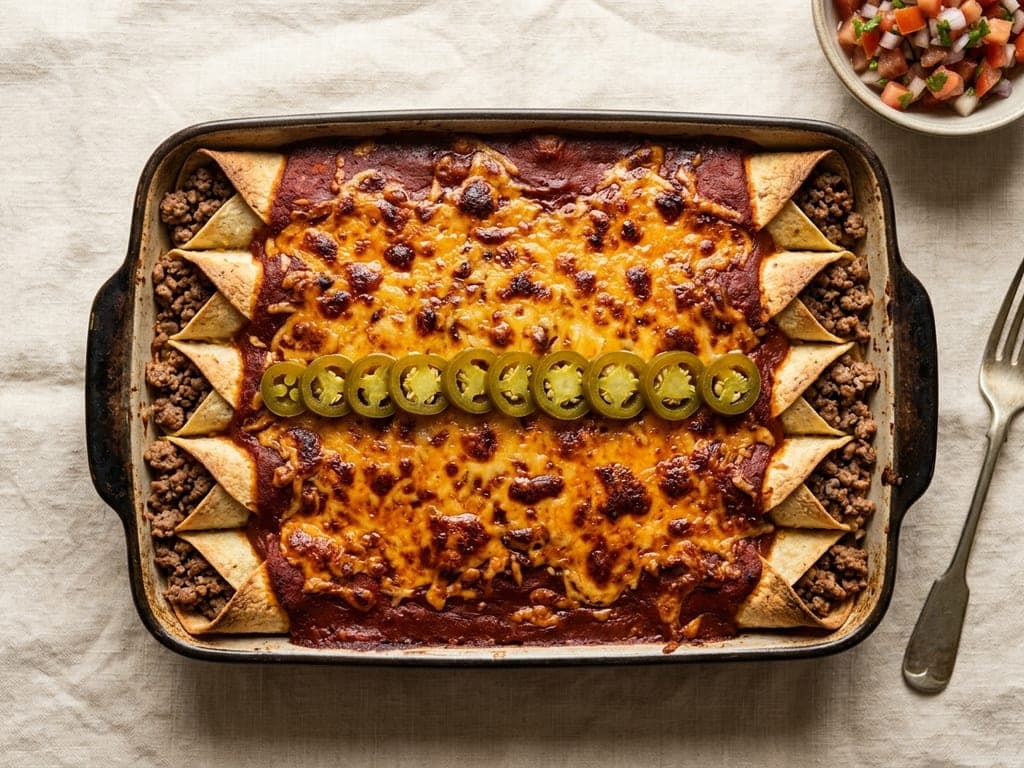
- Leave the ends of the rolls unsauced during assembly so the finished tray has three distinct bands to look at.
- Let the cheese brown properly — a few dark blisters give an overhead shot the depth an evenly pale top never has.
- Lay the pickled jalapeños in one line rather than dotting them about; a single green stripe across brick red does all the colour work.
- Shoot straight down with the light raking from one side so the ridges of the rolls cast visible shadows.
The Chili Queens and the combination plate
Tex-Mex has a real lineage, and it begins with women selling food outdoors. From roughly the 1860s until the 1930s, San Antonio’s plazas filled at dusk with the stands of the Chili Queens — Mexican-American women who set up lantern-lit tables and sold chili con carne, tamales, enchiladas and coffee to whoever was passing, often through the night. The railroad’s arrival in the 1870s brought travellers, the travellers brought appetite and publicity, and the food of those plazas became the template for what restaurants would later sell as Mexican food in Texas. Sanitation rules ended it: the stands were banned as unsanitary in 1937, reopened after public protest under a licensed, screened-in arrangement in 1939, and closed for good by health officials in the early 1940s.
What the restaurants formalised was the combination plate: two enchiladas under gravy and cheese, rice, refried beans, everything arriving on one oval platter so hot the waiter warns you. Cumin, which is not a common seasoning in most of Mexico, became a signature of the Texan style. So did yellow cheese, and so did the gravy. Calling that inauthentic misses the point by about a century — it is authentically Tejano food, a border cuisine with its own history, and it deserves to be cooked as carefully as anything else rather than reheated out of a jar.
In defence of yellow cheese
Somewhere along the way, mild orange cheese became the thing food writers apologise for. It does not need the apology. Mild cheddar and Colby-Jack melt smoothly and evenly at oven temperature and stay flowing as the dish cools on the table, which is precisely the job here: a continuous molten blanket over the whole tray, not distinct pools. Aged cheddar, for all its better flavour, splits and goes oily under heat because its fat and protein have less to hold them together. Mozzarella strings rather than flows and turns rubbery as it cools. If you want more flavour without breaking the melt, use two-thirds mild cheddar to one-third a sharper cheese, and grate it yourself — bagged pre-grated cheese is dusted with anti-caking starch that makes the top grainy.
European shoppers: any mild semi-hard melting cheese does this job. Young gouda, edam, a mild Cheddar-style block, or the mild orange cheeses sold for toasties all behave the same way. The colour is annatto, a plant dye, and contributes nothing but the look — which, on a Tex-Mex plate, is admittedly part of the point.
Ground beef, shredded beef, and the browning that matters
Ground beef is the classic and the quick one, and the only technique that matters is refusing to stir it. A hot pan, the meat in one layer, then three or four minutes of leaving it completely alone: that is the difference between browned beef with a crust and grey beef stewing in its own liquid. Break it up only once the first side has taken colour. Use 20% fat mince — leaner mince gives you dry crumbs and no fat to carry the spices — and drain most of the rendered fat afterwards, keeping about a tablespoon.
Shredded beef is the slower, better version if you have the time: a 2 lb (900 g) piece of chuck seasoned and braised in the oven at 325°F (163°C) for 3 hours until it pulls apart with a fork, then shredded and moistened with gravy. If you already have birria in the fridge, that meat makes an outstanding enchilada filling — the two dishes share a chile-and-beef logic even though the sauces come from different traditions. Either way, moisten the filling with sauce before rolling; that single spoonful is what keeps the inside of an enchilada from going dry in the oven.
Questions, answered
What sauce goes on beef enchiladas?
In the Tex-Mex tradition, chili gravy: a roux of oil and flour with chili powder and cumin bloomed in it, thinned with beef broth and simmered to a coating consistency. It is savoury and cumin-forward rather than fruity, and it clings better than a chile purée — which is what you want under a lot of cheese. Red chile purée is the Mexican alternative and also excellent; the two are genuinely different sauces.
What is chili gravy made of?
Fat, flour, chili powder, cumin, garlic powder, oregano and beef broth. Cook the roux until nutty, stir the spices into the hot fat for 30 seconds, then whisk in warm broth and simmer 10 minutes. That half-minute of blooming is what stops it tasting dusty, and it takes about fifteen minutes start to finish.
Should I use corn or flour tortillas for beef enchiladas?
Corn, fried briefly in oil first — it holds up under gravy and gives the toasted-corn flavour the dish is built on. Flour tortillas are common in Tex-Mex restaurants and taste good, but they turn pasty under sauce; if you use them, skip the frying step and use a little less gravy.
Why are my beef enchiladas dry inside?
The filling went in unbound. After browning and draining the mince, stir half a cup of the gravy through it — that moisture is what carries the meat through the bake. Over-draining the fat is the other cause: keep about a tablespoon in the pan, and use mince with 20% fat rather than a lean grade.
How do I stop beef enchiladas going soggy?
Fry each corn tortilla for 5–10 seconds a side before filling, sauce the base of the dish only thinly, spoon the gravy over in a band rather than drowning the tray, and bake uncovered for 15–18 minutes as soon as they are assembled. Foil traps steam; a tray left standing on the counter softens before it ever reaches the oven.
Can I use shredded beef instead of ground beef?
Yes, and it is the better version if you have three hours. Braise a 2 lb (900 g) chuck roast at 325°F (163°C) until it shreds with a fork, then moisten it with gravy. Leftover birria makes an excellent filling too. Ground beef is the fast weeknight route and the more traditional one for a Tex-Mex plate.
What cheese is best for beef enchiladas?
A mild orange melting cheese — cheddar or Colby-Jack — because it flows evenly and stays soft as the dish cools, which sharp aged cheeses do not. Grate it yourself; pre-grated cheese carries anti-caking starch that makes the top grainy. In Europe, young gouda, edam or a mild Cheddar-style block all behave the same.
Can I make beef enchiladas ahead or freeze them?
Assemble up to a day ahead, cover and refrigerate, then bake from cold with 8–10 extra minutes — but chill it rather than letting it stand at room temperature. To freeze, assemble unbaked without the fresh garnishes, wrap well, and freeze up to 3 months; bake from frozen at 375°F (190°C) covered for 40 minutes, then uncovered for 15–20.
Is Tex-Mex food authentic Mexican food?
It is authentically Tex-Mex, which is its own border cuisine with a real history — San Antonio’s Chili Queens sold this food from the 1860s to the 1930s, and the restaurant combination plate formalised it afterwards. Cumin, yellow cheese and chili gravy are Texan signatures rather than central Mexican ones. Both traditions are worth cooking properly; neither is a degraded version of the other.
How many calories are in beef enchiladas?
About 680 per serving as built here — three enchiladas with 20%-fat mince, chili gravy and a generous cheese blanket. The cheese is the biggest single dial: cutting it by a third saves roughly 120 calories and still gives full coverage. Leaner mince saves less than you would think and costs the dish more than it is worth.
Snap your finished plate and let the AI plate it again — more beautifully.