Japchae Recipe (잡채, Korean Glass Noodles)
Japchae is the Korean celebration dish that breaks the stir-fry rules: every vegetable is cooked on its own, seasoned on its own, and only then tossed with chewy sweet-potato glass noodles, marinated beef and a soy–sesame sauce. Cooked this way the noodles stay springy, the carrot stays snappy and the spinach tastes of itself — and the platter holds its looks at room temperature, which is exactly why Koreans bring it to every party.
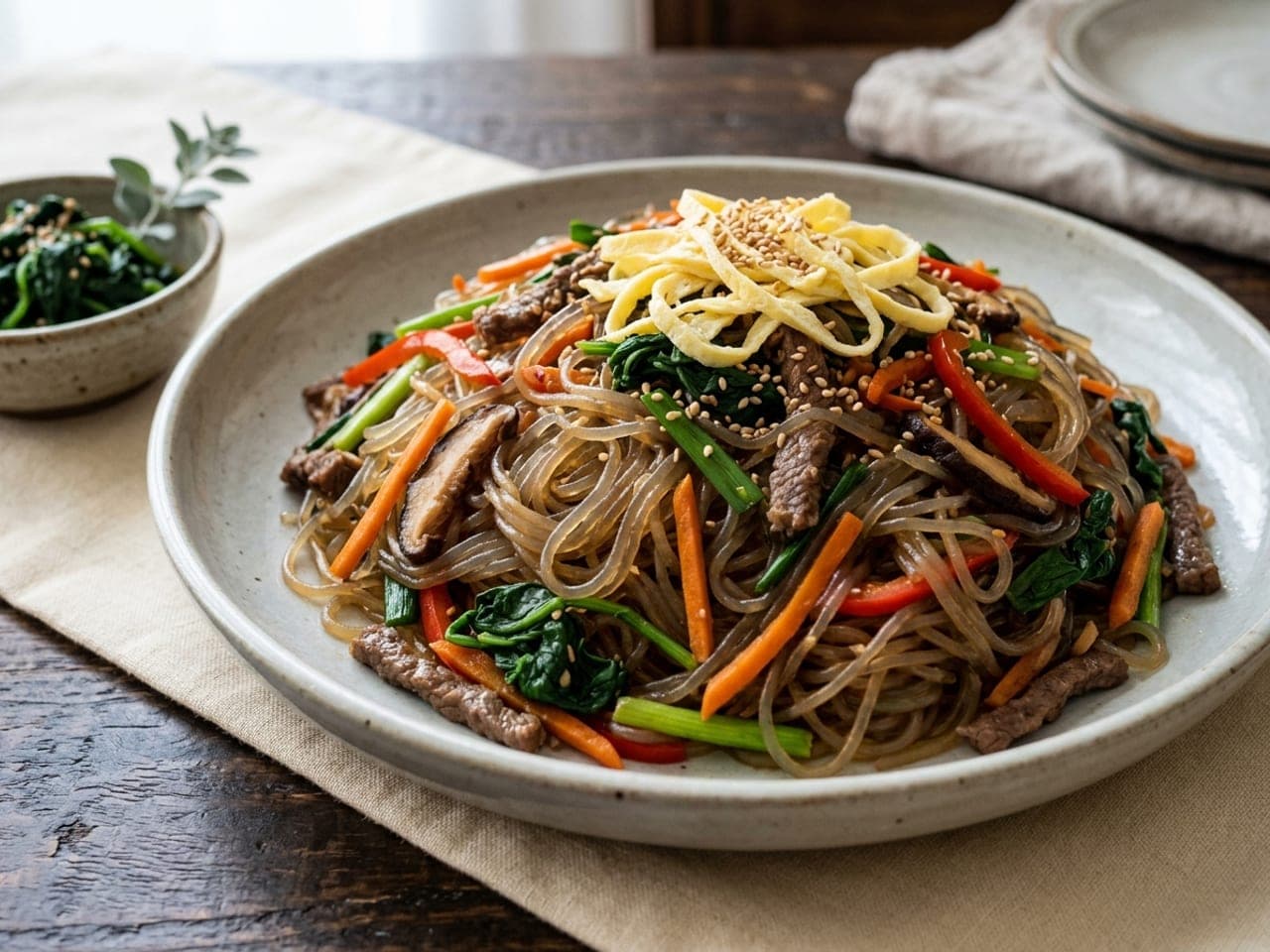
Ingredients
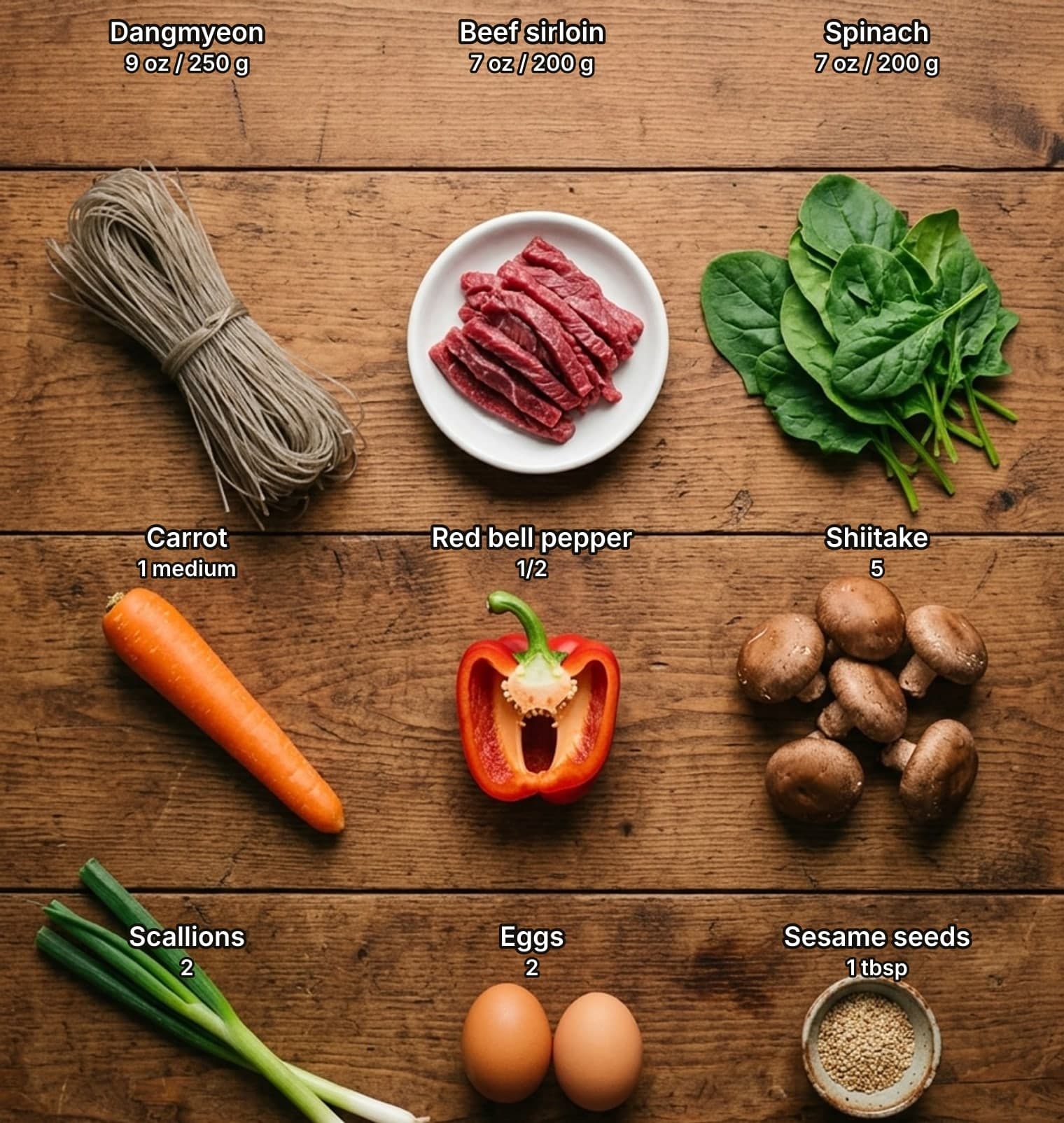
- dangmyeon (당면, Korean sweet-potato starch glass noodles) — the one non-negotiable; mung-bean glass noodles are a different, softer noodle9 oz (250 g)
- beef sirloin or ribeye, cut into thin strips — 30 minutes in the freezer first makes the slicing easy; pork, chicken or extra mushrooms all work7 oz (200 g)
- fresh spinach — blanched 30 seconds, squeezed hard, then seasoned7 oz (200 g)
- carrot, cut into matchsticks1 medium
- yellow onion, thinly sliced1/2 large
- red bell pepper, cut into thin strips1/2
- fresh shiitake mushrooms, stemmed and sliced — or 5 dried, soaked 30 minutes (save the liquid for soup)5
- scallions (spring onions), cut into 2-in (5 cm) lengths2
- eggs, for the jidan ribbons — optional; the dish loses a color, not its structure2
- soy sauce — 4 tbsp for the sauce, 1 tbsp for the beef marinade; certified gluten-free tamari makes the whole dish GF5 tbsp
- sugar — 2 tbsp for the sauce, 1 tsp for the marinade; the gentle sweetness is traditional, not an accident2 tbsp + 1 tsp
- toasted sesame oil — 2 tbsp for the sauce, 1 tsp each for the marinade and the spinach2 tbsp + 2 tsp
- garlic, finely minced — 1 tbsp for the sauce, the rest split between the marinade and the spinach1 1/2 tbsp
- toasted sesame seeds, plus more for the platter1 tbsp
- neutral oil, for the pan, in small splashes between batches2 tbsp
- salt and black pepper — a pinch of salt for each vegetable as it friesto season
What japchae is, and the one rule that makes it
Japchae is a dish of dangmyeon — chewy, springy glass noodles made from sweet-potato starch — tossed with beef and a garden of vegetables in a soy–sugar–sesame sauce, served warm or at room temperature. It is Korea’s definitive celebration food: the dish that appears at birthdays, weddings, New Year (Seollal) and the harvest festival (Chuseok) — beside, if not usually on, the formal ancestral rite table, whose dishes are traditionally cooked without garlic, scallion or chili — and at any gathering where someone wants to signal that they made an effort. The effort is real, and it is one specific kind of effort: nearly everything on the platter is cooked separately.
That separate cooking is the rule that makes the dish, and it is worth understanding before you decide to shortcut it. Every component has a different ideal doneness — onion wants to sweeten, carrot wants to stay snappy, spinach wants 30 seconds of blanching, mushrooms want dry heat and browned edges, beef wants a hard sear — and a single crowded pan forces them all to one compromise doneness in a puddle of shared steam. Cooked apart and seasoned apart, each one arrives at the final toss already tasting complete, and the finished platter reads as a dozen distinct flavors that happen to agree, rather than one brown average.
The payoff for the extra half hour is a dish that is genuinely better at room temperature than most stir-fries are hot, holds its color and texture on a buffet, and reheats the next day almost supernaturally well. There is a reason every Korean family hauls japchae to every party: it is engineered for exactly that job.
How to make Japchae
- Make the sauce and marinate the beef. Stir together the sauce: 4 tbsp soy sauce, 2 tbsp sugar, 2 tbsp toasted sesame oil, 1 tbsp finely minced garlic and 1/4 tsp black pepper, and keep stirring until the sugar has fully dissolved — undissolved sugar sits on the noodles as grit. Slice 7 oz (200 g) of beef sirloin or ribeye into thin strips about 1/4 in (6 mm) wide; 30 minutes in the freezer first firms the meat so the knife glides. Toss the strips with 1 tbsp soy sauce, 1 tsp sugar, 1 tsp sesame oil, 1 tsp minced garlic and a grind of pepper, and put them in the refrigerator to marinate while you cook everything else — marinating happens in the fridge, not on the counter. Fifteen minutes is enough; an hour is better. This is the same soy–sugar–sesame system as bulgogi, scaled down to a supporting role: in japchae the beef is one voice in the choir, not the soloist.
- Blanch and season the spinach — and keep the water. Bring a large pot of water to a boil and salt it. Drop in 7 oz (200 g) of spinach, push it under, and pull it out after 30 seconds, straight into cold water. Squeeze it firmly into a ball — really squeeze; watery spinach dilutes the whole platter — then loosen the clump, and massage it with 1/4 tsp salt, 1/2 tsp minced garlic and 1 tsp sesame oil. This is the namul method, and the massaging matters: the seasoning is worked into the leaves by hand rather than poured over them. Keep the pot of water at a boil — the noodles are about to use it. Seasoning each component at its own station, to its own point, is the whole doctrine of this dish, and the spinach is where it is easiest to feel the difference: blanched-and-dressed spinach tastes green and nutty on its own, which is the standard every other component has to meet.
- Boil, rinse, cut and dress the noodles. Drop 9 oz (250 g) of dangmyeon into the boiling water, stir once so they submerge, and cook for 6–7 minutes — brands vary between 5 and 8, so check the package and start tasting early. Done means translucent grey-brown, springy and chewy with no chalky white core; past done means mushy, and mushy dangmyeon cannot be rescued, so err a shade early. Drain, rinse briefly — a few seconds under cold running water to stop the carryover cooking and wash off the surface starch, not a cold soak; the noodles should still be warm to the touch — and drain again thoroughly. Tip the noodles into your biggest mixing bowl, snip through the pile two or three times with kitchen scissors — dangmyeon are sold in arm-length hanks, and uncut they are unmanageable on a plate — and toss them immediately with 1 tbsp of the sauce. Dressing them warm does two jobs at once: the noodles drink in seasoning while they are still absorbent, and the oil in the sauce keeps them from welding into a block while you cook the rest.
- Make the jidan egg ribbons. Beat 2 eggs with a pinch of salt. Set a nonstick pan over LOW heat, add a little neutral oil, then wipe almost all of it out with a paper towel — a filmed pan, not an oiled one. Pour in half the egg, tilt to a thin even sheet, and let it set gently for 1–2 minutes without taking any color; a browned jidan tastes of browned egg, and this garnish is meant to taste clean. Flip carefully and give it 20–30 seconds more so both sides are fully set, then slide it out. Repeat with the rest. Cool the sheets, roll them into a loose cigar, and slice into thin ribbons. This is jidan (지단), the classic Korean egg garnish; the full banquet version — the same two-tone garnish Korean cooks lay on festive noodles — cooks the yolks and whites as separate sheets for two colors, which is pure showing off and entirely worth it if you have the patience. If you would rather skip the eggs, the dish loses a color, not its structure.
- Stir-fry the vegetables one at a time. Set a wide pan over medium-high heat with a small splash of neutral oil, and cook the vegetables in sequence, each with its own pinch of salt, each tipped out onto a large platter in its own pile before the next goes in: the sliced onion for 1–2 minutes until translucent at the edges but not browned; the carrot matchsticks for 1–2 minutes, still distinctly snappy; the red bell pepper strips for 1 minute; the sliced shiitake for 2–3 minutes until their edges brown and they smell toasty; the scallion lengths for barely 30 seconds. Add small splashes of oil between batches as the pan needs them. Yes, this is slower than throwing everything in together — that is the point. Each vegetable has a different ideal doneness, and a shared pan forces them all to the same wrong one: the onion undercooked, the carrot limp, the mushrooms steamed pale in the crowd’s moisture. Separate piles also keep the colors clean, which matters in a dish that is half about how it looks on the platter.
- Sear the beef hot. Wipe the pan, get it properly hot, and spread the marinated beef strips out in one layer — in two batches if your pan is small, because crowded beef stews grey in its own juices instead of searing. Leave the strips alone for 30 seconds, then toss for another 1–2 minutes until they are browned at the edges and cooked through with no pink remaining; the marinade’s sugar will caramelize and catch a little, which is flavor, not a mistake. Thin strips move fast — the whole batch is done in 2–3 minutes. Tip the beef and its pan juices onto the platter with the vegetables. Use fresh tongs or give the marinade tongs a wash first, and the marinade itself goes down the drain, not over the food — it has been holding raw beef. Then wash your hands with soap and warm water before you go anywhere near the finished platter.
- The toss — hands, not tongs. Return the noodles to the pan over medium heat with the remaining sauce and toss for 1–2 minutes until they are warm, glossy and have drunk the sauce in; this brief re-warming also softens any clumps that formed while they waited. Back into the big bowl, then add everything: the vegetable piles, the beef, the spinach, most of the jidan ribbons and 1 tbsp of toasted sesame seeds. Now toss with freshly washed hands — Korean cooks overwhelmingly reach for a disposable glove here, and it is the hygienic choice too — lifting from the bottom and fluffing, rather than stirring. Hands feel where the dense pockets of noodle are hiding and can separate them; tongs and spoons shear the noodles and mash the vegetables. Taste, and adjust with a splash of soy sauce, a pinch of sugar or a thread of sesame oil — the balance should read savory first, gently sweet second, sesame all the way through. Mound onto a platter, finish with the reserved jidan and a last scatter of sesame seeds, and serve warm or at room temperature — within the time window in the safety notes.
Safety & hygiene Important
- A room-temperature dish still owns a clock. Japchae is traditionally served warm or at room temperature, and that is genuinely fine — as long as you treat time as the control, because temperature is not doing that job. The standard rule applies: no more than 2 hours total in the room-temperature zone, cut to 1 hour when the room is above 90°F (32°C), and the clock includes the time the platter spends looking decorative on a buffet — and the drive to the party: the two hours are cumulative from the moment it leaves the stove, and time back in the fridge does not top the budget back up. For a party, the move is to portion out what the table will eat in the next hour or so, keep the rest covered in the refrigerator, and swap in a clean, cold platter as each one empties — USDA’s buffet rule; topping up a dish already on the table puts new food onto the old food’s clock — rather than standing the whole batch out at once. When the window closes, the platter is done — cooked noodles, beef and egg that have sat out all afternoon are not rescued by a night in the fridge or a blast of reheating, because some of what grows at room temperature makes toxins that heat does not destroy. And because this platter is hand-tossed and then held out of the fridge, hands are part of the safety story: Staphylococcus aureus travels from hands into ready-to-eat food and, given warm hours, makes exactly that kind of heat-stable toxin. Wash before the toss, glove up — especially over any cut — and keep the clock short.
- Noodles carry the same spore story as rice. Cooked starches — rice famously, but cooked noodles and pasta just as much — can carry Bacillus cereus, a bacterium whose spores survive boiling and which multiplies in food left in the warm zone; there are documented outbreaks, some severe, traced to cooked noodles and pasta left out too long. The toxin it produces is heat-stable, so reheating does not undo the mistake — the whole game is time. Get leftovers into the refrigerator within 2 hours of cooking (1 hour in a hot kitchen), in shallow containers so they cool through quickly. US guidance (USDA) keeps leftovers 3–4 days; UK guidance (FSA) says 48 hours and reheat only once. Reheat until steaming hot throughout — 165°F (74°C) — not merely until the noodles loosen. The good news is that japchae reheats better than almost any noodle dish, for reasons explained in the serving section; the clock is the only part that does not bend.
- Eggs, and why the crepe is the safe shape. The jidan sheets in this recipe are cooked fully set on both sides, and a fully set egg is the food-safety endpoint — no further caution needed for most eaters. It is still worth knowing the frame: in the US, the FDA advises cooking eggs until yolks and whites are firm, and using pasteurized eggs for any dish that would serve them raw or undercooked — with children, older adults, and anyone pregnant or immunocompromised the groups that caution protects; in the UK, hen eggs carrying the British Lion mark (or the Laid in Britain scheme) are graded very low risk for Salmonella — since 2017 the FSA has said even vulnerable groups may eat them runny — while eggs outside those schemes still want thorough cooking; the crepe here is set regardless, so every audience lands in the same safe place. The practical points are around the raw egg, not the cooked one: wash hands and the whisking bowl after handling raw egg, keep the beaten egg away from the finished platter, and put shells straight in the bin rather than down on the work surface where the scallions are waiting.
- Raw beef, its marinade, and its board. Marinate the beef in the refrigerator, never on the counter — room-temperature marinating is exactly the warm hold bacteria want, and the soy and sugar do nothing to stop them. Used marinade has been sitting in contact with raw beef: discard it, and wash or swap the tongs that moved the raw strips before they touch anything cooked. Give raw beef its own cutting board, or wash the board and knife with hot soapy water before they go back into service on vegetables. On doneness: US guidance for whole-muscle beef is 145°F (63°C) with a 3-minute rest, and strips this thin blow past that in seconds of proper searing — cook them until no pink remains and you are comfortably done. One exception: pre-sliced or mechanically tenderized beef from the supermarket should be treated like ground meat — the processing carries surface organisms into the interior — so cook it right through rather than leaning on the whole-cut figure. Beyond that, the practical risk with thin-sliced beef is not undercooking; it is the board, the tongs and the marinade bowl.
- Allergens — and the odd shape of japchae’s gluten. Sesame is everywhere in this dish — the oil, the seeds, the spinach dressing — and it is a declared major allergen in both the US (the ninth, since January 2023) and the EU; note that toasted sesame oil is an unrefined oil and does carry the allergen, unlike the highly refined oils some allergy guidance exempts. Soy is in the soy sauce, egg is in the jidan (easily omitted — the dish loses a color, not its structure), and beef is present unless you take the vegetarian route. The gluten, though, has an odd shape here: dangmyeon are pure sweet-potato starch, naturally gluten-free, so effectively the entire gluten load of japchae is the soy sauce. Swap it for a tamari that is itself labelled or certified gluten-free — tamari is a style of soy sauce, not a guarantee, and some tamari is brewed with wheat — and the dish becomes gluten-free in one move. Coeliacs should also glance at the noodle package for a cross-contact statement, since some factories run wheat noodles on shared lines. And unlike the egg, sesame has no opt-out here — the oil, the seeds and the spinach dressing are structural — so a sesame allergy means telling your guest what is in the dish, not engineering around it.
3 ways to plate it
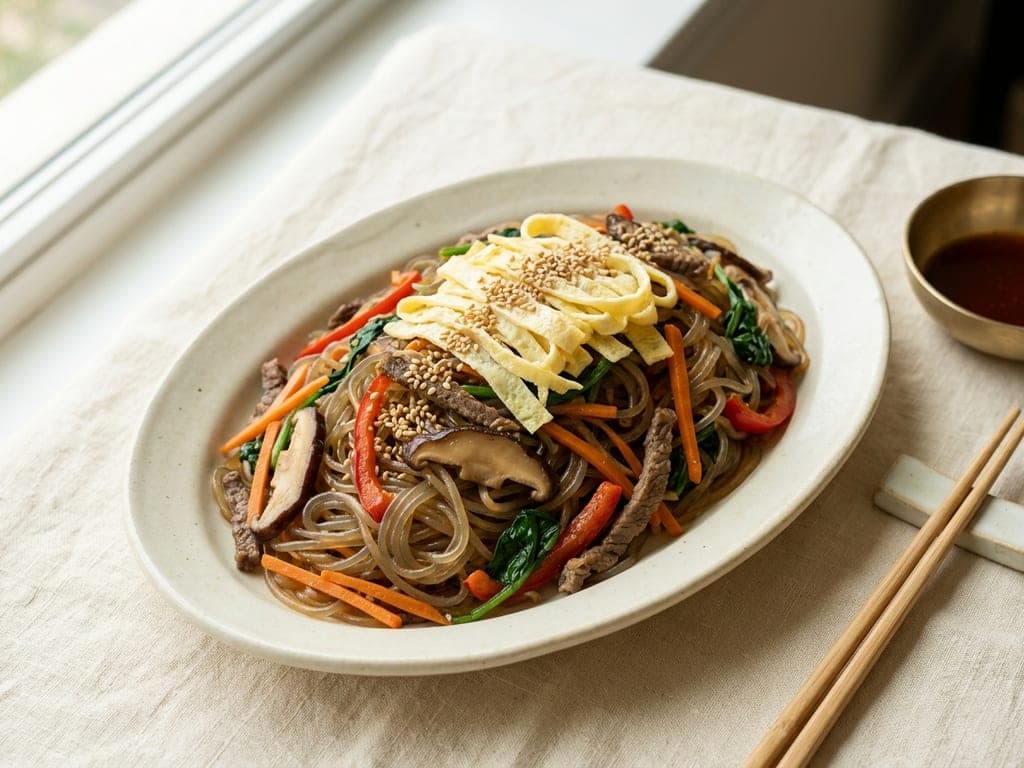
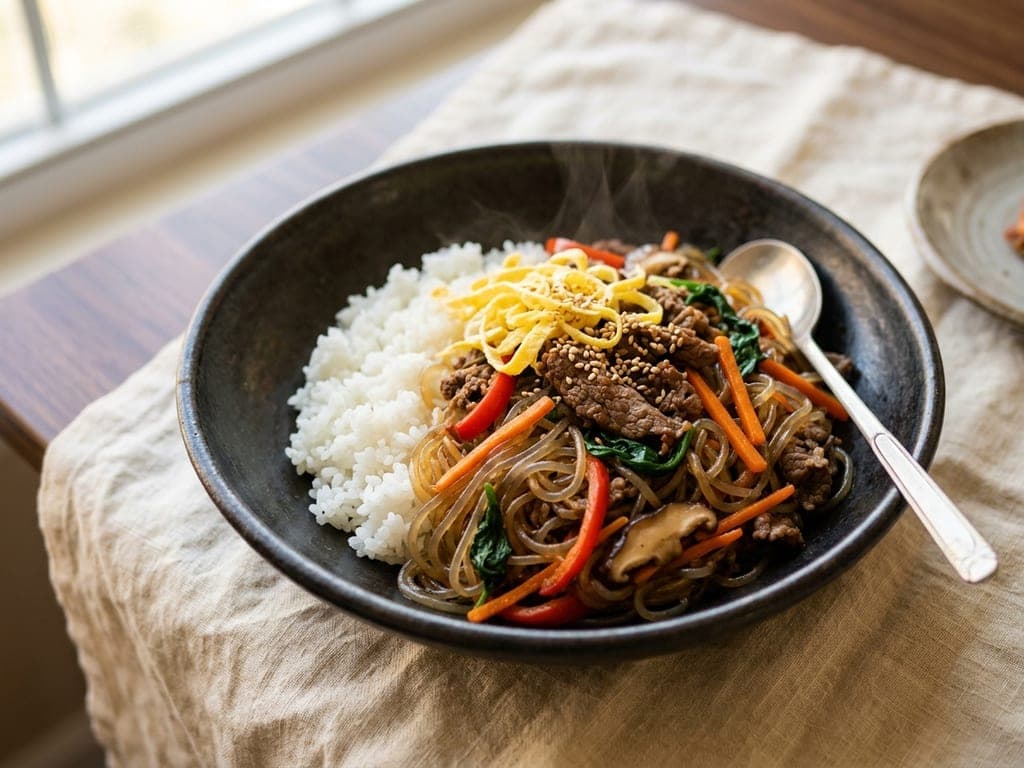
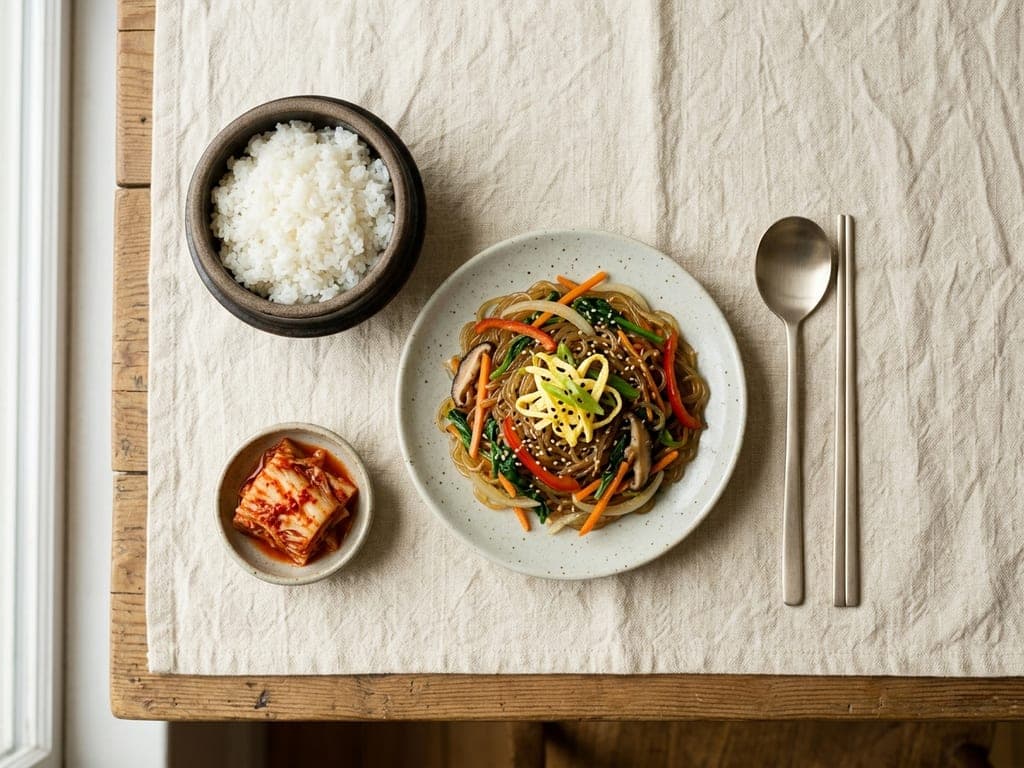
What are the ingredients of japchae?
Japchae is built from dangmyeon (sweet-potato starch glass noodles), thin-sliced beef, a set of vegetables cooked one by one — classically spinach, carrot, onion, mushrooms and scallions, with red bell pepper a common modern addition — jidan (thin egg-crepe ribbons) as the garnish, and a sauce that is nothing more than soy sauce, sugar, toasted sesame oil, garlic, black pepper and sesame seeds. Neutral oil and salt do the cooking.
What is negotiable: the exact vegetable roster (Koreans compose it by color as much as by flavor — see the five-color reading below), the beef (pork, chicken, or extra mushrooms all serve), and the egg. What is not negotiable: the dangmyeon, the sesame, and the separate cooking. Swap the noodle and you have made a different dish; skip the sesame and it stops tasting Korean; cook it all in one pan and you have made a decent noodle stir-fry that no Korean grandmother would recognize as japchae.
One quiet ingredient deserves a word: the sugar. Japchae is supposed to read gently sweet — not dessert-sweet, but noticeably rounder than a Chinese stir-fry — and the 2 tbsp in the sauce is doing deliberate, traditional work. Cutting it to nothing produces a flatter, saltier dish, which is a legitimate preference but a different target.
The noodle: dangmyeon, and why japchae is nearly gluten-free
Dangmyeon (당면) are glass noodles extruded from sweet-potato starch — nothing else but water. Dried, they are grey-brown, wiry and arm-length; cooked, they turn translucent, glossy and springy, with the bouncy, chewy resistance Koreans prize as jjolgit-jjolgit. That chew is the dish’s texture backbone, and it is why substitutions disappoint: mung-bean glass noodles (the thin ones sold for spring rolls and Chinese soups) are softer, finer and collapse under this much tossing, and rice vermicelli is a different dish entirely. Buy noodles that say sweet potato on the package — any Korean grocery carries them, and most large Asian groceries do too.
Because the noodle is pure starch, japchae sits one ingredient away from gluten-free: the soy sauce is effectively the dish’s entire gluten load. Swap in a certified gluten-free tamari and it crosses over — a genuinely useful property in a party dish, covered properly in the safety notes.
The name dangmyeon is itself a history lesson: it is written 唐麵, literally ‘Tang noodles’ — but the 唐 is just the old Sino-Korean prefix for ‘Chinese’, and the noodle actually reached Korea from Qing China at the end of the Joseon era. Korea’s first large dangmyeon factory opened in Sariwon in 1919. Hold that date; it matters to the history below.
The dish that spent four centuries without noodles
Japchae’s name is Sino-Korean: 잡채 is 雜菜, ‘mixed vegetables’ — and the name is honest, because there is no noodle in it. The dish is old — the name is in the royal Annals by 1447, when five bowls of japchae set out at a royal tomb rite drew an objection precisely because japchae was understood as ordinary, everyday food. Its most famous moment came a century and a half later, at the court of King Gwanghaegun (reigned 1608–1623): an official named Yi Chung curried the king’s favor by sending exquisite dishes to the palace — japchae his signature among them — and rose to high office on the strength of it. His contemporaries were unimpressed. The Annals preserve a mocking couplet naming him the ‘japchae sangseo’ — the japchae minister, remembered in Korean today as the japchae panseo, one of Korean history’s better insults — and they are specific about the flattery’s effect: at every meal, the record says, the king waited for the food from Yi Chung’s house before he would pick up his chopsticks.
The oldest surviving recipe, in the c. 1670 household cookbook Eumsik dimibang, is a platter of nearly twenty julienned vegetables — cucumber, radish, mung-bean sprouts, mushrooms and their seasonal colleagues, each prepared on its own — with a little shredded pheasant at the center and a mustard or pheasant-broth dressing; the soy-and-sesame chord came later. And no dangmyeon anywhere, for the excellent reason that dangmyeon did not exist in Korea: starch noodles arrived from Qing China at the end of the Joseon era, Korea’s first large dangmyeon factory opened in Sariwon in 1919, and the first japchae recipe to include the noodle appears in print in 1921 — with a rival 1924 cookbook still arguing against it. The version the world now knows — noodle-forward, beef-optional, soy-and-sesame dressed — is barely a century old, sitting on top of a dish recorded back to 1447.
This is worth knowing beyond dinner-party trivia, because it explains the dish’s grammar. Japchae is not a noodle dish with vegetables in it; it is a vegetable dish that adopted a noodle. Cook it with that priority — vegetables treated as individuals, noodles as the newest guest — and you are cooking the dish’s actual structure.
What kind of sauce is in japchae? A system, not a dressing
The japchae sauce is soy sauce, sugar, toasted sesame oil, minced garlic and black pepper — roughly 2 parts soy to 1 part sugar to 1 part sesame oil, finished with toasted sesame seeds at the toss. Use a standard all-purpose Korean or Japanese soy sauce (jin ganjang); the pale Korean soup soy sauce (guk ganjang) is saltier and sharper and will unbalance it.
But the sauce is the least of it, and this is the part most non-Korean recipes miss: japchae is seasoned as a system, not dressed at the end. The beef carries its own marinade — the same soy–sugar–sesame chord, scaled down. The spinach is massaged with salt, garlic and sesame oil at its own station. Each vegetable takes its pinch of salt in the pan. The noodles drink a spoonful of sauce while they are warm and absorbent, a good twenty minutes before the final toss. By the time everything meets, every component already tastes finished, and the remaining sauce merely ties them together. Pour the same total seasoning over unseasoned components at the end and you get the familiar failure: a platter that tastes of sauce on top and of nothing underneath.
This layered approach is also why the dish survives room temperature so well. Seasoning that lives inside each component does not fade as the platter cools the way a surface dressing does.
Beef, vegetables, and the five-color reading
The beef wants to be a tender quick-cooking cut — sirloin or ribeye — sliced thin against the grain; half an hour in the freezer makes the slicing easy. Its marinade is bulgogi’s in miniature, which is no accident: the two dishes share the same soy–sugar–sesame grammar, and if you have made our bulgogi you already know this beef. Pork and chicken are ordinary substitutions in Korean home cooking; so is doubling the mushrooms and skipping meat entirely.
The classic vegetable set — spinach, carrot, onion, shiitake, scallion, and now commonly red bell pepper — is not arbitrary. Korean festive cooking composes plates around obangsaek (오방색), the traditional five-color scheme of white, yellow, blue-green (청 — realized as green on the plate), red and black that maps to the five directions in Korean cosmology. The showpiece obangsaek dishes are gujeolpan and sinseollo, but Korea’s own Food Promotion Institute points to japchae as a dish whose ingredients run the full set: white and yellow in the jidan ribbons, green in the spinach and scallion, red in the carrot and pepper, black-brown in the shiitake against the glossy noodles — the last two only once the egg goes on, which is an argument for the egg. It is also a practical shopping guide — compose by color and the flavor balance tends to follow.
On mushrooms: fresh shiitake are the standard, dried shiitake soaked for 30 minutes are arguably better (deeper flavor, chewier bite — save the soaking liquid for soup), and wood ear mushrooms are a common, pleasantly crunchy addition. King oyster mushrooms, torn into strips, are the luxury move in vegetarian versions.
Is japchae healthy? An honest ledger
As written, a main-course serving — a quarter of this recipe — lands around 575 kcal: call it 520–640 depending on your hand with the oils and whether you use sirloin or ribeye. The arithmetic is dominated by the noodles (9 oz / 250 g of dry sweet-potato starch is roughly 870 kcal on its own) with the sesame and frying oils second and the beef, sugar and eggs sharing third. Sodium is the number worth respecting: with 5 tbsp of soy sauce across the sauce and marinade plus the salted components, a serving carries roughly 1,450–1,650 mg — around two-thirds of a day’s recommended intake before any rice or side dishes arrive.
The honest framing: dangmyeon are nearly pure starch — negligible protein, negligible fiber, and, contrary to the common claim that glass noodles are a low-GI food, a real glycemic load: the one published Korean measurement of sweet-potato starch vermicelli puts it at GI 60, medium and higher than fresh wheat noodles, while the low-GI reputation belongs to mung-bean noodles, which are a different product. It is the portion, not the index, that does the work. What redeems the dish nutritionally is everything else on the platter: a proper japchae is heavy with vegetables and carries a modest portion of protein, so the plate as a whole is far better balanced than the noodle alone. A Korean portion helps too — served as a banchan side among many dishes, a serving is half the size and half the numbers of the Western main-course plate.
To lighten it without breaking it: push the vegetable-to-noodle ratio up (the dish tolerates this happily — it was once all vegetables), trim the sugar to 1.5 tbsp before you trim anything else, and measure the sesame oil rather than pouring. There is no version without the noodles and the sesame that is still japchae.
Vegetarian and vegan japchae — the noodle is the modern part, not the meat
Vegetarian japchae is not a compromise, and it sits close in spirit to the oldest version on record: the 1670 recipe is a platter of nearly twenty vegetables with only a little shredded pheasant at the center — a vegetable dish with a meat garnish, not the reverse (though not strictly vegetarian either; the pheasant was in its sauce too). Drop the beef and double the mushrooms — a mix of fresh and soaked dried shiitake for depth, wood ear for crunch, king oyster torn into meaty strips — and give them the beef’s marinade treatment before they hit the pan. Skip the jidan as well and the dish is vegan: the sauce contains nothing animal.
The traps are the usual quiet ones. Some modern recipes slip oyster sauce into the seasoning — not traditional, and not vegetarian. Pre-made ‘Korean BBQ’ sauces often contain pear and sometimes fish sauce or beef extract; this dish never needs them. And if you are serving mixed company, cook the mushrooms before the beef in the shared pan, not after.
One genuinely useful upgrade for the meatless version: salt the mushrooms lightly as they fry and let them brown harder than feels polite. Browned mushroom edges are where the savory depth comes from when the beef is gone, and pale steamed mushrooms are the most common reason a vegetarian japchae tastes thin.
Serving it: side or main, warm or room temperature — and the day-two trick
In Korea, japchae is a banchan — a side dish, one of several around the rice — and a celebration dish that anchors the party table. Abroad it has been promoted to a main, which it handles perfectly well; a quarter of this recipe is a generous single plate. There is also an honorable middle path: japchae-bap — at home, simply leftover japchae piled over hot rice, sometimes with a fried egg — which turns the platter into a weeknight dinner with one scoop. (Order japchae-bap at a Korean-Chinese restaurant and a different, excellent dish arrives: a wok-fried version on thicker noodles, built on chili oil and oyster sauce.) Serve it warm or at room temperature — never fridge-cold, where the noodles stiffen and the sesame goes mute — and mind the two-hour window in the safety notes if it is standing on a buffet.
The day-two behavior is the dish’s best magic trick. Refrigerated dangmyeon turn hard and brittle — the starch recrystallizes as it chills, the same retrogradation that staling bread undergoes — and a cold container of japchae looks like a lost cause. Heat reverses it: 30–60 seconds in a microwave with a teaspoon of water, or two minutes tossed in a hot pan, and the noodles spring back to nearly their original bounce — just carry leftovers on past the bounce, to steaming hot throughout (165°F / 74°C). Japchae is one of the very few noodle dishes that genuinely revives rather than merely softens, which is why it travels so well.
What to put beside it: as a main, a bowl of rice and something sharp — kimchi, or quick-pickled cucumber — to cut the sesame richness. As a side, it belongs next to grilled meat — bulgogi shares its seasoning grammar, and the two eat best together.
Questions, answered
What are the ingredients of japchae?
Dangmyeon (Korean sweet-potato starch glass noodles), thin-sliced beef (sirloin or ribeye), spinach, carrot, onion, shiitake mushrooms, scallions and commonly red bell pepper, plus thin egg-crepe ribbons (jidan) on top. The sauce is soy sauce, sugar, toasted sesame oil, garlic and black pepper, finished with toasted sesame seeds. Each vegetable is cooked and seasoned separately before everything is tossed together — that separate cooking is as much an ingredient as anything on the list.
What is the difference between japchae and chapchae?
Nothing — they are the same word, 잡채, in two romanization systems. Japchae follows the Revised Romanization Korea has used officially since 2000; chapchae descends from the older McCune–Reischauer system — strictly chapch’ae, with an apostrophe menus always dropped — and jabchae turns up as a hybrid spelling. Menus and cookbooks mix them freely. The dish is identical.
Is japchae healthy or not?
It is middling, and honest framing helps: a main-course serving of this recipe runs about 575 kcal with roughly 1,450–1,650 mg of sodium. The glass noodles are nearly pure starch — almost no protein or fiber — but the dish as a whole is heavy with vegetables and modest with meat, which redeems the plate. Eaten Korean-style, as a smaller side among several dishes, the numbers halve. To lighten it, raise the vegetable-to-noodle ratio rather than shrinking the plate.
What kind of sauce is in japchae?
Soy sauce, sugar and toasted sesame oil — roughly 2 : 1 : 1 — with minced garlic, black pepper and toasted sesame seeds. There is no bottled ‘japchae sauce’; it is mixed in two minutes from pantry staples. Use an all-purpose soy sauce, not Korean soup soy sauce, which is saltier and sharper. But japchae is seasoned in layers, not dressed at the end: the beef has its own marinade, the spinach its own dressing, each vegetable its pinch of salt, and the noodles drink a spoonful of sauce while still warm. The final sauce only ties together components that already taste finished.
What noodles are used in japchae, and can I substitute?
Dangmyeon — glass noodles made from sweet-potato starch, sold dried in long grey-brown hanks in any Korean grocery. Their springy chew is the dish’s backbone, and substitutes genuinely disappoint: thin mung-bean glass noodles are softer and collapse under tossing, and rice noodles make a different dish. If the package says sweet potato, you have the right thing.
Is japchae gluten-free?
Almost — and fixably. The noodles are pure sweet-potato starch, naturally gluten-free, so the soy sauce is effectively the dish’s entire gluten load. Swap it for a tamari that is itself labelled or certified gluten-free (tamari is a style, not a guarantee — some is brewed with wheat) and japchae crosses over. Coeliacs should also check the noodle package for a shared-line cross-contact statement.
Why are my noodles mushy, or stuck together in a block?
Mushy means overboiled — dangmyeon go from springy to soft quickly, so taste from 5 minutes and pull them the moment the chalky core is gone; there is no rescue afterwards. Clumping means they sat undressed: toss the drained noodles with a spoonful of sauce while still warm, and the oil keeps them separate. If they have already welded, a brief re-warm in the pan with the sauce loosens them completely.
Can I make japchae ahead, and how do I reheat it?
Yes — it is one of the best make-ahead noodle dishes there is. Refrigerated, the noodles stiffen as their starch recrystallizes, but heat reverses it: 30–60 seconds in the microwave with a teaspoon of water, or two minutes in a hot pan, brings the bounce back — but for refrigerated leftovers keep going past the texture point, until the portion is steaming hot throughout at 165°F (74°C), stirring and checking in more than one spot. Keep leftovers refrigerated within 2 hours of cooking; US guidance keeps them 3–4 days, UK guidance says 48 hours and one reheat. Add the jidan and a fresh pinch of sesame seeds after reheating, not before storing.
Is japchae served hot or cold?
Warm or at room temperature — both are traditional, and the dish is engineered for the buffet table. What it should never be is fridge-cold, where the noodles turn stiff and the sesame aroma disappears. If it has been refrigerated, always re-warm it — fully, to steaming hot, not just to softness. On a buffet, respect the 2-hour room-temperature window (1 hour in real heat) and replenish from the fridge rather than standing the whole batch out.
What does japchae mean?
It is Sino-Korean: 잡채 written in hanja is 雜菜 — jap, ‘mixed’ or ‘assorted’, and chae, ‘vegetables’. There is no noodle in the name because for most of the dish’s history there was no noodle in the dish: the name is in the royal Annals by 1447, the oldest surviving recipe (1670) is a noodle-free platter of julienned vegetables, and the sweet-potato noodle only entered in the early 20th century when Korean factories began producing dangmyeon.
Can I make japchae vegetarian or vegan?
Easily. The oldest japchae on record was overwhelmingly vegetable — nearly twenty of them on one platter, with only a little pheasant — so a meatless version sits comfortably in the dish’s history. Drop the beef, double the mushrooms (mixed fresh and soaked dried shiitake, wood ear for crunch, or torn king oyster), and give them the beef’s marinade before frying them hard. Skip the egg ribbons and it is vegan; the sauce contains nothing animal. Watch for oyster sauce in modern recipes — not traditional, and not vegetarian.
What do Koreans eat japchae with?
Rice, almost always — japchae is a banchan, a side dish among several around the rice bowl, and a fixture of holiday and party tables (Seollal, Chuseok, birthdays, weddings). At home, leftover japchae over hot rice — japchae-bap — is a one-bowl meal, sometimes with a fried egg; the Korean-Chinese restaurant dish of the same name is a different, wok-fried thing on thicker noodles. As a side it pairs best with grilled meat — bulgogi shares its seasoning grammar — and something sharp like kimchi to cut the sesame.
Why is everything cooked separately? Can I just use one pan?
You can, and you will get a decent noodle stir-fry that is not japchae. Each component has a different ideal doneness — snappy carrot, sweet onion, browned mushrooms, barely wilted spinach — and one crowded pan forces them all to a single compromise while they steam in each other’s moisture. Cooking them in sequence in the same pan costs perhaps 15 extra minutes and is the entire difference between a platter of distinct colors and flavors and a brown average. It is the dish’s one non-negotiable technique.
What cut of beef is best, and can I use pork or chicken?
Sirloin or ribeye, sliced thin against the grain — 30 minutes in the freezer firms the meat so thin slicing is easy. The marinade is a scaled-down bulgogi treatment, so anything that suits bulgogi suits this. Pork shoulder and chicken thigh are both ordinary substitutions in Korean home cooking; keep the same marinade and the same hard, uncrowded sear.
Snap your finished plate and let the AI plate it again — more beautifully.