Kimchi Fried Rice Recipe (Kimchi-Bokkeumbap, Sour-Jar Payoff)
The dish Koreans make when the kimchi has gone properly sour and dinner needs to exist in fifteen minutes: kimchi-bokkeumbap. Old kimchi caramelized in fat, day-old rice pressed against a hot pan until it crackles, the jar's own juice as seasoning, and a runny-yolked egg on top doing the work of a sauce. The secret isn't a technique — it's using kimchi most recipes would call too far gone.
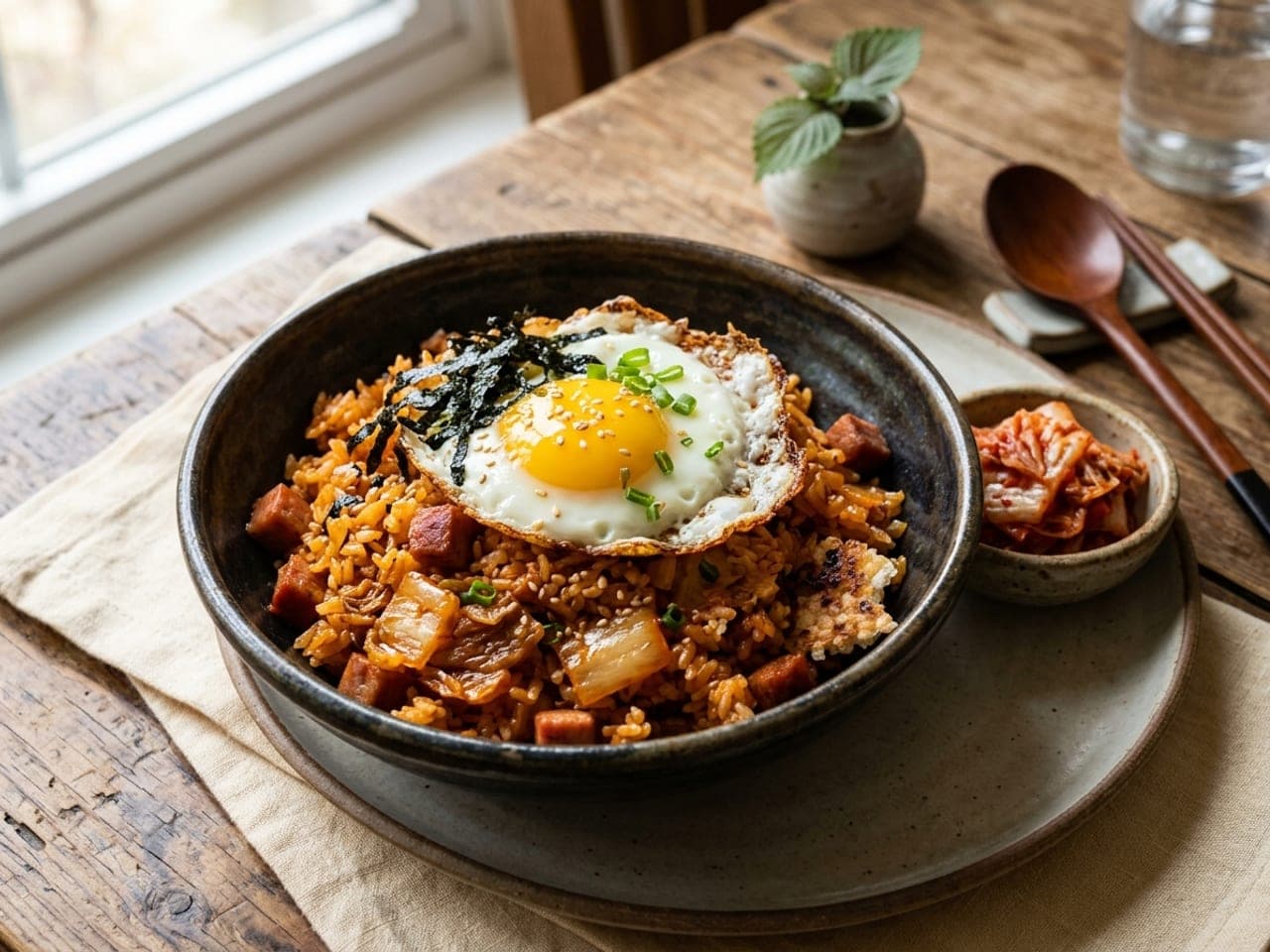
Ingredients
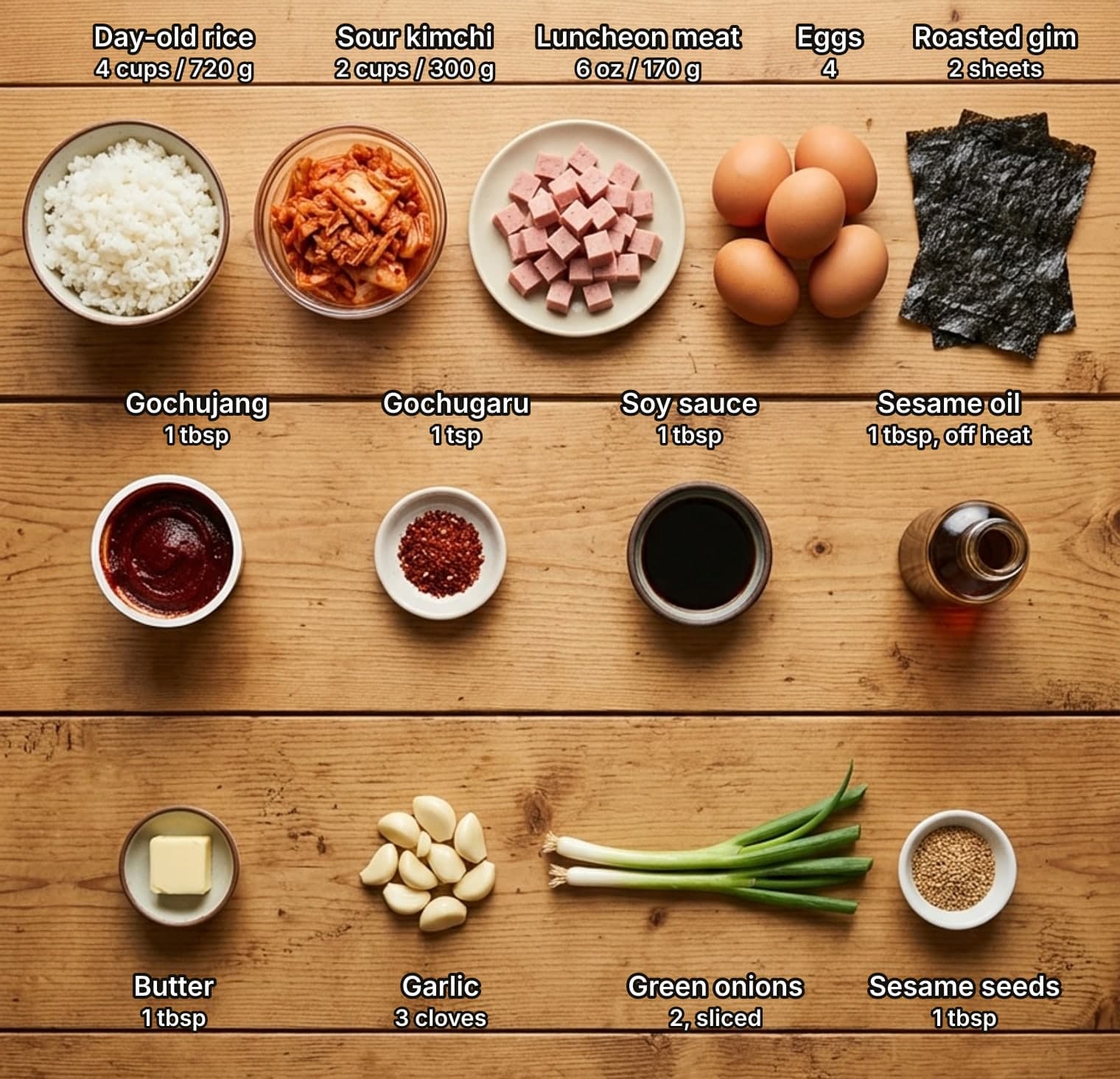
- day-old cooked short-grain rice, cold, clumps broken up (medium-grain works; see the rice ruling in the shopping section)4 cups (720 g)
- well-fermented, sour napa cabbage kimchi, chopped — the older the better (see the sour-kimchi doctrine)2 cups (300 g)
- kimchi juice, straight from the jar — it's seasoning, not waste1/4 cup (60 ml)
- Spam or other luncheon meat, in 1/2-inch (1 cm) dice — or pork belly, thick-cut bacon, or skip it (options in the FAQ)6 oz (170 g)
- neutral oil1 tbsp (2 if cooking meatless)
- butter (swap more oil to keep it dairy-free)1 tbsp
- garlic, minced3 cloves
- gochujang — optional but recommended, bloomed in the fat1 tbsp
- gochugaru (Korean chile flakes) — optional, for heat1 tsp
- soy sauce1 tbsp
- sugar — balances the sour1 tsp
- toasted sesame oil — added off the heat, never fried1 tbsp
- eggs, for frying sunny-side up — one per bowl4
- roasted seaweed (gim), crumbled — or gim jaban, the pre-crumbled seasoned topping2 sheets or 3 tbsp
- green onions (spring onions), thinly sliced2
- toasted sesame seeds1 tbsp
- shredded low-moisture mozzarella — optional, for the modern cheese variant (see FAQ)1/2 cup (55 g)
What kimchi-bokkeumbap is (and why it needs the kimchi you'd almost throw out)
Kimchi-bokkeumbap — kimchi 'stir-fried rice' — is Korean home cooking at its most honest: the dish that happens when the kimchi has fermented past polite, yesterday's rice is sitting in the cooker, and dinner needs to exist in fifteen minutes with one pan. It isn't restaurant food, though restaurants serve it; it's fridge-cleanout food with a national fan base, the Korean sibling of carbonara-at-midnight or beans on toast — except it happens to be one of the best things you can do with a skillet. There's no canonical recipe to violate: households argue butter versus oil, gochujang versus none, Spam versus pork versus tuna versus nothing, and every version is somebody's mother's definitive one.
The dish only makes sense inside the kimchi lifecycle. Fresh kimchi is a crisp, bright side salad; a few weeks in, ripened, it's at its table peak; and past that it turns shin-kimchi — sour kimchi, soft, fizzy at the edges, the cooking stage — which is when the jar's second career begins: kimchi-jjigae (stew), kimchi-jeon (pancakes), and this. (Age it deliberately for months longer and it becomes mugeunji, the deeply aged prize Koreans braise with pork belly — a different destination than tonight's.) The souring isn't decline, it's ripening for a different purpose: fermentation has already broken the cabbage down and built the acids and umami that frying will concentrate into something close to a sauce. That's why the fresh stuff fails here — it hasn't done the work yet. The tradition of making kimchi at scale, kimjang, was inscribed by UNESCO in December 2013 (the listing honors the communal making-and-sharing tradition, not the food itself — the culture is the making, the waiting, and the using-up), and every kimjang household has needed a repertoire for the sour end of the jar ever since jars existed.
Then there's the canned meat, which deserves its history told straight. Spam arrived in Korea with the US military, and in the desperate years after the Korean War, meat scavenged and traded from army bases became the base of budae-jjigae — 'army base stew' — a dish of scarcity that evolved into a beloved comfort food. Spam never left: South Korea became the biggest Spam market in the world outside the US, and gift boxes of it are a genuinely prestigious holiday present at Chuseok. So the diced pink cubes in kimchi fried rice aren't ironic or lazy — they're a taste of modern Korean history, and their salty-fatty chew against the sour rice is exactly right. Use pork belly or bacon if you prefer; just don't apologize for the can.
How to make Kimchi Fried Rice
- Start with kimchi that's past its salad days. Take your oldest, sourest kimchi — the jar that's gone fizzy-sharp and a little translucent, the one you've been avoiding — and chop 2 cups (300 g) of it into bite-size pieces, reserving 1/4 cup (60 ml) of the juice from the jar. That juice is seasoning, not waste. Get everything else — meat diced, garlic minced, gim crumbled, sauces measured — next to the stove before the pan gets hot: this dish moves in one direction. If your kimchi is young and still crunchy-fresh, this is the wrong dish for tonight (or see the FAQ for the aging fix): fresh kimchi fries up like seasoned raw cabbage, while sour kimchi has already done the slow work of becoming a sauce.
- Break up yesterday's rice. Break 4 cups (720 g) of cold, day-old cooked short-grain rice apart with wet hands or a spatula until the clumps give — every grain separate-ish, none mashed. Cold rice has dried at the surface and firmed through (starch does this overnight; the pantry science is in the section below), which is exactly what lets it fry into distinct, chewy grains with crisp edges instead of steaming into porridge. No day-old rice? The tray hack in the FAQ gets fresh rice most of the way there in twenty minutes.
- Render the meat — or don't, it's your fridge. Heat the neutral oil in a wide skillet or wok over medium-high heat and fry the diced luncheon meat (or pork belly or bacon) in a single layer, leaving it alone until the bottoms brown before tossing, 3–4 minutes total, until the edges bronze and the fat renders out. In Korea the canned-meat version is nobody's compromise — it's a beloved standard with its own history, told below. Cooking meatless tonight? Skip straight to the next step with an extra half-tablespoon of oil, and know that the dish loses nothing structural: the kimchi is the engine here.
- Caramelize the kimchi — this is the flavor step. Add the butter to the pan, then the chopped kimchi, and fry for a full 4–5 minutes, stirring now and then, until the edges catch color and the sourness in the air turns sweet-savory. Don't rush this: raw kimchi stirred into rice makes wet, sour rice, but kimchi fried in fat until its sugars caramelize becomes something deeper — jammy, mellow, faintly smoky. This one step is most of the difference between homemade-average and Korean-home-real.
- Bloom the paste and the garlic. Push the kimchi aside, drop the gochujang and garlic into the cleared space, and fry them in the fat for 30–45 seconds until fragrant and a shade darker. Gochujang is optional in the strict sense — plenty of Korean home cooks skip it — but blooming it in fat rather than stirring it in later wakes up the roasted, fermented depth that makes the finished rice taste older than its fifteen minutes. Add the gochugaru now too if you want the heat turned up — and if the garlic is racing toward brown, pull the pan off the heat for a few seconds; burnt garlic will follow you through the whole bowl.
- Rice in — now press, don't stir. Add the rice, the reserved kimchi juice, the soy sauce and the sugar, and toss everything until the rice turns a uniform sunset orange. Then stop stirring. Press the rice flat against the pan with the back of the spatula and leave it alone for 60–90 seconds until you hear crackling; fold it over, press again, repeat two or three times. Those toasted, chewy-crisp patches are the point — Koreans grow up chasing the scorched rice at the bottom of the pot (nurungji), and this is the fried-rice version of that instinct.
- Sesame oil off the heat, always. Kill the heat, drizzle the toasted sesame oil over the rice and give it one last fold. Sesame oil is a finishing perfume, not a frying fat — its aroma burns off within a minute over flame, which is why it goes in last, off the heat, here as in most Korean dishes. Taste now: more kimchi juice if it needs sourness and salt, a pinch more sugar if your kimchi ran especially sharp. (Making the cheese version? Scatter the mozzarella over the rice now, lid on for a minute, and let it slump before the eggs go on.)
- Fry the eggs and build the bowl. In a second pan (or the same one, wiped), fry the eggs sunny-side up in a little oil until the whites are set and the yolks still shake — lacy brown edges are a feature. Mound the rice into bowls, slide an egg on top of each, and finish with crumbled gim, sesame seeds and green onion (spring onion) threads. Breaking the yolk over the rice IS the sauce course: fat and gloss over sour and savory. Anyone who wants their yolk set gets no argument, just quietly less glory.
Safety & hygiene Important
- Rice is the one to respect here. Cooked rice is the ingredient in this dish with a genuine safety story: uncooked rice commonly carries spores of Bacillus cereus, which survive cooking, and if cooked rice sits warm they wake up and produce a toxin that further reheating does NOT destroy — this is why 'just reheat it well' is not a rice strategy. The rules are all about the clock: get cooked rice into a shallow container and into the fridge within an hour or two of cooking (the faster the better), and keep 'day-old' honest — US guidance allows cooked rice 3–4 days refrigerated, while UK NHS/FSA advice is the cautious end at about 24 hours; if your fridge runs warm or the rice sat out after dinner, the UK number is the wiser one. Reheat the finished fried rice once, to steaming hot throughout — 165°F (74°C) — and don't re-refrigerate and reheat it again (the once-only rule is officially the UK's; it's worth adopting everywhere). Rice that spent an evening on the counter isn't an ingredient; it's a lesson.
- The runny yolk, stated honestly. A sunny-side-up egg with a shaking yolk is the canonical finish, and a runny yolk means an egg that isn't fully cooked: a small Salmonella risk that healthy adults routinely accept and vulnerable eaters shouldn't. For pregnant guests, small children, older eaters or anyone immunocompromised, either fry the eggs over-hard until the yolk is set (the dish survives — the yolk becomes garnish instead of sauce) or use pasteurized eggs. (In the UK, the FSA says British Lion-stamped eggs — from Salmonella-vaccinated, traceable flocks; not pasteurized, a different mechanism — can be eaten runny even by pregnant women, children and older people; that advice does not extend to severely immunocompromised diners, who should stick to set yolks or pasteurized eggs.) Usual raw-egg handling applies: hands and anything the shells touched get soap and hot water, no raw egg dripping onto the finished rice, and eggs are a major allergen in their own right — the rice is complete without one.
- The allergens hiding in the jar. The quiet allergen story of this dish is the kimchi itself: most cabbage kimchi is fermented with jeotgal — salted fermented seafood, most often saeu-jeot (salted shrimp) or anchovy fish sauce, sometimes oyster, squid or octopus — which puts crustacean, fish and even mollusc allergens invisibly inside the vegetable component. For an allergic table, the vegan label is a useful shortlist but not the verdict: 'vegan' is a dietary claim, not an allergen guarantee (UK food-safety authorities specifically warn that vegan-labelled foods can still carry may-contain cross-contact), so read the allergen declaration and the 'may contain' line before the jar reaches the pan. That same label — meaning no jeotgal, no fish sauce — is, separately, what makes the dish genuinely vegetarian, since ordinary kimchi already isn't. The rest of the roster: soy and wheat in the soy sauce and gochujang (tamari and a certified gluten-free gochujang close the gluten path, labels not vibes — and check the luncheon-meat can, some brands bind with wheat), sesame in the oil and seeds, egg on top, dairy in the butter (swap oil) and in the cheese variant. Gim is usually just seaweed, salt and oil — but the seasoned varieties are worth a packet check too. Leftovers: fridge within 2 hours in a shallow container, eat within the rice window above, reheat once to 165°F (74°C) — and fry a fresh egg for round two; reheated runny yolks please no one and worry some.
3 ways to plate it
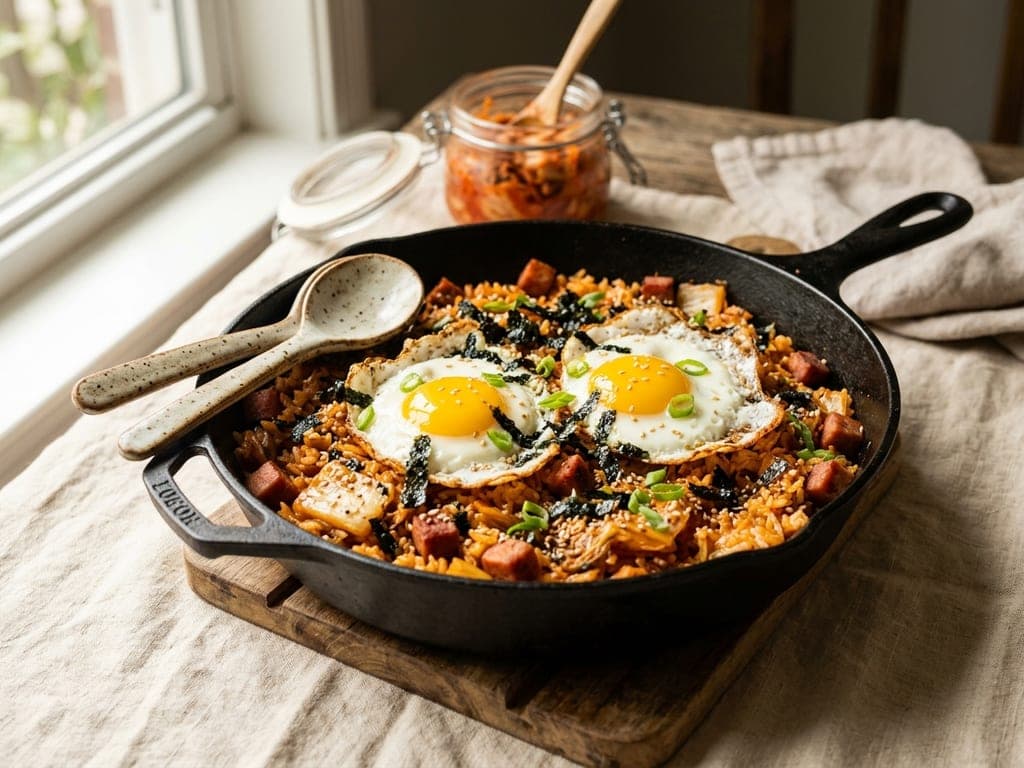
- Leave the rice in the skillet with its crisp patches face-up rather than tossing them under — the browned bits are the trophy.
- Slide the fried eggs on top in the pan, spaced so every serving spoon reaches a yolk.
- Crumble the gim and scatter the sesame and green onion (spring onion) threads over everything at the table, not in the kitchen — the crackle is part of the show.
- Set the kimchi jar itself on the table as its own banchan; nobody has ever complained about more.
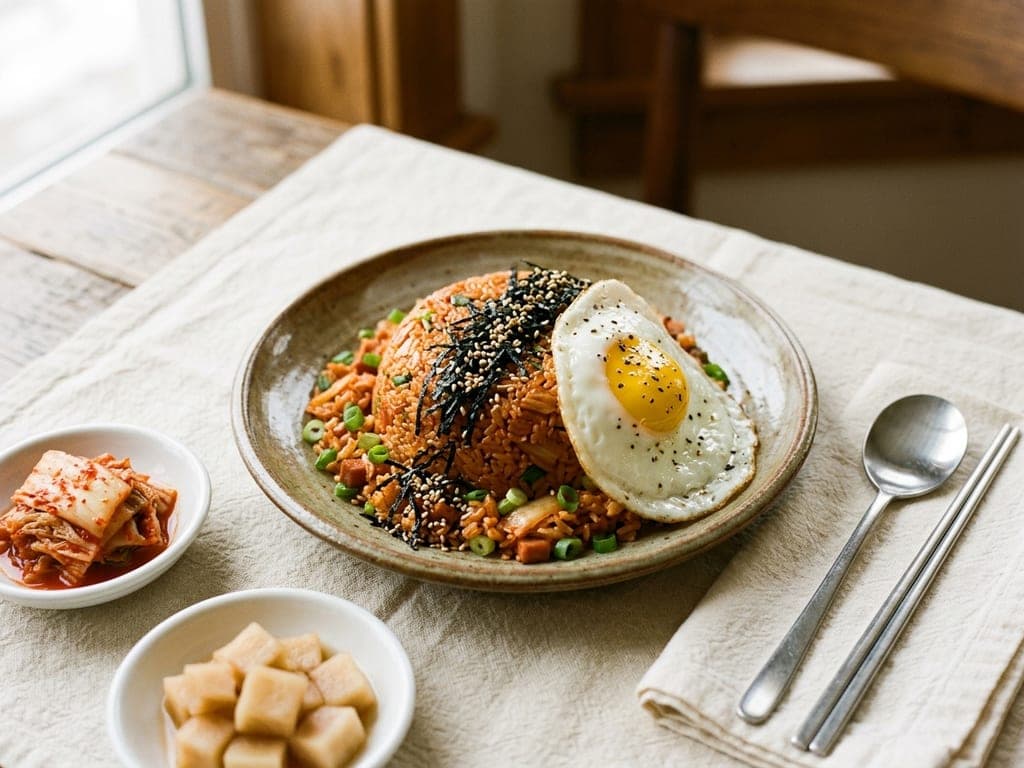
- Pack the hot rice firmly into a small rice bowl, put the plate face-down on top, and flip the pair in one motion — lift the bowl slowly.
- Lean the fried egg against the dome's flank rather than capping it, so the yolk breaks down the slope when cut.
- Stripe the dome with a pinch of gim threads and sesame seeds; put a small dish of extra kimchi and one of pickled radish alongside.
- Serve with a spoon AND chopsticks, Korean-table style — the spoon is for the rice, and it's the one that matters.
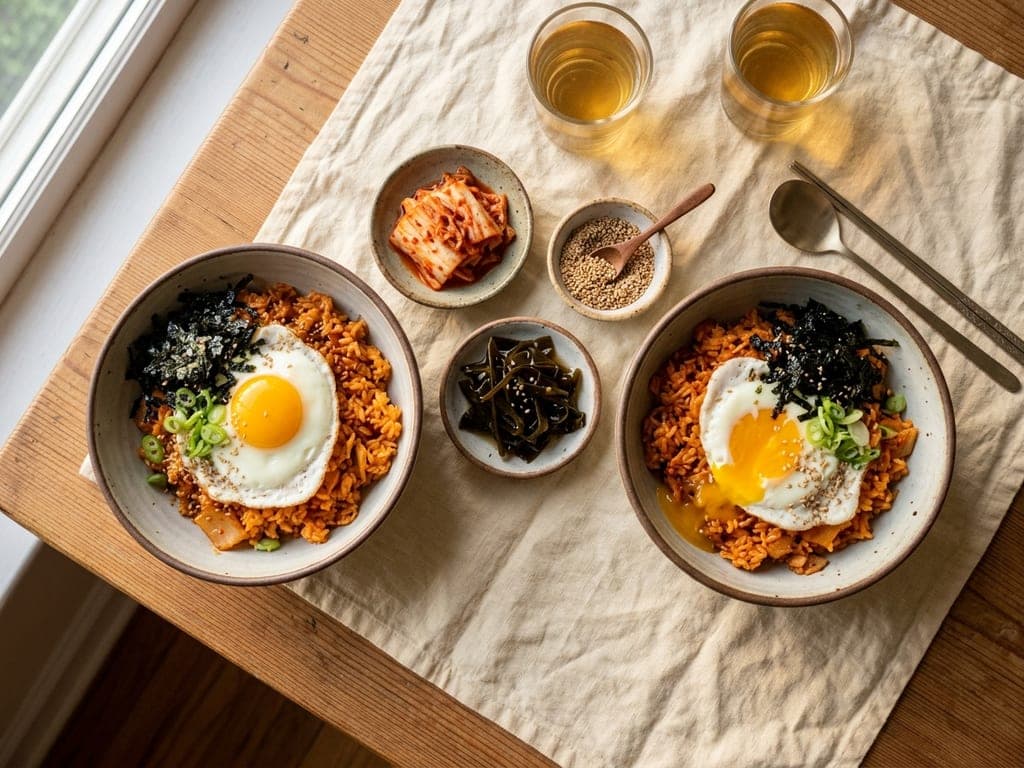
- Mound the rice loosely in deep bowls — height over neatness — with an egg riding each mound.
- Give every diner their own tiny dish of extra kimchi and a shared one of gim strips; odd numbers of small dishes read more Korean than symmetry.
- Put the sesame seeds in a tiny bowl with a spoon so people can add their own crackle.
- Cold barley tea or a lager alongside, and the pan within reach — the crisp bottom layer goes to whoever asks first.
The mechanism: sour kimchi, old rice, hot press
Everything in this dish is a moisture-and-acid negotiation. Sour kimchi brings lactic acid, glutamates and cell walls already softened by fermentation — frying it in fat for a real 4–5 minutes drives off the raw sharpness, caramelizes its sugars, and leaves a jammy, savory base that coats every grain. This is the step home cooks skip and then wonder why their version tastes like rice with cold kimchi in it. The butter isn't ancient tradition (Korean home cooking adopted it enthusiastically within living memory) but it earns its place: milk solids brown against the pan and round the acid off. And the jar juice is the cheat code — fermented, seasoned, garlicky liquid that the dish treats as its stock and its salt at once.
The rice rule is starch science, not superstition. Freshly cooked rice is swollen and surface-wet; overnight in the fridge, its starches retrograde — they re-crystallize and firm — and the surface dries, so the grains hit the pan as separate, sturdy individuals that toast rather than smear. (The tray hack works because it fakes both properties: spread fresh rice thin, and evaporation plus cooling do in twenty minutes a blunter version of what the fridge does overnight.) Then comes the press: flattening the rice against hot steel and leaving it alone builds the toasted crust Koreans are culturally hardwired to chase — nurungji, the scorched rice at the bottom of every traditional pot, reborn as crisp patches in a weeknight skillet. Stir constantly and you'll never get it; press, wait, listen for the crackle.
The finish is a two-part perfume-and-sauce move. Toasted sesame oil goes in off the heat because its aroma compounds are volatile — thirty seconds over flame and it's just generic fat, which is why 'fry in sesame oil' is the most common Korean-food mistake in Western kitchens. And the egg on top isn't garnish: a broken sunny-side yolk is the dish's sauce course, fat and richness dragged through sour-savory rice, which is why the yolk should shake when the bowl lands. Gim — roasted, salted seaweed, crumbled over everything — adds the crackly salt-and-ocean top note that ties the bowl together.
Shopping honestly: the jar, the can, the sheet
Supermarket kimchi is completely legitimate here, and the two names you'll actually find are Jongga (also spelled Chongga) and Bibigo — either makes a proper napa cabbage kimchi (baechu-kimchi, the default kind; that's what you want, not radish or cucumber styles). Buy it further ahead than you need it: a sealed jar in the fridge keeps fermenting slowly, and the 'too sour' complaint on the review page is this recipe's shopping tip. Check the label for two things — jeotgal (salted fermented seafood: shrimp, anchovy, sometimes oyster or squid) and fish sauce (their absence is what 'vegan' means on a kimchi label — both brands sell vegan kimchi, Jongga's the more shelf-visible in Western stores, Bibigo's under its PlanTable line, availability varying by market), and heat level, which varies by brand more than any label admits. Don't assume the vegetable picture on the front has anything to do with vegetarian cooking.
On the can: buy actual Spam or any luncheon meat you like, and if wheat is a concern read the binder ingredients. The alternatives ladder honestly: thick-cut bacon brings smoke the original doesn't have (pleasant, but noticeably American), pork belly is the butcher-counter upgrade, canned tuna — drained, folded in at the end — is a common Korean home variant, and mushrooms fried hard in the meat slot make the best vegan version. What you shouldn't do is use something lean and polite like chicken breast; this dish wants fat that renders, because the kimchi fries in it.
Gim is roasted seaweed: flat sheets from the sushi-nori aisle work crumbled, and the actually-ideal product is gim jaban — pre-crumbled, seasoned seaweed flakes sold in tubs and pouches precisely for scattering over rice dishes like this one. The chip-aisle snack seaweed sits in between: saltier and oilier than sheets, and fine in a pinch if you crumble it with restraint. Rice: short-grain (sushi-style) is correct — its plumpness and slight cling are what make the pressed crust cohere — but the honest truth is that day-old long-grain works in a pinch and makes a looser, more Chinese-style bowl; medium-grain 'calrose' splits the difference and is what half the Korean diaspora uses anyway. What matters far more than the grain is the day-old part.
Questions, answered
My kimchi is fresh and crunchy — can I still make this?
Tonight? You'll get a lesser dish — fresh kimchi fries up like seasoned cabbage because fermentation hasn't yet built the acids and depth this recipe runs on. The fix is patience: leave the jar out on the counter for a day or two with the lid loosened a crack — fermenting jars build real pressure — and it will sour dramatically at room temperature; then tighten and refrigerate. The emergency patch for cooking right now: add an extra tablespoon of kimchi juice, a teaspoon of rice vinegar and a pinch more sugar and gochugaru to fake the age. And from now on, buy kimchi a few weeks before you need it — the fridge does the work.
Is day-old rice really necessary?
It's the difference between fried rice and sautéed porridge. Fresh rice is surface-wet and soft, so it smears and steams; refrigerated overnight, the starches firm and the surface dries, and the grains toast individually. The twenty-minute fake: spread just-cooked rice one grain deep on a sheet pan (baking tray) and park it in the fridge uncovered — no plastic wrap (cling film), which just traps the steam you're trying to lose; evaporation and cooling get you most of the way. What you shouldn't do is deliberately leave rice out for hours to 'age' it; that's the one genuinely risky move in this dish (see the rice safety note).
Spam? Seriously?
Seriously, and respectfully. Canned luncheon meat entered Korean cooking through US army bases during and after the Korean War, became the backbone of budae-jjigae ('army base stew'), and never left — South Korea is the world's second-biggest Spam market after the US itself, and holiday gift sets of it are genuinely prestigious. In this dish its salty, browning-friendly fat is exactly what the sour rice wants. If the can isn't your thing: pork belly, thick-cut bacon, drained canned tuna, or hard-fried mushrooms all hold the slot honorably.
Is kimchi fried rice vegetarian?
Usually not, and the reason hides in the jar: most cabbage kimchi is fermented with jeotgal — salted fermented seafood, typically shrimp or anchovy — and/or fish sauce, so the 'vegetable' component quietly contains crustacean and fish (and sometimes mollusc). Kimchi labelled vegan — a real supermarket category from the major brands — omits both, and from there the vegetarian version is easy: skip the meat, fry the kimchi in butter or oil, keep the egg. Fully vegan: vegan kimchi, oil instead of butter, mushrooms in the meat slot, no egg — and a little extra gochujang where the egg's richness would have been.
What about the cheese version?
Real, modern, and glorious in its way: about 1/2 cup (55 g) of shredded low-moisture mozzarella over the finished rice, lid on for a minute until it melts into pull-able strings — a thoroughly modern move, part of the cheese-on-everything wave that has swept Korean comfort food since the 1990s (cheese arrived in Korean home cooking the same enthusiastic way butter did). It softens the sour edge, which makes it the single best gateway version for kids and kimchi skeptics. Purists eat it happily at midnight and deny it at noon. If you make it, keep the egg — yolk plus cheese is excess in the correct direction.
How spicy is it, and what's the kid-table plan?
As spicy as your kimchi plus your choices — the dish itself adds heat only through the optional gochujang and gochugaru. With mild kimchi and both left out, it lands at 'warm', and the butter, egg and cheese versions all pull it milder. For a kid-friendly bowl: younger, less sour kimchi (heresy for adults, correct for children), no gochugaru, cheese on top, yolk set. To push the other way: sour kimchi, the full gochugaru, and an extra spoon of gochujang bloomed dark in the fat.
How do I store and reheat leftovers — isn't rice risky?
Rice has one real rule-set and it's about time, not reheating power: Bacillus cereus spores survive cooking and can build a heat-stable toxin if rice sits warm, so cooked rice goes into the fridge within an hour or two, full stop. US guidance allows refrigerated cooked rice 3–4 days; UK advice caps it around 24 hours — if in doubt, the shorter clock wins. The finished fried rice reheats ONCE, to properly steaming (165°F / 74°C), ideally back in a skillet where it re-crisps rather than in the microwave where it steams. Fry a fresh egg for the reheat; a reheated runny yolk is both sad and unwise.
How is this different from Chinese fried rice?
Philosophically: Chinese fried rice chases wok hei — breath-of-the-wok char from violent heat, with the rice itself as the star and seasonings kept minimal. Kimchi-bokkeumbap doesn't need the inferno, because the kimchi IS the sauce: medium-high heat in an ordinary skillet is fully authentic, the flavor comes from caramelized fermented cabbage rather than smoke, and the texture goal is jammy-with-crisp-patches rather than each-grain-dancing. It's also why the Korean version forgives a home stove that would embarrass a wok recipe. Different physics, both correct.
What do I serve with kimchi fried rice?
It's a complete one-bowl meal by design — egg on top, gim, done — and in Korea it's exactly what gets made from the fridge the morning after a chimaek night, which makes it the official second act of this site's Korean fried chicken. As a table: a couple of banchan-style small dishes (more kimchi, cucumber, the chicken's pickled radish if any survived), or serve it alongside bulgogi when you want a Korean spread where the rice course brings its own personality. A fried-egg upgrade for guests: one extra egg per bowl, because the yolk is the sauce and seconds are real.
Snap your finished plate and let the AI plate it again — more beautifully.