Bulgogi Recipe (Korean BBQ Beef — the Slice and the Sear Decide It)
Korea's 'fire meat': paper-thin beef in a sweet soy-pear marinade, seared hard and fast so the sugars caramelize instead of stewing. The recipe is mostly two disciplines — a partial freeze that makes the thin slice possible, and a ripping-hot pan worked in small batches — plus an honest answer for the day the only pear at the store is a Conference.
Ingredients
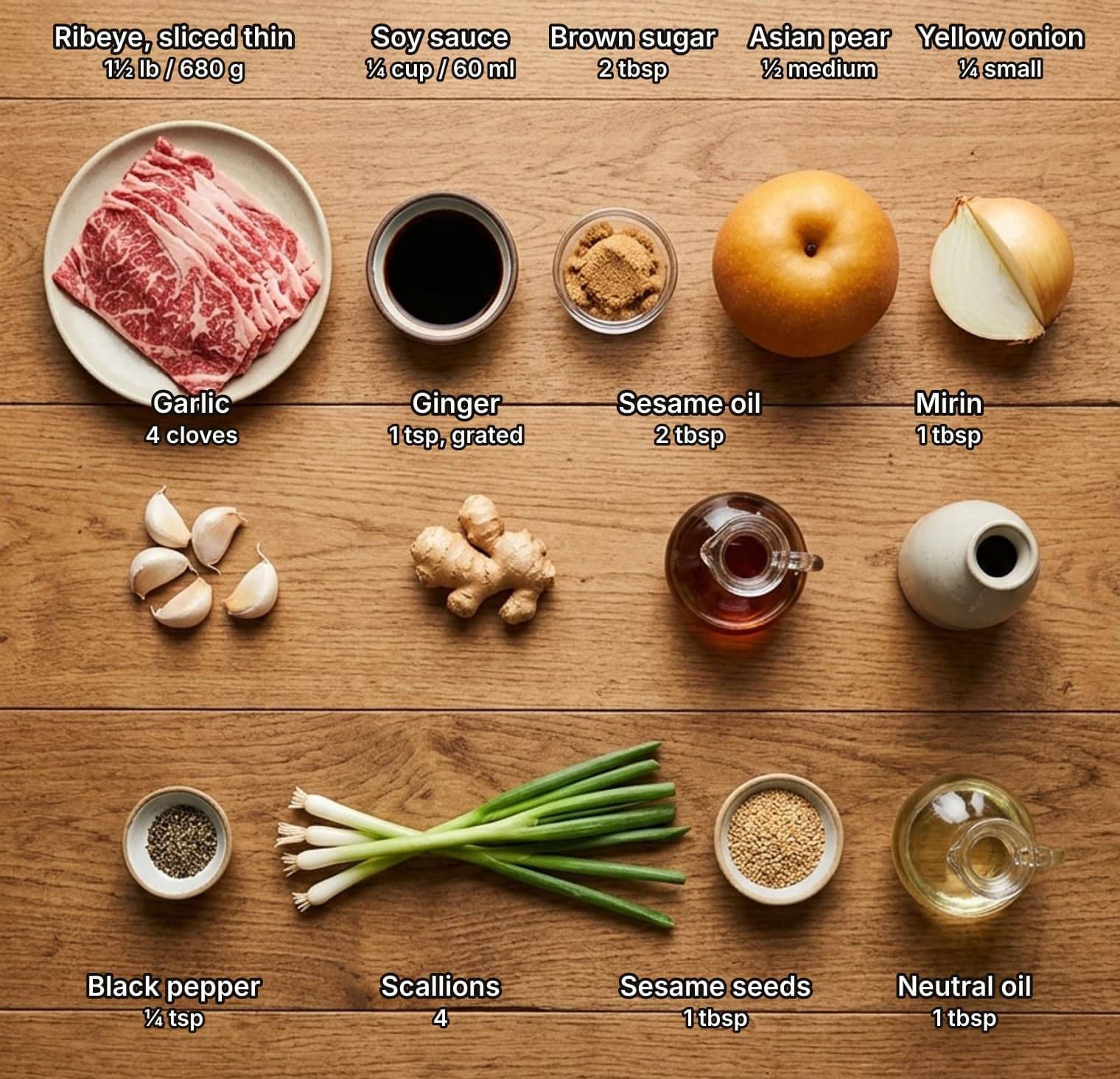
- boneless ribeye, chuck eye or well-marbled top sirloin — or a pre-sliced bulgogi tray from a Korean market1 1/2 lb (680 g)
- soy sauce (all-purpose soy — Korean jin or yangjo ganjang, or Japanese koikuchi; not soup soy, not sweet soy)1/4 cup (60 ml)
- packed brown sugar2 tbsp
- Asian pear (sold as nashi or Korean pear in Europe), peeled and finely grated — see the shopping section for substitutes1/2 medium, about 1/3 cup (80 g) pulp
- yellow onion, finely grated1/4 small, about 3 tbsp
- garlic, finely grated4 cloves
- fresh ginger, finely grated1 tsp
- toasted sesame oil2 tbsp
- mirin or cheongju (Korean rice wine) — optional but traditional1 tbsp
- freshly ground black pepper1/4 tsp
- scallions (spring onions) — whites thinly sliced for the marinade, greens in 2-inch (5 cm) lengths for the pan4
- toasted sesame seeds1 tbsp
- neutral oil, for the pan1 tbsp, plus more between batches
- steamed short-grain rice, lettuce leaves, ssamjang and kimchi, to serve
Fire meat: what bulgogi is — and is not
Bulgogi — 불고기, literally 'fire meat' — is the dish most Koreans would hand a foreigner first: thin beef in a sweet soy marinade, cooked fast over serious heat, mild enough for children and good enough for company. Its lineage is usually traced through maekjeok, the skewered meat associated with the ancient Goguryeo kingdom, to neobiani, the 'wide-flattened' marinated beef of the Joseon royal court — which makes bulgogi, by way of a very long game of telephone, palace food that ended up on every extended family's table grill. The through-line across those centuries is the idea, not the recipe: beef made luxurious by knife work and a sweet-savory glaze rather than by expensive cuts left whole.
It is not a synonym for Korean barbecue, and the menu words are worth keeping straight: galbi is short rib in a related but thicker marinade with a bone to manage, samgyeopsal is unmarinated pork belly, yukhoe is the raw cousin. Bulgogi itself comes in famous regional styles. The seared style this page teaches — beef caramelized dry over high heat, closest to the charcoal-grilled bulgogi of Gwangyang (Eonyang, near Ulsan, grills a third celebrated dry style of finely chopped, pressed beef) — is what most Western diners mean by the word. But across much of Seoul, bulgogi arrives as Seoul-sik bulgogi, the 'old-style' Seoul version: the same marinated beef simmered on a domed tabletop pan whose moat fills with sweet broth that glass noodles and mushrooms drown in happily. Neither is more correct; one is a sear and one is nearly a soup, and this marinade works for both — a splash of water and some enoki in a shallow pan and you've crossed over.
At a Korean table, bulgogi is rarely a lone centerpiece the way a steak is — and the home version was never the charcoal show anyway; in a Korean apartment it's a frying pan or that domed bulgogi pan, not a brazier. It lands alongside rice, a small crowd of banchan, a lettuce pile and a tub of ssamjang, and it's assembled bite by bite rather than plated. That context is worth keeping even in a Tuesday kitchen: the sweet beef needs the plain rice and the sharp kimchi the way the kimchi needs the beef.
How to make Bulgogi
- Buy ribeye — or the tray that decides it for you. If you have a Korean market, the decision is already made: buy the tray labeled bulgogi, which is ribeye or sirloin shaved to about 1/8 inch (3 mm) on a machine your knife will never beat — that tray isn't a shortcut around the dish, it IS the dish. (Don't grab chadolbaegi by mistake — that's paper-thin unmarinated brisket meant for grilling plain at KBBQ or dropping into shabu; a different dish, not a bulgogi shortcut.) At a regular supermarket, buy a boneless ribeye or well-marbled top sirloin at least 1 inch (2.5 cm) thick; chuck eye is the value pick with most of ribeye's character. Skip lean round, stew cubes and anything pre-cut into thick 'stir-fry strips' — those are how bulgogi gets its reputation for chew.
- Freeze the beef halfway — the slice is the recipe. Put the beef on a plate in the freezer for 35–60 minutes depending on thickness, until it is firm at the edges and stiff but still giving under a fingertip — never frozen through. This is the step that separates homemade bulgogi from the restaurant version, because the target is about 1/8 inch (3 mm), and soft raw beef simply will not slice that thin; it smears and tears no matter how good the knife. If the meat softens while you work, send it back to the freezer for 10 minutes and carry on. Pre-sliced tray buyers: skip straight to the marinade and feel no guilt.
- Slice thin, across the grain, with your longest knife. Find the direction of the muscle fibers and slice across them, not along them, in long smooth strokes — aim for 1/8 inch (3 mm) or thinner, tilting the blade for wider sheets if that helps. Across the grain is non-negotiable: bulgogi is chewed in soft sheets, and a with-the-grain slice turns the same beef into rubber bands. Some slices will be wider than others; consistency matters less here than it does on a skewer, because everything cooks in seconds anyway. Lay the slices out as you go rather than piling them — they'll take the marinade evenly and separate easily later.
- Grate the wet things — the pear and onion ARE the marinade. On the fine side of a box grater (or in a small food processor), grate the pear and the onion to a wet pulp, catching every drop of juice. Whisk the pulp in a large bowl with 1/4 cup (60 ml) soy sauce, 2 tbsp brown sugar, the garlic, ginger, 2 tbsp sesame oil, the mirin if using, the black pepper and the sliced scallion whites. The pear is doing three jobs: a clean fruit sweetness white sugar can't fake, moisture, and a mild enzymatic nudge toward tenderness — gently, which is exactly why Korean cooks reach for pear rather than kiwi or pineapple, whose enzymes are aggressive enough to turn 3 mm beef to paste. The grated onion is the marinade's backbone seasoning; nobody tastes it as onion, everybody misses it when it's gone.
- Thirty minutes is enough — and know when longer stops helping. Add the beef to the bowl and massage the marinade in with your hands for a full minute, separating the slices so every face gets coated, then cover and refrigerate. Slices this thin are nearly all surface, so 30 minutes genuinely seasons them; one to four hours is the sweet spot if dinner allows it. Overnight is traditional and fine — plenty of Korean kitchens do exactly that — just know the trade: flavor gets deeper and saltier while the texture drifts a shade softer, which is why one to four hours is this page's preference. The hard time limit belongs to the wrong fruits, not the clock — see the pear substitutes. Marinating always happens in the refrigerator; the safety notes have the clock.
- Drain like you mean it, then heat the pan past polite. Lift the beef out by the handful and let the excess marinade drip back — really let it drip, with a light squeeze; toss the scallion greens through the drained meat. Wet beef is the great bulgogi failure: the liquid floods the pan and the meat boils grey in its own soy-pear juice instead of browning, and what clings after a good squeeze is precisely enough to caramelize. The spent marinade has held raw beef — the trash, or a hard one-minute boil for a table drizzle; the cleaner move is spooning off a few tablespoons before the beef ever went in (safety notes rule on this). Now set your widest cast-iron or carbon-steel skillet over high heat for a genuine 3–4 minutes, until 1 tbsp of neutral oil shimmers and just begins to smoke; turn on the extractor and crack a window, because properly made indoor bulgogi produces a little honest smoke.
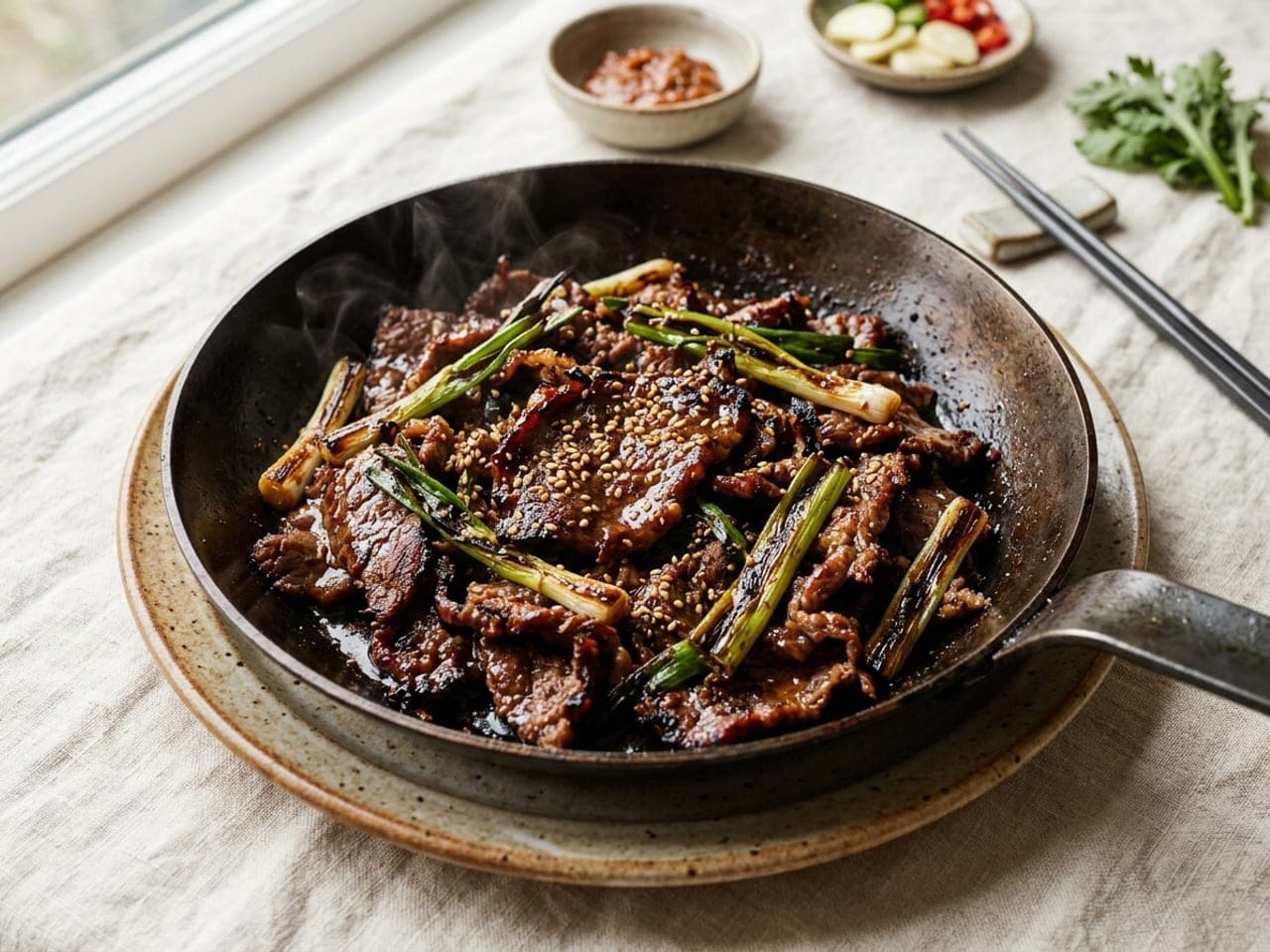
- Sear in stingy batches — crowding is steaming. Lay in a loose single layer of beef — a third of the bowl at most; it should look like you were cheap with it, and it should sizzle furiously on contact. Leave it alone for 45–90 seconds until the underside browns and the sugar starts to catch, then toss and give it 30–60 seconds more, until just cooked through with dark caramelized patches. Tip the batch onto a warm plate, add a film of oil if the pan looks dry, and give the pan a good half-minute to roar back before the next round. Three modest batches beat one heroic dump every time — the pan's stored heat is a budget, and a crowded pan spends it all at once. This much heat feels wrong with a sugary marinade, but the sugar-burn problem is solved by time, not temperature: each batch is out before caramel can cross into carbon. If your kitchen owns a tabletop butane grill, this is its moment — cook at the table Korean-style and the batch problem disappears one tong-load at a time.
- Finish with sesame and serve it the Korean way — immediately. Pile all the beef back together off the heat, scatter over the toasted sesame seeds, and taste a piece: it should be savory-sweet, glossy, and tender enough to pull apart with chopsticks. Flat? A few drops of soy and a pinch of sugar tossed through the residual heat wake it up. Then to the table while it still glistens — bulgogi has no resting period and does not improve by waiting. Serve it over steamed short-grain rice as a bowl, or do it properly as ssam: a lettuce leaf in the palm, a pinch of rice, a slice or two of beef, a dab of ssamjang, folded into one perfect bite. Kimchi and whatever banchan the fridge offers turn it from a recipe into a Korean dinner; leftovers, if they exist, are tomorrow's best-case fried rice.
Safety & hygiene Important
- The marinade held raw beef — treat it like raw beef. Everything the raw beef and its marinade touched — the board and knife that sliced it, the bowl, the grater, the tongs that loaded the pan, your hands — is on raw-meat rules until hot soapy water says otherwise, and the tongs that placed raw beef in the pan don't serve the finished platter. Want a table drizzle? The clean move is reserving a few spoonfuls of marinade before the beef ever goes in. The spent marinade itself gets two options: the trash, or a rolling boil in a small saucepan — boiling before reuse is USDA's rule for any raw-meat marinade; the full minute is our margin. Never brush it over cooked beef cold, and never leave it on the counter 'for later'.
- Marinate cold, and mind the two-hour clock. Marinating happens in the refrigerator, full stop — room-temperature marinating is a bacterial head start dressed up as convenience, and a thin-sliced pile of beef warms into the danger zone faster than a roast ever would. Tabletop grilling doubles the rules rather than suspending them: the raw platter at the table rides the same clock — keep it small and replenish from the fridge — and the chopsticks or tongs that lay raw beef on the grill never carry cooked beef to a plate. The standard clock applies at both ends: raw beef stays out no longer than it takes to slice and sauce it, and the cooked platter goes into the fridge within 2 hours of leaving the pan (1 hour if the kitchen is above 90°F/32°C). Doneness is the easy part: USDA calls intact beef done at 145°F (63°C) with a rest, and ribbons this thin blow past that the moment they brown — under a soy-sugar glaze, browned-through and no longer translucent is your test, and it happens in seconds.
- Leftovers and the freezer play. Cooked bulgogi keeps 3 to 4 days refrigerated and reheats best in a hot skillet, fast, until properly steaming — 165°F (74°C) is USDA's reheat line — because the microwave turns caramelized edges to sweet steam. The genuinely useful storage move happens before cooking: raw sliced beef in its marinade, pressed flat in a freezer bag with the air squeezed out, holds up to 2 months and marinates itself on the way down and again as it thaws overnight in the fridge — never on the counter. (Freezing the sliced beef plain and marinating on cooking day keeps the texture a shade firmer, if you plan that far ahead.) Thaw fully and pat off the excess before searing, or you're back to the crowded-wet-pan problem the recipe just spent two steps solving.
3 ways to plate it
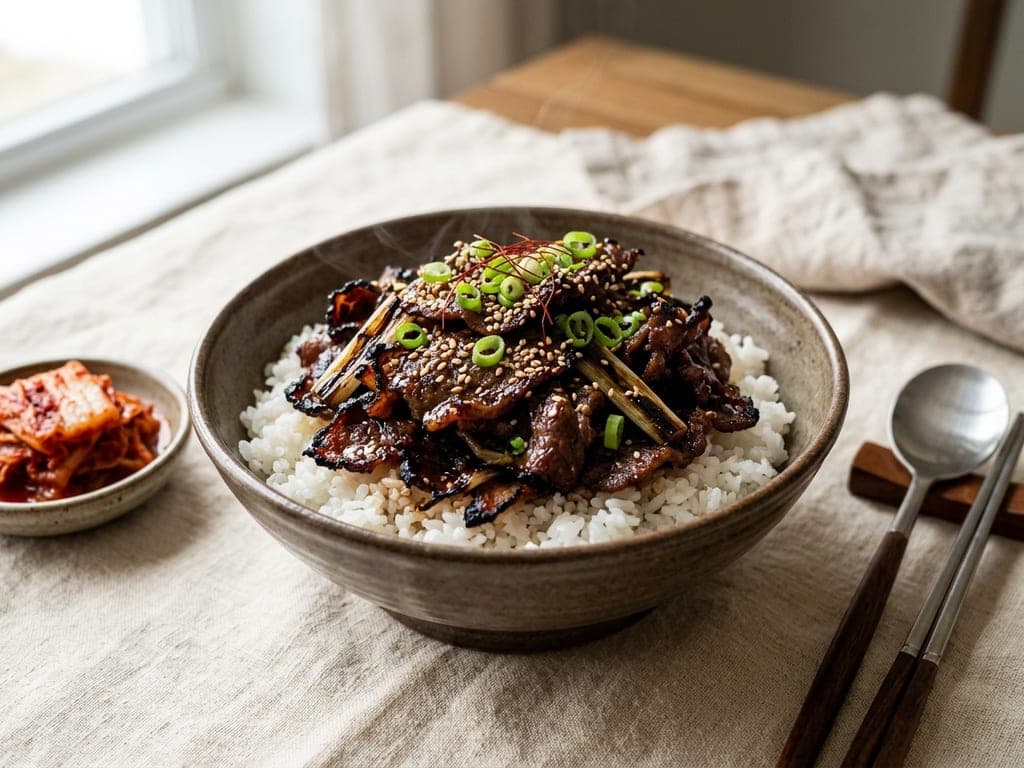
- Mound hot short-grain rice in a deep bowl — a real mound, not a flat layer; the bowl format wants height for the beef to drape over.
- Pile the beef and its charred scallions on while both are still glossy from the pan, letting a little of the clinging glaze run down into the rice below.
- Scatter toasted sesame seeds and a few thin rings of raw scallion over the top for the fresh-against-caramelized contrast.
- Put a small dish of kimchi beside the bowl, and serve with a spoon as well as chopsticks — the glaze-soaked rice at the bottom is the best three bites of the dish.
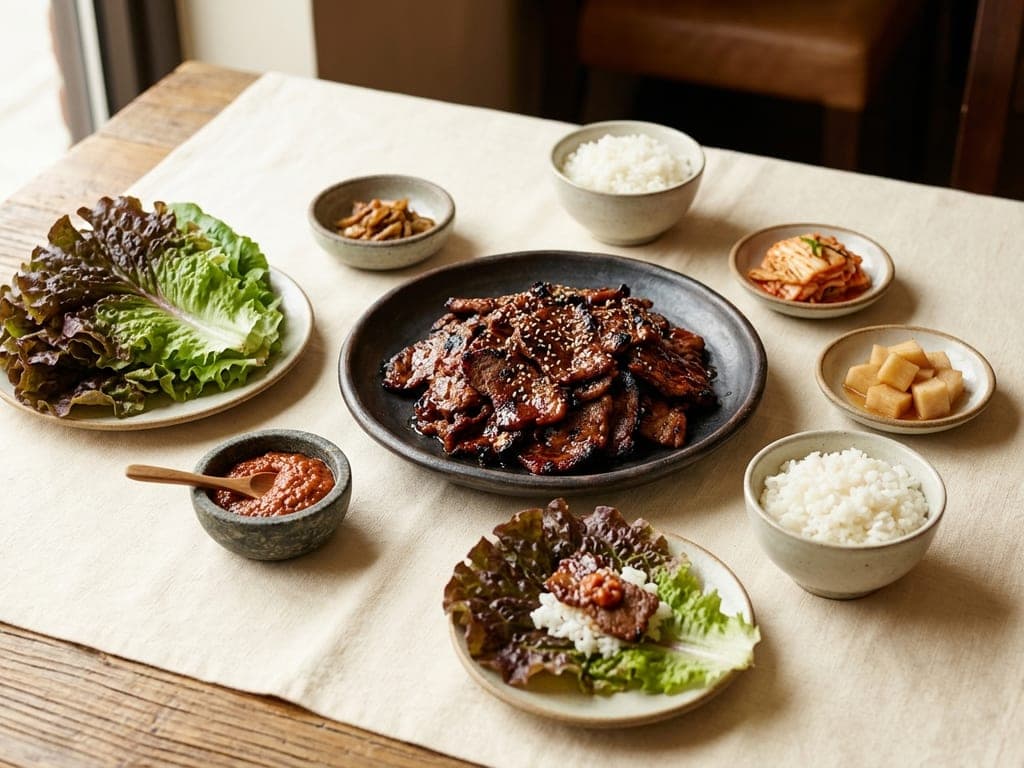
- Give the beef its own platter at the center — dark ceramic makes the mahogany glaze glow — and let everything else orbit it in genuinely small bowls.
- Stack washed, whole lettuce leaves (red-leaf and butter both fold well) loosely on a plate; a neat fan wilts, a loose stack invites hands.
- Set out ssamjang in a small stone or ceramic bowl with its own spoon, plus individual rice bowls and at least kimchi — mismatched ceramics read more Korean than a matched set.
- Build one wrap as a demonstration and leave it on the platter's edge: leaf, pinch of rice, slice of beef, dab of ssamjang — the loaded leaf teaches the format faster than any explanation.
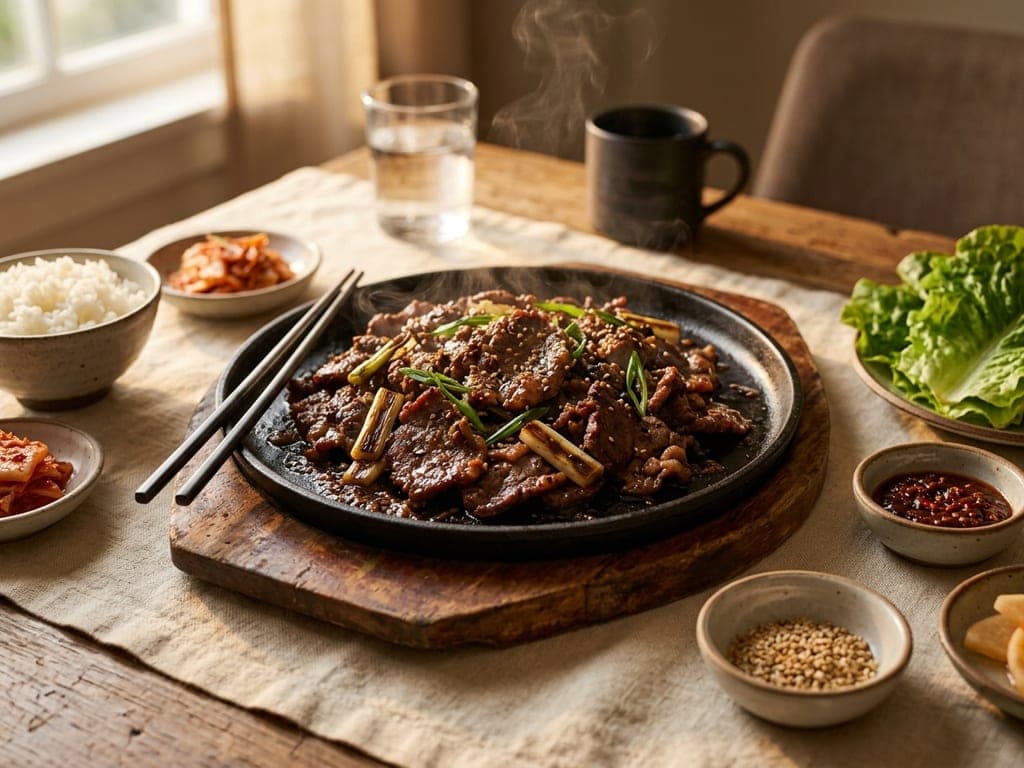
- Heat a cast-iron sizzle platter (or simply carry the cooking skillet) so the beef arrives at the table steaming and faintly crackling on hot metal over a wooden trivet.
- Pile the beef loosely with its scallions rather than spreading it flat — height holds heat, and the loose pile shows off the frilled, charred edges.
- Cluster the supporting bowls — rice, kimchi, ssamjang, lettuce — close around the platter so the table reads as one shared meal, not place settings.
- Serve with long chopsticks or tongs resting on the platter's edge and let people take from the center — the shared-pan ritual is half of what makes bulgogi taste like Korea.
The two decisions: the slice and the sear
Every bulgogi that disappoints failed one of two moments, and neither is the marinade. The first is the slice. Bulgogi's tenderness is mostly geometry: at 1/8 inch (3 mm), across the grain, any decently marbled beef eats soft, because no muscle fiber is long enough to fight back — and at that thickness the marinade doesn't need hours, since there's barely any 'inside' for flavor to reach. The partial freeze exists purely to make that geometry achievable with a home knife; it isn't cheffy technique, it's a workaround for the fact that Korean butchers own a deli slicer and you don't.
The second decision is the sear, and it's really a decision about water. This marinade is mostly liquid, and liquid is the enemy of browning: pile the wet beef into one pan and the temperature crashes, the juices pool, and the beef simmers to sweet grey — technically cooked, spiritually boiled. A restaurant tabletop grill cheats in your favor here — fat and juice drain away, flame hits from below, and nobody stacks three layers of meat on one grate. At home the honest equivalent is a preheated cast-iron or carbon-steel pan and the three-batch discipline: drain hard, cook loose, let the pan recover. High heat plus short time is what lets a sugary marinade caramelize without burning; low heat plus long time gives the sugar every opportunity to do both wrong things at once.
The tabletop butane grill deserves its own honest paragraph: restaurant bulgogi tastes the way it does partly because it's cooked in front of you in single layers over sustained heat, seconds before eating. A butane burner and a grill plate at the table reproduce that completely — a modest appliance and the single best upgrade for Korean cooking at home. An outdoor grill adds the one thing a skillet can't, real smoke — use a grill basket or perforated pan so the slices don't fall through the grates. Failing both, the broiler (the overhead grill) is a workable route: beef spread in one layer on a foil-lined sheet, 3–4 minutes under maximum heat, no flip needed on slices this thin — just don't walk away from sugar under a broiler element.
Shopping honestly: the cut, the pear, the pantry
The cut question has a luxurious answer and a practical one. Ribeye is the classic and still the benchmark — its marbling self-bastes at high heat and forgives the extra thirty seconds. Chuck eye delivers most of ribeye's character at two-thirds the price; well-marbled top sirloin is the lean-but-honest budget pick; and if you spot boneless short rib or chuck flap (often labeled boneless short ribs or Korean-style BBQ cut), take it — it's the same rich muscle as galbi without the bone. What to avoid is very lean round or anything labeled for stewing: with no fat in the sheet, thin beef goes from tender to dry papery in the pan, and no marinade rescues it. Any Korean market — and increasingly the freezer aisle of big Asian grocers — sells 'bulgogi beef' pre-sliced; frozen slabs of it thaw in the fridge overnight and are the correct weeknight answer.
The pear earns its mythology, with an asterisk. Korean bae is a huge, crisp, almost apple-textured pear — round, russet-to-pale-yellow, heavy for its size; in Europe look for it sold as nashi — and grated to pulp it gives the marinade a fresh sweetness plain sugar can't imitate, plus a mild enzymatic assist on the meat's surface. The honest ranking of substitutes: a juicy sweet apple like a Fuji plus a small pinch of extra sugar (very close, and always in the fruit bowl), a ripe ordinary pear (close on sweetness, softer in character), or simply an extra 1/2 tbsp of sugar and 1 tbsp of water — bulgogi existed before supermarkets, and it survives. The one substitution to refuse is the internet's favorite: kiwi. Its protease is an order of magnitude more aggressive than pear's, and on 3 mm beef it doesn't tenderize, it digests — twenty minutes too long and the surface turns to wet felt. Pineapple plays the same trick.
The rest is pantry fine print. Soy sauce means all-purpose soy — Korean jin ganjang (the everyday cooking soy, usually a brewed-plus-hydrolyzed blend) and yangjo ganjang (100% naturally brewed) both work, as does any Japanese koikuchi — not Korean soup soy (guk ganjang, far saltier, a different job) and not Indonesian-style sweet soy, which would double the sugar. Sesame oil means the dark, toasted, aggressively nutty kind, and it's a seasoning, not a frying oil — it goes in the marinade and stays off the direct heat otherwise. Mirin or cheongju adds gloss and rounds the soy's edges; skip it rather than substitute a harsh wine. And the sesame seeds should be toasted ones from a jar opened this year — stale sesame is the quietest way to make a fresh dish taste tired.
Questions, answered
What if I can't find Asian pear?
Grate a juicy sweet apple (Fuji or Gala) and add an extra teaspoon of sugar — you lose a little floral sweetness and some of the mild enzyme assist, and the beef still tastes like bulgogi. A ripe ordinary pear also works; plain extra sugar and a splash of water is the no-fruit fallback. Do not 'upgrade' to kiwi or pineapple: their enzymes are far too aggressive for 1/8-inch (3 mm) beef and will turn it mealy in under an hour.
What's the best cut of beef for bulgogi?
Ribeye is the benchmark — the marbling keeps 3 mm slices juicy at high heat. Chuck eye is the value pick, well-marbled top sirloin the lean-but-workable one, and boneless short rib or chuck flap is a quiet upgrade if your store carries it. Skip eye of round, stew meat and pre-cut 'stir-fry strips'. The pre-sliced bulgogi tray at a Korean market beats anything you'll slice at home — just don't confuse it with chadolbaegi — paper-thin unmarinated brisket for grilling plain or shabu, a different dish.
How long should bulgogi marinate?
30 minutes genuinely works — slices this thin are nearly all surface. One to four hours is the sweet spot. Overnight is traditional and works — expect deeper, saltier flavor and a slightly softer texture, which is why 1–4 hours is this page's preference. (With kiwi, pineapple or a lot of apple in the bowl, overnight IS a problem.) Need to prep further ahead? Freeze the beef instead — see the freezing answer.
Why did my bulgogi come out grey and watery instead of caramelized?
One of three fixable sins, possibly all at once: the beef went in wet (drain hard and squeeze each handful), the pan wasn't hot enough (a genuine 3–4 minute preheat, until the oil shimmers), or the pan was crowded (thirds, with 20–30 seconds of recovery between batches). The marinade is mostly water — the entire cooking method is a campaign against that water.
Can I cook bulgogi on an outdoor grill, a tabletop grill or under the broiler?
All three. An outdoor grill is the one method that adds real smoke — use a grill basket or perforated pan so the slices don't fall through, same high heat, same batch logic. A Korean tabletop grill is the restaurant default and drains the juices as it cooks; if you own one, this marinade is what it's for. The broiler (the overhead grill) works too: one layer on a foil-lined sheet, 3–4 minutes under maximum heat (a weak broiler may want 5–6), no flip needed — but stay with it; it's sugar under a live element.
Is bulgogi supposed to be a dry sear or have broth?
Both are authentic branches of the same dish. The dry-seared, caramelized style (this recipe) is closest to Gwangyang's charcoal bulgogi and is what most Western menus serve. Seoul-style bulgogi (Seoul-sik, the 'old-style') simmers the same marinated beef on a domed pan in its own sweet broth, with glass noodles and mushrooms soaking in the moat. To cross over, cook this marinade and beef in a shallow pan with a splash of water and a handful of enoki instead of searing dry.
Is bulgogi spicy, and what do you serve with it?
Classic bulgogi isn't spicy — it's sweet-savory from soy, sugar, sesame and pear; the heat lives in the condiments. Serve it over short-grain rice or as ssam: lettuce leaf, a pinch of rice, a ribbon of beef, a dab of ssamjang, folded and eaten in one bite, with kimchi as the minimum banchan and gochujang on the table for the heat-seekers. Leftovers make the best fried rice and kimbap filling in the repertoire — a reason to double the recipe on purpose.
Can I freeze bulgogi — and can I make it with chicken or pork?
Freeze it raw: sliced beef in its marinade, pressed flat in a zip-top bag with the air squeezed out, up to 2 months — it marinates itself as it freezes and thaws (overnight in the fridge, never on the counter; pat dry before searing). Freezing the sliced beef plain and marinating on cooking day keeps the texture slightly firmer. Cooked leftovers: 3–4 days in the fridge, or frozen up to 2 months, reheated hard in a skillet. And yes to both proteins: a soy-marinade dak bulgogi (chicken thigh, same marinade, cooked through to 165°F/74°C) is a classic take — though much of Korea serves dak bulgogi spicy and gochujang-red — and thin pork shoulder works in this soy-pear style too; the famous spicy red pork at Korean restaurants is jeyuk bokkeum, its own recipe.
Snap your finished plate and let the AI plate it again — more beautifully.