Korean Fried Chicken Recipe (Double-Fry, Yangnyeom & Soy-Garlic)
Korea's fried chicken, done the Korean way: a barely-there starch batter, two trips through the oil, and a thin crust engineered to crackle for hours under a lacquer of sweet-hot yangnyeom sauce — or garlicky soy, or half and half from the same batch. The pickled radish cubes and the cold beer aren't garnish; they're half the experience.
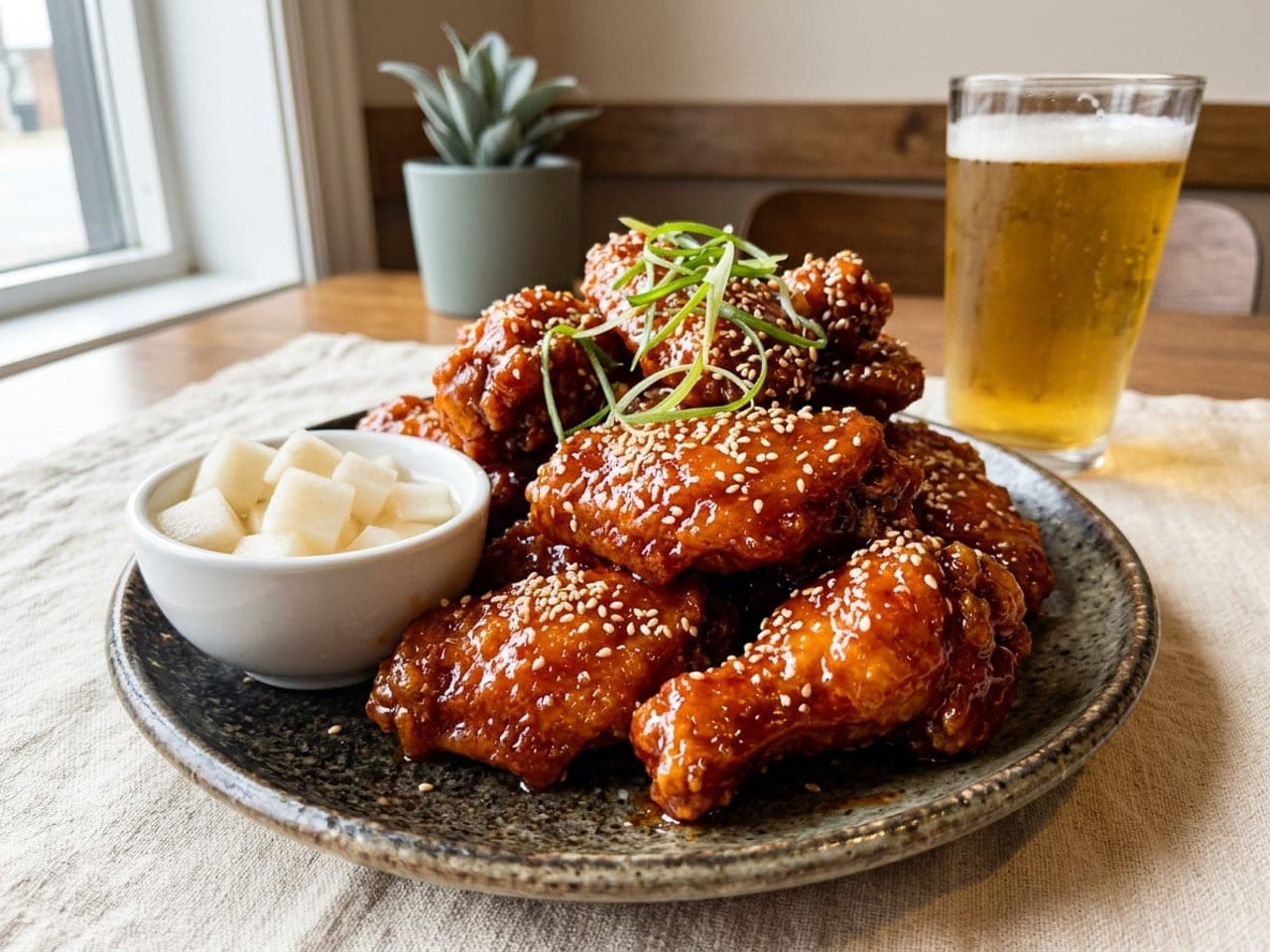
Ingredients
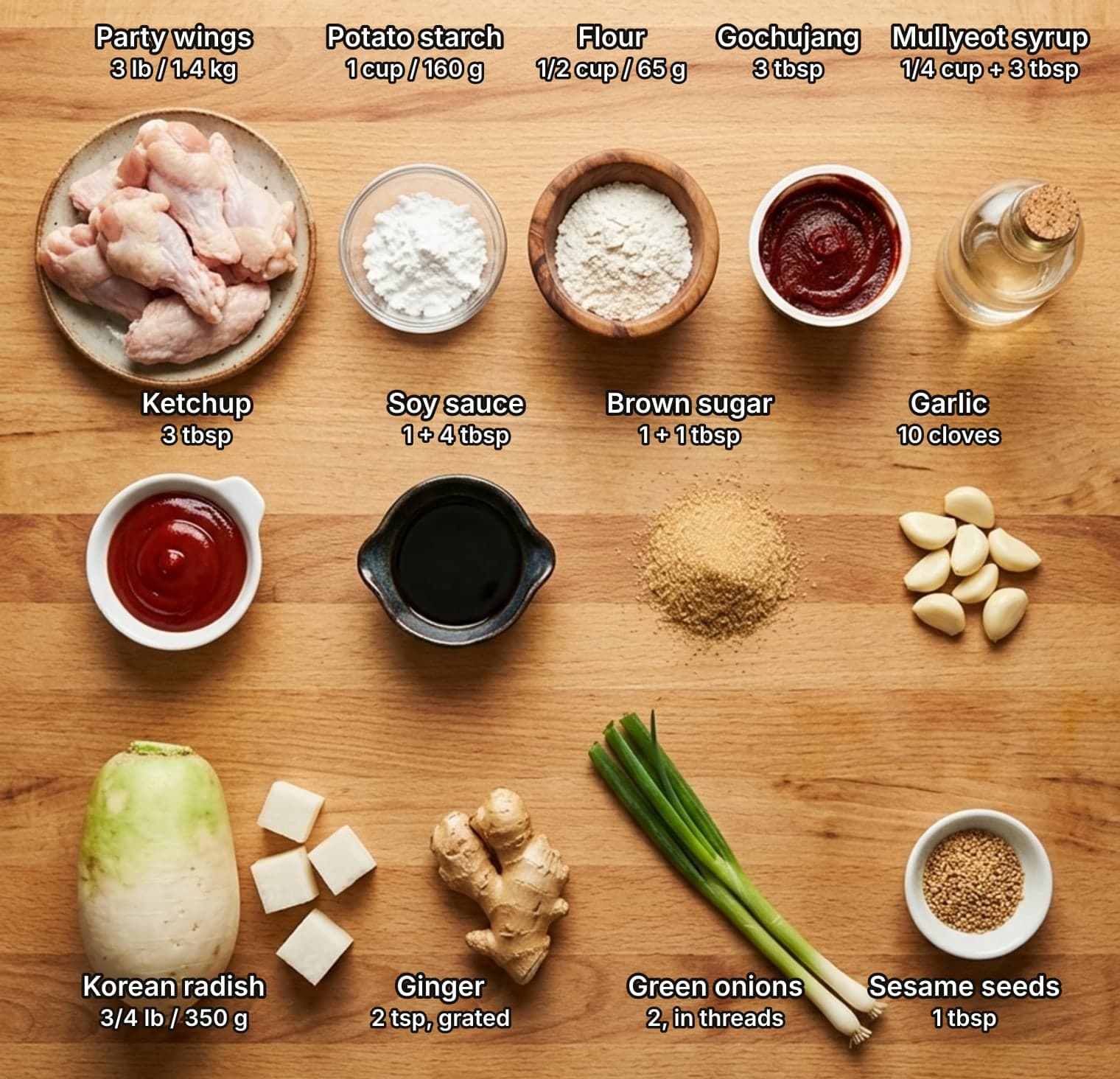
- chicken party wings (drumettes and flats — or a whole chicken cut into small pieces, the Korean market way; boneless option in the FAQ)3 lb (1.4 kg)
- fine salt — for the wings and the batter1 1/2 tsp, divided
- black pepper1/2 tsp
- rice wine (mirin or a dry sherry) — optional, it takes the poultry edge off1 tbsp
- potato starch (or cornstarch — cornflour in the UK; see the starch ruling in the FAQ)1 cup (160 g; cornstarch 130 g)
- all-purpose (plain) flour1/2 cup (65 g)
- baking powder1 tsp
- very cold water — icy, for the batterabout 1 cup (240 ml)
- neutral frying oil (canola, sunflower or peanut)2 quarts (2 L)
- gochujang — the tub, not the squeeze-bottle 'sauce' (see shopping)3 tbsp
- ketchup — standard in shop yangnyeom, not a shortcut3 tbsp
- Korean starch syrup (mullyeot, the corn-based chicken-shop bottle — or rice syrup/jocheong, or honey, a shade less; the shine lives here)1/4 cup (85 g), plus 3 tbsp for the soy-garlic option
- brown sugar1 tbsp, plus 1 tbsp for the soy-garlic option
- soy sauce1 tbsp, plus 4 tbsp (60 ml) for the soy-garlic option
- rice vinegar1 tbsp
- garlic, minced4 cloves, plus 6 for the soy-garlic option
- fresh ginger, grated1 tsp, plus 1 tsp for the soy-garlic option
- Korean radish (mu) or daikon, in 3/4-inch (2 cm) cubes — for the chikin-mu3/4 lb (350 g)
- white vinegar, sugar and water — the chikin-mu brine, equal parts, plus 1/2 tsp salt1/3 cup (80 ml) each
- toasted sesame seeds — for the yangnyeom half1 tbsp
- green onions (spring onions), cut into fine threads — for the soy-garlic half2, optional
What Korean fried chicken is (and how Korea re-engineered the bird)
Korean fried chicken — chikin (치킨) in Korean, a Konglish borrowing that now means specifically THIS, not chicken in general — is fried chicken rebuilt from the crust inward. Where American fried chicken grows a thick, craggy, seasoned armor, the Korean bird wears a thin, glassy shell that shatters rather than crunches, engineered to stay crisp under a coat of sauce and through a long conversation. The ordering grammar is standard nationwide: huraideu (후라이드, from 'fried') is the plain one, yangnyeom (양념, 'seasoned') is the sticky sweet-hot red one, and banban (반반, 'half-half') is the treaty — one box, both kinds. By most counts South Korea has more fried-chicken shops than the world has McDonald's, which is less a statistic than a national mood.
The history is compressed and mostly modern. Whole birds roasted or fried as yennal tongdak ('old-days whole chicken') were the market-stall standard of the 1960s and 70s; Lims Chicken, generally credited as the first Korean fried-chicken franchise, opened in 1977, and the pivotal invention came in the early 1980s in Daegu, when Yoon Jong-gye — whose small shop grew into the Mexican Chicken chain — began brushing fried birds with a sweet chili sauce so they'd eat soft and glossy rather than dry — though Pelicana, founded 1982, has long claimed the yangnyeom crown too — both stories have partisans, and a recipe page is a bad place to pretend the archive is settled. The 1997 IMF crisis turned chicken shops into the default second act for laid-off office workers, which is how a country of fifty million came to support tens of thousands of them; Kyochon (1991) and Bonchon (2002) then carried the style abroad, and one line about chimaek in the 2013–14 K-drama My Love from the Star set off a Korean-fried-chicken craze across China and the rest of Asia that never really receded.
What makes it Korean isn't one trick but a system: small pieces that maximize crust-to-meat ratio, the thin starch shell, sauce applied as lacquer rather than dip, sweet-sour radish cubes as the mandatory cold counterpoint, and beer as the assumed beverage — chimaek is a portmanteau of chikin and maekju (beer), and it's an institution with its own festivals. Fried chicken in Korea is not an appetizer or a side; it's a social event that happens to be food, delivered at midnight, eaten from the box, negotiated piece by piece.
How to make Korean Fried Chicken
- Pickle the radish before anything touches a pan. Cube the radish into 3/4-inch (2 cm) dice, dissolve the sugar and salt in the vinegar and water, and pour the brine over the cubes in a jar or bowl. Into the fridge it goes. In Korea, no fried chicken arrives without this bowl of chikin-mu — cold, sweet-sour radish whose whole job is punctuation: a crunchy reset between bites of hot, rich crust. Ten minutes in the brine makes it edible; an hour makes it right; overnight makes it perfect; it keeps a week, so the second batch of chicken already has its sidekick waiting.
- Dry the wings like the crust depends on it — it does. Pat the wings aggressively dry with paper towels, then season with the salt, pepper and rice wine (mirin or a dry sherry — optional, but it takes the poultry edge off the way Korean kitchens like). Let them sit while you make the sauces. Surface water is the enemy twice over: it spatters violently when it meets 330°F (165°C) oil, and it steams under the batter exactly where you're trying to build crunch. Dry chicken is safer AND crispier — the rare free lunch in cooking.
- Both sauces before the first wing fries. Yangnyeom: stir the gochujang, ketchup, mullyeot syrup, brown sugar, soy sauce, rice vinegar, half the garlic and the ginger in a small saucepan over medium-low heat and simmer 2–3 minutes, until glossy and just thickened. Off the heat. For the soy-garlic half of a banban order, simmer the soy sauce, syrup, brown sugar, remaining garlic, ginger and water in a second small pan for 3–4 minutes to a light glaze — stop early, it thickens as it cools. Sauce-first is chronology, not preference: once the second fry ends, the crust's clock is running, and you don't want to be mincing garlic while it ticks.
- A batter that's barely there. Whisk the potato starch, flour, baking powder and remaining salt, then whisk in the very cold water until the batter runs off the whisk in a thin ribbon — the texture of cold heavy cream, not pancake batter. Fold in the wings until every piece is slicked. Thin is the doctrine: this batter's job is a shell about one starch grain thick, not a coat. Cold water keeps the flour's gluten sleepy, and less gluten means shatter instead of chew.
- First fry at 330°F (165°C): cook it, don't color it. Heat the oil to 330°F (165°C) in a heavy pot no more than half full, with a clip-on thermometer doing the judging. Fry the wings in batches of 8–10, lifting each piece from the batter so the excess sheets off and lowering it in away from you, for 8–10 minutes — they should come out cooked through but only pale blond, the color of shortbread, not fried chicken. Lift onto a wire rack, never paper towels (paper traps steam under the crust you just built). Let the oil climb back to temperature between batches; crowded, cooling oil is how batter turns to sponge.
- The rest between fries is doing real work. Let each batch rest on the rack at least 10 minutes, up to 30 — conveniently, about how long the next batch takes. This pause is not downtime; it's the middle of the recipe. Residual heat keeps pushing moisture out of the skin and batter as steam, and the crust goes visibly dull and soft. That's planned. You've just emptied the crust of the water that would have ruined the second fry — which now has nothing left to do but the fun part.
- Second fry at 375°F (190°C): now the crackle happens. Bring the oil up to 375°F (190°C) and fry the rested wings again, same batches, 4–6 minutes to a deep even gold. Listen: the bubbling quiets as the last moisture leaves — that hush is the sound of a crust that will still crackle at the bottom of the pile an hour from now. Check one thick drumette with an instant-read thermometer: 165°F (74°C) at the bone. Back onto the rack for two minutes so the crust sets in air, not against a plate.
- Lacquer, don't drown. Working in a big bowl, toss half the chicken with warm — not bubbling — yangnyeom sauce added a spoonful at a time (hot sugar syrup clings to skin and burns worse than water, so let it fall below a simmer first); fold and turn until every piece is lacquered red and glossy, then stop. The other half gets the soy-garlic glaze the same way (that's banban, the half-and-half every Korean chicken shop sells), or more yangnyeom, or nothing at all — plain huraideu has its loyalists for a reason. Sesame seeds on the red, scallion threads on the soy. A thin coat is the whole game: sauce should sit ON the crust like paint, not soak into it like weather.
- Serve it chimaek style. Pile the chicken on a platter, put the chikin-mu in its own small bowl (it stays in its brine — never on the plate), and open something cold and carbonated: chimaek is chicken plus maekju, beer, and the pairing is Korea's national after-work ritual, not a suggestion. Stack more napkins than seems reasonable — Korean chicken shops hand out plastic gloves with every order, which tells you the correct eating technique is committed and two-handed. Eat now; this crust holds better than any fried chicken you've made, but fried chicken is still a now food.
Safety & hygiene Important
- Raw chicken rules (including the one about not washing it). Don't rinse the wings — USDA guidance is clear that washing raw chicken sprays Salmonella and Campylobacter around the sink and counter in droplets you can't see, and patting dry with paper towels is both the safe prep and the one the crust wants anyway. The board, the towels, your hands and anything the raw wings or their batter touched stay on raw-poultry rules until hot soapy water says otherwise — the batter bowl included, since it held raw chicken for half an hour. Doneness is a number, not a color: 165°F (74°C) on an instant-read thermometer pushed through the crust to the bone of the thickest piece. The double fry usually lands well past that, but the thermometer, not the clock, gets the final word.
- Two quarts of hot oil is the sharpest knife in the kitchen. Use a heavy, tall-sided pot filled no more than half — oil expands and bubbles up hard when wet chicken lands in it. Clip on a thermometer and treat 375°F (190°C) as a ceiling, not a vibe; smoking oil is oil telling you to cut the heat. Lower every piece in away from you with tongs or a spider, keep the fry zone clear of kids, pets and dangling sleeves, and never walk away from a pot of hot oil, even between batches. If the worst happens and the oil ignites: heat off, lid on, and never, ever water — water flash-boils under burning oil and throws it at the ceiling. Don't try to carry a burning pot anywhere (spilled burning oil is how a stove fire becomes a house fire); leave the lid on until everything is fully cold, and if the fire doesn't die the moment the lid lands, get everyone out and call the fire brigade. Keep the pot's lid within arm's reach the whole session, and let the oil cool completely before you move, strain or store it. Strained through a fine sieve into a sealed jar kept somewhere dark, frying oil is good for two or three more savory sessions; when it's dark, foamy or smells fishy, it's done — cooled, bottled and binned (or dropped at a municipal oil-recycling point, if your town runs one), never down the drain.
- Allergens and the leftover clock. This recipe carries wheat (the flour, the soy sauce — standard brewed soy is roughly half wheat — and most gochujang: check the label, wheat flour sits high on the ingredient list of the standard tubs), soy (soy sauce and gochujang both) and sesame, each a major allergen; if you take the sherry option for the rice wine, that adds sulphites, an EU-labelled allergen in its own right. The gluten-free path is real but runs entirely on labels: a batter of pure potato starch (skip the flour; the crust gets slightly more fragile and a shade less golden), a certified gluten-free tamari for the soy sauce (most tamari is wheat-free, but it's a label check, not a category guarantee), a certified gluten-free gochujang — they exist in the same aisle — plus two quiet ones: mullyeot is corn-based but some bottles are saccharified with barley malt (honey sidesteps the question entirely), and some European baking powders bulk with wheat flour where US brands use cornstarch. Leftovers follow the standard clock: out of the danger zone within 2 hours (1 hour above 90°F/32°C), shallow container, fridge, 3–4 days. Re-crisp in a 400°F (200°C) oven on a rack for 8–10 minutes, until an instant-read shows 165°F (74°C) inside — the microwave turns crust to memory — and know that sauced pieces only ever come partway back. If you're cooking for tomorrow on purpose, store the chicken unsauced — chill it uncovered on a rack just until cold, an hour or so, then cover it (plastic wrap — cling film — straight onto warm crust traps the steam that kills it; the hot rack reheat brings the crackle back anyway) — and glaze after reheating. The pro make-ahead hides in the double fry itself: freeze the wings after the first fry, up to a month, and second-fry straight from frozen with 2–3 extra minutes, confirming 165°F (74°C) at the bone before saucing. That's how you fry for a party without frying during a party.
3 ways to plate it
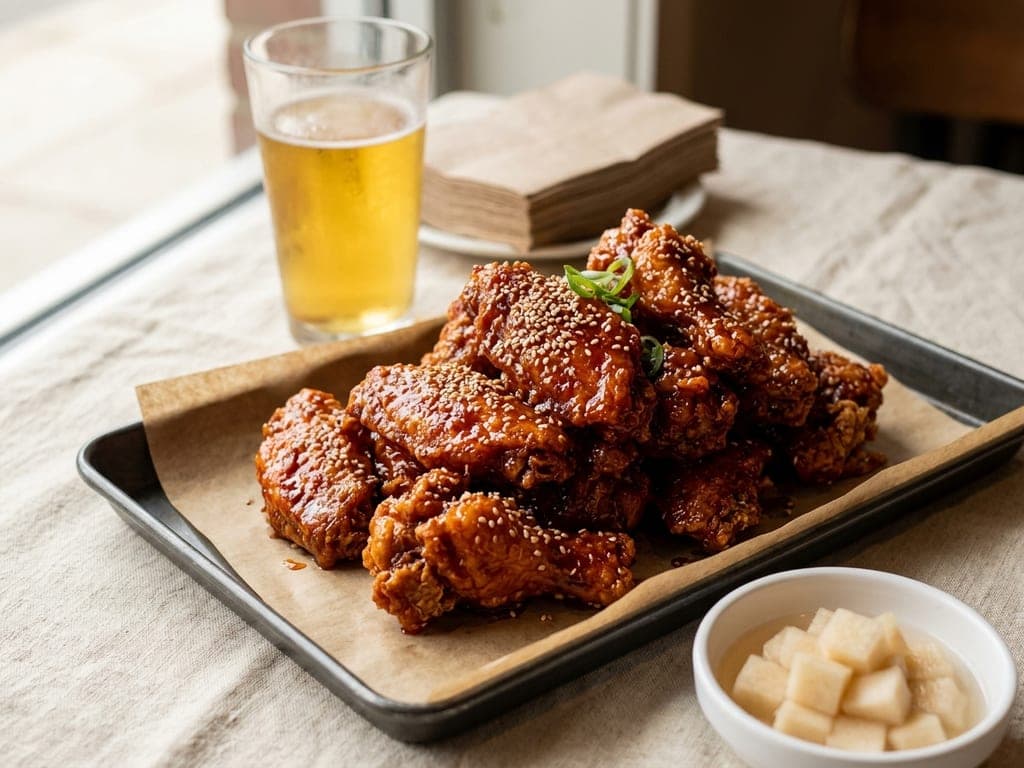
- Pile the chicken high on a parchment-lined platter or a dark matte tray — gloss on gloss disappears, and height reads generous while the pile keeps itself warm.
- Scatter sesame seeds over the red glaze while it's still tacky so they actually stay on.
- Serve the chikin-mu cold, in its own small bowl with a little brine — never on the chicken plate, where the brine would attack the crust.
- Pour a cold lager into a chilled glass and stack more napkins than seems reasonable; this is a two-hands dish.
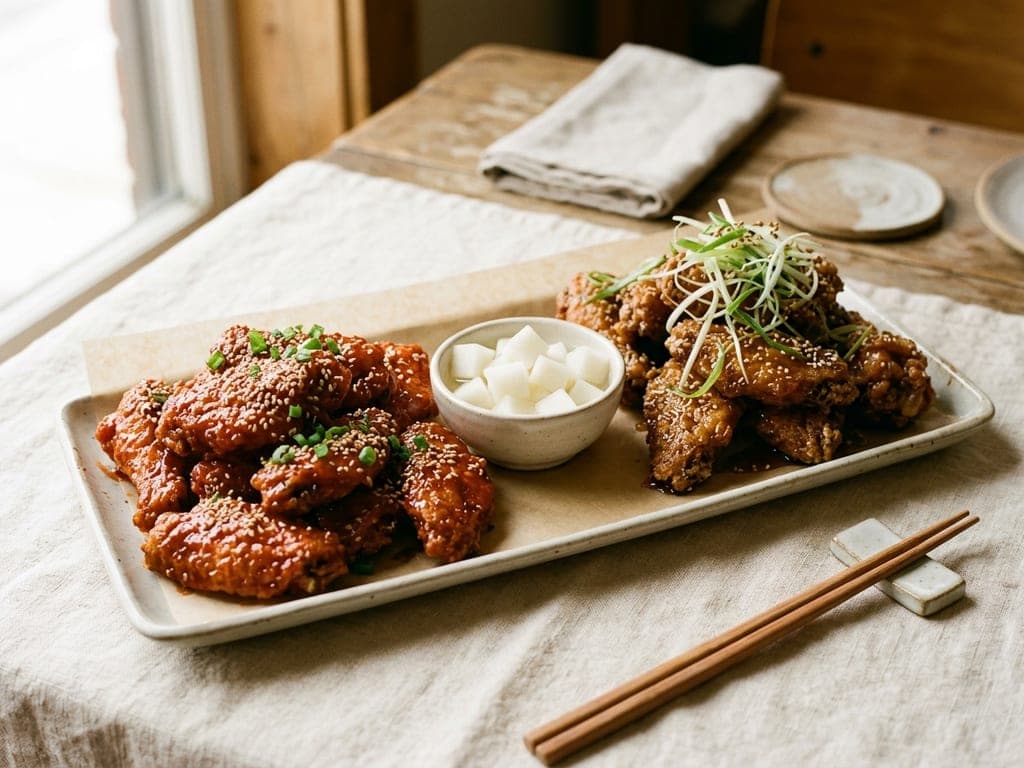
- Sauce the halves in separate bowls — a spoonful at a time, tossed to a thin lacquer — so neither glaze muddies the other.
- Lay them on a parchment-lined tray with a clear border between the red and the amber — the two-tone line IS the presentation, and a dry chopstick is the unglamorous tool for policing it.
- Mark the territories by garnish: sesame seeds on the yangnyeom side, scallion threads on the soy-garlic side.
- Put the chikin-mu bowl on the border between them — it's the neutral zone both sides share.
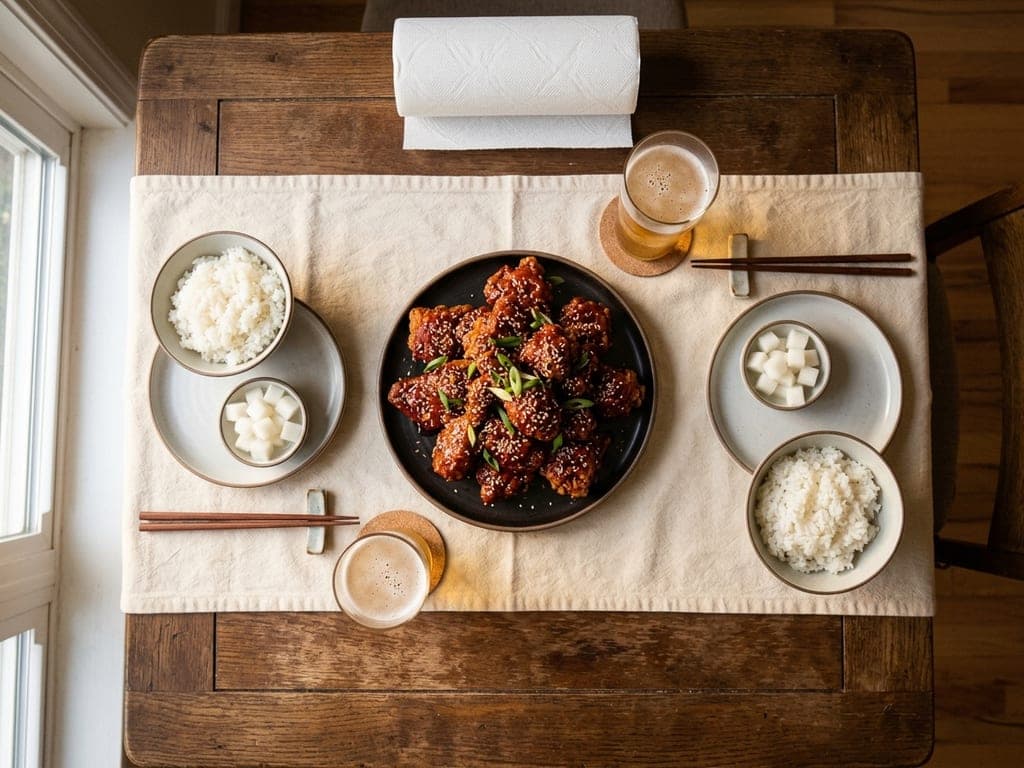
- Set the platter dead center and give every diner a small plate and their own little bowl of chikin-mu — private radish prevents double-dip diplomacy.
- Keep a stack of paper napkins or a roll of kitchen towel visibly on the table; Korean shops include plastic gloves, which is the level of commitment to signal.
- Add one bowl of steamed rice per hungry diner to stretch the chicken into a full dinner, Korean-home style.
- Glasses of cold beer or a cold barley tea for the kids — something cold and clean opposite the hot and glazed is the point of the table.
The crust is engineering, not luck
Every crisp-fried food fights the same enemy: water. Chicken skin and batter are full of it, water refuses to pass 212°F (100°C), and a crust only turns crisp and golden when its surface gets well past 300°F (150°C) — so as long as moisture keeps arriving from inside, the crust is being steamed from behind no matter how hot the oil is. The double fry solves this with division of labor. The first, gentler fry at 330°F (165°C) cooks the meat and starts evicting water; the rest between fries lets residual heat push steam out while the crust relaxes; the second, hotter fry meets a nearly dry surface and can finally do the only two jobs left — color and crackle. A single long fry can't get there: hot enough to crisp means overcooked meat, gentle enough for the meat means a crust that sighs instead of shatters.
The batter is the second half of the engineering. Starch, not flour, is the majority partner because gluten is the enemy of shatter — flour's proteins build stretchy networks that fry up bready and then go leathery under sauce, while starch granules set into a brittle glass. Potato starch (the Japanese frying standard and the pick of Korean home recipes) makes the hardest, glassiest shell; cornstarch runs a close second, a little lighter and more delicate. The flour that remains contributes browning and just enough structure; the baking powder blows micro-bubbles that make the shell airy instead of dense; the very cold water keeps what gluten there is from waking up. And the coat stays thin on purpose — a thick crust is a sponge with ambitions, but a thin shell gives sauce nowhere to soak, which is the entire reason yangnyeom chicken doesn't arrive soggy. One honesty note: not every Korean chain batters the same way — Kyochon is famous for an almost invisible coat, and others run dredges or thicker batters by menu item — so this thin wet batter is a choice this recipe makes, not a law of the cuisine.
It helps to see the neighbors clearly. Japanese karaage — this site's other fried chicken — runs the opposite philosophy: flavor goes INTO the meat via a soy-ginger marinade and the whisper-thin potato-starch coat exists to protect juiciness, not to carry sauce; modern karaage often double-fries too, so the real divide isn't technique but where the flavor lives. American Southern fried chicken builds a thick buttermilk-and-flour crust with the seasoning in the crust itself, fried once, lower and slower — magnificent, and structurally unsauceable, which is why America drizzles (see our hot honey chicken) while Korea lacquers. Three birds, three philosophies, no losers.
Shopping honestly: gochujang, mullyeot, and the radish
Gochujang is the pantry anchor: a fermented paste of red chile, glutinous rice and soybeans, sold in tubs that keep for many months in the fridge and turn up in half this site's Korean cooking. Chung Jung One and CJ Haechandle are the two supermarket standards and either is right here; heat varies by brand and line — Korean tubs print a spice scale on the front, worth a glance — so taste your sauce before deciding it needs more. Two label notes: most gochujang contains wheat, which matters at a gluten-free table (certified-GF jars exist — certification on the label, not the category), and so-called 'gochujang sauce' squeeze bottles are a pre-sweetened condiment, not the paste; buy the tub. And don't invent a gochujang substitute from tomato paste and cayenne — you'll make a different, sadder sauce; the tub keeps for months and repays the trip.
The chicken-shop gloss — that glassy, patent-leather shine on yangnyeom chicken — is starch syrup, not sugar. Koreans call it mullyeot: a clear, corn-based syrup (the Ottogi bottle is the fixture, labelled 'corn syrup' in English), noticeably less sweet than honey, nearly flavor-neutral, and it sets to a lacquer instead of a stickiness. Don't confuse it with Korean rice syrup — jocheong, or ssal-yeot — the ambery, malty cousin sold right beside it, which swaps in with a slight flavor shift. Honey substitutes honestly (use a shade less and expect a floral note and a touch more sweetness); Western light corn syrup is the nearest supermarket twin, close enough that nobody at the table will know; maple syrup is a different dish. The ketchup, before anyone objects, is not a Western corruption — it's been standard in shop and home yangnyeom for decades, supplying tomato tang, color and a vinegar backbone in one squeeze.
The radish for chikin-mu is Korean mu — squat, pale, green-shouldered, peppery-sweet — but daikon is an honest substitute available in every Western supermarket, and in a 10-minute pickle the difference mostly vanishes. Potato starch lives in Asian markets (katakuriko in Japanese packaging) and health-food aisles alike; skip the Korean 'frying mix' bags for this recipe — convenient, but they're wheat-based, which quietly undoes the starch doctrine and the gluten-free path both. For the oil, anything neutral with a high smoke point — canola, sunflower, peanut — and yes, two quarts (2 L) is real; think of it as the cost of the party, then strain, store and reuse it two or three times to amortize.
Questions, answered
What actually makes Korean fried chicken different from American fried chicken?
Three structural choices. The crust: thin, starch-based and glassy, built to shatter, versus the thick craggy flour crust of the American South. The fry: twice, with a rest between, so the crust is dry enough to survive sauce and hours. The seasoning: applied after frying as a lacquered sauce (or not at all), versus seasoning carried in the crust itself. Net effect — Korean fried chicken stays audibly crisp under a wet glaze, which American crust structurally cannot do; it drizzles instead (our hot honey chicken is that philosophy, done on purpose). Calling them the same food because both are fried chicken is like calling a baguette and a biscuit the same food because both are baked dough.
Yangnyeom, huraideu, banban, chimaek — decode the menu for me.
Huraideu (from English 'fried') is the plain, naked-crust bird. Yangnyeom means 'seasoned' and is the glossy sweet-hot red one this page anchors on. Banban is 'half-half' — one order, both styles, the standard family compromise and secretly the best way to serve this recipe. Chimaek is chicken + maekju (beer): not a dish but the occasion itself, the Korean equivalent of wings-and-a-game. Chikin-mu is the bowl of pickled radish cubes that accompanies every order in Korea, no exceptions.
Is the double fry really mandatory?
For this result, yes — the first fry cooks, the rest dries, the second fry crisps, and no single fry can do all three jobs (hot enough to crisp overcooks the meat; gentle enough for the meat leaves the crust damp). The only honest shortcut is stopping: do the first fry hours ahead and refrigerate the once-fried wings — or freeze them for up to a month — then run only the 5-minute second fry before serving. An air fryer makes a respectable weeknight bird — roughly 380°F (193°C), 12–15 minutes, flip, another 8–10, then a short hot blast after a rest — and an oven on a rack at 425°F (220°C) gets further from the mark; neither produces this thin, waterproof crust. If that's the appliance tonight, embrace it as its own dish rather than a substitute.
Potato starch or cornstarch — does it matter?
Both work; the crust changes character slightly. Potato starch (the Japanese karaage standard, and the pick of Korean home recipes — the shops themselves mostly run proprietary wheat-flour-and-starch mixes) fries into the hardest, glassiest, longest-lasting shell. Cornstarch — cornflour in the UK — runs a close second: a touch lighter and more delicate, marginally quicker to soften under sauce. Use what you can get, but if you're near an Asian market, the potato starch bag costs little and also upgrades every future dredge and slurry in your kitchen. What matters more than the starch's species: keep the flour minority small, and the water icy.
What's the white radish cube thing, and can I skip it?
Chikin-mu — sweet-sour pickled radish cubes, served cold, standard-issue with every chicken order in Korea, including delivery. Its job is architectural: cold against hot, sharp against rich, crunch against crackle; skip it and the third piece of chicken starts tasting like the eighth. You can skip it the way you can skip lemon with fried fish — the chicken will still be fried, and you'll miss the point. It's ten minutes of prep from a vegetable that costs almost nothing. Skip the beer if you must. Keep the radish.
How spicy is yangnyeom, and what's the kid-table plan?
Milder than it looks — the red is gochujang and ketchup, and the profile is sweet-forward with a slow warm finish, closer to barbecue sauce than to buffalo. Standard tubs of gochujang land mild-to-medium, though brands vary (the scale is printed on Korean packaging). For heat-averse tables, the soy-garlic glaze contains no chile at all — this is precisely what banban is for: one fry batch, the red half for the adults, the soy-garlic half for the kids, plain huraideu for the purist. To push heat UP, stir a teaspoon of gochugaru or a squeeze of sriracha into the finished yangnyeom.
Can I use boneless chicken, or something other than wings?
Yes — boneless thighs, cut into 1.5-inch (4 cm) chunks, are the standard 'sunsal' (boneless) order in Korea and arguably easier to eat. Same batter, same double fry, shorter clocks: about 6 minutes on the first fry, 3–4 on the second, same 165°F (74°C) finish line. A whole chicken cut into small pieces is the traditional market move if you're comfortable with a cleaver. Breast meat works but forgives nothing — if you use it, don't skip the rice wine, and mind the thermometer like a hawk.
How do I keep it crispy, make it ahead, and reheat leftovers?
Keeping crisp is mostly pre-solved: the double fry and the thin sauce coat are the mechanism, and the pile stays crackly through a long dinner. For staging a party, finished unsauced chicken holds on a rack in a 200°F (93°C) oven for up to 30 minutes — comfortably above the 140°F (60°C) hot-holding line — sauce at the table. Make-ahead: stop after the first fry (fridge, hours) or freeze the once-fried wings up to a month, then second-fry straight from frozen with 2–3 extra minutes — party math that beats any warming drawer. Leftovers: fridge within 2 hours, 3–4 days, re-crisped on a rack in a 400°F (200°C) oven for 8–10 minutes, to 165°F (74°C) inside; the microwave is where crust goes to die. Sauced pieces come back maybe eighty percent; unsauced pieces come back nearly whole, so glaze only what you'll finish tonight.
What do I serve with Korean fried chicken?
Cold lager, the chikin-mu, and napkins — that's the canonical chimaek table, and adding more dishes is honestly un-Korean of you. If you're building a bigger Korean spread from this site's shelf anyway: bulgogi for the grill side of the cuisine, korean corn dogs if the evening is trending street-food, and steamed rice plus the radish stretches the chicken into a proper dinner. For the fried-chicken scholars: make karaage the same week and taste the two philosophies back to back — flavor in the meat versus flavor on the crust.
Snap your finished plate and let the AI plate it again — more beautifully.