Dan Dan Noodles Recipe (担担面, Sichuan Street Style)
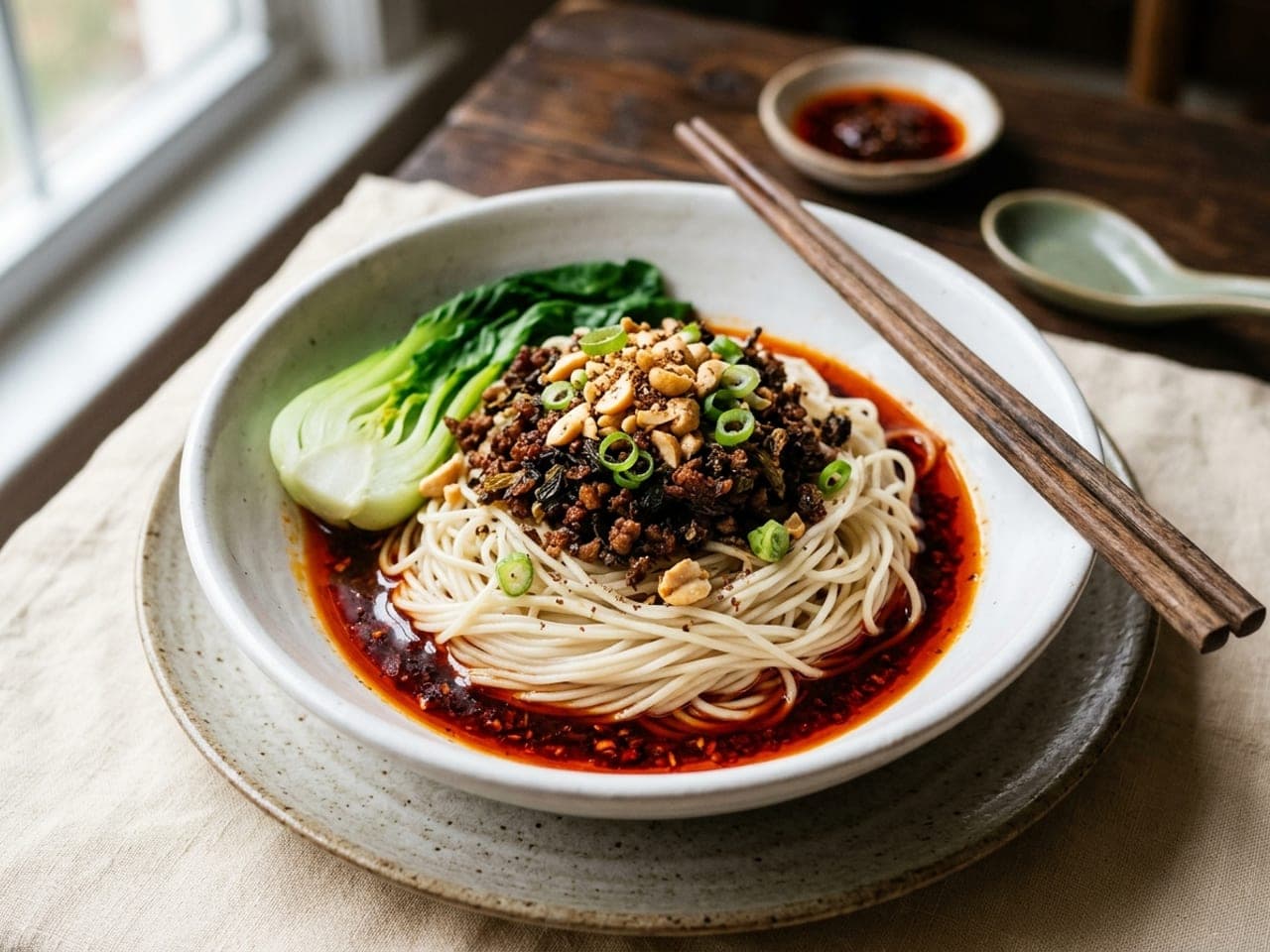
Dan dan noodles are built upside down: the sauce goes into the bowl first — chili oil, soy, sesame paste, ground Sichuan pepper — hot noodles land on top of it, and a dry, crispy crumble of pork and preserved mustard greens crowns the pile, unmixed. The eater does the tossing. Named for the shoulder poles Sichuan street vendors carried them on, this is the small, loud bowl the takeout version grew out of — and the toss is the dish. The chili oil wants an overnight rest, so start it the day before, or open a good jar and this is a 50-minute dinner.
Ingredients
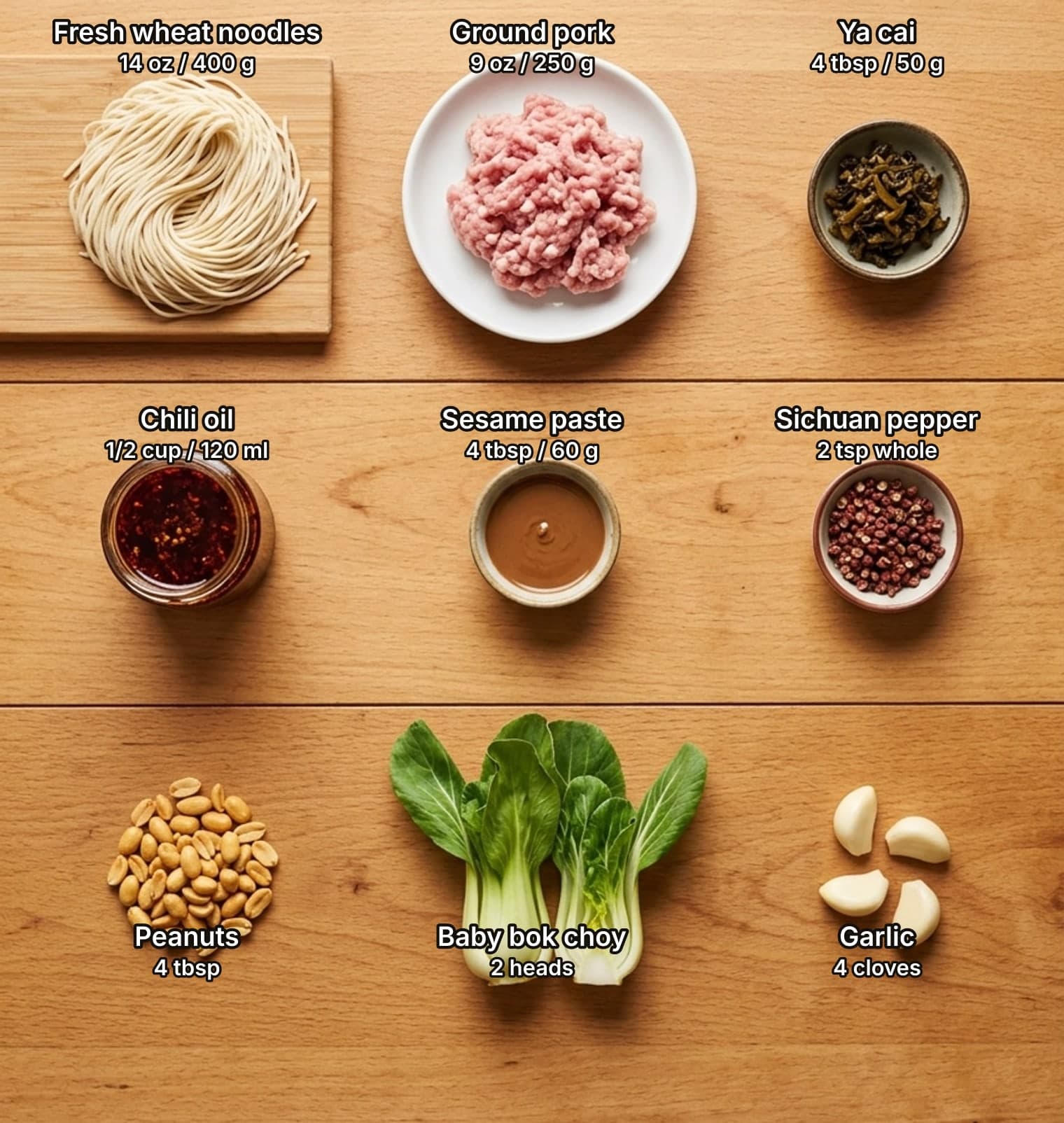
- fresh thin wheat noodles (plain pale — lightly alkaline is fine, but not egg noodles and not full yellow ramen) — or 10 oz (280 g) dried thin wheat noodles14 oz (400 g)
- ground pork (pork mince), around 20% fat — it should crisp, not stew; finely chopped mushrooms for the vegan crumble9 oz (250 g)
- ya cai (碎米芽菜, Yibin preserved mustard greens, sold in small foil packets) — the ingredient most versions skip; chopped Tianjin preserved vegetable is the nearest substitute4 tbsp (50 g)
- sweet bean sauce (甜面酱, tianmianjiang) — hoisin is sweeter and spiced, a last resort (drop the bowls’ sugar to 1/4 tsp)1 tbsp
- Shaoxing wine — a medium-dry sherry is the stand-in1 tbsp
- light soy sauce — 2 tsp for the pork, 2 tsp per bowl3 tbsp + 1 tsp
- Chinese sesame paste (芝麻酱, from toasted seeds) — tahini plus 1/2 tsp toasted sesame oil per tbsp is the honest understudy; omit entirely for the Chengdu-lean bowl4 tbsp (60 g)
- Sichuan chili oil with its sediment (红油) — homemade (step 1) or a good jar; check the label for sesame, peanuts and dried shrimp1/2 cup (120 ml)
- whole red Sichuan peppercorns, toasted and ground just before serving — yields about 1 3/4 tsp powder: the bowls use a little over half, the rest goes to the table2 tsp
- sugar2 tsp
- garlic, grated or minced to a paste4 small cloves
- Chinkiang black vinegar (镇江香醋) — optional and genuinely debated (Dunlop’s traditional bowl takes it, Mr Xie’s does not); Sichuan’s own Baoning vinegar (保宁醋) is the local pour if you find it4 tsp
- roasted peanuts, roughly crushed — also common in chili crisp, so allergy-check both1/4 cup (4 tbsp)
- scallions (spring onions), green parts, thinly sliced2
- baby bok choy (pak choi), halved — blanched in the noodle water2 heads
- neutral oil — 1 tbsp for the pork, plus 1 cup (240 ml) if making the chili oil1 tbsp
- medium-coarse Sichuan chili flakes — only if making the chili oil in step 11/2 cup (8 tbsp)
- salt — for the chili-oil batch; the bowls need none1 tsp
What dan dan noodles are: a bowl built upside down
Dan dan noodles — 担担面, dàndàn miàn — are a Sichuan street dish of thin wheat noodles over a fierce, unmixed sauce of chili oil, soy sauce, sesame paste, garlic and ground Sichuan pepper, topped with a dry, crispy crumble of pork and preserved mustard greens. Everything about the construction is deliberate and slightly backwards by Western noodle logic: the sauce hides at the bottom of the bowl, the noodles land on top of it, the topping stays in a pile, and the dish arrives at the table looking pale and unfinished. Then the eater tosses it — thoroughly, from the bottom — and it becomes the loudest small bowl in Chinese cooking: numbing, hot, nutty, salty and crunchy at once.
That last paragraph answers the question the search engines get asked most — what are dan dan noodles? — but the operative fact for a cook is the format. Dan dan noodles are not a stir-fry and not a soup (in Chengdu; Hong Kong and Japan run soupier — see the map below). They are a dressed noodle, and the dressing happens at the table. Every technique on this page serves that one moment: a sauce mixed to deliberate overstrength, noodles cooked to a bite that survives tossing, a topping fried dry so it stays distinct instead of dissolving.
The dish shares its flavor grammar with our mapo tofu — the same chili-oil base, the same Sichuan pepper buzz, the same málà two-axis logic of heat and numbing as separate, independently tunable sensations. If you cook both in one week, your pantry is already amortized — though this bowl works a different corner of it: no doubanjiang here, but chili oil, Sichuan pepper, ya cai and sweet bean sauce instead.
How to make Dan Dan Noodles
- Make the chili oil the night before — or open a good jar. If you are making your own: put 1/2 cup (8 tbsp) of medium-coarse Sichuan chili flakes and 1 tsp of salt in a completely DRY, heavy metal or stoneware bowl — never plastic, and not glass, which can crack from the thermal shock — holding at least three or four times the volume of the oil, because the mixture foams up dramatically when they meet. Bone dry, because a drop of water under smoking-hot oil erupts. Heat 1 cup (240 ml) of neutral oil in a small saucepan to about 325°F (163°C) on a thermometer — or until a test flake sizzles briskly without blackening — then pour it over the flakes in two or three additions, stirring between pours: the first, hottest pour toasts some flakes dark and nutty, the cooler later pours bloom the rest bright red. Let it stand at least 2 hours; overnight is much better. This is hongyou (红油), the red oil, and it is the single most important flavor in the bowl. The four bowls use half the batch; the strained rest keeps for the table and the next round (storage rules in the safety notes). If you would rather use a jar, buy a Sichuan chili oil with plenty of sediment and stir it up before spooning — and read the label, because many contain sesame and some contain peanuts. Aromatics like ginger or star anise in the hot oil are optional; if you use them, strain them out before storing — the safety notes explain why that is not fussiness.
- Toast and grind the Sichuan pepper. Toast 2 tsp of whole red Sichuan peppercorns in a dry pan over medium-low heat for 1–2 minutes, shaking often, until they smell citrusy and floral; if they smoke or blacken, start over — burnt huajiao is bitter. Discard any shiny black seeds (gritty, flavorless — the husk carries everything), cool, and grind to a powder. Two teaspoons of whole husks grind to roughly 1 3/4 teaspoons of powder; the four bowls use a little over half of it, and the rest belongs in a small dish at the table. Grind now, not days ahead: the bright citrus aroma is volatile and starts leaving the moment the husk breaks, even though the numbing compound itself fades far more slowly. If you have made our mapo tofu, this is the same move — dan dan noodles and mapo tofu share a spice rack.
- Fry the pork topping dry and crisp. Heat 1 tbsp of neutral oil in a wok or wide skillet (frying pan) over medium-high heat, add 9 oz (250 g) of ground pork (pork mince), and cook, breaking it into small crumbles, for 4–6 minutes — past browned, all the way to dry and audibly crisping. You are not making a juicy meat sauce; you are making saozi (臊子), a dry, crunchy topping that stays distinct in the bowl, and gray steamed mince is the most common failure of this dish outside Sichuan. Splash in 1 tbsp of Shaoxing wine and let it steam off, then add 1 tbsp of sweet bean sauce and 2 tsp of light soy sauce and fry for a minute until the crumbles are glossy and dark. Finally add 4 tbsp of ya cai and fry 1–2 minutes more until the whole mixture is dry, crumbly and intensely savory. Ground pork is done at 160°F (71°C) by US (USDA) guidance — the UK (FSA) equivalent is 70°C (158°F) held for 2 minutes — and this dry-crisp treatment takes it comfortably past that, but check with a thermometer the first time: press the crumble into a mound against the pan and probe the center of that, since loose crumbles will not give a true reading. Color alone is not a reliable indicator. The topping keeps for days and freezes well, which makes the second bowl of dan dan noodles a ten-minute dinner.
- Build the sauce in the bowls, not the pan. Set out four bowls and build the sauce directly in each: 2 tsp light soy sauce, 1 tbsp Chinese sesame paste, 2 tbsp chili oil including its sediment, a scant 1/4 tsp of the ground Sichuan pepper, 1/2 tsp sugar, one small clove of garlic grated or minced to a paste, and — if you take a side in the debate covered below — 1 tsp of Chinkiang black vinegar. This bowl-first construction is not a plating flourish; it is the dish’s original street format, built for speed and for per-eater tuning, and it remains the correct way to make it. It also hands you the controls: chili oil is the heat dial, Sichuan pepper is the numbing dial, and they are two separate axes — turn them independently. Taste a fingertip of the raw sauce now; it should be assertively too strong, because a bowlful of plain noodles is coming to dilute it.
- Blanch the greens, then boil the noodles. Bring a large pot of water to a boil. Drop in the halved baby bok choy for 60–90 seconds until the stems are just tender, lift them out to a plate, and keep the water boiling. Add 14 oz (400 g) of fresh thin wheat noodles — or 10 oz (280 g) dried — stir immediately so they do not weld, and cook fresh noodles 1–2 minutes, dried ones a minute short of the package time. You want just done with a definite bite: the noodles keep cooking in the hot bowl, and soft noodles turn to porridge under vigorous tossing. Before you drain anything, dip out a mug of the starchy noodle water — the next step depends on it.
- Loosen each bowl with noodle water. Spoon 2–3 tbsp of hot noodle water into each bowl and whisk with chopsticks. The sesame paste will do something alarming first — it seizes and clumps, exactly as tahini does when water first hits it — and then, as you keep stirring, it relaxes into a smooth, silky sauce the consistency of single (light) cream. That transformation is the answer to why restaurant dan dan sauce feels silkier than homemade: it is not more oil, it is dilution, temperature and starch. The sauce should pour lazily off a spoon and be aggressively seasoned to the tongue. Too thick and it will glue the noodles into a mat; too thin and it slides off them into a puddle. Adjust with another spoonful of water or a little more sesame paste — the noodle water is free and the correction takes seconds.
- Assemble, serve unmixed — and insist on the toss. Lift the noodles straight from the pot into the bowls — a little clinging water is a feature, not sloppiness — nesting each portion on top of its sauce without stirring. Spoon the pork-and-ya-cai crumble over the center, scatter the crushed peanuts and sliced scallion greens, set the blanched bok choy at the rim, and finish with a pinch of ground Sichuan pepper. Serve immediately, unmixed, and tell everyone the rule before they touch it: chopsticks to the bottom, and toss at least ten times — until every strand is slicked red and the crumble is distributed — before the first bite. An untossed mouthful is plain noodles; the mouthful after a lazy toss is either bland or brutal. The toss is not presentation theater, it is the final cooking step, done at the table by the person eating. It is also why the dish photographs pale and eats loud.
Safety & hygiene Important
- Infused oil is a preserving decision, not just a flavor one. Chili flakes alone in hot oil are the lower-risk version of this condiment — dried flakes can carry spores too; what they do not bring is the moisture bacteria need — and the recipe is written that way on purpose. The risk arrives with fresh aromatics: garlic, ginger, scallion or anything else moist left sitting in oil creates the exact environment — low-acid, airless, room temperature — where Clostridium botulinum can produce toxin, and botulism does not announce itself with off smells or tastes. So: if you flavor the hot oil with aromatics, strain every solid piece out before the oil goes into storage; treat any oil that still contains garlic or other fresh aromatics as fully perishable — refrigerated and discarded after four days, the National Center for Home Food Preservation’s limit, or frozen for longer; and store the strained, flakes-only oil in a clean sealed jar. US extension guidance genuinely splits on how long: Maine allows dried-ingredient oils up to three months in a cool dark place, Georgia recommends the refrigerator for anything not acidified — so treat a month in a cool dark cupboard as the outside limit, and use the refrigerator (up to three months) if you want the margin. Commercial chili oils and chili crisps are formulated and processed for shelf stability; your kitchen is not a cannery, and homemade does not inherit their shelf life. If a stored oil ever smells sour, fizzes, or bulges its lid, discard it without tasting — but never run that test in reverse: an oil that looks and smells perfectly fine can still be unsafe, which is exactly why the storage rules above are the control, not your nose.
- Allergens: sesame and peanut share this bowl — and hide in the jar. This dish concentrates two of the most serious allergens in one bowl, one of them twice. Sesame is in the sesame paste and frequently in jarred chili oil; it is a declared major allergen in the US (the ninth, since January 2023) and the EU, and unrefined sesame products — paste, toasted oil — carry it fully. Peanuts are the garnish, and they also hide in many chili crisps and some chili oils, so a jar needs reading even for a peanut-only allergy. They are also the easiest allergen here to design around: keep them in a dish at the table rather than scattered over every bowl, and a peanut-allergic guest can eat the same bowl as everyone else — still check the chili-oil label. Wheat is unavoidable as written: the noodles are wheat, ordinary soy sauce contains it, sweet bean sauce is fermented from wheat flour, and Shaoxing wine is brewed with a wheat-based starter — a genuinely gluten-free dan dan noodle requires rice noodles and reworked seasonings, at which point it is honestly a different (still delicious) dish. Soy runs through the soy sauce and most pastes. And Sichuan pepper itself is a documented allergen with published anaphylaxis cases; its early symptoms — tingling, itching in the mouth — overlap with the normal numbing, so warn first-timers to expect a buzz, and treat spreading swelling, throat involvement or hives as an emergency, not a strong batch. It cross-reacts with cashew, pistachio and citrus seed — and in this recipe the pepper is in the bowl sauce, not just the garnish, so a guest with those allergies needs a bowl built without it from the start: omit the scant 1/4 tsp at the sauce-building step as well as the finishing pinch.
- Ground pork has one endpoint, and color is not it. Ground (minced) pork is a mixed product — surface and interior are the same place — so it gets the ground-meat rule, not the whole-cut one: 160°F (71°C) by USDA guidance, or the FSA’s 70°C for 2 minutes (75°C instantaneous is the common shorthand), checked with a thermometer the first time you make this. Pink-to-brown is not a reliable signal in either direction, especially under soy and sweet bean sauce, which brown everything on contact. The dry-crisp saozi treatment in this recipe runs long and hot enough to pass the endpoint with room to spare — the point of the thermometer is to prove that to yourself once. Wash hands, board and the breaking-up spatula after raw pork, and keep the raw package’s drips out of the ya cai packet you are about to open.
- Cooked noodles keep the same clock as cooked rice. Cooked wheat noodles belong to the same food-safety family as cooked rice: Bacillus cereus spores survive boiling, grow in food left in the warm zone, and can produce a toxin that reheating does not destroy — the fatal case reports in the literature are home leftovers left out at room temperature for days — though restaurants and caterers produce plenty of B. cereus outbreaks too; the common factor everywhere is warm holding, not whose kitchen it is. The rule is time: leftovers into the refrigerator within 2 hours of cooking (1 hour if the kitchen is above 90°F / 32°C), in shallow containers. US (USDA) guidance keeps leftovers 3–4 days; UK (FSA) general guidance says 48 hours and reheat once only, to steaming hot throughout — USDA is the one that puts a number on ‘steaming hot’: 165°F (74°C). And note the FSA is stricter still for rice itself (chill ideally within an hour, eat within 24), a reasonable ceiling to borrow for a big batch of cooked noodles. The honest note for this specific dish: assembled dan dan noodles do not keep — the noodles drink the sauce and set into a block — so store components separately. The pork topping refrigerates for 3–4 days and freezes beautifully; cooked noodles are best not kept at all, since fresh ones take two minutes. That division of labor happens to be the food-safe one too.
- Hot oil, chili hands, and the pour. The chili-oil pour is the one genuinely hazardous moment in this recipe, so stage it: the bowl of flakes DRY and sitting on a stable, heatproof surface (not the stove edge), the pan small and controllable, the pour slow and away from you — hot oil meeting a stray drop of water spits violently, and 325°F (163°C) oil burns instantly. Never leave heating oil unattended; if oil ever smokes heavily and catches, slide a lid over the pan and kill the heat — never water, which turns an oil fire into a fireball. Leave the lid on until the pan is completely cold, never try to carry a burning pan, and if the fire does not die at once, get everyone out, close the door and call the fire service. Afterwards, remember capsaicin is oil-soluble: wash hands with plenty of soap and warm water after handling flakes and chili oil (or rub with a little fresh oil first, then wash), keep fingers away from eyes and contact lenses, and if chili oil does reach an eye, take any contact lens out, flush with copious lukewarm water for a full 15 minutes, and get urgent eye care if pain, blurred vision or redness persists. The finished bowls run hotter than they look, too — the oil layer holds heat under the noodles — which is worth a word to anyone serving children.
3 ways to plate it
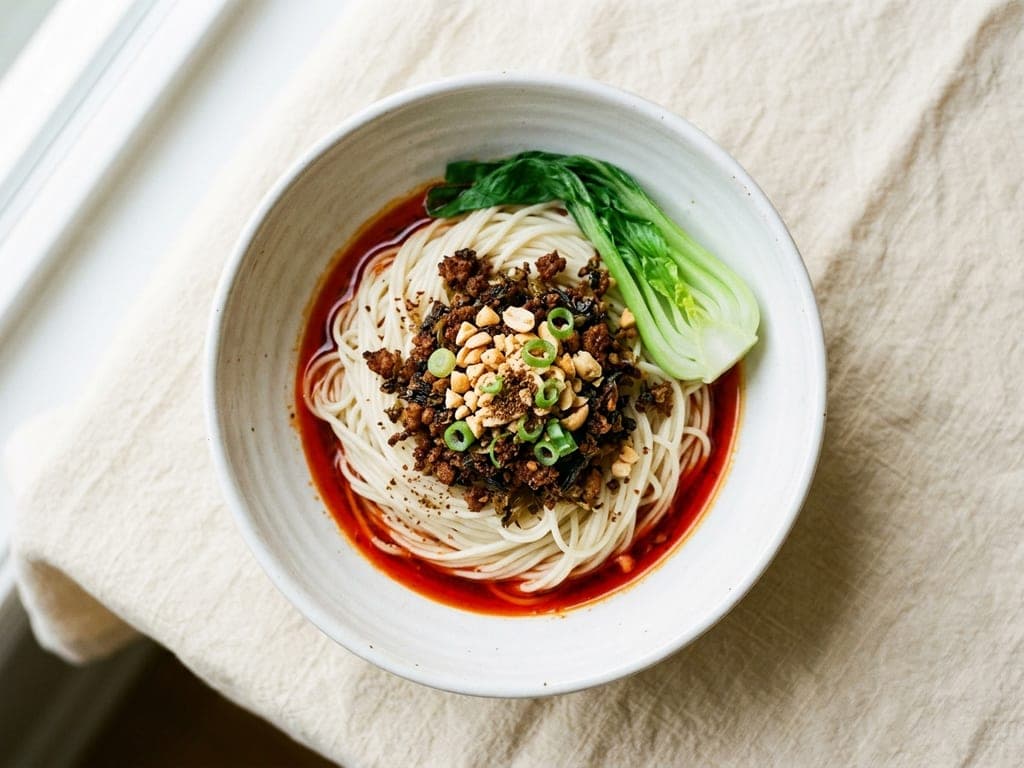
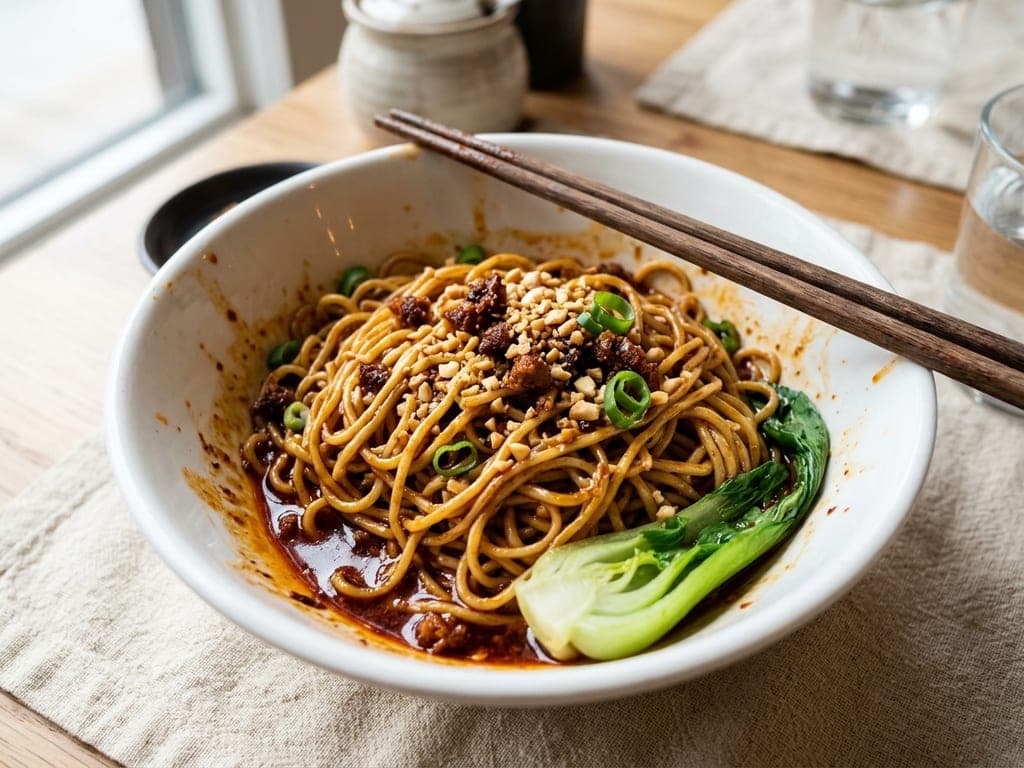
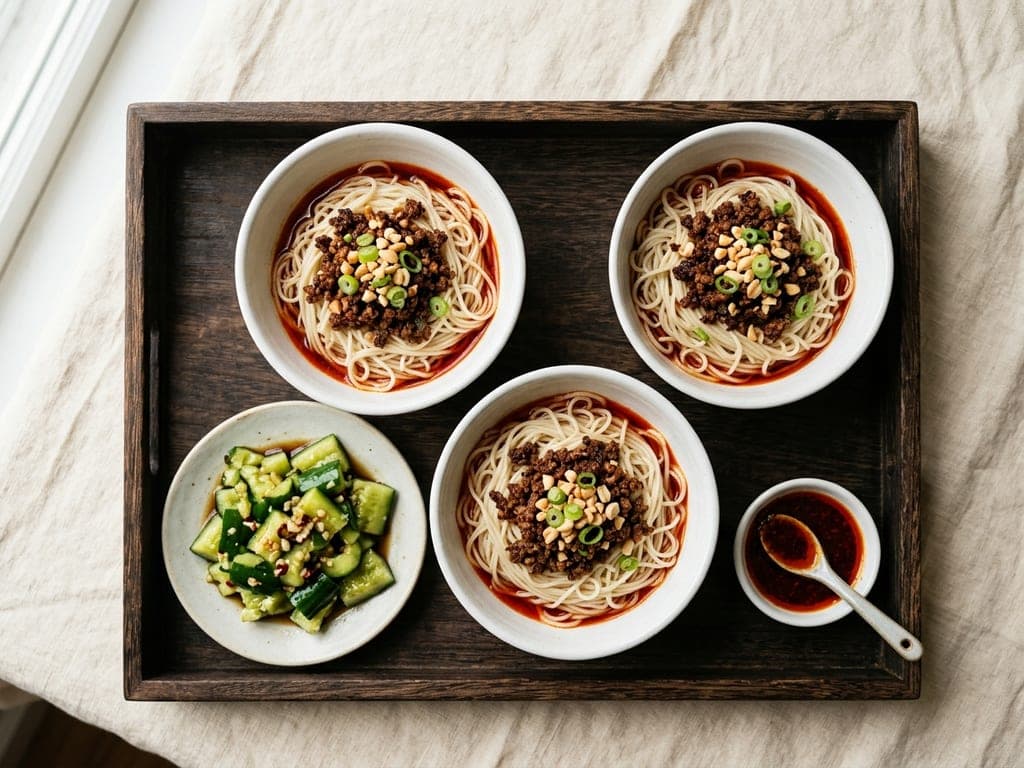
What are the ingredients for dan dan noodles?
Four components, each short. The noodles: thin fresh wheat noodles. The topping (saozi): ground pork fried dry and crisp with Shaoxing wine, sweet bean sauce, light soy and ya cai — preserved mustard greens, of which more below. The bowl sauce: chili oil with its sediment, light soy sauce, Chinese sesame paste, ground toasted Sichuan pepper, garlic, a little sugar, and hot noodle water to loosen. The garnish: crushed roasted peanuts, scallion greens, and something briefly green — baby bok choy blanched in the noodle water is standard.
Two ingredients are non-negotiable and they are not the two people guard. The first is real Sichuan chili oil, made or bought with its flaky sediment — the red oil is the dish’s engine, and a generic hot sauce or a naked drizzle of sriracha is not in the same business. The second is ya cai, the fermented mustard greens in the topping — the ingredient nearly every Western version quietly drops, and the single clearest difference between a bowl that tastes like Chengdu and a bowl that tastes like spicy peanut noodles.
What is genuinely debatable: the sesame paste quantity (a regional argument this page maps honestly below), the vinegar (closer to standard than not — Chengdu prizes the bowl faintly sour as well as hot, and in Sichuan the pour would be local Baoning vinegar — though respected recipes skip it), the peanuts (common but not universal), and the meat (pork is standard; beef has real Chengdu precedent — Fuchsia Dunlop’s Mr Xie’s dandan noodles, 牛肉担担面, are a beef dish). What is not up for debate is the toss.
The name is a shoulder pole
Dàn (担) is the shoulder pole with its two hanging loads — slung from the springy bamboo biǎndan (扁担) that moved half of old China — and dàndàn miàn is literally ‘carrying-pole noodles’: noodles named not for an ingredient or a place but for a delivery system. The vendors of nineteenth-century Sichuan walked their whole restaurant through the streets on one pole: a charcoal stove and water pot swinging on one end; noodles, bowls, chopsticks and a battery of seasonings on the other, the vendor’s cry of ‘dàndàn miàn—’ doing the advertising. Sold that way, the dish had to be what it still is: tiny bowls, the seasonings spooned into each bowl to order, noodles boiled in a minute, topping from a jar. The street format is the recipe.
The standard origin story names a specific man: Chen Baobao (陈包包), a peddler from Zigong in southern Sichuan, credited with creating the dish in 1841 and carrying it to fame. The attribution and the suspiciously precise date repeat through Chinese culinary references, and we pass them along the way we passed along Chen Mapo’s 1862 — honestly flagged as lore-grade. There is no contemporary document; there is a name, a date, a story polished by 180 years of retelling — and a rival account crediting a Chengdu vendor a century earlier, in the Qianlong era. What is certain is the picture: by the late Qing, pole vendors selling seasoned noodles were fixtures of Sichuan street life, and Chengdu made this particular bowl its own.
The pole explains one more thing worth keeping: the portion. Street dan dan was a xiaochi — a ‘small eat’, a between-meals snack of a few mouthfuls, priced and sized accordingly. Chinese accounts are precise about it: one liang of noodles and no more, in a small fluted white porcelain bowl — half a liang when it appeared as a banquet interlude — and at two or three liang, the saying goes, it stops being dan dan mian and becomes cui sao mian. (A liang is 50 g today; under the Qing weights of the 1840s it was nearer 37.) When the dish moved into restaurants and then across the Pacific, the bowl grew to dinner size but the seasoning intensity never relaxed, which is why a full Western portion of a properly made batch is genuinely loud. Our recipe serves four dinner bowls; Chengdu would call each of them a serving and a half.
The sesame paste question — an honest map
Ask whether sesame paste belongs in dan dan noodles and you have started an argument that runs from Chengdu to Tokyo. The honest map looks like this: in Chengdu itself, bowls vary vendor to vendor, but the dial genuinely moves within the city itself — chili-oil-forward bowls with little or no paste at one end, nuttier bowls at the other. Fuchsia Dunlop’s two Chengdu recipes bracket the range neatly: her ‘traditional’ dandan noodles take a restrained 2 teaspoons of paste, thinned with oil and pooled in the base of the bowl, while her Mr Xie’s version — from a famous, long-demolished shop near Sichuan University — goes to a full 2 tablespoons and swaps the pork for beef. What changes outward from Sichuan is not the paste’s presence but its job — from seasoning to the body of the bowl: Hong Kong and Taiwan versions lean into it, Japan’s tantanmen (next section) is built on it, and by the time the dish reaches an American takeout menu, the paste has often become peanut butter and the bowl has become a creamy sesame-peanut noodle with chili oil as an accent rather than the engine.
None of those bowls is a moral failing — but they are different dishes wearing one name, and a cook should get to choose knowingly. This recipe takes the middle of the map: 1 tbsp of sesame paste per bowl, enough to give the sauce body and a nutty backbone while the chili oil stays in charge. For the Chengdu-lean version, simply omit the paste and add an extra teaspoon of chili oil and a half-teaspoon more soy per bowl — the sauce turns from creamy to slick and the heat reads brighter. For the takeout direction, go to 2 tbsp of paste per bowl and thin it with extra noodle water.
A buying note, because the jars are confusing: Chinese sesame paste (zhima jiang, 芝麻酱) is ground from toasted seeds — deep brown, intensely roasty. Tahini is ground from raw or lightly toasted seeds and is paler and milder; it is an acceptable understudy if you stir half a teaspoon of toasted sesame oil into each tablespoon. Do not substitute sweetened sesame products or black sesame paste, which belong to desserts.
Ya cai and the crisp crumble — the part everyone skips
Ya cai (芽菜) is the topping’s soul: mustard-green stems, wilted, salted and slowly fermented until they are dark, tender-crunchy and intensely savory-sweet. The canonical product comes from Yibin in southern Sichuan — look for suimiyacai (碎米芽菜), ‘broken-rice ya cai’ — named for the rice-grain-sized mince, not for any rice — sold in small foil packets in Chinese groceries and online, ready-chopped and ready to fry. It is one of Sichuan’s four great preserved vegetables — alongside Fuling zhacai, Nanchong dongcai and Neijiang datoucai — and its umami-funk is precisely the flavor Western dan dan recipes are missing when they taste one-dimensionally of chili and nut. If you truly cannot find it, chopped Tianjin preserved vegetable (dong cai) is the nearest substitute, and rinsed, chopped zha cai a more distant one; both change the accent, neither embarrasses the bowl. There is no fresh-vegetable substitute — the fermentation is the flavor.
The pork half of the topping follows a rule this site’s readers have met before: fry it past browned, all the way to dry and crisp. Sichuan cooks grade the topping as sūxiāng (酥香), crisp and fragrant — the same 酥 our mapo tofu page spends a paragraph on, and the crisp topping even has its own name, cuìsào (脆臊) — and that crispness is what lets it stay a distinct, crunchy event scattered through slippery noodles instead of dissolving into the sauce. Sweet bean sauce (tianmianjiang, 甜面酱), a dark fermented wheat-flour paste, glosses and seasons the crumble; hoisin is sweeter and spiced, a last resort — drop the bowls’ sugar to 1/4 tsp if you use it.
Make double. The finished crumble keeps 3–4 days refrigerated (48 hours by UK guidance) and freezes for months, and a jar of it in the freezer converts dan dan noodles from a project into a ten-minute dinner — boil noodles, build bowls, reheat crumble, done.
The noodles, and the loosening law
The right noodle is a thin, round or square-cut fresh wheat noodle — the plain pale kind sold refrigerated in Asian groceries; in Sichuan and Chongqing these fresh wet noodles are shuǐmiàn (水面), ‘water noodles’, fresh as opposed to dried. Notice what it is not: it is not an egg noodle. Alkalinity, though, is a spectrum here rather than a rule: plenty of Chengdu noodle shops use a lightly alkaline fresh noodle (碱水面, jiǎnshuǐ miàn), far gentler than the kansui dose in Japanese ramen, so a lightly alkaline fresh wheat noodle is perfectly authentic. What pushes the bowl toward tantanmen is the full ramen noodle — deep yellow, bouncy, with a real mineral tang. If fresh is out of reach, dried thin wheat noodles are a fine everyday substitute; cook them a minute short of the package and finish judging by bite. Whatever the noodle, just-done matters more than brand: it will keep cooking in a hot bowl and take a beating from the toss.
Then comes the least glamorous, most important move on this page: loosening the sauce with hot noodle water. Sesame paste straight from the jar is nearly solid; chili oil is pure fat; soy is thin and salty. Whisked with two or three spoonfuls of starchy, near-boiling noodle water, they emulsify into a single silky sauce that coats every strand — which is the entire answer to the ‘secret to a great dan dan sauce’ question people ask. Restaurants are not adding a mystery ingredient; they are diluting correctly, at temperature, with water that carries a little starch to bind the emulsion.
Two mechanical details make the difference between silky and split. First, expect the seize: sesame paste clumps when water first hits it, exactly like tahini, and relaxes as you keep stirring — do not panic and add oil. Second, transfer the noodles wet, straight from the pot with tongs or chopsticks rather than drained bone-dry in a colander; the clinging water is a built-in final adjustment, and dry noodles instantly stiffen the sauce you just perfected.
Tantanmen — the Japanese descendant, by the same hands as mabo dofu
In Japan, 担担麺 — tantanmen — is one of the country’s favorite ramen styles: a full soup bowl of sesame-rich, gently spicy broth over alkaline ramen noodles, crowned with the familiar pork crumble. It descends directly from dan dan mian, and the adaptation has a name attached: Chen Kenmin, the Sichuan-born chef who settled in Japan after the Second World War and introduced Sichuan cooking there through his Tokyo restaurant and television work in the 1950s and 60s. Readers of our mapo tofu page have met him already — he is the same man credited with reshaping that dish into Japanese mabo dofu. The two great Sichuan exports traveled to Japan in the same suitcase, and were retuned by the same palate: more sesame, less chili, softer numbing, and — the structural change — broth, turning a dry tossed snack into a soup meal that made sense in a ramen culture.
Tantanmen is a genuinely different dish, not a translation error: different noodle (ramen-grade alkaline), different format (soup), different balance (sesame leads, chili accents), often finished with soy milk or extra stock in modern shops. If the bowl you are actually craving is creamy, soupy and nutty, that is the dish to make — and it deserves its own recipe rather than a compromised version of this one.
The quickest bridge between them, for the curious: make this recipe’s topping and sauce, then loosen each bowl with 1 cup (240 ml) of hot unsalted chicken stock instead of 3 tbsp of noodle water, and use fresh ramen noodles. It is not a proper tantanmen — the real thing builds its broth on sesame and stock in different proportions — but it is a delicious sketch of how one dish became the other somewhere over the East China Sea.
Nutrition, honestly — and the portion the pole already solved
A full dinner bowl of this recipe — a quarter of the batch, tossed and eaten — runs in the region of 820 kcal: roughly 255 from the noodles, 210 from the pork topping, 90 from the sesame paste, and close to 265 from the chili oil, peanuts and sugar. Call it 750–900 depending on the honest variables: how much of the 2 tbsp of oil per bowl actually leaves with the noodles (some always stays glossing the empty bowl), how fatty your pork is, and whether you took the Chengdu-lean or the extra-nutty fork. Sodium is substantial — in the region of 1,500–1,800 mg per bowl across the soy, the ya cai, the sweet bean sauce and the salt in the chili oil — roughly two-thirds to three-quarters of a day’s recommended intake, before any sides.
There is no low-sodium dan dan that still tastes like the dish; the seasoning system is salt-fermented from three directions. What there is, is the portion answer, and the dish’s own history already solved it: dan dan noodles were engineered as a xiaochi, a small intense snack, not a trough. Serve this batch to six as a starter or a noodle course — Chengdu-sized bowls — and the numbers drop by a third while the experience, if anything, improves. Fierce food eats best in small bowls.
The vegetable in the bowl is a garnish, not a serving; treat the meal honestly and put something plain and green beside it — more blanched bok choy, or a smashed cucumber salad, which is what it would meet on a Sichuan table anyway.
Vegetarian and vegan dan dan noodles
The conversion is easier than it looks, because the pork was doing a texture job as much as a flavor one. Replace it with 9 oz (250 g) of finely chopped shiitake and king oyster mushrooms — or a mix of mushrooms and crumbled extra-firm tofu, pressed dry — and fry them exactly as hard as the recipe fries the pork: past browned, to genuinely dry and crisping at the edges, before the Shaoxing, sweet bean sauce and ya cai go in. The crumble should rustle when you stir it. Everything else in the bowl is already plant-based: ya cai is a vegetable ferment, sesame paste is seeds, and the sauce contains nothing animal as written.
The traps are all in jars. Some chili oils and most chili crisps in the fried-shallot style contain dried shrimp or seafood extract — read the label. Sweet bean sauce is plant-based but its cousin on the shelf, certain ‘barbecue’ or shacha sauces, are not. And if you loosen the bowls with stock instead of noodle water for a richer sauce, make it vegetable stock — chicken stock is the most common accidental animal ingredient in ‘vegetarian’ noodle bowls, here as everywhere.
One honest note on depth: pork fat carries chili flavor in a way mushrooms cannot, so the vegan bowl benefits from a slightly more generous hand with the chili oil — an extra teaspoon per bowl — and a pinch more sugar to round it. Season the crumble a shade harder than feels right and taste the assembled, tossed result before judging.
Questions, answered
What are dan dan noodles?
A Sichuan street dish: thin wheat noodles served over an unmixed sauce of chili oil, soy sauce, sesame paste, garlic and ground Sichuan pepper, topped with a crispy fried crumble of pork and ya cai (preserved mustard greens), plus peanuts and scallions. The eater tosses everything together at the table. The name means ‘carrying-pole noodles’, after the shoulder poles Chengdu street vendors sold them from. Expect them numbing and spicy at once — the Sichuan málà signature — in a small, intense portion.
What is the secret to good dandan noodles?
Four things, in order: real Sichuan chili oil with its sediment (the dish’s engine — make it the night before or buy a good jar); ya cai, the fermented mustard greens nearly every Western version skips; a pork topping fried past browned to genuinely dry and crisp, so it stays distinct in the bowl; and the toss — the dish is served unmixed and only becomes itself when the eater tosses it thoroughly from the bottom. No single ingredient rescues a bowl that misses these four.
What is the secret to a great dan dan sauce?
Hot, starchy noodle water. Sesame paste, chili oil and soy only become one silky sauce when they are loosened with two or three spoonfuls of near-boiling water from the noodle pot, whisked in the bowl until the mixture relaxes to the consistency of light cream. The paste will seize and clump first — exactly like tahini — then smooth out; keep stirring, don’t add oil. Restaurants aren’t adding a mystery ingredient, they’re diluting correctly, at temperature. The sauce should taste aggressively overseasoned on its own, because plain noodles are coming to dilute it. (In Chengdu the soy half is often fùzhì jiàngyóu, a sweetened, spiced ‘compound’ soy sauce — this recipe’s soy-plus-sugar is the honest home stand-in.)
What kind of noodle is in dan dan noodles?
Thin fresh wheat noodles — plain pale, round or square-cut, sold refrigerated in Asian groceries; the lightly alkaline fresh noodles many Chengdu shops use (碱水面) are fine here. Not egg noodles, and not full ramen: the deep yellow, springy, heavily alkaline noodle belongs to Japanese tantanmen and reads as a different dish. Dried thin wheat noodles are a fine substitute — cook them a minute short of the package time, to just-done with a firm bite, because they keep cooking in the hot bowl and must survive the toss.
Are dan dan noodles the same as tantanmen?
No — tantanmen is the Japanese descendant, adapted in the 1950s–60s by Chen Kenmin, the same Sichuan-born chef credited with turning mapo tofu into Japanese mabo dofu. Tantanmen is a soup (dan dan noodles are tossed, not brothy), uses alkaline ramen noodles, leans much harder on sesame, and runs milder on both chili and Sichuan pepper. They share ancestry and a topping; they are different dishes and deserve different recipes.
Is sesame paste authentic in dan dan noodles?
Yes — in a range. Chengdu bowls run from chili-oil-forward with no paste at all to a full 2 tablespoons in Fuchsia Dunlop’s Mr Xie’s version; her ‘traditional’ recipe takes 2 restrained teaspoons. What is not Chengdu is paste as the body of the bowl: Hong Kong and Taiwan lean nuttier, Japan’s tantanmen is built on sesame, and American takeout often swaps in peanut butter. This recipe uses 1 tbsp per bowl as a middle path; omit it (adding a little extra chili oil and soy) for the Chengdu-lean bowl. All of these are real dishes — but they are different bowls wearing one name, so choose knowingly.
Can I use peanut butter or tahini instead of Chinese sesame paste?
Tahini, yes, with a correction: it is ground from raw or lightly toasted seeds, so stir half a teaspoon of toasted sesame oil into each tablespoon to fake the roast. Peanut butter takes the bowl toward the American takeout style — creamy, nutty, gentler — which is a legitimate dish, but be aware you are choosing that branch, not approximating Chengdu. Use smooth, unsweetened peanut butter if you go there, and keep the chili oil generous so the bowl stays Sichuan-adjacent.
What is ya cai, and what can I substitute?
Fermented mustard-green stems from Yibin in southern Sichuan — dark, tender-crunchy, intensely savory. Look for foil packets labelled suimiyacai (碎米芽菜) in Chinese groceries or online; it comes ready-chopped. It is the ingredient most Western recipes silently drop, and the clearest single difference between a bowl that tastes like Chengdu and one that tastes like spicy peanut noodles. Nearest substitutes: chopped Tianjin preserved vegetable, or rinsed chopped zha cai. There is no fresh-vegetable substitute — the fermentation is the flavor.
How spicy are dan dan noodles, and how do I tone them down?
As written: assertively spicy and noticeably numbing — loud by design, since the dish was built as a small intense snack. The two sensations are separate dials: chili oil controls the burn, ground Sichuan pepper controls the buzz, and you can turn either down independently. For a gentler bowl, use 1 tbsp of chili oil per bowl instead of 2 (favoring the sediment for flavor), and halve the pepper. Don’t reduce the soy or sesame paste — the bowl reads flat, not milder.
Can I make dan dan noodles ahead, and do leftovers keep?
The components, yes; the assembled bowl, no — the noodles drink the sauce and set into a block within the hour. The pork-and-ya-cai crumble keeps 3–4 days refrigerated and freezes for months; the chili oil keeps a month in a cool dark cupboard — or up to three months refrigerated — once strained of any aromatics (four days, refrigerated, if garlic stays in — see the safety notes); the pork crumble and the ground pepper can sit ready all afternoon — but build the wet sauce (chili oil, sesame paste, soy and especially the raw garlic) shortly before serving, or keep pre-built bowls in the refrigerator rather than on the counter. Fresh noodles take two minutes, so the dish’s own logistics agree with the food-safety ones: assemble to order.
How many calories are in dan dan noodles?
About 820 kcal for a full dinner bowl of this recipe — call it 750–900 depending on pork fat and how much of the chili oil leaves the bowl — with roughly 1,500–1,800 mg of sodium. Served Chengdu-style as a small noodle course for six, the numbers drop by a third. The vegetable garnish is not a serving of vegetables; put a plain green side or a smashed cucumber salad next to it.
Can dan dan noodles be vegetarian or vegan?
Yes, convincingly: replace the pork with finely chopped shiitake and king oyster mushrooms (or mushrooms plus pressed, crumbled extra-firm tofu) and fry the crumble just as dry and crisp before the sweet bean sauce and ya cai go in. Everything else in the bowl is already plant-based. The jar traps: some chili oils and most chili crisps contain dried shrimp, and stock-loosened versions want vegetable stock. Add an extra teaspoon of chili oil per bowl — pork fat carries chili flavor, and the vegan bowl earns the top-up.
What do you serve with dan dan noodles?
Something plain and something cold. In Sichuan the dish is a xiaochi — a small snack course — so it shares the table naturally: a smashed cucumber salad dressed with vinegar and garlic is the classic cooling partner, extra blanched greens keep the bowl honest, and plain steamed rice is not wrong if the bowl is your whole dinner. Skip competing sauces — one loud dish per table. If you’re building a Sichuan night, our mapo tofu is the natural companion; the two share a spice rack and split the workload.
Snap your finished plate and let the AI plate it again — more beautifully.