Drunken Noodles Recipe (Pad Kee Mao — No Alcohol in the Pan, Plenty of Fire)
Pad kee mao, the drunkard's stir-fry: wide rice noodles thrown at a furious pan with garlic, bird's eye chilies, holy basil and green peppercorns. There is no alcohol in it — the name describes the customer, not the ingredients — and it is pad see ew's loud sibling: same noodle, opposite temperament, engineered for the end of a long night.
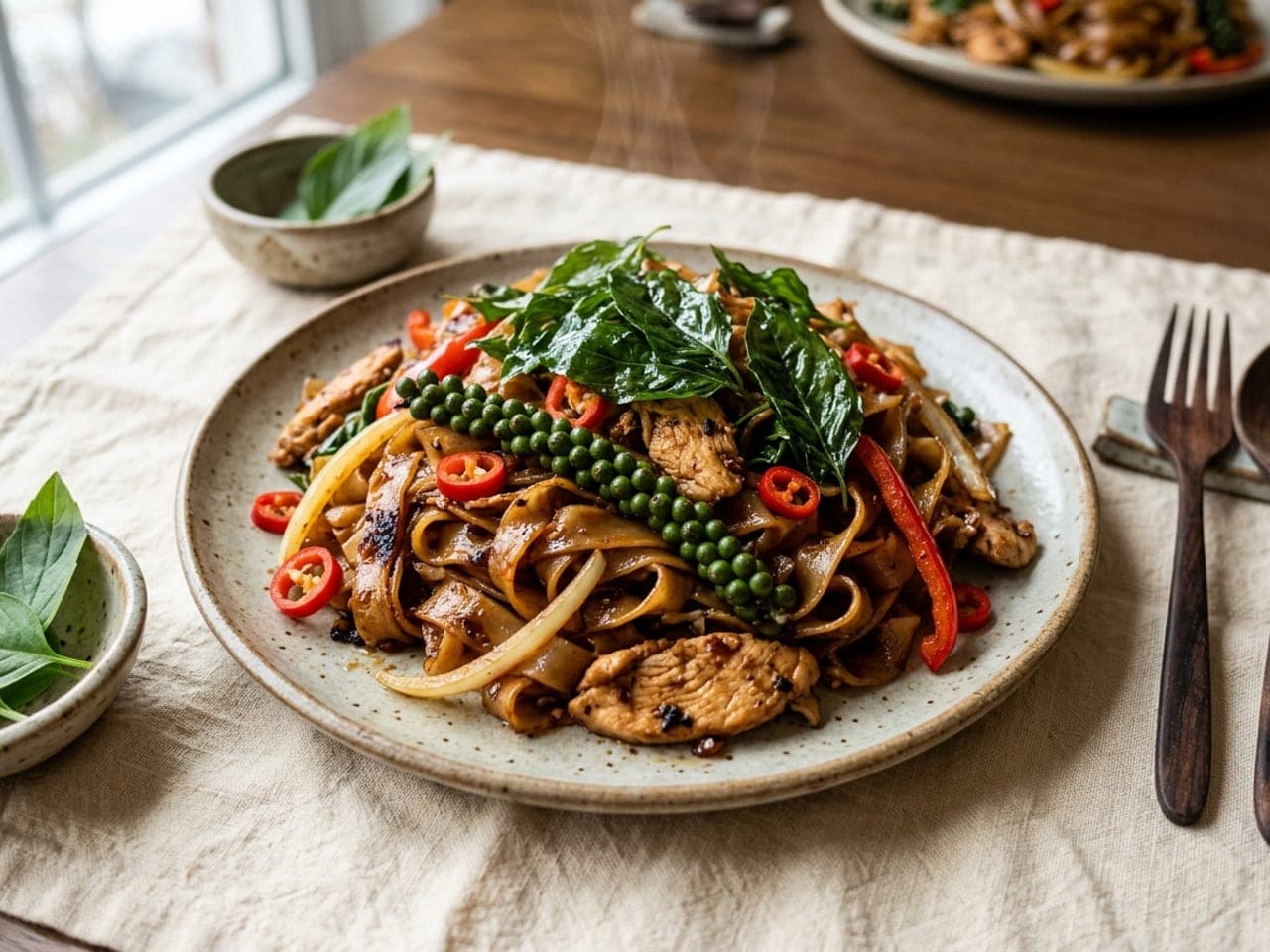
Ingredients
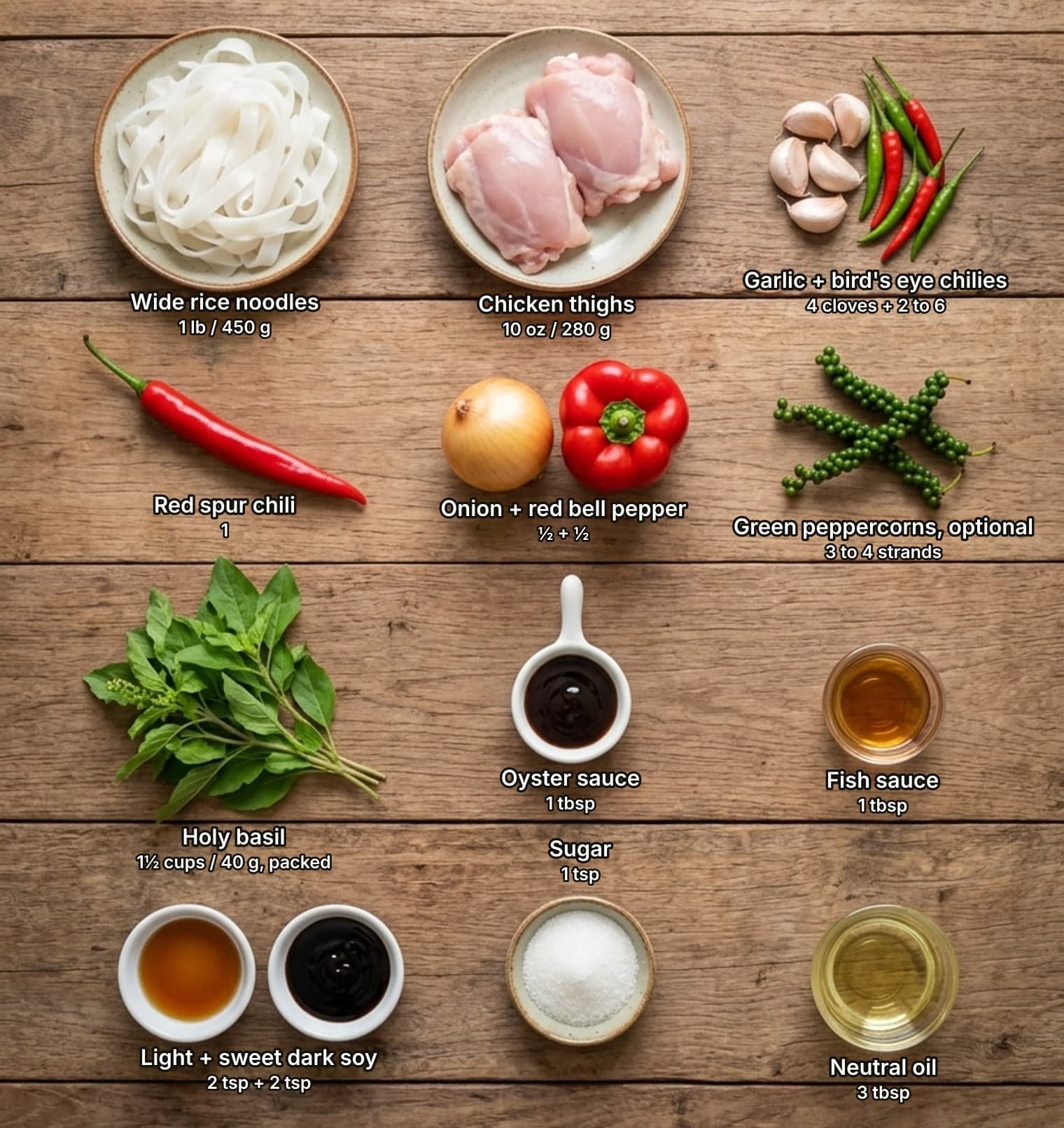
- fresh wide rice noodles (sen yai) — or 7 oz / 200 g dried XL rice sticks1 lb / 450 g
- boneless chicken thighs, sliced thin against the grain10 oz / 280 g
- garlic, roughly pounded4 cloves
- bird's eye chilies, pounded with the garlic2–6, to conscience
- red spur chili or Fresno, in rings1
- small onion, in slim wedges½
- red bell pepper, in strips½
- fresh green peppercorn strands (optional, transformative)3–4
- holy basil leaves (bai kaphrao) — or 1 cup / 25 g Thai sweet basil1½ cups / 40 g, packed
- oyster sauce1 tbsp
- fish sauce1 tbsp
- light soy sauce2 tsp
- sweet dark soy sauce (see ew wan — or kecap manis)2 tsp
- sugar1 tsp
- neutral high-smoke-point oil3 tbsp
The name is a story (and the pan is sober)
Pad kee mao — ผัดขี้เมา — translates, with no way to soften it, as 'drunkard's stir-fry'; 'khi mao' is Thai for a drunk person, and English menus laundered that into the more romantic 'drunken noodles'. The dish contains no alcohol whatsoever. What it contains is an explanation, and Thai food culture offers three: it is what the drinking table orders — fiery, salty food built to accompany a long night of cold beer or rice whisky; it is what the drinker cooks after — a slam-everything-in-the-wok dish forgiving enough for an impaired chef and loud enough to feel like a meal; or it is the morning-after cure, on the theory that enough chili and holy basil can shout down any hangover. Nobody rules; all three describe the same dish: maximum flavor, minimum ceremony, best consumed late.
Structurally it is a kuaitiao kee mao — the same Thai-Chinese wide-rice-noodle family as pad see ew, taken in the opposite direction. Where pad see ew is the calm lunch dish (sweet, mild, charred), pad kee mao is the midnight dish: bird's eye chilies and pounded garlic up front, holy basil and green peppercorn perfume over the top, fish sauce leaning in where sweetness steps back. Same noodle, same wok, same four-minute cook — a personality transplant.
One boundary worth drawing early, because menus blur it: pad kee mao is not pad kra pao. Pad kra pao is the holy-basil stir-fry of minced meat over rice — arguably Thailand's true national everyday dish — and it shares the basil and the temperament but not the noodle. If a menu offers 'basil noodles', it usually means this page; if it offers 'Thai basil chicken over rice', that is kra pao, and it deserves its own day.
How to make Drunken noodles
- Ready the noodles first. Same drill as every wide-noodle dish: fresh sen yai from the refrigerator case arrives welded into a brick — tip it into a microwave-safe bowl, microwave in 30-second bursts until warm and floppy, then separate the ribbons gently and forgive the tears. Dried fallback: soak 7 oz (200 g) of the widest rice sticks you can find in hand-hot kettle water (not the hot tap) for 30–40 minutes until limp but still firm-chewy, and drain hard. The full noodle briefing lives on our pad see ew page; this page assumes the short version and moves on to the chilies.
- Build the garlic-chili base — a rough pound, not a mince. Roughly pound 4 garlic cloves with 2–6 bird's eye chilies (your call — see the heat section before choosing bravado) in a mortar until broken and juicy but still coarse, or pulse-chop them together on a board. The rough texture is functional: uneven shards of garlic and chili scatter through the noodles as little landmines instead of dissolving into uniform background heat, which is half of pad kee mao's personality. Slice 1 red spur chili (or Fresno) into rings and keep it separate — it is there for fruity color, not violence.
- Mix the sauce. Stir together 1 tbsp oyster sauce, 1 tbsp fish sauce, 2 tsp light soy sauce, 2 tsp sweet dark soy sauce (see ew wan or kecap manis) and 1 tsp sugar. Note the ratio against the sibling dish: where pad see ew leans on sweet soy as its engine, pad kee mao runs saltier and leaner — fish sauce steps forward, sweetness steps back to a supporting role. Same shelf of bottles, different government. Set it by the stove; from the moment oil hits the pan, the whole dish is four minutes.
- Prep the rest — and pick the basil eyes open. Slice 10 oz (280 g) boneless chicken thigh thin against the grain. Cut ½ small onion into slim wedges, ½ red bell pepper into strips, and if you found them, break 3–4 strands of fresh green peppercorns into short lengths. Then the defining decision: pick 1½ cups (about 40 g) of holy basil leaves (bai kaphrao) if any Thai or Vietnamese grocer within reach carries it — peppery, clove-ish, almost minty sharp — or 1 cup (25 g) of Thai sweet basil (horapha) as the honest Western substitute, knowing it trades kaphrao's black-pepper bite for anise perfume. The section below owns this fully; the one-line ruling is: holy basil is the dish, Thai basil is a very good dinner.
- Halve everything — one plate per pan, same as its sibling. Split the noodles, chicken, vegetables, sauce and aromatics into two portions, because this dish obeys the same law as pad see ew: a home burner has enough fury for one plate, and a doubled load turns searing into stewing. If anything, pad kee mao punishes crowding harder — its sauce is thinner, so a cooled pan leaves you with wet noodles and raw-tasting chili instead of char and perfume. Four extra minutes, two proper plates.
- Sear the chicken, then wake the chili-garlic. Heat a wok or heavy cast-iron skillet on maximum until water skitters and vanishes, add 1½ tbsp high-smoke-point oil, and sear half the chicken in one layer, 45–60 seconds untouched, until browned hard on the underside. Push it aside, drop in half the pounded garlic-chili, and stir just 20–30 seconds until violently fragrant but not browned — pounded garlic burns faster than sliced, and burnt chili-garlic is a bitterness no sauce rescues. Yes, the air will catch in your throat a little. That is chili hitting hot oil, it is temporary, and the hood should already be running.
- Vegetables, noodles, sauce — press, char, once more. Add half the onion wedges, bell pepper strips, spur chili rings and peppercorn strands; toss 30 seconds, keeping everything moving and aggressive. Add half the noodles and half the sauce and fold until every ribbon is glossed, then do what the sibling page teaches: spread the noodles flat, press them against the metal, and leave them 45 seconds until the undersides blister with dark spots — pad kee mao wants char every bit as much as pad see ew, it just wears more perfume over it. Toss once, press briefly again.
- Heat off, basil in — the basil cooks in the residual heat. Kill the burner, throw in half the basil leaves, and fold for 10–15 seconds until they slump glossy and the whole pan smells like the reason you made this. Basil added over live heat blackens and goes bitter; basil folded through residual heat perfumes everything and keeps its color — this timing is the single most common place restaurant copies go wrong at home. Plate immediately, wipe the pan out with a dry wad of paper towel held in tongs — water on a maximum-heat pan is a steam burst at face height, and a thermal-shock crack risk for the cast iron this page recommends — and cook round two. Serve with nothing but a cold, very plain drink — the traditional pairing is exactly what the name implies — and read the plating section on the fried-egg question before deciding you are done.
Safety & hygiene Important
- Chilies first, because this page means them. Pad kee mao is the hottest dish on this site so far, and the danger window is prep, not eating: capsaicin is an oil, so wash hands with soap — twice — after pounding chilies, because water alone just relocates it, and chili-hands will find eyes, noses, and contact lenses with sniper accuracy hours later. Wear disposable gloves if you handle lenses at all; pound with the pestle angled away (chili juice in the eye is memorable); give chilies the last corner of the cutting board; and when chili meets hot oil the air stings for a moment — ventilate, stand back, and never lean over the pan to smell it. If a mouth catches more fire than it consented to: milk, yogurt or a spoon of sugar; water is famously useless because capsaicin does not dissolve in it. Keep the finished plate and the chili stash away from small children — bird's eye chilies look like candy and are not.
- The pan rules, inherited in full. Every high-heat law from the pad see ew page governs here unchanged, condensed once: never leave a maximum-heat pan — not for a phone call, not for the doorbell; handle turned in, sleeves up, metal lid or baking sheet within reach BEFORE the burner goes on; brief oil-smoke is the dish working, continuous heavy smoke means past the limit and headed for its flash point — off the heat; if oil ignites — heat off, lid slid on from the side at arm's length (never dropped from above), lid stays until stone cold, never water, and never carry the pan anywhere: moving a pan fire is how most cooking-fire burns happen, and if it is not out at once, everyone leaves and the fire service gets the call; hood on, window open, and the smoke alarm is a safety device, not a critic. The burn rule, standing site-wide: cool any burn under cool running water for a full 20 minutes — no ice, no butter — rings off, and medical attention for anything blistered, larger than the person's palm, on the face, hands or a joint, looking white or charred (deep burns can be painless), or on a child.
- Raw chicken, ninety-second edition. Thin-sliced thigh cooks in about ninety seconds of proper wok heat, and every rule still applies at that speed: board, knife, bowl and hands are raw-poultry zones until washed — hot soapy water for tools, a real 20-second soap wash for hands before touching the noodle bag or the basil. Verify on the thickest piece: opaque throughout, no translucent core, juices clear — remembering color is a proxy, not proof, and USDA's one reliable test is a thermometer at 165°F (74°C), which truly seared thin slices clear almost instantly; when in doubt, 30 more seconds costs nothing — the risk is not the recipe's timing, it is the piece that hid in the pile and never met the pan. No rinsing raw chicken, ever; it cleans nothing and sprays the sink.
- Noodle leftovers ride the same fried-rice clock. Rice noodles are prime Bacillus cereus territory — the 'fried rice syndrome' organism whose toxin survives reheating, which makes room-temperature hours the one unfixable mistake. Leftovers: into the fridge within 2 hours of cooking (1 hour above 90°F/32°C), shallow container, eaten the next day (the NHS rule for cooked rice is 24 hours, and rice noodles ride the same clock), reheated once until steaming hot throughout. The basil will arrive at day two looking tragic — dark and slumped — which is cosmetic; fold a few fresh leaves through the reheated plate and it recovers almost completely. A plate that sat out through a long dinner party and a longer conversation gets binned, not refrigerated at midnight — the clock ran out while everyone was talking.
3 ways to plate it
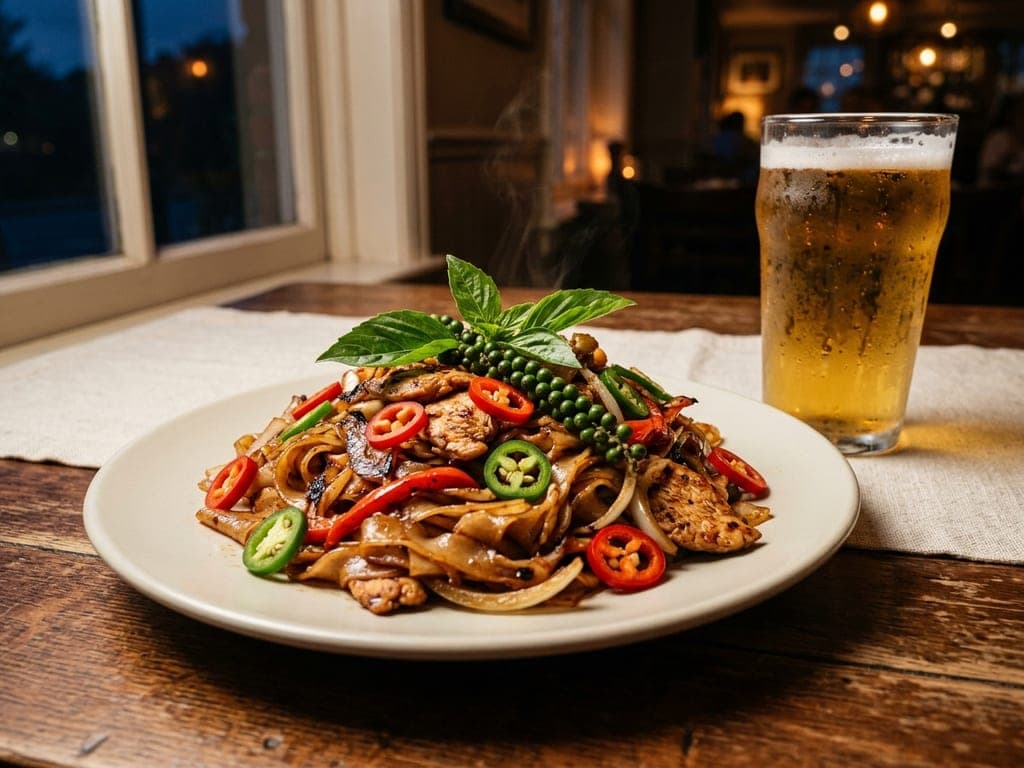
- Tip the pan and let the noodles land as they fall — one confident tangle with height; the char spots, red chili rings and green peppercorn strands should surface naturally, and rearranging buries them.
- Rescue three or four of the best basil leaves from the fold and lay them on the summit while everything is hot enough to keep them glossy.
- Give the plate one visible strand of green peppercorns across the top — it is the dish's signature jewelry and the thing that makes people ask what it is.
- Serve with a spoon and fork, Thai-style — fork herds, spoon carries — and put the cold drink in the frame; this plate has an intended context and it is not a work lunch.
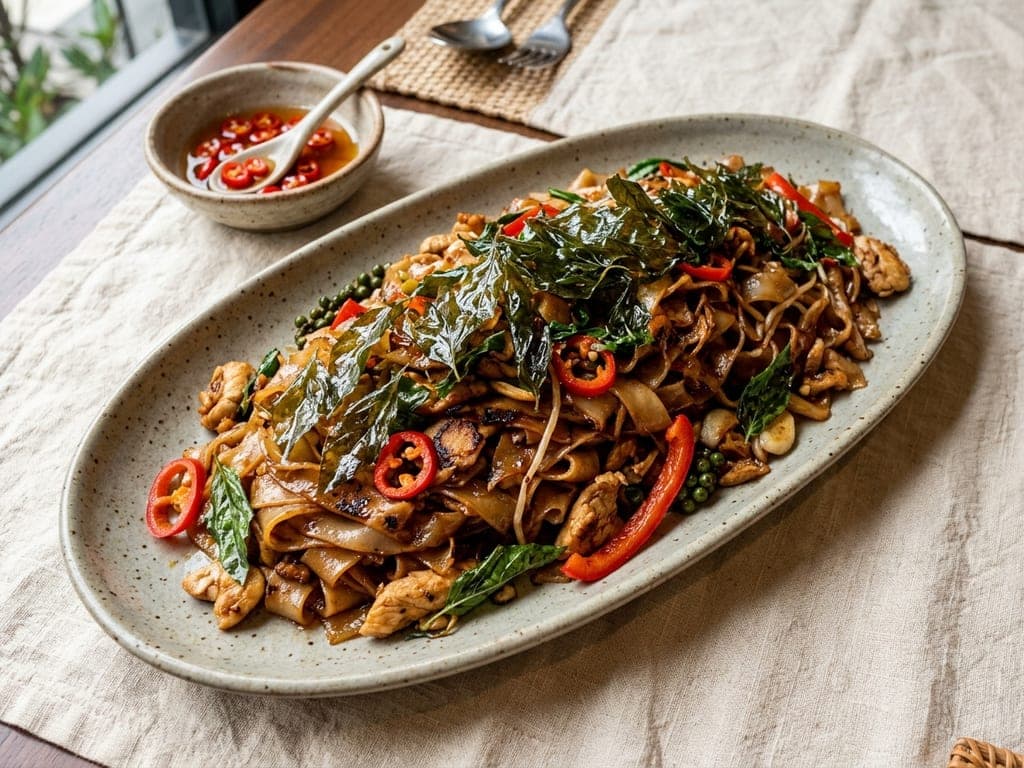
- Mound both batches down the platter's center line rather than spreading edge-to-edge — a ridge looks generous, a layer looks like catering.
- Flash-fry a small handful of dry basil leaves in the residual oil of the finished pan, 20–30 seconds until they crisp and turn glassy-dark, and drain them on paper for one minute.
- Scatter the crisp leaves over the ridge from a height at the last moment — they shatter on contact with steam, so this is strictly a serving-time move.
- Add a small bowl of extra bird's eye chilies in fish sauce (prik nam pla) at the platter's corner for the table's chili-hawks, and let everyone else ignore it in peace.
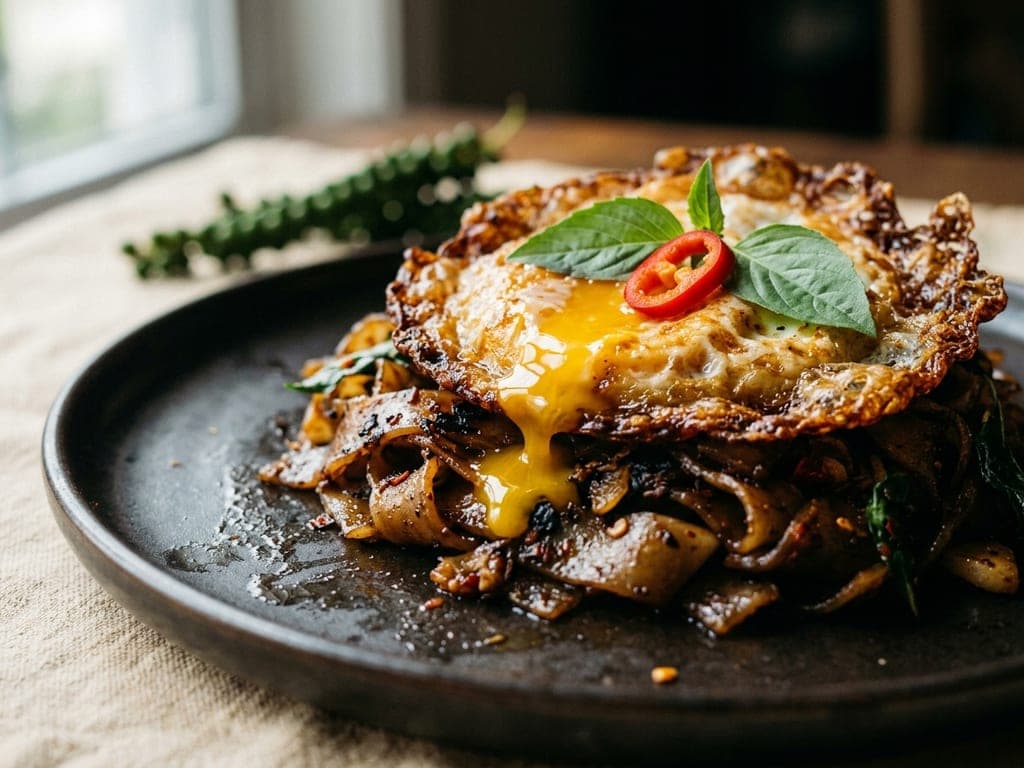
- Fry the egg in the still-hot pan after the noodles leave it: 2 tbsp oil, high heat, spooning oil over the top until the white's edge is bronzed lace and the yolk still shivers.
- Perch it half-on the pile with the laciest edge facing up — the contrast of blistered white against dark noodles is the plate's best photograph.
- Break format on garnish restraint once: a few fresh basil leaves AND one spur-chili ring on the egg itself ties the crown back to the dish below it.
- Instruct the table: yolk first, immediately — it is the cooling counter-sauce to the chili, and it only performs that mercy while it runs. (Small children and anyone advised off runny eggs get theirs fried hard; the mercy survives.)
Holy basil vs Thai basil — the honest ruling
The herb that defines pad kee mao is bai kaphrao: holy basil, Ocimum tenuiflorum, the same species Indian tradition reveres as tulsi (Thai markets sell culinary cultivars bred for the pan rather than the temple, but botanically it is one and the same species). Kaphrao does not taste like Western basil at all — it is peppery, clove-forward, faintly minty, almost sharp, and it holds its nerve against chili and fish sauce where sweet basil would faint. Its one weakness is logistics: it wilts within a day or two of picking, ships badly, and therefore lives almost exclusively in Thai and Vietnamese groceries, sold in modest bags that should be used the day they come home.
What Western restaurants and nearly every English-language recipe actually use is Thai sweet basil — horapha, the purple-stemmed, anise-scented one that ships beautifully and looks great on camera. This page refuses to pretend the swap is invisible: horapha turns the dish sweeter and more licorice-perfumed, kaphrao keeps it savage and peppery. But it is an honorable substitute, not a failure — a horapha pad kee mao is still a far better dinner than no pad kee mao, and 1 cup (25 g) of it (it is more intense in perfume, lighter in pepper) stands in for the 1½ cups (40 g) of kaphrao the recipe wants. Italian sweet basil is the distant third: usable in an emergency, add it with the heat fully off, and accept the dish has moved continents.
If a plant-shop tulsi or a seed packet crosses your path: holy basil grows enthusiastically on a warm windowsill and shrugs off harvesting, which is the actual long-term answer for anyone who cooks Thai food monthly. Pick leaves and tender tops, never wash until the last minute, and use scissors-to-pan freshness as the standard the store-bought bag is measured against.
The heat architecture (choose your chili honestly)
Pad kee mao's fire is built from parts, and knowing the parts lets you tune it without gutting it. The engine is prik kee noo — bird's eye chilies, small, upward-pointing, roughly 50,000–100,000 Scoville — pounded with the garlic so their heat is baked into the dish's foundation rather than sprinkled on top. The chorus is the spur chili (prik chi fa, or a Fresno in Western shops): big, mild, fruity, sliced into rings for color and flavor with barely any burn. The perfume is fresh green peppercorns — soft young strands that pop with a completely different, aromatic heat — plus the basil's clove-pepper finish. Restaurant-menu 'Thai hot' is mostly just more bird's eyes; the architecture does not change.
Scaling honestly: 2 bird's eyes is assertive-but-civilian, 4 is properly Thai, 6 is the version the name was written about. Scaling to zero, though, changes the dish's citizenship — a chili-free pad kee mao is just soy noodles wearing basil, at which point the pad see ew next door is the better dinner and this page will not be offended. The civilized floor: 1–2 bird's eyes, seeds and white membranes scraped out (the pith is where the capsaicin actually lives; the seeds just sit in it), spur chili kept for fruit and color, and the green peppercorns doing aromatic work that reads as complexity rather than pain.
The fresh green peppercorns deserve their own sentence, because Western recipes cut them first and they cost almost nothing to keep: sold in strands — brined in jars at most Thai groceries, fresh (often in the freezer case) when you are lucky; freeze any surplus — they bring a bright, resinous, un-chili pepperiness that is one of the flavors people cannot name in a proper restaurant pad kee mao. Brined ones: rinse first. No source at all: crack a few dried green or black peppercorns over the finished plate and you will hear a faint echo of it.
Bangkok vs the takeout box, and the fine print
A street-stall pad kee mao in Thailand is leaner than its American portrait: noodles, protein, chili-garlic, basil, peppercorns, maybe krachai (fingerroot — a gingery rhizome cut into pale needles) or an extra strand of young green peppercorns, and not much else. The US-Thai restaurant version added the vegetable chorus — onion wedges, bell pepper strips, sometimes baby corn, bamboo shoots or tomato — partly to suit American plate expectations, partly because a heap of vegetables civilizes the chili load for a broader dining room. This recipe includes onion and bell pepper with its eyes open: they belong to the dish's American dialect, they are genuinely good in it, and anyone chasing the Bangkok baseline can simply leave them out and add nothing in their place.
The shopping trip is the same one pad see ew sent you on — sen yai noodles, oyster sauce, light soy, sweet dark soy — plus fish sauce (the one bottle no Thai kitchen negotiates on; Squid, Tiparos and Megachef are honorable Thai bottles at their price points, and Vietnamese Red Boat is the premium outlier that improves anything it touches), bird's eye chilies (freeze the surplus whole; they take it well), and the basil question settled above. This is deliberate: the two pages were built as a pair precisely so that one Asian-grocery run funds a week of both dishes, and the bottles keep for a year of Thursdays.
Fine print for the plate as served: fish (fish sauce), molluscan shellfish (oyster sauce), wheat and soy (the soy sauces, most oyster sauce, kecap manis), egg only if you take the fried-egg upgrade. Gluten-free runs the same conversion as the sibling page — tamari, certified GF oyster sauce, sweet soy built from tamari and palm sugar — and the fish sauce is naturally GF but never vegetarian. For an actually-vegetarian pad kee mao: mushroom stir-fry sauce for both the oyster and fish sauce (accepting a softer, earthier salt), pressed extra-firm tofu seared first, and the chilies suddenly carrying even more of the show — which they are happy to do.
Questions, answered
Why are they called drunken noodles?
'Pad kee mao' translates bluntly as 'drunkard's stir-fry', and the name describes the eater, never the ingredients. Thai food culture offers three origin stories — the dish the drinking table orders alongside cold beer, the dish a drunk person can successfully cook (everything in one pan, impossible to ruin subtly), or the morning-after cure by chili shock therapy. All three agree on the essentials: it is loud, salty, fiery, and at its best late at night. English menus softened 'drunkard' into 'drunken', and the romance stuck.
Do drunken noodles contain alcohol?
None — no beer, no wine, no whisky, nothing in the pan or the sauce. This is the single most-asked question about the dish and the answer is a flat no: the 'drunken' in the name refers to who eats it and when, not what is in it. It is fully safe for anyone avoiding alcohol for any reason. The traditional accompaniment is another matter — the dish was more or less designed to sit next to a very cold beer — but that decision happens at the table, not in the recipe.
What is the difference between drunken noodles and pad thai?
Almost everything except the country. Pad thai: thin rice noodles, sweet-sour tamarind sauce, peanuts, lime, dried shrimp, gentle heat — sweet-and-sour and crunchy. Pad kee mao: wide rice noodles, salty soy-and-fish-sauce glaze, pounded bird's eye chilies, holy basil, no peanuts, no lime, no tamarind — hot and herbal. Pad thai is the postcard; drunken noodles are the local at the end of the bar. People who order pad thai on the first visit tend to order pad kee mao on the fifth.
What is the difference between drunken noodles and pad see ew?
Same wide rice noodles, same wok, same four-minute cook — opposite temperament. Pad see ew is the calm sibling: sweet dark soy, no chili in the pan, char as the whole personality. Pad kee mao is the loud one: less sweetness, more fish sauce, pounded chilies and garlic, holy basil and green peppercorns over the top. The Thai shorthand is lunch dish versus late-night dish. Our pad see ew page is this recipe's deliberate sibling — the sauce-shelf shopping overlaps almost completely, which is why this site built them the same week.
What is the difference between pad kee mao and pad kra pao?
The noodle. Pad kra pao is Thailand's holy-basil stir-fry of minced pork or chicken served over rice, usually under a crispy fried egg — arguably the country's true everyday lunch. Pad kee mao is the same fire-and-basil temperament applied to wide rice noodles. Menus in the West blur them ('basil noodles', 'basil chicken'), but the grammar is simple: over rice with minced meat = kra pao; wide noodles = kee mao. Both worship bai kaphrao; they just give it a different vehicle.
How spicy are drunken noodles — and can I make them milder?
At the midpoint of the written range — 4 bird's eyes — properly hot: Thai-restaurant 'medium-hot', honest sweat territory. The tunable part: bird's eye count (2 is assertive, 6 is the dish's namesake), and scraping out the seeds and white membranes — the pith is where the capsaicin actually concentrates. Keep the spur chili and green peppercorns at full strength regardless — they carry fruit and perfume, not pain. The floor worth respecting: at zero chilies the dish loses its citizenship and becomes soy noodles with basil, at which point pad see ew is the better order. One or two cleaned bird's eyes is the civilized minimum that still deserves the name.
What is holy basil, and what can I substitute?
Bai kaphrao — Ocimum tenuiflorum, the peppery, clove-scented basil that defines this dish (same species as India's revered tulsi, in culinary cultivars). It barely survives shipping, so it lives almost only in Thai and Vietnamese groceries. First substitute: Thai sweet basil (horapha) — the purple-stemmed, anise-perfumed one — which makes a sweeter, more licorice-toned but entirely honorable version; use a little less. Distant third: Italian basil, added strictly off-heat. Long-term answer: holy basil grows happily on a warm windowsill, and homegrown beats every bag in the store.
What are the green strands in restaurant drunken noodles?
Fresh green peppercorns — young, soft peppercorn clusters sold in strands in Thai groceries, fresh or brined. They pop between the teeth with a bright, resinous, aromatic heat that is completely different from chili burn, and they are one of the 'why does the restaurant version taste deeper' ingredients that Western recipes quietly delete. Fresh strands freeze well; brined ones just need a rinse. No source? A coarse crack of dried green or black peppercorns over the finished plate is a faint but real echo.
What noodles do drunken noodles use — and can I use dried?
Sen yai, the same fresh wide rice noodles as pad see ew: refrigerated sheets or ribbons from an Asian grocery, microwaved briefly until pliable and separated by hand (they arrive welded; this is normal). Dried: the widest rice sticks available — XL or 10 mm — soaked in hot tap water until limp but still chewy, never boiled, drained hard; they finish in the sauce. The fresh-versus-dried gap is real but not fatal: dried makes a firmer, narrower, entirely respectable weeknight pad kee mao. The full noodle handbook lives on our pad see ew page.
Are drunken noodles gluten-free?
Not off the shelf, but convertibly. The rice noodles and fish sauce are naturally gluten-free; the wheat hides in the light soy, the sweet dark soy (and kecap manis), and most oyster sauces. The conversion: tamari for the soy, a certified GF oyster sauce, and the sweet soy built from tamari simmered with palm or brown sugar. Check the fresh noodle package for wheat-starch dusting, and the dish converts cleanly — the chilies, basil and peppercorns never had gluten to begin with.
Snap your finished plate and let the AI plate it again — more beautifully.