Mapo Tofu Recipe (Ma Po Tofu), Real Sichuan
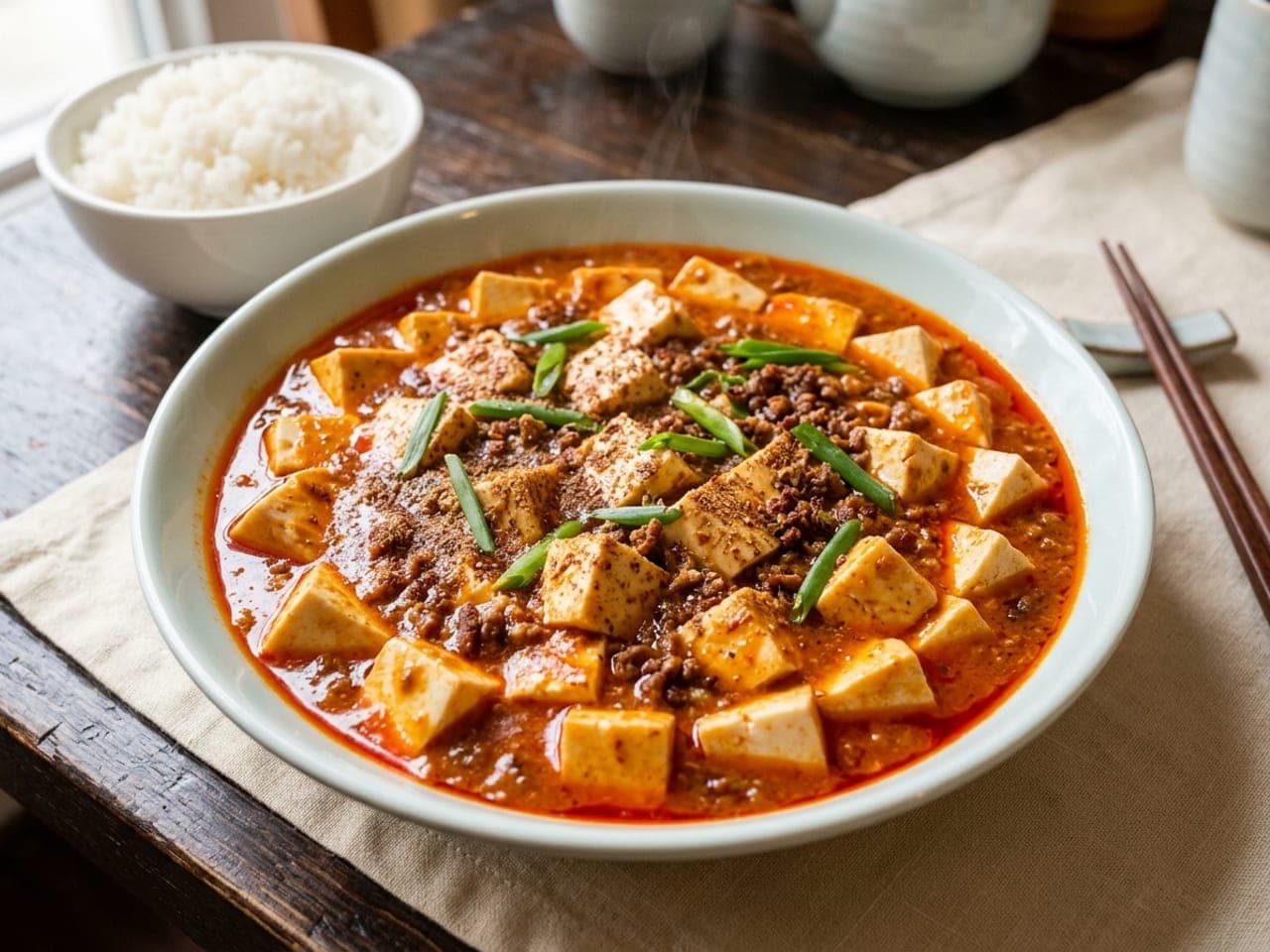
Real mapo tofu buzzes. Soft tofu blanched whole, Pixian doubanjiang fried until the oil runs red, ground Sichuan pepper dusted over at the end. Serves 4 in 40 minutes.
Ingredients
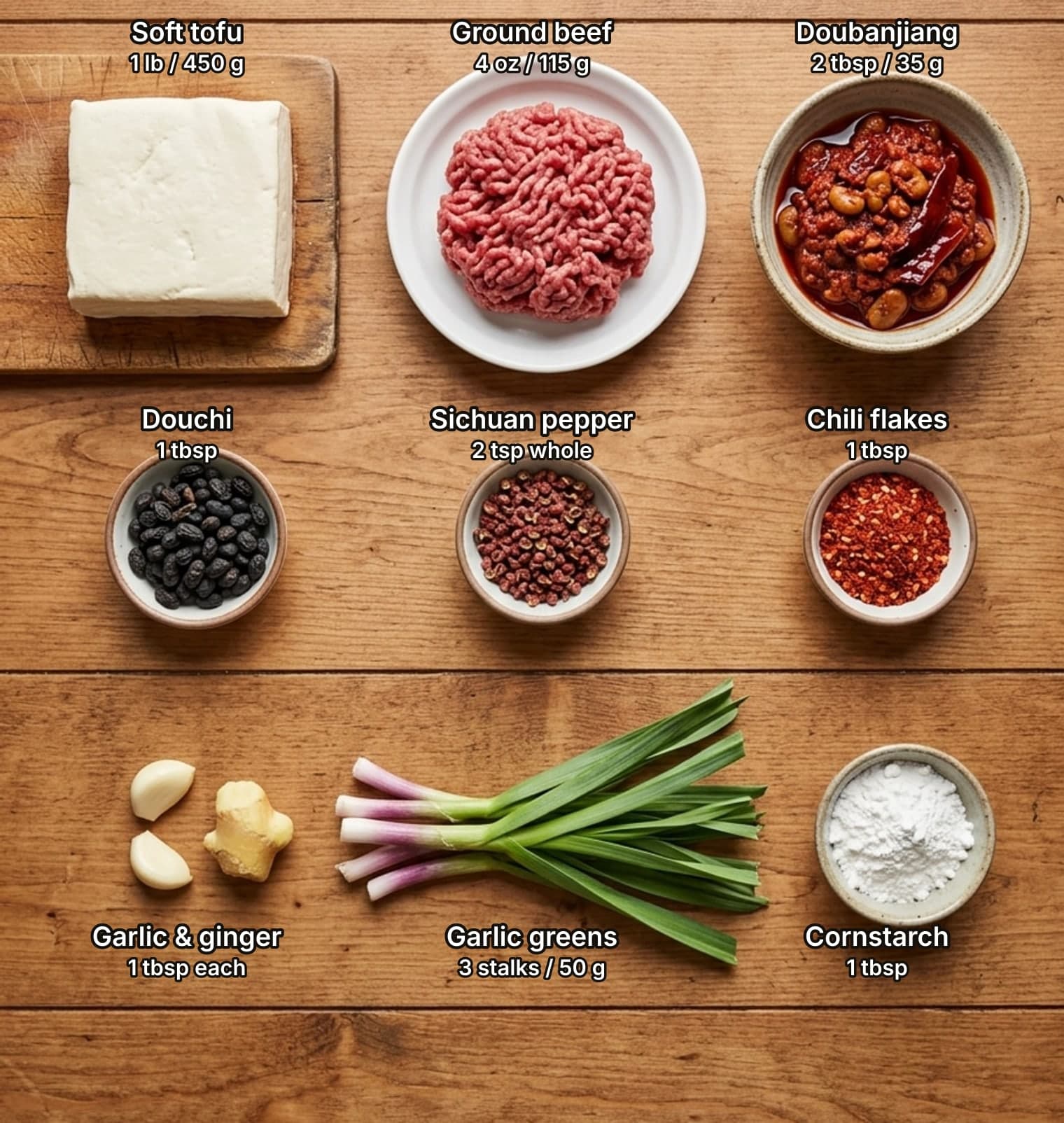
- soft or medium tofu (嫩豆腐), water-packed, from the chilled cabinet. Chinese groceries sell 16 to 19 oz blocks; most US supermarket soft tofu comes in 14 oz (397 g) tubs, and one of those is fine as it stands, so use the whole pack. Silken works but is fragile, firm is the wrong dish1 lb (450 g)
- fine sea salt or table salt, for the blanching water, dissolved in 6 to 8 cups (1.5 to 2 liters). The water volume matters as much as the salt. Diamond Crystal kosher, use 2 tbsp; Morton kosher, 1 1/4 tbsp1 tbsp (17 g)
- neutral oil, or caiziyou (菜籽油, roasted rapeseed oil) if you can get it. Sichuan traditional oil is the roasted, expeller-pressed kind, dark amber and openly aromatic, the opposite of the refined and deodorized canola sold in the West as neutral oil. Neutral oil makes this dish properly; caiziyou adds a toasty aroma nothing else substitutes for3 tbsp
- ground beef, 80/20 (beef mince with 20% fat), hand-chopped if you have the patience; pork is widely used, beef is the Chengdu classic4 oz (115 g)
- Pixian doubanjiang (郫县豆瓣酱, fermented broad-bean chili paste), chopped fine — the soul of the dish; toban djan works at a pinch but is sweeter2 tbsp (about 35 g)
- douchi (豆豉, whole fermented black soybeans — NOT black bean sauce, NOT black turtle beans), rinsed and roughly chopped — the older ferment, traditional1 tbsp
- Sichuan chili flakes — 2 tsp for a milder pot1 tbsp
- garlic, finely minced1 tbsp
- ginger, finely minced1 tbsp
- unsalted chicken stock, or water (vegetable stock or water for the vegan version)1 1/4 cups (300 ml)
- light soy sauce — a nudge, not a second brine; the paste is already salty1 tsp
- sugar1/2 tsp
- cornstarch (cornflour) whisked into 3 tbsp cold water, mixed during prep; add it in stages and stop when the sauce clings, even if slurry is left1 tbsp
- whole red Sichuan peppercorns (红花椒), toasted and ground just before serving — yields about 1 3/4 tsp powder; 1 tsp whole if cautious2 tsp
- garlic greens (蒜苗, suàn miáo), cut into 1 in (2.5 cm) segments, the Chengdu choice. Sold in the US as green garlic or garlic greens: leafy, flat-bladed, with a pale purple-tinged base. Not garlic scapes (蒜薹), which shops often label garlic stems. Or the green parts of 3 scallions (spring onions), cut the same length3 stalks (about 50 g)
- chili oil, optional, for the finishing slick. Read that jar: most Sichuan chili oils and chili crisps contain sesame, many contain Sichuan pepper itself, and some carry peanut or dried shrimp1 tsp
Before you start
Everything is chopped, measured and within reach before the pan goes on. Once the tofu is in the sauce there is no free hand.
Whisk 1 tbsp of cornstarch into 3 tbsp of cold water and leave it on the counter. Mince the garlic and the ginger, chop the doubanjiang and the rinsed douchi, measure the chili flakes, and cut the greens into 1 in (2.5 cm) segments.
Put the blanching water on and toast the Sichuan peppercorns while it comes up to heat, then leave them whole. You grind them later, during the simmer, so the powder is minutes old when it reaches the bowl.
Fill your serving bowl with boiling water so it is warm when the food arrives, and blanch the tofu last: cook within about 30 minutes of lifting it out.
From the moment the stock goes into the pan the dish takes under ten minutes, and it is meant to reach the table scalding.
How to make Mapo Tofu
- Cut and blanch the tofu in properly salted water. Fill your serving bowl with boiling water and leave it to stand while you cook; you will tip it out and dry it just before you serve. A wide bowl is the right shape for this dish and the worst shape for keeping it hot, and 烫 is one of the things you are being judged on. Cut 1 lb (450 g) of soft or medium tofu into cubes about 3/4 in (2 cm). Bring 6 to 8 cups (1.5 to 2 liters) of water to 180°F to 190°F (82°C to 88°C), a surface that trembles and throws the occasional bubble but never rolls. Stir in 1 tbsp of salt and slide the cubes in. A 1 lb (450 g) block straight from the fridge pulls the pot down by roughly 25°F (14°C), so leave the burner on low and let it climb back rather than turning the heat up, which brings it to a boil and tears the cubes before they ever reach the pan. Hold them until the water comes back up and the cubes tremble and rise to the surface, about 2 minutes, and up to 10 if you are not pressed, because longer at this temperature is gentler and the surface keeps firming the whole time. Then lift them out with a slotted spoon or a skimmer rather than tipping the pan into a colander, and leave them to drip while you cook. That tremble is the endpoint Chen Kenichi's published recipe uses, and the skimmer is why his cubes arrive whole. The water volume matters as much as the salt. A tablespoon of fine table salt weighs about 0.6 oz (17 g): in 2 cups (500 ml) that is a 3.5% brine, as salty as the sea, which cures tofu rather than seasoning it. The same tablespoon in 2 quarts (2 liters) is about 0.9%, roughly well-salted pasta water, and that is the one you want. Weigh the salt if you can, because a tablespoon of coarse flake salt weighs far less than a tablespoon of fine salt and the brine moves with it. This is the step most home versions skip and it does three separate jobs: the salt seasons tofu from the outside in, which nothing later in the recipe can do; the gentle heat firms the surface proteins so the cubes survive being moved around a wok; and it drives off the raw, beany note that plain fresh tofu carries. Use the blanched tofu within about 30 minutes; if you need longer, refrigerate it rather than leaving it sitting in cooling water, which is exactly the warm hold where bacteria multiply fastest.
- Toast the Sichuan pepper while the blanching water heats. Put 2 tsp of whole red Sichuan peppercorns (红花椒) in a dry pan over medium-low heat and toast for 1–2 minutes, shaking often, until they smell citrusy and floral; if they smoke or blacken, throw them out and start again, because burnt huajiao is bitter and dead. Tip them out to cool and leave them whole for now: you will grind them during the simmer in step 5, so the powder is minutes old when it reaches the bowl. 2 tsp whole grinds to roughly 1 3/4 tsp of powder, which is the dose this dish wants across four people; use 1 tsp whole if you are cautious. If the husks contain shiny black seeds, discard those first: they are gritty and add nothing, and it is the husk that carries the tingle. Grind late, not early. What you lose first is the aroma — the bright citrus-and-pine top note is carried by volatile oils that start evaporating the moment you break the husk — while the numbing compound itself is tougher and fades over months rather than hours. A supermarket jar of pre-ground powder has usually lost both: the fragrance to time on the shelf, and much of the tingle to age. Use red Sichuan pepper here, warm and woody and floral; green (青花椒) is brighter, more citrusy, often more aggressively numbing, and belongs to later Chengdu fashion and to fish.
- Fry the meat until it is dry and crisp at the edges. Use a wok or a wide straight-sided pan about 11 in (28 cm) across. The test comes later: the tofu cubes should end up in one layer with the sauce coming partway up their sides, because two layers deep and the bottom one is crushed by everything you do to the top one. Keep a flat-edged wok spatula or a ladle beside the pan; a round-bowled wooden spoon drags the cubes rather than pushing them. Heat 3 tbsp of neutral oil in it over medium-high. Add 4 oz (115 g) of ground beef (beef mince) — hand-chopped if you have the patience, so the pieces have irregular edges that brown — and cook, breaking it up, until it has gone past browned to genuinely dry and slightly crisp, 4–5 minutes. You are not trying to keep it juicy: in this dish the meat is a seasoning and a texture, scattered through the sauce as small crisp bits rather than served as mince. This is the 酥 (sū) in the seven-character standard below, and gray steamed mince in a red sauce is one of the dish's common failures. USDA guidance for ground beef and pork is 160°F (71°C), checked with a food thermometer — color is not a reliable indicator either way, since lean mince can stay pink well above the endpoint and can brown well below it. Frying it dry and crisp as described takes it comfortably past that, but check it the first time you make this. The UK equivalent is the FSA's 158°F (70°C) held for 2 minutes at the center, or 167°F (75°C) for 30 seconds, or 176°F (80°C) for 6 seconds. Lift out about a third of the crisped beef with a slotted spoon and set it on a plate. The rest stays in the pan, where its fat and fond are the base of everything that follows; the reserved third goes back over the top at the end, with the greens, because mince that sits in sauce for five minutes softens no matter how hard you fried it, and a scatter of crisp beef at the surface is the only way 酥 reaches the person eating.
- Fry the doubanjiang until the oil runs red — the step that decides the dish. Have all of it ready in bowls before the pan goes on: doubanjiang chopped, douchi rinsed and chopped, garlic and ginger minced, chili flakes measured, greens cut, slurry mixed. From the moment the paste hits the oil there are about two minutes of work and no time to pick up a knife. Now lift the pan off the burner and let it lose its rage for a few seconds, push the meat to one side, add 2 tbsp of finely chopped Pixian doubanjiang to the oil, and stir it through the fat off the heat. Then set the pan back on LOW and fry for 1 to 2 minutes, stirring constantly, until the oil around it turns a deep orange-red and the smell changes from raw and salty to round and toasty. This is not timidity: it is how the starred kitchens do it. Chen Kenichi, his son Chen Kentaro in his Kikkoman version, and Tomoya Kawada at three-starred Sazenka all kill the heat before the doubanjiang meets the pan. Two cues tell you where you are. The paste bubbles coarsely at first: that is its own water boiling off, and while it is boiling the paste cannot get much past 212°F (100°C) or scorch. When the bubbling turns fine and quiet the water is gone and the temperature starts to climb fast, which is your signal to move on within seconds rather than minutes. Then tilt the pan and look at the oil running to the low side: it should be clear ruby red the whole way through, not cloudy and not brown. The red is carotenoid pigment, capsanthin and capsorubin, and it is fat-soluble, so if the pan ever looks dry, add another tablespoon of oil, because with no free fat there is nothing for the color to dissolve into. Then add 1 tbsp of rinsed, chopped douchi, 1 tbsp of chili flakes (2 tsp for a milder pot), and 1 tbsp each of minced garlic and ginger, and fry another 30 seconds until the garlic smells cooked but has not browned; pull the pan off the heat for those 30 seconds if it is running hot, which is what China Sichuan Food does with the flakes, because they contain little water and burn easily. This is the single most important technique here, and it has a name: 炒出红油, frying out the red oil. Doubanjiang stirred into liquid tastes like salty bean paste; doubanjiang fried in fat surrenders its color and its fat-soluble aromatics into the oil, and that colored oil is what coats every cube of tofu later. If you take one thing from this page, take this: the oil should be red before any liquid goes in. Burnt doubanjiang is bitter and unfixable, and taking the pan off the heat first is the cheapest insurance against it.
- Add the stock, taste it, and slide the tofu in — then stop stirring. Pour in 1 1/4 cups (300 ml) of unsalted chicken stock or water, add 1 tsp light soy sauce and 1/2 tsp sugar, and bring to a simmer. Taste the liquid before the tofu goes anywhere near it: it should already be salty from the doubanjiang, and the soy is a nudge rather than a second brine. Drain the tofu and slide the cubes in gently, tipping them from the colander rather than dropping them, and simmer 3–4 minutes so they take on the salt and the color. From this moment, do not stir. To move things, push and shake at the same time, which is how it is done in the Chen family's kitchens: press the tofu with the ROUND back of a ladle while rocking the pan by the handle. The ladle moves the cubes, the rocking keeps them from sitting against hot metal, and neither motion drags. A stirring motion drags cubes against each other and against the pan and turns a dish of intact tofu into scrambled tofu — this is the most common and most visible mapo tofu failure, and the reason so many people conclude the dish is impossible at home. A few cubes will break; that is human. A pan of rubble means you stirred. Keep it at a simmer lively enough to move the surface, not just steam. Over those 3 to 4 minutes the liquid should drop until it sits just below the tops of the cubes instead of covering them: that reduction is what concentrates the sauce, and the starch that follows only makes it cling. This is also when to grind the toasted peppercorns, because the pan wants nothing from you and the powder is best minutes old. Then taste again. The tofu carries water in with it, so the pan is not quite what you tasted a minute ago, and a few drops of soy or a pinch of sugar is the correction, not more salt.
- Thicken in stages — 勾芡, and why one dump never works. Whisk 1 tbsp of cornstarch (cornflour) into 3 tbsp of cold water during your prep, before the pan ever goes on, because there is no window for it once the tofu is simmering. Stir the slurry again (it settles). Now take the pan OFF the heat, add about a third of it, and swirl the pan so it disperses. Put the pan back on and bring the sauce to a full boil for 20 to 30 seconds before you judge it, then repeat. Off the heat you have time to distribute the starch without dragging a spoon through soft tofu, which is what the Chen family's Akasaka kitchen does; the boil is not optional either, and that kitchen's own recipe warns that slurry which has not been cooked properly goes watery and thin again later. Cornstarch granules start swelling at about 140°F (60°C) and are not fully gelatinized until the liquid is close to 205°F (96°C), which is why each addition has to come back to a simmer before it means anything. Two things follow. Stop while the sauce still looks a notch looser than you want, because it keeps tightening as it cools and sets to a gel below about 100°F (38°C): the bowl is always thicker than the pan. And the quantity here is a ceiling, not a quota, so if you have slurry left when the sauce is right, stop and discard it. Staging is what separates a sauce that clings from one that either stays watery or turns to glue: a single dump gives you no feedback until it is too late, and you either under-thicken and keep correcting or overshoot into paste. This is 勾芡 (gōuqiàn), and it is not a hedge: the Chen Mapo restaurant's own statement of its method lists 三次勾芡, thickening in three additions, as one of the six things that make the dish. The finished sauce should coat the tofu in a thin shining sheet and hold a line briefly when you push a spoon through it, pourable rather than stiff; if a spatula stands up in it, splash in a little water.
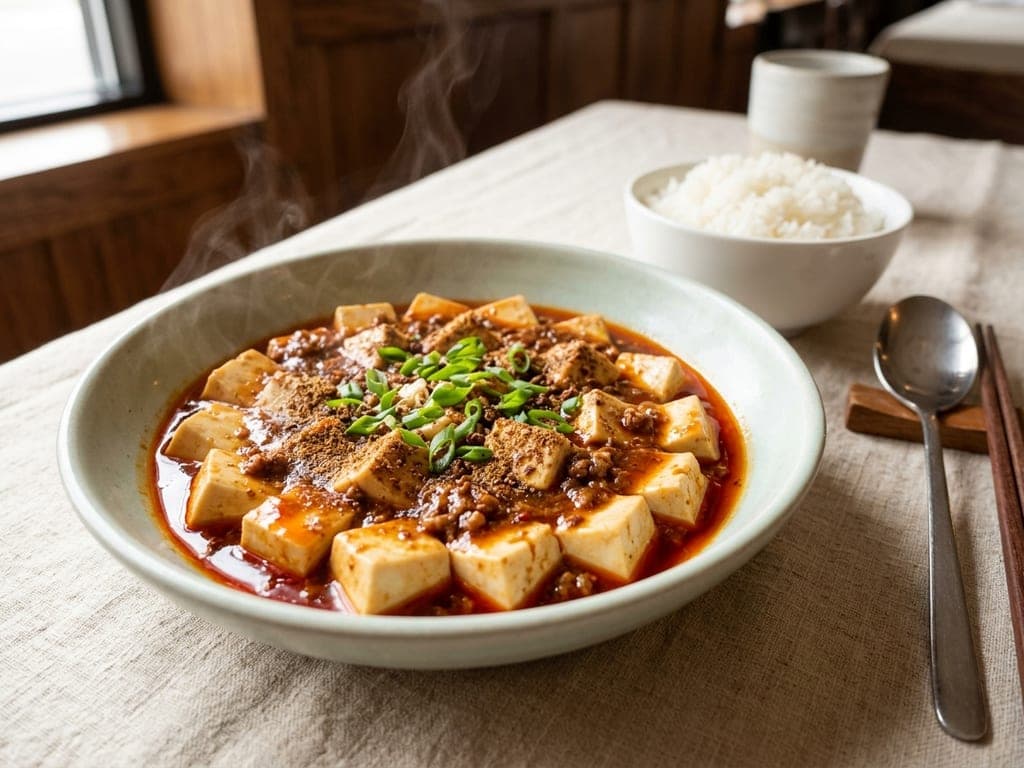
- Finish with greens, pepper and oil, and serve it scalding. Just before the greens go in, put the pan back over high heat for a few seconds until the sauce is properly bubbling. Both Chen Kenichi and Tomoya Kawada finish on high, and it is the difference between a dish that reaches the table at 烫 and one that arrives merely warm. Then take the pan off the heat. Scatter over about 3 garlic greens (蒜苗) cut into 1 in (2.5 cm) segments, the Chengdu choice, or the green parts of 3 scallions (spring onions) cut the same length, along with the reserved crisp beef, and leave them where they land. Dust the ground Sichuan pepper across the top: aim for a light even veil over most of the surface rather than a heap in the middle, and expect it to look rust-red, not brown, because powder that is dull brown in the jar is old. Stir neither one in. The green and the rust-red against pale tofu is most of what the dish looks like, and folding them through gives you a uniform brown bowl. Last, swirl in 1 tsp of chili oil, or 1 tsp of neutral oil if you do not want more heat. This is a named professional step, 明油 in Chinese kitchens and 化粧油, makeup oil, in the Japanese trade, and it is why restaurant mapo tofu looks lacquered rather than merely wet. Serve immediately, in the warmed bowl you filled in step 1, with plain steamed rice. The pepper goes on last and off the heat because its aromatics are volatile and its tingle is best met head-on: cooked into the sauce from the start it flattens into a faint background hum, while dusted over the top it hits the lips on the first bite. If anyone at the table has a cashew, pistachio, citrus-seed or sesame allergy, keep the ground pepper in a small dish on the side and leave the chili oil off their bowl as well. Most ready-made chili oils and chili crisps carry Sichuan pepper themselves, so a bowl with no dusting is not a pepper-free bowl if a spoonful of chili crisp went into it. See the safety notes.
Safety & hygiene Important
- The numbing tingle is normal — but never use it to dismiss a reaction. Má is a physical buzzing on the lips and the front of the tongue that fades over a few minutes, and it is worth warning first-time guests that it is coming, because an unexpected tingling mouth alarms people. But this page will not tell you the sensation is simply harmless, because Sichuan pepper is itself a documented food allergen — its major allergen has been characterized in the allergy literature, it is heat-stable (toasting and grinding do not destroy it), and there are published cases of anaphylaxis. The early symptoms of that reaction are itching, tingling and swelling in the mouth and throat, which overlap almost exactly with normal numbing. So hold both ideas at once: expect the buzz, and treat escalation as a warning. If the sensation spreads to the throat, involves swelling, difficulty swallowing or breathing, or hives, or simply does not settle, treat it as an allergic reaction and seek emergency care. The allergen cross-reacts with cashew, pistachio, citrus seed and sesame, so serve anyone with those allergies a portion without the Sichuan pepper dusting — which is a good argument for keeping the ground pepper in a small dish on the table rather than showering it over the whole bowl. Leave the finishing chili oil off that bowl as well. Most ready-made Sichuan chili oils and chili crisps contain Sichuan pepper themselves, so a bowl with no dusting is not a pepper-free bowl if a spoonful of chili crisp went into it.
- Allergens: soy, wheat, sesame, peanut and shellfish — and why this is probably not gluten-free. Soy and wheat are in this dish as written. Sesame, peanut and crustacean shellfish can all arrive with one optional ingredient, the ready-made chili oil at the end, so read that jar before it goes near anyone with those allergies. All five are major allergens in the US, and all five must be declared on packaged food in the UK and the EU. Soy is unavoidable here: it is in the tofu, the doubanjiang, the douchi and the soy sauce. Wheat is the one people miss — traditional Pixian doubanjiang is fermented on wheat flour and commercial pastes commonly list it, ordinary soy sauce almost always contains it, the Shaoxing wine some versions add is fermented with a wheat qū starter, branded douchi is not automatically safe either (Koon Chun's spiced fermented black beans list soy sauce made with wheat flour), and the udon serving suggestion is wheat as well. Sesame belongs on the list too if you finish with sesame oil; it is a declared major allergen in both the US (the ninth, since January 2023) and the EU, and ready-made chili oil and chili crisp are the usual hidden source — many contain sesame, some contain peanut or dried shrimp, and some pastes declare sulphites, so read that specific jar rather than trusting the category. Do not assume this dish is gluten-free. A genuinely gluten-free version needs a chili-bean paste labelled gluten-free — a label that merely omits wheat from the ingredient list is not enough, since the traditional paste is fermented on wheat flour — plus soy sauce replaced with a tamari that is itself labelled or certified gluten-free, because tamari is a style of soy sauce and many tamari products are brewed with some wheat, plus a gluten-free stock, since bouillon cubes and powders commonly carry wheat, plus douchi whose own label you have read, and no Shaoxing wine. Serve that version with rice, not the noodles. One more: doubanjiang is a fermented fava-bean product, so anyone with G6PD deficiency (favism) should treat it as such and take medical advice rather than recipe-blog advice.
- Tofu is a ready-to-eat refrigerated food, and the blanch is not a holding step. Tofu is low-acid, high-moisture and highly perishable — a time-and-temperature-control food in the regulatory sense, and a ready-to-eat refrigerated one, which means Listeria can grow slowly even at fridge temperature. Keep it at or below 40°F (4°C), use opened packs within a couple of days, store leftover blocks submerged in fresh water in a sealed container and change that water daily; the water stops the tofu drying out, it does not extend its life, so respect the pack's use-by date regardless. The blanch in step 1 is a cooking step, not storage: use the cubes within about 30 minutes and refrigerate them if you need longer, because a pan of water cooling from a simmer with 1 lb (450 g) of cold tofu in it passes straight down through the range where bacteria multiply fastest: 40°F to 140°F (4°C to 60°C) in US guidance, 46°F to 145°F (8°C to 63°C) in UK guidance. One more handling point, because the blanched tofu is ready to eat and gets only minutes in the sauce: wash your hands with soap and warm water after handling the raw mince and before you touch the drained tofu, and do not rinse raw mince under the tap, which sprays whatever is on it around the sink. Never substitute a passive soak in hot water for the simmer — that is the one version of this recipe that is genuinely unsafe, and it is what some silken-tofu instructions quietly suggest. If you are pregnant, over 65, or immunocompromised, make sure the finished dish is steaming hot throughout, 165°F (74°C), and eat it fresh rather than as a leftover. And do not leave the finished pan out: soft tofu in a warm, low-acid, high-protein sauce is not a counter food.
- The rice clock, and the US/UK split on leftovers. This dish mandates rice, so it inherits rice's food-safety story. Uncooked rice carries spores of Bacillus cereus that survive cooking, and the toxin they can produce at room temperature is heat-stable — reheating does not rescue it, so the whole game is time, not temperature. UK guidance (the FSA and Food Standards Scotland) is the strict one here and the one worth following; USDA sets no rice-specific limit, but the toxin risk is a clock rather than a temperature, so the shorter rule is the one that protects you. Do not leave cooked rice to cool in the pan, the cooker or the steamer: spread it out, get it into the fridge within one hour, keep it no more than one day, and reheat it once only, until steaming hot throughout. The mapo tofu itself follows the ordinary leftover rules, with one honest complication for our two audiences: US guidance (USDA) is to keep leftovers 3–4 days, while UK guidance (FSA) is to eat them within 48 hours and to reheat food only once. The EU sets no consumer figure of its own, so readers there should follow their national agency. Cool fast rather than slowly: divide it into shallow containers instead of leaving the whole pan out. US guidance (USDA) is to refrigerate within two hours, or one hour if the kitchen is above 90°F (32°C), and USDA is explicit that hot food can go straight into the fridge; UK guidance (FSA) is the reverse on that last point, cool it at room temperature first and then get it into the fridge within one to two hours. Cover it, and reheat to 165°F (74°C) throughout, stirring and checking in more than one spot, because a set cornstarch sauce heats very unevenly in a microwave. USDA asks for a rolling boil when reheating sauces and gravies, which would shred the tofu, so use the thermometer endpoint instead and stop there. If you are deliberately making extra for noodles, portion that off before you serve so it is only ever reheated once. Freezing is technically fine and texturally bad: soft tofu turns spongy.
- Chili, hot oil, and tofu that stays scalding. Capsaicin is oil-soluble, so a rinse under water will not shift it. Wash your hands with plenty of soap and warm water after handling the paste and the flakes, or rub them with cooking oil first and then wash; better still, wear gloves. Do not touch your eyes or face while cooking, and take contact lenses out before you start — if chili does get in an eye, flush it with copious warm water for a full 15 minutes and get medical advice if pain, redness or blurred vision persists. Lower the mince into the hot oil away from you, and drain the tofu properly before it goes in, because wet food in hot fat spatters. Finally, a small thing that catches people out at the table: soft tofu holds heat far longer than it looks, and the cubes stay scalding after the bowl has stopped steaming — worth saying out loud if there are children eating.
3 ways to plate it
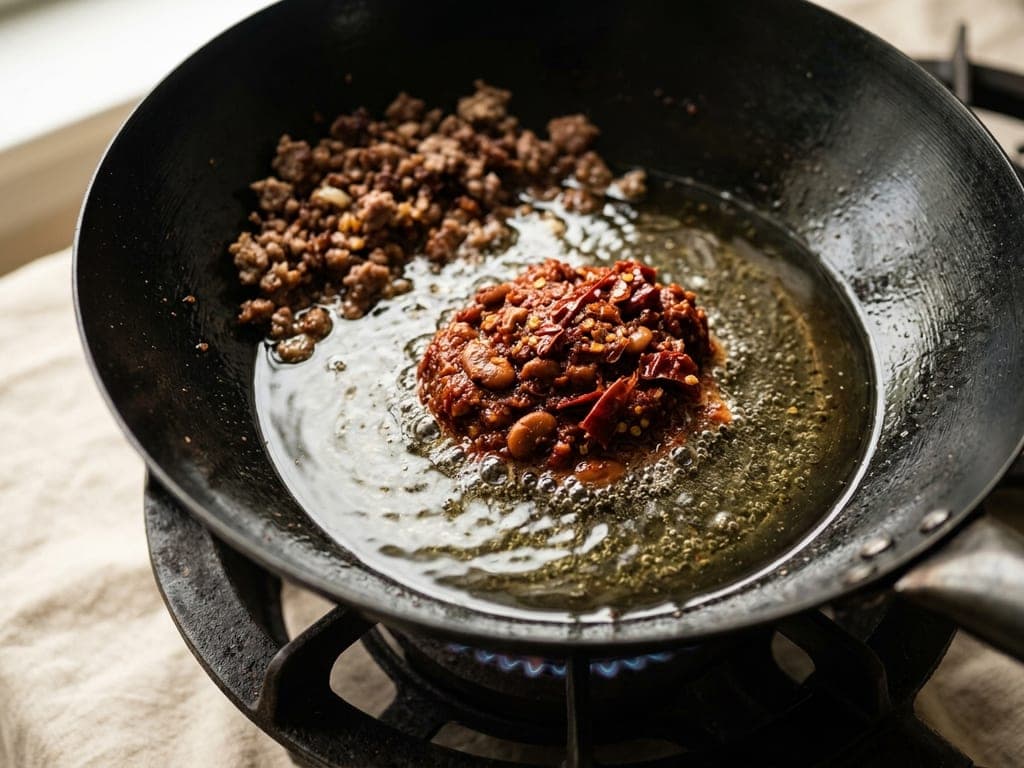 1. Fry the doubanjiang in the oil on its own, pushed to one side of the meat.
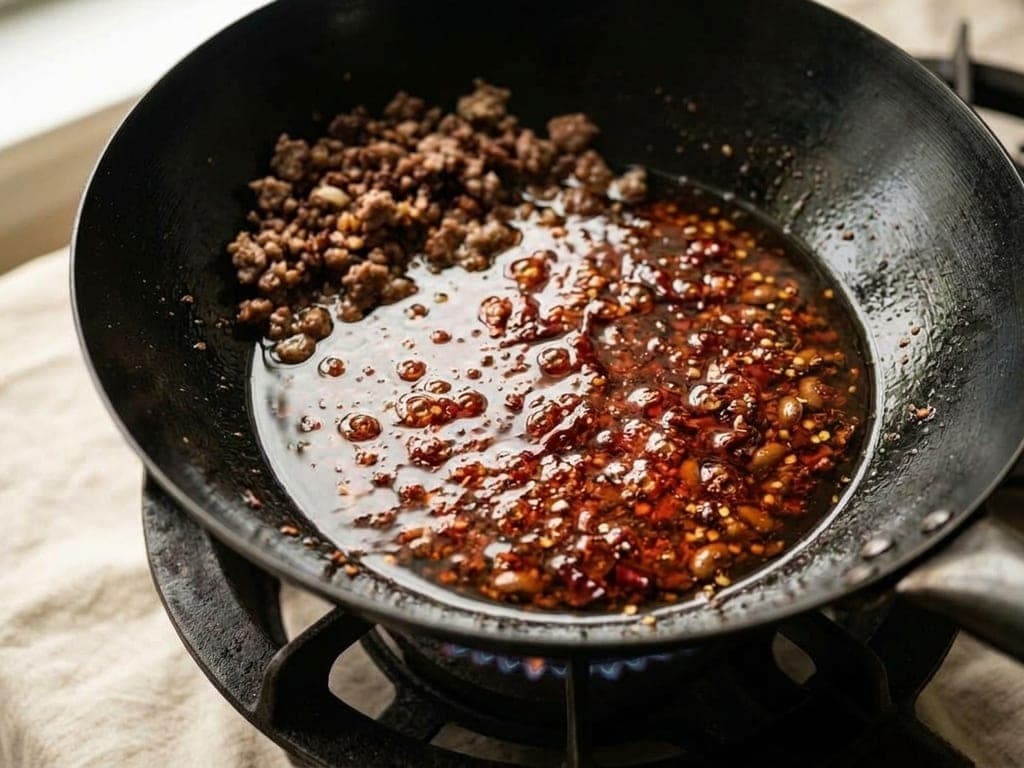 2. Keep going until the whole pool of oil runs deep orange-red. That is 炒出红油, and it is the step that decides the dish.
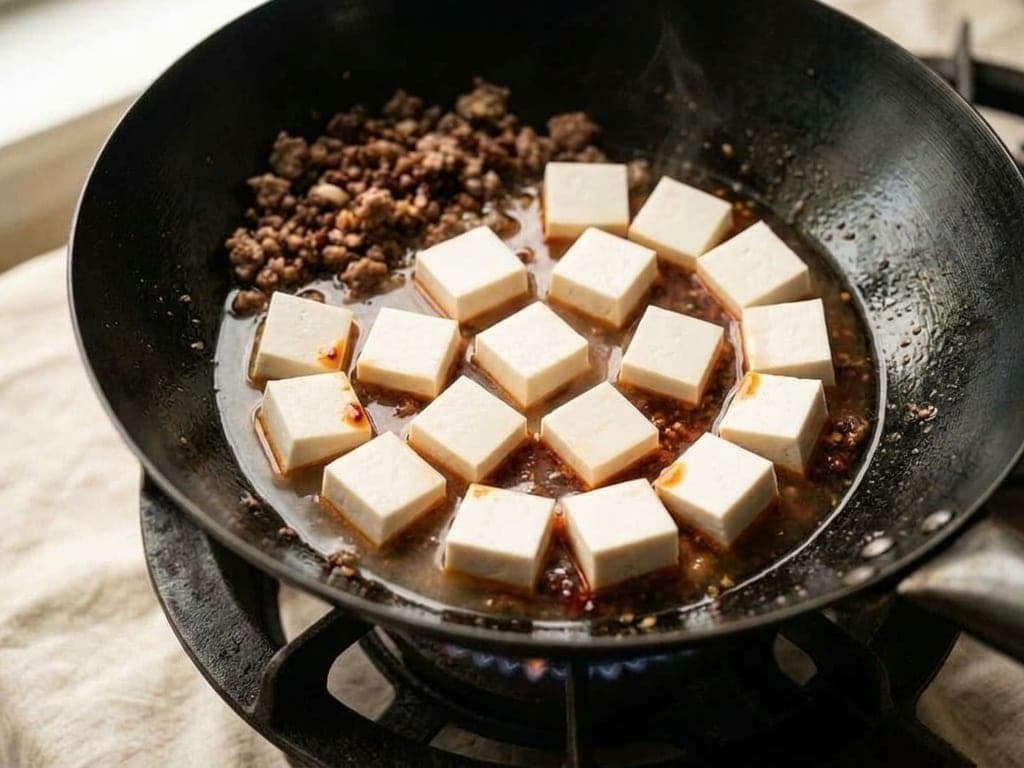 3. Slide the blanched cubes in and let them settle in one layer, the liquid partway up their sides.
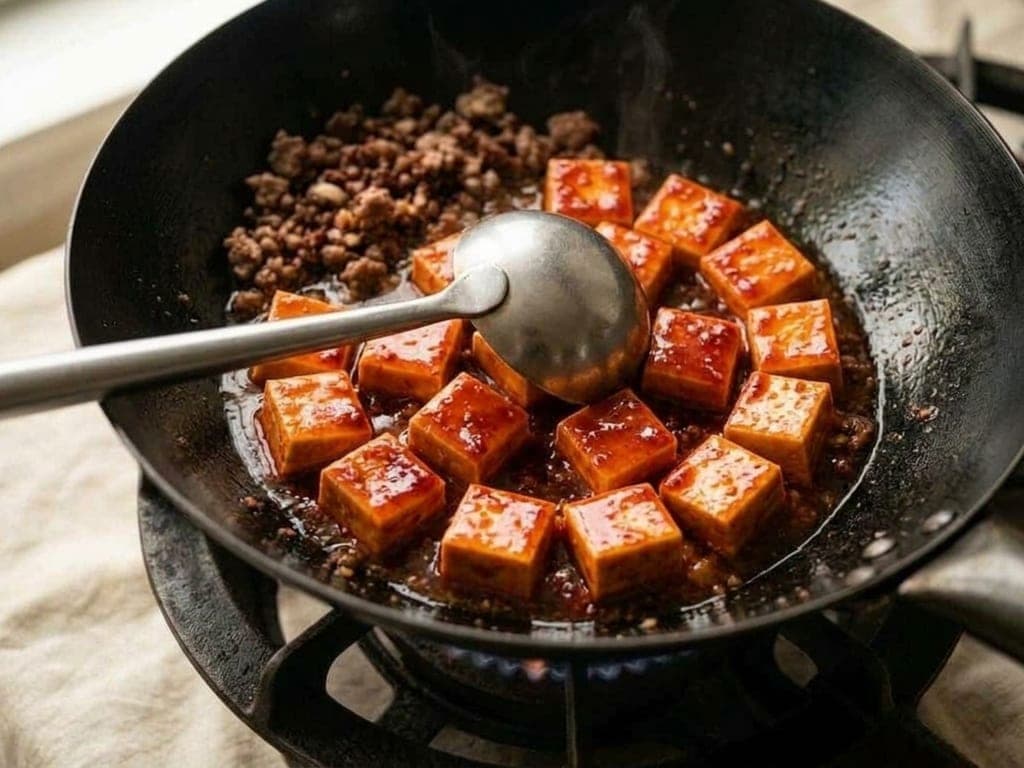 4. Move them with the ROUND back of a ladle, pushing and rocking the pan rather than stirring, while the sauce thickens around them.
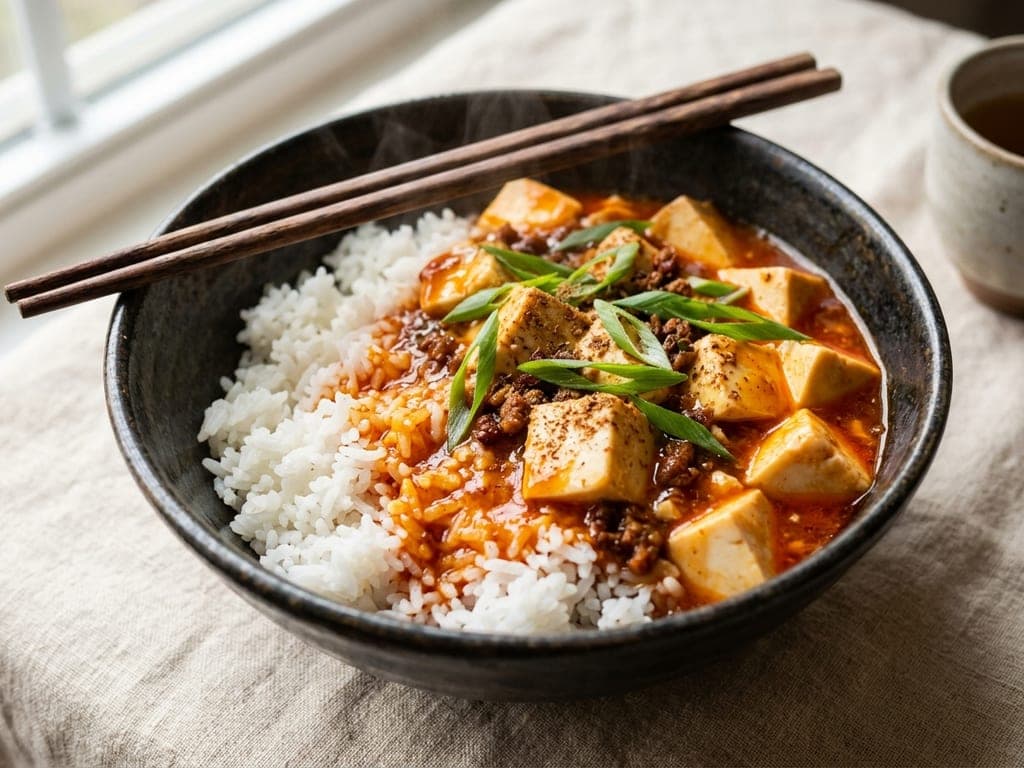
What makes mapo tofu so good: seven characters, seven separate targets
Mapo tofu is the clearest example in Chinese cooking of layering rather than mixing. The chili heat comes from two sources you dial separately (the fermented bean paste, which you leave alone because it is also the salt and the savor, and the chili flakes laid on top of it), the fragrance from that same paste fried in oil until it gives up its color, the savory depth from fermented black beans and the crisped meat, and the tingle from ground Sichuan pepper added at the very end, off the heat. None of those flavors is doing another's job, which is why you taste them in sequence rather than as one blurred impression of "spicy." Take out the numbness, or the fried-out red oil, or the soft tofu, and you still have a decent spicy braise — the dish people remember is the full stack.
Sichuan cooks describe the finished plate with a string of single characters, and it is worth learning them because each one is a separate target you can hit or miss: 麻 (má, numbing), 辣 (là, spicy), 烫 (tàng, mouth-scaldingly hot), 鲜 (xiān, savory), 嫩 (nèn, tender), 香 (xiāng, fragrant) and 酥 (sū, crisp — of the meat). That last one is the giveaway of a cook who knows the dish: the beef is supposed to be dry and crunchy at the edges, not soft, and it is scattered through the sauce as texture rather than served as mince. 烫 is the one most home versions lose simply by taking too long to get the bowl to the table.
The texture is the other half of the argument. Tofu this soft has almost no flavor of its own and a delicate, custardy structure, so the entire technique — the salted blanch, the push instead of the stir, the staged thickening — exists to season it and move it around without destroying it. Everything in the method below is in service of getting an intact, seasoned, barely-set cube into a sauce assertive enough to carry it.
What are the ingredients in mapo tofu?
Mapo tofu is built from tofu, a small amount of ground meat, and four fermented or aromatic Sichuan seasonings: doubanjiang (fermented broad-bean chili paste, the backbone of the modern dish), douchi (whole fermented black soybeans, the older ferment, for savory depth), chili flakes (for clean heat on top of what the paste already brings), and Sichuan pepper (for the numbing tingle). Garlic, ginger, stock, a cornstarch slurry and garlic greens or scallions complete it, with a little soy sauce and sugar as adjustments rather than foundations. Sugar and Shaoxing wine are common small additions.
Two of those are where most versions go wrong. Soft tofu is not interchangeable with firm, and Pixian doubanjiang is not interchangeable with a generic chili-bean sauce — get either wrong and you are cooking something adjacent to mapo tofu rather than mapo tofu. The one ingredient today's dish genuinely cannot survive without is the doubanjiang: without it you have spicy tofu.
There is a wrinkle in that sentence, though, and it is the rarest fact on this page. The earliest written recipe attributed to Chen Mapo — recorded in a 1958 government culinary survey, 《中国名菜谱》 — does not use doubanjiang at all. Its fermented element is douchi. The broad-bean chili paste that now defines mapo tofu was a later standardization, which is why the douchi in the ingredient list here is marked traditional rather than optional, whatever most recipes tell you: it is the older of the two ferments, and the dish it came from was built on it.
Málà: the two axes most Western versions collapse into one
麻辣 is not a synonym for "very spicy." It is two separate sensations on two separate axes, and confusing them is why so much Western Sichuan cooking tastes loud but flat. Là (辣) is chili heat: capsaicin, a burning sensation, entirely familiar. Má (麻) is something else — a buzzing, vibrating, slightly anesthetic tingle across the lips and the front of the tongue, produced by Sichuan pepper (花椒, huājiāo), which is not a true peppercorn at all but the dried husk of a Zanthoxylum berry, unrelated to black pepper. The active compound is hydroxy-alpha-sanshool, and it works on touch-sensitive nerve endings rather than heat receptors, which is why it registers as a physical vibration rather than a flavor. It is not a hint of citrus and it is not optional garnish.
There is a specific historical reason so many Americans have eaten mapo tofu without ever meeting this sensation: Sichuan pepper spent decades on a US import blacklist. A 1968 USDA ban on Chinese citrus swept in the whole Zanthoxylum genus over citrus-canker fears, and although the rule went largely unenforced for some thirty years, inspectors began actively seizing shipments in 2002 — Sichuan pepper became the single most-confiscated agricultural import of the next several years. The ban lifted in 2005 on condition the pepper be heated to 140°F (60°C) for ten minutes before import, a requirement later dropped. A great deal of American Chinese cooking developed around a spice that was legally awkward and unreliably available, which is precisely how "mapo tofu" came to mean spicy tofu in brown sauce on so many menus.
Two practical consequences follow. Buy Sichuan pepper from a source that turns its stock over, because the tingle fades with age and a jar that has sat for two years will barely register — and buy it whole, since it is grinding and time that do the damage. Chen Kentaro, whose family's Shisen Hanten in Singapore holds one MICHELIN star, gives three tests you can apply in the shop: "It is important to choose freshly harvested ones and you can usually tell by their fragrance and colour. Fresh ones are brighter in colour and stronger in aroma. As you place the peppercorns closer to your nose, the smell becomes more pungent. The seeds should also be whole, rather than broken…" And treat the dose as personal: 2 tsp of whole peppercorns for four people, which grinds down to roughly 1 3/4 tsp of powder, is a properly numbing plate; 1 tsp is a cautious introduction. Turn the heat down by cutting the chili flakes, not the doubanjiang, and turn the numbing down separately — that is the whole point of two axes.
Doubanjiang and douchi: what to buy, and what not to substitute
Doubanjiang (豆瓣酱) is a paste of fermented broad beans (fava beans) and chilies, aged with salt. The benchmark is Pixian doubanjiang from Pixian — now Pidu District, on the edge of Chengdu — which holds a protected geographical indication in China and is aged anywhere from months to several years; the older pastes are darker, mellower and more expensive. Look for "Pixian" or 郫县 on the label (romanizations vary: "Pi Xian," "Pixian Douban"), and for a coarse, visibly beany texture with recognizable chili skin rather than a smooth sauce. Chop it on a board before it hits the pan, because whole broad-bean pieces do not break down in a short cook and leave you with salty lumps instead of an even base. And note that the paste is salty enough to season the dish on its own — that is exactly why the stock in this recipe is unsalted and the soy sauce is a single teaspoon. The protection is formal and datable: Pixian doubanjiang has held a Chinese geographical indication since December 2005, has its own national standard (GB/T 20560-2006), was listed as national intangible cultural heritage in 2008, and has been protected in the EU since 1 March 2021. It is worth what the trade pays for it: Chen Kenmin could not import from Sichuan at all in 1950s Japan and made his pastes from scratch, and once relations allowed it he sent his son to Pixian to source the real thing. The family's Singapore restaurants still bring their paste in from Pidu district. If a restaurant group will fly paste in from one county, the county is doing something.
Chili bean sauce, sold as toban djan by Lee Kum Kee and others, is the same family and will get you into the neighborhood, but it is not an equal swap: it is smoother and sweeter than Pixian paste and usually carries added sugar and flavor enhancers, so taste before you add any soy sauce. Korean gochujang is not a substitute at all — it is sweet, built on rice and red pepper, and will take the dish somewhere else entirely. Neither is hoisin, tianmianjiang, or any dark sweet bean sauce. There is also no such thing as a traditional bottled "mapo tofu sauce" in Sichuan cooking; the sauce is built in the pan, and the jars carrying that name are convenience products mostly formulated for the Japanese version of the dish.
Douchi (豆豉) deserves its own warning, because two shopping traps sit right next to it. These are whole fermented black soybeans — not the black turtle beans sold as "black beans" in Western supermarkets, and not jarred black bean sauce, which is a finished product made from douchi rather than a substitute for it. Buy them whole in a bag or tub, rinse them to take the surface salt off, and chop them roughly before they go in. They are the older backbone of this dish and they are worth the trip.
Mapo tofu sauce: what it actually is
Strip out the tofu and the beef and what is left is short. Two tbsp of Pixian doubanjiang, 1 tbsp of rinsed chopped douchi, 1 tbsp of chili flakes, 1 tbsp each of minced garlic and ginger, 1 1/4 cups (300 ml) of unsalted stock or water, 1 tsp of light soy sauce, 1/2 tsp of sugar, and 1 tbsp of cornstarch whisked into 3 tbsp of cold water. Three tbsp of oil carry the whole thing. There is no bottled product that is this, which is why the shops sell you a seasoning kit instead.
The sauce is made by two moves rather than by a recipe. The first is 炒出红油, frying the paste in oil until the oil around it turns deep orange-red: that colored oil is what coats the tofu later, and doubanjiang stirred into liquid instead of fried in fat simply tastes of salty bean paste. The second is 勾芡, adding the starch slurry in small stages with a full boil between them, stopping when the sauce holds a line behind a spoon. Five minutes, no jar. If you are making it ahead for noodles, treat it like any other cooked sauce: chill it fast, keep it to the 48 hours the leftovers note gives, and reheat it once.
Which tofu, which meat: the two choices that decide the dish
Use soft or medium tofu, sold in Chinese groceries as 嫩豆腐 (nèn dòufu). In a Western supermarket that means the water-packed soft block sitting in the chilled cabinet, not the aseptic carton on the shelf. It holds a cube shape but yields completely on the tongue, and that barely-set interior against an assertive sauce is the entire textural point of the dish. Block silken tofu will work and is what many Western recipes call for, but it is genuinely more fragile — expect some breakage even with careful technique, slide the cubes in and out with a skimmer, and still give them the full 2-minute simmer rather than a passive soak. Firm and extra-firm tofu are the wrong direction: they survive the pan perfectly and give you spicy cubes that bounce, which is a different and lesser dinner.
On the meat, the Chengdu restaurant classic is beef — often hand-chopped rather than machine-ground, so the pieces have irregular edges that brown and crisp into that 酥 texture. This surprises people who know Chinese cooking mostly through pork, and it is one of the more reliable markers of a recipe written from the Sichuan tradition rather than adapted for a Western kitchen. In practice both are cooked and served widely, including in China, and pork is what several of the most-followed English-language recipes call for — partly because Japanese mabo dofu uses pork, partly because writers copy one another. But do not treat pork as a foreign dilution. The earliest description of the shop has the diner supply the meat and names pork and beef in one breath; the shop itself switched to pork at one point so that customers who did not eat beef could order the dish, then switched back; and Che Fu, the Chengdu writer who watched the shop's cook work at the Wanfu Bridge premises in the 1920s, recorded that the state-run restaurant used pork for some thirty years after 1949 and thought the dish lost its soul for it. Beef is the better plate and it is what the source restaurant serves today. Pork is not an English-language invention.
Use what you have; just do not call the pork version more authentic for being fattier. What matters more than the species is the treatment and the quantity: a small amount, cooked until dry and crisp, functioning as seasoning rather than as the main event. Four ounces (115 g) is plenty for four people, because this is a tofu dish with meat in it, not a meat sauce with tofu.
What Michelin kitchens do with mapo tofu
Mapo tofu is not a fine-dining dish, and the MICHELIN Guide's own listings say so. In Chengdu, where it was invented, Chen Mapo Tofu on Qinghua Road carries a Bib Gourmand for good-value cooking rather than a star, and the inspectors sum the place up in one line: "Word has it that this century-old shop is the true original source of this numbing, spicy dish, invented by Lady Chen. Silky tofu, ground beef and spices are cooked in a stone pot that stays hot for a long time, perfect with a bowl of steamed rice." Two details there are worth taking home. The first is the beef, which is what this recipe calls for and what most English-language versions replace with pork. The second is the pot: you cannot buy back a stone pot's thermal mass at home, but you can fill the serving bowl with boiling water while you cook, tip it out and dry it just before the tofu goes in. A cold bowl takes the scald out of this dish in about a minute. (Star status as of September 2026, and stars move.)
Blanch the tofu, and lift it out the moment it shivers. The MICHELIN Guide asked Chen Kentaro what makes a good mapo tofu, and his answer was one step: "The most important step is to boil the tofu lightly before cooking it in the mapo sauce. This step ensures that the moisture is sealed within the tofu to create the rich velvety texture for the dish." He is the third generation of the family that brought Sichuan food to Japan, and the family's Shisen Hanten in Singapore holds one MICHELIN star today, after holding two from 2016 to 2022. His father Chen Kenichi's published version gives the endpoint you can actually see: when the water comes back up the cubes shiver and rise, and that is the moment to lift them out with a skimmer.
Take the pan off the heat before the bean paste goes in. Chen Kenichi, Chen Kentaro and Tomoya Kawada all kill the heat, stir the doubanjiang into the fried meat off the burner, and only then put the pan back on low. Ryoji Tanaka, head chef of the family's Akasaka restaurant in Tokyo, explains why: Chinese cooking is thought to live on high heat, and in a professional kitchen that matters, but you can burn things or panic halfway and ruin them, so the knack for success is mastering low heat. Burnt doubanjiang is the one mistake in this dish you cannot cook back out.
Kill the heat for the starch as well. Chen Kentaro's rule, given for a thickened soup but exactly the problem here, is to turn the fire off before the starch goes in and only turn it back on once the slurry has been stirred through. In a pan of soft tofu that pays twice, because off the heat you have time to fold the slurry in without dragging a spoon through the cubes. Then it has to boil to set.
Finish with a spoonful of oil. Four published versions from this one lineage all end the same way, with oil added after the sauce is thickened rather than cooked into it from the start: Chen Kenmin drizzled plain oil around the rim of the pan, Chen Kenichi raises the heat and stirs in chili oil at the last second, Chen Kentaro adds 1 tbsp chili oil plus 1/4 tsp Sichuan pepper oil, and the Akasaka kitchen calls the step by its trade name, 化粧油, makeup oil. It is what makes restaurant mapo tofu look lacquered instead of wet.
One more, from the top of the guide. Tomoya Kawada of Sazenka in Tokyo, the only Chinese restaurant in Japan with three MICHELIN stars, published a home mapo tofu that uses water and no stock at all, on the grounds that a good tofu is the flavor and stock covers it. If you have decent tofu, water is a choice, not a compromise.
What does mapo mean in Chinese? The name, and the woman it belongs to
麻婆豆腐 breaks into three parts: má (麻), here short for 麻子 (mázi), "pockmarks"; pó (婆), from 婆婆 (pópo), an old woman or grandmother; and dòufu (豆腐), tofu. So the name is, bluntly, "pockmarked old woman's tofu" — after the cook who created it. There is a coincidence in it too neat to ignore: the character 麻 also carries the sense of numbness, and it is the same 麻 as in 麻辣 (málà) and 麻木 (mámù, numb). Both are standard dictionary senses of the one character. But the dish is named for the cook's face, not for the tingle in your mouth. Same character, two meanings, one fortunate overlap — and the name does not mean "numbing old woman."
The dish is traced to Chengdu in the early 1860s, at a small restaurant, 陈兴盛饭铺, near the Wanfu Bridge (万福桥) run by a couple named Chen. When the husband died, his widow kept the place going. Her face was pockmarked, customers came to call her Chen Mapo — Pockmarked Granny Chen — and her tofu dish took her name with it. The restaurant that grew out of it, 陈麻婆豆腐, still trades in Chengdu today under the city's catering company.
The commonly cited date is 1862, the first year of the Tongzhi reign, and the story is better attested than most restaurant origin tales. Zhou Xun's late-Qing memoir of Chengdu, 《芙蓉话旧录》, describes the place: a woman called Chen Mapo outside the north gate who was good at cooking tofu, eight coppers a bowl with the seasoning and the labor included, and if you wanted pork or beef in it you brought it yourself or sent a waiter out to buy it. "Most people do not know the shop's name," he writes, "but say Chen Mapo and everyone knows." By 1909 Fu Chongju's survey of the city, 《成都通览》, listed 陈麻婆之豆腐 among Chengdu's famous foods, which is the dish's earliest printed appearance. A detailed account in Guangming Daily puts the opening slightly earlier, at the end of the Xianfeng reign, around 1861, on Shangheba Street outside the north gate. None of these is contemporary with the 1860s, so the exact year, the smallpox usually blamed for the pockmarks and the customers said to have been oil porters crossing the bridge stay where they are: the trade's own account rather than a document.
Vegetarian and vegan mapo tofu, and the traps that catch people
This dish adapts unusually well, because the meat was never the star. Replace it with 4 oz (115 g) of finely chopped shiitake — or a mix of shiitake and king oyster stem — and fry the pieces hard in the oil until they shrink, dry out and take color before the doubanjiang goes in, exactly as you would the beef. Rehydrated dried shiitake, chopped, with a splash of the soaking liquid, gives even more savory depth. Crumbled smoked or pre-fried tofu works too. A sauce-only version with no mince at all is cleaner and a little flatter; add extra mushrooms rather than pretending the gap is not there.
Because the traditional recipe contains no dairy and no egg, vegetarian and vegan are the same problem here: the meat is the only animal ingredient, unless you let one in by accident. And they do get let in. Chicken or beef stock is the most common accidental non-vegetarian ingredient in recipes labelled vegetarian, and water is a perfectly acceptable substitute since the doubanjiang carries the dish. Oyster sauce turns up in a lot of easy and Japanese-leaning versions and is not traditional Chengdu seasoning in any case. Some restaurants fry in lard or beef tallow. Chili oils and chili crisps frequently contain dried shrimp — read the bottle. Bottled Japanese mabo sauces often include meat extract, oyster sauce or both. Tomoya Kawada of Sazenka in Tokyo, the only Chinese restaurant in Japan with three MICHELIN stars, published a home version that uses water and no stock at all, on the grounds that a good tofu is the flavor and stock covers it. If your tofu is decent, water is a choice rather than a compromise.
Doubanjiang and douchi are themselves plant ferments and are fine, though you will want to read those labels anyway, since you are checking them for wheat regardless. What you cannot do is drop the doubanjiang and the Sichuan pepper and still call the result vegetarian mapo tofu. That is spicy tofu, which is allowed, and is not this.
Japanese mabo dofu — a descendant, not a translation
In Japan, 麻婆豆腐 (mābō dōfu) is a household staple, and it is a real dish with its own history rather than a failed copy of Chengdu. It is noticeably milder, sweeter and saucier than the Sichuan original, and usually made with pork rather than beef. The sweetness has a specific source: across four published recipes from the Chen family, the branch's founding lineage, the constant is tianmianjiang, sweet wheat-flour bean paste, usually a spoon of it against a spoon of doubanjiang. Japanese home and convenience versions do reach for miso and sesame oil; this kitchen does not. The numbing tells a three-generation story. Chen Kenmin's own published recipe, taught on Japanese television in 1981, lists no Sichuan pepper at all, because he built the dish for a country that had never met it. His grandson Chen Kentaro's published version finishes with both ground huajiao and Sichuan pepper oil, and MICHELIN's write-up of the family's Singapore offshoot describes the sauce as Sichuan-pepper inflected. The Japanese branch took the numbing out and has been putting it back.
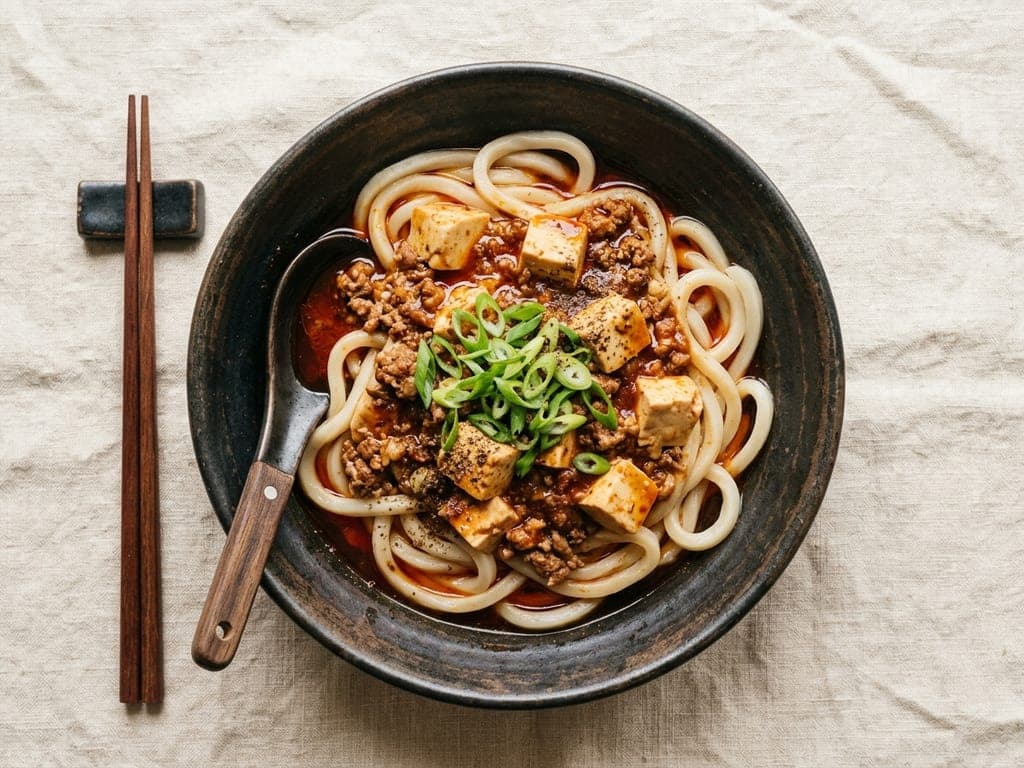
The adaptation has a name attached to it: Chen Kenmin (陈建民), a Sichuan-born chef who settled in Japan after the Second World War and is widely credited with introducing Sichuan cooking there, reworked the dish for Japanese palates. His son, Chen Kenichi, later became famous as the Iron Chef Chinese. The adaptation stuck so thoroughly that bottled mabo dofu sauce is a standard Japanese grocery item and mabo udon — the same sauce over thick wheat noodles — is an ordinary lunch.
If Japanese-style is the plate you actually want, make that plate and call it mabo dofu, and you can use the family's own numbers. Chen Kentaro's version published on Kikkoman's recipe site, for four people, is momen (cotton) tofu, 3 oz (80 g) of ground pork, 1 tbsp doubanjiang, 1 tbsp tianmianjiang, 1 tsp chili powder, 1 tsp chopped douchi, 2/3 cup (150 ml) of stock, a starch slurry, and a finish of 1 tbsp chili oil with 1/4 tsp Sichuan pepper oil and a dusting of ground huajiao. Note the tofu: the Japanese branch reaches for momen, the cotton block, which is part of why the Japanese version survives being stirred and this one does not, though the family is not dogmatic about it and its own home versions use silken. What is worth avoiding is splitting the difference and producing a sweet, non-numbing dish that still claims to be Sichuan. The two share a name in characters and not much else in the mouth.
What to serve with mapo tofu
Serve it with plain steamed rice, essentially always. The dish is intensely salty and spicy by design, and rice is not an accompaniment here so much as the other half of the meal. At a shared table, serve it in its own bowl so the sauce is not soaked up on the way. Eating alone, ladle the tofu over half a bowl of rice and work outward from the border, which is the serve in the rice-bowl photograph below, and the way Chen's Mapo Tofu in Singapore, the Bib Gourmand offshoot of the one-MICHELIN-star Shisen Hanten by Chen Kentaro, sells it: a mapo don over hot Hokkaido rice. What you should not do is mix it through and let the rice drink the sauce before you sit down. A cold smashed cucumber salad, dressed with vinegar and garlic, is the right thing next to it.
Everything else on the table is there to cool the mouth between bites: bok choy blanched or fried with garlic, plain stir-fried green beans, or a clear soup. Keep the second dish unspiced. Two málà dishes in one meal cancel each other out, because the numbing dulls the palate for whatever follows it.
Mapo tofu over noodles, and mabo udon
Leftovers do something excellent: spooned over udon or Chinese wheat noodles, mapo tofu becomes a second dish entirely. If you are making it for noodles deliberately, add another 2/3 cup (150 ml) of stock and keep the sauce a little looser so it coats the noodles rather than sitting on them — and portion that extra off before you serve, so it only ever gets reheated once.
Mapo tofu calories, sodium, and whether it is healthy
On the numbers: roughly 280 kcal per serving as written, across four servings with rice served separately — call it 250–310 depending on the fat content of your beef and how oily your doubanjiang is. That is lower than most published figures for this dish, and deliberately so, because it is calculated with the soft tofu this recipe actually calls for rather than the firm tofu it tells you to avoid; swap in firm and the same arithmetic lands somewhere between 300 and 375 per serving, depending which firm tofu you bought: USDA lists 78 kcal per 100 g for firm nigari tofu and 144 kcal per 100 g for the denser calcium-sulfate kind. Kikkoman publishes the nutrition for Chen Kentaro's mapo tofu at 282 kcal per serving across four servings, and that version carries more added oil than this one. It is not the same recipe, it uses pork and momen tofu, but a professionally calculated figure landing within two calories of ours suggests the higher numbers published elsewhere are built on the wrong tofu.
The number worth watching is not calories but sodium. Doubanjiang is a salt-preserved product and it is the entire seasoning system here — a serving lands at about 900 mg with a typical Pixian paste, and anywhere from 600 to 1,100 mg depending on your brand and how much of the blanching salt the tofu takes up. A real Pixian paste made to the geographical-indication standard carries more salt than the supermarket chili-bean sauces the published panels are usually built on, and 900 mg is around two-fifths of a day's recommended intake in one bowl, before the rice. If you are managing sodium, cut the doubanjiang to 1 tbsp, skip the added soy sauce, and blanch in plain unsalted water. Beyond that, it is a genuinely reasonable plate of food: tofu is a decent source of plant protein, the meat quantity is small, and roughly half the fat is the frying oil. It is not health food, and there is no honest low-sodium version that still tastes like Chengdu.
Questions, answered
Where can I buy Pixian doubanjiang?
A Chinese grocery is the reliable answer, in the refrigerated or the sauce aisle, in a tub or a jar labelled 郫县豆瓣 or "Pixian broad bean paste"; Juan Cheng and Dan Dan Xiang are the two brands most often stocked in the West, and specialist importers ship aged grades by mail. You are looking for a coarse, matte, brick-red paste with whole broad beans and ragged strips of chili skin visible in it, not a smooth dark jam. The common supermarket stand-in, toban djan, is the same family but sweeter and smoother, so taste before you add any soy sauce. Once opened, keep the tub in the fridge.
What are some common mistakes when making ma po tofu?
The usual failures: stirring the tofu instead of pushing it, so the cubes collapse; using firm tofu, which holds its shape but loses the point; adding doubanjiang without chopping it or without frying it in oil until the oil turns red; dumping the cornstarch slurry in all at once, which either lumps or turns the sauce to glue; skipping Sichuan pepper or using stale pre-ground powder, which removes the numbing half of málà; over-salting with soy sauce on top of an already salty bean paste; and cooking the mince only until it is gray rather than browning it dry and crisp. A quieter one is substituting gochujang or hoisin for Pixian doubanjiang and expecting Chengdu.
Can I use ground pork instead of beef?
Yes. Beef is the Chengdu restaurant classic and it is what the source restaurant serves today, but pork is not a Western dilution: the earliest description of Chen Mapo's shop has the diner bring the meat and names pork and beef in one breath, and the restaurant itself cooked with pork for some thirty years after 1949. Use the same 4 oz (115 g), fry it just as hard and just as dry, and treat it as seasoning rather than as the main event. What matters more than the species is that it ends up crisp.
Do I have to blanch the tofu?
It is the step most home versions skip and the one a starred kitchen would put first. Chen Kentaro, asked by the MICHELIN Guide what makes a good mapo tofu, named it as the single most important step: the tofu is boiled lightly before it meets the sauce so the moisture is sealed in and the texture turns velvety. It also seasons the cubes from the outside in, which nothing later in the recipe can do, firms the surface so they survive being moved around the pan, and drives off the raw beany note. Two minutes in water at 180°F to 190°F (82°C to 88°C) with 1 tbsp of salt, then lift them out with a skimmer.
What kind of tofu is best for mapo tofu?
Water-packed soft or medium tofu, sold as 嫩豆腐, from the chilled cabinet rather than an aseptic carton. Cut it into 3/4 in (2 cm) cubes and blanch them for 2 minutes in well-salted simmering water so they season, firm up and lose their raw beany note. Block silken tofu works but is fragile — use a skimmer and never stir. Firm and extra-firm hold their shape at the cost of the dish's defining softness.
Why does my tofu fall apart?
Almost always stirring. Once the tofu is in the sauce, push it with the back of a ladle or swirl the pan by the handle instead of dragging a spoon through it. Blanching the cubes in salted water first firms the surface considerably and makes them much more robust. A few broken cubes are normal; a pan of rubble means a spoon went through it.
Is mapo tofu healthy, and how many calories are in it?
Around 280 kcal per serving as written, across four servings before rice, with about 900 mg of sodium (600 to 1,100 mg depending on your doubanjiang). It is a decent source of plant protein and modest in meat, and about half the fat is the frying oil that makes the red sauce. The honest caveat is the sodium, which comes from the salt-fermented bean paste that is the dish's whole seasoning system — there is no low-sodium version that still tastes like Chengdu. Eaten with rice and a plain vegetable it is a reasonable dinner, not a health plate.
Can mapo tofu be vegetarian or vegan?
Yes, and it works very well, because the meat was never the star. Fry finely chopped shiitake or king oyster mushrooms in the oil until they shrink and brown, then carry on with doubanjiang, douchi, chili, garlic, ginger, water or vegetable stock, the slurry and the ground pepper. The traditional dish has no dairy or egg, so vegetarian and vegan are the same once the meat is gone — but avoid chicken stock, oyster sauce, lard, and chili oils containing dried shrimp, which are the usual accidental animal ingredients.
Is mapo tofu gluten-free?
Usually not. Traditional Pixian doubanjiang is fermented on wheat flour, ordinary soy sauce almost always contains wheat, and stock cubes commonly do too. For a gluten-free version you need a chili-bean paste labelled gluten-free — an ingredient list that merely omits wheat is not enough — plus a tamari that is itself labelled or certified gluten-free, since tamari is a style rather than a guarantee, plus gluten-free stock. Serve it with rice rather than the noodle suggestion.
What is the difference between Chinese and Japanese mapo tofu?
Sichuan mapo tofu is a Chengdu dish: beef, Pixian doubanjiang, obvious chili heat and a strong numbing finish from ground Sichuan pepper. Japanese mābō dōfu is milder, sweeter and saucier, usually made with pork, often seasoned with miso and sesame oil, and barely numbing or not at all. It descends from a postwar adaptation associated with the chef Chen Kenmin. Bottled mabo sauce and mabo udon belong to the Japanese branch — they are related by name and ancestry rather than by taste.
What is mapo tofu sauce, and can I buy it?
In Sichuan cooking it is not a separate condiment. It is what happens in the pan when you fry Pixian doubanjiang and chili in oil, add stock, and thicken with a staged cornstarch slurry. Jars labelled "mapo sauce" are convenience products, and the Japanese ones are formulated for mabo dofu rather than for Chengdu. If you want this dish, buy Pixian doubanjiang and build the sauce in the pan — it takes about two minutes longer.
Can I make mapo tofu without Sichuan peppercorns?
You can, and it will be a good spicy tofu dish — but the numbing half of málà is what makes it mapo tofu specifically, and there is no substitute, because nothing else produces that sensation. Black pepper is a different plant entirely. If you cannot find whole Sichuan peppercorns, it is worth ordering them; if you only have pre-ground, use more than you think and buy whole next time.
Can I serve mapo tofu over noodles or udon?
Yes. Plain steamed rice is the Chengdu default and still the right first choice, but leftover mapo tofu is excellent over Chinese wheat noodles, rice noodles, or udon — the Japanese lunch-bowl version, mabo udon, is a dish in its own right. Keep the sauce slightly looser if you are making it for noodles deliberately, and portion that extra off before serving so it is only reheated once.
Can I make it ahead?
It is best fresh, but it reheats well. Add a splash of water to loosen the set starch and reheat to 165°F (74°C) throughout, stirring and checking in more than one spot, since a thickened sauce heats very unevenly in a microwave; on the hob, bring it to a full simmer. Reheat it once only. Add freshly ground Sichuan pepper and the greens at the table rather than before storing, because the numbing fades on standing.
What do you serve with mapo tofu?
Plain steamed rice, in its own bowl rather than underneath, so the sauce is not soaked up before the dish reaches the table. Everything else on the table is there to cool the mouth between bites: smashed cucumber salad dressed with vinegar and garlic, bok choy blanched or fried with garlic, plain stir-fried green beans, or a clear soup. Keep the second dish unspiced. Two málà dishes in one meal cancel each other out, because the numbing dulls the palate for whatever follows it.
How spicy is mapo tofu, and how do I make it milder?
As written it is properly hot and properly numbing, which is the point. Turn the two down separately. For less burn, cut the chili flakes from 1 tbsp to 2 tsp, or leave them and the finishing chili oil out entirely; the doubanjiang still carries the dish. For less tingle, grind 1 tsp of whole Sichuan peppercorns instead of 2 tsp, or put the ground pepper on the table so each person doses their own bowl. What you should not cut is the doubanjiang, which is the seasoning system rather than the heat source.
Can I freeze mapo tofu?
You can, but do not. Freezing changes tofu permanently: the water inside it crystallizes and leaves a spongy, chewy block full of small holes, which is the opposite of the custardy cube this dish is built around, and the cornstarch-thickened sauce separates and weeps as it thaws. Refrigerate leftovers instead, use them within 48 hours, and reheat once to 165°F (74°C) throughout.
How do you pronounce mapo tofu?
Roughly MAH paw DOH foo. In Mandarin it is má pó dòufu (麻婆豆腐): má and pó both rise, dòu falls, and fu is light and unstressed. The Japanese form, mābō dōfu (マーボー豆腐), stretches the first two vowels and renders the unaspirated p as a b.
Do Michelin-starred chefs make mapo tofu?
Yes, and the guide's own listings are more modest than people assume. The birthplace restaurant in Chengdu, Chen Mapo Tofu on Qinghua Road, holds a Bib Gourmand for good-value cooking, not a star. The starred version of this dish comes from the Japanese branch: Shisen Hanten by Chen Kentaro in Singapore, run by the grandson of the chef who took Sichuan food to Japan, holds one MICHELIN star, and Tomoya Kawada of three-starred Sazenka in Tokyo has published his own. The techniques they share are all borrowable: blanch the tofu before it meets the sauce, take the pan off the heat before the bean paste goes in and again before the starch, finish with a spoonful of oil after the sauce has set, and serve it in a vessel that was warm before the food arrived. (Star status as of September 2026.)
Snap your finished plate and let the AI plate it again — more beautifully.