General Tso's Chicken Recipe (Crispy Takeout Classic, From Scratch)
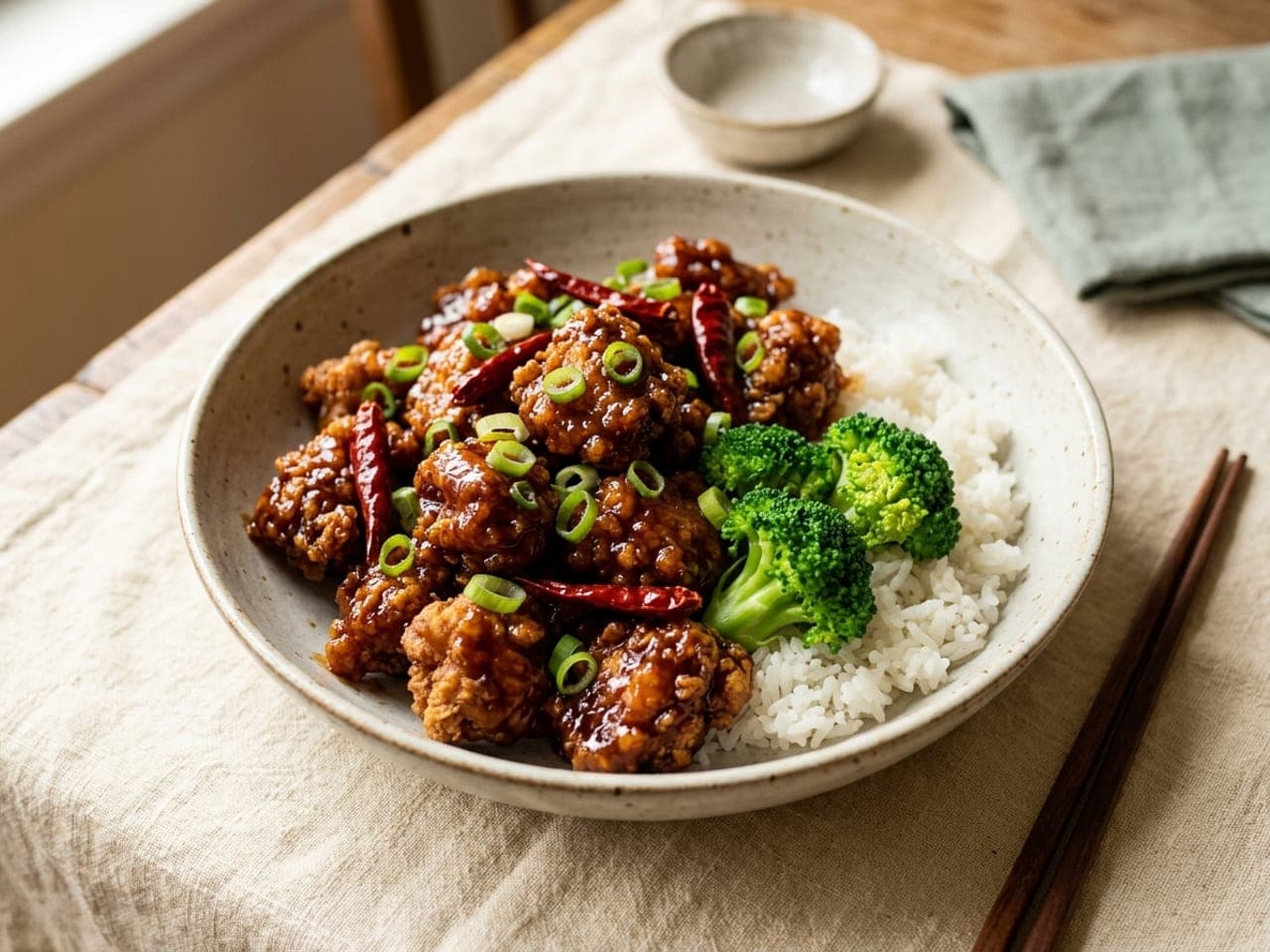
The Chinese-American classic built from its actual parts: craggy fried chicken thighs in a glossy sweet-hot-sour lacquer, whole dried chiles perfuming the pan, scallions over the top and steamed broccoli on the side. Invented in Taipei in the early 1950s by an exiled Hunanese chef, sweetened in 1970s New York, and named for a general who never tasted it — takeout's best origin story, cooked properly at home.
Ingredients
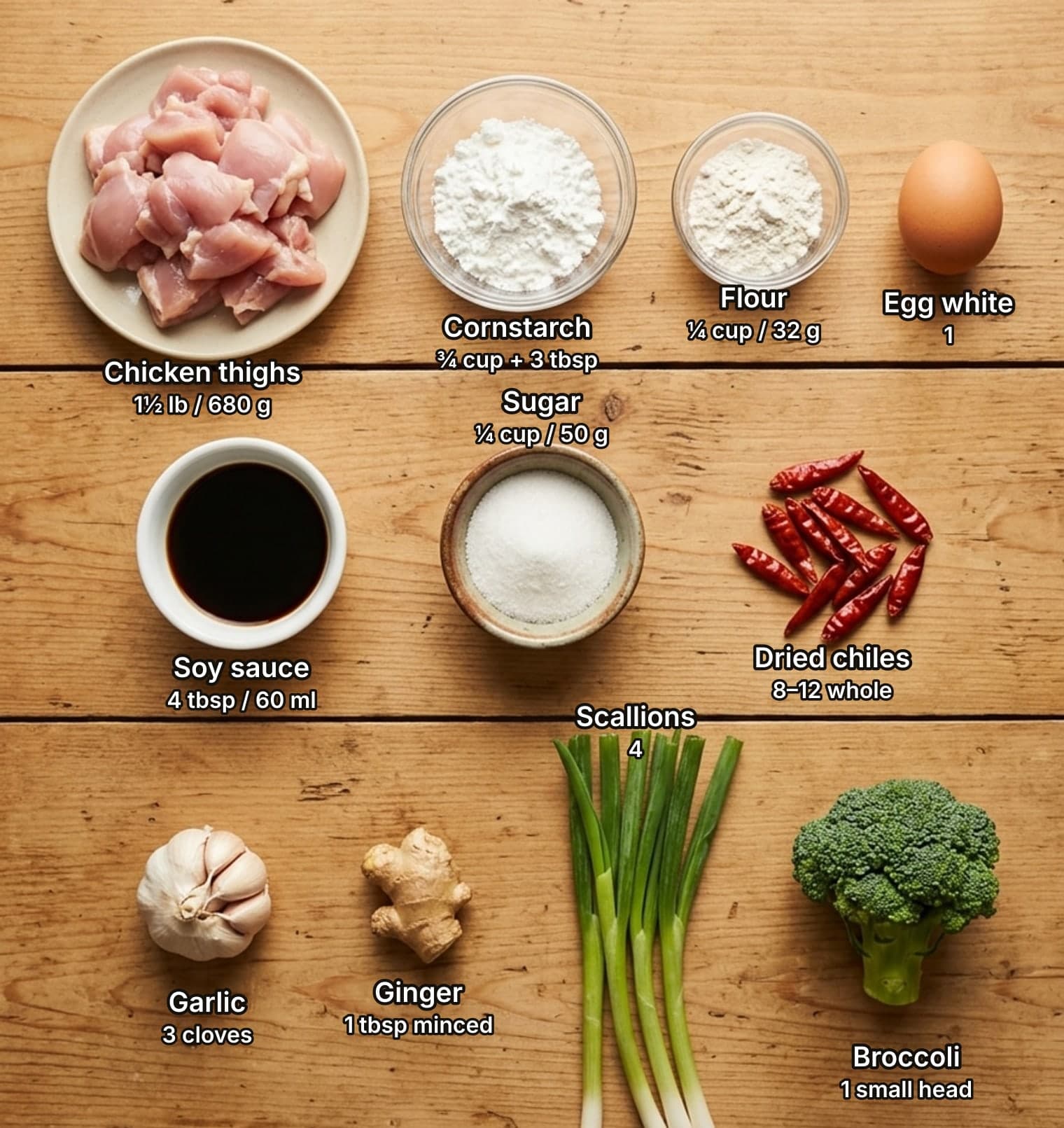
- boneless, skinless chicken thighs, cut into 1.5-inch (4 cm) chunks1 1/2 lb (680 g)
- soy sauce1 tbsp for the marinade, plus 3 tbsp (45 ml) for the sauce
- Shaoxing wine (or a dry sherry — see shopping; skippable, but better with)1 tbsp for the marinade, plus 1 tbsp for the sauce
- egg white1
- cornstarch (cornflour in the UK)2 tbsp for the marinade, 3/4 cup (95 g) for the dredge, plus 1 tbsp for the slurry
- all-purpose (plain) flour1/4 cup (32 g)
- baking powder1/2 tsp
- fine salt3/4 tsp, divided
- white pepper (or black)1/4 tsp
- neutral frying oil (canola, sunflower or peanut)1 1/2 quarts (1.5 L)
- garlic, minced3 cloves
- fresh ginger, minced1 tbsp
- whole dried red chiles (Chinese facing-heaven chiles, or chiles de árbol)8–12, left whole
- green onions (spring onions) — whites cut into 1-inch (2.5 cm) lengths for the sauce, greens sliced to finish4
- chicken stock or water1/2 cup (120 ml)
- sugar — yes, really; see the honesty note in the shopping section1/4 cup (50 g)
- rice vinegar (unseasoned)3 tbsp (45 ml)
- dark soy sauce — optional, for the takeout mahogany1 tsp
- toasted sesame oil1 tsp
- toasted sesame seeds — optional, a light hand (see the sesame-chicken FAQ)1 tsp
- steamed rice and steamed broccoli, to serve4 cups (about 630 g) cooked rice; 1 small head of broccoli
What General Tso's chicken is (and who General Tso actually was)
General Tso's chicken is the standard-bearer of American Chinese cooking: chunks of dark-meat chicken in a craggy fried crust, tossed through a glossy sauce that runs sweet, tangy and quietly hot, scattered with scallions and served over rice — routinely America's most-ordered Chinese dish, the one GrubHub's order data has ranked #1 in the category nationwide. The general is real. Zuo Zongtang — Tso Tsung-t'ang in the older romanization — was a Qing-dynasty statesman and military commander from Hunan province, born 1812, died 1885, celebrated in China for helping put down the Taiping Rebellion and for reconquering Xinjiang for the empire. He was, by every account, a formidable man. He was also dead some seven decades before the first plate of his chicken existed, and in Hunan he is remembered as a scholar-general, not a dinner.
The dish was invented in Taipei in the early 1950s by Peng Chang-kuei — a chef born in Changsha, Hunan, around 1918 (his obituaries disagreed even about the year), who trained in the exacting banquet tradition of the Hunanese elite and fled to Taiwan in 1949 with the Nationalist government. As Peng told the story, a multi-day state visit by the American admiral Arthur W. Radford exhausted his repertoire, and he improvised: chicken chunks fried hard, then sauced with soy, vinegar, garlic, ginger and dried chiles — salty, hot, sour, and barely sweet at all — named on the spot for Hunan's greatest general. It's his own account, told late in life, and even the date wobbles in the telling: Peng sometimes said 1952, US records put Radford's visit in 1953, and the version the New York Times printed says 1955. The broad consensus still hands Peng the dish — though not quite unanimously, as New York is about to show — and nobody disputes that his original tasted almost nothing like the takeout box.
The sweetness is a New York story. In the early 1970s, Hunanese cooking arrived in Manhattan in a rush: chef T.T. Wang of the Shun Lee restaurants served a crisper, sweeter General Tso's by 1972 — Shun Lee claims the invention outright, the record's one real counter-claim — and Peng himself arrived in 1973 with his own restaurant on East 44th Street, where, at least as Peng proudly told it, Henry Kissinger became a regular (Kissinger did throw a well-reported banquet there in 1977, the year the New York Times review landed). Peng admitted to Dunlop that he, too, altered the recipe for American palates; between them, the sweet version conquered the city and then the country. The 2014 documentary The Search for General Tso traces the whole migration, including its strangest turn: when the food writer Fuchsia Dunlop went looking in Hunan itself, cooks and eaters there had never heard of the dish — Peng's own 1990s Changsha branch failed as 'too sweet' — and Peng, who died in Taipei in 2016 at 97 or 98 by rival obituary counts, the family's Peng Yuan restaurants in Taiwan still serving his cooking, pronounced the fully Americanized dish 'crazy nonsense' on camera. This page cooks the American classic, and keeps his original in the FAQ, where you can cook the argument yourself.
How to make General Tso's Chicken
- Velvet the chicken — the marinade is armor, not just flavor. Pat the thighs dry with paper towels before you cut them — surface water thins the marinade and spatters in the oil later — then cut into chunks and toss with the soy sauce, Shaoxing wine, egg white, 2 tbsp of the cornstarch and 1/4 tsp of the salt until every piece is slicked in a loose, glossy paste, then let it sit 15–30 minutes in the refrigerator while you build everything else (USDA's marinating rule is fridge, never counter — and the chill keeps the dredge clumps firmer later anyway). This is velveting, the technique most closely associated with Cantonese restaurant kitchens and the tenderness of every good stir-fried takeout protein: the egg-white-and-starch film sets in the hot oil a moment before the meat's surface does, so the chicken inside steams gently in its own jacket instead of seizing. Thighs are the right cut here — they forgive an extra minute in the oil the way breast never will.
- Mix the sauce before anything fries — chronology is a doctrine. Stir the stock, the 3 tbsp soy sauce, the remaining tablespoon of Shaoxing, the sugar, the rice vinegar, the dark soy and the sesame oil together in a measuring cup until the sugar dissolves. In a separate small bowl, stir the last tablespoon of cornstarch into 2 tbsp of cold water — that's the slurry, and it stays separate on purpose. Once chicken starts coming out of the oil, its crust is on the clock; the ninety seconds you'd spend measuring vinegar then is exactly the ninety seconds the crackle can't spare. Sauce first is not fussiness. It's how the finished dish arrives crisp.
- The craggy dredge — batter's better-behaved cousin. Whisk the remaining cornstarch, the flour, the baking powder, the remaining 1/2 tsp salt and the white pepper in a wide bowl. Now the move that makes the crust: drizzle 2–3 tbsp of liquid from the marinating chicken into the dry mix and rake it through with your fingers until the bowl is full of small, irregular clumps, like wet gravel. Press each chunk of chicken firmly into this rubble so the clumps stud its surface. Those craggy points are the entire architecture of the dish — every knob fries into a shard that keeps its crunch under sauce, where a smooth batter would present one flat surface and surrender it all at once.
- Fry at 350°F (175°C), in batches, and trust the thermometer. Heat the oil to 350°F (175°C) in a heavy pot no more than half full, with a clip-on thermometer doing the judging. Fry the chicken in three or four batches — crowding drops the temperature, and cool oil soaks in instead of searing — lowering each piece in away from you and nudging them apart in the first thirty seconds so they don't weld. Four to five minutes a batch, until deep gold and audibly lighter in the oil. Lift onto a wire rack, never paper towels; paper traps steam under the crust you just built. Let the oil climb back to temperature between batches, and check one thick piece with an instant-read thermometer: 165°F (74°C) inside.
- The optional second fry, ninety seconds of insurance. For crust that shrugs off sauce entirely, bring the oil up to 375°F (190°C) and give the chicken a second, shorter trip — sixty to ninety seconds, all of it at once if your pot allows, until the color deepens half a shade. This is the same moisture-engineering the double-fried chickens of Seoul and Nagoya run: the rest between fries lets steam finish leaving, and the hotter second fry crisps a surface that's finally dry. For a weeknight, skip it — the craggy dredge alone outlasts most sauces. For company, or if the chicken will wait at all before saucing, those ninety seconds are the cheapest upgrade in the recipe.
- Bloom the chiles — they're scenery, not snacks. Move the oil pot off the heat to a back burner — it strains and jars once it's fully cold, not now, and it has two or three sessions left in it — and carefully ladle 1 tbsp of it into a wok or a wide skillet over medium heat. Add the whole dried chiles and toast them 30 seconds, until they're glossy, darkened a shade and unmistakably fragrant — not blackened, which turns the whole dish acrid. Add the garlic, ginger and scallion whites and stir 30–45 seconds more, until the garlic smells sweet but hasn't colored. The chiles stay whole because their job is perfume and menace, not payload: they season the oil, decorate the plate, and get eaten by nobody.
- Reduce first, slurry second — never the other way around. Pour in the sauce base and let it come to a hard simmer for a minute or two, until it smells concentrated and the raw edge of the vinegar rounds off. Only then stir the slurry once more (cornstarch settles fast) and add it in two or three additions, simmering a few seconds between each, until the sauce runs thick enough to coat a spoon and hold a line drawn through it. Stop there — it thickens further the moment it meets the chicken and again as it cools. Reduction builds flavor; the slurry only builds texture. A sauce thickened before it's reduced is glue with ambitions.
- The ten-second toss. Kill the heat, add the fried chicken to the wok and toss — ten to fifteen seconds, no more — until every shard is lacquered and glossy and the sauce has visibly nowhere left to pool. This is a coat of paint, not a bath: the sauce should sit ON the crust in a thin, clinging layer, and the bottom of the pan should end up nearly clean. Scatter the scallion greens (and, if you're using them, a restrained pinch of sesame seeds) and fold once more. If a puddle chases the chicken around the wok, you slurried past the lacquer line — next time, hold back the last addition.
- Serve it over the rice it was born for. Straight to the table, over steamed rice, with the broccoli — which conveniently steams in the time the last batch fries — tucked alongside to catch its share of sauce. The whole chiles go to the plate as scenery; warn the table anyway. Like every fried-and-glazed chicken on earth, this is a now food: the crust's finest fifteen minutes start immediately, and the leftovers (good as the FAQ says they can be) are a different, softer dish. Cook it when people are already hungry, and let the sizzle be the dinner bell.
Safety & hygiene Important
- Raw chicken rules (including the one about not washing it). Don't rinse the chicken — USDA guidance is blunt that washing raw poultry sprays Salmonella and Campylobacter around the sink in droplets you can't see, and it does nothing the fryer won't do better. Everything the raw chunks touch — board, knife, the marinade bowl, the dredge bowl (it held raw chicken AND its liquid), your hands — stays on raw-poultry rules until hot soapy water says otherwise, and the marinade itself is never reused. Doneness is a number, not a color: 165°F (74°C) on an instant-read thermometer pushed to the center of the thickest chunk — UK guidance works to 75°C, so let it tick one more degree if that's your rulebook. Thighs are forgiving, so the fry usually lands past that with room to spare — but the thermometer, not the clock or the color, gets the final word.
- A pot of hot oil is the sharpest knife in the kitchen. Use a heavy, tall-sided pot filled no more than half — oil climbs hard when wet chicken lands in it. Clip on a thermometer and treat 375°F (190°C) as a ceiling, not a vibe; smoking oil is oil telling you to cut the heat. Lower every piece in away from you, keep the fry zone clear of kids, pets and dangling sleeves, and never walk away from hot oil, even between batches. If it ignites: heat off, lid on, and never water — water flash-boils under burning oil and throws it at the ceiling. Don't carry a burning pot; leave the lid on until everything is fully cold, and if the fire doesn't die the moment the lid lands, get everyone out and call the fire department — 911 in the US, 112 in most of Europe. Afterward, let the oil cool completely before straining it through a fine sieve into a sealed jar — kept in the fridge or a cool dark cupboard, it's good for two or three more savory sessions. When it's dark, foamy or smells fishy, it's done: cooled, bottled and binned (or dropped at a municipal oil-recycling point), never down the drain.
- Allergens and the leftover clock. This recipe carries wheat (the flour; standard brewed soy sauce — the Kikkoman-style brew is roughly equal parts wheat and soybeans; and Shaoxing wine, which ferments on a wheat-based starter), soy, egg (the velveting marinade) and sesame (the oil, plus the optional seeds) — each a major allergen in the US and EU — and if a dry sherry stands in for the Shaoxing, that adds sulphites, an EU-labelled allergen in its own right. Two quieter label checks: store-bought chicken stock and bouillon very often contain celery, an EU-labelled allergen (use water if that's your table), and if you fry in peanut oil, know your bottle — highly refined peanut oil is considered non-allergenic by the FDA because refining strips the protein, but cold-pressed or 'gourmet' peanut oils are not, so for a peanut-allergic guest use canola or sunflower. The gluten-free path is real but runs on labels: an all-cornstarch dredge (drop the flour; the crust fries a shade paler and more brittle), a certified gluten-free tamari in place of both soy sauces, a dry sherry or pure-rice sake in place of the Shaoxing, and a glance at the baking powder (some European brands bulk with wheat flour where US brands use cornstarch). Leftovers follow the standard clock: out of the danger zone within 2 hours (1 hour above 90°F/32°C), shallow container, fridge, 3–4 days, and reheated to 165°F (74°C) — best on a rack in a 400°F (200°C) oven for 8–10 minutes, because the microwave turns crust to memory. Sauced pieces only ever come partway back; if you're cooking ahead on purpose, stop after the fry, refrigerate or freeze the unsauced chicken (up to a month), and re-fry straight from frozen with 2–3 extra minutes, back to 165°F (74°C) on the thermometer, before saucing fresh.
3 ways to plate it
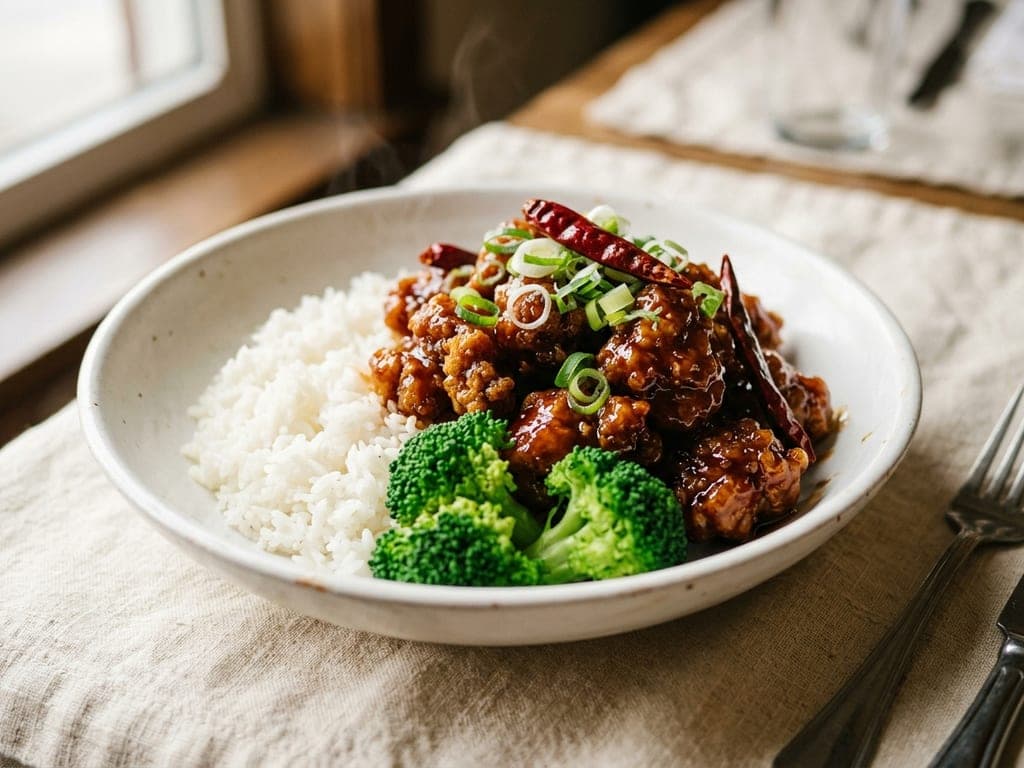
- Mound the rice slightly off-center in a wide shallow bowl and press the back of the spoon into it once, so there's a low slope for the chicken to lean on.
- Pile the chicken over half the rice, leaving a crescent of white showing — the contrast is what makes the lacquer read as lacquer.
- Tuck three or four broccoli florets into the seam between chicken and rice, stems down, so the heads catch stray sauce.
- Finish with scallion greens and two or three whole chiles from the pan placed where they can be seen and avoided.
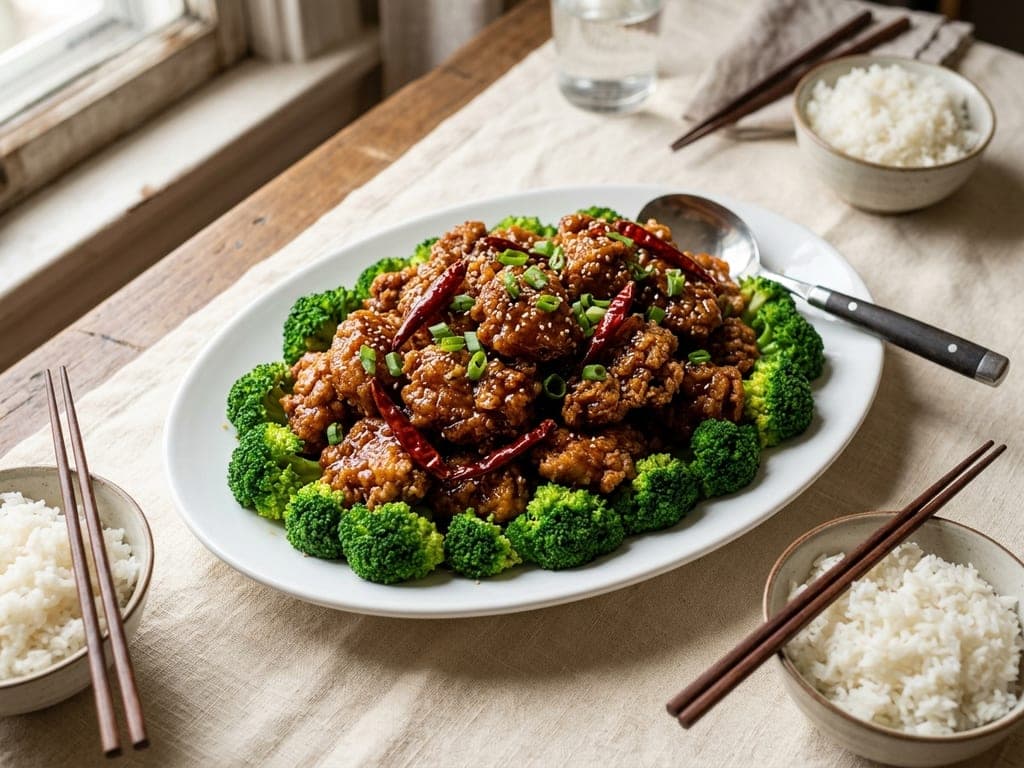
- Warm the platter first — thirty seconds under hot tap water, dried — so the lacquer stays glossy instead of setting on cold ceramic.
- Pile the chicken high in the center rather than spreading it flat; height keeps the pile crisp and reads as abundance.
- Ring the base with the broccoli, florets outward, and let the whole chiles sit where the toss left them.
- Give every diner their own bowl of rice and a serving spoon for the platter — the chicken goes over the rice at the last second, never before.
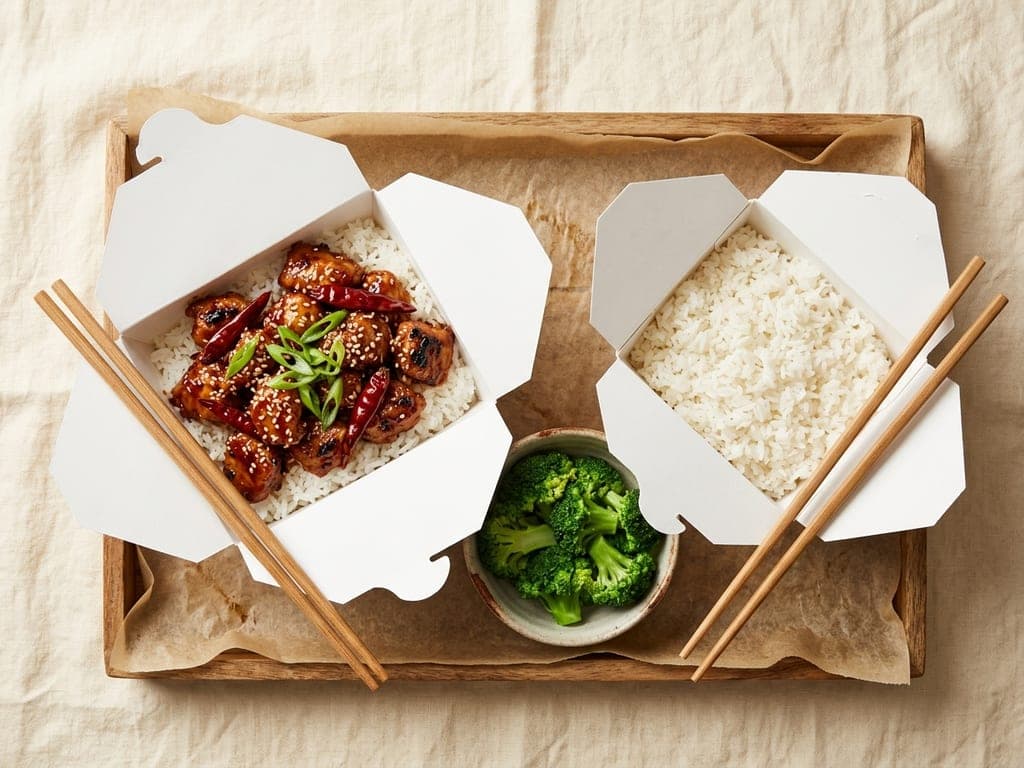
- Pack the rice loosely into plain white takeout-style boxes — one per diner — and spoon the chicken over the rice right at the box's mouth, where it shows.
- Fold the lids fully back so the gloss and the scallion green do the talking.
- Set the boxes on a parchment-lined tray with chopsticks across each box and the broccoli in one shared bowl at the center.
- Serve within minutes — the box steams its contents soft faster than a plate, which is half of why homemade beats delivery.
The crust and the lacquer are one system
Fried-then-sauced chicken is an engineering problem before it's a recipe: sauce is mostly water, water is the enemy of crunch, and the whole dish is a race between the lacquer going on and the crackle giving out. General Tso's solves it in layers, and the first layer is the marinade. Velveting — the technique running under half the Chinese takeout canon — wraps the meat in a film of egg white, starch and soy that sets the instant it hits hot oil, a fraction before the chicken's own surface can seize. The meat inside effectively steams in a jacket, which is why takeout chicken is tender in a way that plain floured chicken isn't, and why thighs plus velvet is the most forgiving combination in the fried-chicken world.
The second layer is the dredge, and the trick is that it's deliberately ruined. A smooth cornstarch coat fries into a smooth shell — fine for a dish served naked, doomed under sauce, because a flat surface meets the lacquer everywhere at once. Raking spoonfuls of the wet marinade through the dry mix first turns it into gravel, and pressing the chicken into that gravel studs every piece with knobs and points that fry into free-standing shards. Sauce settles into the valleys; the peaks stay dry and loud. The mix itself is a doctrine in ratio form: cornstarch as the majority partner because starch fries glassy where wheat fries bready, a minority of flour for browning and cohesion, and a pinch of baking powder blowing micro-bubbles so the shell shatters instead of cracking.
The third layer is restraint with the sauce, and it's where takeout technique gets misread at home. The sauce is reduced first — a minute or two at a hard simmer, concentrating soy and rounding the vinegar — and thickened second, with a cornstarch slurry added in stages until it just holds a line on a spoon; thickening before reducing gives you volume without flavor, which is how mall-food-court Tso's goes wrong. One teaspoon of dark soy is the entire secret of the takeout color, that deep mahogany a regular soy sauce can't reach. And the toss lasts ten seconds off the heat, because the goal is a coat of paint, not a bath. Worth saying plainly: Peng's Taipei original ran the same architecture with a different flag — soy, vinegar, garlic and chiles with almost no sugar, hot and sour where New York went sweet — and several of the SERP's best-loved shortcuts (hoisin in place of a built sauce) are honorable pantry moves that simply give up the ability to steer sweet, sour and heat independently. Building it from parts is barely more work, and the dials are the reward.
Shopping honestly: two soys, a wine, and the chile question
Two soy sauces do two jobs. The everyday bottle — a light or all-purpose brewed soy; Kikkoman, or Pearl River Bridge's light if you're in a Chinese grocery — is the seasoning backbone. Dark soy sauce is a different product: thicker, less salty, faintly molasses-edged, and it exists almost entirely for color — the single teaspoon here is what turns the sauce takeout-mahogany instead of pale amber. Skip it and the dish tastes the same and photographs lighter; substitute nothing for it, least of all more regular soy, which just adds salt. Shaoxing wine — the amber, nutty rice wine of Chinese cooking — is sold in most supermarkets now as salted 'cooking' grade, which is exactly fine here; a dry sherry is the honest substitute (it adds sulphites to the allergen list), and leaving it out entirely costs a little depth, not the dish.
The sugar deserves a straight sentence: a quarter cup across four servings is what makes this General Tso's and not a Hunan stir-fry, and pretending otherwise is how recipes end up tasting like apology. The dish is sweet — that's the New York of it — balanced against three tablespoons of rice vinegar (unseasoned; the 'seasoned' bottles carry their own sugar and salt) and the chile heat. Three tablespoons of sugar is the floor before the dish changes name. In the other direction, a spoon of honey does nothing cane sugar doesn't, and brown sugar muddies the gloss. If your takeout benchmark has always tasted deeper than your homemade attempts, the missing ingredient is usually the dark soy — or a pinch of MSG, which most takeout kitchens use, which the FDA regards as safe, and which this recipe treats as optional and unashamed.
The chiles are the dish's flag, and they're a costume with a real dagger under it. Chinese groceries sell facing-heaven chiles (chao tian jiao) — stubby, scarlet, fruity-hot — and any supermarket's chiles de árbol stand in perfectly; both are used whole, toasted in the oil until glossy, and left on the plate as scenery nobody eats. Whole chiles perfume; broken chiles and their seeds commit — snap a few in half if your table wants real heat. Cornstarch, one bag, runs the whole recipe — marinade, dredge and slurry alike (it's cornflour in the UK, and the pure-starch dredge is also the gluten-free route). The sesame oil should be the toasted, dark kind, added at the end as a finisher, never as a frying medium. And the broccoli isn't decoration: it's the American plate's standard partner because its florets hold sauce like cups, and it steams conveniently in the exact minutes the last batch fries.
Questions, answered
What's the secret ingredient in General Tso's chicken?
There isn't one — there's a secret system. The takeout traits people chase come from technique: velveting (the egg-white-and-cornstarch marinade) for the tenderness, marinade droplets raked into the dredge for the craggy crust, and a sauce that's reduced before it's thickened so it lacquers instead of pooling. If you insist on bottles: the teaspoon of dark soy sauce is the entire takeout color, Shaoxing wine is the background depth most home versions miss, toasted sesame oil is the finishing aroma — and the quietest honest answer is a pinch of MSG, which most takeout kitchens use and the FDA considers safe. No single one of them rescues a dish that skips the technique.
What ingredients are in General Tso's chicken?
Boneless chicken thighs; a velveting marinade of soy sauce, Shaoxing wine, egg white and cornstarch; a frying dredge of cornstarch, flour and baking powder; and a sauce built from chicken stock, soy sauce, rice vinegar, sugar, garlic, ginger, scallions and whole dried red chiles, finished with toasted sesame oil and thickened with a cornstarch slurry. Steamed rice and broccoli ride alongside, and sesame seeds are an optional garnish. Restaurant versions vary at the margins — some add hoisin or ketchup for body and color, and once orange peel appears you're drifting into orange chicken's territory — but that list is the dish.
Is General Tso's chicken basically orange chicken?
They're cousins, not twins. Both are American-Chinese fried-and-glazed chicken built on the same architecture — crisp coated dark meat, glossy sweet sauce — but orange chicken is citrus-forward, sweeter and essentially mild, its flavor anchored in orange peel and juice (an echo of chenpi ji, the Chinese dried-tangerine-peel chicken — a classically Sichuanese flavor, whatever orange-chicken lore says about Hunan), and it's a 1987 invention from the Panda Express kitchen, credited to chef Andy Kao. General Tso's runs on a vinegar-and-chile backbone instead: no citrus, a sharper edge, and real heat from whole dried chiles. If your benchmark plate is sweet and sunny, you're an orange chicken person; if it bites back a little, you're here.
What's the secret to a crispy General Tso's chicken?
Five habits, in order of payoff. Press the chicken into a craggy dredge — dry mix moistened with spoonfuls of marinade until it clumps — so the crust fries into shards with peaks the sauce can't reach. Hold the oil at 350°F (175°C) and fry in batches; crowded, cooling oil soaks instead of searing. Drain on a wire rack, never paper towels, which steam the underside soft. Reduce the sauce to a clinging lacquer and toss for only ten seconds off the heat. And if the chicken must wait at all before saucing, give it the optional 60–90-second second fry at 375°F (190°C) — the same moisture trick Korean fried chicken runs, in miniature.
General Tso's vs sesame chicken — what's the actual difference?
Same fry, different soul. Sesame chicken is the sweet one: a milder, candy-glossed sauce with little or no chile presence, finished under a genuine blanket of sesame seeds. General Tso's keeps a hot-sour edge — vinegar in the sauce, whole dried chiles in the pan — and wears sesame seeds only as an optional whisper, if at all. On a takeout menu the two often share a fryer and most of a sauce base, which is why they blur; at home the difference is a dial: drop the chiles and vinegar, raise the sugar, triple the sesame seeds, and you've cooked sesame chicken. Keep them, and you've cooked the general's.
Who was General Tso, and did he ever eat this chicken?
Zuo Zongtang (Tso Tsung-t'ang, 1812–1885) was a celebrated Qing-dynasty statesman and general from Hunan province — a leader in crushing the Taiping Rebellion and in reconquering Xinjiang. He never ate the dish and had nothing to do with it: he died some seven decades before it was invented. The name was a tribute — coined in Taipei in the early 1950s by the exiled Hunanese chef Peng Chang-kuei who, by his own account, needed a name worthy of a banquet dish improvised for an American admiral and reached for his home province's greatest military hero. In Hunan itself, where Zuo is a genuine historical figure, the chicken named after him was unknown until American curiosity started importing the question.
How many calories is General Tso's chicken — is it really 1,300?
The infamous number is real, but it belongs to restaurant portions: the Center for Science in the Public Interest's famous Chinese-restaurant survey clocked a typical General Tso's order around 1,300 calories — before the rice — with about a day and a half's sodium (3,200 mg). That's a portion problem more than a recipe problem. This version works out to roughly 600 calories per serving before rice (add about 200 per cup of steamed long-grain rice), with sodium in the neighborhood of 1,700 mg — better than takeout's 3,200, not blameless — because a home portion is honest, the craggy dredge carries less coating than a thick batter, a hard fry at the right temperature absorbs less oil than a crowded one, and the sugar is a measured quarter cup across four plates rather than a ladle of pre-made sauce. It's still a fried dish in a sweet glaze — dinner, not a health food — but it's a dinner you've seen the inside of.
Can I make General Tso's chicken in an air fryer, or baked?
Yes, with honest expectations. Air fryer: skip the wet-clump trick (it drips through the basket), toss the velveted chicken in the dry dredge, rest five minutes until the coating looks damp, spray generously with oil and run 400°F (200°C) for 12–14 minutes, flipping and re-spraying once, to 165°F (74°C) inside. The crust comes out thinner and drier-edged — genuinely good under this lacquer, different from fried. Oven: same prep on a rack over a sheet pan, 425°F (220°C) for about 20 minutes, until an instant-read in the thickest piece says 165°F (74°C), and accept another step down in crunch. The sauce, made exactly the same way, carries both versions; neither matches the fry, and pretending otherwise is how air-fryer recipes lose trust.
Can I make it ahead, and what happens to leftovers?
Stage it, don't finish it. The chicken can be fried, cooled briefly and refrigerated within 2 hours (1 hour if it's above 90°F/32°C where you're working) — or frozen up to a month — then re-fried straight from cold (or frozen, plus 2–3 minutes) at 375°F (190°C) until hot to 165°F (74°C), which is exactly the double-fry with a pause in the middle. The sauce base holds 3–4 days in the fridge; add the slurry only when you finish the dish. Leftovers of the finished, sauced dish keep 3–4 days refrigerated and reheat best spread on a rack in a 400°F (200°C) oven for 8–10 minutes, to 165°F (74°C) inside — the microwave returns tender chicken in sauce, which is edible and a little sad. Sauced crust only ever comes about eighty percent of the way back, so if you know tonight cooks for tomorrow too, sauce only what you'll eat now.
What did Peng's original General Tso's chicken taste like — and can I cook it?
Peng Chang-kuei's original was a Hunanese banquet dish: salty, hot and sour, with soy, garlic, ginger, vinegar and dried chiles doing the talking and sugar barely present — closer to a sharpened, glossy chile chicken than to anything in a takeout box. Fuchsia Dunlop, who interviewed Peng in Taipei and published his version, describes a dish where the vinegar and chiles lead and nothing is candied. To cook the argument yourself: same chicken, same fry, but drop the sugar to 1 teaspoon, raise the rice vinegar to 1/4 cup (60 ml), skip the dark soy, and let the chiles number closer to twelve. It's a different, older dish wearing the same crust — and splitting a batch of fried chicken between the two sauces is the best history lesson this site can offer.
What should I serve with General Tso's chicken?
Steamed white rice and steamed broccoli are the canonical American plate, and they're canonical because they work: neutral, sauce-catching, and timed for free (the broccoli steams while the last batch fries). Beyond that, this dish sits on the site's fried-then-sauced shelf with three philosophical neighbors worth tasting the same month: Korean fried chicken, which runs the same lacquer logic with a thinner crust and a fermented-chile sauce; karaage, which puts all its flavor in the marinade and none on top; and hot honey chicken, the American drizzle school. Four fried chickens, four answers to the same question — where should the flavor live?
Snap your finished plate and let the AI plate it again — more beautifully.