Chicken Carbonara Recipe (Real Egg Sauce, Plus a Creamy Version)
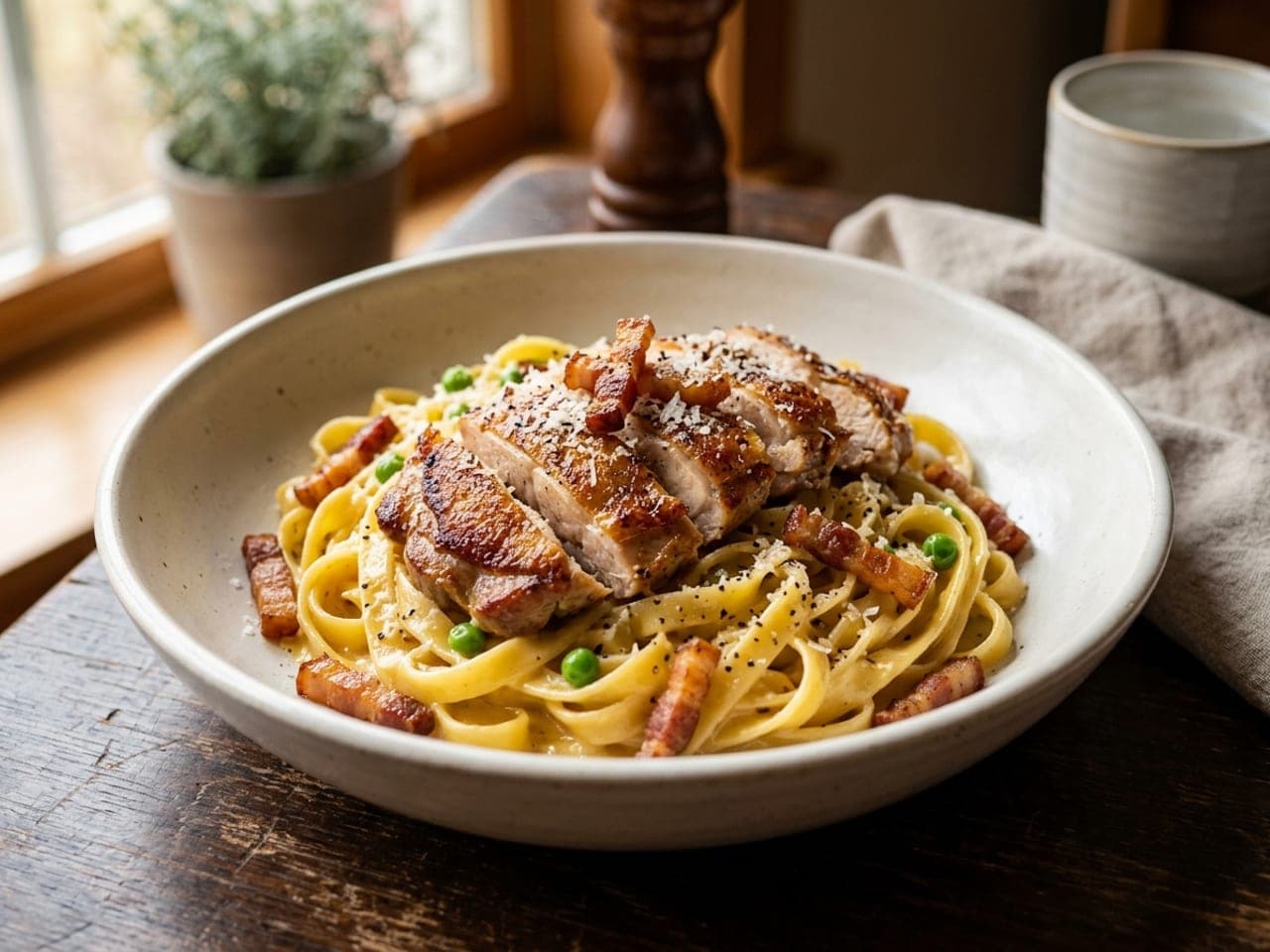
Chicken carbonara is an American dish — Rome would like that noted — and a better one than its chain-restaurant reputation suggests. Done properly it is a complete dinner: chicken seared hard in rendered guanciale fat, rested and sliced, folded through fettuccine dressed with the real Roman emulsion of egg yolk, Pecorino Romano and starchy pasta water, burner off. This page gives that version first and a fully specified cream version second, because both are honest dinners and only one of them can scramble.
Ingredients
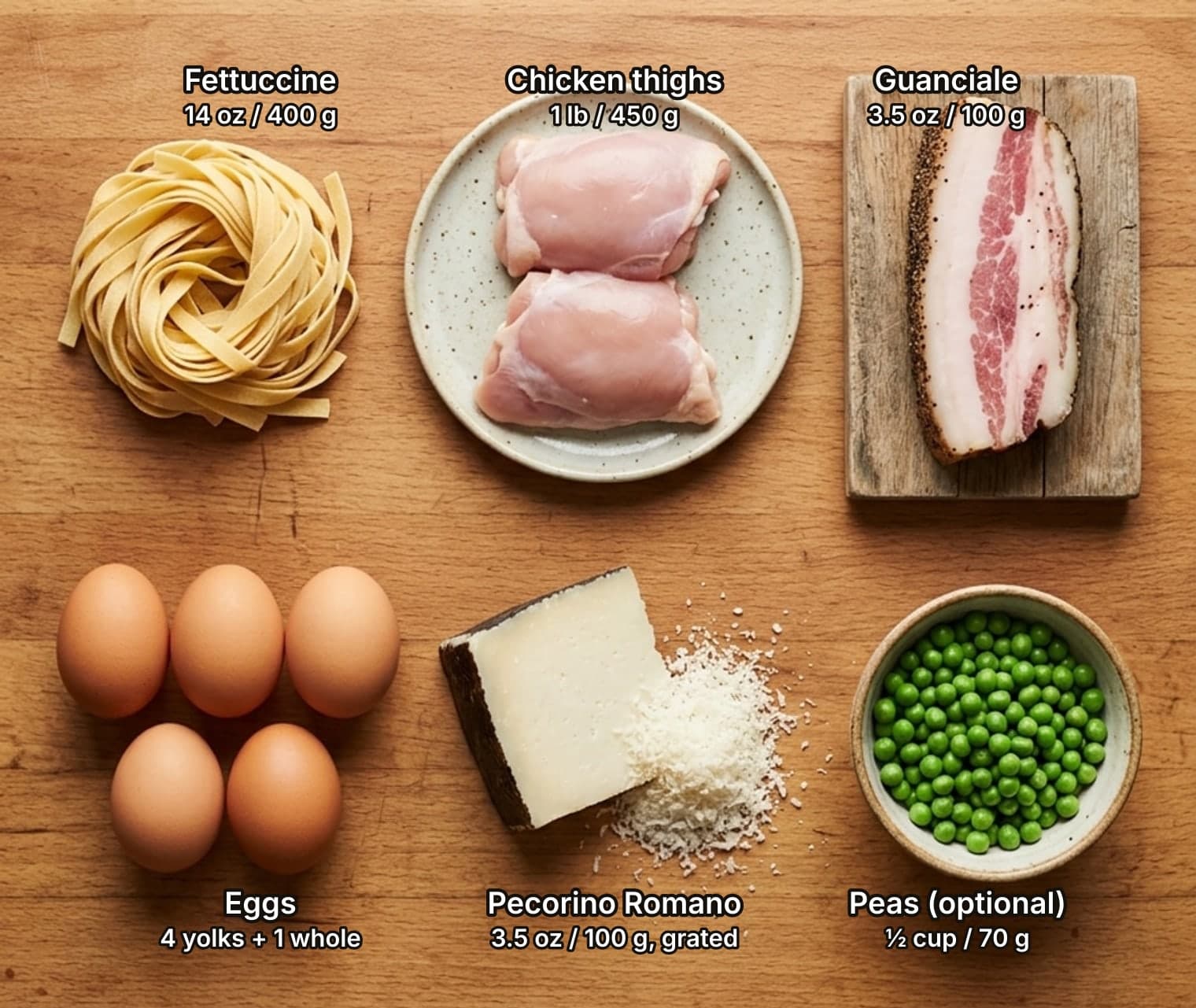
- fettuccine — the American default; spaghetti or rigatoni work just as well, and bronze-cut pasta holds the sauce better14 oz (400 g)
- boneless, skinless chicken thighs (or breasts, cut thick), in 3/4 in (2 cm) pieces or left whole to sear and slice1 lb (450 g)
- guanciale (cured pork jowl) or pancetta, rind removed, cut into batons about 1/4 × 1 in (6 mm × 2.5 cm) — a third less than the Roman dish, because the chicken now carries the body3.5 oz (100 g)
- egg yolks, from large eggs — pasteurized if anyone at the table is pregnant, elderly, very young or immunocompromised4
- whole large egg — its white keeps the sauce pourable around the chicken1
- Pecorino Romano, finely grated and weighed, not measured by the cup; up to half can be Parmigiano-Reggiano for a milder sauce3.5 oz (100 g), plus more for serving
- black peppercorns, coarsely cracked — half on the chicken, half in the sauce2 tsp, plus more to finish
- kosher salt (coarse), for the chicken — the only salt that touches the meat3/4 tsp
- kosher salt, for the pasta water — about half the usual amount, deliberately1 tbsp (about 15 g)
- water, for the pasta — less than the package suggests, so it runs starchier3 quarts (2.8 liters)
- olive oil, only if the pan runs dry before the second batch of chicken — pancetta renders less fat than guanciale1 tsp, optional
- frozen peas — the classic American addition, dropped into the pasta water for the last minute; a garnish, not a vegetable course1/2 cup (70 g), optional
What chicken carbonara is — and what it isn't
Chicken carbonara is an American dish, and it is worth saying so at the top, because most recipes that rank for it pretend otherwise or never raise the question. Rome's carbonara is pasta dressed with egg, Pecorino Romano, guanciale and black pepper, served as a first course; it does not contain chicken, and no trattoria in the city would put it there, for the same reason Romans do not, as a rule, put chicken meat in a pasta sauce: chicken is a second course, eaten after the pasta. (The one old Roman exception, fettuccine with chicken giblets — rigaglie — proves the rule: the offal for the sauce, never the bird.) Chicken carbonara has no recorded inventor or date; it grew up in American restaurants, where a plate of pasta is the whole dinner and a dinner needs a protein, and it usually arrived under cream, with bacon and often peas.
None of that makes it a bad dish; it makes it a different one, and a far better dinner than its reputation when two things are done properly. The first is the sauce: the real emulsion of egg yolk, pecorino, rendered pork fat and starchy pasta water, set only by the heat of the pasta — richer, sharper and lighter than cream, and something almost nobody ranking for this dish makes. The second is the chicken, cooked like chicken — seared hard in the pork fat, rested, sliced — rather than poached grey in cream, which is why most memories of the dish are beige. This page gives the egg version first and a fully specified cream version second.
How to make Chicken Carbonara
- Salt the chicken first, then crack, grate and cut. Prep starts with the chicken, which needs time with its salt. Crack 2 tsp of black peppercorns coarsely and divide it in two before anything raw is touched — 1 tsp for the chicken, 1 tsp for the sauce. Pat 1 lb (450 g) of boneless, skinless thighs dry, cut into 3/4 in (2 cm) pieces or leave whole, and season with 3/4 tsp of kosher salt (coarse) and the chicken's 1 tsp of pepper; leave it uncovered on a plate in the refrigerator, bottom shelf, while you do the rest — 20 minutes for thighs, 30 for breast (add those 10 minutes to the prep time). Set out a second, clean plate for the cooked pork and chicken now, so the one that held the raw meat never sees them again. Wash hands, board and knife. Put 3 quarts (2.8 liters) of water on to boil with 1 tbsp (about 15 g) of salt — less water than the package suggests, so it runs starchier, and half the usual salt; the pecorino and pork salt the dish later. Grate 3.5 oz (100 g) of Pecorino Romano to a powder and weigh it. Cut 3.5 oz (100 g) of rindless guanciale or pancetta into batons 1/4 in (6 mm) thick and 1 in (2.5 cm) long. That is the 20 minutes of prep.
- Render the pork from a cold pan, then lift it out — 8 minutes. Put the pork batons into a large, cold skillet — 12 in (30 cm) if you have one; the chicken needs the room — over medium-low heat for about 8 minutes, stirring now and then, until the fat runs clear and the lean is deep gold with crisp edges and a chewy middle. Pancetta renders less than guanciale; that is what the optional teaspoon of oil is for. Lift the pork out with a slotted spoon and leave the fat: 2–3 tbsp is exactly enough to sear the chicken in, so pour off any more. The pork comes out now because it would burn at the heat the chicken needs; it goes back in at the end, where its crisp edges can be seen.
- Sear the chicken hard in the pork fat — 7 minutes. Raise the heat to medium-high and wait until the fat shimmers. Lay the chicken in a single layer with space between the pieces — two batches of 3–4 minutes each, about 7 minutes in all. Crowd the pan and the chicken steams grey in its own juice, the chain-restaurant failure this page exists to avoid. Leave the pieces alone for 2 minutes to take color, then turn and finish. Check the thickest piece with an instant-read thermometer: 165°F (74°C) is the FSIS minimum for poultry, and a thigh will go 10°F (about 6°C) past it and stay juicy. Whole thighs take about 4 minutes on the first side and 3 on the second; breast is done the moment it reads 165°F (74°C). Move the chicken to the clean plate with the pork — not the plate the raw chicken sat on — and keep the fat in the pan.
- Whisk the egg and cheese paste — 2 minutes. In a bowl wide enough to hold all the pasta and chicken later, whisk 4 egg yolks with 1 whole egg, then stir in the grated pecorino and the remaining 1 tsp of pepper to a thick, almost dry paste. That stiffness is correct; the pasta water loosens it in a moment. Mixing the cheese into the egg now, rather than over the pasta later, is the best protection against clumps: every grain is coated in egg before it meets heat. Set the bowl somewhere warm but nowhere near the burner. This is also the moment to decide who is eating: for anyone pregnant, elderly, very young or immunocompromised, these eggs should be pasteurized, because the finished sauce is warmed, not cooked — or make the cream version below.
- Cook the fettuccine one minute short, and save the water — 10 minutes. Drop 14 oz (400 g) of fettuccine into the boiling water, stir for the first 30 seconds, and cook to one minute short of the package time — about 10 minutes for most dried fettuccine; it finishes in the pan. If you are doing one thing at a time, as the 30-minute cook time assumes, this is when you slice whole thighs across the grain into strips about 1/2 in (1 cm) wide. About 2 minutes before the pasta is done, scoop 1 1/2 cups (360 ml) of the cloudy cooking water into a jug; you will use perhaps a third, and you cannot get it back once the pot is drained. If peas are going in, add 1/2 cup (70 g) for the last minute. Drain loosely and do not rinse.
- Burner off: pasta, pork and chicken back into the pan — 1 minute. Turn the burner under the skillet off — off, not low — and give the pan 30 seconds if it has sat hot since the chicken came out. Tip the drained fettuccine into the fat — away from you; the fat is still hot enough to spit — and toss hard with tongs for 30 seconds, so every strand is glossed with pork fat and the browned bits lift off the pan. Add 2 tbsp of the reserved pasta water and toss again; the starch and fat form a thin glaze, the foundation the egg builds on. Return the chicken and the crisp pork, with any juice from their clean plate, and toss once more. The chicken is already at 165°F (74°C) and needs only warming. This is why it was seared first: the next step can never be heated.
- The emulsion, with the heat already gone — 1 minute. Hold the back of your hand 1 in (2.5 cm) above the pasta: hot enough to feel, not to hurt. Whisk 3 tbsp of the hot pasta water into the egg paste to loosen it to a thick batter, which tempers the egg. Then either pour the egg over the pasta in the skillet or — safer, because a heavy pan holds heat and the chicken makes the pile deeper and hotter than a plain carbonara — tip the pasta, chicken and pork into the egg bowl. Toss fast and continuously for a full minute, lifting from the bottom. The sauce goes from streaky to smooth to glossy as the pasta's residual heat thickens the yolk, around 150–160°F (65–71°C), without taking it to 160°F (71°C), where it starts to grain, or 165°F (74°C), where it is curds. Add pasta water a tablespoon at a time until it flows like satin and coats the chicken too, then stop.
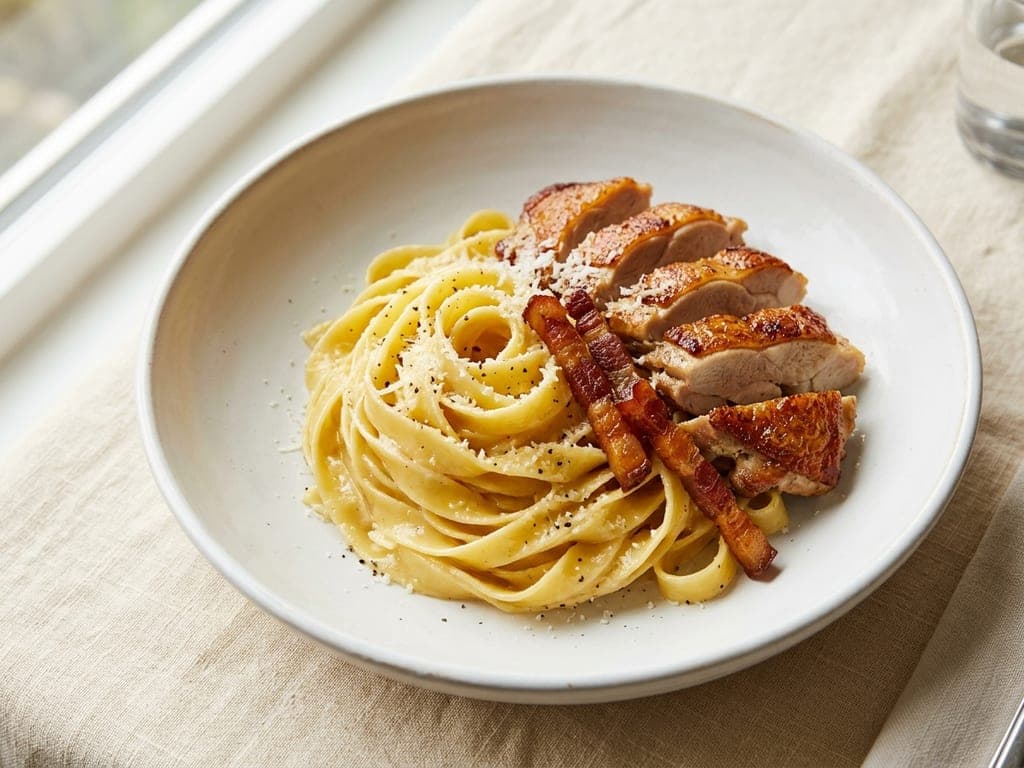
- Serve within two minutes — 1 minute. The sauce is at its best for about two minutes and then tightens, so the bowls should be warm before the pasta is drained; a rinse with pasta water does it. Twirl the fettuccine into a nest with tongs turned inside a ladle and set it in the center of each bowl. Lay the chicken over the top — fanned if you seared the thighs whole, tucked through if you used pieces — so it is seen, not buried. Spoon the crisp pork over, then a fine snow of extra pecorino and a last crack of pepper; peas, if you cooked them, go where they show. Nothing else: no parsley, no oil, no cream. Plating takes the one minute the sauce gives you.
Safety & hygiene Important
- Chicken to 165°F (74°C) — a thermometer, not a guess. The USDA's Food Safety and Inspection Service sets one safe minimum internal temperature for all poultry, thigh or breast, whole or in pieces: 165°F (74°C), measured with a food thermometer in the thickest part. Color is not a test — thigh meat can stay pink near a blood vessel when well past safe, and breast can look white well before 165°F (74°C). Small pieces in a hot pan get there in minutes; whole thighs take longer, so check two. Here the chicken must be fully cooked before it goes near the egg, because the emulsion is built with the burner off and never heated again. The UK Food Standards Agency's visual test — steaming hot throughout, no pink meat, juices running clear — is the fallback if you have no thermometer; the thermometer is better.
- Do not wash the chicken, and give it its own board. Rinsing raw chicken under the tap does not clean it; it spreads it. The USDA's position is that washing raw poultry splashes bacteria such as Campylobacter and Salmonella onto sinks, taps and nearby surfaces, and in its 2019 observational study with North Carolina State University, 60 percent of the cooks who washed their chicken left bacteria in the sink, and 14 percent still had it there after they thought they had cleaned the sink; a quarter of them also got bacteria onto the salad being made beside it — though so did many non-washers, so the salad figure is really about hands and boards. The UK Food Standards Agency has given the same advice since its 2014 campaign. Pat the chicken dry with paper towel instead, which also helps the sear, and bin the towel. Cut it on a board nothing else touches until the board has been washed in hot soapy water, use a clean knife for the pork and cheese, and wash your hands for 20 seconds before you pick up the grater.
- The eggs are warmed, not cooked — choose the egg, or choose the cream version. The egg emulsion reaches roughly 150–160°F (65–71°C): hot enough to thicken, deliberately not hot enough to set. FDA and USDA guidance is that egg dishes be cooked to 160°F (71°C) — 165°F (74°C) when the dish also contains meat or poultry, as this one does — and since nobody holds a thermometer in a tossing bowl, treat the sauce as a lightly cooked egg. US guidance is that any dish served with raw or undercooked egg be made with pasteurized eggs or egg products; that advice is aimed at everyone, and it is non-negotiable for anyone pregnant, over 65, under 5 or immunocompromised, the groups for whom a Salmonella infection is most dangerous. Healthy adults using ordinary shell eggs are accepting a small risk knowingly; pasteurized shell eggs, sold in some US supermarkets, change nothing about the recipe. The cream version is the other answer: it can be taken to 165°F (74°C) — the figure for an egg dish with meat or poultry in it — without curdling, because cream dilutes the egg proteins and raises their setting point. In the UK, the Food Standards Agency has advised since 2017 that eggs carrying the British Lion mark (or, since 2021, the Laid in Britain mark) are safe for infants, children, pregnant women and older people even runny — but not for the severely immunocompromised, who should still cook eggs thoroughly; eggs outside those schemes should be fully cooked for vulnerable groups.
- The two-hour clock, leftovers, and reheating once. The rules for what is left are those for any cooked chicken and egg: no more than 2 hours at room temperature in total, 1 hour if the room is above 90°F (32°C), then into the refrigerator in a shallow container. US guidance (USDA) gives cooked leftovers 3–4 days at 40°F (4°C) or below; UK guidance (FSA) says 48 hours and reheat only once. Reheat in a pan over low heat with a splash of water, stirring, until steaming hot — 165°F (74°C) on a thermometer in a piece of chicken, not just the pasta. The egg version goes slightly grainy; the cream version survives better. Do not reheat twice, and do not freeze the egg version, which separates. The cream version can hold for a crowd in a low oven above the USDA hot-holding line of 140°F (60°C) for about an hour; the egg version cannot be held at all.
- Allergens, and what is in the pork. This dish contains egg, milk (Pecorino Romano, and Parmigiano-Reggiano if you blend) and wheat (the pasta) — three of the major allergens that must be declared in the US and the EU — and pork unless you leave it out, which matters for religious and dietary reasons. The cream version swaps pecorino for cream and Parmesan, so still milk. Pecorino is a sheep's-milk cheese, which does not help anyone with a cow's-milk allergy; the proteins involved are shared across species. Gluten-free fettuccine works unchanged, though its water carries less starch and you may need more of it. Guanciale and pancetta are cured with salt, pepper and often nitrites, and some artisanal pieces add wine, garlic or rosemary; bacon (streaky bacon, to a British reader) is usually smoked as well. Read the label if that matters.
- Salt the chicken in the fridge, and mind the hot fat. The 20–30 minutes the chicken spends with its salt is a dry brine, and FSIS is explicit that brining of any kind happens in the refrigerator, not on the counter — uncovered on a plate on the bottom shelf, where nothing can drip onto it and it can drip onto nothing. Then the fat: the pork renders into 2–3 tbsp of hot fat, the chicken goes into it at medium-high, and later a pot's worth of wet pasta lands in the same pan. Lay chicken in away from you, drain the pasta loosely rather than dripping, add it with the burner already off, and pour any excess fat into a heatproof cup rather than the sink. Keep the jug of pasta water, the bowl of egg and the tongs within reach before the pasta goes in.
3 ways to plate it
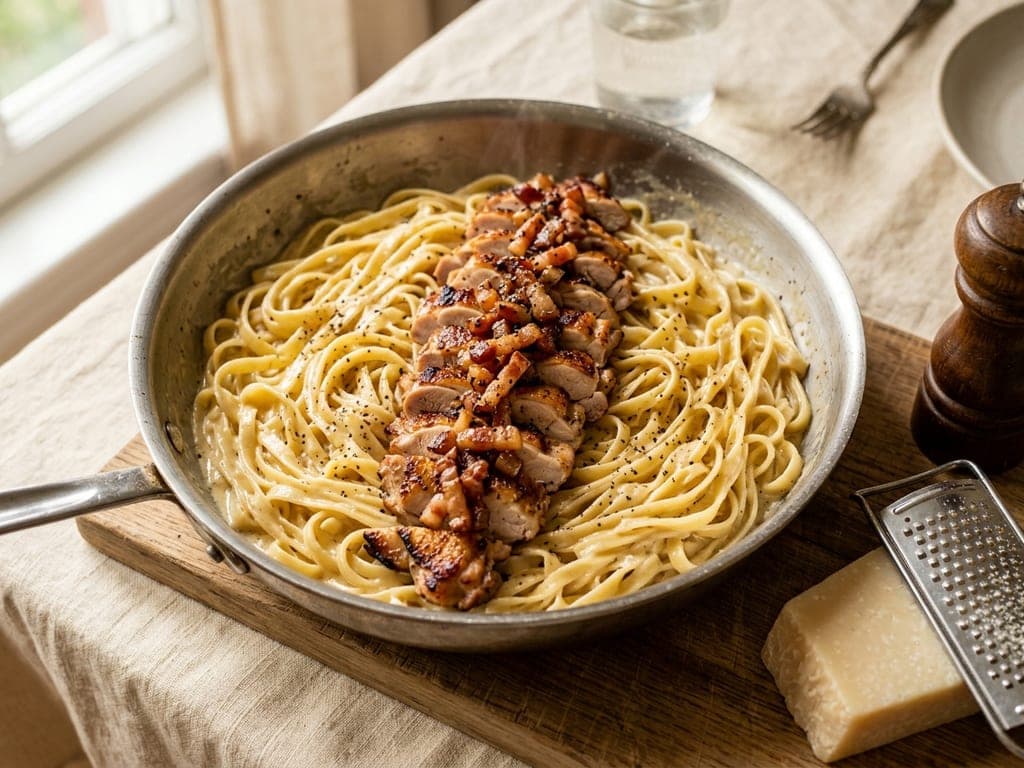
The order of operations: why the chicken is cooked before the sauce
The recipe is an argument about sequence. Carbonara's sauce cannot be heated after it is made — the egg that thickens it at about 150°F (65°C) curdles a few degrees later — so everything that needs cooking must be finished before the egg goes in; after that, the only heat in the kitchen is what the pasta brought with it. The chicken must therefore reach the FSIS minimum of 165°F (74°C) in the pan, on its own, before the pasta is drained, because there is no second chance: a piece underdone when the egg arrives stays underdone on the plate. That is the one structural difference from the Roman dish, and it fixes the order of everything else.
So: render the pork from a cold pan and lift it out; sear the chicken in the fat it left; make the egg paste; cook the pasta and save its water; then, burner off, pasta into the fat, pork and chicken back in, egg last, pasta water to finish, serve in two minutes. The chicken is warm when the egg arrives, not hot — and a pile of pasta and chicken holds more heat than pasta alone, which is the one way this dish scrambles more easily than the original. Once you have made it twice, drop the pasta as the first batch of chicken goes in; the whole thing then runs in about 40 minutes.
The chicken: thigh vs breast, the sear, the rest, the slice
Thighs, honestly. Boneless, skinless thighs carry more fat and connective tissue than breast: the fat keeps the meat juicy through a hard sear and a toss in hot pasta, and the collagen means a thigh that overshoots 165°F (74°C) by 10–15°F (6–8°C) is still tender. Breast has a window of a few degrees between done and dry, and this recipe asks the chicken to sit in a hot pile of pasta after it is cooked — the wrong place for a narrow window. If breast is what you have, cut it thick, 3/4 in (2 cm) pieces or whole halves no thinner than 1 in (2.5 cm); dry-brine it, meaning the 3/4 tsp of salt left on for 30 minutes so it moves into the muscle and holds water there; and pull it at 165°F (74°C) exactly.
The sear is straightforward if the pan is hot and not crowded: fat shimmering, pieces in a single layer with space between them, left alone for 2 minutes so a crust forms, turned once. Crowd the pan and the chicken steams in its own juice — grey, wet and unfortunately familiar. Rest whole thighs for the 10 minutes the pasta takes, then slice across the grain into strips about 1/2 in (1 cm) wide; rest pieces too, so the juice that runs out goes back into the pan with them. Season with salt and black pepper only: garlic powder, Italian seasoning, lemon zest and paprika all fight the cheese, and the cheese wins.
The sauce: the real emulsion, with chicken in the pan
The sauce is the one from our spaghetti carbonara page, unchanged: 4 yolks and 1 whole egg, 3.5 oz (100 g) of finely grated Pecorino Romano, the sauce's 1 tsp of cracked pepper (the other teaspoon is on the chicken) and 1 1/2 cups (360 ml) of reserved pasta water for 14 oz (400 g) of pasta, bound with the rendered pork fat. The physics is the same. A yolk begins to thicken at about 150°F (65°C), starts to grain at about 160°F (71°C) and is curds by 165°F (74°C) — pure yolk is set at 158°F (70°C), so the target is the top of the window; just-drained pasta is well above that, so the job is a controlled crash — let the pasta lose heat to the pan, the fat and the air, keep everything moving, and add starchy water, which thins the sauce and gets between the egg proteins as they try to bond.
The chicken changes two things. It makes the pile deeper, and a deeper pile holds more heat and sheds it more slowly, so the pan needs its 30 seconds off the burner before the pasta goes in, and the egg needs its tempering — 3 tbsp of hot pasta water whisked in first — more than ever. And it asks the sauce to coat meat as well as pasta, which is why the whole egg stays in the ratio: an all-yolk sauce is stiffer and leaves the chicken bare. The safest method, worth learning with 1 lb (450 g) of chicken at stake, is the bain-marie: the egg bowl set over the draining pasta pot, where steam warms it to a temperature that cannot exceed boiling, and everything tossed in the bowl there. Slower, and nearly impossible to scramble.
The creamy path — the second recipe, honestly specified
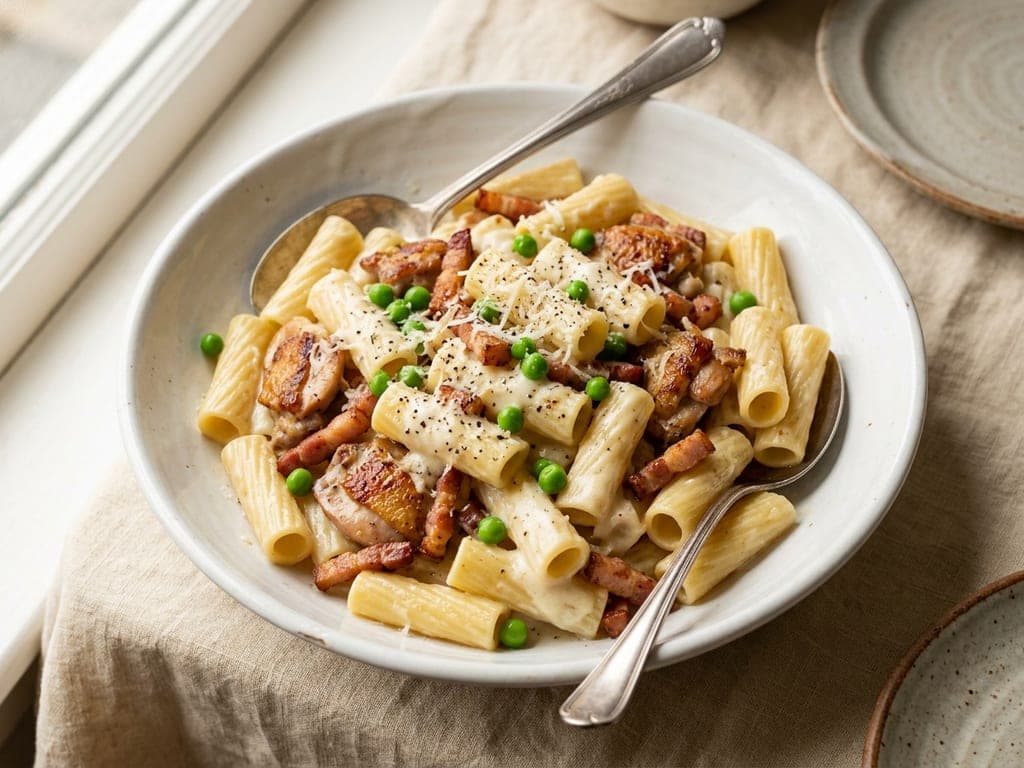
Most people searching for chicken carbonara mean the cream one, and it deserves a real recipe rather than a shrug. This version matches our carbonara sauce page: 3/4 cup (180 ml) of heavy cream (double cream), 1 whole egg plus 1 yolk, 2.5 oz (70 g) of finely grated Parmesan, 4 oz (115 g) of bacon or pancetta and the same 2 tsp of cracked pepper, for the same 14 oz (400 g) of pasta and 1 lb (450 g) of chicken; everything else stays. Render the bacon, sear the chicken in its fat, cook the pasta and save its water exactly as above. Then, with the skillet over low heat, add the cream to the fat, let it come to a bare simmer for a minute, and turn the burner off.
Whisk the egg and yolk with the Parmesan, temper them with 3 tbsp of the hot cream, and stir the mixture into the pan with the pasta, chicken and bacon, tossing until it coats. It can go back over low heat to warm through — and for anyone pregnant or otherwise at risk it should, to 165°F (74°C) on a thermometer, the figure for an egg dish with meat in it — but it must never boil once the egg is in; cream raises the egg's curdling point, it does not abolish it. What you get tastes of cream and bacon first and cheese second, holds for a crowd as the egg version cannot, and is more or less what the chain restaurants serve. It lands at roughly 850–950 calories a serving depending on how much bacon fat stays in, close to the egg version, since the cream and bacon replace the guanciale fat and extra yolks.
Chicken carbonara vs chicken alfredo (and vs Roman carbonara)
The confusion is understandable: on an American menu the two sit side by side, both white, both rich, both with chicken. They are not the same. Alfredo is butter and Parmesan — in its original form, at Alfredo Di Lelio's restaurant in Rome in the early twentieth century, only butter, Parmesan and the pasta's own starch tossed through fresh fettuccine; in its American form, heavy cream, butter and Parmesan, often with garlic. It contains no egg and no pork. Carbonara's sauce is egg and cheese bound by pork fat, and its flavor is the sharp, salty line of pecorino and pepper rather than the roundness of butter. Chicken alfredo is chicken carbonara's closest sibling, and our alfredo sauce page treats it the same way: an American dish with a Roman ancestor.
Against Roman carbonara the differences are three, and none is the sauce when the sauce is made properly. The Roman plate has no chicken and half again as much guanciale — 5.3 oz (150 g) for the same pasta — because the pork is the only protein; it is a primo, a first course of 3–3.5 oz (85–100 g) of dry pasta a head, with a secondo to follow; and it is spaghetti or rigatoni, not fettuccine. Rome does have an egg-and-butter fettuccine that usually takes cream today — fettuccine alla papalina, with prosciutto, peas and Parmesan, made, the story goes, for Eugenio Pacelli, the future Pius XII, in the 1930s (other accounts say for the Pope in the 1950s) — and it still has no chicken in it. Chicken carbonara is the whole dinner, trades a third of the pork for 1 lb (450 g) of chicken, and sits on fettuccine because that is the shape Americans pair with a white sauce.
Peas, mushrooms, spinach and the other things people add — a civil guide
Peas are the classic American addition and the only one with a claim to tradition: they are in the chain-restaurant versions (Cheesecake Factory's carbonara carries them; Olive Garden's does not) and, as it happens, in Rome's fettuccine alla papalina. Do them as the recipe card describes — 1/2 cup (70 g) of frozen peas in the pasta water for the last 2 minutes, so they are hot through, kept to a scattering on top where the green reads against the gold. Keep them few: a handful is a garnish; a cup is a vegetable course that waters the sauce down. Mushrooms work if cooked first and dry — sliced cremini (chestnut mushrooms) seared in the pork fat after the chicken until browned and their water is gone, then returned with the chicken. Half-cooked mushrooms weep into the emulsion and thin it.
Spinach is the one to be wary of: it gives off water the moment it meets hot pasta and loosens the sauce into soup, so if you must, wilt it separately, squeeze it hard and fold in a little at the end. Sun-dried tomatoes, asparagus and broccoli belong to a different dish, a chicken pasta in cream sauce, and are fine there. Garlic is the most asked-for seasoning, and the honest answer is that a single smashed clove warmed in the pork fat and removed before the chicken goes in perfumes the fat without fighting the cheese; minced garlic cooked into the sauce does fight it. The rule for all of it: anything that goes in must be cooked and dry before the egg arrives.
Serving, leftovers and reheating, and what Rome thinks
Serve it as what it is: a whole dinner, on warm plates, a portion built from 3.5 oz (100 g) of dry pasta and 4 oz (112 g) of chicken a head, with nothing else on the plate and something sharp beside it — an arugula (rocket) salad with lemon, or bitter greens — and no garlic bread, which is starch on starch. It wants an unoaked white with acidity, or a light red with little tannin. Leftovers are a compromise, and a slightly better one than with the Roman dish, because the chicken reheats well even when the sauce does not: refrigerate within 2 hours, keep 3–4 days (US) or 48 hours (UK), and reheat once until a piece of chicken reads 165°F (74°C). Neither version freezes well.
And Rome. Italians do not, as a rule, put chicken in pasta — chicken is a secondo, pasta is a primo, and the two do not meet on one plate — and carbonara with chicken is a standing joke in the city, the kind of order a waiter repeats to the kitchen in a raised voice. That reaction is real, mostly good-humored, and about categories rather than flavor: nobody in Rome thinks chicken and pecorino taste bad together; they think they belong on different plates. None of which makes the dish worse. It is an American dinner with a Roman sauce, better with the real sauce than with cream, and best made without apology and without calling it Roman.
Questions, answered
What is chicken carbonara made of?
Pasta — fettuccine in the US, spaghetti or rigatoni just as well — tossed with seared chicken, cured pork (guanciale, pancetta or bacon) and a sauce that is either the Roman emulsion of egg yolk, Pecorino Romano, black pepper and starchy pasta water or, in most American versions, heavy cream with Parmesan and an egg. This page's egg version uses 1 lb (450 g) of chicken thighs, 3.5 oz (100 g) of guanciale, 4 yolks and 1 egg, 3.5 oz (100 g) of pecorino and 14 oz (400 g) of pasta for four. Peas are the usual optional extra.
Is chicken carbonara the same as Alfredo?
No. Alfredo sauce is butter and Parmesan — with heavy cream in the American version — and has no egg and no pork; carbonara sauce is egg and cheese bound with rendered pork fat and pasta water, with no butter and, in its Roman form, no cream. Both are white, rich pasta dinners with chicken on American menus, but carbonara tastes sharp and salty from pecorino, pepper and pork, while alfredo tastes round and buttery. Creamy chain-restaurant chicken carbonara sits between the two; the egg version on this page does not.
What are some common mistakes to avoid when making chicken carbonara?
Leaving the burner on when the egg goes in, crowding the chicken so it steams grey instead of searing, and using cheese grated coarse or bought pre-grated, which clumps. Behind those: not saving enough pasta water, adding the egg to a pan too hot to hold your hand over, overcooking breast by waiting for color instead of reading 165°F (74°C), and seasoning the chicken with garlic powder or dried herbs that fight the cheese. If the sauce starts to grain, add pasta water at once and toss fast, off the heat.
What is the secret to good carbonara?
Heat control: the egg must be warmed to a glossy emulsion at roughly 150–160°F (65–71°C) and never cooked, so the burner is off before the egg arrives and hot, starchy pasta water goes in a spoonful at a time while you toss without stopping. With chicken there are two secrets behind that one: the chicken is fully cooked to 165°F (74°C) and rested before the sauce exists, because it can never be heated again, and the pile is deeper and hotter than plain pasta, so temper the egg with 3 tbsp of hot water first and build the sauce in the bowl, not the skillet.
Is chicken carbonara Italian?
No — it is an American dish built on a Roman sauce. Roman carbonara is egg, Pecorino Romano, guanciale and pepper on spaghetti or rigatoni, served as a first course, and it has never contained chicken; Italians do not, as a rule, put chicken in pasta at all, because chicken is a second course. Chicken carbonara developed in American restaurants, usually with cream, bacon and peas, as a one-plate dinner; in Rome, asking for it is a standing joke. It is still a good dish, better with the real egg sauce than with cream; it is simply not Roman.
Can I use bacon instead of guanciale or pancetta?
Yes. American bacon is cured and smoked, so it brings smoke that guanciale does not, and the result tastes of bacon and chicken first and cheese second — the flavor most people expect from chicken carbonara, and a good dinner. Use 3.5 oz (100 g) of thick-cut bacon in the egg version or 4 oz (115 g) in the cream version, cut into wide pieces and rendered from a cold pan until crisp at the edges, and sear the chicken in its fat as you would with guanciale. Use a little less pepper, which fights the smoke, and expect more fat to pour off.
Can I make chicken carbonara with cream, or without it?
Both, and this page specifies both. Without cream is the primary recipe: 4 yolks and 1 egg whisked with 3.5 oz (100 g) of pecorino, emulsified off the heat with pork fat and pasta water — creamy with no cream in it. With cream is the second recipe: 3/4 cup (180 ml) of heavy cream brought to a bare simmer in the pork fat, burner off, then 1 egg and 1 yolk whisked with 2.5 oz (70 g) of Parmesan stirred in and never boiled again. The cream version is far harder to scramble — it splits only if it boils — holds for a crowd, and can be cooked to 165°F (74°C) for anyone who should not eat a warmed egg.
Can I add peas, mushrooms or spinach to chicken carbonara?
Yes, with one rule: anything added must be cooked and dry before the egg goes in, because nothing can be cooked afterwards. Peas are the classic American addition — 1/2 cup (70 g) of frozen peas in the pasta water for the last minute, kept to a scattering on top. Mushrooms work if seared in the pork fat after the chicken until browned and dry, then returned with it. Spinach weeps water into the emulsion, so wilt it separately, squeeze it hard and add a little. A smashed garlic clove warmed in the fat and removed is fine; minced garlic in the sauce is not.
Should I use chicken breast or thighs, and can I use rotisserie chicken?
Thighs, by preference: their fat and collagen keep them juicy through the sear and the toss, and they forgive a reading a few degrees past 165°F (74°C), where breast goes dry. Breast works cut thick, dry-brined with 3/4 tsp of salt for 30 minutes in the fridge, seared fast and pulled at exactly 165°F (74°C). Rotisserie chicken works and skips the searing: pull about 2 1/2 cups (350 g) of meat off the bird, warm it in the pork fat until a piece reads 165°F (74°C) — cold chicken will not get there from pasta heat alone — then continue with the burner off as written.
Is chicken carbonara safe to eat when pregnant?
The egg version as written is a lightly cooked egg dish — the sauce reaches about 150–160°F (65–71°C), below the 160°F (71°C) the FDA gives for egg dishes — so in the US the safe route in pregnancy is pasteurized eggs, which change nothing about the recipe, or the cream version on this page taken to 165°F (74°C) on a thermometer, the figure for an egg dish with meat in it. In the UK, the Food Standards Agency has advised since 2017 that British Lion (or Laid in Britain) eggs are safe in pregnancy even runny — the advice excludes the severely immunocompromised; eggs outside those schemes should be fully cooked. The chicken must reach 165°F (74°C) either way; pecorino and Parmesan are hard cheeses, considered safe in pregnancy.
How many calories are in chicken carbonara?
About 850 per serving for the egg version; check it: 3.5 oz (100 g) dry pasta, about 360; 4 oz (112 g) raw chicken thigh, about 160 (breast, about 120); 0.9 oz (25 g) guanciale with its rendered fat, about 160; one yolk plus a quarter of a whole egg, about 70; 0.9 oz (25 g) Pecorino Romano, about 100. Total about 850; optional peas and oil add about 25. Sodium is roughly 1,000–1,450 mg: 300–490 from pecorino, 230–325 from guanciale (more with pancetta or bacon), 200–350 from the chicken's salt, 60–150 absorbed from the pasta water, about 100 from chicken and egg — around half of the 2,300 mg US daily ceiling.
Can I make chicken carbonara ahead for a crowd, and how do I reheat leftovers?
The cream version can be made ahead; the egg version cannot. Cream carbonara holds covered in a low oven, above the USDA hot-holding line of 140°F (60°C), for about an hour, loosened with pasta water before serving. The egg emulsion tightens within minutes and scrambles on reheating, so for a crowd either make the cream version or cook the chicken and pork ahead and finish the egg sauce in batches. Leftovers of either: refrigerate within 2 hours, keep 3–4 days (USDA) or 48 hours (FSA), and reheat once until a piece of chicken reads 165°F (74°C).
Snap your finished plate and let the AI plate it again — more beautifully.