Carbonara Sauce: The Roman Egg Emulsion and the Creamy Version
Carbonara sauce means two things. In Rome it is an emulsion of egg yolk, Pecorino Romano, rendered guanciale fat and starchy pasta water that does not exist until hot pasta is in the bowl; in most US and UK jars and most US restaurants it is a cream-and-Parmesan sauce with bacon. This page makes both in full, the Roman version first — including the egg-and-cheese paste you can make a day ahead — and says which one survives a casserole dish.
Ingredients
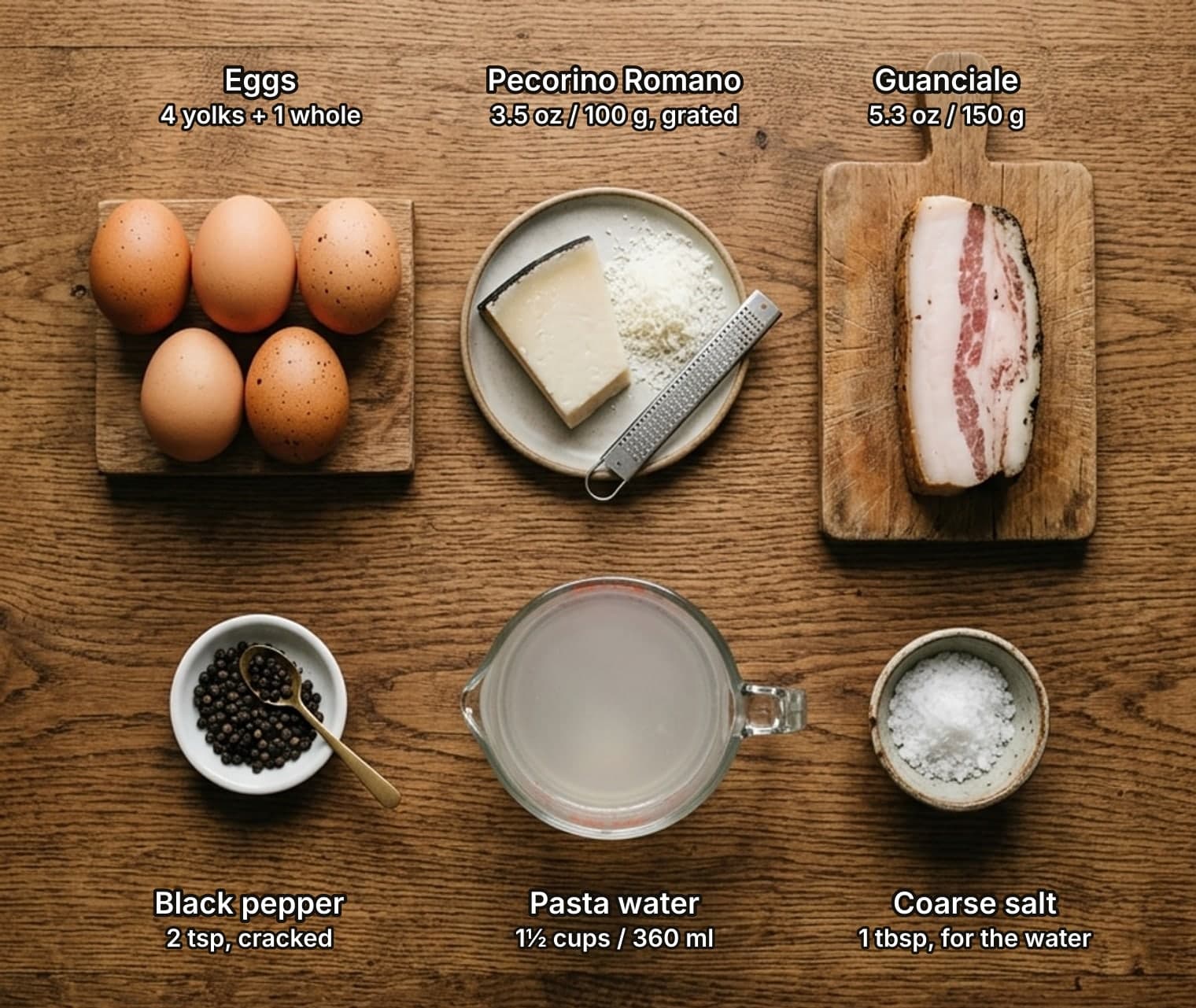
- egg yolks, from large eggs — pasteurized for anyone in a vulnerable group4
- whole large egg — the white keeps the sauce pourable1
- Pecorino Romano, microplane-grated and weighed — a wedge, not the pre-grated tub; up to half can be Parmigiano-Reggiano3.5 oz (100 g), plus more to serve
- guanciale (cured pork jowl), rind off, in batons about 1/4 × 1 in (6 mm × 2.5 cm) — or pancetta, or thick-cut bacon (streaky bacon to a UK reader)5.3 oz (150 g)
- black peppercorns, coarsely cracked2 tsp
- starchy pasta cooking water, scooped out before draining — about 1/2 cup (120 ml) gets used1 1/2 cups (360 ml) reserved
- kosher salt (coarse salt), for the pasta water — half the usual dose1 tbsp (about 15 g) per 3 quarts (2.8 liters)
- pasta of your choosing, to dress — spaghetti, rigatoni, mezze maniche, bucatini or potato gnocchi14 oz (400 g), for 4
What carbonara sauce actually is, and the paste you can make ahead
Carbonara sauce is the wrong mental model, and this page says so up front. What coats a Roman carbonara is an emulsion — a cousin of mayonnaise and hollandaise — built in the bowl from egg, finely grated Pecorino Romano, rendered guanciale fat and starchy pasta water, and set only by the residual heat of the pasta. It exists ninety seconds after the pasta is drained and begins to tighten two minutes later. You cannot make it ahead, jar it or ladle it; you can only finish it.
What you can make ahead is the paste. Four yolks, one whole egg, 3.5 oz (100 g) of pecorino and a teaspoon of cracked pepper, whisked to a stiff, almost dry mass, keep in the refrigerator for 24 hours and are the closest thing to carbonara sauce in a container that exists. It is where the technique lives: every grain of cheese is wrapped in egg before it meets heat, the best protection against clumping. The cream-and-Parmesan sauce that jars and US menus call carbonara is a different thing, made in full further down.
How to make Carbonara Sauce
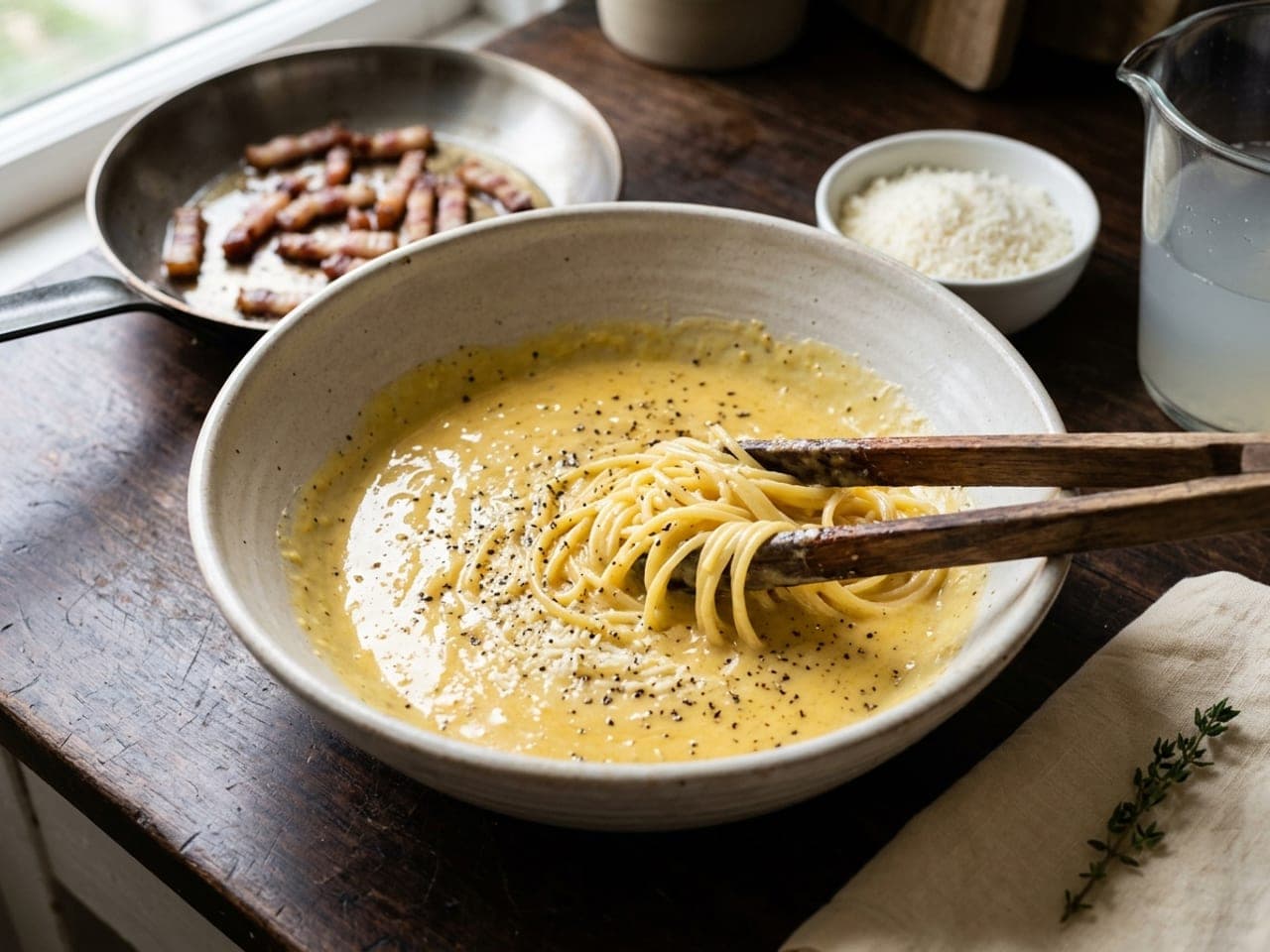
- Make the paste — today, or up to a day ahead. Put the pasta water on to heat first (step 3 has the quantities), then grate 3.5 oz (100 g) of Pecorino Romano to a powder on a microplane and weigh it. Crack 2 tsp of black peppercorns under the flat of a knife. In a large bowl, whisk 4 egg yolks with 1 whole egg, then stir in the cheese and half the pepper. It tightens into a stiff, almost dry paste; this is the sauce in its storable form. Cooking now, leave it on the counter away from the stove — it waits the half hour the guanciale and pasta take, well inside the 2-hour rule for raw egg. Making it ahead, press plastic wrap (cling film) onto the surface, refrigerate, and use within 24 hours — it is raw egg.
- Render the guanciale from cold. Trim the rind from 5.3 oz (150 g) of guanciale and cut it into batons about 1/4 in (6 mm) thick and 1 in (2.5 cm) long. Put them into a large cold skillet over medium-low heat. Give it 10–12 minutes, until the fat is clear and the lean is deep gold at the edges. Add the remaining pepper for the last 30 seconds, then take the pan off the heat. Scoop most of the guanciale pieces out onto a plate with a slotted spoon so they stay crisp, leaving the fat behind; keep about 3 tbsp of liquid fat in the pan and pour off any excess into a heatproof cup — the fat is an ingredient, not a by-product.
- Cook the pasta and save the water. Bring 3 quarts (2.8 liters) of water to the boil with 1 tbsp (about 15 g) of kosher salt — less water than the package suggests, so it runs starchier, and half the usual salt. Cook 14 oz (400 g) of pasta to one minute short of the package al dente time; gnocchi are done when they float. Two minutes before draining, scoop 1 1/2 cups (360 ml) of the cloudy water into a jug by the stove; you will use about 1/2 cup (120 ml), but once the pot is drained there is no more. Drain loosely; do not rinse.
- Temper the paste. Whisk 3 tbsp of the hot pasta water into the paste, a spoonful at a time, until it loosens to a thick batter. This raises the egg's temperature gently and dilutes the proteins with starch, which gets between them. For the professional safety net, set the bowl over the pasta pot while the pasta drains — a bain-marie — and whisk there for 30 seconds; the steam warms the paste to a temperature that cannot exceed boiling water. Either way, the burner under the skillet stays off from here on.
- Toss in the fat, then marry the two. Tip the drained pasta into the skillet of guanciale fat — pan warm, burner off — and toss hard for 30 seconds. Add 2 tbsp of the reserved water and toss again; fat and starch form a thin glaze. Return about two-thirds of the guanciale, holding the rest back for the top. Hold the back of your hand a few inches (5–8 cm) above the pan for a second or two: hot, not enough to make you pull away. A pan you cannot hold your hand over will scramble the egg; wait 30 seconds if you must. Then tip the pasta into the bowl of tempered paste and toss with tongs for a full minute.
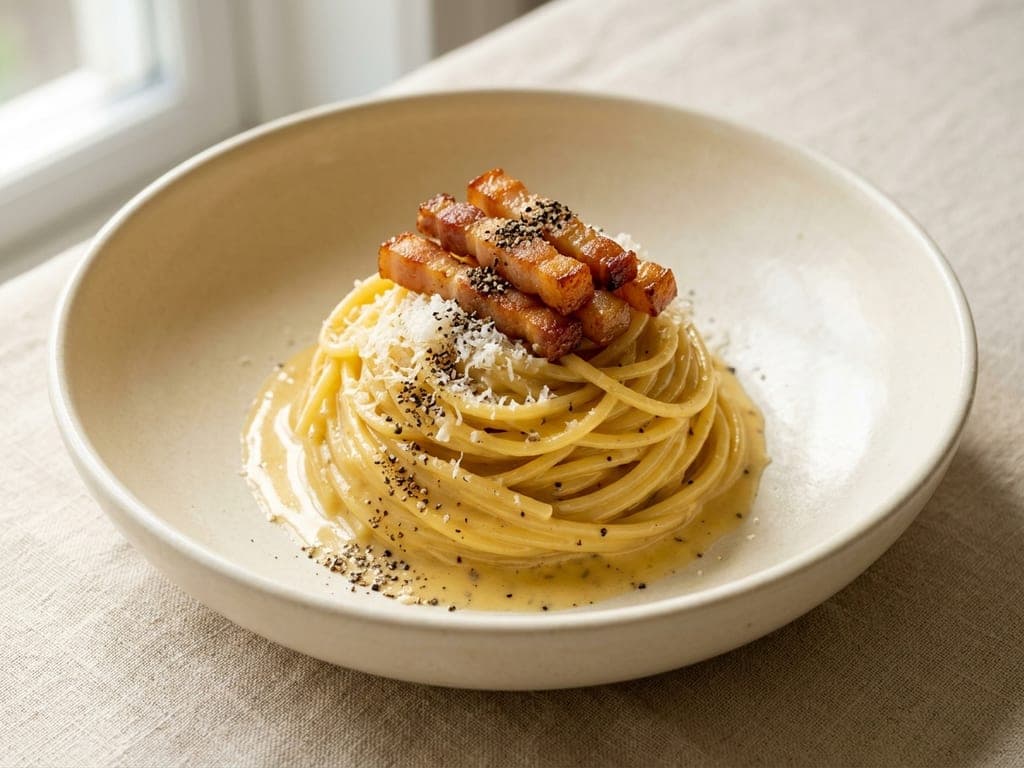
- Loosen, judge, serve. The sauce goes from streaky to smooth to glossy. Keep adding pasta water a tablespoon at a time — around 1/2 cup (120 ml) in total — until it flows and coats every piece like satin: a lifted strand should drip slowly, not cling like glue. Stop the moment it looks right; it tightens as it cools. If it begins to look grainy, add water and toss faster. Serve at once into warm bowls with the guanciale on top, a light snow of extra pecorino and a crack of pepper.
Safety & hygiene Important
- The egg is warmed, not cooked — know who is at the table. A finished carbonara sauce takes the egg to roughly 150–160°F (65–71°C), hot enough to thicken but short of the 160°F (71°C) the FDA and USDA set for egg dishes — and of the 165°F (74°C) FoodSafety.gov gives when the dish also contains meat — so treat it as a lightly cooked egg. US guidance is that any dish served with raw or undercooked egg be made with pasteurized eggs or egg products; that advice is aimed at everyone, and it is non-negotiable for anyone pregnant, over 65, under 5 or immunocompromised, the groups for whom a Salmonella infection is most dangerous. Healthy adults using ordinary shell eggs are accepting a small risk knowingly. In the UK, eggs carrying the British Lion or Laid in Britain marks are rated safe for pregnant women, infants, children and older people even lightly cooked — but not for the severely immunocompromised, who should still cook eggs thoroughly — under Food Standards Agency advice since 2017; other eggs need full cooking.
- The make-ahead paste is a raw-egg product. The yolk, egg, cheese and pepper paste is the one part of this sauce you can prepare in advance, and it must be treated like any bowl of raw beaten egg: clean container, surface covered, into the refrigerator at or below 40°F (4°C) within minutes of mixing, used within 24 hours. Out of the fridge it is on the 2-hour clock (1 hour above 90°F / 32°C) — the half hour the pasta and guanciale take is fine, an afternoon on the counter is not — do not stretch a day-old batch with fresh egg, and discard anything that smells off. If you are feeding anyone in a vulnerable group, make it with pasteurized eggs — every batch.
- The two-hour clock, leftovers, and one reheat only. Finished sauce on pasta should be eaten within minutes, but if it sits, the standard rule applies: no more than 2 hours at room temperature, cut to 1 hour above 90°F (32°C), and the same clock runs for the creamy version on a buffet unless it is held hot, at 140°F (60°C) or above, on a proper warmer. US guidance (USDA) keeps cooked leftovers 3–4 days; UK guidance (FSA, NHS) says 48 hours and reheat only once. Reheat until steaming hot throughout — 165°F (74°C) — with a splash of water over low heat, stirring; the egg will partly set. Never reheat twice. Freezing is not a safety problem — it is a texture one: both versions split on thawing, so we do not (see the storage section).
- Allergens, and what is in the cured pork. Both versions contain egg and milk. Pecorino Romano is a sheep's-milk cheese, which does not help a cow's-milk allergy, because the proteins are shared across species; the Parmesan and cream in the creamy version are cow's milk. Wheat arrives only through the pasta, so a good gluten-free pasta makes a gluten-free dish. Both versions contain pork, which is not a regulated allergen but matters to many. Guanciale, pancetta and bacon are cured with salt and often nitrates or nitrites, and artisanal guanciale may carry wine, garlic or rosemary in the cure; read the label. Cook all of them through.
- Hot fat, and a pan that is off but not cold. Rendered guanciale fat is hotter than it looks and it spits when wet pasta lands in it — which is what the method asks you to do — and the creamy version asks you to pour cream into a pan of hot bacon fat. Drain the pasta loosely rather than dripping, add it with the burner already off so the fat has stopped bubbling, and tip it away from you; pour cream in off the heat too, then return the pan to a low flame. Pour excess fat into a heatproof cup, never a plastic one or the sink. Have the jug of pasta water, the bowl of paste and the tongs all within reach before the pasta goes in, because the emulsion step does not allow for a trip across the kitchen. If you use the bain-marie, hold the bowl with a dry towel — a wet one conducts steam straight to your hand.
3 ways to plate it
The ingredients, and what each one is doing
Egg is the body. Yolks carry fat, flavor and lecithin, the emulsifier that holds fat and water together; whites carry water and set firmer and earlier, so four yolks plus one whole egg for 14 oz (400 g) of pasta is rich enough to coat and wet enough to flow. Guanciale fat is the ingredient people leave out by accident; jowl renders into something close to a clear, peppery oil. From 5.3 oz (150 g) you get about 4 tbsp, sometimes 5; about 3 tbsp go into the sauce. The other half of the emulsion is pasta water, whose starch thickens the sauce and keeps egg proteins apart.
Pecorino Romano is the seasoning and half the thickening: a hard, aged sheep's-milk cheese whose protected zone is Lazio, Sardinia (where most of it is now made) and the Grosseto province of Tuscany, saltier and sharper than Parmigiano-Reggiano; up to half Parmigiano softens it. Buy a wedge, not a tub — pre-grated cheese is dusted with cellulose or potato starch and clumps instead of melting. Grate it on a microplane to a powder. Weigh it, because a cup of grated cheese can weigh 1.8 oz (50 g) or 3.5 oz (100 g) depending on the grater. Pepper is an ingredient, not a garnish: 2 tsp cracked coarse, half whisked into the paste and half bloomed in the hot fat.
The method in detail: temperature, tempering and the bain-marie
Every failed carbonara sauce is a temperature failure. Egg-yolk proteins begin to thicken at around 150°F (65°C); with cheese, fat and starch folded in, the mixture stays creamy through the 150s, starts to turn grainy at about 160°F (71°C) and is curds by 165°F (74°C) — pure yolk on its own is already set at 158°F (70°C), so the 150–160°F (65–71°C) target is the top of the window. Pasta from the pot is well above 160°F (71°C). The method is a controlled crash: the pasta must shed heat to the pan, the fat, the bowl and the air and land the egg in the 150s, while constant tossing keeps the egg moving. The burner is off before the egg enters, and stays off.
Three levers control the crash. Tempering: whisking 3 tbsp of hot pasta water into the paste first raises its temperature gently and dilutes the protein. Starch: cook the pasta in slightly less water than the package suggests, and the cloudier water is more forgiving. The vessel: build the sauce in the bowl, not the heat-storing skillet. The professional lever is the bain-marie — the bowl set over the pasta pot as it drains, warmed by steam to a temperature that cannot exceed boiling. Slower, fussier, and much harder to scramble. Hold the bowl with a dry towel; a wet one conducts steam.
Creamy carbonara sauce — the second recipe, honestly
Here is the sauce most jars, most US restaurant menus and most searches for creamy carbonara actually mean, written out in full. For 14 oz (400 g) of pasta, four servings: 4 oz (115 g) of bacon or pancetta, in strips; 3/4 cup (180 ml) of heavy cream (double cream); 1 whole egg plus 1 yolk; 2.5 oz (70 g) of finely grated Parmesan; 1 tsp of coarsely cracked black pepper; and, optionally, a crushed garlic clove warmed in the fat and removed.
Render the bacon in a cold skillet over medium-low heat until crisp at the edges, 8–10 minutes, then pour off all but 1 tbsp of fat. Add the cream, simmer gently for 2–3 minutes to thicken a little, and take the pan off the heat. Whisk the egg, yolk, Parmesan and pepper, temper with a few spoonfuls of the hot cream, and stir into the pan off the heat. Add the drained pasta and toss, loosening with pasta water. Warm over the lowest flame if needed, and never let it boil once the egg is in. This is the one safety win the cream buys: because cream dilutes and buffers the egg proteins, the sauce can be taken to 160°F (71°C) — 165°F (74°C) when the dish carries meat or chicken — without graining, so for a vulnerable eater the creamy version cooked to that number with a thermometer is the carbonara that needs no pasteurized eggs. Boiling is where it splits.
That cushion is the honest reason this version is easier. Cream's fat and proteins dilute and buffer the egg, so the sauce tolerates a wider temperature band before it grains — the reason a crème anglaise can be taken to 170–180°F (77–82°C). It is not meaningfully lighter: the cream alone is about 600 calories for the pot (nearer 800 with UK double cream), and the finished sauce lands within roughly 50–100 calories a serving of the Roman one — about 330–400 before pasta, against 410. It tastes of cream and bacon first and cheese second, and it descends from Italian printed recipes of the 1960s that used cream too, so it is not a heresy, only a different dish.
Carbonara sauce vs alfredo, and vs cacio e pepe
Carbonara and alfredo are confused because in the US both arrive as a pale, rich coating on pasta: alfredo has no egg and no pork, and carbonara is built on both. Alfredo in Rome — our alfredo sauce page covers it — is fettuccine tossed with a great deal of butter, Parmigiano-Reggiano and starchy pasta water, no cream. Alfredo in the US is butter, heavy cream and Parmesan, often with garlic. A white sauce with bacon in it is a creamy carbonara; one without is alfredo with ideas.
Cacio e pepe is the closer relative. It is Pecorino Romano, black pepper and pasta water — an emulsion with no fat but the cheese's own and no egg to help. Add guanciale and you have gricia; add egg to gricia and you have carbonara. That is why the vegetarian question has a clean answer: carbonara sauce without the pork is cacio e pepe with egg in it. It is also a diagnostic: if your carbonara keeps splitting, make cacio e pepe or gricia a few times; the cheese-water-fat glaze they teach is the foundation the egg sits on.
What to put it on: the uses map
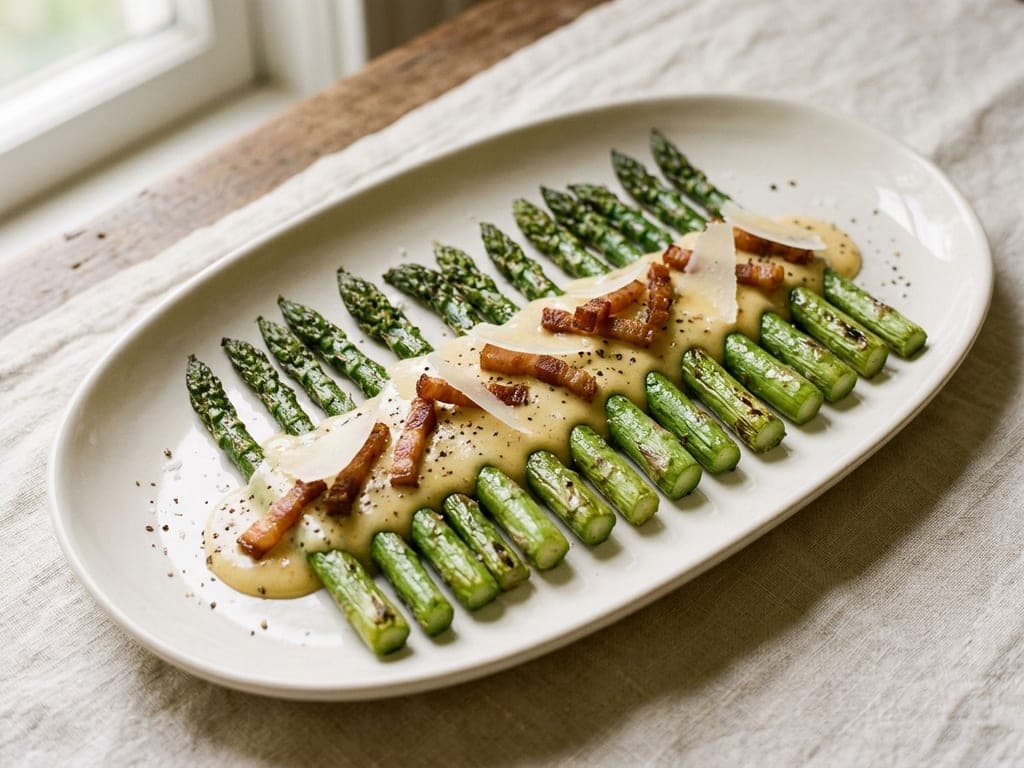
The Roman emulsion is for pasta that has just left the water. Spaghetti, rigatoni, mezze maniche, bucatini, fettuccine and, folded gently, potato gnocchi all work. The sauce sets on hot, wet, starchy food, so anything cooled, rinsed or starchless gives you cold egg. Off the noodle, make a small dressing in a bain-marie — paste loosened with hot water and whisked over the pot until thick and glossy — fold in warm guanciale fat, and spoon it over roasted asparagus, leeks or broccoli. It does not bake; in a 400°F (200°C) oven an egg emulsion becomes a frittata.
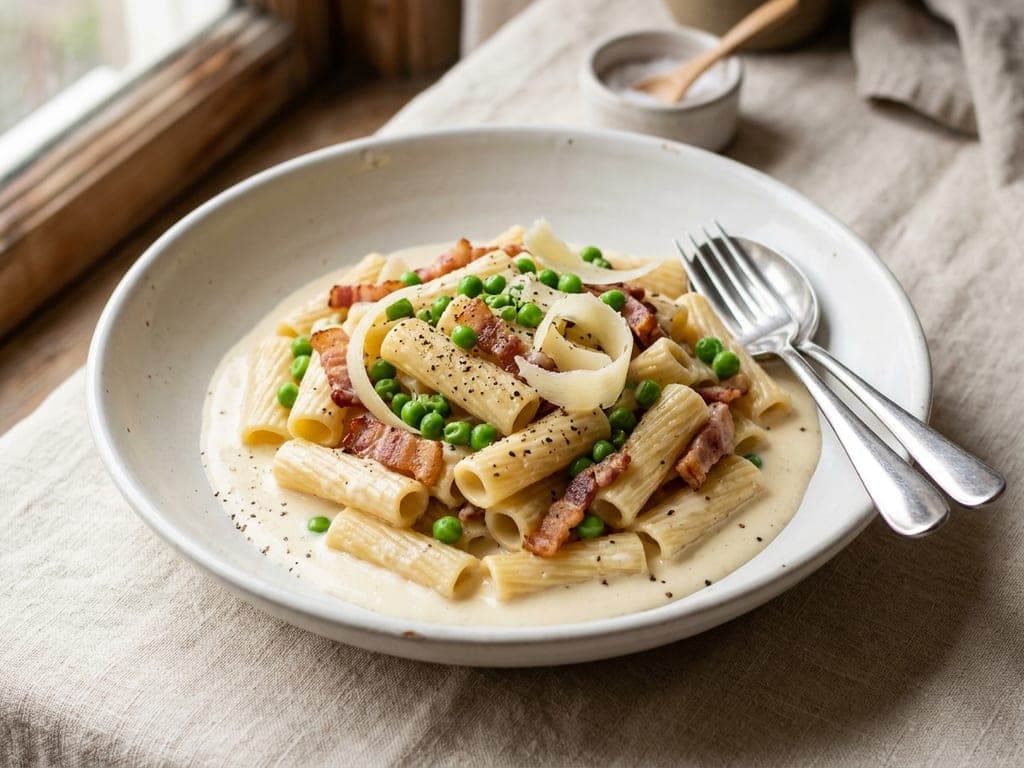
The creamy version is the workhorse for everything else. Chicken carbonara — seared chicken, peas, the cream sauce, rigatoni or penne — is a one-dish dinner, and the cream carries the chicken where the egg version would set around it. It can be baked under Parmesan at 375°F (190°C) — 15–20 minutes if it goes in hot, 35–45 minutes covered from cold, and in either case until the center reads 165°F (74°C), the figure for a dish with meat in it; it can sit on a warmer held at 140°F (60°C) or above for a buffet, or for the two-hour clock without one; it reheats the next day. Use the egg version when you are at the stove; use the cream version when the sauce has to wait for people.
Storing, reheating, and why it does not freeze
The make-ahead ledger is short. The paste keeps 24 hours in the refrigerator under plastic wrap pressed onto its surface, because it is raw egg. The guanciale can be rendered ahead — within the 2-hour clock on the counter, or refrigerated in its fat and rewarmed gently before the pasta goes in. The sauce itself cannot be assembled and held: it keeps tightening until it is a block. Refrigerate within 2 hours; keep 3–4 days under US guidance or 48 hours under UK guidance; reheat once, to 165°F (74°C). The egg version partly scrambles regardless; the creamy version comes back better.
Neither version freezes well — not a safety question but a texture one. An egg emulsion frozen and thawed separates into water, fat and rubbery curds, because ice crystals rupture the protein network that held the fat in suspension; cream sauces split on thawing for the same reason. Jarred products survive the shelf because they are heat-treated and usually thickened with starch, which is precisely what makes them a different sauce. If you want carbonara in the freezer, freeze the guanciale, cut and ready to render, and the sauce itself takes four minutes once the pasta is cooked.
The history in one paragraph, and a note on the name
Carbonara is younger than it feels; the spaghetti carbonara page has the dates. The dish is absent from Ada Boni's La cucina romana of 1930; the first mention in print found so far is a 23 August 1939 Dutch-language newspaper article naming spaghetti alla carbonara at a Trastevere trattoria (a find published in February 2026 that pushed the dish back before the war); a 1950 La Stampa article describes American officers coming to Trastevere looking for it; the first printed recipe is from 1952, in Chicago, in Patricia Bronté's guide describing the dish at Armando's; the first Italian recipe appeared in La Cucina Italiana in 1954, with pancetta, Gruyère and garlic, the year Elizabeth David also recorded it. Cream was common in Italian print from the 1960s to the 1980s — Luigi Carnacina's 1960 cookbook among them. In March 2023 the University of Parma historian Alberto Grandi told the Financial Times the dish was essentially Italian-American, and half of Italy objected. Carbonara Day has been 6 April since 2017.
The phrase carbonara sauce, meanwhile, is a translation artifact. A Roman cook does not make a carbonara sauce and put it on spaghetti; she makes spaghetti alla carbonara, and the verb for what happens in the bowl is condire, to dress. Italian does have a noun for it — sugo covers any homogeneous pasta dressing, and Italian supermarkets sell a jarred sugo alla carbonara — but in a Roman kitchen what goes on a carbonara is the condimento, the dressing, and it is made on the pasta. Which is why the jar is not a fraud, only a different object: a sauce that can sit on a shelf is, by definition, not the one that forms in the bowl.
Questions, answered
What is carbonara sauce made of?
Egg — four yolks and one whole egg for 14 oz (400 g) of pasta — whisked with 3.5 oz (100 g) of finely grated Pecorino Romano and cracked black pepper, then emulsified with about 3 tbsp of rendered guanciale fat and roughly 1/2 cup (120 ml) of starchy pasta water, using only the heat of the just-drained pasta. No cream, garlic, onion or butter. The creamy carbonara sauce in jars and most US restaurants is a different recipe: heavy cream, Parmesan, bacon, pepper, sometimes an egg.
How do you make a simple carbonara sauce?
Whisk 4 egg yolks, 1 whole egg, 3.5 oz (100 g) of finely grated pecorino and 1 tsp of cracked pepper into a paste; render 5.3 oz (150 g) of cubed guanciale slowly from cold and keep about 3 tbsp of its fat; cook any pasta and save 1 1/2 cups (360 ml) of its water. Burner off, toss the drained pasta in the fat, whisk 3 tbsp of hot pasta water into the paste, then combine and toss for a minute, adding water a tablespoon at a time until glossy.
How to make carbonara creamy sauce?
Render 4 oz (115 g) of bacon or pancetta, pour off all but 1 tbsp of fat, add 3/4 cup (180 ml) of heavy cream, simmer gently for 2–3 minutes and take the pan off the heat; whisk 1 egg, 1 yolk, 2.5 oz (70 g) of grated Parmesan and 1 tsp of pepper, temper with a few spoons of the hot cream, stir it into the pan and toss with 14 oz (400 g) of drained pasta. Never let it boil once the egg is in. This is the sauce most creamy carbonara recipes mean.
Is carbonara sauce the same as Alfredo?
No — alfredo has no egg and no pork, and carbonara is built on both. Alfredo in Rome is butter, Parmigiano-Reggiano and pasta water tossed with fettuccine; alfredo in the US adds heavy cream and usually garlic. Carbonara is an egg-and-pecorino emulsion with guanciale and black pepper. The quick test: a white sauce with bacon in it is a creamy carbonara, and one without is alfredo. Our alfredo sauce page makes both alfredos.
Can you make carbonara sauce ahead of time, and can you freeze it?
Only the paste, and nothing freezes. Whisk the yolks, whole egg, grated pecorino and pepper, press plastic wrap onto the surface, refrigerate at or below 40°F (4°C) and use within 24 hours — it is raw egg. The finished emulsion cannot be held, because it sets as it cools, and cannot be frozen, because thawing breaks it into water, fat and curds; the creamy version splits on thawing too. Leftovers keep 3–4 days under US guidance, 48 hours under UK guidance, reheated once to 165°F (74°C).
Can you buy carbonara sauce in a jar, and is it any good?
You can, and none of it is the Roman emulsion, which does not exist until hot pasta meets egg and cannot be bottled. US and UK jars are almost always the creamy version — cream or milk, cheese, starch, some cured pork, heat-treated for the shelf; Italian jars (Rana, Barilla and others sell a sugo alla carbonara labelled senza panna) are egg yolk, pecorino and guanciale or pancetta bound with starch. The better ones are acceptable; the worst are floury and sweet. The honest shortcut is the paste: four yolks, an egg, 3.5 oz (100 g) of pecorino and pepper, which keeps a day.
How much carbonara sauce do you need per pound of pasta?
For 1 lb (450 g) of dry pasta, scale the Roman recipe up by about an eighth: 5 yolks plus 1 whole egg, 4 oz (115 g) of Pecorino Romano, 6 oz (170 g) of guanciale, 2 1/2 tsp of cracked pepper and a little over 1/2 cup (about 135 ml) of pasta water. The rule of thumb is one yolk and 0.9 oz (25 g) of cheese per 3.5 oz (100 g) of dry pasta, plus one whole egg for the pot.
What can you put carbonara sauce on besides spaghetti?
Rigatoni, mezze maniche, bucatini, fettuccine and potato gnocchi all take the Roman egg emulsion, provided they go from the pot into the sauce hot and starchy. Off the noodle, the egg version works as a warm bain-marie dressing over roasted asparagus, leeks, broccoli or potatoes. It does not work baked, on a buffet or as a sauce for chicken, because it sets and scrambles. The creamy version does all of those: chicken carbonara, a pasta bake under Parmesan at 375°F (190°C) until the center reads 165°F (74°C), a buffet tray held hot.
How do you fix a split or grainy carbonara sauce?
Add hot pasta water immediately — a tablespoon at a time — and toss hard, off the heat; if the sauce has only begun to grain, the water dilutes and cools the egg and it recovers. Once fully scrambled it cannot be un-scrambled; next time temper the paste, build the sauce in the bowl rather than the skillet, and keep the burner off. A creamy sauce split by boiling can usually be rescued with a splash of cold cream whisked in off the heat.
Can you make a vegetarian carbonara sauce?
Yes, and the honest name for it is cacio e pepe with egg: leave out the guanciale, replace its fat with 3 tbsp of butter or olive oil warmed with the pepper, and make the emulsion exactly as written. Check the cheese — Pecorino Romano and Parmigiano-Reggiano are made with animal rennet by their PDO rules (lamb rennet paste and calf rennet respectively), so a strict vegetarian wants a pecorino-style cheese made with vegetable rennet. Mushrooms are the usual stand-in for the pork, but they render water, not fat, so sear them dry and crisp first.
Can I use milk instead of cream in creamy carbonara sauce?
You can, but you get a thinner, more fragile sauce, because cream's fat both thickens the sauce and buffers the egg. Whole milk at about 3.5 percent fat needs help: use the full egg plus yolk, add 1 oz (30 g) more Parmesan, and either reduce the milk by a third before the egg goes in or stir in a slurry of 1 tsp of cornstarch (cornflour). Half-and-half (a US blend of milk and cream at 10.5 to 18 percent fat by US rule; the nearest UK products are half cream or single cream) works unchanged.
How many calories are in carbonara sauce, and is it healthy?
About 410 calories per serving for the sauce alone, before the pasta; sodium is the bigger issue. The arithmetic, per person: 1.3 oz (37 g) of guanciale with most of its rendered fat, about 240 calories (pour off a tablespoon of fat and you drop about 30 a plate); one yolk plus a quarter of a whole egg, about 70; 0.9 oz (25 g) of Pecorino Romano, about 100. That is 410; add 3.5 oz (100 g) of dry spaghetti at about 360 and you reach the 770 on our spaghetti carbonara page. Sodium is roughly 1,000–1,450 mg per serving before the pasta: pecorino 300–500 mg, guanciale 550–850 mg depending on the cure, egg about 25 mg, the pasta water in the sauce about 60 mg; the pasta itself absorbs another 60–150 mg, which is how the spaghetti page reaches 1,100–1,600 — around half or more of the 2,300 mg daily ceiling US guidelines set.
Snap your finished plate and let the AI plate it again — more beautifully.