Alfredo Sauce Recipe (Creamy, Homemade, No Flour)
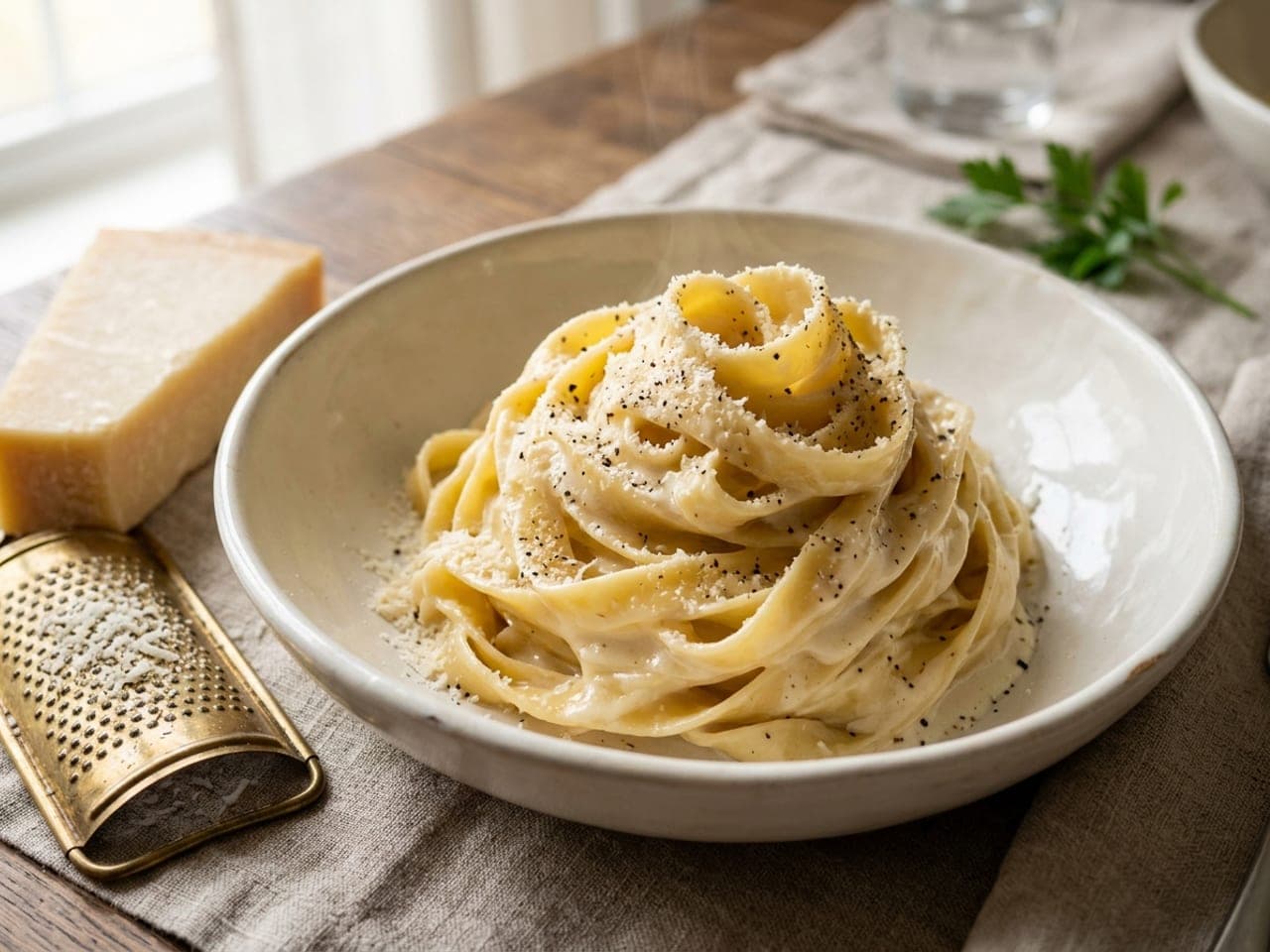
Alfredo sauce is butter, heavy cream and grated Parmigiano-Reggiano, finished off the heat so the cheese melts smooth. No flour, no jar, about 35 minutes.
Ingredients
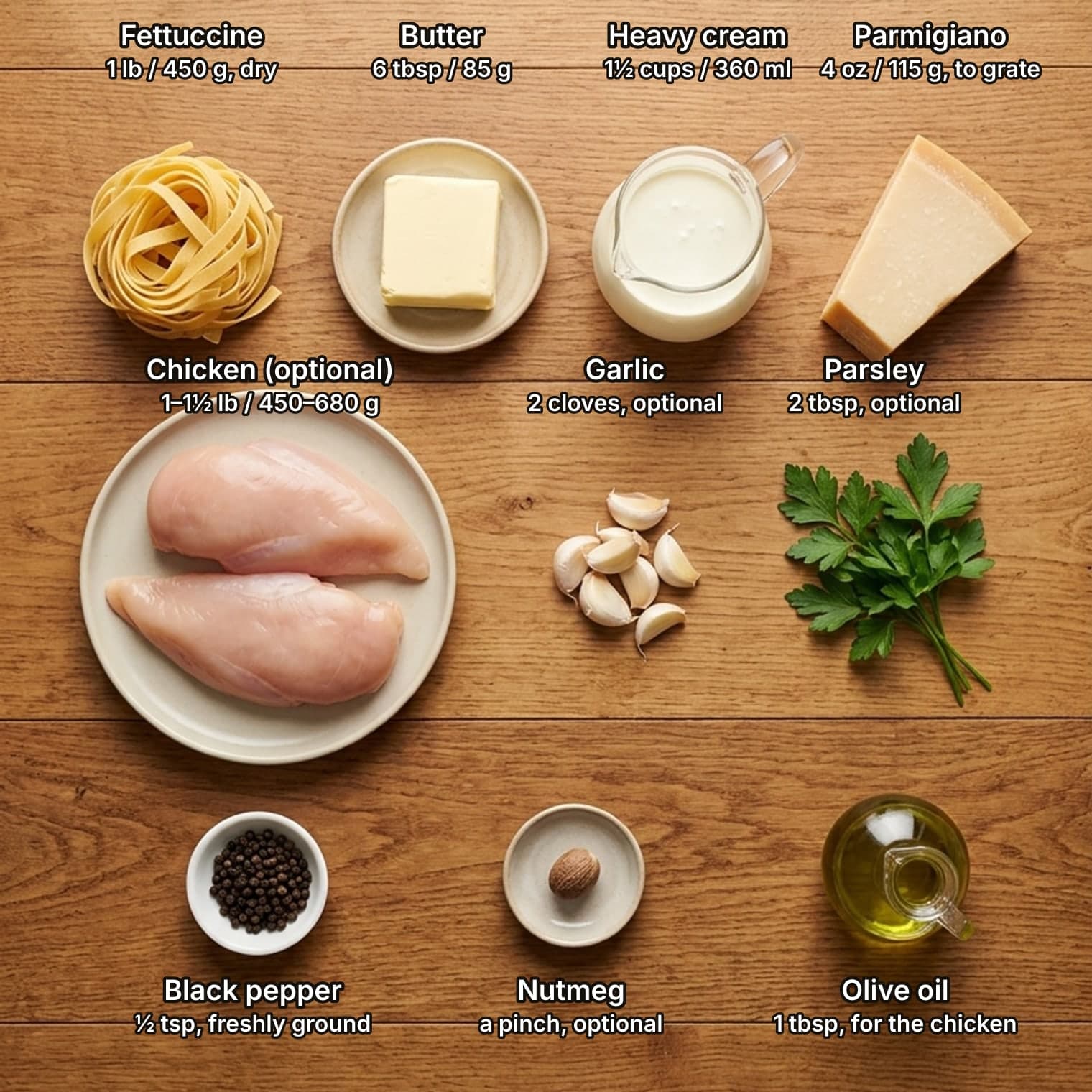
- fettuccine (fresh egg pasta is the Roman choice and adds egg to the allergens)1 lb (450 g) dry or 1 1/4 lb (570 g) fresh
- unsalted butter6 tbsp (85 g)
- heavy cream (UK: whipping cream, about 35% fat; double cream, 48%, makes it heavier)1 1/2 cups (360 ml)
- Parmigiano-Reggiano, about 24 months old, finely grated from a block (about 2 cups off a rasp, less off a box grater), plus 1 oz (30 g) to serve; made with calf rennet, so not vegetarian4 oz (115 g)
- garlic, finely minced (optional, standard in the American version)2 cloves
- kosher salt (coarse), for 3 quarts (2.8 L) of pasta water, plus more to taste1 tbsp Morton or 1 tbsp plus 2 tsp Diamond Crystal (about 14 g)
- black pepper, freshly ground, plus more to taste1/2 tsp
- nutmeg, freshly grated (optional)1 pinch
- reserved starchy pasta water1 cup (240 ml)
- boneless chicken breasts (optional, for chicken alfredo)1 to 1 1/2 lb (450 to 680 g)
- neutral or olive oil (only for the chicken)1 tbsp
- flat-leaf parsley, chopped (optional)2 tbsp
Before you start: the short version
Melt 6 tbsp (85 g) butter, simmer 1 1/2 cups (360 ml) heavy cream in it for 5 to 8 minutes until it coats a spoon, take the pan off the heat and let it settle, then stir in 4 oz (115 g) of Parmigiano-Reggiano you grated yourself, a handful at a time. Toss in 1 lb (450 g) of cooked fettuccine with a splash of its cooking water and eat right away.
Two rules decide whether it comes out glossy or grainy: grate the cheese from a block, and add it off the heat. The method builds both in, and "Why alfredo turns grainy" explains them. The Roman original, fettuccine al burro, has no cream at all; it's further down as the harder variation, next to how Michelin-starred chefs make theirs.
Time: about 35 minutes, most of it waiting for the water, which is when you grate the cheese; chicken adds up to 20 minutes. Makes about 2 cups (470 ml) of sauce, enough for 1 lb (450 g) of pasta and four bowls.
How to make Alfredo Sauce
- Put the water on, then grate the cheese. Bring 3 quarts (2.8 L) of water to a boil in a medium-large pot: less water than the usual 4 quarts (3.8 L) makes starchier pasta water, and the sauce needs that starch. While it heats, grate 4 oz (115 g) of Parmigiano-Reggiano from a block on a rasp or the fine holes of a box grater. That's about 2 cups loosely packed off a rasp and noticeably less off a box grater, so weigh it if you can. If the label shows an age, about 24 months is the one to buy. Taste a shard: how salty this wedge is decides the salt later. Keep the pile loose on a plate. Making chicken alfredo? Sear it now, while the water heats (see "Chicken, shrimp, broccoli").
- Salt the water and start the pasta. When the water is at a rolling boil, add about 14 g of kosher salt: 1 tbsp Morton or 1 tbsp plus 2 tsp Diamond Crystal. The brands differ by weight, so the grams are the real measure. It should taste seasoned, not briny: seawater is about 3.5% salt, roughly seven times this. Add the fettuccine and stir for the first 30 seconds so the ribbons don't stick. Dry fettuccine takes 10 to 13 minutes, about as long as the sauce, so start the next step as soon as it goes in. Fresh fettuccine takes 2 to 4 minutes, so make the sauce first and drop the pasta once the cheese is in. Either way, pull it a shade firmer than you'd serve it; it finishes in the sauce.
- Melt the butter with the garlic. Set a wide, heavy skillet, 12 inches (30 cm) if you have one, over medium-low heat and melt 6 tbsp (85 g) unsalted butter until it foams without browning. If you're using garlic, add the 2 minced cloves and stir for 30 to 45 seconds, just until the raw edge lifts, with no color: browned garlic turns bitter and follows you through the whole bowl. If it races, pull the pan off the heat for a few seconds. If you seared chicken in this skillet, wipe it out first so the oil and browned bits don't color the sauce.
- Pour in the cream and reduce it by a quarter. Pour in 1 1/2 cups (360 ml) heavy cream and bring it to a lively simmer. Heavy cream has enough fat to bubble without curdling (Harold McGee puts the line at about 25% fat, and heavy cream is about 36%), so the risks here are a boil-over and a scorched bottom: stir often and scrape the corners. Reduce 5 to 8 minutes, until it has pulled back by about a quarter and coats the back of a spoon. That is all the thickening this sauce needs. Grind in 1/2 tsp black pepper, add the pinch of nutmeg if you like it, and hold the salt: the cheese brings plenty. The no-boil rule starts when the cheese goes in.
- Take the pan off the heat, then add the cheese. Move the skillet off the burner and let it stand, stirring now and then, while you warm the bowls. Don't take the bubbles stopping as your signal: a gentle simmer can run as low as about 180°F (82°C), so a still surface can still be hot enough to seize the cheese. Give it a few minutes off the heat, or, with an instant-read thermometer, wait for about 160°F (71°C). Then add the Parmigiano in three or four handfuls, stirring each until it disappears before the next goes in. It should turn smooth and glossy. If it looks greasy or grainy, see "If it goes wrong." Never put it back on a flame to melt the cheese. Using fresh fettuccine? Drop it into the boiling water now.
- Drain the pasta into the sauce and toss. Scoop 1 cup (240 ml) of the cloudy cooking water into a mug, then lift the fettuccine straight into the skillet with tongs, or drain it without rinsing and tip it in at once: pasta left in a colander glues itself into a mat. Toss off the heat, or over the lowest flame without letting it bubble, adding the pasta water 1/4 cup (60 ml) at a time until every ribbon is coated and the sauce moves like heavy silk: not paste, not soup. Taste, add salt only if it needs it, and grind over more pepper.
- Plate now: alfredo doesn't wait. Divide the pasta among four warmed shallow bowls: warm them in a 200°F (93°C) oven while the pasta cooks, or fill them with hot tap water and dry them just before plating. A cold bowl is what makes this sauce seize. Twirl each portion into a nest, lay any chicken slices on top, and finish with more Parmigiano, a last grind of pepper, and parsley only if you want the color. Eat right away: the sauce tightens as it cools, and a teaspoon of leftover pasta water brings a dry ribbon back.
Safety & hygiene Important
- Milk, wheat, egg, and the rennet question. Allergens at a glance: milk (butter, cream, cheese) and wheat (the pasta); egg if you use fresh egg fettuccine or a cheese that lists lysozyme; crustacean shellfish if you add shrimp. Butter, cream and Parmigiano are all milk products, so this sauce is not safe for anyone with a milk allergy, full stop: an allergy is about the proteins, not the lactose. Lactose is a different matter. Parmigiano loses its lactose to fermentation in the first two days of production and tests below 0.01 g per 100 g, but the cream still carries some: about 10 g in 1 1/2 cups (360 ml), roughly 2 1/2 g a serving. That is well under the 12 g in about 1 cup (240 ml) of milk that many lactose-intolerant people handle with mild or no symptoms, and lactose-free cream takes it near zero. The sauce itself contains no wheat, and a gluten-free fettuccine works fine: cook it in its own pot with a clean colander and tongs, and still save a cup of the starchy water. And the rennet question: Parmigiano-Reggiano's rules allow only calf rennet, so this recipe as written is not vegetarian (see "Is alfredo sauce vegetarian?"). If you swap cheeses, read the label for egg: Grana Padano and some vegetarian hard cheeses add lysozyme from egg white. Parmigiano-Reggiano allows no additives, so it has none.
- Leftovers, one gentle reheat, and the freezer. Alfredo is a fresh emulsion, not a stew. Refrigerate leftovers in a shallow, covered container within 2 hours of cooking, or within 1 hour if the room is above 90°F (32°C); divide it rather than parking the hot skillet in the fridge, so it clears the 40 to 140°F (4 to 60°C) danger zone fast. US guidance gives 3 to 4 days; the UK's Food Standards Agency says eat leftovers within 48 hours. Reheat once (a UK rule from the FSA and NHS; US agencies set a temperature rather than a count), in a saucepan over low heat with a splash of milk or cream, stirring until it is steaming hot all the way through: 165°F (74°C) on a thermometer, the US standard for all leftovers and the one that matters most with chicken in the pan. That is hotter than the cheese likes, so reheated alfredo comes back less smooth than fresh; that's the trade for safe leftovers. In a microwave, use half power in 30-second bursts, stirring and adding a little liquid between each. Half power is kinder to the cheese, but every microwave leaves cold pockets, so the stirring is doing the safety work: let it stand a minute and check the middle reaches 165°F (74°C). The stiff, dull look of cold leftovers is normal. Anything that smells sharp or like old butter goes in the bin, but a clean smell is not a pass: the bacteria that cause food poisoning don't change how food looks, smells or tastes, so day 4 is the limit even when it seems fine. The freezer keeps it safe but ruins the texture; see "Can I freeze alfredo sauce?"
- The chicken, the pregnant guest, and hot cream. If you're making chicken alfredo, the chicken is its own food-safety job. Don't rinse it first: washing raw poultry sprays campylobacter around the sink, and it takes very little to make you ill. Pat the breasts dry with paper towel and bin the towel. Cook to 165°F (74°C) in the thickest part, measured with a thermometer that isn't touching the pan; clear juices and no pink are rough signs, not a reading. Poultry needs no safety rest (the 3-minute rule belongs to beef, pork, lamb and veal cooked to 145°F (63°C)), so the rest here is for juiciness. Everything the raw chicken touched (board, knife, hands, the plate it waited on, the tongs and the probe between checks) gets hot soapy water before it goes near the pasta or the cheese. For pregnant guests, this is where US and UK advice split. Parmigiano-Reggiano is always made from raw milk. The NHS counts hard cheeses, parmesan included, as safe in pregnancy even when unpasteurized, because they are too dry for Listeria to grow easily. The CDC and FDA are stricter: any cheese made from raw milk is on their riskier list unless it is heated to 165°F (74°C) or until steaming hot, and this sauce keeps the cheese off the heat on purpose. If you follow US advice, use a parmesan whose label says pasteurized milk, for the sauce and for the shower at the table. Butter and cream should say pasteurized too; almost all on US and UK shelves are, and the NHS lists unpasteurized cream and butter as foods to avoid. (Not medical advice: a clinician's narrower list wins.) Last, the quiet hazard: hot cream spatters and clings to skin longer than water does. Keep pan handles turned in, and treat any burn straight away under cool running water for 20 minutes, the time the NHS gives, starting as soon as you can (it still helps up to 3 hours later). Not ice or iced water, and no creams, oils or butter. The same goes for the oil you sear chicken in: it spatters hardest the moment the meat goes in.
4 ways to plate it
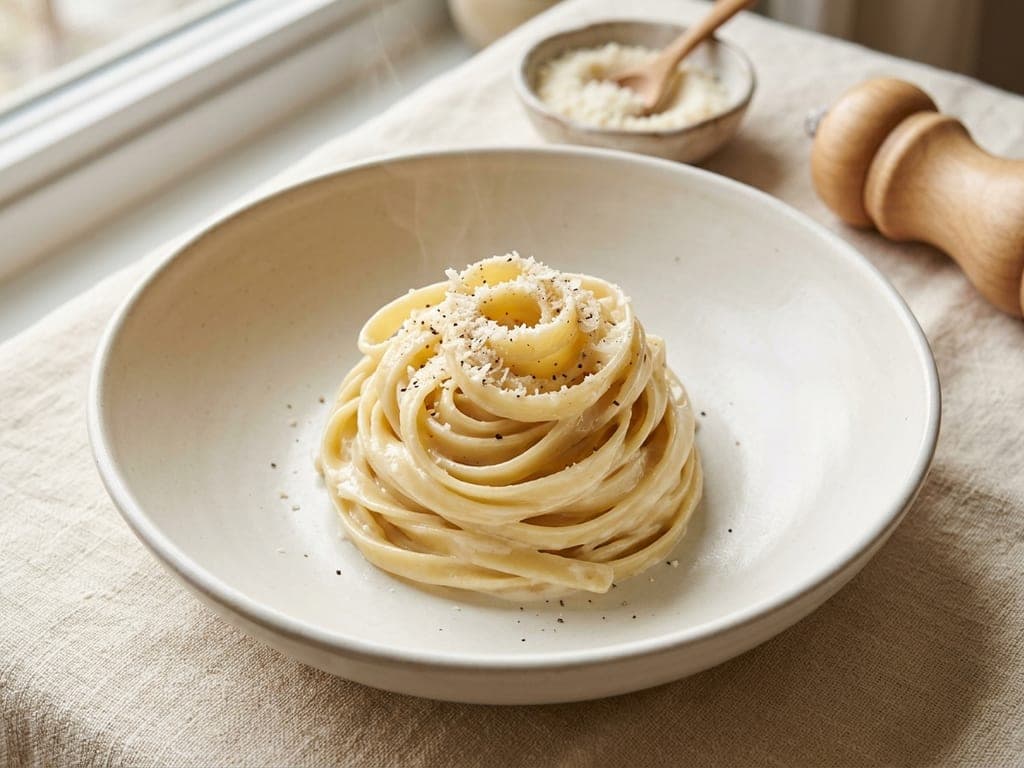
- Warm four wide, shallow bowls with hot water and dry them: warm to the touch, not scorching.
- Lift a quarter of the pasta into a ladle with tongs, stand a carving fork in it and twirl until the ribbons coil tight around the tines. Slide the coil into the center of the bowl and draw the fork straight up.
- Spoon any sauce left in the ladle over the crown so the top shines, and wipe the rim clean with a damp towel.
- Finish with a light, coarse grate of Parmigiano and a few turns of pepper. Fine cheese in the sauce, coarse on top: that is how Missy Robbins, who won a Michelin star at A Voce in New York, finishes her fettuccine Alfredo, with 5-year-old cheese. If you have an older wedge (30 months or more), this is where it goes.
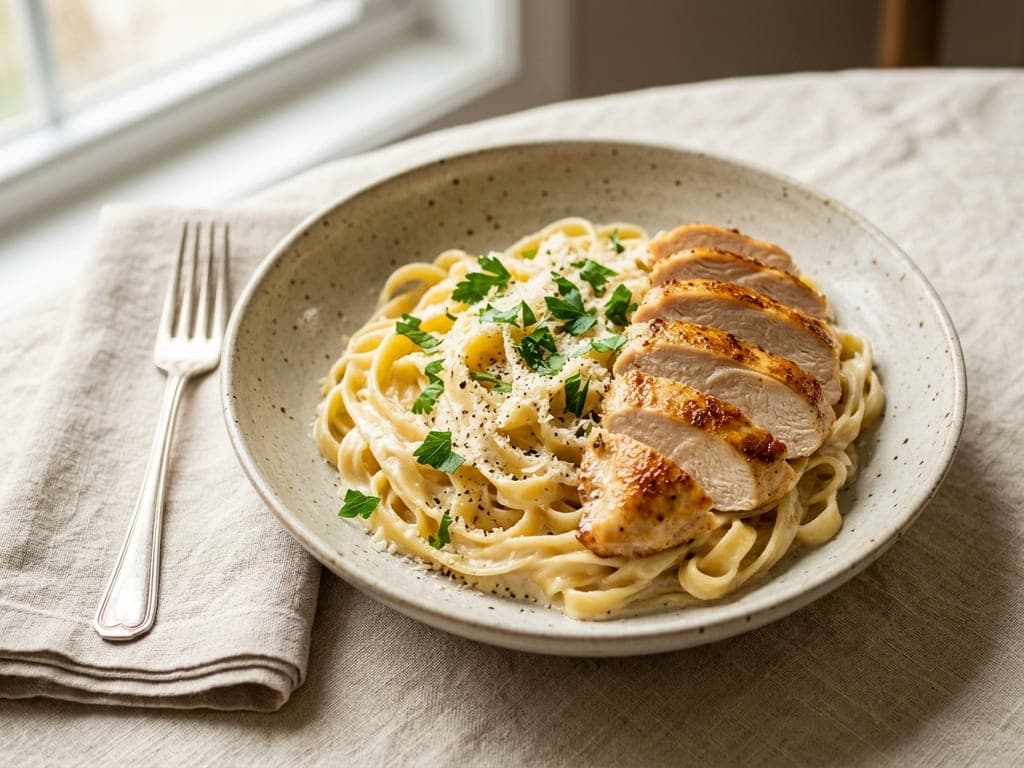
- Rest the 165°F (74°C) chicken 5 minutes, then slice across the grain on a bias.
- Twirl the dressed fettuccine into a low, compact nest just off center in a warmed shallow bowl, leaving one side open for the chicken.
- Fan 4 or 5 slices down one flank of the nest so ribbon and chicken both show.
- Finish with a last grate of Parmigiano and pepper. If you want green, a few parsley leaves on the pasta, never on the chicken.
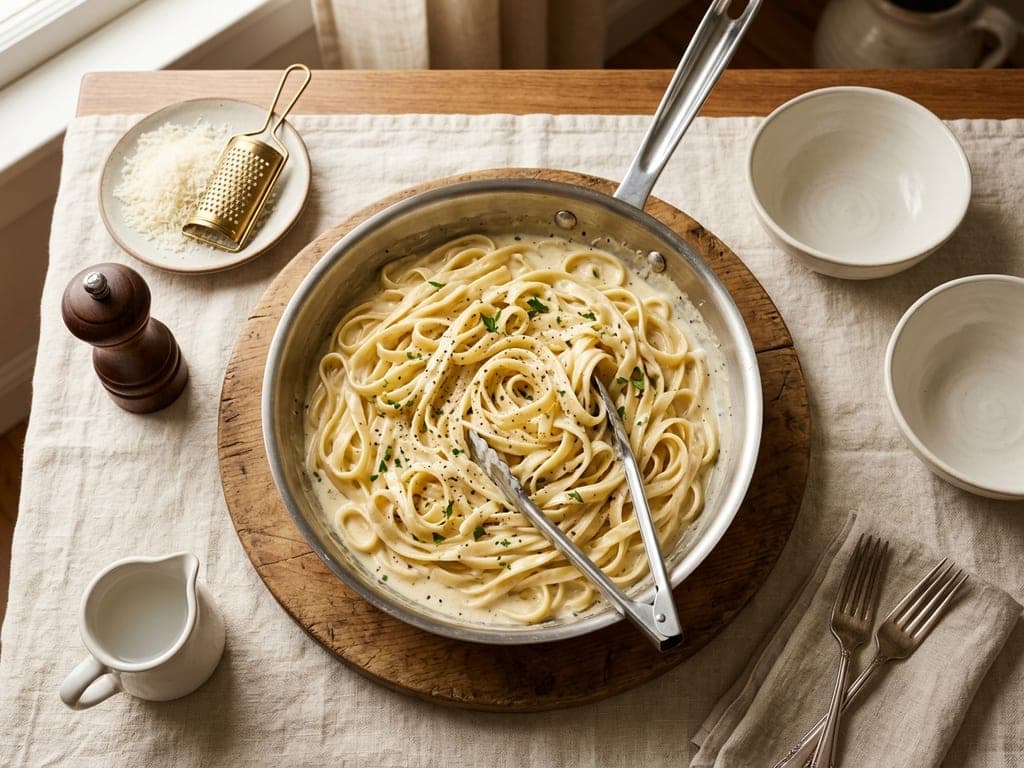
- Wipe the skillet rim so the presentation is the sauce, not the spatters.
- Set the hot pan on a board or trivet mid-table, handle turned in, away from the edge, and say out loud that it is hot; skip this serve with young children at the table. Whatever is still in the pan after 2 hours at the table, or 1 hour on a day above 90°F (32°C), goes in the bin, not the fridge.
- Bring the extra grated Parmigiano and a pepper mill to the table, and toss the first handful through the pan with a big fork and spoon, lifting from the bottom. That tableside fold is how Alfredo alla Scrofa in Rome still finishes the original, in front of the diner.
- Park a tiny pitcher of the leftover pasta water for last-second loosening. Let it cool to warm first: it comes out of the pot at boiling.
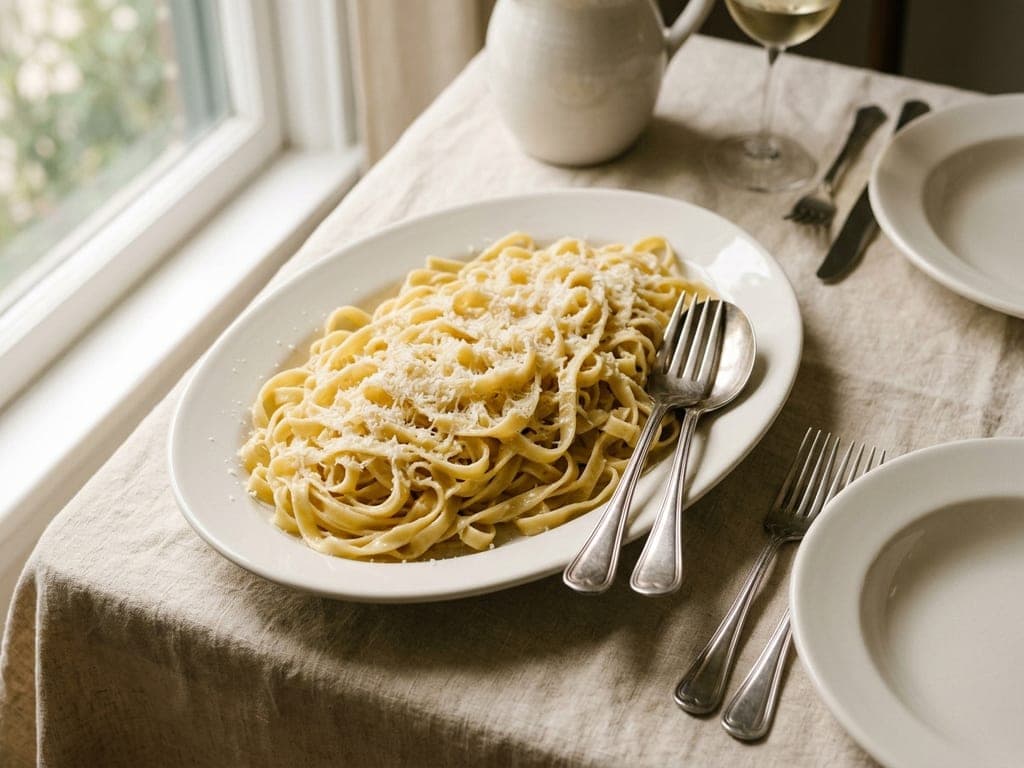
- Warm an oval platter under hot water, dry it and scatter soft curls of butter over it.
- Lift the fettuccine straight from the pot onto the butter with a big fork, letting some cooking water come along.
- Shower on the finely grated Parmigiano and fold from the bottom up with a fork and spoon until butter, cheese and water turn glossy.
- Portion straight from the platter onto warm plates at the table.
Chicken, shrimp, broccoli: the usual add-ons
Chicken alfredo. Cook it while the pasta water heats; it adds up to 20 minutes. Pound or butterfly 1 to 1 1/2 lb (450 to 680 g) boneless chicken breasts to an even 3/4 inch (2 cm), pat them dry and season both sides with kosher salt and black pepper. Sear in 1 tbsp oil in the skillet over medium-high heat, 5 to 7 minutes per side without moving them, until a thermometer in the thickest part reads 165°F (74°C). Rest the chicken on a board, loosely tented with foil, and wipe out the skillet before the butter goes in. Slice across the grain just before serving and lay the slices on top of each bowl; don't toss them through, where they shed fibers and dull the gloss. The chicken and its oil add about 170 to 235 calories per serving.
Shrimp alfredo. Before the butter goes in, cook 1 lb (450 g) peeled, deveined shrimp in 1 tbsp oil over medium-high heat, 1 to 2 minutes per side, until the flesh is pearly and opaque. Lift them out, wipe the pan, build the sauce, and return the shrimp for the final toss.
Broccoli. Drop about 3 cups (250 g) of small florets into the pasta pot for the last 3 minutes of cooking; they drain with the noodles and go into the sauce together.
Or borrow the add-ons Patrick O'Connell published from The Inn at Little Washington, which holds two Michelin stars: thin strips of Virginia country ham, a dry-cured, hickory-smoked American ham (a smoked cured ham such as speck works in Europe), warmed in the cream; garlicky wilted Swiss chard tossed through; snipped chives on top.
Beyond pasta, the sauce is good over seared chicken, roasted vegetables or a baked potato. Make it right before you serve it: it doesn't hold, and it doesn't freeze well.
Why alfredo turns grainy: the cheese, the heat, the starch
Two things decide whether this sauce is glossy or grainy, and the first is the cheese. Shelf-stable pre-grated cheese is tumbled with an anti-caking agent, powdered cellulose in the US and more often potato starch in the UK, so the shreds don't fuse in the tub. That coating doesn't melt, and the sauce stays faintly chalky however long you stir. Grated Parmigiano Reggiano DOP is the honest exception: its rules allow no additives, though they do allow up to 18% rind by weight and require a non-powdery grate, so it is drier than a wedge you grate tonight. Fine at the table, second best in the pan. Age matters too. Most wedges on sale are 24 to 36 months old; for the sauce, look for about 24 months, the age Alfredo alla Scrofa and Massimo Bottura's published Parmigiano cream both use. Past about 30 months the consortium describes the cheese as "distinctively crumbly, with a grainy texture": grate that over the top instead. Buy the smallest wedge you'll finish in a couple of weeks and keep it in cheese paper or a zip-top bag with the air pressed out.
The second, and bigger, cause is heat. Heat makes the proteins in grated cheese knit together and squeeze out their fat, fastest where there is little liquid and nothing moving them. In a 2025 Physics of Fluids study of cacio e pepe, Pecorino stirred into plain hot water with no starch seized into clumps at around 149°F (65°C). A machine changes the picture: Bottura's Parmigiano cream at three-star Osteria Francescana goes into cream at 140°F (60°C) and is blended up to 176°F (80°C), and one version is brought to a boil while the blades spin. A spoon in a skillet is not a blender, so a lot of grainy alfredo is not bad cheese; it is boiled cheese. And the bubbles stopping is not a thermometer: a gentle simmer can run as low as about 180°F (82°C). Give the cream a few minutes off the burner, or wait for about 160°F (71°C) if you own an instant-read thermometer, then add the cheese in handfuls, stirring each in before the next. Off the heat. Handfuls. Stir.
The last piece is starch. The cloudy pasta water carries dissolved starch, and starch protects the cheese: in the same cacio e pepe study, more starch pushed clumping to higher temperatures and kept any clumps small, while too little let the cheese seize into what the authors call a "Mozzarella Phase." Starch also thickens the water the butterfat sits in. That's why the pasta finishes in the pan: you're not topping noodles, you're building one sauce. Add the water a splash at a time: too little and the sauce is paste, too much and it's soup, and soup is the easier fix, because it tightens as you toss. It keeps tightening on the plate too, which is why alfredo doesn't wait.
If it goes wrong
Grainy or sandy: the cheese got too hot, or it was pre-grated. Off the heat, stir in pasta water a tablespoon at a time. If the pasta isn't in yet and that fails, try a few seconds with an immersion blender before you start over; blending is how Massimo Bottura's three-star kitchen turns Parmigiano and warm cream into a smooth sauce. Worth a try, not a guarantee.
Greasy or split: too hot again. Same fixes, off the heat.
Too thin: the cream was under-reduced or the cheese under-measured. Keep tossing off the heat for a minute; it thickens as it cools.
Too thick or pasty: add pasta water 1/4 cup (60 ml) at a time.
Salty and stiff: the wedge was old and dry. Loosen with pasta water and add no more salt.
Bland: salt only after the cheese is in, then more black pepper.
How Michelin-starred chefs make it
Three chefs who have held Michelin stars have published their fettuccine Alfredo, and a three-star kitchen has published the Parmigiano sauce behind it. Their methods line up with this page's two rules more closely than the legends do.
Missy Robbins won Michelin stars at both of New York's A Voce restaurants (2009 and 2010) before opening Lilia and Misi in Brooklyn. The fettuccine Alfredo in her 2021 book Pasta has no cream, and she builds the sauce before the pasta is ready: 1/2 to 3/4 cup (120 to 180 ml) of boiling pasta water goes into a wide pan over low heat, cold cubed butter is swirled in until the two turn into one creamy liquid, and about 50 grinds of black pepper go in with it. Fresh fettuccine cooks 1 to 2 minutes, goes straight into the pan and is tossed over medium heat with more pasta water. Then the pan comes off the heat and finely grated 2-year-old Parmigiano goes in a little at a time while she keeps tossing. She finishes with a coarse grating of 5-year-old Parmigiano and more pepper, and part of her butter is buffalo-milk butter, which she likes for its tang.
Angela Hartnett, whose Murano in London has held one Michelin star since 2009, cooks the cream version in two stages. Two thirds of the cream reduces with the butter over medium heat for about 10 minutes, until thick. The pasta then goes straight into that sauce with the rest of the cream and the Parmesan, a few tablespoons of pasta water if it needs loosening, and what she calls "a wintery, warming twist of nutmeg."
Patrick O'Connell of The Inn at Little Washington in Virginia (three Michelin stars from 2019, two since November 2025) published a cream Alfredo in Food & Wine that treats the sauce as a base. Thin strips of Virginia country ham warm in the simmered cream with a pinch of nutmeg, garlicky wilted Swiss chard is tossed through, and snipped chives go on top.
Massimo Bottura's Osteria Francescana in Modena holds three Michelin stars, and his Parmigiano cream for tortellini is the Alfredo idea taken as far as it goes. One published version warms 7 oz (200 g) of fresh cream to 140°F (60°C), adds 10 1/2 oz (300 g) of 24-month Parmigiano, blends it smooth with an immersion blender and brings it to 176°F (80°C) to serve. He calls it a good, versatile sauce and suggests it in place of béchamel. That is three parts cheese to two of cream by weight; this page runs about one to three, because it has a pound of pasta to coat. The Michelin Guide describes the dish on his menu as "Modenese tortellini in a silky 36-month Parmigiano Reggiano sauce," and his signature Five Ages of Parmigiano Reggiano is built on wheels from 24 to 50 months old. "The ageing is crucial," he told Identità Golose.
The reference for the Roman plate is not a starred restaurant at all: it is Alfredo alla Scrofa in Rome (see "The Roman original").
What they share: real Parmigiano, most often about two years old; a liquid for the cheese to melt into, whether pasta water or cream; and pasta that finishes in the sauce. Robbins adds her cheese a little at a time; Hartnett adds hers all at once with the last of the cream. None of them thickens with flour, and the one who heats Parmigiano hardest, Bottura, runs a blender through it while he does.
The Roman original: fettuccine al burro
Harder, not simpler: there's no cream to hide behind. For four, at Roman portions: 1 lb (450 g) fresh egg fettuccine, rolled as thin as you can get it; 1/2 cup (113 g) soft unsalted butter in pieces; and 8 oz (225 g) Parmigiano-Reggiano aged about 24 months, grated as fine as you can (about 4 cups off a rasp) and shaken through a fine sieve. That is a lot of cheese, and it is still a little under Rome's ratio: Alfredo alla Scrofa's recipe, published by the Parmigiano Reggiano consortium, uses 3 1/2 tbsp (50 g) of butter and about 4 oz (120 g) of 24-month cheese for two, sifted three times so it falls like powder, with a sweet Alpine butter to set off the salty cheese. Cook the pasta in a medium pot of well-salted water so the water turns starchy; thin fresh ribbons need a minute or two. Keep 1 cup (240 ml) of the water.
Rome's way: warm a serving platter or wide bowl, spread the butter over it, lift the pasta on with tongs or a big fork, still dripping so a little cooking water comes along, shower on the cheese and toss hard, folding from the bottom up, until butter, cheese and water turn into a pale, glossy cream. Il Vero Alfredo, the Di Lelio family's restaurant, adds butter both before and after the pasta lands and uses a younger cheese of about 16 to 18 months.
The easier way at home comes from Missy Robbins, who won Michelin stars at New York's A Voce: swirl the butter into 1/2 to 3/4 cup (120 to 180 ml) of boiling pasta water in a wide pan over low heat until the two look like one creamy liquid, add the pasta and toss over medium heat for a minute with more pasta water, then take the pan off the heat and add the cheese a handful at a time while you keep tossing. Don't let the butter and water boil hard before the pasta goes in: Saveur, writing about the beurre monté in Thomas Keller's The French Laundry Cookbook, warns that the mixture separates if it boils. Robbins adds black pepper; Rome doesn't.
"The right amount of water is the secret, and you work at it trial after trial to get the cream right: too much and it turns brothy, too little and it's dry." Mario Mozzetti of Alfredo alla Scrofa, in the restaurant's recipe for the Parmigiano Reggiano consortium (translated from Italian).
Serve within the minute. If it looks greasy, add water and toss harder; if watery, keep tossing, because it tightens. No garlic, no cream, no nutmeg. It fails on dry pasta, on pre-grated cheese and on a bowl so hot it cooks the cheese, and on very little else.
When to cook which: the cream version is the Tuesday dinner that holds together long enough to get four bowls to the table. The Roman version is for the night you have excellent fresh pasta, excellent butter, good Parmigiano and the nerve to toss hard and serve in the same minute. What's a mistake in either is pre-grated cheese; what's a mistake in the American one is flour or cream cheese, which "No flour, no cream cheese" takes one at a time.
Two sauces named Alfredo: Rome's, and America's
In Rome this dish is not a cream sauce. Italians cook it at home as fettuccine al burro, pasta burro e parmigiano or plain pasta in bianco, the buttered pasta made for children and upset stomachs, and the idea is old: around 1460 Maestro Martino, a cook working in Rome, dressed his "maccaroni romaneschi," ribbons cut a finger wide, with butter, good cheese and sweet spices. The version with a name dates to 1908. Alfredo Di Lelio, cooking in his mother Angelina's trattoria on Piazza Rosa, made fettuccine with an extravagant amount of butter and fresh Parmigiano for his wife Ines, who had lost her appetite after the birth of their son Armando. He called them le bionde, "the blondes"; his menus and newspaper ads sold "most majestic" fettuccine with double butter, and later writers called them al triplo burro. No cream, no garlic, no parsley. Piazza Rosa was cleared around 1910 for the Galleria Colonna, and in 1914 Di Lelio opened his own restaurant on Via della Scrofa, tossing every plate at the table with a showman's flourish. That is why some sources say 1914: Alfredo alla Scrofa dates the dish to its own opening, while the Di Lelio family and food historian Luca Cesari date it to 1908.
Americans found it in the 1920s. Sinclair Lewis's Babbitt (1922) mentions "a little trattoria on the Via della Scrofa where you get the best fettuccine in the world," and George Rector praised Alfredo's tableside ritual in The Saturday Evening Post in 1927. Then the star turn, told by both Roman restaurants: Mary Pickford and Douglas Fairbanks ate there, fell for the dish and gave Alfredo a gold fork and spoon engraved "To Alfredo the King of the noodles." The dates shift with the teller. Alfredo alla Scrofa says the couple came on their honeymoon and sent the cutlery from America afterward; the Di Lelio family dates the gift to 1927; and the Mary Pickford Foundation's chronology names London and Paris for the 1920 honeymoon and records trips to Italy in late 1921 and spring 1926. Read the dates as family lore. What the couple spread was the fame, not the cream: the recipes American papers printed in the 1920s and 1930s were still butter and cheese.
The cream is American, and it came late. Buitoni was selling prepared Alfredo dinners by 1964. By 1966 the Pennsylvania Dutch noodle company printed an Alfredo recipe on its fettuccine packages that added 1/2 cup (120 ml) of cream and some Swiss cheese to the butter and Parmesan, and in 1973 Marcella Hazan's The Classic Italian Cook Book taught Americans a Fettuccine all'Alfredo tossed in cream and butter, with nutmeg. The usual explanation is that the butter and Parmesan Americans could buy in the 1950s were too weak to carry the dish alone; the other is that cream was a shortcut to the silk Alfredo got from minutes of tossing at the table. Either way, heavy cream solved a practical problem, and there's no need to sneer at it. It is what people mean when they type the search, and it is what this recipe makes.
Why two Alfredos? In 1943, with wartime rationing, Di Lelio sold Via della Scrofa to two of his waiters, whose families still run it as Alfredo alla Scrofa. In 1950 he opened again on Piazza Augusto Imperatore with his son Armando; that restaurant, Il Vero Alfredo, is run today by his granddaughter Ines Di Lelio and great-granddaughter Chiara Cuomo. Both toss the pasta at the table, and both say they hold the golden cutlery. Outside those two addresses, Italians quoted by Milk Street call it "tourist food."
No flour, no cream cheese, and a word about the jar
Classic American alfredo is butter, cream and cheese. Flour is a béchamel move: it thickens, it holds, and it tastes like white sauce with parmesan stirred in, a fine casserole base and not this. Cream cheese is the other common shortcut: body plus a tang that reads as richness, and so stable that banquet kitchens swear by it. Both exist because somebody had a grainy pan once and wanted insurance. But the insurance you actually need is a block of cheese and the willingness to turn the burner off. And if you genuinely need a sauce that survives an hour in a hotel pan, make the cream-cheese version knowingly and call it what it is: a different dish that's harder to break, and correspondingly less alive.
There is cleaner insurance than cream cheese: sodium citrate. In the 2025 Physics of Fluids cacio e pepe study, citrate at 2% of the cheese's weight gave a completely smooth, stable sauce; for 4 oz (115 g) of Parmigiano that is about 2.3 g, dissolved in the cream before the cheese goes in. The study used Pecorino, and the authors note citrate slightly blunts the cheese flavor.
The jar is not a moral failure either. It's a shelf-stable product engineered to pour after a year in a cupboard and to coat pasta without splitting, which is why it tastes slightly sweet and slightly gluey: engineering, not cooking. If the jar is what brought you to this page, welcome: in about 15 minutes at the stove you'll have a sauce that tastes of butter and Parmigiano. Keep a jar for the nights you can't. Even Rome has one: since 2020 Alfredo alla Scrofa has sold a jarred "Salsa Alfredo," and its label lists Parmigiano (43%), water, butter, rice flour and sunflower oil. No cream in it, though even that jar needs a little rice flour.
The dials, honestly: these quantities sauce 1 lb (450 g) of dry fettuccine for four. If the sauce tastes thin, it's usually under-cheesed, not under-creamed: add an ounce (30 g) more cheese before you add more cream. If it lands salty and stiff, your wedge ran old and hard; loosen with pasta water and hold the added salt. If it keeps reducing too thick, hold back a third of the cream and add it with the pasta, as Angela Hartnett does at one-star Murano; America's Test Kitchen splits its cream the same way because fully reduced cream turns too thick. Garlic is optional and standard in the American plate. Nutmeg is a house choice, not a rule: Marcella Hazan's 1973 cream-and-butter Fettuccine all'Alfredo already used it, Hartnett and Patrick O'Connell of two-star The Inn at Little Washington both grate it in, and neither Rome restaurant uses it. A pinch is the most this sauce needs. Black pepper is not optional. And salt last, always after the cheese: Parmigiano is a salt-delivery system, and wheels vary more than recipes admit.
Questions, answered
What is alfredo sauce made of?
American alfredo sauce is butter, heavy cream and finely grated Parmesan, usually with garlic and black pepper. This recipe uses 6 tbsp (85 g) butter, 1 1/2 cups (360 ml) heavy cream and 4 oz (115 g) Parmigiano-Reggiano. The Roman original, fettuccine al burro, has no cream at all: fresh fettuccine, butter, Parmigiano and a little pasta water, tossed until they turn into a sauce.
What cheese is best for alfredo sauce?
A wedge of Parmigiano-Reggiano you grate yourself. By rule it ages at least 12 months, and most wedges on sale are 24 to 36 months old; Rome's two Alfredo restaurants sit inside that range, Alfredo alla Scrofa at 24 months and Il Vero Alfredo at about 16 to 18. Grana Padano is milder and cheaper and works, but it generally contains lysozyme from egg white (a few types, such as Trentingrana, don't), so it is not reliably egg-free. Pecorino Romano is a sheep's-milk cheese, sharper and saltier; The Kitchn's version goes half Pecorino, half Parmesan, and if you try that, hold back the salt. A domestic US parmesan must be cured at least 10 months by law and is fine grated from a block. Whatever you choose, buy a block.
Can I use pre-grated Parmesan in a pinch?
You can, but expect a less smooth sauce. Shelf-stable pre-grated cheese is tumbled with an anti-caking agent that doesn't melt; overheating is the bigger cause of grainy alfredo, but the coating is the one you can avoid at the store. Cheese grated that day at a deli counter from a real wheel has no coating and usually melts fine; the shelf-stable tub and the green shaker are what fail. If the label lists cellulose or an anti-caking agent, spend the money on a 4 oz (115 g) wedge instead.
Why did my alfredo turn grainy?
Usually heat, sometimes the cheese, often both. Cheese sprinkled into cream that is still bubbling, or a sauce boiled after the cheese is in, turns to grit in an oil slick: the hotter the sauce, the more readily the cheese proteins clump and squeeze out their fat. Pre-grated cheese adds a coating that never melts. Take the pan off the burner, give it a few minutes (or wait for about 160°F (71°C) on a thermometer), and add freshly grated cheese in handfuls. If it has already split, see "If it goes wrong" above: pasta water off the heat, and an immersion blender as a last try before the pasta goes in.
How do I thicken alfredo sauce without flour?
Three ways, none of them flour: simmer the cream a minute or two longer before the cheese goes in, add more grated cheese off the heat a handful at a time, and let the tossed pasta sit for a minute, because the sauce keeps tightening as it cools. This sauce thickens twice on its own: the cream reduces by about a quarter until it coats a spoon, and then the 4 oz (115 g) of real cheese melts into it off the heat. Flour makes it a béchamel; cream cheese makes it a stable, tangy banquet sauce. Both are legitimate foods and neither is alfredo. A thin pan usually means the cream was under-reduced, the cheese was under-measured, or the pasta water got away from you. What looks slightly loose in the skillet is right on the plate. Chasing thick with starch is how you get glue.
Can I make alfredo sauce with milk or half-and-half?
Half-and-half, yes, with care. Milk, not in this recipe: it has too little fat to carry the cheese, which is why milk-based alfredo recipes add a flour roux and end up closer to a cheesy béchamel. Heavy cream is about 36% fat; half-and-half (single cream at 18% is the closest UK match) runs 10.5 to 18%, below the roughly 25% Harold McGee gives as the line where cream resists curdling. So half-and-half makes a thinner sauce that splits more easily: keep the heat low, don't try to boil it thick, and lean on the cheese and pasta water for body. With only milk in the fridge, make the Roman version instead.
How much alfredo sauce do I need for a pound of pasta?
This recipe makes about 2 cups (470 ml) of sauce, the right amount for 1 lb (450 g) of dry fettuccine, or four main-course bowls. For 8 oz (225 g) of pasta, halve everything. For a crowd, cook it in batches of this size rather than one giant pan: the cheese needs room and a calm, off-heat pan to melt smooth. For sauce on its own, over chicken or vegetables, stop after the cheese step and use it right away; a splash of warm milk over low heat loosens it if it tightens.
How do Michelin-starred chefs make fettuccine Alfredo?
With fewer tricks than you'd think, and never with flour. Missy Robbins, who won Michelin stars at New York's A Voce, swirls butter into boiling pasta water before the fettuccine goes in, adds 2-year-old Parmigiano off the heat and finishes with a coarse grating of 5-year-old cheese. Angela Hartnett of one-star Murano in London reduces two thirds of her cream with the butter, then adds the rest with the pasta and Parmesan, plus nutmeg. Massimo Bottura of three-star Osteria Francescana blends 24-month Parmigiano into warm cream for the sauce on his tortellini. The details are in "How Michelin-starred chefs make it" above.
How do you make the Roman original, fettuccine al burro?
Fresh egg fettuccine, butter and a lot of finely grated Parmigiano, tossed with a little cooking water until they turn into a pale, glossy cream: no cream, no garlic. For four, 1 lb (450 g) fresh pasta, 1/2 cup (113 g) butter and 8 oz (225 g) Parmigiano. The full method, Rome's way and Missy Robbins's easier home way, is in "The Roman original: fettuccine al burro" above.
Is alfredo sauce the same as carbonara?
No. Alfredo has no egg and no pork; carbonara is built on both, with eggs, guanciale (cured pork cheek) and Pecorino Romano. What they share is the method: cheese melted into fat and starchy pasta water, off the heat. Our carbonara sauce page makes the other one.
Does it have to be fettuccine?
No, but wide ribbons (fettuccine, tagliatelle, pappardelle) give a cream sauce the most surface to cling to; spaghetti works with a little more pooling, and short shapes push it toward casserole. Whatever the shape, finish it in the pan with a splash of its own water.
Is alfredo sauce vegetarian?
Not as written, and the reason hides in the cheese: Parmigiano-Reggiano's PDO rules allow only calf rennet, a coagulant taken from a calf's stomach, so a dish built on real Parmigiano isn't vegetarian, and this page doesn't label it as one. Grana Padano, the usual stand-in, uses calf rennet too. The fix is easy: buy a hard cheese labelled vegetarian and grate it yourself the same way. In the UK that means Italian-style hard cheese with a vegetarian mark; in the US, a wedge sold as vegetarian parmesan, because a label that just says "enzymes" doesn't tell you the source. Vegan alfredo is a different sauce built on cashews or starch; it can be good, it brings a tree-nut allergen of its own if it's the cashew kind, and it isn't this.
How long does alfredo keep in the fridge, and how do I reheat it?
3 to 4 days in the fridge by US guidance, 48 hours by the UK's Food Standards Agency; get it in within 2 hours of cooking. Reheat once, gently, and all the way: a saucepan over low heat with a splash of milk or cream, stirring the whole time, until it is steaming hot right through, 165°F (74°C) in the middle, the US standard for every leftover. That is hotter than the cheese likes, so expect it to come back looser or slightly grainy; off the heat, whisk in another splash of milk to bring some gloss back. USDA's shortcut for sauces is a rolling boil, which would split this one, so use a thermometer instead. In a microwave, go half power in 30-second bursts, stirring and adding a little liquid between rounds, then check the middle. The once-only rule is UK guidance (FSA and NHS); US agencies set a temperature, not a count.
Can I freeze alfredo sauce?
It keeps safely frozen, but it won't come back the same. The USDA's food-safety service names cream sauce among the foods that don't freeze well: the butterfat and cheese separate as it thaws and return greasy and grainy, however hard you whisk. Food held at 0°F (-18°C) stays safe, so this is a texture problem, not a safety one. The meal-prep move that works: freeze cooked chicken on its own and make the sauce fresh; it takes about 15 minutes once the water boils. Half the recipe halves cleanly for two.
Is alfredo sauce safe to eat during pregnancy?
It depends on whose guidance you follow; this is one of the few places US and UK advice split. Parmigiano-Reggiano is always made from raw (unpasteurized) milk; its rules forbid heat-treating it. The NHS counts hard cheeses, parmesan included, as safe in pregnancy even when unpasteurized. The CDC and FDA are stricter: any cheese made from raw milk is on their riskier list unless it is heated to 165°F (74°C) or until steaming hot, and this recipe adds the cheese off the heat on purpose, with more grated over at the table. So if you follow US advice, use a parmesan whose label says pasteurized milk and grate it from the block the same way. Butter and cream should say pasteurized too, any chicken goes to 165°F (74°C), and the same US advice applies to anyone over 65 or with a weakened immune system. None of this is personal medical advice: if a clinician has given you a narrower list, their list wins.
How many calories are in fettuccine alfredo?
About 990 per bowl as written (a quarter of the recipe, pasta included, chicken not), and roughly 570 of those come from the sauce. Each bowl carries about 58 g of fat, 36 g of it saturated, more than the 20 g Daily Value the FDA uses on food labels. Chicken adds about 170 to 235. If that's more than you want, serve smaller bowls with a green salad; a milk-and-flour sauce is lighter, but it is a different dish.
Snap your finished plate and let the AI plate it again — more beautifully.