Carbonara Recipe (Spaghetti alla Carbonara, the Roman Way)
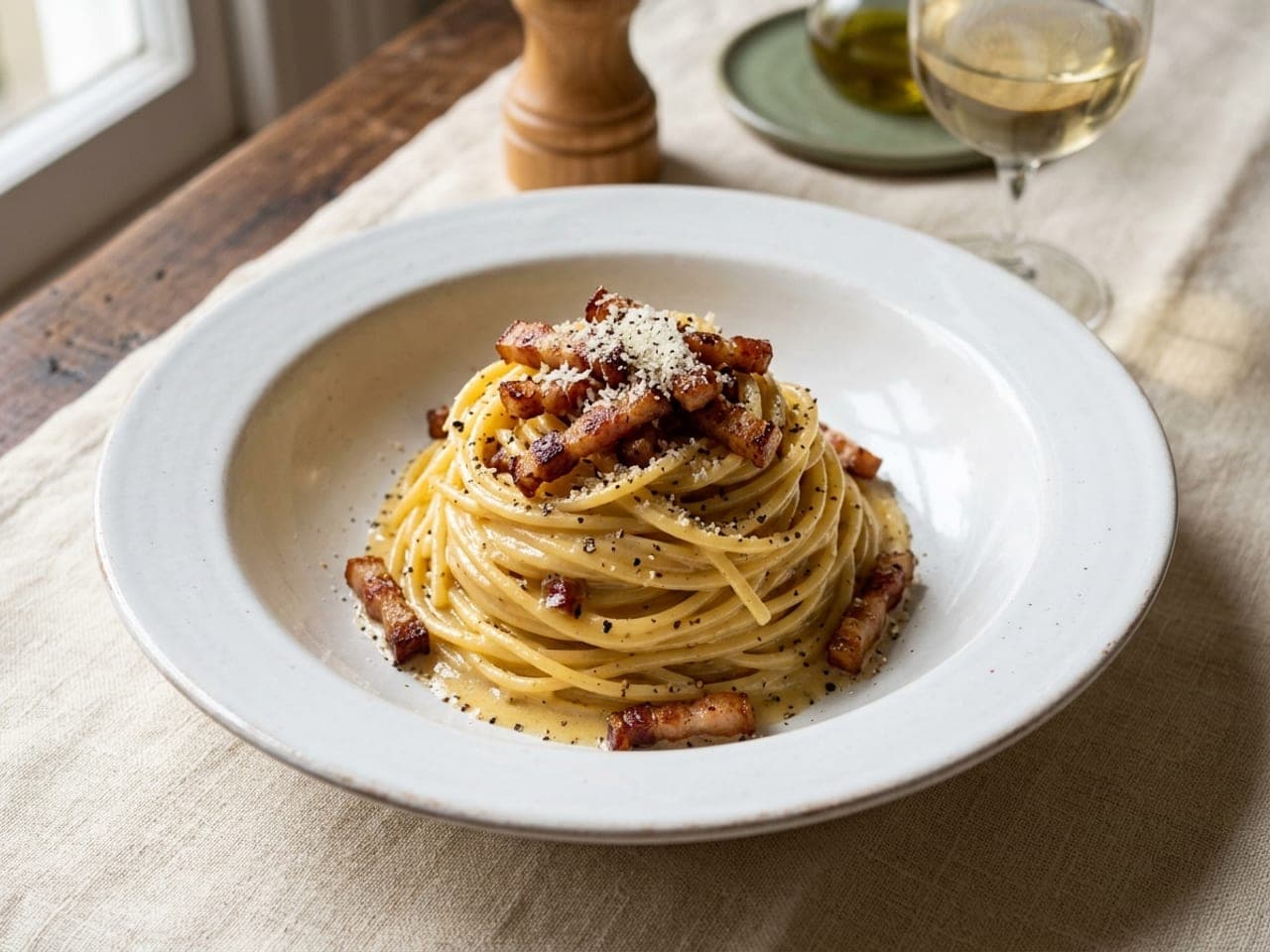
Authentic Roman carbonara: spaghetti, guanciale, egg yolks, Pecorino Romano and black pepper, no cream. Silky, not scrambled, in about 35 minutes.
Ingredients
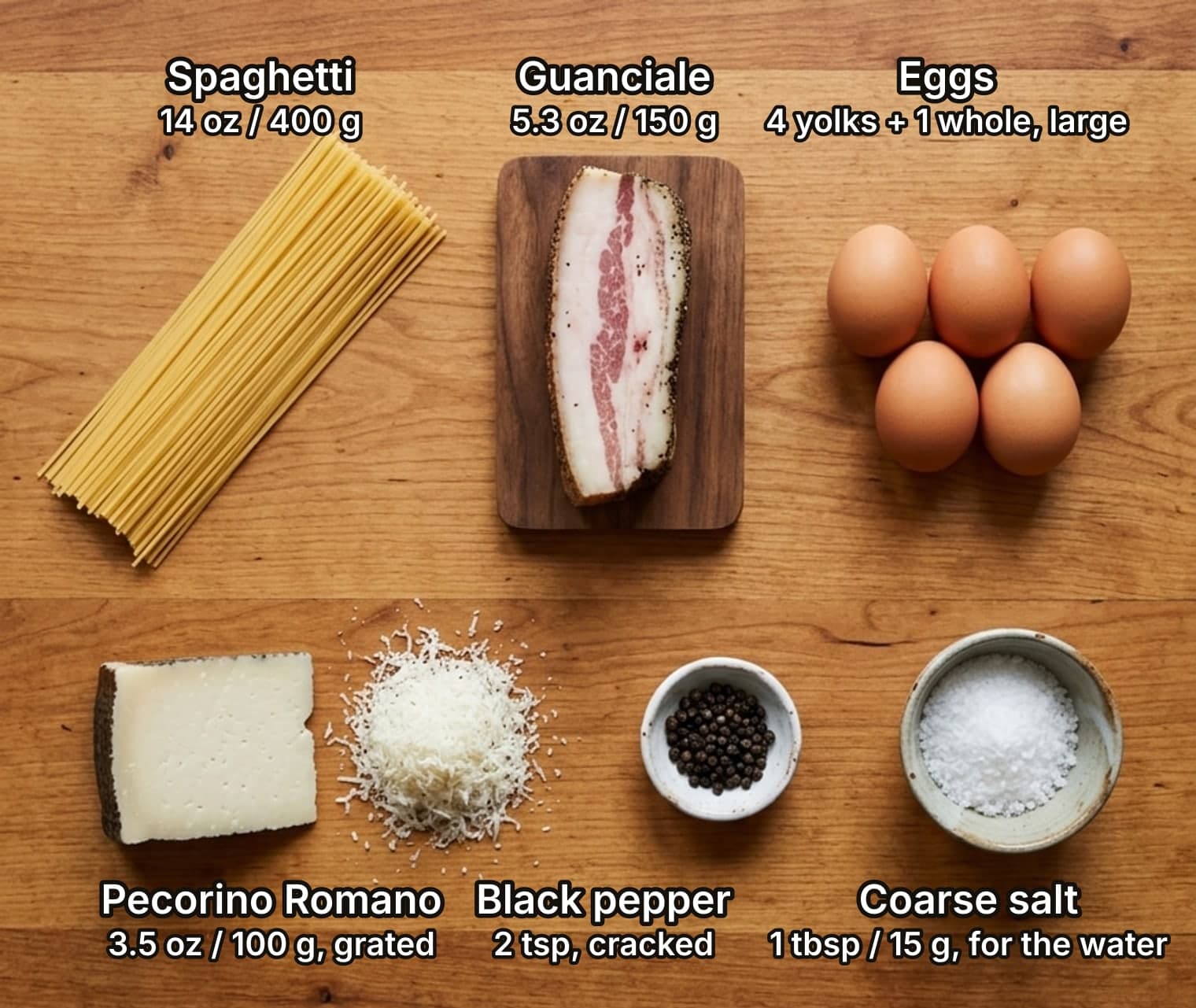
- spaghetti, bronze-cut if you can find it (or rigatoni or mezze maniche)14 oz (400 g)
- guanciale (cured pork jowl), rind and peppery outer crust removed, cut into 1/4 × 1 in (6 mm × 2.5 cm) batons (unsmoked pancetta is the nearest substitute)5.3 oz (150 g)
- egg yolks, from large eggs (UK and EU medium); pasteurized if anyone eating is pregnant, under 5, over 65 or immunocompromised4
- large egg, whole (UK and EU medium)1
- Pecorino Romano, finely grated on a microplane and weighed, plus more to serve (up to half can be Parmigiano-Reggiano)3.5 oz (100 g)
- black peppercorns, toasted and coarsely cracked2 tsp
- coarse salt (kosher salt), for the pasta water (about half the usual amount; weigh it if you can)1 tbsp Morton or 1 3/4 tbsp Diamond Crystal (15 g)
- water, for the pasta (less than usual, for starchier water)3 quarts (2.8 liters)
Before you start: what carbonara is, and the one rule
Spaghetti alla carbonara is pasta dressed with egg, Pecorino Romano, guanciale (cured pork jowl) and black pepper, and nothing else: no cream, no garlic, no onion, no parsley. The sauce is an emulsion of egg, finely grated cheese, rendered pork fat and starchy pasta water, thickened only by the heat of the just-cooked pasta. The one rule: no flame under the egg.
The short version: for each person, 3.5 oz (100 g) of spaghetti, 1.3 oz (37 g) of guanciale, 1 egg yolk and 0.9 oz (25 g) of Pecorino Romano, plus 1 whole egg for the pot and plenty of black pepper. Render the guanciale from a cold pan, whisk the eggs and cheese to a paste, then toss the hot pasta into it with the burner off, adding starchy pasta water a spoonful at a time until the sauce is glossy, at about 150°F (65°C). About 35 minutes, start to finish.
Once the pasta leaves the pot you toss for one minute and serve, with no time to fetch anything, so before it goes in have tongs, a jug for 1 1/2 cups (360 ml) of pasta water, the egg bowl and warm bowls within reach. Buy a wedge of Pecorino Romano, not pre-grated cheese. Cooking for anyone pregnant, under 5, over 65 or immunocompromised? Use pasteurized eggs: the sauce is warmed, not cooked through (see Safety).
How to make Spaghetti Carbonara
- Grate, crack and get the water on. Put 3 quarts (2.8 liters) of water on to boil with 1 tbsp of Morton kosher salt or about 1 3/4 tbsp of Diamond Crystal (15 g): less water and about half the salt you would normally use, because the smaller pot makes starchier water and the cheese and guanciale will salt the dish hard later. Grate 3.5 oz (100 g) of Pecorino Romano on a microplane, about 1 3/4 cups (420 ml) loosely packed; weigh it if you can. Toast 2 tsp of black peppercorns in a dry pan for a minute, then crack them coarsely. Trim the rind and the dark outer crust of pepper and cure from 5.3 oz (150 g) of guanciale, and cut it into batons about 1/4 in (6 mm) thick and 1 in (2.5 cm) long, thicker than bacon strips so each keeps a chewy center inside a crisp edge.
- Render the guanciale from a cold pan. Put the guanciale into a large, cold skillet and set it over medium-low heat, so the fat melts out gradually. Cook for 10 to 12 minutes, stirring now and then, until the fat is clear and the lean is deep gold and crisp at the edges but still a little chewy in the middle; it keeps cooking in the residual heat. Add half the cracked pepper (about 1 tsp) for the last 30 seconds so it blooms. Take the pan off the heat and lift most of the guanciale onto a plate with a slotted spoon, leaving the fat behind; out of the fat the pieces stay crisp. If there is more than about 3 tbsp of fat, pour the excess into a heatproof cup.
- Make the egg and cheese paste. In a bowl wide enough to hold all the pasta, whisk 4 egg yolks and 1 whole egg. Stir in the Pecorino Romano and the rest of the pepper to a thick, almost dry paste; it looks alarmingly stiff, which is correct. Whisking the cheese into the egg now is one of the best protections against clumping, because each grain is wrapped in egg before it meets heat; the other is starch, which arrives with the pasta water. Leave the bowl at room temperature, away from the stove. The sauce is warmed, not cooked through, so if anyone at the table is pregnant, under 5, over 65 or immunocompromised, use pasteurized eggs (see Safety).
- Cook the spaghetti to al dente, and keep the pot. Drop 14 oz (400 g) of spaghetti into the boiling water, stir for the first 30 seconds, and cook it to the package’s al dente time. Do not pull it early: the burner stays off from here, so the pasta gets no more cooking. While it cooks, warm the serving bowls with a ladle of the boiling water each, to be tipped out just before plating. About 2 minutes before the pasta is done, scoop 1 1/2 cups (360 ml) of the cloudy cooking water into a jug; you will use perhaps a third of it. Do not drain the pot: it is your bain-marie if the sauce needs gentle heat.
- Toss the pasta in the fat, off the heat. Lift the spaghetti out of the pot with tongs, let it drip for a second, and drop it straight into the skillet of guanciale fat; the burner under the skillet stays off. Turn the pasta pot down to a bare simmer. Toss hard for 30 seconds so every strand is coated in fat and pepper, return about two-thirds of the guanciale, and hold the rest back for the top of each bowl. Add 2 tbsp of the reserved pasta water and toss again; the starch and fat form a thin glaze for the egg to build on. If the skillet is too hot to hold your hand a few inches (5 to 8 cm) above it for a second or two, wait 30 seconds.
- The emulsion, off the heat. Whisk 3 tbsp of the hot pasta water into the egg-and-cheese paste until it looks like thick batter; this tempers the egg. Tip the pasta, fat and guanciale from the skillet into the egg bowl and toss fast, without stopping, for a full minute, lifting and turning with tongs. The sauce goes from streaky to smooth to glossy. Add more pasta water 1 tbsp at a time until it coats every strand and drips slowly from a lifted strand, and stop as soon as it looks right; it tightens as it cools. If it starts to look grainy, add a splash of water and toss faster. If after a minute it is still thin and pools in the bowl, the pasta cooled too far: set the bowl over the simmering pot, its base clear of the water, and toss in 15 to 20 second bursts until it turns glossy and clings. Never put it over a direct flame. To check without a thermometer, dip a spoon and draw a finger across the back: if the line holds, it is ready. The first few times, push an instant-read probe thermometer into the middle of the sauced pasta: aim for about 150°F (65°C), the temperature Luciano Monosilio works to, and stop well before 158°F (70°C), where yolk sets.
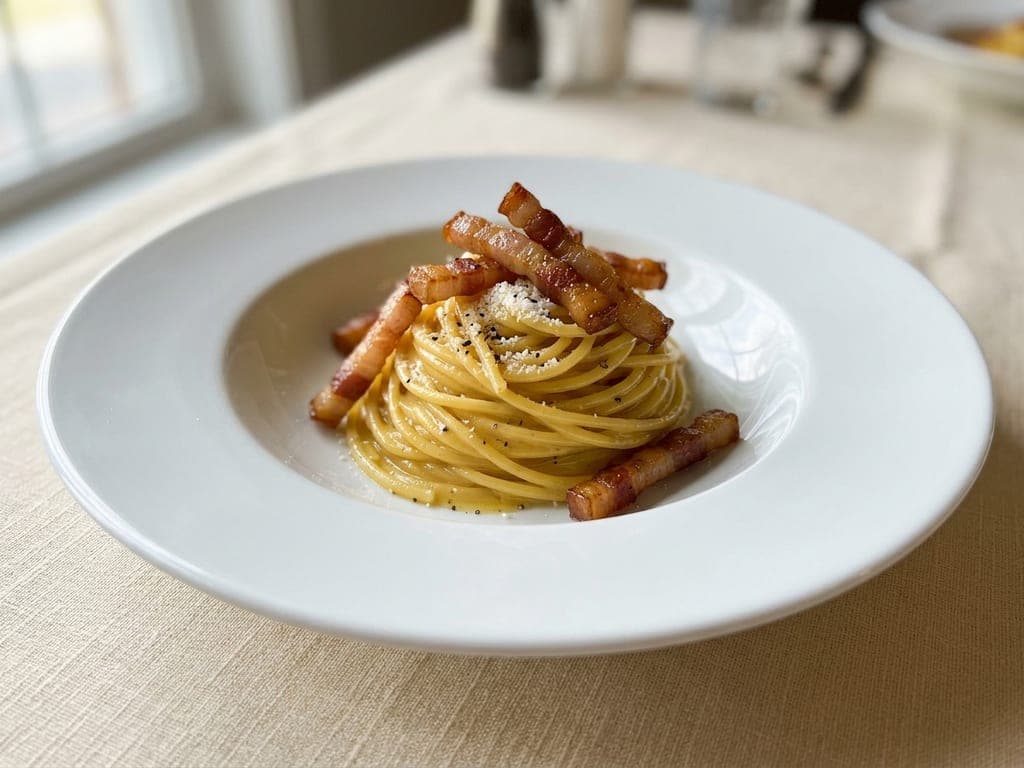
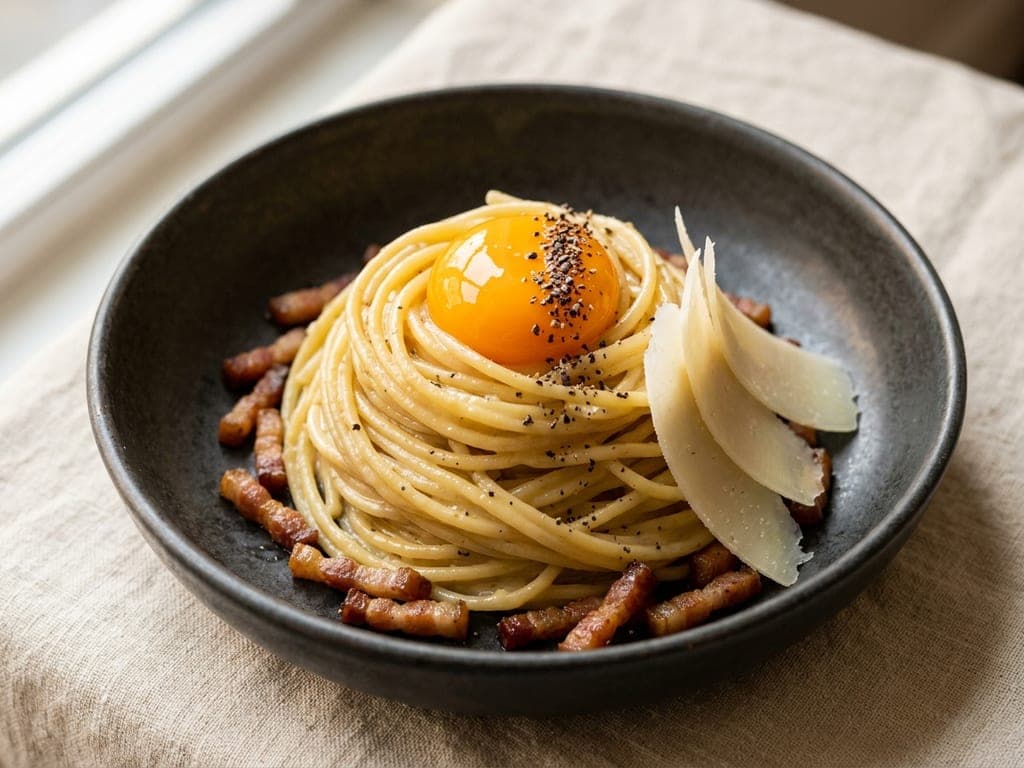
- Serve at once. Tip the water out of the warm bowls. Twirl each portion into a tall nest with tongs turned inside a ladle and set it in the center of a bowl. Spoon the reserved guanciale on top, add a light snow of Pecorino Romano and a crack of pepper, and carry it straight to the table: the sauce is at its best for a couple of minutes, and it should arrive warm, not piping hot. The first two plating ideas below build on this nest; the third trades it for a platter.
Safety & hygiene Important
- The eggs are warmed, not cooked: know who you are feeding. Bottom line: US guidance is to make any lightly cooked egg dish with pasteurized eggs, and if anyone at the table is pregnant, under 5, over 65 or has a weakened immune system, treat that as non-negotiable. A correctly made carbonara takes the egg to about 150°F (65°C): hot enough to thicken, deliberately not hot enough to set. That is below the 160°F (71°C) the FDA and USDA give for egg dishes, and below the 165°F (74°C) FoodSafety.gov gives when the dish also contains meat, as this one does. Even with a probe thermometer, a bowl of pasta being tossed is never one even temperature, so treat the sauce as a lightly cooked egg. Healthy adults who use ordinary shell eggs are accepting a small risk: a USDA risk assessment from 2000, cited by the FDA when it wrote its egg-safety rule, put contamination at roughly one egg in 20,000. That rule has required Salmonella controls since 2010 on farms with 50,000 or more laying hens and since 2012 on farms with 3,000 or more; smaller flocks and farms that sell all their eggs directly to consumers are exempt, so farmers-market and backyard eggs fall outside it. Pasteurized shell eggs are sold in some US supermarkets and work in this recipe like any other egg; the carton usually says they have been treated. Do not try to pasteurize eggs yourself: USDA says the equipment is not available for home use and that it is very difficult to do at home without cooking the egg. That includes the water-bath method below. Some chefs, Monosilio among them, say it pasteurizes the yolks; read that as a figure of speech. The long-standing USDA pasteurization table for liquid yolk calls for 142°F (61°C) held for 3.5 minutes, measured, which a bowl whisked by eye cannot promise. In his own restaurant, Monosilio uses eggs pasteurized with professional equipment.
- UK and Ireland: Lion eggs, Laid in Britain, and eating out. In the UK, hen eggs produced under the British Lion Code, whose measures include vaccinating hens against Salmonella, or under the Laid in Britain scheme are rated very low risk by the Food Standards Agency. Its advice, first given for Lion eggs in October 2017 and extended to Laid in Britain eggs in 2021, is that babies and young children, pregnant people, older adults and people with underlying conditions such as cancer, diabetes, or liver or kidney disease can eat those eggs raw or lightly cooked. People who are severely immunocompromised and on a medically supervised diet should follow their own medical advice, and vulnerable people should eat other eggs, imported ones included, only thoroughly cooked. That matters most when you order carbonara out, because you cannot see the carton. Through 2025 and 2026 the UK Health Security Agency investigated Salmonella Enteritidis outbreaks it says may be linked to imported eggs, with 586 confirmed cases and two deaths in England by 15 September 2026 and cases associated with eating at cafés, restaurants and takeaways; the FSA’s advice is that vulnerable people eating out should avoid dishes with raw or lightly cooked egg. Ireland’s Food Safety Authority names carbonara itself as a higher-risk dish for vulnerable people because of its part-cooked egg, and lists dishes made with pasteurized liquid egg as the safer option. When in doubt, pasteurized eggs are the answer that works everywhere.
- Pregnancy: the cheese and the guanciale, not just the egg. Pecorino Romano and Parmigiano-Reggiano are hard, long-aged cheeses, and neither is normally made from pasteurized milk: the Pecorino Romano PDO rules allow raw or thermized (lightly heated) milk, and Parmigiano-Reggiano must be made from raw milk. UK advice is relaxed about this: the NHS lists hard cheeses such as parmesan as safe in pregnancy whether pasteurized or not. US advice is stricter: FoodSafety.gov tells pregnant women to avoid cheese made with unpasteurized milk unless it has been heated to 165°F (74°C) or until steaming hot, which this sauce never reaches, and to choose hard cheeses made with pasteurized milk, so in the US read the label or ask at the cheese counter. The guanciale is not a worry once it is rendered as in step 2: the NHS asks pregnant women to cook cold cured meats until steaming hot, and 10 to 12 minutes in the pan does that.
- Guanciale is raw-cured: it needs to be cooked, and it needs the fridge. Guanciale is a salt-cured, air-dried product, not a cooked one; it is traditionally eaten cooked, and in this recipe it is fully rendered over 10–12 minutes, which takes it well past any safety threshold. Keep it refrigerated once the package is open. Guanciale is not on the USDA storage chart, so the nearest entries have to stand in: pancetta and ordinary bacon at about 7 days in the refrigerator, dry-cured slab bacon — the closest thing on the chart to a whole piece of guanciale — at 4 to 6 weeks. Follow the producer’s date, wrap a cut piece tightly, and treat pre-diced or sliced product like pancetta. Mold follows the USDA’s split: on a whole dry-cured piece it behaves like a country ham — surface mold is normal and can be scrubbed or trimmed off — but diced, sliced or vacuum-packed wet product with mold on it is a discard, as it is for bacon and luncheon meats. Anything slimy, sour-smelling or off-color is a discard regardless. If you substitute bacon, it is cured and often smoked but still a raw product in the US — cook it through. Wash the board and knife after cutting any of these before they touch anything that will not be cooked.
- The two-hour clock, and the shorter UK one for leftovers. Carbonara is meant to be eaten within minutes, but if it sits out, the standard rule applies: no more than 2 hours at room temperature in total, cut to 1 hour if the room is above 90°F (32°C). An egg-and-cheese sauce is an accommodating environment for bacteria once it drops into the warm zone, so leftovers go into the refrigerator promptly, in a shallow container so they cool through quickly. US guidance (USDA) keeps cooked leftovers 3–4 days; UK guidance (FSA, NHS) says 48 hours and reheat only once. Reheat leftovers until steaming hot throughout — 165°F (74°C) — and accept that the texture will not be what it was; a splash of water and a gentle pan over low heat, stirring, is the kindest method, and the sauce will scramble slightly no matter what you do. Do not reheat carbonara twice.
- Allergens, and what is quietly in the guanciale. This dish contains egg, milk (the Pecorino Romano, and Parmigiano-Reggiano if you blend) and wheat (the spaghetti) — three of the major allergens that must be declared in both the US and the EU — and it contains pork, which matters for religious and dietary reasons even though it is not one of the regulated major allergens. Pecorino Romano is a sheep’s-milk cheese, which does not help anyone with a cow’s-milk allergy, since the allergy is to milk proteins shared across species. The reverse also exists: a rare allergy to sheep’s and goat’s milk turns up in people who tolerate cow’s milk, and for them the Pecorino is the problem and an all-Parmigiano version may be the fix, with their allergist’s agreement. Lactose intolerance is a different condition, and long-aged hard cheese carries very little lactose; the Parmigiano-Reggiano consortium labels its cheese naturally lactose-free. Neither cheese is vegetarian: Pecorino Romano is made with lamb rennet under its PDO rules and Parmigiano-Reggiano with calf rennet. For a gluten-free carbonara, the method is unchanged with a good gluten-free spaghetti cooked in fresh water in a clean pot; boiling does not remove gluten from water that wheat pasta has been cooked in. Reserve the pasta water from that pot, not from a wheat batch. If you are making both at once, give the gluten-free batch its own tongs and bowl, and lift its share of the guanciale and fat into a separate pan before any wheat pasta goes into the skillet. Gluten-free pastas differ in how much starch they shed, so judge the water by how cloudy it looks and add it a spoonful at a time. Pecorino Romano and plain guanciale are naturally gluten-free, but check the label of any cure or anti-caking agent. Guanciale and pancetta are typically cured with salt, pepper and sometimes nitrates or nitrites, and some artisanal products include wine or garlic in the cure — read the label if that matters to you.
- Hot fat, and a pan that is off but not cold. Rendered guanciale fat is hotter than it looks and it spits when wet pasta lands in it — which is exactly what this recipe asks you to do. Lift the pasta out with tongs and let it drip for a second before it goes into the fat, with the burner already off so the fat has stopped actively bubbling, and lower it in away from you. Keep the jug of pasta water, the bowl of egg and the tongs all within reach before the pasta goes in, because the emulsion step does not allow for a trip across the kitchen. Never pour water into hot fat that is still over a flame. And if you use the double-boiler method described below — the bowl of egg set over the pasta pot — hold the bowl with a dry towel; a wet towel conducts steam straight to your hand.
3 ways to plate it
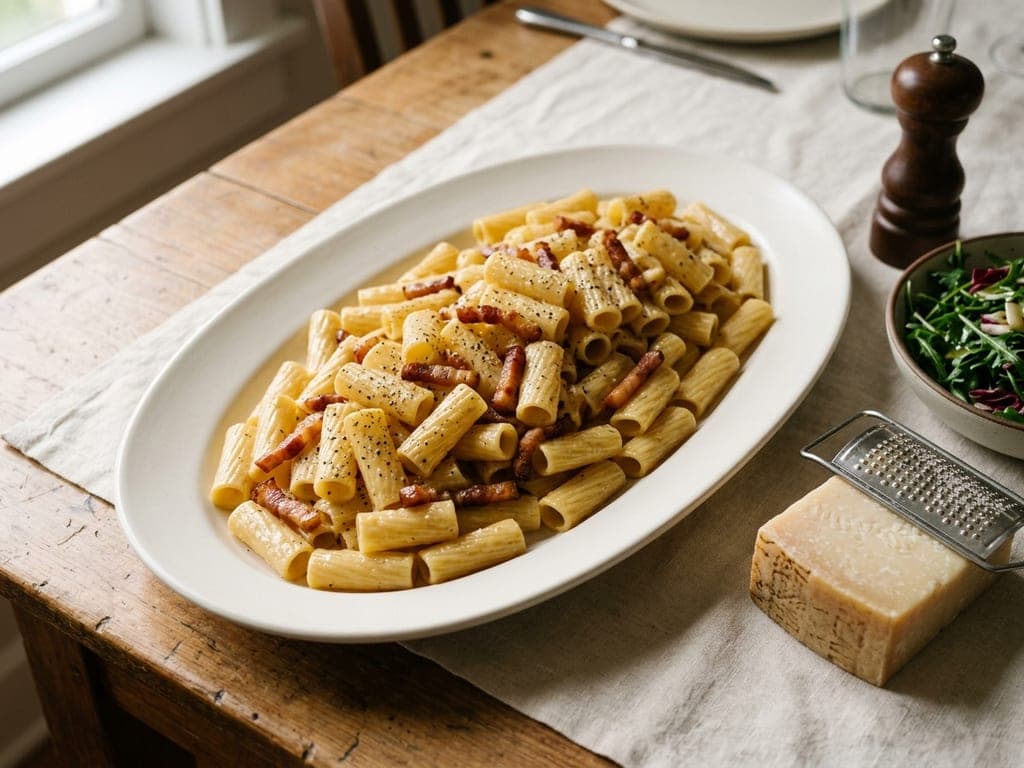
Serving it: wine, sides and leftovers
Carbonara is a dish with a deadline. The emulsion is perfect the moment it comes together and begins to tighten within two or three minutes as it cools and the cheese firms, so everything else — warm bowls, the table set, the wine open, the guests sitting — has to happen before the pasta comes out of the pot, not after. In a Roman trattoria it arrives in a shallow bowl, twirled high, with guanciale on top and nothing green anywhere near it. At home, warm the bowls with hot water from the pasta pot while the pasta cooks, and serve straight from the tossing bowl, keeping a few spoonfuls of reserved pasta water by the table to loosen the last portion if it has tightened.
It wants something sharp alongside, not something rich: a plate of bitter greens — chicory, puntarelle with anchovy dressing if you can get it, or a simple arugula (rocket) salad with lemon — and no bread, which has nothing to mop up and only adds starch to starch. For wine, Rome pours dry whites from the Castelli Romani — a Frascati — or a young, unoaked Cesanese — Lazio’s own red — served a little cool; the dish’s fat and salt want acidity and no tannin to speak of.
Leftovers are a compromise: the emulsion sets in the fridge and partly scrambles when reheated. Refrigerate within 2 hours and eat within 3 to 4 days in the US (48 hours under UK advice), reheating once, all the way to steaming hot, 165°F (74°C). Freezing is safe, and it is what UK advice suggests for leftovers you will not eat within 48 hours, but it is no kinder to the sauce than the fridge. The better move is a frittata: fold the cold pasta into three or four beaten eggs and cook it until set through, 165°F (74°C) at the center.
Why carbonara scrambles: the temperature window, three levers and the bain-marie
Carbonara’s sauce is an emulsion, a stable suspension of fat in water like a hollandaise or a mayonnaise, built in the bowl from four things: egg, whose proteins thicken when gently heated and whose yolk lecithin holds fat and water together; finely grated cheese, which melts into that matrix and seasons it; rendered guanciale fat; and starchy pasta water, whose dissolved starch both thickens the sauce and, crucially, gets in the way of the egg proteins as they try to bond to one another. Heat is what sets it, and the only heat allowed is the residual heat of the pasta. The burner is off. Pasta straight from the pot is far hotter than the egg can take, so the job is to bring the egg up gently, with enough water and constant motion, and to stop.
Every carbonara failure is a temperature failure, so it is worth knowing the numbers. Egg-yolk proteins begin to denature and thicken at around 150°F (65°C); egg-white proteins start to set a little earlier, around 145°F (63°C), and a mixture of the two with cheese and fat and starch folded in will look creamy through the 150s and begin to turn grainy — the proteins bonding into curds and squeezing out their water — at about 160°F (71°C), and is curds by 165°F (74°C); pure yolk on its own is already set at 158°F (70°C), so this recipe aims for about 150°F (65°C) and treats 158°F (70°C) as the line not to cross. Spaghetti straight from the pot is well above 160°F (71°C). The method, then, is a controlled crash: the pasta must lose enough heat to the pan, the fat, the bowl and the air to land the sauce at about 150°F (65°C), and the cook must keep everything moving so no single patch of egg sits against a hot surface long enough to curdle.
Three levers make that crash controllable. The first is tempering: whisking a few spoonfuls of hot pasta water into the egg paste before it meets the pasta raises its temperature gently and dilutes the proteins, so the shock of the pasta is smaller. The second is starch: dissolved starch from the pasta water physically interferes with protein-to-protein bonding, which is why the same egg that scrambles in a dry pan turns silky with a splash of cloudy water — cook the pasta in less water than the package suggests and the water will be starchier. The third is the pan itself: a heavy skillet holds a lot of heat, so the safest place to build the emulsion is the bowl the eggs are in, with the pasta tipped into it, rather than the skillet. Starred cooks work the same way. Monosilio’s rule is that carbonara is finished in a bowl, not the pan, so the egg is not stressed. Giorgio Locatelli beats the eggs and cheese in a warm bowl and tips the hot spaghetti in, because, he writes, it is easy to underestimate the heat of the pan. The step before it, blooming the pepper in the fat and loosening the pan with pasta water, is how Angelo Troiani starts his.
The starch matters for the cheese as much as for the egg. A 2025 study in Physics of Fluids heated Pecorino Romano in water, with no egg, and found that without starch it collapses into stringy, mozzarella-like clumps at around 149°F (65°C), right in carbonara’s working range; starch at 2 to 3 percent of the cheese’s weight kept the sauce smooth, and the authors found that pasta water alone does not carry enough starch to stabilize it. In carbonara the egg does part of that work, which is why the cheese goes into the egg first; the smaller pot of water does the rest.
The move that made one Roman chef’s name is a bain-marie, a bagnomaria. Luciano Monosilio worked it out as chef of Pipero al Rex, where he won a Michelin star in 2012 at 27, and a New York Times writer’s name for him, the King of Carbonara, stuck. He now cooks at his own Luciano Cucina Italiana near Campo de’ Fiori, which the Michelin Guide lists without a star; its inspectors write, “It is said that one of the capital’s finest carbonaras is served here, and we can only agree.” He treats the egg like a savory zabaione. Set a glass or steel bowl over the pot while the pasta cooks, without letting it touch the water. In it, whisk the yolks, the grated cheese, a spoonful of the rendered fat and a splash of pasta water until the mixture thickens, which Monosilio puts at about 140 to 149°F (60 to 65°C); he checks it by drawing a finger across the back of a coated spoon. When the pasta is done, take the bowl off and lift the pasta straight into it with tongs, so the water stays in the pot and keeps boiling. Add a ladle or two of pasta water, toss, and set the bowl back over the pot for about a minute, tossing all the time; fold in the guanciale last. It is slower and fussier, it is much harder to scramble, and it is a restaurant refinement, not an old Roman habit. A bowl over a boiling pot can still take egg past 165°F (74°C) if you stop moving it, so it is a wider window, not a guarantee, and it does not pasteurize the egg (see Safety).
On the ratio: yolks alone give the richest, most saffron-colored sauce, and it tightens more as it cools. Whole eggs give a paler, looser sauce that scrambles more easily, because the white starts to set at about 145°F (63°C), a few degrees before the yolk. Starred chefs split on this. Monosilio uses one yolk per person and no white at all, because, he says, the white sets first. Angelo Troiani of Il Convivio Troiani insists on some white, 2 whole eggs and 4 yolks for four, because in his view the dish’s true aroma comes from the white, and Niko Romito’s published home recipe uses a whole egg per person plus 2 yolks. Italian recipes range from yolks only to one yolk per person plus a whole egg for every two. This recipe’s four yolks plus one whole egg for four sits in the middle: the white keeps the sauce pourable and the yolks keep it rich. None of these chefs puts cream in a carbonara; the famous starred dish that does, Heinz Beck’s fagottelli at three-star La Pergola, puts it in a filling, not a sauce (see below).
How Michelin-starred kitchens make it
Starred chefs agree on carbonara about as much as Roman grandmothers do, but they publish their numbers, and the numbers are useful. For comparison, this page uses, per 3.5 oz (100 g) of dry pasta, 1.3 oz (37 g) of guanciale, one yolk plus a quarter of a whole egg, and 0.9 oz (25 g) of Pecorino Romano.
Luciano Monosilio, who won his star at Pipero al Rex, works by ratio: one yolk and 1.8 oz (50 g) of guanciale for every 2.5 oz (70 g) of pasta, yolks only. For 10 oz (280 g) of pasta, four plates in his restaurant, that is 4 yolks, 7 oz (200 g) of guanciale and about 1.8 oz (50 g) of Pecorino Romano and Grana Padano together in the cream. His split between the two cheeses has shifted over the years: his 2019 rules lean on pecorino, while his 2024 and 2026 versions lean on Grana in the cream, for a more delicate flavor, with more pecorino grated over the top. Ounce for ounce of pasta, his carbonara carries more yolk, nearly twice the guanciale and about a quarter less cheese in the sauce than this recipe, so it is porkier and milder where this one is sharper and saltier. To cook his balance with 14 oz (400 g) of spaghetti, use 6 yolks, 10 oz (285 g) of guanciale and 2.5 oz (70 g) of mixed cheese.
Niko Romito, whose Reale in Castel di Sangro has held three stars since the 2014 guide, gives a home version in his 2015 cookbook Unforketable: 14 oz (400 g) of mezze maniche and 14 oz (400 g) of guanciale for four, 4 whole eggs plus 2 yolks, 1.4 oz (40 g) of pecorino and 2.1 oz (60 g) of Parmigiano-Reggiano. There is no water bath: the drained pasta goes into the bowl with a small ladle of its water.
Angelo Troiani, whose Il Convivio Troiani in Rome has held its star since 1993, uses 2.1 oz (60 g) of guanciale, 1 oz (30 g) of mild aged pecorino, and 2 whole eggs plus 4 yolks for four. He lifts most of the guanciale out of the pan, adds a splash of water to stop the cooking and the pepper so it hydrates, and tosses the pasta there to draw out its starch before any egg goes in. He warns that too much cheese is one of the commonest mistakes, because the egg has to stay the lead, and he calls a raw, liquid egg the most typical and unacceptable one: to him, carbonara should smell of cooked egg.
Giorgio Locatelli, whose Locanda Locatelli in London held a star from 2003 until its last service in December 2024, beats 5 yolks and 1 whole egg with young pecorino in a warm bowl for 18 oz (500 g) of spaghetti, and crushes the peppercorns in the guanciale pan, loosening them with pasta water. It is easy, he writes, to underestimate the heat of the pan, which is why his eggs wait in a bowl.
What they share matters more than where they differ. Every one of them keeps the egg away from a live flame, every one uses the pasta water, and none puts cream in a carbonara. They differ on the egg (yolks only or some white) and the cheese (pure pecorino or a blend), the two choices this recipe leaves to you.
When starred kitchens play with it, they rebuild it rather than restyle it. At La Pergola, Rome’s only three-star restaurant, Heinz Beck put the sauce inside the pasta: his fagottelli are filled with yolks whisked over a water bath with pecorino and white pepper, cooled and lightened with whipped cream, then served with guanciale, diced zucchini and a veal-stock sauce and finished with Tellicherry pepper. He wanted carbonara’s personality in a lighter, more digestible form; “They explode in the mouth,” he told The Guardian. Antonello Colonna first made his Negativo di carbonara, star-shaped egg-pasta ravioli filled with a water-bath cream of egg and cheese on a pool of crème fraîche and pecorino fonduta, in 2000, and told Identità Golose in 2018 that he cannot take it off the menu; his restaurant in Labico holds one star. At one-star All’Oro in Rome, Riccardo Di Giacinto created a Riassunto di carbonara in 2011: every carbonara ingredient except the pasta, served in an eggshell. And Troiani turned it into a dessert, with pastry cream and ricotta for the egg, coconut for the pecorino, candied orange peel for the guanciale and cacao nibs for the pepper. None of these is a carbonara recipe; all of them show how precisely the original is understood.
A note on names, because menus and articles blur them. In the 2026 Michelin Guide, La Pergola holds three stars and Pipero Roma, the restaurant where Monosilio won his, holds one under chef Ciro Scamardella; Alessandro Pipero says its carbonara has always been made the classic way, and it sells a take-home kit built on mezze maniche. Luciano Cucina Italiana is in the Guide without a star. The trattorie most visitors queue for hold no stars at all: that includes Roscioli, where Monosilio says he first saw carbonara made well, Da Enzo al 29, Armando al Pantheon and Da Danilo.
Guanciale, pecorino and eggs: what to buy and what to swap
Guanciale is cured pork jowl — the cheek — salted, peppered and hung for weeks until the fat is dense and ivory and the meat is deep rose. It is the Roman choice and it is worth seeking out, because jowl fat renders softer and more completely than belly fat and tastes more of pork and less of smoke. Rendered slowly from a cold pan, it gives you two things at once: crisp-edged, chewy-centered pieces to scatter over the top, and a few tablespoons of clear, peppery fat that form one half of the emulsion. Luciano Monosilio buys guanciale cured for at least four months and seasoned with black pepper rather than chili, and trims off both the rind, which he says carries rancid notes, and the peppery cured crust, which turns bitter in the pan.
Guanciale first, and not for reasons of purity. Jowl is far fattier than belly — roughly two-thirds fat — and that fat renders into something closer to a clear, fragrant oil than the slightly waxy fat of pancetta; the lean is softer and chews rather than shatters. The cure is usually salt, black pepper and sometimes rosemary or a rub of garlic, and there is no smoke, so it does not pull the dish in a direction the cheese has to fight. A well-stocked Italian deli, a good cheese counter, or an online specialist will have it, and a piece keeps in the fridge for weeks.
Pancetta is the same kind of cure on pork belly, sold flat (tesa) or rolled (arrotolata), and the unsmoked kind, pancetta dolce, is the nearest substitute in both flavor and behavior. Check the label: in Italy and across Europe a lot of supermarket pancetta, the diced cubetti especially, is pancetta affumicata, which is smoked and cooks like bacon. It renders a little less fat, so you may want to add a teaspoon of olive oil to the cold pan to get it started, and its lean is meatier and goes crisper. Buy it as a piece and cut your own batons; the pre-diced cubes sold in tubs are too small and go straight to crunchy.
Bacon is where honesty matters. American bacon (which is streaky bacon to a European reader — the British default cut is back bacon, much leaner) is smoked, and smoke is a dominant flavor: a carbonara made with it is a genuinely good dish, and it is what carbonara means in most kitchens outside Italy, but it tastes of smoke and bacon first and of cheese and pepper second. If bacon is what you have, use a thick-cut, lightly smoked one, cut it into wide pieces, and render it exactly as you would guanciale. Leave out half the pepper, which fights the smoke, and do not apologize for it at the table. It is not the Roman dish; it is a good dinner. What does not work at all is anything that will not render: ham, prosciutto and turkey bacon give you no fat to build the emulsion on, and the sauce has nothing to hold.
Pecorino Romano is a hard, aged sheep’s-milk cheese whose protected zone is the whole of Lazio, the whole of Sardinia — where most of it is now made — and the Grosseto province of Tuscany, and it is salty and sharp in a way that Parmigiano-Reggiano is not — it is the reason a good carbonara tastes bright rather than merely rich. Grated fine, it dissolves; grated coarse, it clumps. Many Roman cooks soften its edge with a share of Parmigiano-Reggiano or Grana Padano, and history is on their side: the first cookbook carbonara, in Felix Dessì’s La signora in cucina of 1955, called for Parmesan with pecorino as the sharper option, and Parmesan stayed the usual cheese well into the 1960s. Starred kitchens blend too (see above). Half-and-half is a reasonable home choice; the recipe here is pure pecorino because that is today’s reference point, and you can move toward Parmigiano from there. Buy a wedge with the Pecorino Romano DOP (PDO) seal. In the US, cheese sold simply as “Romano” may legally be made from cow’s, sheep’s or goat’s milk, and American pre-grated Romano and Parmesan may carry an anti-caking agent such as cellulose, which keeps them from melting smoothly. Pre-grated Pecorino Romano DOP must be pure cheese with nothing added, but a wedge grated on a microplane still gives the finest, fastest-melting powder.
Black pepper is not a garnish here but a named ingredient, cracked coarse so it reads as flecks, and half of it bloomed in the hot fat, where its aroma opens up. The eggs are the sauce’s body, and the section on scrambling explains the ratio. The pasta water is the fifth ingredient most recipes leave off the list: its starch is the insurance policy, and it is why the recipe tells you to save more than you think you need.
Creamy carbonara, chicken carbonara, and the other things people call carbonara
Outside Rome the word has a wider meaning, and pretending otherwise helps nobody. Creamy carbonara — a cup (240 ml) of heavy cream (double cream) with Parmesan and bacon, sometimes with a single egg stirred in at the end, sometimes with none — is a real and well-loved home dish across the US, the UK and northern Europe, and it descends honestly from those Italian cookbook recipes of the 1960s that used cream too. It is easier to make, impossible to scramble, and it tastes of cream and bacon rather than of egg and cheese. If that is what you want, make it on purpose and call it what it is; the egg-emulsion on this page is a different dish, and not a harder one once you have done it twice.
Stars outside Italy do not settle the argument either. Gordon Ramsay, whose Restaurant Gordon Ramsay in London holds three stars, publishes a ten-minute carbonara with crème fraîche, peas, mushrooms and chili. A Heston Blumenthal recipe (The Fat Duck, three stars) starts from slow-cooked onions, garlic, smoked bacon and green chili, and Angela Hartnett of one-star Murano adds garlic, chili flakes and parsley to hers. Good cooks and good dinners, but not the Roman dish.
Chicken carbonara is the American restaurant-chain extension of the creamy version — sliced chicken breast, cream, bacon, peas sometimes — and it is a complete dinner where the Roman dish is a first course. Carbonara sauce, as a thing people search for and jar companies sell, is usually a cream-and-cheese sauce with bacon flavor; the Roman sauce cannot be jarred because it does not exist until the pasta is in the bowl. All of these are fine things to eat. The small, civil request from Rome is just that the cream version not be presented as the original.
The four Roman pastas, and where carbonara sits
Rome’s pasta canon is four dishes that share a pantry: cacio e pepe, gricia, amatriciana and carbonara. Cacio e pepe is the base — pasta, Pecorino Romano, black pepper and starchy water, an emulsion with no fat but the cheese’s own. Add guanciale and you have gricia, the shepherd’s dish, which is the one most Romans will tell you is the ancestor of the other two. Add tomato to gricia and you have amatriciana, the dish of Amatrice in the hills north-east of Rome. Add egg to gricia and you have carbonara. Seen that way, carbonara is not a strange outlier with raw egg in it; it is the richest member of the gricia family. That family tree is a cook’s map rather than a pedigree: the earliest carbonara recipes used pancetta, bacon or ham with Parmesan, guanciale arrived in the 1960s and pecorino became the rule only in the 1990s. The dish grew toward its siblings, and today it shares their pantry.
The family resemblance is also a diagnostic. If you can make a cacio e pepe that does not clump — cheese and pepper and water tossed into a sauce with no egg to help — you understand the emulsion, and carbonara is cacio e pepe with a safety net. If your carbonara keeps splitting, go back and make gricia a few times: same guanciale, same cheese, same pasta water, no egg to scramble, and the fat-and-starch glaze it teaches is the foundation the egg sits on.
A dish from 1939, or a little older? The history, dated
Carbonara feels ancient and is not. It is absent from Ada Boni’s La cucina romana of 1930, the book that set down the Roman repertoire (it does include amatriciana and cacio e pepe), and no printed Italian source before the Second World War names it. Naples came close: Vincenzo Corrado’s Il cuoco galante (first printed in 1773) used egg to bind timbales, fritters and pasta in broth, while pasta dressed with cheese, egg and lard, the cacio e uova that are plainly relatives, shows up in Neapolitan cookbooks only in the nineteenth century; Luca Cesari dates the first clear recipe to Francesco Palma’s Il principe dei cuochi of 1881. For decades the printed trail was thought to start after the war, and every early trace points to the same corner of Rome: a 1 May 1948 piece in Il Giornale di Trieste praising the “steaming, fragrant” spaghetti alla carbonara served on Piazza di Santa Maria in Trastevere; the 1949 Totò film Yvonne la Nuit, in which a waiter calls “spaghetti alla carbonara for three” in a trattoria on that same square; and a 26 July 1950 article in the Turin newspaper La Stampa naming the host of Cesaretto alla Cisterna, also in Trastevere, as the first to welcome American officers who came looking for spaghetti alla carbonara.
The closest pre-war relative on record is Umbrian: the 1931 Touring Club Italiano guide describes strascinati from Cascia dressed with beaten eggs, sausage and fat and lean pork, a dish Cesari has called carbonara’s grandmother.
The first printed recipes appeared in 1952, and neither was in Italy. On 20 April the French Catholic daily La Croix du Nord printed one credited to the Roman actor Aldo Fabrizi, made with fried bacon, butter, oil, egg and grated cheese, and Patricia Bronté’s Chicago restaurant guide Vittles and Vice, published the same year, gave the version served at a restaurant called Armando’s: tagliarini, Italian bacon, eggs and Parmesan. The first Italian printed recipe followed in August 1954 in the magazine La Cucina Italiana, and it would not pass a Roman purity test today: pancetta, Gruyère and a clove of garlic. Elizabeth David’s Italian Food, published in London the same year, calls it “a Roman dish” and makes it with ham or coppa softened in butter, beaten eggs and Parmesan.
Then, in early 2026, the story moved. A reader of the Dutch daily NRC, Koos Stadhouders, found a 23 August 1939 article in Delpher, the Dutch national newspaper archive, and the paper’s food writer Janneke Vreugdenhil reported it on 23 January; she and Edwin Winkels then took it to Italy’s historians. It ran in De Koerier, a Dutch-language daily in Batavia (now Jakarta), signed “N.K.”: the Rome correspondent Norah Koch Berkhuijsen. On Piazza di Santa Maria in Trastevere, she wrote, two trattorie were “peaceful competitors” whose owners had been friends from father to son, one known for risotto with shrimp and the other, Alfredo (not the fettuccine Alfredo of Via della Scrofa), for “spaghetti alla carbonara,” which she glossed in Dutch as “strings, the way the charcoal burner’s wife makes them.” One line, no recipe, and nearly five years before Allied troops entered Rome in June 1944. Luca Cesari and Alberto Grandi, the historians who had built the post-war case, confirmed it; Cesari said the history of carbonara would have to be rewritten completely.
Until that find, the origin story most food historians took seriously, and the one Cesari set out in his history of pasta, was that carbonara grew out of an encounter between Roman cooking and Allied army rations: bacon and powdered egg, which American soldiers had in quantity in 1944, combined by Roman cooks with the local habit of dressing pasta with cheese and cured pork. A Bolognese cook, Renato Gualandi (1921 to 2016), told for decades, in print from at least 1991, how he invented the dish on 22 September 1944 in Riccione, cooking for Allied generals after the liberation of Rimini, because “the Americans had fabulous bacon, very good cream, some cheese and powdered egg yolks.” The skeptics were never convinced, and Cesari notes that the detailed account of that lunch in Gualandi’s own 2006 autobiography never mentions carbonara. After 1939 the story can at most explain one bacon-and-cream version, not the dish or its name. Grandi’s own reading now is that the Americans remain central to the dish as it spread, but that the name has an older and more complicated life. The etymologies remain unproven: the carbonai, the charcoal burners of the Apennines; the Carbonari, the nineteenth-century secret society; black pepper like coal dust. The 1939 article does not settle it, because its author was translating the Italian name, not explaining it. Aart Heering, the journalist who identified her, reads alla carbonara as “in the charcoal burners’ manner” rather than anyone’s wife, and Grandi still rates the charcoal-burner story as thin.
What is well documented is how recently the recipe settled. Many Italian printed versions from the 1960s to the 1980s include cream, starting with Luigi Carnacina’s influential La grande cucina of 1960, which was also the first to specify guanciale. It reached the very top: Gualtiero Marchesi, whose Milan restaurant became the first in Italy to hold three Michelin stars in 1985 (he handed them back in 2008), published a carbonara in 1989 with about 1 cup (250 ml) of cream to 14 oz (400 g) of spaghetti. Only in the 1990s did the cream, garlic, onion, wine and parsley fall away and the egg, guanciale and pecorino version harden into orthodoxy. That is the backdrop to the row of March 2023, when the University of Parma historian Alberto Grandi told the Financial Times that carbonara was an American recipe (the same piece quoted Cesari calling it “an American dish born in Italy”), and half of Italy’s food press rose to object. Both sides had a point then and both have one now: the dish is Roman in every way that matters to the tongue, and it is younger than television. Italy’s pasta makers, for their part, have celebrated Carbonara Day every 6 April since 2017.
Is carbonara healthy? The numbers
A serving of this recipe — a quarter of 14 oz (400 g) of spaghetti, 1.3 oz (37 g) of guanciale, one yolk and a quarter of a whole egg, and 0.9 oz (25 g) of Pecorino Romano — comes to roughly 770 calories, about 36 g of fat (around 15 g saturated), 30 g of protein and 75 g of carbohydrate. The pasta is about 360 of those calories, the guanciale and its fat about 240 (assuming most of the rendered fat goes into the sauce; pour off a tablespoon and you drop about 30 a plate), the cheese about 100, the egg about 70. That is a generous Italian first course, since Italy’s dietary guidelines count 2.8 oz (80 g) of dry pasta as a standard serving and Luciano Monosilio plates 2.5 oz (70 g), and a fair American main course; an American pound (1 lb / 450 g) of pasta for four adds around 50 calories a plate.
Sodium is the real problem. Pecorino Romano is among the saltiest cheeses sold, guanciale is a cured meat, and the pasta absorbs salt from its water; this serving lands somewhere around 1,100 to 1,600 mg of sodium, depending mostly on the guanciale’s cure, which is between about half and 70 percent of the 2,300 mg daily limit in the Dietary Guidelines for Americans, 2025 to 2030. The recipe already halves the salt in the pasta water for this reason, and the next lever is the cheese: Genuine Parmigiano-Reggiano carries about a third of the sodium of Pecorino Romano (about 650 mg against 1,750 to 1,970 mg per 3.5 oz / 100 g, by the two consortia’s own figures), so a half-and-half blend saves a plate around 150 mg and an all-Parmigiano version around 300, a gentler dish, still recognizably itself. The saving needs the real thing: US domestic “Parmesan” is salted much closer to Romano (USDA lists about 1,180 mg against 1,430 mg per 100 g), so swapping it in changes the flavor far more than the sodium. (A note on the salt itself: a tablespoon of coarse salt weighs anywhere from 8 g to 15 g depending on the brand, which is why the recipe gives the gram figure.)
What carbonara is not is a dish to make lighter by substitution. Low-fat cheese will not melt into an emulsion; turkey bacon renders no fat to build one; egg whites alone make a rubbery sauce. The better strategy is the Italian one — a smaller portion as a first course, a plate of bitter greens beside it, and no bread — and to make it rarely and well rather than often and compromised.
Questions, answered
What are the four ingredients in carbonara?
Guanciale (cured pork jowl), eggs, Pecorino Romano and black pepper — plus the pasta and a splash of its starchy cooking water, the fifth ingredient most recipes leave off the list, and the one that turns the other four into a sauce. That is the Roman version. No cream, no garlic, no onion, no parsley, no butter and no oil beyond the fat the guanciale renders.
What is real carbonara sauce made of?
Egg — yolks with some whole egg — whisked with finely grated Pecorino Romano and black pepper, then emulsified with rendered guanciale fat and starchy pasta water using only the residual heat of the just-cooked pasta. It is not a sauce that exists before the pasta goes in; it is made in the bowl, in about a minute, and it contains no cream. The creaminess comes from the egg proteins thickening gently and the cheese melting into them.
How do I make a simple carbonara?
Render guanciale (or pancetta) batons slowly in a cold pan until crisp-edged; boil spaghetti in lightly salted water; whisk 4 yolks and 1 whole egg with 3.5 oz (100 g) of finely grated Pecorino Romano and cracked pepper. Lift the pasta out with tongs, saving 1 1/2 cups (360 ml) of its water; toss it in the pork fat with the burner off, then tip it into the egg bowl and toss hard for a minute, adding pasta water a tablespoon at a time until glossy. Serve at once. Four ingredients, about 35 minutes, one rule: no flame under the egg.
What is the secret to good carbonara?
Heat control: the egg must be warmed to a thick, glossy emulsion, about 150°F (65°C), and never cooked, so the pan is off the heat before the egg arrives and starchy pasta water is added a spoonful at a time while you toss constantly. The three supporting secrets are grating the cheese to a powder and whisking it into the egg first (no clumps), rendering guanciale slowly from a cold pan (fat and flavor), and saving far more pasta water than you think you need.
What is carbonara?
A Roman pasta dish — classically spaghetti, also rigatoni — dressed with an emulsion of egg, Pecorino Romano, rendered guanciale and black pepper, with no cream. It is one of Rome’s four canonical pastas alongside cacio e pepe, gricia and amatriciana, and despite its reputation it is a young dish: the earliest known mention is a 1939 Dutch newspaper article describing a trattoria in Trastevere, and the first printed recipes appear in 1952 and 1954, in France, Chicago and Italy, a few years after the Second World War.
Can I use bacon or pancetta instead of guanciale?
Yes — pancetta is the closest substitute (same cure, pork belly instead of jowl; add a teaspoon of oil to get it rendering), and thick-cut streaky bacon works but adds smoke, which makes it a different, still-good dish. Cut either into wide pieces rather than tiny dice so they stay chewy inside, render from a cold pan, and with bacon use half the pepper. Outside Italy, bacon carbonara is what most people mean by the word, and there is no shame in it.
Parmesan or Pecorino Romano for carbonara?
Pecorino Romano is the Roman choice and gives the dish its sharp, salty brightness; Parmigiano-Reggiano is milder, nuttier and less salty. Roman cooks and starred chefs alike often blend in Parmigiano-Reggiano or Grana Padano; half and half is a fair home choice, and pure Parmesan makes a gentler, rounder carbonara that some people prefer. Whichever you use, buy a wedge and grate it very finely; American pre-grated cheese is drier and usually carries an anti-caking agent such as cellulose, so it stays in grains instead of melting into the sauce.
Why did my carbonara scramble, and how do I fix it?
The egg got hotter than about 160–165°F (71–74°C): usually because the pan was still on the burner, the skillet was too hot when the egg went in, or there was not enough pasta water to dilute and protect the proteins. To rescue a sauce that is just starting to grain, add pasta water immediately and toss fast off the heat; once it has fully curdled it cannot be un-scrambled. Next time, build the emulsion in the egg bowl rather than the skillet, temper the egg with a few spoons of hot water first, keep tossing, and the first few times push an instant-read probe thermometer into the middle of the sauced pasta: about 150°F (65°C) is the target, and 158°F (70°C) is too far.
Why is my carbonara runny, and how do I thicken it?
It did not get warm enough. The egg only thickens at about 150°F (65°C), and pasta that sat in a cooling pan, went into a cold bowl or was loosened with too much water can land below that. Set the bowl over the pot of barely simmering pasta water, with its base clear of the water, and toss for 15 to 20 seconds at a time until the sauce turns glossy and clings to the pasta. Do not put it back over a direct flame, where it scrambles in seconds. Next time, move the pasta straight from the pot to the pan and on to the egg without pausing, and stop adding water a little sooner.
Egg yolks or whole eggs for carbonara?
Both work, and they make different sauces. Yolks alone give the richest, deepest-colored sauce, which tightens more as it cools; whole eggs make it paler and looser and easier to scramble, because the white sets a few degrees before the yolk. This recipe uses 4 yolks plus 1 whole egg for 14 oz (400 g) of spaghetti, a middle path. Starred chefs split: Luciano Monosilio uses yolks only, one for every 2.5 oz (70 g) of pasta, while Angelo Troiani of Il Convivio Troiani uses 2 whole eggs and 4 yolks for four because, he says, the aroma comes from the white.
Is carbonara safe to eat with the egg barely cooked?
For healthy adults the risk from a lightly cooked egg is small; US guidance (FDA and USDA) is nonetheless that any dish served with raw or undercooked egg be made with pasteurized eggs, and that matters most for anyone pregnant, under 5, over 65 or immunocompromised — for them it is not optional. Pasteurized shell eggs work identically in the recipe. In the UK, the Food Standards Agency says hen eggs with the British Lion mark (its advice since 2017) or from the Laid in Britain scheme (added in 2021) can be eaten lightly cooked by pregnant people, babies, children, older adults and people with conditions such as diabetes; people who are severely immunocompromised should follow their own medical advice, and vulnerable people should eat any other eggs, imported ones included, only thoroughly cooked. When eating out, where you cannot check the eggs, the FSA’s advice for vulnerable people is to avoid lightly cooked egg dishes.
Why is there no cream in carbonara?
Because the egg and cheese emulsion is the cream: yolk proteins thicken as they warm, cheese melts into them, and starchy pasta water and guanciale fat bind the whole into a glossy coating without any dairy cream at all. Cream was common in Italian printed recipes of the 1960s–80s and dropped out as the dish standardized; today the Roman version treats it as a crutch that masks the egg and cheese. Adding a tablespoon as a stabilizer works and is nobody’s business but yours.
Can I make carbonara creamy without cream?
Yes, and this is the whole technique: whisk the finely grated cheese into the egg before it meets heat, take the pan off the burner, and add hot starchy pasta water a tablespoon at a time while tossing constantly until the sauce flows like satin. Using a whole egg alongside the yolks keeps it pourable; a bain-marie — the egg bowl set over the pasta pot — makes it much harder to scramble. The creaminess is an emulsion of egg, cheese, fat and starch, and water is the ingredient that makes it flow.
Can I reheat carbonara?
You can, but it will not be the same dish: the emulsion sets in the fridge and partly scrambles on reheating. The best method is a pan over low heat with a splash of water, stirring constantly, taken all the way to steaming hot throughout — 165°F (74°C) — because egg-based leftovers should be reheated properly, not just warmed. Refrigerate within 2 hours of cooking, keep 3–4 days (US guidance) or 48 hours (UK guidance), reheat once, and if you freeze it, know that it is safe but will not help the texture. The honest alternative is a frittata: fold the cold pasta into beaten eggs and cook it through to 165°F (74°C), the leftover-and-meat figure.
How many calories are in carbonara?
This recipe comes to roughly 770 calories per serving, based on 3.5 oz (100 g) of dry spaghetti, 1.3 oz (37 g) of guanciale with most of its rendered fat, one yolk plus a quarter of a whole egg, and 0.9 oz (25 g) of Pecorino Romano per plate. Around 1,100–1,600 mg of sodium comes with it, mostly from the cheese and cured pork.
What pasta shape is best for carbonara?
Spaghetti is the classic, and a bronze-cut spaghetti with a rough surface holds the emulsion best; rigatoni and mezze maniche (short, wide tubes) are the other shapes Romans use, and their ridges and hollows trap sauce and guanciale. Dried fettuccine and bucatini work. Avoid very thin pasta like angel hair, which cools too fast and overcooks, and avoid fresh egg pasta, which is too soft and already rich.
Where does carbonara come from, and what does the name mean?
Rome, but recently, and the date keeps moving: it does not appear in Ada Boni’s 1930 Roman cookbook; the earliest mention found so far is a 23 August 1939 Dutch newspaper article naming spaghetti alla carbonara at a Trastevere trattoria, a find first reported by the Dutch newspaper NRC in January 2026 that pushed the dish back before the war; the first printed recipes are from 1952 (France and Chicago) and 1954 (Italy). The long-standing theory that it grew from Allied bacon-and-egg rations in 1944 now explains at most the version, not the name. The name itself is unexplained: charcoal burners (carbonai), the Carbonari secret society and pepper like coal dust have all been proposed, and the 1939 writer’s Dutch gloss, “the way the charcoal burner’s wife makes them,” translates the name rather than explaining it.
Does carbonara have garlic?
Not the Roman version, which is guanciale, egg, Pecorino Romano and black pepper. Garlic turns up in plenty of home recipes, and the first recipe printed in Italy, in La Cucina Italiana in August 1954, used a clove of it with pancetta and Gruyère.
How do Michelin-starred chefs make carbonara?
Mostly the way this page does: away from a live flame, with starchy pasta water, and without cream. The best-known starred technique is Luciano Monosilio’s water bath, which he worked out as chef of Pipero al Rex, where he won a Michelin star in 2012; his own restaurant today, Luciano Cucina Italiana, is in the Guide without a star. He whisks yolks, Pecorino Romano and Grana Padano over the pasta pot to about 140 to 149°F (60 to 65°C), and uses one yolk and 1.8 oz (50 g) of guanciale for every 2.5 oz (70 g) of pasta. Starred chefs disagree about the egg: Monosilio uses yolks only, while Angelo Troiani of one-star Il Convivio Troiani insists on some white for its aroma.
Snap your finished plate and let the AI plate it again — more beautifully.