Soft Dinner Rolls Recipe: Make-Ahead, Done at 190°F (88°C)
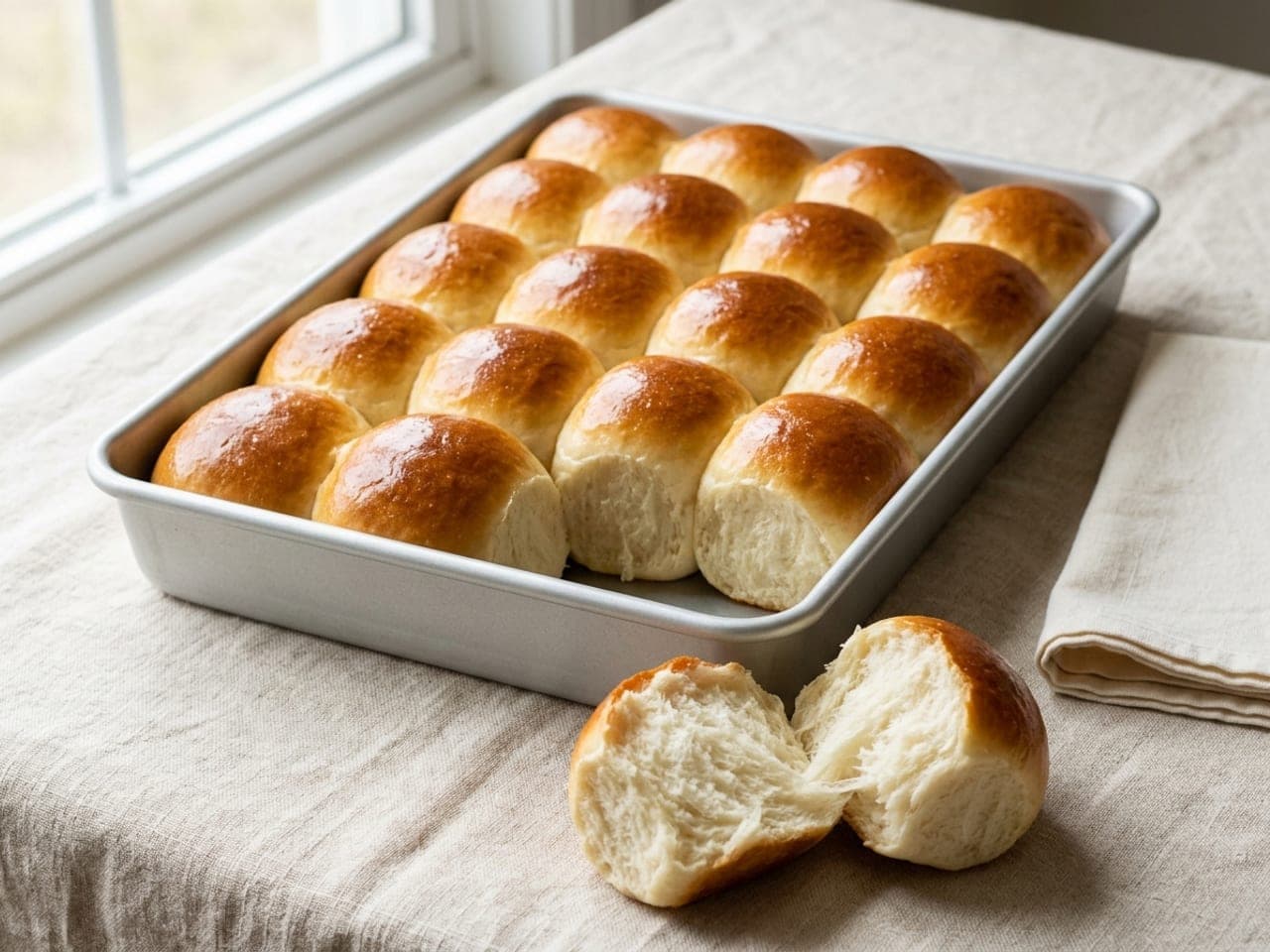
Soft, buttery pull-apart dinner rolls for the Thanksgiving bread basket: 16 rolls from one 9x13-inch (23x33 cm) pan, enriched with milk, butter and egg, plus a small cooked flour paste (tangzhong) that keeps them soft into day three. They’re done at 190°F (88°C) in the center, the number the top-ranking recipes leave out, and the plan covers every make-ahead route with real windows: overnight in the fridge, frozen unbaked, par-baked the 1949 Brown ’n Serve way, or baked and frozen. Four shapes from one dough, honey butter, and the history the internet gets wrong: “Parker House rolls” were in print by May 1868, not invented in the 1870s. Vegetarian; contains wheat, milk and egg.
Ingredients
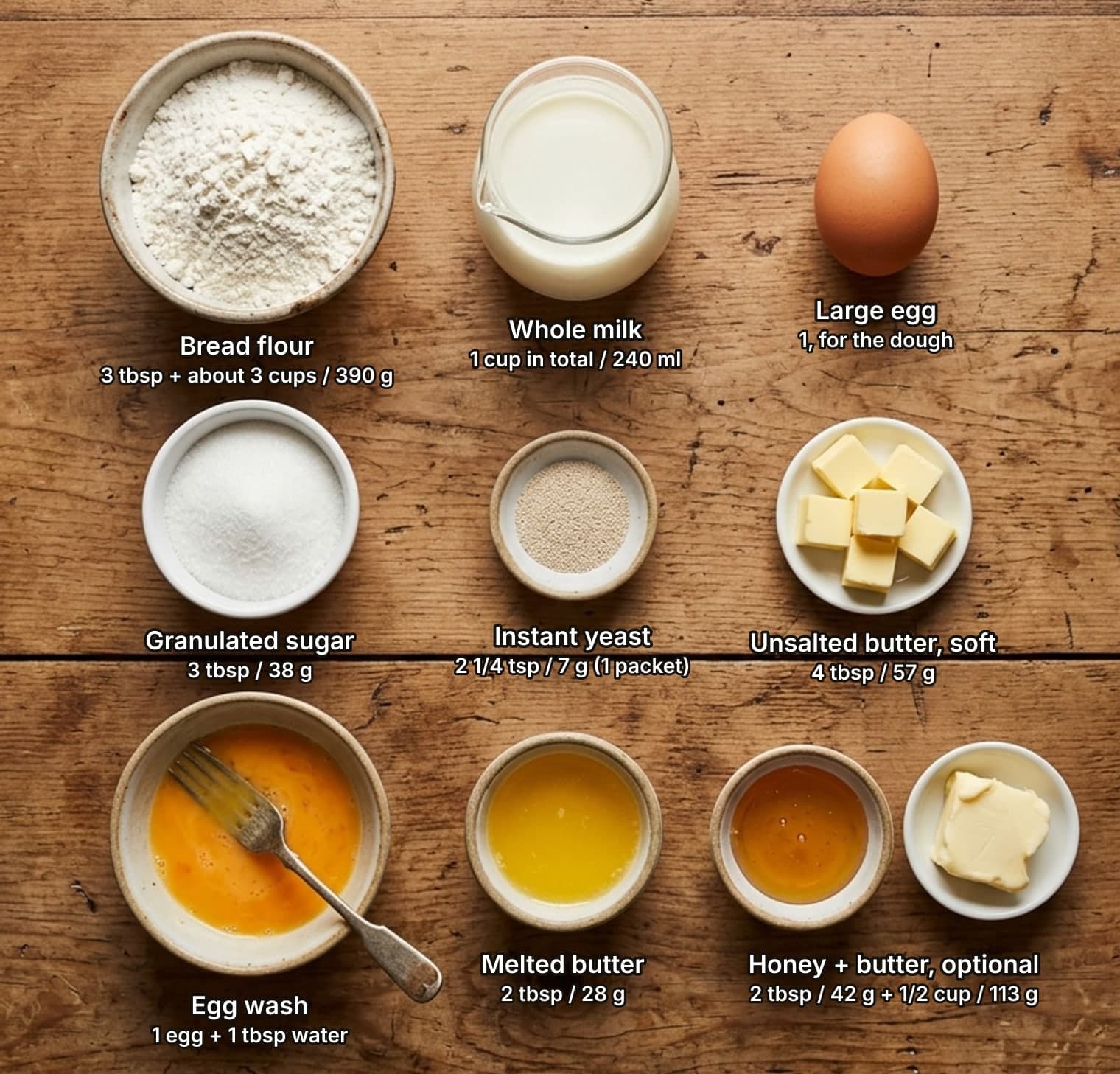
- bread flour (strong white bread flour in the UK) for the tangzhong paste; unbleached all-purpose also works. Contains wheat3 tbsp (25 g)
- whole milk for the tangzhong paste (UHT or ultra-pasteurized milk is ideal, see the scalded-milk FAQ). Contains milk1/2 cup (120 ml)
- whole milk, cold from the fridge (it finishes cooling the paste, so the dough lands near its target temperature)1/2 cup (120 ml)
- large egg, out of the fridge for about 30 minutes (USDA: no more than 2 hours). Contains egg; for egg-free rolls leave it out and add 3 tbsp (45 ml) more milk1
- bread flour for the dough, spooned and leveled or, better, weighed (all-purpose works with no other change and bakes a touch more tender)about 3 cups (365 g)
- granulated sugar3 tbsp (38 g)
- instant yeast or active dry yeast (no need to dissolve active dry first; it just rises 15 to 20 minutes slower). For rolls frozen unbaked longer than 2 to 3 days, use 2 3/4 tsp (8.4 g)2 1/4 tsp (1 packet, 7 g)
- fine table salt (with Diamond Crystal kosher salt, about 2 1/2 tsp)1 1/4 tsp (7.5 g)
- unsalted butter, soft and pliable but not melted, cut into 8 pieces, plus a little extra for the bowl and pan. Contains milk4 tbsp (57 g)
- egg wash: 1 large egg beaten with 1 tbsp water (you will use about half; not counted in the nutrition). Egg-free: soy milk with a little maple syrup (contains soy)1 egg + 1 tbsp water
- unsalted butter, melted, to brush the hot rolls2 tbsp (28 g)
- flaky sea salt, such as Maldon (optional; not counted in the sodium: about 0.2 g per roll adds roughly 78 mg sodium to each)about 3 g, a small pinch per roll
- for whipped honey butter (optional, for the table; not counted in the nutrition): unsalted butter, very soft1/2 cup (113 g)
- honey, for the honey butter (never for babies under 12 months)2 tbsp (42 g)
- flaky sea salt, for the honey butter1/4 tsp
The done number: 190°F (88°C), not “golden brown”
Every top-ranking dinner roll recipe we read (King Arthur, Martha Stewart, Sally’s Baking Addiction, Mom Loves Baking, The Country Cook and Food52) tells you to bake until golden brown, or until the rolls sound hollow when tapped. None gives an internal temperature. That is how one Food52 reader found the rolls “still a tad bit doughy” after the stated 14 minutes and “had to go for about 25 min.” Color is a poor guide for this kind of dough: milk sugar, egg and sugar all brown a crust fast, so an enriched roll looks finished before its middle is.
The number is 190°F (88°C) at the center of a roll from the middle of the pan. King Arthur uses 190°F (88°C) as its benchmark for most yeast breads and asks for “at least 190°F” (88°C) on its pull-apart butter buns; Serious Eats pulls its Parker House rolls at 190°F (88°C); and ThermoWorks’ own bread guide gives 180 to 190°F (82 to 88°C) for enriched doughs against 190 to 210°F (88 to 99°C) for lean ones. By then the egg and gluten proteins, which set between about 160 and 185°F (71 and 85°C), are cooked; much past 190 to 195°F (88 to 91°C), a soft roll starts to dry.
So why does the answer box for this question say 200 to 205°F (93 to 96°C)? It comes from a ThermoWorks post on Thanksgiving rolls, and it is a lean-bread number that sits above ThermoWorks’ own enriched range. On a buttery roll it simply bakes out moisture. Save it for crusty rolls.
Two more numbers frame it. The USDA publishes no doneness temperature for bread; the only official figure that applies is 160°F (71°C) for dishes containing egg (FoodSafety.gov), which a 190°F (88°C) roll clears by 30°F (17°C). And a par-baked roll stops at 175°F (79°C): set, but pale enough to brown later. To check, push a digital instant-read thermometer in from the side of a middle roll to its center. In 1871 a visitor to the Parker House kitchens watched the bakers pull their rolls “as soon as they became a genuine golden brown.” That color is still the look you want. The thermometer is how you know the inside matches it.
How to make Dinner Rolls
- Cook the tangzhong, let it cool, then add cold milk. In a small saucepan, whisk the 3 tbsp (25 g) of bread flour into 1/2 cup (120 ml) of the milk until smooth. Set it over medium-low heat and whisk constantly for 2 to 3 minutes, until it thickens into a soft pudding that holds the tracks of the whisk and reads 149°F (65°C) on an instant-read thermometer. Scrape it into the bowl of a stand mixer and let it cool, uncovered, for 10 to 15 minutes, until it reads about 104°F (40°C); weigh out the dough ingredients meanwhile. Then whisk in the remaining 1/2 cup (120 ml) of cold milk, then the egg. Why: in lab tests on wheat starch, more than 90% of it was gelatinized at 149°F (65°C) and above (Yamada and colleagues), so the paste swells and holds water that would otherwise leave the crumb as the rolls sit. That is what keeps them soft on day three. Why wait before adding the milk: a hot paste kills yeast, which dies at about 140°F (60°C), so keep anything the yeast touches under 100°F (38°C). Cold milk and egg alone would bring a just-cooked paste down to about 95°F (35°C), safe for the yeast, but the long knead then warms the dough well past its 75 to 78°F (24 to 26°C) target (step 3). With the paste cooled first, the mix lands at about 70°F (21°C) and the kneaded dough finishes close to the target.
- Mix, rest 10 minutes, then knead. Add the 365 g of bread flour, the sugar, yeast and salt to the bowl. Mix with the dough hook on low for about 2 minutes, until no dry flour remains; the dough will look shaggy. Cover the bowl and leave it for 10 minutes. Then knead on medium-low for 5 minutes, until the dough turns smooth and starts to pull away from the sides. Why the pause and why no butter yet: during the rest the flour hydrates and gluten starts forming on its own, and gluten is what gives these rolls their height. A cooked-flour paste works against gluten (Japanese yudane research found gelatinized starch inhibits gluten formation during mixing), and fat does too: America’s Test Kitchen found butter makes the gluten strands too slippery to grab each other, so it holds the butter back until the gluten is established. That was ATK’s fix for tangzhong rolls that baked up squat, and it is ours.
- Knead in the butter until the dough windowpanes. With the mixer on medium-low, add the 4 tbsp (57 g) of soft butter one piece at a time, letting each disappear before adding the next, about 2 minutes. Keep kneading for 6 to 8 minutes more, until the dough is smooth, glossy and slightly tacky and cleans the sides of the bowl. Test it: stretch a walnut-sized piece between your fingers; it should thin into a sheet you can almost see through before it tears (the windowpane test). By hand, allow 10 to 15 minutes on an unfloured counter, and resist adding flour, because the dough firms up as you work it. Why so long: King Arthur notes that butter, sugar and egg weaken a dough, “so a longer mixing time is typical,” and under-kneaded enriched dough leaks butter and bakes dense. Aim for a dough that finishes at 75 to 78°F (24 to 26°C), King Arthur’s target; check it with the thermometer, then wash the probe. If you skipped the paste’s cooling time it will run warmer, around 82 to 86°F (28 to 30°C). That only speeds the first rise, so start checking it at 45 minutes. In King Arthur’s tests, dough mixed with 120°F (49°C) water tasted bitter and acidic and dried out faster.
- Let it double. Shape the dough into a ball, set it in a lightly buttered bowl or straight-sided container, and cover. Leave it somewhere warm, ideally 75 to 78°F (24 to 26°C), until doubled, 60 to 90 minutes; add 15 to 20 minutes with active dry yeast. In a cold kitchen, a switched-off oven with only the light on works. Why: this is where the rolls get their gas and most of their flavor, and time follows temperature, so judge by size, not the clock. A strip of tape on the container at the starting level makes “doubled” easy to read. If you are making the rolls ahead, this is not the place to pause. For rolls frozen unbaked, skip this rise and shape the dough straight after kneading; the other make-ahead routes branch after shaping (step 6), where the timing is easiest to control.
- Divide by weight and shape tight balls. Turn the dough out onto an unfloured counter, press out the gas, and weigh it: it should be about 790 g. Cut it into 16 pieces of about 49 g each. To shape, cup your hand over a piece and roll it in small circles against the counter with light downward pressure until the underside seals and the top pulls into a smooth, tight skin. If the dough slides without gripping, wipe the counter with a damp cloth; if it sticks, butter your palm lightly (King Arthur’s fixes). Set the balls seam side down in a buttered 9x13-inch (23x33 cm) pan in 4 rows of 4. They won’t touch yet; they will once they rise. Cover the pan with greased plastic wrap or a lid rather than a bare towel, which lets the tops dry into a skin. Why weigh: equal rolls bake at the same rate, so a 190°F (88°C) reading on the middle roll speaks for all of them. Why tight and crowded: surface tension makes the rolls rise up instead of slumping, and packed into the pan they rise into each other “so that they crowd each other and become pull-apart rolls, with unbrowned sides” (King Arthur). For cloverleaf, Parker House, knot or round shapes, see the shapes section.
- Final rise (or the make-ahead fork). Cover the pan and let the rolls rise somewhere warm, no hotter than about 80°F (27°C), for 45 to 60 minutes, until puffy and touching: “puffed but not quite doubled,” as Serious Eats puts it. Poke the side of one gently: King Arthur’s cue is that the dent “should remain or slowly fill back in”; if it springs right back, give it 10 minutes more. About 30 minutes into the rise, heat the oven to 350°F (177°C) with a rack in the lower middle; if the rolls are rising in the oven, take them out before you heat it. Why the poke and not the clock: under-proofed rolls bake small and dense, and over-proofed dough deflates and bakes flat (The Country Cook). If the schedule slips, put the covered pan in the fridge rather than stretching its time on the counter. This is also the fork for making ahead: instead of this rise, the covered pan can go straight into the fridge overnight, or the risen rolls can be par-baked, and the make-ahead section picks up from here (rolls frozen unbaked fork earlier, straight after kneading).
- Egg wash, then bake to 190°F (88°C). Beat the egg with 1 tbsp water and brush a thin, even coat over the tops, without letting it pool in the gaps. Bake for 20 to 25 minutes, turning the pan halfway, until the tops are deep golden and a digital instant-read thermometer pushed in from the side of a roll in the middle of the pan reads 190°F (88°C) at its center. If the tops are dark before the middle gets there, lay a sheet of foil loosely over the pan. Why the thermometer: milk sugar (which yeast cannot ferment), egg and sugar brown an enriched crust early, so these rolls look done before they are, and the middle roll of a crowded pan is always the last to cook. Why 350°F (177°C): it gives the center of the pan time to reach 190°F (88°C) before the sugar-rich tops scorch. Small or spaced rolls can take 375°F (191°C).
- Butter them hot, rest 10 minutes, serve warm. The moment the pan comes out, brush the tops with the 2 tbsp (28 g) of melted butter (or the honey glaze in the finishes section), using a clean brush, not the egg-wash one, which carries raw egg and raw dough (wash that one in hot, soapy water). If you like, scatter flaky salt over the wet butter so it sticks. Leave the rolls in the pan for 10 minutes, then lift them out in one slab onto a rack or straight into a napkin-lined basket, and serve warm. Why butter now and not before: in Baker Bettie’s side-by-side wash test, butter brushed on before baking came out “pale and dull,” while butter brushed on after baking gave a crust that was “very golden and very shiny,” and it softens the crust as it soaks in. The short rest makes the slab easier to lift out in one piece. Time the bake so the rest ends as people sit down, rather than holding the rolls in a warm oven, where they keep drying. Leftovers keep airtight on the counter for 2 to 3 days; freeze any longer (the fridge slows mold but stales them fastest; see the make-ahead section).
Safety & hygiene Important
- Don’t taste the raw dough. The FDA is blunt: “Flour is a raw food,” “Processing raw grains into flour does not kill harmful bacteria,” and you should “Never eat or taste raw flour, dough, or batter.” It isn’t theoretical: E. coli in General Mills flour sickened 63 people in 24 states in 2015 and 2016 (17 hospitalized), and Salmonella in Gold Medal flour sickened 14 people in 13 states in 2022 and 2023 (CDC). This dough also contains raw egg. On Thanksgiving the dough often shares a kitchen with raw turkey and with dishes that won’t be cooked, so give it its own clean board and bowl, and keep flour and dough away from salads and boards (the FDA warns that “flour is a powder and spreads easily”). Wash your hands with soap for 20 seconds before and after handling the dough, wash bowls and counters afterwards, and wash the thermometer probe in hot, soapy water between every use: dough, turkey and rolls. Follow the FDA’s line for families too: “DO NOT let children use raw dough for crafts or play clay.”
- Egg: bake it through, and wash only unbaked dough. No USDA doneness temperature exists for bread. The official number that applies is 160°F (71°C) for dishes containing egg (FoodSafety.gov); baked to 190°F (88°C), these rolls clear it by 30°F (17°C), and par-baked rolls at 175°F (79°C) clear it before their final bake. Brush egg wash only onto unbaked dough, never onto already-baked rolls as a last-minute gloss, and cover and refrigerate the leftover beaten egg within 2 hours, then cook it firm within 2 to 4 days (FSIS) or discard it.
- Honey butter and babies under 12 months. CDC says not to give babies under 12 months honey or products made with it, because of the risk of infant botulism; honey butter and the honey glaze both count. At a family table, keep the honey butter clearly apart from plain butter, or glaze only the rolls meant for older guests.
- Rising, chilling and storing. No agency sets a time limit for rising yeast dough. The nearest official line is USDA’s egg guidance: don’t keep eggs out of the fridge more than 2 hours, and cook dishes containing raw eggs right away or refrigerate them and cook within 24 hours (FSIS). This recipe’s two rises keep the dough at room temperature for about 2 1/2 to 3 hours before it bakes, which is normal for enriched bread, and baking to 190°F (88°C) goes well past the 140 to 165°F (60 to 74°C) range where USDA says most pathogens are destroyed. Treat the rise times as a ceiling, not something to stretch: if the day slips, refrigerate the dough. For the make-ahead routes, get shaped rolls into a fridge at 40°F (4°C) or colder (FDA) right after shaping and bake them within 24 hours, thaw frozen dough in the fridge, and freeze par-baked rolls as soon as they have cooled. Baked rolls keep best airtight on the counter for 2 to 3 days; the fridge slows mold but stales them fastest, so freeze any you won’t eat by then.
- Allergens: wheat, milk, egg. These rolls contain wheat (gluten), milk and egg, three of the FDA’s nine major food allergens and among the 14 allergens that UK and EU food law requires businesses to declare. Many US bread flours also contain malted barley flour, another cereal containing gluten under UK and EU rules. They are vegetarian, not vegan. Egg-free: leave the egg out of the dough, add 3 tbsp (45 ml) more milk, and use soy milk with a little maple syrup as the wash (soy is also a major allergen). Sesame joins the list if you seed the tops. Dairy-free: plant milk and vegan butter, as King Arthur suggests for its roll mix; many vegan butters and plant milks are made from nuts (cashew, almond) or soy, so check the label and tell guests. If you use the potato-flake swap (see the FAQ), check that label too: many brands contain sulfites (sodium bisulfite), which UK and EU law lists among the 14 allergens, and some carry a may-contain-milk warning.
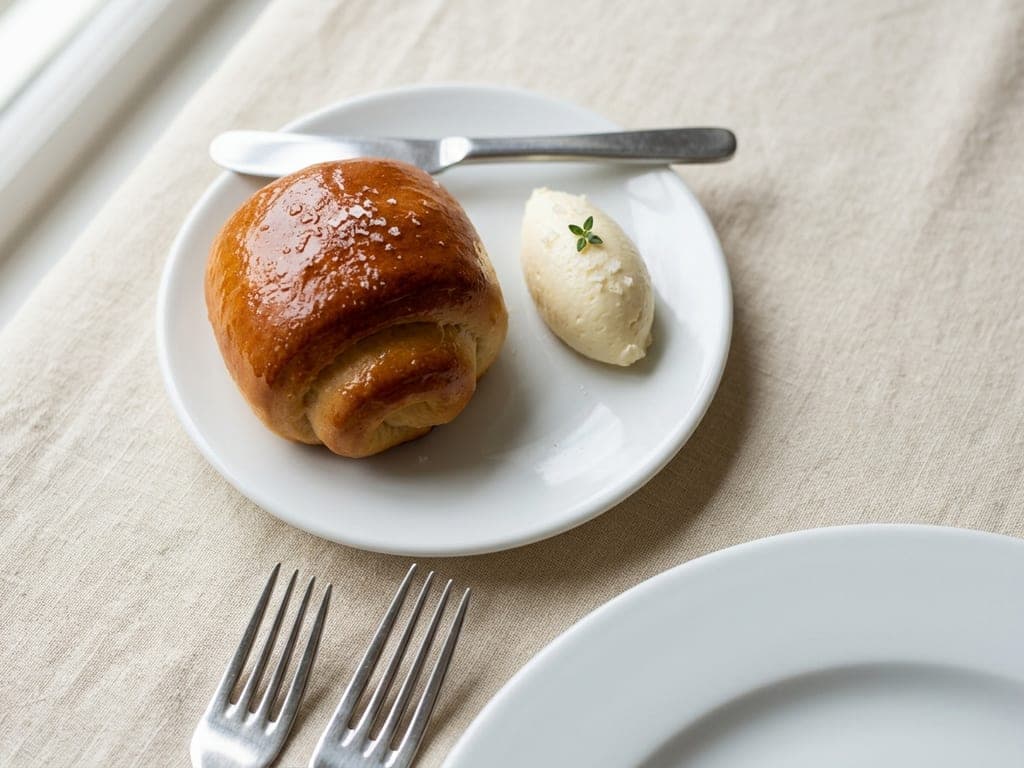
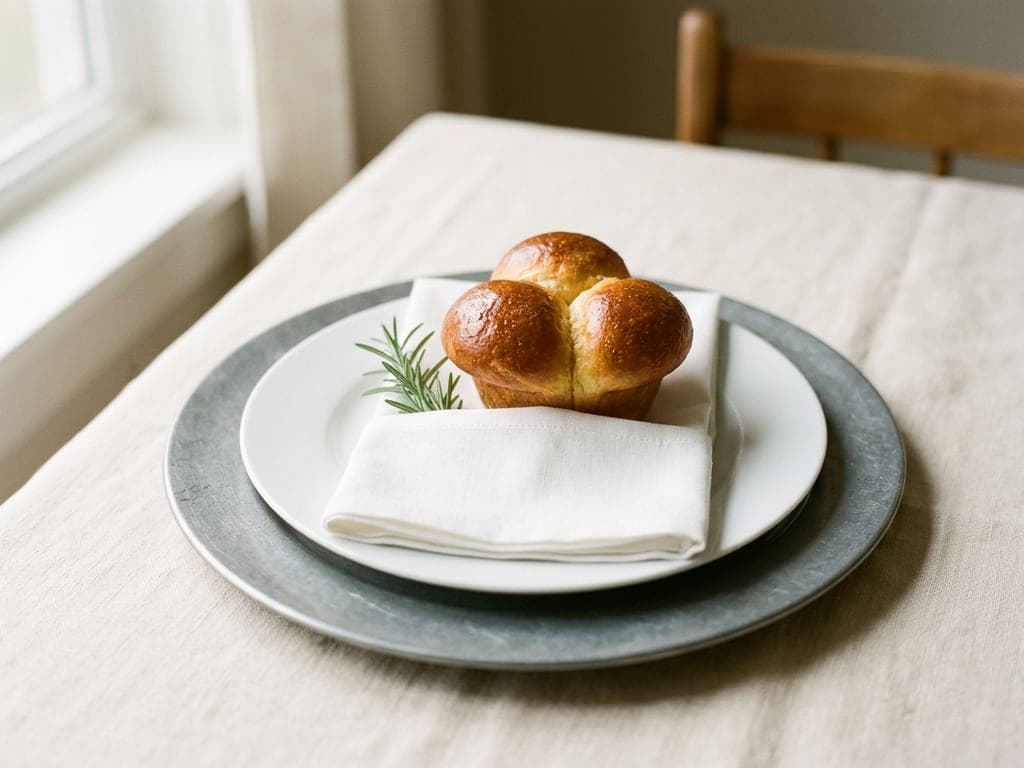
3 ways to plate it
Parker House rolls are older than the internet says
The folded, buttery roll named for Harvey D. Parker’s hotel on School Street in Boston, which opened on 8 October 1855, is usually said to date from the 1870s. The Oxford Encyclopedia of Food and Drink in America says so, as cited by Wikipedia, and food sites repeat it. The newspapers say otherwise. In May 1868, reporting on a YMCA May breakfast at Jackson Hall, the Lowell Daily Courier in Massachusetts wrote: “The Parker House rolls were just as good as when they left the Parker House kitchen, and the waiters were all attention.” That July the same paper described excursion baskets that “bore the frank of the Parker House, and contained salmon salad, cold chicken, sandwiches, Parker House rolls and Philadelphia butter.” By 1868 the hotel kitchen was already sending its rolls out as a named product.
Three years later a visitor saw them being made. The Christian Union of 23 August 1871 printed an unsigned account of a stay at the hotel and a tour of its kitchens, which Mrs. Henry Ward Beecher later reprinted in her book All Around the House (1878): “In another apartment, the famous Parker House rolls were being prepared, while large trayfuls were rising, or dozens baking, in the immense ovens, which were lighted by gas.” Recipes were in print too. The Gettysburg Star and Sentinel ran one under “Good Rolls” on 22 October 1869, and by 1874 the roll was in Dedham Receipts (Boston, 1871), in Mrs. Cornelius’s The Young Housekeeper’s Friend (1871 edition, as “Parker Rolls”), in Maria Parloa’s Appledore Cook Book (1872), in Mrs. H. W. Beecher’s Motherly Talks with Young Housekeepers (1873), and three times over in a Chicago community cookbook (1874). Yankee magazine’s “oldest printed recipe on file,” from an April 1874 New Hampshire paper, is years late.
Who made it first is murkier. The hotel’s own historian credits a German baker named Ward, working under chef Augustine Anezin, and Boston’s Landmarks Commission says Anezin, who ran the kitchen from 1865 until his death in 1881, presided over the roll’s development, which fits the 1868 print record. Tales of an angry cook have no 19th-century source that we could find. The earliest we found is a 1910 Boston Globe story, reprinted in the Fort Wayne Sentinel, in which a former Parker House cook said that he and a fellow cook, “greatly indignant” over a chambermaid accused of theft, “whacked” the dough, and that Mr. Parker then asked him to make the rolls that way from then on. The better-known version, a baker tossing unfinished rolls into the oven, is cited to a 1954 cookbook. The hotel’s historian also calls the tale of Franklin and Eleanor Roosevelt requesting the recipe in 1933 a legend. And the fold may be older than its name: the baker Jessup Whitehead recalled in 1881 working beside a Nashville baker, “A. Nelson by name,” who made the same shapes “as far back as 1850, on one of the old-time, high-living floating palaces of New Orleans.” He added: “Some four or five years after I saw the same in Cincinnati and Evansville, under the name of Parker House rolls.” That clashes with the Anezin story: it would put the name in the Ohio valley by 1854 or 1855, around the time the hotel opened and a decade before Anezin took over the kitchen. Whitehead was writing some 30 years later, and the earliest print we can find is 1868, so treat his dates loosely. The Parker House gave the roll its name and its fame.
For its first decades in print it was mostly a tea, supper and breakfast bread. Mrs. Cornelius chilled her shaped Parker Rolls “until an hour before tea”; Dedham Receipts said to “roll it thin, cut them out round, butter one half, and turn them over even” and “Bake for supper about ten minutes”; Buckeye Cookery (1877) warned that “Parker House rolls for breakfast at eight must be made ready” well ahead. When Fannie Farmer wanted a roll for dinner in 1896, she gave it its own name: “Salad or Dinner Rolls. Use same ingredients as for Parker House Rolls, allowing one-fourth cup butter.”
How rolls got onto the Thanksgiving table
There were no yeast rolls at the 1621 harvest feast at Plymouth. Edward Winslow’s letter lists the colony’s crops, “We set the last spring some twenty acres of Indian corn, and sowed some six acres of barley and peas” (about 8 and 2.4 hectares), and mentions no wheat at all. The historians at Plimoth Patuxet say the colonists used the new corn in porridges, puddings and flat, unleavened bread, and probably lacked enough butter and wheat flour even for pie crust.
Two and a half centuries later, Buckeye Cookery’s Thanksgiving dinners of 1877 list “brown bread and superior biscuit,” and Buckeye’s own superior biscuit is an enriched yeast dough: sweet milk, butter and lard, “yeast and flour” left to “rise over night,” then “one beaten egg” in the morning, another rise, and biscuits shaped and baked “when light.” That is a dinner roll in all but name. Rolls by name are rare on 19th-century Thanksgiving bills of fare, which often list no bread at all. Fannie Farmer’s “Menu for Thanksgiving Dinner” of 1896, unchanged in her 1906 edition, runs from “Oyster Soup. Crisp Crackers.” to “Café Noir,” and its only bread is the crackers, though the same book allows “bread sticks, small rolls, or crisp crackers” with a dinner soup. One of the earliest Thanksgiving menus with rolls by name that we found is military: at Jefferson Barracks, Missouri, on 27 November 1902, two cavalry squadrons sat down to “California celery; Parker House rolls, creamery butter; grape jelly; radishes” (Army and Navy Journal). The named Parker House roll beside the turkey shows up in the 1900s, and the convenience rolls that followed Brown ’n Serve in 1949 made the basket easy.
The roll itself is older than the holiday habit. “Dinner roll” is British first: the Oxford English Dictionary’s earliest evidence is an 1819 Edinburgh newspaper. An 1836 Philadelphia etiquette book explains that at dinner, rolls replaced bread, and “a roll is found placed within each napkin.” The formula is older still. Mrs. Rundell’s New System of Domestic Cookery (London, 1806, and Philadelphia and Boston, 1807) gives “Brentford Rolls” of flour, salt, sugar and butter, with “two eggs beaten with two spoonfuls of yeast” and milk: the formula of today’s American dinner roll, in an English cookbook reprinted in America.
Continental everyday rolls mostly stayed lean and crusty, from the German Semmel (from Latin simila, the finest wheat flour) to the Czech houska, whose Old Czech name, húska, comes from hus, the goose, for a roll shaped like one. The American dinner roll kept to the richer English cookery-book line and made it softer and sweeter still.
Why this dough: a tangzhong for day three, not for height
Soft rolls are enriched rolls. Serious Eats divides bread into two basic categories, lean and enriched, and explains what milk, butter and egg do: “The fat in all three ingredients coats the gluten strands and makes both the crumb and the crust more tender; it also makes the interior texture more finely grained.” This formula carries 1 cup (240 ml) of whole milk, an egg and 4 tbsp (57 g) of butter for 390 g of flour, plus 3 tbsp (38 g) of sugar. That sugar is 9.7% of the flour weight, just under the 10% at which ordinary yeast starts to slow (King Arthur).
The one extra step is a tangzhong: 3 tbsp (25 g) of the flour cooked in 1/2 cup (120 ml) of the milk to 149°F (65°C). That is about 6% of the flour at a 1:5 ratio, the low end of King Arthur’s 5 to 10%. We weighed whether it earns its saucepan, because it is sold as the secret to tall, fluffy rolls, and the research doesn’t support that. Studies of Japanese yudane, the scalded-flour method tangzhong grew out of, found gelatinized starch lowers gas retention and loaf volume, and America’s Test Kitchen’s first tangzhong rolls came out “a bit squat and the crumb was coarse.” Height comes from gluten and fermentation, which is why this dough uses bread flour, rests before kneading and gets its butter late.
What the paste does do is slow staling, which is the part a holiday roll needs. In one peer-reviewed study, bread made with 20% gelatinized flour got about 390% harder over 72 hours, against about 800% for the control; in another, the crumb on day three held 40.6% moisture with a 65°C paste against 38.3% without (Yamada and colleagues). Our 6% paste is far below 20%, so expect a smaller share of that, but it points the same way. Thanksgiving rolls live for days: par-baked weeks ahead or baked on Wednesday, eaten on Thursday, split for turkey sandwiches on Friday. For three minutes at the stove, that is worth it. Not everyone wants maximum softness (in a 2016 Korean consumer test on rice pan bread, tasters split 52 to 48 between the tangzhong loaves and plain), so the FAQ gives the no-paste and potato-flake versions.
Bread flour (strong white bread flour in the UK) suits a tangzhong dough because it has a little more gluten to hold the steam, which is why ATK uses it for its fluffy dinner rolls. The gap is smaller than the labels suggest: King Arthur’s bread flour is 12.7% protein against 11.7% for its all-purpose, and USDA’s reference values are 12.0 g and 10.3 g per 100 g. All-purpose works here with no other change; King Arthur’s side-by-side test found enriched milk bread came out most alike with either flour. What matters more is measuring: USDA counts a cup of bread flour at 137 g and King Arthur at 120 g, and over 3 cups that is about 50 g of flour, the difference between a soft dough and a stiff one. Use whole milk: in Handle the Heat’s tests, water in place of milk gave rolls that “didn’t brown much” and chewed like baguette.
The Thanksgiving make-ahead plan, with real windows
Fresh rolls want the oven just when the turkey does, which is why so many cooks give up and buy them. You don’t have to. Every route below starts from the same dough and branches either straight after kneading (frozen unbaked) or at step 6 (the other three), and each has a real limit. For baked rolls the storage rule is the same whichever route you take: counter or freezer rather than the fridge, which slows mold but stales bread fastest. Staling is mostly starch recrystallizing, and it runs fastest at fridge temperatures: Aguirre and colleagues (2011) measured the highest retrogradation rate at 39°F (4°C) of the temperatures they tested. Heating back above about 131 to 140°F (55 to 60°C) reverses it (Ghiasi, Hoseney and colleagues, 1984), which is why a day-old roll revives in the oven but stales again quickly afterwards.
Overnight in the fridge (8 to 18 hours). Right after shaping, cover the pan tightly and refrigerate it. Serious Eats cold-proofs shaped rolls for 8 to 10 hours and Baker Bettie for up to 18. Next day, take the pan out 1 to 1 1/2 hours before baking and let the rolls finish rising on the counter; The Kitchn’s advice is that it’s “ok if they’re still a little cool to the touch; as long as they’ve puffed up.” Egg wash and bake as written, going by 190°F (88°C); a cool pan may need a few extra minutes. Bake within 24 hours of refrigerating, USDA’s window for dishes containing raw eggs (FSIS); dough held longer also “can start to become sour and off-tasting, especially rolls made with eggs and milk” (The Kitchn).
Frozen unbaked (up to 2 weeks). This route skips the first rise, as King Arthur’s does: knead, then shape the rolls at once into a buttered metal or foil pan, wrap it well and freeze it straight away in a 0°F (-18°C) freezer; once solid, the rolls can be bagged. King Arthur’s limit is “no longer than 2 weeks, 3 at the outside,” and it raises the yeast by about 20% (here 2 3/4 tsp, 8.4 g) for anything longer than 2 to 3 days. The limit comes from the yeast itself: some of it dies in the freezer and “releases a substance called glutathione, which acts as a natural dough relaxer,” so long-frozen rolls spread instead of rising. To bake, set them back in the buttered pan, cover, and thaw them overnight in the fridge (8 to 16 hours, the window Rhodes, the frozen-dough maker, gives for its rolls), then let them finish rising on the counter for 1 to 2 hours, until puffy, and bake as written. King Arthur thaws and rises its rolls on the counter for 4 to 5 hours at 65 to 70°F (18 to 21°C), but that is a long stretch out of the fridge for a dough with egg and milk in it, so we thaw in the fridge. Some recipes allow 2 months; for anything that far ahead, par-bake instead.
Par-baked and frozen, the Brown ’n Serve way (up to 6 weeks; the best Thanksgiving plan). Let the shaped rolls rise fully (step 6), skip the egg wash, and bake at 300°F (149°C) until they are set and pale and a middle roll reads 175°F (79°C). That takes about 15 minutes for spaced rolls (ATK) and can take 20 to 25 minutes or more in a crowded 9x13-inch (23x33 cm) pan, so go by the thermometer. Cool them completely on a rack at room temperature. Freeze them uncovered on a tray until solid, about 1 hour, then pull them apart (King Arthur’s step) and bag them airtight. Do it straight away rather than parking them in the fridge, where staling runs fastest. America’s Test Kitchen and King Arthur both give up to 6 weeks, so for a late-November Thanksgiving you can bake in mid-October. On the day, set the frozen rolls apart on a parchment-lined metal sheet pan and bake at 425°F (218°C) for 8 to 12 minutes, until deep golden all over and hot through, then brush with butter and salt. Don’t finish them as one frozen slab: when ATK tried a pull-apart pan, the innermost rolls still hadn’t heated through after thawing and 17 minutes at 400°F (204°C). If yours froze as a connected block, King Arthur allows 3 to 5 minutes more; check a middle roll. About ten minutes of oven fits in the time the turkey rests.
The method is 77 years old, and it began as an accident. In 1949 Joe Gregor, an ex-GI struggling to keep his bakery going in Avon Park, Florida, “slammed a batch of rolls into the oven and a few minutes later the fire siren blew. He jammed on his hat and turned off the gas, joined the other volunteer firemen,” the Los Angeles Times reported that November. “An hour later when he opened the oven door and saw the partly baked Parkerhouse rolls, he had his answer to the hot biscuit problem.” General Mills, whose flour salesman had found him, bought the process. The Times, which names it only as “a national milling concern,” put the price at “a rumored $25,000 plus a handsome set of silver for his wife,” though an Avon Park historian citing the local paper gives $40,000 for the process and the business. General Mills then passed the process on to bakeries nationwide. Gregor’s patent (US 2,549,595, granted in 1951) par-bakes at preferably 275 to 300°F (135 to 149°C) to an internal 165 to 180°F (74 to 82°C), stopping “before substantial caramelization of the sugar in the crust,” and finishes at 425 to 450°F (218 to 232°C) for 7 to 10 minutes. The modern test-kitchen numbers land in the same place.
Baked and frozen (about 1 month at best). Cool the rolls completely, wrap them in foil, then put them in a freezer bag. The Kitchn gives about a month before frost and freezer burn take over; others say up to 3 months. Thaw them in their wrapping on the counter, not in the fridge, then reheat, still in foil, at 350°F (177°C) for about 15 minutes, as ATK does. Warm only what you will serve, because reheated bread goes stale again fast.
Four shapes from one dough
Each shape starts from the risen dough, about 790 g. Crowding decides the crust: rolls packed into a pan steam each other and stay soft-sided, while spaced rolls brown all over and bake faster. Bake them all at 350°F (177°C), or 375°F (191°C) for the spaced shapes if you want a deeper crust, start checking early, and go by 190°F (88°C) at the center.
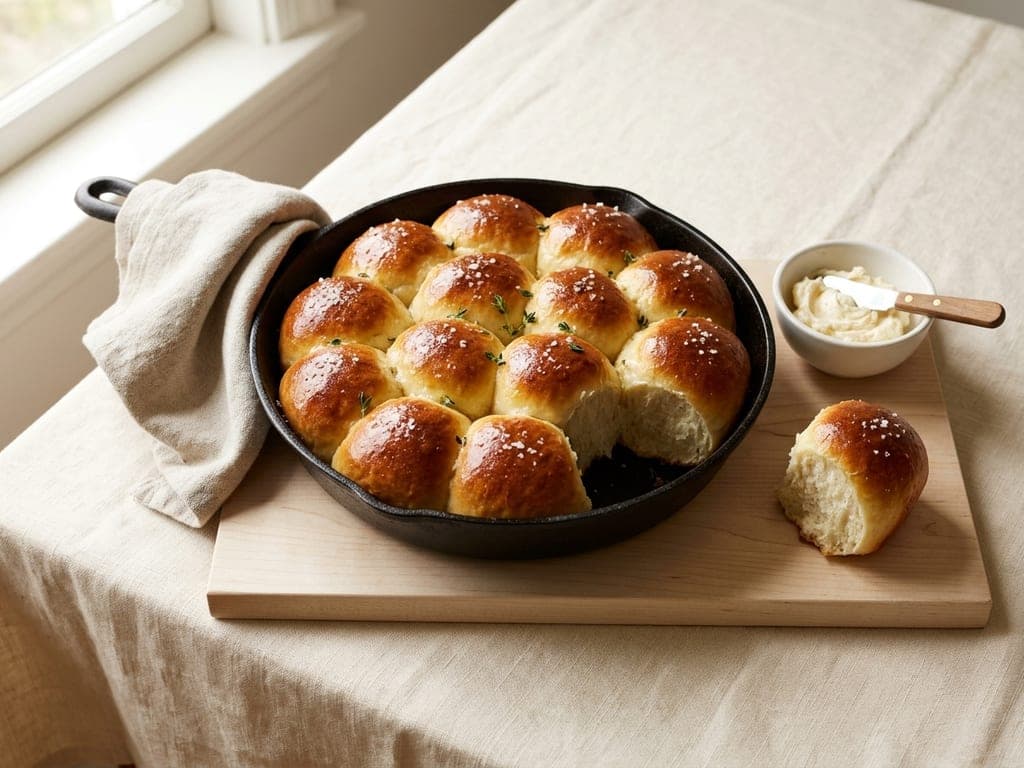
Pull-apart round. Sixteen balls of about 49 g in a buttered 10-inch (25 cm) cast-iron skillet (Sally’s Baking Addiction lists a skillet among its pan options), about 11 around the edge and 5 in the middle, or 8 each in two 9-inch (23 cm) round cake pans, King Arthur’s option. The skillet has about two-thirds of the floor space of a 9x13-inch (23x33 cm) pan, so the rolls rise taller into each other and the middle ones take longest: check the center roll, and tent with foil if the edge browns first. Two 9-inch (23 cm) rounds, with about the same floor space, should bake on about the same clock as the 9x13-inch (23x33 cm) pan.
Parker House fold. Shape 16 balls, rest them covered for 10 minutes so the gluten relaxes, then roll each into an oval about 4 inches (10 cm) long. Brush lightly with melted butter from a separate small dish, not the butter saved for the baked rolls (about 1 tbsp, 14 g, more; about 6 kcal per roll, not counted in the nutrition). Press a crease across the middle with a chopstick or the back of a knife, and fold so the top edge sits just short of the bottom one. Set them in the 9x13-inch (23x33 cm) pan in rows, just touching, all folded the same way. This is the 19th-century method: Mrs. Lincoln’s Boston Cook Book (1884) says to “press the thumb across the middle and fold over like a turnover,” and to “Spread a bit of soft butter the size of a pea on the edge before folding it, if you like the crusty inside which that gives.” Fannie Farmer (1896) creased hers with a knife handle and noted, “As rolls rise they will part slightly”: the butter in the fold keeps the halves from fusing, so they open cleanly. Mrs. Lincoln’s separate Pocket-book or Letter Rolls are rectangles folded in thirds, like a letter.
Cloverleaf. Divide the dough into 48 balls of about 16 g and set three in each buttered hole of a muffin tin; you need 16 holes, so a 12-hole tin plus 4 holes of a second. They rise into a three-lobed crown that pulls apart at the table and, spaced in their cups, brown all over; start checking at 15 minutes. Fannie Farmer’s 1906 edition already pictures “Clover Leaf Biscuit,” and the Boston Cooking-School Magazine spelled out the muffin-tin method in its 1913 to 1914 volume: “set these three, each, in round muffin pans.”
Knots. Roll each 49 g piece into a rope about 9 inches (23 cm) long, tie a loose single knot, and tuck one end underneath and the other up through the middle. Bake on a sheet pan lined with parchment (baking paper), 2 inches (5 cm) apart. Spaced knots crust all round, the way King Arthur describes rolls baked “farther apart”; start checking at 15 minutes.
Egg wash before, butter after, and honey butter
The answer box for “butter before or after baking?” currently says butter before helps the crust brown. Tested, it doesn’t. Baker Bettie brushed the same dough with eight different washes (biscuits, not rolls, so treat it as a guide): melted butter before baking came out “pale and dull”; melted butter after baking was “very golden and very shiny (slightly less shiny than an egg wash)”; and egg wash was “very golden and very shiny, the most of all washes.” So do both, in order: egg wash before, for color and gloss; butter the moment the rolls come out, for a soft, glossy crust; flaky salt on the wet butter so it sticks. It is also how Serious Eats finishes its Parker House rolls: “Immediately brush hot rolls with reserved melted butter and sprinkle with flaky sea salt.”
For an egg-free wash, King Arthur’s test found soy milk with maple syrup the standout, with “Nice shine” and “Great browning”; aquafaba gave “Little color.” Soy is an allergen too, so say so.
Honey butter, two ways. As a glaze, stir 1 tbsp honey into the 2 tbsp (28 g) of melted butter and brush it on the hot rolls in place of plain butter; it adds about 4 kcal per roll (21 g honey at 304 kcal per 100 g, over 16 rolls). Brush it only after baking, because honey browns faster than sugar. As a spread for the table, beat 1/2 cup (113 g) very soft unsalted butter with 2 tbsp (42 g) honey and 1/4 tsp flaky salt for 2 to 3 minutes, until pale and fluffy. The bowl weighs about 155 g and holds about 938 kcal (113 g butter at 717 kcal per 100 g plus 42 g honey at 304), about 6 kcal per gram, so a 15 g quenelle (a generous tablespoon) is about 90 kcal. It is not counted in the recipe’s nutrition. Keep it away from babies under 12 months (see the safety notes).
Questions, answered
What is the secret to soft dinner rolls?
Three things, none of them secret. Enrichment: milk, butter and egg put fat into the dough, which coats the gluten and makes the crumb tender and fine. Water that stays put: a cooked flour paste (tangzhong) or potato flakes hold extra moisture as gelatinized starch, so the rolls stay soft for days. And the finish: crowd the rolls in the pan so they steam each other’s sides, pull them at 190°F (88°C) in the center rather than baking to a deeper brown, brush with butter after baking, and store them airtight on the counter rather than in the fridge, where staling runs fastest. Weighing the flour helps too: a dough that stays slightly tacky bakes softer than one stiffened with extra flour.
What temperature should dinner rolls be when done?
190°F (88°C) at the center of a roll from the middle of the pan, for soft, enriched rolls like these. That is King Arthur’s benchmark for most yeast breads, and Serious Eats pulls its Parker House rolls at 190°F (88°C). The 200 to 205°F (93 to 96°C) you may see comes from a ThermoWorks Thanksgiving post and is a lean-bread number; ThermoWorks’ own bread guide gives enriched doughs 180 to 190°F (82 to 88°C). USDA has no doneness temperature for bread; the only official number that applies is 160°F (71°C) for egg dishes, which 190°F (88°C) clears. For par-baked rolls, stop at 175°F (79°C).
Do you brush rolls with butter before or after baking?
After. In Baker Bettie’s side-by-side test, butter brushed on before baking came out “pale and dull,” while butter brushed on after baking was “very golden and very shiny.” For the best crust, brush with egg wash before baking (the most golden and shiny of all the washes she tested), then with melted butter the moment the rolls leave the oven, with flaky salt on top.
How long do dinner rolls need to rise?
1 3/4 to 2 1/2 hours in total here: 60 to 90 minutes for the first rise, until doubled, and 45 to 60 minutes after shaping, until puffy and touching; add 15 to 20 minutes with active dry yeast. Time follows temperature, so aim for a dough at 75 to 78°F (24 to 26°C) and a warm spot no hotter than about 80°F (27°C), and judge the second rise with a gentle poke, not the clock. That is why this recipe’s total time says 4 hours, not the 37 minutes one popular recipe card listed, which drew the reader comment, “MAN is that total time misleading.”
Can I make dinner rolls ahead of time?
Yes, four ways, each with a real limit. Overnight: refrigerate the shaped rolls for 8 to 18 hours (bake within 24 hours), then let them finish rising for 1 to 1 1/2 hours before baking. Frozen unbaked: shape straight after kneading, skipping the first rise, and freeze for up to 2 weeks (King Arthur), with about 20% more yeast if longer than a few days; thaw overnight in the fridge, then 1 to 2 hours on the counter. Par-baked: bake at 300°F (149°C) to 175°F (79°C), freeze for up to 6 weeks, pull the rolls apart, and finish from frozen on a sheet pan at 425°F (218°C) for 8 to 12 minutes. This is the best Thanksgiving route because it needs the oven for only about 10 minutes. Baked and frozen: about a month, reheated in foil at 350°F (177°C) for about 15 minutes.
Should I use bread flour or all-purpose flour for dinner rolls?
Either works in this recipe. Bread flour gives a tangzhong dough a little more gluten to hold its steam, so the rolls stand a bit taller and spring back; all-purpose gives a slightly more tender, less chewy roll. The protein gap is smaller than people think: King Arthur lists 12.7% for its bread flour and 11.7% for its all-purpose, and USDA’s reference values are 12.0 g and 10.3 g per 100 g. How you measure matters more, so weigh it (365 g for the dough plus 25 g for the paste): sources count a cup at anywhere from 120 g (King Arthur) to 137 g (USDA).
Why are my homemade rolls dense and hard?
Usually one of six things. Too much flour, from scooped cups or flour added while kneading: the dough should stay slightly tacky. Dead or sluggish yeast: liquid over 140°F (60°C) kills it, and cold dough just crawls, so aim for 75 to 78°F (24 to 26°C). Butter added too early, or too short a knead: enriched dough needs a long knead and a windowpane. Too much sugar: above about 10% of the flour weight, ordinary yeast slows down. Under-proofing: if a poke springs right back, wait 10 minutes more. Over-baking: past 190 to 195°F (88 to 91°C) the crumb dries. And if they were soft yesterday and hard today, that is staling, not your baking, and the fridge makes it worse.
What is the difference between dinner rolls and yeast rolls?
“Dinner roll” names the job, a small bread served with a meal; “yeast roll” names the leavening. Most dinner rolls are yeast rolls, but not all: baking-powder dinner rolls exist, and canned crescent rolls such as Pillsbury’s are leavened with baking powder, not yeast. What yeast adds beyond rise is flavor: heated yeast and sugar are an important source of 2-acetyl-1-pyrroline, the roasty key aroma of a wheat bread crust (Schieberle). Hawaiian rolls are a sweet branch of the family: King’s Hawaiian baked its sweet bread in loaves for three decades before launching its 12-pack of dinner rolls in 1983, and its label lists potato flour.
Is tangzhong worth it for dinner rolls, and can I skip it?
Worth it if you want the rolls soft for more than a day, which at Thanksgiving you usually do. It does not make rolls taller (yudane research shows gelatinized starch tends to lower volume unless the gluten is built up), but it slows staling. To skip it, whisk the 3 tbsp (25 g) of flour in with the rest and take the chill off all 1 cup (240 ml) of milk, to about 70°F (21°C), before adding the egg, so the dough still finishes near 75 to 78°F (24 to 26°C); the rolls bake just as well and firm up sooner. For a similar effect without the saucepan, use King Arthur’s swap: replace 1/4 cup (30 g) of the flour with 1/2 cup (43 g) of instant potato flakes, which are already about 91% gelatinized (Ju and colleagues, 2020). Check the flakes’ label and tell guests: many brands contain sulfites (sodium bisulfite), and some carry a may-contain-milk warning.
Do you need to scald the milk for dinner rolls?
It helps a little, but not for the reason usually given. The culprit is native whey protein, not glutathione (that comes from dead yeast). In a controlled test, unheated milk made loaves about 5% smaller and the crumb about 32% harder than milk heated to 176°F (80°C) for 30 minutes (Kikuchi and colleagues, 2012). Ordinary pasteurization, about 161°F (72°C) for 15 seconds, leaves the whey essentially native (Qi and colleagues, 2015), and a tangzhong cooked only to 149°F (65°C) doesn’t change that. The easy fixes: use UHT or ultra-pasteurized milk, which is already partly denatured, or bring the milk to 180 to 190°F (82 to 88°C) and cool it to lukewarm before using it.
How many calories are in a homemade dinner roll?
About 151 kcal per roll here, with 4 g protein, 5.6 g fat, 21 g carbohydrate and 194 mg sodium. The arithmetic, from USDA FoodData Central values: bread flour 390 g = 1,407.9 kcal; whole milk 244 g = 148.8; egg 50 g = 71.5; butter in the dough 57 g = 408.7; sugar 37.5 g = 145.1; yeast 7 g = 22.8; brushing butter 28.4 g = 203.6. Total 2,408.4 kcal ÷ 16 = 151 kcal. Sodium is mostly the 7.5 g of table salt: 2,910 of the batch’s 3,107 mg. Not counted: the egg wash (a whole egg would add about 4 kcal per roll), flaky salt and honey butter. For scale, a buttered roll comes out at about 45 g, so per 1 oz (28 g) ours comes to about 94 kcal and 121 mg sodium, against 90 kcal and 75 mg for a King’s Hawaiian roll (label).
Snap your finished plate and let the AI plate it again — more beautifully.