12 Christmas dinner ideas full menus planned around one oven
Most lists of Christmas dinner ideas are a hundred single recipes. These are whole menus, from two people to twenty, and each one says what to buy per guest, what goes into the oven at what time, and what was finished the day before.
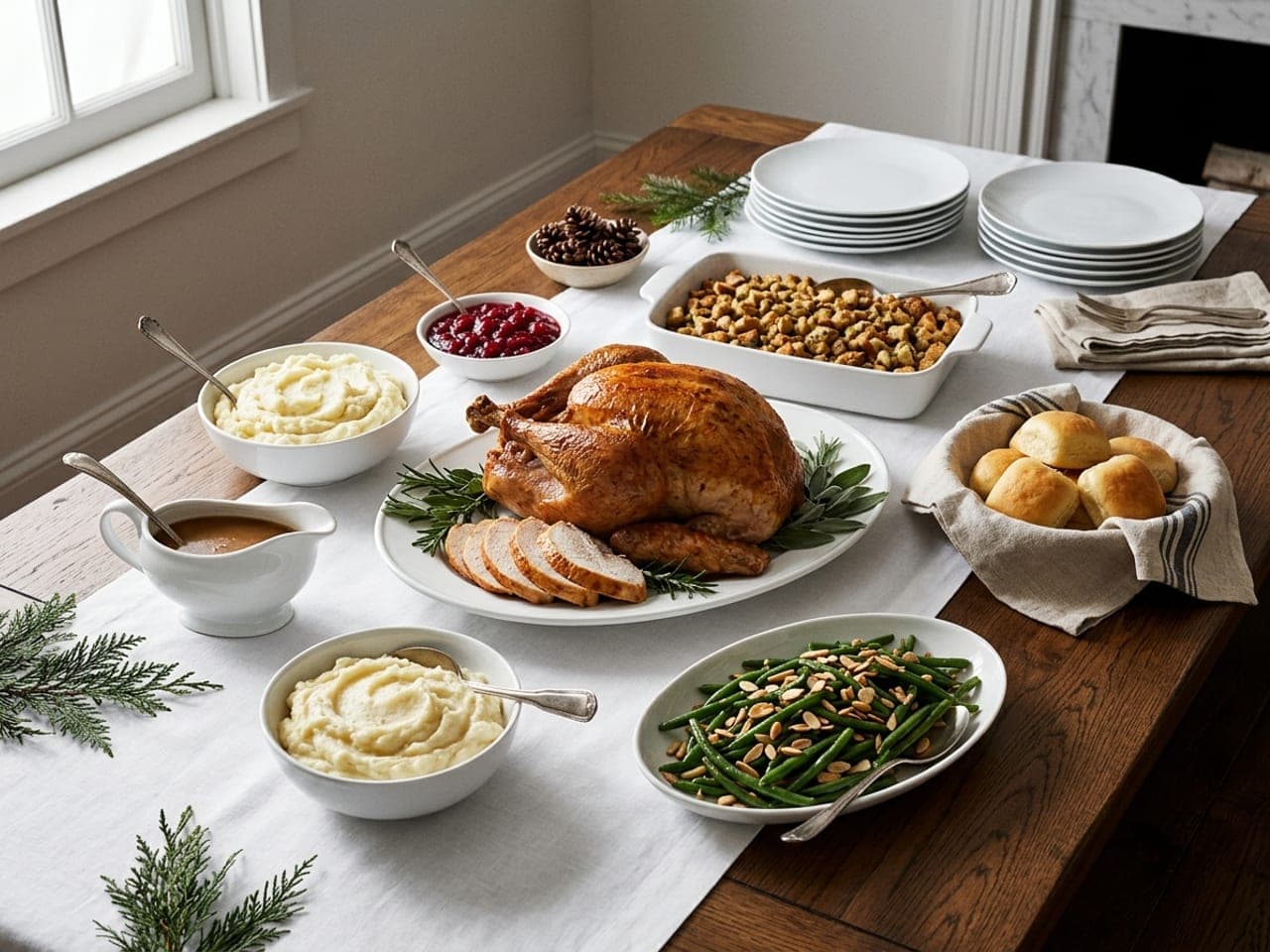
The photos on this page are AI-generated illustrations.
A Christmas dinner menu is a main, a potato, one or two vegetables, a bread and a dessert, chosen so that they never need more oven than you have. The twelve menus below are built that way: five big roasts, three tables from other kitchens and four lighter, smaller or bigger ones. Every card gives the menu, the amounts to buy, a timed plan counted back from the main course (a first course is eaten while the roast rests), what is made ahead and one plating note.
How to use it. Pick by guest count, check how the plan works in one oven, shop from the amounts per guest and work down the make-ahead timeline, dated for Christmas 2026. Dishes we have a full recipe for link to it. Seven others carry a short recipe that follows one named published recipe, credited and linked, and not kitchen-tested by us. Prime rib and ham link to our calculators, which size and time them but are not recipes; the turkey crown, the ham glaze, Christmas pudding, smoked salmon and the antipasto board have neither. Our own suggestions and arithmetic are labeled as ours.
The rules it follows. Temperatures are USDA’s minimums (food safety). Where a chef’s method goes lower, the card says whose it is and that it is below the minimum. British rules are given separately where they differ, and some guests need a different plate.
The big roasts
Five dinners built on a roast, each with its oven plan counted back from the serving time.
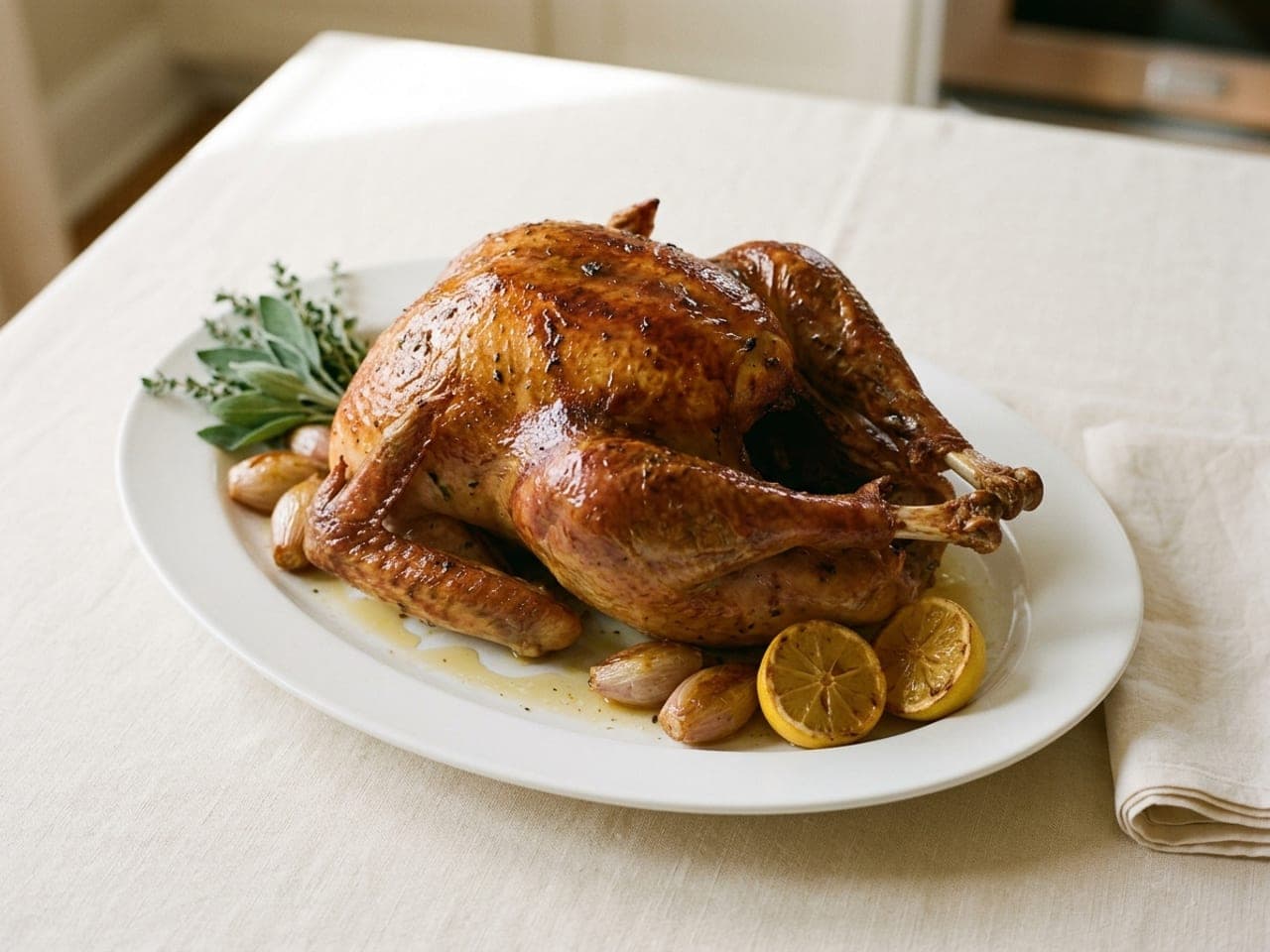
- Menu
- Butternut squash soup; roast turkey with turkey gravy; mashed potatoes, stuffing baked in a dish, cranberry sauce and dinner rolls; pecan pie.
- Buy
- 1 lb (450 g) of whole turkey a guest (USDA), 1½ lb (680 g) for leftovers (Food Network): a 12 to 14 lb (5.4 to 6.4 kg) bird, or 18 lb (8.2 kg) with leftovers. Half a pound (227 g) of potatoes each (Whole Foods Market). For twelve: three times the mash recipe, 1½ times the gravy and the rolls (a batch makes 16), 1⅓ times the stuffing, 1¼ batches of soup and two pies.
- Ahead
- Frozen bird into the fridge Sun 20 Dec; dry brine Wed 23 Dec, or Thursday morning if there is still ice in the cavity (UK: see the timeline). Soup no earlier than Tue 22 Dec (UK: Wed 23 Dec); cranberry sauce from Sat 19 Dec; pies on Christmas Eve.
- On the plate
- Carve in the kitchen, fan the breast slices on one side of a warm platter with the dark meat on the other, and pass the gravy.
- Allergens
- Wheat, milk and egg (rolls, stuffing, gravy, pie), pecans; soy in some stuffing cubes; celery in stuffing and most stock; sulphites if the gravy has wine.
Oven plan, dinner at 3:00 pm
- 10:10 amOven to 325°F (163°C).
- 10:30 amTurkey in.
- 1:30 pmStuffing in beside it if both tins fit: 40 to 60 minutes, to 165°F (74°C) in the center. If not, it bakes in the rest (30 minutes at 350°F (177°C)), the rolls follow and dinner is nearer 3:20 pm.
- 2:15 pmTurkey out at the recipe’s temperatures, to rest 30 to 45 minutes; the stuffing stays in if it is not at temperature. Oven up to 425°F (218°C).
- 2:30 pmFrozen par-baked rolls in, straight from the freezer, 8 to 12 minutes.
- 2:45 pmCarve.
- 3:00 pmServe.
- 4:15 pmLeftover turkey off the bone and in the fridge, with everything else perishable.
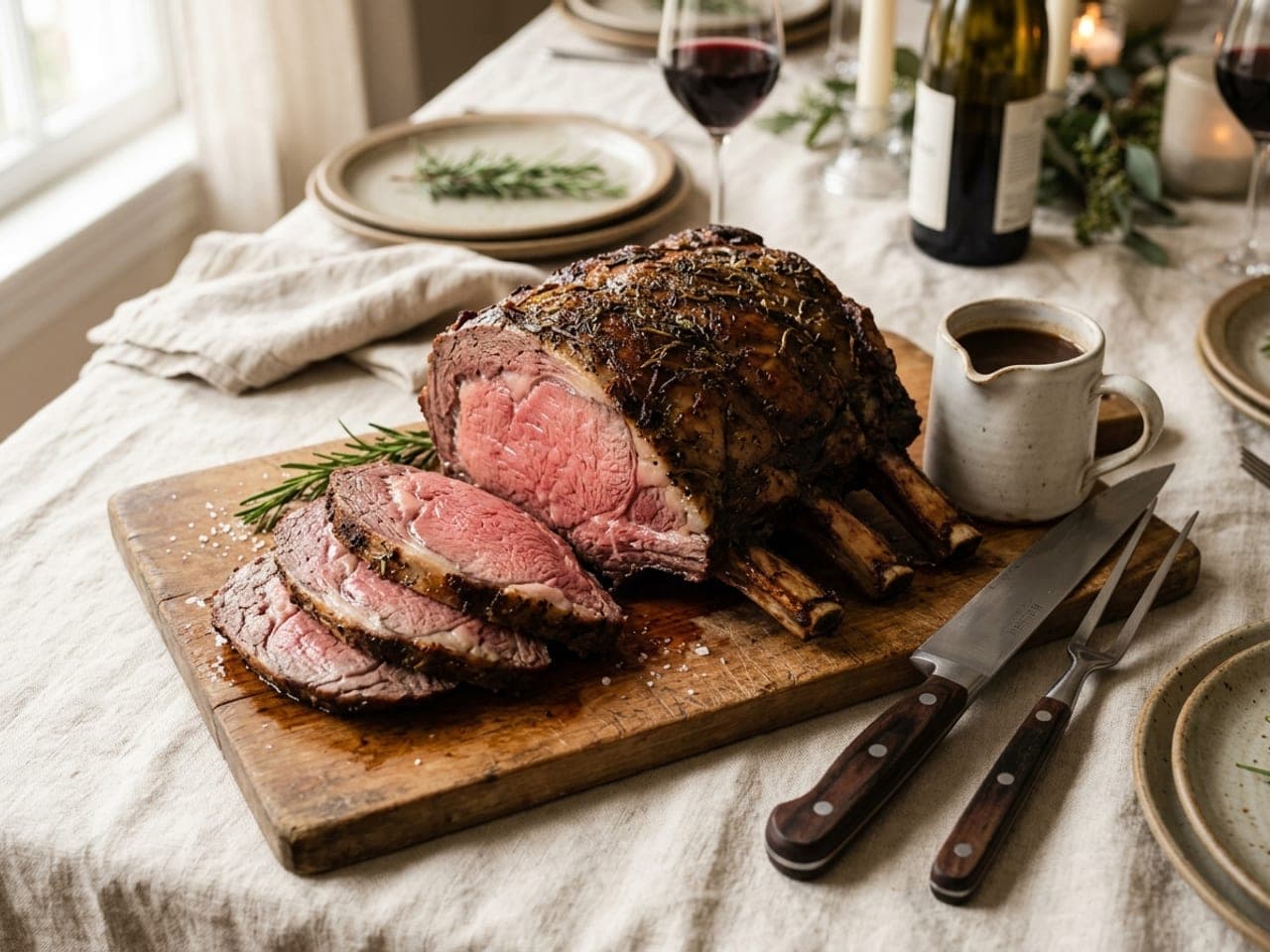
- Menu
- Deviled eggs with drinks; a bone-in rib roast with au jus and Yorkshire puddings; mashed potatoes and green beans amandine; crème brûlée.
- Buy
- About 1 lb (450 g) of bone-in roast a guest (Serious Eats, which also calls ¾ lb (340 g) enough), or one rib for every two (Southern Living): an 8 lb (3.6 kg), four-rib roast, bought no earlier than Sun 20 Dec if you salt it from the 21st. For eight: twice the mash recipe, 1⅓ batches of crème brûlée (it makes six) and 1½ times the pudding batter.
- Whose times
- USDA’s chart for a 325°F (163°C) oven is the slowest in print, so the puddings are never squeezed. The beef checkoff’s 350°F (177°C) table gives 6 to 8 lb (2.7 to 3.6 kg) 2½ to 3 hours to 145°F (63°C); our prime rib calculator uses it but takes this roast out at 135°F (57°C), after 2¼ to 2½ hours, and lets the rest carry it up (5 to 15°F (3 to 8°C), the checkoff says).
- Ahead
- Salt the roast from Mon 21 Dec (Serious Eats: up to four days ahead, uncovered on a rack; bottom shelf). Custards baked Wed 23 Dec. Batter mixed on Christmas morning.
- Rarer beef
- Medium rare, served at 130°F (54°C), is below the USDA minimum: see who should skip it and its note on mechanically tenderized roasts.
- On the plate
- One thick slice, cut side up, jus pooled beside it and not over the crust of the pudding.
- Allergens
- Wheat, milk and egg (puddings, custard, potatoes), almonds on the beans, mustard and egg in the deviled eggs. The au jus can add sulphites (wine), fish (Worcestershire sauce) or soy.
Oven plan, dinner at 5:00 pm
- 11:45 amOven to 325°F (163°C).
- 12:05 pmRoast in. USDA: 23 to 30 minutes per pound, so 3 to 4 hours for 8 lb (3.6 kg).
- 3:00 pmStart reading the thermometer in the center, away from the bone.
- 3:10 pm onOut at 145°F (63°C), USDA’s minimum, and tented with foil. The puddings need 50 minutes from here: if the roast is early, start them and eat early (the 2-hour clock is running).
- 4:05 pmLatest time to turn the oven to 460°F (240°C), or 450°F (232°C). If the roast is not at 145°F (63°C) yet, dinner moves; it does not come out early.
- 4:20 pmTin of dripping in for 10 minutes: very hot fat, see the recipe.
- 4:30 pmBatter in, 25 minutes.
- 4:45 pmCarve while they bake.
- 4:55 pmPuddings out.
- 5:00 pmServe.
- By 6:05 pmLeftover beef in the fridge, 2 hours after it left the oven.
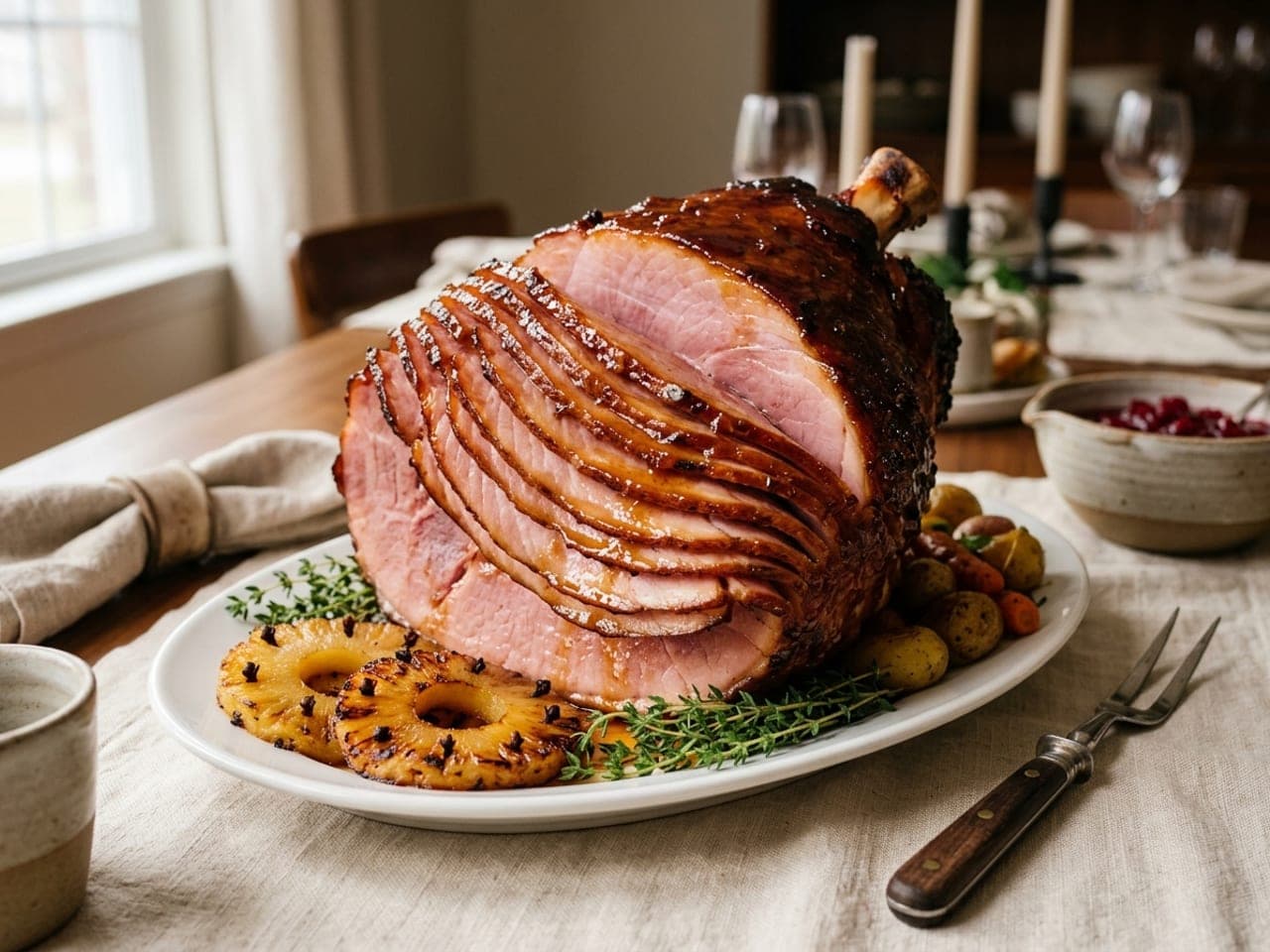
- Menu
- Deviled eggs; a spiral-sliced ham with your glaze; scalloped potatoes, green beans amandine, a green salad and dinner rolls; pecan pie.
- Buy
- USDA’s guide is ⅓ to ½ lb (150 to 225 g) of bone-in ham a serving: 6 lb (2.7 kg) for twelve, or 9 lb (4.1 kg) with leftovers (the ham calculator does any table). For twelve: two pies, 1½ batches of rolls (a batch makes 16) and a second dish of potatoes or smaller squares (the recipe serves 10).
- Oven notes
- USDA’s spiral ham row covers 7 to 9 lb (3.2 to 4.1 kg), so the plan is for the larger ham. It notes that a spiral ham can also be served cold from the fridge.
- Ahead
- Potatoes and pies baked on Christmas Eve and chilled within 2 hours; eggs boiled and filling made up to 2 days before.
- On the plate
- Three overlapping slices, glaze edge up, potatoes cut as a square beside them.
- Allergens
- Milk (potatoes), egg and mustard (eggs, salad dressing), wheat, milk and egg (rolls, pie), almonds, pecans; read the ham label and the glaze.
Oven plan, dinner at 2:00 pm, 9 lb (4.1 kg) ham
- 10:15 amOven to 325°F (163°C), USDA’s floor for ham.
- 10:30 amHam in, wrapped tightly in foil. USDA: 10 to 18 minutes per pound, so 1½ to 2¾ hours.
- 12:00 pmStart checking: 140°F (60°C) for a ham sealed at the plant, 165°F (74°C) if the store sliced or wrapped it. If it is there early, leave it wrapped in the oven, off the 2-hour clock (our suggestion).
- 12:30 pmYesterday’s scalloped potatoes in beside it, covered, 45 to 60 minutes, until the center reads 165°F (74°C).
- 1:10 pmUncover the ham, glaze it and give it the last 10 minutes.
- 1:20 pmHam out and tented, to rest 15 minutes (Serious Eats).
- 1:30 pmPotatoes out and covered. Oven up to 425°F (218°C).
- 1:45 pmFrozen par-baked rolls in, 8 to 12 minutes.
- 1:50 pmCarve.
- 2:00 pmServe.
- 3:20 pmLeftovers in the fridge, 2 hours after the ham left the oven.
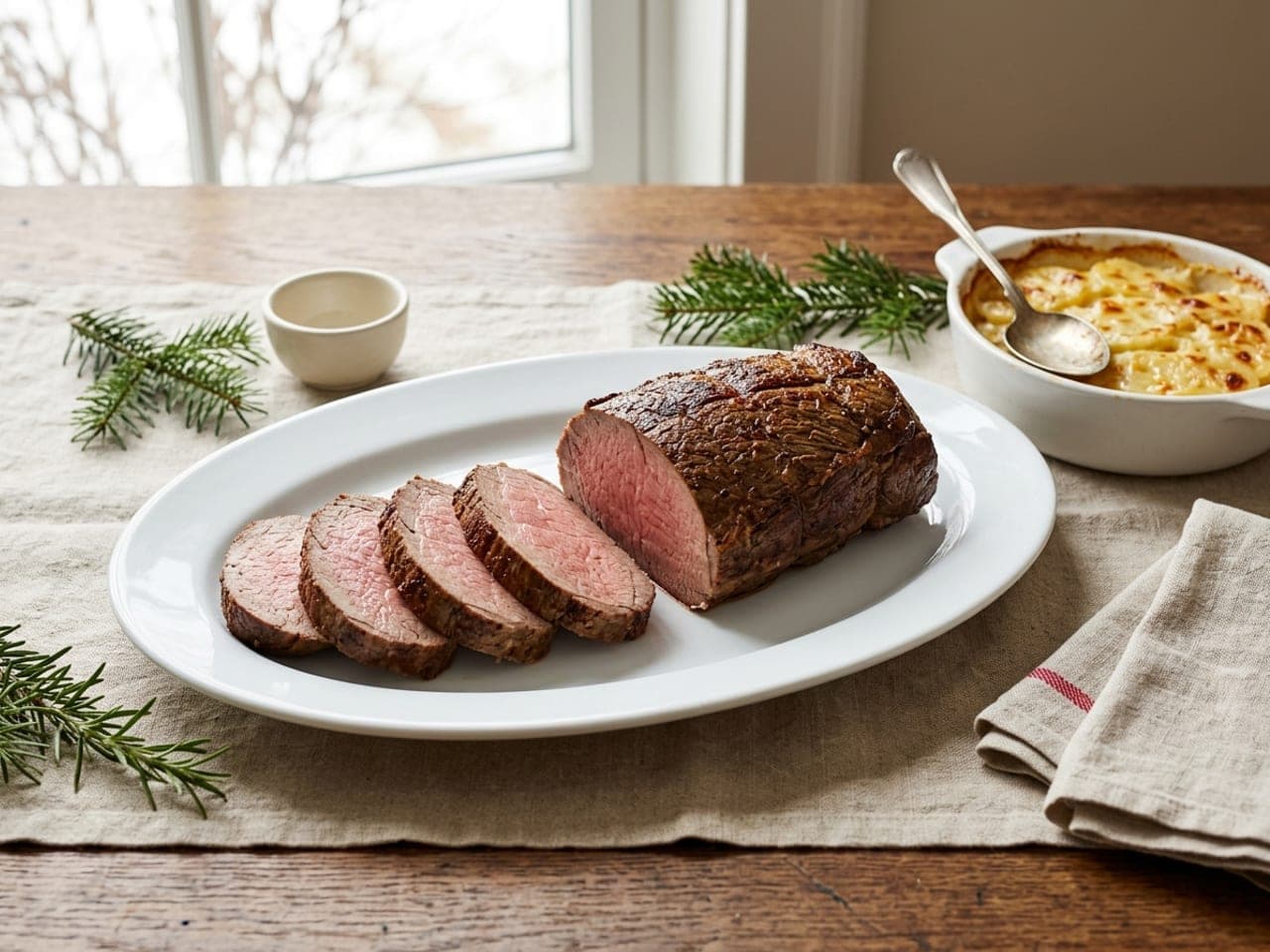
- Menu
- Butternut squash soup; roast tenderloin with a steak sauce; scalloped potatoes and green beans amandine; chocolate mousse or lemon posset.
- Buy
- The Kitchn allows 6 oz (170 g) of beef a guest and Southern Living 8 oz (225 g): a 3 lb (1.4 kg) center cut for six.
- Ahead
- Salt the beef on Christmas Eve (America’s Test Kitchen: 12 to 24 hours). Soup no earlier than Tue 22 Dec (UK: Wed 23 Dec). Potatoes assembled on Christmas Eve afternoon (24 hours at most); mousse or posset the same day.
- Dessert safety
- The mousse has raw egg white and rum: use pasteurized eggs, make it on Christmas Eve (it keeps one day) and see who should skip it. The posset has neither.
- On the plate
- Two medallions leaning on each other, sauce beside them (slicing notes).
- Allergens
- Milk (potatoes, butter, and the soup unless you make its vegan swap), almonds on the beans; egg and milk in the mousse, milk in the posset.
Oven plan, dinner at 6:15 pm, USDA’s method
- 3:45 pmOven to 400°F (200°C).
- 4:00 pmPotatoes in, covered, for 45 minutes, then uncovered about 30.
- 5:15 pmPotatoes out and covered. Oven up to 425°F (218°C).
- 5:20 pmTenderloin in. USDA’s chart gives a 2 to 3 lb (0.9 to 1.4 kg) piece 35 to 45 minutes in total. A whole 4 to 6 lb (1.8 to 2.7 kg) one takes 45 to 60: put it in at 5:05 pm.
- 5:50 pmSoup reheated to 165°F (74°C) and served.
- 6:00 pmBeef out when the center reads 145°F (63°C). Potatoes back in, uncovered, while it rests.
- 6:10 pmCarve (USDA: rest at least 3 minutes).
- 6:15 pmServe.
- 7:15 pmLeftover potatoes in the fridge (2 hours from 5:15 pm); the beef by 8:00 pm.
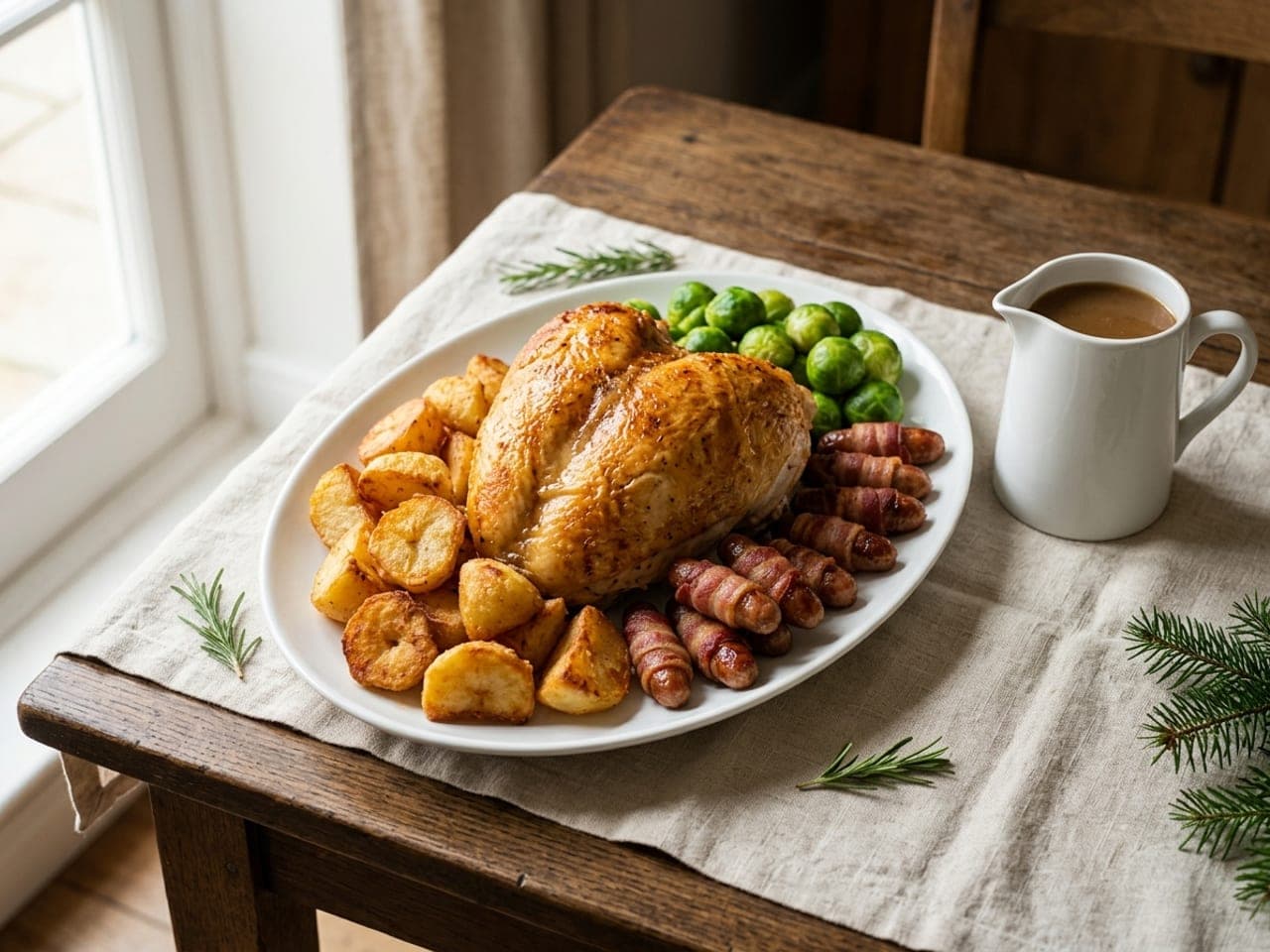
- Menu
- Smoked salmon to start (not for every guest); turkey crown with gravy and bread sauce; roast potatoes (recipe below), pigs in blankets, steamed Brussels sprouts, carrots and cranberry sauce; Christmas pudding.
- Buy
- BBC Good Food says a 4.4 to 5.5 lb (2 to 2.5 kg) crown feeds six; for eight buy about 6.6 lb (3 kg) and add 10 minutes (our scaling). Each: 8 oz (225 g) of potatoes (Delia Smith), 2 pigs in blankets (Good Food magazine), about 3 oz (80 g) of sprouts (Good Housekeeping UK).
- What fits a 60 cm oven
- For six, the crown, one tin of potatoes and a tray of sausages fill both shelves. For eight they do not all fit: roast the pigs in blankets in the crown’s tin for its last 30 to 35 minutes, or after it comes out. Our reading of the sizes, not a tested fit: try the empty tins first.
- Ahead
- Pudding made weeks before or bought; potatoes peeled on Christmas Eve (Nigella Lawson keeps them whole under cold water); a frozen crown thawed to finish on Christmas Eve (the UK rule).
- On the plate
- Three slices of breast, potatoes at the back for height, gravy over the meat only so the potatoes stay crisp.
- Allergens
- Wheat and milk (bread sauce, gravy, pudding), fish (starter). A Christmas pudding usually also has egg, almonds or other nuts, sulphites and alcohol, and sausages wheat and sulphites: read both labels. Celery in most stock.
Oven plan, lunch at 2:30 pm, 5.5 lb (2.5 kg) crown
- 11:25 amOven to 375°F (190°C), or 170°C with a fan.
- 11:45 amCrown in: British Turkey’s rule, as BBC Good Food prints it, gives 2 hours for 2.5 kg.
- 12:00 pmBread sauce milk heated and left to infuse.
- 12:50 pmPotatoes steamed for 10 minutes and shaken.
- 12:55 pmTin of fat onto the lower shelf to heat.
- 1:00 pmChristmas pudding on to steam, by its label (or microwave it after the main course).
- 1:10 pmPotatoes into the hot fat, with the tin out on the stove top. Pigs in blankets in, 30 to 35 minutes.
- 1:45 pmCrown out at 165°F (74°C) in the thickest part (UK: 70°C held for 2 minutes) and tented; BBC Good Food rests a turkey 30 to 45 minutes. Pigs in blankets out at 160°F (71°C). Oven up to 400°F (200°C).
- 2:00 pmCrumbs into the bread sauce.
- 2:15 pmSprouts steamed 5 to 8 minutes (Delia), carrots on, gravy made.
- 2:20 pmPotatoes out.
- 2:25 pmCarve.
- 2:30 pmServe.
- 3:45 pmLeftover turkey in the fridge.
Central European and Italian-American tables
Three Christmas tables from other kitchens.
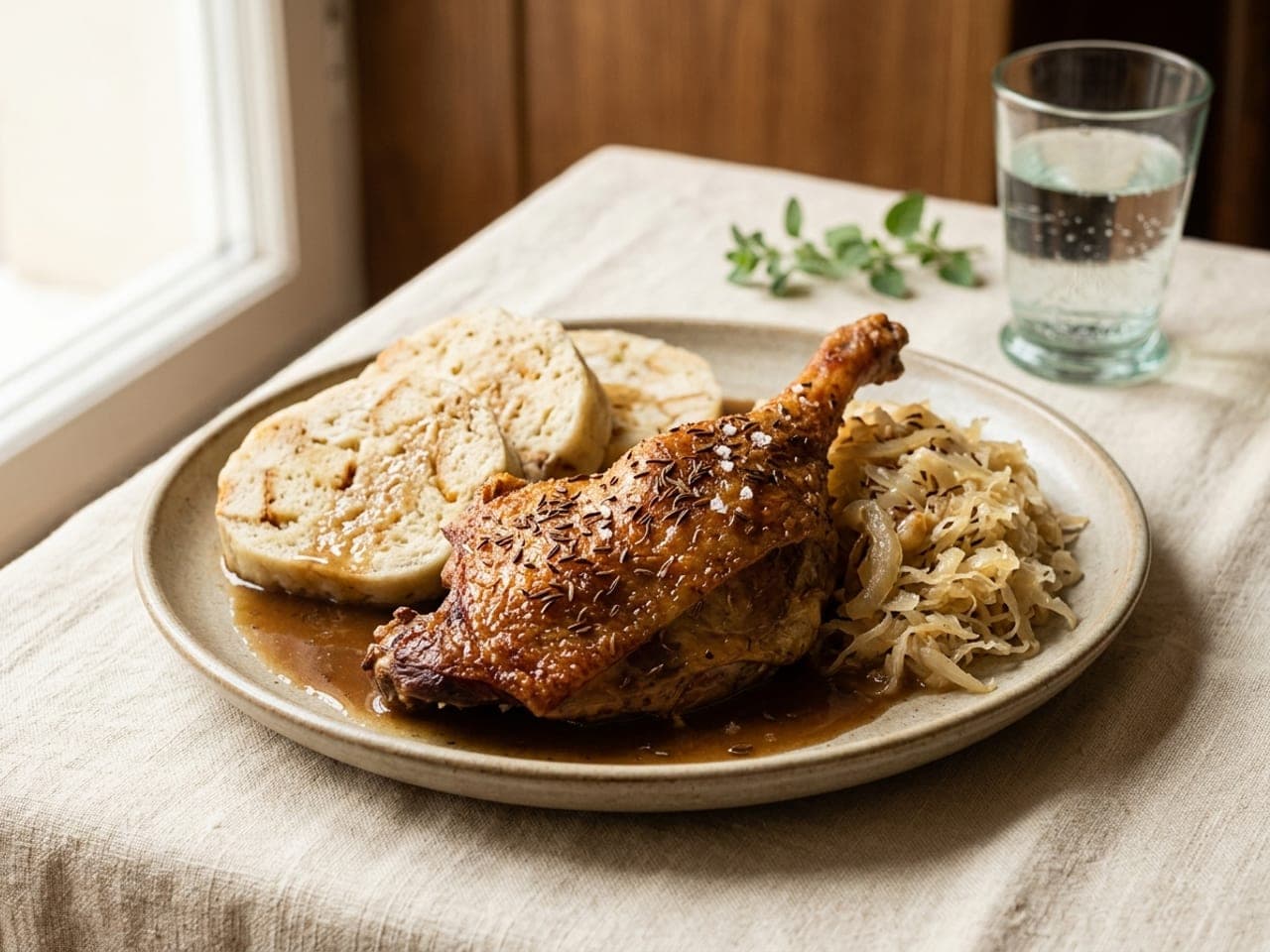
- Menu
- Beef broth with noodles; roast duck or roast goose; braised cabbage and bread dumplings; apple strudel.
- Buy
- USDA allows 1 to 1½ lb (450 to 680 g) of raw duck or goose a person: a 4.4 lb (2 kg) duck for four, an 8.8 lb (4 kg) goose for six (the recipes). For six, make the cabbage 1½ times (it serves four).
- Goose instead
- Oven on at 2:25 pm, goose in at 2:45 pm: 30 minutes at 425°F (220°C), about 2 hours at 340°F (170°C), ladling the fat out every 45 minutes, then a rest of 20 to 30. A goose is safe at 165°F (74°C) in the thigh (USDA); our recipe goes to 180°F (82°C) for tenderness. Raymond Blanc takes the breast out at 55°C and rests it 30 minutes, far below USDA’s figure.
- Ahead
- Broth the day before, chilled fast and brought back to a full boil. Dumplings steamed in the afternoon and re-steamed in slices; cool and refrigerate them within 2 hours if they wait longer than that.
- On the plate
- A leg or a fan of breast, three dumpling slices overlapping, cabbage in the gap, juices on the dumplings.
- Allergens
- Wheat, milk and egg (dumplings, strudel), walnuts in the strudel; the cabbage is cooked in lard, so it is not vegetarian.
Oven plan, dinner at 6:00 pm, duck
- MorningBake the strudel.
- 3:20 pmSalt the duck. Oven to 400°F (200°C), or 180°C with a fan.
- 3:40 pmDuck in, breast down, 45 minutes.
- 4:25 pmTurn it and ladle the hot fat out of the tin, with the tin on the stove top, never tipped. Oven up to 425°F (220°C, the recipe’s figure), 60 to 70 minutes more.
- 5:30 pmOut when the thigh reads 165°F (74°C), the recipe’s figure and USDA’s. Rest 15 minutes under foil while the cabbage finishes and the dumplings steam.
- 5:50 pmCarve.
- 6:00 pmServe.
- 7:30 pmLeftover duck in the fridge.
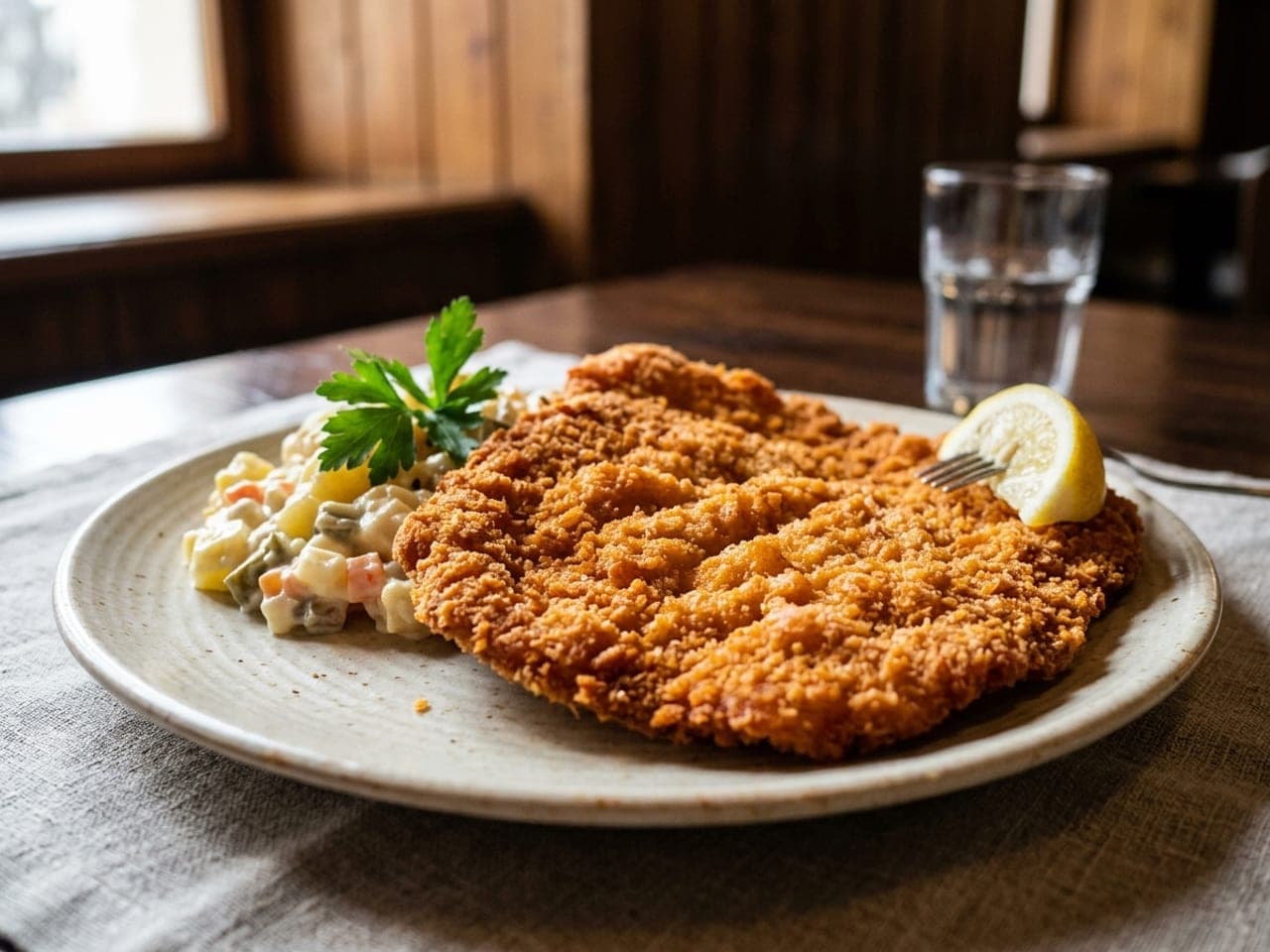
- Menu
- Open-faced sandwiches with drinks (our pick, not a Christmas Eve custom); fried breaded pork schnitzel with Czech potato salad and lemon; vánočka, the braided Christmas bread, with coffee.
- Buy
- The recipe cuts four escalopes of about 5 oz (150 g) each; add one a head for more. The salad serves six.
- Ahead
- The day before dinner, make the salad once the potatoes are fully cold and chill it overnight (the timeline dates it for a Christmas Day meal). Baking the vánočka the same day is our suggestion.
- Safety
- The salad goes back in the fridge within 2 hours. The recipe takes schnitzel to 70°C, above USDA’s 145°F (63°C) for pork. The sandwiches carry ham and salami, cold cured meats: see who should skip them.
- On the plate
- Schnitzel overlapping the rim side, a tight spoonful of salad, lemon wedge on the crumb.
- Allergens
- Wheat and egg (crumb, sandwiches, vánočka), egg and usually mustard (mayonnaise), milk (cheese on the sandwiches, vánočka), almonds (vánočka).
Stove plan, dinner at 6:00 pm
- 5:30 pmBread the pork.
- 5:40 pmFry two at a time, 3 to 4 minutes a side, laying each one into the oil away from you, with a lid within reach. For six, use two pans or start frying at 5:30 pm.
- 6:00 pmServe at once. The oven stays off.
- Menu
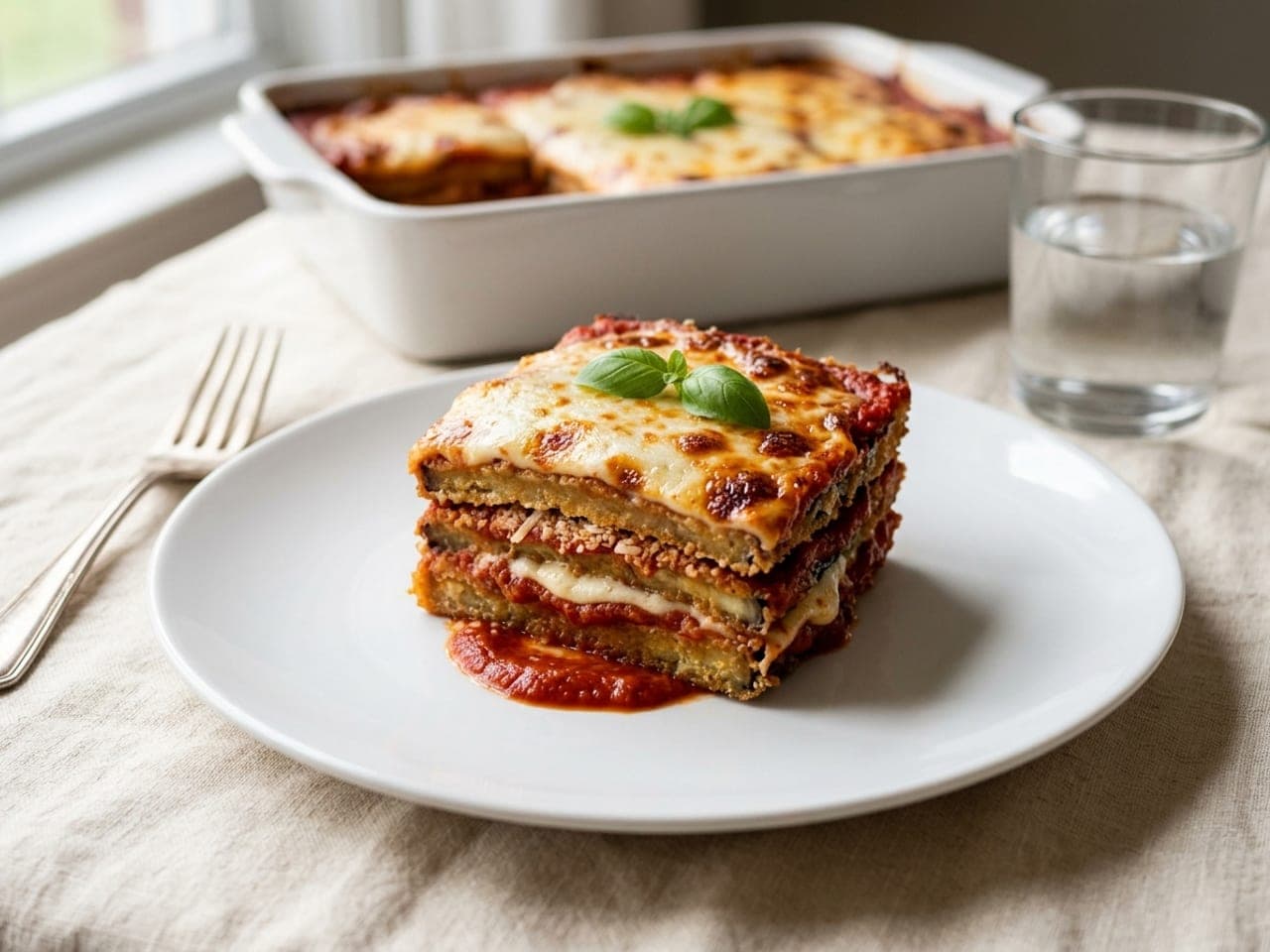
- An antipasto board (our board calculator counts 2 oz (57 g) each of cheese and cured meat a guest, and has a vegetarian switch); eggplant Parmesan with a green salad and bread; panna cotta, which is set with gelatin, so not vegetarian either.
- Buy
- One dish serves eight. Two for sixteen is our scaling: they run past 75 minutes, so swap the racks when you uncover them and go by the thermometer.
- Ahead
- Sauce up to 3 days before, slices fried a day before, the dish assembled up to 24 hours before it bakes (the recipe’s windows): from late afternoon on Christmas Eve. Panna cotta the day before.
- On the plate
- A clean square lifted with a spatula, a spoon of sauce beside it, basil on top.
- Allergens
- Milk, wheat and egg; mustard (salad dressing); cured meats on the board are a higher-risk food.
Oven plan, dinner at 6:00 pm
- 4:25 pmOven to 375°F (190°C).
- 4:40 pmThe cold, assembled dish in, covered, for 40 minutes.
- 5:20 pmUncover.
- 5:40 pm onOut when the center reads 165°F (74°C), by about 5:55 pm: 60 to 75 minutes from cold in all.
- 6:00 pmDress the salad and serve.
Lighter, smaller and bigger
- Menu
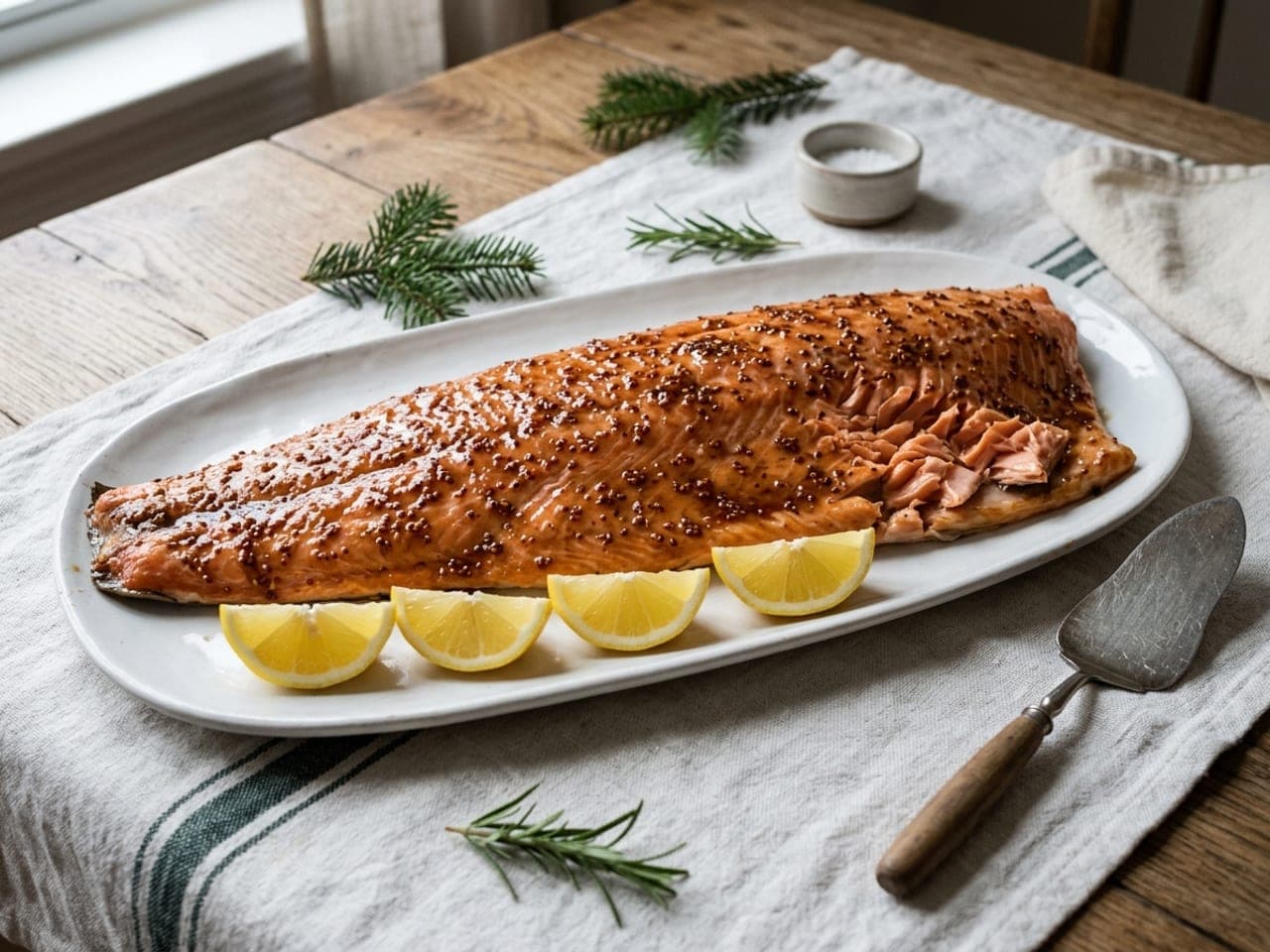
- Butternut squash soup; roast side of salmon (recipe below); boiled potatoes with butter and parsley, braised carrots and a green salad; lemon posset.
- Buy
- BBC Good Food’s 3.3 lb (1.5 kg) side serves six, about 9 oz (250 g) each (our arithmetic); make the potato and carrot recipes 1½ times (they serve four). Cut the side in two if it is longer than your tin.
- Ahead
- Soup no earlier than Tue 22 Dec (UK: Wed 23 Dec), by the Food Standards Agency’s 48-hour rule. Posset on Christmas Eve; glaze mixed in the morning.
- On the plate
- Bring the side to the table whole on a board or platter, lemon wedges down one edge, and cut across into portions.
- Allergens
- Fish, mustard (glaze, salad dressing), egg (salad dressing), milk (potatoes, carrots, posset, and the soup unless you make its vegan swap), wheat (the carrots are finished with flour).
Oven plan, main course at 6:30 pm
- 5:45 pmOven to 400°F (200°C), or 180°C with a fan. Soup on to reheat, to 165°F (74°C).
- 6:00 pmPotatoes on to boil, carrots on.
- 6:05 pmSalmon in, about 20 minutes. Soup served.
- 6:25 pmSalmon out when the thickest part reads 145°F (63°C), the US minimum for fish, and flakes easily.
- 6:30 pmServe.
- 8:25 pmLeftover fish in the fridge.
- Menu
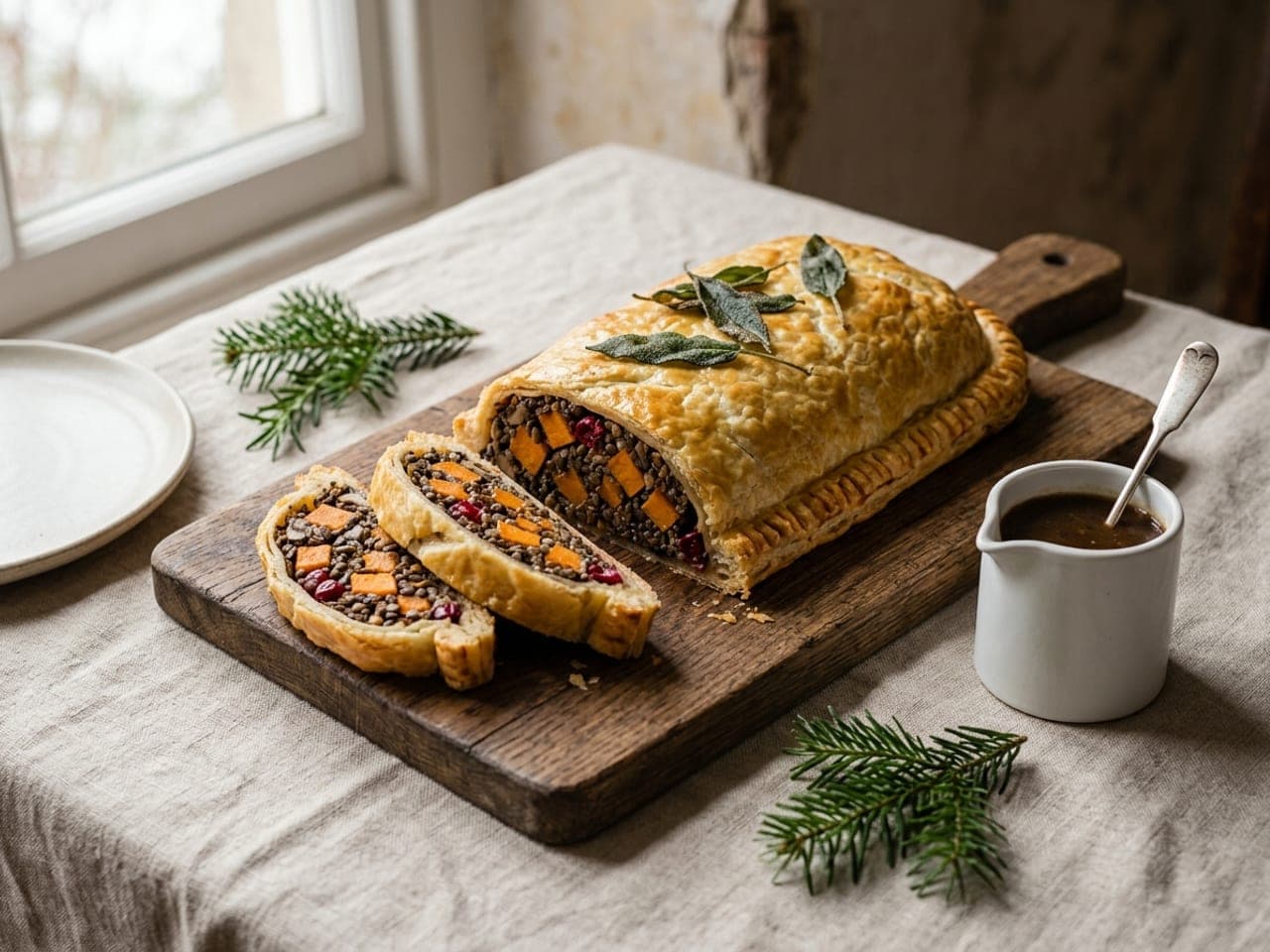
- Butternut squash soup; mushroom and sweet potato Wellington (recipe below) with mushroom gravy; scalloped potatoes, braised carrots and steamed Brussels sprouts; pecan pie.
- Buy
- One Wellington serves six; the pie serves eight and the potatoes ten, so there are seconds.
- Ahead
- The Wellington is assembled and chilled up to 2 days before (BBC Good Food): on the evening of Wed 23 Dec, or on Christmas Eve. Soup no earlier than Tue 22 Dec (UK: Wed 23 Dec). Pie baked and potatoes assembled on Christmas Eve afternoon.
- Vegetarian notes
- The Wellington itself is vegan with dairy-free pastry; if you add the optional Gruyère to the potatoes, use a cheese labeled vegetarian.
- On the plate
- One thick slice lying flat to show the filling, gravy beside it.
- Allergens
- Wheat, walnuts or pecans, mustard (Wellington), milk (potatoes, carrots, gravy, and the soup unless you make its vegan swap), egg, milk and pecans (pie).
Oven plan, dinner at 5:00 pm
- 3:10 pmOven to 400°F (200°C).
- 3:25 pmPotatoes in, covered, for 45 minutes.
- 4:00 pmWellington in on the other rack, 35 to 40 minutes.
- 4:10 pmUncover the potatoes, about 30 minutes more.
- 4:40 pmPotatoes out. Sage leaves onto the pastry, 10 minutes more. A full oven runs slow and the potatoes vent steam: give the pastry 5 minutes longer if it is pale (our note).
- 4:50 pmWellington out to rest 10 minutes.
- 5:00 pmServe.
- Menu
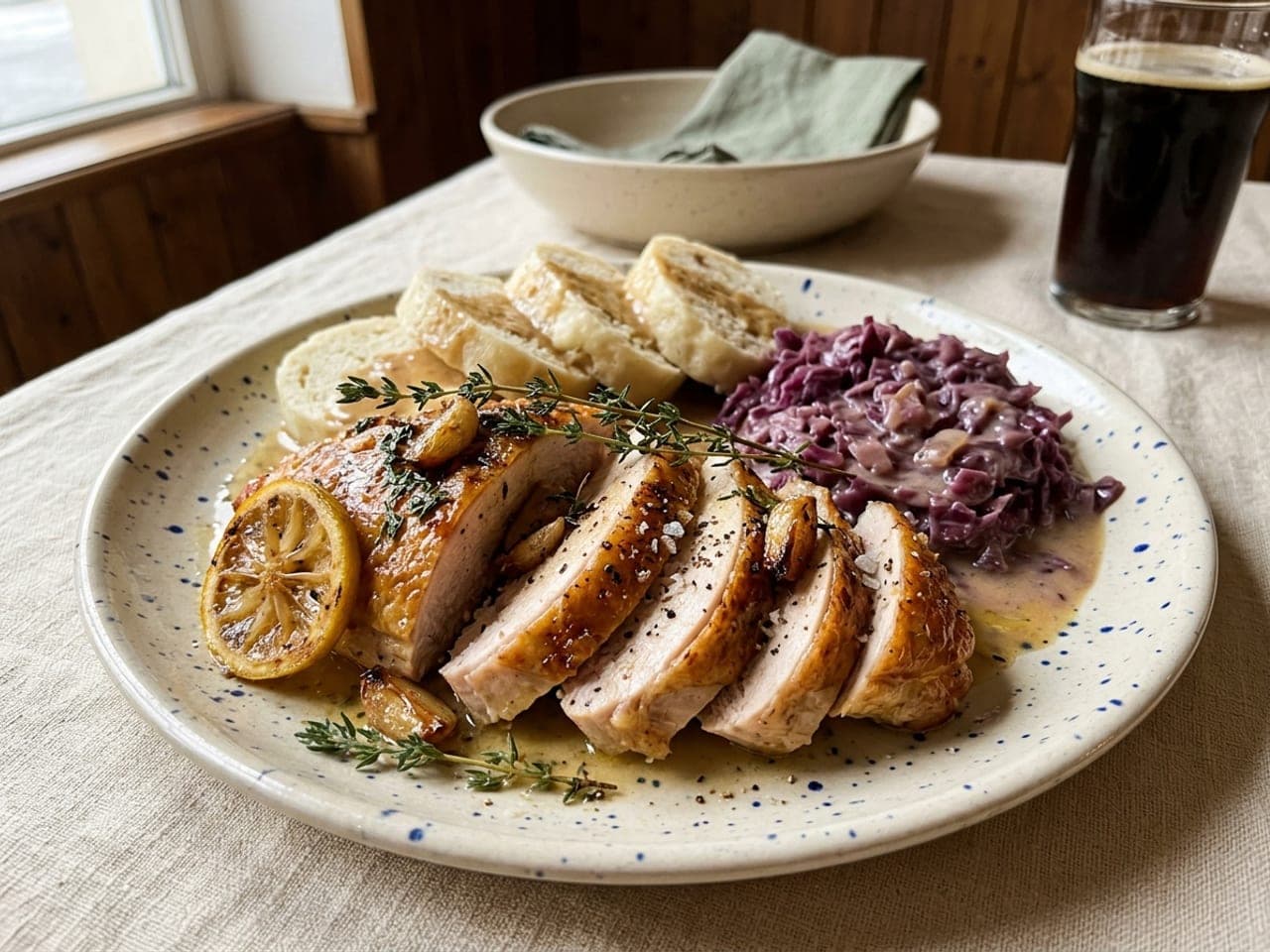
- Smoked salmon on toast (or not, for some guests); turkey breast with its pan juices; roast potatoes and steamed Brussels sprouts; crème brûlée.
- Buy
- The recipe’s 1.3 lb (600 g) breast serves four: dinner and tomorrow’s sandwiches. 1 lb (450 g) of potatoes (Delia’s 8 oz (225 g) each); smoked salmon at 2 to 3½ oz (50 to 100 g) a person, as BBC Good Food’s starters use.
- Ahead
- Bake the custards up to 2 days before; the recipe makes six, and the spares keep 3 to 4 days from baking. Caramelize two under the broiler (the overhead grill) just before serving.
- On the plate
- Three slices fanned, potatoes stacked behind, sprouts in a small pile, juices spooned over the meat.
- Allergens
- Milk (butter baste), fish (starter), wheat (toast), egg and milk (custard).
Oven plan, dinner at 6:00 pm
- 4:30 pmOven to 400°F (200°C) with the fat for the potatoes in it.
- 4:38 pmPotatoes on to steam, 10 minutes.
- 4:50 pmPotatoes into the hot fat, with the tin out on the stove top: 50 minutes to 1 hour.
- 5:10 pmSear the turkey 2 to 3 minutes a side.
- 5:15 pmTurkey in, 30 to 35 minutes.
- 5:50 pmTurkey out when the center reads 165°F (74°C), to rest 8 to 10 minutes. Sprouts steam 5 to 8 minutes. Potatoes out when golden.
- 6:00 pmSlice and serve.
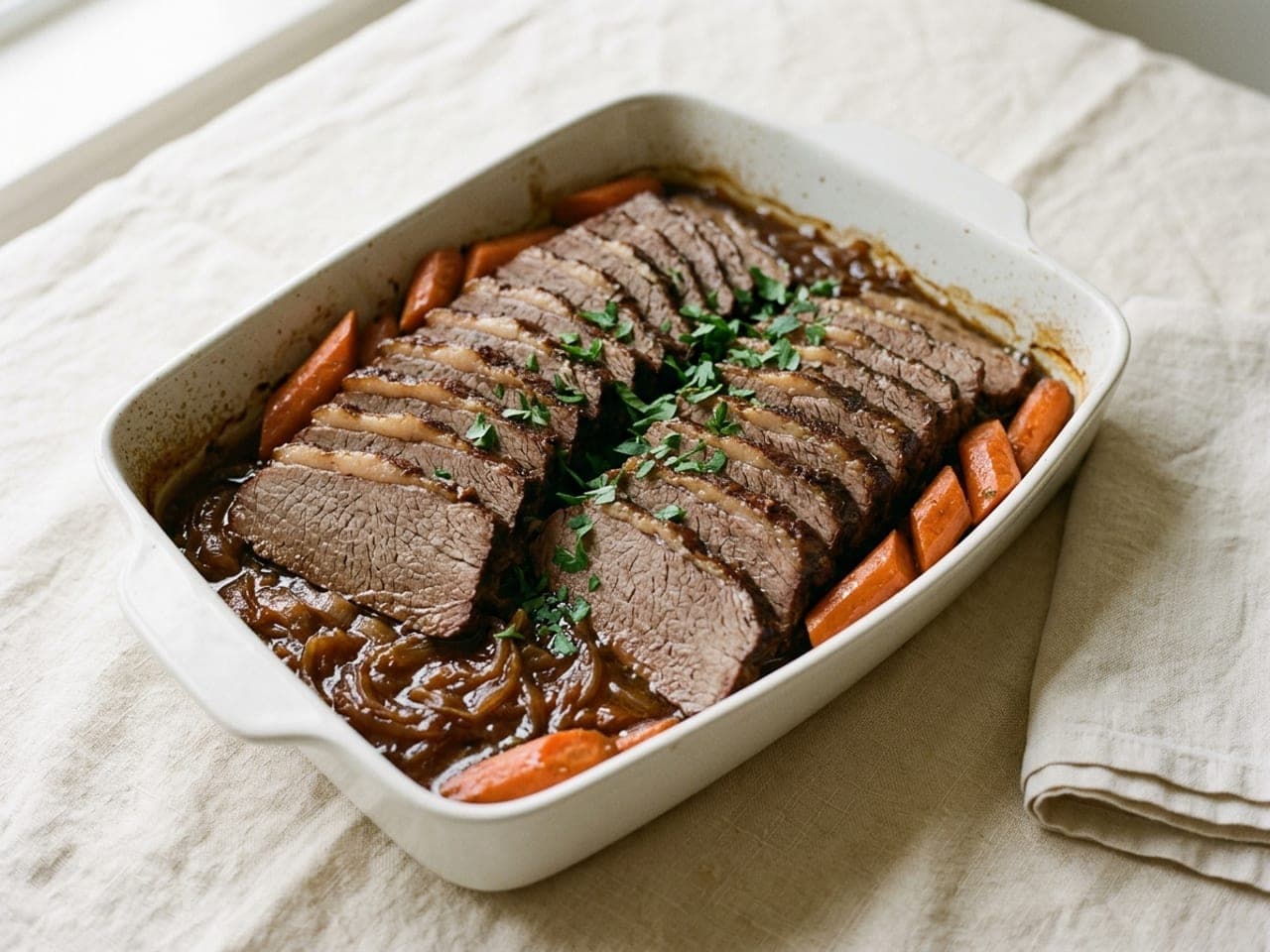
- Menu
- Butternut squash soup in cups; brisket in its onion sauce with horseradish; mashed potatoes, a green salad and dinner rolls; crème brûlée cheesecake.
- Buy
- One 5 lb (2.3 kg) brisket flat serves ten (the recipe); two for twenty is our scaling. A batch of soup serves ten at ¾ cup (180 ml): make two. Half a pound (227 g) of potatoes a guest; two batches of rolls for twenty; a second cheesecake beyond twelve.
- Ahead
- Braise the brisket Wed 23 Dec and cool it the recipe’s way: meat cut in pieces, liquid in shallow containers no deeper than 2 inches (5 cm), in the fridge within 2 hours, never whole in the pot. Slice it cold on Christmas Eve (it reheats up to 3 days after cooking, 2 in the UK). Cheesecake from Mon 21 Dec to Christmas Eve morning. Soup no earlier than Tue 22 Dec (UK: Wed 23 Dec). Rolls frozen up to 6 weeks before. Mash made on Christmas morning and kept hot, or the day before, cooled in shallow dishes within 2 hours and reheated once.
- Safety
- Two briskets and two batches of soup are a lot of hot food for one fridge: use shallow containers, leave space between them and check it stays at 40°F (4°C) or colder. On the day, hot dishes stay at 140°F (60°C) or above or go back in the fridge within 2 hours. The sauce contains red wine, and long cooking does not remove all of it (the numbers).
- On the plate
- Slices shingled in rows in the dish so it reads as the whole cut.
- Allergens
- Milk, wheat, egg; mustard (salad dressing); sulphites (wine); read the horseradish jar.
Oven plan (our order), buffet opens at 4:00 pm
- 1:55 pmOven to 425°F (218°C).
- 2:15 pmFirst sheet of frozen par-baked rolls in, 8 to 12 minutes. Rolls go first: they are safe at room temperature.
- 2:28 pmSecond sheet in.
- 2:40 pmRolls out and wrapped in a cloth. Oven down to 350°F (177°C).
- 2:55 pmFirst dish of sliced brisket in its sauce in, under parchment and foil.
- 3:30 pmMash reheated to 165°F (74°C) on the stove, then into a preheated slow cooker, which holds but does not reheat (USDA). Soup on.
- 3:40 pmSecond dish of brisket in. The first comes out when its center reads 165°F (74°C), usually after 30 to 45 minutes, and stays covered.
- 4:00 pmBuffet opens with the first dish.
- 4:30 pmSecond dish out at 165°F (74°C) to replace it.
The trimmings the menus share
The British sides the menus above lean on. Each follows one named published recipe, credited and linked; none has been kitchen-tested by us.
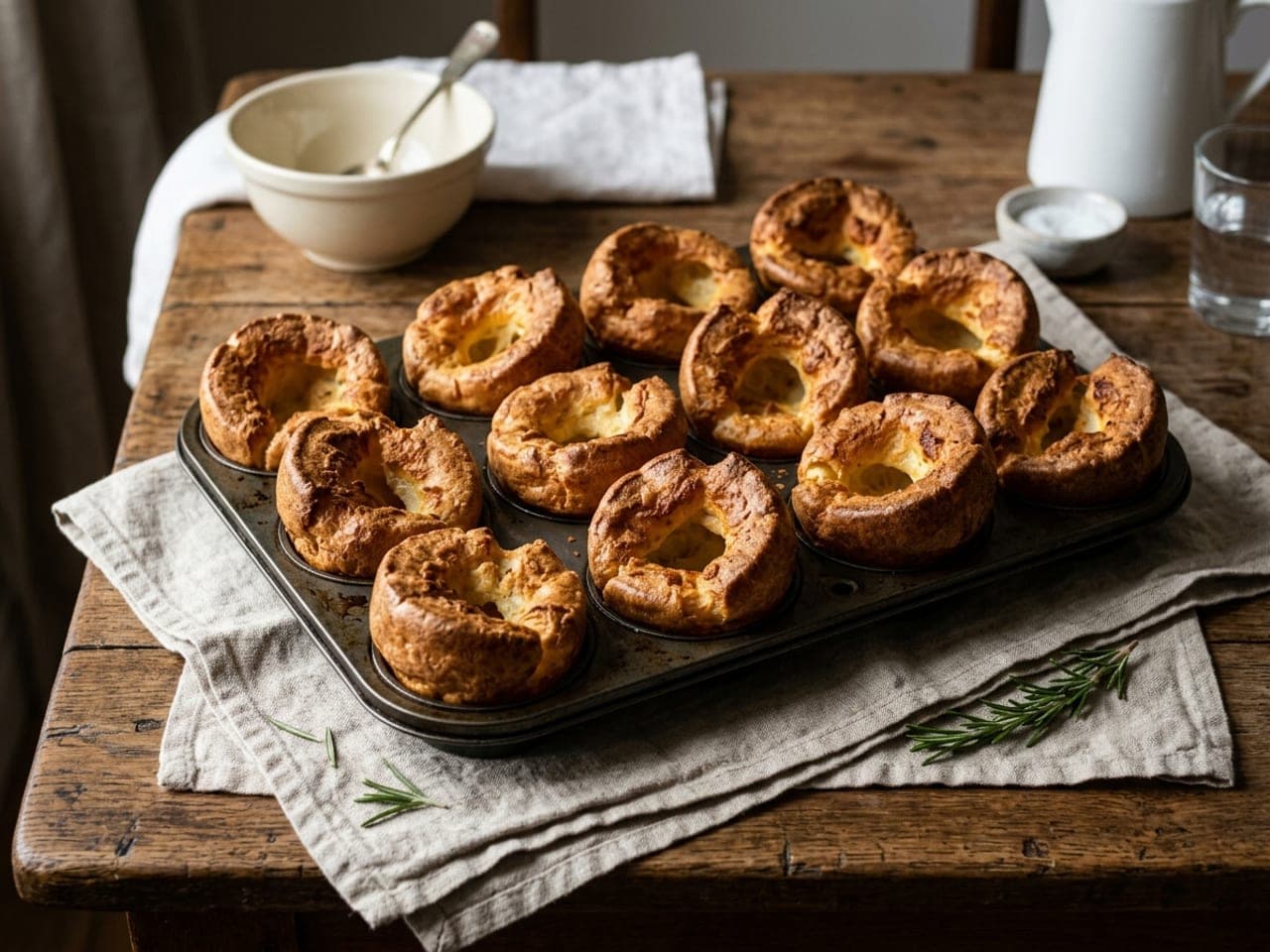
Yorkshire puddings
They bake at the top of the oven’s range, so they belong to the roast’s rest. BBC Food rests the batter up to 12 hours; Serious Eats rests its own up to 3 days. Allow 1 to 2 a person (Good Food magazine). Allergens: wheat, milk, egg. With beef dripping they are not vegetarian.
Quick recipe · For 6. After BBC Food’s Make-ahead Yorkshire pudding (Mike Robinson); not kitchen-tested by us. For 8, make one and a half times the batter (our scaling)
Ingredients
- 3 eggs
- 4 oz (115 g) flour and a pinch of salt
- ½ pint (275 ml) milk, the British measure the recipe prints
- Beef dripping (rendered beef fat) for the tin
Method
- Mix the eggs, flour and salt, then stir in the milk to a thin batter. Cover and rest in the fridge for up to 12 hours: for a 4:30 pm bake, mix it on Christmas morning.
- Put ½ inch (1 cm) of dripping in each hole of a muffin tin and heat it in the oven at 460°F (240°C), or 450°F (232°C), for about 10 minutes, until very hot.
- Pour in the batter, return the tin at once and bake 25 minutes, until golden and crisp, without opening the door for the first 20. Full recipe: BBC Food.
A tin of fat at 460°F (240°C) is the most dangerous thing in this dinner: clear the floor in front of the oven before you lift it out, and keep children away.
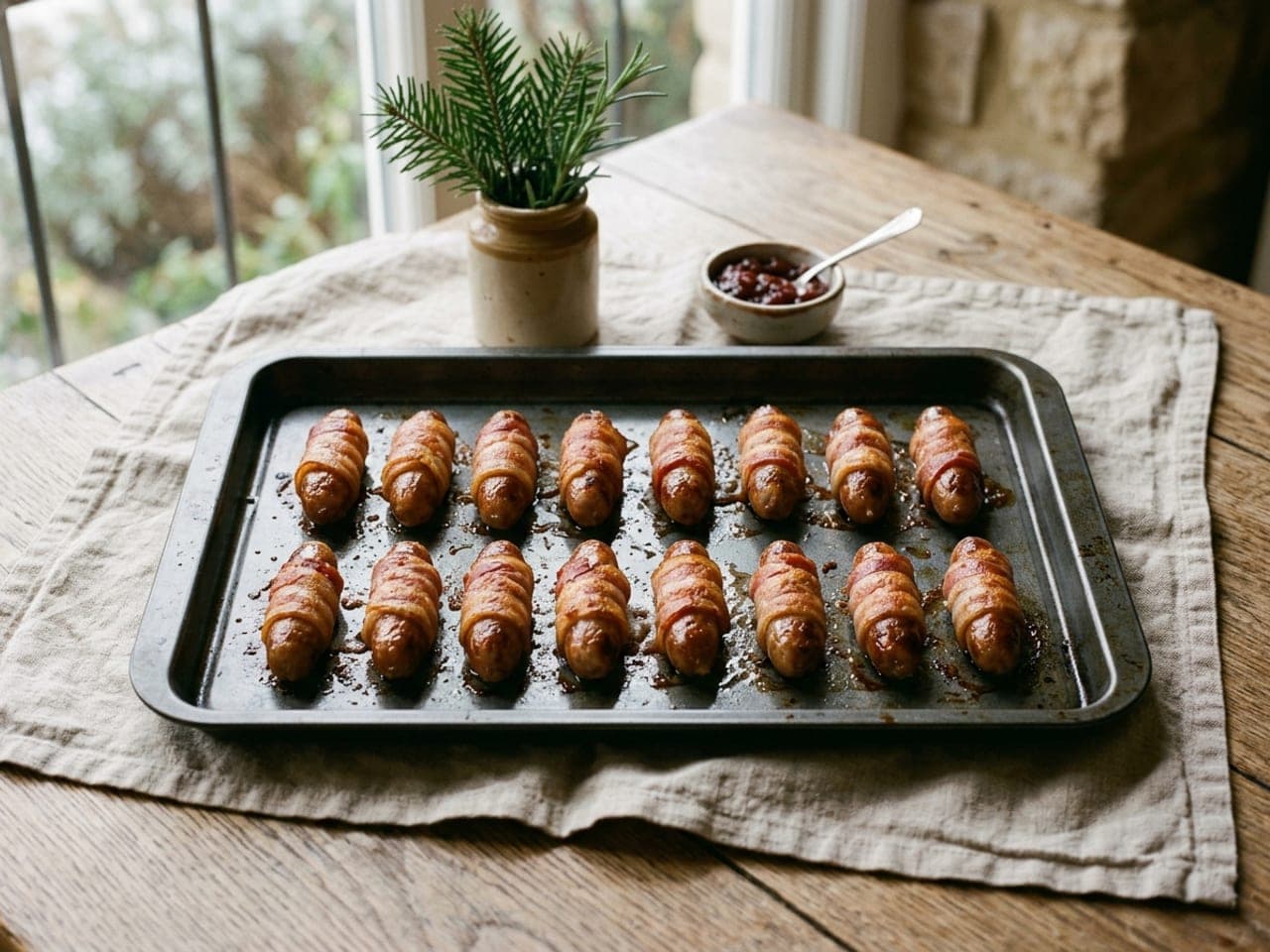
Pigs in blankets, the British kind
Small sausages wrapped in bacon, roasted beside the turkey at 375°F (190°C). Good Food magazine counts 2 a person; the Food Savvy campaign 2 to 3. Allergens: check the sausages for wheat and sulphites.
Quick recipe · 16, for 8 at two each. After BBC Good Food’s Classic pigs in blankets (Miriam Nice); not kitchen-tested by us
Ingredients
- 16 chipolatas (thin pork sausages)
- 8 slices smoked streaky bacon (regular American bacon)
- A baking tray
Method
- Heat the oven to 375°F (190°C), or 170°C with a fan. Cut each slice of bacon in half and wrap one piece around each sausage.
- Roast on a tray for 30 to 35 minutes, until golden. Full recipe: BBC Good Food.
Cook them right through: 160°F (71°C) in the middle of a sausage (USDA; the UK’s figure is 70°C held for 2 minutes), not just golden outside. They go in raw beside a nearly cooked bird: keep the tray clear of it and use separate tongs.
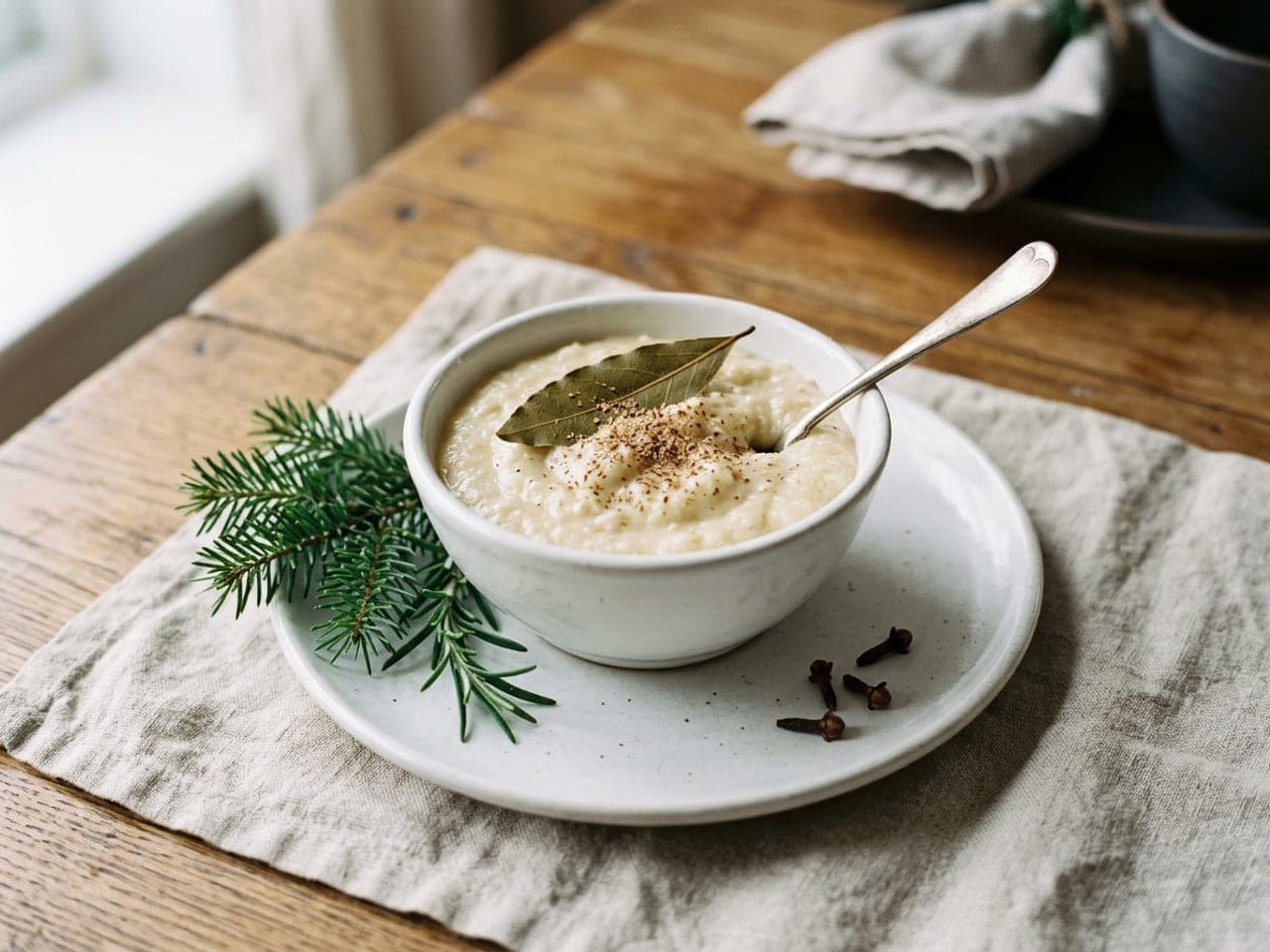
Bread sauce
The mild, clove-scented sauce the British put beside turkey. Delia’s method is same-day: the milk infuses for two hours while the turkey roasts; her site’s team says it also freezes, without the cream. Allergens: wheat, milk.
Quick recipe · For 8. After Delia Smith’s Traditional Bread Sauce, shortened; not kitchen-tested by us
Ingredients
- 1 large onion, halved, studded with 15 to 18 whole cloves (or use grated nutmeg)
- 1 pint (570 ml) whole milk: a British pint, about 2½ US cups
- 1 bay leaf and 8 black peppercorns
- 4 oz (110 g) fresh white breadcrumbs
- 2 oz (50 g) butter and 2 tbsp heavy cream (double cream)
Method
- Bring the milk just to a boil with the onion, bay and peppercorns, take it off the heat and leave it in a warm place to infuse for 2 hours (see the note below).
- Lift out the onion, bay and peppercorns and keep them. Stir in the breadcrumbs and half the butter and cook on a very low heat for about 15 minutes, until the crumbs swell and the sauce thickens. Delia then puts the onion back until the sauce is needed.
- Just before serving, take the onion out, reheat gently and beat in the rest of the butter and the cream. Full recipe: Delia Online.
Warm milk is on the 2-hour clock: keep the sauce at 140°F (60°C) or above, or make it late, and for an infusion longer than 2 hours use the fridge and bring the milk back to a simmer before the crumbs go in (our caution, not Delia’s).
How to fit a Christmas dinner into one oven
The roast’s rest is the free oven window, and how long it lasts depends on whom you ask.
| Main | Oven while it cooks | Rest in print | What the rest frees up |
|---|---|---|---|
| Whole turkey | 325°F (163°C), USDA’s floor, 3 to 3¾ hours for 12 to 14 lb (5.4 to 6.4 kg) | USDA 20 minutes; our recipe 30 to 45; Delia Smith 30 to 50; Serious Eats up to an hour | A hot oven for rolls or sprouts |
| Bone-in prime rib | 325°F (163°C), 3 to 4 hours to 145°F (63°C) for 8 lb (3.6 kg) (USDA); at 350°F (177°C), 2½ to 3 hours for 6 to 8 lb (2.7 to 3.6 kg) (the beef checkoff) | The beef checkoff 15 to 20 minutes; Serious Eats 30 to 90 under foil after its low-oven roast | Yorkshire puddings at 460°F (240°C) |
| Spiral ham | 325°F (163°C) under foil, 10 to 18 minutes per pound (USDA) | Serious Eats 15 minutes | Rolls. The potatoes reheat beside the ham |
| Beef tenderloin | 425°F (218°C), 35 to 60 minutes by size (USDA) | USDA 3 minutes minimum; Serious Eats about 15 for a conventional roast, 5 after its slow one | Ten minutes: the potatoes, baked first, go back in |
| Turkey crown (UK) | 375°F (190°C), about 2 hours for 5.5 lb (2.5 kg) (British Turkey, via BBC Good Food) | BBC Good Food 30 to 45 minutes | Roast potatoes finish at 400°F (200°C) |
| Duck or goose | Two stages, up to 425°F (220°C, the recipes’ figure) for duck | Duck 15 minutes, goose 20 to 30 (our recipes); BBC Good Food rests goose 30 | Little: the sides are on the stove |
Plan backward from the rest. Write down when the roast comes out, then give the rest to the one side that needs a hotter oven. Anything that bakes at the roast’s own temperature goes in beside it during its last hour; everything else moves to the stove, a slow cooker or the day before. Our limit is two dishes beside a roast, if both fit; our timeline tool allows one beside a turkey.
Check the fit. Try the empty tins in the cold oven the day before. Two tins side by side suit a 30 inch (76 cm) American range; in a 60 cm European oven a second dish rarely fits beside a whole turkey or a large ham, so bake that side in the rest or the day before.
A long rest is a quality claim, not a safety one. USDA’s 20 minutes for turkey is for carving quality; after it, its general rules apply: hot food stays at 140°F (60°C) or above, or is in the fridge within 2 hours. The longer rests in print come with no temperature data.
Racks. America’s Test Kitchen’s baking rule leaves space between pans and the oven walls and, with a pan on each rack, swaps and turns them halfway. LG says cooking on several racks may slightly increase cook times for some foods.
Fan ovens. The American convention sets a convection oven 25°F (14°C) lower (King Arthur Baking; LG’s ovens do it automatically, so don’t do it twice); the British one knocks off 36°F (20°C) (Nigella Lawson’s site, BBC Good Food).
Off the oven. Mashed potatoes hold in a preheated slow cooker if they go in hot (USDA: 165°F (74°C) first, then 140°F (60°C) or above). Gravy, vegetables, bread sauce and soup are stove jobs.
For a turkey dinner, a tool does this arithmetic. Our Thanksgiving timeline planner takes any dinner date: this link asks it for 25 December, a 14 lb (6.4 kg) bird and a dish beside the turkey (untick that box if yours will not fit). It plans turkey menus only.
How much food per guest
Named sources’ figures, with the arithmetic for eight.
| Food | Per adult | For 8 | Who says |
|---|---|---|---|
| Whole turkey | 1 lb (450 g); 1½ lb (680 g) with leftovers | 8 lb (3.6 kg); 12 lb (5.4 kg) | USDA FSIS; Food Network with leftovers |
| Bone-in prime rib | 1 lb (450 g), or ¾ lb (340 g) | 8 lb (3.6 kg), four ribs | Serious Eats prints both figures |
| Ham | ⅓ to ½ lb (150 to 225 g) bone-in; ¼ to ⅓ lb (115 to 150 g) boneless | 2⅔ to 4 lb (1.2 to 1.8 kg) bone-in | USDA FSIS |
| Beef tenderloin | 6 to 8 oz (170 to 225 g) | 3 to 4 lb (1.4 to 1.8 kg) | The Kitchn for the lower figure; Southern Living for the higher |
| Potatoes for mash | ½ lb (227 g) raw | 4 lb (1.8 kg) | Whole Foods Market; Melissa Clark says 5 to 6 oz (142 to 170 g) |
| Stuffing | ¾ cup (180 ml) cooked | 6 cups (1.4 l) | Food Network; Whole Foods Market |
| Gravy | ½ cup (120 ml) | 4 cups (950 ml) | Whole Foods Market; Good Housekeeping UK says at least 125 ml |
| Cranberry sauce | ⅓ to ½ cup (80 to 120 ml) in the US; about 1 oz (25 g) in the UK | Up to 4 cups (950 ml); a jar of at least 7 oz (200 g) | Food Network; Good Housekeeping UK |
| Vegetables | 4 oz (113 g) in total in the US; 8½ oz (240 g) raw across three in the UK | 2 lb (900 g); 4.2 lb (1.9 kg) | Food Network; BBC Good Food |
| Dinner rolls | 1½, by our division | 12 | Food Network prints 12 rolls for eight |
| Pie | One 9 inch (23 cm) pie feeds 6 to 8 | One, or two if it is the only dessert | Food Network; Melissa Clark |
| Wine with dinner | Half a 750 ml bottle | 4 bottles | Better Homes & Gardens; Whole Foods Market and Food Network print 2 to 3 for eight |
Children: Good Housekeeping UK allows five to ten-year-olds about two-thirds of an adult portion. Other counts: the party food calculator does amounts for any number of guests.
Pick a menu by guest count
Each menu is sized by its main.
| Guests | Menus that fit | Why |
|---|---|---|
| 2 | Christmas dinner for two | One small roast, one oven temperature, an hour |
| 4 | Roast duck; Czech Christmas Eve | One bird or four escalopes |
| 6 | British turkey crown; side of salmon; mushroom Wellington; beef tenderloin; a goose in the duck menu | Each main is sized for six by its source |
| 8 | Prime rib; Italian-American baked dinner; the British menu with a 6.6 lb (3 kg) crown | A four-rib roast or one baking dish serves eight |
| 10 to 12 | Roast turkey; glazed ham; a whole tenderloin | A 12 to 14 lb (5.4 to 6.4 kg) bird or one ham; each card lists what to double for twelve |
| 12 to 20 | The make-ahead menu; glazed ham with a larger ham and more of every side | Nothing is carved to order and the oven only reheats |
The make-ahead timeline for Christmas 2026
Christmas Day 2026 is a Friday. Where the US and UK rules differ, both are given.
Which standard? USDA allows 3 to 4 days, counted here from the day a dish was first cooked; the Food Standards Agency 48 hours, which the UK dates here apply (it has no make-ahead rule).
- Sun 22 Nov, Stir-up Sunday
- The traditional day to make a Christmas pudding. Nigella Lawson makes hers up to 6 weeks ahead; BBC Food at least a month.
- From mid-November: par-bake and freeze the dinner rolls (up to 6 weeks, King Arthur Baking). Yorkshire puddings freeze for up to 3 months (BBC Food, Serious Eats).
- Sat 19 Dec
- Cranberry sauce from today: BBC Good Food keeps its homemade sauce a week in the fridge.
- Sun 20 Dec
- US: a frozen 12 to 14 lb (5.4 to 6.4 kg) turkey goes into the fridge today, on a tray on the bottom shelf, below anything ready to eat: 3 to 4 days to thaw (USDA FSIS: 24 hours for every 4 to 5 lb (1.8 to 2.3 kg)), then up to 2 days thawed, the room for the recipe’s dry brine.
- The earliest day to buy a rib roast for salting tomorrow (USDA: a raw roast keeps 3 to 5 days), or go by its use-by date.
- Mon 21 Dec
- UK: the Food Standards Agency allows 10 to 12 hours per kg in the fridge and says to use defrosted food within 24 hours. A 5.4 to 6.4 kg bird goes in today, so the thaw finishes on Christmas Eve, and is dry-brined for one night only.
- Salt a rib roast from today (Serious Eats: up to four days ahead, uncovered on a rack), on the bottom shelf.
- Bake the crème brûlée cheesecake from today to Christmas Eve morning: it needs 6 hours to chill and keeps covered for 4 to 5 days.
- Tue 22 Dec
- The first day for the butternut squash soup in the US (it keeps 2 to 3 days); tomorrow in the UK.
- Wed 23 Dec
- Dry-brine the US turkey as soon as it has thawed: today, or tomorrow morning if there is still ice in the cavity.
- Bake crème brûlée custards. Braise the brisket and cool it the recipe’s way: meat in pieces, liquid in shallow containers no deeper than 2 inches (5 cm), in the fridge within 2 hours, never whole in the pot. Assemble the Wellington this evening or tomorrow: it keeps 2 days.
- Thu 24 Dec, Christmas Eve
- Bake the pecan pie and refrigerate it. In the afternoon, assemble the scalloped potatoes (up to 24 hours unbaked), or bake them and chill them within 2 hours: tomorrow’s reheat is their one reheat. From late afternoon, assemble the eggplant Parmesan (24 hours too).
- Make the Czech potato salad for a Christmas Day meal (a day earlier for a Christmas Eve one) and the mousse. Slice the cold brisket. Salt the tenderloin. Peel the roast potatoes and keep them whole under cold water (Nigella Lawson). Yorkshire batter waits until morning (BBC Food: up to 12 hours).
- Stuffing: prepare the dry and the wet parts and keep them apart until the dish goes into the oven (USDA FSIS).
- Set the table tonight: how to set a Christmas table.
- Fri 25 Dec, Christmas Day
- Follow your menu’s plan. It counts back from the main course, so move all its times together.
- The 2-hour clock for cooked food starts when the roast leaves the oven, not when dinner starts: each plan ends with its fridge time.
- Sat 26 Dec to Wed 30 Dec
- UK leftovers (Food Standards Agency): 48 hours from cooking, reheated once. Friday’s turkey, gravy and mash by Sun 27 Dec; anything baked on Christmas Eve by Sat 26 Dec; a dish made ahead and reheated on the day (brisket, soup, scalloped potatoes) has had its one reheat: eat it cold on Boxing Day, or bin it.
- US leftovers (USDA FSIS): 3 to 4 days, counted here from the day each dish was first cooked. Friday’s turkey and gravy to Mon 28 Dec or Tue 29 Dec (gravy first); the brisket braised on the 23rd to Sat 26 Dec or Sun 27 Dec; the soup sooner still. Spiral ham gets 3 to 5 days, to Wed 30 Dec. Or freeze them.
Food safety for a long Christmas meal
American and British advice differ in places, so each rule names its authority.
- The temperatures this page plans toUSDA’s minimums: 165°F (74°C) for turkey, duck, goose, stuffing and anything reheated; 145°F (63°C) with a 3-minute rest for whole cuts of beef, pork, lamb and fresh ham; 145°F (63°C) for fish; 140°F (60°C) for a fully cooked ham sealed at the plant. Roasting charts are planning times; the thermometer decides, read in the center of the thickest part, away from bone (the middle of a baked dish). In the UK the Food Standards Agency accepts 70°C held for 2 minutes, or 75°C for 30 seconds, for any food.
- Chef temperatures and low ovensSerious Eats pulls prime rib and tenderloin at 120 to 130°F (49 to 54°C), turkey breast at 150°F (66°C) and city ham at 120°F (49°C), and roasts beef and ham in ovens from 150 to 250°F (66 to 121°C). Each is below the USDA minimum, and USDA does not recommend roasting below 325°F (163°C). Our own turkey recipe takes the bird out before the breast reaches 165°F (74°C) and requires it to get there in the rest, or go back in.
- Two hours on the tableUSDA: nothing perishable sits out more than 2 hours, or 1 hour above 90°F (32°C), because bacteria grow fastest between 40 and 140°F (4 to 60°C). The UK’s agency says to cool and refrigerate cooked food within 1 to 2 hours; its community-event advice and Food Standards Scotland’s Christmas advice give chilled buffet food no longer than 4 hours out of the fridge.
- Holding food hotUSDA’s line is 140°F (60°C) or above; the FDA suggests an oven at 200 to 250°F (93 to 121°C) and warns that some warmers only reach 110 to 120°F (43 to 49°C), so check the product label. Britain’s 63°C is a legal rule for food businesses; the Food Standards Agency’s pages for home cooks give no hot-holding temperature.
- StuffingUSDA FSIS recommends baking it in a dish; inside a bird its center must reach 165°F (74°C), often after the meat is done. The Food Standards Agency says the same: a separate tin. Wet and dry ingredients are mixed just before cooking (how the sides hub handles it).
- Leftovers, by countryUnited States (USDA FSIS): into the fridge within 2 hours, in shallow containers; eat within 3 to 4 days, spiral ham within 3 to 5; reheat to 165°F (74°C) and bring gravy to a rolling boil. USDA’s pages disagree on gravy (its turkey pages say 3 to 4 days, a blog post of November 2009 says 1 to 2), so use it first. United Kingdom (Food Standards Agency): within 48 hours, reheated until steaming hot throughout, once only; defrosted leftovers within 24 hours.
- Hot food and the fridgeThe two countries give opposite instructions. USDA and the CDC say hot food can go straight into the refrigerator; the Food Standards Agency says to cool it at room temperature first. Either way, divide big pots and roasts. The CDC says most outbreaks of Clostridium perfringens food poisoning happen in November and December, many of them linked to turkey and roast beef, and most often to food cooked in large batches and held at unsafe temperatures.
- Don’t wash the turkeyUSDA and the Food Standards Agency agree: in USDA’s 2019 study, 60 percent of people who rinsed raw poultry had bacteria in the sink afterward.
- Alcohol stays in the foodUSDA’s nutrient retention table keeps 75 percent of the alcohol in a flamed dish, 70 percent in an uncooked one left overnight (brandy butter), 40 percent after 15 minutes of simmering and 5 percent after two and a half hours. Offer children, pregnant guests and anyone who avoids alcohol a version without it.
- AllergensThe US names 9 major allergens (sesame since 1 January 2023) and UK law 14, adding celery, mustard, sulphites, lupin and molluscs, which turn up in stock, glazes, wine and dried fruit. Cooking does not remove an allergen: the Food Standards Agency tells hosts to ask guests beforehand, keep the packets and never just lift the food off the plate.
Guests who need a different plate
For pregnant guests, older adults, young children and anyone with a weakened immune system.
- Rare beefMedium-rare prime rib and tenderloin are below USDA’s 145°F (63°C) minimum, which the CDC repeats for adults 65 and older. For these guests, roast the meat to 145°F (63°C), or cook their slices on in a hot pan to 145°F (63°C) on a thermometer; do not judge by color or count on end slices. Or choose a menu that is cooked through: turkey, ham or brisket. Read the label too: a roast marked mechanically, blade or needle tenderized has had its surface pushed inside, and USDA says to cook it to 145°F (63°C) with a 3-minute rest, for everyone. The NHS pregnancy page, as read on 8 October 2026, counts whole cuts of beef “thoroughly cooked on the outside” as safe and requires rolled joints to be cooked right through.
- Raw-egg desserts and eggnogMousse, tiramisu and homemade eggnog are often made with raw egg; the chocolate mousse on the tenderloin menu is one, with rum. US: the FDA says to use pasteurized eggs for anything served raw or lightly cooked and to cook an eggnog base to 160°F (71°C); University of Minnesota Extension adds that alcohol cannot be relied on to kill bacteria in raw egg. UK: since October 2017 the Food Standards Agency has said that British Lion eggs can be eaten raw by pregnant women, children and older people, but not by the severely immunocompromised. Safe under one country’s rule is not automatically safe under the other’s.
- Cold-smoked fishOn 27 July 2023 the Food Standards Agency and Food Standards Scotland advised pregnant women and people with weakened immune systems to avoid ready-to-eat cold-smoked or cured fish, such as smoked salmon, unless it is cooked until steaming hot, and repeated it in December 2024; older people are asked to be aware of the risk. The FDA lists refrigerated smoked seafood as higher-risk for the same groups.
- Pâté, cured meats and soft cheeseThe FDA lists refrigerated pâté as a high-risk food for these groups. The NHS says to avoid liver products (so liver pâté) in pregnancy and to cook cold cured meats such as salami and prosciutto, and brie, camembert and soft blue cheeses, until steaming hot. The CDC’s version: no unheated deli meat, cold cuts or fermented or dry sausages such as salami for pregnant women, people 65 or older or people with weakened immunity.
- Goose and gameThe NHS pregnancy list groups goose with game meats to avoid, because game may contain lead.
- Small childrenFor under-fives, cut sausages lengthwise into strips, not coins, keep nuts off their plates (the NHS says no whole nuts under 5; the CDC lists nuts, sausages and bones as choking hazards) and check fish and poultry for bones. No honey for babies under 1 (NHS): the salmon glaze has it. A coin or charm in a pudding is a choking hazard at any age (our caution).
Where the Christmas dinner traditions come from
What named sources support, in brief.
- Goose, then turkeyIn A Christmas Carol (1843) the Cratchits’ dinner is a goose; the turkey is the gift Scrooge sends on Christmas morning. Turkey was on English Christmas tables by 1573 (Thomas Tusser, as quoted by Lauritsen and colleagues), but published accounts put its takeover from goose between the 1930s (BBC Future) and the 1950s (the Museum of English Rural Life).
- HamThe story that Christmas ham descends from a Norse Yule boar rests on two Old Norse passages about swearing oaths on a sacrificial boar; neither mentions ham. Spiral slicing was patented by Harry Hoenselaar of Detroit (filed 1944, granted 1952); USDA’s page dates the invention to 1957.
- The Feast of the Seven FishesItalian-American, from southern Italian Christmas Eve abstinence from meat. Britannica says the name is believed to be exclusively Italian-American and first appears in print in the 1980s; in Italy the meal is the cena della Vigilia. An anthropologist who studies the feast says the reasons for seven are unknown.
- Carp and potato saladRadio Prague International describes the Czech Christmas Eve meal as carp fried in breadcrumbs with potato salad; carp became its center in the 19th century. Some families prefer schnitzel, and roast duck is a favorite on Christmas Day (the same broadcaster).
- Christmas puddingIts ancestor is the plum pottage of the early 15th century (The Field, citing the Oxford Companion to Food). A recipe headed “Boiled plum or Christmas pudding” was in print by 1828, in Elizabeth Hammond’s Modern Domestic Cookery. Stir-up Sunday, the last Sunday before Advent, falls on 22 November in 2026.
See your Christmas main re-plated first
Photograph a trial run of the dish you are planning and Plate Artists shows it re-plated on a plate from its library, with the moves to get there. Your first re-plate is free with an account.
Start free · 1 enhancement →Free account · 1 free enhancement · No credit card
Christmas dinner questions, answered
What is a traditional Christmas dinner menu?
In the United States, a ham, a turkey or a rib roast with potatoes, a green vegetable, rolls and pie: on the menu pages we read, ham and turkey appeared most often, then prime rib; beef tenderloin, baked pasta and pork roasts were on about half. The British one here is turkey with roast potatoes, sprouts, pigs in blankets, gravy and Christmas pudding. See the roast turkey, glazed ham, prime rib and British menus.
What can I make for Christmas dinner besides ham and turkey?
Beef is the usual answer: prime rib or tenderloin. Beyond that, a roast duck, a side of salmon, a mushroom Wellington, an Italian-American baked dish, schnitzel with potato salad or a make-ahead brisket.
What goes with a ham dinner for Christmas?
Scalloped potatoes are the classic partner because a dish baked the day before reheats at the ham’s own 325°F (163°C). Add a green vegetable cooked on the stove, a salad, rolls and a pie baked the day before. The glazed ham menu has the timings.
What if I don’t have a lot of oven space for my Christmas dinner?
Use the roast’s rest: most roasts wait 15 to 45 minutes under foil, and that is when rolls, Yorkshire puddings or potatoes get a hot oven (the one-oven table). The schnitzel, salmon and make-ahead menus barely use the oven at all.
How much food should I make for Christmas dinner?
Per adult: 1 lb (450 g) of whole turkey or bone-in rib roast, ⅓ to ½ lb (150 to 225 g) of bone-in ham, half a pound (227 g) of potatoes, ¾ cup (180 ml) of stuffing, ½ cup (120 ml) of gravy and 1½ rolls. The amounts table has every figure, its source and the sum for eight.
What can you cook ahead of time for Christmas dinner?
Cranberry sauce a week ahead; soup, braises and baked custards two to three days; pie, scalloped potatoes, potato salad and an assembled baked dish the day before; rolls par-baked and frozen weeks ahead. Not stuffing: USDA keeps its wet and dry parts apart until it bakes. The timeline dates each one.
What should I make for Christmas Eve dinner?
Something that leaves the oven free for the next day. The Czech schnitzel and potato salad uses no oven, the baked eggplant Parmesan is assembled a day ahead, and the side of salmon takes 20 minutes.
How do you make Christmas dinner for two special?
Keep the traditional plate and shrink the roast: a turkey breast, roast potatoes and sprouts share one oven at 400°F (200°C) for an hour, and two crème brûlées made ahead are caramelized just before serving. The menu for two has the times.
How long should a turkey rest, and what do I do with the oven?
Our roast turkey recipe rests the bird 30 to 45 minutes; USDA’s figure is 20 minutes, for quality, and other published rests run up to an hour. Frozen par-baked rolls fit in it: 8 to 12 minutes at 425°F (218°C).
How long can Christmas dinner sit out?
In the US, 2 hours from when the food leaves the oven or the fridge (USDA): put dishes away between courses. The UK’s Food Standards Agency says to refrigerate cooked food within 1 to 2 hours; chilled buffet food gets up to 4 hours out of the fridge.
How long do Christmas leftovers last?
In the US, 3 to 4 days in the fridge for turkey, beef, sides and gravy and 3 to 5 for spiral ham (USDA), reheated to 165°F (74°C). In the UK, the Food Standards Agency says 48 hours, reheated once. We count from the day each dish was first cooked.
Is there still alcohol in a flamed Christmas pudding or a wine gravy?
Yes. USDA’s retention table leaves 75 percent of the alcohol in a flamed dish and 40 percent after 15 minutes of simmering; even two and a half hours of cooking leaves 5 percent. Serve guests who avoid alcohol a version made without it.
The research behind this guide
Agencies, publications and recipes named in the text:
- USDA FSIS, Roasting those “other” holiday meats (oven times; 145°F and a 3-minute rest; no ovens below 325°F; charts are approximate)
- USDA FSIS, Hams and food safety (portions; 325°F; 140°F and 165°F; spiral ham timing; can be served cold; “invented in 1957”; 3 to 5 days)
- USDA FSIS, Let’s talk turkey: a consumer guide to safely roasting a turkey (1 pound per person; 325°F timetable; 165°F; 20-minute rest; thawed bird 1 to 2 days; stuffing)
- USDA FSIS, Turkey basics: safe thawing (24 hours for each 4 to 5 pounds)
- USDA FSIS, Duck and goose from farm to table (1 to 1½ pounds per person; 165°F)
- USDA FSIS, Safe minimum internal temperature chart (fish 145°F; ground meats and sausage 160°F)
- USDA FSIS, Mechanically tenderized beef (145°F and a 3-minute rest; check the label)
- FoodSafety.gov, Cold food storage chart (fresh beef roasts 3 to 5 days)
- USDA FSIS, Stuffing and food safety (cook separately; do not mix ahead)
- USDA FSIS, Danger zone (40°F to 140°F; 2 hours, 1 hour above 90°F)
- USDA FSIS, Leftovers and food safety (3 to 4 days; shallow containers; 165°F; rolling boil; hot food into the fridge)
- USDA FSIS, Slow cookers and food safety (reheat first, then hold at 140°F)
- USDA FSIS, Turkey from farm to table (gravy 3 to 4 days)
- USDA blog, Happy Leftovers Day! (27 November 2009: gravy within one to two days)
- USDA press release, Washing raw poultry: our science, your choice (20 August 2019)
- USDA Table of Nutrient Retention Factors, Release 6 (2007): alcohol retention
- FDA, Serving up safe buffets (oven at 200 to 250°F; warmers at 110 to 120°F)
- FDA, What you need to know about preventing Listeria infections (smoked seafood, pâté)
- FDA, What you need to know about egg safety (pasteurized eggs for raw dishes)
- FDA, Holiday goodies (Food safety for moms-to-be: eggnog base to 160°F)
- FDA, The FASTER Act: sesame is the ninth major food allergen
- University of Minnesota Extension, Making homemade egg nog that’s safe (alcohol “cannot be relied upon to kill bacteria”; Internet Archive copy of 18 November 2025, the live page has since been replaced)
- CDC, About C. perfringens food poisoning (November and December; turkey and roast beef)
- CDC, Preparing your holiday turkey safely (no need to cool food before refrigerating)
- CDC, Preventing Listeria infection (unheated deli meat, cold cuts, fermented or dry sausages; higher-risk groups)
- CDC, Choking hazards (nuts, sausages, bones in meat or fish)
- CDC, Safer food choices for adults 65 and older (145°F and a 3-minute rest)
- Food Standards Agency, Christmas food hygiene (GOV.UK, read 8 October 2026: thawing, stuffing, washing, cooling within 1 to 2 hours)
- Food Standards Agency, Cooking your food (GOV.UK: 70°C for 2 minutes; leftovers within 48 hours; reheat once)
- Food Standards Agency, How to chill, freeze and defrost food safely (GOV.UK: use defrosted food within 24 hours; four hours; raw meat on the bottom shelf; do not put hot food in the fridge)
- Food Standards Agency, Providing food at community and charity events (GOV.UK: chilled buffet food out no more than four hours)
- Food Standards Scotland, Christmas food safety (buffet: chilled foods out no longer than four hours)
- Food Standards Agency, Home food fact checker (GOV.UK: British Lion and Laid in Britain eggs; reheating)
- Food Standards Agency, New advice on eating runny eggs (press release of 11 October 2017, copy at Wired-Gov)
- GOV.UK, Food hygiene for your business: cooking (hot food kept at or above 63°C is a business rule)
- Food Standards Scotland and Food Standards Agency, updated advice on ready-to-eat cold-smoked and cured fish (27 July 2023)
- Food Standards Scotland and Food Standards Agency, reminder on cold-smoked and cured fish (2 December 2024)
- Food Standards Agency, Food allergy and intolerance advice for consumers (GOV.UK: the 14 allergens; eating in and preparing an allergy-safe meal)
- NHS, Foods to avoid in pregnancy (read 8 October 2026)
- NHS, Foods to avoid giving babies and young children (no whole nuts under 5; no honey under 1)
- Beef. It’s What’s For Dinner (the beef checkoff), Oven roasting time guidelines (350°F ribeye roast table)
- Beef. It’s What’s For Dinner (the beef checkoff), Determining doneness (rises 5 to 15°F out of the oven; 15 to 20 minutes standing time)
- Serious Eats, Roasted and reverse seared prime rib (J. Kenji López-Alt: buying, salting ahead, oven from 150°F, pull temperatures, resting under foil)
- Serious Eats, Slow-roasted beef tenderloin (J. Kenji López-Alt)
- Serious Eats, Maple-glazed spiral ham (15-minute rest; 120°F pull)
- Serious Eats, The best simple roast turkey with gravy (breast to 150°F; 300°F oven)
- Serious Eats, Make Thanksgiving easier: 8 classic sides you can prep days in advance (Robin Shreeves, 11 November 2025: a turkey can rest up to an hour)
- Serious Eats, The best Yorkshire pudding (batter rested overnight or up to 3 days)
- America’s Test Kitchen, Classic roast beef tenderloin for a crowd (salted at least 12 hours or up to 24)
- America’s Test Kitchen, Staggering and rotating during baking
- America’s Test Kitchen, Baking basics: oven placement
- LG, Understanding convection cooking (automatic 25°F reduction; multi-rack cooking may slightly increase cook times)
- King Arthur Baking, Convection oven vs. traditional oven
- King Arthur Baking, Homemade brown and serve rolls (frozen up to 6 weeks; baked from frozen at 425°F for 8 to 12 minutes)
- Nigella.com, How do you work out the fan oven conversions?
- Nigella.com, Perfect roast potatoes (peel the day before)
- Nigella.com, Ultimate Christmas pudding (up to 6 weeks ahead)
- BBC Good Food, The foolproof turkey guide (a 2 to 2.5 kg crown feeds six; British Turkey’s crown timings; resting 30 to 45 minutes)
- BBC Good Food, Christmas portion planner (a 2 to 2.5 kg crown for six; cooked turkey per person; 240 g of vegetables)
- Good Food magazine, December 2023, Portion planner (pigs in blankets, Yorkshire puddings)
- BBC Good Food, Conversion guides (fan oven temperatures)
- BBC Good Food, How to roast a goose (resting 30 minutes)
- BBC Good Food, Raymond’s roast goose (breast to 55°C, then rested 30 minutes)
- BBC Good Food, Spiced roast side of salmon (Roopa Gulati)
- BBC Good Food, Easy vegan wellington (Anna Glover)
- BBC Good Food, Classic pigs in blankets (Miriam Nice)
- BBC Good Food, Really simple cranberry sauce (keeps 1 week)
- BBC Good Food, Scandi smoked salmon (200 g for four)
- BBC Good Food, Smoked salmon carpaccio (400 g for four)
- BBC Food, Make-ahead Yorkshire pudding (Mike Robinson)
- BBC Food, How to make Christmas pudding (at least a month ahead)
- Delia Online, Perfect roast potatoes
- Delia Online, Traditional bread sauce (and her team’s answer on freezing it without the cream)
- Delia Online, Brussels sprouts (steam 5 to 8 minutes)
- Delia Online, Roast turkey with American apricot stuffing (rest 30 to 50 minutes)
- Good Housekeeping UK, How to feed a crowd at Christmas (per-person amounts; a 200 g jar of cranberry sauce for eight; children two-thirds)
- Food Savvy, Portion Christmas like a pro (2 to 3 pigs in blankets)
- Food Network Kitchen, Thanksgiving dinner portion planner (1½ pounds of turkey with leftovers; 12 rolls for eight)
- Whole Foods Market, Holiday servings calculator
- TODAY, How much food should you cook for Thanksgiving? (Melissa Clark)
- Better Homes & Gardens, party drinks chart (one bottle per two guests)
- Southern Living, How much prime rib to buy for your holiday dinner (one rib for every two diners)
- The Kitchn, Here’s exactly how much beef tenderloin to buy per person (6 ounces)
- Southern Living, How much beef tenderloin per person to buy for your dinner (8 ounces)
- Charles Dickens, A Christmas Carol (1843), Staves Three and Five (Project Gutenberg)
- BBC Future, How the turkey conquered Christmas (Zaria Gorvett, 17 December 2021)
- Museum of English Rural Life, Why do we eat turkey at Christmas? (19 December 2022)
- Lauritsen, M., et al. (2018), Celebrating Easter, Christmas and their associated alien fauna, World Archaeology 50(2): quotes Tusser’s list from an 1812 reprint
- Wikipedia, Sonargöltr (two Old Norse passages on the oath boar; neither mentions ham)
- US Patent 2,599,328, H. J. Hoenselaar, ham slicing machine (filed 1944, granted 3 June 1952)
- Encyclopaedia Britannica, Feast of the Seven Fishes (Rebecca M. Kulik, 30 October 2024)
- Michael A. Di Giovine, West Chester University, research on the Feast of the Seven Fishes
- Radio Prague International, Why do Czechs only eat carp at Christmas? (Vít Pohanka, 25 December 2021)
- Radio Prague International, The carp’s journey from the fishpond to the Christmas table (Daniela Lazarová, 1 December 2018)
- Radio Prague International, Czech Christmas traditions explained, from Ježíšek to the Golden Pig (Brian Kenety, 24 December 2018): schnitzel; roast duck
- The Field, Stir-Up Sunday: stir up, we beseech thee (Ettie Neil-Gallacher, 21 November 2024)
- Elizabeth Hammond, Modern Domestic Cookery, and Useful Receipt Book (Internet Archive scan with an 1828 title page): “Boiled plum or Christmas pudding”
- BBC Good Food, Everything you need for Stir-up Sunday (the last Sunday before Advent)
Keep going
How to set a Christmas table
Seats per table, the American and British place settings, crackers, candles and a timeline to dinner.
Side dishes, planned around one oven
Twenty-one sides sorted by where they cook, written for Thanksgiving and just as true in December.
Fancy desserts for a dinner party
Desserts sorted by how much work is left once guests sit down.
Course meal builder
Build a 3 to 12-course meal and choose a dish from our recipes for each course, with a cooking plan and a menu card.